




Abstract
Theoretical perspectives, and a large body of empirical research examining sex-segregated occupations, identify the attitudinal barriers of the majority as pivotal for both workplace well-being and the retention of minorities. Globally, where more than 90% of the early childhood education and care workforce is female, understanding the attitudes of the majority is critical in informing actions to sustain men’s participation. So too are female educators’ understanding, acceptance and responses to the attitudes of other key stakeholders. The extent to which decisions in the workplace reflect personal, organisational or parent perspectives is not well understood. In this study, the authors analyse interview data from the female majority to distinguish personal voice and attributed beliefs regarding the inclusion of men in the early childhood education and care workplace. They analyse interview data from 96 women working as educators in a representative sample of long-day-care and kindergarten services in Queensland, Australia. The analyses suggest that the view of male educators as assets was claimed, while concerns about risk or competency were typically attributed to others. Attributed views were not often contested, but instead accepted or excused. The findings suggest that while the inclusion of men in the early childhood education and care workforce is explicitly accepted by female colleagues, actions within the workforce may be influenced by the attitudes of those outside or by latent personal attitudes distanced by positioning as the voice of others.
Background
Internationally, men comprise a very low percentage of the early childhood education and care (ECEC) workforce. In Australia, this figure is between 2% and 3% (Australian Bureau of Statistics, 2018). These figures coexist with staff shortfalls (Department of Jobs and Small Business, 2018) and growing labour demands (Organisation for Economic Co-operation and Development, 2019). Further, men leave the ECEC workforce at higher rates than women (Brody, 2015; Lyons et al., 2005). Understanding the barriers to the recruitment, retention and inclusion of male educators constitutes a first step in redressing these imbalances. This study focuses on one potential barrier: the attitudes held by the female majority within the ECEC workforce, and how these attitudes incorporate broader societal narratives. Existing scholarship points to multiple factors that may serve as barriers to male participation, including poor pay (Cook et al., 2017), working conditions (Andrew, 2015; McDonald et al., 2018), low status (Tennhoff et al., 2015; Yulindrasari and Ujianti, 2018) and limited career pathways (Cumming et al., 2015; Pirard et al., 2015). While these factors are barriers to the workforce participation of all educators, regardless of their gender, negative societal attitudes target men more specifically (Bhana, 2016; Hancock, 2012; Moosa and Bhana, 2018; Thorpe et al., 2018).
Gender and the ECEC workplace
Gender is a key individual characteristic that influences choice of occupation, in which men and women come to dominate different types of work, resulting in occupational sex segregation. While the large body of literature uses the term ‘gender segregation’ and ‘sex segregation’ interchangeably, acknowledging that our data does not allow us to extend beyond a male–female binary, in this article we adopt the term ‘sex segregation’.
For some 50 years, theorising of the reasons for, and consequences of, occupational sex segregation has been a focus for scholars of social science, particularly regarding the relative disadvantage of working in female-dominated occupations, as these are accorded lower status and remuneration (Preston, 1999; Williams, 1993). Levanon and Grusky (2016) present two reasons for occupational sex segregation. First, they describe ‘essentialism’, a rationale that has a biological underpinning. Here the belief is that men and women have different innate capacities. A particular example relating to ECEC is the belief that caring is an innately feminine activity and implicitly tied to the evolutionary capacity for mothering. Thus, women may be more likely to select care-based occupations, and employers show preference for employing women in these. The second reason they describe is ‘vertical segregation’, a rationale with a social underpinning. Vertical segregation asserts that men have a greater social advantage relating to societal expectations and social capital, which allows them to leverage higher-status work both across and within occupations. For example, women are typically responsible for domestic care work and, as a result, are often viewed as less committed to the workplace and less suitable for the demands of high-status occupations (Cohen, 2004). In ECEC, accordingly, extreme vertical gender segregation may occur because men do not favour the low status and poorly remunerated work, while women, who shoulder higher unpaid domestic duties, are willing to trade off financial reward for the security and flexibility offered in care work (e.g. part-time and casual options). Within ECEC, men might also have access to higher-level roles, and thus be more likely to move from educator to managerial roles within the ECEC environment (Warin, 2018).
Such underpinning personal belief systems (essentialism) and social mechanisms (vertical segregation) can affect collegial relationships within the workplace and the well-being of the gender minority. The literature on women’s inclusion in male-dominated work fields suggests that attitudinal barriers are potent (Kossek et al., 2016; Newcomer et al., 2018; Tweed, 2018). Data from female-dominated work environments shows similar potency (Clow et al., 2015; Sargent, 2013). In ECEC, male educators report experiences of exclusion (Kamberi et al., 2016), isolation (Moosa and Bhana, 2017) and suspicion (Cameron, 2006). There is also evidence of men being tokenised or valorised – being set apart as ‘special’, symbolic of all men or father substitutes (Mallozzi and Galman, 2014; Santos and Amâncio, 2018). Equally, the majority workforce may serve as gatekeepers, preventing a ‘foreigner’ from invading their ‘territory’ (Kamberi et al., 2016; Sargent, 2005).
The work of ECEC is team-based and predicated on collegial relationships (Warin, 2018). Respect of individuals and inclusion of all educators within the team are requisite to effective teamwork and productivity (Rolfe, 2006; Thorpe et al., 2018; Warin, 2018). In centre-based ECEC, each room will have at least two educators working together to support the learning and care activities. Across a centre, the flexibility of staffing is typically required to support the complex range of demands over the course of the day. How well individuals work together impacts not only the workplace environment, but also the well-being of those within it (Naghieh et al., 2015). In the case of an educator with a gender-minority identity, inclusion may impact the educator’s well-being and retention (Børve, 2017; Gallant and Riley, 2017).
There is evidence that female ECEC educators can become advocates for male educators (Thorpe et al., 2018; Timmerman and Schreuder, 2008), and that these actions result in male educators feeling supported and enjoying their work (Bullough, 2015; Thorpe et al., 2018). However, more prevalent in the literature are accounts of men’s place in ECEC being questioned. Two key themes emerge. The first relates to essentialist beliefs: questioning of the suitability of men to undertake ‘women’s work’ (Drudy, 2008; Petersen, 2014), including beliefs that men do not have the natural ability to care for young children appropriately (Xu and Waniganayake, 2018). The second relates to vertical segregation, in which men taking low-status work in ECEC raises questions about sexuality and masculinity. For instance, Bhana and Moosa (2016) discuss how the ECEC profession is diminished by a culture of dominant hegemonic masculinity. Male pre-service educators do not consider a career with young children, fearing that it will cause them to lose status or feel emasculated (Bhana and Moosa, 2016; Brody et al., 2020; Jovanovic, 2013; Warin, 2014). Extending this rationale – and most confronting – is the questioning of the sexual motives of men choosing to work with young children, including deep-rooted societal stereotypes of men as sexual predators (Heikkilä and Hellman, 2017; Sumsion, 2000). Tufan (2018) shows how perceptions of male educators as ‘dangerous’ can be seen as a moral panic: they cause public fear, despite no accompanying empirical evidence.
Researching attitudes to men in ECEC
The extent to which views about the place of men in ECEC are societal views or held within the context of the ECEC workplace is difficult to discern. Reporting of unfavourable attitudes towards male ECEC colleagues may be subject to social desirability biases, given that such attitudes run counter to recent social advocacy for men in ECEC (Organisation for Economic Co-operation and Development, 2019), workplace rules (Thorpe et al., 2018) and common interpersonal etiquette (Tourangeau et al., 2019). In the context of a face-to-face interview about men’s place in ECEC, it is possible that female educators may mask any reticence in order to protect themselves from potential judgements (Pruit, 2015; Rohrmann and Brody, 2015). In other contexts, interviewees have been found to voice their own beliefs as the perspectives of others in order to avoid judgement (Maio and Augoustinos, 2005). In response, in this study, the interview data is analysed to take account of how attitudes are expressed. Specifically, the analyses examine the extent to which attitudes about men in ECEC, whether underpinned by essentialist belief or social mechanisms of vertical segregation, are claimed by female educators as representing their personal viewpoints or those of other social actors.
Analytical approach
In this study, we analyse data from 96 semi-structured face-to-face interviews with female educators from 13 ECEC centres participating in the Early Years Workforce Study (ARC LP14100652). The research methodology has been published in detail elsewhere (Irvine et al., 2016; Thorpe et al., 2018). In short, the study centres were selected using stratified sampling to achieve representation of ECEC centres in Queensland, Australia. The focus of the interviews was the ECEC workforce and workplace. However, gender emerged as a strong theme. We used an abductive approach to analyse the data, guided by the theoretical positioning and findings of prior studies but also open to identifying emerging themes from the empirical data (Alvesson and Sköldberg, 2017). The analysis was conducted in two phases. First, statements concerning gender were identified. Second, based on their content, formulation and positioning within the broader interview, the statements were dichotomised according to whether the views were expressed as a personal view or attributed as the belief of another stakeholder. The responses within these categories were coded for emergent themes. These themes are discussed within the context of occupational-sex-segregation theory.
Empirical evidence
The data is summarised in a taxonomy diagram (Figure 1). There were 197 statements concerning the place of men in ECEC expressed by 90 of the 96 educators interviewed. Of these statements, 127 were coded as personal expressed beliefs and 70 as attributed beliefs. The emergent themes (Alvesson and Sköldberg, 2017) presented men as both assets and risks. In presenting the data, we provide illustrative examples, of the emergent themes, educator names are presented as pseudonyms.
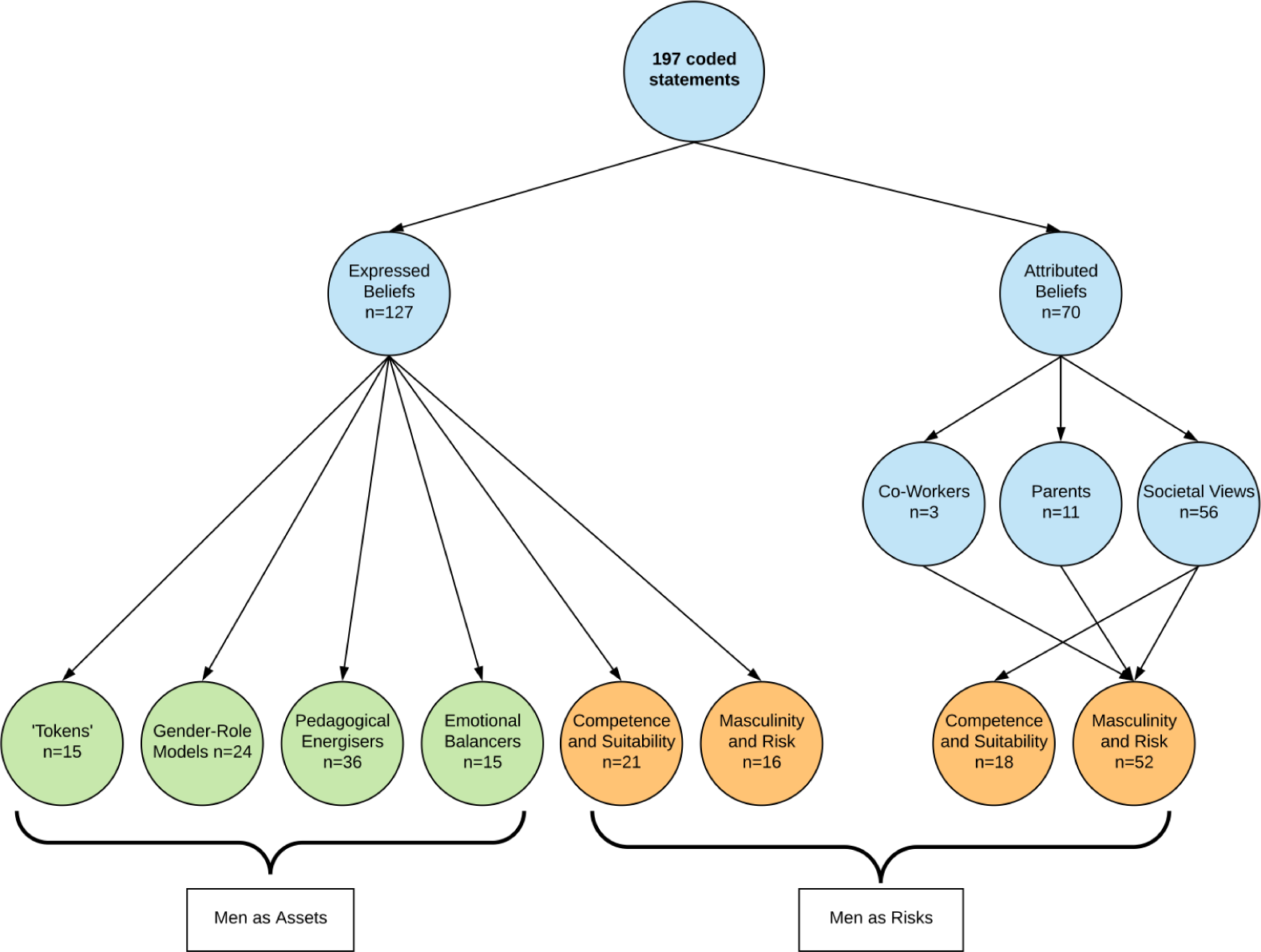
Taxonomy diagram showing the coded statements.
Expressed beliefs
The themes emerging from personally held beliefs typically presented men as assets. For some, men were simply ‘tokens’ – an unspecified male representative within the workplace. Others more specifically portrayed male educators as ‘gender role models’, ‘pedagogical energisers’ and ‘emotional balancers’. A minority of the personally expressed beliefs (37 or 28%) presented themes of ‘incompetence’ and ‘risk’.
Tokens
Male educators were identified as a representation of men and masculinity. This ‘otherness’ was presented as an asset without substantiation: ‘I’ve worked with a few men and they’ve been fantastic. I think there should be more in the service because – I don’t know’ (Kyra, 35, Assistant Educator). Kyra’s inability to articulate the contribution of men to the ECEC workplace suggests a symbolic focus on male educators and sets them apart as a novelty rather than a team member.
Gender role models
Male educators were recurrently valued as models of masculinity, both challenging traditional models of masculinity and representing masculinity. Remy, for example, articulates male educators as gender-challenging: ‘especially for boys, they have that male role model and they see that men can do different types of jobs and not just out in the mine or driving trucks or something like that’ (Remy, 30, Assistant Educator). In contrast, June presents male educators as substitute ‘father figures’, framed within the social context of family disruption and single-parent families: ‘they do need to have those role models but also a lot of them don’t have permanent fathers or fathers who are in contact’ (June, 61, Teacher). Both characterisations of male educators serve to isolate rather than include men as part of the ECEC team, objectifying male educators as representations of masculinity.
Pedagogical energisers
The interviewees expressed a clear belief that the interactions which male educators had with children were different in type from those of female educators. They asserted that the presence of a male educator changed the pedagogical dynamic, with benefit for children’s learning: ‘I think it would be good because it would bring in a different sort of learning and different type of perspective for the children and things’ (Arial, 30, Assistant Educator). They also expressed this belief in terms of a positive energy: ‘I feel it gives it that little “oomph” or something. Gives it another, different dimension, sort of thing, to the group’ (Rosie, 34, Assistant Educator). For some, this quality was articulated in terms of men’s engagement in ‘rough and tumble’ play, a form of play characterised as atypical of female educators. Mel summarises this perspective: ‘Yeah, so they’ll run around the playground. They probably got down and dirty in the sandpit and stuff a bit more than what some of the female staff would have’ (Mel, 36, Administrator). While positioned as making a unique contribution to the interactional quality within the ECEC setting, male educators in these comments were positioned as compensatory or additional, rather than innovative or disruptive to the pedagogical practices of the team as a whole.
Emotional balancers
Some of the interviewees presented their male colleagues as changing the emotional environment within the workplace by diluting ‘female emotion’. Marcela, for example, states that the presence of a man improves workplace relationships: ‘Oh definitely. The centre’s full of girls. You always get the bitching between staff and that stuff. You chuck a man in there and it changes that whole dynamic’ (Marcella, 25, Assistant Educator). Marcela’s depiction of men as serving to diffuse female emotion again positions men as compensatory – a solution for deficits in female educators’ emotionality.
Handymen
Though few, descriptions of men as useful in undertaking tasks traditionally assigned as ‘men’s work’ were evident in the data. Deena provides an example: ‘I think so, because we need maintenance stuff like cleaning and fixing things and like that . . . When we have a male working here, he could do that, rather than just waiting’ (Deena, 36, Assistant Educator). Here, an essentialist positioning which asserts that men are suited to physical and technical work is asserted. Men are positioned as a useful accessory rather than as effective educators and carers.
Competence and suitability
Contrasting with the view of men as physically and technically competent, some presented men as being less competent or unsuitable for the central work of an ECEC educator, in terms of both the demands and nature of the work. Deanne, for example, suggests that men are unaware of the importance of cleanliness, planning and record-keeping: ‘They don’t tend to understand the behind-the-scenes side, the dirty work, the cleaning, all that presentation standards side of it . . . They do less of it’ (Deanne, 48, Director). Mary picks up this theme, suggesting that the work is demanding and unmatched to men’s way of working: ‘I think some of it is it’s a lot of work. I’m not saying men are lazy, but it’s a lot of work and it’s different work’ (Mary, 26, Director). Jade suggests that men are innately less suited to nurturing roles: ‘I think it is just our motherly instincts, I guess, you know, kick in. I think we are better at it. It is probably a bit sexist but that’s just the way things were, and how they have been’ (Jade, 20, Assistant Educator). Raelene evokes a stereotype, presenting ECEC as incompatible with the role of ‘breadwinner’: ‘The males – it’s a stereotype but it’s still a true stereotype – are the main breadwinners in any household’ (Raelene, 29, Lead Educator).
Masculinity and risk
For some, subverting hegemonic ideals of masculinity through their employment in ECEC raises questions. Specifically, the choice raised suspicions about motives or inferences about sexuality. Sharon, for example, formulates this view in terms of sexuality, suggesting that men who work in ECEC are typically homosexual: ‘the few males I have met in the sector they’re gay’ (Sharon, 41, Teacher). Trina and Renee question men’s motives by asserting that they should not be included in intimate care tasks. Both express this view from their perspective of being a mother: ‘when I’m a parent, I don’t like my child to be changed by a man, I think. I said I’m not comfortable doing that’ (Renee, 51, Assistant Educator); ‘I don’t know if I could put my littlie in with a man by himself’ (Trina, 54, Lead Educator).
While the majority of the personally expressed beliefs positioned men as assets to ECEC, essentialist beliefs were a pervasive underpinning. Work in ECEC was presented as ‘suited’ to a feminine predisposition, and essentialist masculine traits were reconfigured as positive in the ECEC environment as ‘compensation’ for feminine limitations. Men were seen as having more energy and emotional balance, while also providing gender role-modelling to compensate for female-led homes in which the absence of a father was presented as problematic. Juxtaposed was a minority of comments that raised questions about the motives of men who transgressed the occupational-sex-segregation boundary in ECEC. Notable in all of the expressed personal beliefs was the absence of a challenge of traditional gendered views.
Attributed beliefs
The attributed beliefs were singularly associated with less favourable accounts of men in ECEC. These accounts focused on men’s competence and risk, and were expressed most often as societal views, but sometimes as the views of parents and co-workers. Notably, none reflected the response of children.
Competence
Attributed beliefs that men are unsuitable for work in ECEC were largely voiced as broad societal views that defined the role of the ECEC educator as a ‘substitute mother’. Ariana provides a typical example:
I think that society’s still a little bit backwards. I think that a lot of people would be like, ‘Oh, I don’t want’ – you would look at children and think [I would like] a mother figure to be looking after them during the day and nurture them and stuff. (Ariana, 23, Assistant Educator)
Masculinity
Reflecting the comments provided as expressed personal beliefs, work in ECEC was portrayed as being incompatible with masculinity. The positioning of ECEC as emasculating was presented from the perspectives of other men. Joan, for example, surmises that being an ECEC educator would be viewed as emasculating: ‘I don’t know whether the guys, amongst themselves, go, “It’s a pussy’s job. That’s not a real job”’ (Joan, 39, Lead Educator). Nancy, in contrast, focuses on the lower status of ECEC compared with other forms of teaching: ‘I think there might be that blokey kind of thing where they might go, “Oh, you know, why would you want to teach little kids? Why don’t you teach older kids or high school or something like that?”’ (Nancy, 59, Director). However, Kathy talks of gatekeeping by ECEC employers:
A lot of men go for roles in early learning and it is actually the people who are giving out the jobs who are discriminatory against them; maybe there’s always that kind of stigma around ‘Why do men want to work with little children?’ (Kathy, 48, Educational Leader)
Risk
The threat to small children of men working in ECEC was the most frequently occurring attributed belief. While none of our interviewees reported witnessing, or knowing of, an instance in which a male educator was a threat to a child, the potential for such danger was latent. Some female educators, such as Zelda, express this threat in terms of the protection of men: ‘I think it’s just the stigma behind children and young males. Then toileting and nappy changing and things like that, which some men don’t want to be put in a situation where they could be accused of things’ (Zelda, 22, Lead Educator). On the other hand, others such as Carie voice this as a fear held by parents: ‘I think that most parents prefer a female educator to a male educator. I don’t know if it’s because it’s a mother thing and they just feel safer that their children are with women than with men’ (Carie, 24, Assistant Educator). These fears were not challenged, but rather presented as an understandable perspective. While essentialist views are evident in these accounts, broader social mechanisms that exclude men through an ‘absence of trust’ also emerge. Notable in these accounts, positioned as the voice of another, was the tacit acceptance of these views.
Discussion
With a growing labour demand (Thorpe et al., 2018) and increasing recognition that workforce diversity benefits children (Sak et al., 2019; Warin, 2018), the participation of men as ECEC educators is a significant social and economic imperative. Promoting and sustaining male participation is inevitably linked to inclusive workplace practices and relationships with the gender majority within the workforce (Rolfe, 2006; Thorpe et al., 2018; Warin, 2018). Such practices are underpinned by attitudes, whether spoken or unspoken. In the case of the ECEC workplace, societal and parental attitudes may also affect workplace practices (Kamberi et al., 2016; Tufan, 2018). In this article, we have provided novel evidence of the beliefs and attitudes of the female gender majority pertaining to men’s place as ECEC educators. The work is novel in two distinct ways. First, the sample was not opportunistic, but rather systematically selected to represent educators working in ECEC services across a diversity of remote, regional and urban settings, and to encompass a diversity of social and cultural population characteristics. Within the participating centres, a 98% participation rate yielded a sample of some 96 educators. Second, the analyses distinguished between direct expression of personal beliefs and those attributed to others. This distinction is important because held beliefs rather than expressed beliefs are those that impact actions (Maio and Augoustinos, 2005). In this respect, contesting the views of others is also a significant factor underlying workplace actions.
Two clear findings emerge from our analyses. First, most of the comments directly voiced the view that male educators are an asset. Consistent with previous studies (Timmerman and Schreuder, 2008; Van Laere et al., 2014), the women spoke of the value of male educators, and identified valuable and unique contributions. However, the ways in which men’s participation was described often served to present men as ‘other’ rather than as an integral part of the ECEC team (Thorpe et al., 2018; Warin, 2018). Men were variously presented as a symbol of masculinity, a role model, a role challenger, an energiser, an emotional balancer and a handyman – all roles presented as female deficits and aligning with essentialist understandings of occupational sex segregation. Evident in these accounts are both contradictions and the conditions placed on the presentation of male participation. These highlighted men as having distinctive roles, which failed to encompass their competence and contribution to the key focus of their work – educating and caring for young children and working in partnership with colleagues and families.
Second, overt opposition to male educators’ participation and assertions of risk were rarely expressed directly, but instead were attributed to parents and the broader society. The absence of trust and presence of threat to child safety loomed large in the women’s attributed accounts. We note that while these views may genuinely be those of others, the contesting of these positions by the interviewees was not evidenced. Rather, they were presented as fact, and accepted or excused. In reality, such threats are low (Pruit, 2015; Thorpe et al., 2018), yet their presence in the narratives of the female educators was potent. There is also the possibility that the presentation of men as a ‘risk’ in the ECEC workplace may be a view held by the female educators but positioned as the voice of another. Social psychology studies identify this as a common strategy to avoid judgement when there is dissonance between contextually acceptable views and held beliefs (Maio and Augoustinos, 2005). Notably, few comments asserting concern about the participation of male educators in ECEC were made directly. Interestingly, when these occurred, the educator positioned herself as a mother, not as an educator.
Against a background of considerable essentialist belief, a silence pertaining to the right of men to make a contribution as competent educators signified tacit acceptance of vertical segregation, which isolated men from and within the ECEC workforce.
Study implications and limitations
This study directs attention to new directions for research and practice. First, with regard to research, our sampling strategy, which uses population stratification, advances studies of attitudes in this field. The generalisability of the study, while limited to the Australian context, has greater power in documenting the challenges faced by male educators than the large body of prior studies that are based on small opportunistic samples. Our analytical approach engages with interesting challenges to interview methodologies when assessing attitudes to men in ECEC. Consistent with earlier accounts (Pruit, 2015; Rohrmann and Brody, 2015), our data suggests the possibility that women in ECEC may provide socially desirable responses when questioned about men’s place in ECEC. The stark dichotomy of explicit personal claiming of valuing male participation juxtaposed against attitudes and implicit external attributions of risk suggests that social desirability biases may be at play. Even if the views presented were genuinely those of others, the acceptance of these views indicates an underlying challenge for the inclusion of male educators. While our study has provided novel insights, there remains a need to apply other methodologies to advance understanding of the association of attitudes and actions in the workplace. Alternative methodologies, including observational methods, are needed.
With regard to practice, both the explicitly voiced personal attitudes and the implicitly inferred concerns about competence and safety evidenced in our data position men as ‘other’, and may serve to discriminate, isolate and precipitate loss in the sector (Figure 2; Brody, 2015; Moosa and Bhana, 2017). Further, the positioning of male educators’ role as compensating for female deficit raises questions about female educators’ own sense of worth, and may explain gatekeeping, a vertical-segregation mechanism (Kamberi et al., 2016; Levanon and Grusky, 2016). An inclusive workplace is critical to the success of gender minorities in the workplace. Inclusive practices would see women advocating for the full inclusion of men in all aspects of ECEC roles and responsibilities, challenging stereotypes and refraining from gatekeeping (Børve, 2017; Vohra et al., 2015). Awareness training and explicit critical reflection on everyday decisions, actions and language use within the ECEC service regarding diversity, whether of gender or other forms of culture, is indicated. Further, communication with parents and messaging in response to the community should indicate support of the full inclusion of male educators.
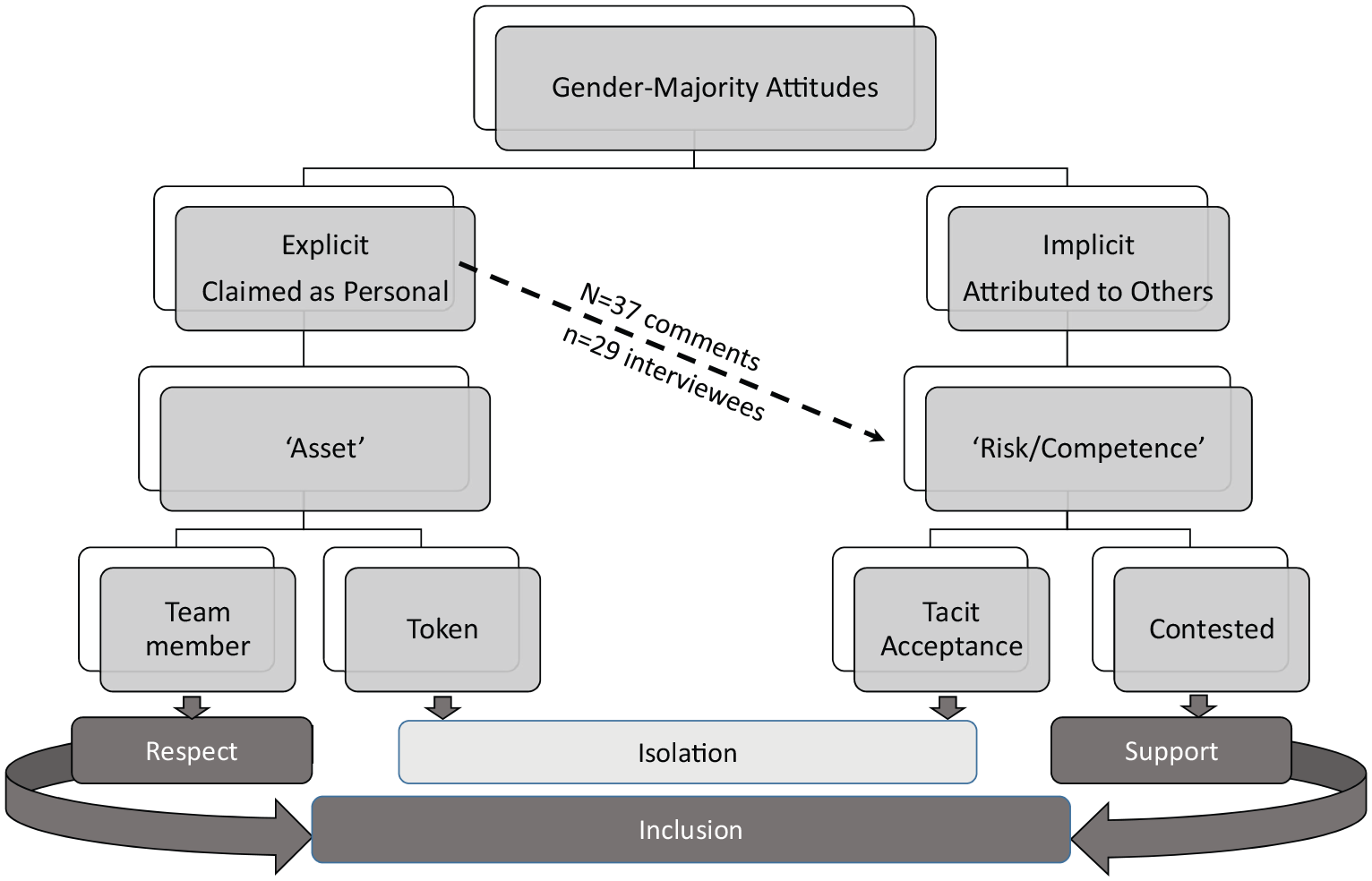
Flowchart of female educators’ beliefs.
Footnotes
Declaration of conflicting interests
The authors declared no potential conflicts of interest with respect to the research, authorship and/or publication of this article.
Funding
The author received financial support for the research, authorship and/or publication of this article: This work was funded by the Australian Research Council under the Linkage scheme (LP140100652) in partnership with the Queensland Government, Department of Education and Training, The Creche and Kindergarten Association of Queensland and Goodstart Early Learning, Australia.
