




Abstract
Regulatory drivers of teacher quality and teacher professionalism are increasingly being utilised in Australia and internationally to improve children’s outcomes. In the context of a recent national review on teacher registration, this article reports on findings from a small-scale study that investigated three early childhood teachers’ perceptions of teacher registration in New South Wales, Australia. The participants rejected discursive truths about the need for and benefits of teacher registration, associating this relatively new mechanism of teacher accountability as a threat to teachers’ professional practice and job satisfaction, and to centres’ provision of quality early childhood education. The findings problematise a discourse of teacher professionalism made enticing by a vow to bring early childhood teachers in from the margins of the educator sector.
Introduction
Regulatory drivers of teacher quality and teacher professionalism are increasingly being utilised in Australia and internationally to improve children’s outcomes (Brass and Holloway, 2019; Duhn, 2011; Grieshaber, 2017; Lloyd and Hallett, 2010; Toledo-Figueroa et al., 2017). In early childhood education (ECE) in Australia, these drivers have been operationalised in the accreditation of initial teacher preparation programs (Gibson et al., 2017) and, more recently in most jurisdictions, in the registration of early childhood teachers (ECTs; AITSL, 2018). The current move to accredit all ECTs in a unified system of teacher registration (AITSL, 2018) is symptomatic of a shift to professionalise a sector that is on the margins of education in Australia and undervalued in the public arena (Pascoe and Brennan, 2017; Press et al., 2015).
Teacher registration sits within a traditional conceptualisation of professionalism that values specialist expert knowledge, teacher autonomy, adherence to a professional code of ethics and systems of accountability for quality assurance (Lloyd and Hallett, 2010; Toledo-Figueroa et al., 2017). In this positioning, teacher registration is rendered a benign mechanism that supports and improves teacher quality, with no adverse effects. This construction is problematic, however, for three interconnected reasons. First, the high status that expert skills and knowledge afford is, as noted earlier, lacking for ECTs. Second, in the context of neo-liberal policy logics adopted in many countries of the Organisation for Economic Co-operation and Development today, teacher quality and status are entwined with the meeting of externally determined standards and performative accountability measures that may have limited relevance to the local context (Duhn, 2011). Third, the traditional approach fails to acknowledge the potentially discursive impact of externally determined notions of ‘professionalism’ on teachers’ practice and identity (Brass and Holloway, 2019; Fenech et al., 2010).
While there is a well-established body of research critiquing the governing of ECTs through the regulation of ECE services (e.g. Fenech and Sumsion, 2007; Grieshaber, 2002; Osgood, 2006), less attention has been paid to the accreditation of initial early childhood teacher education programs (a notable exception being Gibson et al., 2017) or to teacher registration. Indeed, much of the focus on teacher registration in Australia and internationally has concentrated on teachers in the schooling sector (e.g. Call, 2018; Garver, 2019; Révai, 2018; Talbot, 2016; Toledo-Figueroa et al., 2017). There is consensus in this body of literature that teacher registration is intended to lift the quality of the teaching profession and thereby improve student outcomes by articulating what teachers ‘should know and be able to do’ (Toledo-Figueroa et al., 2017: 73), underpinning and informing the quality of initial teacher education programs, and promoting ongoing professional development and improvement. Teaching standards and teacher registration are also intended to raise the status of teaching as a profession. There is, however, inconsistent evidence to show that teacher registration does, in fact, achieve its intended outcomes (Call, 2018; Toledo-Figueroa et al., 2017).
This article reports on a study that investigated three ECTs’ perceptions of teacher registration in the state of New South Wales (NSW, where teacher registration is referred to as teacher accreditation). In this jurisdiction, the registration of all ECTs came into effect in 2018. Conducted prior to a recent national review of teacher registration (AITSL, 2018), the findings from the study problematise moves to professionalise the early childhood teaching sector through registration. Before presenting our approach and findings, we begin with an overview of teacher registration in Australia.
Teacher registration in Australia
In Australia, all school-based early childhood, primary and secondary qualified teachers and most ECTs working in prior-to-school settings must meet the Australian Professional Standards for Teachers (APST) to be registered and eligible for employment (AITSL, 2018; NESA, 2017a). The APST comprise seven standards across three central teaching domains: professional knowledge (two standards: knowing students and how they learn and knowing the content and how to teach it); professional practice (three standards: planning for and implementing effective teaching and learning; creating and maintaining supportive and safe learning environments; and assessing, providing feedback and reporting on student learning); and professional engagement (two standards: engaging in professional learning and engaging professionally with colleagues, parents/carers and the community) (AITSL, 2017). The standards intend to support the professional development of all teachers and provide a foundation for consistency across the country (AITSL, 2018). Teachers are registered at one of four stages: Conditional or Provisional, Proficient, Highly Accomplished and Lead Teacher (NESA, 2017b).
While the majority of ECTs in Australia are registered, requirements vary across the country (AITSL, 2018). For example, in some jurisdictions, only ECTs employed in schools are required to be registered. In NSW, the state in which the current study was undertaken, teacher registration only became compulsory for all teachers in July 2016 (AITSL, 2018). Prior to this, and since 2004, only teachers working in schools were required to be registered (NESA, 2017d). This previous exclusion of four-year university-qualified ECTs working in the prior-to-school sector was attributed to a marginalising of ECTs in the wider education sector (Maloney and Barblett, 2003; Woodrow, 2007, 2008) – thus the introduction of teacher registration for ECTs in NSW received strong support. Both the NSW Education Standards Authority (NESA, 2015) – the statutory authority responsible for setting and monitoring quality teaching, learning, assessment and school standards – and the Independent Education Union (2015) argued that the extension of teacher registration to ECTs signified that all teachers were part of one profession and, in doing so, would address the marginalisation and limited status of ECTs.
Applying for registration involves the collection of evidence of practice that links to the APST (NESA, 2017a). This evidence can include records of children’s learning, plans for learning and play, observations, child/family feedback and teacher reflections. Once Proficient Teacher registration has been achieved, ECTs must maintain their registration over a five-year full-time cycle by completing at least 100 hours of professional development and continuing to demonstrate that their practice is meeting the APST through a report that is submitted at the end of the registration cycle (NESA, 2017c). Following a transition phase that requires 20 of the 100 hours of professional development to be approved training, ECTs (as with primary and secondary teachers) will be required to complete a minimum of 50 hours of Quality Teacher Registered professional development in addition to 50 hours of Teacher Identified professional development and/or further study (NESA, 2017c).
Academic commentary has focused on the registration of teachers in schools and is critical of the implementation of the APST and teacher registration more broadly. Scholars (Connell, 2009; Howie, 2006; Mayer, 2011) have cautioned against equating the meeting of the APST with quality teaching, arguing that adopting such a competency-based view of quality narrows teaching practice and diminishes professional autonomy and teacher artistry. Others (Howie, 2006) have argued that registration positions teachers in a deficit discourse by pointing out what they purportedly cannot do and requiring mandatory professional development to ‘fix’ the deficit.
To date, there is insufficient and mixed evidence of the impact of this system of teacher registration on teacher quality. Empirical peer-reviewed research is confined to Talbot’s (2016) qualitative study of eight primary and secondary teachers’ experiences of professional registration. The participants highlighted the extensive demands in both time and energy needed to successfully meet the required standards, leading Talbot to caution that registration may be reduced to a ‘ticking-off’ process that holds no contextual relevance to an individual teacher’s practice and learning needs. The findings also led Talbot to question a key assumption of teacher registration – that there is an inherent nexus between professional development, professional learning and changed practice.
Contrary to these findings were those of a case-study evaluation of the usefulness, effectiveness and impact of the APST in schools (AITSL, 2016). This evaluation found that the APST enabled improved support for pre-service and graduate teachers, facilitated cultures of learning, and supported teachers’ professional development and career progression. Facilitators that included effective leadership, available resources and time, and a supportive culture were perceived to enable these positive outcomes, while an absence of these facilitators and misalignment with the local setting (e.g. limited access to professional learning) posed key barriers.
In 2018, the AITSL conducted an extensive national review of teacher registration, with a focus on improving and reinforcing teacher quality, strengthening children’s safety and streamlining teacher registration processes (AITSL, 2018). The Terms of Reference for the review specified that it should include within its scope consideration of ‘the registration of early childhood teachers as part of a national approach to teacher registration, and how the Teacher Standards should be applied in this context’ (AITSL, 2018: 54). This review was undertaken in the context of recent reforms to professionalise the early childhood workforce through the implementation of the National Quality Framework (NQF; ACECQA, 2018). This national system of regulation, quality assurance and quality improvement increased requirements for the employment of ECTs, lifted the qualifications of the ECE workforce, introduced new national quality standards, improved educator-to-child ratios and implemented a national curriculum Early Years Learning Framework. A premise and expectation of the NQF is that services will engage in a process of ongoing quality improvement, with Quality Area 7 of the National Quality Standard requiring services to demonstrate that ‘there is an effective self-assessment and quality improvement process in place’ and ‘educators, co-ordinators and staff members’ performance is regularly evaluated and individual plans are in place to support learning and development’ (ACECQA, 2018: 91).
The AITSL review involved stakeholder consultations, submissions and an online survey. Two of the review panel’s 17 recommendations were specific to ECTs: that, irrespective of their place of employment, all ECTs in Australia be required to register under a consistent national system (Recommendation 5) and that the APST be revised to ensure ‘their relevance and applicability to ECTs’ (Recommendation 6) (AITSL, 2018: v). Other recommendations were also applicable to ECTs: for example, that there be a stronger focus on the APST and registration requirements in initial teacher education programs (Recommendation 8); that information transfer be improved across jurisdictions to strengthen children’s safety, improve teacher workforce mobility and support teaching as one profession (Recommendations 9, 10, 12 and 13); and that a national approach to English-proficiency assessments be updated (Recommendation 14). The review also identified key issues specific to the ECE sector that require further consideration in any proposed implementation plan: that an ECT is often the only qualified teacher employed in an ECE service; the lack of onsite or organisational mentors to support teachers’ transition from provisional to proficient registration; that ECTs are already accountable to, and provide evidence for education quality through, the NQF ACECQA, 2018); and the limited availability of, and access to, quality professional development.
While the AITSL’s (2018) national review included ECT perspectives, these were sought within the confines of a consultative process that positioned the governing of teachers through registration as a necessary good. For example, stakeholders were asked to comment on ‘How could a nationally consistent approach to teacher registration support and improve the quality of early childhood teaching in school and non-school settings?’ (AITSL, 2018: 12). Notably, while over 75% of 600 ECT survey respondents considered teacher registration ‘worthwhile’ (AITSL, 2018: 73), less than half of the respondents agreed that registration supports the professional recognition of teachers and contributes to improving teachers’ professional practice. The study reported in this article, conducted prior to the national review, sought to gain qualitative insights into how three ECTs perceived and experienced teacher registration so as to contribute to emerging understandings about registration for teachers in the prior-to-school sector.
The current study
Theoretical framework and approach
Following Ball (1994) and drawing on Foucauldian ideas of power, knowledge and truth (Foucault, 1972, 1980a, 1980b, 1982, 1983), we approached constructions of teacher professionalism such as the ‘Accreditation of early childhood teachers policy’ (NESA, 2015) as discourse. We see this policy and the framing of teacher registration in the AITSL (2018) review as having discursive power, potentially constituting power relations between ECTs and regulatory bodies, circulating truths about teacher quality, teacher professionalism and the need for registration, and constructing accepted teacher identities and practices.
As discourses influence language, thought and practice (Ball, 1994), they are also part of the socially constructed context from which teachers shape their perspectives. Accordingly, teachers’ perceptions of teacher regulation were explored in this study through a social-constructivist lens, using qualitative inquiry. Drawing on the Foucauldian ideas discussed above, we were interested in understanding both what teachers thought about teacher registration and the discursive truths being circulated by regulatory bodies, and the factors that influenced their perceptions and experiences.
Methods
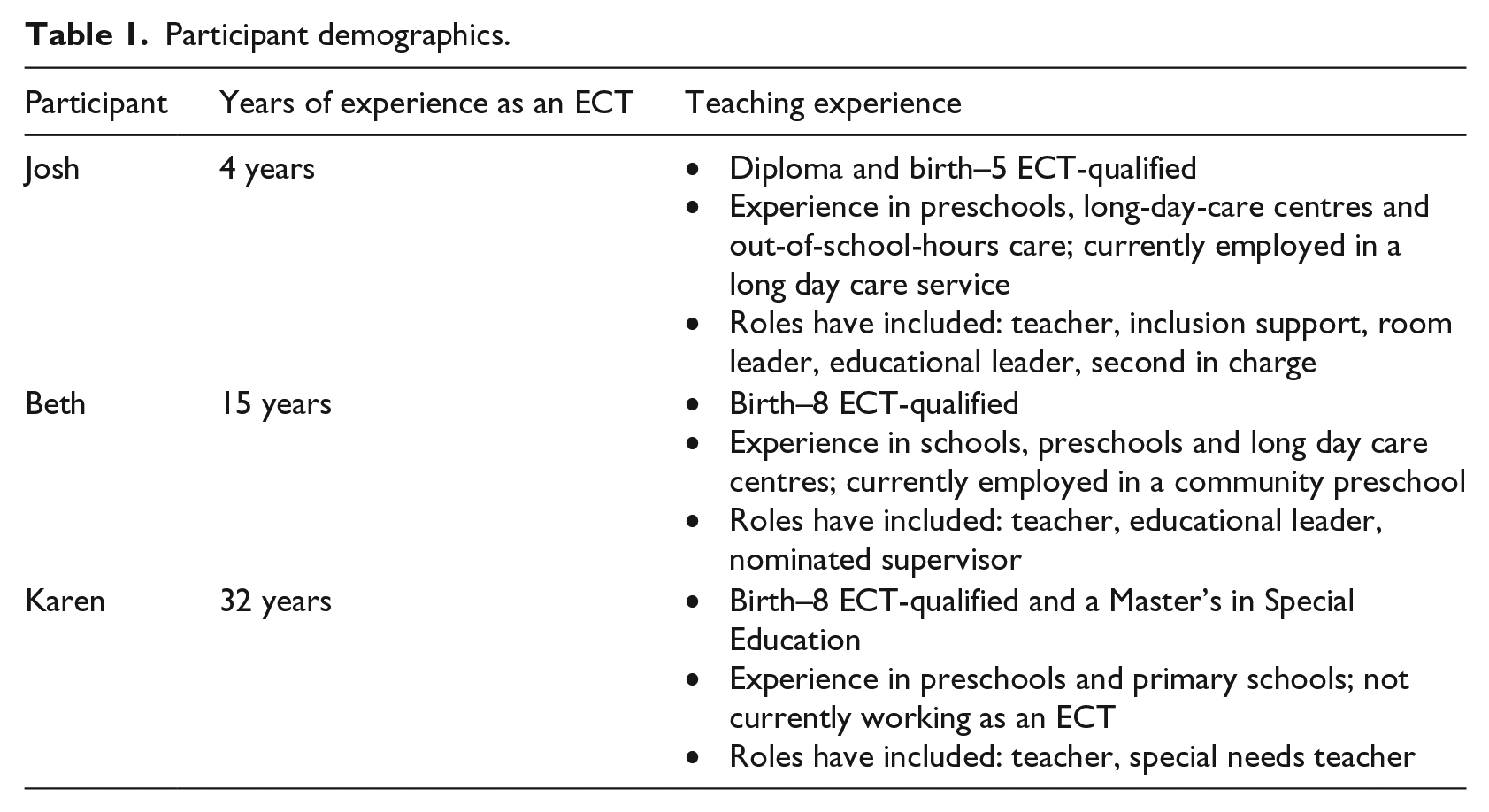
Following ethics approval from the University of Sydney’s Human Research Ethics Committee (Approval number 2017/065), participants were recruited through an advertisement placed in the Independent Education Union’s Newsmonth publication. The study utilised a convenience sample, with the first three ECTs with university early childhood teaching qualifications to express interest in the study recruited. Recruitment was limited to three participants, given the time constraints under which this Honours study was conducted. Each participant had varying levels of experience in a range of educational contexts (see Table 1). Pseudonyms have been used to ensure the anonymity of the participants.
Participant demographics.
Face-to-face semi-structured interviews of 30–60 minutes’ duration were conducted by Author 2 in February 2017, eight months after teacher registration was made compulsory. The interview schedule focused on (1) the participants’ knowledge of teacher registration; (2) the perceived benefits and disadvantages of registration for themselves, the profession and children attending ECE services; and (3) the influences that have shaped their perceptions. Each interview was transcribed verbatim and followed by a member check before being analysed using the Foucauldian concepts noted earlier.
Foucault himself was not prescriptive about how data or discursive analyses ought to be undertaken, stating instead: ‘I would like my books to be a kind of tool box which others can rummage through to find a tool with which they can use however they wish in their own area’ (Foucault, 1974, cited in O’Farrell, 2005: 50). This invitation led us to search for the participants’ identification of, and perspectives on, the discursive truths about teacher registration. The data pertaining to the second and third questions revealed three discursive truths discussed by the participants: first, that it is needed; second, that it will improve teacher quality; and third, that it will lead to increased professional recognition and status for ECTs. Having collated the relevant data into three separate files, we then examined the participants’ perspectives on each of the identified truths, mindful of Foucauldian concepts pertaining to discursive power. The questions that we took to our examination of each file included: Did the truth claims lead to the participants self-regulating their behaviour and practices in any way? Did the participants purport alternative truth claims about teacher registration? Did they exercise resistance to registration requirements in any way? Evidence of these ideas in each of the three identified truths is reported and discussed below.
Problematising the need for teacher registration
The participants rejected the purported need for teacher registration for two reasons, the first being what they perceived to be an already over-regulated sector. All of the participants maintained that ECTs’ professional practice had become more complex by what they perceived to be more but unnecessary regulations and requirements. Karen reflected: ‘I’m really jaded by the way the world’s gone . . . it’s just too many hoops to jump through’. Josh similarly commented: ‘We prove it [quality] every single day on the floor. I don’t really think we need to jump through extra hoops to prove it to anyone else’. All of the participants also questioned the need for teacher registration, given that ECTs are already accountable for quality early childhood education and care through the NQF. As noted by Karen: ‘One process should do both because, really, you’re doing both. That’s what you’re showing in your accreditation of the centre, examples of your teaching, so I’m not quite sure why it can’t tick both boxes while we’re box-ticking’. Beth also reflected on this idea, arguing that if ECE services provided evidence that their educators were accessing professional development, there should be no need to have the two systems of centre accreditation and teacher registration. In her view, funding would be better spent on enabling teachers to access quality professional development, with the onus of accountability being on services to ensure that they are providing this access for their teachers: ‘If services are accessing that on a regular basis, and they can prove that we’ve accessed these services, why make individual teachers do it?’
The deficit positioning of ECTs in teacher registration discourse was the second reason why participants rejected the purported need for teacher registration. In contrast to the discursive truth that this external regulatory mechanism was needed for ECTs to undertake professional development, all three participants repeatedly explained that teacher registration had not improved their practice, pointing instead to their own intrinsic motivation for quality improvement and their undertaking of ongoing professional development. Karen, for example, stated: I’m very happy to do however many hours of ongoing anything because I always have and I always feel it’s important to stay up to date with what’s going on . . . If I was in charge, it would just be one process and you would be encouraged to take responsibility for your own ongoing learning . . . The assumption that we’re not doing that is annoying.
Similarly, Josh noted: ‘our professional development is actually built into our model – our business model – we’re pretty constantly doing training and professional development seminars and stuff . . . it’s part of our culture’. Josh was highly critical of registration as an extrinsic driver of teacher quality: ‘It’s like kids! You know, do this and you get a sticker’.
Collectively, the participants’ rejection of the purported need for teacher registration resonated with Urban’s (2008: 138) observation that ‘too often the language of “quality” is employed to legitimise the proliferating maze of regulations in ECEC [early childhood education and care], and to undermine instead of support professional autonomy’. The participants in this study did not consider that registration would enhance their teaching practice. Their ‘prevailing professional habitus’ (Urban, 2008: 135) comprised a commitment to quality ECE, an exercising of professional judgment, continuous learning and quality improvement, and investment in professional development – a habitus that contrasted sharply with the participants’ perceptions of the deficit positioning of teachers in, and accountability requirements of, teacher registration. In these ways, the participants exposed and resisted the power of regulatory authorities such as the AITSL and NESA to construct prevailing discourses and individual subjectivities (Foucault, 1983).
Notably, Beth referred to herself as ‘lucky’ because her service supported and paid for all professional development – something she observed many services did not do, leaving teachers to undertake professional development in their own time with their own money. This observation, which contrasts with Josh’s reference to his centre’s culture as one that prioritised ongoing professional development, further problematises the use of professional standards as a lever of teacher quality. Following Bacchi’s (2009) Foucauldian-informed ‘What’s the problem represented to be?’ approach to policy analysis, an assumption of the ‘Accreditation of early childhood teachers policy’ (NESA, 2015) and the teacher registration review (AITSL, 2018) is that without accountability to professional standards, teachers will not develop their teaching practice. The participants again exercised resistance by rejecting this framing of the problem, with the comments from Beth and Josh suggesting an alternative truth – that a problem with teacher quality lies with early childhood education and care providers who do not provide a learning-community culture and material support for the development of their educators.
Given the focus on quality improvement in Quality Area 7 of the National Quality Standard, it appears that the NQF provides the requisite regulatory mechanism to support and assess teacher quality, without teacher registration potentially shifting capacity for professional development away from early childhood education and care providers and solely onto ECTs. The participants’ accountability to the NQF highlighted regulation fatigue and questioned the introduction of an additional regulatory system for ECTs. Given the complexity of teachers’ work with its associated regulatory burden, registration presented as another ‘hoop’ that teachers have to jump through. Consistent with the findings from Talbot (2016) and the AITSL (2018), the participants’ perceived limited utility of teacher registration for improving teachers’ practice, together with the requirements on teachers’ time, threatens a tick-the-box approach to the meeting of the APST.
Problematising teacher registration as a mechanism to improve teacher quality
Aligning closely with the participants’ problematising of the need for teacher registration was the participants’ resisting of the truth claim that registration improves teacher quality. In addition to being intrinsically motivated to undertake ongoing professional development to improve their practice, Beth and Karen referred to the deleterious impact of teacher registration on their job satisfaction. Karen highlighted a growing amount of paperwork, which was taking her time away from the children, maintaining that the APST forced ECTs to focus their planning on what looks good and matches the standards, rather than the needs and interests of the children: Well, you have less time with the children. And, as I say, you aren’t fully focused on the children. You’re focused on the children and what looks good, what impresses. I’ve got to look good. I’ve got to justify my existence.
Karen’s comments here are illustrative of the objectification power of discourses such as teacher registration, which ‘transform individuals [ECTs] into subjects’ (Foucault, 1983: 208). That Karen regulated her own behaviour is particularly telling, given that this subjectification occurred even though she rejected the purported need for teacher registration.
Pointing to regulatory burden, in what may be perceived to be an act of resistance, Beth admitted that she planned to leave the profession before having to complete the requirements of teacher registration. She referred to teacher registration as Just another set of things to remember . . . [which] tipped me over . . . I mean, there’s been a lot of changes and a lot of them have been for the good but a lot of them have done nothing but just add to the workload.
She also expressed concern about the burden on graduate teachers having to comply with registration requirements: It really is way too much work . . . you’ve got to keep all of the documentation. You’ve got to keep all the records and make sure every ‘i’ is dotted and every ‘t’ is crossed. It’s just something you don’t need to do as a beginning teacher. You should be focusing on teaching, not paperwork. It’s the world we live in now. I don’t want to teach in those conditions.
Notably, as an experienced teacher, Karen also experienced this regulatory burden: I’m very happy to do however many hours of [professional development] because I always have and I always feel it’s important to stay up to date with what’s going on, but having to record it and having to justify it really becomes a drag.
Contrary, then, to the truth claim that teacher registration would lead to improved teacher quality, and the positioning of teacher registration as the benign mechanism noted earlier, the participants’ perceptions pointed to its objectifying of teachers and ensuing deleterious effect on centre quality. This effect was through the felt impact of teacher registration on job satisfaction and staff turnover. This is a significant concern, given the already high staff turnover rate and teacher shortages in ECE in Australia. In long-day-care services, for example, the annual turnover rate for educators of all qualification levels is 20–50%, with high stress levels and dissatisfaction with pay and working conditions key contributing factors (Jones et al., 2017). Conversely, a low staff turnover rate contributes to the quality of a service and leads to benefits for children’s learning and development (Press et al., 2015).
Problematising teacher registration as a mechanism to improve the recognition and status of ECTs
All three participants noted that teacher registration had not enhanced the status of ECTs or, indeed, the status of school teachers. Citing a campaign that advocated for teacher registration as a way of achieving pay parity and increased professional recognition, Karen commented: ‘No one got paid any more. The same criticisms are being made from community and government . . . And it’s such a pity and it won’t raise that profile’. Similarly, Josh’s experience of teacher registration led him to surmise that the process merely presented ‘hoops to jump through . . . proving our professionalism to a society that doesn’t believe it’. His experience working with families also led him to conclude that they were unlikely to know or care whether he was a registered teacher: ‘I’m not sure if, like, are the families that use our service going to be, like, “Oh, he’s accredited!”’
These excerpts and those presented in the previous two sections are illustrative of how the participants in this study critiqued the utility of teacher registration through their respective professional lenses, utilising their own knowledge, experience and judgement to reject claims that proffer a causal relationship between teacher registration and increased professional status and improved practice. In this way, they did not present as policy subjects who ‘are produced by and reproduce policy logics’ (Garver, 2019: 2). They appeared as actors, exercising agency and resistance in their local contexts by either approaching registration requirements in a technical tick-the-box fashion to minimise regulatory burden or, as in the case of Beth, choosing to leave the profession.
But what of new ECT graduates who will no longer be privy to practising as professionals outside the scope of teacher registration? The onus on teacher educator providers to embed the APST more explicitly into initial teacher education programs (AITSL, 2018) means that new ECT graduates will be subject to the discursive influence of registration as a regulatory technology in their pre-service training. Ball provides a telling reminder that regulatory accountabilities change what it means to be a teacher. They do not just change what we do; they also change who we are, how we think about what we do, how we relate to one another, how we decide what is important and what is acceptable . . . these changes are both out there, in the system, the institution; and ‘in here’, in our heads and in our souls. (Ball, 2016: 1050)
It will thus be incumbent on teacher educators in academies also to problematise teacher registration and explore possibilities for culturally specific ‘professionalism/s’ (Duhn, 2011: 133).
Limitations and implications for future research
The findings reported in this study problematise sanctioned truths about the benefits of teacher registration. As a small-scale study, these findings provide an important contribution to emerging research investigating teacher registration in ECE contexts, yet cannot be generalised. The recruitment strategy resulted in three participants who are intrinsically committed to high-quality ECE and quality improvement through professional development, and who therefore were critical of teacher registration as an external regulatory driver of teacher quality. The findings of the study could have been markedly different had a different recruitment strategy been utilised that resulted in participants with varying commitment to ongoing quality improvement. Two of the three participants were also highly experienced teachers who held early childhood teaching qualifications that enabled them to work in both schools and prior-to-school services. This experience in both sectors may have influenced their perceptions about teacher registration in ways that may not resonate with a larger cohort of inexperienced teachers with birth–5 prior-to-school teaching qualifications. More broadly, this study was undertaken in only one Australian jurisdiction, NSW, a state in which regulatory requirements for ECTs exceed NQF requirements (Fenech et al., 2012) and where teacher registration has only been in place for three years. It is conceivable that ECTs practising in other jurisdictions where ECT requirements are less rigorous (and thus where services are more likely to employ just one ECT) and where teacher registration is well established may experience teacher registration differently to the participants in this study.
Notwithstanding these limitations, the study does offer insights into how teacher registration can affect ECTs and their practice, adding to the limited literature in Australia and internationally on registration in an early childhood context. Continued research in this area is needed to further explore the impact of this regulatory technology and to inform future policy. Future research that explores the perspectives of a greater variety and number of ECTs across Australia − employed in centres of varying quality and offering different levels of paid quality professional development – is needed to better ascertain the impact of teacher registration on teachers’ practice and constructions of their professional selves. Additionally, research is needed to supplement a growing body of literature (e.g. Bourke et al., 2018; Ryan and Bourke, 2018) focused on the discursive impact of teacher registration on initial teacher education programs, which is predominantly school-centric.
Conclusion
The governing of ECTs through teacher registration and the accompanying truths of enhanced teacher quality and professional status warrant critical analysis. In attempting to construct a new type of ECT professional whose practice is oriented and accountable to a set of externally determined standards, teacher registration poses a threat to ECTs’ job satisfaction and professional practice, and to services’ provision of quality ECE. The findings from this study caution advocates of a nationally consistent system of teacher registration for early childhood, primary and secondary teachers to be wary that they are not betrayed by regulatory authorities’ co-opting of their aspirations for pay parity and improved professional recognition (Fenech et al., 2008).
Footnotes
Acknowledgements
We are grateful to the two reviewers who provided constructive feedback on a previous version of this article.
Funding
The authors received no financial support for the research, authorship and/or publication of this article.
