




Abstract
We demonstrate that Black children are not faring well in early childhood settings and suggest ways educators can work toward ensuring that Black children thrive and flourish in schools. Five types of daily violence/traumas that Black children experience in schools are described against the ethical backdrop First Do No Harm (Boutte, 2008). Evoking the Maasai legend that asks, How are the children? we share two examples of Black males’ school experiences, though we readily acknowledge that Black females experience parallel issues. We present an overview of five types of school violence (physical, symbolic, linguistic, curricular/pedagogical, and systemic), and conclude by offering ways to interrupt these to ensure that Black children are well.
Keywords
Introduction
While discussion of violence experienced by Black children in schools has been addressed in academic literature (e.g. Johnson, Bryan and Boutte, 2019; Ighodaro and Wiggan, 2011), it is seldom addressed in early childhood circles. Our purpose is to demonstrate that Black children are not faring well—even in early childhood settings—and to suggest ways educators can work toward ensuring that Black children thrive and flourish in schools. We first demonstrate ways that they are subjected to various types of violence daily even against the ethical backdrop First Do No Harm (Boutte, 2008). Evoking the Maasai legend that asks, How are the children? we share two examples of Black males’ school experiences, though we readily acknowledge that Black females experience parallel issues. Using the lived experiences of the first author’s son and the second author’s nephew, we present an overview of five types of school violence (physical, symbolic, linguistic, curricular/pedagogical, and systemic) and conclude by offering ways to interrupt these to ensure that Black children are well.
We want to be clear. It is not our goal in this article to only focus on the problems Black children face in early childhood education; we also want to provide solutions to countering the anti-Black violence Black children face in early childhood classrooms and to acknowledge that not all teachers intentionally enact such violence toward Black children. Bonilla-Silva (2006) contended that people in general, and teachers specifically in this case, can engage in racist acts without being racist. The same is true for teachers’ participation in anti-Blackness violence. More pointedly, teachers can engage in anti-Black violence without being anti-Black. Race, racism, and anti-Blackness are normalized constructions that people, including teachers, play into without knowing in most cases. Our goal in this article is to make these forms of anti-Blackness readily apparent. In order to change things, it is important to acknowledge and name them.
And how are the children?
One of the most accomplished and fabled groups of warriors were the mighty Maasai warriors of eastern Africa. No tribe was considered to have warriors more fearsome or intelligent than the mighty Maasai. It is perhaps surprising then, to learn the traditional greeting that passed between Maasai warriors was “Kasserian Ingera?” meaning, “And how are the children?” Even warriors with no children of their own would give the traditional answer, “All the children are well,” which indicated that when the priorities of protecting the young and the powerless are in place, peace and safety prevail.
This is still the traditional greeting among the Maasai people of Kenya. It acknowledges the high value that the Maasai place on their children’s well-being. The Maasai society has not forgotten its reason for being, its proper functions and responsibilities. “All the children are well” means that life is good. It means that the daily struggles for existence do not preclude proper caring for their young.
We wondered, if we heard that question and passed it along to each other a dozen times a day, whether it would begin to make a difference in the reality of how children are thought of or cared about in our own country. What if every adult among us, parent and non-parent alike, felt equal weight for the daily care and protection of all the children in our community, in our town, in our state, in our country, and in our world?
Imagine what it would be like if heads of government (e.g. presidents, governors, mayors) began every press conference, every public appearance by asking and answering the question, “And how are the children?” Envision beginning every faculty or school meeting with the same greeting. It would be interesting to hear their answers. We wonder whether they could truly say without any hesitation, “The children are well. Yes, all the children are well.”
Gleaning insight from the Maasai, we may ask how our own consciousness about our children’s welfare might be affected if we took to greeting each other with this daily question, “And how are the children?” Pointedly, in this article, we ask the question, How are Black children and when will they be well in schools in society?
Black children are not well in schools and society
We share two stories of violence encountered by Black children during the early childhood years in schools. We emphasize that these stories are not anomalies and urge educators to hear them and to reflect on daily practices in their respective educational spaces so that they can ensure that Black children are well.
Jonathan’s story
When Jonathan, my son (first Author), was in third grade, he came home terrified after learning in social studies about a group called the “KKK” (Ku Klux Klan) who killed Black people. Through his early childhood lenses, which reflected a rudimentary sense of time, Jonathan viewed the KKK as a clear and present danger. I tried to assure him that the KKK was no longer as prevalent and that we could now fight back and were not afraid of them. My answer was lame and inadequate in many ways.
As Jonathan continued to learn Eurocentric versions of history over the years, coupled with the invisibility of Black teachers and African and African-American content throughout the curriculum, he slowly began to disidentify with school and the “academic” discourses offered there. Jonathan wanted badly to believe that life was fair and often said to his father and me (both education professors), “Everything does not deal with race!” His grades and test scores were excellent (in part due to the education we provided at home), but over time we saw the pain he suffered that none of us could name. By the sixth grade, Jonathan was placed in a math class two levels above his peers. His scores were superior in all areas of the state-mandated tests; however, he was overlooked for the school’s academic team until we [parents] intervened. Retrospectively, I believe that Jonathan had internalized the message that it was better to be cool than to be smart. Once after one of our discussions about it being okay to be both smart and cool, he said to us, “I’ve been cool since sixth grade.” Hence, we interpreted this to mean that the coup d‘etat of his disbelief in the school system was solidified in the sixth grade. One day, Jonathan and another Black child with the same name from a family of the same socioeconomic status (middle SES) mused that the teacher would not miss them if they disappeared. There were only four Black children in a class of about twenty-five. So, the two Jonathans decided to hide behind their desks at lunch time and not got to lunch. As predicted by the boys, neither the teacher nor any of the students noticed their absence.
While educators often ask parents for help, we are reaching out to educators for help. As Black parents, we tried our best to make sure that our children were prepared for school. It is important to note that we also taught Black history at home and in the community. We gave our children strong names (Jonathan means given by God) and provided safety, security, and love at home. Yet, this was insufficient to buffer them from the violence they experienced in school and society.
Jerrell’s story
When Barack Obama was elected presidential nominee for the Democratic Party, Jerrell (second author’s nephew) became quite fond of him. Jerrell was a five-year-old kindergartener who attended a private elementary school at that time. Eastside Christian Academy (pseudonym) was a predominantly White school located in the southeastern United States. When Senator Obama appeared on television, Jerrell enthusiastically chanted Obama’s name and attentively tuned into the television each time he appeared. Like Jonathan, Jerrell was always taught Black history and the importance of self-love and pride at home. Understanding the limited focus on Black cultural ways of knowing and being in school curricula in both public and private schools, his mother, Melba, was adamant about teaching him Black cultural knowledge he would not receive at school. Therefore, it was no surprise that Jerrell had developed a profound interest in Obama’s trajectory to the American presidency. When President Obama was elected, Jerrell continued to share his admiration for him.
Prior to President Obama’s election, a portrait of former President George W. Bush (43rd president) appeared on the wall in the main office of Jerrell’s school, given he was president at that time. Jerrell and his mom were certain that after the election of President Barack H. Obama, the school would remove Bush’s portrait and replace it with President Obama’s. Instead, they removed Bush’s portrait and replaced it with an American flag. Melba asked the school administration why Obama’s portrait was not displayed. They refused to provide an adequate response to her question. However, she knew the refusal to display President Obama’s portrait was because he was Black. Such refusal was a disappointment to both Jerrell and his mother.
During the following academic year, Jerrell’s first-grade teacher, a White female, insisted that Jerrell was academically underperforming in comparison to his counterparts. Jerrell was one of only four Black students in her class. Prior to attending Eastside Christian Academy, Jerrell had attended a preschool in the same neighborhood where he excelled academically. My sister was surprised at the teacher’s assessment of Jerrell’s academic performance and at her request to hire a tutor to support Jerrell academically, particularly in the area of reading and language arts. During a parent–teacher conference, Melba discovered that the teacher’s assessment of Jerrell’s academic ability was based on Jerrell’s limited exposure to the Abeka curriculum, which many of Jerrell’s classmates had been exposed to in previous years because they had attended the school during preschool. The Abeka curriculum is a culturally unresponsive program that is based on “developmentally appropriate practices” in reading. Melba also discovered that the teacher provided the White students opportunities to retake reading assessments they had previously failed. Jerrell was not provided similar opportunities. Given these challenges at Eastside Christian Academy, Melba decided to remove Jerrell from the school. As a result, Jerrell has consistently been an A/B honor roll student. Currently, a high school junior, Jerrell has won several poetry slams and has been nominated for several national writing awards.
Types of violence in schools
Never in history has violence been initiated by the oppressed.
While African-American students and people are often wrongly portrayed, stereotyped, and profiled as being violent, rarely do educators consider the ongoing acts of violence against Black humanity in schools and society. For many educators, it may be difficult to envision violence in schools, particularly in early childhood education, beyond the conception of physical abuse. But as Freire (1970/1999) noted, attacks on people’s humanity are acts of violence. On a daily basis, Black children are exposed to ongoing continuous micro-assaults (explicit derogation), micro-insults (insensitive and belittling actions), and micro-invalidations (actions that nullify our experiences or realities) (Ighodaro and Wiggan, 2011). We could present often-cited statistics, but they are already well known: differential academic outcomes, dropout rates, test scores, suspensions, disproportionality in special education and gifted education, tracking, lack of access, and the cradle to prison pipeline (see Ford, 2013).
It is only reasonable that Black people and students do defend themselves from these ongoing onslaughts. Examples of defenses include resistance to unfair classroom rules and inequitable curricula. To better explain such defenses, we draw on Dumas and Ross’s (2016) notion of anti-Blackness. Dumas and Ross (2016) define anti-Blackness as a particular disdain for Black people as reflected in American laws and policies. By this they mean that anti-Blackness is a social construction that does not merely focus on race and racism, but rather addresses the specificity of Black people’s embodied lived experience of social suffering and resistance violence, and perhaps most importantly, as an antagonism, in which the Black is a despised thing-in-itself (but not person for herself or himself) in opposition to all that is pure, human(e), and White (416).
In Table 1, drawing on the notion of anti-Blackness, we present five examples of anti-Black violence in schools: (1) physical, (2) symbolic, (3) linguistic, (4) curricular and pedagogical, and (5) systemic. We then provide examples of each.
Types of anti-Black violence in schools.
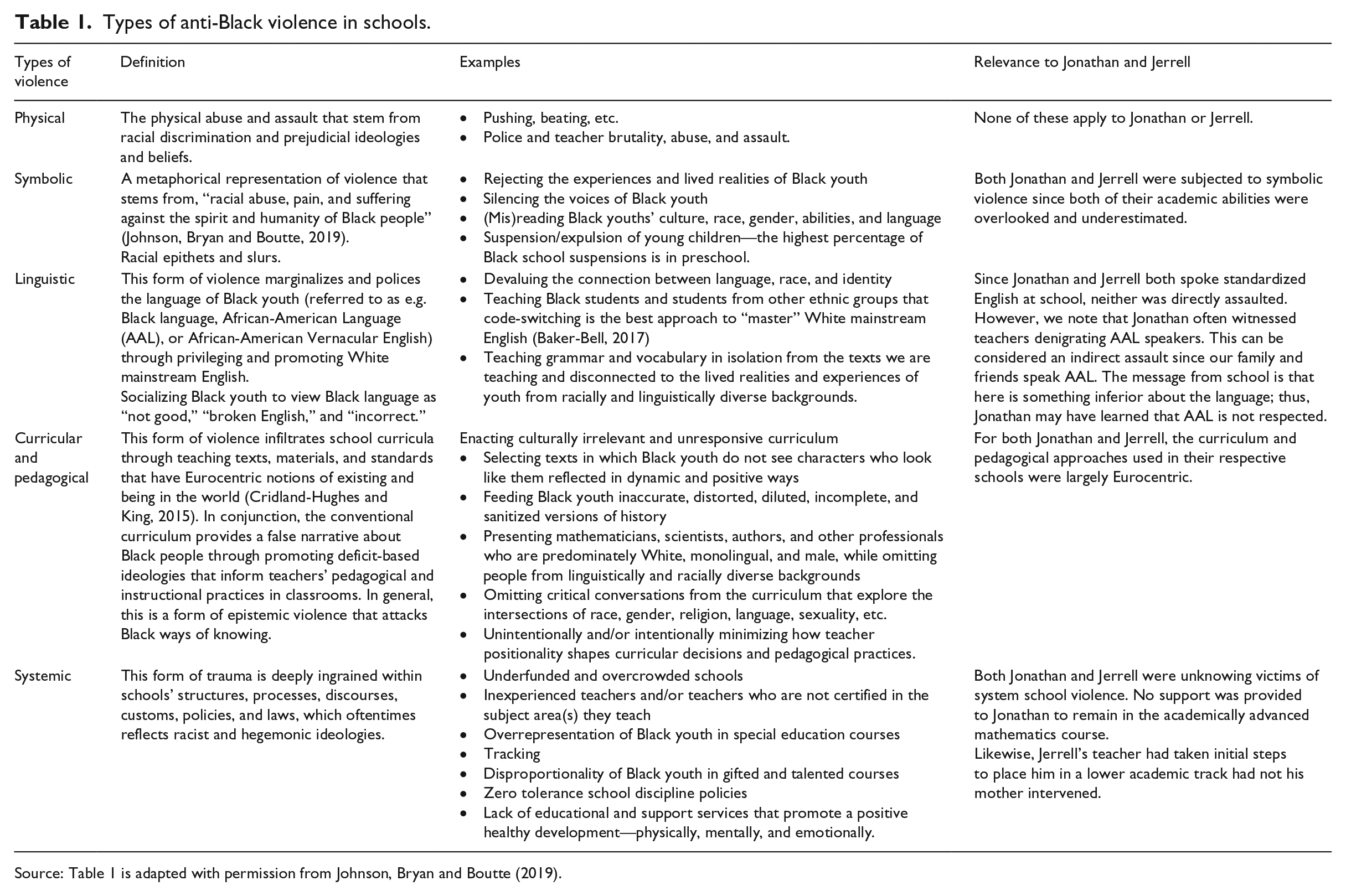
Source: Table 1 is adapted with permission from Johnson, Bryan and Boutte (2019).
Ethically, if we are to assure that Black children are well, it is important to name and call out these acts of violence. When educators say, First Do No Harm [to children], a bold and unapologetic decision must be made to include Black children in this equation and to view and protect them as children. As parents, we try to protect our children in many ways, such as changing schools, as in Jerrell’s case, and ensuring that Jonathan was placed on the academic team based on his qualifications. Many parents even go so far as to relocate to different neighborhoods in the quintessential search for “better schools.” So for us, we knowingly decided to illuminate school violence (albeit unintentional in most cases) that Black children are subjected to in school, even though it will make some educators uncomfortable. We hope that this discomfort will provoke a learning edge and that educators understand that it is better for us to be uncomfortable (long enough to hear and change) rather than to continue to subject Black children to ongoing, endemic violence. Our ethical obligation is to do our part to protect the children. Just as parents, we put ourselves in uncomfortable positions in the best interests of our children and family members; we must do the same for Black children as we are all interconnected as humans.
According to Woodson (1933), the “lynching of Black body starts in the schoolhouse” meaning that the disdain for, disgust of and violence enacted toward Black people are rooted in the schooling experiences of Black children, where they are subjected to the aforementioned types of anti-Black violence. In this section of the article we will use these types of violence to analyze Jonathan’s and Jerrell’s stories.
Taken together, Jonathan’s and Jerrell’s stories are constant reminders of the ways in which Black children are “lynched” in schools and how educators, albeit unintentionally in most cases, play a role in carrying out such anti-Black violence in early childhood classrooms. As such, most educators are what Johnson and Bryan (2017) described as “wearing white sheets without wearing white sheets.” Johnson and Bryan (2017) noted that the white sheet is a representation of the garb worn by members of the KKK. They explained that when educators enact culturally unresponsive pedagogical and schooling practices that negatively impact on Black children, educators are engaging in the lynching of Black children in classrooms. In other words, these educators symbolically and metaphysically become the holders of the gun, the bullet (killers of hopes and dreams) and those who inflict the wounds on the hearts, minds, and spirits of Black children (Bryan, 2017, 2018b; Leonardo and Boas, 2013).
We want to return to the opening stories about Jonathan and Jerrell to illuminate several points about why Black children are not well in early childhood classrooms. It is important to highlight that anti-Black violence is not relegated to a certain place, time and/or geographic location. It is a national and global phenomenon (Dumas and Ross, 2016). For example, although attending schools in different regions of the state of South Carolina and at different times (Jonathan is older than Jerrell), both Jonathan and Jerrell were victims of schooling systems that were (and still are) intentionally designed to harm and “keep them at the bottom of the well” (Bell, 1992). Bell’s metaphor acknowledges White Americans’ way of denying Black people’s access to economic, social, political, and educational privileges and advantages that would allow them to empower themselves in a White supremacist, patriarchal, capitalist, and imperialistic society. Curry (2017) contends that Black boys (and men) are more likely to be victimized in such an anti-Black system. Such is the case for Jonathan and Jerrell. Seeing Black boys as victims of anti-Blackness does not mean that Black girls and other children of color are not negatively affected. Indeed, examples abound in the media and popular press, which highlight the ways in which Black girls are victims of the types of anti-Black violence we have detailed. A few examples will be shared later in this section. Further, we fully understand that some types of anti-Black violence are far more egregious than other (not that there is a hierarchy of the types of anti-Black violence in schools); however, we analyze Jonathan’s and Jerrell’s in the order the types of anti-Black violence are presented in Table 1.
The first type of anti-Black violence is physical violence. Although Jonathan and Jerrell did not experience physical violence from their White female teachers, we cannot suggest with honesty and integrity that Black boys are not victims of physical violence in early childhood classrooms. For example, a video recording from an elementary school in Goose Creek, South Carolina shows an example of such anti-Black, misandric physical violence. A Black boy was sent out of his third grade classroom for supposedly “disrupting class.” While standing in the hallway, the teacher kicked him “as a way to remove him away from the classrooms” (Tripp, 2018). Disrupting class is one of those minor and subjective behavioral/disciplinary infractions that pushes many Black children, especially boys, out of classrooms (Milner et al., 2018); however, a typical consequence for such disruption is suspension from school, not physical violence (Johnson, Bryan and Boutte, 2019). To be clear, we are not advocating suspension and/or expulsion from schools for Black boys, because both suspension and expulsion lead to Black boys’ entry into the preschool/school-to-prison pipeline where they are disproportionately removed from classrooms and placed within the criminal/juvenile justice system (Wright and Counsell, 2018). We encourage teachers to use more humanizing and loving approaches to support Black children in early childhood classrooms, which we detail in a later section.
We are not oblivious to or ignoring the ways in which Black girls are also victims of physical violence in schools. We understand that the physical violence most Black boys experience could also be experienced by Jaliyah and Janiyah (the first author’s granddaughters) and other Black girls like Shakara. Shakara, a Black female student at Spring Valley High School in Columbia, South Carolina, was tossed around the classroom by Officer Ben Fields for refusing to relinquish her cellphone in 2015 (Baker-Bell et al., 2017). Although this anti-Black physical violence took place in a high school setting, this could also be the experience of Black girls in early childhood classrooms as there are instances of Black girls in elementary school being handcuffed. For example, a six-year-old Chicago girl was arrested for allegedly “stealing” candy from her elementary teacher’s desk (Quinlan, 2016).
Symbolic violence, the second type of anti-Black violence Black children face in schools, is evident in both Jonathan’s and Jerrell’s stories. Jonathan’s being invisible to his White teacher and classmates during lunch and recess reifies the paradox of invisibility and hypervisibility in which Black boys exist. In other words, Black boys are often invisible when they attempt to be a part of and contribute positively to classroom environments (i.e. raising hands to participate in class) and hypervisible when suspected of being mischievous (Howard, 2014). As such, Jonathan’s teacher and classmates enacted racial abuse, pain, and suffering against his spirit and humanity as they positioned Jonathan and his friend Jonathan as invisible in their early childhood classrooms. Bryan (2018) suggested that such mistreatment of Black boys in classrooms is particularly problematic because young children as apprentices of observation in classrooms observe both the positive and negative practices of their teachers. Reinforcing the invisibility of Black boys is a bad schooling practice that can be passed down to White children in classrooms, especially White girls who are more likely to become teachers. More than eighty percent of teachers are White, middle-class females (Boutte, 2015). If teachers see Black boys as invisible in some cases and hypervisible in others, White girls who become teachers will take such dehumanizing practices into both preservice and inservice teaching.
Fond of the President, when not able to see Barack Obama’s portrait displayed in his school’s main office, Jerrell became a victim of symbolic violence (invisibility), which subjected him to racial abuse and pain. Thompson (1996) posits that positive displays of Black images like Obama’s portrait can serve as “mentors on paper [and print]” for Black boys who do not always see positive images of Black people—Black men in particular—in books, media, and popular press. As such, we must also consider the negative impact of not having these mentors on paper and print for Black boys. Further, Sims Bishop (1990) strongly urged teachers and other educational professionals to ensure that Black children are provided mirrors in which to see themselves and windows through which they can see the world. The portrait of President Obama could have provided both a window and mirror for Jerrell; instead, he experienced racial pain and abuse fogging the mirrors and closing the windows to future dreams and opportunities, due to President Obama being rendered invisible in the main office. Love (2016) suggested that such types of inflictions experienced by Jonathan and Jerrell represent quotidian spirit murders—the physiological and psychological dehumanization and trauma Black children face in schools and society writ large. Given that early childhood education is foundational to the schooling experiences of Black boys like Jonathan and Jerrell and other children of color, we must ask ourselves not only when but how can Black children be well in early childhood education and beyond if they are constantly confronted with incidences of symbolic violence.
Building on the notion of physical and symbolic violence in this article, we also want to point to the linguistic violence Jerrell faced in his first-grade classroom. Jerrell’s White female teacher perceived him as being unable to read because he “struggled” with the Abeka curriculum, widely used in his school. It is important to note that most boys are victims of linguistic violence as they are too often constructed as non-readers (Kirkland, 2011). As such, teachers and other educational professionals disregard the linguistic capital they bring to classrooms if they are speakers of African-American Language (AAL) and other linguistic forms that are contrary to what Baker-Bell (2017) refers to as White Mainstream American English (WMAE). Given that most books in early childhood classrooms are written in WMAE, they ignore, malign, and marginalize the linguistic capital that many Black children bring to classrooms. AAL speakers like Jonathan and Jerrell who are biliterate and bilingual (speaking both AAL and WMAE) should be seen as such in classrooms. Books, media, and other resources are needed to support them in classrooms. Currently, AAL speakers are expected to abandon their language and literacy practices (Boutte, 2015). We agree with Baines et al. (2018) that early childhood educators have been doing it the White way long enough (i.e. using culturally unresponsive language and literacy practices).
More than two decades ago, Ladson-Billings (1994/2009) challenged teachers to abandon curricular and pedagogical practices that were culturally unresponsive and dehumanizing to Black children. However, presently, we find most teachers still holding onto and using the same old curricular and pedagogical practices that have proven unsuccessful with Black children; thus, enacting violence toward them. Jonathan’s teacher attempted to teach a social studies lesson on the KKK, which invoked fear in Jonathan and led him to believe that the KKK was a clear and present danger to him and his family. This was actually an opportunity to teach multiple realities beyond the well-worn storyline that positions Black people as victims instead of victors who fought back against the KKK. Culturally relevant and sustaining instruction helps teachers to acknowledge the cultural wealth of Black people; using these curricular and pedagogical styles when teaching complex, sociopolitical issues in social studies and other content areas is necessary to protect Black children in schools.
Collectively, the physical, symbolic, linguistic, and curricular and pedagogical violence Black children like Jonathan and Jerrell face in schools is a part of the wider, systemic violence Black children face not only in schools but society writ large. In other words, this systemic violence underscores what Hartman (2007) considers the “afterlife of slavery” of Black people, children in this case. Hartman defines this as “the intentional dehumanization of Black life by a racial calculus and a political arithmetic that were entrenched centuries ago” (6). Therefore, Jonathan’s and Jerrell’s experiences in early childhood are neatly etched in and connected to what Hartman and other Afro-pessimists referred to as Black people’s perpetual position as “slave” in the White gaze (i.e. the perceptions of White people) and the systemic violence enacted toward Black people. It is clear that such gaze also plays out in early childhood classrooms and will continue to do so if educators do not learn to love Black children.
Revolutionary love is what they need: recommendations for making Black children well in early childhood education
We acknowledge that there are early childhood classrooms where teachers are genuinely engaging in what we call revolutionary love and doing the heart work of working against horrific experiences of anti-Blackness and anti-Black violence in early childhood classrooms. By revolutionary love, we mean these teachers have moved beyond the notion of fake love (Johnson, Bryan and Boutte, 2019) that dominates early childhood classrooms. Fake love encompasses mushy acts and expressions such as “I love all children” and “I don’t see color” without understanding racism and refusing to acknowledge the ways race, racism, White supremacy, and anti-Blackness work to disenfranchise Black students. Further, the idea of revolutionary love and doing the heart work to support Black children in classrooms has nothing to do with trying to save them (as is customary for most White teachers to feel the need to do) (Bean-Folkes and Lewis Ellison, 2018). By “saving” them, we mean that instead of having high expectations for Black children, some teachers feel the need to lower academic standards and expectations and grant them “permission to fail rather than demands to succeed” (Ladson-Billings, 1994/2009). Teachers who engage in revolutionary love do not see Black children as “other people’s children”; instead, they see them and treat them as their own. Seeing Black children, treating them as their own, and engaging in revolutionary love require teachers to become “co-conspirators” (Love, 2019): individuals who not only support Black children, but also stand alongside them in the struggle to dismantle the types of anti-Black violence they face in schools. For example, teachers who are co-conspirators and engage in revolutionary love, seek to interrupt the school-to-prison pipeline that disproportionately targets Black boys and places them in the criminal justice system (Bryan, 2018). Rather, they contest control and punishment in early childhood classrooms and find culturally relevant, sustaining, caring practices that keep Black boys in the classroom. Likewise, educators who engage in revolutionary love, (1) counter linguistic violence by celebrating AAL and indigenous African languages; (2) teach all students heritage knowledge about African diasporic people, beginning with ancient Africa and continuing through to contemporary times; and (3) work to dismantle anti-Black school policies and practices and replace them with ones that honor the humanity and dignity of Black people.
We propose that revolutionary love leads to revolutionary teaching (Johnson, Bryan and Boutte, 2019). Revolutionary teaching includes centering Africa through African diaspora literacy (learning about people in the African diaspora and Black cultural ways of knowing and being). African diaspora literacy centers on and provides young learners with opportunities to connect to the rich languages, histories, and rich cultural traditions of the diaspora, which are often missing from the early childhood curriculum (Johnson, Boutte, Greene and Smith, 2018). Revolutionary teaching is the kind of pedagogical and curricular assurance Black children need to heal from the types of anti-Black violence they face in and beyond school. It is the kind of teaching that gives us an affirming response to the question, “And how are the children?” Then, we can say with honesty and integrity that the children are well!
Engaging in revolutionary love and teaching should not only be seen as an approach to teaching and learning for Black children. Young White children and children of color who were classmates and counterparts of both Jonathan and Jerrell witnessed the anti-Blackness they endured. Therefore, we recommend that teachers engage in revolutionary love and teaching with White children too. As a result of White supremacy and racism, they have been damaged and have lost their full capacity to love Blackness and Black children. White children are “apprentices” who learn through observation and, when provided appropriate models of engaging in revolutionary love and teaching, can also learn to love Black cultural ways of knowing and being and to love Black people in revolutionary ways. As such, we will also be able to say that White children are well.
Conclusion
Educators must learn to be “at home” on the street corners, barrios, churches, mosques, kitchens, porches, and stoops of people and communities so that our work more accurately reflects students’ concerns and interests. As educators we have a moral and ethical obligation to act on behalf of our children. We have to protect them. We have to love and teach them in revolutionary ways. This may mean that we will be in temporarily uncomfortable cognitive, social, and emotional spaces. Yet, this is necessary on behalf of the children.
Singularly, the acts of violence that Black children encounter in school are problematic; however, the cumulative effect of endemic violence and trauma is magnified and causes psychological, educational, and social trauma that can result in permanent damage to the spirits of young children if no healing interventions are available.
In closing, we urge readers to reflect upon the Maasai greeting, “Kasserian Ingera?”: “And how are the children?” We ask, “Will you stand for and with the Black children?” If not, as educators, we will continuously and painfully revisit the question that framed this discussion, “When will Black children be well?”
Footnotes
Funding
The authors received no financial support for the research, authorship, and/or publication of this article.
