




Abstract
This article presents ways to promote children’s measurement reasoning in a preschool classroom setting using a non-standard unit. Providing children with a personalized ruler allows them to practice measurement as part of their daily routine.
Four-year-old John came to the block center and started to build block buildings, saying: “I’m going to make a big water school.” He kept stacking the wooden blocks to his height. Ms Lee, his teacher, asked him not to stack the blocks higher than his sitting height, which is one of the class safety rules. John took a couple of blocks from the block building he was creating and placed them on the floor. A few minutes later, John started to place more blocks on top of his block building and the building became higher than his height again. Ms Lee told John that it would be unsafe to build the buildings higher than his height if the building fell. She reminded him to make sure his building was not higher than his sitting height.
This is a very common scene in many early childhood classrooms, where teachers must continuously remind children not to build block buildings too high, especially when the blocks are made of wood. Teachers often say not to build block buildings higher than children’s sitting height or shoulder height, due to safety concerns. This is a popular rule in a block center, yet it is challenging for children to follow. The concern is that this rule is not as effective as it could be for many young children. Although a teacher relates the rule using the child’s body as the reference for sitting height or shoulder height, it is challenging for children to apply when comparing the height of buildings with their own body heights. In order to compare block-building height to their body height, children must continuously move themselves in relation to the block buildings, or they may need someone else to judge which is higher. Connecting the height of a block building with children’s sitting height or shoulder height is meaningful for children since it is related to their own bodies. However, it may be challenging for them to comprehend. In order to make this practice more feasible for children, they need something concrete to manipulate and visual representations to understand this comparison concept of measuring. To do so, a personalized ruler was integrated in the block center in a preschool classroom. The personalized ruler was found to be effective in helping children practice measurement and promoting their measurement reasoning by continuous measurement comparisons.
According to the National Council of Teachers of Mathematics (2000), children from pre-kindergarten (Pre-K) through Grade 2 should use tools to measure, including both non-standard and standard units. In addition, the National Council’s (2006: 11) curriculum focal points indicate that children should be able to identify “measurable attributes and compare objects by using these attributes,” starting from Pre-K. The Common Core State Standards Initiative (2010) also states that it is important for children from their kindergarten year to use non-standard unit measures to practice comparing magnitudes and quantities by directly comparing real objects.
A personalized ruler allows children to measure attributes (lengths and heights) and compare them (the height of a block building and the individual child’s sitting height). Each child in the classroom owns their own personalized ruler of sitting height, which is created by measuring individual children’s actual sitting height. The children write their name on their own personalized ruler so that they can visually see how high their sitting height is and use it whenever needed. When the personalized rulers were introduced and placed in the block center, it benefited the children greatly, as they tried to see how high their building was compared to their sitting height. Integrating personalized rulers changed the way the children played in the block center.
Once personalized rulers were adopted in the block center, the children tended to build their buildings lower than their sitting height. At the same time, they continuously brought the ruler to measure their block creations (Figure 1), instead of asking: “Is this higher than my sitting height?” This practice promotes children’s measurement reasoning by encouraging them to compare the height of their buildings with their sitting-height ruler. Sometimes, they even corrected each other by saying: “That’s not your sitting height. Use your ruler.” This shows that children immediately see and know whether the height of a block building is taller than their peer’s sitting height. The personalized ruler functions both as a referent and as a non-standard measurement unit when it is integrated in a block center.
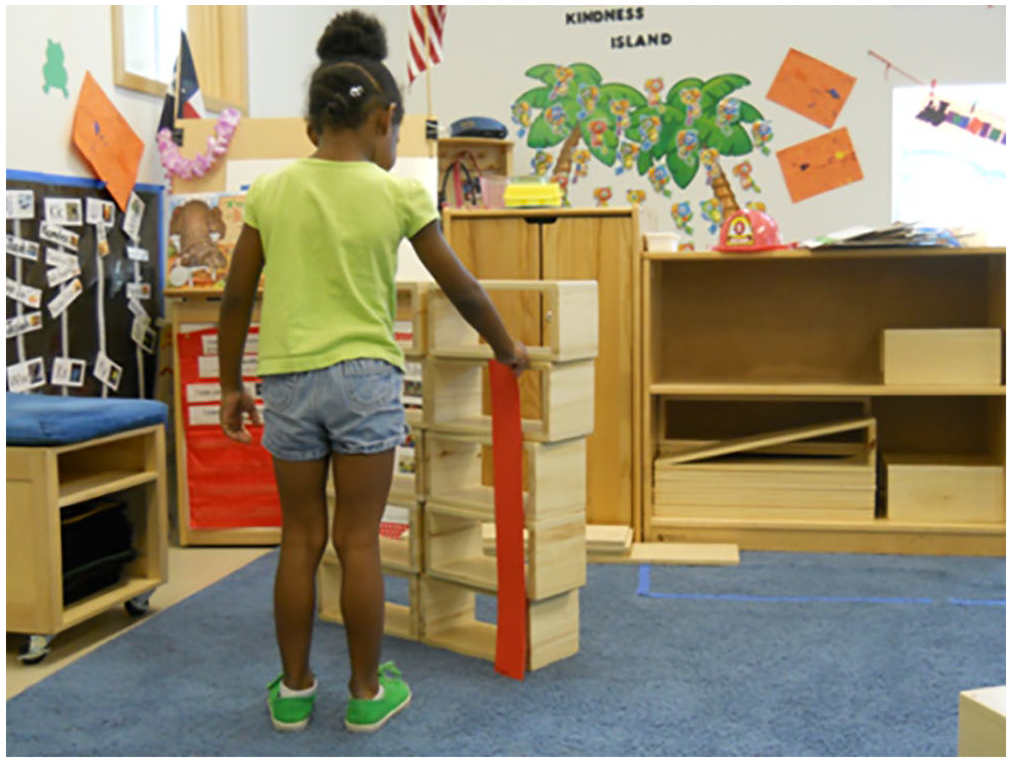
A child measuring a block building using a personalized ruler.
It is common behavior for young children when they play with blocks to try to build their buildings too high and stack up the blocks (Wardle, 2002). Safety becomes a serious concern among early childhood teachers when children start to stack blocks higher than their heights. In this case, however, it was interesting to note that utilizing the personalized rulers tended to make the children spread the blocks out in more complex structures, which is an advanced stage of block-building.
The personalized rulers were placed in the block center and utilized there for the majority of the time. However, as shown in Figure 2, the children sometimes took their personalized rulers to other centers to measure and compare the lengths of their creations with the personalized ruler.
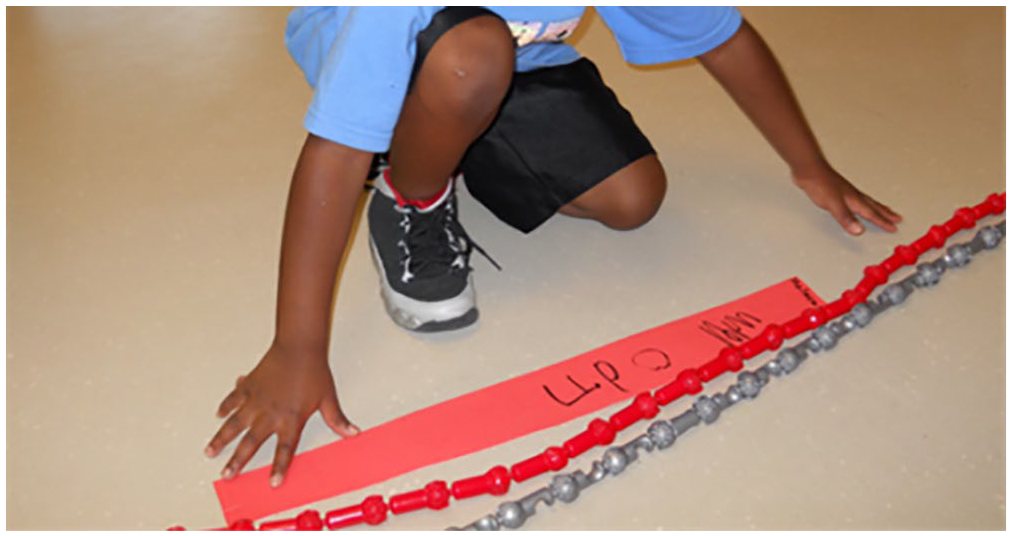
A child comparing the lengths of linking blocks and his personalized ruler.
They were always welcome to use their rulers in other centers. When integrating personalized rulers in the classroom, the children frequently used terms associated with measurement reasoning in comparing the length or height of objects, such as, for example, “longer,” “shorter,” “bigger,” “taller,” or “same.”
Conclusion
Children from Pre-K through Grade 2 should be learning about measurement using a non-standard unit (National Council, 2000). It has been strongly recommended for young children to practice measuring using a variety of objects to help them build concrete measurement concepts (Copley et al., 2004). Measuring occurs in children’s everyday life at home and at school (e.g. “I’m taller than you are”; “I have a bigger hand”; “Mine is faster”). As teachers of young children, being able to connect what children know (often considered informal knowledge of mathematics) and what children should know is very important to help them practice measurement. Children enjoy comparing the measurement attributes of real objects (Lee, 2017). By integrating a personalized ruler, they move to a more abstract level by comparing the targeted attribute of a real object (height of a block building) with a non-standard measurement unit (personalized ruler). This allows them to practice the measurement process using a non-standard unit: knowing what to measure, knowing what unit to use, knowing how to measure, and sharing/reporting their findings (Lee et al., 2015). These are exactly the same processes children follow when they use standard units of measurement.
Footnotes
Funding
The authors received no financial support for the research, authorship, and/or publication of this article.
