




Abstract
This article draws on a new materialist paradigm to explore bricolaging data from an early childhood research project through an immanent ethical lens. This lens enables the researcher to stretch towards non-hierarchical relationships in between subjects and objects, thinking and doing. A bricoleur explores and builds different knowledge-production pathways, allowing experimentation with a wide range of methods and theoretical perspectives. The argument presented here is that bricolaging data could be a non-hierarchical tool through which the researcher considers materiality and artefacts as intra-active participators. Empirical matter – such as videos, photographs, dialogue transcripts, scribblings, sounds, vibrations, bodies and recycled materials – becomes visible through several reviews and rereadings. Here, the bricoleur explores how various data can be read by bricolaging it together, resulting in several narratives that may disrupt and challenge dominant discourses and present alternative perspectives in early childhood pedagogy.
The neo-liberalist logic underpinning western societies places acute pressure on the individual preschool child through education programmes that feature standardized tests in pursuit of predetermined outcomes (Dahlberg and Moss, 2005; Dahlberg et al., 2002; Pettersson, 2017). This ‘schoolification’ of early childhood education and care means that children find themselves increasingly measured against normalizing standards that act to regulate all aspects of childhood by situating children’s learning in a developmentalist perspective (Osgood and Red Ruby Scarlet, 2015: 355). I position this article against this dominant ‘schoolification’ discourse by presenting an alternative perspective on early childhood pedagogy based on the understanding that young children are growing up in a world that is ‘increasingly complex, boundary-blurring, heterogeneous, interdependent and ethically confronting’ (Taylor et al., 2012: 81).
Drawing on new materialist research and methodology, I experiment with how bricolage can produce alternate early years entanglements that offer a shift to different ways of thinking, being and becoming. The term ‘new materialism’ refers to a wide range of ‘contemporary theories that redefine the relationship between matter and meaning’ (De Freitas and Palmer, 2015: 1202). Objects are viewed as intra-active participants in the more-than-human world and not as ‘simply responding to the interactions of the human’ (Malone, 2018: 48; see also Barad, 2007). By bricolaging data from visual and other sensory ethnography (Pink, 2007, 2015), I examine young children’s aesthetic explorations with recycled materials, different matter and materialities. I also consider if and how bricolaging different matter can disrupt dominant discourses in early childhood developmental theory frameworks and policies (Taylor et al., 2012: 81).
In the next section, I introduce the concept of bricolage. Then, I present the research context, including both the human and non-human entities shaping it. This context produces the immanent ethical framework from which the bricolage process emerges. Immanent ethics is developed from the conceptualization of immanence offered by the French philosopher Gilles Deleuze. In Pure Immanence, he writes how life is everywhere, in all the moments that a given living subject goes through and that are measured by given lived objects: an immanent life carrying with it the events or singularities that are merely actualized in subjects and objects. (Deleuze, 2001: 29)
Immanent ethics is a philosophical perspective aimed at moving beyond the framework of established truths and discourses, and attempting to challenge and dissolve hierarchical structures in between human, non-human and the material world (Lenz Taguchi, 2010). Working with immanent ethics allows the researcher to analyse the potentiality of different material relationships which involves and evolves through the project (De Freitas and Palmer, 2015). The different methods include audiovisual processes, multiple ways of writing, and after-talks that proceeded from the children’s material play activities. In the final section, I feature the bricoleurs playing with the ongoing bricolage through different emerging narratives, and explore how these may be of educational interest.
Exploring the concept of bricolage
Bricolage is a concept that is used across various disciplines, including the arts (Del Real, 2008; Dezeuze, 2008; Selkrig, 2014), political science (Carstensen, 2011), and post-structural education research methods (Denzin and Lincoln, 2011; Kaufmann, 2011). The origins of bricolage can be traced to the work of Lévi-Strauss (1966), who introduced the term to the social sciences and situated it as ‘an analogy to depict how … cultures generate new myths and religious systems’ (Altglas, 2014: 474). Lévi-Strauss’s bricolage could be seen as a way of reusing materials, where researchers ‘[p]ick up the pieces of what is left, paste them together’ (Kincheloe, 2001: 681) and use them to solve new problems. A bricoleur will use ‘whatever knowledge tool at-hand in the repertoire, and whatever artefacts that are available in the given context to meet diverse knowledge-production tasks’ (Rogers, 2012: 3).
Bricoleurs work with multi-perspectival methods because they have recognized the limitations of one single method or one disciplinary approach (Kincheloe, 2001: 681). Bricolaging allows researchers to be dynamic and heterogeneous in using disciplines, methodologies and theoretical perspectives (Denzin and Lincoln, 2011) to investigate the ‘complexity of meaning-making processes and contradictions of the lived world’ (Rogers, 2012: 4). According to Rogers (2012: 3), Lévi-Strauss describes the meaning-making bricoleur as one who does not ‘approach knowledge-production activities with concrete plans, methods, tools, or checklists of criterion. Rather, their processes are much more flexible, fluid, and open-ended’.
Kaufmann (2011) describes the bricoleur as one who collects different objects (data) for an installation or a construction (bricolage). A bricoleur assembles objects into entanglements through an improvised and intuitive process, including the use of images, sounds, vibrations, bodies, texts and artefacts (Denzin and Lincoln, 2011). Bricolaging is also a process of collecting diverse elements from various places and times, involving different people (Sandvik, 2011). The verb ‘bricolaging’ refers to unpredictable and creative processes, allowing researchers to draw on various tools and materials to produce new knowledge (Rogers, 2012; Sandvik, 2011).
As the bricoleur in this research and the writer of this article, I am acknowledging Lévi-Strauss’s (1966) and Kincheloe’s (2001) use of the term ‘bricolage’ and building on knowledge by Kaufmann (2011), Denzin and Lincoln (2011), Rogers (2012) and Sandvik (2011). However, I am expanding the concept a bit further to explore in what ways bricolage can offer a more non-hierarchical approach to analyse data differently. Subsequently, can bricolaging acknowledge different ways of producing knowledge with young children? Through different audiovisual and transcribed empirical matter, together with other data, I investigate the potential of bricolaging.
Methodological approaches in the bricolage
I draw on different data from my ongoing doctoral project – Aesthetic explorations with recycled materials: In the light of materiality – in a Remida centre. 1 International Remida centres have the common function of promoting the idea that waste materials (e.g. offcuts or discarded and unworthy items) can be meaningful resources (Remida, 2018; Vecchi, 2010, 2012). Reinventing their use and meaning can extend the materials’ lifespan – a proactive approach to environmentalism and change. Remida centres are all closely connected, developed and inspired by the pedagogy in the early childhood centres in the Reggio Emilia municipality in northern Italy (Remida, 2018). In the Nordic countries, several early childhood centres are influenced and inspired by the Reggio Emilia approach, and there are several Remida centres and also creative-reuse centres.
The Remida centre where the research was undertaken had a black box. Created for children from early childhood centres and schools, this space offered different digital and analogue tools – such as light tables, an overhead projector, torches, light equipment (e.g. coloured spotlights on the ceiling), and audio and recording equipment (e.g. microphones and loops) – to explore materials and materialities. The entire study took place within the confines of this black box, where six small groups of young children encountered recycled materials and different tools. These encounters were video-recorded and photographed. Besides the children, there were early childhood centre teachers and teaching assistants (practitioners), an artist and an atelierista. 2 The artist worked in the Remida centre and supervised the sessions. The atelierista worked as a Reggio Emilia-inspired studio/atelier teacher in the early childhood centre. All of the adult participants, including myself, had worked for several years with values, principles, ideas, materials and tools inspired by the pedagogy of Reggio Emilia.
I have chosen a combination of data collection and creation methods in my doctoral research, where several senses and forms of mediation work together. Bricolaging data from various methods has allowed me to think about research from different perspectives and acknowledge the data’s complexities. The encounters in between the children, the recycled materials and tools were photographed and video-recorded. When photographing, I chose moments that affected me, where I registered the occurrence of something doing (Stewart, 2007); the camera generated photographs that froze moments in time and further attracted my attention. These callings were situations where colours, shadows or movements invited the exploration of the young children (see Figure 1).
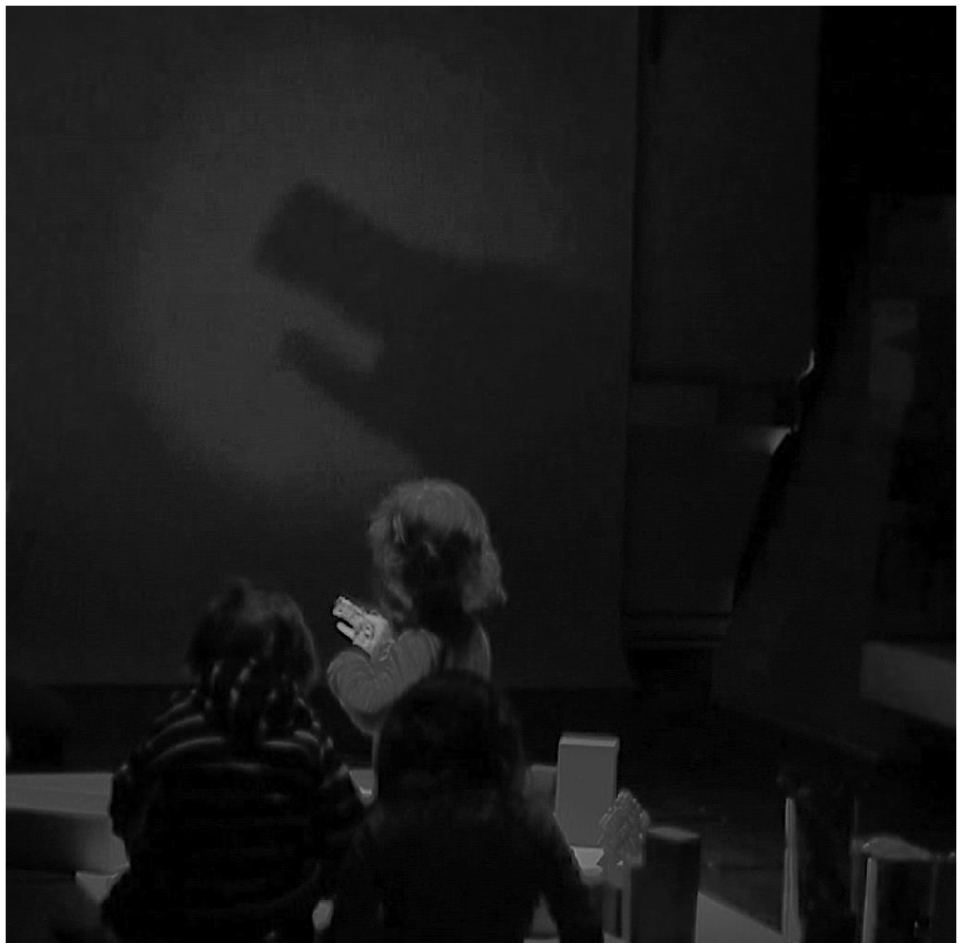
Spooky story.
By using video recordings, I added one more image-based technology to the study as a way to create living images. These living images did not necessarily add ‘significantly more’ than words but could offer insights into complex matter that might emphasize, in different ways, what researchers think they see and write through mere observations (Staunæs and Kofoed, 2015: 1230). Subsequently, the still images and living images had different foci and angles, and contributed to the bricolage in different ways. The audiovisual methods, such as capturing video footage and photographs, enabled me to decentralize the anthropocentric (human-centred) perspective, to physically move the lenses and try to capture these intra-actions between humans, non-humans and artefacts. These different audiovisual methods may not be innocent communication channels in the world but somewhat intertwined and mingled in a disorganized way with the world (Staunæs and Kofoed, 2015: 1230).
The research includes field notes written both during the session and afterwards. In advance, I invited all of the adult participants to join me for a talk (e.g. after-talk). Following up immediately after the session connected us more closely with the embodied experiences, materialities and affects. Within the Reggio Emilia approach, documentation is often used as a starting point for developing pedagogical documentation (e.g. texts, photographs or installations).
Some of the data took the form of jottings during my fieldwork at the Remida centre, including notes on a napkin (in a local café) and field notes while listening to the after-talks or rewatching the video sessions. The different entangled matter made me explore the written text, as part of the ongoing apparatus, through different approaches, including personal narratives from my encounters with the research matter. Writing with full attention to all materialities, as well as challenging the rules and structures of writing, made sense in a new materialistic framework. The immanent ethical approach makes it possible to bricolage the different data at hand and let thoughts happen in writing (Handforth and Taylor, 2016).
The bricoleur ‘cuts together-apart’
Before being aware of the concept of bricolage, I collected objects. Throughout the research process, I collected pamphlets, postcards and posters from exhibitions, as well as popular-science articles from newspapers. I also collected sensations, words, concepts, objects, narratives and images that resonated with the project, and put them on a physical mind map (installation), similar to Kaufmann’s (2011) idea of a bricolage. I collected this matter (e.g. postcards, concepts and images) because it felt like it mattered what matter I used to think other matters with (Haraway, 2016: 12).
Bricolaging some of the objects on a physical mind map made me question and further explore if the bricolage opened up different and complex ways of sense-making where I let myself be affected by the data. The notion of being moved or disturbed by the data lies in the concept of affect. A new materialist researcher is challenged by how to understand and consider the agency and affects that may be produced in data collection and analyses (Lenz Taguchi, 2014).
As a bricoleur, I experimented with how matter became entangled, literally, on the physical mind map (through bricolaging data) and in my senses. The concept of bricolage resonates with me. While bricolaging it together, I studied how different matter – bodies, materials and materialities – became entangled, exploring what these entanglements might offer. Narratives and ideas seemed to emerge with and in the different matter of the bricolage.
Experimenting with the bricolage
This bricolage process comprises several stages. The first consists of collecting and arranging hundreds of photographs, hours of video footage, video transcripts, the pages of transcripts of the after-talks, the mind map, various artefacts and jottings. My analysis starts with relating to the matter by seeing, touching, listening to, feeling and sensing the different material relationships that entangled and developed the bricolage.
In the second stage, I make a selection and execute the agential cuts for the bricolage. I adopted a playful attitude as a bricoleur of different data, inspired by Barad’s (2014) weaving of different texts (from different thinkers) in her article ‘Diffracting diffraction: Cutting together-apart’. The following fragments are ‘agential cuts’ (Barad, 2007) of several images, video transcripts and different writings (e.g. field notes and jottings). These cuts are ‘[d]ifferent powerful parts of a larger apparatus that produced different events, depending on who and what they met’ (Westberg Bernemyr, 2015: 79; my translation). Different matter mattered in the different events by exploring agential cuts where various material conditions made something occur (Lenz Taguchi, 2010). With these agential cuts, different fragments, connectedness and togetherness with the larger apparatus is acknowledged. I am, as Kinchloe (2001: 686) writes, ‘[c]arefully exploring the relationships connecting the object of inquiry to the contexts in which it exists’, in order to construct the most useful bricolage that my wide knowledge of research strategies can provide.
These agential cuts form different matter that produces something in the encounter with other matter, human or non-human; the different agential cuts produce different phenomena (Barad, 2007: 175). Entanglements of matter and meaning emerge from concentrating on each sentence, which is illustrated by the images (Figures 1 and 2) and texts in different styles. Instead of just thinking about them, I try to encounter them by relating viscerally with them as ‘a movement from the abstract and the linguistic to the specific and the material’ (Blaise, 2016: 624). In this way, research becomes an ongoing process, where different affects are continually working within and on each other. Dividing the different sentences and bricolaging them together disturbs linear thinking. ‘In a way similar to poetry, it [becomes] possible for the reader to halt, move back and jump forward and go beyond the linear reading habits through a zigzagging movement’ (Hohti, 2016: 1153).
The collected matter (e.g. on the mind map, various artefacts and jottings) also entangles with and connects to my thinking and writing, doing and being, and the research idea. I am in a state of being in which I choose to live, writing through locality, materiality and artisan craft (Ulmer, 2017: 201). The idea of being a bricoleur makes me more responsive to the data. The bricolage’s materialities draw my full attention, including the matter echoing with the research. The research stories are layered in the bricolage, and I attempt to prevent the predominance of authorial voices (Handforth and Taylor, 2016).
Spooky narratives
Three children are working together with different recycled materials in the Remida centre’s black box. They aesthetically explore the different objects and installations. An artist, an early childhood teacher and an atelierista are also present; they remain mostly silent but support the children if needed. I am settled in a corner with a digital video recorder and camera.
Spooky story One child, Be, explores an industrial metal object with a torch [picture in the bricolage part] (Figure 1). A large shadow appears on the wall. Be says: ‘Now, it is spooky’. The atelierista asks: ‘You think it is spooky?’
3
Be moves the pinkie finger up and down the object’s ‘mouth’ and watches the shadow attentively. For the researcher, it looks like a dragon or a beast with a large mouth turned to the sky. The beast seems to open and shuts its mouth, created by Be’s finger movements. In the background, one of the other children (Le) says ‘Now it is night’ and lies down. (Transcript, video recording)
The spooky story had moments of exploring the material that could initiate subsequent events. During the event and immediately afterwards, these moments attracted my attention, starting with Be exploring the metal piece. This particular moment began a chain reaction that manifested itself through human and non-human entities and the different materialities. Here, I use italic and bold text to help readers follow the different agential cuts of the data.
Be jumps up and follows Le, who is walking around with heavy steps. Both of them with torches in one hand and lifting their feet high and stepping hard onto the floor [a kind of marching?]. ‘This is how a spooky story goes,’ Be says. (Transcript, video recording) There are feet on the wooden floor. I can see it. How the children use their feet, how they wander, dance, walk and run. I can hear it. Their socks swish, tap, shriek and slide, on the floor, with the floor. (Field notes)
They walk around and pass Ad’s work, and they are more attentive than last time, tiptoeing around and between it. The atelierista says: ‘What a sound; it is kind of a spooky sound’ [Referring to the marching steps they take up again after tiptoing]. Le says: ‘It is the horror monster’. ‘Oh, this is the sound of the horror monster … yes?’ the atelierista asks. The stepping of the two children gets even more firm and loud (and now you can feel the vibrations through the floor as well). ‘The ground shakes,’ the atelierista confirms. (Transcript, video recording) I can also feel it. Small vibrations through my body, starts in my own feet, as a light tickling against the sole, and as it passes through, it manifests itself through my legs and whole body and centres around the stomach, heart and lungs, as strong vibration materialities. The children’s explorations entangle with me, not only as what I see or hear, but also through their movements. We all connect through vibrations. (Field notes)
I listen. I listen to the voices as they talk about the events. I listen to their laughter, their struggling with words, their pauses, their repetitions, their hmms and yeses and even more laughter. I listen to my own voice, my eagerness, my questions, my interruptions, my repetitions of words, my hmms, yeses and laughter. I listen again. I listen to the sounds in the back. Children. Children from the fieldwork are still here [where I was] and still there, and they are exploring their surroundings. Experimenting with loud sounds, and laughter. I laugh with them in their excitement. I listen. Words, concepts and meaning-making, questions, reflection and understanding a bit more, or struggling with/in the constant uncertainty. I listen, layers of sounds, tones, laughter and silence connecting with me now and me then, and the sense of revisiting the whole event. (Jottings after listening to and transcribing the after-talk)
Next, I explore what the different empirical matter does by experimenting with the bricolage in an immanent ethical methodology.
Mapping aesthetic explorations and their becomings
Different materialities (e.g. light, shadow, darkness, sound and vibrations) entangled and blended with bodies, words and artefacts (e.g. recycled materials and torches), and discourses on how we, the adults, perceived children and how we were perceived. Words and concepts that were (dis)connected came to light, sparking potential narratives for the participants, the observers and myself (the researcher) – micro-moments of horror and humour. Multiple ways to read appeared out of the hodgepodge of texts, objects and images in the bricolage.
First, the spooky and horror-monster stories were narrated by the children, who seemed inspired by the shadow of the horror monster on the wall (Figure 1) or the beast as an archetype and the different entangled materialities. The spooky story materialized through intra-actions with the materialities of the darkness, the shadows, the torches and the vibrations on the floor – ‘“This is how a spooky story goes,” Be says’. Through the black box’s different tools, materials and materialities, we were all drawn into different spooky narratives and separate tales about the horror monster. Horror was also present in the children’s ongoing narrative when exploring spooky shadows on the wall and feeling the vibrations on the floor, encouraged by each other’s marching in a circle (the spooky story itself) – ‘One could feel the wind gust as they passed’, the atelierista remarks. The spooky story and the horror monster made us feel anxious, and both entertained and frightened us.
Second, as adults, we expressed our fear of objectification (observing and being observed) when we felt reduced to objects or props, losing our sense of authority and control. We articulated our powerlessness: ‘It was like we were not there, all four of us [referring to the adults], or we were there, but as materialities’; ‘They used us like objects’; ‘We have really lost control, our role as adults, our authority’. However, embedded in the ongoing spooky story, we had to deal and stay with this trouble, stuck behind the curtains in the dark space.
In our reflections on these two entangled narratives, we discussed our sensations, such as the gust of wind when the children passed and the vibrations we felt through the floor as the marching altered its form: ‘It was like waves, it was like waves in the room’; ‘It was like, like, what do you call it, several sensations [multi-sensory] at the same time, sound, movements, light … it was very powerful’. We expressed our shared concern at losing authority and being objectified. We also discussed our concern about when to stop if the children could not stop themselves, referring to other situations where children could get hurt or matters got out of hand.
My jottings showed how involved I felt with the occurrence in the black box, as well as my worries about being unable to create the conditions for the encounters between the children and the materialities. I was also concerned that we (adults) would run ahead of what was happening: Together. Beside. Breathe with. Breathe in. Stay. Do not run ahead. Listen Listen Listen. Body. Materialities. Discourses. (Figure 2)
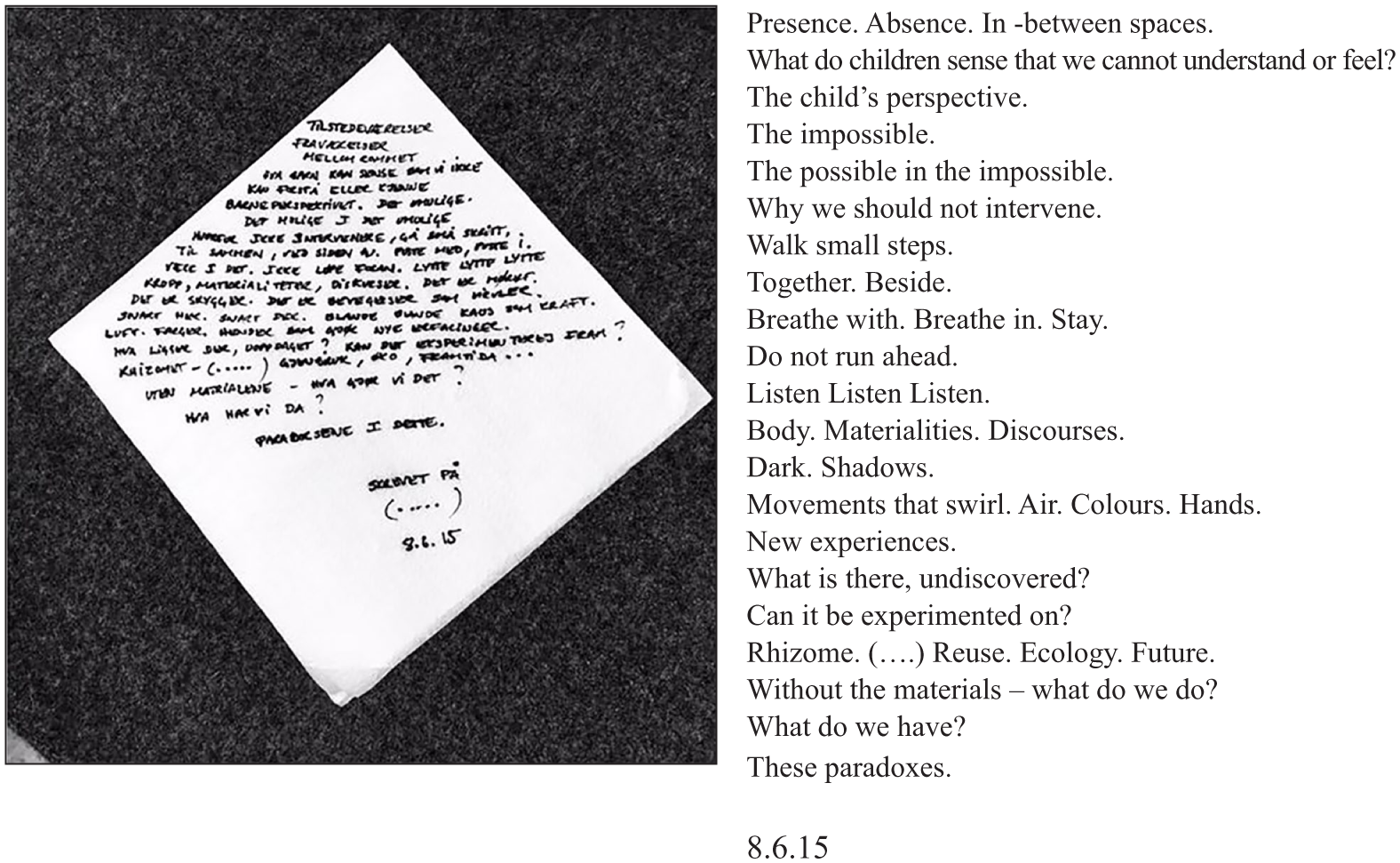
Jottings on a napkin.
However, the children’s use of us (adults) as props, showing their capability to be inspired by the various materials, tools and materialities in the black box, contradicted my worries. The children were creative, curious, strong, interdependent and aesthetically exploring. By using us as props in the room, they challenged the notion of the divide between humans and things (subjects/objects); humans became objects and objects and materialities became companions. They responded to the calls from the materials and intra-acted with the materialities from the materials, lights, shadows and vibrations. Such intra-action can also be viewed as a paradox of objectification in the Anthropocene, where everything other than the human seems to be of lesser value (Haraway, 2016).
Finally, there was horror, simultaneously with a lot of humour and laughter, as described in the transcripts of the after-talk and jottings. Laughter or humour could be perceived as a dichotomy to horror, and could also be claimed as necessary in troubling times. In the session, horror and humour became inseparable, closely connected to, drawn to and drawing from each other, perhaps as a sort of survival mechanism or a ‘co-presence of good and bad, cute and creepy, hospitality and hostility, war and peace, friend and enemy’ (Tesar and Koro-Ljungberg, 2016: 696). For both the children and adults, humour seemed to be an approach to remain strong, cope and find ways of staying with the trouble (Haraway, 2016), despite the embodied fear felt.
Working with immanent ethics as a conceptual framing and as a part of the bricolage urged me to understand learning processes as interdependent intra-actions that could involve concepts, materials and the environment (Lenz Taguchi, 2010). These immanent ethical processes communicated not only through encounters with matter from the fieldwork and the different objects collected along the way, but also with the installation itself (the bricolage) and the movements in time, through memories, perspectives and understandings. By mapping them in the bricolage, the exteriority of the objects connected to whatever forces and directions seemed potentially related to them. Since the bricolage seemed open and connectable in all of its entanglements, it had multiple entryways.
I recognize immanent ethics in this research by considering what transpired in both the data-gathering process and the surrounding spaces; what was added and what just occurred could be significant in the research context. I tried to avoid privileging someone/something in favour of others in the bricolage. In this project, humans, non-humans and matter (e.g. field notes, jottings and other objects) became entangled in a non-hierarchical bricolage.
Bricolaging as a non-hierarchical approach
In this article, I started by asking if bricolaging data could be used as a non-hierarchical approach when considering the intra-actions between humans and non-humans, artefacts and materialities. Subsequently, what could be of educational interest in these materials? What could be important for research in early childhood?
In opening up to entangled data, methods and analysis tools, I was trying to avoid a linear research design and being fixed in a scientific tradition. By staying with the data for a certain period, inspired by Kaufmann (2011) and Koro-Ljungberg (2016), my experience was that some data seemed to emerge from the matter; the data sometimes appeared to be alive, take control, and change me and the bricolage.
Writing and thinking about the data has worked on me as a continuously becoming-researcher undergoing processes with the empirical matter. Relating to Kaufmann’s (2011: 150) argument, the method of analysis does not follow a logical search for meaning, but is ‘a creative play, imaginatively weaving and juxtaposition fragments of the above-mentioned empirical matter, constructing a text where each piece of empirical matter may be read through the other’. The research is, then, rhizomatic, a doing (Rhedding-Jones, 2005). As becoming-research coalesces with materiality, and then with the immanent ethics within the bricolage, what counts as data is called into question.
In the spooky story, bodies, materials and materialities become entangled and spark the narratives. These human relations with more-than-humans offer opportunities to acknowledge materiality, artefacts, space and different materialities in new relations. Light, shadows and vibrations are active participants and companions in young children’s play and learning. ‘When the human is decentered from the investigations and attention is turned to the events that cause us to stumble or wonder, new knowledge is generated’ (Moxnes and Osgood, 2018: 298). New knowledge can challenge sedimented ideas and dominant discourses, and present alternative perspectives. This inquiry presents ways to view the child differently and, further, it offers a hopeful shift away from the schoolification framing that acts to limit, regulate and contain how early childhood education and care is conceptualized, practised and researched. Subsequently, this article’s bricolaged data presents an invitation to practitioners and researchers to consider children and childhood afresh, and thereby create possibilities to register the generative significance of children’s intra-actions with materials and materialities in early childhood pedagogy.
From bricolaging matter, I find bodies (humans) and materialities (non-humans) that resonate with and respond to horror, which is ignited by a complex exploration of/with recycled materials. ‘Things can shape how we use our hands and bodies and determine or affect where we focus our attention and thoughts and how we play and learn; children manage artefacts but are also managed by artefacts’ (Hultman, 2016: 17; my translation). When thinking in non-anthropocentric terms and with immanent ethics, artefacts and humans are mutually entangled in intra-action. Granting authority to children, or even to things, can be horrific, especially for adults, as experienced in the spooky story. As authority figures, adults are used to being superior to children and having control. Humans are so accustomed to being superior to all things that we cannot imagine being extensions of them (Hultman, 2016). Nonetheless, in our encounters with materials, all of us have sometimes felt as if our hands have a will of their own, ‘as a very strong desire to hold, feel, turn and twist, pull closer to the eyes and look, try and explore’ (Hultman, 2016: 13; my translation).
Do we need horror (monsters) in our lives?
By opening up to what data might be, time unfolds. I emphasize the importance of time to stay with the data, focusing on processes rather than results. In the empirical matter (data/objects), humans, non-humans and objects made themselves visible, sensible and audible, emerging from the empirical material itself as entangled words, concepts and objects. We, the participants, could hear the horror (monster) through the children stomping on the floor; we could sense it through the vibrations on the floor and the gust of wind as the strong bodies passed by. The practitioners could feel it by losing their authority over things, materiality and the children, and perceive it in the encounter between the hand and the object. Not one sensation but myriad sensations existed. Not one but several horror narratives belonged to separate people or things, which crossed, disturbed, challenged and entangled with one another.
Using a bricolage as an analytical tool, I tried to avoid falling into long-established research practices and habits, such as taken-for-granted ideas about children or notions from child development theories. At the same time, I risked letting go of certainty and human exceptionalism (Blaise, 2016: 618). Several parallel horror narratives arose from the intra-actions among the materialities of light, shadow, darkness, vibrations, metal objects and bodies. The children’s spooky story and horror monsters, the adults’ fear of being objectified, my horror at being an observer and the horror-humour survival concept are all perspectives of the immanent ethical approach as none-more-important-than-the-other narratives rising to the surface through bricolaging.
With these points in mind, could this article itself be the empirical matter? The text could be the data, part of the bricolage, read by different readers or perhaps even used in different settings, and it could be becoming-research in relation to my text and its readers. If this article resonates and engages readers, they contribute to the bricolage through rereadings, their thoughts and the generation of new knowledge. Subsequently, the bricolage goes beyond this article, where the non-hierarchical material relationship in immanent ethics also includes time. The one I was, myself and becoming-me are intertwined with my earlier experiences from early childhood centres, creative-recycling centres and previous fieldwork.
[T]ime can’t be fixed. The past is never closed, never finished once and for all, but there is no taking it back, setting time aright, putting the world back on its axis. There is no erasure finally. The trace of all reconfigurings is written into the enfolded materializations of what was/is/to-come. (Barad, 2014: 183)
This idea of constantly ongoing data, the becoming-researcher processes, together with what readers produce from the article itself, can produce new understandings and ways of thinking, and processes of experimentation that can extend our appreciation of recycled materials in early childhood contexts and what they do for our conceptualizations of and encounters with children.
Footnotes
Acknowledgements
I thank all the participants in this research: The Remida centre, human and non-human. I am also grateful to the reviewers and my supervisors and critical friends for their thoughtful comments.
Funding
The author(s) received no financial support for the research, authorship, and/or publication of this article.

Notes
Author biography
Nina Odegard is a Ph.D. candidate at the Faculty of Teacher Education and International Studies, Institute of Early Childhood Education at Oslo Metropolitan University. Her Ph.D. project is called Aesthetic explorations with recycled materials - in light of materiality. She began at Oslo Metropolitan after working as a project leader at a Creative Recycle Center and as a pedagogical supervisor for Early Childhood Centers concerning pedagogical documentation, materials, and room as the third pedagogue, all based on and inspired by a Reggio Emilia approach. She has also written a Norwegian book Reuse as a creative force - when matter comes to matter, where she shows how work with recycled materials can inspire open-ended ways of playing, learning, thinking, and producing new ideas.