



Abstract
This article seeks to contribute new perspectives to the ontology and epistemology of preschool science education by exploring the idea of using everyday verbs, rather than nouns, to discern possibilities for science learning in preschool. Herein, the author merges empirical examples from preschools with findings from research on children’s noun and verb learning and posthumanist perspectives on matter and concepts. What comes out of the exploration is a radical way of viewing and knowing the world. The verbs trigger a shift from an object-oriented view of the world to seeing action and non-tangible processes and phenomena in one’s surroundings. Further, the verbs highlight the potential science learning that emerges in action and in child–matter relations, opening up to preschool science pedagogies that go beyond subjective/objective and concrete/abstract binaries.
Possible ways of knowing in preschool science
What are possible and desirable ways of knowing in preschool practice? Globally, the question is brought to the fore by an increasing focus on academically oriented goals in preschool policies (Brogaard Clausen, 2015; Fleer, 2011; Organisation for Economic Co-operation and Development, 2006), causing researchers to raise concerns that subject-specific, narrow forms of knowing will prevail at the expense of care, play and subject integration (Gananathan, 2011; Gunnarsdottir, 2014; Klaar and Öhman, 2014). But while current policy trends indicate a narrowed scope for possible ways of learning in preschool, parts of contemporary early childhood research work in an opposite way, extending and multiplying notions of children’s knowing and being in the world. Not least in this journal, recent contributions have opened up new ways of thinking about the role of children’s bodies, their relations with matter, and children’s emotions and explorations in preschool pedagogy (e.g. Ottersland Myhre et al., 2018; Procter and Hackett, 2017). A posthumanist/new materialist wave of theorising has interrupted many of the concepts that are core to preschool practice by challenging the human-centred foundation on which they build. For example, researchers have suggested that ‘play’ (Änggård, 2016), ‘interest’ (Moberg, 2018) and ‘learning’ (Taylor et al., 2013) emerge and develop in multiple versions in children’s – emotionally loaded – relations with a material world that is not passive, but ‘plays back’.
Taking both these trends into account – increasingly academically oriented preschool policies and the contemporary research discussion on children’s knowing and being – this article engages with the subject teaching practice that may be part of preschool realities. Herein, I explore ontological and epistemological potentialities arising in the arena of science teaching in Swedish preschool, which is a school form for children aged from one to five. The revision of the Swedish curriculum in 2010 meant an increased focus on stimulating children’s learning and interest in science, including their knowledge about ‘relations in nature’ and ‘simple chemical processes and physical phenomena’ (National Agency for Education, 2011: 10). My point of departure is that preschool science teaching occurs at a crossing point of preschool and science traditions, and, at that crossing point, one critical issue concerns the view of the knower and the known. While western preschool practices commonly build on child-centred ideals (Taylor et al., 2012), where the child’s voice and subjective experiences are central in one way or another (Sommer et al., 2013), a central claim of traditional science practice has been that knowledge production is objective and universal, transcending human particularity (Keller, 1992). These seemingly opposing ideals of the preschool and science – in simplified terms framed in an objectivity/subjectivity dichotomy – suggest that epistemological tensions arise as educators implement science activities in preschool. Such tensions are indicated in recent Swedish studies, showing student teachers’ and in-service teachers’ resistance to telling children what is ‘right or wrong’ in science activities, thereby avoiding the position of an authoritarian presenter of science facts (Areljung et al., 2017; Sundberg and Ottander, 2013). Other studies show that even though teachers have intentions to steer practice towards science learning, these intentions are often overshadowed by their will to follow children’s initiatives and ideas (Gustavsson et al., 2016; Westman and Bergmark, 2014). What can be discerned from these studies is a tendency for teachers to avoid a stereotype science epistemology of predetermined, objective knowledge, since it clashes with the preschool ideal of basing practice on the experiences and interests of individual children.
Yet, the crossing point of preschool’s and science’s ways of knowing is not solely an arena of tensions, but also one where educators’ and researchers’ boundary work opens up to epistemological reconfigurations of traditional science teaching. Here, I draw on a generalised and simplified idea of traditional science teaching based on Siry’s (2013) overview of the research on what happens in school science classrooms – that is, a transmission of canonical concepts from teacher to student, as well as practical experiments that follow a cookbook approach. Contesting traditional science teaching, Siry (2013) and Andersson and Gullberg (2014) have, respectively, given examples of how children produce their own science knowledge by playfully engaging in inquiry about water and sinking and floating objects, which is a common exercise in preschool. They point out that if children’s actions and understandings are measured against canonical expectations of how ‘buoyancy’ should be investigated (often by sorting floating and sinking objects into two piles) and explained, a large share of children’s progressive investigations and emergent understandings of science will go unnoticed. But if children are encouraged and supported to conduct investigations based on their own discoveries and questions, children may, as in Siry’s (2013) example, gain more multifaceted experiences of the buoyancy concept. Areljung et al. (2017) give another example of productive boundary work in the preschool science arena by pointing out how educators, in their talk about their own preschool science practice, acknowledge a vast range of legitimate ways to learn about the material world, including, and combining, children’s systematic observations, experiments, whole-body experiences, personal taste and imagination. One educator tells a story about when they brought paper and pencils to a forest to draw the trees. The children noticed that there were no leaves on the trees, but then ‘some of them decided to draw leaves anyway because it was prettier’ (Areljung et al., 2017: 1186). From this educator’s point of view, there did not seem to be much tension involved in the fact that the children’s observations of what the trees looked like were blended with their individual taste of what looked pretty. Rather, both these features (observation and taste) of knowing were possible at the same time. The way these educators conceptualise their own teaching indicates that preschool science teaching may transcend the objective/subjective divide and make way for children to learn science with their whole beings.
Recognising that the realisation of science curricula in preschool practice evokes educators’ and researchers’ resistance and reconfigurations of traditional ways of teaching, the current article aims to further contribute to the discussion of what preschool science pedagogies can be. I find that such a discussion is critical at a time when an increased focus on academically oriented learning goals accentuates questions of what are possible and desirable ways of knowing in preschool practice. Following Siry’s (2013) plea for science pedagogies that emerge from children’s inquiries, I seek to provide alternative ways of communicating, and analysing, the potential for science learning that emerges in children’s activities in the world. In order to meet the article’s aim, I explore and discuss the ontological and epistemological potentialities of a particular pedagogical idea concerning science in preschool, presented in the following section.
The ‘verb idea’ emerges and expands
A few years ago, five preschool educators and I initiated a project regarding science education in preschool. The project was inspired by design-based research, where both practitioners and researchers are involved in formulating the problem and setting out goals, and where a model addressing these goals is developed through implementation in practice (Plomp, 2013). Our educational goal was to develop pedagogical models or materials for educators to support children to develop knowledge of chemical processes and physical phenomena (Areljung, 2016). As is common in design-based research, the research aims were twofold, aiming to contribute knowledge on both the model or materials developed and the design process itself (Plomp, 2013). Initially, we did not have any specific idea of what type of model or material we would develop. Since our professional backgrounds were different (five educators with long and wide experience from working in preschools and educating in-service preschool staff and myself, a science education researcher and former schoolteacher of science and mathematics), we used the first meetings to discuss what we thought preschool science could be. Early on, one of the educators described a preschool scenario which he had learnt about from another preschool educator, to discuss what potential science learning it might entail: Story 1. Rags sticking to the wall. A small group of preschool children were in a room where there was a bucket of water and a number of rags. No adult was in the room, but the situation was videotaped. The video showed that the children dipped the rags in the water and then threw the wet rags on the wall, noticing that they stuck to the wall for a while. They also noticed that if they threw dry rags on the wall, they did not stick.
The story of the rags sticking to the wall was a critical event for those of us who participated in the meeting because it led to a profound impact on how we viewed the world (Webster and Mertova, 2007). I propose that, prior to the meeting, we had all typically focused on nouns and tangible objects when seeing and communicating about the world, but during the meeting we experienced a radical change in perspective. When we jointly considered the story about the children throwing rags on the wall, we happened to draw attention to the verb ‘stick’ instead of focusing on the bucket, the water, the rags and the wall – the nouns involved in the story. We concluded that ‘stick’ was what was going on, temporarily, between the wet rags and the wall. Hence, the verb ‘stick’ led us to notice the special event that, under these circumstances, these specific materials attach to each other while other materials do not.
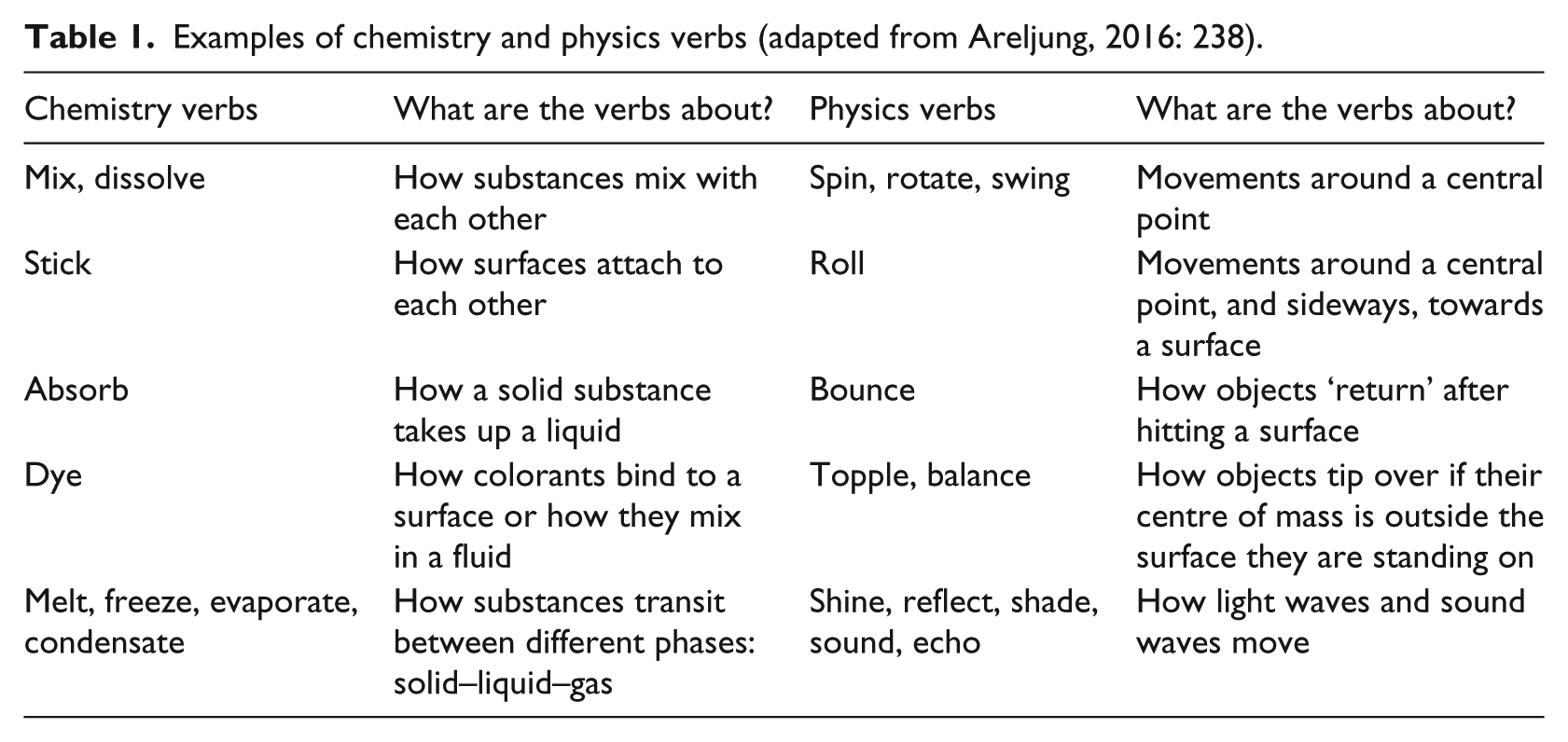
We soon realised that the verb ‘stick’ could help us to identify several scientific phenomena in everyday preschool situations. When things stick to each other, it is often because of chemical and physical phenomena such as magnetism, adhesion, friction and static electricity. Intrigued by this colloquial entrance into physics and chemistry (topics often perceived by educators as difficult to work with in preschool (Areljung, 2018a)), we tried to identify more everyday verbs that relate to physical phenomena and chemical processes. For physics, we listed verbs that involve energy, movement and forces, such as ‘roll’, ‘spin’, ‘rotate’, ‘swing’ and ‘bounce’ (Table 1). For chemistry, we listed verbs that address the properties and constitution of various substances, and what happens when various substances meet. Examples of such verbs are ‘mix’, ‘stick’, ‘dye’, ‘melt’, ‘freeze’ and ‘rust’. The verbs address a particularity, a phenomenon that does not occur everywhere but depends on certain conditions. For example, by using the verb ‘reflect’, educators and children can identify the particularity that some, but not all, surfaces function as mirrors. By using the verbs ‘balance’ versus ‘topple over’, they can discern the particularity that different things happen to the building blocks in a tower depending on how they place them.
Examples of chemistry and physics verbs (adapted from Areljung, 2016: 238).
Soon after the emergence of the idea of using everyday verbs in work with science in preschool (hereafter referred to as the ‘verb idea’), we engaged 10 educators in 3 preschools to implement and develop the idea in practice. Previously, I have examined why the verb idea was adopted by these educators, finding that the idea seemed to function as a catalyst, helping educators to identify physics and chemistry in everyday events (Areljung, 2018a). Foreseeing the pedagogical potential of the verb idea, those of us who participated in the project continuously shared our work in various forums (conferences, blogs and professional development events) and learnt that it was being adopted by educators locally, nationally and internationally. Recently, the verb idea was included in a professional development programme launched by the Swedish National Agency for Education (Areljung, 2018b).
The verb idea occurred unexpectedly and not from any expressed theoretical underpinning. Over the years, as I recognised that the verb idea was impacting the preschool community far beyond the preschools participating in our project, I became increasingly interested in trying to uncover theoretically what it was about the verb idea that could critically impact my – and others’ – view of, and practices in, the world. In this article, I seek to unpack the ontological and epistemological potentialities inherent in the verb idea by reading it through three lenses that I did not have in mind when starting the project. The first lens focuses on young children’s noun and verb learning. I chose this lens because the verb idea arose from the contrast between linguistic elements. The second lens focuses on matter and mattering, and troubles the relations between the knower and the known. I was inspired to choose this – posthumanist – lens because I judged that it resonated with the way the preschool educators and children materialised the verb idea in practice – for example, by exploring the physics verb ‘rolling’ with all of their bodies and many different modes of expression. The third lens adheres to the posthumanist perspective as it focuses on science concepts as agentive rather than pre-existing abstractions. My aspiration is that the three readings will twist and trigger each other to generate knowledge in line with the article’s aim – to provide alternative ways of communicating, and analysing, the science learning potential that emerges in children’s activities in the world.
Data production and ethics
Seeking to elucidate and extend the discussion, the following sections include two stories from a preschool that has implemented the verb idea in practice. The stories stem from transcriptions of six project meetings in which the educators and I discussed their verb-based science activities, drawing on the educators’ visual (photographs, videos) and verbal recollections from their own practice. Just as the above story about rags sticking to the wall, the stories were formed and inspired by critical event narrative analysis (Webster and Mertova, 2007). While the story of the rags sticking to the wall was the critical event that initially caused a profound change in how we in the project group viewed the world around us, I have built the following two stories on what Mertova and Webster (2012: 15) refer to as ‘like events’ – that is, events that further ‘illustrated, confirmed, and/or repeated the experience of the critical event’. The like events stood out from the transcripts because they were portrayed, by the educators and/or myself, as remarkable discoveries tied to the physics verbs under exploration. One like event concerns the discovery of how rolling and spinning motions differ; the other is about clapping the rhythm of rolling. After having identified the like events, I sought information in the transcripts, occurring both before and after the events, to produce a narrative of how the educators and I tried to make sense of the events.
In line with the design-based approach, the empirical data was produced to serve both educational and research goals (Plomp, 2013). Prior to starting the collaboration with the preschools, I informed the caregivers and educators about the purpose and use of the data, and their right to refrain from participation, as well as my efforts to keep all individuals anonymous when communicating about the project. When it comes to handling data, another ethical matter concerns the ownership of the project’s outcomes. By writing this article, I have claimed power over a part of the outcomes, as I have been the one who has condensed and interpreted the data from the educators’ practices into stories to fit the article’s aim. Yet, I have not had the monopoly when it comes to analysing and voicing our joint work. The participating educators have presented our project in several professional development events, produced their own blogs and been interviewed in various media. In this way, the project has multiple outcomes in terms of what we participants emphasise, conclude and ask. Since we have shared thoughts during the project, these outcome are inevitably intertwined, and difficult to separate and assign to single authors.
Through a linguistic lens: touching items (noun referents), experiencing actions (verb referents) or making them happen
I start this section by presenting an overview story of the preschool’s work in order to provide a backdrop for a linguistic reading of the verb idea: Story 2, Part 1. The rolling and spinning theme work. The educators told me that they wanted to focus on physical phenomena that children could explore with their whole bodies. Therefore, they decided to work with the two physics verbs ‘roll’ and ‘spin’, and carried out the theme ‘kick-off’ in a large field, encouraging the children to roll and spin in different ways. This type of activity recurred throughout the year-long theme work, with various additions, such as trying to roll somebody else up a hill or trying to roll in parallel down a hill. During the theme work, the children also tried to roll different items down hills and inclined planes, and to paint inspired by the verbs ‘roll’ and ‘spin’. On one occasion, the children were given the task of finding and photographing four things that rolled and four things that did not roll. The children tested the rolling ability of things they found in the preschool practically before adding them to their image lists of rolling and non-rolling things.
This first reading is done through a lens formed by research on children’s noun and verb learning. Drawing on previous research in the field, Friend and Pace (2011: 867) point out that the referents for verbs (actions) may be difficult to distinguish since they are entangled in a ‘stream of motion’, whereas the referents for nouns can often be distinguished as solid objects with clear boundaries. However, the pattern is nuanced. Golinkoff and Hirsh-Pasek (2006) highlight that some verb mappings are relatively easy if the actions are distinct, such as ‘eat’ or ‘kiss’ – as well as, I suggest, ‘roll’ and ‘spin’. Further, Mandler (2006) posits that children often draw on their experiences of whether and how objects move when they judge if they are animate or inanimate, which points out that actions play a role not only in verb mapping, but also when mapping a noun to an object. The example can be transferred to the sorting/rolling-items exercise mentioned in the story above. Even if children draw on the visual features of a wheel or a ball, such as their roundness or spherical shape, to discern them from other items, they might ultimately determine whether they are balls, wheels or something else depending on how they roll. That way, the clear boundaries of the solid objects (see Friend and Pace, 2011) are blurred, and the process of detecting noun referents is intertwined with the detecting of verb referents.
Nevertheless, the research consensus is that it is easier for children to map nouns to their referents than to map verbs. Does this imply that it is more appropriate to build preschool science themes on nouns rather than verbs? I rephrase the question by asking what kinds of experiencing noun-oriented and verb-oriented science teaching proposes. While many nouns refer to objects or organisms (in preschool, science themes often revolve around nouns such as ‘water’ and various plants or animals) which it is possible for children to observe and touch, verbs often refer to actions which are ephemeral and cannot be observed or touched in the same way as still objects (see Gentner, 2006). So far, the noun/verb divide is in line with binary thinking in terms of concrete/abstract, which is a dichotomy that has been influential in preschool practice historically, suggesting that the concrete, not the abstract, is appropriate for children to work with (Cannella, 1997). However, children can experience verb referents such as ‘roll’ and ‘spin’ with their own bodies or make them happen (Brandone et al., 2007), which indicates that one way for children to explore physical phenomena is through embodied experiences of the referents for physics verbs. In so doing, I suggest that the concrete/abstract is overruled. When children experience a verb referent, it is not applicable to talk of things being either concrete or abstract. Although verb referents – for instance, the referent for ‘rolling’ – cannot be touched in any concrete form, they do not necessarily refer to phenomena that are abstracted from children’s worlds, but to phenomena that they can feel in their own bodies, as they are both tangible and uncapturable at the same time.
Generally, language research regarding young children’s verb and noun learning triggers questions about how we view the world and how we portray it. In the sorting/rolling-items exercise mentioned earlier, the children were asked to take photographs of what rolled and what did not, which implies that the objects’ boundaries were materialised in two-dimensional still-life pictures. If you look at photographs of a cube, a ball and a child, you may perceive that they are solid objects with distinct visual differences (see Brandone et al., 2007). Yet, if you look at video shots of a cube, a ball and a child rolling down a hill, the object-related distinctions are blurred, while ‘roll’ stands out as a distinct event (see Golinkoff and Hirsh-Pasek, 2006). Such a photograph/video metaphor evokes questions of what is portrayed as valued – and possible – ways of knowing in preschool pedagogies. Do preschool documentation practices foreground clear border objects and congealed snapshots of everyday life or do they also capture the ongoingness of what happens in the preschool? In order to further this ontological discussion, I present a continuation of Story 2, formed around the discovery of how rolling and spinning motions differ: Story 2, Part 2. Rolling versus spinning. The educators held onto ‘roll’ for a whole year but abandoned ‘spin’ after a few weeks since it did not seem to engage the children. During our project meetings, the educators and I discussed how it could be that the children’s engagement varied so much depending on which of the verbs they were asked to explore. The educators concluded that in one of the activities, in which they had encouraged children to roll and spin in a green field, there were many different possibilities to move across the field while rolling, whereas spinning meant that the children moved around in the same spot. A similar difference emerged when children were encouraged to paint ‘roll’ and ‘spin’. Painting by having marbles and other items roll through paint gave rise to various patterns across the paper, but when children painted ‘spin’, they turned the paintbrush around in the same spot, resulting in one circular mark on the paper.
In terms of how we see the world and our place in it, I find it particularly interesting that Brandone et al. (2007: 1322) argue that verb learning is important, since verbs ‘allow us to talk about, not only people and things, but, crucially, the relations between them’. In the story above, the verbs ‘roll’ and ‘spin’ address the relation between the children and the ground. In the first case, almost all of the children’s bodies are put in relation to the ground, as they roll across a surface, whereas only feet and the ground are in relation when they spin. As the story indicates, the educators considered the possibility that the children were more engaged in rolling because that verb proposed more varied actions compared to spinning. The difference emerged in the children’s own bodily rolling and spinning, as well as in their artwork. Both the person/painting tool that rolls and that which spins move around their midpoint, but a key difference is that the person/tool that rolls also moves across a surface. I find the discovery of this force-and-motion-related distinction between roll and spin remarkable – not necessarily the distinction as such, but the way it surfaced in an arena where various forms of bodily engagements and art experimentation were intertwined. Sticking with the linguistic view on verbs as markers of the relations between people and things, or things and things (Brandone et al., 2017), I will now add a second lens to my reading of the verb idea, focusing on verb and noun dimensions in posthumanist work on knowing and relations between people and matter.
Through a posthumanist lens: science learning emerging within child–matter relations
Taylor et al. (2012) propose that the human-centred ideal of fostering autonomy and individuality has been very powerful in preschool policies and practice. Yet, in the last decade, a growing body of research has used posthumanist theorising to challenge human-centred pedagogies. When I read preschool practice through a lens from which the human is decentred, I become more observant of children’s constant engagements with non-human organisms and matter that dictate what is possible and desirable for them to do (e.g. Duhn, 2012; Rautio, 2013). For example, Hultman (2011: 77) suggests that children hypothesise with matter and not about matter, since ‘things whisper, answer, demand and offer’ (my translation). But rather than allocating agency to children and matter per se, posthumanist work commonly suggests that interest, hypotheses, investigations and conclusions emerge within matter–child or matter–matter relations (e.g. Hultman and Lenz Taguchi, 2010). Birch (2018) has, for example, troubled the notion of ‘children’, ‘spaces’ and ‘experiences’ in the museum. While the museum tradition carries an emphasis on the museum’s objects and their written descriptions, or on the visitors and their experiences, Birch draws on contemporary museum research and posthumanist work to argue that attention be drawn to the in-betweenness (the child–object relations) that happens in museums. If Story 1 is read through such a relation-focusing lens, it would be the ‘sticking’, rather than the children, rags or the wall as such, that sparks the investigation and maintains the children’s interest. In Story 2, it would be the ‘rolling’ and ‘spinning’, not the children, the wheels or the hills, that encourage the explorations of how incline, surface, composition and shape matter to how the physical phenomena feel in your body; how heavy, monotonous or joyful they are; and what their paint tracks may look like. Combining a linguistic and a posthumanist lens, I see that the science verbs may be referents for relations between matter and matter (rags sticking to the wall) and children and matter (children rolling on/with the ground) in which agency emerges, and may drive science practice and learning.
Since the verb idea arose from the contrast between linguistic elements, it may be considered difficult to fit with posthumanist views on mattering, as linguistics is a contested area within posthumanist theorising. For example, Barad (2003) has sought to disrupt the idea that language can represent the underlying structures of the world. I do not delve into that discussion here, but wish to point at (with the representational problem put aside) the resemblance between the idea of highlighting verbs and actions, instead of nouns and objects, and Barad’s (2003, 2007) theory of ‘agential realism’, in which objects do not exist on their own, but emerge in mutual processes within relations – coined ‘intra-actions’. As such, the relations are ontological entities that come before objects (Barad, 2003), compared with the verb idea, which suggests a shift towards seeing verb referents before noun referents in everyday events. Rereading Story 1 from an agential-realist perspective, the ‘sticking’ would be a primary ontological entity, through which objects – the rag, water and wall – emerge. The shift is small (just verbs instead of nouns), but enormous (shifting one’s perception of primary ontological entities), which is why agential realism offers some insight into why the story of the rags sticking to the wall sparked a critical event that profoundly affected how we viewed the world (Webster and Mertova, 2007).
When it comes to knowing, agential realism entails that we cannot know from a position outside the world, but that we are entangled with the material world, which we try to understand (Barad, 2007). The idea of producing knowledge in such a way breaks from a traditional scientific method, which claims to produce objective knowledge, conveying the idea that the scientist is distanced from the matter manipulated in the inquiry (Barad, 2007). What is central here is to what degree, if any, the knower may be entangled with the known. With reference to Barad’s work, Colucci-Gray (2017: 550) discusses the role of learners’ experiences in science education, asserting that when knowledge is ‘encapsulated in nouns’, it may no longer have any connection to the learners’ original experiences of the science phenomenon per se. In contrast to the idea of science learning as accumulating factual information, Colucci-Gray proposes that science learning is a form of literacy that builds on retelling one’s activities in the world. Considering the viewpoints of Barad and Colucci-Gray, I find the following story significant: Story 3. Clapping the sound of rolling. Having started in the autumn, the preschool’s ‘rolling theme’ kept going for a whole year. In the winter, the children rolled on various types of snow, identifying the various sounds of their rolling. Soon after they begun to record and compare the sounds of various items rolling down a snowy hill. The children also produced rolling sounds themselves, and the educators and children arranged a contest in which they voted for their favourite sound. Further, the educators encouraged the children to paint and sculpt the sound of rolling. In a follow-up interview, the educators expressed that the children, after several rolling activities both outdoors and indoors, ‘have the sensation of rolling in their bodies’. The educators described one occasion where they had encouraged the children to ‘clap the sound of rolling’. Some of the children clapped the pace between each turn. Further, they clapped quickly to illustrate rolling down and made one single clap to illustrate rolling upwards. One educator was struck by what had unfolded through the children’s clapping, saying: ‘I feel in my whole body that this is a discovery. It is like a summary of all that we have done [during the theme work]’.
The educators’ statements in the above story suggest that the children captured various dimensions of ‘rolling’ through embodied experiences, and that they could transfer their conclusions through bodily communication. In this story as well as in Story 2, which have displayed glimpses of how the educators implemented the verb idea in practice, appears an alternative to the classical, detached form of systematic science inquiry. I suggest that the systematic lies in the multifacetedness, in children’s many ways of experiencing science phenomena and of retelling their experiences (Colucci-Gray, 2017) – for example, by showing, painting, sculpting and clapping their experiences of rolling. Here, children are invited to express and explore their experiences with multiple senses and aesthetic modes of expression, promoting personal taste (voting for one’s favourite sound) and imagination (painting what the sound of rolling may look like) as part of intensifying their understanding of science phenomena. In such forms of systematic inquiry, educators need not differentiate between subjective and objective ways of knowing since there is room for both personal and more general forms of knowing when exploring science phenomena from within child–matter intra-action.
Through an agentive-concept lens: science phenomena as playmates changing the game
The verb idea assumes that some concepts (verbs) are particularly useful for identifying and encouraging children’s engagement with physical phenomena. The verbs included in our list are intentionally colloquial in order to lower the threshold for teaching science, contesting conceptions of science as difficult and something that happens in classrooms, not in everyday life. But what is the nature of these verbs? In this section, I continue along posthumanist trajectories when reading the verb idea through a lens that troubles the notion of concepts.
Drawing on the work of Gilles Deleuze and Félix Guattari, recent research has explored the idea of concepts being agentive and ongoing parts of education, rather than timeless, fixed and transcendent abstractions (Colebrook, 2017; Lenz Taguchi, 2016). The idea is critical in a preschool context because, as De Freitas and Palmer (2016) point out, if we treat concepts as transcendent abstractions, we will keep interpreting children’s activities as failing to resemble the concepts. If we instead consider concepts as something that emerges within children’s activities in the world, there is no predetermined template to fail to resemble as children themselves contribute to an ongoing making of the concepts. In their analysis of children building towers of plastic beakers, De Freitas and Palmer (2016) propose that the concept of ‘gravity’ is agentive in the sense that it intervenes in the building. For example, ‘gravity’ acts when the children’s hands destabilise the tower and the beakers fall down, making mild sounds when they bounce on the table and floor, and when the children pick them up to carefully place them on top of the tower again. De Freitas and Palmer write that concepts can be seen as ‘flexible and amusing playmates participating in children’s explorative investigations’ (1220). Gravity plays with the children, the plastic beakers, the air and the floor. It is an unruly counterpart, but crucial to the sounding, bouncing and (de)stabilising events that keep the exploration going. This analytical approach has also been used by Haus (2018), who suggests that concepts of force act as playmates when a child makes and tests a paper plane. Haus posits that the child and paper ‘become scientific’ in intra-action as the child experiences and investigates how the concepts of force influence their folding and flying.
When reading the verb idea through the lens of agentive concepts, I must first ask whether verbs such as ‘spin’ and ‘roll’ are too colloquial to even count as science concepts. In De Freitas and Palmer’s (2016) description of the tower-building, everyday verbs such as ‘falling’ and ‘bouncing’ are part of the example, but ‘gravity’ is the concept in focus for analysis. Thinking of verbs in linguistic terms, as a referent for action and relations (Brandone et al., 2007; Friend and Pace, 2011), I suggest that ‘falling’ and ‘bouncing’ mark the events in which gravity emerges and acts as a playmate. So, rather than considering the everyday science verbs as agentive concepts as such, I suggest that the verbs can be referents for the intra-actions in which agentive science concepts come into play. For instance, in Story 1, the concepts ‘adhesion’ and ‘gravity’ can be said to unfold and act within the sticking. The wet rag sticks to the wall as chemical forces (adhesion) between the water and the wall come into play, but eventually these forces are trumped by gravity and the rag falls (another physics verb) down. In line with De Freitas and Palmer’s (2016) suggestion, ‘adhesion’ and ‘gravity’ can be considered to be playmates that intervene in the children’s exploration, changing the game and making it exciting. Without adhesion and gravity, this particular play would not have been possible. Another playmate, occurring in Story 3, is the concept of ‘sound’ that emerged and acted in the rolling activities. According to the educators, the children were involved in recording and retelling a large range of various sounds. The sound was never exactly the same, due to the ever-changing combination of weather, incline, surface, speed and body, which suggests that the concept ‘sound’ was a versatile playmate, intervening in the child–matter intra-actions and making the rolling an exciting sonic endeavour.
Conclusion: action-oriented preschool science beyond the subjective/objective divide
With this article, I have discussed the idea of verb-oriented science teaching in relation to research on verb and noun learning and to posthumanist perspectives on knowing and the idea of concepts as playmates. The discussion boils down to the question of what type of ontological entity (objects or actions/relations) we foreground in our speech, which type we perceive first in everyday events in preschool, and how that, in turn, affects preschool science pedagogies. After reading the verb idea through a combination of three lenses – the idea of verbs as referents for relations and actions (linguistic lens) with the idea of intra-action (posthumanist lens) and that of agentive concepts – my condensed suggestion is that the verb idea may help educators to recognise, and build on, the intra-actions in which science concepts unfold and act as playmates. In this sense, the verb idea breaks new ontological and epistemological ground at the crossing point of preschool and scientific ways of knowing. In terms of challenging ontology, the verbs trigger a shift from an object-oriented view to being oriented towards actions and the relations between children and matter (see Brandone et al., 2007), attentive to the ephemeral, non-tangible – but experienceable – science phenomena in our surrounding world (see Friend and Pace, 2011). In terms of challenging epistemology, the verb idea aligns with the idea that knowing emerges in action and in human–matter relations, and thereby traditional science ideals of objectivity, where the scientist learns ‘at a distance’ from the material s/he learns about, are challenged (see Barad, 2003).
This article is positioned at a time when an increased focus on academically oriented learning goals accentuates questions of what are possible and desirable ways of learning in preschool institutions. One issue essential to the field of preschool science research concerns children’s role in learning and, in contrast to school science traditions of students acquiring canonical concepts, Siry (2013) and Andersson and Gullberg (2014) have argued for, and provided empirical examples of, pedagogies that build on the idea that children produce their own science knowledge by actively engaging in inquiry. As their analyses are framed within human-centred perspectives, mainly allocating agency to children and teachers, the current article offers additional insights into how such pedagogies may be conceptualised. From a linguistic point of view, verbs may be referents for relations and actions, which implies that the verb idea could support action-oriented pedagogies in which children experience and test scientific phenomena in relation with their surrounding world. In such pedagogies, science concepts are seen as agentive playmates rather than pre-existing, decontextualised ideas to be acquired (De Freitas and Palmer, 2016), and children may produce knowledge by retelling their actions in the world (Colucci-Gray, 2017). Such a pedagogical approach makes way for preschool educators to create new ways of talking about children’s science learning, where possible and desirable ways of knowing are not divided along subjective/objective or concrete/abstract dichotomies, but rather are a matter of engaging in multiple relations with the surrounding world.
Footnotes
Acknowledgements
My wholehearted gratitude goes to the educators and children who have contributed their creativity and enthusiasm to developing the verb idea in practice. Furthermore, I want to thank the anonymous reviewer whose insightful comments helped me to expand my thinking and writing.
Declaration of Conflicting Interests
The author(s) declared no potential conflicts of interest with respect to the research, authorship, and/or publication of this article.
Funding
The author(s) received no financial support for the research, authorship, and/or publication of this article.