




Abstract
This article considers opportunities and risks arising from the prominence of the belonging motif in Australia’s Early Years Learning Framework and, more implicitly, in the National Quality Standard, against which the quality of the early childhood education and care services is assessed. A vignette constructed from case study data generated in the babies’ room in an early childhood centre in an Aboriginal community in rural Queensland is used to illuminate some of these opportunities and risks.
Keywords
Introduction
As its official title makes explicit, Australia’s national early childhood curriculum, Belonging, Being and Becoming: The Early Years Learning Framework for Australia (EYLF; Australian Government, 2009), foregrounds the motif of ‘belonging’. The prominence of this motif has been amplified by the formal linking of the EYLF to the National Quality Standard (hereafter the Standard; Australian Children’s Education and Care Quality Authority, n.d.), the benchmark against which the quality of most prior-to-school early childhood education and care (ECEC) services is assessed. Despite the visibility of belonging, little guidance is provided in either the EYLF or the Standard about how it might or should be conceptualised beyond the level of everyday explanations and understandings. As we argue in this article, this conceptual lacuna gives rise to risks and opportunities that will continue to require careful negotiation if these key Australian policy documents are to have transformative effects. Although our focus is on the Australian context, our arguments may be pertinent to other ECEC curriculum and policy contexts – such as Finland (Board of Education, 2017), New Zealand (Ministry of Education, 2017) and South Africa (Department of Basic Education, 2015) – which also emphasise the importance of belonging.
The article proceeds in three parts. First, as policy context and background, we explain the rationale for the decision to foreground the belonging motif in the EYLF; the connection between the EYLF and the Standard; and criteria for the ‘exceeding the Standard’ rating. Second, we draw on scholarly critique and empirical studies about the EYLF and/or the Standard to identify risks and opportunities within the Australian ECEC context arising from the foregrounding of belonging. Finally, we illustrate some of these risks and opportunities with a data vignette from the babies’ room in an ECEC centre in a rural Aboriginal community in the state of Queensland, generated as part of the ‘Babies and Belonging’ study. 1
Policy context and background
The development and implementation of the EYLF and the Standard were central to the former federal Labor government’s (2007–2013) national ECEC reform agenda. From Foucauldian perspectives, both initiatives could be considered instruments of surveillance and governmentality (Hunkin, 2017), and emblematic of globalised human capital and accountability agendas that are increasingly framing ECEC within Australia and elsewhere (Moss and Urban, 2017). Nevertheless, with their strong emphasis on the importance of local context, they create space for rich and generative discussion, and diverse, critically informed interpretation and implementation (Hunkin, 2017). As Hunkin rightly points out, however, that space must be proactively preserved, including, we maintain, space to conceptualise belonging in sophisticated, complex and diverse ways.
The EYLF
The EYLF was jointly developed by the Council of Australian Governments EYLF Working Party, comprising policymakers from all federal, state and territory jurisdictions with responsibilities for ECEC, and the EYLF Consortium, comprising academics, practitioners, representatives from early childhood organisations and consultants. Insider accounts (e.g. Mulhearn, 2016; Sumsion et al., 2009) explain the reasons for foregrounding belonging. Mulhearn (2016), a member of the EYLF Working Party, referred to positive feedback on the motif from national consultations on draft versions of the EYLF, including from many Aboriginal people. The support of Indigenous groups was especially important, given a contentious, albeit never publicly announced, government directive to the EYLF Working Party not to proceed with work already well underway on a draft national early learning framework specifically designed to support Aboriginal children. 2 As a ‘trade-off’, the EYLF and all aspects of its implementation would emphasise the importance of locally relevant and ‘culturally competent’ practice (Mulhearn, 2016).
Initially, this trade-off appeared to allow scope within the EYLF for explicit and detailed recognition and valuing of the cultural and linguistic diversity within Australia and, specifically, Aboriginal peoples’ cultures, identities and ‘ways of knowing and being’ (Mulhearn, 2016: 173). Yet it became increasingly apparent from successive publicly released drafts that this shared aspiration of the Working Party and the Consortium would not be fully realised – primarily because of political sensitivities arising from frequently vitriolic press coverage of the draft versions (Hunkin, 2016; Sumsion and Grieshaber, 2012). In contrast, despite close press and ministerial scrutiny, the belonging motif remained unchallenged; presumably, it was considered politically innocuous.
For many in the ECEC sector, the perceived inclusiveness of the motif partially ameliorated disappointment (Young, 2009) that respect for Indigenous knowledges had been rendered close to ‘invisible in generalised statements’ (Mulhearn, 2016: 253). With its implicit recognition of many traditional early childhood education emphases (e.g. development of identity, socialisation), it also assisted in allaying sector concerns about the potential for a national learning framework to lead to the ‘schoolification’ of birth-to-five settings at the expense of traditional early childhood values, strengths and priorities.
For the EYLF Consortium, the belonging motif had further appeal. Its scope to be interpreted and taken up in diverse, culturally relevant ways to some extent kept alive aspirations that the EYLF would retain considerable transformative potential, despite the ultimately non-negotiable ‘toning down’ of the wording of these aspirations in successive drafts (Sumsion et al., 2009: 7). It later became apparent, however, that scope to realise this potential would be mediated by the effects of the subsequent formal linking of the EYLF to the Standard – a policy decision that had not been announced at the time of the EYLF’s development (Mulhearn, 2016).
The National Quality Standard
The Standard was introduced in 2012, approximately two and a half years after ministerial approval of the EYLF, with revisions taking effect in 2018. The Standard established a benchmark in seven ‘quality areas’ against which most of Australia’s ECEC services must be assessed to secure government funding (Australian Children’s Education and Care Quality Authority, 2017). In order to meet the Standard, practice must be consistent with the EYLF. In the absence of equivalent publicly available insider accounts to those documenting the development of the EYLF, it is difficult to gain a nuanced understanding of the aspirations, contestations and compromises involved in the development of the Standard – or the challenges presumably involved in the ongoing negotiation of its potentially conflicting dual focus on compliance and setting-specific quality improvement (Mulhearn, 2016). It appears, however, that in some ways the Australian Children’s Education and Care Quality Authority is making sustained efforts to avoid a trajectory towards prioritising compliance and readily observable, technicist aspects of practice – a widely perceived limitation of Australia’s previous quality assessment system (1994–2011; Fenech et al., 2008). This arguably optimistic view is not universally held. Duhn and Grieshaber (2016: 60), for instance, contend that the Standard ‘orders the unorderable, tames the untameable, and reduces complexity, sophistication and convolution to masquerade as something simple’. It seems unlikely that the revisions to the Standard would have been sufficiently far-reaching to have alleviated their concerns.
Nevertheless, the principles on which the Standard was based prior to 2018, for instance, appeared to offer some safeguards against a slide towards narrow, reductionist, compliance-oriented approaches. The principles included: ‘Children are successful, competent and capable learners’; ‘Equity, inclusion and diversity underpin the framework’; and ‘Australia’s Aboriginal and Torres Strait Islander cultures are valued’ (Australian Children’s Education and Care Quality Authority, 2017: 8). Moreover, the revised Guide to the National Quality Standard (Australian Children’s Education and Care Quality Authority, 2018) elaborates on the spirit of these principles and introduces the requirement that to achieve the rating of ‘exceeding the Standard’, ECEC services must demonstrate consistent evidence of three themes across all seven quality areas encompassed by the Standard.
The first of these themes is that practice (including in relation to fostering a sense of belonging) is ‘embedded in all aspects of the service’s operations’ – in other words, ‘interwoven and … visible, directly or indirectly, in many forms’ and resonant with the service’s ‘philosophy and broader vision for quality’ (Australian Children’s Education and Care Quality Authority, 2018: 337). The second theme is that practice is ‘informed by critical reflection’ (337). Amongst other expectations, it requires educators to ‘respond with integrity to complex situations and challenges’ and ‘articulate the reasons for their decisions and practices and to be accountable to children, families, colleagues and communities for their choice of approaches’ (339). The third theme is that practice is ‘shaped by meaningful engagement with families and/or the community’ (337). Educators are expected to ‘learn from, and build on the strengths of children, families, colleagues and the community’, and to ‘seek deeper insights into the wealth of knowledge, capacities, expertise and resources within families, the community and colleagues’ (341). They are also expected to recognise that ‘diversity in factors such as language, cultural identity, child rearing practices, values and beliefs contributes to the unique depth and complexity’ of their service, and to ensure that their ‘practice is suited to and draws inspiration from this unique context’ (342). At face value, these principles and themes provide encouraging scope for critically reflective and contextually and culturally relevant practice, including ways of thinking about how belonging might be conceptualised, fostered and recognised. Yet this laudable intent, also evident in the non-prescriptive nature of the EYLF, presents risks as well as opportunities.
Risks and opportunities
In this part of the article, we discuss two kinds of interrelated risks and opportunities associated with the emphasis on belonging: those pertaining to the work that the belonging motif does in the EYLF (Sumsion and Wong, 2011) and, by extension, in the Standard, and preparedness, or otherwise, to move beyond current reliance on western ‘visions and knowledge grids’ (Mentha, 2016: 22), particularly in the implementation of the Standard.
The work performed by the belonging motif
Notwithstanding the allure of the belonging motif and near universal support for its prominence in the EYLF, as Probyn (1996) reminds us, the work that this motif performs always requires critical scrutiny. Of particular interest to us is whether it generates rich, culturally diverse understandings of belonging. Other than a preliminary baseline evaluation (Monash University, 2011), the EYLF has not been formally evaluated. Consequently, responses to questions about the work of belonging (e.g. see Sumsion and Wong, 2011) can only be piecemeal, preliminary and speculative. With these caveats in mind, we draw on and briefly synthesise a mix of scholarly critique and reports of small-scale qualitative projects that, collectively, have the potential to generate insights into and additional questions concerning the work and possible effects of the belonging motif.
While acknowledging the place of everyday as well as theoretical understandings of belonging, in their complex philosophical argument, Peers and Fleer (2014) warn of dangers stemming from the EYLF’s lack of theoretical clarity and coherence concerning belonging, thus providing little substantive basis for transformative change. The risk of unproductive ‘eclectic rummaging through variable and incommensurate theoretical sources’ (919), they maintain, is compounded by the EYLF’s explicit support for theoretical diversity. Unless educators have well-informed understandings of relevant theories, they argue, the EYLF offers only an illusion of intellectual freedom to pursue sophisticated ways of conceiving of and fostering belonging.
Although not specifically concerned with the belonging motif, Grieshaber and Graham (2017: 99) are likewise ambivalent about the considerable ‘intellectual engagement’ required of educators. They argue that, as a ‘low-definition’ framework, the EYLF ‘adds layers of intricacy and sophistication’ to the expectations placed on educators (99), especially as official educator guides (e.g. Australian Government, 2010, n.d.) are similarly non-prescriptive. This could constitute an ethically dubious as well as unrealistic policy demand, Grieshaber and Graham maintain, given that poorly paid, vocationally qualified educators constitute the majority of the Australian ECEC workforce, and vocational education has typically not included a focus on abstract, theoretical knowledge. Moreover, as they point out, the market has responded with a proliferation of resources for educators, including how to foster belonging, many of which are reductionist, technicist and decontextualised – and hence antithetical to the intent underpinning the EYLF. Their arguments seem particularly pertinent to the belonging motif, given that the notion of belonging is conceptually complex (Sumsion and Wong, 2011) but vulnerable to simplistic interpretations.
A growing corpus of small qualitative studies prompted by the EYLF provides mixed support for these concerns. Several studies by educators themselves (e.g. Giugni, 2011; Simpson-Dal Santo, 2014; Whitty, 2016) document their use of the intellectual freedom that the EYLF purports to offer educators, often in ways that provide insights into the questions posed by Sumsion and Wong (2011) about the work of belonging in the EYLF. On the other hand, Tillett and Wong (2018), using Sumsion and Wong’s (2011) cartographic mapping of conceptualisations of belonging, identify a need to cultivate ‘enhanced and expanded’ educator understandings of belonging for the EYLF to prove transformative. Encouragingly, Kilderry et al. (2016) report on educators’ gradually growing confidence in using unfamiliar theoretical concepts referred to in the EYLF and the Standard, which, presumably, could lead to increasingly thoughtful, well-developed and diverse conceptions of and endeavours to promote belonging.
New insights into belonging generated by studies prompted by the EYLF and the Standard are arguably most evident in relation to infant-toddler belonging, as illustrated, for instance, by Stratigos’s (2015) case study of the ‘politics of belonging’ encountered by an eight-to-nine-month-old in an ECEC setting. Her study reinforces the importance of continually striving for more complex and nuanced understandings of belonging. Developing complex, nuanced and coherent understandings is not a straightforward undertaking, however, as Cheeseman’s (2017) study of infants’ encounters with the EYLF highlights. Providing some indirect empirical support for concerns raised by Peers and Fleer (2014), Cheeseman identifies complexities, tensions and contradictions when educators’ practices are informed by developmental and attachment theories and children’s rights discourses, all of which, she argues, have differing implications for conceptualising belonging and how it might be promoted.
From their children’s-rights-framed exploration of three-to-four-year-old children’s expressions and understandings of belonging, Wastell and Degotardi (2017) also flag complexities and possible tensions. Of particular note are those that could arise from culturally diverse and potentially conflicting manifestations of and implications for fostering belonging. Accordingly, they call for empirical studies of belonging that extend beyond supposedly ‘mainstream Australian experience’ (45) to broaden, enrich and render more inclusive knowledge and understandings of belonging, including a valuing of Aboriginal ways of understanding and doing belonging. Given the lack of explicit attention to Aboriginal perspectives and knowledges in the EYLF and the Standard, and the almost total reliance to date on western theorists in conceptual and empirical investigations of belonging prompted by the implementation of the EYLF and the Standard, 3 we concur with Wastell and Degotardi (2017) that this is crucial in addressing critical questions about belonging of the kind articulated by Sumsion and Wong (2011) and in other endeavours to realise the transformative potential of the belonging motif, including our ‘Babies and Belonging’ study.
Moving beyond a reliance on western visions and knowledge grids in relation to belonging
Influenced by the African scholar AB Nsamenang (2006), Mentha (2016) makes a particularly eloquent and powerful case for the need to move beyond the almost exclusively western ‘visions and knowledge grids’ (12) underpinning ‘our positions of expertise’ (164) as codified in the EYLF and the Standard. Drawing on multiple streams of knowledge – including Indigenous Australian, decolonising, Foucauldian and other critical perspectives – as well as memory narratives constructed from her personal/professional experiences as an early childhood educator, she examines how dominant assumptions, expectations and practices in relation to being and becoming evident in the EYLF and the Standard might be decolonised to encompass, value and make visible Indigenous Australian epistemologies and knowledges. The same arguments, she implies, are equally relevant to the belonging motif. Central to Mentha’s primarily conceptual exploration is the metaphor of streams of saltwater and freshwater knowledge, as used by the late Aboriginal musician, educator and Yolngu elder Dr Yunupingu (cited by Shoemaker, 1994). Key to this metaphor is that in the ‘swirls and eddies’ at the confluence of these knowledge streams, ‘the brackish water becomes drinkable’ (Mentha, 2016: 17).
This brackish but drinkable water, Mentha (2016) explains, provides a meeting space ‘for critical dialogue across divides and difference’ (21) between Indigenous and non-Indigenous perspectives, for the coexistence of different perspectives, and for the co-production of alternative knowledge grids and coordinates concerning the EYLF and the Standard. All knowledge streams are complex; all have their difficult questions and ‘risky possibilities’ (174). Finding ways, despite the murkiness of the brackish water, to negotiate these complexities, challenging questions and risks, she argues, provides ‘the basis for walking toward co-existence, co-production and recognition of the transformative possibilities’ (241–242), and articulating these possibilities into practice and policy.
Mentha emphasises the need for multiple ‘entry points’ into the swirls and eddies of the confluence of different knowledge streams. Amongst the entry points she uses to great effect are narratives of the ‘vernacular of micro and local experience’ (225). They forcefully disrupt the presumptions and claims of neutrality of dominant discourses and interpretations, and illuminate Indigenous Australian perspectives on, and ways of supporting, young children’s being and becoming. Especially powerful is her juxtaposition of statements in the EYLF and the Standard espousing the importance of supporting children’s agency with what she argues is a long-standing, widely encountered tendency to frame Indigenous children’s demonstrations of high levels of agency as deficits (e.g. in children’s behaviour and/or educators’ practices) rather than strengths. In highlighting contradictions and tensions such as these, Mentha reminds us that ‘dominant frameworks of knowledge for ECEC practice are not the only story to hear, nor are they an ultimate, or superior, truth of child and childhood’ (228), including about children’s being, becoming and, indeed, belonging.
Inspired by Mentha, in the next part of the article we discuss a vignette from the ‘Babies and Belonging’ study of what to us seems a vernacular micro-expression of belonging in an ECEC centre in a small rural Aboriginal community in the state of Queensland. We hope that it might serve as an entry point to provoking the kinds of conversations needed in working towards the coexistence and co-production of the transformative possibilities afforded by the emphasis on belonging in the EYLF and the Standard.
A vignette of ‘belonging’
The impetus for the ‘Babies and Belonging’ study was the emphasis on belonging in the EYLF. The study was also prompted in part by our concern that this complex phenomenon might be reduced to narrowly prescribed understandings to the potential detriment of ECEC settings (children, families, educators) in contexts often deemed disadvantaged by mainstream socio-economic indicators. An aim of the study, therefore, was to document and gain a deeper understanding of the diverse ways in which babies’ belonging might be understood, fostered and conveyed.
The vignette draws on data generated in the babies’ (Koalas) room at the Gundarah Early Learning Centre (pseudonyms are used throughout). One of four case sites in the larger study, Gundarah is located in rural Queensland in an Aboriginal community established in 1897 under a Queensland Government Act. The Act resulted in the forced relocation of Aboriginal people to reserves and missions with no regard for kinship alliances and language groups, and in the denial of basic rights and freedoms. Despite this devastating dispossession, the community is described as close-knit by the educational leader, Bea, who is also the team leader in the babies’ room and has lived in the community all her life. A Multifunctional Aboriginal Children’s Service licensed for 81 children up to school age, Gundarah had not been assessed by the Quality Authority at the time of data generation.
Data generation (through video footage, field notes, and conversational interviews with the centre’s director and the educational leader) took place over 7 months during 29 full-day visits to Gundarah by the third author, a non-Indigenous research assistant with extensive experience working in Australian Aboriginal communities. Our interpretation of the data has been informed by various sources that, following Mentha (2016), might be considered in some ways as knowledge streams. They include: (1) ongoing conversations with the centre’s director and with the educational leader, Bea, as well as consultation with community elders, facilitated by the centre’s director and Bea, about their preferences for how we represent manifestations of belonging; (2) the growing corpus of work by Indigenous Australian early childhood academics and educators about Australian Indigenous cultures, knowledges and practices (e.g. Martin, 2016a, 2016b); (3) syntheses of literature and empirical studies reporting on Australian Indigenous cultures, knowledges and practices and the implications for ECEC (e.g. Kitson and Bowes, 2010; Lohoar et al., 2014; Priest, 2005; Secretariat, 2011) either undertaken or widely cited by Indigenous writers and organisations; (4) empirical studies highlighting young Indigenous Australian children’s sophisticated capabilities (e.g. Phillips and Moroney, 2017); and (5) cross-disciplinary, cross-perspectival conversations within our research team (for more detail, see Sumsion et al., 2018). As non-Indigenous researchers and an Indigenous Australian researcher (Matthew Stapleton) who was born on country but not the country on which Gundarah is located, we were acutely mindful of the need for respectful and tentative interpretations that hold open wider possibilities for the ongoing negotiation and co-production of meanings emphasised by Mentha (2016).
The following vignette adds to the series of vignettes we are constructing from the data (for more detailed examples, see Harrison et al., 2017). The data on which the vignette is based was selected for three key reasons: it reflects ‘everyday’ life at Gundarah; it involves children’s agency, which, as Mentha (2016) highlights, can be a major source of tension between Australian Indigenous and western perspectives concerning practices in ECEC; and it stands out to us as having considerable power to elicit the kinds of conversations required for coexistence/co-production, as called for by Mentha.
The vignette centres on Hal, one of four focus-baby participants in the Koalas room (licensed for eight babies, from age 6 weeks to 15 months). At the time, Hal was 10 months of age and the youngest child in the room. He had been attending the centre for six weeks. Field notes conveyed that in those early weeks Hal preferred limited contact with others, particularly other children. He also preferred to remain either indoors or on the veranda, rather than venturing into the outdoor playground. Educators respected his preferences. Indeed, field notes highlighted ‘a strong culture of acceptance; a willingness to allow the children to engage with others and the learning environment to whatever extent they want at any given time’ (26 May 2015). As the centre’s director noted, however: ‘At the same time, with our babies … we like to encourage them to look after one another … it’s about sharing, teaching sharing, and looking after one another and that helps them belong’ (Interview, 13 August 2015). Implicit here are references to agency, and to the symbiotic relationship between belonging and exclusion (Probyn, 1996).
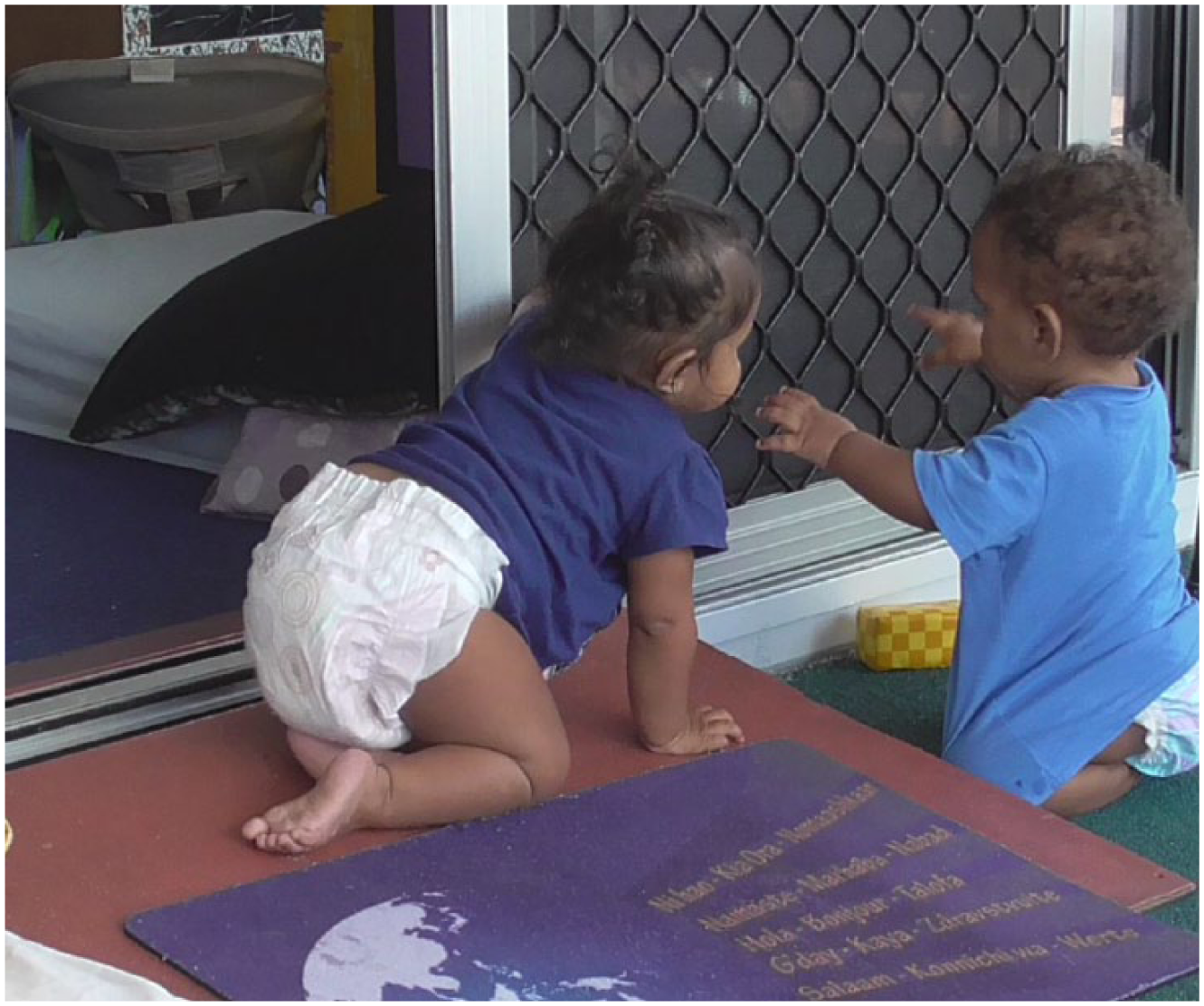
The vignette consists of six stills from video data. Figure 1 is from footage taken one month after Hal commenced at the centre. Hal is sitting in the doorway leading from the room to the covered verandah immediately beyond. He appears to have been hovering in the doorway for several minutes, mostly out of view of the camera. Figure 1 is intended to convey how, during his first few weeks, he spent a considerable amount of time observing everyday life in the centre going on around him, apparently with little inclination to engage with other children or the educators. The doorway seemed to be one of his preferred vantage points.
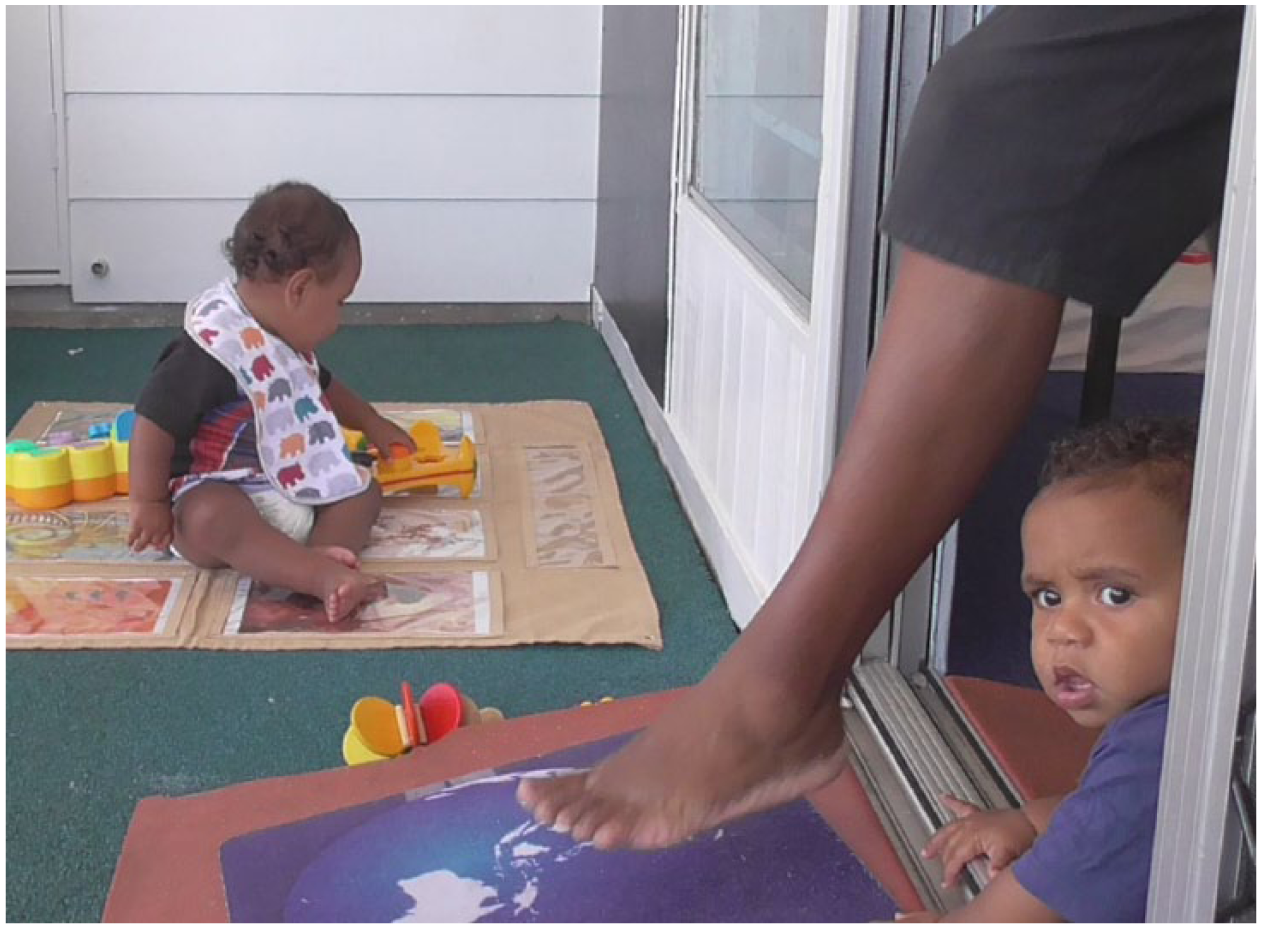
Hal at the door.
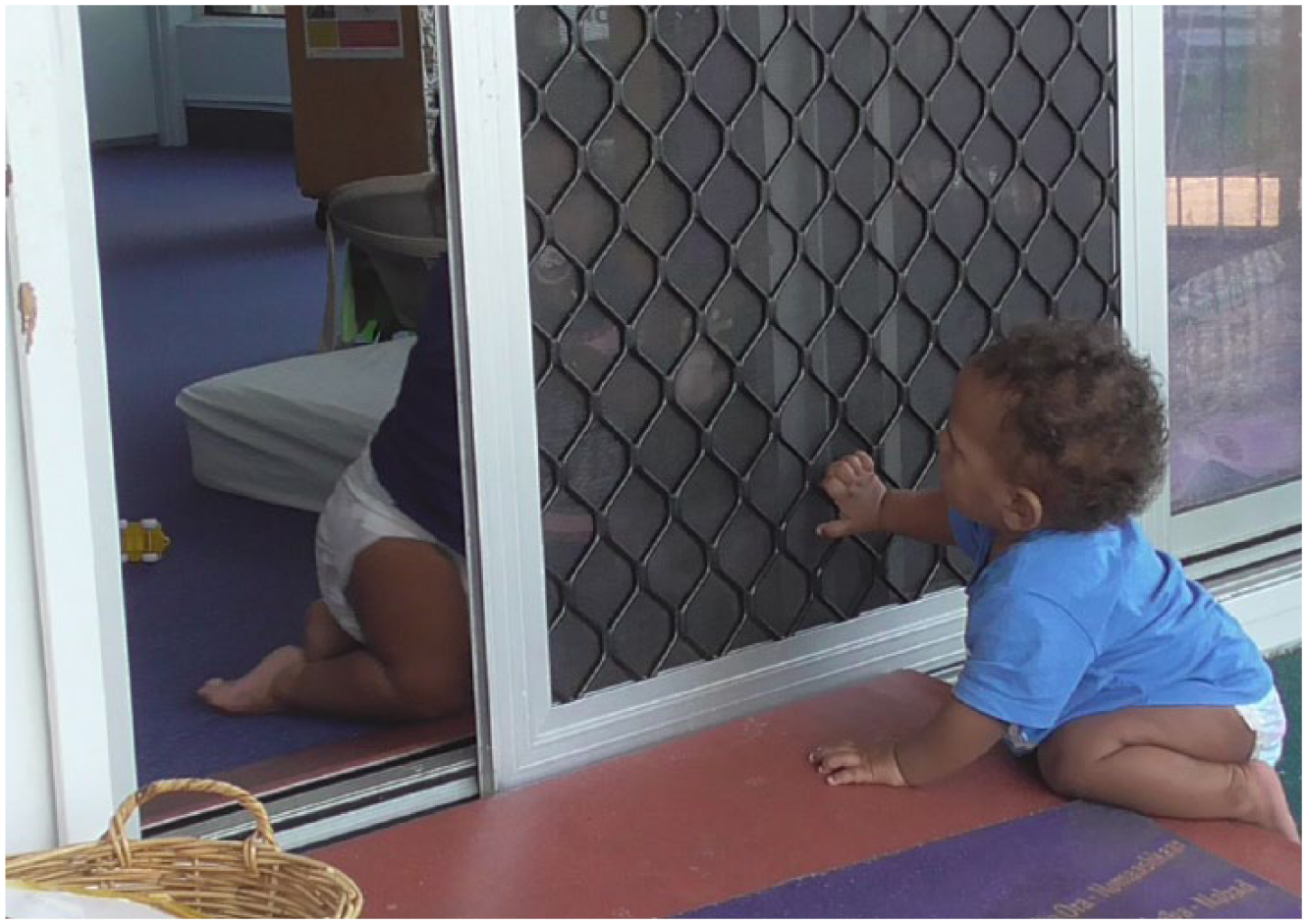
Figures 2 to 6 are taken from 10 minutes of video footage captured two weeks later (six weeks after Hal commenced), which begins with Hal sitting on Sally’s knee. Sally, the other educator in the Koalas room, is sitting immediately outside the same doorway featured in Figure 1. Although Sally’s attention is mostly on Hal, she also interacts with other children who are nearby. Figure 2 conveys Hal’s gradually developing relationship with Sally: ‘Hal is beginning to bond with Sally and she with him judging by the tenderness in her smiles and manner with him’ (Field notes, 18 March 2015). A few minutes later, Sally gently lifts Hal from her lap to the mat next to her chair. She places a woven cane basket of toys alongside him and, as she does so, Eva and Ani, two of the children who can be seen in Figure 2, make their way over to Hal and the basket of toys. Hal glances briefly at Sally, possibly as if to say ‘I’d rather sit on your lap’, but then takes some toys from the basket. As Eva and Ani drag the basket closer to them, he initially looks straight ahead, rather than at the two girls, before turning his back to them. Ani crawls away, but Eva stays. She holds out a toy to him, vocalises and succeeds in making contact with Hal (Figure 3). He looks intently at her and continues to gaze at her as she crawls away and enters the room.
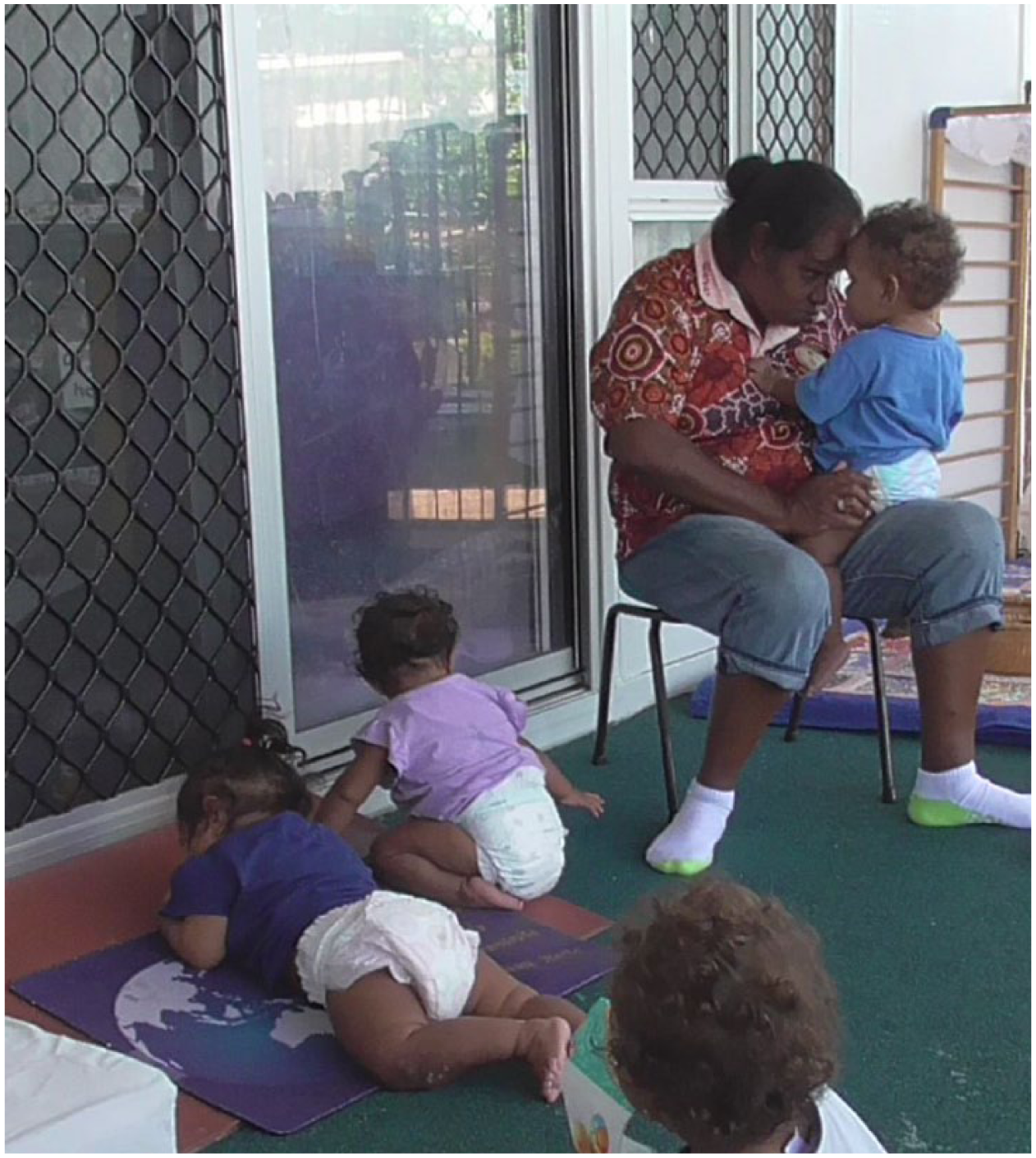
Hal and Sally.
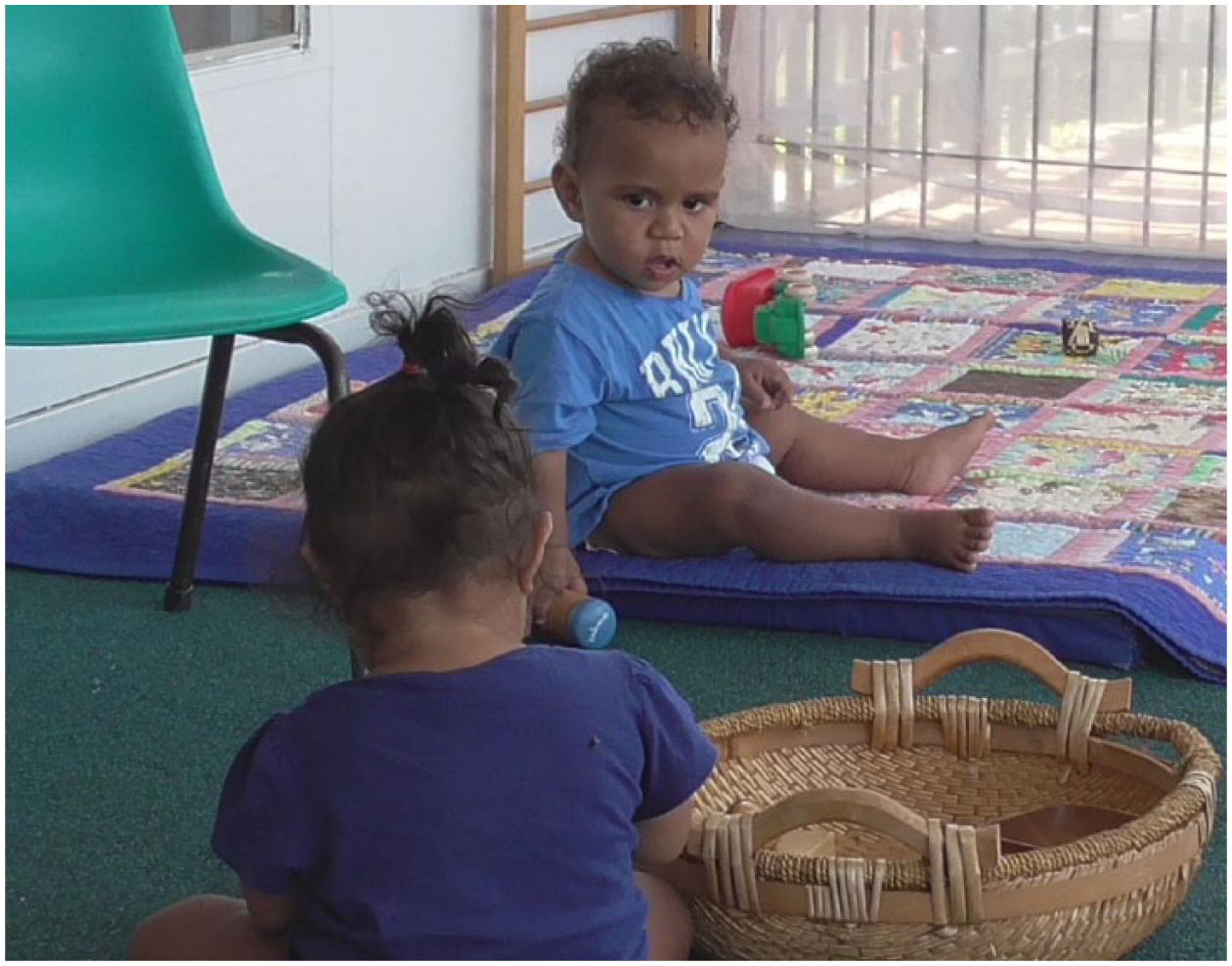
Hal and Eva.
Hal returns to the door.
Eva returns to Hal.
Eva and Hal playing with the door.
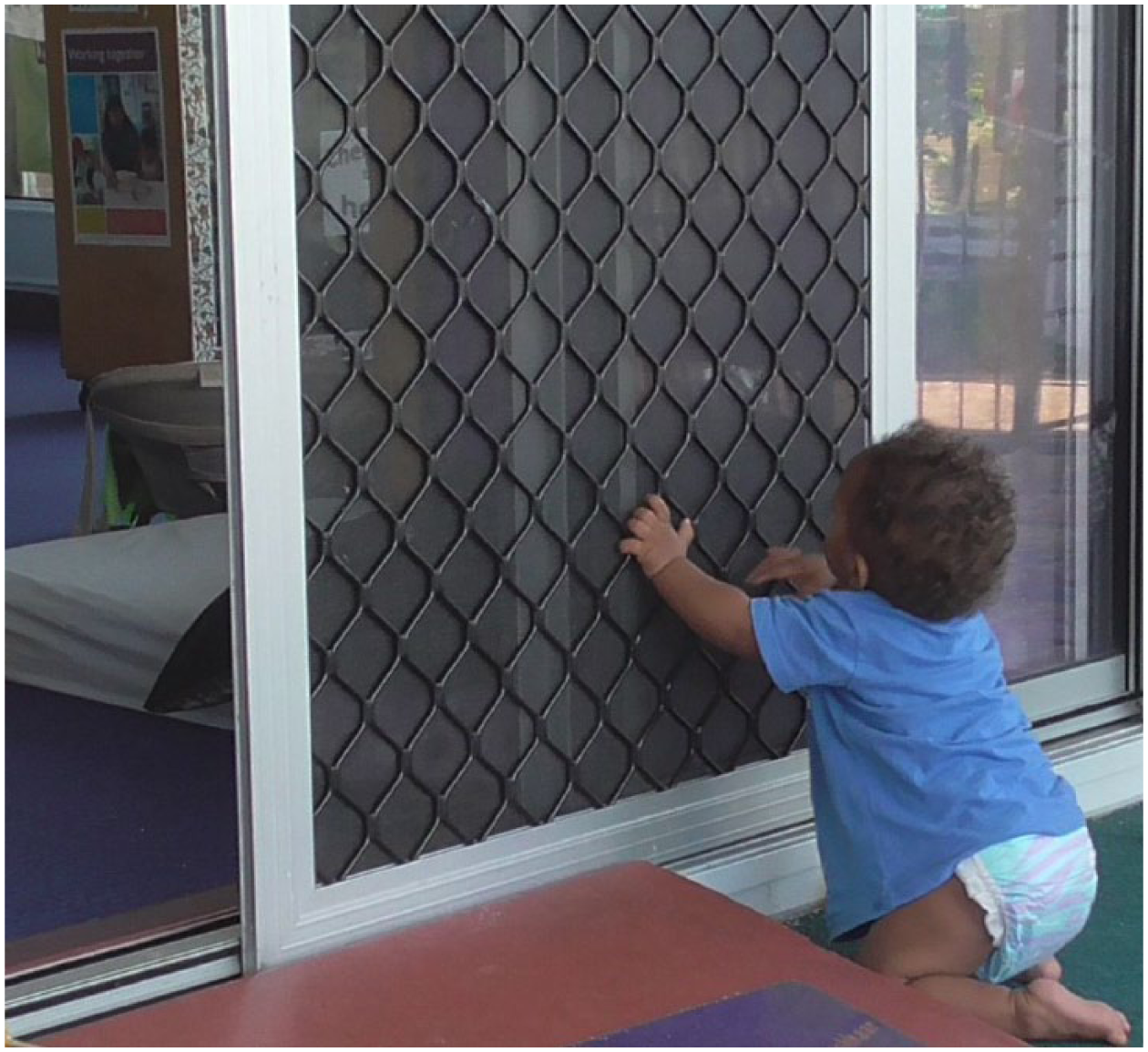
Shortly after, Hal makes his way to the doorway (Figure 4), which seems to perform many functions for him, including possibly serving as a ‘safe haven’ (Field notes, 20 March 2015). Almost immediately, Eva again approaches Hal (Figure 5), as if to engage him in ‘door play’. He seems happy to take up her invitation. She crawls back into the room and positions herself so that she is in face-to-face contact with him through the sliding mesh door. They then proceed to slide it back and forth with some force and what appears to be considerable enjoyment (Figure 6). Eventually, Eva slides the door shut, leaving Hal outside. He tries for some time to open it, without success. He vocalises to Sally, who is now inside, and bangs on the wire mesh. Sally comes to the door and opens it for him. Hal pauses in the doorway, then crawls into the room.
Discussion
In our view, this vignette lends itself to multiple interpretations through diverse perspectives, as indeed is advocated in the EYLF with respect to ECEC pedagogy and practice. We are mindful that the point of co-production is to hold open possibilities (Mentha, 2016). We are also acutely conscious of our limited capacities to understand the complex relationships and processes playing out in this vignette. So, we limit ourselves here to saying that we think we recognise in this vignette many of the strengths that have been documented in the literature cited above about Australian Indigenous cultures, knowledges and practices. Several aspects especially stand out to us. They include the willingness to allow Hal space and freedom to explore his new environment at Gundarah in ways that he prefers; the sense of collective responsibility for Hal, as seen in educator Sally’s and baby Eva’s interactions with him; and Sally’s confidence in Hal and Eva’s capacity to play without incident with the sliding door as a way of engaging with each other, while she (Sally) discreetly monitors their play at a distance. Together, the respecting of Hal’s preferences and the sense of collective responsibility, confidence and trust evident in this vignette seem to us to potentially constitute a micro-expression of belonging insofar as they resonate with many generally recognised ‘constituents’ of belonging variously referred to in endeavours to conceptualise, articulate and/or illustrate belonging in ECEC contexts (e.g. see Juutinen, 2018; Stratigos et al., 2014; Sumsion and Wong, 2011; Woodhead and Brooker, 2008).
Whether belonging as a phenomenon and lived experience can be directly observed or even inferred, however, especially for very young children who are not yet able to reflect on or readily communicate the meaning they make of their experiences verbally, remains, for us, a matter for debate. We acknowledge the possibility that our reading of this vignette as a micro-expression of belonging might be skewed or overly complicated by the research questions driving the study. Or perhaps we have been inclined to romanticise or valorise the interactional styles in this Aboriginal centre. Conceivably, an alternative reading might conclude that the vignette is about a case of an initially reticent child new to the centre who, with support and encouragement, gradually engages with others, rather than about belonging per se.
The possibility, and indeed the likelihood, that whether infants (and perhaps toddlers and preschool-aged children) experience a sense of belonging in ECEC settings might ultimately be indeterminable poses broader questions about work that belonging does and might do in ECEC policy contexts where it features prominently. As we reflect on the range of views surveyed in this article, as well as on the vignette presented as a possible micro-expression of belonging, we are particularly conscious of two (among other) potential trajectories.
One possible trajectory is that the expansiveness and elasticity of the phenomenon of belonging encourages further conceptual and empirical explorations of belonging in diverse contexts, as called for by Wastell and Degotardi (2017), and produces vernacular narratives and micro-expressions similar to those advocated by Mentha (2016). This form of representation potentially encourages co-produced interpretations and understandings of belonging, as our narrative about Hal, Sally, Eva and the sliding door, along with our conjectures about insights it might generate, hopefully illustrates. In our view, co-production that draws on Indigenous and non-Indigenous knowledge streams to support non-Indigenous Australians’ learning about ways in which Indigenous Australian early childhood educators, children and communities understand, support and recognise belonging would have considerable potential to contribute to addressing the lack of detailed attention in the EYLF and the Standard to Indigenous ways of knowing, being, becoming and belonging. Notions similar to co-production, such as ‘both-ways’ learning (Fasoli and Farmer, 2015) and intercultural understanding (Priest, 2005), are not new. As Fasoli and Farmer (2015: 163) point out, however, ‘a reoccurring concern is the tendency for many non-Aboriginal people to assert a belief in a both-ways philosophy but to implement it in a simplistic and tokenistic way’. In conjunction with the revised Guide to the National Quality Standard’s explicit emphasis on flexibility, reflexivity, and cultural sensitivity and relevance, powerful narratives could potentially generate a deeper commitment to more meaningful co-production of knowledge and understandings about belonging and, more broadly, to culturally relevant and respectful, strengths-based quality assurance processes.
Another, more pessimistic, possible trajectory is that the espoused emphasis in the Standard on critically reflective and culturally relevant practice will prove or come to be perceived as little more than rhetoric. A likely consequence could be an escalation and intensification of governmentality and surveillance in the Foucauldian sense implicitly foreshadowed by Hunkin (2016, 2017), resulting in the prioritising of the management of perceived risks over contextually and culturally relevant practice. Rather than a sensitive response to Hal’s ways of belonging, the vignette from Gundarah might be more likely to be perceived, therefore, as the inadequate management of the risks associated with infants playing with a sliding door. Given the differences between Indigenous and non-Indigenous cultures about what constitute appropriate risks for young children (Lohoar et al., 2014), this trajectory could exacerbate existing divides and the associated devaluing of Indigenous values, as described by Mentha (2016).
These speculative trajectories seem likely to be entangled rather than disparate. Nevertheless, they highlight how Australia may be at a crossroads in terms of the transformative potential or otherwise of its ECEC policy emphases. Although our focus has been the Australian context, we believe that the risks and opportunities associated with the emphasis on belonging in the EYLF and the Standard may have relevance to other ECEC curriculum and quality assurance contexts that similarly emphasise belonging. We suggest that this is particularly the case for other so-called settler nations like Australia, with Indigenous cultures and heritages that have remained strong despite colonisation and dispossession. More broadly, we would like to think that this article, and particularly the vignette from Gundarah, might make a useful contribution to ongoing decolonising endeavours in ECEC in Australia and elsewhere.
Footnotes
Acknowledgements
We gratefully acknowledge the generous contributions of the educators, parents and community of Gundoo Early Childhood Learning Centre who were participants in the ‘Babies and Belonging’ study and have agreed that images of themselves and their children can be published.
Authors’ note
Linda Harrison is also affiliated with Macquarie University.
Funding
This research was supported by the Australian Research Council Linkage Program (Grant number LP130100067) and the industry partner Centre Support Pty Ltd.