




Abstract
In this article, the author examines the ways in which a classroom quality metric framed the teaching and learning experiences of teachers and children in three Head Start classrooms. Using comic subjectivity theory, the author critically analyzes the ways in which the high-stakes classroom quality measure used in Head Start settings directed her gaze as a researcher, and had implications for teachers’ practice and children’s learning within the site of this gaze. This analysis raises questions about expectations for teachers’ performativity, the role of researchers’ complicity, and how children’s learning is conceptualized in early childhood classrooms that are heavily accountable to outside forces. This article also considers what the costs may be for teachers and children in early childhood settings where quality is conceptualized in ways that stand in stark contrast to teachers’ professional and personal knowledge. In these sites, their knowledge of and engagement with children is made subject to measure-directed regimes in the current accountability-driven era.
In the USA, accountability in early childhood settings is on the rise (Brown, 2009; Bullough et al., 2014). Particularly in settings where program support relies on public monies, teachers, children, and curricula are subject to measures and evaluations that quantify and frame children’s learning through quality metrics (Fenech, 2011; Peters et al., 2017). Through these measures, quality is framed as an objective truth that can be quantified and known through statistical analyses and comparisons. Head Start is the largest publicly funded early childhood program in the USA and serves low-income three- to five-year-old children in various care settings. Since Head Start’s inception in 1965, the program has been subject to rising accountability requirements that reflect shifting political regimes in the USA (Lubeck et al., 1997). Most recently, in 2007, the government implemented new policies focused on improving Head Start program quality by requiring programs to evaluate teaching practices using valid, reliable measures of classroom quality (Head Start Act of 2007).
In 2010, these policies were refined into a system known as the Head Start Designation Renewal System (HS-DRS) (Office of Head Start, 2010). Under the HS-DRS, a single observational measure of classroom quality, the Pre-K Classroom Assessment Scoring System (Pre-K CLASS; Pianta et al., 2008), was designated to evaluate the quality of all Head Start programs, with minimum scores required on each of the three domains of the measure (see Table 1). Under the HS-DRS, Head Start programs not meeting these minimum scores must reapply for funding and compete with other programs for these monies (Mashburn, 2017). As of 2016, 34% of all Head Start programs were required to recompete for their funding as a result of not meeting the HS-DRS criteria (Office of Head Start, 2016). Of these, 35% were due to low Pre-K CLASS scores. Research indicates that within this high-stakes context, Head Start programs are focusing their attention on teaching and learning practices that will meet these criteria, rather than on the needs of their students or their teaching staffs (Bullough et al., 2014). This policy reflects historical trends in Head Start programming to surveil and evaluate the practices of teachers, as well as families and children, as a means of accounting for federal expenditures on low-income and predominantly non-white communities (Sissel, 2000).
Description of Pre-K CLASS domains, dimensions and ratings.
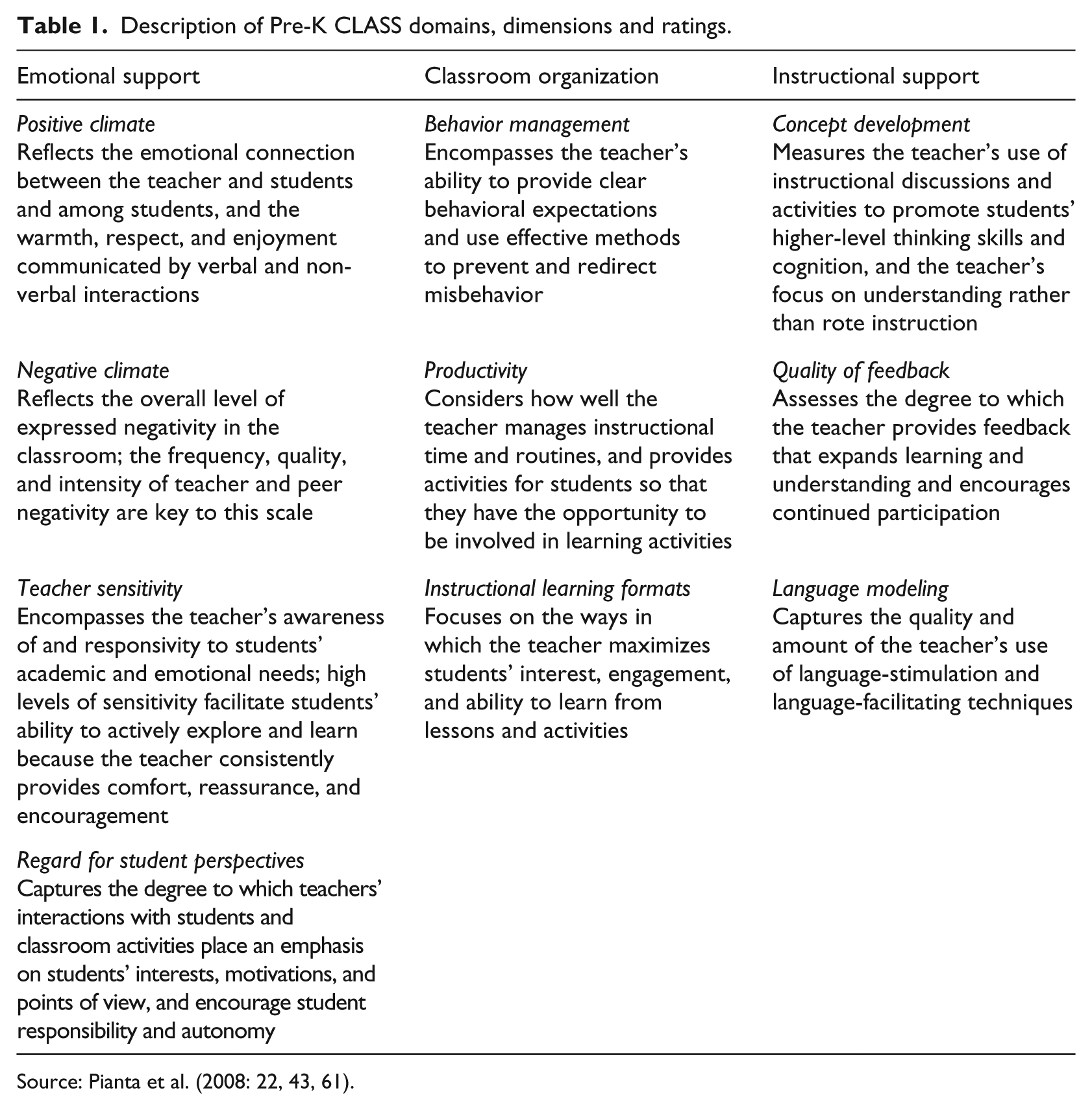
Source: Pianta et al. (2008: 22, 43, 61).
In this article, I explore the implications of the new accountability requirement of the Pre-K CLASS as a part of the HS-DRS, and how the lens of the Pre-K CLASS framed what constituted “high-quality” teaching and learning in three Head Start classrooms. In doing so, I examine how relying on a quality metric within a high-stakes accountability context can reframe what we see as “high-quality” teaching and learning, and impact the choices that teachers make and the experiences that children have, as a result. To do this, I ask: How did the use of a classroom quality measure within a high-stakes accountability context frame what could be seen as “high-quality” moments of teaching and learning in three Head Start classrooms? When evaluative eyes were on the teacher–child interactions in these classrooms, what teaching and learning went unseen? How might an intensifying focus on teacher–child interactions reframe what constitutes “high-quality” teaching and learning in early childhood settings, and what are the implications of this for teachers and children?
Literature review
This article exists at an intersection of three research literatures in early childhood education: what constitutes “high-quality” educational experiences for young children; growing accountability requirements for Head Start and other early childhood programs in the USA; and how the convergence of quality and accountability is impacting notions of teaching and learning in early childhood settings in the USA.
Quality in early childhood education
What is quality in early childhood? This is a question that is incredibly difficult to answer. To some researchers, quality is a neutral concept, free of values or assumptions—or at least neutral enough that some aspects can be known, counted, and used as the basis for comparison and evaluation (Dahlberg et al., 1999). For early childhood researchers working from sociocultural perspectives, quality is a cultural construct, informed by community beliefs, language, practices, and shared knowledge (Moss and Dahlberg, 2008; Tobin, 2005). As such, quality is defined by each unique setting, from the voices of community members, parents, teachers, and children. From this perspective, context matters when determining what constitutes quality. This makes comparing sites and holding them accountable to specific policy and regulatory goals challenging and difficult to scale (Urban, 2008). As a result, and as Fenech (2011) noted, an agreed-upon definition of what constitutes “quality” in early childhood settings remains stubbornly elusive within the field. Despite this, quality measures in early childhood have come to dominate much of the research base. Measures such as the Early Childhood Environment Rating Scale (ECERS-R; Harms et al., 2004) and the Pre-K CLASS (Pianta et al., 2008) have become so ubiquitous in early childhood quantitative research that few studies now define the term “high quality.” Rather, their choice of measure defines the meaning of quality.
While these measures of quality have come to dominate how “quality” is constituted and represented in positivist early childhood research, as Moss and Dahlberg note, this comes at a cost: Measures of “quality” involve looking for what has been predefined, discarding what does not figure … it involves the decontextualised application of abstract criteria, reducing the complexity … to scores or boxes to tick; it strives for agreement and the elimination of different perspectives; it assumes the autonomous and objective (adult) observer. (Moss and Dahlberg, 2008: 7)
In other words, what is eliminated when these measures are carefully constructed and validated by researchers are those very local values, beliefs, and ways of living that cannot be codified, known, and easily measured, but that inform what constitutes any notion of quality (Dahlberg et al., 1999; Fenech, 2011; Tobin, 2005). It becomes the work of the adult observer and the measure to determine quality, rather than the children, teachers, and families within that setting. From this perspective, once objectified and defined within a psychometrically derived and validated measure, the notion of quality can become a tool of comparison and regulation (Urban, 2008). While this narrowing of the notion of what constitutes quality makes it easier to evaluate and hold accountable programs when they do not meet the criteria designated by government policies, it also risks silencing the great diversity of communities, values, and contexts in which early childhood programs support children and families in the USA. This article aims to bring these voices back into the quality conversation.
Accountability in early childhood education
Despite conflicting notions of what constitutes quality (or if this is even knowable), as well as validity concerns for the Pre-K CLASS’s use in high-stakes accountability (Mashburn, 2017), the Pre-K CLASS is currently the single high-stakes measure of quality for all Head Start programs (Office of Head Start, 2010). This reflects a trend of local, state, and federal governing bodies making publicly funded early childhood education in the USA increasingly subject to accountability requirements that are intensely focused on measuring and improving program quality (Bullough et al., 2014). While it is not clear why the Pre-K CLASS has been chosen to be the single metric for evaluating classroom quality in Head Start, especially since the impact of “high-quality” (as measured by the Pre-K CLASS) pre-kindergarten on child outcomes (academic, social/emotional) is moderate at best (Leal et al., 2018), under HS-DRS it nevertheless is.
Defining quality as knowable and measurable is an important part of this movement towards regulation and accountability (Urban, 2008). As with Head Start, these policies can have incredibly high stakes, with continued program funding and/or program rankings threatened if the minimum criteria on quality measures are not met (Office of Head Start, 2016). However, there are other high stakes as well. Research indicates that when teachers are being evaluated based on very specific notions of what constitutes “high-quality” practice, they will move to closely align their practices with these measures, often despite professional knowledge that in doing so they may fail to meet the cultural, linguistic, emotional, developmental, and/or individual needs of their students (Brown and Lee, 2012; Bullough et al., 2014). The result is that teachers’ provision of learning experiences for young children is driven by how they will be evaluated by outside observers, rather than by the needs of the young children in their care.
In addition, this accountability around quality encourages programs to focus their professional development efforts and curricular design around meeting the criteria and notions of quality embedded within the evaluative measure (Hamre et al., 2014; Trivette et al., 2012; Zan and Donegan-Ritter, 2014). This has implications for how program leaders and teachers make decisions for children, focusing their attention on external accountability rather than the needs of the children in their care. While creating safe and caring spaces for young children is a goal of all early childhood practitioners and researchers, high-stakes accountability systems may cause teachers to foreground key requirements rather than the needs of individual children. These high-stakes contexts may also shift the ways in which observers think about teachers and children in early childhood classrooms, with “high-quality” practices defined as certain types of interactions rather than the broad variety of ways in which teachers and children engage together in teaching and learning every day.
The convergence of quality and accountability in early childhood
Research on what constitutes quality in early childhood settings and how notions of quality are used to make programs accountable intersect in the daily work of children and teachers. As noted above, when teachers are being evaluated, their classroom practice tends to shift towards the tool being used to evaluate them (Brown and Lee, 2012). The Pre-K CLASS is largely focused on observing and scoring the quality of teacher–child interactions (known as process quality), and how teachers are engaging children in learning (Pianta et al., 2008). This notion of quality that is defined by the teachers’ interactions with children, as opposed to other means/modes of learning in early childhood settings, may reflect a larger policy shift in the USA. This shift, already prevalent in US public kindergartens (Bassok et al., 2016), is towards more teacher-directed and academically focused (early reading and early mathematics) skills that aim to make children “ready” for kindergarten and beyond (Ackerman and Barnett, 2005).
Policymakers have long tasked Head Start with making three- to five-year-old children “ready” for school (Lubeck et al., 2001; McAllister et al., 2005). As noted above, notions of what constitutes readiness have changed, even as researchers voice concerns that this academic-readiness focus may come at the cost of children’s social/emotional experiences (Gupta and Lucia, 2017; Weissberg and Cascarino, 2013). From an academic-readiness perspective, teacher-directed instruction is key to making sure that children have specific skills mastered by the end of their time in preschool (such as letter/sound identification, number recognition, and other pre-reading/early mathematics knowledge) (Brown, 2009). As Pyle and Danniels (2017: 275) note: “Tensions between academic and developmental perspectives toward learning and play have been reported over the years, with teachers revealing some discord between mandated standards and preferred instructional practices.” When high-stakes evaluations of teacher practices and classroom quality are joined with an intensifying focus on academic readiness, it is likely that teachers will choose the practices to which they are being made accountable (Bullough et al., 2014). The intersections of an intensifying focus on a single version of classroom quality, a high-stakes accountability context, and rising expectations for academic-readiness skills raise concerns as to what knowledge is informing teacher practice in public preschool programs like Head Start.
What is challenging about this emerging context is that how young children learn is more complex than a teacher defining and then enacting what a child can, should, or will learn (Hatch, 2010). How very young children learn extends beyond the information and knowledge that teachers provide to them either in small-group, whole-group, or one-on-one experiences. Young children can, and do, learn outside the inputs of adults: on their own in imaginative play and/or engagement with materials and their environment; with and from more knowledgeable peers, particularly other children in mixed-age classrooms; and when teachers follow children’s play, scaffolding and supporting the child’s leadership in learning and engagement (Nicholson et al., 2014). In early childhood classrooms that support and encourage these varied ways for children to learn through play, the role of the teacher is rarely directive or dyadic, but rather playful and supporting, and yet possibly unseen by quality measures.
This article explores how teaching and learning were framed in three Head Start classrooms, contrasting the lens of the Pre-K CLASS and a broader view of the learning/teaching occurring in each site. In doing so, I raise questions about how the intersections of a single notion of quality and high-stakes accountability within the Head Start context are shifting the ways that we recognize, understand, and value the complex nature of teaching and learning in early childhood settings.
Theoretical framework
To do this, I use comic subjectivity theory (Zupančič, 2008) as a theoretical framework to explore three vignettes. Also known as incongruity theory, this critical framework is grounded in the works of Lacan, Kant, and Schopenhauer (Morreall, 1983; Watson, 2015). Comic incongruity draws our attention to how many things in daily life are like a Möbius strip, wherein there is “only one surface … yet at every point there is also the other side … this endless movement of contradiction, [which can] be recognized as the essence of tragedy … and tragic comedy” (Zupančič, 2008: 54–55). When interactions between teachers and children are framed as the site where “quality” learning experiences happen, this pushes us to consider what constitutes “the other side,” or what we do not see when we look away from the learning and meaning that children can and do create outside of a teacher’s direction and interaction. In this article, I use the language of seen and unseen to frame the ways in which quality metrics direct our attention to “only one surface” of children’s learning—the surface managed and directed through teacher interaction and direction—pulling on Lacan’s (1994) notion of the seen/unseen.
I also take up Osgood’s (2006) use of Foucault’s and Bentham’s panopticon to consider the impacts of the gaze of the Pre-K CLASS on teacher, child, and researcher experiences in these three Head Start classrooms. The notion of the panopticon is a visual one, framing the observable (seen) as valid and what is not observed (unseen) as invisible and devoid of meaning. This is the mechanism of power: the constant observation of the subject as a means of ensuring compliance and self-control in this adherence to the expected behaviors. As Osgood notes: This theoretical model can be applied to ECEC [early childhood education and care] practitioners, who, through policy, workforce reform and concomitant objectifying practices of constant surveillance … find that the way in which power is exercised is largely invisible … [and] so sophisticated and seemingly abstract that it becomes impossible to challenge or negotiate. (Osgood, 2006: 7)
From this perspective, the pervasiveness of accountability measures, as well as the established goal of “quality,” makes the ways in which teachers (and children) are being controlled through objectifying practices hard to identify, name, and confront. I use these frameworks to understand how the Pre-K CLASS framed teaching and learning, making certain practices seen and others invisible, and, as a result, what came to be valued in the roles and work of teachers and children when measured through a high-stakes observational quality metric.
Background/context
This article emerged from a subset of data gathered as a part of a small professional development design study in a mid-sized urban school district that implements the local Head Start program. The director of the Head Start program contacted me and asked for help in designing a professional development program that would help them to improve their teachers’ scores on the Pre-K CLASS (Pianta et al., 2008). The motivation for this was that the program’s teachers had failed to meet the minimum score criteria on one of the three domains (Instructional Support) that comprise the Pre-K CLASS (Table 1). Without an improvement on their Instructional Support scores, the director told me, it was likely that the program would not be refunded and nearly 8000 students would need to be reassigned to new Head Start sites as a result. It was within this context that I began working with six Head Start teachers to improve their Instructional Support scores via our professional development program.
The Pre-K CLASS consists of three domains: Emotional Support, Classroom Organization and Instructional Support (see Table 1). Each of these domains also consists of specific dimensions, which represent the quality constructs that together make up the larger domain. Classrooms are rated as performing “low,” “middle,” or “high” based on these specific constructs. Originally developed as an academic research tool, the CLASS measure was designed to be implemented over four 20-minute observation periods where a reliable observer (through extensive training and testing) observed and then rated classroom practices (Pianta et al., 2008). Under the HS-DRS, however, this has been changed, and programs are now subject to a limited two-cycle observation in a representative sample of classrooms within the program (Mashburn, 2017). According to Mashburn (2017), this raises serious issues with the measure’s validity when used in this way, as well as ethical concerns with using a tool designed for research for high-stakes accountability.
Since the implementation of the HS-DRS, Head Start programs have largely scored well in the domains of Classroom Organization and Behavior Management, but have struggled to meet minimum required scores for the Instructional Support domain (Office of Head Start, 2016; for a detailed description, see Table 2). This was the case for the program that I was working with, and the reason why they were intensely focused on finding ways to improve their Instructional Support scores to meet the minimum criteria under the HS-DRS. While it is not entirely clear why Head Start programs (and other pre-kindergarten programs) score lower on Instructional Support than the other two domains (La Paro et al., 2004), it may reflect a mismatch between the teacher-driven/enacted model of the Instructional Support construct and traditional and current approaches to pedagogy in early childhood settings. More research is needed to understand this relationship.
Dimensions of the Instructional Support domain.
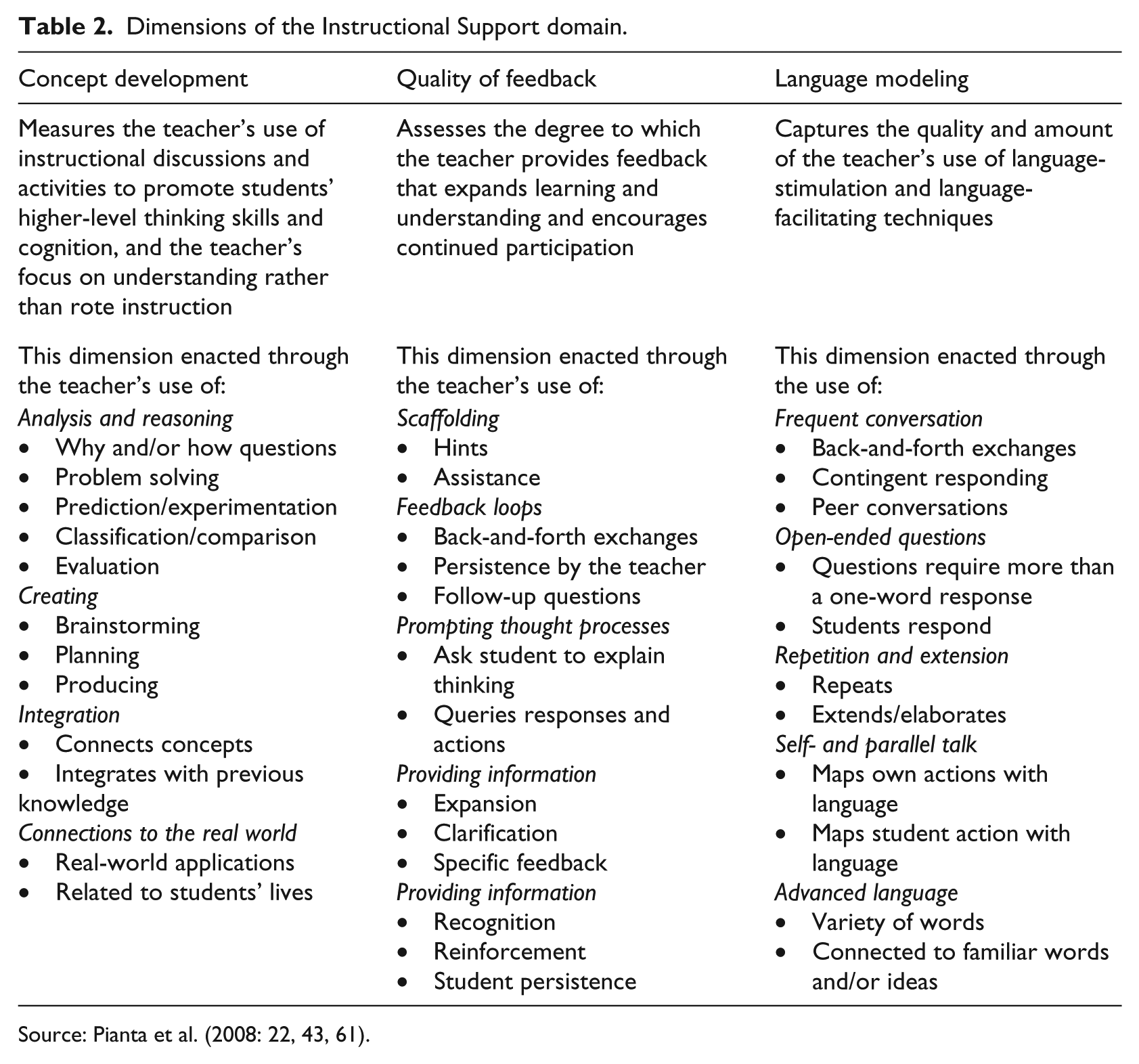
Source: Pianta et al. (2008: 22, 43, 61).
Within this high-stakes context, and as a teacher educator familiar with the play-based, culturally responsive programming the district provided in its Head Start classrooms, I felt it was important to support their need to improve their Instructional Support scores to ensure program funding. Given the program director’s concerns, I designed a professional development program to pilot with a small group of teachers who expressed interest in improving their Instructional Support scores. Six teachers volunteered to participate based on their interest in improving their Instructional Support scores.
In the professional development, I utilized detailed classroom observations as a site of joint study, observing each classroom three times and taking rich observational field notes (Clifford, 1990; Emerson et al., 2011). These notes aimed to capture the multiplicative activities, actions, and interactions that occur in any early childhood classrooms. I would then select teacher–child interactions from each set of field notes and examine these excerpts one on one with the teacher. Using the Pre-K CLASS lens of Instructional Support, we reviewed and “rewrote” these selected interactions together. Over the course of three observations and meeting sessions, the teacher would gradually take on more of the “rewriting” process. The goal in doing this was to capture each teacher’s specific classroom instructional practices and help them re-envision some of their teacher–child interactions through the Instructional Support lens of the Pre-K CLASS.
Methods
In this article, I use a critical interpretive approach (Creswell, 1998) to explore three vignettes from a larger professional development study (Stake, 1995). My methodological approach has informed the larger study’s design, the data collected, and the ways in which this data was analyzed. The data examined for this article is a subset from the larger study.
Participants
The three teachers focused on in this article were participants in the larger professional development, and all very experienced early childhood practitioners. Misha is an African American woman in her early sixties and had the longest tenure in the Head Start program in our professional development group. 1 She had taught for over 25 years, and also been a Head Start parent and administrator in another program. Her mother had been one of the founders of the first local Head Start program in 1966. Misha had a Bachelor of Arts degree in early childhood and was also a valid and reliable Pre-K CLASS observer, meaning that she had undergone extensive training and could observe and rate other classrooms. Marie is a white woman who has been teaching in care and Head Start settings for nearly 20 years. She began teaching in this Head Start program when she moved to the area about seven years prior, first as an assistant teacher and then as the lead teacher. She has a Bachelor’s degree in early childhood education. Lanaia is an African American woman in her late forties who has been teaching in this Head Start program for over 20 years. She began as a parent of a Head Start child, moved to a classroom aide position, then assistant teacher, and on completion of her Associate degree seven years earlier, she moved into a lead teacher position. Each of the three classrooms had 15 students, a lead teacher, and an assistant teacher. The programs were half day (morning and afternoon) and I observed in the morning classes in Marie’s and Lanaia’s rooms, and the afternoon class in Misha’s room. The classrooms were nested in elementary schools in the school district that held and implemented the Head Start grant.
Data collection
The data used in this article is: (1) the thick descriptive field notes (Clifford, 1990; Emerson et al., 2011; Geertz, 2003) collected over three days of observation in each classroom as a part of the larger professional development study; (2) my Pre-K CLASS codings of moments of Instructional Support from the observations for use in the professional development work with each teacher; and (3) written reflections following each observation to note any important pieces of information that were not captured by the observation notes (such as additional visitors, events, etc.).
The first two pieces of data were taken from the same observations: the broader, thicker whole-classroom observation (the “unseen” by the measure) and the Pre-K CLASS coded Instructional Support examples we were focusing on rewriting with the teacher (the “seen” by the measure). The contrast between these two data sets first caught my attention when we began coding all of the professional development project data. My reflections written after each observation served as a point of triangulation, and to capture my own positionality and perspectives (Emerson et al., 2011). These reflections became an important site of sense-making about what I had observed, the dominant narratives at play, and my own role in focusing the teacher’s attention on their Instructional Support practices with children.
Data analysis
Using NVivo 10 (Bazeley and Jackson, 2013), I analyzed the field notes, Pre-K CLASS Instructional Support coding, and reflections for each classroom. Utilizing the typology of comic subjectivity theory to represent the seen and unseen sides of the “endless movement of contradiction” (Zupančič, 2008: 55), I began to code my data using emergent coding (Charmaz, 2006), identifying themes across the Pre-K CLASS segments for each class, and examining the events surrounding each identified Instructional Support moment. Working between the data sources revealed how the Instructional Support lens of the professional development had foregrounded certain aspects of teaching/learning (teacher-directed, teacher–child dyad, whole-group teacher-led moments) as seen, and left other aspects of learning unseen during the periods of observation of teacher–child interactions.
Findings
In this section, I use vignettes from my observations to exemplify and embody my findings (Richardson and Lockridge, 1998). In the first vignette, I explore the ways in which the Pre-K CLASS shaped how children’s learning outside of teachers’ interactions was unseen through the Instructional Support lens, causing the teacher to question what may be lost when solitary learning does not count towards the quantification of “high-quality” instructional practices. In the second vignette, I examine how the Pre-K CLASS shifted the notion of who is or can be a teacher in early childhood settings, shifting attention away from peer interactions and towards teacher-dominated ones. In the third vignette, I take up how the high-stakes nature of this quality metric created a force amongst all actors (children, teachers, and researcher) to both comply with and be complicit in this versioning of quality.
Vignette 1. When is it learning?
Breakfast is over and the children have scattered around the room looking for a place to play. A few new children have joined the classroom in the last week or so, and Misha is being called to different spots in the room to negotiate the rules about how many children can be in any one center, what’s happening with the plants they are growing, who can be the doctor in dress up, etc. As soon as she gets a child settled, she is off to answer another call. One little boy, Anthony, the newest in the room, is having a hard time finding a place to play.
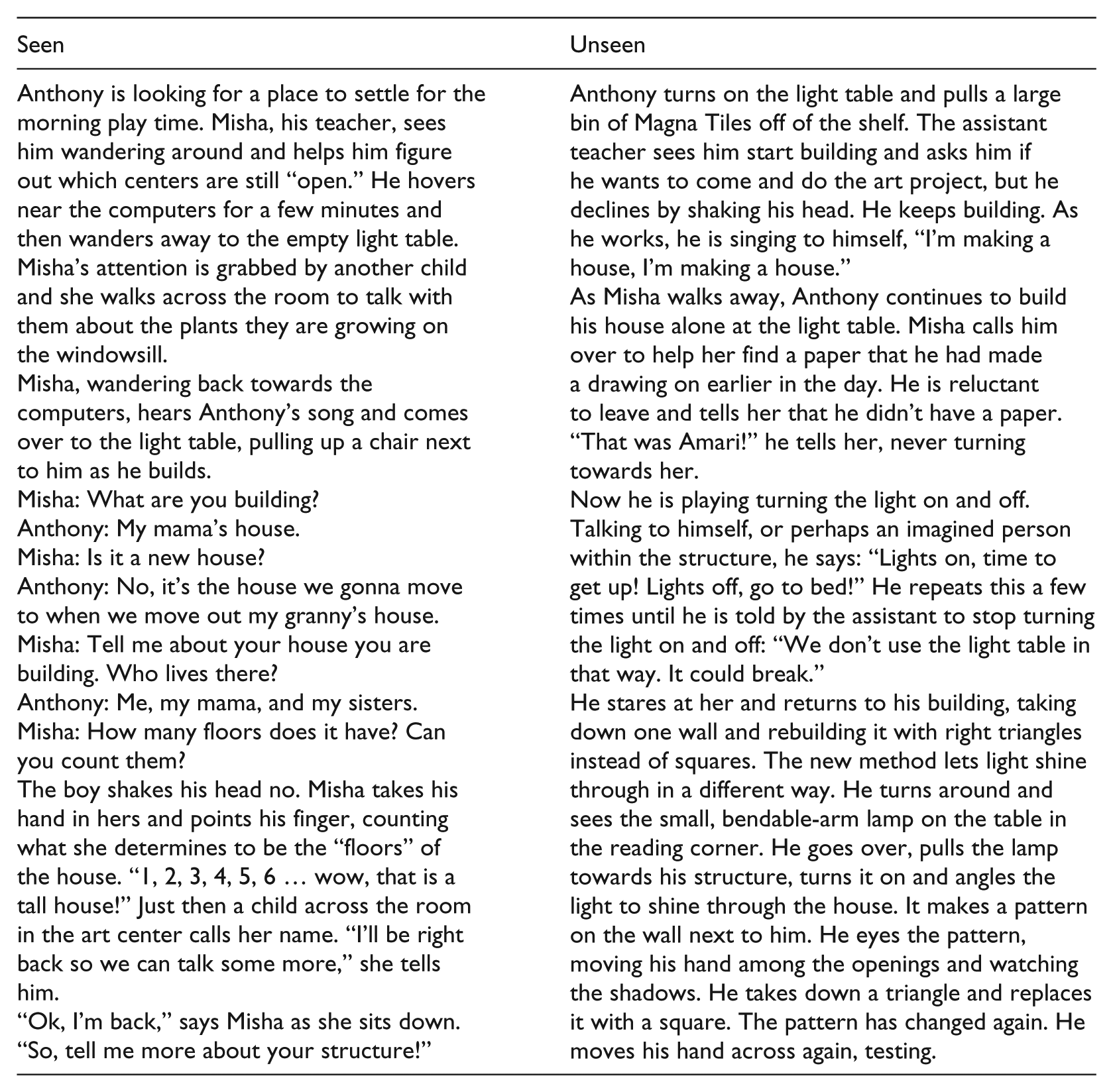
In this vignette, a child is deeply engaged in solitary work, exploring materials and testing and making sense of light and shadow. As the teacher enters and exits the child’s play, her interaction makes learning seen in terms of the provisions of Instructional Support that can be counted and rated. However, the ways in which his unseen learning creates richer and deeper opportunities for exploration, testing, and sense-making outside of his interactions with Misha goes unvalued by the measure in terms of Instructional Support. For example, her descriptive language and concepts of “floors” and her use of counting, as well as open-ended questioning, all reflect the constructs of Instructional Support, though at varied levels of quality. However, Anthony’s exploration of light, shape, and space, his movement of the lamp to create and change shadows, cannot be counted within this construct. Through the Pre-K CLASS, there is no way to see a child’s deep engagement and sense-making outside of the teacher–child dyadic relationship within the domain of Instructional Support. Rather, only when the teacher steps in to turn this moment into a teacher-driven interaction does the moment count as a site of learning, meaning-making, and therefore, concept development. Although the child is satisfied to be working on his own and deeply engaged with manipulating and learning from materials, his work cannot be considered within this domain. Here, the measure, serving as the surveilling eye of accountability (Osgood, 2006), cannot “see” or quantify the learning in this moment. Rather, per the measure, Misha must persist in order to “create” learning opportunities for Anthony that can be counted, and garner the necessary scores on the Instructional Support domain for which she is accountable.
Misha, who is a reliable Pre-K CLASS observer, recognized and identified this issue in our work together in the professional development. She understood and brought up how the ways in which she engages children in questioning, feedback, and developing understandings matter more in the evaluation of her classroom than other kinds of learning. “I know what they want to see, so when they come, I can give it to them. But is it what a child needs? Sometimes,” she told me in a lengthy discussion during one of our professional development sessions.
While Misha’s interaction with Anthony was respectful and attempted to engage him in questioning and conversation related to his work at the light table, she knows that when she is observed, she must show that she can engage children in Instructional Support practices that rate as “high quality.” The regulation of Misha’s work through the gaze of this measure is present when any outside observer is in her classroom, making her accountable not to the children in her care, but to a high-stakes policy requirement (Osgood, 2006). In conversation during our professional development work, Misha recognized this dilemma: It used to be the environment that mattered—the right materials, creating opportunities for play. Now, with the CLASS, it’s me—I make all the learning happen—or I have to if I want to get a good score. And you know we need that good score.
When we talked about Anthony and his choice to play alone, which continued through much of the month, Misha told me: “He has had a lot of trauma in his life. Sometimes children need space, but I can’t give him space—not when I’m being observed—even if that is what he needs.” This, too, reflects Misha’s ability to negotiate when she is going to align her practice to the Pre-K CLASS and when she is not. However, as I sat observing her classroom, her natural response to me and to the measure was to show that she could meet the criteria set by the Pre-K CLASS for high-quality Instructional Support, even when it meant disrupting one kind of learning for another. The notion that Anthony’s learning could be counted (seen) via the Pre-K CLASS only when he was interacting with a teacher creates a troubling understanding of what kinds of learning matter in early childhood settings subject to quality metrics, and one that Misha recognized and resisted. Here too the comic absurdity of this moment is foregrounded, where what can be seen/counted by the measure in turn devalues learning experiences that are directed by the child, as opposed to the teacher (Zupančič, 2008). Bullough et al. (2014) notes that in high-stakes accountability contexts, teacher practice and, as a result, children’s learning, often become driven by the measures used to enforce ‘best practice’. While the Pre-K CLASS is intended to improve teacher practices, and therefore child outcomes, there are unintended consequences to narrowly defining and framing what can be seen and counted as ‘high quality’ learning. In the next vignette, I explore how this plays out in the context of who can teach others per the Pre-K CLASS and what teaching goes unseen as a result.
Vignette 2. Who can be a teacher?
It is midway through the morning and the children are taking turns at various centers during free-play time. The classroom’s student teacher has just finished an extended project-approach study of birds’ nests with the students. She has left behind the materials that the children used in their culminating experience. These materials are large, long pieces of cloth, brown packing paper, and string that the children can use to build child-sized nests. The classroom teacher, Marie, is calling over children to work on building nests. Three children, Kiya (4), Monte (5), and Terell (3), have been at the playdough table all morning. Marie joins them during my observation as a part of her journeys around the classroom interacting with all the children.
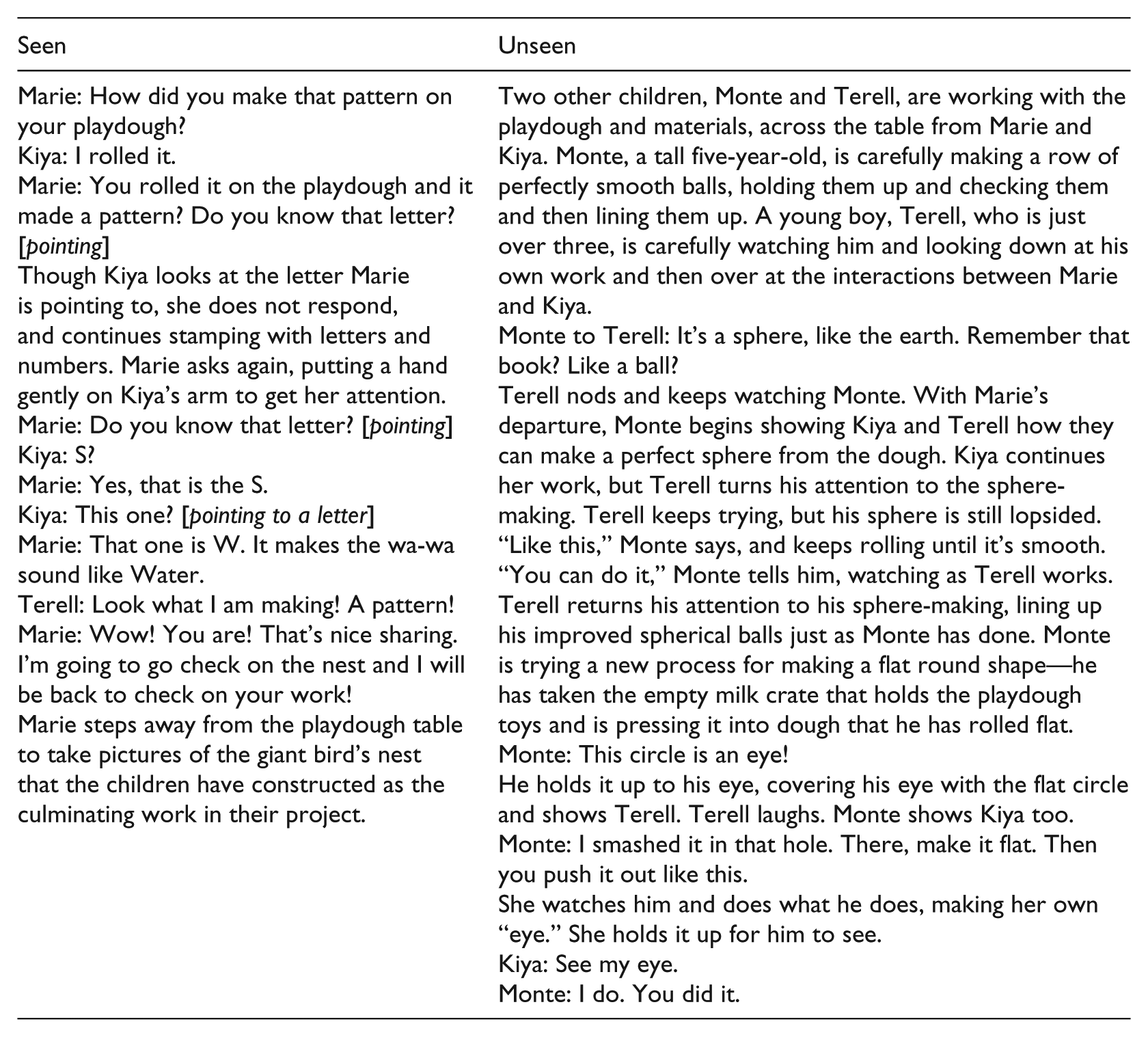
In this vignette, Marie is making the rounds as children play, stopping and engaging them in interactions, and asking them about their work. She circles and then returns to the nest-making station on the carpet area, staying for a longer time to support the children in their building. She uses this time to revisit the vocabulary and concepts that the children have become familiar with through their project work. In this way, she is engaging in many of the Instructional Support practices that the Pre-K CLASS rates. However, as I am watching her, I see the other teaching which is happening, but which is not captured by the measure—that of Monte, a more knowledgeable peer, as he guides the work of Kiya and Terell. Monte’s careful and calm guidance allows Kiya and Terell to shadow his work. Unlike Marie, Monte asks no questions of his friends, but does give them additional information and makes connections with high-level vocabulary (e.g. sphere, planets) and earlier learning experiences within their classroom.
There is rich teaching and learning here, but the Pre-K CLASS draws my attention to the relationships between Marie and the children, pulling my gaze (Osgood, 2006) and that of Marie to those actions that are framed as ‘high quality’ Instructional Supports via the Pre-K CLASS. If I focus in on Marie’s interactions with Kiya, as the measure dictates, I see a teacher seeking to imbed specific concepts and language into Kiya’s learning. Kiya is not interested in identifying letters as Marie directs, but Marie is working to create a connection and revisit a concept—two elements of Instructional Support that she has been focused on in our professional development work. The interaction reflects how Marie has interpreted the Instructional Support construct and tries to apply it in her daily work, with varying success. Although Marie persists, Kiya is reluctant to engage. Interestingly, Terell is seeking Marie’s input, but as he directs her towards the pattern he has been making, Marie’s eye is caught by the work happening with the bird’s nest and she walks quickly to grab her camera and document the elaborate creation.
In her absence, Monte steps in, and Kiya and Terell follow his lead, using his modeling to develop their own work with the playdough. As the vignette closes, Kiya speaks without prompting for the first time, showing Monte that she, too, can make an “eye,” having followed his narrative and employed it in her own work. What is most interesting here is that much of the language that Monte uses, as well as his calm demeanor, reflects the ways in which Marie engages with the children throughout the day. However, in evaluating Marie’s overall classroom quality, this hidden work (of setting the tone, providing the materials, and engaging so many children in supportive ways) goes unseen and unquantified as Instructional Support by the Pre-K CLASS.
When discussing these events in her classroom, Marie expressed reluctance over pushing children into the kinds of interactions that she knew would allow her to achieve a higher Instructional Support score: It feels so forced when you try to make a child interact with you. And how can you have this high-quality [makes air quotes with her fingers] conversation with kids when what you are focused on is making them produce a good example when there is a stranger watching them with a clipboard?
This theme—of teachers feeling that they were forcing children into interactions that they either did not want to participate in or disrupted their rich play—reverberated across my observations and interactions with the teachers, and is well illustrated in Kiya’s silence as Marie worked to engage her. Although teaching and learning were happening outside of Marie’s interactions with the children, those moments went unvalued when the lens of the Pre-K CLASS was placed between the observer and the classroom.
Were a federal observer to come for two 20-minute cycles of observation in these two classrooms, it is doubtful that they would be able to capture the richness of learning taking place in their accounting for quality. As a result, learning and teaching that exist outside of the Instructional Support construct would go unseen, and only that which falls within the surveillance of practice, and is rated positively, will come to constitute ‘high quality’ practice (Osgood, 2006). The complexity of life and learning in early childhood classrooms is difficult to capture in two 20-minute observations on a single day, and yet this is how Head Start classrooms are evaluated under the HS-DRS system. Marie and Misha’s acknowledgement of the ways in which this measure made all of us complicit in putting scores ahead of what children needed (time, patience, and sometimes solitude) is the theme that I explore in the final vignette.
Vignette 3. Compliance and complicity
The children are scattered around the classroom, engaged in different centers and materials. I am following Lanaia as she moves from area to area, checking in with children, her clipboard in her hands, making notes. At the kitchen area, she stops and asks if she can sit down at the table where two girls, Sonja and Marquia, are setting out plates and cups. The girls nod and Lanaia pulls up a chair. On the other side of the bookshelf, two boys converse loudly as they construct a marble run.
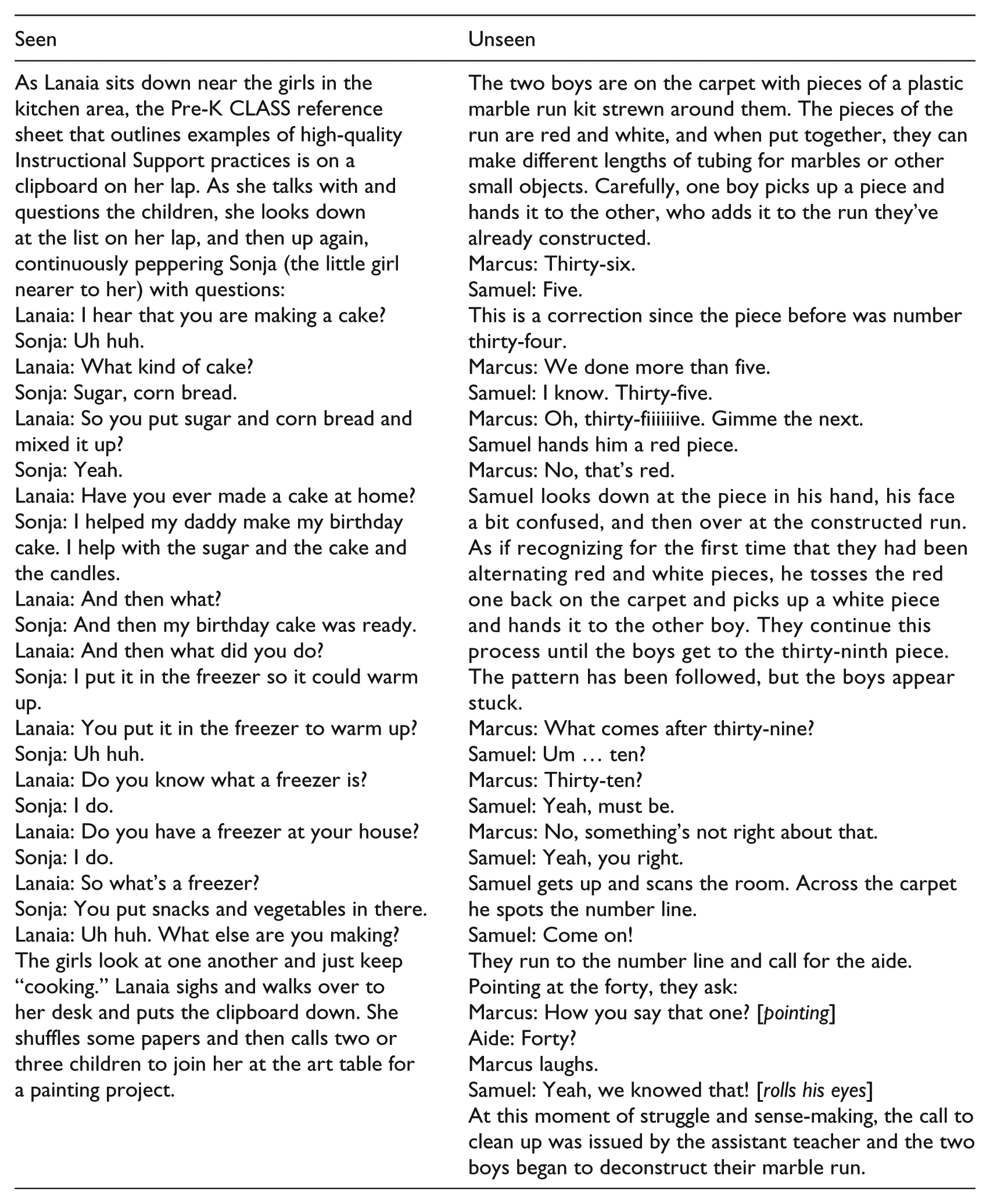
In this vignette, Lanaia is seeking to create the interactions that she knows we have been exploring in our professional development work together. While the other teachers in the professional development had had borderline Instructional Support scores, according to Lanaia, her Instructional Support scores were the lowest of the whole program. Out of the six participants, her scores, she told me, had been the lowest in their last outside observation. Her anxiety and focus on Instructional Support mastery was intense, and this focus is reflected in her persistence with the two girls. In this interaction, Lanaia’s voice and questioning dominate the play. As a result, the children’s planning and decision-making in the play are made secondary to the teacher-enacted moments of Instructional Support. Despite her efforts, we see Sonja and Marquia resisting Lanaia’s insistence that they comply with her questions. Instead, the girls use their play as a way to evade her plans for their play and learning. The two girls never really stop their game and seem to answer Lanaia’s questions as a means to get through the process. Though temporarily disrupting the richness of their play, the girls’ game only stops during the interaction, and then restarts when Lanaia leaves. This is not a critique of Lanaia, but rather of the high-stakes measure which influenced the choices that she felt compelled to make in her interactions with the children. Knowing that her scores on the Instructional Support domain were amongst the lowest in the program, Lanaia’s efforts were focused on changing this and averting the negative consequences that she believed her low scores could bring about for the larger program. As a result, she is unable to escape the surveillance and accounting for practice that now informs her decision-making as she interacts with children as I, and others, observe in her classroom (Osgood, 2006).
Through the lens of Instructional Support, the rich sense-making and learning that Samuel and Marcus were engaged in on the carpet went unseen. However, Lanaia’s work with Sonja and Marquia was an opportunity for teacher-enacted Instructional Support. When Lanaia and I revisited her Instructional Support practices in the play with Sonja and Marquia in our professional development, we worked to rewrite her as a part of the play. However, to support the key constructs of Instructional Support, her role was central in the play of the girls. Had we chosen to rewrite the boys’ marble run to add high-quality Instructional Support, we would have had to add Lanaia to that interaction. This raised an important question: What would have been gained in doing so? If Lanaia had joined the boys’ work, would she have elevated their thinking? Or can we be satisfied that the learning that they engaged in together was of “high quality” without Lanaia? Samuel and Marcus had supported one another and, when they needed help, had first looked to one another and then sought out an adult. Although they had not come to the right conclusion in that first moment, they had figured out all of the elements. Learning had happened between the two of them, without open-ended questioning or a teacher scaffolding or modeling complex language. While the Pre-K CLASS can help us to see the moments of teacher–child interaction and assign different notions of what constitutes quality in these moments, the making invisible of peer-to-peer learning and teaching certainly shifts conceptions of what can constitute teaching and learning in early childhood spaces.
Had Lanaia’s focus in the play kitchen been on supporting rather than directing the learning, she may have found a way to join, but not disrupt, the learning. This is not a critique of Lanaia. She was driven by the high stakes that now frame her work. If directing/guiding children’s experiences is more “high quality” than the learning of the two children on the carpet, she will direct and guide. As a Pre-K CLASS observer, my focus would never have been on the children on the carpet, because their learning was not framed through the teacher’s efforts, and therefore could not reflect the teacher’s use of Instructional Support. However, knowing how and when (or when not) to insert yourself into the work of children is also the sign of “high-quality” teaching, though not in a way that can be captured in this measure. Lanaia and her students were all made subject to the measure that determined their program’s continued funding.
The other issue that this vignette (and the others) highlights is that of my own complicity. Through the creation of this professional development experience, I had joined in the act of foregrounding a very specific kind of teaching and learning: Instructional Support, as defined by the Pre-K CLASS. Lanaia’s referencing of the clipboard on her lap highlights this, as do Marie’s insistent questioning and Misha’s disruption of Anthony’s solitary work. As I sat observing the teachers, even for the purposes of the professional development, each was keenly aware of what the measure (and therefore, I) was hoping to capture. Keeping the Instructional Support practices sheet right there on her lap, Lanaia constantly directed her interactions with the children through that lens, rather than using her own professional knowledge and her students’ needs to inform her actions. As I sat observing Lanaia, Marie, and Misha in their efforts to meet these criteria in ways which actually disrupted the play that is so strongly valued in early childhood settings, I felt highly complicit in pushing the teachers towards this narrow single notion of what constituted “high-quality” teaching and learning in Head Start classrooms.
Discussion
In this article, I use these three vignettes to highlight the ways in which the use of the Pre-K CLASS in a high-stakes accountability context can and does inform and frame how teachers see their role, and shifts our notions of what can constitute “high-quality” teaching and learning. Whereas intentional early childhood teachers can and should use professional knowledge and the unique needs and backgrounds of the children within their classrooms to design learning experiences (Epstein, 2014), in a high-stakes context, what usually comes to matter is the measure (Bullough et al., 2014). As these vignettes reveal, rather than looking for opportunities to support and join children’s sense-making, the teachers felt compelled to direct the learning, often ignoring the natural interests and learning of the children, and preventing them from having an opportunity to give support when it is actually needed. This reflects much of the current literature about the influences of high-stakes accountability, which is growing in early childhood settings (Brown, 2009; Bullough et al., 2014; Goldstein, 1997), where teachers find themselves making instructional choices that conflict with their professional knowledge of what young children actually need.
Findings in this study also highlight how framing quality through a single measure, and using high-stakes accountability to enact this vision of quality, can have unintended consequences for teachers and children, as teachers work to instantiate a narrow version of ‘high quality’ practice into their daily work. As this paper explores, many of the practices that children are engaging with that enact notions of rich learning and engagement are unseen and/or undermined when teachers are driven to implement a narrow notion of practice. This is where the use of critical frameworks like comic subjectivity theory (Zupančič, 2008) create opportunities to examine both the intended goals of policy and the seriously consequences that come from highly regulated and surveilled teacher practices. Bloch (1987) wrote of the ways in which early childhood historically sought legitimacy by ‘making scientific’ the practices of our field via measurement and accounting. In this HS-DRS policy, Head Start’s efforts to account for the quality of their teachers and programs in fact undermines the professional knowledge and decision-making of teachers in favor of narrowly defined notions of quality. Under this high-stakes policy requirement, the rich complexity of early childhood settings is traded for a simpler means of accounting for federal investment in early care and learning. The comic absurdity of policy efforts to count, measure and enforce this narrow version of ‘quality’ makes invisible and undermines the meaningful, and difficult to quantify, ways in which teachers and young children work and learn together everyday (Zupančič, 2008). Add to this the ways in which the adults in Head Start classrooms (teachers, aides, supervisors, observers, researchers) are made complicit of the enactment of a regulatory gaze upon children’s play and learning, and one cannot but throw up their hands in frustrated laughter and tears over the ways in which we account for the work of children and teachers. This article aims to push back on the notion that quality can be simply known, measured, and used to hold individual programs accountable to one standard or one way of being “high quality,” and to raise concern over the ways that this high-stakes context around quality in Head Start is shifting teacher decision-making and children’s experiences as a result. Having the adult observer “reduc[e] the complexity and concreteness of the environment … to scores of boxes to tick” (Moss and Dahlberg, 2008: 3–12) makes it possible to rate, rank, and hold accountable Head Start programs. As the vignettes and themes explored in this study illustrate, what is made invisible or unseen by a measure is the truly rich learning and teaching already occurring in early childhood settings, and how these might be supported in meaningful ways that reflect the work of the teachers and children in each program and community. These vignettes also illustrate how the uses of the Pre-K CLASS as a high-stakes accountability tool, and the professional development I designed to help improve teachers’ scores on this measure, impacted both how they interacted with the children in their care and how they valued what constituted high-quality teaching and learning in their own classrooms. As the teachers in this study engaged with reframing their teaching through the Pre-K CLASS construct of Instructional Support, the teachers’ focus became their interactions with children as the site of high-quality practice, pulling their attention and that of observers from the ways in which children made meaning and engaged in learning with peers and solitarily. Since the Pre-K CLASS foregrounds the teacher–child dyad in creating learning for young children, the ways in which young children can and do engage in learning and teaching through play without teacher direction were hidden. This erasure of children’s learning independently of adults poses great risks to both children’s rights and needs in programs like Head Start. It also shifts our notions of what it is to “teach” in early childhood. If teachers’ work is only valued through their performativity and directive interaction with children, this undervalues the other work that early childhood teachers undertake as they observe, contingently respond, and intentionally create spaces where children can learn without a teacher’s express direction (Kamii and Ewing, 1996).
I am not arguing that there is not a place for teacher–child interactions, or adults providing instruction to children in ways that are supportive to the learning that the children are choosing to focus on. The teachers in this study valued the ways in which the focus of the Pre-K CLASS was foregrounding the need to have rich conversations with children to explore ideas, engage in extended interactions, and support children’s overall experiences beyond the immediate classroom. However, when classroom quality measures are used in high-stakes contexts, the costs can be quite high (Mashburn, 2017) and shape teachers’ decision-making in ways that undermine their professional and context-specific knowledge. This paper aims to push back on the notion that quality can be simply objectively known, measured, and used to hold individual programs accountable to one way of being ‘high quality’. As this paper shows, this narrow notion of quality is impactful on the decision-making of teachers who are subject to it within high stakes contexts. A co-constructed and democratically derived meaning of what constitutes quality in that classroom or center/program (as valued by teachers, leaders, children, families, and the broader community/cultural context) would create the opportunity for valuing all of the varied forms of teaching and learning observed in the three vignettes explored in this article. However, a single measure of quality within a high-stakes context “cannot … accommodate complexity, values, diversity, subjectivity, multiple perspectives, and other features of a world understood to be both uncertain and diverse” (Dahlberg et al., 2007: 105). By tying classroom quality to high-stakes accountability, as with the HS-DRS, we diminish the professional knowledge and decision-making of teachers, and risk narrowing notions of how teaching and learning can and should happen in early childhood settings.
Conclusions
As Osgood notes: whether the power is opaque or visible, it is ultimately so sophisticated and seemingly abstract that it becomes impossible to challenge or negotiate. Thus, in a quest to conform to dominant constructions of professionalism, practitioners become regulated and controlled by disciplinary technologies of the self. (Osgood, 2006: 7)
Ironically, in this study, when the teachers did seek to conform to the ways in which they interpreted the Pre-K CLASS constructs, they were less likely to follow practices that aligned with their own beliefs about what the children in their classrooms actually needed. In their need to comply within the high-stakes context, their engagement with children became less of a site for real interaction.
For the participating teachers in this study, the high-stakes nature of the measure made their goals less oriented towards improving interactions with students and more focused on complying with a fear-based interpretation of “high-quality” Instructional Support practices. While the stated goal of the Pre-K CLASS is admirable (to improve the ways in which teachers can and do support young children through rich interactions), the high-stakes nature of the measure as a part of the HS-DRS has changed the nature of the measure and the ways that it can be used to support and improve teachers’ practices in early childhood settings. In this situation, teachers’ interactions with children are framed by accountability. Rather than focusing their attention on professional skill-building and responsive interactions with children in their play, the focus shifts to doing whatever is necessary to ensure program funding. As Head Start continues to implement high-stakes accountability measures that frame “quality” through a single measure, we must consider how we can support children’s right to play and learn in ways that are supported, rather than enacted and directed, by teachers. We must also consider what the implications for teachers’ teaching and children’s learning may be if notions of what constitutes “high-quality” learning experiences in early childhood settings continue to narrow.
Footnotes
Funding
The author(s) received no financial support for the research, authorship, and/or publication of this article.