




Abstract
In this article, the authors reflect on Myrna’s Children’s Village, their university laboratory school located in southern New Mexico in the USA. The Village serves children from the age of six weeks to five years through an array of early childhood programs. This diversity provides a unique context, while also posing issues and concerns, such as lack of collaboration across programs, and also how the authors’ critically framed teacher education program is in many ways disconnected from the developmental philosophies that guide most of the Village’s programs. Based on their discussions as faculty of early childhood who work with the Children’s Village, the authors offer their thoughts and insights about how the Village came to be, its purposes, and who they are as faculty in relation to the Village. The authors then offer possible new directions for the Children’s Village in which greater collaboration across programs is fostered along with stronger faculty engagement. The purpose of sharing these reflections is to encourage a shift in how, as a field, university laboratory schools are conceptualized and how collaboration might be enhanced within dynamic early childhood contexts.
Keywords
Introduction
Early childhood laboratory (lab) schools on university campuses have historically been conceptualized to serve as practicum sites for students, to advance research, and provide care and education for children of university employees, students, and, in some cases, the surrounding community. The most common philosophies in lab school settings are those grounded in developmental perspectives. As Elicker and Barbour explain: from the beginning, lab schools were organized to fulfill a three-part mission: research (generating knowledge about child development), education (preparing teachers, therapists, and other child and family clinicians), and service (disseminating evidence-based information about child development and childrearing to parents and the general public). (Elicker and Barbour, 2012: 139)
As such, lab schools have been designed based on child development missions and conceptual frameworks that guide each of the classroom’s curricula within the school, experiential learning for students, and the research conducted. For some time, critical scholarship has problematized the use and pervasiveness of developmental perspectives in early childhood education and care, as they have universalized constructions of childhood, marginalized and stigmatized minoritized children and families, limited more organic approaches to pedagogy, and elevated and prioritized post-positivist research with young children, families, and educators (Burman, 1994; Soto, 2001; Swadener and Lubeck, 1995; Viruru, 2001).
With a mission and purpose similar to other lab schools across the USA, our lab school at New Mexico State University (NMSU), Myrna’s Children’s Village, differs in many respects in that classrooms are supported by an array of programs with varying philosophies. Examples include Head Start, which is a US-government-funded preschool program for young children classified as “low-income”; programs funded by our local Pre-K–12 public school district; and classrooms supported by statewide preschool initiatives. This diversity in early childhood programs housed in one lab school community provides great potential for reconceptualizing how we approach the design of university lab schools, while at the same time poses unique issues and concerns for how children, university students, and we as faculty experience and engage with our lab school. As an example, although diversity in perspectives and approaches through individual programs provides opportunities to have open and honest dialogues with practicum students about the strengths and challenges in each, students, Village educators, and ourselves as faculty have noticed disconnections across programs. Additionally, we have pondered as faculty how our critically framed teacher education program is in many ways disconnected from the developmental philosophies that guide most of the Village’s preschool classrooms. Based on these potentials and complexities, in this article we discuss our reflections on the Children’s Village.
Conceptualizing our conversations and reflections
This article came about through shared critical conversations among three faculty colleagues of early childhood education from multiple positions, experiences, and perspectives. Koeun Kim is an Assistant Professor and has been at NMSU for two years. Michelle Salazar Pérez is an Associate Professor who has been at the university for four years, and Betsy Cahill, the director of the early childhood program, has been at NMSU for 24 years. As newer faculty, Koeun and Michelle sought to gain insight into the history of the Children’s Village, in addition to sharing experiences entering the program as early childhood faculty. Koeun and Betsy have also had unique experiences being parents of children who have attended preschool at the Village. The three of us came together in this reflective space, then, having many different roles as parents and faculty, and with hopes of strengthening the programs at the Children’s Village and becoming more involved in research and teaching collaborations.
What we share in this article is based on our recorded and transcribed critically framed conversations about the Children’s Village over one semester. The conversations were organic, and therefore went in many different directions. Although we have power as faculty to share these insights, as you will find throughout our discussion of the Village, the setting lends itself to multiple power positionings outside of university faculty. There are differing authorities for the various programs that are part of the Village, each with their own approaches, individual supervisors, and administrative structures. In this initial discussion, then, our intentions are not to provide explicit examples about how to make changes to individual programs at the Village, but rather to provide insight into how we have been grappling with dilemmas, tensions, and potentialities in our relationship to the Village as early childhood university faculty. We view this discussion as a first step of moving forward as a more collaborative environment—one that will indeed be best conceptualized with all stakeholders involved. These initial ideas we address, however, came about through shared conversations among us as faculty.
We begin by reviewing the literature about university lab schools in the USA to provide context for the design of our lab school. We then discuss the history of the Children’s Village. Next, we discuss the purposes of the Village, having programs that serve the campus and surrounding local communities, for student field experiences, and as a research center. We then turn our conversation to who we believe we are as faculty in relation to the Children’s Village. We end with reflections on possible new directions for the Children’s Village as a diverse, conflictual, and complex learning community that fosters the surfacing of a third space (Gutiérrez et al., 1997). By sharing our critical reflections, we hope to contribute to the conversation about the role and place of lab schools in teacher education programs—not to provide concrete “solutions,” but rather to cultivate ideas that provide possibilities as we engage in future dialogue with each of the stakeholders at the Village. Moreover, with the unique make-up of the Children’s Village, we hope to encourage others to bring together diverse early childhood programs on their campuses and open further discussions about how faculty and teachers can foster a sense of community within such dynamic contexts.
University lab schools: a review of the literature
The history of lab schools
The idea of a laboratory school in education was originally based on the use of clinical settings for students pursuing medical degrees (Gresham, 2012). In 1896, Dewey founded the Laboratory School at the University of Chicago, where he remained the director for eight years, until 1904. As one of the most notable and researched lab schools in US history, much has been written about Dewey’s “progressive education” approaches (Fallace and Fantozzi, 2017) and efforts to advance child development theories (Wilcox-Herzog and McLaren, 2012), the political and operational challenges the school faced (Knoll, 2015), and misrepresentations of the school’s history—for instance, the integral role that women played in shaping the school’s mission and pedagogical practices (Durst, 2010). Throughout the 20th century, other lab schools were established across the USA, several of which were financially supported by the Laura Spellman Rockefeller Memorial Fund. Bloch problematizes that these institutes began as a way to provide laboratories for training young women in home economics and childcare (“scientific motherhood”) and as a way to provide an easy setting in which to do experimental and scientific studies of children’s development. (Bloch, 1992: 12)
Bloch continues that lab schools “pushed the field and the institutes and their associated researchers toward more ‘scientific’ and ‘objective’ studies of child development within nursery school contexts” (12). This post-positivist research focus is problematic; it is well documented by critical early childhood theorists that developmental perspectives have historically privileged white, male, heteronormative, middle- to upper-class framings of childhood(s) (Burman, 1994). This has created power for the dominant and marginalized Others.
The establishment of lab schools at universities throughout the USA has been instrumental in the dominant presence of developmental perspectives in the missions and practices of most lab schools today, and in the field of early childhood generally. Lab schools (or what some call “demonstration schools”) have historically operated in countries across the globe—such as Thailand, Australia, Canada, Germany, and the Philippines, among many others—with similar goals and missions as lab schools in the USA.
Research and pedagogical approaches in lab schools
Elicker and Barbour suggest that much of the research conducted in the first 50 years of lab schools … used attending children as subjects for experimental or observational studies designed to describe normal patterns of child development, often without regard to context and without much direct impact on educational practices. (Elicker and Barbour, 2012: 140)
As Bloch (1992: 13) maintains: “the majority of child development researchers tried to divorce themselves, as best they could, from practice or teacher-training issues.” Over time, research in lab schools expanded to include studies about influencing educational practices. However, most remain grounded in developmentalism (Monroe and Horm, 2012; Swartz and McElwain, 2012).
Using Graue and Walsh’s (1998: 5) assertion that researchers should “think of children as living in specific settings, with specific experiences and situations” (original emphasis), File (2012: 146) suggests that “university labs provide a setting for researchers to explore the workings of particular groups of children within a context that is situated culturally and historically while also constituting a unique niche for the children’s experiences.” File (2012) cites Grieshaber (2008), Mac Naughton (2004), and Hatch (2010) as advocating for a paradigm shift in the theories used to engage in research and pedagogy in lab schools. They argue that developmental perspectives have limited how we construct childhood(s) and potentials for research and praxis that engage and grapple with the complexity and diversity in the lives of younger human beings.
In our experiences at the Children’s Village, we can find many similarities in the challenges and purposes of lab schools. Unique is our desire to integrate critical perspectives in the research, curricula, and field experiences for our students, and to foster greater collaboration across our very diverse and multiple preschool programs. We hope to do so from our positioning as faculty, to imagine new futures where we work more closely and collaboratively with the many program teachers and administrators who comprise the Village. In the following, we share our reflections on the Village, first explaining its history.
The history of the Children’s Village
Prior to what we now know as Myrna’s Children’s Village, the College of Education had a lab school in the basement of its main building. In a technical way, our lab school at NMSU receives Instructional and General monies, and therefore does not pay for rent or other expenses such as electricity and custodial services. Other labs on campus that receive similar support include our chemistry and biology labs. As an early childhood lab school, in the mid to late 1990s, the College of Education supported three types of preschool programs: a half-day classroom, a federally funded Head Start classroom, and a special education classroom. Betsy recalls asking in 1994 during her interview tour of the lab school why the three classrooms were not integrated—a question that has remained for us as a teacher education program, even as we have transitioned, integrated a few programs, and expanded to the Children’s Village.
In 2003, there was a fire in the College of Education. During building renovations, the lab school was asked to move. A campus real-estate liaison suggested that if funding could be sought, the early childhood program could renovate on-campus abandoned student housing for a new lab school. The housing was given to us, and once the first building was renovated, two public preschool programs were created to serve children identified as requiring special education services, and who were either bilingual or Spanish speaking. Slowly, more of the surrounding student housing was renovated and a half-day preschool classroom was created serving children aged three to four. Two childcare classrooms, serving children aged two to five, were established to support NMSU student parents and the retention of university faculty and staff. Head Start was also re-established in one of the buildings, and Early Head Start classrooms joined later. We also have a family resource center and a family library. All of these programs, which serve the mostly Latinx, Indigenous, and international families of the local and university community, make up what is now Myrna’s Children’s Village (for program information, see Table 1).
Myrna’s Children’s Village program information.
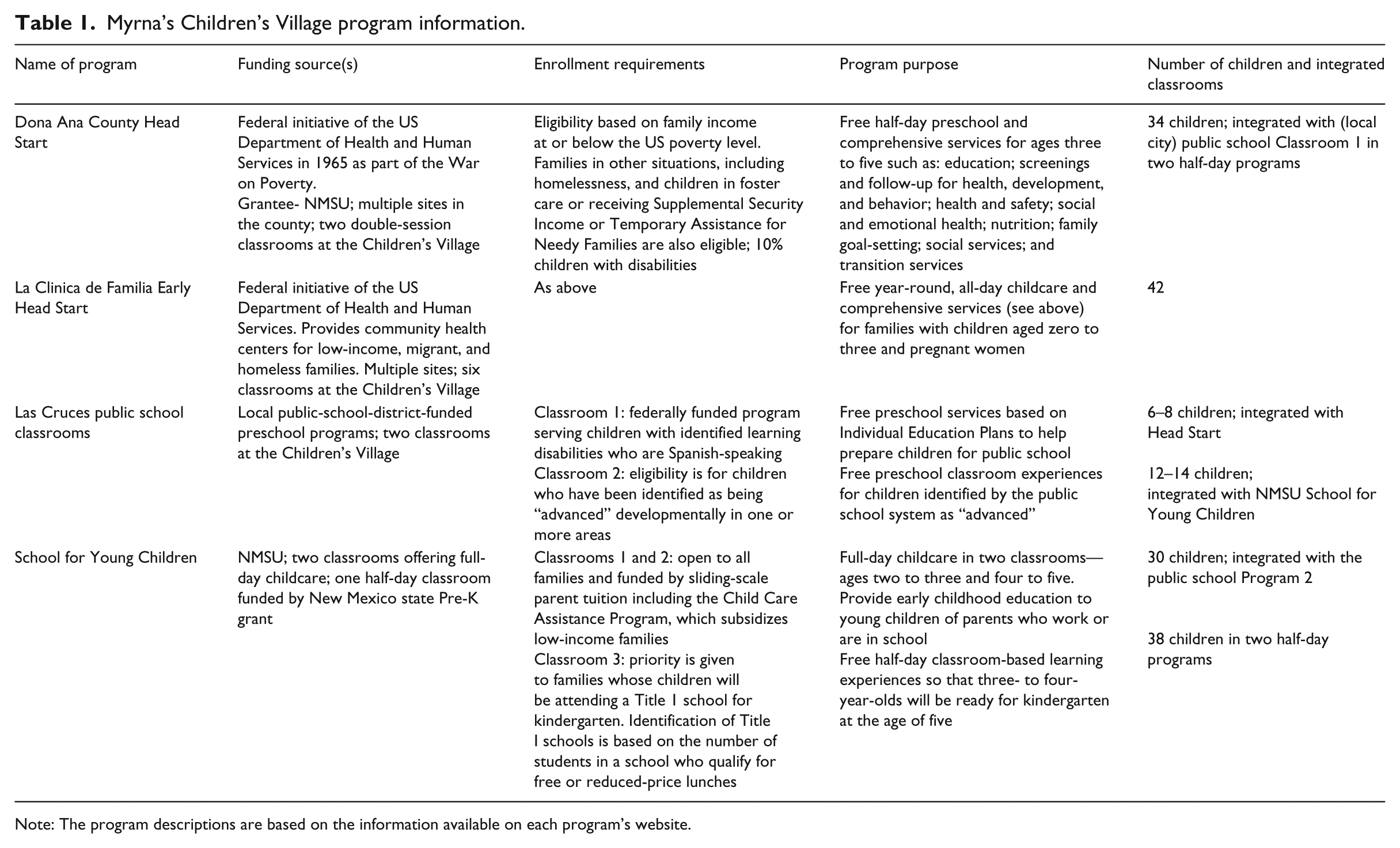
Note: The program descriptions are based on the information available on each program’s website.
The Village’s programs are supported by several funding sources: Las Cruces public schools, Dona Ana County Head Start, New Mexico state Pre-K readiness grant funding, and the La Clinica de Familia Early Head Start program. The lab school’s name, Myrna’s Children’s Village, came from alumni donors who met and married while attending NMSU. The woman dropped out of school once she had their first child, so the couple wished to support a childcare program for student parents. One million dollars were pledged but only a quarter was received, which covered the cost of some renovations. Additional monies were found through state agencies and partnerships developed from advocacy work. Early childhood faculty were active at the state level, helping to create an early childhood “career lattice,” and this work facilitated many connections. For instance, faculty received two grants, one for toddlers and one for Pre-K, which established these two existing classrooms in the Village. Connections were also fostered through local partnerships with community programs, such as La Clinica de Familia Early Head Start joining the Village.
The purpose of the Children’s Village and who it serves
We view the Children’s Village as a place that brings the community into the university setting—so, a place that serves and has an impact on the surrounding community and teachers in various ways through access to university resources and potentials for university-wide involvement and collaboration. A major role of the Children’s Village beyond serving the community is to provide field experiences for our undergraduate Bachelor’s degree program and for students from other colleges and disciplines, such as nursing. We attempt to place our students with teachers who have obtained a Master’s degree with regional accreditation standards for higher education institutions. In our local community, it is difficult to find teachers with degrees beyond an Associate degree, so one rationale for the university to support a lab school is for student field experiences. The Children’s Village also allows us to have a diversity of placements, as required by accreditation agencies, instead of just offering field experience in a homogenous lab school setting on campus.
Based on our professional experiences working with other university lab schools, the Children’s Village has less of a clinical feel. Our programs do not have observation rooms, decks, or two-way mirrors, allowing children to know when university students are present. We feel this is important to break away from adults being distant and unengaged observers in early childhood contexts. Shifting from the questions and post-positivist methods that have traditionally framed child study in laboratory settings, we challenge the focus on children as “measurable standardized phenomena” and objects under ongoing surveillance (File, 2012: 146).
Finally, the Children’s Village serves as a research center. In recent years, doctoral students have been mostly involved in research with the Village. Example projects include an exploration of field trips as pedagogy, and grandparents and grandchildren’s use of Global Positioning Systems as a shared technology tool. In reviving and strengthening the role of lab schools as a potential space for experimenting with new ideas and making transformational early childhood practices, we envision a place for collaborative scholarship and dialogue between researchers and lab school teachers.
(Dis)connections with/in the Village
Diversity is an integral part of who we are as a lab school community. However, as we create a Village on our campus, it is equally important to explore the opportunities and challenges in making connections with and within the Village. There has been much conversation among us concerning what the Village currently looks like and how we can create connections to strengthen our community.
When walking around the Children’s Village, in some ways, one can feel the physical disconnect between the programs. Every classroom is in its own color-coded building, so a teacher in one program cannot greet or talk to another teacher without exiting her or his building. Some teachers are not even aware of all the programs that exist in the Village. There is also limited daily interaction among the children who attend the various programs, except for outdoor playtime when they share the same playground together. In order to overcome the lack of daily interaction associated with the physical disconnect, three classrooms that are part of the School for Young Children (toddler, preschool, and Pre-K) participate in weekly exploration days, when children are free to move from one classroom to another. The Village also hosts a Family Interaction Day twice yearly when all the programs and the local community agencies come together to visit with one another.
There are also differences among the programs in their philosophical approaches. Because funding comes from various sources and oversight entities, each has unique curricular and child assessment guidelines to follow. There appears to be more regulation associated with some programs (such as Head Start) than others, and early childhood programs in New Mexico are now required to document and assess for the state Quality Rating and Improvement System. This places a greater emphasis on assessment framed through developmental perspectives (Pérez & Cahill, 2015). There are also logistical differences among the various programs, such as hours of operation, the number of children per teacher, and health, nutrition, and safety regulations. Interestingly, funders are very curious about the braiding of programs at university lab schools, so that there is not a redundancy in funds being spent across programs. An example would be that children come to a school for half-day Pre-K in the morning and that same classroom may be used in the afternoon for childcare services. This sharing of resources would help to streamline funding. The Children’s Village, indeed, hosts a diversity of programs; however, they are not blended. Rather, they exist side by side.
The diversity in both the logistical and philosophical approaches at the Children’s Village can be beneficial for a university teacher education program, allowing students to learn about and experience a range of early childhood practices and the nature of complex teacher engagement all in one place. However, as faculty, we are sometimes concerned about the messages university students may receive. For instance, because students may have an internship for a semester in a Head Start classroom, which serves low-income children (and is more regulated in terms of what types of curriculum teachers can implement), and then have another internship in a less regulated program that serves more economically privileged children, we fear that students could leave the program with the idea that working with low-income children means needing to be more regulatory. Instead, we aim for a deep understanding that the curriculum, the hidden curriculum, and the social organization of the various educational institutions that are part of the Village contribute to social reproduction (Anyon, 1981). This is an issue that we seek to address in our courses as teacher educators from critical stances (Bloch et al., 2014). Specifically, we address how some early childhood programs serving low-income children, such as Head Start, can impose stricter regulations on teachers and children, limiting emergent and organic pedagogies (Ellsworth and Ames, 1998; Souto-Manning, 2010); how dominant “at-risk” discourses are produced and circulated in our society and educational institutions to construct certain children as lacking or outside universal norms and in need of intervention (Swadener and Lubeck, 1995); and the “lived experience” of minoritized children and their families, which helps us address power, privilege, and oppression (Saavedra, 2011). As such, while the Village poses some tensions related to the diverse approaches present in each program, this diversity also provides the opportunity for critical dialogues about the potentials and challenges in each program.
We have heard feedback from educators, students, parents, and faculty about the disconnect across the programs. For instance, of the nine classrooms, only two are blended. Among us as faculty, we have had personal childhood experiences, being placed in programs according to gifted and, in turn, socio-economic status within one school. As Betsy expressed in our recorded conversations: I still have this image that we should be able to blend funding sources, blend programs, so that … that isn’t the Head Start child or that is the child with disabilities, but instead they are children and families and not placed in a program according to who they are or by their class or ability. (Transcribed conversation)
In our reflections, we ponder whether programs being disconnected is something we wish to perpetuate at the Children’s Village. This leads us to think more deeply about making stronger connections across classrooms, not for the purpose of uniformity, but rather to build a stronger community between children and teachers in the various programs.
Finally, we have found a disconnect between what we teach in our university courses and the curricular approaches in most of the programs at the Children’s Village—a tension which is complex, with individual program regulations that teachers, and at times we as teacher educators, are forced to comply with, and that could be better addressed by us as faculty. We emphasize that teachers are not to blame for these disconnections. Rather, we ponder if there is something more we could do to be more collaborative as a lab school community versus merely having programs that exist side by side. This tension is what we view as one of the purposes of engaging in this initial conversation.
We are a teacher education program with a strong orientation toward social justice, and that frames many of our pedagogies within critical philosophies. A critical social justice perspective (Sensoy and DiAngelo, 2017) compels us to understand our own positions within an inequitable society at both the individual and structural levels, and to engage in practices that make for a more socially justice society. Particularly, we draw on an array of critical, feminist, post-colonial, and postmodern perspectives in our work to disrupt the universal truth of child development, best practice, and other grand narratives that are based on Western or Eurocentric values (Bloch et al., 2014). One of the key issues in our consideration of field experiences is the opportunity for our students to observe and experience the day-to-day enactment of critical perspectives in early childhood settings, which has not always found a comfortable home in more traditional fieldwork placements. Without a collaborative approach to integrate our social justice focus into the early childhood programs at the Village, our students may simply disregard critical stances as too ideal or theoretical, and lacking practical relevance.
In order to illustrate this disconnect, one can see how the descriptions of the programs at the Village are embedded in developmental discourses. One reads: “The program is developmental in its approach because we respect and support the natural stages of the child’s physical, cognitive, social and emotional development” (NMSU School for Young Children, 2018). Juxtapositioned next to our syllabi, which have critical objectives, one can see the disconnect between what we teach and students’ field experiences. Example syllabi objectives include asking students to “Challenge dominant ideas surrounding childhood and Early Childhood Education and Care as a field (e.g. challenge child development discourses, gendered constructs, and historically, the disregard for diverse ways of being)” and to “reconceptualize our understandings of childhood/s and the purposes of the field.”
Although we are critical of the many disconnections that occur in the Children’s Village across programs and with our teacher education approaches, we also see it as a unique place that reimagines a typically homogenous university lab school. There is something to be said for bringing diverse perspectives into one space, even if there is little collaboration across programs. Koeun, who is Korean, shared an experience as a student in South Korea carrying out her student teaching in her university’s lab school. Established teaching methods, materials, and practice that were once successful with an economically privileged population at the lab school proved to be difficult in her first year of teaching, often leaving her with feelings of frustration, incompetence, and guilt; she felt as if she only knew one way to be a teacher. When she entered graduate school and was exposed to a multiplicity of early childhood perspectives and approaches, she became a stronger pedagogue. Perhaps this is something the Children’s Village offers to our students: diverse perspectives on early childhood education and care.
Who we are in relation to the Children’s Village
As we continued in our conversations and reflections about the Children’s Village, we thought about our relationships with it as faculty. In Michelle’s experiences at other university lab schools in the USA, she never quite felt like she was an engaged faculty member. Because of her critical perspective, she felt as if there was a major disconnect between what students experienced at lab schools and what she was teaching in her university courses. In our recorded conversations, Michelle recalls: At one university, I was concerned with the very traditional, developmental approach of the lab school, with little attention to the intersections of race, class, gender, language, and sexuality in the curriculum—all things I teach extensively about in my university courses. (Transcribed conversation)
Michelle continued: At another university lab school, as a Latina professor, I felt really culturally disconnected. It had an all-white teaching and administrative staff that appeared to disregard issues surrounding diversity. Many of my university students of color had conflicts with the teachers at the lab school. This made me avoid placing students there and also discouraged me from engaging in research there myself. Instead, I had students visit a local center that served children and families who were Mexican immigrants and with leadership and educational staff that had a deep respect for the children and families’ lives and culture. (Transcribed conversation)
Michelle has found that, at the Village, some teachers have not appeared to support explicitly talking about race and class with children. This is concerning, since we emphasize the importance of diversity and social justice in our university courses, and the students are not always seeing examples of this in their field experiences. We have determined that if we become more engaged as faculty with the Village this could have the potential to change.
The parent experience
Koeun’s perspective of the Children’s Village shifted and expanded when she became a parent of a child attending the university lab school. For instance, the way she understood the relationship with her child’s teacher changed in a slightly different way. Previously, Koeun had reservations about classroom visits because she was afraid that her presence in the classroom, associated with her roles as a researcher or a teacher educator, might unintentionally place teachers under continuous surveillance, judgment, and evaluation. However, positioning herself as a parent of a child, she felt more comfortable visiting and observing the classroom to help her four-year-old make a smooth transition to a new environment. Being a teacher educator also caused internal conflicts about how Koeun felt about her child being enrolled in an on-campus lab school. She recalls being asked as a parent to fill out a permission form for students to be able to observe her child, and also for faculty and students to have access to the classroom for research purposes. Although she had engaged in this process many times as a faculty member, her perspective changed when she was in the role of a parent. She was concerned about how students would construct and assess her child during observations, since her child comes from a different culture and is typically categorized as an English language learner. This gave her intimate insight into how it feels as a parent with a child in a program that constantly positions children as subjects of research.
In Betsy’s experience as a parent, she recalls having had her son’s teachers in her university courses and other professors’ courses that exposed students to a critical perspective on gender. During a home visit, teachers from the Children’s Village shared their concerns about Betsy’s son, who has always expressed his gender across a non-binary continuum. Although Betsy observed that her son was usually able to be himself in their classroom, the fact that the teachers were concerned about him being “gender-appropriate” as he prepared to enter kindergarten meant that there was a clear disconnect between what was being taught in our critically based teacher education program and teachers’ praxis at the Village.
When discussing these issues and others that have arisen for each of us, whether from a faculty or parent perspective, although we are critical of our own programs at the Village and lab schools generally, we see hope in potentially shifting our relationships with teachers and what is possible if an effort is made to work more intimately with the various programs. There is a greater diversity of teachers and philosophical approaches than any of us have experienced at other universities and, as such, we see great potential. Next, we share preliminary thinking on transforming our relationships with the Children’s Village.
Potentials for transforming the Children’s Village: thoughts on creating a more critical, collaborative, and connected community
In our conversations, tensions and possibilities have emerged. For instance, we have learned how disengaged we have become as faculty with the Children’s Village programs and how we might build more of a community between us as university faculty and teaching staff, and among the Village programs. We understand that a vital aspect of building these relationships is to invite teachers and stakeholders into the conversation. We also have imaginaries in mind that we believe could inspire an improved lab school, such as bringing better attention to diversity and centering critical perspectives that could be enacted with children and demonstrated for teacher candidates. Moreover, as faculty, we wish to learn from our teachers about the contemporary context of working in early childhood programs with differing philosophies, regulations, curricula, data surveillance, and resulting pressures. We want to be cautious not to add to teachers’ workload, but hope to engage in possibilities.
Moss (2013) describes the concept of pedagogical meeting places where the field of early childhood can create new understandings of education, learning, knowledge, and practice. We ponder how our lab school, comprising four different early childhood community programs, might engage in creating new understandings and deeper partnerships. Perhaps a newly imagined Village would involve (a) sharing and combining information from diverse programs; (b) participating in the negotiation of roles and responsibilities in the education of future educators; and (c) developing research with an eye toward transforming ourselves and, ideally, making a difference for the larger community.
Sharing and combining information from diverse programs
When thinking about building a sense of community across programs, we do not want it to be imposed. However, in our personal experiences, it has been helpful when programs or communities provide opportunities to learn about each other and work collectively. For instance, there may be events each semester that we are all highly encouraged to attend. At those events, we can engage in community-building exercises. These might be ways to get to know each other personally or to discuss a particular topic pertinent to all of us.
As faculty, we already have academic knowledge of the diverse types of early childhood settings at the Children’s Village, but perhaps we need to learn more specifically about the community programs located in our shared village. Combining information involves looking for ways to link programs with each other and with the faculty. In order to move toward interdependence, we must find resources and establish structures which enable dialogue between program staff, administrators, and faculty. Each program has its own professional development days. Perhaps we could schedule Children’s Village professional learning days (Edward and Nutall, 2009), where everyone meets together regularly for sustained and meaningful dialogue. The complexities of the work of early educators will be acknowledged (Blaise, 2009), while the research expertise of the faculty could be a resource for programs, if desired. A priority for these meetings could be sharing our work and perspectives, looking for commonalities, intersections, and divergences.
Finally, Carnahan and Doyle (2012) have stated that lab schools should return to their mission statement periodically to criticality analyze their role in the university and community. As such, we could revisit and write a new mission statement for the Children’s Village to initiate shared purpose. Collectively, we can, as Reifel (2003) suggests, decide the mission for ourselves, and how it functions within our context. Through dialogue and a focus on redefining ourselves, we may be able to work across the organizational boundaries of each program to develop a mission that represents our collaboration.
Leadership of an interdependent system
One aim of this project is to understand our lab school as one system rather than a group of individual programs. Laszlo (2012: 100) calls this “living a new consciousness,” which involves thinking in terms of interconnections and processes rather than structures. In order to assist in this transformation, we recently searched for a new director for the entire Children’s Village—someone who could move us toward working together and in a more critically oriented direction. During the interview process, we asked questions of applicants on the place and purpose of lab schools in a university setting. From this, a committee—comprising university faculty, a former parent, and a teacher—selected a director with a focus on connections—connecting the diverse community programs and our faculty, connecting our strong emphasis on social justice and critical perspectives to curricula, connecting the programs to each other, and connecting the work of the lab school with the university as a whole.
The shift from independent authorities to shared pedagogical leadership could be guided by a theoretical model of distributed leadership. Specific to early childhood leadership, we lean toward the work of Heikka et al. (2012), who frame distributed leadership as the complex interaction of people who are working for a common purpose. Joint leadership is a form of distributed leadership (Wilhelmson, 2006) and takes place when the work and leadership activities occur between two people. In order to put this concept into action, we have recently moved one of our teachers into a leadership role. We also hope to distribute leadership functions by having the new director and assistant director work interdependently for the Village. The new director and assistant director can carry out the visions of the teachers and faculty through the collective enactment of our shared ideas and responsibilities. And, hopefully, joint leadership can provide a supportive relationship for the two leaders through a period of change.
Negotiation of roles and responsibilities in the preparation of future educators
The Children’s Village is supported by the university because it is the lab school for our academic programs. The lab teachers play an important role: demonstrating engaged and emergent pedagogy, taking time to supervise college students in field experiences, and connecting research and theory to practice. Interestingly, because we are comprised of community programs, we are unable to select our lab teachers. Faculty rarely participate in the hiring of lab teachers, as this occurs within each funded program by its hiring protocol.
The foremost role of the lab teachers is to provide a caring learning environment for children and families. Consequently, the preparation of teacher candidates is secondary. Over time, this work has emerged organically with the assumption that the teachers have expertise to impart because they choose to work at a university lab school. On occasion, the lab teachers meet individually with the director of the teacher education program to discuss a challenging situation with a college student, or learn about updated forms needed for documentation. Yet working with adult learners can seem quite different from working with young children. We could host a seminar each semester on ways to provide guidance, support, and supervision of the teacher candidates. This would provide a space for conversations with our lab teachers to negotiate roles and responsibilities. Moreover, we could create a space for dialogue about more critically oriented approaches to supervision and teacher education.
Developing research collaborations to make a difference for the larger community
Many of our lab teachers appear to like working within the university culture. It may be because the teachers enjoy working with future teachers and having “more hands in the classroom.” Or maybe they appreciate little or no interference from their off-campus program administrators. We wonder if some of our lab teachers might be interested in working with faculty or teachers in other programs as co-designers of research. Teachers could participate in theorizing in concert with colleagues and/or faculty, rather than just responding to others’ research in their classrooms (e.g. graduate student research). This could help to blend some of the critical perspectives of the faculty and depart from the developmental frameworks used in most lab school programs. The teachers, alone or in collaboration, could also conduct their own studies each year and present them to local researchers in an annual symposium. This might prompt dialogues between faculty and the teachers about creating new critically oriented imaginaries for inquiry. Another idea might be to engage in small community projects together to benefit the community.
Conclusion
The Children’s Village is a hybrid space meaning it is multivoiced, with the conflicts and tensions that come with shared learning communities. Employing the concept of hybridity, we can negotiate as partners, thus allowing for the “recognition of the multiple, shifting interactional contexts” (Valente, 2017: 556). It will take time to create this third space (Gutiérrez et al., 1999) such that all the program representatives and their individual worlds can come together to construct a new space. In nurturing a third space, teachers, administrators, and faculty accept that there are multiple realities and then engage in dialogue. It involves a willingness to allow different points of view, and making way for new and deeper understandings of how things could be.
According to Facer (2011), schools should be a laboratory of community partnerships that support their students and teachers to act in the world, to experiment, to extend their curiosity, and to take action. As faculty, we hope to engage in critical discussions with our colleagues that promote alternatives and a close examination of underlying assumptions. We strive for a reconceptualized view of an early childhood lab school (Loizou, 2013)—one which brings together its three missions and becomes a dynamic community of praxis.
Footnotes
Funding
The authors received no financial support for the research, authorship, and/or publication of this article.
