




Abstract
The purpose of this article is to examine the disconnect happening in relation to family–centre partnerships. Developing partnerships with families is hotly debated and provides challenges for educators teaching in the early childhood sector. Using a comparative case study analysis, several research studies conducted in the states of New South Wales and Victoria, Australia, are examined to illustrate these disconnects. These issues are examined within Belonging, Being and Becoming: The Early Years Learning Framework for Australia, a national framework that is common to all programs across Australia, which identifies practice, principles and learning outcomes for young children. This disconnect is related to the language that is used by the early childhood staff and misunderstood by the parents, the ways communication occurs and its ineffectiveness. The article argues that there is a need to move beyond the current rhetoric of engaging in partnerships with families to a space that allows for transparency, reciprocity and new language.
Keywords
Introduction
The National Quality Agenda for early childhood education and care (ECEC) was introduced across Australia in 2009. It provides a platform for the development of strong quality standards and ratings for all early childhood centres, streamlined regulatory approaches and an early years learning framework to guide the practice of all early childhood educators across Australia (Council of Australian Governments, 2006: 5). Introduced in 2009 as the first phase of this agenda was Belonging, Being and Becoming: The Early Years Learning Framework for Australia (EYLF; (Department of Education, 2009). In 2012, the National Regulations and the National Quality Standard (NQS) were introduced and mandated as the regulatory and accreditation standards for all ECEC centres. The three documents were designed to be complementary in order to guide and inform the practice of educators and the early childhood sector. It was hoped that they would provide consistent and transparent information across all services and jurisdictions in the practices and approaches undertaken with children and families.
The EYLF and family partnerships
The EYLF positions families as the child’s most important and influential first teacher. One of the key principles of the EYLF is ‘Partnerships’ (Principle 2; Department of Education, Employment and Workplace Relations, 2009). This principle supports practices that welcome families into the setting, and educators collaborating with families on decisions about the curriculum. The language used to describe this partnership includes: ‘value’, ‘trust’, ‘share’, ‘engage’ and ‘respectfully’ (12). Partnerships are again mentioned in Principle 3: ‘High Expectations and Equity’ – educators are reminded about working in partnerships ‘to find equitable and effective ways to ensure that all children have opportunities to achieve learning outcomes’ (13). While this might relate to the partnerships that are created between the educators and the children, the EYLF acknowledges the relationships between the children and the family, so the partnerships must extend beyond that of the child–educator dyad and include the family. This theme of partnerships is also embedded in many of the EYLF’s practices. These include: ‘Holistic Approaches’ (Practice 1), ‘Continuity of Learning and Transitions’ (Practice 7) and ‘Assessment for Learning’ (Practice 8). Interestingly, the term ‘partnerships’ is not defined or included in the glossary of terms. In Australia, the range of experience and qualifications of educators who are required to implement the curriculum framework is diverse. This can include educators with a basic entry-level vocational certificate, through to a diploma, Bachelor and/or Master’s degree. As family partnerships are embedded in this document but not clearly defined or articulated, the authors argue that it is potentially problematic for educators to interpret how this might be enacted in practice.
The NQS and collaborative partnerships with families
The NQS identifies seven quality areas against which all ECEC centres are rated. Quality Area 6 focuses specifically on collaborative partnerships with families and communities, and includes two standards: ‘Standard 6.1: Respectful and supportive relationships with families are developed and maintained’ and ‘Standard 6.2: Families are supported in their parenting role and their values and beliefs about childrearing are respected’. Within each standard, there are a number of elements that centres are assessed against.
Unlike the language found in the EYLF to describe partnerships, the NQS uses language such as ‘effective enrolment’ and ‘involved in the service and contribute to decisions’ (Australian Children’s Education and Care Quality Authority, 2012: 139). While the notion of shared decision-making is explicit in Standard 6.2, and recognises that families have expertise, it also suggests that current information is available to families about community services and resources to support parenting and family well-being. While the provision of information is an essential component of an educator’s role, the interactions and relationship need to go much deeper than merely serving as a conduit for information-sharing. This language reflects a notion of the family–educator dyad being one of ‘help-seeker’ and ‘help-giver’. This language is found in the literature on family-centred practice and creates a relationship where families are disempowered as equal decision makers (Rouse, 2012). While some families are seeking advice, support and education about parenting and their role as parents, many families are capable and confident in their parenting role. Utilising a strengths-based approach which views families as competent in their parenting role would change this relationship. This strengths approach recognises that most families are able to provide for the learning, development, health and well-being of their children, and are indeed the child’s most important and influential first teacher.
Similarly, Quality Area 1, which focuses on the educational program and educator practice, outlines in Standard 1.2 that ‘each child’s learning and development is assessed as part of an ongoing cycle of planning, documenting and evaluation’, and that this documentation is available to families (Australian Children’s Education and Care Quality Authority, 2012: 10). However, this is not reinforced in the EYLF, which specifically states that ‘children’s progress can be identified, documented and communicated to families’ (Department of Education, Employment and Workplace Relations, 2009: 20). It could be argued that the use of words such as ‘available to’ positions families in a deficit position, as they are recipients of information rather than a critical contributor to the information-sharing and decision-making about their child’s learning.
Family–educator partnership literature
The family–educator partnership literature is varied and does not reach consensus on what is meant by ‘partnerships’. Bakker and Denessen (2007) argue that the literature fails to provide a clear definition of family partnerships. In relation to education settings, the word ‘partnerships’ interchanges with the use of terms such as ‘parent involvement’ (Berthelsen and Walker, 2008; Jinnah and Walters, 2008; Souto-Manning and Swick, 2006; Zellman and Perlman, 2006), ‘parent engagement’ (Douglass, 2011) and ‘parent partnership’ (Hughes and MacNaughton, 2003). Other authors, such as Epstein (2011), use both ‘partnership’ and ‘involvement’ when exploring the family–educator nexus. Driessen et al. (2005) identify that even with these various terms used, the notion of partnership is ambiguous when examining the relationship between ECEC centres and families (see also Hedges and Lee, 2010; Martin, 2006; Patrikakou et al., 2005). Others, such as Whitmarsh (2011), argue that family partnerships are a Western phenomenon and therefore measuring something that is not understood or even valued in non-Western cultures. This misunderstanding of family partnerships often culminates in a deficit approach to the discussion – for example, who is involved or not involved. Researchers such as Kim (2009) argue that parents are judged regarding their level of involvement in the educational setting, and that this may be impacting on parents’ willingness to be involved in their child’s education.
Taking the viewpoint of the educator or the family provides different perspectives when examining the literature. Karila and Alasuutari (2012) suggest that literature on family-centred partnerships usually focuses on how to involve all parents in their child’s education, rather than describing the relationship within the context of reciprocity. The nature of this involvement is also generally driven by the educator. Keyes (2002) suggests that educators will sometimes have good feelings of shared efforts and mutually valued achievement with some families, while with others there is a sense of frustration, helplessness or even anger over conflicting perceptions and understandings. There is a further argument that educators see their role with families largely as one of building parenting skills by providing information (educating families) about the program activities and child development (Hujala et al., 2009; Tayler, 2006). In contrast, families state that the capacity to form trusting relationships is of key importance and, unlike in other relationships, trust needs to be immediate (McGrath, 2007). Fundamental to this relationship is an understanding that the educator knows the child, likes the child (Loughran, 2008: 38), is genuine and authentic (Robson, 2006), and feels valued and needed (Swick, 2004).
Regardless of this, the terminology used in the literature creates a construct in which notions of trust, respect, reciprocity, mutually shared goals and decision-making are prevalent (Alasuutari, 2010; Dunlap and Fox, 2007; Dunst and Dempsey, 2007; Keen, 2007). Literature focusing on partnerships in the context of schooling and education also identifies these elements. For instance, Douglass (2011) identifies partnerships between families and teachers as occurring when there is shared power, responsiveness, reciprocity, positiveness and sensitivity. Cavanagh and Romanoski (2005) also suggest that commitment and responsibility for the child’s learning should be shared within a framework of trust, respect and agreement. Goos et al. (2007) concur and add that partnerships are essential for having a successful impact on children’s academic success. A sense of equality where both parties share in the decision-making has also been found to be key for effective partnerships in educational settings (Alasuutari, 2010; Summers et al., 2005).
This notion of reciprocity is also significant when examining partnerships. Reciprocal practices are those in which there is a respect for the differing values, beliefs and expectations that may be present between families and professionals, creating a space whereby each learns from the other and will be changed in the process (Henry and Breyfogle, 2006). Deslandes (2001) outlines a reciprocal partnership model in which there is a reconciling of all points of view and a search for consensus between the partners, recognising that each party has a particular knowledge and expertise to share. Building on this, as it is relevant to contemporary practice, reciprocity, however, is more than just having a respect for the differing values, beliefs and expectations. It is stepping into the other’s shoes to understand their point of view and finding a compromise that is acceptable to both. In many ways, it can be thought of as providing a space where the mutual and reciprocal relationship creates new understandings and leads to mutually transformative partnerships (Dostilio, 2014). Le Cornu and Peters (2009) refer to reciprocal partnerships as involving a joint process of experimentation and reflection between all participants, whereby partnership practices are developed through joint action, negotiation, experimentation and reflection.
Research design
This article presents the findings from four independent studies which have been undertaken by each author in order to explore the nature of the interactions between parents and educators as they reflect on partnerships. A comparative case study analysis was undertaken by examining these four research studies conducted in New South Wales and Victoria, Australia, in community-based long-day-care centres over the past eight years. A comparative case study allows for the examination of several cases to look for patterns, similarities and disconnects, examining in rich detail the context and features of two or more instances of specific phenomena that differ only on one or two independent variables (Campbell, 2010; Druckman, 2005). A thematic analysis (Braun and Clarke, 2006) was used to draw out the similarities and disconnects between each of the four studies.
The analysis was guided by two key research questions:
What are the similarities in the discourse in terms of the language of family–centre partnership across the four studies?
What are the perceptions of the families and educators in terms of communication strategies across the four studies?
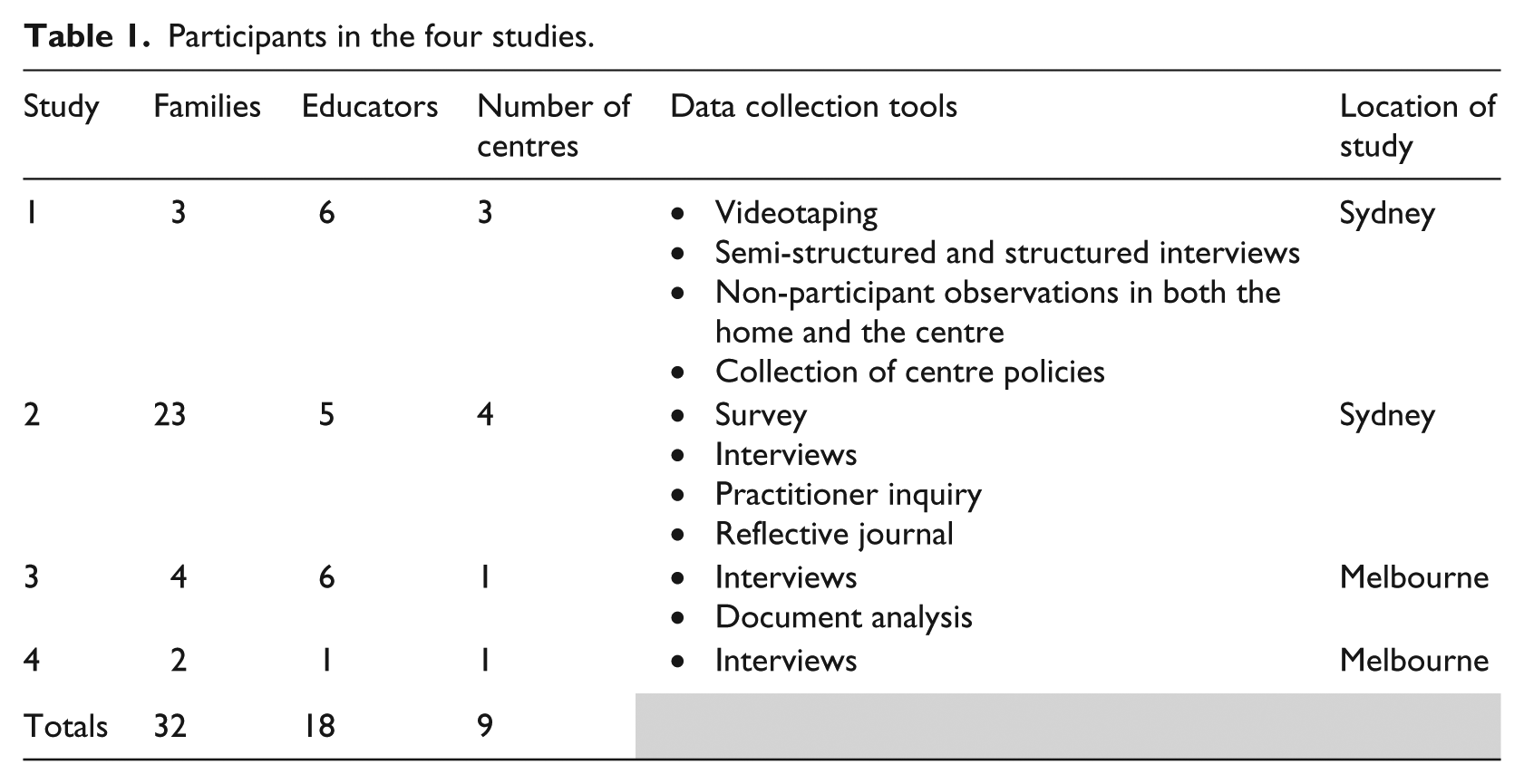
Ethical approval was obtained for all the research studies from the authors’ respective universities (Macquarie University and Deakin University). Although Study 1 was conducted prior to the implementation of the EYLF, at that time in New South Wales there was the NSW Curriculum Framework for Children’s Services: The Practice of Relationships: Essential Provisions for Children’s Services New South Wales Department of Community Services, Office of Childcare (2005), which had many similarities to the EYLF. The other three studies were conducted after the introduction of the National Quality Agenda. The design of each study is briefly outlined next, and an overview of the four studies is presented in Table 1.
Participants in the four studies.
Study 1 (2007)
Author 1’s thesis investigated the experiences of families utilising ECEC centres and identified the levels of connectivity between families and centres. For this article, the data reported on is from the first phase, which included in-depth case studies of three families with a three-year-old child in an ECEC centre. The families were in different centres in Sydney, New South Wales. They included an Aboriginal and Torres Strait islander family, a culturally and linguistically diverse family, and a family wherein the father had a physical illness.
Study 2 (2012)
Author 1 investigated culturally and linguistically diverse families’ and qualified early childhood teachers’ perceptions about partnerships with a mixed-methods approach in Sydney. Four ECEC centres were involved in the study. There were three phases to the study and, for this article, the data reported is from the qualitative feedback from families (n = 23) and teachers (n = 5) from the survey responses in the first phase of the study.
Study 3 (2012)
Author 2’s thesis adopted a qualitative case study approach. This study explored the interactions and relationships between educators and families in an ECEC centre as they reflected on notions of partnership and family-centred practice. The centre was located in outer metropolitan Melbourne, Victoria. Four parents and six educators participated in the study, and the educators worked in various roles.
Study 4 (2013)
Author 2 conducted a small-scale case study in a centre in Melbourne, focusing on the re-greening and inclusion of natural affordances in the birth-to-two-years outdoor play space. The research included landscape gardeners, early childhood academics and early childhood educators in redesigning and creating an outdoor learning space for infants and toddlers. One educator who had been involved in the original design and two families of children utilising the outdoor space were interviewed.
Data analysis and key findings
While each of these studies was undertaken as a stand-alone investigation of applied educator practice, parallel findings across the studies emerged in the data analyses. Drawing on both the National Quality Framework guides (NQS and EYLF) and the partnership literature, each of the four studies was examined to draw out similarities as well as disconnects between the language used by the participants in the way the nature of the interactions was discussed and the perceptions of the families and educators in terms of communication. Four key themes were consistent across the studies and have framed the presentation of the findings. These key themes focused on the language of partnership, the language of culture, the language of practice and the perceptions of communication.
The language of partnership
When analysing each of the studies, the responses across all four were consistent in the way a notion of partnership was apparent in the language of the participants. It became clear, however, that while the language strongly reflected a partnership framework of mutuality, trust, reciprocity and shared decision-making, there was a contrast in the language of families to that of the educators. The families described a sense of trust and being guided by the educators as a key component driving the nature of the relationships with the educators. For instance: Forming a partnership in developing my child’s strengths and abilities and addressing any areas of concern. Providing a consistent approach to social, emotional and learning development. (Study 2, Parent 7, Centre 1) You could always talk to her, she was always listening to you … never took offence at anything, she always listened. Whether she implemented what you offered or not, it always felt like she could get on board. (Study 3, Parent 2)
In contrast, the same focus on trust and mutual guidance was not as apparent with the educators. While all of the educators spoke of having respectful relationships with the families, the characteristics of mutuality, trust and reciprocity were less evident. Each of the educators saw the relationships with families as a key part of their role, but all identified that these did not always look the same or were not always reciprocated. While ‘trust’ was highlighted frequently by the families, ‘trust’ was a characteristic that was discussed less by the educators, and the relationships were discussed in ways that presented a professional distance. For instance: I have a relationship with all my parents. That comes with the job, it’s a professional requirement to have a relationship with all these parents … There are families I have got a professional relationship that’s still trusting and respectful but doesn’t overlap to that certain degree. (Study 3, Educator 1)
In fact, many of the educators noted that families did not trust them. This perspective dictated the way the educators discussed the relationships with families in terms of the elements of partnership. The following example from Study 3 illustrates this perspective: This family, whatever I did, she didn’t like me, you know? So I was greeting her in the morning, she was ignoring me, and when she brought her child she used to wait for another staff member to come in, like she didn’t trust leaving him with me. (Study 3, Educator 3)
The educators also discussed their interactions with families in relation to focusing on the practices and understandings that supported parents in the practical care and developmental knowledge of their children – for example, improving children’s behaviours and helping families understand children’s development: Trained staff who know what is important for children’s development. (Study 1, Educator 2, Centre 3) We try to explain to her, leave him without a nappy and he’ll get used to getting wet, but she doesn’t want him to get wet, she wants him to be potty-trained straight away. (Study 3, Educator 5)
As noted earlier, there is confusion about the language of partnerships in both the EYLF and NQS, as well as in the research literature. It is therefore not surprising that the families and educators in these four studies had different understandings of what a partnership entailed.
The language of culture
The educators spoke of the importance of recognising culture and diversity in building positive relationships with families. However, in Study 3, the educators perceived it difficult to form relationships with families for whom English was not their first language: One would be the language because we can’t communicate to each other; it’s both ways, she can’t talk to me and I can’t talk to her. We do sort of sign-language-type things to try and get our point across, but it’s really difficult. (Study 3, Educator 2)
The educators noted the importance of recognising and familiarising families with different cultures and celebrations; appreciating and understanding others to broaden the child’s view beyond the family unit; maintaining families’ culture and traditions to contribute to a child’s sense of identity; and using diversity as an entry point for learning and building relationships. This broadening of the child’s view was considered beneficial to children as it developed an understanding of diversity and difference. Emphasis was placed on empathy, understanding and appreciation of diversity: Children exposed to a diversity of people – adults and children and both personality and culture. (Study 1, Educator 2, Centre 3) We actually do learning stories in the family’s language if we can. ‘R’ is doing Turkish, I’m doing Italian … If we’ve got a child whose family is predominately Italian, we try and do a learning story in Italian. (Study 3, Educator 6)
The respectful consideration of culture was ambiguous when it came to the program design and linking back to the EYLF and the NQS. For example, one of the educators in Study 3 noted that: We respect their culture. For instance, this week is Chinese New Year, so in our room we try and have some craft to do with Chinese, we have some artefacts, costumes, and try and, even with cooking … Some cultures don’t understand the importance of play, or cleaning up, packing up, they don’t like their boys in some cultures to pack up and clean up. So we try and teach them that it’s not to do with culture, it’s to do with independence … but it should extend to the home. But in some cultures it doesn’t. Mum does everything. (Study 3, Educator 6)
While the educators felt that they were being respectful of the children and families’ cultural backgrounds, this was not as evident from the perspective of the families. One of the parents in Study 3 felt she was closer to the carer in the room [who] is of the same culture as me and we have a common language and we talk about Eid and food … The centre does try and do some Turkish meals. I have given them some recipes but when I ask if they have used them, they say they will get around to it. (Study 3, Parent 1)
However, in Study 1, all three families discussed the need for their children to have a sound understanding of the family’s beliefs and culture, but with the desire for their children to be accepted into the wider community. This was seen as a conflict – the balance between respecting identity (cultural and family beliefs) and conforming to the broader community’s value system. For example: His own culture is important but he gets that from home all the time. We talk about who he is, his identity … [however] we are not just defined by our race … [and] the reality is it is not just all Kooris’ and he needs to get used to this. (Study 1, Family 1, Mother)
The language of culture and the importance of embedding it in the early childhood curriculum was therefore seen as important by the educators, even if it did come with some judgements, but this was not necessarily supported by the families. The parents in this study did not want the focus to be on culture per se, but wanted to ensure that their child ‘fits’ in. An anti-bias approach in the early childhood curriculum needs further exploration as it is often noted that educators find it frustrating and hard to enact in practice as families do not always support this (Dau, 2001; Derman Sparkes and Olsen-Edwards, 2010).
The language of practice
The language that underpinned the conversations with the families in relation to the expectation for their child in the ECEC centre focused on notions of care, love, happiness and friendships. It was clear from all four studies that the families wanted educators who knew their child. Rather than just focusing on learning and educational programs, the concerns presented by the families were about ensuring that their child was happy and safe, having fun, being cared for and loved. There was a sense of needing to know the educators not in relation to the qualifications and expertise they held, but their commitment. For example: ‘They can feel that day care is a safe place. They have the knowledge that if they need help they have someone else to turn to even though mum and dad aren’t there’ (Study 2, Parent 5, Centre 3). In Study 4, which was a study focusing on the outdoor play environment, the parents focused on children’s well-being as being important for their development: ‘I think it’s important for them to play outside and obviously get out in the sun and fresh air. Kids hate being cooped up inside all day, in my opinion’ (Study 4, Parent 2).
In Study 1, the families also placed a high importance on education in the program. For instance, Family 1 and Family 2 discussed both the program and the role of the educators in developing their children’s knowledge and skills. For instance, the father from Family 2 noted that he wanted to see a ‘Figure of a teacher who says yes/no and tells them what they can and can’t do. Teach him for school. Listening skills … use they’re [sic] hearing and interpret well when listening to instructions’.
While the language of the families tended to reflect the need for their child to be happy and cared for, the language of the educators was more focused on how parents can foster their child’s development effectively at home, reinforcing the connections to the language of the NQS to support families in their parenting role. This was particularly evident when a parent in Study 3 asked for advice on ways to support her child to learn to read at home: My oldest got very upset at about the age of four because she wanted to learn how to read. Do I teach her how to read? They were like, ‘Well, no, have you taught her basic concepts of under/over, up/down’. (Study 3, Parent 2)
While this conceptual understanding is important for children to grasp in order to be able to engage in formal literacy and numeracy learning, the response from the educator did not present a sense of mutuality and partnership to work together to support this child and empower the parent. The educators provided families with access to current information about community services and resources to support parenting and family well-being. This notion of the centre and educators as the experts in giving this information was evident in all four studies. For example: I get information sometimes regarding how I can cope with some child raising challenges. (Study 2, Parent 1, Centre 2) Sometimes the non-English-speaking-background families come and ask about the child, if they need to know about the paediatrician or other stuff, we give information about it. (Study 3, Educator 3)
A sense of mutual sharing of expertise, decision-making and reciprocal relationships was missing from the language of the educators. The provision of information and advice underpins the language of the educators, not an emphasis on gaining insights and new understandings from the expertise of the families. For example, in Study 4, there was a disconnect between the educator and the parents in the documentation of the daily reflections on children’s learning. The educator noted the amount of information that was being presented in the documentation, yet the parents did not feel that they were informed about their individual child’s engagement in the outdoor space.
This language was further highlighted in Study 3, where there was a strong focus on encouraging families to assist children to meet developmental milestones, rather than connecting with families in recognising families’ expertise: Toilet training, that’s something they put on us to, you know, to have to do. And sometimes you might not feel that your child’s ready because … not everyone can just get toilet training as soon as they turn three or whatever it is. (Study 3, Parent 3)
In this example, the parent had concerns about her child’s readiness for toilet training. However, the parent was swayed by the educator’s own views, again positioning the educator as expert. The language of practice used was reflective of the view of the educator being the help-giver – the expert – and the families being the help-seekers. This perception is also represented in the language of the NQS, which suggests that educators need to support families in their parenting role, positioning parents as being in need of the expertise of educators.
Perceptions of communication
In analysing the communication between the educators and the families across the four studies, there was little evidence of the characteristics that underpin authentic partnerships. In each of the studies, the communication was dominated by the needs of the educators and focused mainly on information provision and documentation that should be accessible to families. Quality Area 1 in the NQS requires that ‘documentation about each child’s program and progress is available to families’ (Australian Children’s Education and Care Quality Authority, 2012: 17), and it was clear from all of the studies that the educators are implementing a range of approaches, such as parent boards, notices, newsletters, daily journals and informal get-togethers, in order to ensure that families have access to documentation on the children’s programs. The educators also believed that they were communicating effectively with families and including them in the program and in the decisions made about their child. While in each of the studies the information was provided, there was no avenue to share information collaboratively or evidence of meaningful decision-making. There was also a lack of any reciprocal recognition of the expertise of the parent, except in relation to being invited to share a special skill or bring in something to the program from the family’s culture. This can be summarised by a parent in Study 4 who commented that: Every day, they, the teachers will let me know what they’ve done during the day, yeah they also write up their journal which they have displayed which we can read that shows us what they’ve done for that day. (Study 4, Parent 1)
One of the parents in Study 2 found that the journals provided gave ‘greater insights into how my daughters behave without me around, seeing them and their interests through a new perspective, advice on developmental stages, improves the experience for everyone’ (Study 2, Parent 1, Centre 1). While the purpose of these journals is to document and make visible to families how their children are learning and developing through the program, they do not provide an avenue where reciprocal understanding and a building of new, shared ways of knowing are fostered. Descriptions such as ‘beautiful journal’ (Study 3, Parent 4) present a view of the families as being passive recipients.
In keeping with the expectation of the NQS, it was apparent in all four studies that there was an emphasis on ensuring that families had access to centre information, as well as the program in each of the classrooms, responding to the language used in Quality Area 6 of the NQS. In all four studies, the centres believed that they were communicating effectively with families about the service and the program. However, the reciprocity was missing. For instance: The families are included in our service, as in the curriculum, they’re included in all our special days, every day. It’s the way we speak to them, making sure that they’re given plenty of notice for things. We have newsletters, which we email now, and we have notices, and in our rooms we might talk to parents and remind them about certain things. (Study 3, Educator 6)
However, the families did not feel that they had the same level of engagement with their child’s program as perceived by the educators. For instance, in Study 4, one parent noted: It’s not mentioned in any [information about the outdoor program], we don’t have a discussion, it’s not mentioned in the journal they display, so that’s why I feel that they don’t really have any play in that area, it’s more indoors. (Study 4, Parent 1)
Parent 2 also felt that while there was a daily journal available to families, this did not provide her with understanding of the program or of her child’s engagement in the learning: ‘So I didn’t really know what “J” did. I knew what they did as a group but not what he did on his own’.
Families in Study 2 also noted that communication was important and outlined the ways this happened in the ECEC centres. However, again the emphasis was on being given information, not on being involved in a two-way exchange: ‘The staff are always friendly, and offer information when they can. The daily diaries are fantastic and offer a good insight into what the children do during the day’ (Study 2, Parent 4, Centre 3). This approach to communication positions the educators with the power and expertise. Interestingly, the educators emphasised informal communication, but did not articulate if this was a didactic, one-way giving of information or if it was more a two-way reciprocal approach to communicating: We try and do a lot of it verbally with the parents and that in itself is a really powerful tool in building up relationships with the parents. (Study 1, Educator 1, Centre 2) It’s mostly just conversation at the end of the day and I find that this way, you know, it’s just easier. Families are quite happy to talk with you. That’s how we form relationships. (Study 2, Educator 4, Centre 3)
Analyses of the practices in the four studies in relation to communication with families revealed that giving information to families (not receiving information from families) was emphasised. These passive communication strategies implemented by the centres were contradictory to their policy documents and verbal statements, which emphasised the importance of being responsive to families and openly communicating with them.
Discussion
On examining these four studies, there were common threads that emerged in terms of the discourse of family–centre partnership which contributed to a disconnect in communication between the educators and the families. While, in each of the cases, the educators’ practices reflected the policy documentation, true reciprocal partnerships were not apparent.
Discourse on partnerships
The EYLF positions the family as the expert in relation to knowing and understanding their child. However, this language is not supported by the language of the NQS, which presents the educator as the driver and the one who disseminates the information and makes the documentation available. This contributes to a power imbalance where families are passive in this partnership relationship. Therefore, true reciprocity is lacking as there is no onus on the educator to do anything other than deliver information to families. This unintentionally shifts the responsibility to the parents to find this information. Reciprocity and reciprocal relationships centre on an acknowledgement and a conscious belief that information is not just ‘made available’, but is also mutually shared and valued. This enables a move to new shared understandings that are created when knowledge is pooled and shared equally. This new space is not just a recognition and respect for differences, but also a ‘cultural, social and epistemological change’ through which different funds of knowledge or discourses are brought into ‘conversation’ with each other to challenge and reshape both practice and knowledge (Moje et al., 2004: 44). Moreover, when faced with dichotomous perspectives on what an effective relationship between families and educators might look like, it is not surprising that reciprocal partnerships were not found across the studies.
In terms of regulatory requirements, the educators across the four studies were meeting practice expectations. Each of the four studies presented findings in which the educators were all able to share with families the language of the EYLF – talking about the value of play, incorporating family backgrounds into their planning, and forming respectful relationships with families. However, when examining these relationships as they sit within a notion of partnership, the reciprocity and mutuality that are inherent in any genuine partnership were missing. Rather than building on the expertise of the families and recognising the agency which families bring to ECEC centres, these four studies have highlighted and reflected what Dunst (2010) presents as the ‘help-giver’–‘help-seeker’ relationship between the family and the educator, indicating that there is a power imbalance in place, where families are listened to but not necessarily heard. While for some families this is important, many families hold strong capabilities in their role as parents and should be positioned in the role of help-giver in recognition of their position as experts in understanding their child. Unfortunately, this was not occurring in practice. Each of these studies illustrated a disconnect between the language of the educators and the families. Whilst the families were using language such as ‘care’, ‘happy’, ‘safe’ and ‘love’, the educators were using language that centred on child learning, routines, behaviour and development, and inadvertently undermined the family as having any expertise. This information-dissemination approach, rather than a reciprocal knowledge-building approach, may be adding to families’ anxiety around feeling inadequate and being concerned if they are doing the best for their child.
Implications for policy and practice
For a new space of shared understanding to be realised between educators and families, the language of both the EYLF and the NQS needs closer alignment in order to ensure that family–centre partnerships are reflective of contemporary perspectives. By revising the language in these documents, educators may be more likely to understand what it means to engage in family partnerships. For this to be achievable, the EYLF and NQF need critiquing in order to recognise how these documents support the current status quo of power sitting with the centre and educators. For instance, a search of the EYLF for the word ‘love’ revealed that it is never mentioned. Yet, in these four studies, the families spoke about the importance of their child being cared for and understood. The word ‘care’ in the EYLF only occurs in Outcome 1 and not in any of the Principles, Practices or the three Bs (Belonging, Being and Becoming). If the language in relation to caring for children is only in relation to their identity being supported, it provides the message to educators that only learning is valued. However, this is to the detriment of those ‘soft’ practices about which families are seeking reassurance. The language of the EYLF and the NQS presents limitations for educators seeking to move beyond a practice of being an information-provider to a relationship characterised by reciprocity and mutuality. While there is a disconnect between what parents are seeking from the relationship and educators who are guided by practice expectations outlined in policy documents, the capacity to form genuine reciprocal partnerships is limited.
The complexity of revising these documents is that the NQS is an assessment and rating tool, but the EYLF is a practice framework that guides educators’ interactions with children and families. Therefore, is it possible for the language in these documents to be married (which was the intent) when they have two different purposes? How can these two documents effectively support reciprocal partnerships and position parents as a key expert in order that children and families are not short-changed and the measure of partnerships is reimagined?
Conclusion
It could be argued that the disconnect between the language of the EYLF and the NQS creates a space of confusion regarding the nature of the relationships between parents and educators. Educators are involving families in their programs, seeking information from families and engaging with families. This is accompanied by an understanding of reciprocal partnerships, yet the relationships between parents and the centre in each of these studies were driven by the needs of the educators. Reciprocal partnerships are transformative and create new learning for all parties, but in the relationships in these four studies, the emphasis has been on the educator as the provider of knowledge and the family as the recipient. Therefore, a new space where there are reciprocal connections has not emerged. It is clear that the educators across these four studies were enacting practices reflected by the language of the NQS and the EYLF, but they appeared to be limited in their capacity to form reciprocal partnerships. While the notion was mentioned, it was not enabled in the contexts studied. This article argues that there is a need to move beyond the current rhetoric of engaging in partnerships with families and to challenge educators to critique the current documents (the NQS and the EYLF) in order to ensure that genuine reciprocal partnerships are possible and are created with families.
Footnotes
Funding
The author(s) received no financial support for the research, authorship, and/or publication of this article.