




Abstract
The purpose of this study was to identify indicators of parent engagement in early learning that would be relevant for children’s academic success; equitable for all families regardless of social, educational, or economic backgrounds; and actionable for urban school districts seeking to promote parent engagement with limited resources. Using a Delphi technique, a panel of parents, school staff, and researchers rated 106 parent engagement indicators extracted from stakeholder interviews. After multiple Delphi rounds and panel discussion, 30 indicators were retained. Retained indicators focused on home-based activities and home-school relationships/communication; no school-based activities met criteria for relevance, feasibility, and actionability.
Keywords
The significance of parent engagement in early learning
Entering school ready to learn is critical to children’s long term success (Darney et al., 2013; Davoudzadeh et al., 2015; Duncan et al., 2007). Parents play a central role in their young children’s readiness to learn as they control whether and how their children are exposed to opportunities that support their development of foundational cognitive and social-behavioral skills (Bierman et al., 2017; National Academies of Sciences, Engineering, and Medicine, 2016). Indeed, there is strong evidence demonstrating the importance of parent engagement in supporting young children’s early literacy, math, and social-behavioral skills (Fantuzzo et al., 2004; Powell et al., 2010; Van Voorhis et al., 2013).
Guided by the large body of research documenting the impacts of parent engagement on children’s school success (Boonk et al., 2018; Castro et al., 2015; Van Voorhis et al., 2013), federal Title I policy requires urban school districts serving low-income families to have parent involvement plans (Mapp, 2012) and to make significant investments in initiatives designed to promote parent engagement. This study focuses specifically on parent engagement in early learning in one urban school district, Baltimore City Public Schools. Baltimore City is home to approximately 594,000 people (United States Census Bureau, 2019) and 70% of public schools are designated as Title I schools (Maryland State Department of Education, 2020). The majority of students enrolled in these schools are African American or Latinx (Baltimore City Public Schools, 2020). Consistent with Milner’s (2012) three categories of urban school districts, Baltimore City Public Schools (“City Schools”) would be described as an “urban emergent” district that has struggled to meet the substantial educational and social-emotional needs of its students with limited resources. The majority of City Schools’ students enter kindergarten not meeting state standards for school readiness and a large number of students and families have been exposed to multiple traumas and adversity (Alexander et al., 2014; Child & Adolescent Measurement Initiative, 2014; McDaniels, 2014; Ready at Five, 2020). Recognizing the importance of families in supporting children’s education, the district has a strong commitment to parent engagement. But like many other urban districts, it lacks a validated set of indicators for systematically benchmarking parent engagement. Having a meaningful and validated set of parent engagement indicators for urban school districts would inform transformative parent engagement approaches that can help mitigate the effects of the negative legacy of structural and interpersonal racism in urban schools (Boutte, 2012).
Models for defining, conceptualizing, and assessing parent engagement
Myriad terms have been used to refer to parent engagement, including parent participation, parent involvement and family engagement. In this report, we use the term “parent engagement” because (a) school engagement efforts are largely focused on strengthening relationships with children’s primary caregivers, and (b) the majority of research linking parent engagement in early childhood programs with children’s academic success has been obtained from one family member, usually the primary caregiver (e.g., Fantuzzo et al., 2013; Powell et al., 2010). However, the term “parent” is applied broadly to include a range of caregivers such as grandparents, and other caregiving adults in the child’s life.
Bronfenbrenner’s bioecological model (Bronfenbrenner, 1986), which describes interactions between the family and school as key influences on child development, has been the predominant theoretical framework underpinning parent engagement. In line with this framework, many definitions of parent engagement have highlighted the partnership between parents and educators to support children’s learning. For example, the United States Department of Education (USDE) defines parent engagement as participation of educators and parents in “regular, two-way, and meaningful communication involving student academic learning and other school activities” (United States Department of Education, 2015). Similarly, the National Association for Family, School, and Community Engagement (NAFSCE) defines parent engagement as a shared responsibility to actively support children’s development and learning (National Association for Family, School, and C. E., n. d.). Consistent with this literature, we define parent engagement as a process in which schools and parents (and other family members) work together to support children’s learning.
A variety of models have been developed to describe parent engagement in children’s education and such models have informed existing parent engagement measures. However, these models and measures have limitations, most notably a bias toward middle-class norms and an emphasis on school-based activities that may not be feasible for low-income families (Auerbach, 2007; Delale-O’Connor et al., 2019; Finn, 1998; Lareau & Horvat, 1999). Both limitations may lead to faulty conclusions about parent engagement levels among low-income families. For example, Epstein’s (1995) family-school-community partnership model, one of the foundational models of parent engagement research and practice, includes six typologies of parent involvement, half of which focus on school-based activities (e.g., volunteering at school, involvement in school decision-making via serving on school committees, and school-community collaborations to bring resources into the school). In our prior research, 88% of principals cited attendance at school events as a key indicator of parent engagement, while only 35% of parents mentioned it (Gross et al., 2020). For single or low-income parents working multiple jobs or employed in shift work, serving on school committees, volunteering in the classroom, or attending school events may be unrealistic as they may lack control over their day or evening schedules. Use of models that emphasize parents’ school-based involvement may reflect a middle class bias about how engaged parents should demonstrate their investment in their children’s education, a bias that may inadvertently foster a deficit perspective when parents with limited resources, time, or comfort being in the school are not participating in school-based activities (Lightfoot, 2004; Ho & Cherng, 2018; Jacques & Villegas, 2018; Luet, 2017).
Engagement models that emphasize parent involvement in school-based activities may also disadvantage families of color who may not feel comfortable in school settings. For example, Ho & Cherng (2018) found that teachers perceived immigrant ethnic minority parents as less involved in their children’s education compared to native-born White parents; others have found that Latinx immigrant parents report feeling less welcome in schools and that their concerns are often ignored by school staff (Martinez et al., 2004; Ramirez, 2003). Similarly, Fantuzzo et al. (2013) found that African American parents were less likely to report school-based involvement than parents from other ethnic groups. This may be because African American parents may recall their own negative experiences with racial discrimination in school and feel intimidated by the power schools hold over their children’s futures (Iruka et al., 2011; Lareau & Horvat, 1999; Lewis & Forman, 2002; Posey-Maddox & Haley-Lock, 2016). Thus, lack of involvement in school-based activities may not mean parents are not actively engaged in supporting their children’s learning. Rather parents may be very involved in supporting their children’s learning but in ways that are less observable by teachers and other school staff.
Another common framework for parent engagement is Hoover-Dempsey and Sandler’s parental involvement process model (Hoover-Dempsey & Sandler, 1997; Walker et al., 2005). This model hypothesizes that parent’s school-based and home-based involvement are influenced by three key constructs: parent’s motivational beliefs (i.e., parents beliefs about what their role in supporting their child’s education should be, parents self-efficacy for helping the child succeed in school); parent’s perceptions of invitations for involvement from the school, teacher, and their own child; and parent’s perceived life context (i.e., time and energy for involvement, specific knowledge and skills for involvement). However, this model and its associated measures also have limitations. For example, there is a focus on school-based involvement activities (e.g., “Someone in this family helps out at this child’s school,” “Someone in this family attends PTA meetings”) which may advantage White, middle class, and married parents with more resources and control over their schedules and greater comfort being in school settings. In addition, the vast majority of research on this model has focused on elementary and middle school students so its relevance to parent engagement in early childhood education is less clear (Green et al., 2007; Walker et al., 2005).
Calabrese Barton et al. (2004) and Pérez Carreón et al. (2005) designed the Ecologies of Parent Engagement Framework to offer a more holistic model for understanding parent engagement in urban high poverty school districts. Their framework describes parent engagement as the mediation between the type of capital parents have (i.e., human resources, beliefs/knowledge/expectations, material resources, and relationships with school staff) to support their children’s learning and the kinds of spaces (e.g., classroom, home, and community) in which they support that learning. In addition, this model asserts that engagement as the mediation between capital and space reflects both the actions parents take to support their child’s learning (e.g., attendance at school events and talking with their child about school) and their orientation to action (e.g., expectations for their child’s learning and success). Its focus on parents use of multiple types of capital, their actions, and their orientation to action frames parent engagement in a way that is more empowering to parents, regardless of their social, educational or economic backgrounds. However, this model has primarily been studied in the context of elementary school science education, thus its application to early childhood education is unclear.
Limitations of existing parent engagement indicators
There are many measures of parent engagement developed for a range of populations (e.g., Latinx families) and organizations (e.g., Head Start and public schools). Each of these measures has grown out of an awareness that existing measures were not adequately addressing the needs and interests of relevant populations. For example, McWayne et al. (2013) developed the Parental Engagement of Families from Latino Backgrounds (PEFL) scale specifically for use with Latinx parents of young children in Head Start. The PEFL includes four subscales, three of which reflect home-based activities: foundational education, supplemental education, future oriented teaching, and school participation. There is initial evidence of its reliability and validity as evidenced by associations with teacher-reported parent engagement (McWayne & Melzi, 2014). However, this measure has several potential limitations, including that: (1) it was developed specifically for Head Start, a context that by design necessitates a high level of parent engagement and includes resources to promote such engagement that public schools do not have making its use with Latinx families in public school questionable; (2) there is no evidence of its relations with indicators of children’s academic success; and (3) there is no evidence of its validity for non-Latinx populations.
Fantuzzo et al. (2000, 2013)created the Family Involvement Questionnaire (FIQ) for urban, ethnically diverse parents of children in PreK to first grade. It includes three subscales of parent involvement: home-based involvement (e.g., I spend time with my child working on reading/writing skills; I take my child places in the community to learn special things), school-based involvement (e.g., I volunteer in my child’s classroom; I attend parent workshops or trainings offered by my child’s school), and home-school conferencing (e.g., I talk to my child’s teacher about my child’s accomplishments, I attend conferences with the teacher to talk about my child’s learning or behavior). The FIQ is specifically tailored for use with parents of younger children and has strong reliability (Fantuzzo et al., 2000, 2013). However, only the FIQ home-based involvement subscale has been significantly associated with indicators of academic achievement such as children’s literacy and math skills (Fantuzzo et al., 2013), approaches to learning, classroom behavior, and receptive vocabulary (Fantuzzo et al., 2004). Neither the home-school conferencing subscale or the school-based involvement subscale, both of which include items requiring parents to be present in the school building, have demonstrated convergent or predictive validity with children’s academic outcomes (Fantuzzo et al., 1999, 2000, 2004). These results highlight the importance of capturing activities parents do outside the school to support their children’s academic success relative to what parents do inside the school or classroom and raise questions about the relevance of using indicators of parent engagement that rely on their participation in school-centered activities (Finn, 1998).
Several other researchers have developed school staff-reported measures of parent engagement. For example, the teacher-reported version of the Parent–Teacher Involvement Questionnaire (Reid et al., 2001; Webster-Stratton, 1998) includes items focused on parents’ involvement in the classroom, attendance at school functions, and parent–teacher communication, and there is evidence of its reliability and validity (Arnold et al., 2008; Reid et al., 2001). Similarly, Epstein and colleagues have used staff reports of whether their school implemented specific family involvement practices to capture parent engagement (Epstein & Sheldon, 2002; Mac Iver et al., 2015; Sheldon & Epstein, 2005). However, both approaches rely heavily on parents’ participation in school-based events and may be influenced by unconscious biases about families from low-income backgrounds based on what school staff believe is relevant evidence of parent’s engagement in their child’s education (e.g., school attendance, classroom behavior, academic performance) (Boutte, 2012).
It is also unclear whether existing parent engagement measures tap activities that schools serving low-income families could feasibly change. For example, items like “I take my child to school in the morning,” and “I volunteer in the classroom” require that parents have control over their schedules and access to reliable transportation, barriers that schools are unlikely to be able to change. Although a strong parent–teacher/school connection is essential for supporting children’s academic success, it is also essential that we capture these concepts using items that are feasible to improve in districts like City Schools that serve low-income families with multiple challenges. Measuring and holding schools accountable for parent behaviors they cannot change could contribute to staff demoralization and blaming parents for not supporting the school. While there are a number of measures designed to assess parent engagement in underserved populations, there has been limited attention to whether their items capture behaviors schools could change.
Associations between indicators of parent engagement in early childhood education and children’s academic success vary. Of the multiple forms of parent engagement studied, home-based engagement strategies have shown the most consistent associations with children’s school readiness skills, including receptive vocabulary, early literacy and math skills, and classroom behavior (e.g., Boonk et al., 2018; Loughlin-Presnal & Bierman, 2017). There is also evidence that parent’s holding high expectations for their children’s learning (e.g., Boonk et al., 2018; Castro et al., 2015) and the quality of home-school communication and relationships (e.g., Anthony & Ogg, 2019; Iruka et al., 2011) are linked with children’s literacy, math and social-behavioral skills. Importantly, these relationships hold across economic groups (Boonk et al., 2018). In contrast, evidence linking parent’s school-based involvement with children’s academic success is limited, particularly for low-income populations (Alameda-Lawson & Lawson, 2016; Fantuzzo et al., 2000). These findings underscore the importance of measuring and promoting parent engagement but also ensuring that parent engagement measures include items that are a) linked to children’s academic success, b) equitable for all parents, and c) useful to schools serving students from predominantly low-income urban communities, where many parents did not finish high school or may recall few positive memories of their own education (Iruka et al., 2011; Posey-Maddox & Haley-Lock, 2016).
How the current study addresses limitations of existing models and measures
To address these gaps in the existing models and measures of parent engagement in early childhood education, our team partnered with City Schools through a 2-year multi-phase Researcher-Practitioner Partnership Grant to develop a meaningful and equitable measure of parent engagement for this district. We undertook this partnership with four key assumptions. First, if parents were not engaged in their children’s education during their earliest school years, they would be unlikely to engage in their children’s education in the later elementary school years and beyond. Therefore, it was essential that City Schools have a strong measure of parent engagement focused on Prekindergarten (PreK) and kindergarten. Second, although Maryland is one of the most affluent states in the nation, the majority of City Schools’ students live in poverty (Maryland State Department of Education, 2019). In addition, 76.6% of City Schools students self-identify as African American and 13.5% self-identify as Latinx (Baltimore City Public Schools, 2020), two racial/ethnic groups that have historically been underserved by public school systems (Anderson, 2012; Boschma & Brownstein, 2016). Therefore, any definition and measure of parent engagement employed by the district must be sensitive to the issues faced by parents with limited resources and varied (sometimes negative) perceptions of the role of schools in supporting their children’s education (Ishimaru & Takahashi, 2017; Weiss et al., 2018). Third, it was important that any measure used to benchmark schools’ progress in promoting parent engagement capture behaviors or parent perspectives that schools could feasibly change. Otherwise, parent engagement measures might only serve to frustrate teachers and principals already challenged with raising low-income students’ academic achievement with limited resources. Finally, consistent with the goals of promoting parent engagement in children’s learning, the measure needed to capture behaviors or perspectives that were clearly linked to students’ academic success.
Guided by the Ecologies of Parent Engagement Framework for urban high poverty schools (Calabrese Barton et al., 2004; Pérez Carreón et al., 2005) and previous literature linking specific forms of parent engagement with children’s school success (Boonk et al., 2018; Castro et al., 2015; Iruka et al., 2011) as well as findings from stakeholder interviews in the first phase of our project, seven components of parent engagement relevant to early childhood education were considered in this study: home-based activities, parent–school/teacher relationships, parent–school/teacher communication, parent trust of the school/teacher, parent knowledge about their child’s education, parent expectations for their child’s education, and school-based activities. The purpose of this phase of the project was to identify meaningful indicators of parent engagement in early learning that are relevant for children’s academic success but also equitable for low-income, single parents regardless of their racial/ethnic background and for urban school districts with limited budgets and resources. Meaningful indicators were defined as those that met three criteria: 1) are clearly linked to students’ academic success, 2) capture a behavior that would be feasible for most or all City Schools’ parents to do, and 3) capture a behavior or affect that most or all schools in the district could change or improve (i.e., its “actionability”). The long-term goal of this study is to create a meaningful and psychometrically strong measure of parent engagement in early learning that can be used in school districts serving a preponderance of low-income students and families of color.
Methods
Study design and sample
We used a Delphi technique to select parent engagement indicators that were relevant to children’s academic success, feasible for most or all parents to do, and actionable for schools. The Delphi technique is a well-established iterative process in which panel members with expertise and experience with a construct of interest (in this case parent engagement in early childhood education) provide their opinions about indicators or concepts representing that construct via an electronic survey (Keeney et al., 2001). The Delphi technique typically consists of at least two rounds with the goal being to achieve consensus among expert panel members on the core aspects of the construct. The extent of agreement on core aspects of the construct is assessed via statistical analysis at the end of each round and used to determine which aspects of the core construct need to be returned to the panel for further review in subsequent rounds.
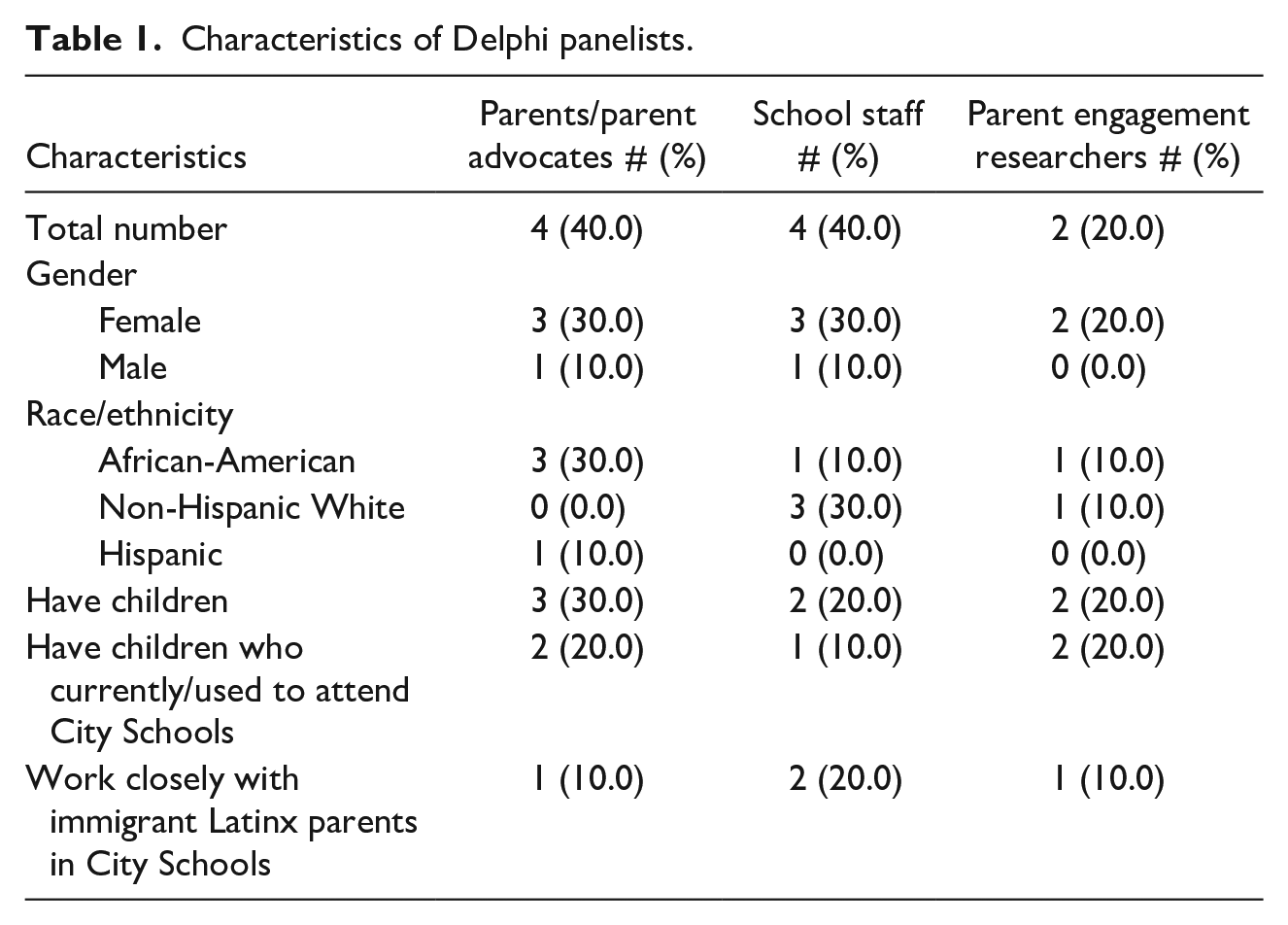
Ten individuals with expertise in parent engagement were recruited individually by the first two authors to participate in the Delphi technique. These individuals possessed important but different knowledge and perspectives about parent engagement based on their backgrounds and relationships with City School parents. Specifically, the panel included representatives from three important subgroups – parents with a strong history of supporting and advocating for their children’s educational needs in City Schools and individuals (one community leader, one bilingual social worker) who advocate on behalf of English and Spanish-speaking families with children enrolled in City Schools (n = 4); school principals and early childhood teachers with a commitment to and significant experience with engaging City Schools parents in their children’s education (n = 4); and researchers who have developed, implemented and evaluated interventions designed to support parent engagement in children’s education in City Schools and nationally (n = 2). Table 1 provides a summary of their characteristics by subgroup. Notably, 70% of all panelists were also parents, 50% had children who had added or were attending City Schools, and 40% of all panelists worked closely with Latinx immigrant parents in their current roles.
Characteristics of Delphi panelists.
Indicator generation
In a previous paper, we reported results from the first phase of our multi-phase research partnership with City Schools exploring how 63 individuals representing five City Schools’ stakeholder groups (parents (n = 23), teachers (n = 8), principals (n = 8), other school-based staff serving young children and their parents (n = 9), district leaders (n = 7), and community leaders (n = 8)) defined and characterized parent engagement in early learning (Gross et al., 2020). Based on content analyses of these qualitative interviews, we identified nine unique definitions of parent engagement and 33 codes and sub-codes descriptive of engaged parents and schools, including: 17 home-based engagement codes (e.g., reading with your child), 8 school-based engagement codes (e.g., volunteering in the classroom), parental knowledge of what is happening in the child’s school, 5 parent–teacher/school communication codes (e.g., direction of communication), parent trust in and quality of the parent–teacher/school relationship, and parents knowing/understanding their impact on their child’s learning. These definitions and codes were used to generate a list of 106 potential parent engagement indicators that could be used in a survey for City Schools. Indicators were then compared against 24 existing parent engagement measures with published items (e.g., Fantuzzo et al., 2000; Hoover-Dempsey et al., 2005; Lau, 2013; McWayne et al., 2013) to ensure the 106 items represented common parent engagement concepts. The final indicator list reflected 8 content areas: Home-based activities (n = 29); Parent–school/teacher relationship (n = 12); Parent–school/teacher communication (n = 19); Parent trust of school/teacher (n = 8); Parent knowledge about their child’s education (n = 9); Parent expectations of/for their child’s education (n = 14); School-based activities (n = 12); and Other (n = 3; see Table 2). These 106 indicators were then evaluated by panel members using the Delphi technique as described in the following section.
Delphi ratings by relevance to academic success, feasibility for parents, and actionability by schools (n = 106 indicators).
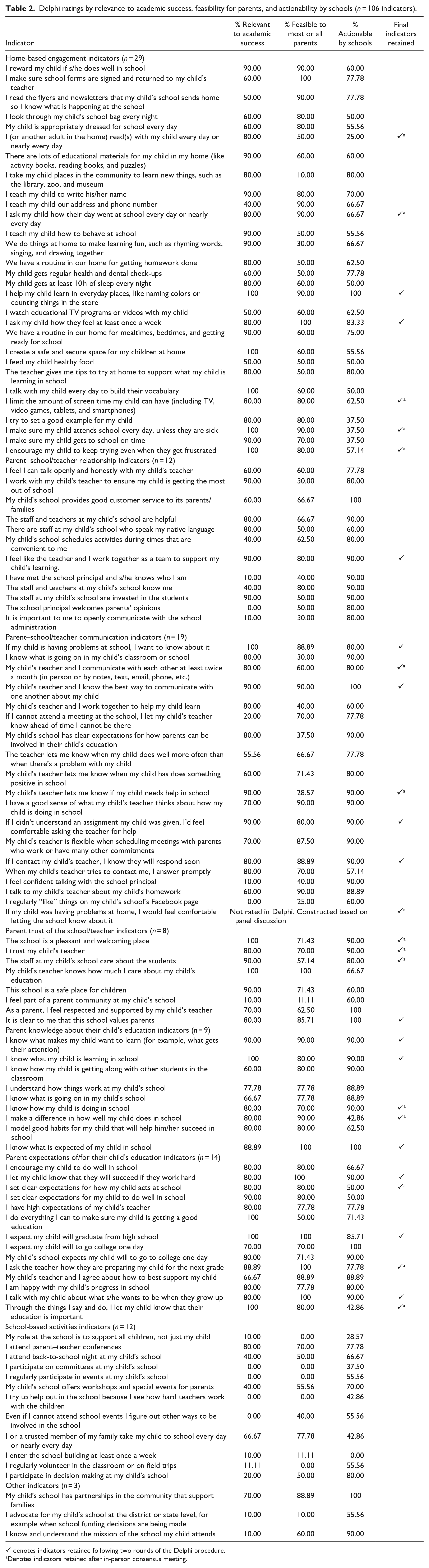
✓ denotes indicators retained following two rounds of the Delphi procedure.
Denotes indicators retained after in-person consensus meeting.
Delphi survey procedures
This study was approved by the University and City Schools’ Institutional Review Boards and the authors have complied with APA ethical standards in the treatment of the study sample. Data from expert panel members were collected over the course of two rounds via an electronic survey administered using Qualtrics (2018). An additional in-person discussion meeting was convened after the second round to achieve final consensus on indicators for which there was still disagreement. Panel members were compensated following completion of each survey round and attending the in-person discussion meeting.
In the first round of the survey, panel members rated the 106 parent engagement indicators on three dimensions:
(1) Relevance to young children’s academic success (rated 0 = “no, not relevant,” 1 = “yes, has some relevance but not among the most relevant,” and 2 = “yes, this is a relevant and strong indicator”).
(2) Feasibility or the extent to which they believed the indicator represented a behavior that was feasible for most or all City Schools parents (rated 0 = “no, not feasible,” 1 = “yes, but feasible only for some parents,” and 2 = “yes, I believe this should be feasible for most or all parents”).
(3) Actionability or the extent to which they believed the indicator represented a behavior or attitude schools could feasibly change through a parent engagement action plan (rated 0 = “no, schools cannot change this,” 1 = “yes, it’s possible for schools to change this but not with the resources available to most schools,” and 2 = “yes, schools could feasibly change this if they had a good action plan”).
The option “not applicable” could also be selected. Panel members could also comment on the indicators or the rationale behind their ratings and suggest additional indicators not represented in the list. Panel members submitted their ratings within 8 days of receiving the electronic survey.
After round one, descriptive statistics were used to examine the number and percentage of respondents rating each indicator as a 0, 1, or 2 on each of the three criteria. For the first round, decisions about indicator retention focused mainly on panel members ratings on relevance for children’s academic success. The rationale was based on the assumption that indicators having low relevance for children’s academic success should not be included in the final survey even if they were ranked high on feasibility and actionability. Indicators rated by at least 80% of panel members as highly relevant to children’s academic success (rating = 2) were retained for consideration for the final survey. Indicators rated as highly relevant by 20% or less were dropped from further consideration. Indicators rated highly relevant to children’s academic success by 30% to 70% of panel members, signifying substantial disagreement among respondents, were returned to the panel members for a second round of Delphi ratings via the Qualtrics survey. Rating instructions for round two were similar to those from round one although more detail was included in the instructions to help panel members more clearly differentiate a rating of 1 versus 2 on relevance, feasibility and actionability. For example, for feasibility ratings panel members were instructed to consider whether the parent could engage in the behavior if reasonable efforts were made to remove common barriers (e.g., barriers due to language or reading comprehension). Similarly, for actionability panel members were instructed to consider whether a school-based campaign to educate parents on the importance of a particular indicator could realistically lead to change or improvement.
Following round two, descriptive statistics were again used to identify the number and percentage of panel members who rated each indicator as a 0, 1, or 2 on each of the three response scales. Indicators identified as highly relevant to children’s academic success by 80% or more of panel members were retained for further evaluation based on their feasibility and actionability ratings. Indicators rated as by 80% or more of panel members as highly relevant, feasible for most or all parents, and actionable by schools (rating = 2 on all criteria) were retained in the final measure (“retained indicators”). Highly relevant indicators rated as feasible and actionable by a minority of panel members were dropped (“dropped indicators”). Highly relevant indicators rated by the majority of panel members as feasible for most or all parents, or as actionable for schools, but not both, were discussed during an in-person meeting of the panel to achieve consensus (“discussed indicators”). Indicators that parent/parent advocates perceived to be feasible for most or all parents, but others panelists did not or that school-based staff perceived to be actionable for schools but other panelists did not were also discussed.
During the in-person meeting, panelists were presented with a list of the indicators that scored high on relevance to academic success, but for which there was disagreement among panelists on feasibility for most or all parents to do and actionability for schools. For each of the indicators in question, the list also included information on the proportion of the parent/parent advocate subgroup who rated the indicator as feasible and the proportion of the school staff subgroup who rated it as actionable in recognition of the fact that these two subgroups would have the most relevant expertise in providing these ratings. The study team reviewed the definitions of feasibility and actionability with the panelists to ensure all panelists had a shared understanding of these criteria. This was followed by a discussion among panel members to determine which items should be retained, giving priority to those indicators receiving high feasibility ratings by members of the parent/parent advocate subgroup and those receiving high actionability ratings by members of the school staff subgroup of the panel. During this discussion, panelists were also given the opportunity to propose changes to the wording to improve their feasibility or actionability or recommend additional indicators they felt were missing. All panelists actively participated in the discussion and had equal opportunities to voice their opinions during this discussion.
Results
Figure 1 summarizes decision rules and main findings from each round of the Delphi survey and the in-person discussion meeting. Upon completion of two rounds of the Delphi survey, 62 indicators were identified as highly relevant to children’s academic success. We then evaluated the 62 indicators on ratings of feasibility for most or all parents and actionability by schools. Fourteen of these indicators (22.6%) were also rated high on feasibility and actionability by 80% or more of experts and were retained for the final measure. These 14 indicators reflected the following parent engagement categories: parent–school/teacher communication (n = 4; e.g., “If my child is having problems at school, I want to know about it”), parent knowledge about their child’s education (n = 3, e.g., “I know what is expected of my child in school”), parent expectations for their child’s education (n = 3; “I expect my child will graduate from high school’), home-based engagement (n = 2 indicators; e.g., “I ask my child how they feel at least once a week”), parent–school/teacher relationship (n = 1; I feel like the teacher and I work together as a team to support my child’s learning), and parent trust of the school/teacher (n = 1, “It is clear to me that this school values parents”).
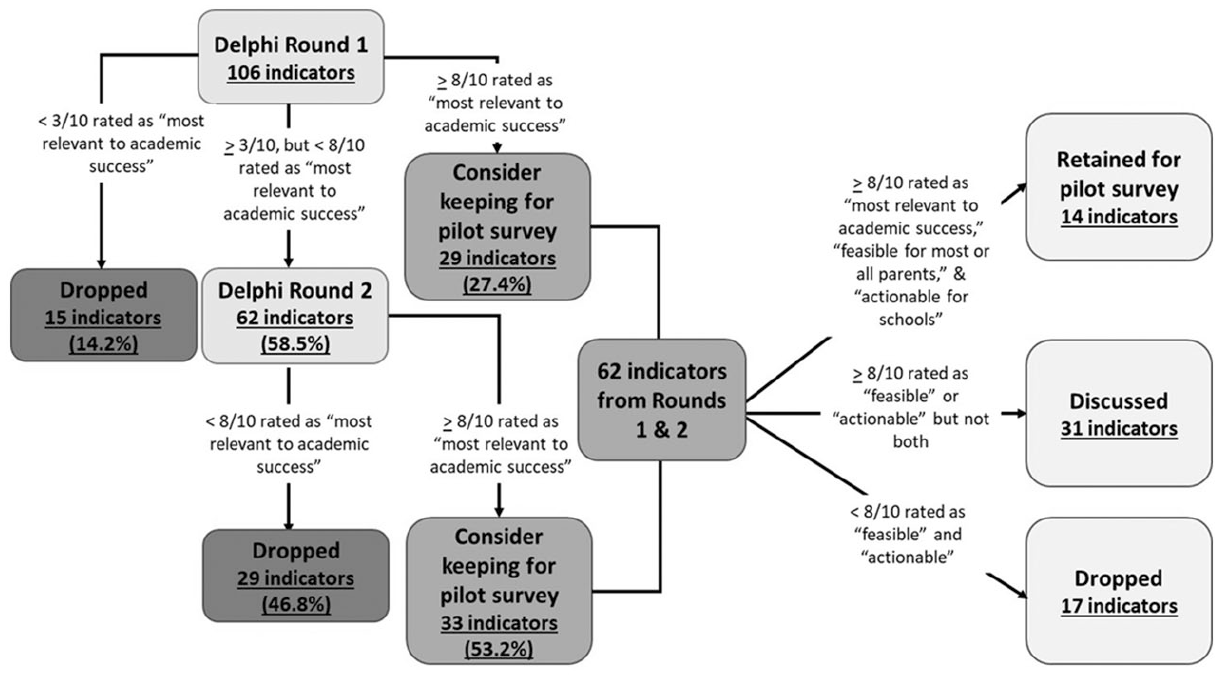
Delphi procedure decision tree and main findings.
About 17 indicators received few high ratings on both their feasibility and actionability and were dropped from further consideration. These indicators reflected the following parent engagement categories: home-based engagement (n = 9; “There are lots of educational materials for my child in my home like activity books, reading books, puzzles”), parent–school/teacher communication (n = 2, “When my child’s teacher tries to contact me, I answer promptly”), parent expectations of/for their child’s education (n = 2, “I have high expectations for my child’s teacher”), school-based engagement (n = 2; e.g., “I attend parent–teacher conferences”), parent–school/teacher relationship (n = 1, “There are staff at my child’s school who speak my native language”), and parent trust of the school/teacher (n = 1, “This school is a safe place for children”).
The remaining 31 indicators rated as highly relevant to children’s academic success (50.0%) received a score of “2” on feasibility (i.e., feasible for most or all parents) OR actionability (i.e., schools could feasibly change this if they had a good action plan) but not both by 80% or more of panel members. These indicators reflected the following parent engagement categories: home-based engagement (n = 9, e.g., “I reward my child if s/he does well in school”), parent expectations of/for their child’s education (n = 8, e.g., “ I set clear expectations for my child to do well in school”), parent–school/teacher communication (n = 4, e.g., “I know what is going on in my child’s classroom or school”), parent–school/teacher relationship (n = 3, e.g., “I work with my child’s teacher to ensure my child is getting the most out of school”), parent knowledge about their child’s education (n = 3, e.g., “ I know how my child is doing in school”), and parent trust of school/teacher (n = 4; e.g., “My child’s teacher cares about my child”). These indicators were discussed with panel members as a group to achieve consensus on which remaining indicators met all three criteria. During the discussion, there were cases where disagreements arose over the wording or emphasis of a particular indicator. In these cases, panel members suggested revisions to existing indicators or the addition of a different indicator that they believed better addressed the concept. Based on this discussion, one new indicator (“If my child was having problems at home, I would feel comfortable letting the school know about it”) was developed.
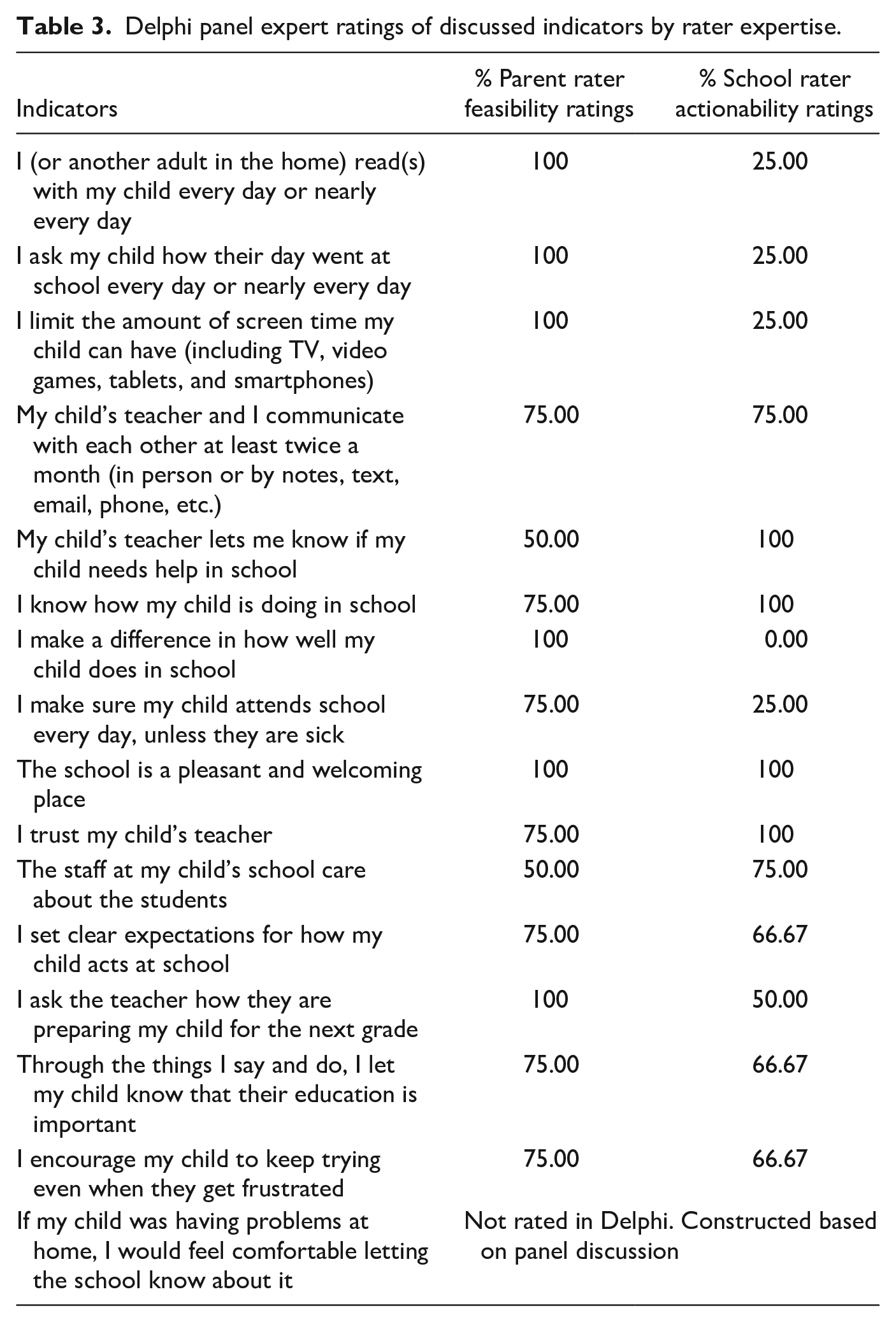
Following the discussion, 16 highly relevant indicators that had been ranked lower on feasibility or actionability initially were recommended for inclusion resulting in a total of 30 meaningful indicators being retained. These 16 indicators reflected the following parent engagement categories: home-based engagement (n = 5, e.g., “I limit the amount of screen time my child can have (including TV, video games, tablets, and smartphones)”), parent expectations of/for their child’s education (n = 4, e.g., “ I set clear expectations for how my child acts at school”), parent–school/teacher communication (n = 2, e.g., “My child’s teacher lets me know if my child needs help in school”), parent knowledge about their child’s education (n = 2, e.g., “ I know how my child is doing in school”), parent trust of school/teacher (n = 2; e.g., “The school is a pleasant and welcoming place”), and parent–school/teacher relationship (n = 1, e.g., “The staff at my child’s school care about the students”). Table 3 displays the 16 discussed indicators that were retained following the in-person group meeting and the ratings these indicators received from parent/parent advocate panelists for feasibility and from school staff panelists for actionability. Among the 16 highly relevant indicators, 8 were rated high on feasibility by 80% or more of panel members, 6 of which were rated high on feasibility by all parent panelists. In terms of actionability of discussed indicators, six were rated high on actionability by 80% or more of all panel members, four of which were rated high on actionability by all school staff panelists. Among the 30 indicators retained at the end of the Delphi technique, 23.3% reflect home-based activities, 23.3% reflect parent–school/teacher communication, 20.0% reflect parent’s expectations of/for their child’s education, 16.7% reflect parent’s knowledge of what their child is learning in school, 13.3% reflect parent’s trust of the school/teacher, and 3.3% reflect the parent–school/teacher relationship. No indicators reflecting school-based activities were retained.
Delphi panel expert ratings of discussed indicators by rater expertise.
Discussion
The purpose of this study was to gain consensus on meaningful indicators of parent engagement in early learning for an urban school district serving a large population of low-income families. Using the Delphi technique, we gathered panel members’ feedback on the extent to which 106 indicators of parent engagement in early childhood education were (a) relevant to students’ academic success, (b) captured behaviors that would be feasible for most or all City Schools parents to do, and (c) captured a behavior or affect that most schools in the district could change or improve. Following two rounds of the Delphi survey and an in-person consensus meeting with panel members, 30 meaningful indicators of parent engagement were identified. An important finding is that of the 106 potential parent engagement indicators reviewed, only 14 were initially rated as highly relevant, feasible, and actionable by a majority of panel members. This suggests that most commonly used parent engagement indicators may not be useful ways to capture this important construct in urban school districts serving predominantly low-income families and families of color.
The indicators that did meet all three criteria for being meaningful indicators of parent engagement focused on home-based activities, knowledge about and expectations parents hold for their children’s education, qualities of parent–teacher/school relationships, and parent–teacher/school communication. These categories of indicators align with our definition of parent engagement as schools and parents working together to support children’s learning and have demonstrated relevance to early childhood education and academic success (Boonk et al., 2018; Castro et al., 2015). For example, Boonk et al. (2018) found in their review of 22 studies focused on early childhood education, that the parent engagement activities most consistently predictive of students’ academic achievement were home based activities such as reading at home with their children, holding high expectations for their children’s education, regularly talking with their children about school, and supporting and encouraging learning. The present study extends those findings by identifying indicators of parents’ knowledge about and expectations for their children’s learning, home-based activities, and parent–teacher/school communication and relationships that are not only relevant to young children’s academic success but also feasible for most or all low-income families and actionable for overburdened school districts serving a high proportion of students living in poverty.
The final 30 items identified as highly relevant, feasible, and actionable are in line with the types of capital parents call upon to support their children’s education that are outlined in the Ecologies of Parent Engagement Framework (Calabrese Barton et al., 2004; Pérez Carreón et al., 2005). In particular, twelve of these items focus on aspects of parent’s relationships (trust, communication, collaboration) with school staff, five focus on parent’s knowledge about what is happening in their child’s school that would likely be obtained through these relationships with school staff, and the remainder focus on the beliefs/expectations parents hold for their child’s learning and the actions parents take to convey those expectations to their children. Importantly, none require that parents purchase material resources or be present in formal school spaces making them feasible for all families, regardless of their economic or employment circumstances.
Of note is the type of parent engagement indicators that did not meet the three criteria for relevance, feasibility, and actionability. Twelve indicators of parent’s school-based engagement were evaluated by the panelists but none were selected due to deficiencies in one or more of the inclusion criteria. Among these twelve indicators, only one (i.e., I attend parent–teacher conferences) was rated as highly relevant to children’s academic success, and none were rated as both highly feasible and actionable by 80% or more of the panel members. These findings are important as the majority of existing parent engagement surveys include multiple indicators dedicated to activities that parents do in the school building to support their child’s learning such as attending school events, parent–teacher conferences, PTA meetings, workshops, volunteering in the classroom, and chaperoning class trips (e.g., Fantuzzo et al., 2000; Green et al., 2007; Kohl et al., 2000; McWayne et al., 2013). Yet none of our panel members rated participation on school committees or in school events, or helping out in the school as highly relevant to children’s academic success; only one rated volunteering in the classroom or on field trips as highly relevant to academic success, despite 40% of our panel members being school-based employees. This is in line with prior research which has found weak to nonexistent relationships between parents’ school-based involvement activities and children’s academic achievement, particularly in early childhood education and among low-income populations (Boonk et al., 2018; Castro et al., 2015; Fantuzzo et al., 2013; c.f. Powell et al., 2010). These data also validate prior concerns raised (Boonk et al., 2018; Finn, 1998; Posey-Maddox & Haley-Lock, 2016) about the continued centrality of parent participation in school-based activities in existing models and measures of parent engagement.
There were 14 indicators that raters indicated were highly relevant to children’s academic success, but that at least 50% of panelists initially perceived were not feasible for most or all parents to do. These included seven indicators of home-based activities and parent expectations for children’s education that are similar to those on existing parent engagement measures. For example, 90% of panelists felt it was not feasible for most or all parents to take their children to places in the community (e.g., library, zoo, etc.) to learn new things, an indicator found on existing parent engagement questionnaires (e.g., Fantuzzo et al., 2000; Kohl et al., 2000; McWayne et al., 2013). Low feasibility ratings may be due to difficulties many low-income parents experience with leveraging either the material or human capital needed to complete these activities, such as accessing reliable transportation, discretionary money to cover the cost of activities, or the time to spend with their child when they are working multiple jobs. Given the relevance of these home-based indicators for supporting young children’s academic success (Boonk et al., 2018; Castro et al., 2015), investments in identifying novel ways to support more low-income families engaging in these activities is warranted.
The other seven highly relevant indicators that 50% or more of panelists initially perceived were not feasible for most or all parents pertained to parent–teacher/school communication and relationships. For instance, 70% of panelists felt it was not feasible for most or all parents to work with the teacher to ensure their child is getting the most out of school, know what is going on in their child’s classroom/school, and be made aware through communication with the teacher that their child needs help in school. The lower feasibility ratings on these indicators may be a function of the way that school communication systems are set up that necessitate that parents be able to communicate with teachers during school hours and often within the school building, which may prove difficult for many single-parent working families. It is important to note that prior research documenting associations between parent–teacher/ school communication and young children’s academic achievement is limited (Anthony & Ogg, 2019; Boonk et al., 2018; Castro et al., 2015; Fantuzzo et al., 2013), which may be because such indicators continue to be confounded with where that communication takes place (i.e., in the school). Another possible contributor to these lower feasibility ratings may be the growing number of non-English speaking families in City Schools and the limited availability of translators or bilingual staff to assist with parent–school/teacher communications. This is consistent with research showing Spanish-speaking parents report more barriers to and lower levels of communication about their child’s education than English-speaking parents (Pérez Carreón et al., 2005; Ramirez, 2003; Wong & Hughes, 2006).
Indicators of the quality of communication and relationships between parents and teachers/schools are reflected in many parent engagement frameworks (e.g., Calabrese Barton et al., 2004; Epstein, 1995) and measures (e.g., Fantuzzo et al., 2000; Lau, 2013; National Parent Teacher Association, n.d.) and are a type of capital likely to be influenced by parent’s own educational histories. For many low-income parents and parents of color, their own history of being failed by the school system may negatively impact their trust of teachers and schools and their motivation to engage in their children’s education (Ishimaru & Takahashi, 2017; Luet, 2017; Weiss et al., 2018). A number of campaigns and initiatives have been developed and successfully implemented to address these historical barriers to parent engagement and guide schools in designing feasible action plans for strengthening parent–teacher/school partnerships as early as in PreK (e.g., Edge Research, 2018; Sheridan & Wheeler, 2017; Snell et al., 2020; Weiss et al., 2018). However, there remains a need to improve measures of parent–teacher/school communication and relationships so they appropriately capture these critical indicators in ways that are equitable for all families.
Ten indicators rated as highly relevant to young children’s academic success were initially perceived to be things schools could not change (i.e., not actionable) by 50% or more of expert panelists. These included common activities parents are expected to do to promote their young children’s learning at home that have been linked with academic success (Boonk et al., 2018; Castro et al., 2015; Van Voorhis et al., 2013) such as talking with their child to build their vocabulary, reading with their child every day or nearly every day, and making sure their children get to school on time. These findings may indicate an affect/norm common in many urban school districts serving low-income families in which school staff perceive that they have very limited time and resources to address their students’ needs within the classroom let alone consider how to change what happens to those children outside of the school building. Such an affect is likely to be reinforced when there is low parent participation in school-based events (e.g., literacy nights, parent–teacher conferences) designed to impart strategies to help parents reinforce their child’s education at home (Edge Research, 2018; Lightfoot, 2004; Luet, 2017). This is supported by research showing lower rates of parental involvement in school-based activities (i.e., attending general school meetings, attending school events, volunteering) among low-income families and families of color compared to their higher income and White peers (e.g., Child Trends, 2016; Fantuzzo et al., 2013; Sonnenschein et al., 2014).
It is worth noting that nine indicators that received lower actionability ratings were eventually recommended for inclusion following the in-person group discussion with panel members (e.g., reading to your child, ensuring child attends school every day unless they are sick, encouraging child to keep trying even when they get frustrated). In the context of this group meeting, it was discussed that while schools may not have control over whether a parent reads or talks with their young child regularly, they could have control over the messages they share with parents about the importance of engaging in these activities with their child to build their vocabulary, literacy, and social-behavioral skills. Reframing the meaning of actionability for panel members seemed to alter their perceptions of schools’ control over these primarily home-based parent engagement indicators. Moreover, there are a number of existing early learning informational campaigns that could be implemented by schools if ratings on these indicators were low. For example, the U.S. Departments of Education and Health and Human Services have partnered with Too Small to Fail to develop tip sheets and messaging campaigns for parents about the importance of talking, reading, and singing with their children every day to promote learning (U.S. Department of Education, 2014). Such a campaign could be integrated into typical school communications to families and have potential to produce significant change in parent engagement and child outcomes. Additionally, the National Network of Partnership Schools is an organization that works with schools across the country to create and implement relevant and feasible action plans to strengthen parent–school partnerships in order to support students learning (Sanders & Epstein, 2000).
A strength of this study is its focus on identifying a meaningful and equitable set of parent engagement indicators grounded in their relevance to young children’s academic success, feasibility for low-income families, and actionability for schools. However, it is important to acknowledge this study’s limitations. First, our measure of relevance to academic success was based on panel member’s perceptions of each indicator’s relevance rather than empirical research. However, two of our panelists were senior researchers with expertise in parent engagement and actively participated in the survey and group discussions. It is also important to note that the 30 indicators that were ultimately retained do align with existing research showing significant relationships between home-based parent engagement activities, parent expectations for their children’s learning (Boonk et al., 2018; Castro et al., 2015; Fantuzzo et al., 2013; Van Voorhis et al., 2013) and parent–teacher/school communication and relationships (Anthony & Ogg, 2019; Iruka et al., 2011) with children’s academic success. Moreover, perceived relevance remains an important construct because if schools and parents do not perceive the indicators to be relevant to children’s academic success, schools will be unlikely to take the results seriously and parents will be unlikely to buy in to efforts designed to promote their engagement in the identified behaviors. Relatedly, we should also note that while social-emotional learning is an implicit aspect of academic success in early childhood, we did not explicitly include relevance to social-emotional learning in our instructions. Future research should include explicit instructions to include social-emotional learning in rating each indicator’s relevance to academic success. A second limitation was the focus on a single urban school district which serves a large number of economically disadvantaged families and families of color. While we suspect that our findings may generalize to other urban emergent districts (Milner, 2012) serving large populations of students from low-income families and families of color the results may not generalize to districts serving different populations (e.g., districts serving more affluent or more geographically dispersed populations). Whether such findings would generalize to other similar and dissimilar school districts is an empirical question worthy of further study.
This Delphi study used 10 expert panel members from three key subgroups: parents and parent advocates, school-based staff, and researchers. Although Delphi panel sizes of 10 raters is recognized as an adequate number of panelists (Akins et al., 2005), our findings may have been different with a larger number or different mix of panelists. For example, had the panel included more representation of Latinx parents and parent from other ethnic groups, we may have identified fewer parent–teacher/school communication items as feasible given difficulties many immigrant families experience in communicating with their child’s school. However, it is important to note that there were many similarities in the items retained in this study and those listed on the PEFL, a parent engagement measure developed specifically for Latinx immigrant families with young children (McWayne et al., 2013; McWayne & Melzi, 2014) and on the Chinese Early Parental Involvement Scale (Lau et al., 2012) developed specifically for use in early childhood education settings in China. Given the importance of identifying academically relevant indicators of parent engagement that are also feasible for low-income parents and actionable for school districts serving the complex needs of students with limited resources, replicating this study with different school populations and more expert panel members would be important. To facilitate replication, we list all 106 indicators rated by our Delphi panel in Table 1.
An advantage of relying on school-based indicators of parent engagement is their cost-efficiency; school personnel can easily observe when parents enter the school to participate in an event or on a committee. The exclusion of school-based indicators means schools may find it more challenging to measure or benchmark their progress in improving parent engagement. Only parents can report on their participation in home-based early learning activities, their knowledge of what their child is learning, their expectations for their child’s education or the extent to which they are comfortable working with teachers. Yet in line with prior research (e.g., Boonk et al., 2018; Castro et al., 2015), the results of this study indicate these are among the most meaningful indicators of parent engagement in low-income populations. Measuring parent-reported indicators of parent engagement means school districts would need to invest resources in periodically surveying parents about their levels of engagement in ways that are not confounded by their school-based participation or language and literacy skills.
A focus on identifying meaningful indicators of parent engagement at this initial entry point into formal schooling (PreK and kindergarten) is important given that parents play a critical role in their young child’s readiness for school (Bierman et al., 2017; National Academies of Sciences, Engineering and Medicine, 2016) and such early social-behavioral and cognitive readiness places children on the path to long term school success (Darney et al., 2013; Davoudzadeh et al., 2015; Duncan et al., 2007). Moreover, research indicates that parent engagement tends to decrease across developmental periods (e.g., Bhargava et al., 2017; Green et al., 2007) emphasizing the need to establish a strong partnership between parents and teachers/schools during this foundational period of schooling. This study successfully identified 30 meaningful indicators representing six components of parent engagement in early childhood education (home-based engagement, parent–teacher/school relationship, parent–teacher/school communication, parent trust of the teacher/school, parents knowledge about their child’s education, and parent’s expectations for their child’s education) that are relevant to children’s academic success, equitable for families regardless of race/ethnicity or income, and actionable for schools. The components and indicators identified in this study are consistent with existing models of parent engagement during the early childhood period (e.g., Gershoff et al., 2007; Fantuzzo et al., 2000; McWayne et al., 2013).
Our results highlight two important conclusions. First, if the field continues to define parent engagement using indicators that are not (a) relevant to students’ academic success, (b) feasible for most or all families to do, and (c) capturing things schools can change, parent engagement measures will not be useful to urban school districts like City Schools serving large populations of children from low-income families or families of color. They may also be counterproductive or harmful if they foster biased perceptions among school staff in these districts about the extent to which parents are engaged in their children’s learning (e.g., Boutte, 2012; Ho & Cherng, 2018; Lightfoot, 2004; Wong & Hughes, 2006). Second, the findings highlight the challenges and complexity of measuring parent engagement in early childhood education in ways that are meaningful across parents and educators. Peter Drucker once wrote that “What gets measured gets managed” (Drucker, 1954). Without a strong measure of parent engagement in early learning that is meaningful to all stakeholder groups and predictive of children’s academic success, the benefits of investing in parent engagement initiatives beginning in early childhood will be difficult for urban districts already challenged with raising low-income students’ academic achievement with limited resources to demonstrate.
Footnotes
Acknowledgements
The authors gratefully acknowledge the contributions of the PEECE Project Advisory Board members Yolanda Abel, Faith Connolly, Kim Cox, Michelle Daniels, Corey Ennis Jr, Joyce Epstein, G. Joyce Hamer, Joseph Manko, Aleesha Manning, Lori Morgan, and Judivelli Torres in providing feedback on potential indicators.
Declaration of Conflicting Interests
The author(s) declared no potential conflicts of interest with respect to the research, authorship, and/or publication of this article.
Funding
The author(s) disclosed receipt of the following financial support for the research, authorship, and/or publication of this article: This study was supported by a grant from the Institute of Education Science, US Department of Education (#R305H170027, 2017). The opinions are those of the authors and do not represent views of the Institute or the US Department of Education.
