




Abstract
Taking risks and enjoying challenges are fundamental to the lives of young children from a developmental and evolutionary point of view. However, in modern societies, increasing concern about dangers and injuries has led to the escalation in regulation and provisions for the safety of young children. This intent to establish secure and risk-free environments for young children reaches, in some cases, the other end of the spectrum – that of overprotection, constraining children’s drive to explore, dare and experiment. This article explores the relationship between children and risk by focusing on the processes of thinking and acting, drawing on positive and negative discourses around risk. The article proposes that more interest should be directed towards enabling children’s own knowledge and understanding of risk, through early childhood education and risk literacy. The use of graphical representations, children’s probabilistic and possibility thinking, the risk culture of the classroom and a cross-curricular approach are pedagogical implications that could inform policy and practice in early childhood education aiming at present and future agents who are risk literate.
Introduction
Recently, there has been a lot of concern regarding risks and young children. Within the wider context of risk in western society (Beck, 2006), new realities, new technologies, socially driven facts, transitions, increasing urbanization and all sorts of different ‘stressors’ in contemporary life characterize not only our own but also young children’s experiences. It could be argued that because children are vulnerable, inexperienced and young (Munro, 2011), with ‘specific’ needs and rights to be met, it is adults’ responsibility to guard and care for them. From this perspective, adults try to eliminate the potential dangers and provide young children with safe and stable environments, either within or outside formal educational settings. This effort is mainly linked to specific policies and provisions of protection and safeguarding that, in turn, have led to an ongoing debate as to what are the respective benefits or impacts on children’s development and well-being.
Taking risks and engaging in risky behaviour and uncertainty are part of everyday life in human societies and will always be present in various manifestations. Adults’ attitudes of supervision and, in some cases, ‘strict’ regulations (Sandseter, 2010) have led to the undesired outcome of altering children’s experiences and play opportunities. Wyver et al. (2010) argue that there is overloaded ‘surplus safety’ today, leading to a new reality – that of ‘no risk’. Bundy et al. (2009) highlight that this ‘no risk’ is a risk itself, as it distorts and limits children’s freedom by having negative implications on their growth. For example, children’s outdoor play has been influenced drastically by this increased alert regarding the risk of accidents and injuries, and the fear of litigation. This has huge consequences for children’s health and well-being, as indicated by many scholars, researchers and educationalists (e.g. Brussoni et al., 2012), such as the lack of physical activity, obesity, a sedentary lifestyle, isolation and a disconnection from nature.
Adult views, perceptions and actions are one side of the coin. This article considers children’s own understanding of risk. This other side of the coin takes into account the agentic and active role of children by considering their voices, opinions and understandings (Tobin, 2005). It recommends that early childhood education (ECE) can serve as a vehicle to transform the ‘cotton-wool’ child to the risk-literate child – a child who has developed risk-taking skills and judgment, competence, and capacities to face uncertainty and instability. If children themselves do not develop the capacity to reason and own the consequences of their decisions, they will not be able to cope with risks and hazards, opportunities and challenges, not just at present, but also in their futures.
The aim of this article is to explore the relationship between children and risk, and to argue that children’s risk literacy can be encouraged in ECE settings. The rationale of risk literacy lies beneath the broader notion of multiliteracies and refers to the ability to deal with uncertainty in an informed way (Gigerenzer, 2008). Risk education has already been implemented in some curricula for older children and adolescents, and seems to be effective (e.g. see Eichler and Vogel, 2015; Shearn, 2004; Till, 2014). Thus, the main argument of this article illustrates the importance of considering risk literacy as an essential and timely skill and attitude within ECE.
Risk and young children
Risk is a complex and multidimensional notion, usually linked to negative connotations. There is no one definition for risk and, as Adams (2001: 30) has stated, risk is ‘the product of the probability and utility of some future event’. This future event is uncertain and could be either positive or negative, involving either damage or an opportunity. However, the discourse around risk today addresses mainly issues of threat, danger, ‘moral panic’ (Garland, 2008), injury and maltreatment. This discourse considering risk as a ‘harmful situation to be avoided’ mistakenly excludes cases where risk can be the foundation for change, possibility, autonomy, creativity or novelty. As Bernstein (1996: 337) noted, there should be a change in ‘the perception of risk from chance of loss into opportunity for gain, from fate and original design to sophisticated, probability-based forecasts of the future, and from helplessness to choice’.
Growth, by definition, involves taking risks and moving out of the comfort zone, and aiming at experiencing novel situations and perspectives (Dweck, 2000). Risk-taking is regarded as being significant in children’s well-being as it encourages physical proneness and independence (Stephenson, 2003), and emotional vigilance such as excitement and pleasure, as well as broader learning and development (Eichsteller and Holthoff, 2009). Children enjoy challenges and, when driven by curiosity and a ‘can-do’ attitude, they can learn to interact with the environment, to link causes and effects, and to become responsible for their decisions and actions, especially during play.
Risky play is a key part of children’s development and evolutionary growth, as it has an adaptive function in reducing fear of stimuli (Sandseter and Kennair, 2011) and survival instincts. In risky play, children can try new strategies, behaviours and actions; collaborate; overcome conflicts and fears; build autonomy, self-esteem, fantasy, motivation, confidence, aspiration and judgment; and familiarize themselves with failure, errors, success and satisfaction. As noted by Thompson (2005), play is not a risk-free activity. On the contrary, it is a space for adventure, ingenuity, freedom, experimentation, trophies, scars, bruises, disappointment and frustration.
Through risk-taking, children can consider alternative courses of action and less obvious routes while solving dilemmas and making decisions (Rolfe, 2010); they can learn to be resilient (Newman and Blackburn, 2002), to regulate their emotions and sensation-seeking (Apter, 2007), and they can develop autonomy and mastery over themselves and their surroundings. Risk-taking is interconnected with aspects of cognitive, social, emotional and biological development (Boyer, 2006). Through diverse contexts and play situations, children have been found able to reason and face feasibilities, estimate odds and therefore make probability judgments, and deal both semantically and conceptually with the evaluation of future events (Nikiforidou et al., 2013). Moreover, children as young as four can understand and rationalize safety and non-safety matters. In this sense, according to Eichsteller and Holthoff (2009), young children can make the distinction between acceptable and unacceptable risks, and reach the point where they can realize that ‘feeling safe’ is different from ‘being safe’.
Indeed, everyone has a propensity to take risks and can be regarded as a ‘risk expert’ (Adams, 2001). Through practice and experience, even young children can learn to manage risky situations. Adams (2001) goes on to propose a conceptual model – the risk thermostat – where risk-taking decisions represent a balancing act in which perceptions of risk are weighed against the propensity to take risks. He argues that this propensity varies from one individual to another, and that it is influenced by potential rewards and losses, especially if there are opportunities for first-hand experiences. Infants can balance rewards and ‘accidents’ at a continuous level through apprehension, determination and intense concentration, which leads them to become junior risk managers. Adams comments that:
the behavior of young children, driven by curiosity and a need for excitement, yet curbed by their sense of danger, suggests that these junior risk experts are performing a balancing act … In mastering such skills they are not seeking a zero-risk life; they are balancing the expected rewards of their actions against the perceived costs of failure. (Adams, 2001: 1)
Thus, risk confrontation involves two processes. The first process is linked to the awareness and perception of the risky situation (objective and subjective thinking and understanding), and the second process is linked to the action and behaviour upon the risky situation (engagement or avoidance). Both processes are interwoven and their relation is non-directional or non-sequential; as such, the use of the words ‘first’ and ‘second’ does not imply order or a series of emergence (Figure 1). This model is based on the perception–action cycle, which is defined by Fuster (2004) as the circular flow of information between an organism and its environment in the course of a sequence of actions towards a goal. According to this cycle, ‘all forms of adaptive behavior require the processing of streams of sensory information and their transduction into series of goal-directed actions’ (Fuster, 2004: 144).
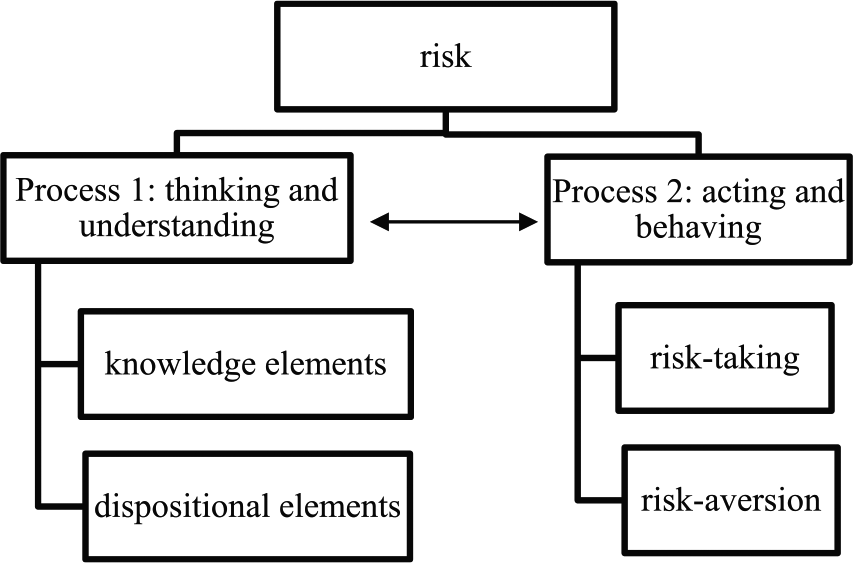
Processes of risk.
For instance, if a group of three-year-old children is introduced for the first time to a climbing frame (an aspect of their environment and sensory information), not all will climb straight away or not all will decide to climb at all (behavioural response and goal-directed action). Some might think about it, observe what others do and then choose to try or not; in this case, thinking precedes action. Others might try immediately; in this case, action comes with limited or no thinking. In addition, risk-taking decisions, given that climbing is risky, can be influenced by personal impulsivity and dispositions, different personalities and temperaments, adult encouragement, peer influence, prior experiences, and rational or intuitive decision-making either during the thinking and/or acting processes.
Process 1 – thinking and understanding risk – is the main focus of discussion in this article. This process relates to the cognitive, perceptual approach of risk. It entails ‘knowledge’ elements and ‘dispositional’ elements, as Gal (2002) has proposed for statistical literacy. In understanding risk, both objective and subjective approaches of interpretation and analysis interlink in multiple ways. The knowledge elements involve cognitive components such as literacy skills, statistical knowledge, mathematical knowledge, probabilistic thinking, context knowledge and critical capacities (Gal, 2002). With knowledge elements, risk can be understood and confronted objectively through calculations and speculations. Risk can be quantifiable, measured and anticipated under this approach. Conversely, dispositional elements are non-cognitive aspects that involve subjective beliefs, emotions and attitudes, as well as the personal point of view of each individual (Gal, 2002). Here, individuals do not perceive risk in the same way, and more impulsive, societal, cultural or external influences construct personal understandings of risk.
Risky decision-making is shaped by many factors. Specifically, Morrongiello and Lasenby (2006) list personal differences such as age, gender and prior experiences; parental/familial factors like parenting style and sibling effects; and, finally, situational factors such as the neighbourhood and peer interactions. Furthermore, Little (2006) agrees that age, gender, socialization practices, personality traits and policy provisions are some of the components that characterize risk-taking in the early years. Subsequently, whether a child will make a risky decision or not, and engage with risk-taking or risk-aversion (Process 2), depends on many factors, including their personal understanding and representation of risk (Process 1).
Despite the complexity of the relationship between risk and young children, children’s restriction in taking risks means restriction in opportunities for learning, knowing, understanding and acting on uncertainty and unfamiliarity. ECE and risk literacy are fundamental in reconstructing this restriction. Children need to engage with ‘reasonable’ risks in a ‘safe’ environment in order to have learning experiences that will enable them to become ‘risk-literate experts’. Supporting young children to take risks with and for an educational goal or incentive can be regarded as a means of safeguarding them. This article addresses the role of risk literacy in ECE in supporting young children’s risk process of thinking and understanding (Process 1) in a proactive way.
Risk literacy as part of ECE
Learning to be a part of the literate world builds up over a lifetime (Copeland and Keefe, 2007). Defining risk literacy in a vastly changing world where ‘old’ certainties are being rapidly transformed and replaced by new realities is complex. Challenges, dangers, hazards and opportunities need sustainable and advantageous decisions. Risk literacy (Gigerenzer, 2008), as a novice type of multiliteracy, involves the capacity, awareness and competence to face a risk both at the cognitive (Process 1) and the behavioural (Process 2) levels. It is a lifelong skill and attitude that shapes informed and educated agents who can evaluate a risky or riskless situation.
Risk literacy in ECE can extend children’s risk experiences in a structured and goal-specific way, as is the case with older children. For instance, risk education programmes for children aged 5 to 16 have three basic objectives:
(a) Awareness raising – strategies designed to disseminate knowledge and understanding of sources of harm; (b) Transferable skills – progressive approaches that aim to develop transferable life skills (relating to the risk assessment and control); and, (c) Behaviour modification – approaches that aim to reduce risk taking behaviour. (Shearn, 2004: 6)
An intervention study with elementary schoolchildren carried out by Till (2014) suggests that it is possible to foster basic competencies for risk assessment and probabilistic decision-making with fourth-grade children through playful activities, the use of hands-on materials and meaningful iconic representations. In ECE, the implementation of risk literacy and risk education is a recently emerging field of research and interest. Lavrysen et al. (2015) carried out a three-month training programme with children aged four and six to suggest that risk perception and risk competence can be improved and measured within the classroom. They propose that risk competence can be identified using a risk-detection test and observational questionnaires, and that risk competence can be improved through intensive risky-play activities.
The learning experiences that take place in the context of the classroom can convey opportunities for examination, inquiry and wonder, especially regarding the processes of thinking and understanding risk. From a pedagogical perspective, graphical representations (a knowledge element), children’s probabilistic thinking (a knowledge element) and the risk culture of the classroom (a dispositional element) are pedagogical aspects that could facilitate young children’s risk literacy using a cross-curricular approach (Figure 2).
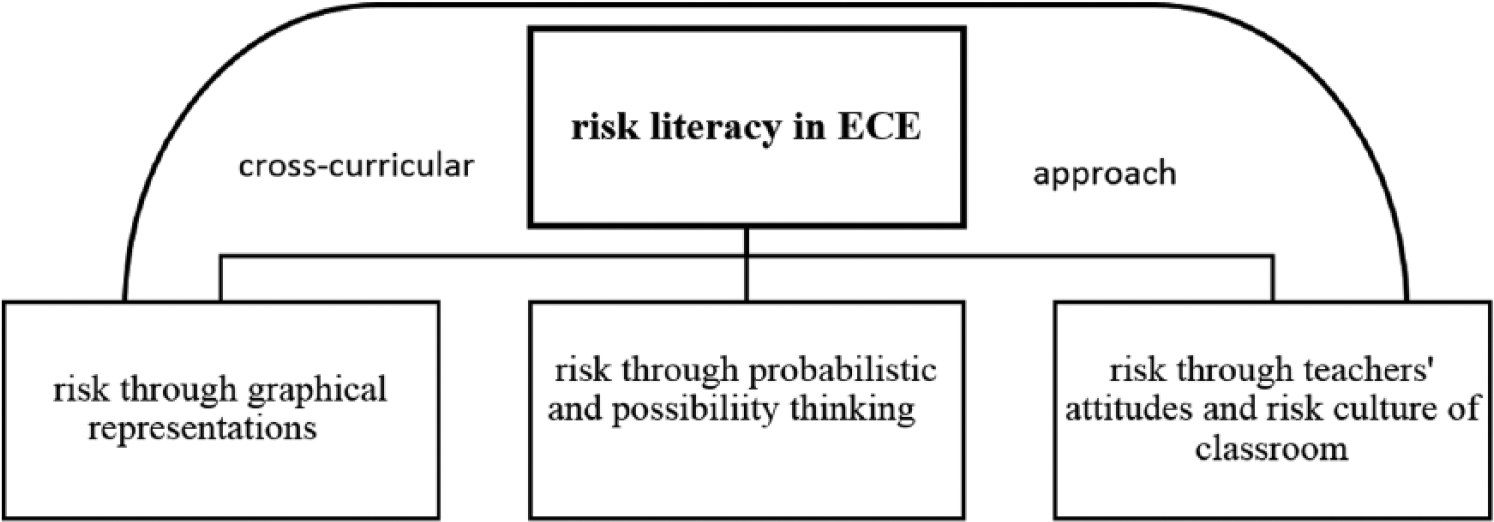
Pedagogical considerations of risk literacy in ECE.
The use of graphical representations in risk scenarios
Communicating risk through graphical representations and data is a key pedagogical aspect of risk literacy. The ability to understand and communicate visual information, relationships and ideas represented in maps, graphs, diagrams, pictures, symbols and charts of different types is concerned with graphical literacy or graphicacy (Wilmot, 1999). Graphicacy has two directions, based on information flow: incoming or inbound and outgoing or outbound.
Young children have the capacity as part of statistical thinking to describe, organize, represent and interpret data (e.g. see Jones et al., 1997; Till, 2014). In this direction, young children’s mathematical graphics and marks are really powerful tools in supporting and evidencing their thinking and communication of meanings (Carruthers and Worthington, 2005). Graphics are used both as a process and a product: either when children develop them (outgoing flow) or when children interpret them (incoming flow). Raising children’s awareness of ‘hazard symbols’ and signs is a way of communicating risk. In this direction, risk can be graphically represented and documented.
Connecting risk with reasoning, probabilistic notions and possibility thinking
Another aspect related to risk literacy is the ability to reason and rationalize actions and decisions through aspects of probabilistic and possibility thinking. Being and becoming risk literate means being able to think, explain and process possibilities and probabilities, future events, alternative pathways, uncertain choices, possible options and probable outcomes.
According to Burnard et al. (2006), possibility thinking can be stimulated through question-posing and question-responding, play, making connections, innovation, being imaginative, self-determination and intentionality. Risk-taking fosters possibility thinking and creativity whilst implying a ‘what if’ or ‘as if’ mindset (Craft, 2001). Possibility thinking for young children involves a move from convergent to more divergent thinking where new ideas, consideration of possible options and imagination of alternatives emerge through the blend of individual, collaborative and communal creativity (Craft et al., 2012). Within this framework, time and space to play and explore, to speculate, to imagine and to consider possibilities for future actions are the basic characteristics of the pedagogy of possibility thinking.
Young children can cognitively perceive randomness (to some extent) and make links between cause and effect (Kushnir and Gopnik, 2005), the most and least probable outcome, and random sampling and base-rate information (Denison et al., 2006). Studies have shown that children as young as four demonstrate an understanding of probabilities and expected value, adjust preferences based on probabilities, indicate notions of probabilistic thinking, and possess specific concepts and skills associated with probabilistic reasoning like causal strength, future reasoning and linguistic capacity connected to risk (e.g. Nikiforidou et al., 2013; Nikiforidou, 2017). Therefore, risk literacy can be connected to probabilistic tasks with dice, cards, and guessing and prediction games in exploring possible future outcomes.
Teachers’ attitudes and the risk culture of classrooms
Another aspect of great importance in supporting risk literacy in the preschool classroom relates to teachers’ attitudes and behaviours with regard to risk-taking. Shearn (2004) reports that teachers’ approaches to risk education appear to be based on clearly defined ‘do’s’ and ‘don’ts’, while the predominant discourse used includes far more ‘safety’ than ‘risk’ connotations. Teachers often require aptitude and training to encourage and promote activities that provoke disequilibrium and conflicts beyond the usual comfort zone of the classroom and children’s current status of thinking or feeling (Brown, 2008).
Cognitive conflicts that lead to conceptual changes and learning might occur through group discussions, argumentation, problem-based learning, collaborative practices, role play or other techniques where children construct knowledge and experiences while participating actively (DeVries and Kohlberg, 1990). Through child-centred didactic approaches, children are actors and initiators in processing information and making decisions while developing risk assessment, risk avoidance and risk adaptation in meaningful ways. It is crucial for young children to undergo experiences in order to interact, make mistakes and discover. Such experiences are encouraged mainly through play and active engagement (Eichsteller and Holthoff, 2009) that shape the risk culture of the classroom.
Risk as a cross-curricular theme
Risk is complex and linked to many aspects of children’s lives. It cannot be detached and associated, for instance, only with hygiene and health. Thus, it can be related to issues of safety and security in road traffic, potential dangers and threats on the Internet, issues of caring for nature, and so on. In this sense, risk literacy can be supported by formal education through and across curriculum topics (Russell, 2015). Through this ‘rounded’ approach, the integration of knowledge, ideas and concepts within and across subject areas and broader life experiences encourages meaningful learning (Hayes, 2010). Risk education can be embedded into existing schemes of work, for each key stage, and can be explored through case studies, vignettes and practical activities (Shearn, 2004).
Rolfe (2010) states that risk and reward can be explored in a variety of curriculum subjects and activities, drawing on personal, social, health and economics education programmes. Accordingly, Spiegelhalter (2009) indicates that risk literacy can be taught not only as part of mathematics and statistics, but also as part of science and civic and social education. Eichler and Vogel (2015) agree that an explicit risk curriculum is missing, and that risk is mainly associated with proportions, conditional probabilities and expected values. From an early age, pupils can gain an understanding of the probabilities and challenges related to different aspects of everyday life in a holistic way. For example, what are the risks for children who speak a different language (culture)? What are the risks of building a village close to the seaside (geography)?
Final thoughts and next steps
From early in life, children are – and to some extent have to be – exposed to risks. Risks are interconnected with their holistic development (Boyer, 2006) and evolutionary growth (Brussoni et al., 2012; Sandseter and Kennair, 2011). Children can assess risks by themselves and are confident and capable learners who build their character and personality traits over risky experiences, mistakes or achievements. Through experience, errors and triumphs, and driven by curiosity, excitement and fear, young children learn to cope with uncertainty. Thus, as Adams (2001) states, they are in the state of being and becoming ‘risk experts’ who, through practice, learn to manage their propensity to take risks by balancing the expected rewards and perceived costs of failure. These risk-taking skills are mainly cognitive and dispositional, and are progressively refined and influenced by many factors, such as personal differences, parental factors and situational elements (Morrongiello and Lasenby, 2006).
Undeniably, safety has always been an issue for those involved in working with or looking after children, and adults have a duty and responsibility for safeguarding children as a matter of priority. Ensuring safety in any environment related to children is key to children’s well-being and growth. Thus, today there are cases in modern societies where child safety has gone too far and a heightened awareness of what is risky (Thompson, 2005) has led to a culture of ‘no risk’ (Bundy et al., 2009). The fear of litigation, increased societal alarms about child safety and moral panics have led to the increase of policies and practices that limit children’s freedom and play opportunities. In this direction, there are concerns that children today experience excessive overprotection and ‘surplus safety’ (Wyver et al., 2010) – a reality with (in some cases) detrimental implications for their lifestyles and development.
Besides attempting to control and eliminate risk from children’s lives, another way forward is to invest in children’s personal knowledge and understanding of how best to manage risk, under the principles of risk literacy. Giving children an active role in and ownership of their learning (Tobin, 2005) can promote their own perceptions of and attitudes towards risk. If children are provided with space to manage their own risks and decisions in a controlled environment, such as that of a classroom, they can become more skilled, and subsequently literate, in confronting the unpredictable nature of the world in which they live (Gill, 2007). Risk literacy can be a way of ensuring optimal child development while preserving children’s safety and well-being.
ECE settings can play a significant role in transforming ‘overprotected’ children into agents who are able to cognitively assess risks (Process 1) and act upon them (Process 2). ECE can serve as a foundational place and time for children to experience the unknown, discuss hazardous situations, engage with probabilistic and possibility thinking, and make use of graphical representations related to risk. Thereby, the main aim of risk education that applies to older children, according to Shearn (2004) – that of raising children’s risk awareness – can be initiated from ECE through a goal-specific perspective. As Eichler and Vogel (2015) state, risk is not only about calculations, but also about comprehending and dealing with the wider context in which it occurs by applying broader knowledge and critical skills. Hence, young children need a variety of pedagogical opportunities within their daily routines to learn about risk in its various forms and applications (Lavrysen et al., 2015; Martignon and Krauss, 2009; Nikiforidou, 2016; Till, 2014). Three ideas are suggested here.
First, keeping records and graphical representations is a key component of communicating risk (Russell, 2015). Graphs, symbols, marks, signs, tables and pictures assist children to schematize and visualize the relevant information of a risky problem. These representations enable children to develop their mathematical and statistical thinking, and skills of decoding and encoding data (Carruthers and Worthington, 2005; Wilmot, 1999). Second, risk literacy can be enhanced in conjunction with probabilistic notions (Jones et al., 1997) and possibility thinking (Craft, 2001). Cognitively and intuitively, children have shown evidence of understanding, predicting and making links between a state or cause and the probable or upcoming outcome (i.e. Denison et al., 2006; Kushnir and Gopnik, 2005; Nikiforidou et al., 2013). The capacity to infer future events assists in interpreting facts and, in turn, perceiving whether a condition is risky or otherwise.
Thirdly, the dispositional element of risk in ECE can be affected by the risk culture of the classroom. Teachers who are supportive of new materials, games and activities, and who are creative and receptive to mistakes, can produce a ‘riskily safe’ and resilient ambiance in the classroom. Such a stance can be reinforced through the use of language that relates to both risk and safety (Shearn, 2004), open-ended questions, and stimulating materials and safe environments (Eichler and Vogel, 2015). Through training sessions, teachers could develop the perception that risk is not only a case of threat, but also an opportunity for learning (Little, 2006). This perception, in turn, would encourage children to go beyond familiar boundaries and develop a ‘have a go’ attitude. Finally, it is proposed that risk can be approached in a cross-curricular way. Although risk literacy is likely to be associated directly with mathematics and statistics, other parts of the curriculum are also underpinned by risk-related concepts (Eichler and Vogel, 2015; Spiegelhalter, 2009).
Overall, risk can be experiential, contextualized, meaningful and child-centred in ECE. It can be supported by fostering risk literacy in ways that enhance children’s knowledge and understanding of elements of risk (an objective approach), as a response to promoting ownership and independence in making decisions and handling uncertainty. Future research is necessary to give further insights into how risk literacy can be embedded practically in ECE curricula and pedagogy. Risk literacy issues, including instruction and guidance, curriculum objectives, learning goals, teaching packages, resources, teacher professional development and the use of a more constructive risk discourse are approaches that can be adopted. Furthermore, elements of the behavioural response to risk (Process 2) could be examined by identifying whether and how they could inform risk literacy programmes and initiatives.
Being literate in confronting and managing risk and uncertainty is an essential competence in the 21st century of ‘world risk societies’ (Beck, 2006). Risk literacy is valuable and, if introduced from ECE, can lead to risk-knowledgeable children who will gain the foundations for deciding and acting in an effective, reasonable and creative manner.
Footnotes
Funding
This research received no specific grant from any funding agency in the public, commercial or not-for-profit sectors.