




Abstract
This article draws on new materialism, especially the work of Karen Barad, in order to explore curious encounters and intra-actions within the context of a Norwegian kindergarten. The article argues that intra-actions between both human and non-human agents can potentiate forms of learning as well as forms of knowledge that can be neither anticipated nor predicted. This acquisition of new learning and new knowledge applies to both the (re)searchers as well as in relation to teachers and children. The article, in illustrating these transformations, calls attention to the work and play of diffraction, affect and agency. It is argued that the movements and intermingling that occur between and through each constitute what Gilles Deleuze refers to as ‘becoming’. The article goes on to suggest that in becoming, including ‘becoming (re)searcher’, there are possibilities for resisting habitual and sedimented practices.
Beginning in the middle: a line of flight
Zuckerman (2006) uses the phrase ‘learning objects’ to describe the physical objects that are often used in western kindergartens and early years classrooms. The introduction of a ‘learning object’, such as a small ‘kitchen island’ that one often stumbles across in a kindergarten, has its roots in and draws from the philosophy of John Dewey (1859–1952). This philosophy is predicated on Dewey’s belief that objects should contribute towards children’s understanding and appreciation of themselves within the real world. Dewey aligned active experiences with learning (Dewey, 1916; Mayhew and Edwards, 1936). In his view, children should be actively engaged with objects, especially those that are part of the child’s everyday life. According to Dewey, when a child plays with an everyday object, such as a washing-up bowl, spoons, saucepans, and so on, she is directly drawing from her environment – the home – in ways that will inculcate learning. For Dewey (1916: 228), the young child has instincts ‘to explore, to manipulate tools and materials, to construct’, and the task of the practitioner is to offer ‘exercises’ as ‘part of the regular school program’. Dewey (1916: 228) argued that, in so doing, ‘the artificial gap between life in school and out is reduced’. Dewey’s views have been highly influential and, as a consequence, many kindergartens have child-scaled, real-world artefacts, including kitchen appliances.
This article is divided into interconnecting sections, where attempts are made to move in and around theory and data. Such movements allow opportunities to appreciate how, as (re)searchers, we become both affected and infected by data, theory, children’s play, objects and movements. It is in and amongst this milieu that something different in terms of knowledge and understanding is able to emerge. Rather than thinking of Dewey-type exercises, we focus more on explorations, movement and sensations. Such explorations might provoke surprises and different ‘lines of flight’.
(Re)searchers (re)searching
As (re)searchers, we seek fluxes of transformation, not universal knowledge. Alone, we are nothing. However, in approaching virtual becomings as (re)searchers in a kindergarten context, we affect (Massumi, 1995) and are being affected through encounters with both human and non-human objects. Lines of flight and new becomings are set in motion. Through appreciating different assemblages, we note how humans and non-humans evolve and dissolve (Figure 1). 1 By thinking with others, including Hultman and Lenz Taguchi (2010), Barad (2003, 2007, 2014) and material feminisms, ‘matter’ itself is granted active agency, intra-acting with other matter and meaning. As (re)searchers working with(in) assemblages, including kindergarten spaces, children, pedagogues, toys, objects, affect and discourses, we explore new territories (Deleuze and Guattari, 1987) – floating and flowing through time and space, bouncing and bumping into ever-changing obstacles that distort, confuse and allure.
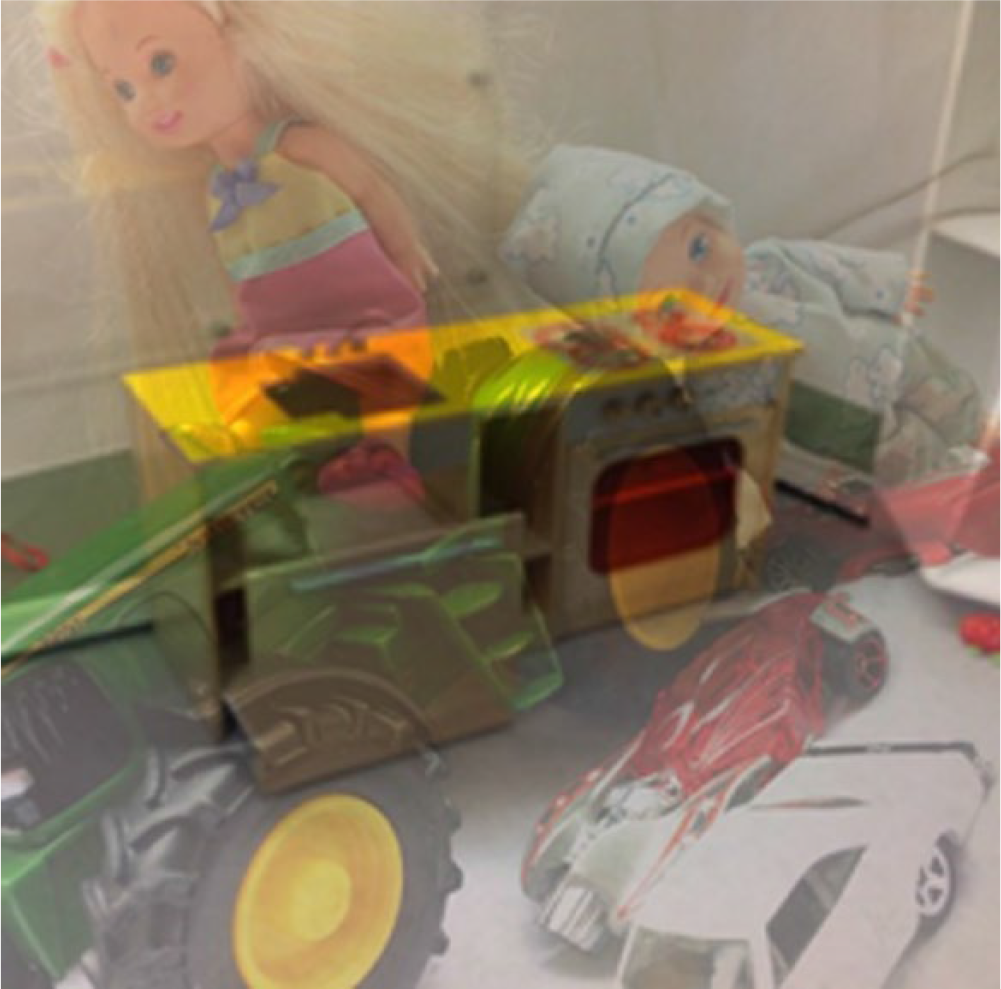
Kitchen-island transformations.
Whilst not wanting to privilege the human in this article, we nevertheless acknowledge the reader’s interest in knowing who ‘we’, the (re)searchers, are and where the (re)search has been conducted. Therefore, in our effort to flatten the hierarchical boundaries between the human and non-human, we position ourselves and the context of the (re)search in the endnotes. 2
Thinking with Deleuze (2014) and Lenz Taguchi (2010), we do not look for what ‘is’, but we look for the virtual potentialities of the child, the object, the event or ourselves. Grosz (2005) emphasises that all matter and organisms have agency and affect each other in a continuous flow of forces and intensities that work in unpredictable ways. Data, as a tool both for learning and for change, holds the potential for (re)exploring the landscapes of the kindergarten.
During a research project undertaken in a kindergarten, we paid close attention to human and non-human actors. We were drawn to a piece of child-sized equipment: a small ‘kitchen island’ featuring an oven and a sink (Figure 2). The object was located in the corner of a playroom, for children between the ages of one and three. Whilst in many ways a familiar object, the ‘kitchen island’ was nevertheless minus many of the objects that are associated with kitchen play. However, whilst in some ways incomplete, this object would go on to trigger our attention and curiosity, and in so doing, it would challenge and disrupt our systems of knowledge. The photograph of the ‘kitchen island’ is, on the one hand, a snapshot of ‘reality’ but, on the other, an invitation to explore. Deleuze (2014: 139) writes: ‘Something in the world forces us to think. This something is an object not of recognition but of a fundamental encounter’.
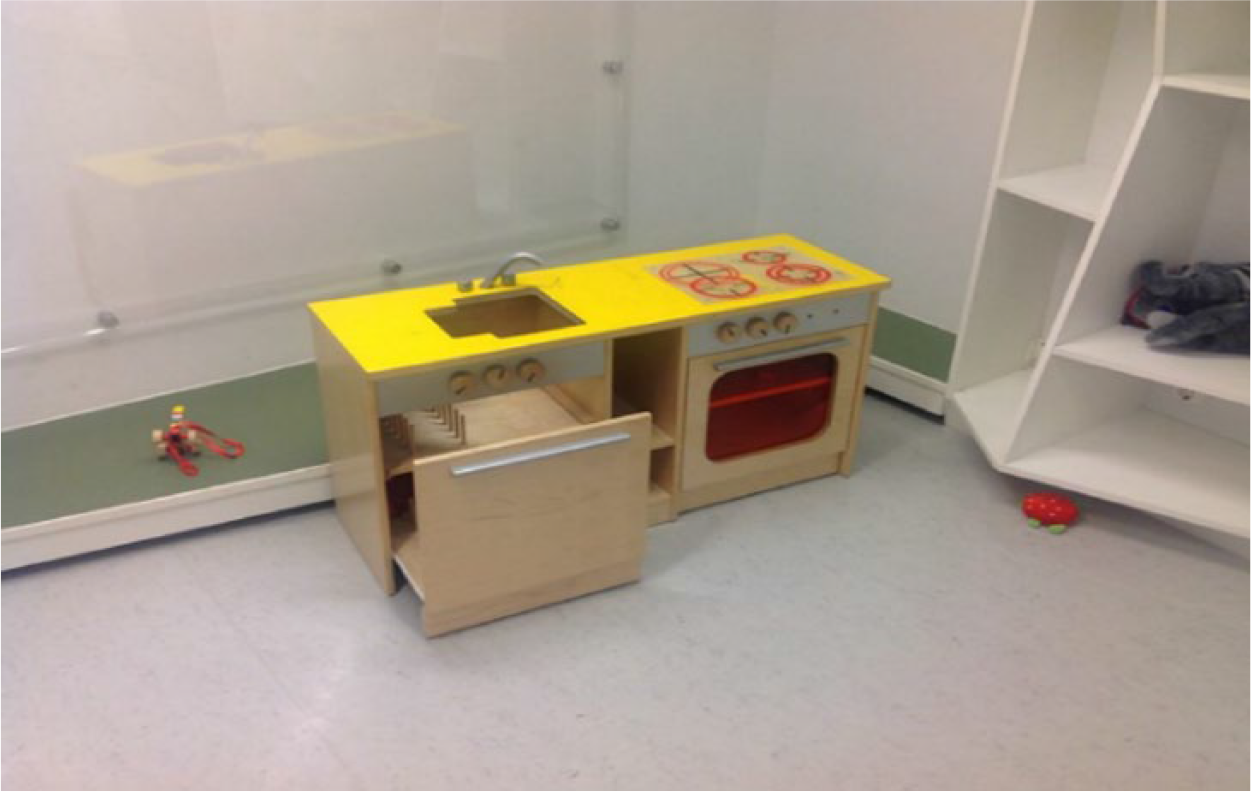
The kitchen island.
Stumbling into data
The mini ‘kitchen island’ (Figure 2) made us ‘stumble’ (Brinkmann, 2014). Following Brinkmann (2014), ‘stumble data’ is something that one stumbles upon which triggers astonishment, mystery and a breakdown in one’s customary understandings. The child-sized piece of furniture – the ‘kitchen island’ – aroused flows of affects and effects including wonder, surprise, engagement, frustration and confusion. Hence, the ‘kitchen island’ thereby became data, and it is this piece of data with which we will intra-act and engage in diffractive readings throughout this article.
Within a ‘flat ontology’ (DeLanda, 2002; Deleuze, 2014), humans are not hierarchically positioned as ‘masters’. Instead, what becomes important are the encounters and entanglements in-between human and non-human objects – the flows, the affects and effects, and the intermingling. Such intermingling allows different narratives to emerge where non-human objects have agency. Where the child’s play, together with our own embodied practices including sensations and affects, enters the (re)search assemblages (Deleuze and Guattari, 1987), and becomes matter with(in), is what Barad (2007, 2014) refers to as a ‘diffraction apparatus’, where virtual potentialities flow. Inspired by Barad (1995, 2007, 2014) and Deleuze (2014), the subject can be understood as assemblages of encounters that will differentiate with each new encounter in their continuous processes of transformation.
We explore with(in) a diffractive methodology. In situating ourselves as (re)searchers in and around the ‘kitchen island’, we encounter other matter and meaning, which, as rhizomatic offspring, provoke new thoughts and other potential becomings. Drawing on Lenz Taguchi (2012: 267), we ‘want to do research and read the data from our own bodies as researchers’, rather than as (re)searchers who look at data from an outsider perspective. Provoked by ‘stumble data’, we tune in to affective intensities – turning up the volume of resonances whilst simultaneously turning down the volume of interpretive analyses and familiar research procedures. Stumbling into data, we embrace the immediate, the unexpected, laughter, silliness, confusion, engagement, embarrassment, silence, tension, breathing, coughing, and so on. We are (re)searchers becoming with data.
Cutting together-apart the ‘kitchen island’
Hultman and Lenz Taguchi (2010: 535) write: ‘When reading diffractively, seeing with data, we look for events of activities and encounters, evoking transformation and change in the performative agents involved’. Barad (2007) explains the term ‘diffraction’ through an illustration of how waves combine when they overlap, and the apparent bending and spreading of waves that occurs when waves encounter an obstruction. It is this movement of overlapping, where the waves change in themselves in intra-action with the obstacle – a huge stone, maybe – with each wave accumulating, that signifies ‘diffraction’ (Barad, 2007; Lenz Taguchi, 2010). In other words, diffraction effects can be explained as effects of interference, where the original wave – the ‘kitchen island’ (Figure 2) standing alone and deserted in the corner of the room – partly remains within the new wave after its transformation into a new one, and so on, wave after wave (Barad, 2007).
As Barad (2014) notes, the cutting together-apart is not about breaking something in two. Rather, it is more like making different patterns that are intermingling entanglements, appearing as a thick, sticky web. In spite of this thick stickiness, the different patterns still have ‘agential separability’ (Barad, 2014: 177). We cut up (agential cuts) ‘the kitchen-island data’, but still see separable, different cuttings together, intra-acting with each other. Thus, making agential cuts can be regarded as making cutting ‘together-apart’, not through separate operations, but in one move (Barad, 2014). In reading the photo-assemblages diffractively, we are offered different/separate affects/sensations and moves, creating hodgepodges of interweaving becomings and ‘lines of flights’ (Deleuze and Guattari, 1987). Through reading data diffractively, we also trouble dichotomies (the cutting in two; Barad, 2014). In so doing, we are caught up in exploration with(in) these multilayered diffraction patterns, which occurs in the readings of our data/fused photograph. These open-ended explorations might trouble the simplicity of being stuck in/to dichotomies.
Seeing or ‘reading’ the photograph of the child-sized ‘kitchen island’ diffractively means installing ourselves in an event of ‘becoming-with’ the data (Haraway, 2008; Hultman and Lenz Taguchi, 2010). Hultman and Lenz Taguchi (2010: 537) write that, ‘in diffractive “readings”, you need to activate all of your bodily affective perceptions when intra-acting with the photographic image’. A diffractive seeing or reading is thus not a reading of a photograph as in a ‘taken-for-granted’ understanding, but a reading with the photograph in our genuine encounter with it (Hultman and Lenz Taguchi, 2010). We, as (re)searchers, engage our bodyminds in (ad)ventures of becoming with the photograph and rhizomatic narratives of the ‘kitchen island’. Like agential cuts (Barad, 2007, 2014) of reality, our ‘data’ holds the potentialities of becoming through diffractive readings.
In (re)turning (to) the photograph of the ‘kitchen island’ (Figure 2), we are not reflecting on the past. We are not trying to fathom what really happened in that moment or in that particular situation. Rather, in following Barad (2014), we are ‘re-turning’ – re-turning where we are turning something over once again. Think here of the soil in your flowerbed that is turned over and over again (Barad, 2014). New matter, which was always there but which lay hidden below the surface – like virtual potentialities – will rise to the surface. Hence, when we are re-turning (to) an event, we can see or read what emerges through the entangled assemblages in different, new or other ways. In turning to the data/photograph of the ‘kitchen island’ repeatedly, something new and/or different emerges. Virtual potentialities are released, like lines of flight, within the ‘kitchen-island’ assemblages. Working in this way resonates with Barad’s terms ‘diffraction’ and ‘spacetimemattering’. She writes: ‘There is no absolute boundary between here-now and there-then. There is nothing that is new; there is nothing that is not new’ (Barad, 2014: 168).
Exploring the matter/meaning concept …
As Barad (2003: 801) notes: ‘Language matters. Discourse matters. Culture matters … the only thing that does not seem to matter anymore is matter’. In embracing the ‘material turn’, where matter matters, we explore new territories. Barad (2007: 3) indicates that ‘matter and meaning are not separate elements’, while consequently referring to the ‘material-discursive’ to make this clear. She writes: ‘Meaning is not an ideality; meaning is material. And matter isn’t what exists separately from meaning. Mattering is a matter of what comes to matter and what doesn’t’ (Barad, 2014: 175). She emphasises that the relationship between the material and the discursive is one of ‘mutual entailment’ and, as she notes, ‘[n]either discursive practices nor material phenomena are ontologically or epistemologically prior’ (Barad, 2007: 152). Knowing and being cannot be separated. Thus, Barad (2007: 185) suggests an ‘onto-epistemology’, which can be defined as ‘the study of practices of knowing in being’. Barad’s term ‘onto-epistemology’ relates to the interdependent and intertwined relationship between theories of being (ontology) and knowing (epistemology). Hultman and Lenz Taguchi clarify this further:
An onto-epistemological thinking thus clearly decenters the researcher as knowing subjects and takes us beyond the dominating subject/object, human/non-human, as well as the discourse/matter and nature/culture dichotomies: it becomes impossible to isolate knowing from being and discourse from matter; they are mutually implicated. (Hultman and Lenz Taguchi, 2010: 539)
Working within a flat ontology, we appreciate a situated methodology that appears entangled and intertwined, emphasising what Barad (2007) refers to as an ‘ethico-onto-epistemology’. In our efforts to ‘flatten’ the human, we have turned to Deleuze and Guattari’s (1987) concept of the assemblage. Following Bennett (2010: 24), we recognise that ‘assemblages are not governed by any central head’. Flat ontologies consist of self-organising systems, where the dynamic properties of matter produce a multiplicity of complex relations and singularities that sometimes lead to the creation of new, unique events and entities, but more often to relatively redundant orders and practices (Marston et al., 2005). This is a different way of doing research. It requires that we both investigate and write our analyses in quite a different way to when writing within, for example, a reflexive or discursive paradigm or a representational paradigm.
Barad (2003: 802) writes: ‘The move toward performative alternatives to representationalism shifts the focus from questions of correspondence between descriptions and reality to matters of practices/doings/actions’. Hence, thinking with Barad as well as Deleuze and Guattari (1994), we are not interested in concepts in order to determine what something ‘is’ – its essence or being. Rather, we are interested in a concept as a vehicle for expressing what might be referred to as an ‘event’ or ‘becoming’. We thus enter and re-enter data filled with curiosity. What might emerge in the entanglements in between different bodies and ideas?
… and appreciating an ethics of immanence …
Lenz Taguchi (2010) proposes an ethics of immanence and potentialities. This suggests that we, as (re)searchers, cannot understand the child, the content, the methodology or ourselves as fixed entities, separated from everything else. An ethics of immanence emphasises the interconnections and intra-actions in between human and non-human organisms. Hence, (re)searching with(in) an ethics of immanence claims our attention and continuous responsibility for what happens in the multiple intra-actions that occur in different learning events, as we affect and are being affected by everything else. According to Lenz Taguchi (2010: xvii), responsibility is thus built into the immanent relationship between all matter and organisms, suggesting that ‘the flow of events becomes a collective responsibility on behalf of all organisms present, whether they are human or non-human’. Responsibility is not something we choose, but it is a part of life and deals with influencing and being influenced (Deleuze, 1988; Lenz Taguchi, 2010).
Through an ethics of immanence, we are giving up the search for the ‘true’ child, ‘true’ knowledge, the ‘true’ researcher or truth per se, in favour of collaborative innovation and creation. An intra-active view on learning involves an ethics that discards reductive, universal objectives and results-oriented practices (Lenz Taguchi, 2010). This entails moving away from the endorsement of ethical principles to the actual practice of ethical behaviour(s). Bennett (2010: xii) speaks of ‘the ethical turn’, where ‘ethics’ no longer refers primarily to a set of doctrines; rather, ethics has ‘to be considered as a complex set of relays between moral contents, aesthetic-affective styles, and public moods’. In the web of relations between human and non-human matter and affect, actions occur including good or bad vibrations. It is therefore of the utmost importance to recognise our responsibilities where we engage in what Barad (2007) refers to as ‘ethico-onto-epistemology’. Practices that are performing an immanent and opportunity-based ethics extend beyond prevailing dichotomies such as science/art, intellect/body and rationality/affect. Such practices are trans/boundary and are characterised by affirmative approaches to change and development where humans are considered to be in mutual coexistence with everything else (Lenz Taguchi, 2010). This is an ethics that emphasises both human and non-human opportunities and potential – the ‘virtual’ and what might become.
… when exploring fused materialities and theories
Our data, the photograph (Figure 2) and the narratives of the ‘kitchen island’ generate affect and effects in between bodies and ideas. The photograph featuring an empty piece of child-sized furniture placed in the corner of a room resonates in our bodies as well as our minds. Exploring what might emerge when we are cutting together-apart (Barad, 2014) the photograph of the mini ‘kitchen island’, we experiment with fused materialities and ideas. Putting to work the Deleuzian concept of the ‘virtual/actual’ provokes the data’s potentialities. What we choose to engage with activates certain flows, whilst other possible flows are ignored. Additionally, some flows might be interrupted and disturbed, initiating new lines of flights that hold the potential for transformation and becomings. Intermingling, stretching and pulling the web of different encounters between matter and meaning allows for a little bit of chaos, the unpredictable and the unknowable, all of which ensures ‘becoming’ (Deleuze and Guattari, 1987).
Dwelling with(in)/re-turning (to) the photograph of the little ‘kitchen island’, the kindergarten practitioners tell different stories (Figure 4) – stories that are rooted in the real, where children’s play is based on predetermined assumptions about what constitutes ‘kitchen play’. One practitioner suggested that the absence of relevant kitchen-play materials – such as child-sized pots and pans, cups and dishes, and so on – might have distorted the ‘right’ use of the ‘kitchen island’. Put slightly differently, having the ‘right’ play materials would help the children to play ‘correctly’ with the ‘kitchen island’. Within this perspective, the ‘kitchen island’ is regarded as a passive object to be played with, while the child is seen as active and in control, as the explorer.
Yet the ‘kitchen island’ offers different possibilities (Figure 3). Recognising the ‘kitchen island’ as an active agent in the assemblage allows virtual potentialities to emerge. When flattening the relationships between different bodies, something else might happen. In our grappling with this, we are moving back and forth, caught up in different flows. Such flows include different theories, different thoughts, different values, different ethical ponderings and different understandings. Cutting together-apart the photograph of the mini ‘kitchen island’ allows for multiple layered readings. The multilayered photograph can be regarded as an assemblage within itself – vibrant, open-ended, affective, sensational (Deleuze and Guattari, 1987). For example, in foregrounding the kindergarten teacher’s observations, where the ‘kitchen island’ is moved into the back (Figure 4), we were able to consider the discourses that are in circulation. Hence, in dwelling with the embedded implication of the practitioner’s statement ‘We did not get everything that we had ordered … We need a way to develop the children’s play further, but we still lack some things’, we begin with three considerations. First, why is the need to ‘develop the children’s play’ understood as being the responsibility of the adults (‘We need’)? Second, why are commercially produced things understood as necessary in order to ‘develop the children’s play further’? And third, why privilege human-centric thought over matter? Working with diffractive readings, we want to challenge, disturb and trouble this ‘human-centred’ (Hultman and Lenz Taguchi, 2010) thinking. For this reason, we try to unfix what might be regarded as fixed and stable – including the words spoken by the human – by making breaks and ruptures and intra-actions where humans are not privileged.
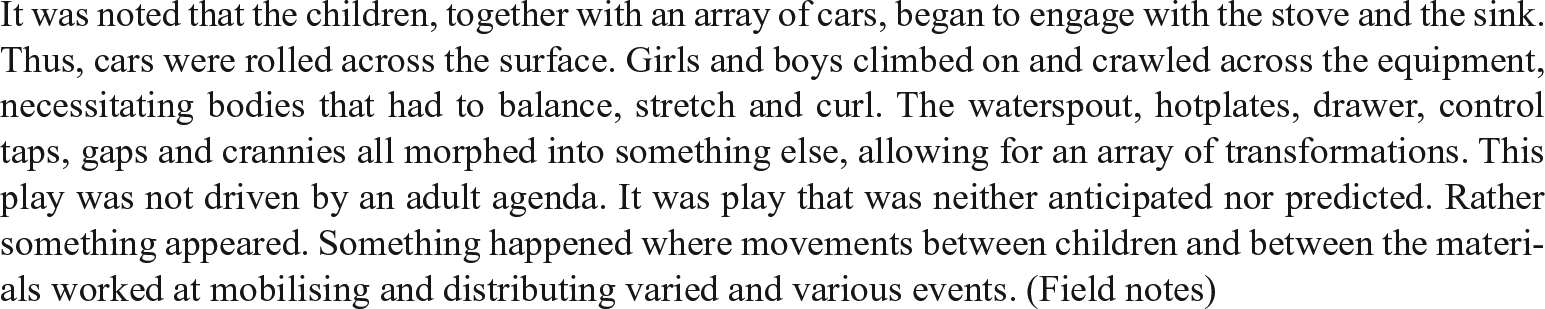
Observation.
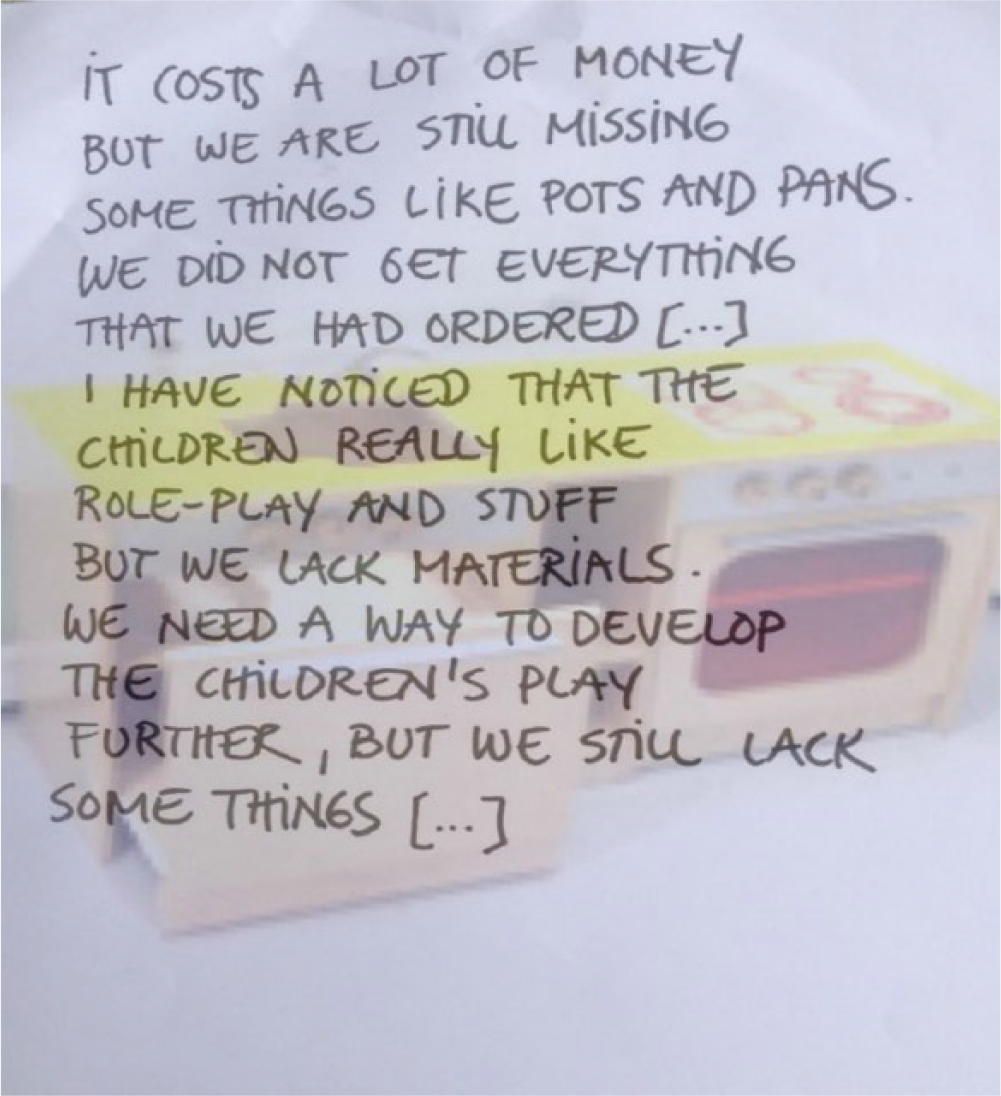
Multilayered data.
Flowing back and forth: re-turning embodied practices
As (re)searchers, we carry our (hi)stories in our bodies and in our minds. In order to clarify this point further, let us ‘re-turn’ (to) the idea that there are ‘proper’ ways of playing with a ‘kitchen island’. Within early years education, we subscribe to certain discourses concerning play, including Dewey-inspired practices. We are, as a consequence, familiar with certain narratives, including that of the ‘active child’ who learns through playing with ‘real’ objects. However, in re-turning (to) the ‘kitchen island’, we have suggested a different conceptualisation of children’s learning. The child-centred perspective has been challenged. Materials including toys and other bits and bobs are considered agentic.
In the photograph of the ‘kitchen island’ (Figure 2), dichotomies can easily be identified if that is what you want to look for. Such dichotomies can include right or wrong ways to play and right or wrong ways to interact with the ‘kitchen island’. It is all too easy to stumble into these dichotomies. However, when undertaking diffractive readings of the photograph, we are no longer concerned with producing absolute separations or dichotomies. Diffractions are about multiplicity. Diffractions resist producing absolute separations and embrace difference. Barad (2014: 169) writes: ‘Diffraction is not a singular event that happens in space and time; rather, it is a dynamism that is integral to spacetimemattering’ and, as such, can be seen as untimely in its moving back and forth in place, space and time. ‘Diffractions do not produce “the same” displaced, as reflection and refraction do’, Haraway (1992: 300) writes, emphasising that ‘[a] diffraction pattern does not map where differences appear, but rather maps where the effects of difference appear’.
Therefore, taking into account the diffractions of difference (Barad, 2014), data can be read in many open-ended directions and in different ways. Data can be experimented with, where new and different flights open up further explorations and experimentations (Deleuze and Guattari, 1987). The different photo-assemblages in this article can, we believe, offer multiple readings, depending on what affects and new paths they trigger for the reader. As (re)searchers, we are still intrigued and surprised by the flowing affects that infect us while caught up in the (re)searcher/kindergarten assemblages. By undertaking diffractive readings of the fused photograph of the ‘kitchen island’, different layers and possibilities of the actual/virtual become possible. Flows of playfulness, curiosity and perhaps foolishness might emerge – a hodgepodge of different bodies, colours, shadows, shapes and forms intra-acting and transforming through encounters with breath, eye, gaze, light and darkness. The assemblages force us to rethink the matter of ‘matter’ and becomings of our embodied practices. Barad (2014) suggests that diffractions cry out for rethinking. The rethinking continues; it never finishes. There is no end, but continuous becomings.
Stumbling and bouncing into hodgepodges of cars, objects and a ‘kitchen island’
Once again … disruption
When cutting together-apart (Barad, 2014) the ‘kitchen island’ once again, the multilayered blending of bodies, surfaces, colours, light and shadows within the photograph (Figure 5) does something to our thinking-feeling (Massumi, 2008). Following Massumi (2008), the concept of ‘affect’ is recognised, where bodies through encounters with other matter or actions experience a non-conscious intensity – occurring when living, playing or exploring. Exploring the mini ‘kitchen island’ during our (re)search, we realised that different objects, like toy cars, were not regarded as ‘proper’ when played with at the ‘kitchen island’ (Figure 3). However, when the children put toy cars on top of the different surfaces, or when the colourful toy cars were moved in fast and furious ways, or when the sink was filled with parked toy cars, it was clear that affect was triggered within the practitioners’ bodies.
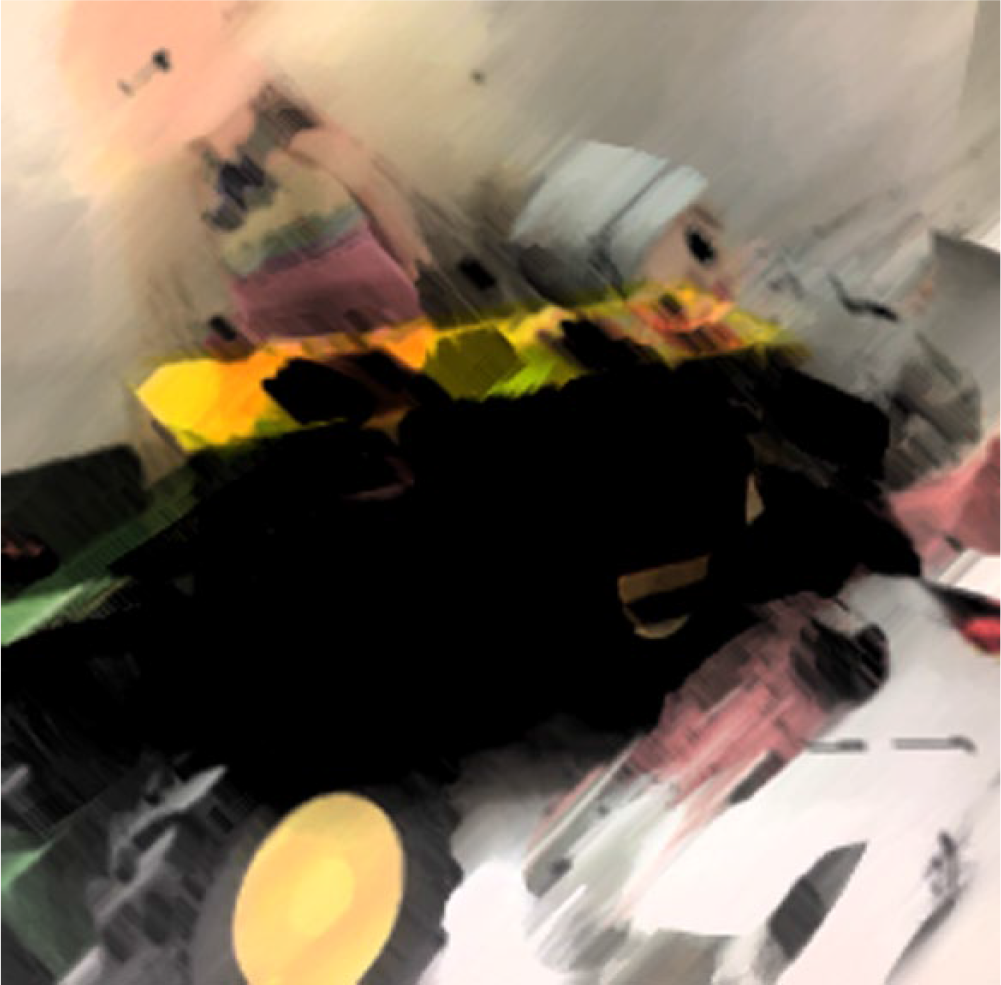
Hodgepodges.
The water tap, sink, hotplates, shelves and cabinet all morphed into something else, allowing for an array of transformations (Figure 6). Something that was not predicted happened – something that troubled and disrupted predetermined ideas of how to play with a ‘kitchen island’ and ideas about learning. Different objects inspired the children’s play in different ways and directions. No longer serving just as a ‘kitchen island’, it could transform into something new, other, different or unforeseen when intra-acting with children, cars, dolls, bricks and other things (Figure 1). Other play was initiated – endless virtual possibilities and becomings. The ‘kitchen island’, together with other actors, acquired new functions within a newly created ‘territory’ (Bogue, 1999). Neither the children nor the equipment were central in the play. Rather, both appeared to be caught within the assemblage, where different flows and different intensities between bodies and materials allowed numerous trajectories or ‘rhizomatic flights’ (Deleuze and Guattari, 1987) to happen (Figure 3). This play was not focused on an end product or a specific outcome. What seemed more important was activity and movements. By centring on movements, the non-human is repositioned with(in) the assemblage, where multiple ways of playing become possible.

Flight lines.
The ‘kitchen island’ intermingling (re)searchers (re)searching
The Deleuzian ‘becoming’ is always a constituent part of an assemblage, acting as a process of change, flight or movement within the constellation. Becoming is about repetition; it is about affinities and the capacity both to sustain and to generate interconnectedness (Braidotti, 2002). Thinking with Deleuze and Braidotti, the steps of ‘becoming’ are neither reproduction nor imitation, but rather empathic proximity and intensive interconnectedness. When ‘becoming’, one piece of the assemblage is drawn into the territory of another piece, changing its value as an element and bringing about a new unity. Everything affects everything else, which makes everything change and in a continuous process of becoming – becoming different in itself, rather than being different in relation to another (Deleuze, 2014). Hence, becoming (re)searcher is not a process of linearity and a matter of following a blueprint. We are more akin to the ‘nomad’, where we are always in the middle or between points, where we are transforming and changing through events that hold affects, intensities and forces (Deleuze and Guattari, 1987; Massumi, 2002).
When everything is entangled, ‘data’ cannot be separated from the (re)searcher. Data is not something ‘out there’ for ‘us’ to ‘collect’ (St Pierre, 2013). Working with what Brinkmann (2014: 723) refers to as ‘stumble data’, our exploration is neither data-driven (induction) nor hypothesis-driven (deduction), but driven by astonishment, mystery and breakdowns in one’s understanding (abduction). The goal of the abductive process is not to arrive at fixed and universal knowledge through the collection of data. Rather, the goal is to be able to act in a specific situation. According to Brinkmann, there are numerous things to ‘stumble’ upon, including conversations, media, books, advertising, consumer objects, architecture, and everyday episodes and situations – or a piece of equipment featuring an oven and a sink: the ‘kitchen island’ (Figure 2). It has caused us to stumble, where the stumbling also becomes data (Brinkmann, 2014).
As active agents with(in) the kindergarten, (re)searcher, children, kitchen-island, objects, toys, affect, effect assemblages (Figure 7), we are infected and transformed by ideas, sensations and matter. They are acting and playing with our minds, bodies and emotions. Discomfort and intensities concerning play, matter, discourse and meaning emerge (Figure 5), stretching and provoking our ethical boundaries. We are troubled, challenged and disrupted in our discursive perceptions of play. Who or what makes the decisions regarding how to play? Or what to play when? In many ways, as (re)searchers, we are being thrown into confusion. It feels like we are stumbling into a big black hole of discomfort where all that comforted us previously has been disrupted. Carrying out diffractive readings of our material, we find ourselves bouncing and bumping in different directions and hodgepodges of entangling materialities.
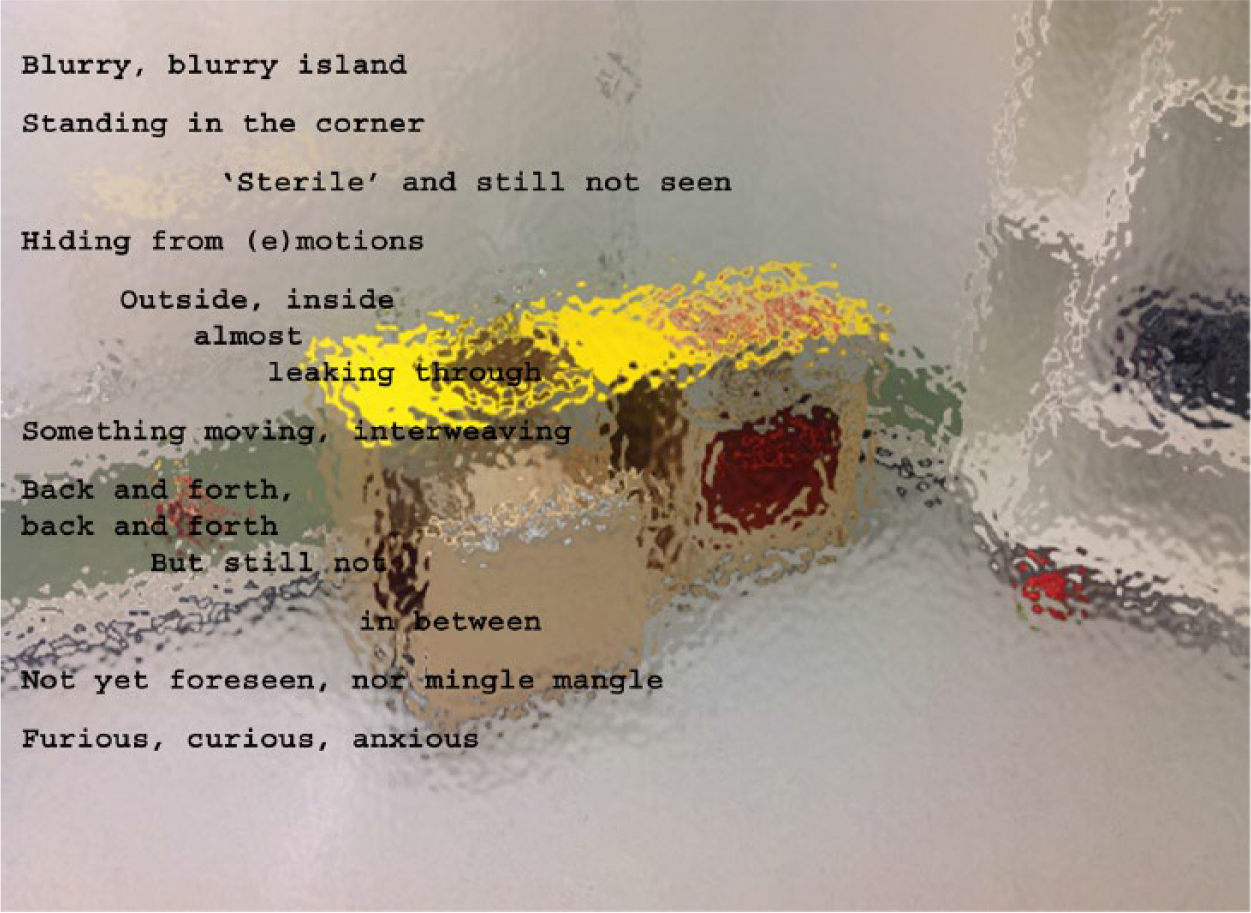
Blurry island.
Discomforting flight ways to become, and …
Reading data diffractively opens up various and varied flight pathways (Deleuze and Guattari, 1987), which can be followed and explored (Barad, 2014). The flight ways hold virtual possibilities and imaginative becomings. While working with the photograph and the narratives of the mini ‘kitchen island’, we have explored and challenged our habitual ways of thinking. By re-turning and by cutting together-apart (Barad, 2014), we have interrupted sedimented perceptions. Diffractive processes will never close, and never finish.
(Re)searching within a relational materialist methodological approach has strong implications not only for the way we think about children and for the educational practices in kindergartens, but also for the way we think about our (re)search and ourselves as (re)searchers (Hultman and Lenz Taguchi, 2010). Hence, ‘thinking can be understood to take place in-between heterogeneous bodies and agents, rather than being something localized inside the mind of an isolated agent’ (Hultman and Lenz Taguchi, 2010: 536). Reading or seeing data within non-hierarchical relations between intra-acting bodies defies a cause-and-effect relationship. Rather, all bodies are ‘causes’ – causes in relationship to each other and for each other (Deleuze, 1990). Inviting a ‘diffractive way of seeing’ activates all of our affective perceptions and, in so doing, challenges taken-for-granted routines and habits. In making matter ‘matter’ and by intra-acting with ‘data’, we are also becoming as (re)searchers. As (re)searchers, we are becoming with ‘data’. It is an embodied becoming, where we can see, feel and touch our ‘data’. As Barad (2003: 829) notes: ‘we do not obtain knowledge by standing outside the world; we know because “we” are of the world. We are part of the world in its differential becoming’.
Footnotes
Acknowledgements
We would like to thank Professor Liz Jones and Associate Professor Ann Merete Otterstad for their advice and comments on previous drafts of this article.
Funding
This research received no specific grant from any funding agency in the public, commercial or not-for-profit sectors.