




Abstract
Grounded in critical and emancipatory theories, five critical ethnographies about the lives of children, grandchildren, colleagues, students, and teachers are analyzed and synthesized to illuminate the ways in which individuals are racially socialized over their lifespans. Three propositions for early childhood contexts were apparent across the studies: (1) racial identity and dysconsciousness are learned over time and across multiple spaces; (2) critical racial literacy is a complex, cyclical, and sometimes contradictory process; and (3) critical racial literacy demands acknowledging and confronting blind spots. Building on these propositions, the authors present implications for enacting practices that promote critical racial literacy in early childhood education settings around the globe.
Pernicious and ongoing physical and emotional racial violence (Boutte, 2008, 2015a) against black and brown people in the USA has amplified the need for communities, parents, and teachers of young children to engage in critical racial literacy. Despite the reality that race and racism clearly impact teaching, learning, and daily living, these concepts continue to be undertheorized and silenced in families, policies, and research on early childhood (Milner and Self, 2014). The following quotes draw from our five critical ethnographic studies, exemplifying the need for critical racial literacy in the lives of young children: I hate the color brown. I am brown so that must mean that I hate myself. (Janiyah African American, six years old) God made you white. God made me white. And God made Ella white and Livie white because we are a white family. (Max, white, four years old) When I was going to school, it was just white people … so when I say [I am] just a white girl, when I grew up, that’s all that it was. (Fourth-grade teacher, white, early fifties)
This article synthesizes our five respective studies to demonstrate how critical racial literacy can be enacted across multiple contexts with children and the adults who teach and parent them. Our multilayered analysis collectively asked: “What happens when critical racial literacy development is studied across early childhood home, school, and community contexts?”
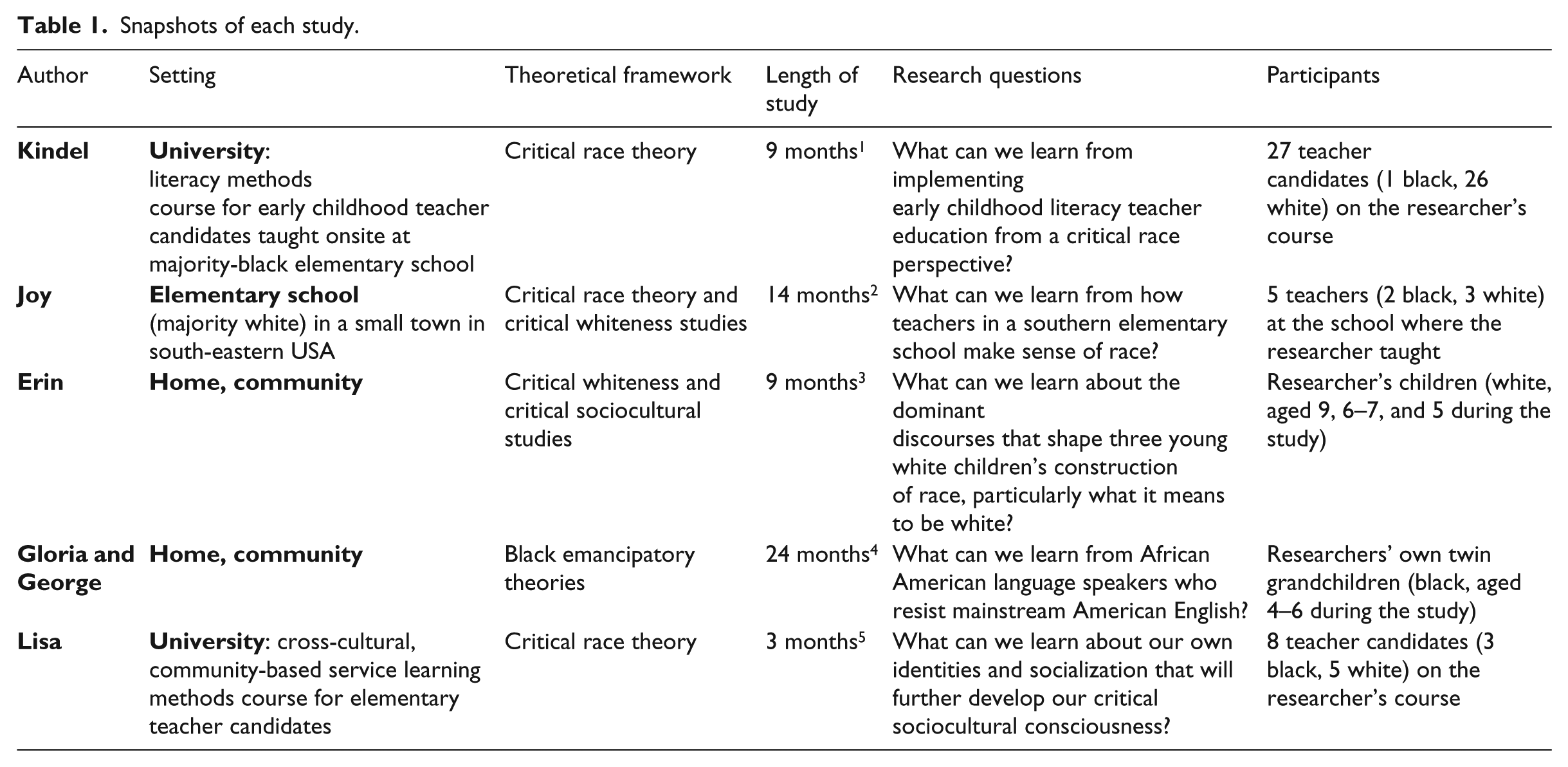
The six researchers involved have studied, presented, and written independently and collaboratively on this topic for the last eight years. Four of the researchers are white females (Kindel, Joy, Erin, and Lisa), one is a black female (Gloria), and one is a black male (George). Erin’s and Gloria and George’s studies included their own children or grandchildren. Kindel’s and Lisa’s studies included students in their teacher education courses, and Joy’s study involved teachers at the school where she taught. We believe that this trans-study approach is a powerful mechanism for approaching racial scholarship, since the development of racial identities is multilayered (DePouw and Matias, 2016; Hughes et al., 2006). Likewise, we believe that studying these deeply rooted, endemic racial issues requires new methodological approaches such as ours (for study snapshots, see Table 1). In our analyses, we took up the concept of critical racial literacy (Guinier, 2004) to illuminate ways that:
racial categories oppress and privilege people through ongoing macroaggressions and microaggressions (Matias, 2016b);
discourses nullify epistemologies that run counter to whiteness-as-superior (Lewis, 2001; Nash, 2013; Vaught and Castagno, 2008);
historical trauma and exploitation contribute to structural social advantages for whites (Cantú et al., 2012; Thandeka, 1999); and
symbols and spaces exclude the histories, heritages, and humanity of racialized others (Epstein and Gist, 2015; Perry, 2003; Sealey-Ruiz and Greene, 2015).
Snapshots of each study.
A wealth of literature tells us that racial categories, discourses, trauma, symbols, and spaces are constructed in schools, homes, and communities from birth (Clark and Clark, 1950; Ferguson, 2000; Thandeka, 1999; Van Ausdale and Feagin, 2001). Thus, unveiling strategies to develop critical racial literacy in early childhood contexts is urgent. Indeed, parents’ and educators’ silence on these issues can be a form of neglect; when children are not taught the sociopolitics of race and racism, they cannot learn how to survive and disrupt racism and white supremacy (Matias, 2016a).
This article first provides an overview of our respective theoretical perspectives and snapshots of each study. Second, we collectively share findings which translate to three propositions for critical racial literacy specifically relevant to early childhood parents, teachers, and teacher educators. Finally, we present implications for enacting practices that promote racial literacy in early childhood educational settings.
Theoretical orientations
Although our work took place in many different early childhood contexts, four major theoretical frameworks permeate all of our studies: (1) critical race theory (Lynn and Dixson, 2013); (2) critical whiteness studies (Johnson, 1999; Nayak, 2007); (3) black emancipatory theories (King and Swartz, 2015; Lynn, 1999); and (4) critical racial literacy (Guinier, 2004; Skerrett, 2011) (see Table 1). Such critical frameworks confront the role that institutional and structural inequities play in racial literacy development in childhood. Likewise, these frameworks are important as they each critique hegemonic structures which impact the daily lives of children, providing tools for interrupting and deconstructing racism with children and the adults who teach them.
Critical race theory
In the context of early childhood educational research, critical race theory has three goals: to (1) expose and explore racism as a legal and structural reality; (2) evaluate neo-liberalism and its effects on laws and policies that perpetuate racism (Ladson-Billings and Tate, 1995: 12–13); and (3) engage in storytelling and counternarratives to give testimony to voices that have been oppressed by racial realities (Lynn and Dixson, 2013). We can work toward these three aims with young children through ongoing socialization, conversation, and action that disrupts and counters racism.
Critical whiteness studies
Complementing critical race theory, critical whiteness studies seeks to destabilize white supremacy and the way it is manifested in day-to-day actions and interactions—especially in early childhood contexts—by illuminating how whiteness operates as the norm (Matias, 2016a). Critical whiteness studies denormalizes and scrutinizes whiteness as a social construction that incessantly fortifies “the power of white identifications and interests” (Gillborn, 2005: 488). Critical whiteness studies also recognizes the major role of teachers and parents in breaking silences around topics of race, and upholds that silences teach children to “deflect, ignore, or dismiss their role, racialization, and privilege in race dynamics” (Matias et al., 2014: 291).
Black emancipatory theories
Black emancipatory theories (Du Bois, 1903; Fanon, 1963; King, 1992, 2006; King and Swartz, 2015; Lynn, 1999; Lynn et al., 2013; Woodson, 1933) emanate from a black studies paradigm to challenge and critique social and equity issues while contributing to the racial and ethnic uplifting of people who are often on the margins in society (Lynn et al., 2013). Black emancipatory theories can directly involve children in: (1) naming and identifying oppression and its constituent components; (2) learning their history; (3) imagining possibilities of a better world; (4) taking reflective actions to interrupt ongoing oppression; and (5) organizing and collaborating with others seeking to dismantle oppressive structures.
Critical racial literacy
Dovetailing with studies of ethnic-racial socialization in childhood and households (Caughy et al., 2002; Priest et al., 2014), the concept of racial literacy has been taken up within the field of teacher education in order to describe the processes by which pre-service teachers develop racial literacy (Sealey-Ruiz and Greene, 2015) and the racial literacy practices of pre-service teachers, in-service teachers, and K–12 students (Epstein and Gist, 2015; Rogers and Mosley, 2006; Skerrett, 2011). Extending these conventional understandings of racial literacy as a set of discrete, cognitive skills, we take on a critical epistemological perspective which allows us to view it as “the powerful and complex ways in which race influences the social, economic, political and educational experiences of individuals and groups” (Skerret, 2011: 314). We view critical racial literacy as a humanizing epistemology requiring parents and educators to recognize, refute, critique, and synthesize the structure of race in daily living, moving toward actions, curricula, communication, and restructuring of oppressive structures that allow us to realize equity.
Methodologies and descriptions of studies
Attending closely to issues of power, identity, and agency, our studies employed critical ethnographic methodologies including auto-ethnography (Denzin, 2005; Hughes et al., 2012), narrative inquiry (Noblit, 2004), critical and performance ethnography (Denzin, 2003; Madison, 2011; Villenas, 2012), and critical race counter-storytelling (Solórzano and Yosso, 2002; Willis et al., 2008). Canvassing US P–20 (preschool through university) schools and homes, our studies all comprised long-term examinations of race and how it is taken up in various contexts with young children. The participants in our studies were black and white; however, the implications of the studies will likely be instructive for thinking about and confronting how white supremacy affects other racial groups. While we realize the scholarship on critical race studies is inclusive of more than two racial groups, we continue to forefront work that is situated on the black/white binary since the majority of black people in the USA live in the south-eastern region where all of our studies took place (DeNavas-Walt et al., 2010), and because the largest disparities across all measures of human life (e.g. education, health care, life expectancy, the justice system, wealth) are between blacks and whites (Children’s Defense Fund, 2014).
We collected data through in-depth individual and small-group phenomenological interviewing (Seidman, 2013), co-performative witnessing (Madison, 2011), and narrative methods (Chase, 2005). Snapshots of our studies are highlighted in Table 1. Drawing from much larger studies in which each asked particular research questions, in this project, we collaboratively engaged in analyzing data specific to critical racial literacy. Our analysis centers on the following research question: “What happens when critical racial literacy development is studied across early childhood home, school, and community contexts?”
Collaborative data analysis
Collaborative data analysis promoted a more dialogic analytic process, enabling us to “cast a wider analytic net” (Saldaña, 2015: 35). In order to ensure a smooth process of group coding, we each coded themes using holistic, first-level coding to develop a codebook of emergent ideas in each data set (Miles et al., 2013: 77). Holistic coding involved applying a coding unit to a chunk of data and was appropriate for us as it is most often used when coders have a general idea of what they are investigating in the data (Miles et al., 2013: 77). The codebook editor (Kindel) organized the coded data into a framework matrix using NVivo software (Saldaña, 2015), then applied constant comparative analysis (Grbich, 2007) to code at the second level, comparing codes from each author in order to integrate the codes using our theoretical frameworks and central research question. The codebook editor then took the second-level codes back to the research team for intensive group discussion in order to achieve “dialogical intersubjectivity” (Saldaña, 2015: 35). Multiple coding sessions provided a platform to explore and negotiate discrepancies and work toward inter-rater reliability (Armstrong et al., 1997).
The codes that emerged fall into two categories: (1) “blind spots” and (2) the development of critical racial literacy with young children and the adults who teach them. 6 Collapsing these codes, we identified three overarching themes or propositions for critical racial literacy. While our findings are organized by discrete propositions, we recognize that racial literacy is fluid and organic, and does not operate in independently functioning silos. As such, the propositions we describe are nuanced and, at times, overlapping. In the following section, we describe and support these propositions with data excerpts from our research.
Propositions for critical racial literacy
Racial identity and racial (dys)consciousness are learned over time and across multiple spaces, therefore critical racial literacy requires reflection (memory work) over both time and space 7
The first proposition illustrates the notion, confirmed in multiple findings, that racial identity socialization occurs early on in a person’s lifespan and is learned over time as we move in and out of present and past temporal spaces (Boutte and Johnson, 2013; Guinier, 2004; Howard, 2015; Nash and Miller, 2015). The fluidity of such movements can make racial literacy difficult to frame, so we propose that the development of critical racial literacy requires memory work in an effort to “re-member” or “reconnect knowledge about the past that has been torn apart by Eurocratic narratives” (King and Swartz, 2015: 1). Through memory work, teachers and families (as first teachers) can intentionally create safe and sustaining spaces to make sense of race in ways that are continuous, progressive, and ongoing—not merely reactive or provided in isolated responses to children’s inquiries about race-related events or ideas (Hughes et al., 2006). In our studies, memory work proved to be a necessary tool to unpack the ways in which we learn to accept racial binaries. For instance, in Kindel’s study, nearly all of the pre-service teachers (26 out of 27 were white) had grown up in predominantly white, racially stratified and segregated communities. White and black pre-service teachers detailed early and dysfunctional awareness of whiteness, as in Haley’s (who identified as white) description of her earliest racial memory: The earliest racial memory I have occurred when I was about two or three years old. Every time my mom would take my brother and sister and I to the store, I would try to get my mom to buy me a black baby doll, and my mom would say, “No, you want this one,” pointing to the white doll. My parents were not racist; it was just understood that, as a white child, I would get a white baby doll. But I did not want it. As I got older, I would receive white dolls and love them, and I learned to want white dolls.
By consistently denying her a black doll, Haley’s mother and family deliberately taught her that whiteness was preferable to blackness. Yet, by analyzing this memory, Haley was able to identify what she would do differently with her own children in a class discussion after sharing this memory in a small group: “I would not do this to my own child. I would let them have whatever kind of doll they want.” Similarly, a white in-service teacher from Joy’s study remembered how she learned what it meant to be white growing up in a racially segregated town: When I was going to school, it was just white people. I can tell you the two first families of black children that came to [my] school because at that point there was an incentive for them to integrate the schools, and so I knew the two families that came. And it was just, it was just, you know, it was a different time … so when I say [I am] just a white girl, when I grew up, that’s all that it was.
While these white pre-service/in-service teachers were not provided with the space to do racial memory work early on in their lives, Gloria and George made sure that their twin grandchildren (who identify as black) were able to do so. They recognized that while the girls sometimes seemed grounded in their blackness—actively resisting learning Standard English and seeming proud of other black cultural dimensions (e.g. communalism, orality, rhythm)—there were times when they expressed a desire for “tan” skin or a dislike for brown skin. Attending a predominantly white school in which they are in the numerical minority had contributed to uncertainty and confusion about the value of blackness and black culture, even though their home life immersed them in positive symbols of blackness, such as African American hand games (Figure 1), food, music, dance, books, dolls, television shows, and communication styles. For example, one day while running errands with Gloria, Janiyah (aged five) mused to her sister: “I hate the color brown. I am brown so that must mean that I hate myself.” 8 In response, Gloria and George began to intensify their efforts to confront the socialization into such attitudes toward blackness in the girls’ world through utilizing black emancipatory theories to “re-member” (put back together) African world views, cosmologies, philosophies, cultural concepts, and practices (King and Swartz, 2015: 1). They shared stories about African people before contact with Europeans as well as through other eras (e.g. enslavement, reconstruction, civil rights, and contemporary times) by using songs, music, videos, children’s books, role-playing, and games. These methods of memory work were highly engaging, as one of the twins volunteered: “I never knew history could be so much fun!” These opportunities to reflect in deliberate ways, such as writing and discussing racial memoirs and forefronting African world views through songs, books, games, and music, proved to be necessary and useful tools in developing critical racial literacy.
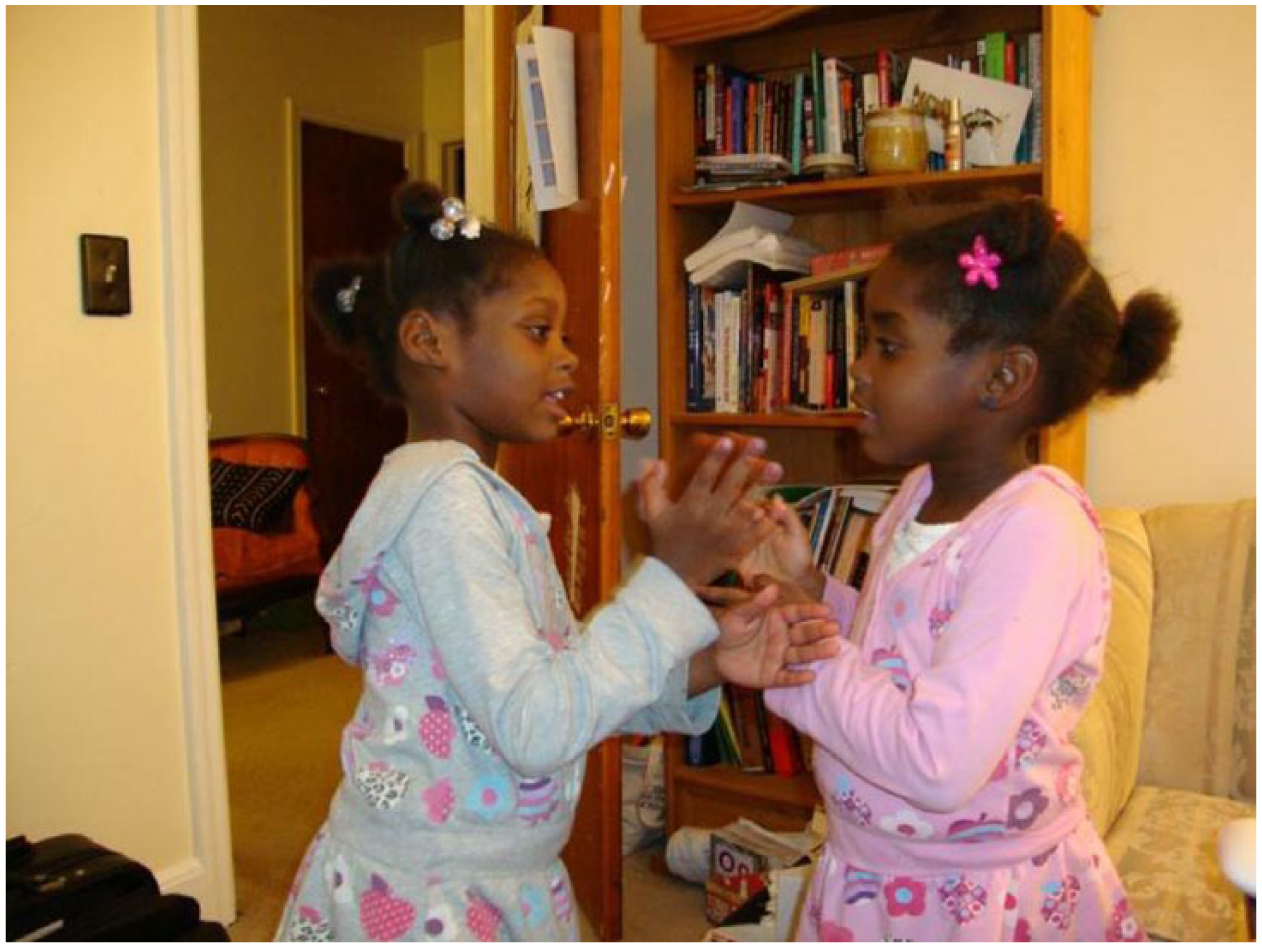
The memory work of African-centric play: Jaliyah and Janiyah playing a handclapping game.
Critical racial literacy is a complex, cyclical, and sometimes contradictory process best supported by critical communities who work together to resist racial hegemony
The second proposition further highlights the complexity and often contradictory nature of racial literacy development and the ways that critical racial literacy can be supported by critical communities who work together to resist racial hegemony. In connection with the idea that we become dysfunctionally racially aware at an early age, all of our studies elucidated that we are racially socialized into belonging to particular sociopolitically constructed racial discourses and identities. These discourses and identities are carried into the social contexts of adulthood.
Erin’s study revealed how her white children (Ella, Olivia, and Max) were socialized into identities that reified white identity as the norm. For example, in church, the idea that God made us and that He made the whole world was pervasive. Since the church community, artifacts, and symbols reflected images and symbols of whiteness, Erin’s children learned to identify whiteness as divinely determined by God. This may be why Erin’s youngest child, Max (aged five at the time of the study), confidently asserted: “God made you white. God made me white. And God made Ella [older sister] white and Livie [middle sister] white because we are a white family.” Max then rationalized that his friend, Miles, was not white because God made him that way: “And God made Miles black because he is in a black family.” Erin’s daughter Olivia also reified the message of the divine creation of whiteness (see Figure 2). The kinds of discourses and contexts that abetted such an early awareness of racial difference and hierarchy were a result of how deeply embedded these messages are in our society’s religious, social, and political discourses. For Erin’s children, learning about who they were racially directly stemmed from teachings in their church which asserted that God assigned people to racial groups. Erin attempted to talk openly with her children about the way race was socially constructed and not predetermined by God in order to counter these discourses and to move beyond discussions of race that dwelt singularly on skin color—an important aspect of developing critical racial literacy (Guinier, 2004).
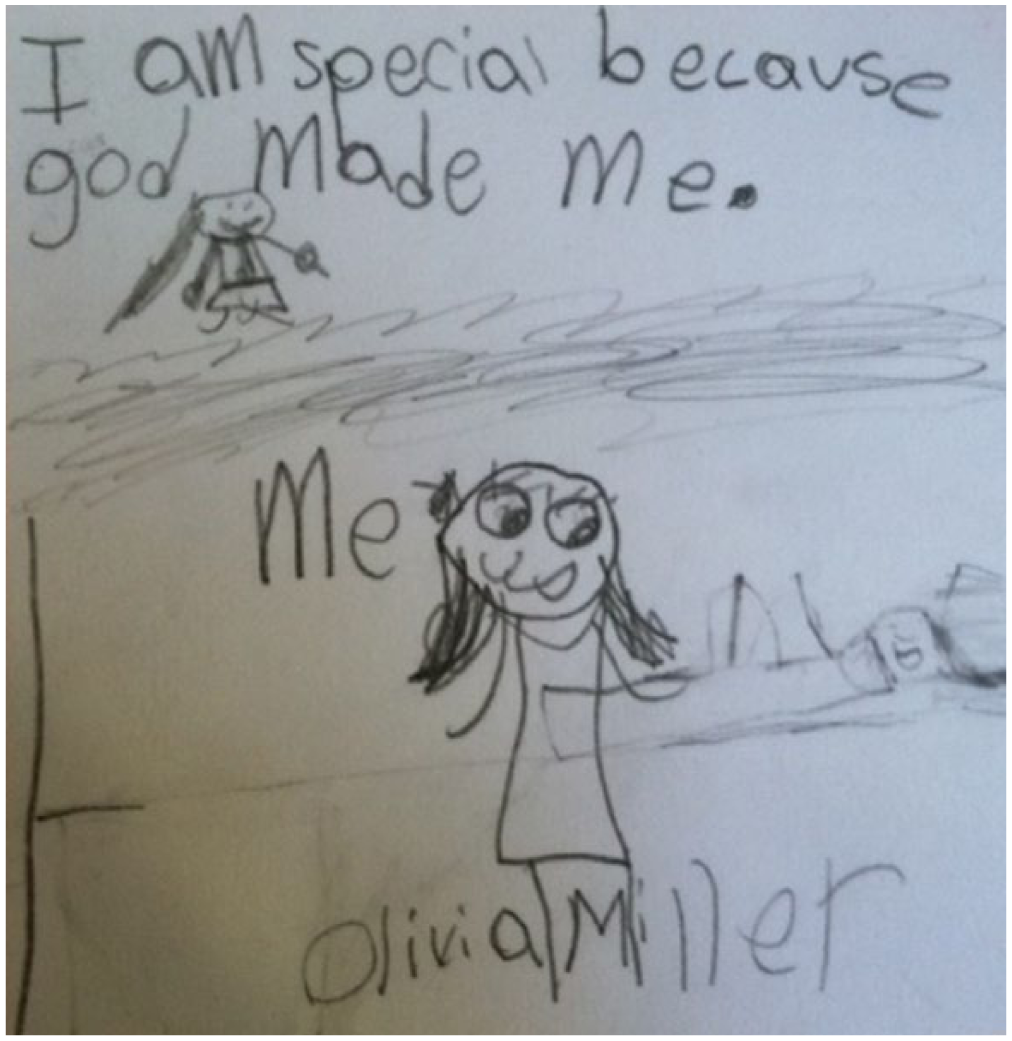
Race as divinely determined: Olivia is made by God.
The complexities of racial literacy were also demonstrated by an elementary teacher, Kobe, from Joy’s study. Kobe described the racial hegemony of caricatures of blackness in the predominantly white school (Lincoln Elementary) where he taught. Kobe described his desire to define himself as a teacher, not a black male teacher: They always put it in my face, that I’m a black male. “Oh, we need more black males in schools”; “You’re a black male teacher, you’re a black male teacher, you’re a black male teacher.” Oh my gosh! Can I just be a teacher? And what does that mean?
Joy followed up: “So, do you, I don’t know if the right word is ‘resent’ that, but that aggravates you that you’re a black male teacher and not teacher first?” Kobe responded: Yes, absolutely. Yes, because I’m not a teacher. “That black male teacher.” That may have a slew of compliments behind it, but it’s always preceded by “black male teacher.” And I guess it was never like that when I was growing up cause it was always white women teachers, but I’m realizing that now. And when I first came to Lincoln Elementary, walking down that hall, stares galore, when I came to visit, to think about interviewing. The principal is walking me through the hallway and people were looking at me like, “Is he gonna be the new janitor?”
As with the assertions of Erin’s young children, Kobe’s assertions point to how ascriptions of race are both contradictory and complex, and how racial identity choices are both limiting and limited. Resisting such hegemonic messages about race can be strengthened through an intersectional lens which complicates falsely racialized limits of identity.
While Kobe’s blackness prescribed contradictory racial identity choices onto him (either janitor or black male teacher), Lisa’s study showed how prescriptive notions of whiteness contorted white pre-service teachers’ understandings about race (Reid, 2013). For example, Diane and Mattie reflected on how hegemonic teaching practices, particularly through their secondary schooling experiences, shaped perceptions of whiteness as an exclusive and superior racial category. As Diane commented: We were also divided between academic levels, like AP [Advanced Placement] and Honors versus Tech [Technical] Prep, which had a lot to do with it. We had a fair amount of whites in the lower levels, but we didn’t have a lot of blacks in the upper levels.
Diane also expressed that, in her schooling, being white meant “being popular,” and further explained that there could not be a person of color “in a popular white group.” Mattie explained that the expectation that her white friends held for each other was that they could not befriend a black person without the loss of white friendships. Mattie’s and Diane’s descriptions of exclusive white group memberships demonstrate the ways in which whites are socialized into racist communities for the purpose of upholding white hegemony, normalizing whiteness, and maintaining white dominance (Bourdieu, 1986).
Gloria and George’s study also shows how their grandchildren (Jaliyah and Janiyah) were socialized into similar disparaging understandings of racialized identities. For example, when Jaliyah was five, she lamented: “Dear [African-centric term for grandmother], I want to be tan.” In response, Gloria explained how people get their color (e.g. parents (genes), God) and read her the book All the Colors We Are (Kissinger, 1994). Jaliyah listened intently and, when Gloria was done, asserted: “That’s good, Dear, but I want to be tan. Tan! Tan! Tan!” Jaliyah’s twin sister Janiyah’s comments shortly after confirmed the urgency of actively interrupting these negative perceptions and teaching the girls about African and black history. For Gloria and George, reflecting on and forefronting black language and culture was central to creating a critical reflective space to develop their granddaughters’ racial identities and literacy, and redress the ugly reality of racism. Beginning their continuing pursuit of African and black studies, Gloria and George did mini-lessons on African history with the twins. They looked at maps of Africa, watched excerpts from African movies, read children’s books, learned African symbols (e.g. Sankofa, unity) and values, took pictures of African symbols in their home, and learned about black language. Engaging in what King (1992) refers to as diaspora literacy, 9 the twins learned that Africa was the cradle of civilization and, indeed, got to visit Kenya and learn more about the origin of humans (see Figure 3). As the twins began to heal within this critical family community and to love blackness, they became proud of who they were (Caughy et al., 2002). One day, Jaliyah (aged six), came home from school and eagerly asked: “Black people are the best people in the world, right Dear?” She told her grandmother that one of her white male classmates thought that white people were the best people in the world, but she informed him otherwise (“Because her Dear said so!”). Gloria chuckled to herself and told her that what she had said was that the first people in the world were from Africa. Gloria then told Jaliyah that she was glad that she was proud of black people and, indeed, they are excellent. Gloria told her that each ethnic group has its own strengths—including whites.
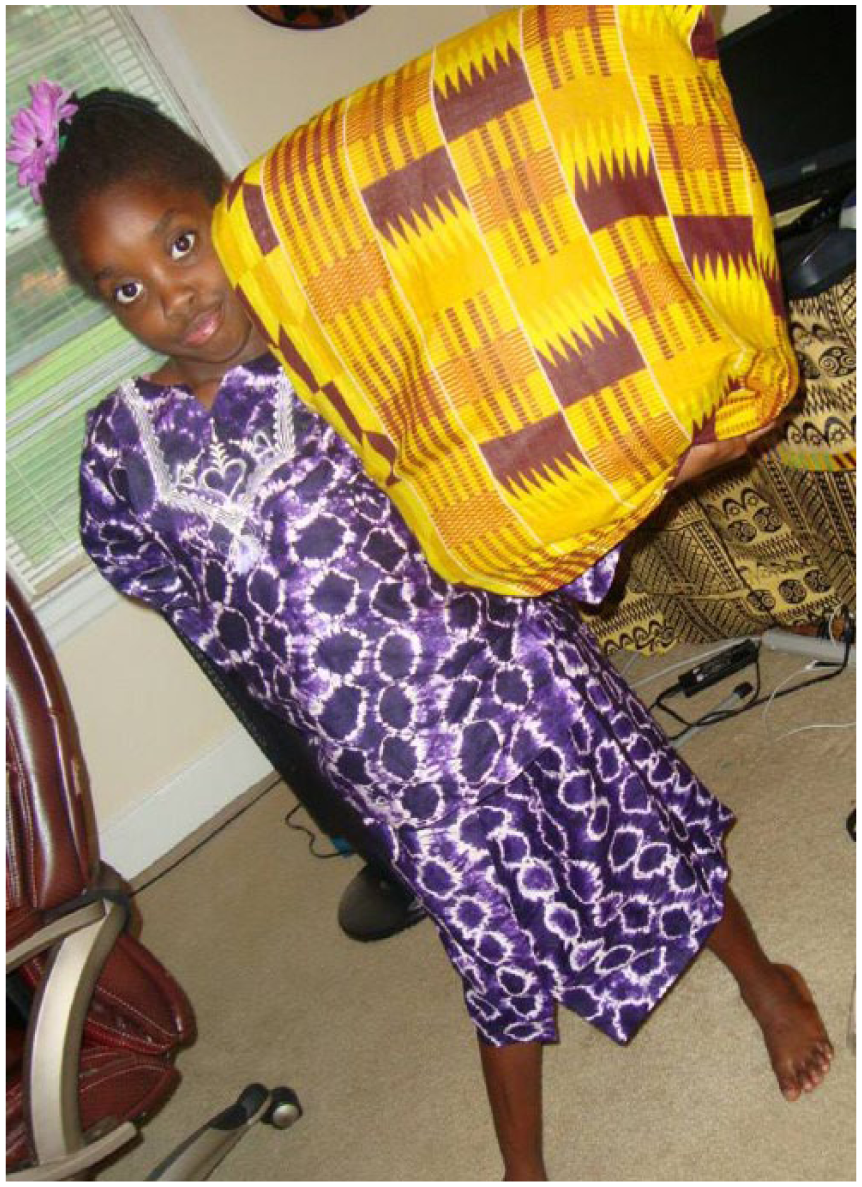
Developing critical family communities through African-centric identity development.
These examples demonstrate the need for teachers, teacher educators, and parents to trouble racist ideology through creating critical communities for resistance, as Erin, Gloria, and George did through actively seeking to interrupt racist discourse, ask questions that promoted new thinking about race, and reflect on ideologies of race as a social construct. Lessons about race like these could have been fundamental if conducted in the early lives, families, and communities of Joy’s and Lisa’s participants, and in the school settings where Joy and Lisa conducted their studies. These anti-racist discursive lessons implicate who we are perceived to be, how we self-identify, and how we mediate race in the classroom (for further resources for specific lessons, see the proposition and discussion below).
Critical racial literacy requires acknowledging and confronting our blind spots relative to socialization
The third proposition illuminates blind spots (Miller, 2012) about issues of race and racism, and discursive tools that can counteract such blind spots. Miller (2012: 66) has described blind spots as “the stealthiest of all oppression, working in plain sight without being noticed” (66). Since whiteness is routinely hegemonized, white people do not often recognize the depth of racial oppression due to their own limited consciousness (Allen, 2004). Blind spots occurred in the context of people’s age of awareness of and early racial identity socialization into thinking about whiteness as superior (as highlighted in the first and second propositions). For example, many of the white pre-service teachers in Kindel’s study stated that discussing race with children was developmentally inappropriate. As Margaret wrote: “according to Piaget, children in the preoperational stage lack abstract thought and respond better to seeing the actual object in front of them, so they are too young to understand about race.” Yet, over time and through working together, some of the pre-service teachers were able to begin to recognize their blind spots and challenge and resist whiteness in cursory ways. Ann and Margaret, once opponents to even the mention of race or racism, wrote positive remarks about their learning in their narrative evaluations of the course: “This class opened my eyes, was challenging, required meaningful reflection and made me … better” (Ann). Margaret explained: I feel that [this class] has pushed me and challenged me to question the way that I view the world and people around me. I have also learned many skills and teaching truths that I can’t wait to bring to life in my classroom.
While her reflections suggest that she had changed her own understandings, Margaret did not indicate that she had changed her opinion regarding young children’s abilities to construct and deconstruct their own meanings about race.
More lasting effects of resistance have resulted from Gloria and George’s work, as they have tried as best they can over time to buffer their grandchildren against the harshness of racism and white supremacy by educating them from African-centric critical perspectives. Gloria and George’s goal is to keep their grandchildren from co-opting destructive messages about blackness which create blind spots to their own understandings about both whiteness and blackness. The twins are immersed in an environment that discursively elevates and normalizes blackness. They are surrounded by family members who love blackness and are engaged in many African and black traditions, such as celebrating Kwanzaa, participating in African dancing, and reading African-centric literature. One day, Janiyah asked Gloria and George: “What’s the big deal about white folks anyway?”—intimating that she did not see anything particularly special about them. “A very good question,” Gloria and George exclaimed. “There should be no big deal.” Over the years, Gloria and George have watched the twins try to make sense of living in a racialized world. Many times they are proud of their blackness. Yet Gloria and George will always be left with the question “Is it enough?” because the twins live in a world that devalues blackness in so many overt and covert ways—from police brutality against black people, to media and books which do not depict black world views, to microaggressions by white teachers, peers, and others (e.g. failing to notice Jaliyah’s new hairstyle or laughing about Janiyah’s African American Language [AAL]). They want the girls to love blackness in its own right—not as a blind spot that exists oppositionally against whites (Boutte, 2015b; Boutte and Johnson, 2013).
Similarly, and reminding us of the role white people have in promoting racial literacy among white children and youth, Erin seemed to be able to help her children resist blind spots and move toward more robust understandings of race. For example, Erin had taken her son Max (then aged five) to the orthopedist to recast a recently broken arm. The nurse who came into the room to remove Max’s cast was the first black medical professional Max had ever seen on visits to this particular surgery. On seeing the man, Max loudly and clearly asked him: “Hey, man, why are you black all over?” Erin immediately asked Max: “Hey, Max, why are you white all over?” Max was literally speechless. While Erin wondered if he was quiet because he was pondering his own normalized whiteness, the nurse proclaimed: “That’s right!” The conversation ended after this exchange, but this brief bit of racial discourse is an important example of the transformative process occurring within Erin as she learned to study and respond to the nuances of whiteness in her family in a world which teaches us that bringing attention to race is wrong (DePouw and Matias, 2016; Vaught and Castagno, 2008). While Erin challenged Max’s learned norm of whiteness by calling attention to his own racialized identity, she stopped there, even though she could have moved into a discussion about why he was surprised to see a black male nurse, and openly discussed some of his learned racist associations. Yet Erin appreciated five-year-old Max’s blatant attention to race and his active construction of whiteness because it gave her a window into his thinking and into the discourse and ideologies that she needed to challenge. Although cursory, the discursive strategies for developing critical racial literacies proposed here arose as a result of being immersed in spaces that demanded memory work within the critical communities of classrooms, homes, and communities that confronted and demanded resistance to blind spots of whiteness.
Discussion
The data that we have discussed in this article reveals how entrenched young children, early childhood teachers, and pre-service teachers were in their feelings of black as bad and white as good—all participants “drew in the racist discourse from their worlds, altered it to make sense out of their own racial experiences, and recycled those messages in interactions with others” (Nash and Miller, 2015: 191). Altogether, the three propositions work in tandem to build understandings and interventions in critical racial literacy in early childhood education. Through engaging in memory work in communities (the first proposition), children, teachers, and parents/grandparents (as first teachers) were able to begin to break apart damaging racial ideologies. Although we all approached and developed critical racial literacy from different positionalities, we all were in a constant state of motion. As a result, we assert that critical racial literacy does not happen when we pause the scene, but rather as those invested in early childhood education engage in continuous memory work by moving through time and space in reflection, taking discursive actions to make sense of how we and the children we work with were/are socialized to understand race (King and Swartz, 2015).
Given the different age groups, contexts, and racial positionalities demonstrated in the data, clearly racial literacy looks different in different individuals. Although racism ensnares all of us, its diverse iterations impact us differently. Those in early childhood contexts can actively strive to become critical communities (the second proposition) who work together to resist and sort through these contradictions and the many pitfalls that trip us up: in order to understand the semantics of race, we must deconstruct it collectively. While the moment-to-moment discursive moves we make toward critical racial literacy are only beginnings, we understand that even failures in striving toward critical racial literacy can prove to be “generative and informative points of departure for further growth” (Gardner, 2016).
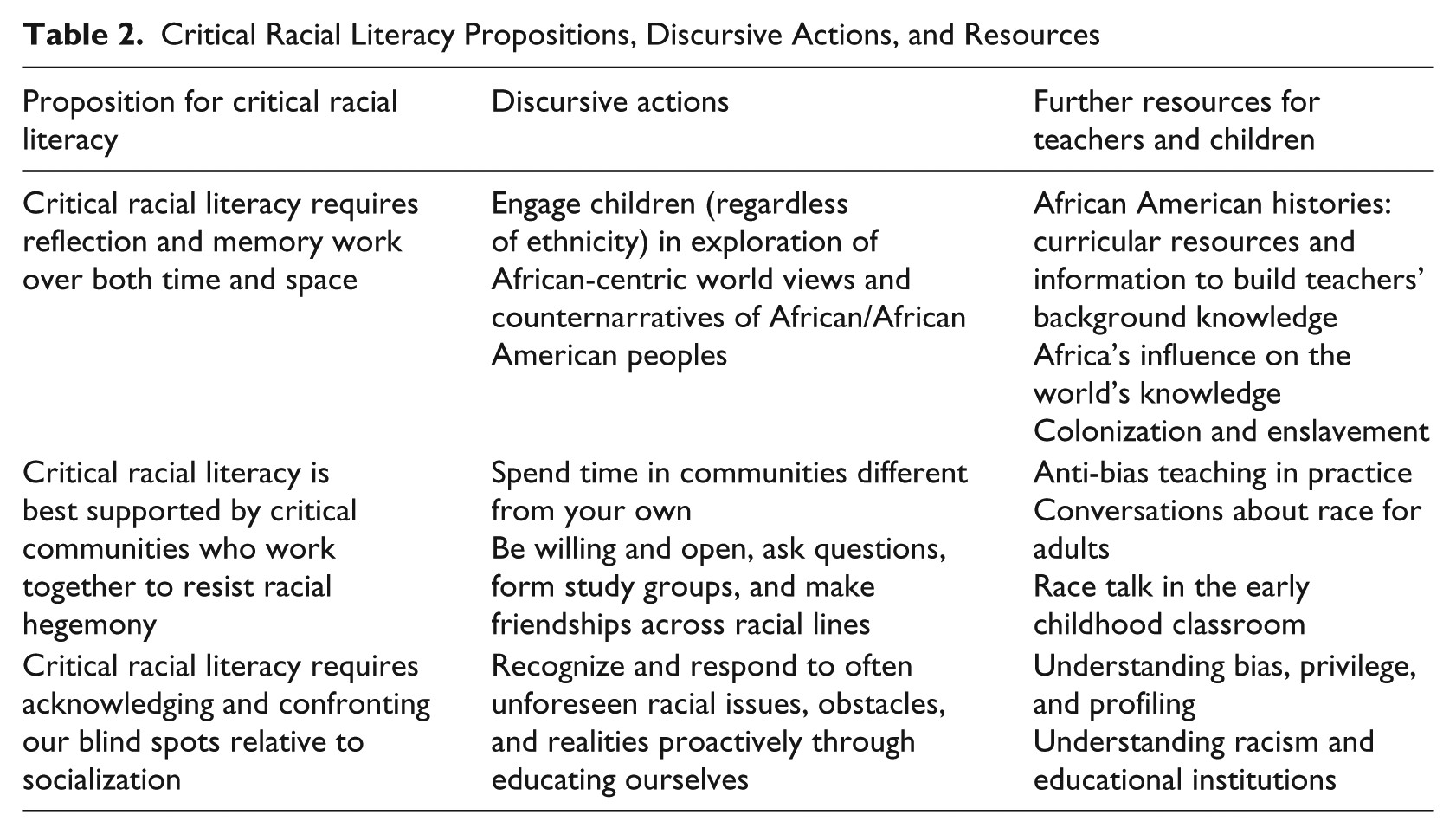
While blind spots to critical racial literacy are learned, they can be unlearned through coaching and commitment. Coming to terms with blind spots is often accompanied by pain. However, widespread assumptions about blackness as inferior are “part of a fictional script that can become internalized by children and embedded within their literacies if they are not countered and mediated by affirmative contexts” (Gardner, 2016). Thus we suggest that part of what parents and teachers can do to disrupt racism is to recognize that racism thrives despite our attempts to use discursive tools (the third proposition). Augmenting the resources discussed throughout this article, Table 2 provides examples of discursive actions and corresponding resources that early childhood stakeholders can refer to in seeking to enact critical racial literacies in their own spaces.
Critical Racial Literacy Propositions, Discursive Actions, and Resources
We make these suggestions with caution, knowing that racism is like a shape-shifter—just when we think we have identified its presence, it is remolded, recreated into something new, evading our ability to completely capture and dismantle it. Early childhood teachers, parents, and community leaders must not run into the dangerous territory of assuming that because we personally profess to disdain racism, it does not exist in our world—it is there, despite our best anti-racist intentions, and learning to continuously search for its insidious shapes is part and parcel of developing critical racial literacy.
Conclusions
The results from this synthesis of studies are not one-dimensional. Drawing from the understanding that, at times, we (humans) are simultaneously perpetuators and victims of racial violence, our work offers propositions that those with an interest in early childhood education can use to extrapolate and generate critical racial literacy practices, both globally and within their/our own respective personal and professional spaces. Despite the permanence of racism and racial violence (Bell, 1995), our individual and collective work takes up the challenge to eradicate such racial violence. Applying critical racial literacy to early childhood spaces makes room for all of us to re-member, reflect on, and recognize the blind spots that beset our abilities to recognize our common humanity.
Footnotes
Funding
This research received no specific grant from any funding agency in the public, commercial, or not-for-profit sectors.