




Abstract
This article discusses the merits of vitalism theory in practice. It suggests a more creative and ecological approach to vitalism theory in the field of child health and development as a way of unlocking childhood potential and research innovation. By using an example from the author’s doctoral research concept (based on Deleuzian ideas) for children, viewing children socially, culturally and philosophically as ‘vectors of entanglements’, the author seeks to demonstrate and encourage the application of vitalism across health, education and participatory research.
Introduction
Considerations of biological determination and Darwinian explanations for understanding life and creation have become a dominant discourse over the last century, although the exact history of these perspectives can be hard to trace (Fujita and Lapidus, 2007). This physicalist, mechanistic approach (biological phenomenology), alongside evolutionary theory, put vitalism in the shade. The apparent demise of vitalism was further expedited by the discovery of urea; the first opposing view of ‘life force’ came in 1828, from the chemist Friedrich Wöhler (1800–1882), who produced organic urea through a combination of inorganic cyanic acid and ammonia. However, Wöhler and his contemporaries did not see the preparation of urea as a refutation of vitalism.
Subsequently, DNA has been discussed by some authors and construed as the ‘deadening of the world and its liveliness’ (Anderson and Harrison, 2010: 37). As Gadamer (2004: 305) cautions, modern sciences are not adequate to explain human experience and communication. He asserts how new or a ‘fusion of horizons’ of possibility can be acquired, which in turn enhances the practices of sociality between children and others in their lives. In this, he posits an appreciation of qualitative methods that appear to transcend his linguistic bias, as he opens up the mind to the enchantment of artwork as visual vocabulary. Therefore, a new synthesis of thought could bring forth illuminating concepts to further inform practice and ensure greater philosophical integration into the understanding of child development. Such integration affords a less sequential trajectory of child development and repositions children’s individuation and creativity by considering children as ‘vectors of entanglements’ (see Figure 1) – thus as corporeal, visceral and vitalistic bodies who create relations of production through complex chains of interactions, interconnections and entanglements, or webs of relationality. As shown in Figure 1, it can be considered that Deleuze and Guattari (1988: 275) articulated a process to the ‘becoming-child’ and the kinaesthetic, visceral logics of the body as a vector of positive affect. The author develops these in their own theoretical and methodological framework of their thesis, reconfiguring them in the idea of ‘the child as a vector of entanglements’ in everyday encounters and happenings to understand affective logic.
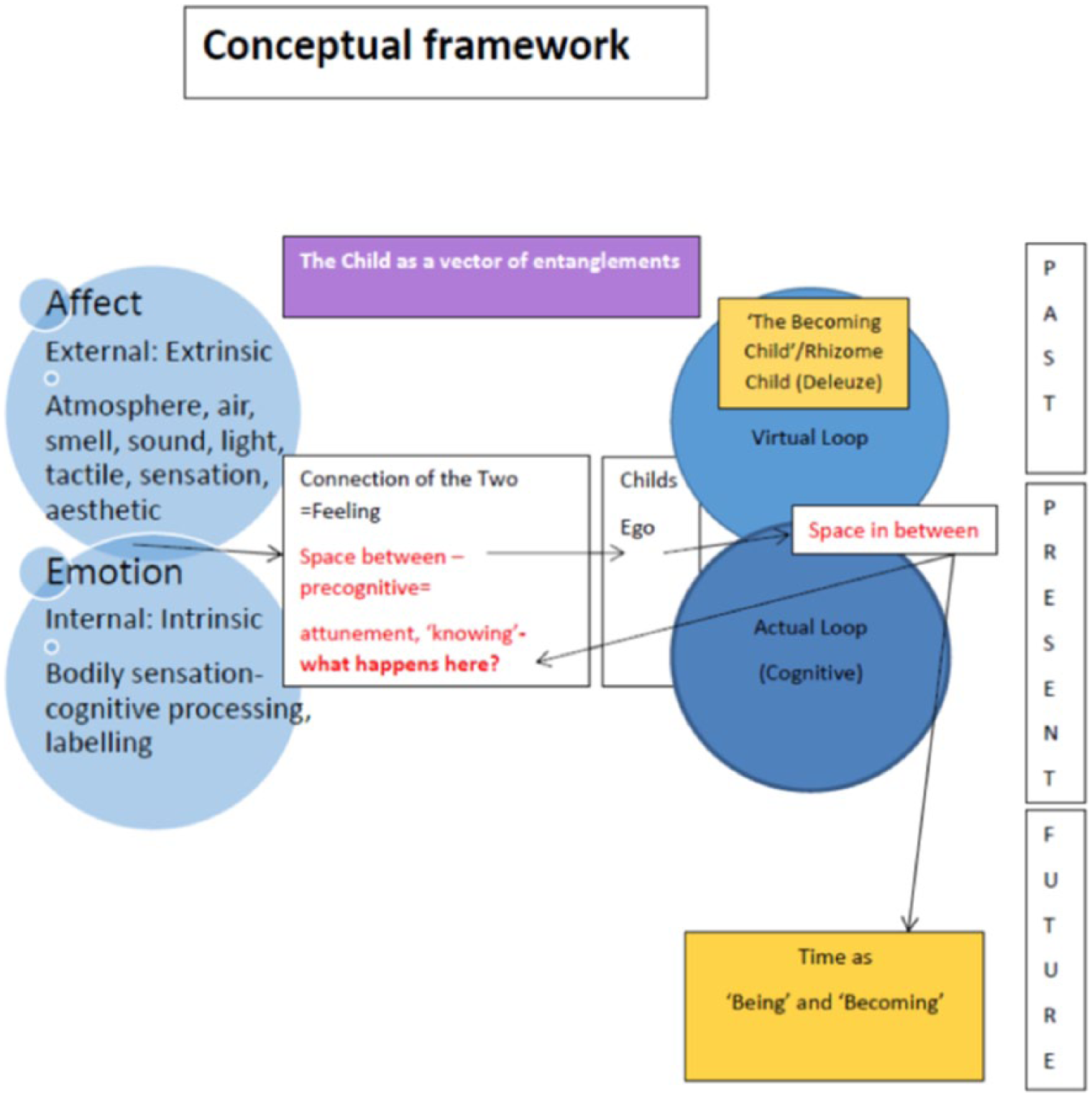
The Child as a Vector of Entanglements.
In order to re-establish this vitalistic position, an appreciation rather than criticism or scepticism of vitalism theory should be embraced. This incumbent task calls for an even greater emphasis on relationality, as all entities, human and non-human, are only to be fully understood in relation to one another (Bergson, 2002). By becoming ‘élan vital’ (Bergson, 2002: 44) and returning to thinking about moment-to-moment encounters and events, a reconnection with the vitalist-inspired geographies of children will be possible. Indeed, ignorance could be the oxymoron to thinking and almost a prerequisite for this new endeavour, as Bergson (2002: 190) so aptly states: ‘the world is more than we can theorise’. Therefore, the very essence of ‘being’ in the world (without thought or analysis) enables a deeper, visceral connection and appreciation of vitalism. The idea of an exceptional quality, soul or spirit draws us to qualitative ontologies and away from the positivist method of representation, deficient in affective and sensory description. Fraser et al. (2005) postulate how this places a particular demand on researchers. In opposition to positivism and mechanism, they state that: ‘objects, subjects, concepts are composed of nothing more or less than relations, reciprocal enfoldings gathered together in temporary and contingent unities. Furthermore, since a relation cannot exist in isolation, all entities can be understood in relation to one another’ (Fraser et al., 2005: 3).
Paradoxically, the seemingly uncanny alliance of epigenetics with vitalism theory could provide an important bridge across this increasingly striated landscape. If the human genome could adapt and redefine itself according to its environment (for more information and discussion of attachment behaviours in humans, see Balbernie, 2001), does this not indicate the vitality of life, biologically driven and environmentally shaped, as the same ecological process? If the genome can putatively incorporate a change in patterns, behaviours and traits through intergenerational influence, then this emerging and remarkable field of science can reconcile both nature and physics. Gadamer (2004: 306) describes a ‘fusing of horizons’ and offers reflection on how past and present are unable to exist without each other. A new understanding creates a shared horizon, inviting researchers to remap the relationships between science, nature and society.
Affect, emotion and sensory experience
A helpful starting point, which can be instrumental to understanding the significance of vitalism and vital (new) materialism being incorporated into child development theory, can be through consideration of affect, emotion and sensory experience. Drawing from the work of Massumi (2002), the dynamic processes of affectual experiences are brought to life in his idea of them being ‘intensities’. The complex juxtaposition between the environment and subject can hold tactile, aesthetic, corporeal and atmospheric transmissions. Rodaway (1994) exports these ideas and, although considered abstract, they are nonetheless a demonstration of the attempts made to exemplify their importance to the human experience. This asserts that the body in space is materially productive, in essence through sensuous, haptic encounters; it has vitality, a visceral energy that can go unseen. Brennan (2004) has offered additional consideration around the transmission of affect. This helps to conceptualise affect as a kind of ‘thinking’, which is done by the body. In comparison to conscious thought, affect is fast and has a different temporality to thought. It involves the brain but not consciousness. It is at a pre-linguistic level. Affect can therefore be described as ‘matter in motion’, which literally ‘moves’ the body (Labanyi, 2010: 225). Thus, affect is not a Pavlovian response to an external stimulus; it involves a kind of judgement enacted by the body. Deleuze and Guattari’s (1988: 102) concept of a ‘machinic assemblage’ exemplifies this – that is, existing becomes conscious in a self-world continuum in which the terms ‘subject’ and ‘object’ make no sense. The literature on affect shows the body to be an information system with potentiality: Deleuze’s ‘the virtual’, located in that half second before response becomes perceived as ‘real’.
The relationality of affect means to be affected by and to affect others, and, as Brennan (2004) states, individuals are not self-contained in terms of their energies; affect is transmitted between bodies to create affective resonances (below the threshold of articulation). This challenges discourses and Foucauldian (1978) theory around ‘biopower’, and how humans are considered to be set apart as exceptional and rational with volitional agency.
The promise of vitalism
Current research which attempts the inclusion of children as participants could be criticised for its lack of methodological potency (Gallacher and Gallagher, 2008). What constitutes true ‘participation’ is debateable, with the child’s ‘voice’ interpreted and captured from an adult construct. Therefore, by using the idea of ‘naïve biology’ to inform ontological and methodological approaches, children’s views could become valid and be seen as significant. Yet there seems to be little reflection on how children are perceived and considered ‘vitalist’ in current research and education, as a push towards school readiness remains at odds with intellectual maturity (Bingham and Whitebread, 2012; Ogletree, 1997). Although an eclectic mix of approaches is emergent within the UK (e.g. the Steiner approach, which focuses on the concept of ‘vital energy’ in relation to childhood, and the Forest School approach and nature orientation), these do not fully embrace vitalism theory and all its potentialities.
If the theory of ‘energy force’ can be observed in human growth and development as a (new) theoretical approach, it is possible to appreciate that children are able to express themselves and learn and flourish to their best potential within the current UK education system. An example of how the concept of vitalism could transpose into practice can be found in the excellent work of Inagaki and Hatano (2004), who recognise that children’s experiences and views regarding the body and mind are interdependent (as opposed to separate), having vitalist causality. Young children essentially think that humans, animals and plants operate through ‘vital power’ – through the taking in of food, water and air needed for growth. This quite sophisticated thinking, although largely formed from a reference point of understanding human behaviour, is extremely valid and can give a fresh view of the anthropomorphic tendency. Bergson (1977) used the term ‘fabulation’ to mean a ‘partial anthropomorphism’ (152), an intentionalisation and vitalisation of nature, beginning with ‘diffused, impersonal forces’ (176), then crystallising those forces into spirits localised in particular places (animism) by imparting increasingly more human personality to those spirits, while at the same time detaching them from the world, until there is a full-blown monotheism (one unitary whole of mind, matter) with a divine that transcends its creatures. In addition, it stipulates the need for exploring the essence of relationship dynamics, which transcend empirical explanation. The idea of children’s tendency towards ‘bioplasmic forces’ has been challenged by Miller and Bartsch (1997), as they contest that adults can have an immature tendency towards vitalism, rendering it as something not unique to childhood. However, a child’s position and view of the world is essentially different to adult constructs, and this opens the argument for further questioning and analysis, as the following quote highlights: ‘What is common to all living systems that allows us to qualify them as living? If not a vital force, if not an organizing principle of some kind, then what?’ (Maturana and Varela, 1980: 74).
Vitalism can unsettle and affect space and social order in schools. The affective capacity of children can stir up a variety of pedagogical, emotional and social issues, and acknowledging their agency and capacity as possible ‘agitators’ in the Early Years Foundation Stage guidance, where the emphasis is on ‘agreed values and codes of behaviour for groups of people’ (Department for Education and Skills, 2007: 1), is destabilising. Yet the denying of children’s active role in creating their own cultures could be arrested by the maintenance of social order (Buckingham, 2000). Undeniably, life forces do matter to children, just as much as material culture. They matter a great deal. However invisible, elusive or obtuse to adults, they capitulate the locus for creative agency and children’s own integrity (Horton, 2010).
The vitality of children
In contemplating the vitality of children, scholars can begin to explore more of the multifaceted nature of being – the sensory and embodied realm which is often given less credence. If children are thought of as vectors of affect, ‘vectors of entanglements’ (having affective capacities), this can lead to an invitation into a world of ‘meshwork’, in which relationships can be woven into rich tapestries of new meaning and relational fabric (Ingold, 2011). This means that the notion of entanglement is fundamental to relationships and the idea of being connected. In knowing another (human or non-human), individuals come to know themselves. The reciprocal ‘flows’ between children and others (objects, things, animals and ‘stuff’) take place through sensory awareness and along lines of connectivity and assemblages. Rather than just assessing, plotting and quantifying a child’s developmental milestones and growth on centile charts, or considering their attachment behaviours and systems, an increase in awareness of their inner states is achieved by allowing vitality to permeate their environments, uncontained, in order to enhance how they grow and connect in new ways (through observing encounters with ‘others’ or ‘agents’ around them). The different individuated relations a child enters can enable greater understanding of how a child ‘becomes’ and grows. These ‘agents’ are not always persons (e.g. they can be objects, toys, teddy bears or pet animals). They function and serve as a basis of relations – relations of production. It is usually the dynamic unfolding of play that creates a spontaneity, a vitality – atmospheric ‘energies’ from collective assemblages. Perhaps the vitality of animals is why children may share such an affinity with them – a nature orientation (Myers, 2007). Wilson (1994) concurs with his idea of ‘biophilia’. These intrinsic and extrinsic relationships are inseparable.
Influenced by Bergson, Deleuze and Guattari (1988) give recognition to vitalist concepts in their thinking of moment-to-moment encounters and events – ‘where something happens’. For Deleuze, the world is never a finite entity with fixed status. He never considers that it is ‘actualised’ and views it as a virtual plane of things to come (or not be). In fact, Deleuze’s notion of space and time means that physical laws do not contain events. Events occur as entanglements with when and where they take place. There is no fixed point of identity, only emergings and becomings through ruptures and plateaus concurrently. As Deleuze succinctly puts it:
A life is everywhere, in all the moments that a given living subject goes through and that are measured by given lived objects: an immanent life … This indefinite life does not have moments, close as they may be one to another, but only between-times, between moments; it doesn’t just come about or come after but offers the immensity of an empty time where one sees the event yet to come already happened. (Deleuze, 2001: 29)
The sensory disposition of children cannot be underestimated. Pink (2015) has wonderfully accounted for this in her extensive exploration of sensory ethnography in developing geographical approaches to research. In viewing perception as multisensory, this approach invites researchers to apprehend visual and non-visual senses as important cross-culturally, as well as helping to ascertain affectual capacities and ‘life forces’. These forces are described as ‘invisible threads’ spun from one person to the other, thus creating entanglements and weavings of intricately patterned interactions (Simmel, 1997: 110).
Whatmore (2002) offers the adoption of ‘relational human geography’ by exploring the ebb and flow of the energetic world. Her idea of ‘hybrid geographies’ is both inspiring and transferable across disciplines. She provides a context for multiple ways of knowing (Whatmore, 2002: 160–161). Through synthesis of her ideas around hybrid, pluralistic approaches, a movement beyond rational thinking to more abstract thinking can occur. In using Latour’s (1993) ‘purification and translation’ diagram, she highlights how scholars need to take note of the hybrid networks ‘under the line’ of rational and conceptual boundaries. Whatmore writes:
In place of the geometric habits that reiterate the world as a single grid-like surface open to the inscription of theoretical claims or universal designs, hybrid mappings are necessarily topological, emphasising the multiplicity of space-times generated in/by the movements and rhythms of heterogeneous association. The spatial vernacular of such geographies is fluid, not flat, unsettling the coordinates of distance and proximity; local and global; inside and outside. (Whatmore, 2002: 6)
In a comparable call for a shift in paradigm, Bondi (1999) suggests a need to reconcile methodological differences (such as psychotherapeutic) and developmental psychology, thus allowing for broader methodologies with which to conduct research, in addition to widening the practice of such pluralisms. As children’s health and development encompass cross-disciplinary fields, the integration of pluralisms in practice can offer a rich source of understanding to complex relational processes.
The writings of Daniel Stern is infused by a vitalistic essence present in early infancy. His wonderfully descriptive account of infants’ ‘weather scape’ conjures up an image that depicts vitalistic theory, reminding us of its fundamental position in children’s geographies and sensory experience: ‘[it is] made up entirely of sequences of risings and fallings of intensity – the jolting of a bright light or a sharp noise, the calming of a voice, or the explosive breakout of a storm of hunger’ (Stern, 1990: 14).
The potential of interpretive ethnography in illuminating childhood vitality
In recognition of the fact that developmental processes are deeply affected by ‘variables’ and events in the wider environment, and children’s multiple interactions and entanglements with others, the rethinking of child development can enable a way of viewing these entanglements as a shaping of the resilience of the ‘rhizomatic’ child. Not just a collection of neologisms, the idea of the rhizome holds a useful position as a metaphor for growth and development, particularly in children. This has been considered by Sellers (2013) in her use of ‘rhizo-mapping’ and idea of ‘rhizo-analysis’. This approach to understanding children’s experiences in the world is both practical and illuminating. Using rhizo-methodology, Sellers (2013) creatively and insightfully demonstrates, through Deleuzian philosophy, what curriculum means to children. She validates the essence of the embodied nature of learning and development. This is through her identification of human and material relations, human energies and forces.
Gallacher’s (2005) ethnographic study also emphasises the autonomy of children with her delightful insight into an early years setting in which children lay claim to their own space and territory, almost weaving a place away from the boundaries of teacher and practitioner instruction. This excellent example is further exemplified by Corsaro’s study (1996: 432) and the notion of the development of a ‘peer culture’ from his research within an Italian nursery school (Corsaro, 1993). This cultural context can be viewed as a platform from which the vitality of children emerges and is played out. He uses the metaphor of a spider’s web to describe the relational process of interpretive reproduction. Hence, childhood experiences and cultural practices that unfold as ‘élan vital’ can be authentic, alive and rich in relational entanglements. As Corsaro (1996: 449) states clearly: ‘A major strength of ethnographic studies of children is their potential for capturing children’s words, actions and perspectives for revitalizing our theories of socialization and human development’. Ethnography can offer a multisensory mapping of young children’s becomings. As Taylor et al. (2012) highlight, the constitutive forces (of children’s becomings and, thus, vitalism) encourage a rethinking of methods and methodological approaches used in research – viewing the world through a very different lens.
Children’s orientation to nature
Expansion of children’s ‘naïve biology’ and the idea of living things having ‘vitalistic causality’ are affirmed effectively through the concept of the human child’s nature orientation, as discussed by Lee (2012). What Lee espouses is a view that the forces of human society, culture and history crucially determine how children develop. He considers that this is an imbalance which can be restored and, in a similar argument, Malone (2016) endorses a post-humanistic approach, recognising a need to disrupt universalism in current ‘child in nature’ debates. Taylor (2013: 118) further highlights the ‘entanglement of human and more than human relations’ as being noteworthy. This authenticates all of the vast potentialities that non-representational theories provide, as they formidably reinforce a vitalistic appreciation (Anderson and Harrison, 2010).
Furthermore, Lorimer (2007) reinforces these connections and provides a fascinating and intriguing concept of ‘charisma’. He asserts that both humans and non-humans can be charismatic, and draws a similarity with Deleuze’s (1994) term ‘singularity’. He indicates something akin to Driesch’s (2010) teleology and ‘prospective potency’ of some animals or organisms. Lorimer (2007) uses the term ‘jizz’ to refer to the aural characteristics of the properties of organisms. In elaborating on this, he details affective charisma and links this to the aesthetic properties of animals and organisms. These can be a conduit to visceral, corporeal interactions and embodied interactions. Lorimer (2007: 927) suggests how charisma ‘emanates from the human body’ and emphasises how non-human charisma sketches a vital materialist ontology that is relational. The notion of charisma gives significant weight to the argument for a re-energising of vitalism theory. Charisma’s ecological, aesthetic and corporeal typology provides a lively contribution to children’s geographies that exemplifies an affective, vital motivating force, which both compels and propels relational interaction. Deleuze (2001: 30) and his thoughts about children resonate along comparable lines: ‘Small children … are infused with an immanent life that is pure power, even bliss … to the degree that they constitute the elements of a transcendental field (individual life, on the other hand, remains inseparable from empirical determinations)’.
Discussion
The entanglements of children, materials, things and environments is well acknowledged theoretically, and also epistemologically (Woodward, 2016). Yet how effective social science methods are for exploring these issues highlights the need for exploration of banal everyday encounters (Horton and Kraftl, 2006). Through this exposition and theorising of how children are, indeed, ‘vectors of entanglements’, both researchers and practitioners can envision how children can create their own ontologies, having the vitality and capacity to do so. Vital materialism offers a perspective on how individuals encounter and experience both the human and non-human world around them (Bennett, 2010). Enabling children’s voices to permeate and inform research requires more than methodological maturity; it also requires a shift of emphasis in current thinking towards greater acknowledgement of child embodiment, experiences, encounters and entanglements. This involves a synthesis of both theoretical and philosophical concepts which marry with vitalism as an illuminating contribution to empiricism. Methodologies such as ethnography can be a pathway to unravelling children’s geographies and peer culture, allowing for a methodological maturity that embraces relational forces between children, adults and the world around them. The enchantment of vitalism and vital materialism can provide a bridge between child and adult worlds by infusing a sense of wonder and awe. This shared enchantment in the world can cultivate a rich curiosity and learning, always ‘being’ and ‘becoming’.
Freedom from representation underscores our individuality, our uniqueness and our dynamic affective capacities. This frames children in a more optimistic position within developmental models and theories. The example of ‘overactivity’ in children can be reconsidered and understood differently – an exuberance of vitality can be viewed as a sensory encounter which can be deintensified within the boundaries of a relational field. Furthermore, the idea of ‘overactivity’ and how children are characterised by teachers and practitioners in the early years can have a significant influence on how children are perceived. The idea of overactivity – often termed and referred to as a child being hyperactive, impulsive, and lacking control and emotional regulation – is a view that can diminish the sense of a child’s exuberance, vitality and curiosity. It infers a pathological quality in such predispositions and characteristics if misrepresented or misunderstood in child development. Therefore, in drawing more from a vitalism perspective, these negative dispositions can be avoided or better understood. As Graham (2007) proposes in her reflections on attention deficit hyperactivity disorder, such a lack of ethical and developmental awareness can be perilous.
Using vitalism theory to elevate affect and sensory descriptions can inform and transform practice in health, education and participatory research. This requires a shift beyond linear, sequential and fixed ontologies and epistemologies. By considering a wide range of perspectives on children’s relational entanglements, practice itself can be rhizomatic and transformational.
Conclusion
As research with children is a journey of co-production (Pryke, Rose and Whatmore, 2003), acknowledgement of their affective capacities and vitality needs to be fully integrated and incorporated. The embodied nature of experience is crucial to the understanding and awareness of children’s health and development. In order for children to be truly engaged as ‘participants’ within research, there is a need to align with their vitalist perspectives.
By reconciling and synthesising these myriad approaches, new lines of inquiry can emerge. As children direct their attention as individual agents who respond to objects as affordances within their environments (see Gibson, 1979), so too can professionals, by becoming equally playful and creative with knowledge – having vitality. Reflection-in-action can enable moment-to-moment ideas to emerge in a collaborative approach (Schon, 1984).
In learning new ideas, practice learns a new language and sees a new horizon. This new language and landscape draw on the ideas of vitalism theory and its fundamental ecological roots. In marrying old and new horizons, it may be possible to see beyond current limitations. By attempting such an immense exposition and reflection on the re-energising of vitalism, the understanding of human individuation, relationality and sociality could be greatly enhanced. The fusion of theories, concepts and ideas can be connected by both sameness and difference. Prevailing paradigms, such as those of physiochemical and biological explanation, should be reconsidered in light of the complexity of social interactions between human and non-human objects/subjects. By embracing this diverse, opportune, pluralistic and philosophical position, and becoming open as human beings, practitioners can be counsel to all the vicissitudes of their own ‘knowing’ and ‘becoming’. Such new and engaging thoughts on child development can be enchanting and liberating to practice, and in work with children. The very materiality and vitality of this paper and text could be the affective opening up of innovative research and transcendental empiricism.
Footnotes
Funding
The author(s) received no financial support for the research, authorship, and/or publication of this article.