




Abstract
In this article, the author explores children’s destruction of their artwork as it occurs on paper or digitally via an interactive whiteboard. Sociocultural accounts of children’s art-making and social semiotic approaches to meaning-making offer a theoretical lens for understanding children’s acts of destruction as meaningful and the way in which different semiotic resources shape the meaning-making involved in destruction differently. In order to explore this further, the author considers two episodes of art-making: firstly, an episode of child–parent art-making that ended in a five-year-old child scribbling over a drawing on paper with a black crayon, and, secondly, an episode of a five-year-old child using touch to cover over the drawing she had made on the classroom interactive whiteboard during free-flow activity time. A comparison between these two episodes is used to explore how digital and paper-based semiotic resources may impact differently on the experience of destruction and the affective and relational work that it can achieve. In this article, the author argues that a social semiotic exploration of destruction can help to move discussions of children’s art-making beyond developmental preoccupations with individual intentions and towards a post-developmental account that engages with the richness of children’s experiences and actions.
Keywords
Introduction
While practitioners in early years education can typically recount multiple examples of children destroying their own artwork, little has been written on how young children rip, shred, scribble over, rub out or press the delete button. This is probably because it is difficult to systematically study acts of spontaneous destruction in children’s art-making, and because such acts do not fit neatly into developmental accounts of children’s art-making, which focus on individual intentions and representations. Instead, as in this study, it is necessary to gather observations of destruction from various research contexts and attempt to make sense of them. I have a particular interest in the materialities of destruction – the physical actions that constitute destruction and the ‘stuff’ that gets destroyed. The materialities of children’s destructive acts in art-making depend on the resources involved in the art-making, and in physical-digital landscapes of activity, destruction is made possible through distinct actions – for example, the touch of a single button.
In this article, destruction is understood to be the action of damaging or obliterating a product of art-making. In the context of children’s art-making, destructive acts are those that undo or ruin the products of activity that is seen as ‘creative’. Examples would be ripping or tearing, scribbling over, rubbing out, scrunching and pressing the ‘delete’ or ‘undo’ button. Destruction in children’s art-making, and how it is shaped by different semiotic resources, is a topic that relates to the theme of this special issue: ‘dark play in digital landscapes’. Destruction in children’s art-making is taken to be a form of ‘dark play’ in the sense that it is often interpreted as a negative action and is often discouraged by adults around the child. ‘Digital landscapes’ are investigated through the lens of social semiotic theory, and covering over on an interactive whiteboard (IWB) is analysed as a destructive act that involves digital-physical resources.
The article adopts a perspective based on two bodies of literature: sociocultural accounts of children’s art-making and social semiotic approaches to children’s meaning-making. From a sociocultural perspective, children’s art-making is seen as a process rather than in terms of its products. Research from this perspective has looked at different elements that make up the sociocultural backdrop to children’s art-making. For example, researchers have considered the influence of the views of adults who surround the child (Anning, 2002, 2003); the impact of the educational systems in which children learn (Burkitt et al., 2010); the significance of physical props in art-making (Frisch, 2006); and how children engage with popular visual culture in their art-making (Thompson, 2003). In social semiotics, all actions are seen as meaningful because of the impact that they have on the unfolding interaction (Kress, 2010; Van Leeuwen, 2005). From this perspective, destruction is seen to be as meaningful as an act that would typically be seen as creative or productive. Rather than trying to link the destructive act to an internal intention within the mind of an individual, social semiotic theory places an emphasis on the visible work that is achieved through the act: how affective and social relations are shaped by the act in that moment.
In the following background sections, I consider the literature on destruction in children’s art-making, as well as previous research on how different semiotic resources can shape children’s art-making. I explore two episodes of art-making in this article, each from a different study, so the context of each of these studies is briefly introduced before the episodes are shared. In the commentaries for each episode, I consider what work the destruction achieves in terms of the affective and relational dimensions of the unfolding interaction, and how the affordances of the semiotic resources being used appear to play into this work. While I am not looking to draw direct comparisons between the two episodes, by discussing the episodes in relation to each other, we can develop a better understanding of the work that destruction can do and the impact of different semiotic resources on destruction.
Destruction in children’s art-making
There is little research that specifically focuses on destruction in children’s art-making. A search of journals focusing on art education and/or early childhood education more generally using terms such as ‘destruction’, ‘destroy’, ‘rip’, ‘tear’, ‘scribble’, ‘erase’, ‘undo’, ‘delete’, ‘trash’ and ‘throw away’ yielded no relevant results. Because of this, it has been necessary to develop a background for this study through research that has explicitly been focused on other topics which relate to the issue of destruction. These include: children’s attitudes towards what happens to products of their art-making; destructive acts in art therapy contexts; and research on natural materials in children’s art-making, where the distinction between creation and destruction is productively challenged.
Children can feel various emotions in relation to the products of their art-making and can desire different things to happen to these products. For example, Boone’s (2008) phenomenological investigations of children’s experiences of having their artwork displayed demonstrated that children did not always want their artwork to be displayed. At times, children wished to hide their artwork away from others, suggesting that destruction may play a role for children in keeping the products of their art-making private. The research of Twigg and Garvis (2010) describes the experiences of practitioners – including their own – in relation to early childhood art education. In the context of this study, they recount the experiences of a six-year-old child who had felt angry when her art was displayed by her teacher after it was left to dry. She had not wanted the artwork to be displayed because: ‘we weren’t happy with how it turned out. It wasn’t our best and we didn’t want everyone to see it’ (Twigg and Garvis, 2010: 197). This example again highlights that children can sometimes want their artwork to remain hidden and private, and that destruction may be one way to achieve this.
In the art therapy literature, acts of destruction are sometimes presented as part of the therapeutic intervention. Accounts of children’s spontaneous acts of destruction in art therapy sessions show that destruction can do particular types of social and affective work. Savins (2002) describes her art therapy work with children who suffer from chronic pain. She recounts the process of art-making for one five-year-old girl, Sula, who depicted her pain through a large grey mark drawn onto a body on the page. Outside of art-making, Sula was reluctant to talk about her experiences of pain, while drawing her pain helped her to open up and verbally explain what she was experiencing. At the end of the dialogue, Sula chose to scribble over the large grey mark that represented her pain. The therapist interpreted this scribbling over as part of the desire to hide the experience of the pain from others. Another interpretation might be that the scribbling over offered some emotional release to Sula or a sense of control – a means of defeating the pain that so damaged her experience of life. From a social semiotic perspective, our interest is not in interpreting why an individual scribbles over their artwork, but instead in how the action shapes the unfolding interaction in the moment. In this instance, the act of destruction was an effective way for the child to end the conversation between the child and the therapist about the pain.
Research on children’s art-making with less traditional materials prompts us to challenge the sharp dichotomies we tend to draw between creation and destruction in art-making. Solberg (2016) describes a land art project conducted with kindergarteners in which the children made art with natural materials in a snowy landscape. The children worked collaboratively to make a large spiral shape on the ground with different natural materials. The next time the children returned to the scene of their art-making, fresh snow had fallen and the spiral had been covered over. Solberg explains that this was a source of interest and joy among the children, and that the fresh snow primarily heralded new opportunities for art-making. Of course, these circumstances are very different to situations of art-making in which a child chooses to destroy the artwork they have just created. However, the example does highlight the potential for fluidity to exist between creation and destruction, particularly when the materials do not lend themselves so readily to traditional processes of archiving and retrieval.
Potentials for affective and social work in destruction
In order to explore the affective and social work that destruction can do in children’s art-making, we need to be clear about what we mean by ‘affect’ and how to observe it in action. While psychological approaches to affect describe it as a shift in the intensity of feeling of an individual (Shami et al., 2008; Shouse, 2005), social science research positions affect as something that occurs between individuals, and therefore a dimension of the social interaction. Building on Deleuze and Guattari (1987), post-structuralist perspectives suggest that affect is an intersubjective phenomenon in constant flux (Fox and Alldred, 2015; Ringrose, 2011). When we discuss the affective work of destruction, we are exploring the potentials of destructive acts to shape the feeling that exists between individuals, actions and the environment. We are simultaneously, therefore, discussing the social work of destruction.
Theorists such as Massumi (2002) and MacLure (2011) place affect as a bodily capacity: bodies are ‘animated by affect’ (MacLure, 2011: 999). Linked to this, conversation analysts focusing on multimodal interaction have suggested that affect is something observable through bodies in unfolding social interactions. Marjorie Harness Goodwin (2006) conceptualises affect as an aspect of embodied interaction that manifests through various modes of communication, including speech, body posture, position, movement, facial expression, gaze and so on. Goodwin’s study of family interactions suggests that affect can be aligned or disaligned between individuals, and that this is visible through how bodies interact with one another in space. Similarly, Charles Goodwin (2007: 58) observes affective alignment in moments of ‘shared attention and action’, in which individuals have the same physical locus of interest and interaction. If two individuals demonstrate consistent attention towards the same object or artefact, they will be drawn closer to one another and will share an affective alignment. This would suggest that an act of destruction might prompt an affective alignment if it enables participants to focus on the same object and action.
Children’s art-making with different semiotic resources
Social semiotics is an approach to meaning-making that emphasises the social and material context in which meaning is made (Hodge and Kress, 1988; Van Leeuwen, 2005). While traditional semiotic theory positions each signifier in relation to a signified object (e.g. the signifier of the word ‘tree’ relates to the idea of the tree in the speaker’s mind), social semiotics suggests that the relationship between signified elements and signifiers is complicated by the particular social environment in which signification occurs (what we mean when we say ‘tree’ depends on the situation we are in). These assertions relate to the theories of post-structuralist thinkers such as Derrida (1978) and Barthes (1977), who both propose the potential for signifiers to remain free from a secure attachment to signified elements. When signifiers are liberated from a secure attachment to signified elements, this lends a greater significance to the specificities of the materialities of the signifier. Thus, how meanings are materially made is the other major concern of social semiotics.
In social semiotics, the materialities of meaning-making are discussed through the term ‘semiotic resources’. Semiotic resources are the ‘actions and artefacts through which we communicate’ (Van Leeuwen, 2005: 2). Van Leeuwen’s definition is particularly helpful because it highlights the networked nature of semiotic resources: they are not simply the materials used to make meanings (e.g. pencil, paper), but also the physical actions (e.g. touch, manipulation) through which these materials are transformed into meaning. Different semiotic resources shape our meaning-making differently. They have this impact as a result of their affordances, which can be thought of as how the resources invite us to engage with them. Affordances are not only created through the material properties of the resources (e.g. their size and shape), but also through their social associations (i.e. how we have seen them used previously). As a set of semiotic resources becomes more embedded in a culture, their affordances will become conventionalised. Newer semiotic resources, such as digital technologies, will have affordances that are less ‘fully and finely articulated’ (Jewitt and Kress, 2003: 2). This links to the idea of ‘slippage’, which has been introduced by Denmead and Hickman (2012) to capture the different extent to which art-making materials are seen as flexible in how they can be used.
Research in the field of new literacies has highlighted the importance of avoiding sharp distinctions between digital and non-digital tools. Burnett et al. (2014) argue that our meaning-making emerges through the orchestration of various embodied and disembodied modes, so that we often move fluidly between digital and physical planes; they refer to this as the (im)materialities of meaning-making. However, this does not preclude a project of trying to disentangle the affordances of different semiotic resources and suggest ways in which particular digital technologies feed into different aspects of the art-making interaction, including destruction. For example, it is insightful to return to the classic study of Labbo (1996), which, more than 20 years ago, demonstrated that when kindergarteners engage in art-making on a computer (as opposed to on paper), they show greater flexibility in their approach to the art-making, and are just as likely to use the computer screen as a ‘playground’ or ‘stage’ as they are to use the screen as a basic ‘canvas’. My own research in this area (Sakr, 2016; Sakr et al., 2016a, 2016b) has suggested that children’s digital art-making is often characterised by a quicker pace and a more relaxed sense of ownership.
Data and analysis
In order to explore destruction in children’s art-making and how it is shaped by different semiotic resources, I introduce two episodes of art-making that involved spontaneous moments of destruction. The first of these episodes involves a five-year-old child making art with her father in her grandparents’ home. The video observation comes from a wider study conducted in collaboration with Dr Natalia Kucirkova that considered how different semiotic resources can shape the experience of child–parent art-making. The study involved a total of eight observations, which were made across several months, with two observations made for each of the four different sets of semiotic resources. Previous publications based on this data have considered how the four different semiotic resources used (crayons, collage, personal-computer software and iPad photography) played into the possibility thinking of the child, the pedagogic strategies used by the father, and the moments of meeting experienced by the child and the father (Kucirkova and Sakr, 2015; Sakr and Kucirkova, 2017). In the particular episode considered here, the child and the father are using crayons on paper for the second time.
In the second of the episodes presented in this article, a five-year-old child is engaged in drawing and then covering over the drawing on an IWB during free-flow activity time in a reception classroom. The video observation comes from a wider study focusing on how children engage with art-making via the classroom IWB. Observations were made over the course of a week, and previous publications have focused on how children collaborated with each other in their art-making and organised turn-taking with the resources (Sakr, 2016).
In analysing the video observations outlined above, I have used multimodal interaction analysis, which focuses attention on the action as it unfolds and how communication and interaction are orchestrated through various modes (Jewitt, 2009; Sakr et al., 2016). Multimodal interaction analysis positions language as just one mode that works in conjunction with many others, such as facial expression, gesture, gaze and movement (Bourne and Jewitt, 2003; Jewitt et al., 2016). Multimodal interaction analysis typically involves as a first step the careful transcription of video data so that action within various modes, and not just language, is captured. As the research questions are applied to an understanding of the transcript, a focus on the sequence of action is constantly maintained, so that each action is seen as fully embedded in the context of the unfolding interaction. This is contrasted with a thematic analysis, where the action may be ‘cut up’ and put back together again in new ways. In multimodal interaction analysis, the emphasis is on what is visible, and how elements of the interaction are seen to work upon that interaction. There is no recourse to individuals’ desires or thoughts to make sense of the interaction. Conclusions can be drawn about the nature of the interaction and the environment, but not about the minds of individuals.
For each observation, I have written a vignette that describes the action as it unfolds. Each vignette was written based on the multimodal transcript, so there remains a focus on various modes of interaction and not just language. Vignettes (rather than full multimodal transcripts) were considered to be more effective in enabling the reader to get a sense of the action as it happened. The conversion from transcript to vignette involves the inevitable loss of some information according to what I considered to be most relevant to the reader; this echoes a previous loss when moving from the video to the transcript. I have written a commentary that links the observation to the research questions. To be specific, I explore questions about the nature of destruction in children’s art-making and how this is shaped by different semiotic resources. I aim to investigate how destruction manifests in art-making with different semiotic resources, and the work that the destructive act achieves in these distinct sociotechnical contexts. I aim to link the work that the destruction achieves with the affordances of the semiotic resources being used.
Observation: Child and parent drawing with crayons
The child and the parent are sitting at the dining room table with crayons and paper laid out in front of them. They discuss together what they are going to draw, and the father suggests that the child (M) might like to draw the necklace which she wore that day to school. She begins this drawing, and this quickly evolves into a drawing of a girl wearing the necklace.
M and her father take it in turns to add elements to the drawing, talking about the different parts of the drawing as they continue. M shows signs of frustration at multiple points in the interaction, explaining that she ‘can’t do it’ when it comes to drawing different elements. At these points, the father takes up the crayons and begins to draw on his daughter’s behalf while she tells him what to do.
M is concerned throughout that the drawing is a carefully realistic representation. For example, she repeatedly says ‘look, it’s pink, pink’ about her cardigan as the father adds the cardigan to the picture. She explains that ‘heads are awvil [oval]’ while her father adds the shape of the face, and that her hair is ‘long, long, long’. The father encourages the child at different points to take a crayon and add elements for herself. The crayons move back and forth between M and her father.
At one point, the child suggests that they should turn over the drawing. She pouts and looks disappointed with the drawing. The father continues with the drawing and continues to talk with a positive and encouraging tone. Later, the child says: ‘Everyone will laugh’. The father chuckles in response to this and asks: ‘Everyone will laugh about her drawing?’ The child nods her head and smiles slightly. The father says: ‘We need to change it into something else … shall we just’; and he drags over the soft toy that is sitting on the table and places it on top of the drawing.
M becomes more animated at the father’s suggestion to cover over the drawing and says: ‘No, we’re just gonna scribble it … and then no one can see it … the children in the picture they won’t see anyone. We’re just gonna scribble on you, ok?’ She enlists her father to find the darkest crayon to scribble with and then, with intense interest and concentration, proceeds to scribble over the drawing they have made. After finishing the scribble, the child explains to her grandmother (who is in the kitchen cooking, visible through the hatch between the kitchen and the dining room) what they have done: ‘Nana, we’re scribbling on it because it’s going to make everyone laugh and I’m scribbling on it’ (Figure 1).
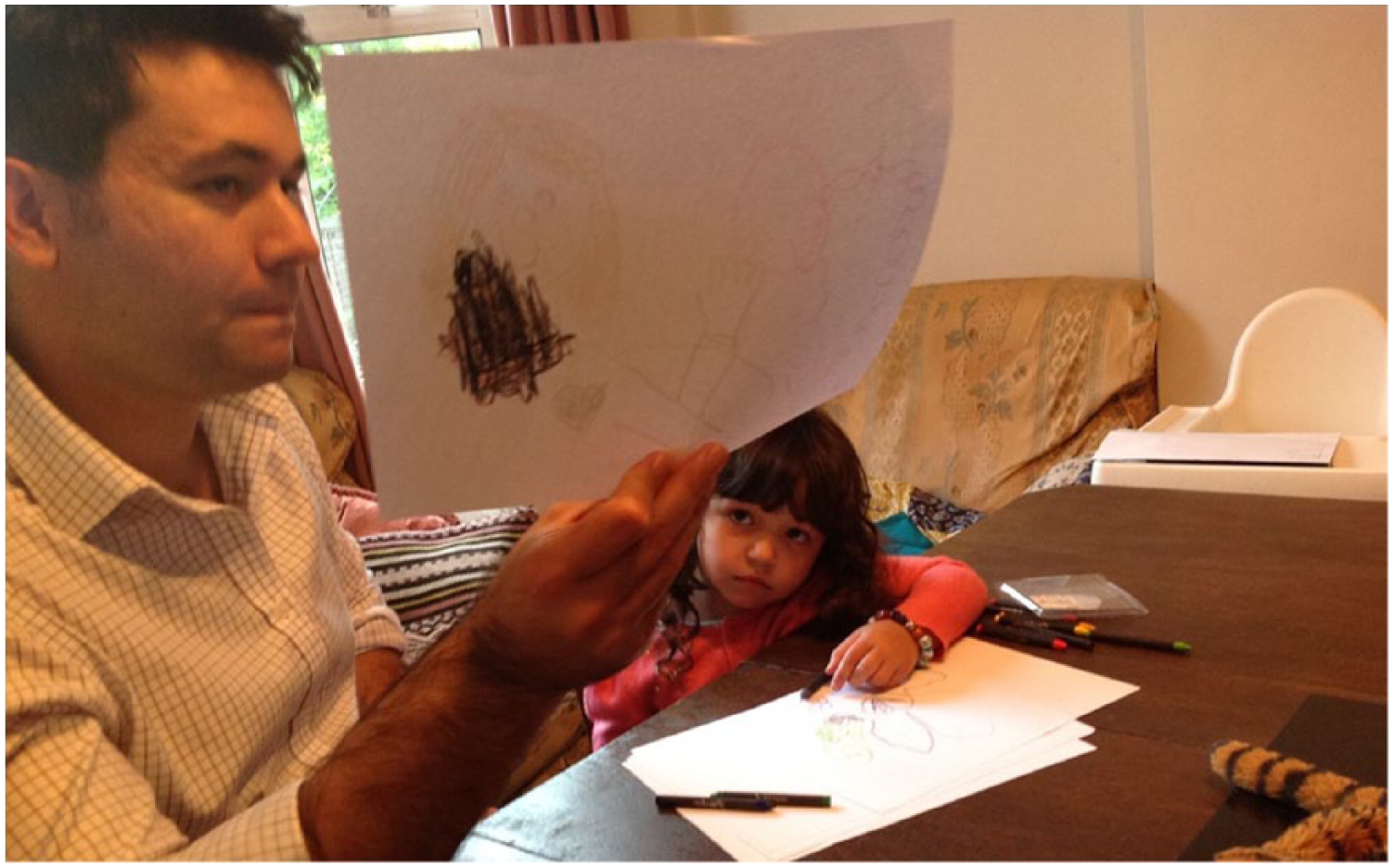
Girl scribbled over.
Commentary
In this observation, scribbling over appears to act as a way for the child to protect herself from the disapproval and ridicule of others. It is not clear who the others are to whom the child refers when she expresses that ‘Everyone will laugh’. The father has remained encouraging and supportive throughout the first phase of the drawing when the child was showing frustration in the process of drawing. Therefore, the father does not appear to be part of the ‘everyone’ who will laugh at what she has done. Through the statement ‘Everyone will laugh’, the child invokes an intangible set of expectations about what constitutes a good or acceptable drawing. This relates to the research of Anning (2002, 2003) and Burkitt et al. (2010), which demonstrates the importance of adults’ expectations in shaping children’s experiences of drawing, even beyond the immediate input offered by adults present in a particular scenario. Once the process of scribbling over has begun, the invocation of ‘everyone’ continues as the child explains that ‘then no one can see it’. However, rather than constituting just a disapproving gaze, the child seems to position the other as a force that she can protect herself from through the act of scribbling over.
There are indicators that the child and the father are drawn closer to one another through scribbling over the drawing. The previous actions involved in drawing have been fraught with tension as the child has been frustrated at various points, and the father has tried unsuccessfully to placate her and maintain positive affect. While the father ignores the earlier suggestion of the child to turn the paper over, he responds to the child’s statement that ‘Everyone will laugh’ with outward indicators of joy and the suggestion that they can cover over what they have done. The father’s response at this moment in the interaction was perhaps different to the reaction of other adults in the same situation, who may have been more inclined to try to make the child feel positive about their artwork through further praise and encouragement. A practitioner in an early childhood setting, for example, may have been more reluctant to engage in a process of ‘covering over’, feeling that they were reinforcing the child’s negative emotions towards their artwork. The father’s response creates an alternative dynamic between the child and the father since they become conspiratorial in their attempts to cover over their artwork. They make eye contact and mirror the facial expressions of each other in a way that is suggestive of moments of meeting (Stern, 2000, 2004), whereby they have a mutual understanding of one another. Thus, scribbling over appears to open up the possibility for their relationship to be strengthened.
The moment when the child says ‘No, we’re just gonna scribble it’ represents quite an abrupt change in the affect shared between the father and the child in the interaction. In the first part of the interaction, when the child and the father have attempted to draw the girl, the crayons have passed back and forth between them. This movement back and forth has been a physical manifestation of the attempts to forge a connection and sustain the activity, despite the child’s loss of interest and positive affect at various points. In other interactions, the back-and-forth flow of resources may be indicative of collaborative creativity, but in this situation, analysis of other modes of communication (particularly facial expression) suggests that this back and forth is part of a lack of affective connection between the child and the father. On the other hand, in the action of scribbling over, the child shows physical indicators of immersion, getting physically closer to the resources and engaging in ‘directive talk’ (Dyson, 1986) to herself. At this point, the father can interact in what seems to be his preferred way – sitting back and enabling the child to take the lead in the activity.
Observation: Drawing on the IWB
Lini is drawing on the IWB. She uses the ‘paint’ tool available in Tux Paint and is drawing with the purple colour onto a white background. She is drawing with the index finger of her right hand and is standing on a stool in front of the IWB so that she has access to the whole screen (Figure 2).
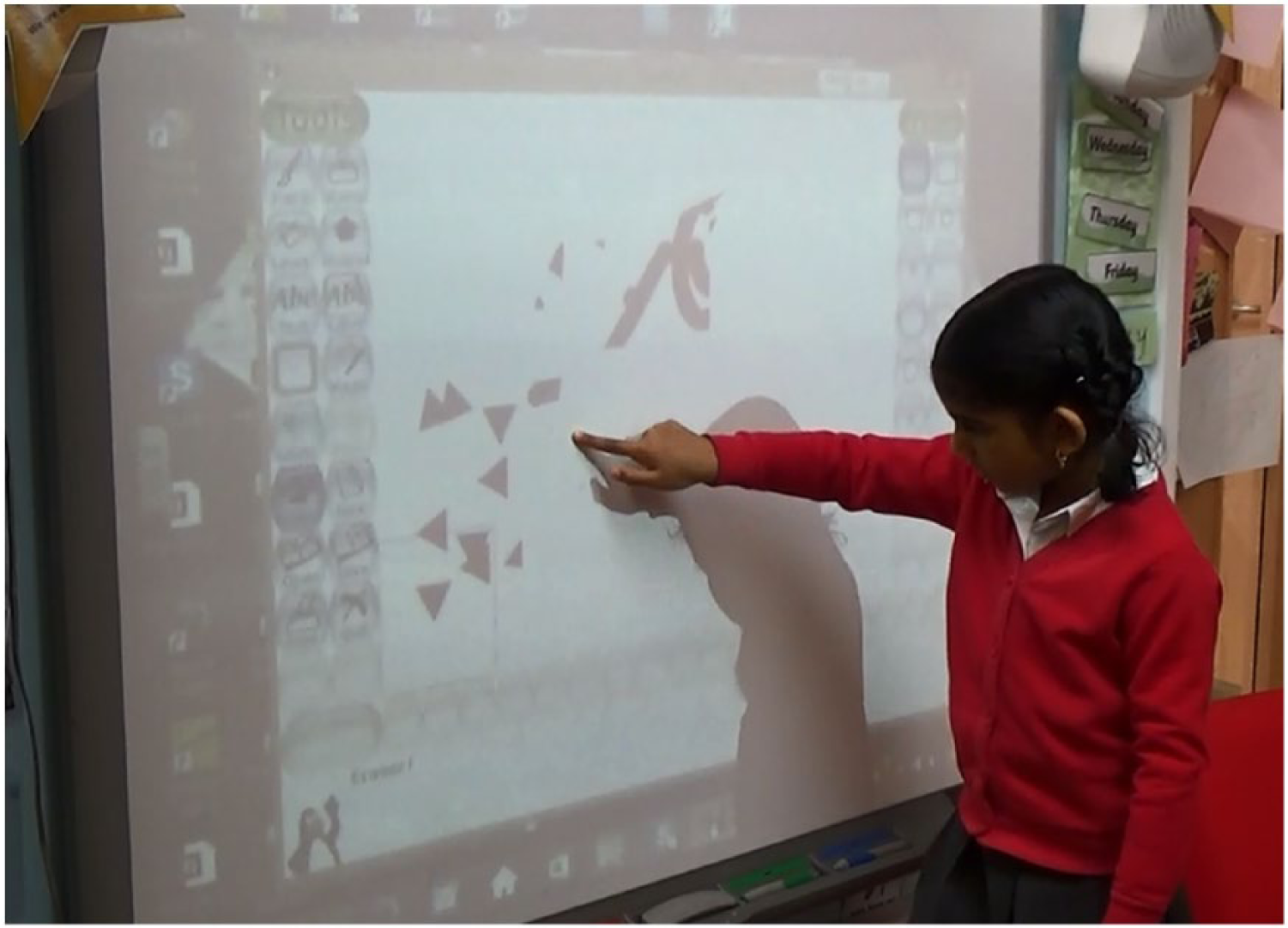
Lini at the IWB.
She draws a girl, made up of a simple face and arms and legs that extend immediately from the face. As she draws, she is singing quietly to herself. At one point, she makes a dramatic swaying movement and claps to herself.
She continues to add to the screen by selecting a triangle shape which she dots around the drawing of the girl. As she does this, she continues to dance and sing quietly to herself. She moves from side to side rhythmically in time with the motion of adding triangles to the screen.
She looks briefly behind her and uses the index finger of her left hand to choose the ‘eraser’ tool, and begins to rub out her work. The eraser tool is much thicker than the paint tool, and so the rubbing out of the representation is brief. She steps off the stool to see the board more clearly and continues to rub out the drawing. Once this has been completed, she walks away from the IWB.
Commentary
By using the eraser tool to cover over her drawing of a girl, Lini removes any classroom record of her art-making. Other than my video record, which is not a classroom resource, there is no way for her teacher, parents or peers to engage with the process she was engaged in as she made art on the IWB. Archiving and retrieval are much more thoroughly conventionalised when art-making occurs on paper. Children are encouraged to put their name on pieces of artwork that they wish to keep, and these are then placed in their individual trays to be taken home or displayed by the teacher. When a child decides not to store their paper art-making, they engage in a physical act of destruction (such as throwing the artwork in the bin) that does not fully excise the record of their activity. Even using a traditional eraser on paper does not typically remove the process of art-making fully, as it often leaves marks or scrunches up the paper. In contrast, when Lini erases her work on the IWB, there is no physical trace of her activity. Through this, the activity has remained almost entirely private, though others may have looked at her as she engaged in the process.
After Lini has scribbled over her drawing, she leaves the IWB in order to engage with another activity in another part of the classroom. The IWB, which is a shared resource between all of the children in the classroom, is free for another child (or group of children) to interact with. As a result of Lini covering over what she has made, there is a fresh screen for the art-making of other children. Observations of the IWB in use across a week showed this as an element of the classroom ‘etiquette’ that developed around this semiotic resource, which has to be shared by almost 30 children. If children did not cover over their own work, the next child went through a process of doing this for them. For some, this was uncomfortable because they were unsure about destroying the work of another child, and whether this was permissible behaviour. Lini saved the next child this concern by doing it herself.
Lini’s scribbling over does not break the flow of the activity. She shows the same physical indicators of immersion and flow throughout the activity, while drawing and while using the eraser tool. She sings to herself and moves rhythmically throughout the creation and destruction. The transition from drawing to using the eraser is almost seamless, though she uses her left hand to select the eraser tool, while the touch applied to the canvas is always carried out with her right hand. Another small break from the activity occurs when Lini turns around briefly, just before choosing the eraser tool. This may indicate that she was aware that others were waiting to use the resource and she acknowledged that it was time for her to finish the activity and hand over the resource.
It is difficult to know how to describe Lini’s destructive activity. Since she selects the ‘eraser’ tool, is this simply akin to the action of ‘rubbing out’ on paper? On the other hand, Lini is using the same quality of touch to carry out the erasure as she did to do the drawing in the first place. This is unlike erasing on paper, where different tools are needed for each of these actions. In addition, the digital tool for ‘erasing’ works on the same principle as the ‘drawing/painting’ tool. Both involve the application of a single colour at the points which are touched on the IWB. The episode demonstrates the complexity in translating processes of paper-based art-making to digital art-making – that although tools in software applications may be based on an understanding of paper-based art-making, they cannot simply replace one another.
Discussion
The episodes above enable us to say some important things about destruction with different semiotic resources, and what social and affective work destruction can achieve. As previous research would suggest (Anning, 2002, 2003; Boone, 2008; Burkitt et al., 2010; Rose et al., 2006), children’s scribbling over of their artwork can relate to the invocation of an ‘other’ with particular standards and expectations, likely to be based on the privileging of visual realism (Duncum, 1999). However, the first episode also demonstrates that through the act of scribbling over, children can take control over this influence and the potential constraint it imposes. The child in this episode asserts her ‘child agenda’ (Dyson, 2010) through scribbling, and asserts her right to do art-making in the way she likes. On the other hand, in the second episode, the destructive act related not to an intangible and distant other, but instead appeared to stem from the child’s desire to placate her peers in the classroom and share the resources of the IWB according to an emerging classroom etiquette. In both episodes, destruction cannot simply be interpreted as the expression of a negative emotion about the products of art-making. Instead, scribbling does the important social work of strengthening immediate relationships and, in one case, disinheriting the expectations of a more distant other.
Thinking about the episodes in relation to one another shows how scribbling over is sometimes a break in affect and at other times a continuation of the affect in art-making. We can determine whether destruction breaks or continues the affective pattern of an interaction through how the action involved manifests as part of the multimodal orchestration of the activity. In the first episode, scribbling over marked a change from the frustrated and tense dynamic of the interaction to a higher level of immersion in the activity. In the second episode, digital erasing was carried out at the same pace and with the same indicators of immersion as the previous drawing. Can an action count as destruction without a break in the affect of the interaction? Can an action be destruction if it does not leave a mark behind (as with erasing on the IWB)? These questions highlight the significance of the materialities of destruction: destruction is embedded in action and artefacts, and it is only through the close analysis of these materialities that we can gain a deeper sense of the nature of destruction on an abstract level, and the affective and social work it can do.
The conclusions we can draw from two short episodes of child art-making are, of course, deeply limited. There are many parameters of the sociotechnical environment in which the art-making occurred that were not taken into account. The nature of the social relationship in the first episode, for example, or how other interactions had unfolded in the classroom during that same week in the second episode, the home/school environment and, of course, the particular children engaged in art-making in both episodes are all essential elements, though they cannot all be taken into consideration. Furthermore, the acts of destruction that we focused on through these episodes represent just a small part of the various forms that destruction can take. I have not considered ripping, shredding, tearing, throwing in the bin, rubbing out, smudging, or pressing an ‘undo’ or ‘delete’ or ‘trash’ button on the computer. Each of these has its own materialities and will reveal other aspects of destruction to take into consideration. While I recognise that these are limitations to the discussion in this article, it would be impossible to consider all of these parameters and all of these examples. What this article offers is a starting point for asking interesting questions about the nature of destruction in children’s art-making: what it is and the work that it does.
This research highlights the need to embrace what appears to be destructive in children’s art-making, and to take a closer look at what is involved and what social and affective work the destruction is doing. Destruction needs to be part of the exploratory dialogue that surrounds our research into children’s art-making. In addition, it needs to become part of practitioners’ dialogue so that they are not disturbed by destructive acts, understanding these as a failure on the part of children or themselves. The article also emphasises the importance of specific materialities – that destruction is nothing without its manifestation through ‘stuff’ and actions, and methods are needed which enable us to pay closer attention and homage to these materialities.
In the future, research on children’s art-making would benefit from a more extensive focus on spontaneous acts of destruction. A social semiotic perspective is important for liberating us from a discourse that positions destruction and children’s art-making more generally in relation to the desires and thoughts of individual minds (Knight, 2013; MacRae, 2011; Thompson, 2015). It enables us to ask ‘What work does this do?’ about acts that appear to be destructive. By engaging with the diversity of destruction in children’s art-making, we are celebrating the diversity of children’s art-making more generally, and we are also challenging ourselves to move away from a strictly developmental perspective on children’s art-making. Destruction is not something that easily corresponds to ages and stages, since a practitioner cannot label an act of destruction as ‘developmentally appropriate’. Thus, it is a practical way to step outside of the developmental discourse and develop a rich post-developmental dialogue around the riches of children’s art-making.
Footnotes
Funding
The author(s) received no financial support for the research, authorship, and/or publication of this article.