




Abstract
Images of children as strong and capable rights-holders have nestled comfortably into the vernacular of early childhood education and care discourses. Promoting a view of children as entitled to contribute to decisions that affect them, these images are now framing themes of many curricular guides and learning frameworks. The inclusion of infants in these curricular guides suggests that they too are entitled to have a say in their learning, and yet little is understood about how we might get to the heart of what an infant thinks, intends and experiences. This article explores possibilities for visual narratives to enable a closer proximity to infants’ perspectives in relation to their learning. Drawing on Levinas’s ideas about ethical encounter and benediction, the authors seek ways to make visible the thinking, theorising and intent of one infant as she reveals her interests in learning.
Since we can never crawl inside an infant’s mind, it may seem pointless to imagine what an infant may experience. Yet that is at the heart of what we really want and need to know. (Stern, 1985: 4)
Introduction
Contemporary approaches to early childhood curriculum urge educators to take a child’s perspective – to view them as capable and competent learners, and enable them to ‘have a voice’ in matters that affect them, including their learning (Department of Education, Employment and Workplace Relations, 2009). Premised on a commitment to a child’s rights perspective and an obligation to the United Nations Convention on the Rights of the Child (UNICEF, 1989) – in particular the right for children to be active participants in matters that affect them – many early childhood curricular guides specify pedagogical practices that support a child’s right to contribute to decisions about their learning (see Organisation for Economic Co-operation and Development, 2012). Often emphasising the child’s natural disposition for curiosity, their right to play, and the significance of learning through reciprocal and responsive relationships, child agency is increasingly acknowledged as not only a right in their learning and education, but also a key strategy for engaging children in rich and contextually relevant learning (Dahlberg and Moss, 2005). Acknowledging the perspectives of young children in ways that enable them to meaningfully contribute to matters that affect them presents significant complexity, but seeking the perspectives of the youngest children – pre-verbal infants – is, as Stern (1985) suggests, fraught with challenges.
As Woodhead (2006) suggests, enabling infants’ capacity to have a say in their learning and contribute meaningfully to decisions about their early childhood experience will perhaps require a shift in adult perspectives about infants and a re-visioning of long-held assumptions about their capacities. It is necessary to move beyond assumptions and attempt to get closer to infants’ perspectives if we are to take seriously their right to be heard. How to get closer to the infant’s perspective and better understand concepts such as rights and agency as they relate to infants has been the focus of relatively little discussion. There is a similar silence in much of the children’s rights discourse about how effectively educators recognise and meaningfully respond to infants’ interests, and their right to initiate and lead their own and others’ learning. Accordingly, and as a contribution to redressing these lacunae, the purpose of this article is to report and reflect on an attempt to get closer to one infant’s perspective and her experience of learning in an early childhood setting. We draw on Levinas’s (1985) ideas of ethical encounter as a way of viewing the curriculum experience of this infant and, in particular, his idea of the ‘benediction’ as a frame to better understand how the infant, without verbal expressive language, might be communicating a desire to influence her own learning. Creating a visual narrative drawn from video footage of the infant (Clare) engaging in play, this article illuminates the potentialities of the notion of an infant’s benediction, or their invitation to others to join them in their learning encounter. It also invites discussion about whether such narratives can be useful in seeing beyond narrow notions of infants as learners, and in better appreciating their agency and capacity to express their learning interests.
This article has emerged in part from a fundamental question that arose for us as part of the 30-member consortium contracted to develop Australia’s Early Years Learning Framework in 2009 (see Sumsion et al., 2009). The consortium was challenged by how to structurally organise the Framework – first and foremost to reflect the entitlements of all children (from birth to five years) equitably, but also to acknowledge and rejoice in the vast differences in development and learning that happen over this significant span of five years. It sought to resist more traditional forms of curriculum that emphasised developmental assumptions and defined learning outcomes, or were limited by narrow curriculum disciplines. The consortium was seeking a critical and reflective approach to curriculum that heralded the learning potential of children from birth to five years. In order to further this thinking, this article attempts to tease out assumptions about infants and explore possibilities for finding new lenses through which to view infants’ capacities and entitlements as learners. We begin with a discussion of images of infants reflected in the early childhood literature and consider to what extent they might currently be viewed as agents of their own learning. Next, we examine the dominant discourses surrounding infants in childcare and how these might impact on the way that educators respond to infants as learners. We then consider Levinas’s (1985) ideas of ethical encounter and his notions of the ‘benediction’ as a way of viewing the infant’s learning experience. Creating a visual narrative drawn from video data of Clare, we explore her benediction, or invitation to learning, along with possibilities for educators to respond to the infant’s expression of interest. We conclude with a reflection on how the idea of ‘benediction’ might be useful in considering possibilities for infants as agents of their own and others’ learning.
Infants as agents of their learning
The image of a capable and competent child, as a learner from birth, has nestled comfortably into the vernacular of much of the early childhood education and care literature. Stemming in part from a commitment to the United Nations Convention on the Rights of the Child (UNICEF, 1989), contemporary approaches to early childhood curriculum reflect a broader policy commitment to enable children to be heard and have a say in matters that affect them. Marking a shift in understandings about children from one in which children are seen as having many needs, the Convention is widely lauded as projecting a more complex image of a child, with rights as well as needs. 1 According to Doek et al. (2006, quoted in Woodhead, 2006: 27), a fundamental goal of the Convention, introduced in General Comment 7, was ‘to emphasize that the young child is not merely a fit object of benevolence, but, rather, that the young child is a right-holder’. Rousing educators to view children as rich in potential, strong, autonomously capable and endowed with rights (Malaguzzi, 1994, cited in Edwards et al., 1994: 72), and as ‘active participants and decision makers’ (Department of Education, Employment and Workplace Relations, 2009: 9), contemporary approaches to curriculum and learning are largely premised on a strong image of a child with rights, potentials and capabilities.
There is little argument that images of children reflecting ideas of citizenry, agency and capability are socially constructed, and that there is significant variation in interpretation of these notions across cultures (Rogoff, 2003). The extent to which children will be projected as agentic and influential is reflected in the diversity of cultural norms and expectations, along with the imperatives of lives lived under diverse circumstances. James and James (2004) note that images of children shape and are shaped by the contexts, beliefs, laws and social aspirations of the communities in which they are raised. Despite the significance of cultural and situational diversity on understandings of child agency, Bandura (2001: 4) argues that ‘people are agents of experiences rather than simply undergoers of experience’. Rather than viewing children as completely shaped by their immediate experiences, Bandura draws attention to the significance of the self as initiator and influencer of experience. Perhaps more easily understood in relation to older children, Bandura’s thinking invites the possibility for the child of any age to be an active participant and constructer of their own experience.
Such notions of child agency and rights in relation to their learning are increasingly visible in the curricular or pedagogical frameworks developed in a number of countries over recent years. Largely designed to specify the intent and outcomes expected of children’s participation in early childhood education, these documents reflect contemporary images of a strong and capable child who actively contributes to their learning experience. For example, the Irish national early childhood curriculum describes children as ‘citizens with rights and responsibilities. They have opinions that are worth listening to, and have the right to be involved in making decisions about matters which affect them’ (National Council for Curriculum and Assessment, 2009: 8). Canada’s British Columbia early learning framework views young children as ‘capable and full of potential; as persons with complex identities, grounded in their individual strengths and capacities, and their unique social, linguistic, and cultural heritage’ (Early Learning Advisory Group, 2008: 4) and the Swedish curriculum calls on the preschool to develop in children ‘the ability to express their thoughts and views and thus have the opportunity of influencing their own situation’ (quoted in Sommer et al., 2010: 16). Perhaps less strident, but nonetheless reflecting a capable child, the United Kingdom’s Early Years Foundation Stage guide states that ‘every child is a unique child, who is constantly learning and can be resilient, capable, confident and self-assured’ (Department for Education, 2014: 6). Australia’s Early Years Learning Framework is premised on images of children who ‘actively construct their own understandings and contribute to others’ learning. They recognise their agency, capacity to initiate and lead learning, and their rights to participate in decisions that affect them, including their learning’ (Department of Education, Employment and Workplace Relations, 2009: 9).
While a strong and powerful image of the child is evident in many curricular documents worldwide, the image translated often reflects that of the older preschool-aged child, who is articulate, expressive and readily able to communicate their ideas, theories and questions. Notions of how these images relate to children under two years – many of whom do not yet express themselves verbally – are less well represented. While often included in this broader image of all children, images of infants reflected in the early childhood literature often project a somewhat different tone and, rather than promoting the potentials and possibilities of infants, the images are often tinged with cautions and concerns. Elfer (2014) has noted that persuasive discourses stemming from attachment theory have underpinned emotional well-being and early childhood practice in the United Kingdom, Europe, the USA, New Zealand and Australia for at least the last 20 years. Infants are perhaps more likely to be viewed as vulnerable and fragile, with policies concerning them expressed in terms of their physical and emotional needs with scant if any attention given to their rights or other aspects of the learning and development. Perhaps an unintended consequence of a genuine concern for the vulnerability of infants in non-familial childcare, researchers and commentators have unknowingly contributed to constructions of infants as fragile, vulnerable and needy. For example, while the important work of Bowlby (1953), Ainsworth and Bowlby (1991), Sims and Hutchins (2011) and Elfer et al. (2012) has contributed to better understandings of infants, it has at the same time focused primarily on their vulnerabilities, projecting images of their fragility with limited attention given to their capabilities and strengths. As Doek et al. (2006, quoted in Woodhead, 2006: 27) observed in relation to country reports submitted to the United Nations as part of the monitoring of each of the participating countries’ achievements against the Convention’s articles, for very young children ‘the reports cover only certain aspects of health care, mainly infant mortality, immunisation and malnutrition, and selected issues in education chiefly related to kindergarten and preschool. Other important issues are rarely addressed’.
Thus there is a complex contradiction. On the one hand, infants’ physical and emotional vulnerability is unquestioned. On the other hand, there is an increasing call to acknowledge infants’ rights and complex capacities for learning and social engagement (see Bradley, 1989; Page et al., 2013; Sommer et al., 2010; Trevarthen, 2011). The risks of overstating the capabilities of infants in an attempt to acknowledge their rights may be that they are viewed as capable in ways that might disadvantage them. Concern for what is often described as the hothousing of infants (e.g. see Kenny, 2011) or the push-down phenomenon of curriculum, where structured learning is viewed as providing children with a long-term academic advantage (see Page et al., 2013), is understandable and salient, and prevalent in much of the literature concerning infants’ involvement in education and care settings. Further to this, Cheeseman et al. (2014) argue that no matter how well intentioned curriculum policy might be, policy which gives primacy to human capital ambitions in order to improve national productivity raises many ethical complexities for working with infants. Despite strong claims of child-centeredness in the aforementioned curricular documents, they remain tinged with adult expressions of expectation and learning goals that fit with a global education imperative (Sommer et al., 2010). But as Woodhead (2006: 31) states: ‘Respecting children’s competencies is not an alternative to protecting their vulnerabilities, especially for the youngest children’. He stresses that the notion of ‘evolving capacities’ within the United Nations Convention on the Rights of the Child gives direction to those working with very young children to be mindful of ‘young children’s developing social and moral awareness and especially their capacities for decision-making, or need for protection “in their best interests”’ (32). Conscious of an infant’s need for care and protection, the notion of ‘evolving capacities’ provides possibilities to look beyond traditional notions of developmentally bound, instructional curricula to also consider infants’ capabilities and capacity to contribute to their learning experience.
Learning as ethical encounter
The work of the Lithuanian/French philosopher Emmanuel Levinas (1906–1995) is helpful in thinking about a child-rights perspective of curriculum for infants. His philosophy of the Other (Levinas, 1987) and, in particular, his thinking in relation to the ethics of encounter offer a way to consider curriculum for infants as a response to the rights of the child to have a say in matters that affect them, including their learning – thereby averting the risk of learning frameworks being interpreted as what Dahlberg and Moss (2005: 77) describe as ‘highly instrumental … [putting] technical practice first’. Levinas’s thinking opens possibilities to move beyond technicist generalisations of curriculum driven by outcomes and expectations, to seek opportunities within learning frameworks to work as collaborative projects framed by an ethical responsiveness unique to each encounter. Levinas’s (1985) ideas about ethical encounter enable possibilities for infants to be protagonists in their learning encounter, rather than solely responding to the adult’s assumptions about their learning needs. For Levinas, each encounter is not born of an assumption about the Other, but is unique for each child and each encounter. Levinas (1985) calls this the ‘face-to-face encounter’. Rather than the educator approaching the curriculum encounter as an expert in knowing the infant and what they need to learn, the face-to-face encounter is premised on an unknowing – a susceptibility (Levinas, 1999). Each face is approached as unique – something to be better understood within the encounter. Positioning the educator as both knowledgeable and susceptible requires the educator to watch and listen closely, keeping assumptions or expectations in check and viewing the encounter as an invitation on behalf of the infant to enter into their learning agenda.
As Levinas (1999: 98) explains: ‘All encounters begin with a benediction, contained in the word “hello”’. For Levinas, the benediction is the invitation to encounter. Drawing on the Jewish/Christian tradition of benediction – ‘The Lord bless you and keep you; the Lord make his face shine upon you, and be gracious to you; The Lord turn his face toward you and give you peace’ (Numbers 6.24–26) – Levinas highlights the power of the benediction and the significance of the face as the invitation to parishioners to go out and encounter the world following the blessing. He uses the idea of benediction as a prompt to be open to the invitation to encounter. Drawing from this thinking, early childhood educators might use the idea of benediction as the prompt to be open and alert to the infant’s sometimes subtle invitation to their learning. Principled on an ethic of responsibility for the Other as an absolute obligation, the encounter takes place with no expectation about how the Other might or should respond. It does not suggest an empirical knowledge of the Other, but is based on a response to the immediate and unique awareness of the Other. Perhaps in contrast to images of educators as knowledgeable about infants’ needs and confident in prescribed ways of responding to them, the ethical encounter enables the infant to be seen as knowledgeable about themselves, their motivations, interests and desires. Brooker (2010: 184) notes that ‘these fundamentally ethical re-definitions of care and caring may sit awkwardly with traditional models of childcare in which a more competent and able individual (an adult) “cares for” a weaker and less competent individual (a child)’. This thinking invites a re-examination of the capability of infants, but also suggests a rethinking of the role of educators who work with them.
Acknowledging the infant as capable of an invitation to encounter, and being open to the possibilities that might emerge from that invitation, requires an educator who can work beyond the limitations of defined expectations and be susceptible in their assumptions of the Other. As Sommer et al. (2010: 18) observe, to work in this way, respecting the rights of infants to have influence over their learning, requires an educator who can ‘work with the interpretations of the text in the curriculum’. Rather than assuming that the experiences of all infants should reflect a narrow interpretation of their capacities, defined by developmental norms, the invitation to watch and listen closely to each infant and respond to their unique benedictions requires an educator who can be open to the possibilities within each encounter. We now consider how educators might be attentive to an infant’s benediction by using a visual narrative to illuminate the subtle and yet meaningful attempts of an infant to invite an adult to her learning encounter.
Using narrative texts to get closer to the infant’s experience
Bruner (1991: 4) contends that, since the Enlightenment, researchers have sought to discover true knowledge – to get a reliable fix on the world. Acknowledging the impossibility of reliably fixing understandings of the human mind, Bruner turns to narratives as ‘versions of reality whose acceptability is governed by convention and “narrative necessity” rather than by empirical verification and logical requiredness’ (Bruner, 1991: 4). While narratives in this sense do not claim to represent a singular, scientific truth, they nonetheless enable insight into possibilities and provide a springboard for contemplating another’s perspective.
van Manen (1990) suggests that narratives can encourage close observation and a reflexive interpretation of meaning. Using what he terms ‘hermeneutic alertness’ to describe this close observation and reflexivity in interpretations, he suggests that we can become more alert to another’s life experience. As Baron (1991, cited in Booth and Booth, 2010) observed, those who most need to have their stories heard may be least able to tell them. He suggests that it is possible to use narrative methods to give a voice to people who lack words, and to gain a closer understanding of their experience. While mindful that Baron’s claim is contentious (e.g. see Jackson and Mazzei, 2009), creating narrative texts (Keats, 2009) reflecting infants’ experiences might be a way to get closer to the infant’s perspective and to become more attuned to their subtle cues and suggestions. Attempting to look beyond generalised assumptions about infants’ experiences of learning to their individual encounters may shed light on perhaps overlooked possibilities and afford glimpses into the more hidden possibilities of their motivations, interests and intents.
Riessman (2008) considers a fully formed narrative to include six elements that create a coherent representation. She suggests the elements of an abstract to indicate the point of the story; an orientation to time, place and characters; a complicating action with a significant turning point; an evaluation where the narrator steps back to comment on the action; a resolution and a coda to bring the action back to the present. She emphasises that not all stories contain all elements and, indeed, some stories may follow a varying sequence. Acknowledging the modernist tones of such a formula for narrative, we nonetheless see the value in ensuring that the narratives developed about the experiences of infants present a coherency and enable each story to be understood in relation to the particular context, time and place of its origin.
Mindful of Riessman’s suggestion for a fully formed narrative to reflect a coherent experience, importantly for this study we are also alert to Outhwaite’s (1995, quoted in Elliott, 2005: 37) caution that narrative is not a formularised ‘unprejudiced technique, but an encounter … a confrontation with something radically different from ourselves’. While Riessman’s (2008) structure provides a useful framework to ensure that the narratives are coherent and meaningful, Outhwaite’s warning is important to this study in recognising that the construction of narratives to reflect the lives of others is always prejudiced and reflective of the biases of those constructing the narrative. We are also mindful of MacLure’s (2009: 97) warning of the many ways in which voice in qualitative research can ‘falter or fail’. She speaks of the dangers of becoming entrapped in the ‘textual politics of good intentions’ (102), for example, by presenting the child’s voice as innocent or idealised. Our intent, then, is to use narrative as a way of creating impressions that provide additional information and perspectives that are often hidden. We are mindful of the partiality that is inevitable in creating narratives about infants’ experiences, but recognise the potential that they afford us in taking a reflexive and susceptible stance in seeking to get closer to the infant’s perspective.
Clare’s benediction
The following narrative was constructed from data generated as part of the Australian Research Council-funded Infants’ Lives in Childcare project (Sumsion et al., 2011). The data used in constructing the narrative consisted of video footage, still photographs and researcher field notes, which were gathered over a period of nine months during 2010 in the baby room of a Sydney early childhood setting. In drawing on multiple sources of data and taking a reflexive stance, this approach to narrative moves beyond a traditional form of observation, as it invites transparency in the reflective process of wondering about children’s learning. Rather than situating the observer as the knowledgeable authority on the subject of the observation and giving primacy to the voice of the observer, the narrative form positions the child as protagonist, with the narrator acknowledging their partiality through a tentative, speculative voice. As van Manen (1990: 36) explains, the narrator transforms the lived experience ‘into a text that expresses something essential in re-living a reflective appropriation of something meaningful’. Unlike a traditional observation or even a learning story (Carr, 2001), the narrative does not aim to explain or classify what is seen; rather, it speculates and wonders about the child’s experience, weaving together the voices of the child and narrator. 2 As Felstiner et al. (2006) explain, this type of narrative invites the reader into the reflective process. This narrative, then, is an attempt to bring together the multiple sources of data to retell a significant moment in one child’s learning.
Clare (a girl of 19 months) is playing with friends in the outdoors. They are near the sandpit and are stepping on a set of large outdoor waffle blocks that are scattered around the ground. The intent of the play is not clear, but the first author (as a visiting researcher) is invited by Clare to play with the blocks. We begin by connecting a few blocks and I (the first author) demonstrate the way the blocks attach. Counting the three prongs on one side then the two prongs on another block, I show the small group of infants how they fit together. We talk about this as we work together – Clare in particular shows an interest in the way the blocks join and shows me each time she successfully connects two blocks (see Figure 1). I suggest that we make some chairs from the blocks and, after considerable time working with the complex material, the two girls are sitting in, swapping seats and attempting to construct more chairs for friends. The play goes on for some time (see Figure 2). Inviting more friends to join them in chairs, Clare, now having more success in connecting the blocks, begins to experiment by using more blocks to make a bigger chair. She soon realises that she can lie down on the bigger chair and proclaims ‘bed’. There is much enjoyment and a number of children join in the bed play (see Figure 3). The play concludes when it is time to pack away, as it is late in the afternoon and children are moving inside. A week later, I return to the setting. The group of children are inside and playing with toys and construction materials on a mat. Clare notices my arrival and, while she does not particularly acknowledge me, she often looks over toward me. I am busy setting up a video camera, which is to be used in the research. It is located on a bench partition and, as it begins to capture the children’s play, I begin to make some notes while leaning on the partition. Clare is sharing a book on the lounge with an educator. She soon moves to the floor, where there is a scattering of indoor waffle blocks – a much smaller version of the waffle blocks I had previously seen her using outdoors. She manipulates the blocks and seems to struggle a little with the connection method, although, in a way, that indicates that she is familiar with the strategy of putting them together (see Figure 4). With no assistance, she manages to connect four blocks in what resembles the box shape she used to make the larger version of the chairs last week. After a short time of struggling with the blocks, she seems satisfied and stands up. She places the box on the floor and proceeds to turn her body to sit in the small replica block chair. She rolls onto her back – not fitting in the chair – and it breaks (see Figure 5). She looks toward me – I suspect recalling our game from last week.
Figures 1 – 3 . Outdoor play with the large waffle blocks.
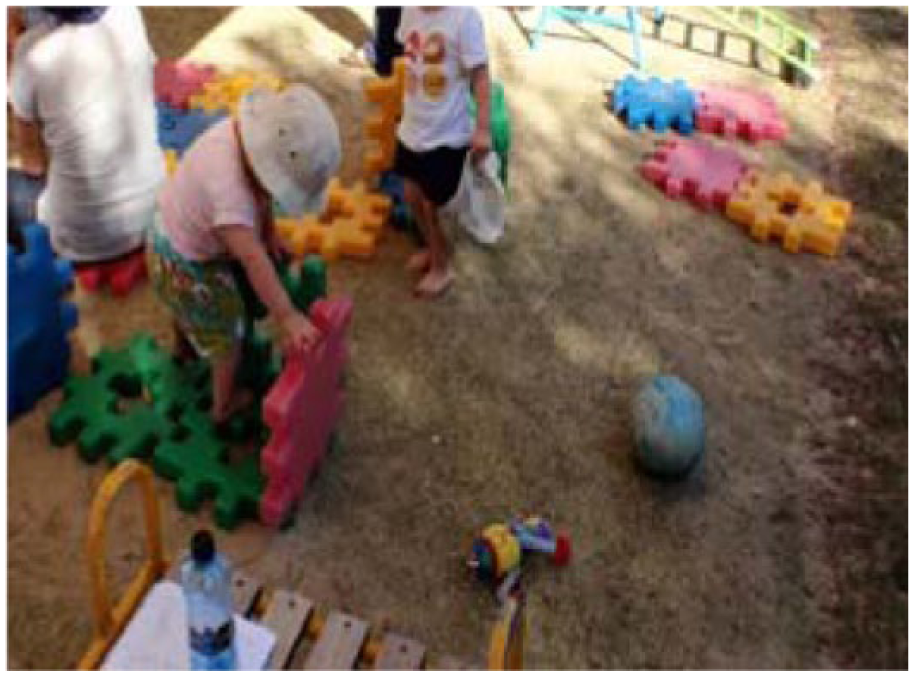
Clare plays with the large waffle blocks.
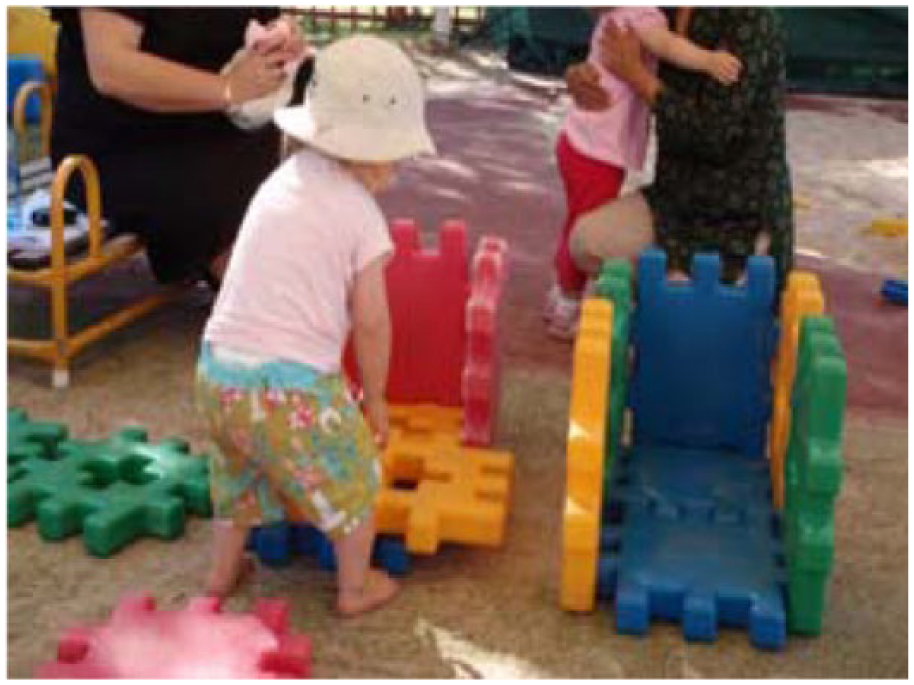
Persisting with the challenge of the waffle blocks.
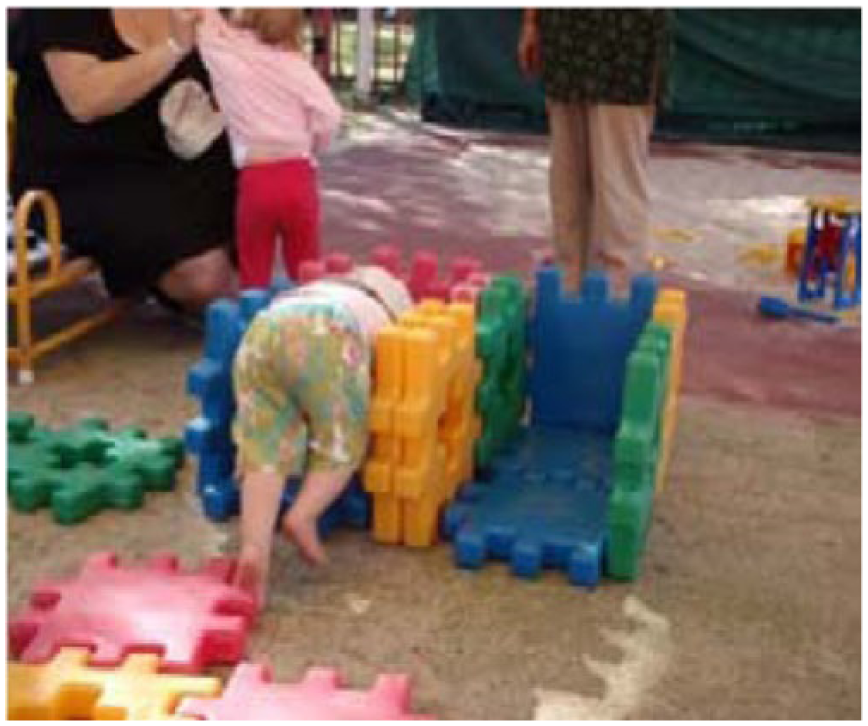
Chairs turn to beds – the play shifts to role play.
Figures 4 and 5 . One week later Clare recalls her previous play with me.
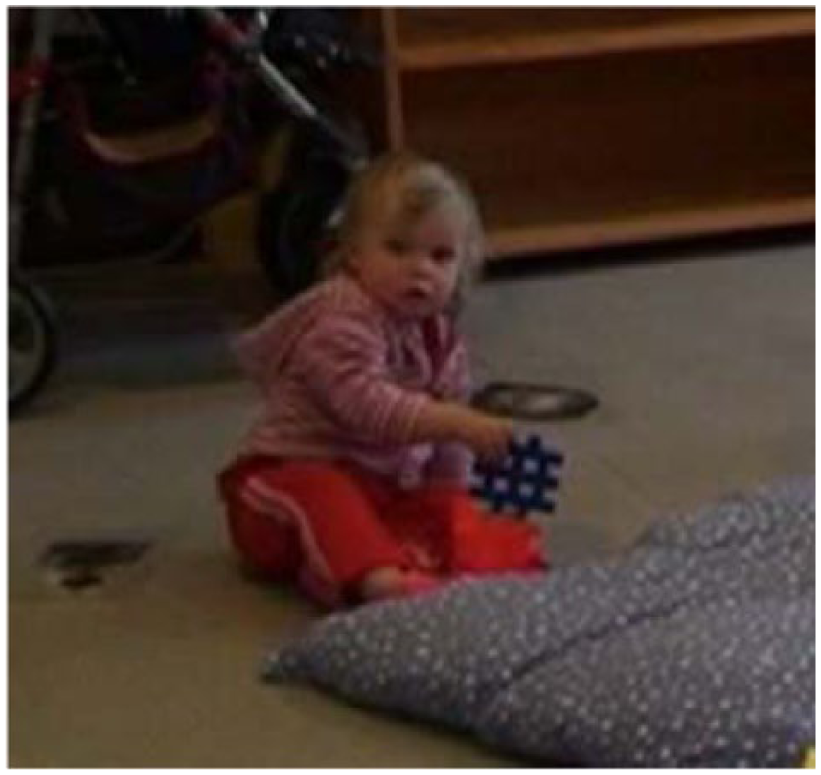
Constructing a small box with waffle blocks – Clare checking that I am watching.
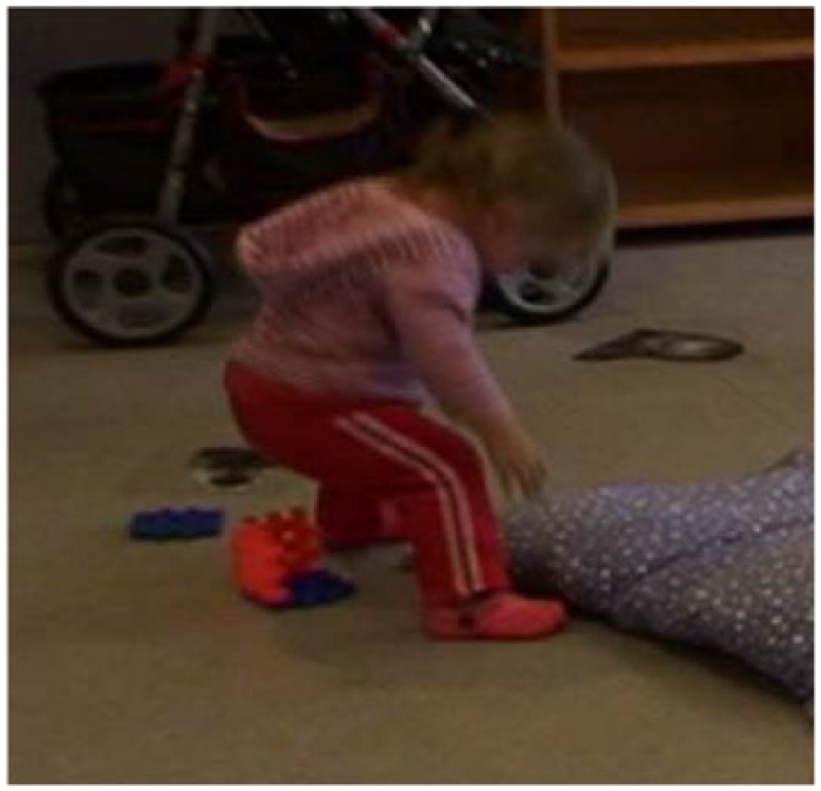
It’s a chair.
Clare’s benediction comes in the form of a very subtle and easily overlooked gesture. There is no verbal or physical contact – her invitation is indirect, yet suggests her confidence in me to understand her actions as an encounter that connects us. Her recall of the game from the previous week indicates a considerable capacity to make meaning and transfer her knowledge of a game in the outdoors to a similar game in the indoors one week later. Significant here, though, is her ability to demonstrate her memory of the game and use sophisticated body language and eye contact as an invitation to me to notice her recall. In the second encounter, her strong use of eye contact drew me into her intent. It required of me attentiveness and attunement. Attunement in this sense is understood as a sensitivity to the infant’s invitation – the willingness to stand back and enable the child to lead the encounter, tentatively seeking possible meaning from the infant’s actions. It is perhaps in contrast to more traditional notions of attunement that imply the emotional bond between adult and child where the responsibility is on the adult to accurately interpret the infant’s action and respond in an appropriate way (see Ainsworth, 1967, cited in Rolfe, 2004). I was unsure if she was suggesting we replay the game from last week or simply attempting to connect with me over the encounter that we had shared. I tried not to draw too many conclusions about her intent, but rather used the invitation to observe more, respond to her invitation with smiles and encouragement, and wait for her further gesture. As she fell to the floor, rolled back and looked toward me, she held her gaze for several seconds – it was a strong and powerful message to me to engage in her invitation.
Figures 6 and 7. Clare’s extended gaze – is this her benediction?
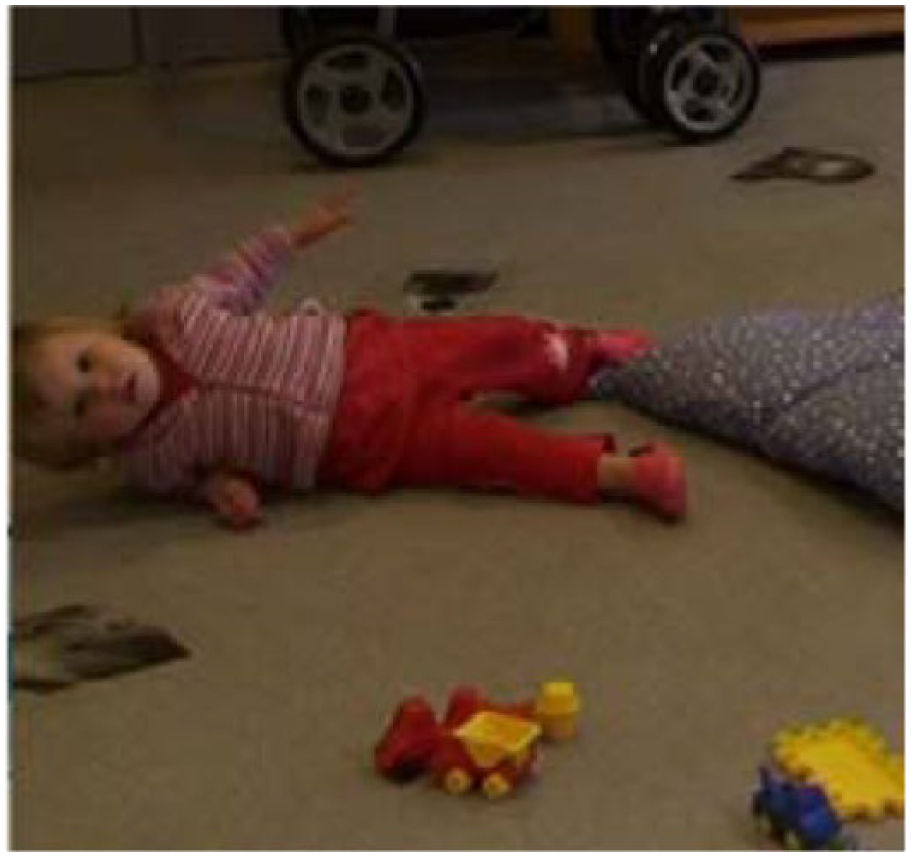
Clare gazes at me as she sits on the box and rolls to the ground.
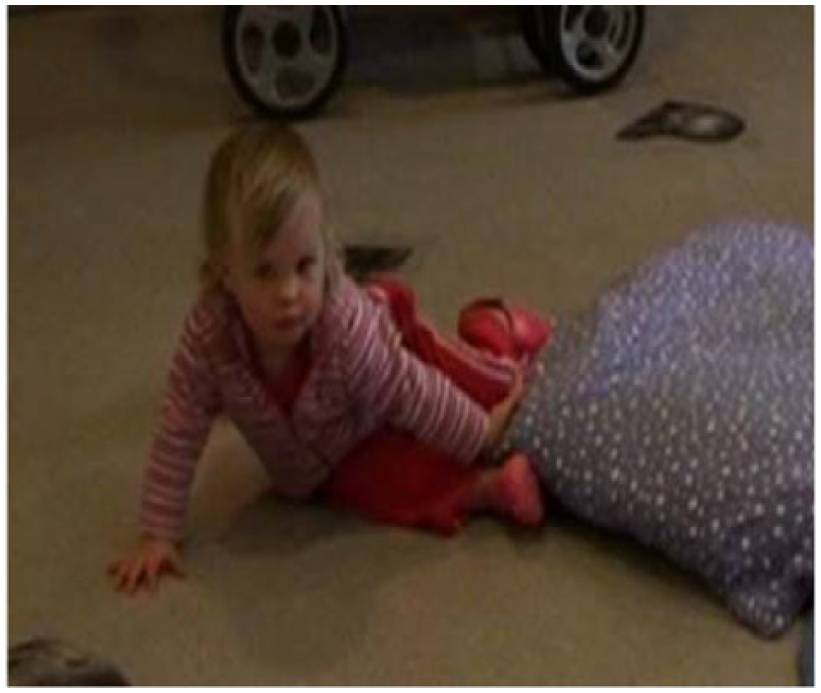
Clare holds her gaze toward me – a strong message of invitation.
Rather than focusing on her developmental stage or her skill in manipulating the blocks, a focus on her benediction invites a broader perspective on her experience. While it is tempting to think about what I might do next to extend her learning or build on her apparent interest in blocks, responding in this way represents assumptions on my behalf about her interests, her development and her understandings. I then become the protagonist of her learning. A focus on her benediction, however, shifts my gaze from what I might assume she needs based on ‘normative developmental assumptions’ (Berthelsen and Brownlee, 2005: 53) to what she is expressing as her unique interests, motives and intents in relation to the blocks. In pausing to seek her intent, I create a space in which she shows me capability beyond my ‘normative developmental assumptions’ of a 19-month-old. I feel encouraged to approach her with susceptibility and wait for further cues. She then leads me to the game of making chairs and beds for small soft toys that fit snugly into the proportions of the small waffle blocks.
Benediction as an invitation to encounter curriculum
The notion of benediction, in this way, foregrounds Clare’s desire and intent to show her interest and engagement in play and learning. While it is tempting, perhaps, to draw on assumptions about her level of motor skill, her interest in blocks as tools and her capacity for memory recall, such assumptions may prompt the educator to take the lead and determine the direction of Clare’s next experience. Certainly, traditional notions of planning for learning based on observation expect that the educator will observe the child’s interest and devise a series of activities and strategies to extend or scaffold the child to achieve the identified objectives (e.g. see Sims and Hutchins, 2011). Being alert to the infant’s own expressions of intent and interest provides other possibilities, beyond a potentially narrow list of possibilities based on a limited range of assumptions. In looking beyond these assumptions, we are made aware of Clare’s level of sophistication in inviting me into her intent; we are forced to notice her considerable interest in the patterning, physics and representational qualities of the materials; and we are encouraged to think more broadly about what she might be expressing an interest in exploring further. Enabling her to take the lead, and seeking to find her expressions of possibility through my susceptible stance, demonstrates a deeper respect for the encounter as collaborative.
Generating a narrative of this encounter has illuminated action and intent that may well have been overlooked or missed. Drawing together the data from still photographs of the week earlier, along with video footage the following week and brief field notes, facilitated a narrative reflection of this infant’s meaningful engagement with learning. Clare made no overt actions to acknowledge my presence or to make physical contact with me. Her benediction was very much a tentative invitation, requiring attunement on my behalf. Likely to have passed without notice, the narrative was a way of making visible that which might be lost or overlooked. It created the possibility to look at an everyday action with greater depth – to be made more aware of this infant’s invitation and strong message about her desire and intent.
This narrative alone sparked further questions for us as researchers about infants’ encounters with curriculum. Might this not be a one-off extraordinary response by Clare? Were other infants making such benedictions? On looking carefully at further data, it became clear that the infants participating in this research demonstrated many examples of what might be considered benedictions. In often subtle and frequently overlooked ways, these infants demonstrated significant desire to communicate their interests and intents, and they employed a wide range of strategies for extending their invitation to others.
Conclusion
The Early Years Learning Framework encourages educators to draw on children’s interests as an ‘important basis for their curriculum decision-making’ (Department of Education, Employment and Workplace Relations, 2009: 15). Yet how to do so effectively with infants has not been well examined. As Woodhead (2006: 25) observes: ‘Realizing rights … entails a fundamental shift in the image of the child within society’. Simply stating the rights of infants in a curricular document does not ensure those rights will be realised. Societal beliefs, views and attitudes about infants in childcare remain a significant and powerful influence over how infants will be respected and responded to in relation to their learning. The persistent images of infants as vulnerable, fragile and completely dependent on adults to shape their future life trajectories perhaps inhibit the possibilities for them to experience more collaboratively possibilities which view the infant as an influential co-constructor of knowledge and ideas.
The use of narratives to reflect the stories and experiences of infants may be one way of getting closer to their perspectives – their thinking, motivations and intents. Focusing the narrative on infants’ benedictions, rather than the traditional form of observation that gives primacy to developmental behaviour, is perhaps a way of illuminating infants’ interests, thus affording the opportunity to respond to their benedictions as the basis for building a participatory curriculum. Levinas’s thinking suggests that these invitations require a sensitive and responsive educator who is ‘susceptible’ rather than ‘knowing’, demonstrating a trust in each infant’s capacity to show their interests. This thinking perhaps opens up possibilities to consider the role of agency in the experience of very young children in their early encounters with learning. A more susceptible stance may lead educators to watch more closely, pause longer or listen more intently in an attempt to better understand each infant’s desire to have a say in their learning. Seeking to understand more effectively the infant’s perspective invites possibilities to consider infants as agents in their own learning and to move toward new forms of critical practice with infants.
Footnotes
Funding
The author(s) disclosed receipt of the following financial support for the research, authorship, and/or publication of this article: The research reported in this article was funded by the Australian Research Council LP0883913 and Partner Organisations KU Children’s Services and Family Day Care Australia.