




Abstract
Since the early 2010s, there has been a proliferation of new platforms for children’s stories (e.g. storybook apps or iBooks), but not necessarily greater diversity of story content or children’s greater interest in reading. This article argues for a new approach to address the apparent paradox of a wider availability of children’s literature combined with children’s eroded reading interest. The issue is suggested to be addressed by considering the agency and aesthetic dimensions which lie at the heart of personalisation theory. Translating agency into reading practice means establishing children’s early authoring, which can result in an eclectic approach to content and increased reading motivation, as long as children’s aesthetic choices are fully supported. However, it is also argued that early authoring should not be conflated with achieving an overly child-centred literature, which would ignore the reciprocity dimension of community and society relations. Digital book-making is suggested to offer original concepts which might provide an alternative approach for future work in the area of early authoring.
Introduction
With the advent of mobile touch-screen technologies in the early 2010s, children’s stories now exist in the form of storybook apps, iBooks or enhanced e-books, and are available on a variety of reading platforms, including iPads, LeapReaders™ or Android tablets. In addition to a wealth of print literature written for early readers, there are thus tens of thousands of digital books available for young children (Shuler et al., 2012). The substantial increase of reading materials in digital formats is often perceived as a panacea which might ignite children’s interest in reading – a view that is supported by some empirical research (Bryant and Levine, 2015; Miranda et al., 2011).
However, despite greater availability and access to digital media in the UK (Ofcom, 2014, 2015) and USA (Common Sense Media, 2013), doubts have begun to be raised about the actual content of new digital stories and the extent to which they provide children with new literacy experiences or new opportunities to engage with stories. Wohlwend and Rowsell (forthcoming) note that the majority of children’s digital books are based on old Literacy 1.0 models, which, unlike Literacy 2.0 models that support novel ways of meaning-making and story engagement, are based on a print literacy model and are not aligned with the multimedia affordances of the digital medium. Others (e.g. Guernsey and Levine, 2015) raise the question of the extent to which digital books might exacerbate rather than reduce the reading gap, typically reported as the difference in reading scores between children from low and high socio-economic backgrounds. The reality that children from different backgrounds experience qualitatively different interactions with digital books has also been widely documented, in both national surveys (Kucirkova and Littleton, 2016) and detailed case studies (e.g. Radesky et al., 2015).
Aligned with these concerns is the need to ensure greater diversity in children’s reading materials, with persistent suggestions that children’s books lack sociocultural and racial diversity. As Strick et al. put it:
For one thing, it’s fine if you happen to be white, male and non-disabled (or a bunny or a bear) but what about all the children who are black or mixed race and those who are disabled or whose family doesn’t happen to conform to the ‘usual’ structure? Isn’t it important that they can see themselves in books, too? (Strick et al., 2014)
Diversity in children’s books is lacking on several levels, including the various contexts of children’s stories (i.e. cultural, racial and gender diversity) as well as their contents (e.g. the portrayal of contemporary topics).
These issues need to be addressed because of the known, close connection between book diversity and children’s motivation to read. Although no causal link can be established, the two are certainly related (Marlow, 2002; Mason, 2007) and of contemporary concern. There is mounting evidence that children’s motivation to read for pleasure is in decline (Bradshaw and Nichols, 2004; Clark, 2013). For example, a national survey in the USA found that the number of American children who say they love reading books for fun dropped almost 10% between 2010 and 2014 (Scholastic, 2015). Similarly, in the UK, a national survey by the National Literacy Trust found that reading for pleasure is in decline and that children read less and perceive books as an ‘uncool activity’ (Clark, 2013). In England, this decline is particularly pronounced, with the 2006 Progress in International Reading Literacy Study questionnaires positioning England in 37th place (of 45) in relation to children’s attitudes to reading, with only 40% of 10-year-olds expressing a positive attitude towards reading (see https://nces.ed.gov/surveys/pirls/). Although England achieved higher scores in the 2011 Progress in International Reading Literacy Study, students’ attitudes towards reading have not significantly changed, with students feeling less positive about reading than their peers in countries with a similar gross domestic product, such as New Zealand.
The reasons for children’s apparent declining interest in reading are multiple, with several potential influences, including young children’s increased use of digital technology for entertainment (see Tech and Play, 2015), as well as the accountability movements and testing culture in many US and UK schools leaving little space for alternative expressions of student choice and participation in curriculum development (see Black, 2011; Sacks, 2000). The extent to which these factors interact with and influence young children’s interest in reading is yet to be verified by research, but what is clear is that these factors are of contemporary importance and often discussed in the context of children’s book diversity. In this article, I focus on the role of diverse reading materials because of its practical significance in the digital reading landscape and current national and international literacy campaigns. For example, in the UK, the initiative launched by the Children’s Laureate, Malorie Blackman, focuses on greater racial diversity in children’s literature. Internationally, diversity movements have been launched on social networks (e.g. the Twitter #WeNeedDiverseBooks campaign) which aim to raise awareness and celebrate more book diversity across continents. These efforts are accompanied by officially compiled and reader-generated book lists which showcase diversity in children’s books. 1 There have also been targeted purchases of imported titles, with several book publishers actively supporting the publication of books specifically dedicated to inclusive stories with characters from varied cultural backgrounds (e.g. Tamarind in the UK). Also, some teachers (e.g. Steiner et al., 2008) have been collecting and reviewing multicultural literature for the past 10 years.
These diversity efforts rest on a contrasting vision – that is, that diversity can be addressed by promoting minority publishing or targeting certain groups of children. As such, they are a direct response to the current problem, but they are not proactive in developing strategies to reduce the source of the problem. As such, they risk becoming fragmentary. I argue that in the context of diversifying children’s books and igniting children’s interest to read, we need a fresh theoretical start that cannot be provided by a countermovement, but by a lateral shift, often observed in paradigm shifts (Kuhn, 1970). A theoretically informed broader perspective can achieve more in terms of addressing the issue of children’s motivation to read and provide a proactive, rather than reactive, future model for the issue of book diversity. I outline how the psychological framework of personalisation, where emphasis is placed on the agentic aspects of book authorship and the aesthetic preferences of each individual, could act as a unifying theoretical framework with the potential to guide the attempts to diversify children’s books.
I begin by summarising literature concerned with reading for pleasure and an overview of the diversity (or lack thereof) in children’s reading resources. This is followed by an exposition of personalisation theory focused on the key concepts of agency, aesthetics and reciprocity, which are most relevant for the present argument. I argue that the act of diversifying reading contexts and contents needs to be integrated with the aesthetics of early authoring, and that this integration requires a fundamental shift from tokenistic customisation to meaningful personalisation. Before concluding, I point to the need for reciprocal models of authoring and some innovations necessary for effective early authoring with digital storybooks/literacy apps.
Definition of key terms
Before discussing the contribution of personalisation, it is important to specify the scope of this article and define a few key terms. The focus of the present discussion is on children’s reading for pleasure or recreational reading – that is, reading which can be defined as ‘reading that we do of our own free will anticipating the satisfaction that we will get from the act of reading’ (Clark and Rumbold, 2006: 6). This kind of reading is, as Clark and Rumbold (2006) point out, closely related to reading motivation (extrinsic and intrinsic) and reading choice. I focus on children who are non-readers, emergent readers or early readers (typically children aged between two and six), and on storybooks – that is, books which are published as a single object and contain a narrative or ‘an account of events occurring over time’ (Bruner, 1991: 6). The term ‘digital storybooks’ refers to any electronic storybook which can be downloaded onto an iPad, tablet or e-book reader, and which contains a comparable narrative to that found in non-digital storybooks but is augmented by a degree of interactivity (such as being able to interact with a character or add the user’s own digital text). I also discuss storybook apps and book-making apps, which are digital story-making and story-sharing software programmes available on tablets and iPads.
Diversity in children’s print and digital books
A child’s book (digital or print) can be considered diverse in two distinct ways. First, there is diversity of the story context, which includes sociocultural diversity of the story’s characters and plots. Second, there is diversity of the story content, which includes the topics and themes portrayed in a book and their relevance and contribution to the appeal of a book. Thus far, the wider debate on book diversity has focused on the lack of diversity of story contexts, notably in relation to children who are not part of the dominant culture. There is a concern that, despite the fact that the populations of ethnic minority groups in several Western countries are on the rise (UNESCO, 2009), these groups are still largely under-represented in children’s books. Also, although the spaces where children grow up are increasingly multicultural and multi-ethnic, ethnic minority groups and immigrant groups are rarely represented in mainstream children’s literature. In the USA, a Cooperative Children’s Book Center (2015) report found that of 3200 children’s books published in 2013, only 93 were about black people, 34 about American Indians, 69 about Asians and 57 about Latinos. Specific subgroups are even more under-represented than major ethnic groups (Nilsson, 2005). In her doctoral dissertation, Atienza (2013) examined the representation of Filipino Americans and concluded that, unlike larger Asian American groups (Chinese Americans, Japanese Americans and Korean Americans), this group is almost non-existent in children’s literature. Besides the lack of gender diversity and representation of multicultural and multi-ethnic interactions, there is also an ongoing criticism that children’s books under-represent children with disabilities, which is an important form of diversity (Beckett et al., 2010; Bland and Gann, 2013; Booktrust, n.d.). In addition, there is a concern that the majority of children’s books use anthropomorphised animal characters to deal with racial diversity, which not only impedes children’s understanding of the true abilities of real animals (Ganea et al., 2014), but also teaches them little about the importance of interconnectedness in cultural discourses.
As for the diversity of story content represented in children’s books, several children’s authors, educators and scholars have voiced the concern that the topics currently represented in children’s books do not align with children’s daily experiences (Harlin and Morgan, 2009; Hodkinson, 2012). There have been some recently produced books which provide exceptions by referring to technological resources – for example, in the print book Goodnight iPad (Droyd, 2012), a child says goodnight to her toys, which include digital toys and an iPad. However, apart from the presence of technology, many contemporary topics – including global cities, ecological problems, the urbanisation of developing countries and religious conflicts – are largely absent from children’s books. Some children’s authors also argue that gender diversity is approached only within limited topics, with a considerable under-representation of boys’ storyworlds in children’s books (Emmett, 2014).
In the next section, I draw on the agency and aesthetics dimensions of personalisation theory as a useful conceptual framework for beginning to understand how children’s literature can be diversified, and how all children can be meaningfully involved in this process.
An outline of personalisation theory
‘Personalisation’ is a broad concept which is applied in various contexts. In education, personalisation is typically described as an incarnation of neo-liberal education policy, where personal responsibility is promoted and services are customised to the needs of each individual (Pykett, 2009). This definition of personalisation is different from that employed in the book publishing industry, where personalisation refers to user-adaptive or user-adaptable systems (Van Velsen et al., 2008), which either adapt to a user’s preferences (e.g. book-recommendation systems through Amazon) or enable users to tailor the product to their needs through direct manipulation (e.g. by inserting their own pictures into a book). Personalisation is, in this area, often used synonymously with customisation and individualisation.
Customisation and individualisation do imply an element of user involvement, and the distinction between customisation, individualisation and personalisation is an important one, as it helps define and focus the learning opportunities in personalised book reading. While customisation and individualisation afford the possibility of choice and involvement, personalised learning represents the highest intensity of a user’s involvement within a given context (Blom and Monk, 2003). Unlike customisation where users merely follow pre-established templates and scripts, personalisation refers to the possibility to insert a user’s own contents and personal data (e.g. children’s names and those of their friends, or places where they like to go and play), which intensify the experience and support empowerment and agency (Oulasvirta and Blom, 2008). Thus, although often used interchangeably, there is a hierarchical relationship between customisation, individualisation and personalisation, with personalisation representing the most intense form of a user’s engagement with a piece of text or narrative (Kucirkova, 2014a).
Personalisation can most clearly be differentiated from customisation through the use of the concept of script and that of template. Script, or a pre-established set of storylines and story characters, is often used in English classes with the aim of supporting children’s writing skills and targeting specific domains – for example, practising diary writing with a standard starter (Goodwyn and Branson, 2005). Storybooks authored by using a script allow for restricted agency, as the child needs to follow a given story structure. Such storybooks are, therefore, not personalised but customised. Similarly, a template, or a preset format of a book, is customised, unless children can make it completely their own. Customisable templates for self-made books or parts of books are widely available online or offered as print books – for example, The Usborne Write Your Own Storybook (Stowell and Chisholm, 2011). Although individualised storybooks are more agentic than customised storybooks, personalised storybooks do not only refer to a specific individual, but also contain this individual’s personal data (e.g. their own picture or their own name). These distinctions are graphically represented in Figure 1, where the two quadrants on the right represent the highest intensity of a child’s engagement with books.
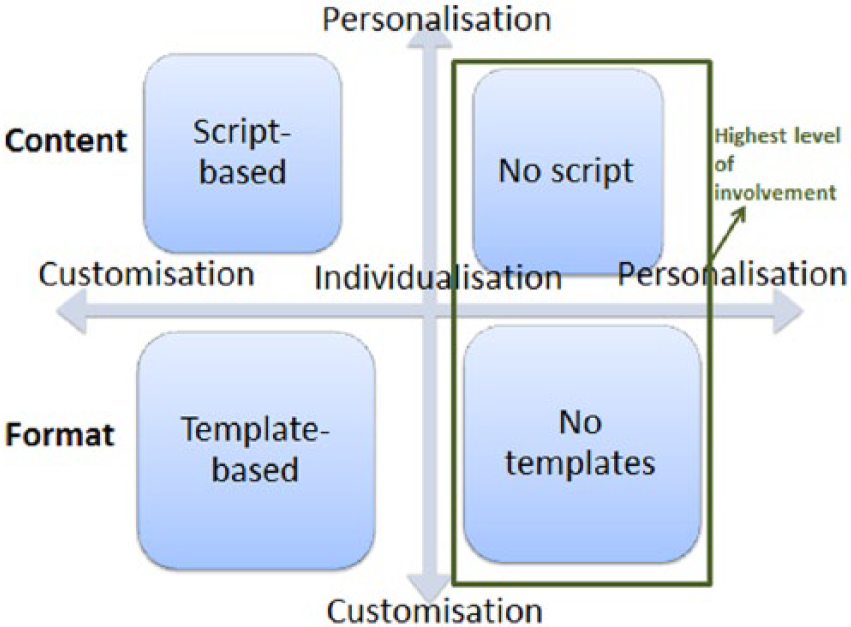
Three kinds of child involvement in early authoring and their relation to storybooks’ content and format.
From a theoretical perspective, the more personalised the format or piece of content of a particular story is, the more likely it is that the child will be motivated and engaged in the story activity (Oulasvirta and Blom, 2008). This theoretical postulate is related to the theoretical works on agency underlying the personalisation paradigm, as outlined next.
Agency in personalisation theory
The concept of agency is widely adopted in many different contexts, so it is important to explain what it means in relation to children’s engagement with storybooks. Drawing on Emirbayer and Mische’s (1998) work, Biesta and Tedder (2007: 11) define agency as ‘a “capacity” that “works” upon the self’, which is similar to Martin’s (2006: 268) definition of agency as being ‘the capacity to be in or to take action’. These definitions share the notion of an individual being agentive, or being allowed to do things themselves in a virtual or physical environment over short or long periods of time. In early education, children’s agency is often subsumed by adult agendas and tempered by an awareness of children’s limited knowledge of reading or learning processes (Vandenbroeck and Bouverne-De Bie, 2006). This has led to a number of studies and projects concerned with agentic goals, notably in relation to supporting the involvement of children from less advantaged backgrounds or minority groups in learning activities (González et al., 2013). Such efforts are often couched in the paradigm of funds of knowledge, which is based on the premise that all people have knowledge and have to negotiate its expression by balancing agency with structural norms and impediments (Moll et al., 1992).
Analysing personalisation in digital environments, Oulasvirta and Blom specify the links between agency and basic psychological needs as follows:
Be the object of change content, functionality, or appearance, it is ultimately the user who decides to undertake a certain action to affect the status of the system. By virtue of this agency, an explicit connection is formed between certain basic needs and motivations and outlet of these forces through personalisation behaviour. (Oulasvirta and Blom, 2008: 15)
Closely linked to agency is thus the ‘appearance function’ of personalisation, which is directly linked to an individual’s motivation to personalise a given context or resource (Oulasvirta and Blom, 2008).
Appearance and aesthetics
Each person displays unique, often random, aesthetic preferences, and a given system or context needs to be adaptable to the user in order to avoid frustration and maintain its appeal. Although the theory posits that ‘an individual’s motivations are their idiosyncratic expressions’ (Oulasvirta and Blom, 2008: 8), there is a strong recognition of a dual perspective on the person who personalises a given product (‘the personaliser’) and the person who receives the personalised product (‘the personalisee’). Oulasvirta and Blom (2008: 10) theorise that it is through the ‘appearance function’ that personalisation taps into interpersonal domains, and explain that ‘personalisation of appearance is at least partially intended to have an effect on other people rather than the user herself’. Importantly, the ‘appearance function’ is closely linked to motivation and engagement, which have been empirically linked to learning in numerous studies (Carini et al., 2006; Goldberg et al., 2011). The personalisation argument therefore suggests that if a child can directly affect a learning activity or environment by personalising it according to his or her aesthetic preferences, then the appearance of that environment changes, which in turn influences the author’s motivation and engagement in the activity.
Reciprocity
I have written elsewhere (Kucirkova, 2014b) about the need for endowing personalised learning and personalised resources with the concept of reciprocity – that is, a reciprocal relationship between the self and others in order to avoid overly learner-centric education models. With young and emergent readers, this involves creating opportunities where children can appreciate the books produced by others and critically evaluate the strengths and limitations of these. This is related to the basic psychological needs of identity, social status and inclusion by others (Littleton and Mercer, 2013; Schapiro, 1995), and relational/collaborative practices in early authoring (Rowe, 2008; Short, 1992). In book-related personalisation, the concept of reciprocity thus reminds us that children’s authoring is not politically or socially independent. Reciprocity is important in conversations around assumptions and stereotypes based on social class and gender discrimination, as demonstrated by Jones’s (2006) work with 5th-grade girls and literacy texts. Building on the Four Resources Model (Luke and Freebody, 1999), Jones (2006) and Jones and Enriquez (2009) showed how critical literacy engagements which are embedded in students’ lives can motivate students to take part in literacy activities and reading – a notion that is relevant for the present argument.
How can constructs of personalisation theory be practically achieved with the reading materials currently available for young children? And, importantly, how can these theoretical notions be put into practice related to reading motivation and the diversity of children’s books?
Agency and children’s digital books
The self-evident application of personalisation theory is that it positions children as authors of the books they engage with. The impact of this should not be underestimated as it creates opportunities for gains in confidence through agentic opportunities of book creation. This proposition is not novel; several intervention studies and qualitative studies have included young children as writers or book authors (e.g. Barratt-Pugh, 2003; Cowie, 1989; Gundlach, 1982). A number of academic (e.g. Short, 2012) and practical publications (e.g. Warren, 2008) outline strategies for supporting early authoring using print books. There are also studies supporting book-making in schools (e.g. Guillén and Bermejo, 2011) or homes (e.g. Pakulski and Kaderavek, 2004). In addition, there is substantial online information put together by parents (e.g. Amy, 2014) and literacy charities – for example, the Book Trust (Dunbar, n.d.). Although not officially recognised in the UK National Curriculum, national institutions provide children with educational series – for example, the British Library Learning Centre offers the practical Make a Book! workshop to primary schools for children attending in Years 3–6. In addition, there are digital book-making programmes, including those developed by the author and colleagues at the Open University (see http://www.open.ac.uk/creet/main/projects/our-story).
With print books, personalisation typically occurs with cut-out pictures – for example, children can stick their own photographs into a self-made book created at school (Johnson, 1997). In the case of children’s digital books, there are several options for personalising the content of a book. Children can add their own texts, sounds or audio files to a given story. For example, with the Cinderella app developed by Nosy Crow™, children can add their own ‘selfie’ to one of the magic mirrors in the prince’s castle. With the Our Story™ app (developed by the Open University), children can add their own texts, audio recordings and pictures to accompany any fictional stories they wish. As such, with several children’s smartphone and tablet apps, early authoring has become versatile, multimedia and possible even for children of preschool age (Kucirkova, 2013; Merchant, 2015).
Thus far, research on digital story-making has focused on specific groups of children – for example, bilingual children (see Rowe and Miller, 2015) or children with special educational needs (Kucirkova et al., 2014). From the point of view of reading diversity, the more personalised a story is, the more likely it is to evidence diversity content and a format which, while it may not follow standard educational criteria, may make a significant contribution to book diversity. Importantly, personalisation theory argues against the danger of normatively invoking child agency as a sufficient rationale for their involvement. The focus on the personal emphasises the need to ensure that the strategies and techniques for involving children in book-valuing are inclusive and not aimed at specific groups of children. Early authoring therefore needs to involve avid as well as reluctant readers, and children from all groups in society. This decreases the likelihood of the continuance of dominant contents and increases the likelihood of diversification.
Aesthetics and digital books
Digital book formats allow users to update their stories periodically and flexibly, breaking away from the rigidity of traditional printed formats in order to produce aesthetically pleasing book products. Personalisation theory stresses the need to utilise children’s agency and support children’s intrinsic need to express their own aesthetic values. This is unlikely to be achieved with the pre-established scripts and templates typically used in school contexts, which encourage children to customise pre-given digital storybooks. Rather, allowing children to personalise – that is, to create their own, aesthetically appealing resources which reflect aspects of their own lives by using their own photographs, drawings or texts – is more likely to sustain interest and motivation in reading (see Oulasvirta and Blom, 2008). One should bear in mind that children need to be supported and empowered to creatively express their aesthetic choices not only with traditional materials in school (Eckhoff, 2013), but also with multimedia digital books.
Another practical recommendation concerning aesthetics is to include children’s personal multimedia data, such as their pictures and voice-overs. While there are only very few print books (e.g. My Daddy Is a Marine, by Alia Reese, 2012) which offer the possibility of inserting ‘selfies’, there are many digital books with this option, facilitated by the embedded camera found in mobile devices (e.g. the My Story™ iPad app). In these books, children can add pictures of others or depictions of their own faces. However, the children’s pictures inserted into these stories often appear quadratic, misrepresenting the actual shape of a child’s head or figure. Similarly, there are apps which allow children to insert their own audio-recorded voice. These, however, offer few opportunities for children to edit their narration or the possibility to accompany it with tunes and melodies, as is the case in professional audiobooks. To move beyond tokenistic representations of personalisation, the storybooks need to be designed and used with children’s carers in order to empower children to directly shape the aesthetics of the content and format of their contributions. Otherwise, personalisation options risk being more commercial than educational in nature.
Reciprocity and children’s digital books
While the production of a print book typically involves a celebratory event (e.g. a book launch), this rarely happens with digital books, despite the fact that these books also take considerable time, effort and thinking to produce. Parents and teachers can be more instrumental in facilitating this process by creating spaces which value children’s authoring and focus on the aesthetic and agentic aspects of children’s contributions. In schools, book releases can be linked to communication with parents and other professionals – for instance, teachers can use the opportunity to share children’s achievements with parents and harness the ease with which digital books can be shared with selected audiences. In this respect, more attention needs to be paid to securing written permission for the books’ use and establishing copyright information. Children’s self-made storybooks are often digitally reproduced and freely shared online, with no clear explanation about photocopying or digital reproduction of the works. If children are to personalise their own texts, there needs to be greater clarity about copyright, moral rights and crafting. This is part of involving children in authorship in the 21st century and fully developing them as readers (see Marsh, 2004).
Another practical embodiment of the reciprocity aspect is enabling more collaborative digital book-making. Community early authoring can help children find their own voices as members of particular social, cultural and gender groups (Rowe, 2008, 2012). However, very few story apps allow collaborative authoring or joint creation between parent and child with aesthetically pleasing and motivating features for intergenerational participation. For example, there are several book-making apps for tablets and smartphones which have a child-friendly user interface and iconic navigation, suitable for emergent readers (e.g. My Story™ and StoryMaker™). There are also adult book-making apps, with similar affordances to the children’s apps but a very different user interface and more advanced possibilities for customising the final product, including sharing it or adding signatures or hyperlinks (e.g. BookCreator™). Dyson (2001) argues that children reflect as well as reframe existing social relationships when creating their own materials, and research with digital book-making shows that children and adults benefit from joint interactions in the creation of multimedia stories (Kucirkova et al., 2013). Yet there are currently very few book-making resources which provide guidance and support for parents and children creating digital storybooks together. This needs to include not only technical support, but also tips and guidance on emotional aspects and effective communication around joint story-making.
Lastly, in view of the increasing popularity of personalised storybooks ordered as gifts for children (Williams, 2014), researchers and practitioners need to be mindful of the possible risk of personalisation in overfocusing on the child and diminishing the importance of community. This risk is particularly increased with children aged two to six, who may not have fully developed their understanding of the risks associated with personal content shared digitally and the importance of others in shaping their own storyworlds. Therefore, if personalisation is used as a theoretical framework to guide future efforts to diversify children’s literature, this should not position children’s authoring as detrimental to traditional adult-generated literature. Adult-generated literature serves an irreplaceable role as ‘touchstones of moral values’ for young children (Marsh and Millard, 2000: 85), and children need to ‘reconcile themselves to their own inconsistencies and those of others’ (Plowden, 1967: 217).
Conclusion
The application of personalisation theory to children’s books expands current debates around diversity to the importance of personal voice (agency), the aesthetic dimension and, indirectly, reciprocity. All three aspects dovetail with the diversity agenda and all carry the potential to influence children’s motivation to read. Personalisation recognises the importance of a personal voice which is inherently diverse and unique to each individual, regardless of gender, ethnic background or abilities. Agency and aesthetics, endowed with reciprocity, can encourage the practice of children’s meaningful book production, which can make a deep and lasting contribution to the development of intrinsically appealing books. As Grainger et al. (2005: 44) write: ‘Children’s writing is unique, they are the only ones who can create genuine “children’s literature”’ and, in doing so, they can ‘inhabit and transform their own and others’ voices in the process’. With the abundance of digital book publishing, we are at a unique point in time when children’s diverse voices can be celebrated and represented in many reading formats, and it is time that we integrate current diversification practices with a theoretical perspective which includes all these voices.
Footnotes
Acknowledgements
The author would like to thank Professor Teresa Cremin for her comments on an earlier version of this article and the anonymous reviewers for their helpful and constructive comments.
Funding
The author(s) received no financial support for the research, authorship, and/or publication of this article.