




Abstract
Narrative production draws upon linguistic, cognitive and pragmatic skills, and is subject to substantial individual differences. This study aimed to characterise the development of narrative production in late childhood and to assess whether children’s cumulative experience of reading fiction is associated with individual differences in narrative language skills. One-hundred-and-twenty-five 9- to 12-year-old children told a story from a wordless picture book, and their narratives were coded for syntactic, semantic and discourse-pragmatic features. The grammatical complexity and propositional content of children’s narratives increased with age between 9 and 12 years, while narrative cohesion, coherence and use of mental state terms were stable across the age range. Measures of fiction reading experience were positively correlated with several indices of narrative production quality and predicted unique variance in narrative macrostructure after controlling for individual differences in vocabulary knowledge, word reading accuracy and theory of mind. These findings are discussed in terms of the continued importance of ‘book language’ as part of the language input beyond early childhood.
Introduction
The ability to construct narratives, both fictional and factual, is a key aspect of oral language competence. Across cultures stories are told to construct, share and make sense of human experience; narrative language is fundamental both to social interaction and academic achievement, particularly literacy outcomes (Britton & Pellegrini, 1990; Suggate et al., 2018). The development of narrative production skills in early childhood has been extensively studied from an emergent literacy perspective (e.g. Gardner-Neblett & Iruka, 2015) and in relation to language pathology (e.g. Pearce et al., 2010). Less work has focused on narrative production in late childhood and adolescence, a period of steady development of pragmatic language and social cognition (Nippold, 2000). The current study examines linguistic, semantic and pragmatic features of picture-book elicited oral narratives produced by 9- to 12-year-old children. Since children within this age range vary widely in how much they read for pleasure (Nippold et al., 2005), we also assess whether children with more cumulative experience of reading narrative fiction show advantages in narrative competence.
Story construction entails the integration of multiple sources of knowledge into a hierarchical conceptual structure at the discourse level; this complex representation can be conceived as the ‘message’ which, according to standard models of language production, activates grammatical and phonological encoding subsystems to produce a spoken output (e.g. Bock & Levelt, 1994). The types of knowledge that may be activated in the formulation of a conceptual representation of narratives include background knowledge about the world (e.g. cause-and-effect relations, event schemas, protagonists’ goal-oriented behaviours) and knowledge of narrative conventions (e.g. ‘story grammar’; Mandler & Johnson, 1977). The conceptual message comprises features of intended meaning and is assumed to influence the language produced at the sentence level (e.g. through processes of lexical selection and function assignment; Bock & Levelt, 1994) and across sentences (e.g. use of linguistic cohesion devices; Karmiloff-Smith, 1985). Empirical studies suggest that adolescents and young adults produce more syntactically complex language when retelling a narrative in comparison to during a general conversation (Nippold et al., 2014, 2017). One possible explanation for this finding is that stories often contain abstract concepts, which stimulate the use of lower frequency words and more complex syntax. The study of narrative production thus affords a unique window on complex language in action.
Narrative quality has been measured along dimensions relating to aspects of the observed linguistic output (microstructure) and inferred conceptual representation of the story (macrostructure) (Heilmann et al., 2010; Norbury & Bishop, 2003). Measures of linguistic cohesion, structural coherence and references to characters’ mental states correlate with untrained judges’ ratings of narratives, suggesting that these discourse-level features are important indicators of story quality above and beyond the language output at the word or sentence level (Schneider & Winship, 2002). Developmental studies show that the foundations for these discourse-level competences are largely in place by middle childhood, with a clear shift in the length and sophistication of narratives produced between the ages of 5 and 9 years (Berman, 1988; Nicolopoulou & Richner, 2007). In a large study of narratives elicited from children and adults using the wordless picture book Frog, where are you? (Mayer, 1969), Berman and Slobin (1994) identified stages in narrative development across five languages. Preschool children tended to describe individual events in isolation, while by middle childhood (7 to 9 years) pictures were construed as a sequentially ordered story. The use of connectives to link propositions also increased in middle childhood, marked by more frequent marking of causal over temporal relations. While Berman and Slobin (1994) did not examine narrative production in later childhood, more recent work indicates that discourse-level narrative skills continue to develop between 9 and 16 years, as older children begin to use a greater range of linguistic devices flexibly in constructing and communicating thematically coherent narratives (Berman, 2008). By late childhood, narratives tend to include more sophisticated linguistic devices, including subordination markers, and more evaluative clauses (i.e. explanation, interpretation and commentary) in comparison with narratives produced by younger children (Colletta et al., 2010). In a cross-sectional study using a story interpretation task, clear progression in socio-cognitive interpretations of characters’ behaviour was observed between the ages of 10 and 17 years, with older adolescents showing a greater focus on character traits and second-order mental states (Genereux & McKeough, 2007). However, both 8- to 10-year-old children and 13- to 15-year-old adolescents recalled significantly less social cognitive information (e.g. characters’ mental states and social interactions) in a narrative recall task compared with young adults, suggesting that developmental limitations in social cognition can inhibit some aspects of narrative processing (Pavias et al., 2016). Taken together, these findings suggest that children between the ages of 9 and 12 can construct coherent narratives around a central theme, incorporating some sophisticated linguistic devices and marking causal relations, but are less likely to fully incorporate social cognitive information than older adolescents and adults. Within these broad developmental trends, significant individual differences in narrative competence have been observed across studies. Individual differences may be explained by underpinning linguistic and cognitive factors and/or differences in experience with narrative; these possibilities are investigated in the current study.
Foundational language skills at the word and sentence level are a necessary prerequisite for narrative production; the quality of children’s narratives has been linked with performance on standardised measures of vocabulary and grammatical knowledge in monolingual, bilingual and clinical samples (Manolitsi & Botting, 2011; Sénéchal et al., 2008; Uccelli & Páez, 2007). Narrative competence is also closely related to literacy skills; longitudinal evidence indicates that the association between oral narrative and reading skills increases in strength during the first three years of reading instruction at school (Reese et al., 2010). Narrative competence may also depend on individual differences in social cognition. A well-developed story integrates the ‘landscape of action’ (events within the framework of the plot) with the ‘landscape of consciousness’ (protagonists’ motivations underpinning these events), such that the explicit plot is given meaning by the inner worlds of the characters (Bruner, 1986). In a study with preschoolers, the extent to which children were able to integrate mental state information with action in a story retelling task was positively related to performance on standard false belief tasks (Riggio & Cassidy, 2009). Theory of mind skills may therefore be an additional source of variation in the comprehension and production of narrative, beyond language and literacy measures (Dore et al., 2018).
Few studies have examined the relation between experiential factors and the development of narrative skills. However, there is reason to expect that children who frequently read fictional texts may produce narratives characterised by more sophisticated linguistic, semantic and/or pragmatic characteristics. ‘Book language’ is an important part of the linguistic input from infancy onwards, as young children experience stories through shared reading interactions and later may read complex texts independently. Book language is differentiated from spoken communicative language input in that it contains greater diversity of word types and more complex sentence structures (Montag et al., 2015; Montag & MacDonald, 2015). Children’s storybooks also contain frequent references to characters’ mental states (Dyer et al., 2000). Book reading provides a rich opportunity for learning, because knowledge about the world, including people’s behaviour and motivations, is conveyed through decontextualised language (Seidenberg & MacDonald, 2018).
There is substantial evidence to suggest that individuals with more experience of text have better language skills and that this association grows stronger through development, likely reflecting a reciprocal causal relation (Cain & Oakhill, 2011; Mol & Bus, 2011). A body of experimental work indicates that children and adults can learn phonological, orthographic and semantic information about new words through incidental exposure during reading (Henderson et al., 2015; Horst et al., 2011). Reading experience has also been linked with sentence-level language production; for example, Montag and MacDonald (2015) reported that 8- and 12-year-old children and adults with more cumulative text exposure produced more low frequency sentence structures (passive relative clauses) in a picture-description task. In a large, longitudinal Finnish sample, children’s recreational reading in the early years of primary education was predicted by their reading skills; by secondary school, more frequent reading for pleasure was an independent longitudinal predictor of reading comprehension, and this effect was specific to book reading over reading of other materials (Torppa et al., 2020). By late childhood, therefore, reading for pleasure may have a specific role in facilitating the development of advanced language skills.
A smaller amount of research has focused on the association between reading experience and social cognition. In a study with 4- to 6-year-old children, Mar et al. (2010) reported that exposure to narrative via storybooks and films predicted variation in theory of mind performance after controlling for vocabulary. Cross-sectional correlational designs cannot establish causality; however, one potential explanation for this link early in development is that shared storybook reading provides a context in which parents often direct children’s attention towards characters’ mental states and alternative perspectives (Ziv et al., 2013). Indeed, longitudinal studies show that parents’ references to cognitive states during interactions with their young children, both in shared storybook reading and other interactional contexts, predict children’s later theory of mind understanding (Adrián et al., 2007; Ensor et al., 2014). When children achieve a sufficient level of reading fluency, experience of reading fiction independently may afford a simulation of the social world, in which they practise reasoning about mental states to explain and predict characters’ actions (Oatley, 2016).
It is therefore plausible that any association between children’s cumulative experience of reading fiction books and their narrative production skills may be explained by vocabulary, reading skills and/or theory of mind. Studies that have directly related reading experience to narrative skills have yielded mixed results. Shared reading experience showed no correlation with the linguistic complexity, cohesion or coherence of 4-year-old children’s oral narratives (Sénéchal et al., 2008). However, a child-report measure of reading for pleasure was a unique predictor of structural coherence and adherence to conventions in written narratives produced by Grade 4 children (Sénéchal et al., 2018). It may be that cumulative experience of fictional plots over a period of years enhances the quality of representations of story elements such as common plot devices and characters’ mental states only by later childhood. Another possible explanation for inconsistent findings is the different measures of shared or independent reading experience used across studies, which include parent-report and child self-report questionnaires, diary records, and author/title recognition checklists completed by parents and/or children. In a study with Chinese preschoolers, Zhang et al. (2018) reported a three-factor structure to a range of measures tapping children’s exposure to books: parent-report measures of shared reading frequency, measures tapping the accessibility of books in the home, and children’s own knowledge of book titles. While all three factors predicted a small amount of unique variance in vocabulary breadth, only children’s knowledge of book titles uniquely predicted vocabulary depth. Triangulating data from different measures, and including instruments completed by children rather than parents, is therefore indicated for studies seeking to investigate children’s cumulative reading experience over time.
Given the limited research on narrative production in later childhood, the first aim of the current study was to explore the development of narrative production between the ages of 9 and 12 years; we expected that narratives produced by older children would be more linguistically complex, semantically rich, cohesive and coherent than those of younger children (Berman, 2008; Berman & Slobin, 1994). The second aim of the study was to examine the association between children’s cumulative experience of fictional texts and their narrative production skills. The association between book exposure and narrative skills has primarily been investigated in early childhood; by late childhood, children vary widely in the extent to which they engage in reading independently (Nippold et al., 2005). We asked (a) which aspects of narrative production are related to children’s cumulative experience of reading fictional texts, and (b) whether associations between fiction reading experience and narrative production skills are explained by individual differences in vocabulary knowledge, reading skills and theory of mind.
Method
Participants
Data were collected during the first phase of a longitudinal study of children’s reading experience and developing language, literacy and socio-cognitive skills. Ethical approval for the study was obtained from York St John University Ethics Committee. One-hundred-and-twenty-six children aged between 9 and 12 years were recruited to the broader study via local schools and advertisements placed in family magazines and websites. One child did not wish to complete the narrative task; therefore, data were available for 125 children (51.2% girls) with a mean age of 10 years 7 months. The large majority of participating children were white British (n = 3 Asian British; n = 1 black British) and all spoke English as a first language. Six parents reported that their child was fluent in at least one other language. Previous research indicates that some aspects of narrative production differ between monolingual and bilingual children (Pearson, 2002); however, excluding the six bilingual children from the analyses did not affect the pattern of findings and so these children were retained in the sample. Parental education level ranged from no formal qualifications to postgraduate qualifications; however, the majority of parents (73% of mothers and 67% of fathers) were educated to university level. Demographic characteristics of the sample, along with performance on standardised tests of vocabulary and reading, are presented in Table 1. Mean vocabulary and reading standardised scores fall within the average range; older children in the sample (11- and 12-year-olds; n = 46) showed significantly higher standardised scores on these measures than younger children (9- and 10-year-olds; n = 79).
Sample characteristics.
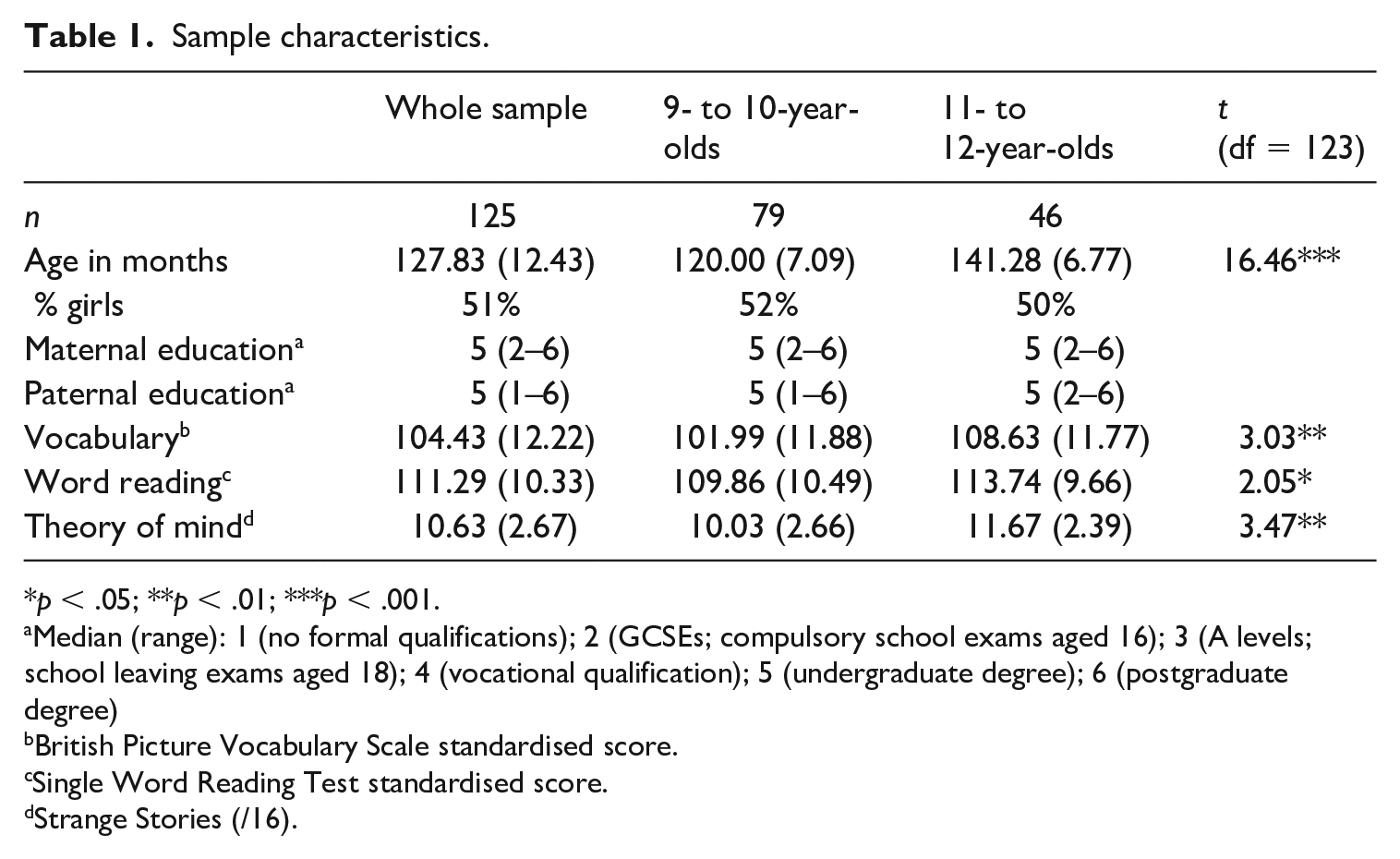
p < .05; **p < .01; ***p < .001.
Median (range): 1 (no formal qualifications); 2 (GCSEs; compulsory school exams aged 16); 3 (A levels; school leaving exams aged 18); 4 (vocational qualification); 5 (undergraduate degree); 6 (postgraduate degree)
British Picture Vocabulary Scale standardised score.
Single Word Reading Test standardised score.
Strange Stories (/16).
Measures and procedures
Narrative production task and coding procedures
Narratives were elicited from children using the wordless picture book Frog, where are you? (Mayer, 1969). This storybook has been used in many previous studies on narrative production in typical and atypical development (e.g. Bamberg & Damrad-Frye, 1991; Norbury & Bishop, 2003). The use of a simple picture book aimed at younger children was to reduce the demands of inferring the plot from the pictures, in order to give children the best chance of producing a high-quality narrative. This text has previously been used with typically developing older children, adolescents and adults to elicit fictional narratives (e.g. Berman & Slobin, 1994). The book comprises 24 pages, each displaying an illustration depicting a scene from a story about a boy and his pet dog and frog. After an initiating event (the frog escaping from its jar during the night), the central theme of the story concerns the boy and dog’s search for the missing frog, during which they encounter several animals and experience a series of misadventures. The story resolves when the boy discovers the frog in a pond with its new family. The pictures provide cues to characters’ mental states (e.g. facial expressions; a series of illustrations indicating a false belief on the part of the boy).
First, children were shown each illustration in turn by the tester and asked to study each one for a few seconds. Next, testers asked children to tell the story in as much detail as possible, turning the pages in their own time. Narratives were audio-recorded and transcribed verbatim. For the purpose of analysis, direct repetitions, reformulations and comments that did not relate directly to the story were removed. Transcripts were segmented into communication units (C-units), defined as an independent clause and its modifiers (Loban, 1976).
The narrative transcripts were coded for seven variables tapping the complexity of language produced, semantic and discourse-pragmatic characteristics. A second rater coded 30% of the sample and inter-rater reliability was assessed by computing intraclass correlations. All variables showed very good inter-rater reliability (see Table 2 for intraclass correlation coefficients).
Summary of narrative production coding variables, maximum possible scores and inter-rater reliability (intraclass correlation coefficients).
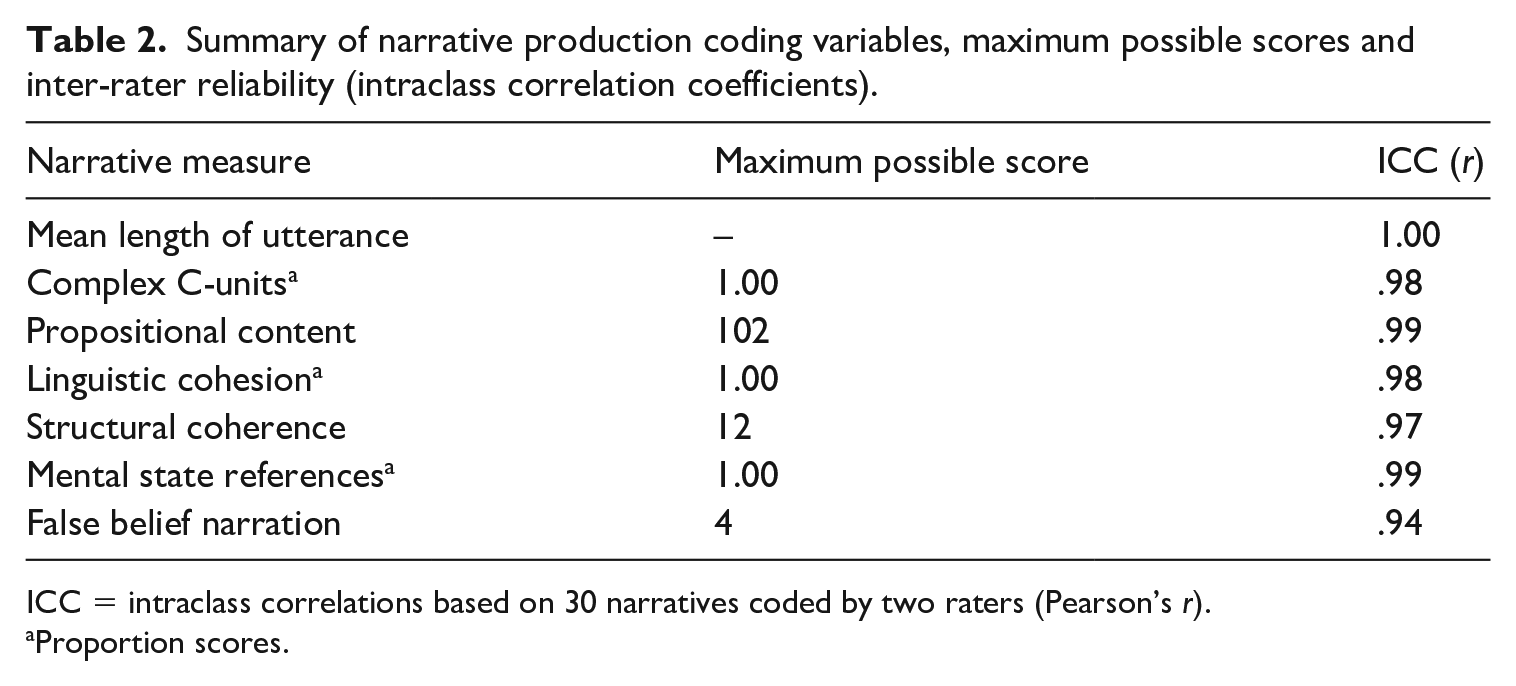
ICC = intraclass correlations based on 30 narratives coded by two raters (Pearson’s r).
Proportion scores.
a. Mean length of utterance
MLU was calculated as the mean number of words per C-unit.
b. Proportion of complex C-units
Each C-unit was coded as simple or complex (Norbury et al., 2014). A complex C-unit was defined as any utterance containing a main clause and at least one dependent clause, and therefore included relative clauses (The dog broke the jar that was on his head) non-finite dependent clauses (The dog appeared, barking happily), and finite dependent clauses (When the boy woke up, the frog had disappeared), and conditional clauses (If he hadn’t looked in the hive, he wouldn’t have got stung). Single-clause C-units in passive voice (The boy got bitten by a beaver) were coded as simple. Syntactic complexity was calculated as: [number of complex C-units / total number of C-units].
c. Propositional content
The list of 51 plausible propositions in Frog, where are you? compiled by Norbury and Bishop (2003) was used to rate children’s narratives for how much of the semantic information indicated by the illustrations was included (see Appendix available online). Each full and accurate proposition (e.g. bees chase dog) was awarded two points, while a partial or somewhat inaccurate proposition (e.g. dog runs away/ flies chase dog) was awarded one point, giving a maximum possible score of 102. Internal consistency for this measure was good (Cronbach’s α = .88).
d. Linguistic cohesion
An adapted version of Cain’s (2003) procedure for coding inter-clausal connectives was used as an indicator of narrative cohesion. Connectives were coded for whether they expressed a dependent relation between two propositions, including temporal relations (e.g. later, before), adversative relations (e.g. but, although) or causal relations (e.g. because, so that). Connectives were coded as independent if they expressed an additive relation (e.g. and, also). The connective ‘(and) then’ was coded as independent, because while it might express a temporal relation, it was generally used in a repetitive, rote manner within children’s narratives (e.g. The dog barked at the bees and then the bees chased the dog.). Linguistic cohesion was defined as the proportion of propositions that were linked to at least one other proposition by a dependent inter-clausal connective.
e. Structural coherence
The coherence scale used with the same picture book in Reilly et al.’s (2004) study was adapted to capture variation in the extent to which narratives were structured around the story’s central theme. Points were awarded for explicit references to the initiating event (2 possible points), searching theme (7 points) and outcome of each search episode including resolution (7 points), giving a maximum possible score of 16 (see online Appendix for full coding scheme).
f. Mental state references
The number of explicit references to characters’ mental states in each narrative was tallied. Mental state references could include cognitive states (e.g. think, believe, know, remember, decide); emotional states (e.g. happy, worried, angrily, frantically, love); and desires/intentions (e.g. want, need, hope, try to). The total number of mental state references was divided by the number of C-units to control for narrative length.
g. False belief episode
The ‘Deer Scene’ coding scheme reported by Manhardt and Rescorla (2002) was used to rate children’s reporting of false belief. In this scene, conveyed in two illustrations, the boy grabs onto what look like branches of a tree. However, the branches are revealed to be the antlers of a stag, which lifts the boy onto its head and runs away. Children’s descriptions of this episode were rated on a 4-point scale differentiating the extent to which the boy’s false belief was explicitly described (see Appendix).
Experience of reading fiction
Children’s experience of reading fiction was measured using three instruments:
a. Book recognition test (BRT)
This measure was developed as an indirect test of fiction book exposure that could be completed by children without the need to read text (Zhang et al., 2018). Twenty key illustrations from fiction books aimed at readers between 9 and 12 years old were compiled. Titles were selected by extracting the most commonly occurring books from several children’s bestseller lists and a list of the most frequently borrowed books aimed at the target age bracket provided by a local library. The final list contained both classic titles (e.g. The Secret Garden) and recently published books (e.g. The Goldfish Boy). Children were shown each illustration on a laminated card and asked whether they recognised the book. Two points were awarded if the child provided the title of the target book, and one point if the child could only give some relevant information about the book (e.g. information about the plot), giving a maximum possible score of 40. Internal reliability for this measure was acceptable (Cronbach’s α = .73).
b. Author recognition test (ART)
Names of 24 authors of fiction aimed at 9- to 12-year-old readers (e.g. Holly Webb, Anthony Horowitz) interspersed with 16 foils were presented in a checklist. Stainthorp (1997) demonstrated that author recognition tests can be used reliably as an indirect index of exposure to books with children of primary school age and highlighted the importance of using culturally and temporally specific items in such recognition measures. Children were instructed to tick each name that they recognised to be an author. In scoring the ART, a point was deducted for each foil checked in order to correct for guessing (Cunningham & Stanovich, 1997). Examination of the data from this measure indicated that guessing was relatively rare; on average 3.49% of the sample checked each foil item. Internal reliability for this measure was acceptable (Cronbach’s α = .76)
c. Self-reported fiction reading habits
Two items from a child-report Reading Habits Questionnaire were included: (i) children were asked to rate how often they read fiction texts on a 5-point Likert scale ranging from 0 (never) to 4 (almost every day); (ii) children were asked to rate how much they enjoy reading for fun on a 5-point Likert scale range from 0 (I don’t enjoy reading at all) to 4 (I enjoy reading very much).
Language and cognitive measures
Children’s receptive vocabulary was assessed using the British Picture Vocabulary Scale, third edition (BPVS3; Dunn et al., 2009; published reliability: α = .91). Children were presented with an array of four pictures and asked to point to the one that matched a word read aloud by the tester. Items increase in difficulty until the discontinuation rule is applied.
Word reading was measured using the Single Word Reading Test 6-16 (Foster, 2007; published reliability: α = .98). Children were presented with a list of 60 words of increasing difficulty and asked to read the words aloud.
Theory of mind was assessed using the short-form Strange Stories task (Happé, 1994). A series of eight vignettes was presented in written form on cards and read aloud by the tester. After each vignette, children were asked to explain an aspect of a character’s behaviour, which required reasoning about complex mental states (e.g. intention to deceive). Scores for each item range between 0 and 2; internal reliability of this measure was high (α = .89).
After a full explanation of the purpose of the study and an opportunity for parents and children to ask questions of the researchers, children provided verbal assent and parents/carers written consent for children’s participation. Children took part in a single testing session with a trained research assistant; testing took place in the university laboratory, family home or school, according to parental preference and lasted approximately one hour. At the end of the testing session, children were given a gift voucher as a token reward for participation.
Results
The development of narrative production skills during late childhood
Descriptive statistics for the seven measures of narrative production are presented in Table 3, alongside tests of difference comparing the narrative performance of 9- to 10-year-olds with 11- to 12-year-olds. Older children’s narratives were more grammatically complex (as measured by MLU and proportion of complex C-units) and contained more propositional content than those of younger children; these age differences remained significant when vocabulary, word reading and theory of mind were controlled. Age effects were not observed in narrative cohesion, coherence, use of mental state terms or false belief narration. It is notable that only 20% of the sample explicitly mentioned the boy’s false belief during the Deer Scene (level 4 of Manhardt & Rescorla’s coding scheme; see Appendix).
Narrative production variables: Descriptive statistics (mean (standard deviation)) and age effects (independent samples t-tests).
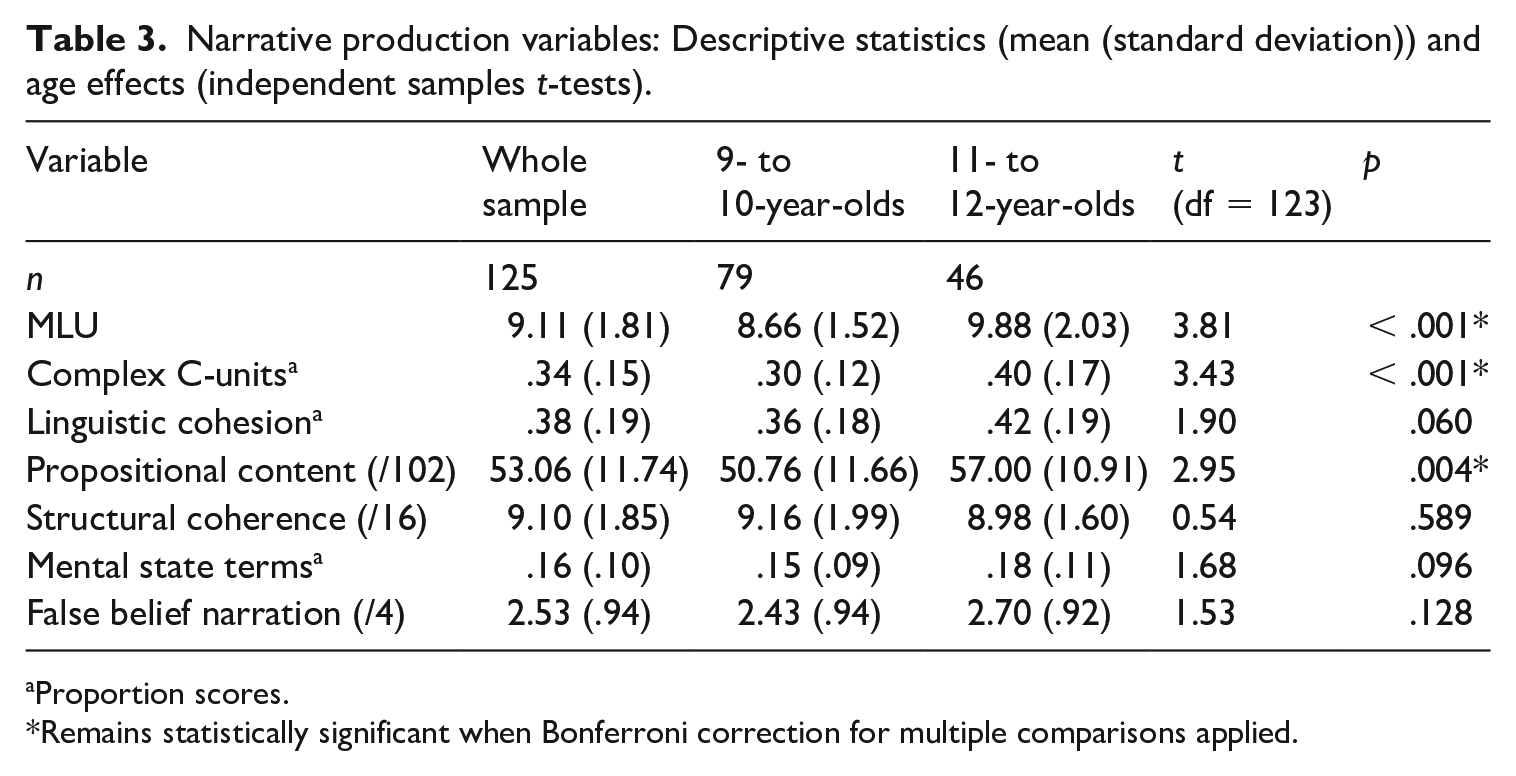
Proportion scores.
Remains statistically significant when Bonferroni correction for multiple comparisons applied.
The narrative measures were generally moderately to strongly inter-correlated (Table 4), although the measures of coherence and false belief narration were less robustly associated with the other variables. Correlations remained highly comparable in strength when children’s age was partialled out, indicating that associations were not explained by maturation.
Zero-order correlations (above diagonal) and partial correlations controlling child age (below diagonal) for all narrative production measures.
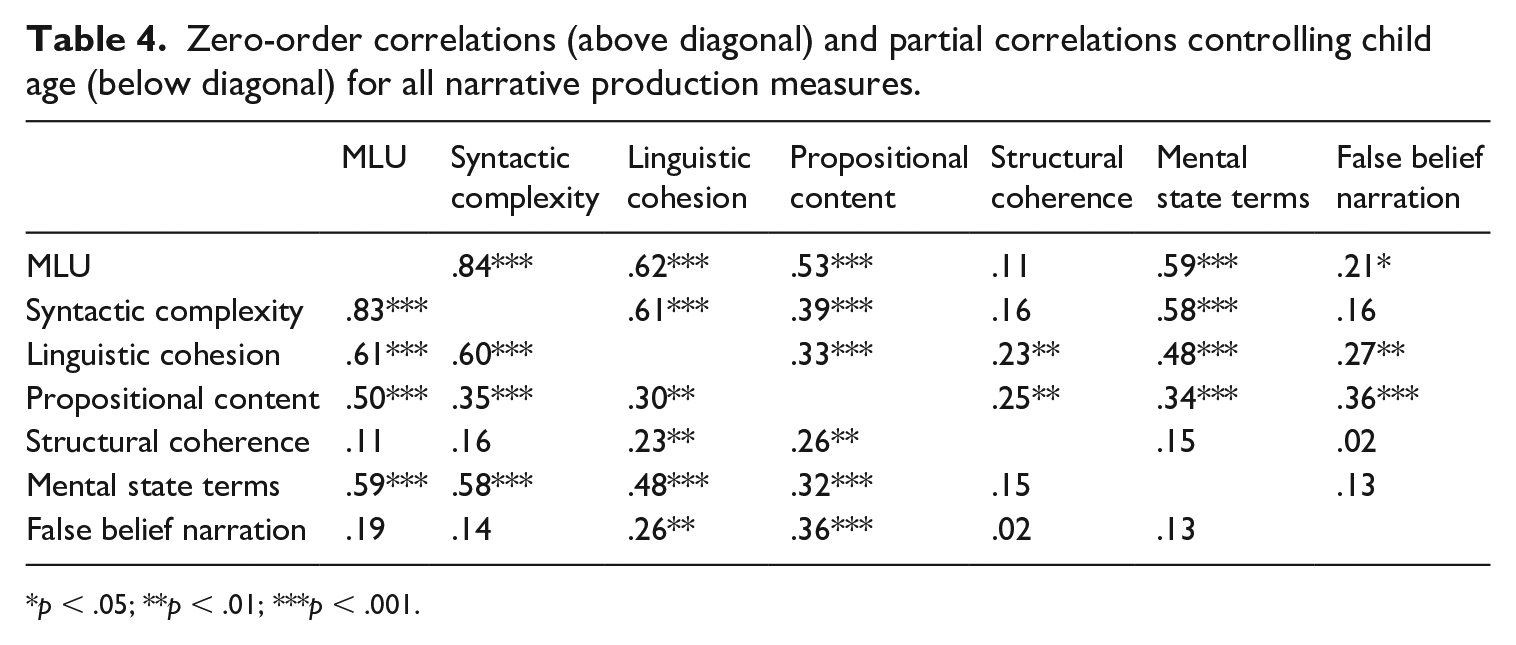
p < .05; **p < .01; ***p < .001.
To reduce the narrative production data for further analyses, standardised narrative variables were subjected to factor analysis. Because it was expected that factors would be correlated, since all measures were derived from the same storytelling episode, principal components analysis with oblimin extraction was utilised. The resulting model yielded a two-factor solution explaining 63% of the variance (Kaiser–Meyer–Olkin = .76; Bartlett’s χ2(21) = 351.51, p < .001). The first factor was defined by MLU, complex C-units, linguistic cohesion and mental state terms (factor loadings: .71–.93) and is interpreted to reflect the microstructure (observed linguistic quality) of children’s narratives. Propositional content, narrative coherence and false belief narration loaded onto a second factor (factor loadings: .42–.91), interpreted as reflecting the macrostructure (inferred conceptual representation) of children’s stories. Note that the factor loading for narrative coherence (.42) was substantially lower than for other variables; however, coherence is retained in subsequent analyses due to its theoretical relation to narrative macrostructure. These two factors were modestly inter-correlated (r = .38; p < .001).
Predicting individual differences in narrative production
Descriptive statistics for the four indicators of fiction reading experience are reported in Table 5; these variables were positively inter-correlated (r = .36–.59). Principal components analysis using oblimin factor extraction conducted on these variables indicated that scores on the book recognition test, author recognition test and self-reported reading enjoyment and frequency of fiction reading loaded onto a single factor with an eigenvalue of 2.33, which explained 58.32% of the variance in the data (Kaiser–Meyer–Olkin = .74; Bartlett’s χ2(6) = 121.72, p < .001; factor loadings: .70–.80). A summed z-scores composite representing children’s fiction reading experience was derived for use in subsequent analyses.
Descriptive statistics (mean (standard deviation)) for measures of fiction reading experience.
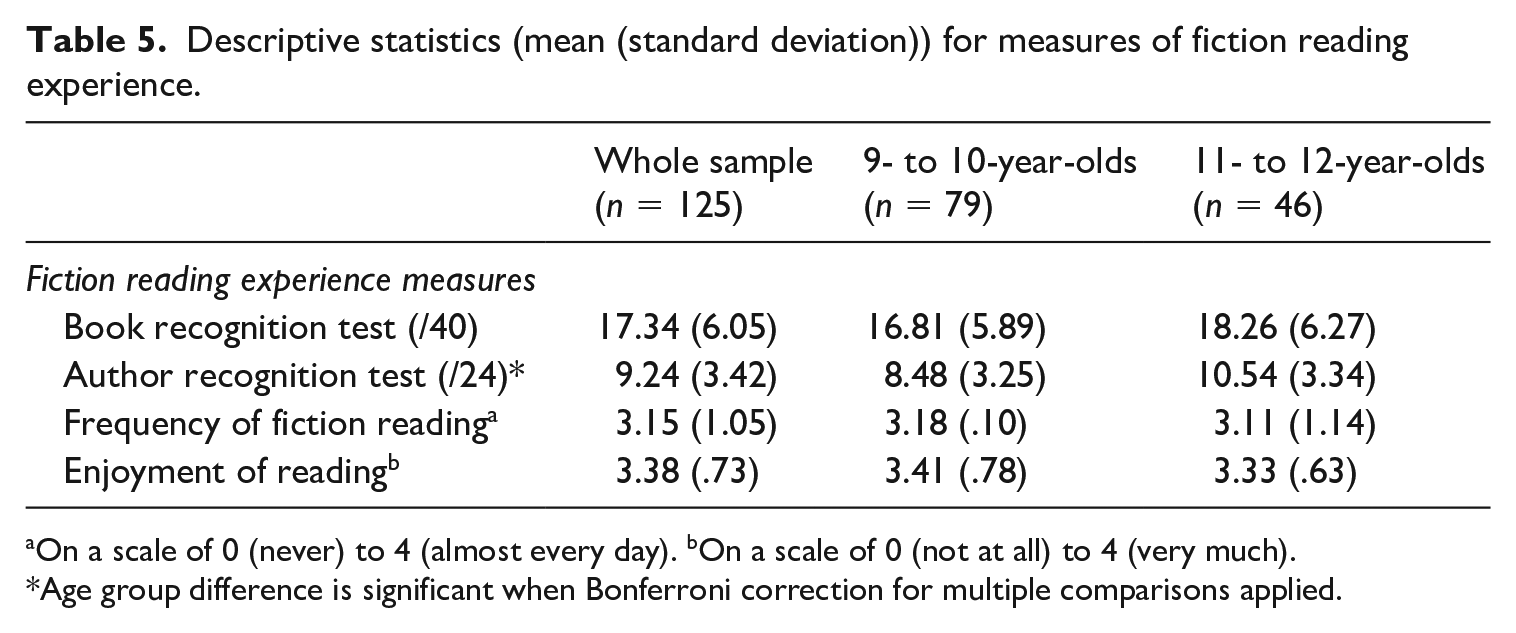
On a scale of 0 (never) to 4 (almost every day). bOn a scale of 0 (not at all) to 4 (very much).
Age group difference is significant when Bonferroni correction for multiple comparisons applied.
Table 6 presents correlations between all variables. Receptive vocabulary, word reading and theory of mind were all modestly related to narrative microstructure and macrostructure (ranging from r = .21, p = .018 to r = .37, p < .001). The composite measure of children’s fiction reading experience was modestly related to narrative microstructure (r = .26, p = .007) and narrative macrostructure (r = .35, p < .001). Fiction reading experience also showed positive correlations with tests of receptive vocabulary, word reading and theory of mind (r = .29–.48; p < .001). The four individual measures of reading experience were each associated with the narrative variables to a comparable extent with the fiction reading composite. Children’s self-reported reading frequency was less robustly correlated with the measures of vocabulary, word reading and theory of mind than the book recognition test, author recognition test and self-reported enjoyment of reading (Table 6).
Zero-order correlations (Pearson’s r) between narrative production, cognitive and linguistic measures and fiction reading experience.
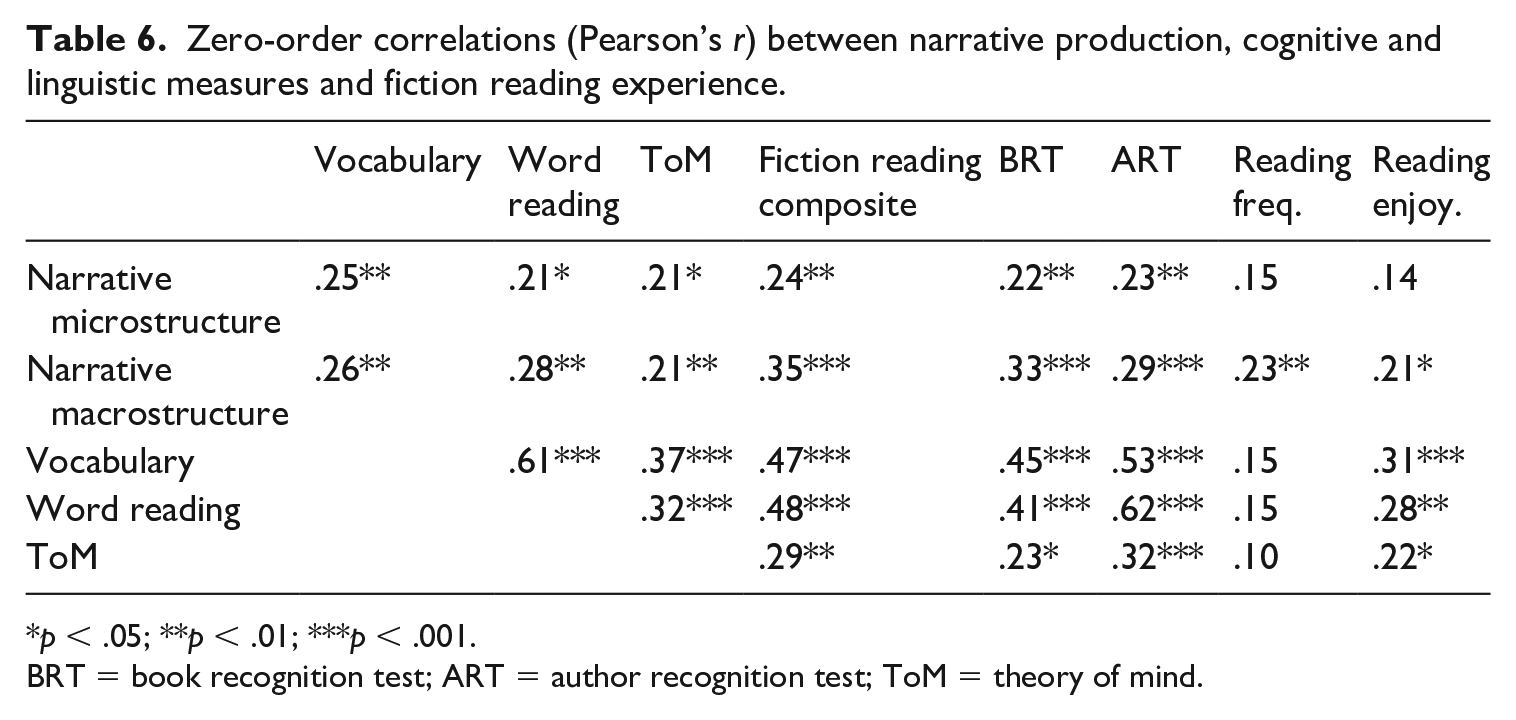
p < .05; **p < .01; ***p < .001.
BRT = book recognition test; ART = author recognition test; ToM = theory of mind.
To test whether experience of reading fiction predicts variance in children’s narrative production skills two hierarchical regression models were assessed, differing in the dependent variable (narrative microstructure or macrostructure). At the first step in both models, child age and maternal education were entered as control variables. At the second step, three cognitive-linguistic predictor variables were entered into the models (receptive vocabulary, word reading and theory of mind). Finally, at the third step the composite score of children’s fiction reading experience was entered. The regression models are summarised in Table 7.
Hierarchical regression models predicting variation in children’s narrative production.
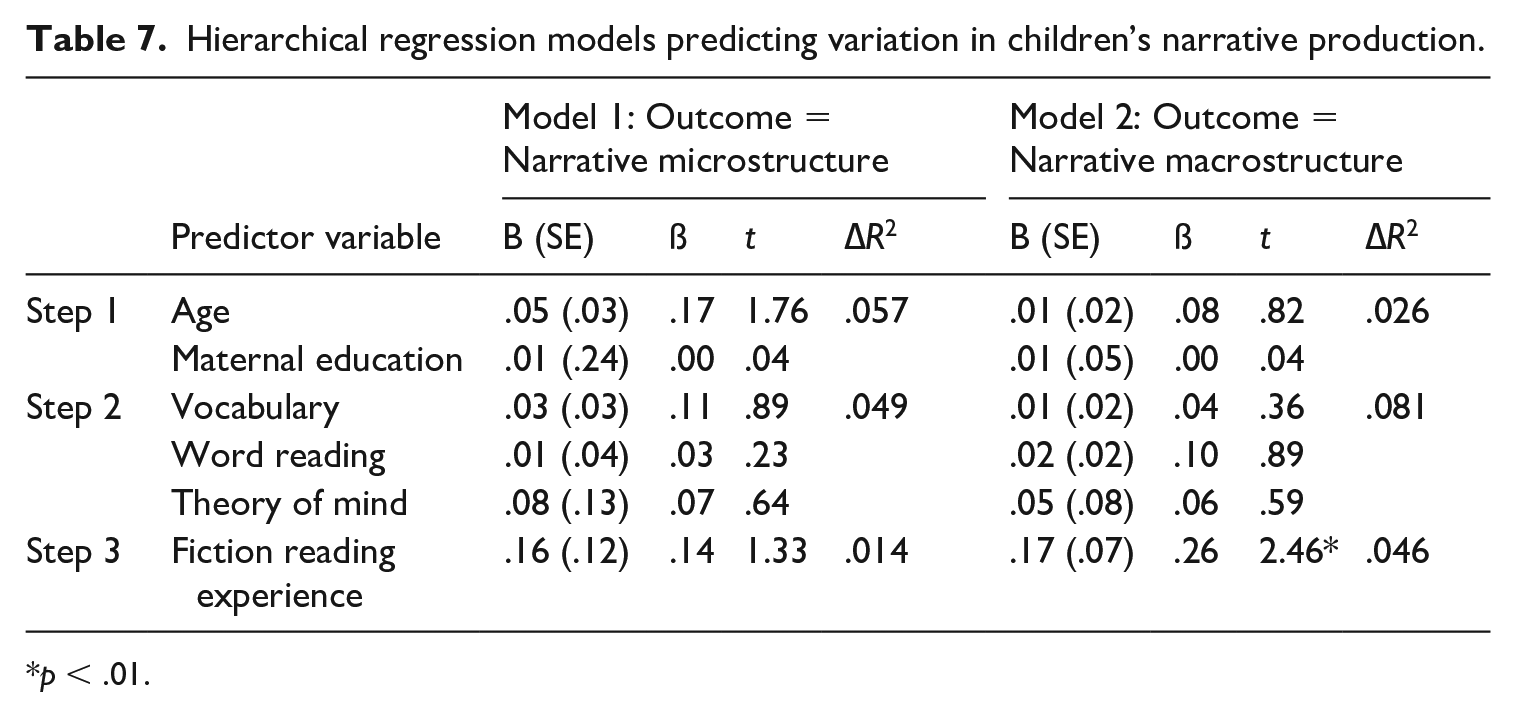
p < .01.
The combined set of predictor variables explained 12% of the variance in narrative microstructure (F (6, 111) = 2.53, p = .023; R2 = .120). None of the individual predictor variables reached significance; adding fiction reading experience at the third step did not significantly improve the fit of the model.
The second hierarchical regression model predicted variation in narrative macrostructure, explaining 15% of the variance (F (6, 111) = 3.35, p = .005; R2 = .153). While the addition of each step significantly improved the fit of the model, experience of reading fiction was the only statistically significant individual predictor variable. After controlling for the other predictors, experience of reading fiction predicted an additional 5% of unique variance in the macrostructure of children’s narratives.
Discussion
In this study, we aimed to characterise individual differences in the quality of oral narratives produced by typically developing 9- to 12-year-old children along a number of dimensions relating to linguistic, semantic and pragmatic features. Our second aim was to establish whether children who read more fictional texts for pleasure produce more sophisticated narratives and, if so, whether this relation can be explained by individual differences in vocabulary knowledge, reading ability and/or theory of mind.
We predicted that linguistic, semantic and discourse features of narratives would increase in complexity between the ages of 9 and 12 years. In partial support of this hypothesis, the linguistic quality of narratives showed development within this age range, with older children producing a higher proportion of grammatically complex utterances than younger children. Older children also extracted more of the propositional content of the story from the picture book illustrations and thus produced semantically richer narratives. However, the discourse-level narrative characteristics observed in the current study (linguistic cohesion, structural coherence and use of mental state terms) did not increase in sophistication within the age range studied. Previous research has demonstrated that later language development is marked by gradual increase in the use of more complex syntactic structures, such as embedded relative clauses and past perfect marking (Colletta et al., 2010; Nippold, 2004). However, when narrating a cartoon, the inclusion of narrative clauses (i.e. recounting an observed event) peaked in 10-year-old children and declined in adults; conversely, explanatory and interpretative clauses increased somewhat between 6 and 10 years, but were used most frequently by adults (Colletta et al., 2010). Taken together with previous studies, the current findings suggest that the use of syntactically complex language and inclusion of narrative detail gradually increases through late childhood. In contrast, discourse-level or evaluative features are less subject to age-related change in this developmental period. However, the developmental window investigated in the current study is relatively small; it may be that discourse-level features depend on social cognition, which shows rapid development through adolescence (Sun & Nippold, 2012).
While all seven measures of narrative quality were inter-correlated, principal components analysis indicated a two-factor structure to the data. The first factor was defined by mean length of utterance, syntactic complexity, linguistic cohesion and references to characters’ mental states, and is interpreted to reflect the microstructure of the narratives. Cohesive devices signal narrative structure by establishing links between sentences and clauses. However, the effective use of inter-clausal connectives to maintain narrative cohesion depends on syntactic skills, since inter-clausal connectives are used to combine clauses into more complex sentence structures. The measure of cohesion employed in the current study was more strongly related to indices of the quality of linguistic output (e.g. MLU) than to measures of discourse-level narrative quality (e.g. coherence). Similarly, use of mental state terms during narrative production is often conceptualised as an evaluative device (e.g. Bamberg & Damrad-Frye, 1991) reflecting the conceptual representation of the story. In the current study, the use of mental state terms was more closely related to indices of observed linguistic quality than inferred conceptual representation: children who used more mental state terms also produced more syntactically complex and cohesive narratives. Mental state terms typically consist of adjectives (upset, sure) or verbs (e.g. think, decide) that often require complements and thus are likely to occur within more complex sentence structures. The use of mental state terms in narrative may therefore be influenced by lexical properties of the words themselves, such that children with more advanced language skills are more likely to incorporate references to characters’ mental states. It is also possible that variation in the use of mental state terms reflects individual differences in theory of mind skills. In the current study, however, the use of mental state terms was significantly correlated with a standardised test of vocabulary but not with a test of advanced theory of mind. Previous studies have also reported weak or no concurrent associations between theory of mind understanding and the use of mental state terms in spoken language during middle to late childhood (e.g. Carr et al., 2018; Grazzani & Ornaghi, 2012).
A second factor was defined by propositional content, structural coherence and false belief narration and is interpreted to reflect narrative macrostructure. In order to score highly in these measures, children need to construct a rich mental model of the story from the sequence of illustrations and judge which information should be included in the spoken output for the listener to make sense of the story. Of all the propositions indicated by the illustrations of Frog, where are you?, the children in this study on average referred to approximately half with substantial individual differences evident in the amount of information included. The measure of false belief narration assessed the level of detail provided on the central character’s cognitive mental states during one episode of the story. Only 20% of children explicitly mentioned the false belief underpinning this sequence. As with children’s use of mental state terms more broadly, false belief narration does not appear to be underpinned by variation in theory of mind understanding. Rather, this measure is interpreted to reflect the sophistication of the conceptual representation of the story children construct through study of the illustrations. The measure of structural coherence was less robustly correlated with other indices of narrative quality and loaded weakly onto the macrostructure factor. It is possible that more sophisticated narratives in this age group made fewer explicit mentions of the search theme, instead maintaining narrative coherence through implicit orientation to the central theme. The modest positive correlation observed between the two narrative factors is consistent with the idea that the quality of the conceptual message influences the language produced (Bock & Levelt, 1994). For example, children who infer more complex relations between propositions in the story from the illustrations (e.g. cause-and-effect relations; mental states underpinning characters’ behaviour) are likely to produce more complex linguistic structures to convey these conceptual relations. Given the cross-sectional correlational data reported here, however, causal pathways cannot be inferred.
The second aim of the study was to assess whether children who have more experience of reading fictional texts produce more sophisticated narratives. Both a composite score indexing fiction reading experience and individual recognition checklist and self-report measures were positively correlated with most individual indices of narrative quality. However, fiction reading experience was a unique predictor of the macrostructure, but not microstructure, of children’s narratives, once linguistic and cognitive predictors were controlled. In line with previous studies (e.g. Cain & Oakhill, 2011; Cunningham & Stanovich, 1997), our measure of reading experience showed robust correlations with standardised measures of children’s vocabulary and word reading ability. Congruent with a smaller literature on the relation between reading habits and theory of mind (e.g. Mar et al., 2010), children who had more experience of reading fiction also scored more highly on the Strange Stories test. However, the association between children’s fiction reading experience and the macrostructure of their spoken narratives was not explained by vocabulary, word reading or theory of mind. Reading fiction provides a context for children to learn about propositional concepts typical to narratives (e.g. characters’ behaviours underpinned by false beliefs). Children with more exposure to fictional texts may therefore have access to richer conceptual representations to underpin story construction, whether in spoken form as in the current study or written form (Sénéchal et al., 2018).
The link between narrative language and literacy development has been widely documented in the literature (Dickinson & McCabe, 2001; Suggate et al., 2018). Storytelling recruits children’s syntactic, semantic and pragmatic language skills, as well as knowledge of narrative conventions and background knowledge. There is evidence of the impact of literacy experiences on the emergence of these narrative skills early in development (e.g. Lever & Sénéchal, 2011). Our findings suggest that substantial individual differences in narrative production persist into late childhood and remain linked to literacy experience. While strong causal interpretation of these cross-sectional data is unwarranted, the fact that the association between fiction reading experience and narrative production was not explained by individual differences in children’s vocabulary, reading and theory of mind skills is consistent with the hypothesis that exposure to book language has a role in supporting discourse-level comprehension and production once children have achieved fluent reading (Sénéchal et al., 2018; Torppa et al., 2020). There is evidence to suggest that reading for pleasure tends to decline between late childhood and adolescence, in part displaced by other leisure activities (Nippold et al., 2005; Sullivan & Brown, 2015). Given the importance of book reading for language, literacy and broader educational attainment, fostering children’s motivation to read independently through the transition to secondary school and beyond is of concern to teachers, parents and speech and language therapists working with older children. Factors identified as important in promoting reading for pleasure in young people include access to resources, choice of reading material and positive relationships with teachers, although the evidence base for interventions targeting reading for pleasure is currently limited (Department for Education, 2012).
The amount of variance in narrative microstructure and macrostructure explained by the variables included in this study was small (12–15%), suggesting that other factors influence the production of narratives in this age group. For example, the ability to produce extended decontextualised narratives depends on sentence-level and discourse-level language skills; the standardised measure of receptive vocabulary in this study captured only word-level knowledge. Previous research indicates that children’s narrative skills may also be supported by higher-level cognitive factors including executive function (Friend & Bates, 2014), metacognition (Lepola et al., 2020) and imagination (Trionfi & Reese, 2009).
This study has several limitations. First, structural coherence was not robustly related to other narrative production measures and loaded weakly onto a ‘narrative macrostructure’ factor. This may be explained by the fact that the story structure of Frog, where are you? is strongly indicated by the illustrations and so variance in performance on the measure of coherence was relatively limited. Given the simple story structure of Frog, where are you?, frequent explicit references to the central search theme are perhaps not needed in order to construct a coherent narrative. Individual differences in coherence may be more evident in a less structured and/or more age-aligned narrative task or with a more sensitive measure of coherence. Second, while the multiple measures of fiction reading experience utilised in this study showed a similar pattern of associations with narrative, language and cognitive skills, suggesting a degree of convergent validity, it is likely that they did not capture the range of children’s reading experiences. Book and author recognition checklists may capture the literacy resources available to children in home and school environments as well as indirectly indexing reading habits. While the current study focused on experience of reading fiction books, it may be that experience of reading a wider range of materials facilitates narrative development. Narratives were collected on a single occasion and, as an example of naturalistic language in use, individual performance may be expected to fluctuate if repeated measures were taken. Finally, the concurrent design of the study means that causal interpretation of the findings is not possible; it may be that having stronger narrative skills leads children to read more fiction, or that the two variables exert a reciprocal influence through development. However, the cultural transmission of narrative skills remains a plausible interpretation of the findings, supported by studies that report cross-cultural differences in semantic-pragmatic aspects of children’s narratives (Gorman et al., 2011). The multiple measures of narrative quality and fiction reading experience within a relatively large sample is a strength of the study.
This study explored individual differences in narrative production from a wordless picture book in a sample of 9- to 12-year-old children. Age effects were observed in the linguistic complexity and propositional content of children’s narratives, but not in narrative cohesion, coherence or use of mental state words, during late childhood. The macrostructure, but not microstructure, of children’s narratives was predicted by cumulative experience of reading fictional texts. The role of input and experiential factors in the development of high-level language skills such as narrative production would be clarified by longitudinal studies.
Supplemental Material
Appendices – Supplemental material for Individual differences in narrative production in late childhood: Associations with age and fiction reading experience
Supplemental material, Appendices for Individual differences in narrative production in late childhood: Associations with age and fiction reading experience by Lorna G. Hamilton, Isabelle O’Halloran and Nicola Cutting in First Language
Footnotes
Acknowledgements
The authors wish to thank Jessica Brown, Jessica Edge and Alex Chamberlain for assistance with data collection, and Jelena Mirkovic for helpful comments on the manuscript.
Author contributions
Funding
The authors received no financial support for the research, authorship, and/or publication of this article.
Supplemental material
Supplemental material for this article is available online.

References
Supplementary Material
Please find the following supplemental material available below.
For Open Access articles published under a Creative Commons License, all supplemental material carries the same license as the article it is associated with.
For non-Open Access articles published, all supplemental material carries a non-exclusive license, and permission requests for re-use of supplemental material or any part of supplemental material shall be sent directly to the copyright owner as specified in the copyright notice associated with the article.
