




Abstract
The rise in personal ownership of touch-screen technology such as iPads and smartphones in the UK in recent years has led to the increasing use of such technology by babies and very young children. This article explores this practice via an online parental survey with 226 UK parents of children aged 0–3 years within the context of the current debate around whether technology is a problematic or advantageous aspect of contemporary childhood. Using a theoretical framework which draws on dominant discourses of childhood, the article presents and analyses data from this survey in order to ascertain how 0–3s are using touch-screen technology in UK homes, and what parents perceive to be the potential benefits and disadvantages of their usage. The findings are discussed in terms of changes in parenting practice, and the importance of further research in the area is emphasised.
Introduction
Recent years have seen an enormous rise in the ownership and use of touch-screen technology such as tablets, smartphones and other mobile devices in many homes in the UK (Ofcom, 2013). These devices potentially offer the very youngest children (from around 6 months of age) the opportunity to engage with the digital world as interfaces on touch-screen devices are immediately accessible using swipes and drags with fingers.
The extent to which touch-screen technology is incorporated into the lives of very young children, and indeed whether it should be incorporated at all, is becoming increasingly recognised as a modern-day parenting dilemma (Cocozza, 2014). This issue deserves careful attention and discussion given the increasing ubiquity of tablets and touch screens in homes as devices become more affordable and easily available (George, 2014). This article reports on the findings of an online survey of UK parents about their 0–3-year-olds’ use of touch screens, and their perspectives on the potential benefits and disadvantages of such usage. This contributes to the small but growing field of research which is exploring parenting practices and issues surrounding the use of touch screens by the very youngest of children.
Literature review and theoretical framework
Parents are the main gatekeepers of their young children’s use of technology. It follows, then, that their beliefs and behaviour in relation to parenting, child development and learning are going to be instrumental in the access their 0–3s have to this technology. The ongoing debate around children’s use of technology is therefore of key relevance here, as parents tend to act according to their definition of being a ‘good parent’ (Robinson, 2013).
Flewitt (2012) has found that parental beliefs have a significant impact on if and how children use digital media in the home environment, with the most positive attitudes reflecting higher rates of usage. In their study of preschoolers using technology in the home, Marsh et al. (2005) found that most parents encouraged and supported their children’s early experiences with digital technologies because they believed that they would play a significant role in their children’s education and future careers. The social nature of children learning through technology was also reinforced in this study, as they found that many young children develop dispositions and competences with and through digital technology in the context of social interaction with their families and peers. In their research with families of 3- and 4-year-olds in Scotland, Stephen et al. (2010) reported that although many parents acknowledged positive aspects of technology, they also had concerns about the negative impact technology use could have in relation to their children’s social skills, physical well-being, emotional development and interest in books.
Stephen et al.’s (2013) associated study of preschool children playing and learning with technological resources at home found that parents’ attitudes were the most important factor in young children’s access to technology. This is supported by the findings of Verenikina and Kervin (2011), who explored parents’ perspectives on their 3–5-year-olds’ use of iPads in a small case study of three families in Australia. They found that parents have a pivotal role in access to these devices, often put time-limited boundaries in place and preferred their children to play ‘educational’ games.
Even though the research studies described here relate to children of a slightly older age group than the present study, it seems clear that perspectives held by parents about their very young children using touch-screen technology are mixed, and that children’s rates of use at home are closely related to their parents’ perceptions of the benefits and/or drawbacks of such use.
Although there are always points of convergence and shades of grey with any polarised situation, it does appear that two dominant discourses are evident in the literature around parenting and children’s use of technology, and it is useful to locate these in relation to the paradigm of the social construction of childhood (James and Prout, 2003). Within this theoretical framework, childhood is understood as plural and diverse, informed by cultural discourses which influence how children are treated, conceptualised and behaved towards in the wider society, and how they are parented and educated at home and at school. In terms of discourses around children and technology, the first can be identified as emanating from a perception of children – particularly very young children – as innocent, natural and in need of shielding from the adult world (Higonnet, 1998). Identifying with this position leads to protectionist behaviour around children and technology, whereby technology is seen as somehow robbing children of their childhoods. Palmer (2007) takes this stance when she writes about children today being polluted by (among other things) technology. This leads to them experiencing what she terms, rather unpleasantly, ‘toxic’ childhoods – an argument which is redolent, 20 years later, of Postman’s (1996) fears that watching television contributes to the ‘disappearance of childhood’ altogether. This type of panic-mongering around technology is often picked up in the right-wing press (e.g. see Adams, 2014), further establishing the correlation between being a ‘good parent’ and protecting or limiting your child(ren)’s access to and use of technology. The rise of outdoor play movements such as Project Wild Thing (Bond, 2013) and the identification of ‘nature-deficit disorder’ (Louv, 2010) can also be conceptualised as being less extreme manifestations of this discourse around childhood being more suitably aligned with the outdoor, social pursuits of nature, rather than the indoor, often solitary pursuits of technology.
The alternative and, in many ways, opposing discourse is grounded in the growing recognition of the opportunities technology offers children in terms of learning, playing and socialising. Also aligned to the concept of the ‘good parent’ is the belief that encouraging your children to use technology and enabling them to do so leads to better educational outcomes for them and, in time, a more successful experience in the world of work. This was demonstrated by Vittrup et al. (2014), who explored parental perceptions in the USA of the role of media and technology in their young children’s (2–7-year-olds’) lives and found that: ‘Overall, parents showed positive attitudes toward media, to the extent that they believed media exposure to be vital to children’s development, and many disagreed with recommendations from expert sources regarding age-appropriate screen time’ (1). They reported that 68.5% of the 101 parents surveyed agreed that ‘introducing technological tools at a young age prepared children better for tomorrow’s work force’, and 33% of them believed that ‘children may fall behind academically if their use of technological tools is restricted in early childhood’ (7).
As well as these two distinct discourses, there are multiple variations and mixes of both of these positions which are likely to be drawn on by parents at different times, depending on circumstances. For example, a parent may feel uncomfortable allowing their young child(ren) to use touch screens unsupervised for entertainment, but be happy for them to use FaceTime or Skype to communicate with grandparents.
The following analysis and discussion reflects on the extent to which these positions are held by those who completed a UK survey in the present study, and focuses on the views of parents with very young children aged from 0 to 3 – an age group which is frequently excluded from research on children and technology.
The purpose of this article is, then, twofold: firstly, to illuminate what 0–3-year-olds are doing with touch-screen devices in UK families at this time, in order to identify emerging common practices and norms, and, secondly, to ascertain what parents perceive as the advantages and drawbacks of their 0–3s using this relatively new technology, and the extent to which the justification of their practices appears to be aligned with either of the two dominant discourses around young children and technology. Findings in both of these areas have implications for supporting parents in guiding their children’s use of touch-screen technology and in understanding the ways in which touch-screen technology is becoming an established part of the social and learning world of many of the very youngest children in the UK and beyond.
Methodology and methods
The methodology used for this study recognises the subjective nature of parental responses to questions about their 0–3s’ use of touch screens, and is based on the concept of childhood and parenting as socially constructed categories which vary according to cultural and social context. From this methodological stance, the responses received from parents have been interpreted according to the key discourses around children and technology which have been outlined in the previous section in order to identify patterns and categories of experience and perception that appear to correlate (or not) with established ways of thinking around very young children in contemporary Western society.
The data for this study was collected via an online questionnaire, which was circulated through personal, parenting and professional networks. The only stipulation for respondents to the questionnaire was that the parents or carers completing it should have at least one child under 3 years of age (36 months). The questionnaire was open for three months from January to April 2014 and was completed by 263 respondents who had a child under 36 months. The questionnaire included demographic tickbox-style questions about the respondent and their family, and questions relating to what (if any) touch screens their children used, what they did on them and how often. The data from these questions is quantitative, and the findings are either described or presented in bar-chart format. Descriptive statistical analysis was undertaken in order to summarise the data and provide an overall picture of the sample and the findings (Winkler, 2009). There were also open questions relating to the parents’ opinions about touch-screen use by very young children in terms of what they felt were the positive and worrying aspects of this practice, and what information/guidance would be helpful to them in managing their very young children’s use of touch-screen devices. This data is qualitative and is presented in the findings section in relation to the categories which arose from recurrent themes in the parental responses. These responses were coded according to patterns which emerged from the data and which related to the key themes of the research around the perceived benefits and drawbacks of 0–3s using touch screens, and the discourses on early childhood to which these relate.
It is important to note here some inherent limitations to this study. The self-selecting nature of the respondents to the questionnaire is a particular weakness of the study, as parents who are not interested in technology, lack the skills to use it or do not own any computers or mobile devices were very unlikely to complete the survey, even if they were emailed it. The majority of the respondents were also limited to being part of the parenting or professional groups targeted by the email containing the questionnaire link, or being personal contacts of the research team, who then often emailed the link on to friends or family who also had children under 3, tweeted it or put it on their Facebook page. This has resulted in a largely middle-class sample of British professionals, and it is recognised that important perspectives and information from diverse and disadvantaged families have been effectively excluded. Therefore it is important to reiterate the point that this study is not meant to be representative of all families in the UK with children under 3. Due to the informal snowball method of data collection (Browne, 2005) and the global nature of communication technology, the survey also found its way to respondents from a range of different countries. However, the vast majority of the respondents (226 out of 263) came from the UK, and it is this subsample whose responses are reported here.
Of the 226 UK participants, 203 were female and 23 were male. They ranged in age from 20 to over 60, with 47 under 30, 152 aged between 31 and 40, and 27 aged over 40. The respondents were mainly parents (219), with 7 grandparents also completing the survey. In terms of ethnicity, the majority were white British (198), with the remainder being Asian or black British or of mixed heritage. As an indicator of social class, the respondents were asked to indicate their highest-level qualification (see Rose and Harrison, 2010), and 194 reported having a university degree or higher degree, with only 2 respondents having no qualifications. In relation to the children under 3 who were the focus of the responses, there were 252 children (129 female and 123 male), ranging in age from 1 month to 36 months. All of the respondents were anonymous, and the first page of the survey explained that, by completing the questionnaire, they were consenting to their data being included in the study.
It is important to acknowledge the differences that can exist between what parents/respondents report to do with their 0–3-year-olds in relation to touch-screen technology and what they actually do. This ‘reality gap’ has been recognised as a weakness of survey data which is not triangulated by other research methods such as observations or semi-structured interviews (Seale, 2004). Whilst acknowledging that the findings reported here may or may not accurately reflect ‘reality’ (a problem inherent in all research to some extent), the value of this study resides in the way the survey allows a relatively large group of parents to anonymously express their concerns, justify their practices and share their children’s positive experiences with touch-screen technology at a time when it is a relatively new part of their families’ lives. Identifying the patterns of their responses and the discourses they seem to be drawing on is an important step towards understanding this new and, in many ways, unchartered dimension to parenting very young children.
Findings
In what ways do 0–3-year-olds use touch-screen technology?
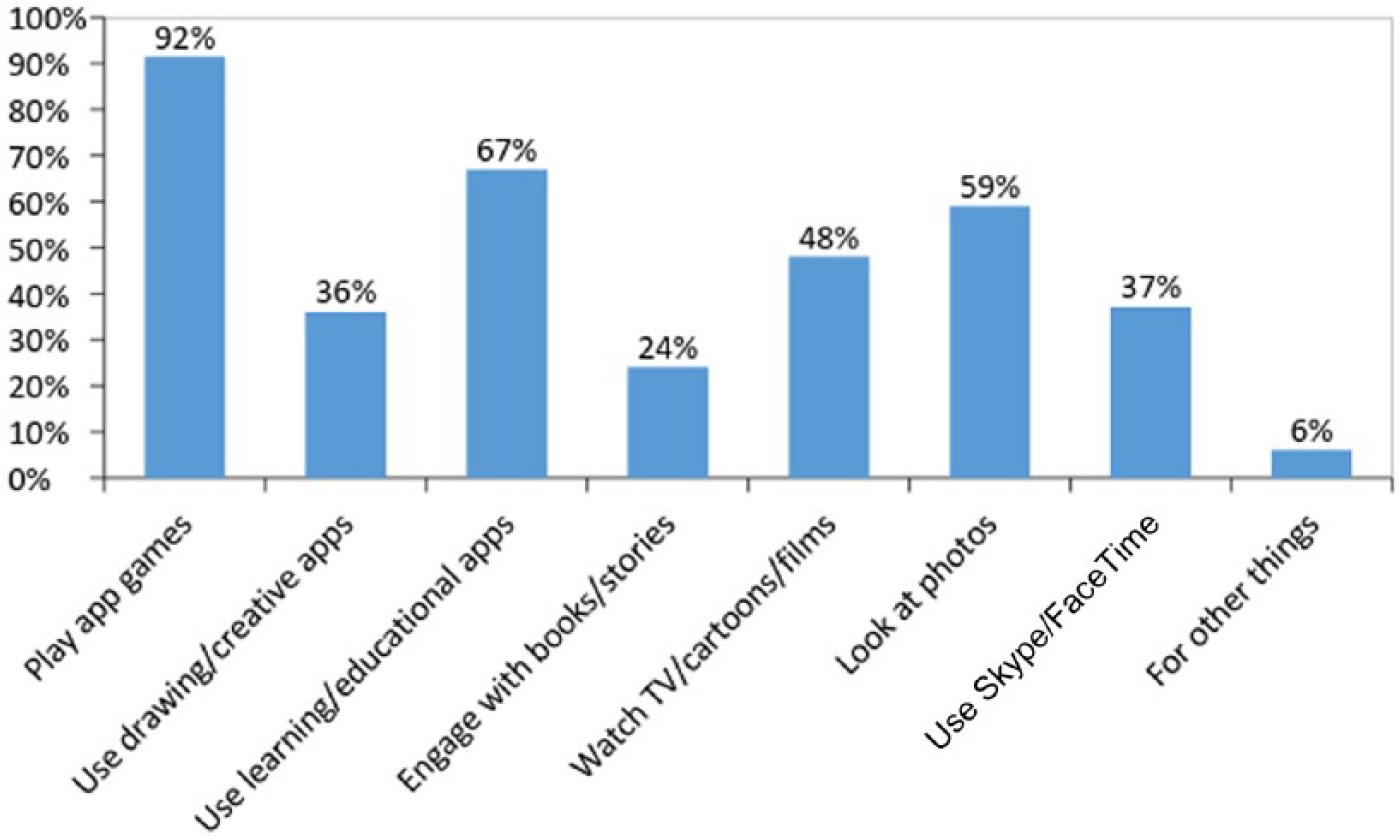
In her study of families in four European countries, including England, Palaiologou (2014) found that the rate of children under 3 having access to digital technology, including tablets, was around 60%. However, responses to this survey indicate that the rate of children under 3 in middle-class homes in the UK using a smartphone or iPad (not including other computers or laptops) daily or sometimes is slightly higher, at 66%. This suggests that rates of usage in this age group may well be rising quickly due to the easily accessible nature of touch screens and tablets and the weakening of what Vittrup et al. (2014: 10) describe as ‘parental scepticism around young children using technology’. The most common reasons given by parents for their 0–3s to use touch screens are shown in Figure 1.
What do 0–3s do with touch screens?
Playing game applications (apps) is the most popular use of touch screens with this age group. With so many free game apps available which are tailored to babies and toddlers, 0–3s may be able to use these fairly independently. For such young children, it is unsurprising that the relatively passive pursuits of looking at photographs and watching video sources are also common uses of touch screens. This fits with the finding that the majority of parents say that their 0–3s use touch screens for ‘entertainment’ – once set up, very little input is needed from an adult for a young child to engage with either of these activities.
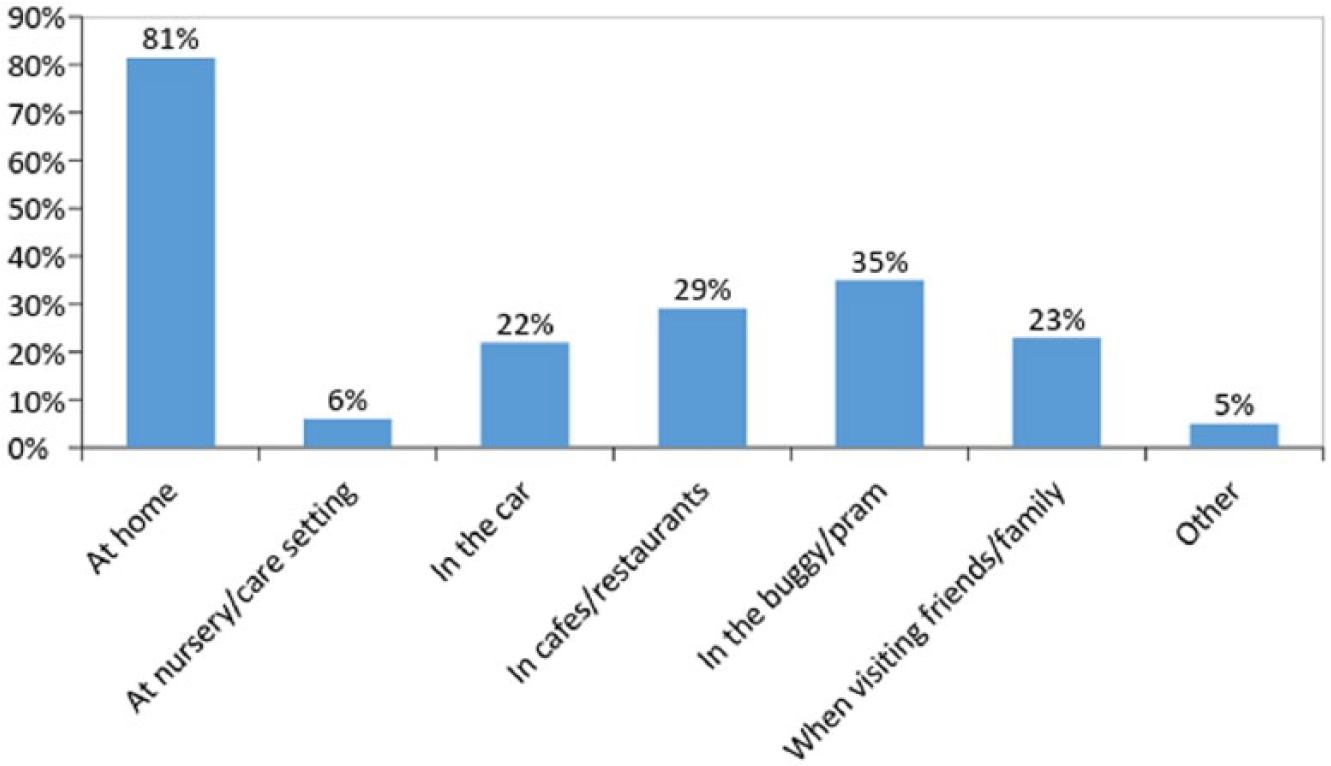
In terms of where 0–3s use touch screens, Figure 2 shows that ‘at home’ is by far the most common place, in line with previous research which has documented the rise in preschoolers using technology at home (see Stephen et al., 2013). The relatively low percentage of parents who say their 0–3s use touch screens at nursery may be due to the children not being in settings at all or to their parents being unaware that touch screens/tablets may be being used in their children’s settings.
Where do 0–3s use touch screens?
In the ‘Other’ category, parents also mentioned using touch screens/tablets when on aeroplanes with their 0–3s and at medical appointments and in waiting rooms to keep the child calm and occupied. These are both areas of public life which can be particularly challenging with a very young child, and the distraction offered by a touch screen or tablet has the potential to ease parental stress considerably.
What do parents perceive as the benefits of their 0–3-year-olds using touch screens?
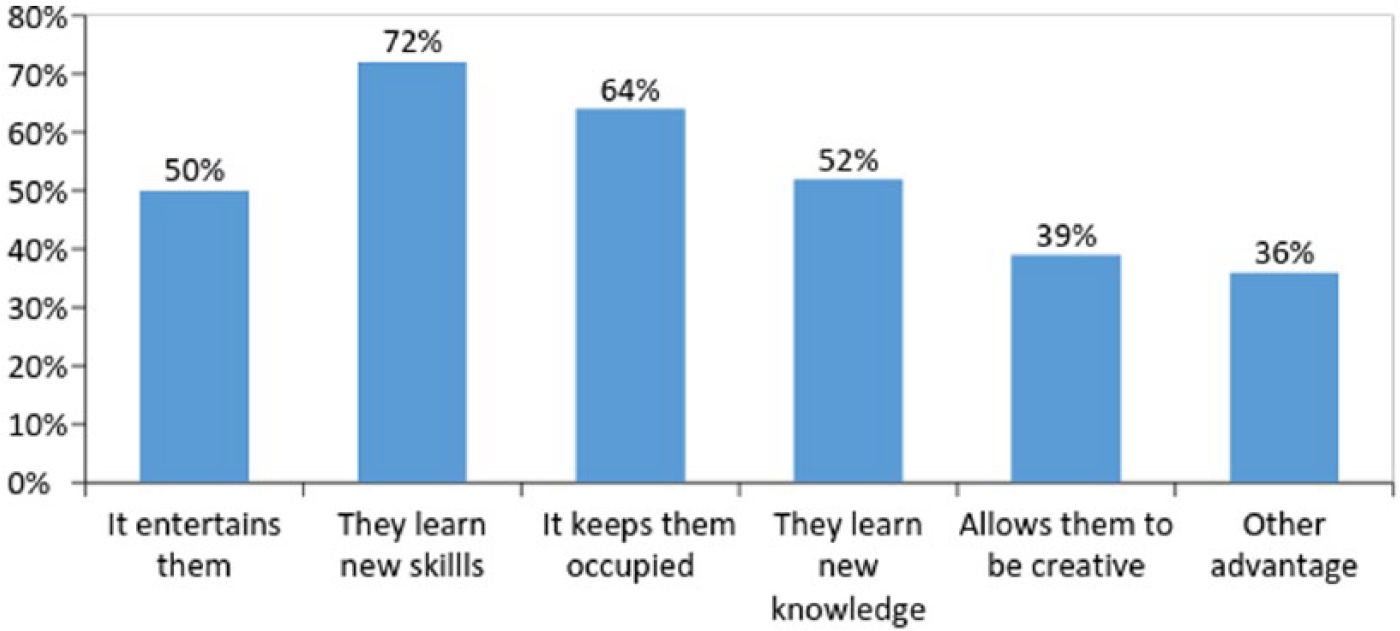
The parental responses to the question asking them to tick the advantages/benefits they perceive for their very young children using touch screens are shown in Figure 3. The use of touch screens for learning new skills was the highest-scoring benefit perceived by parents, followed closely by using touch screens to keep them occupied.
What do parents/carers perceive as the benefits of their 0–3-year-olds using touch screens?
Parents were given the opportunity of providing additional written comments to this question. Some also made relevant comments at the end of the survey when they were asked if there was anything they would like to add about their 0–3s’ use of touch screens. The qualitative responses from both these sources were coded into the following categories of benefit to the child: technological capital; educational advantage; distraction; self-actualisation; and family contact. These are expanded on below.
Many responses (38%) focused on the ways in which parents felt that an early investment in learning how to use technology would be beneficial to their children at some point in the future. Acknowledgment of the ever increasing role technology will play in the future lives of the children was a common theme, as evident in the following examples:
It will help him adapt to the computer age. They are being introduced to technology that they will be using throughout their life. We live in a technological world, it’s going to be an important skill in his lifetime.
Closely related to the ‘technological capital’ category are the ‘educational advantage’ responses, which focus particularly on key literacy and numeracy skills which touch screens are perceived to help very young children acquire. For example: ‘My daughter has started to read (preschool). This is largely due to her using apps we have put on the tablet’. Being a ‘good parent’ seems to be interpreted here as ensuring that their children are ‘keeping up’ with technological, and therefore social, changes. This awareness of the need for future technological skills has not been documented before in relation to children as young as this and is an important indicator of the impact touch screens may be having on perceptions around very early childhood education and play.
Some parents (8%) talked candidly about using touch screens for more practical reasons, such as for distracting or controlling their very young children – for example:
My child only uses it during nappy change, it’s the only way I can get her to stay put. It can be an instant pleaser in places such as the car (my 2-year-old hates car journeys) and occasionally if out eating etc and she is bored of drawing/playing it keeps her still. We use specific apps to help distract during medical procedures for child.
This recognition of very young children’s fascination with touch screens was also evident in parents’ reporting of the way in which touch screens were perceived to enable very young children to express their creativity, pursue knowledge or explore their own identity. Comments on this theme of ‘self-actualisation’ included the following:
They can follow their interests, choose what they are interested in and pursue it when they want to. It’s fun for them, and they see us doing it, but mainly it gives him access to a world of possibilities mostly pictures which is why I love the internet too. She can be very impatient when she cannot achieve something. Using the iPad has allowed her to learn to do something e.g. complete a puzzle before she was dexterous enough to complete a real one.
The child experiencing self-actualisation through touch-screen use is related in some ways to the concept of the ‘innocent child’ who is free to explore the world and express himself or herself without adult constraint. Ironically, however, the image of the ‘innocent child’ is very closely tied with natural surroundings and so is, in many ways, antipathetic to the image of the child using a mobile device.
Another interesting category of responses focused on the opportunities touch screens presented to very young children for communicating and connecting with absent family members, even over very long distances:
We live a 3 hour drive from family and so being able to FaceTime with them on a regular basis is really important for us all. My daughter loves to see her family on FaceTime and I think it’s important. Allows him to see and ‘chat’ with grandparents who live far away.
In a time of increasingly geographically disparate extended families due to changes in social mobility, employment patterns and globalisation, it is clear that mobile touch-screen devices offer important opportunities for even very young children to develop relationships with distant family members (Kelly, 2013). This use of touch screens seemed to be uncontentious for the respondents, and no negative comments were made about the facility for babies and toddlers to see and connect with physically absent friends and family.
What concerns do parents have about their 0–3-year-olds using touch screens?
The majority of the parents (61.5%) reported having concerns about their 0–3s using touch screens. Tickbox options were not provided for this question, as it was not considered ethical to unnecessarily alarm parents or give them cause to worry about the possible consequences of their very young children using touch screens. For this reason, the question was left open, with parents contributing their own unprompted written concerns.
The responses to this question drew largely on the discourse of childhood innocence, whereby children are perceived as primarily vulnerable and in need of guidance and protection, with the adult knowing best and being the advocate for the child’s well-being. There was also evidence of the established and historical polarised debate on children and technology, with a small number of respondents (6%) reporting having no concerns at all about their under 3s using touch screens, and locating their use as no different from other activities such as reading books, and others being so worried about negative effects that they allow no use at all. The positions held at opposite ends of the scale in this debate are evident in the following extracts. There were the very relaxed:
No concerns as we limit access and use apps that restricts little one’s access to the rest of the phone. No, I don’t understand why it is any different from a book, it’s only bad if used inappropriately same as any other form of media, everything in balance.
And there were the very concerned:
We have not encouraged our daughter to use a touch screen. We haven’t even let her know it’s possible to play games on devices etc. It doesn’t seem right to me that she might be potentially able to use a device very competently before she is able to speak properly. I would not let my son use anything other than the camera at this age [21 months]. He does not use the smartphone for anything else.
However, the majority of the respondents (66%) allowed their under 3s to use touch screens, but 85% of them reported putting limitations on their use (usually between 20 and 30 minutes per day). The range of concerns expressed about the practice fell into the following broad categories and seemed often to be compounded by a lack of trusted official guidance and research-based evidence.
Becoming addicted/dependant
Many parents (26%) expressed fears that their child may become over-reliant on, or even addicted to, their mobile devices. This is a concern which is familiar in relation to older children playing computer games and to all ages of children watching television, but which has not been widely documented in relation to such a young age group using digital technology. The following comments illustrate the unease many parents feel at allowing their children to use touch screens, and go some way to explaining their need for official guidelines on what limits they should be setting around their children’s usage of the devices:
I worry that he expects to play on it a lot and gets upset if I say no. Screens seem to be addictive in a way that books/toys are not.
Connected to these addiction concerns were worries about the potentially unknown unpleasant physical consequences of touch-screen use, which again aligned with the protectionist discourse around early childhood.
Worries about negative physical effects and developmental delay
Ensuring that their very young children were learning to interact and communicate effectively was extremely important to the questionnaire respondents. Examples of comments around this issue are provided below and represent significant first-hand observations of how touch-screen use may be interfering with this important area of development:
In the very young babies if the screen is very close to their face … it reduces the time they can spend looking at real people’s faces and learning social skills. My toddler sometimes gets very focused on the screen and does not want to interact with the rest of us. This worries me, so we do limit her use of the screens. I believe it discourages social interaction. Also when people use them to occupy a child in a restaurant for example it is not teaching children how to interact in different social settings and in my opinion replaces one bad behaviour with a quieter one.
Parental fears also related to the ways in which touch-screen use may impact negatively on their child’s cognitive, social and physical development (including eyesight). These types of concerns are reflected in the following responses:
Yes, they become fixated in certain games that have no value to their development. It is then hard to remove the device and engage the child in other activities that I feel are of greater benefit to their development. If they use it too much it might prevent them from developing other relevant skills at the right time – but what is too much?
The idea that touch-screen use is not part of what is accepted as ‘normal’ development (Piaget, 1972) is a strong one and reflects a conceptual separation between technological skills and other skills that young children need to develop, as well as a common bias towards more ‘natural’ occupations for very young children. This is linked to the category of responses in which parents voiced concerns over the way touch-screen use may be replacing the traditional play and learning that characterised their own childhoods in a less technologically saturated time.
Accessing inappropriate content
The discourse on protecting childhood innocence was particularly strong in this category of responses, in which parents voiced concerns about their very young children accessing what was felt to be inappropriate content. This is a well-documented – and very real – fear in relation to children and media, and has been evident since the advent of communication technology, reflecting the destabilising impact new technologies can have on parent–child power relations (Byron, 2008). Comments around this issue included the following:
I control the content my son has access to. I would not like him to access violent games or sexual content or anything age inappropriate. I recognise that I have to supervise content in the future as the internet contains unsuitable material which can be accessed by mistake.
The concept of children being damaged or ‘losing their innocence’ through accessing inappropriate material again aligns with the protectionist discourse, and suggests that official guidance and information around keeping safe on the Internet may need to be extended to include even very young children and babies.
Touch-screen use replacing traditional play and learning
That very young children learn through play has become accepted in most of the developed world and forms the basis of many curriculums and frameworks of early education, as well as informing health and education campaigns aimed at parents (see Patte and Brown, 2012). The strength of this discourse is reflected in the types of concerns the parents in this study have about touch screens taking these learning opportunities away from their children by replacing traditional forms of play and print books:
They very quickly start to want to play only on the iPad rather than anything else. The iPad version of reality is more colourful, easier and more appealing than real life e.g. colouring in an iPad is much easier than on real paper with real pens. For this reason, we limit their use and do not allow access every day. If they are on a tablet it’s likely they will be watching videos or playing games and this means they will not be doing other necessary activities like free, creative play, reading and exercise.
It seems clear from the types of concerns here and the lack of guidance on the issue that parental concern around 0–3s using touch screens is an area which needs further research. Indeed, in this survey, 95% of the parents had had no guidance or information relating to their 0–3s using touch screens from any source. Of the few parents who had had some advice, this had been sourced by themselves from paediatric websites or from professional friends and colleagues. The lack of informed guidance, particularly around ‘safe’ lengths of time for 0–3s to use touch screens, was a cause of concern for many parents.
Discussion and conclusion
The responses in this study have revealed some important findings with implications for parenting practice and further research in the area.
In relation to the enduring strength of established early childhood discourses around innocence and naturalness, the findings suggest that these are still very powerful in shaping the perceptions and beliefs of parents of very young children. This is reflected in the concerns respondents expressed in relation to touch screens potentially replacing traditional play and learning, and fears around children accessing inappropriate material online. The issue of touch screens replacing traditional play and learning is related to this as accepted middle-class constructions of being a ‘good parent’ have very much focused on encouraging children to read/be read print books and express themselves through physically creative and/or outdoor activities. The way touch screens are used threatens these traditional concepts of play and learning, and parents are understandably anxious as to the consequences of this for their children’s development and well-being. Concerns were also prevalent around the potentially negative impact of touch-screen use on babies and toddlers’ interaction and communication skills. Again, much research has highlighted the importance of talking to babies and encouraging social interaction to ensure healthy emotional and social development (see Whitehead, 2010), and touch-screen use appears to challenge this in ways that are clearly documented in the parents’ responses.
As well as identifying the strength of traditional perspectives on childhood evident in the parental responses, the study has also highlighted some novel ways of thinking about early childhood which may have important implications for the way in which very young children are conceptualised, cared for and educated in contemporary society. For example, the references to babies and toddlers needing to build up their technological capital in order to be successful in their future education and careers are a reflection of how touch-screen technology may be impacting on traditional ways of thinking about very early childhood as a time of protection from the ‘adult’ world of technology (Postman, 1996). There was also much positive feedback on the use of tablets to enable very young children to connect easily with distant family members via Skype or FaceTime, suggesting that it may not be touch-screen technology itself which is seen as a threat to the ideals of very early childhood, but how it is actually used.
This article has identified the growing practice of babies and toddlers using touch screens as a contested space in which adults attempt to reconcile their understanding of early childhood and their role as parents in the face of ‘new’ technology which has the potential to both threaten and emancipate their children’s experience of their earliest years of life. The concept of phronesis or ‘practical wisdom’ that changes over time and between generations is relevant here when considering how touch-screen technology presents parents with a new dilemma of parenting in circumstances which have shifted significantly since they themselves were children.
Traditional entrenched discourses on childhood innocence and fears around technology negatively impacting on early childhood are still clearly instrumental in influencing perceptions and behaviours, but new possibilities are arising and there is a growing recognition of the previously undocumented abilities of very young children to move into new territories of expression and learning using touch screens. As one parent commented with wonder in relation to her 10-month-old son: ‘I can’t believe how fast he’s picked things up – it really is amazing how well he can navigate a touch screen to get what he wants’. However, the survey responses also indicate that parents can hold various different positions concurrently in relation to their 0–3s using touch screens, whereby they may encourage their children to use such devices in certain circumstances or in certain ways, but not others. For example, one mother of a 13-month-old stated: ‘I would not let my son use anything other than the camera at this age. He does not use the smartphone for anything else’. And another parent of a 2-year-old explained: ‘We [parents] do not let our son have or use our smartphones when at home but we do use them out of the house and his nanny will let him use hers’. In this respect, the reality of touch-screen use for this age group is complicated by the, sometimes conflicting, attitudes and beliefs held by their parents about what is perceived as appropriate for their children. In relation to how early childhood is constructed by the parents who responded to this survey, it seems that touch-screen technology is a somewhat divisive issue. In line with earlier studies of children and technology (e.g. Marsh et al., 2005; Stephen et al., 2010), some parents have embraced the new medium as a way for their 0–3s to develop skills and competencies further. For others, however, touch screens represent a threat to cherished ideals around childhood innocence and children’s physical, social and emotional well-being (Louv, 2010; Palmer, 2007).
More research is clearly needed with a wider sample of parents of 0–3-year-olds in order to explore how touch screens can be used in ways that are most beneficial for their development and well-being, so that advice and guidelines for families can be produced that take account of parents’ needs both to protect their children and to prepare them for their future in a world mediated by technology.
Footnotes
Funding
The author(s) received no financial support for the research, authorship, and/or publication of this article.