




Abstract
This article documents the pedagogical and practical struggles of a sample of early educators in a large urban school district in the USA who engaged in a professional development course which offered them alternative conceptions of teaching that critically questioned the norms and practices of their high-stakes neo-liberal early education system. Examining the evolution of some of these teachers’ conceptions and practices illuminates the challenges that exist in attempting to address culturally relevant issues with students in a highly scripted and surveilled teaching context. It also reveals three key issues that early educators, teacher educators, and those who advocate for early childhood education should consider when developing and/or enacting alternative conceptions of teaching in similar neo-liberal early education environments.
Keywords
Introduction
The global political, economic, and social shift towards neo-liberalism (Harvey, 2005), which views public education as a governmental investment in its citizens that will convert them into lifelong learners who become earners who can pay back this economic venture into their development through their spending as consumers (Ailwood, 2008; Apple, 2001), continues to redefine the purpose, direction, and role of teachers in early childhood education (ECE) settings (Duhn, 2010; Perez and Cannella, 2011; Sumsion and Wong, 2011). In contexts such as the USA, these neo-liberal reforms have led to systems of education rooted in standards-based accountability reforms (O’Day, 2002) that focus on early educators teaching children a prescribed curriculum so that they are able to attain mandated achievement requirements (e.g. Buras, 2011; Parks and Bridges-Rhoads, 2012). This framing of early educators teaching children particular skills so that they are prepared to succeed in the public education system (e.g. Williams et al., 2012) ignores the cultural, linguistic, and economic complexities of the communities in which they live (e.g. Corsaro, 2011; Lipman, 2004) and fails to encapsulate how these racialized, developmentalist, and socio-economic/political contexts affect their experiences in school (e.g. Burman, 2008; Sleeter, 2008; Van Ausdale and Feagin, 2001).
The qualitative action research study (Costello, 2003; Craig, 2009) discussed in this article attempted to offer a sample of early educators in a large urban public education system in the USA, where the majority of their students come from linguistically, culturally, and socio-economically diverse communities, 1 alternative conceptions of teaching to this neo-liberal notion of practice through a professional development course. It did so by first asking them to engage with critical theory in the field of ECE (e.g. Cannella, 1997; Dahlberg and Moss, 2005; Mac Naughton, 2005) to question the norms, practices, and governing structures that exist in their high-stakes teaching contexts and become more aware of the critical issues children face on a daily basis within the communities in which they live, develop, and learn (Fleer, 2006; Langford, 2010; Rogoff, 2003). Then, the teachers on this professional development course were presented with culturally relevant pedagogy (CRP; Ladson-Billings, 1994, 2006) as a conceptual, practical, and political response to the governing discourses that shaped their instruction. The goal of the professional development course was for the teachers to use this theory of practice as a vehicle to help them reconceptualize their understandings of their role as teachers within their high-stakes neo-liberal early education context so that they would pursue learning experiences with their linguistically, culturally, and socio-economically diverse students that reflected issues central to their lives in and/or outside their classrooms.
This article analyzes and interprets these teachers’ experiences in trying to conceptualize and enact alternative conceptions of teaching to those found in their highly scripted and surveilled school district. Doing so provides insight into whether alternative education projects can be taken up in a neo-liberal early education context and, if so, what such projects might entail so that early educators can respond to and navigate this neo-liberal framing of ECE in a manner that addresses the sociocultural worlds of the children participating in these programs.
Defining the theory of action behind the professional development course
The purpose of the professional development course examined in this article was to assist early educators who taught in a high-stakes publicly funded early education system to engage in a critical examination of their work in the neo-liberal classroom and, while doing so, help them to pursue lines of inquiry with their students that reflect their sociocultural worlds. In order to conduct this investigation into their teaching, the early educators were first offered various critiques of the two dominant discourses that define their current field of ECE practice: developmentally appropriate practice (DAP; e.g. Bloch, 1992) and high-stakes standards-based accountability reform (e.g. Brown, 2009a). Then, they were introduced to CRP as an alternative form of practice that they could use with their students. With this theory of practice in mind, they then studied how others have used a range of critical theories to investigate such issues as gender (e.g. Aina and Cameron, 2011) and race (e.g. Derman-Sparks and Ramsey, 2011) with young children so that they could generate their own ideas about how to investigate issues in their own classrooms that are central to their students’ lives. The neo-liberal critique and the positioning of CRP as an alternative theory of practice that they were presented with in the professional development course are explored below.
Defining neo-liberalism
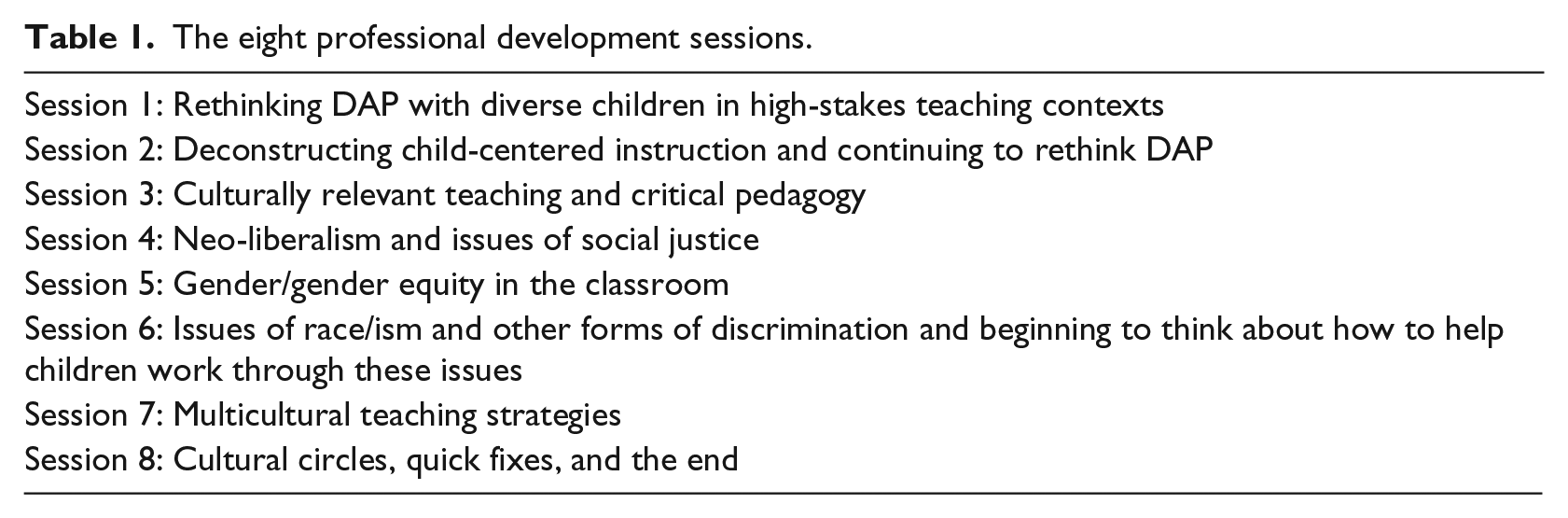
In order to situate how the idea of governing was defined and discussed within the professional development course, the teachers read excerpts from Cannella’s (1997) critique of DAP for the second session (for a list of the topics examined in each session, see Table 1). This text was used to introduce the teachers to Foucault’s notions of power—specifically, disciplinary power and normalization, and governmentality. For Foucault (1995: 194), power is productive: it “produces reality; it produces domains of objects and rituals of truth,” and, in terms of the professional development course, the teachers discussed how DAP depends on, and at the same time produces, a normalized vision of child development and learning that disciplines them to act in particular ways with their students. Next, governmentality was introduced to assist the teachers in connecting these ideas of normalization and disciplinary power to the governing structures in which they taught. For Foucault (1991), governmentality is the modern form of governance through which social institutions—both public and private—generate particular discourses to establish specific norms that relate to various aspects of our lives. Disciplinary powers emerge through these discourses that normalize particular instructional behaviors, such as DAP or standards-based instruction, which these teachers are to internalize and govern themselves with in relation to the social institutions in which they interact, such as the school, district, and larger community in which they live (Fendler, 1998).
The eight professional development sessions.
Cannella’s (1997) critique of DAP through Foucault’s notions of power and governmentality was then used as a springboard to unpack how the neo-liberal high-stakes standards-based accountability reforms that governed their early education context affected their teaching. In the fourth session of the professional development course, the teachers were introduced to neo-liberalism as a theory of governance in which democracy is no longer a political concept. It is an economic one. Using the work of Apple (2001), Harvey (2008), and others (e.g. Smith et al., 2004), the teachers reviewed how the neo-liberal system of governance within the USA and abroad (e.g. Lingard, 2010; Tabb, 2002) has emerged and evolved (Majone, 1989) over the last 40 years.
Using Harvey (2008: 30), they saw that, beginning in the 1970s, “there was a growing sense among the U.S. upper classes that the antibusiness and anti-imperialist climate that had emerged toward the end of the 1960s had gone too far.” In response to this disruption to their power, the upper classes, working with and through business organizations (e.g. the American Chamber of Commerce and the Business Roundtable), sought to maintain their power through establishing political think tanks (e.g. the Heritage Foundation) and supporting politicians (e.g. Nixon and Regan) to “demonstrate that what was good for business was good for America” (Harvey, 2008: 30). Working collectively through varied social, political, and institutional networks (e.g. Demas et al., 2003), these groups put forward a neo-liberal vision of governance in which society is to be governed by “the laws of the market, free competition, private ownership, and profitability” (Apple, 2000: 30), meaning that government no longer seeks “to govern through ‘society,’ but through the regulated choices of individual citizens, now constructed as subjects of choices and aspirations to self-actualization and self-fulfillment” (Rose, 1996: 41). For citizens to attain such fulfillment it is necessary for them to make choices that allow them to accrue the credentials and capital needed to participate successfully in the markets that define society (Lemke, 2001; Rose, 1996; Wright, 2012).
The teachers also explored (e.g. Brown, 2014) how a neo-liberal form of governance creates what Rose (1999) termed a strange new coupling of power, in which individuals appear to be “responsible for their own well-being through the choices they make” as consumers (Robertson and Dale, 2002: 469). Yet, under this theory of consumer-based governance, as Dahlberg and Moss (2005: 133) pointed out, the “state remains strong despite appearing to dissolve.” It does so by restricting the forms of education that these teachers can engage in, by requiring them to attend to state- as well as district-sanctioned curricular documents (Popkewitz and Bloch, 2001). Lastly, the teachers were told of such resources as Lipman (2011) and Harvey (2005) to help them trace the origins of neo-liberalism further.
Relating neo-liberalism to their teaching
In order to assist the teachers in the professional development program with understanding how neo-liberalism relates to their teaching, the No Child Left Behind Act (NCLB) was discussed (Brown, 2009b). As Hursh (2007: 495) pointed out, NCLB “solidified neoliberalism as the dominant approach to policy making” in the USA. In discussing NCLB, the teachers were first reminded that, if government frames public programs as economic enterprises (e.g. Krieg, 2011), this means that public early childhood, elementary, secondary, and collegiate education systems are positioned as institutions which provide citizens/students with a series of credentials (e.g. a high school or college diploma) required to gain employment, so that they can earn the financial capital needed to participate in the consumer-based markets that define society (Ball and Vincent, 2005; Rose, 1996). This means that the public education system the teachers worked in is defined through the economic principles of performance and efficiency (Saltman, 2005), which is made visible through measuring their ability to produce students who are to attain particular levels of performance on their state’s standardized assessments that evaluate their mastery of certain sets of knowledge and skills (Lipman, 2004; McNeil, 2000).
Using the real-world example of NCLB assisted these early educators in seeing what neo-liberalism means in terms of their teaching on a daily basis and, with the assistance of the instructor, they began to make the connection between NCLB and the establishment of their state-based early learning standards for children in publicly supported ECE programs (e.g. Scott-Little et al., 2006), and the readiness assessments their state and school district used to quantify young children’s school-readiness skills to ensure they are on a trajectory for academic success (Daily et al., 2010). From there, the discussion in the professional development course turned to how this neo-liberal framing of ECE creates a work environment in which these teachers are under a perpetual state of surveillance, where they essentially must act as “salespeople for their own pedagogical performances” and demonstrate their worth through their ability to produce students who achieve high test scores (De Lissovoy, 2014: 428).
Offering CRP as one alternative
Beginning in the third professional development session and continuing across the school year, the teachers were offered CRP (Ladson-Billings, 1994, 1995, 2006, 2014) as an alternative theory of instruction that could potentially counter both the normalizing practices of DAP and the neo-liberal framing of teaching as a “technicist” activity (Reid and Johnson, 1993). Ladson-Billings’ (1995, 2006) conception of CRP was selected because it draws from Apple (1993) and other critical scholars (e.g. Delpit, 1992; Freire, 1974) to explain how teachers and students can experience an intellectual death in their classrooms through the disciplinary practices emerging from neo-liberal policies that deskill and dehumanize their classroom practices. In order to counter these dehumanizing aspects of the neo-liberal classroom, CRP advocates for pedagogical practices that empower students “intellectually, socially, emotionally, and politically by using cultural referents to impart knowledge, skills, and attitudes” (Ladson-Billings, 1994: 17–18). It does this by expecting teachers to foster academic success, cultural competence, and sociopolitical consciousness for all of their students (Han and Thomas, 2010). To engage in CRP not only requires early educators to foster academic achievement through practices that reflect an understanding of the impact of culture on children’s development and learning, but it also expects these teachers to attend to the sociopolitical context in which they work, which includes both the neo-liberal politics and policies that impact their teaching and their students’ learning in their classrooms (Gay, 2002; Ladson-Billings, 1995).
The basic tenants of CRP—academic success, cultural competence, and sociopolitical awareness—were offered as a way for the teachers in the professional development course to engage critically in the cultural landscapes of their classrooms (Ladson-Billings, 1994, 2014). Ladson-Billings (2014: 78) notes that few take up the sociopolitical dimensions of CRP, critically engaging students in ways that “have a direct impact on their lives and communities.” To do this requires teachers to engage with students as subjects, rather than objects, in order to reposition them as active participants within the curriculum development process (Ladson-Billings, 2014). In Session 3, the teachers were challenged to question how CRP could be used to counter the normalizing and disciplinary powers of DAP that they had unpacked in Session 2. They also examined their own cultural make-up and how their notions of race and culture affect their interactions with children and their families, as well as their instruction in the classroom. These ideas that challenged their conceptions of themselves as teachers and the practices they engaged in with their students were carried over into Session 4, where the teachers were asked to utilize CRP as a counter-example to the neo-liberal framing of teaching as an act in which they provide all children with the skills and knowledge needed to attain specific test scores (Ball, 2003).
Across all of these and the remaining professional development sessions, CRP was referred to as an alternative form of instruction these teachers could use in their classrooms. It provided the teachers with a theory of practice that demonstrates how they could address the academic success of their students through a humanizing, empowering pedagogy which attends to their sociopolitical lives in a way that takes “learning beyond the confines of the classroom using school knowledge and skills to identify, analyze, and solve real-world problems” (Ladson-Billings, 2014: 75). Moreover, the instructor told the teachers that by addressing the practical, cultural, and political realities of their students, the instructional practices they engaged in or content they covered in their two lessons with their students for the professional development course would differ for each teacher. Engaging in CRP would create a level of uncertainty for them within their own instruction, and thus a primary goal of the professional development course was for the lead instructor, as well as their fellow teachers, to provide them with the support they needed to come to know the sociocultural worlds of their students and select topics of investigation that addressed their realities in and out of school.
Methods
The data analyzed and interpreted in this article comes from a larger action research study (Costello, 2003; Craig, 2009) which investigated how the participation of pre-kindergarten (Pre-K) and kindergarten teachers in a year-long professional development course affected their practical conceptions of and pedagogical practices in a high-stakes neo-liberal early learning context. This article examines the findings from one of the primary research questions that guided this larger study. Specifically, it begins to answer: How were the conceptions and practices of a sample of early educators working in a high-stakes neo-liberal early education context affected by their participation in a professional development course that asked them to reconceptualize their understandings of their role as teachers so that they would pursue learning experiences with their students that reflected issues central to their lives in and/or outside their classrooms?
Examining the findings of this research question through this action research study helps to illuminate the challenges that exist in attempting to address culturally relevant issues with students in a highly scripted and surveilled teaching context. It can also reveal key issues that early educators, teacher educators, and those who advocate for ECE should consider when developing and/or enacting alternative conceptions of teaching in similar early education environments.
Participants
The district’s director and associate director of ECE purposely selected (Merriam, 2009) the teachers who were to be enrolled in this district-sanctioned professional development course. When asked what she hoped the Pre-K and kindergarten teachers participating in the professional development course would gain from this experience, the associate director of ECE, who oversees curriculum development and implementation, stated:
I want them to think about how they can incorporate children’s cultures into their classrooms, address issues of social justice, have kids be aware as well as receptive to those who are different from them. I also want them to develop an understanding of how the broader picture of where they’re working, their situation, impacts the decisions that they’re making. In other words, the policy, the policy structure, the organizational structure where they work causes them to react in certain ways.
The directors invited teachers with at least one year of experience whom they had observed in their classrooms and felt were willing to engage in a critical examination of their practical knowledge. Fourteen teachers were invited to participate; twelve came to the first meeting; nine teachers and the associate director of ECE agreed to be in the study; and five of these nine teachers and the associate director of ECE attended almost all of the eight meetings. When talking with two of the three teachers who decided not to participate in the study, both stated that they felt they could not take on any additional work during the academic school year. For the four participants who attended the meetings irregularly, each cited a lack of time to participate in the professional development course due to personal (e.g. being a parent) and/or professional (e.g. participating in a newly implemented pay-for-performance program within the school district) obligations.
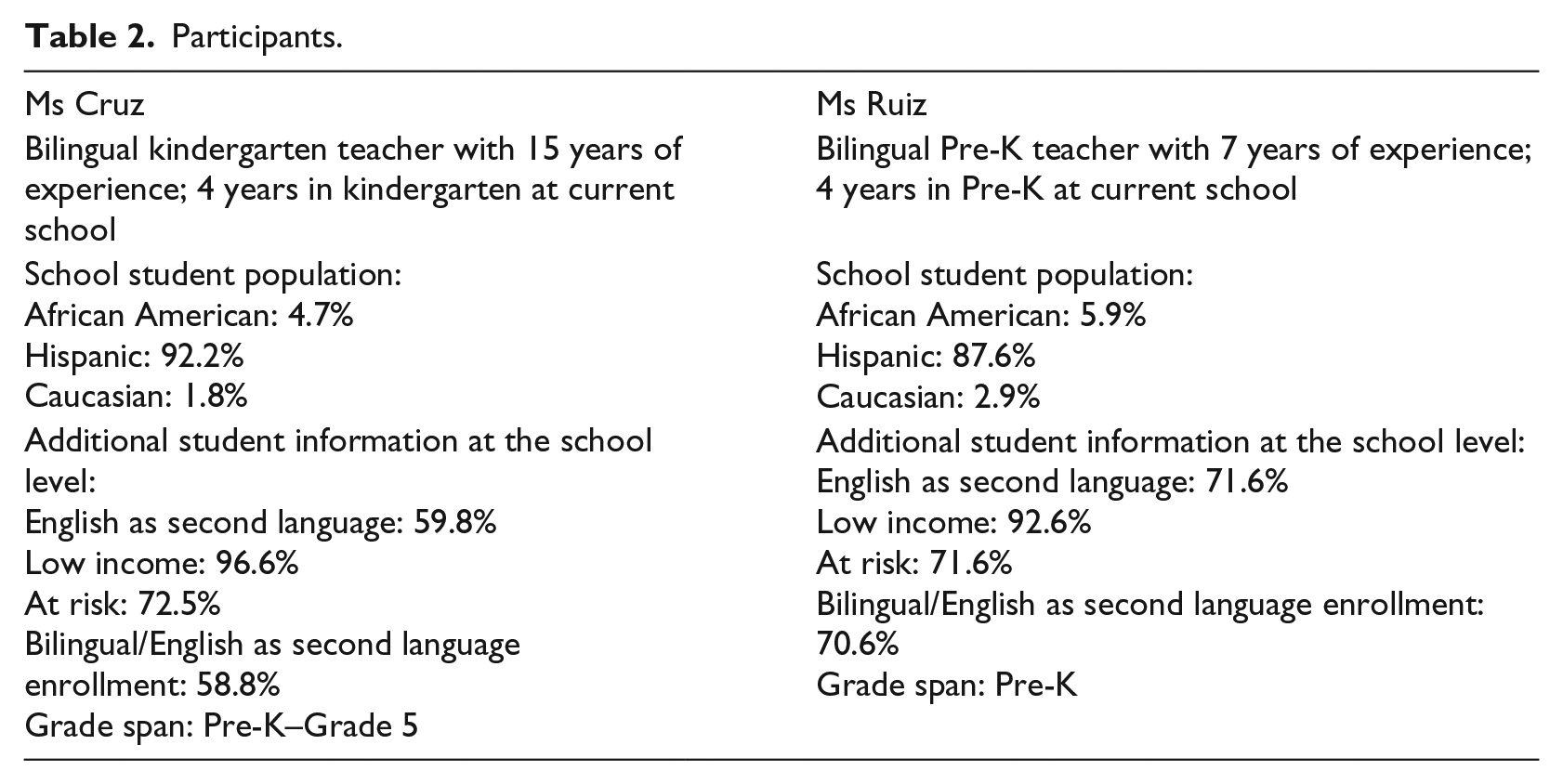
This article focuses on the experiences of two of the nine participants: Ms Cruz (both names are pseudonyms) and Ms Ruiz (for more details about these two participants, see Table 2). Ms Cruz and Ms Ruiz were selected for five reasons. First, both attended almost all of the eight meetings; second, they represent the two grades that teachers in this professional development program taught (Ms Cruz taught kindergarten and Ms Ruiz taught Pre-K); third, these were the first teachers of their respective grade levels to take up the challenge of creating and implementing lessons that were central to the children’s lives inside or outside the classroom community; fourth, they taught in the most common school contexts found among the teachers who participated in this study (a highly monitored (Ms Cruz) and a somewhat monitored (Ms Ruiz) teaching context); and finally, while both were the first to teach lessons to their students that were to focus on their children’s lives inside or outside the classroom community, each decided not to pursue particular topics of interest that addressed their students’ sociocultural worlds. Examining why they did not do so offers insight into the impact of neo-liberal reform on these teachers’ conceptions and practices within this high-stakes teaching context. In sum, focusing on the experiences of these two teachers offers the chance to develop “a richer and more complex picture of the phenomenon under study” (Mertens, 2009: 265).
Participants.
Teaching context
This study took place in a diverse urban Pre-K through Grade 12 (Pre-K–12) school district in a Midwestern state within the USA that educates over 80,000 students. 2 This state is a high-stakes neo-liberal teaching context in which Pre-K–12 children participate in a range of accountability systems that policymakers designed in order to hold them, their teachers, and their schools accountable for students attaining state-mandated academic achievement markers. The district’s full-day Pre-K program is a state-supported voluntary intervention program that is offered to four-year-old children whom the state’s policymakers deem to be at risk for school success. Policymakers deem these markers of risk to be: an inability to speak or comprehend the English language, low-income status, homelessness, or in the foster care system.
Pre-K–12 teachers in this school district are expected to implement the District’s Aligned Curriculum (DAC) in their classrooms. Designed by district administrators, the DAC links the state’s mandated testing system with the district’s curriculum, textbooks, teacher training, and accountability measures so that teachers have a clearly articulated idea about what to teach and what students should learn on a day-to-day basis. The DAC governs the practices of teachers across the district by providing them with daily lesson plans that link instructional materials, including the district’s grade-level curriculum, with, in particular, the state’s mandated Pre-K–12 content standards in each of the core subject areas of language arts, reading, mathematics, science, and social studies.
Other disciplinary actions instigated by district administrators included requiring Pre-K–12 teachers to employ a standardized report card that documents students’ academic performance and personal development four times across the school year, and weekly time sheets that the teachers are to turn in to document what they are teaching students each day and for how long. District administrators put these tools of governance in place to ensure that every teacher across the district is teaching all of his or her students the same knowledge and skills through a similar set of practices for an appropriate amount of time, in order to ready them for the state’s high-stakes tests that begin in Grade 3.
In terms of the high stakes within this teaching context that policymakers implemented to discipline education stakeholders to work towards the goal of ensuring that all children meet specific norms of academic performance, state-mandated assessments begin in Pre-K, with every school district being required to assess their Pre-K through Grade 1 students’ emergent literacy skills three times a year using a state-approved standardized assessment measure. This state’s policymakers measure public school students’ attainment of the mandated Pre-K–12 content standards by requiring those in Grades 3 through 11 to take a series of high-stakes examinations. The high stakes for students begin in Grade 5 and appear again in Grades 8 and 11. Their academic achievement scores are used to determine grade promotion of high school completion. The stakes for schools and school districts occur under a statewide ranking system that determines whether or not students in these schools and districts attained an acceptable level of progress in improving their academic achievement. If not, this initiates a series of mandated interventions and sanctions, which can eventually lead to schools being closed or reconstituted, and district teachers and administrators being fired and replaced.
Details about the professional development course
The teachers who participated in this project attended eight professional learning sessions of two hours in duration over an eight-month period. The lead author facilitated each of the meetings and the second author attended them and participated in the group discussions. The eight meetings were designed to challenge the Pre-K and kindergarten teachers’ conceptions of teaching in a high-stakes neo-liberal public early education system. The researchers sought to achieve this goal by using three empirically based professional development strategies: (1) participating in a year-long critical inquiry into teaching linguistically, culturally, and socio-economically diverse children in a high-stakes neo-liberal context (Webster-Wright, 2009); (2) developing, implementing, videotaping, and analyzing two lessons the teachers taught in order to help their students to critically examine an issue central to them and their community (Sherin and Van Es, 2009); and (3) creating a critical vision of teaching young children in a high-stakes context through a learning community that fosters individual and collective change (Olson and Craig, 2001).
During each session, the Pre-K and kindergarten teachers engaged with a series of readings, videos, and learning activities that sought not only to challenge their conceptions of critical issues in ECE, but also to become aware of their own personal conceptions of teaching in a neo-liberal early education context. These materials were selected based on the stance that their theoretical and/or conceptual orientation had to be critical in nature and sought to transform the current power structures and/or discourses within ECE (Crotty, 1998). For instance, the Boutte (2008) reading in Session 6 advocates for early educators to take on an anti-racist, social justice stance in their teaching. Each of the eight sessions followed a pattern in which the group would check in with the instructor to see how things were progressing; discuss the readings for the week; engage in an activity that attempted to extend the participants’ thinking in some way around the critical issue being discussed in that session (e.g. engaging in a reader’s theatre activity using McCloskey’s (2012) work in Session 3 to examine the affordances that discussing such issues as jail with children offers them and the teacher); and then reflect not only on the session itself, but also on how the session might affect their teaching over the next few weeks.
Outside of the eight professional development sessions, the lead researcher met with the participants at their schools either to interview them for the study, to discuss with them strategies for implementing a learning activity that was central to the children’s lives, or to document their teaching of such lessons. Even with such support, one limitation that emerged in the roll-out of this professional development course was that most of the teachers, by their own choosing, did not start teaching lessons until after the seventh learning session. Because this was so late in the school year, the group did not formally share and analyze any videotaped lessons they taught with the rest of the learning community. Other limitations of this investigation include the researchers studying a limited set of issues with a small sample size (nine teachers) in one school district in one state in the USA (Yin, 2014). In order to enhance the trustworthiness of this piece, the strategies of member checking, triangulation, and peer debriefing were used (Lincoln and Guba, 1985; Thomas, 2011).
Data collection and analyses
Data collection, which occurred during the 2012–2013 school year, documented the evolution of these teachers’ conceptions and practices in this neo-liberal ECE context in three ways. First, each of the eight professional development sessions was documented through videotaping, field notes, and artifact collection (Emerson et al., 1995). Second, each teacher participated in up to four semi-structured interviews across the academic school year: an initial interview, which occurred between the first and second session; an interview after one or possibly both of the lessons taught for the course; and a final interview, which occurred after the last session (Lindlof and Taylor, 2002). Finally, the teachers’ two sets of lessons with their students were also documented through videotaping, field notes, and artifact collection.
Traditional qualitative analytic methods were used to analyze the data (Erickson, 1986). First, all of the interviews, field notes, and videos of the professional development course and the teachers’ lessons with their students were transcribed. The transcribed data was coded using external codes that were based on the theorists’ and researchers’ neo-liberal conceptions of early education and teacher education outlined in the section of this article that detailed the theory of action behind this professional development course (Graue and Walsh, 1998; Miles and Huberman, 1994). These external codes included: the mandated curriculum, the role of the student, lifelong learning, individualism, consumerism, conceptions of practice, conceptions of culture, CRP, and DAP. After the data had been read several times and coded using the external codes, an internal set of codes (Graue and Walsh, 1998) was developed that represented the themes that emerged through this process. For instance, the internal code “pressure to do well” emerged because Ms Cruz, as well as other teachers in the study, noted several times that they were under constant pressure to ensure that they were following the DAC, so that their students would be ready to perform in the next grade level and beyond. Ms Cruz noted in her final interview: “We get pressured to do well. I feel a pressure about following the DAC because that’s what they’re telling me is going to prepare my children to pass the state’s high-stakes exams in third grade.”
After coding the data using these internal codes and reading these documents several more times, themes were developed, such as “A failed interest in decoupling,” which reflected how these two teachers’ conceptions and practices in their early childhood teaching settings evolved across the course of the school year in relation to the purpose of this professional development course (Thomas, 2011). They were read against the data in search of contradictory evidence and refined through further analysis (Wolcott, 1994). In the end, three themes emerged, which are examined sequentially in this interpretive document and illuminate how the conceptions and practices of Ms Cruz and Ms Ruiz were affected by their participation in this professional development course (Denzin and Lincoln, 2003).
Findings
Strange but successful coupling
Ms Cruz and Ms Ruiz were interviewed individually after the first professional learning session, which introduced them to the purpose of the professional development sessions. This interview sought to gain insight into their conceptions of teaching in their high-stakes early education context, which included their goals for their students and how they strived to achieve such goals through their instruction.
Goals for students
When asked what she hoped to achieve with her students across the school year, Ms Cruz commented:
I want my students to be independent. I want them to be able to do things on their own; again, my job is to fulfill the expectations of the public education system, which mandates I teach the state content standards and my students master them. At the same time, I know that, developmentally, not all children will learn them at the same time. We all learn to walk at a certain stage … I want them to finish kindergarten knowing sounds and having a love for learning so that when they go on to first grade they can say, “Yes, I got a good foundation to build on.”
Ms Cruz’s statement entails traces of neo-liberalism, including standards-based accountability reform and developmentalism (Burman, 2008). Her primary goal seems to be to create productive, independent students upon whom she will be able to inscribe state policymakers’ mandated content standards so that they will be on a trajectory to success in school. Ms Cruz’s conception of success for her students also appears to encapsulate the neo-liberal understanding that, as Einboden et al. (2013: 560) noted, “healthy cognitive and emotional development in the early years translates into tangible economic returns” for the student and the state.
When asked to describe what she hoped to achieve with her students, Ms Ruiz’s response contained traces of Ball’s (2003) notion of double alienation, which for teachers means being estranged from the act of teaching while taking on the neo-liberal image of the teacher. However, in Ms Ruiz’s case, it was the students, not her, who were alienated. She noted:
I want them to have the basics, be it academic or anything, to be prepared for kindergarten. There’s lots of learning going on, but kids eventually hate school. They all hate it. My daughters hate school. Nobody wants to go to school, but they have to go. So I have to make it fun, to make the learning meaningful to them, so that it makes sense to learn this because they need it. They always ask me why they have to learn this, and you need to say that you need it because you’ll use it. I really want them to feel that they have to learn this, so they can go into kindergarten wanting to learn more things. I want them to be excited and motivated because many kids don’t care about learning, so I try to make them feel like I care about them so that they care about what I have to teach them.
Ms Ruiz’s personal as well as professional knowledge and experiences appear to frame her understanding of her role in the classroom, as well as her goals for her students. She seemed to know that, as students participate in the neo-liberal education system and learn that their role is to master a predetermined set of knowledge and skills which may or may not reflect their interests or sociocultural backgrounds, they become alienated from it (Ball, 2003). In order to make this process of internalizing the norms of schooling meaningful, which includes engaging in specific acts of learning and mastering policymakers’ mandated content standards, Ms Ruiz not only took on the role of teacher, but also took on the role of a salesperson who had to convince her students that what they are doing in the classroom will eventually have some sort of use and/or meaning in their lives.
Instructional decision-making
When asked to describe their instructional decision-making process and how it relates to their goals for their students, what each teacher stated she taught was similar, but how and why they came to that decision about their instruction was quite different. For Ms Cruz, who taught kindergarten in a Pre-K through Grade 5 elementary school, the students’ academic achievement across the entire school campus affected her instruction. She noted:
Our literacy scores last year for our entire kindergarten team were very low. I was embarrassed; never in my life have I had scores like that. In the past three years, I’ve felt, when March came around, that I had not done enough, even though I’ve done everything the DAC told me to do. This year, I’m taking ownership. I’m applying what the district is asking me to do, but I’m not necessarily following the exact same lesson found in the DAC. I’m following the state’s content standards for K [kindergarten], which is what the state wants, which is what they need to pass all these state tests. I guess I’m kind of teaching to the test, and that’s fine.
Both Ms Cruz and Ms Ruiz taught in an education system that was regulated by audit (Peck, 2010). For Ms Cruz, the students’ poor performance during the previous academic year appeared to have led her to frame her teaching as being in a state of crisis. In doing so, Ms Cruz did not look outside the neo-liberal education system for a solution to her instruction, but rather turned to the state’s content standards as her “medium to recovery” (Slater, 2014: 3). Ms Cruz seemed to be aware of the contradictory as well as disciplinary nature of looking to the same system that told her she was failing as a teacher for the solution to her students’ poor performance, but nevertheless appeared to have accepted this role as a governing agent for the state.
Ms Ruiz, on the other hand, taught in a school that only served children enrolled in Pre-K, and thus the distance between her school and the state’s audit system was greater. Still, when discussing what she taught, she responded:
The DAC guides me in what the kids should be learning at each stage, so then, as they progress, I start teaching more difficult things, different concepts. The DAC shows me how I can do this step by step, and that’s helpful because we are going to have to assess those things.
While the state’s audit system had not told Ms Ruiz that she was failing in her teaching, its presence can still be seen through her enactment of her school district’s aligned curriculum. Ms Ruiz’s conception of her role as a teacher and what she was to teach—essentially how she framed her subjectivity as a teacher—mimicked the curricular and pedagogical expectations of the state (De Lissovoy, 2008), but it also reinforced the idea of her, as well as her students, being alienated from the instructional decision-making process (Ball, 2003).
So while this “discourse of containment” (Lipman, 2013: 569) appeared to demarcate both teachers’ roles as early educators, their statements demonstrate that neither teacher was naive about the impact of state and district policymakers’ reforms on their teaching. As Ms Ruiz noted:
If the state or district wants me to be a better teacher, to be more effective, there needs to be less pressure on the assessment outcomes. There are so many assessments that I have to do for the district they really don’t let me teach. I might have to assess things I haven’t had the time to teach. And there was a time when I was so naive, where I thought why don’t we combine all the assessments into one and everybody gets their answers with whatever they want to so they can see how much learning is taking place? Just do one assessment for everything and we can focus more on teaching. But that’s never going to happen. So finding the time to dedicate to teaching, to actually teach with the themes that are in the DAC, is a big challenge.
Even though Ms Ruiz seemed to recognize how her subjectivity was “constituted” through the accountability policies found in her school district and state (Youdell, 2006: 7), she did not appear to recognize the strange coupling of power that exists within her framing of her role as a teacher: “to … teach with the themes that are in the DAC.”
The remaining professional development sessions
In the professional development sessions that followed the initial interviews, Ms Cruz, Ms Ruiz and their colleagues were engaged in a series of learning experiences that challenged as well as explained what it means to teach in a high-stakes neo-liberal early education context through instructional practices that attended to their students’ individual, cultural, linguistic, and economic needs. For instance, after being introduced to Foucault’s conceptions of power via Cannella’s (1997) critique of DAP (Copple and Bredekamp, 2009) in the second professional development session, they then used Mac Naughton’s (2005) strategies for deconstruction to identify the norms that governed their instructional decision-making and that of the other early educators they had read about (e.g. Ryan, 2005). In Session 2, the lead instructor, when talking with the teachers about the process of deconstruction, asked:
Mac Naughton (2005) says that engaging in this binary analysis helps those of us working in early childhood settings to analyze the specific politics that we bring into being through our teaching and use to make sense of the lives of our students. So when you think about the state’s content standards or the district’s report card assessment rubric, what are the binaries you are creating about your student within your instruction? What are you saying about the children that aren’t fitting within those dynamics?
The lead instructor asked such questions repeatedly across each session in order to help the teachers analyze how such professional (e.g. DAP) and political discourses (e.g. their state’s neo-liberal education policies) governed their teaching.
Additionally, by examining such topics as engaging in critical acts around issues of social justice (Kuby, 2011) in professional development (Session 3) or deconstructing issues of gender in the classroom using queer theory (Blaise and Taylor, 2012) in professional development (Session 5), each teacher was asked to design and engage in two lessons with the children in their classrooms that examined an issue central to their students’ lives in and/or out of school. This activity was discussed with the teachers in numerous ways across the semester. For instance, in Session 3, the lead instructor commented:
With your lessons, I don’t want to put any confines on you. I am not saying you have to do this or that in your lessons with your students. You need to think about what you are comfortable with … My goal with these meetings is to get you to at least take a step towards trying to pursue a learning activity that is rooted in your students’ sociocultural worlds, because I think it’s going to be pretty powerful for you and your students. Doing this type of lesson one or two times this year might open you up to doing it ten times next year or maybe realizing that you might want to do it every time something comes up in the children’s lives … I know the district’s policies tell you what to do, so it can distract you and make it difficult for you to find a space to do something that is meaningful to the kids in your classroom community. I just hope that by engaging in this type of teaching this year, it will help these practices become a part of your repertoire of instructional skills that you use in your classroom.
This statement demonstrates how the lessons the teachers were asked and encouraged to enact across the school year with their students were not framed solely through CRP, which would have simply replaced one disciplinary discourse with another. Rather, CRP was provided as an example of a theory of instruction they could look to for inspiration in conceptualizing lessons that countered policymakers’ neo-liberal reforms and addressed issues relevant to their students’ lives in and out of school.
A failed interest in decoupling
Both Ms Cruz and Ms Ruiz demonstrated an interest in pursuing lines of inquiry that stepped away from the demands of the DAC and/or state content standards and addressed the sociocultural backgrounds of the children in their classrooms. For instance, Ms Ruiz noted in Session 3 that: “I want my students to be culturally proficient, to be aware and accept everybody, to be proud of Spanish as their first language, and to value themselves and value their backgrounds.” Additionally, as immigrants from Latin American countries, both teachers stated that they felt a connection between themselves and their students. For instance, Ms Cruz commented in her initial interview that:
Being from Latin America, I think I can relate to them culturally … Still, even though 100% of my children are Hispanic, I still have children from El Salvador, Honduras, Mexico, Puerto Rico, so I still have to find a common ground.
However, she added in Session 3 that: “While, culturally, I think I can relate to them, I cannot relate to them having someone in their family in jail or not having money to buy food. I cannot relate to that.” In this statement, Ms Cruz appeared to demonstrate that she recognized the social and economic inequality that neo-liberal systems of governance ignore (Ong, 2007), and it was in this disjuncture between the system of early education in which she worked and her understanding of her students’ lives that she saw an opportunity to investigate an important issue to her students: the topic of immigration.
Ms Cruz’s interest in the issue of immigration first appeared in her initial interview. When discussing the dynamics of her class, she stated:
I actually had a student come to me the other day and say my brother’s in town … because my dad got picked up by the police [for being an undocumented immigrant] … this is the third student that has discussed this with me.
Her interest in this topic reappeared in Session 4, when she commented:
I’m thinking about how maybe pursuing the topic of immigration because I do have three children whose parents have been picked up this year, and I have one who has a parent who has already been deported. That is something they all have in common that they could talk about. It is all very sad if you will think about it, so I don’t know. You know, where’s the line for me to say it’s okay to talk about this and what’s happening outside of my classroom? What will teachers and parents say about this? Where do you draw the line? … What if someone comes in and sees us talking about this? Like the other day there were three people from the district in my classroom and I didn’t know it. I just turned around and it was like an ambush. These people from the district just walk into my classroom with a checklist and, you know, they are not looking for all your great things. They are looking for what you are lacking.
Ms Cruz demonstrated a sense of anxiousness in pursuing this topic of immigration for a number of reasons: talking about the students’ lives outside the classroom; worrying what her colleagues and the children’s families might say; and being surveilled by district personnel to follow the DAC. Still, Ms Cruz was encouraged by her fellow teachers and the associate director of ECE to pursue the topic. As the associate director noted in Session 4:
You’re listening to what it is that the kids are saying, so it isn’t something you are necessarily imposing on them. It is coming up anyway, and so you should think about ways to strategically approach it with them in your teaching.
Ms Cruz responded to this encouragement positively, but since this conversation occurred at the very end of the professional development session, she appeared to let another teacher discuss a topic she might purse with her Pre-K students before the class ended.
Immigration continued to be an issue that Ms Cruz seemed interested in pursuing with her students. For instance, when a colleague discussed in Session 7 how she examined the issue of jail with her students, Ms Cruz noted: “I wonder if you can tie that into immigration. Sometimes I see that in my classroom with my students getting deported.” Later in the conversation, she reiterated: “I wish I could do a lesson on immigration.” When asked by a fellow teacher in the professional development class why she could not, she stated:
I have a colleague’s child in my class, and I don’t think that she would be happy if I brought that topic into the classroom … I do want to go there, but I don’t want to deal with that.
So, while Ms Cruz appeared to be reluctant to pursue this line of inquiry, she said she was still open to the possibility of examining it before the end of the school year. She added: “It would be an awesome lesson to see what happened because I know there’s other children in my classroom whose parents are struggling with immigration issues.” Even with the support of the associate director of ECE and her colleagues in the professional development sessions, Ms Cruz decided not to pursue this topic.
Instead, she decided to study the topic of bullying with her students. In her interview following the first lesson she taught as part of the course, she said that she picked this subject matter because
there has been a lot of picking on one another in my classroom, and I want my students to know what is a bully, and how to stop it … I want them to think about what it means to act like a bully. Is it because you didn’t get your way, so you’re going to be a bully? That’s what I’m saying. That makes you the bully … we’re all a group. We’re one family. That’s what I always tell them. We all need to get along no matter what. We may not like someone, but we still have to be respectful.
While this statement demonstrates how Ms Cruz tried to build a positive learning community among her students, this topic of study fit within the social-emotional curriculum that, according to Ms Cruz, the entire school “teaches them throughout the whole year.” It appears that the cost of pursuing the topic of immigration in her school context was too great for Ms Cruz. Instead, she made what Baez (2007: 10) characterized as a “rational choice,” in which she saw her role as one where she needed to maximize her “capital” as a teacher by pursuing topics for study with her students that were sanctioned by her school, the district, and the state.
Ms Ruiz was also interested in supporting her students’ cultural and linguistic backgrounds, but, similarly to Ms Cruz, she did not appear comfortable in pursuing such a topic of study. When asked in her initial interview what she might pursue, she noted: “I want them to learn so many things. I want them to learn to work together, to learn to use the knowledge, to bring the academics to their daily life.” In this statement, Ms Ruiz positioned the “children within subjectivities of standardization, containment and obedience” (Brit and Rudolph, 2013: 49), and, ultimately, this led her to teach a lesson for the professional development class project from the DAC on the weekly theme of imagination, in which the students were to respond to a story using their imagination in their writing journals. While making the connection between academic learning and daily life, as well as pursuing lessons that teach children the knowledge and skills required for school success, falls under the conception of CRP (Ladson-Billings, 2006), it fell short of the goals of the professional development course.
When asked why she chose to study a topic found in the DAC, Ms Ruiz noted that the prior year she had actually created a performance with her students for their families which celebrated the sacrifices the families made by immigrating to the USA to offer their children more opportunities than they had had as children. When discussing how she described the play to the students’ families in the interview following the first lesson she taught as part of the course, she commented:
I didn’t want to say to them that I’m focusing on immigration. I’m focusing on opportunities. I’d say opportunities, that these students have more opportunities than other students from other places, where many times they don’t even have the opportunity to be in school. I wanted the students and parents to celebrate the opportunities they have and recognize the sacrifices they made in coming here.
While her description of the narrative found in the student performance she had pursued the previous year contained traces of what Villenas (2005) termed self-empowerment through surviving and thriving as immigrants, it also contained traces of the neo-liberal discourses of individual responsibility and opportunity created by and within the market.
Nevertheless, after teaching her first lesson for the professional development course, Ms Ruiz was asked if she would pursue a similar activity to the performance she had undertaken the year before, and she commented in Session 6 that: “I’m planning to do something. There is always a performance at the end of the year, but it has to be meaningful for them also. I want them to take that experience with them.” However, when the lead researcher complimented her on planning to pursue such a task with the students, she responded: “Not everybody thinks like that. They give you the standards and this is what you’re supposed to do.” This hesitancy about what others might think of her teaching, which is similar to the worries displayed by Ms Cruz, ultimately led to Ms Ruiz not pursuing such a lesson, exemplifying Dahlberg and Moss’s (2005) point that neo-liberal reforms not only manifest themselves through self-internalization, but also through acts of governing others—in Ms Ruiz’s case, she appeared to be governed by her colleagues.
The “state” remains strong
At the end of the professional development sessions, neither Ms Cruz nor Ms Ruiz pursued topics involving children’s sociocultural backgrounds. Still, both stated that the professional development course had been beneficial for them. Ms Cruz commented in her final interview that: “The sessions made me aware of my biases, more conscious of whether I’m pushing my ideas onto the children. I’m letting them communicate more what they need or what they believe. I want them to have their opinion.” So, while the professional development course appeared to open Ms Cruz up to the idea of engaging in instructional practices that offer children the chance to engage in “complex, challenging learning” (Brit and Rudolph, 2013: 49), she fell short of pursuing such topics as immigration with her students. When asked why, she stated that she never felt “safe” in pursuing this line of inquiry. She also reiterated in the final interview that: “I have a colleague’s child in my class, and I am not sure how that colleague would have responded to it.” However, after pause, she continued:
I didn’t do it because we get pressured to do well … because, whether we like it or not, we have to teach the state content standards. It’s state-mandated, and I’ve asked this question many times: How do you know what to teach? I’ve been told you follow the state’s content standards. That tells you what you need to teach. That’s what they’re telling me is going to prepare my children to pass the high-stakes tests in third grade.
De Lissovoy (2014: 423) has noted that accountability systems can pit “students, teachers and schools against each other in a struggle for higher scores and superior rankings,” and, in Ms Cruz’s case, it appears that these systems can also cause teachers to fight themselves in determining what it is their students need to learn to succeed in school. In the end, Ms Cruz saw the professional development course changing how she responded to her students, but what she taught them mimicked the “technicist” (Reid and Johnson, 1993) understanding of the role that the state expected her to take on, in which she was to engage in state-sanctioned practices to produce students who achieve high test scores.
Similarly to Ms Cruz, Ms Ruiz also found participating in the professional development sessions to be beneficial. In her final interview, she explained that:
The meetings helped me to express myself, to tell honestly what’s happening, and to hear other teachers. I think it was very helpful for me because many times we just say, “Oh, everything is OK, everything is fine.” You feel like you’re the only one that is frustrated with the system, or because you think you are the only one, you think, “OK, maybe I’m not doing my job like I’m supposed to be doing if everybody else is OK with what they’re doing.” It helped me understand that.
Ms Ruiz appeared to have found solidarity in working with a cohort of teachers who were questioning the norms of the neo-liberal system of education in which they worked. However, she struggled to find a solution to address the issues and frustrations she felt as a teacher. She went on to note: “There are many things I’ve wanted to change in education, but nobody is willing to step up and say, ‘OK, we need to change this.’” Similarly to the teachers in Osgood’s (2010) study, Ms Ruiz appeared to struggle to find a compromise between her personal philosophy and professional expectations, and while she seemed to want to change the system, she appeared to feel alone or isolated when trying to deviate from the norm.
When asked in the final interview to reflect on why she did not pursue another performance with her students on a similar topic to the one she had pursued the previous year about the opportunities students gained through their families immigrating to the USA, she noted:
There is no more time to do other things like a show. I feel like, if I do this, the other teachers will feel forced to do it, and they don’t want to do it. For example, if I said “Let’s do a skit like last year,” they would say “No.” I feel like I’m alone, and I don’t want to put in any more work on it.
While there is a sense of frustration as well as isolation in Ms Ruiz’s statement, she appeared to contradict the goals she set for her own students. In this same interview, Ms Ruiz commented:
I want students to be more aware of things that happen around them. I think that they also need to understand that there are many things that are not going to be easy. There are many obstacles. I want to help them somehow to try better. I want them to be persistent.
In essence, she wanted her students to be persistent when faced with such obstacles as she herself faced as a teacher. Yet, when talking about such change, Ms Ruiz appeared to succumb to the will of the state. In the final interview, she noted:
While there are things I want to change in education, somebody else from above is saying, “You have to do this.” That somebody from above we cannot reach, and they are not going to come to our classroom and see what’s happening in here and the problems that there are here, because they just make decisions from up there. That’s why there are so many things that need to be changed, but it is not going to change.
Ms Ruiz’s comments and decisions mimic Lipman’s (2013: 569) point that “the persistent strength of accountability discourses” is that they “define teaching and learning” in a particular way and “discipline subjectivities” so that they “limit the terms of engagement” within the classroom and larger school context.
Ms Ruiz recognized the false choices that exist within neo-liberal education systems (Cannella and Swadener, 2006), but she, as well as Ms Cruz, did not appear to know how to move beyond, or even believe that she could move beyond, the strength of the state in determining what she could teach the students in her classroom. Ms Ruiz and Ms Cruz’s frustrations highlight the tension that exists within neo-liberal education systems for early educators as they consider ways in which they might attempt to step beyond their visions for classroom change and actually enact new forms of instruction with children.
Discussion
The experiences of Ms Cruz and Ms Ruiz reveal the difficulties teachers face in attempting to enact an alternative education project when working in a highly scripted and surveilled ECE context. Our intentions behind this professional development course were to provide these teachers with alternative conceptions of teaching to this neo-liberal notion of early education, so that they might pursue opportunities of learning with their students that offered them a chance to investigate topics of study that reflected the cultural, linguistic, and economic complexities of the communities in which they lived. What we learned from this experience, which the themes in the above detail, is that Ms Cruz and Ms Ruiz both appeared to recognize the power of the state in dictating “what” they were to do as early educators in their classrooms and, during their time in the professional development course, both demonstrated visions of teaching and learning with children that went beyond the expectations and demands of their neo-liberal teaching environment (De Lissovoy, 2014). However, where each teacher fell short in this project—and, quite possibly, this could be a failure on our part with the design of the professional development course itself—was that neither teacher felt empowered enough as an early educator in a high-stakes teaching context to enact her conceptions of curricular change. For Ms Cruz, numerous factors, such as teaching a colleague’s child and being watched over by district administrators, appeared to prohibit her from pursuing a topic that she saw as being relevant to many of the students’ lives. For Ms Ruiz, past experience and unsupportive colleagues within her school seemed to dissuade her from pursuing such lessons as another end-of-year performance with her students that reflected their and/or their families’ personal experiences in immigrating to the USA. Additionally, these two teachers’ experiences with being overwhelmed by teaching requirements, watched over by district administrators, and unsupported by colleagues within their schools might illuminate why some of the invited participants withdrew from the professional development course at the beginning of the study and the lack of participation by many who had agreed to participate.
These findings, which demonstrate the difficulty for teachers in enacting learning activities that reflect the sociocultural worlds of the children in their classrooms, add to a growing body of literature in the USA and abroad about the potential negative effects that high-stakes neo-liberal accountability policies have on teachers and students (e.g. Bown and Sumsion, 2007; Brit and Rudolph, 2013; Buras, 2011; Einboden et al., 2013; Fasoli and Moss, 2007; Fenech and Sumsion, 2007; Gillborn and Youdell, 2000; Valli and Buese, 2007). Moreover, these teachers’ experiences bring to light three issues that early educators, teacher educators, and those who advocate for ECE should consider when attempting to take up an alternative education project in a high-stakes early education context so that classroom teachers can respond to and navigate this neo-liberal framing of ECE in a manner that addresses the sociocultural worlds of the children participating in their programs.
Implications
First, the findings of this study demonstrate that simply offering teachers an alternative to the neo-liberal framing of ECE does not lead to the enactment of curricular change in their classrooms. The two teachers examined in this article, as well as the other seven who participated in the professional development course, were willing to question how they conceptualized their practice and what they did with the children in their classrooms. Such activities either led to or reinforced their own doubts about what they were expected to do in the classroom—for instance, Ms Cruz recognizing that she was choosing to teach towards the test. These acts of recognition of how their subjectivity as teachers was tied to the neo-liberal early education system in which they worked reveal how these policies do not necessarily eliminate teachers’ alternative conceptions of their roles in the classroom (Ball, 2003; De Lissovoy, 2014). Rather, enacting such visions was the hurdle that Ms Cruz and Ms Ruiz could not overcome in their teaching. They were overrun by the demands of the state for all children to attain specific test scores at particular points in their schooling (Buras, 2011; Youdell, 2006). This impediment to change brings to light the effectiveness of the strange coupling of power (Rose, 1999) that exists within neo-liberal reform.
For the teachers in this study, we learned that they knew the “state” was present in their teaching and were aware of the surveillance of administrators. They seemed to appease both by enacting either the state standards or the district curriculum; Ms Cruz’s awareness appeared to be greater than Ms Ruiz’s. Yet none of the nine teachers, through the statements they made in their interviews or the professional development sessions, saw such power as overshadowing who they were as teachers. However, when we asked them to take action and directly confront such power through the professional development course, they became aware of how great a challenge it was to overcome the strength of the “state” if they were to enact their alternative visions of ECE. For Ms Cruz, her alternative vision was enacting a lesson with her students about immigration; for Ms Ruiz, it was conducting an end-of-year performance with her students that reflected their and/or their families’ personal experiences in immigrating to the USA; and, for us, the instructors and researchers, it was having the teachers pivot their instruction off their students’ sociocultural worlds rather than their district’s governing policies. As Guinier and Torres (2002: 18) noted: “Identity is both a target of power and a vehicle for resistance.” In this action research study (Costello, 2003; Craig, 2009), the two teachers examined in this article could identify how policymakers’ neo-liberal reforms were acting upon them and what they did in their classrooms, but both struggled to take up the identity of a teacher who engaged in their visions of alternative learning experiences that countered the state’s and district policymakers’ mandated reforms.
To overcome the strength of the state—and this is the second implication—requires teachers to make the difficult decision of being willing to face the consequences of taking on a resistive teaching identity that might materialize as either upsetting school administrators or possibly having their students perform poorly in the state examinations. Simply arguing that teachers can covertly enact alternative curricular agendas while still covering the necessary material in their instruction to prepare students for the test leaves the system unchanged (Brown, 2014; De Lissovoy, 2014). This creates a difficult dilemma for teachers, as well as for teacher educators, like us, and other advocates who seek change to the neo-liberal system through such activities as critical professional development (e.g. Osgood, 2010) and/or educational reform (e.g. Lipman, 2011).
For public school early childhood educators, the neo-liberal system has made them disposable commodities that are easily replaced by newly trained and/or untrained (e.g. Teach for America) teachers who are willing to teach as their state or local system dictates (Apple, 2001; Einboden et al., 2013; Lipman, 2013). Teacher educators must recognize this and, in doing so, they should be aware that asking their pre-service teachers in their training programs or in-service teachers through professional development courses, such as the one examined in this article, to work towards an alternative system, which may make them unemployable, creates a serious ethical dilemma in the teacher education process (Brown, 2009c; Dahlberg and Moss, 2005).
Nevertheless—and this is the final implication—we learned through this study that such change and/or spaces do exist, but to engage in such acts requires more than the willingness of one teacher or one professional development course to take up the challenge. As De Lissovoy (2012: 479) noted, it requires a resiliency by these actors that the “state” never anticipated—acts in which teachers and students refuse to be “captured by the traps and tropes” of the neo-liberal education system. In this study, Ms Ruiz’s previous actions exemplify this point. She was able to take on the identity of a teacher committed to engaging in an educational process that reflected the lives and experiences of her students through the development of a performance with her students. However, while her administrators never reprimanded her for such an act, it was Ms Ruiz’s colleagues who disciplined her to conform to the expectations of the district.
For such unanticipated responses by teachers and/or teacher educators to be sustained, it may also require the allies and alliances with colleagues, as well as children’s families and administrators, that Apple (2001), Guinier and Torres (2002), and others (e.g. Stone, 2002) speak about to enact and/or sustain change. This study demonstrated that forming alliances with teachers from different schools in a professional development course that asked them to build their own alliances with their students in their classrooms is not enough. Instead, as other studies have shown (Brown, 2008; Galindo and Medina, 2009), these alliances must be broad and include the stakeholders within the teachers’ schools and across the local community—specifically the families of the children being served—to be able to counter such reforms, so that teachers can engage in learning experiences with their students that reflect their communities. Fostering such action through teacher training program projects, as well as in professional development courses with practicing teachers working in the same school community, might provide a viable as well as sustainable response to the demands of the neo-liberal state that is centered on the governance of subjects rather than the collective whole.
Thus, there is a need for further research that examines the ways in which early educators can find the power within themselves and with others to resist, and enact visions of instruction that go beyond policymakers’ high-stakes reforms. If they fail to do so, as Guinier and Torres (2002: 167) and others (e.g. Dahlberg and Moss, 2005) have pointed out, early education stakeholders and the larger society are going “to witness the slow but steady evisceration of American democracy.”
Conclusion
In sum, the findings from this investigation into the impact of a professional development course that offered a sample of early educators in the USA alternative conceptions of teaching, which critically questioned the norms and practices of their high-stakes ECE system, demonstrate that simply assisting early educators in envisioning change and then asking them to go it alone when enacting such visions in their classrooms and/or school does not appear to be a viable option for transforming this neo-liberal framing of ECE. While the two teachers in this article appeared to appreciate the comradeship of their fellow participants and the opportunity to rethink their teaching through such practices as CRP, both seemed to recognize their positioning as disposable commodities within their neo-liberal ECE system. Thus, it appears that it is critical for early childhood educators who want to enact or assist others with engaging in alternative visions of ECE to develop coalitions with colleagues, families, administrators, and others who will support their efforts for change. Without such cooperation, it appears that any unanticipated response to an ECE system focused on producing successful individuals is unlikely to succeed.
Footnotes
Acknowledgements
The authors would like to thank the editors of this journal and the anonymous reviewers for their thoughtful and insightful suggestions in strengthening this article.
Funding
The author(s) received no financial support for the research, authorship, and/or publication of this article.