




Abstract
The aim of this study was to explore the different ways in which a number of Chilean stakeholders conceptualise the ‘good early childhood educator’ in Chile. In a context where new foreign narratives are increasingly dominating the field and the recent standardisation of the educators’ professional role is being implemented, this research constitutes a critical and alternative viewpoint, analysing the situation as a whole and creating dialogues between key actors in order to open possibilities to new understandings. Twenty-three participants, including early childhood educators, teacher educators and key informants from national providers of early childhood education, were interviewed. Adopting a postmodern approach to grounded theory (situational analysis), the participants’ discourses were analysed and compared, together with a diversity of identified elements and human and non-human actors. Shared meanings, conflicts, tensions and local understandings were identified in the data and cartographic tools were used to illustrate them. The article concludes with some reflections on the new possibilities these findings can bring to the future of structures and discourses within the early childhood profession in Chile and worldwide.
Introduction
Due to the emergence of early childhood education (ECE) as an important policy area in education, Chilean early childhood educators, as well as many other early childhood educators around the world, currently find themselves under the spotlight. Considered as key players for achieving better learning and development outcomes (Organisation for Economic Co-operation and Development, 2012; Sylva et al., 2004), educators are constantly confronting higher expectations, changes in regulations and new qualification requirements. Decisions about what early childhood educators are expected to know and be able to do have become a policy issue, with numerous scholars, policymakers and political advisors around the globe currently debating what it means to be a good (or high-quality) professional in ECE and how it can be achieved.
Attempts to answer these questions are numerous. However, what counts as high-quality knowledge and practice in early childhood remains a questionable concept, and current debates around the subject reveal multiple understandings being shaped by a number of discourses (Dahlberg et al., 1999, 2007; Moss, 2006). Discourses, for the purpose of this article, are defined not just as the everyday language we use to communicate with each other, but also the ‘historically and culturally specific categories through which we give meaning to our lives, practise our lives, invest emotionally in our lives and constitute our social structures’ (Mac Naughton, 2000: 49).
Despite the multiplicity of understandings of good early childhood workers and their professional role (Moss, 2006), some of these understandings are reported to receive more attention than others, and influence the development of national and international policies in the field. These influential or dominant discourses have been argued to be constructed from particular hierarchical processes, originating mainly in English-speaking countries – especially the USA – and subsequently disseminated on a global scale (Dahlberg et al., 2007). This process sets aside many other possibilities for locally constructed understandings to have an impact in their own regions and determine the implementation of practices which are not necessarily appropriate for the multiplicity of contexts to which they are being applied (Urban, 2008).
Dominant discourses regarding the professional early years educator are focused on the individual practitioner (Urban, 2008), whose role is described in technical terms – in other words, the application of certain practice guidelines to produce pre-specified learning outcomes, which can be measured by observing and assessing children’s behaviour against standardised criteria (Moss, 2006). Within these discourses, knowledge acquisition and knowledge transmission are highly valued processes, which are understood as objective linear progressions towards a desirable end, excluding personal interpretations and feelings (Moss, 2006).
Suggestions for challenging this situation and re-envisioning the future profession from a broader and more equitable perspective have been made by a number of scholars. Urban (2008), for instance, argues for the exploration of alternative paradigms, where professionalism in early childhood is understood as a relational practice, open to change, uncertainty and the possibility of co-constructing professional knowledge through participatory processes of creating understandings through dialogue. Moreover, Moss (2006) asserts that structures and understandings need to be critically analysed in relation to discourses, and local actions are to be taken by early childhood workers themselves and their communities, in order to introduce changes into larger structures of power.
Some researchers in the field have accepted this challenge and decided to explore ‘professionalism from within’ (Osgood, 2010) – that is, investigate understandings and meanings inside early childhood centres, whether through narrative perspectives (Osgood, 2012; Warren, 2014), action research (Peeters and Vandenbroeck, 2011) or critical analysis of discourses (Langford, 2007), to name a few. Interesting contributions have emerged from these studies – for example, the importance of relationships and emotionality in being an ECE practitioner (Chalke, 2013; Harwood et al., 2012; Manning-Morton, 2006; Moyles, 2001; Taggart, 2011); educators’ resistance to regulations and frames of reference (Bradbury, 2012; Fenech and Sumsion, 2007; Osgood, 2006); and the change of paradigms across time (Peeters and Vandenbroeck, 2011). These findings corroborate the belief that addressing professionalism as a discourse that is constantly under reconstruction in specific local and historical contexts (Urban and Dalli, 2008) makes sense.
Early childhood institutions, however, are places where a variety of domains, interests and social actors intersect (Tobin et al., 2009). Other stakeholders play a crucial role in defining the possibilities and limitations of the educator’s professional role (Dalli and Urban, 2010), therefore researching understandings should also take an ecological approach, focusing on perspectives from a diversity of associate actors, and creating spaces for encounter between the macro- and micro-aspects of early childhood policy and practice (Urban, 2012). Lobman and Ryan (2007), for example, took a relatively systemic approach to investigate the viewpoints of key stakeholders on early childhood teacher development, and organised a series of focus groups in order to understand their beliefs regarding what educators should know and be able to do, examining the perceptions of those involved in developing a new system of regulations and standards in the USA. They found that all of the groups of stakeholders believed that early childhood teachers need foundational knowledge in child development and pedagogy. However, important differences in perceptions exposed several tensions between stakeholders’ understandings.
In this article, I present the findings from a doctoral study that investigated the different definitions of a ‘good early childhood educator’ in Chile, drawing on the interpretations of early childhood educators, teacher educators and members of national organisations. The aim of this study was to look at the situation of professionalism from an ecological perspective in order to explore the conceptualisations of being a good professional from the perspectives of several stakeholders, comparing their views, connecting them with broader structures, and opening a space where these stakeholders can have a dialogue – a place to expose both their agreements and some of their contradictions and disagreements.
The Chilean context
Conceptualisations of the ‘good early childhood educator’ in Chile have shifted considerably over time, and have been historically influenced by international discourses and practices. This study is situated in a context of new regulations, major changes in terms of understandings, and a highly complex structure of ECE provision.
The first training school for kindergarterinas (the former name given to ‘early childhood educators’ in Chile) was opened in Santiago in early 1900 by Leopoldina Maluscka, an Austrian educator who also led the opening of the first kindergarten, incorporating the pedagogical ideas of Friedrich Fröbel. According to Maluscka, kindergarterinas were expected to demonstrate a dedicated love of children, have good hygienic habits, be aware of their manners, constantly watch children to avoid behavioural conflicts, and, most importantly, be responsible for developing children’s religious and moral understandings (Abett de la Torre Díaz, 2011).
During the 1940s, the University of Chile opened the first school for early childhood educators (the Escuela de Educadoras de Párvulos) and a major shift occurred in the expectations of the qualities of the educator. Guided by teacher educators such as the exiled Spanish intellectual Matilde Huici and the Chilean diplomat Amanda Labarca, the approach was transformed to be more ‘comprehensive and mainly educational’ (Peralta, 2011: 19). In other words, from an emphasis on religious and moral values, the educators’ training was now focused on psychology, health, nutrition and arts in early childhood settings. A number of scholars from diverse areas contributed to the development of a new curriculum, and even the name of the profession changed, in order to accentuate the educational (as opposed to caring) role of the early years professional (Huici, 1946).
It is worth noting that the working conditions of the educators at this time were relatively poor. Low salaries, a heavy workload, no social security and discrimination against working women were commonplace. According to Abett de la Torre Díaz (2013), this status contradicted the official image of a skilful educator and contributor to the construction of the nation.
Today, substantial changes are taking place once again. A culture of accountability, regulations and outcomes-focused standards is being established, on a par with many other countries. The accelerated increase in provision and the international demands for better-qualified educators have led to the development of new regulations under the logic of standardisation and ‘internationalisation’ (Ministerio de Educación, 2012). The new standards for ECE degrees – Estándares orientadores para carreras de educación parvularia (Ministerio de Educación, 2012) – are an example of these new policies. They define a set of objective knowledge, skills and attitudes that all graduates from ECE degrees should be able to demonstrate at the end of their studies. The main focus of these new standards is the internalisation by ECE students of a disciplinary knowledge base in order to become ‘experts’ in early childhood development theories, literacy pedagogy, numeracy, the arts and the sciences (Ministerio de Educación, 2012). In line with the understanding of the early childhood worker as a technician (Moss, 2006), Chilean educators are also expected to play a role in the promotion of children’s learning by designing, implementing and evaluating learning processes based on ‘best practices’ reported in national and international research (Ministerio de Educación, 2012).
In terms of the structure of the Chilean ECE system, it is composed of a number of organisations with roles that often overlap. The Ministry of Education of Chile is responsible for the design and implementation of policies in this area, and is also the funding agency for different institutions. There are at least five national providers of ECE: municipalities (administrators of public schools and kindergartens); private educational centres with government subsidies; the Junta Nacional de Jardines Infantiles (National Board of Nursery Schools); the Integra Foundation, a not-for-profit private organisation; and fee-paying private educational centres. The system is highly segmented. While public schools and Junta Nacional and Integra nurseries absorb more than 90% of the country’s poorest families, fee-paying private programmes provide for the wealthiest sector (Staab and Gerhard, 2010).
The working conditions of Chilean educators vary considerably, depending on the provider they work for. However, and despite the apparent differences, their salaries are still the lowest in the education sector (approximately 20% less than primary school teachers) and their workload is higher when compared to other professions. Those in full-time roles are expected to work between 8 and 11 hours per day (Junta Nacional, 2010; Staab and Gerhard, 2010).
Methodological framework
Researching complex structures, understandings and discourses is challenging. Finding a methodology that can connect them as subjects of study is even more so. Qualitative constructive methodologies such as grounded theory (Charmaz, 2006) are valuable tools to analyse people’s understandings and perceptions, but they need to be integrated into complementary critical methodologies to examine the broader situation.
Situational analysis, designed by Adele Clarke (2003, 2005, 2007), is a comprehensive research methodology that is complementary to constructionist grounded theory, and it was chosen for this study because it offers the possibility to ‘analyse complex situations of inquiry’ (Clarke, 2005: xxii); explore structures and discourses simultaneously; and create spaces for encounter between the macro- and micro-levels of the system by taking the whole situation as the unit of analysis.
In terms of initial analysis and coding, situational analysis relies completely on grounded theory (Clarke, 2005). However, what happens after basic coding is what makes it different and stimulating, since textual cartography is used to analyse, simultaneously, existent and silenced elements, actors and discourses in the situation, positioning them in certain social worlds and arenas which are affecting and being affected by these elements (Salazar Pérez and Cannella, 2013).
Social worlds are defined by Strauss et al. (1964) as groups of people with shared commitments to certain activities, sharing resources of many kinds to achieve their goals and building shared ideologies about how to go about their goals (Clarke, 2005). Through communication, participants in social worlds ‘generate, adopt or adapt’ ideologies regarding how their work should be done, and other actions that may affect them (Clarke, 2005). Organisations or members of these organisations may participate in a number of social worlds, therefore the structure of them is highly fluid. In addition, every social world has subdivisions or subworlds that are constantly shifting, reorganising and realigning. Furthermore, social worlds are situated in larger ‘arenas of concern’ (Clarke, 2005). In these arenas, social worlds that focus on a given issue, and are prepared to act in some way, come together (Strauss et al., 1964). Many different collective and individual actors can be involved in an arena.
For the purpose of this study, one example of a social world could be Chilean training institutions which offer a degree in ECE. Within this social world, administrative staff, teacher educators, students and other actors share common goals in terms of ECE and training, and communicate with each other to adapt, for instance, government regulations directed at schools of education. This social world, in turn, is situated within the larger arena of Chilean higher education, where all of the other schools and faculties, and the different actors within them, congregate.
Situational analysis offers three mapping techniques to use during the analysis and also as a way of interpretation and communication of results. Situational maps lay out the major human, non-human and discursive elements of the research situation of concern, and incite the search for relationships amongst them; social worlds/arenas maps situate the different elements in social worlds and arenas of commitment, within which they are engaged in ongoing negotiations; and positional maps illustrate the major positions found in the situation, including some unseen viewpoints, tensions and conflicts (Clarke, 2005). Situational analysis, in brief, is a method that represents the field’s messiness, opening the possibility to ask critical questions and to generate partial answers for one particular situation (Mathar, 2008).
Methods of data collection and analysis
The research was conducted in two regions of Chile. In each region, people from national organisation providers of ECE in the local area were contacted. A total of six key informants consented to be interviewed individually. In addition, two public universities that offer degrees in ECE were approached. From them, six teacher educators agreed to participate in the study. Two of them were heads of school, while the other four were current and former lecturers. The teacher educators were also interviewed individually. All of these interviews were semi-structured and lasted for approximately one hour.
In addition, six public (as opposed to private) early childhood centres took part in the research. The head teachers from each centre were asked to select four educators to be interviewed collectively. However, it was never possible to gather these groups of educators together. Consequently, five unintended dyadic interviews (they were expected to be group interviews) and one individual interview were conducted with 11 early childhood educators. They differed in terms of years of experience and the level they were working at (from crèche to kindergarten).
The interviewees were asked about their understanding of the attributes of a ‘good early childhood educator’. The objective was to give them space to explain their expectations regarding professionalism in ECE, and enable them to reflect on what was appropriate and valued in their contexts. The interviews also investigated the participants’ perceptions of other stakeholders’ understanding of the same issue, so that they could integrate other elements into their responses.
All of the interviews were conducted in Spanish at the participants’ workplace, and were audiotaped and then carefully transcribed. In order to achieve confidentiality, the data was kept secure in locked storage and, while coding, the log of the participants’ names was kept separate from the data. All of the transcriptions were coded under the principles of grounded theory (Charmaz, 2006), and the codes were then organised for the construction of temporal themes. The codes and themes were used to create situational maps by following some of the guiding questions proposed by Clarke (2005: 187), such as: ‘What are the discourses in the broader situation? Who (individually and collectively) is involved (supportive, opposed, providing knowledge, materials, money, what else?) in producing these discourses?’ What material things – non-human elements – are involved in the discourse? ‘What are the implicated/silent actors?’ ‘What historical and other contemporary cultural symbols are evoked in the discourse?’ ‘What are some of the contested issues in the discourse?’ Once constructed, the situational maps were used to develop social worlds/arenas maps, in order to outline previously identified elements acting both as individuals and as members of social worlds interacting in broader spaces (arenas).
Finally, after constructing one final social worlds map containing the interpretation of the whole situation, the main discursive positions of the different groups of stakeholders were represented as a created dialogue, allowing the researcher – and the reader – to understand the points of view of the representatives of the identified social worlds, and the main tensions, conflicts and points of disagreement found in the analysis. Sullivan’s (2012) method of ‘creating dialogue’ was used instead of the construction of positional maps because of its flexibility of representation. According to Sullivan (2012), the method consists in taking sound bites – or, in this case, text bites – from different transcripts and placing them together in one new context, which is defined by a common subject of conversation. Text bites are decontextualised and specifically selected bites of recorded interviews that allow the introduction of many participants’ perspectives into the analysis and illustrate the polyphonic nature of the situation. Sullivan (2012) argues that the value of this analytic tool is that it allows the reader to understand the expectations that different groups have of each other, giving them equal status.
Results
Shared meanings
Similarly to the findings of Lobman and Ryan (2007), all of the groups of stakeholders stated that ‘good early childhood educators’ need foundational knowledge in child development and understanding of a number of disciplines. Literacy, numeracy and the sciences were the most commonly named areas, whereas knowledge about other disciplines such as the arts, religion or nutrition was not mentioned. These findings corroborate the aforementioned shift of understanding occurring in Chilean training institutions and policies, where disciplinary knowledge transmission in ECE settings occupies a principal role, replacing past conceptualisations related to religion, hygiene, nutrition and the arts.
Additionally, all of the stakeholders mentioned that a good educator is someone who is capable of mediating learning within the classroom by organising environments and activities according to the National Curriculum, and evaluating children’s learning outcomes. This view reveals how international hegemonic discourses have permeated the Chilean context, creating an understanding of the educator as a technician, according to Moss’s (2006) categorisation.
Alternative understandings
Investigating stakeholders’ perceptions within the Chilean context has created the possibility to identify some common understandings amongst them. In addition, some new meanings, considered to be locally pertinent, were also recognised. All of these new meanings are related to contexts of poverty, where the majority of educators in Chile are working or expected to work. The study was conducted only within public institutions, which receive a high percentage of families with the lowest socio-economic backgrounds in Chile, therefore issues relating to poverty were recurrent topics in the interviews.
One interesting alternative conceptualisation of the ‘good early childhood educator’ was given by three teacher educators who declared that professionalism, more than the possession of a certain amount of specialised knowledge, is related to personal attitudes. These personal attitudes were linked to the needs of the centres where the educators were expected to work, such as initiative and resourcefulness, or the ability to find quick and clever ways to overcome difficulties. The participants explained that, within the deprived environments where educators work, they are confronted with countless uncertain situations where they are expected to act immediately and assertively – for example, issues of domestic violence in the community or theft within the school. In addition, because educators usually experience a lack of resources (both pedagogical and structural) within their settings, they are expected to be self-starters and enterprising in order to get what they need. One example given by one of the participants was the case of an educator who managed to obtain money from a raffle in order to buy a heater for her classroom.
Another alternative meaning, provided by all of the interviewed early childhood educators, was that early childhood work was understood to have a compensatory role. All of the educators were aware of the social and economic disadvantages of the contexts in which the children lived, and described them in terms of negative attributes such as violence, neglect, and drug and alcohol abuse. Because of these characteristics, the role of a good early childhood practitioner was perceived as compensatory and educative at the same time. The participants argued that they should compensate for the children’s home deficiencies, especially emotional and affective. Some of them also recognised a responsibility for educating parents and families, giving them the parenting skills they are believed to need to educate their children.
Connected to this compensatory role was the requirement of a good educator to be able to be empathetic and give love to people within the community. These two characteristics were mentioned only by the early childhood educators, and they gave three reasons for this. First, the educators believed that empathy and love were needed to communicate with and understand children and families, and in order to repair some of the perceived social damage and find solutions to some of their social problems. Second, love was understood as a tool for developing caring and supportive relationships with their colleagues, especially early childhood assistants, who work alongside them in the classroom and are typically perceived to be in need. And third, love was conceptualised as a driving force to give meaning to their experiences and to continue doing their job, despite the difficulties. The participants from the national institution providers of ECE in Chile did not mention either the contexts of poverty where educators work or issues of emotionality and feelings.
Conflicts and tensions
One of the main tensions found in the participants’ responses was the conceptualisation by some of the interviewees from both the national and training institutions of educators as failing or lacking, in contrast to the educators, who considered themselves to be capable and adequately qualified. The key informants from the national institutions and some of the teacher educators, valuing above all the mastering of subject knowledge, stated that educators in Chile are not accomplishing their expected professional roles. They depicted the profession as ‘in crisis’ and ‘in urgent need of external intervention and regulation’. ECE educators were believed to lack specialised pedagogical and disciplinary knowledge, acting only from ‘common sense’ and without any theoretical support. These perceived deficiencies, however, were not necessarily attributed to the educators themselves, but to other external elements that were seen to be shaping educators’ practices, such as deficiencies in teacher education. Discourses about the strengths and the potential of educators, students, children, their families and their contexts were rarely mentioned. On the other hand, all of the early childhood educators who participated in the study defined themselves as hard-working, adequately qualified, and possessing the necessary knowledge and pedagogical base to respond to children’s and families’ needs. Self-criticism with regard to their own role and practices was virtually absent.
Another tension identified within training institutions is their resistance to the new standards (Ministerio de Educación, 2012). According to the teacher educators, the new document is being implemented in the majority of institutions, but, far from acting as a guide, it has been transformed into an imposition that is difficult to achieve. The teacher educators argued that the document is far too extensive, not necessarily appropriate to their particular contexts, and assumes a rather elevated cultural background on the part of the students, which, they believed, is far from the reality. The interviewees from the national institutions, in contrast, saw the document as a response to an urgent need to ‘elevate the profession to international standards’ and ‘the only way out’ of the perceived crisis.
Finally, television and the mass media were identified by the educators as significant elements in shaping others’ (especially parents’) understandings of the educator’s role. There was a conflict in their practices as a result of a recent news investigation that revealed a case of repeated physical abuse of children by their educator. As reported by the participants, the ‘irresponsible generalisation of educators as potentially abusive and violent towards children’ had made families aware of possible ‘misbehaviour’. The interviewed educators experienced this generalisation as an unfair situation and felt they had no protection against parents, who could easily (either fairly or unfairly) lodge a complaint against them. Interestingly, although parents were often perceived as lacking, vulnerable and in need, they were also conceived as powerful threats, influential and capable of making judgments which could ruin an educator’s career.
Mapping
Several situational maps were constructed for each group of stakeholders. The maps included the main discourses identified in the participants’ responses – that is, the more prevalent discourses and those that were spoken about more passionately, and the main human individual and collective actors involved in the situation, as well as the non-human elements discussed by the interviewees. An example of a situational map can be seen in Figure 1, which was developed from the early childhood educators’ responses.
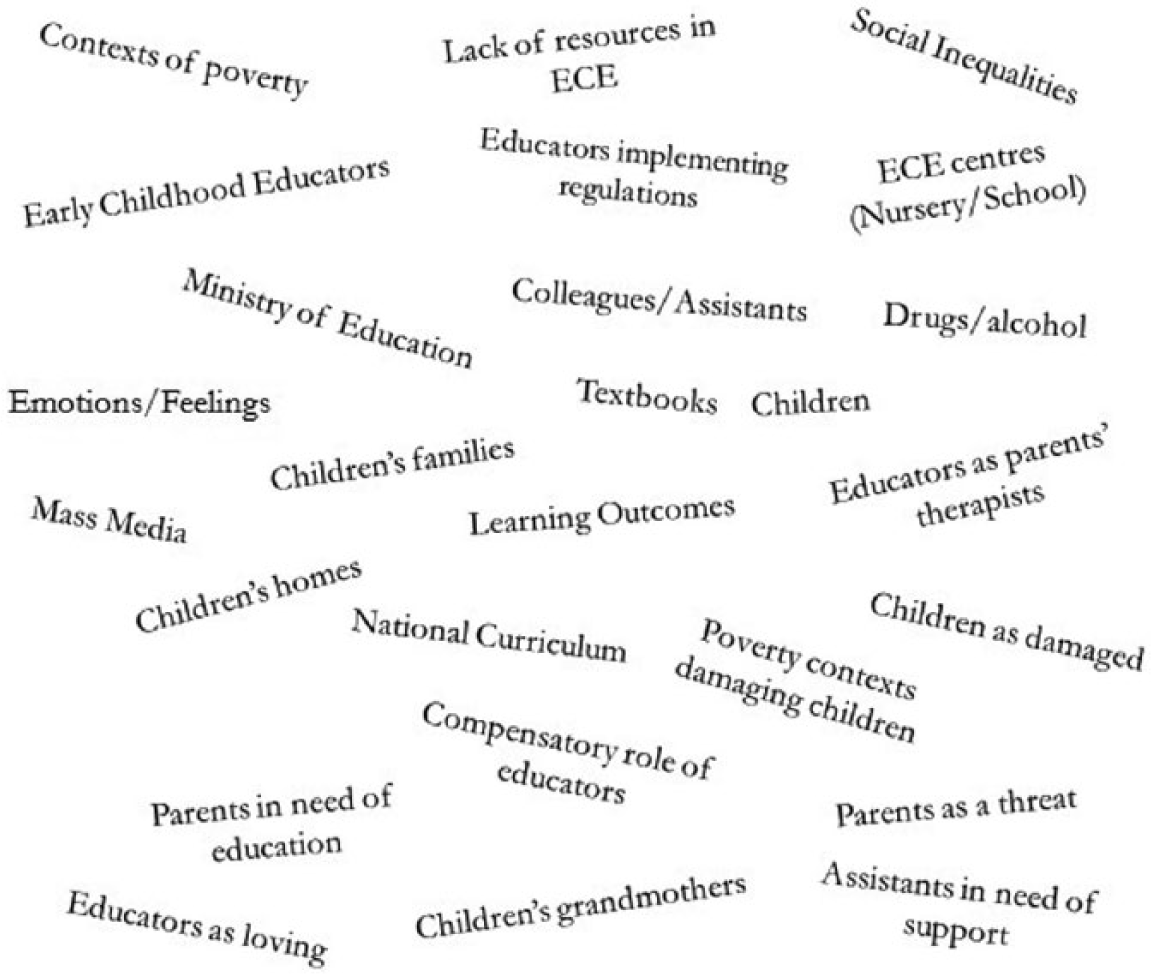
Example of a situational map outlining the main elements identified in the early childhood educators’ responses.
After identifying the main elements in each group of stakeholders, these elements were organised into nine categories: individual human actors; collective human actors; non-human elements; silent actors; discursive constructions of the elements; discursive constructions of the good educator; political/sociocultural elements; temporal/spatial elements; and major issues/debates. With these categories in mind, as well as Clarke’s suggested questions mentioned in the methodology section above, social worlds/arenas maps were created by situating all of the elements in the space, constructing social worlds, subworlds and arenas, and illustrating their relationships. Dozens of maps were drawn and numerous social worlds were constructed while the analysis was taking shape, until, finally, following the suggestions of Clarke and Friese (2007), a final map was drawn after data saturation (a concept taken from classical grounded theory) – that is, after tinkering, additions, deletions and reorganisation, the most important elements (from the researcher’s perspective) were included – and, by looking at the map, it was possible to return to all of the major stories identified in the situation. Figure 2 shows this final (although partial and temporal) attempt to interpret the whole situation through a social worlds map.
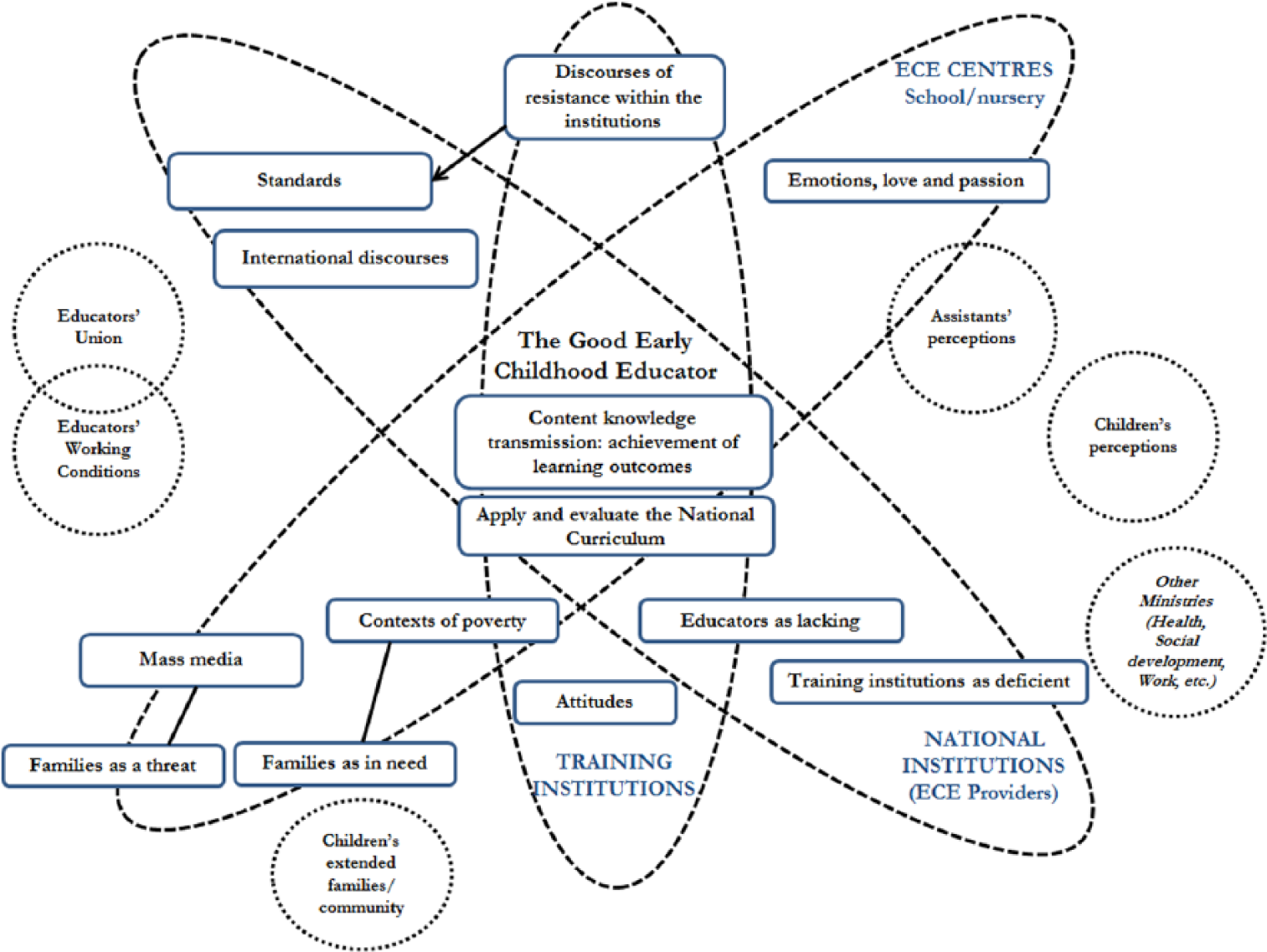
The final social worlds map constructed after the analysis of the discourses, structures and understandings identified in the stakeholders’ responses to the question ‘What makes a good early childhood educator in Chile?’
Three main social worlds were identified as relevant: the national institution providers of ECE; the training institutions; and the ECE centres (schools and nurseries). They are represented by the interconnected ovals in Figure 2. Shared understandings were placed in the middle of the map. Other elements were distributed according to their sources and, in some cases, the connections between them.
Discourses of failure and deficient educators and training institutions dominate the social world of ECE providers. In contrast, discourses of emotions, love and passion are important attributes within the ECE centres. These discourses are related to the idea of children and families as vulnerable and in need. Being affectionate makes sense as a means for social transformation and improvement in the contexts of poverty and social inequality where educators work. However, the affection given is, in one way or another, limited by the discourses of the mass media and television, which transform parents into a threat, whose complaints could cause educators to lose their job, sometimes unjustly. Other elements, such as the new standards for early childhood degrees, are placed within the national organisations and linked to the discourses of resistance identified in the responses of the teacher educators.
Finally, circles represent those absent or less integrated actors on the margins of the situation, such as children and ECE assistants. Despite being mentioned often by all of the stakeholders, children and their families were conceptualised by the participants in this study as in need, passive receptors and subjects of evaluation. Their perspectives and interests were not necessarily shaping the stakeholders’ practices and discourses. Assistants, in turn, were mostly mentioned by the early childhood educators – however, frequently by utilising infantilising discourses, portraying them as in need of support and care.
Other government bodies, although presumably having an influence on children’s, families’ and other stakeholders’ lives, were never mentioned by the participants. Neither was the Early Childhood Educators’ Union, a small organisation in the country that is responsible for representing educators’ voices and protecting their working rights.
Created dialogues: What makes a ‘good early childhood educator’?
The ideas around what makes a ‘good early childhood educator’ are multiple, since several positions were found in the responses of the participants. Figure 3 illustrates these different positions in two created dialogues amongst the stakeholders. All of the quotes were extracted from the interviews and then translated and adapted (as minimally as possible) to make them coherent. The first dialogue addresses the question: ‘What makes a “good early childhood educator” in Chile?’ The second explores the role of the educator in contexts of child poverty and social inequality.
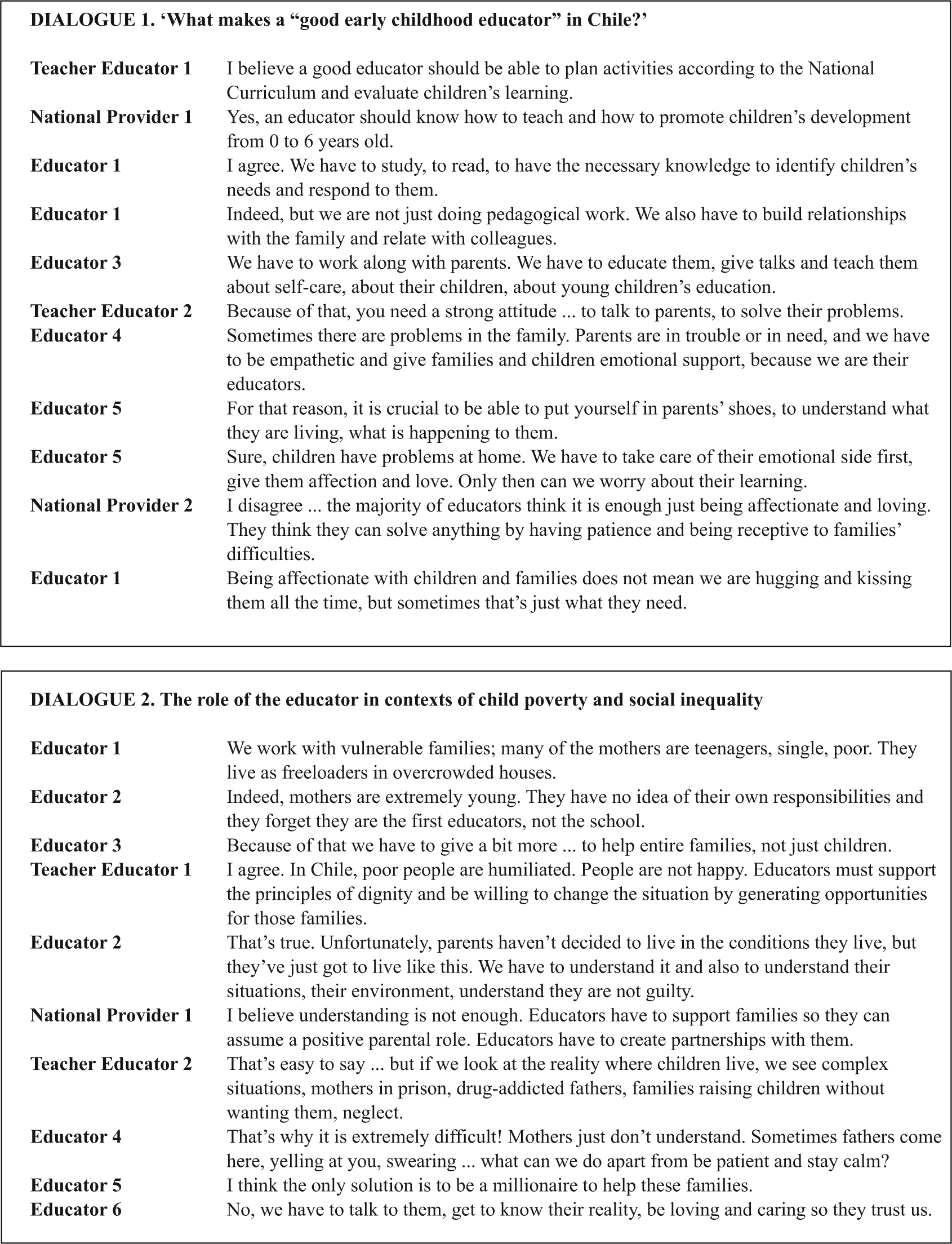
Created dialogues using text bites from the interviews.
The intention of this created dialogue is not to place the different positions as contradictory or incompatible. Rather, I argue that, in general, the stakeholders have understandings that vary in their emphasis, but they usually overlap and could easily complement each other. Overall, the interviewees tended to emphasise what they thought was ‘the most important’ or ‘the essential’ component of early childhood professionalism, without necessarily rejecting the other elements.
Future possibilities
Although it is true that this study is limited to the views of a small number of participants from particular settings in two regions of Chile, and it is subjective in the sense of the researcher’s personal interpretations and playfulness with the data, the findings can provide a starting point for discussing and rethinking new possibilities for understanding what it means to be a ‘good early childhood educator’ in Chile.
Some lessons can be learnt from the stakeholders’ responses and the comparison between them. First, although originating in foreign contexts and defining an educator in technical terms (Moss, 2006), discourses of knowledge transmission and implementation of the National Curriculum could be considered as valuable in this context, since they are something that all stakeholders share and respect. Thus, it indicates a consensus in considering the official document as a guide for practice, and evidences some kind of effective communication from the macro (government, organisations) to the micro (ECE centres and trainings institutions) level.
Second, the identified conflicts and tensions have the potential to expose often unseen subjects, which can help us to rethink particular issues and analyse how they are affecting practices within a situation. For instance, the findings from this research invite us to:
Rethink regulations (such as standards) and explore the negative and positive ways in which they are having an impact on curricula and decision-making in training institutions.
Reflect on the presence of the mass media in ECE and how different conceptualisations are being communicated to the general population, influencing local policies and practices of fear and threat.
Investigate the need to include silenced actors in the situation, and explore the means by which they can be integrated.
Reconsider current approaches to teacher training, and think about the possibility of incorporating new objectives that aim to develop future teachers’ attitudes and emotions.
Evaluate to what extent the professional development programs for early childhood educators are responding to the different contexts where they work, and how they promote the discussion of critical questions about the position of children, families and educators themselves within the society.
Finally, the findings of this research study could promote the possibility of having a real dialogue between stakeholders, which, rather than being aimed at finding consensus, has the potential to democratically place all voices and positions on the same level, creating awareness of each other’s understandings and strengths. It could open a space to disagree and develop different and deeper questions, because, as asserted by Vandenbroeck (2009: 169), ‘we need disagreement in order to challenge what is taken for granted and to acknowledge that our expertise is provisional and tentative’.
Footnotes
Declaration of conflicting interests
The author declares that there is no conflict of interest.
Funding
The author acknowledges Chilean National Scholarship Program for Graduate studies from CONICYT - Chile for their financial support.