




Abstract
This article considers what the repercussions are when the concept of ‘quality’ is examined within the epistemological and ontological theoretical shifts that are afforded by post-humanism. In particular, Braidotti’s configuring of thinking as ‘nomadic activity’ and the need for ‘process ontology’, together with Massumi’s ideas relating to ‘activist philosophy’, create the necessary conceptual space for thinking differently. The article takes as a point of departure ethnographic data that has emerged from the twin locations of Norway and England, which broadly centres on some of the practices, habits and mundanities that are associated with Norwegian and English children (aged between two and four) eating food whilst attending their barnehagene or ‘preschool’ setting. It is within the milieu of eating that the authors take up the challenge of confronting ‘quality’, where they question whether it is possible to put to one side a universal standard so as to consider other potentialities. Inevitably, the authors conclude with more questions than answers.
Introduction
This article considers what the repercussions are when the concept of quality is examined within the epistemological and ontological theoretical shifts that are afforded by post-humanism. In particular, Braidotti’s (2006) configuring of thinking as ‘nomadic activity’ and the need for ‘process ontology’, together with Massumi’s (2011) ideas relating to ‘activist philosophy’, create the necessary conceptual space for thinking differently. The article takes as a point of departure ethnographic data that has emerged from the twin locations of Norway and England, which broadly centres on some of the practices, habits and mundanities that are associated with Norwegian and English children (aged between two and four) eating food whilst attending their barnehagene or ‘preschool’ setting. It is within the milieu of eating that we take up the challenge of thinking differently, including thinking differently about a concept of quality, where we question whether it is possible to put to one side a universal standard so as to consider other potentialities. Inevitably, we conclude with more questions than answers.
The article is divided into four interlinking sections. The first section focuses on why there is a necessity to ‘think differently’ both in broad terms and, more specifically, in relation to ‘quality’. We try to make clear why this is especially difficult for each of the authors, given their affiliation to the field of early years education. In the second section, we present some of the conceptual tools with which we have an ongoing engagement, which, in addition to nomadic activity, process ontology and activist philosophy, also include ‘becoming’ (Deleuze and Guattari, 1988) and ‘event’ (Deleuze, 1990). In the third section, we focus on some of the mundanities of eating and use them as a conduit for rethinking the concept of ‘quality’. And, in the fourth section, we ask further questions, which work in directing attention to other ways of (re)thinking quality. Through each section we struggle, Sisyphus-like, with the problematic burden of ‘quality’.
Thinking differently
In both Norway and England, the students for whom we have responsibility will leave their respective universities in Oslo and Manchester in order to become teachers in a field that has been, and will continue to be, subjected to a political gaze. In both geographical contexts, it is a gaze that has a similar vision, where ‘quality’ is implicated in an agenda that is directed at raising educational standards both nationally and globally, engendering a stable society and securing economic stability. Within both countries, barnehagenes and preschools will exist within structural mechanisms, including policies (e.g. Department for Education, 2015a, 2015b; Norwegian Ministry of Education and Research, 2009) and curriculum guidelines (Department for Education, 2012; Steinnes and Haug, 2013), as well as inspection regimes (Lekhal, 2013; Office for Standards in Education, 2010/11; Waldegrave, 2013), which are targeted at ensuring that the teaching, learning and other services that settings provide are of ‘good quality’ (Ball, 2003, 2008; OECD, 2013; Trippestad, 2009; UNICEF, 2000). Our students will, by necessity, become implicated in numerous technologies aimed at securing ‘quality’ education. They will be involved in making judgments against a normalized standard of what does and does not constitute quality. Such rationalist approaches to both conceptualizing and materializing quality are endemic within early childhood education globally.
It is a notion of progress that has its roots in modernity, where enlightenment thinkers such as Kant (1784) perceived the use of reason as a move from immaturity to maturity. ‘The development of rational forms of social organization and rational modes of thought promised liberation from the irrationality of myth, religion, superstition, release from the arbitrary use of power as well as from the dark side of human natures’ (Harvey, 1989: 12). As Kellner and Lewis (n.d.) highlight: ‘Kant’s liberal humanism is encapsulated and articulated within his theory of freedom’. They continue: ‘Kant believed that pre-enlightenment superstition, cruelty, and ignorance would be replaced by both individual liberty and universal peace’. It is possible to appreciate how Kant perceived the project of enlightenment developmentally, within a linear trajectory. In his essay ‘What is enlightenment?’, he writes:
Laziness and cowardice are the reasons why such a large part of mankind gladly remain minors all their lives, long after nature has freed them from external guidance. They are the reasons why it is so easy for others to set themselves up as guardians. It is so comfortable to be a minor. If I have a book that thinks for me, a pastor who acts as my conscience, a physician who prescribes my diet, and so on – then I have no need to exert myself. I have no need to think. (Kant, 1784)
In order to effect this move where irrational immaturity gives way to the rational, thinking subject, the educating of children has and continues to be managed and governed. There is, then, a substantial history both within England and Norway where the management of children, including their health, welfare and education, has been linked to an overarching narrative of rational social betterment, where the discourse of liberal humanism permeates everyday practices – where what it means, for example, ‘to be kind’ or ‘to be fair’ is universally assumed, habitually practised and manifested in what is known as and referred to as ‘common sense’.
The possibilities of thinking differently about ‘quality’ are made especially difficult because it is closely aligned with an overly rationalist perception of education, which can be measured, procuring quantifiable results that can then represent ‘quality’. This has direct repercussions for our students once they are practising where they will teach within the shadow of these results, including those that emanate from tests such as the Programme for International Student Assessment (PISA), which is administered by the Organisation for Economic Co-operation and Development (OECD). The recent results from PISA, which is a global measure used to test the mathematics, reading and science attainments of 15-year-olds, were perceived by the right-wing governments of both Norway and England as disappointing. The fallout from these results has repercussions in terms of early years teaching, the curriculum and children’s learning, where there is the rationalist view that getting it ‘right’ in the early years will ensure subsequent success (Calman and Tarr-Whelan, 2005). As noted in an open letter from 60 academics from around the world to the OECD’s director of the PISA programme:
By emphasising a narrow range of measurable aspects of education, PISA takes attention away from the less measurable or immeasurable educational objectives like physical, moral, civic and artistic development, thereby dangerously narrowing our collective imagination regarding what education is and ought to be about.
The letter continues:
As an organisation of economic development, OECD is naturally biased in favour of the economic role of public [state] schools. But preparing young men and women for gainful employment is not the only, and not even the main goal of public education, which has to prepare students for participation in democratic self-government, moral action and a life of personal development, growth and wellbeing. (Andrews et al., 2014)
It is within and against this context where we find ourselves tethered to modernity’s legacy, but where we also seek exits from its tenacious hold. Previously, we have turned to theoretical approaches, including post-structuralism, feminist post-structuralism, deconstruction and queer theory, so as to think differently. Such approaches set their sights on eroding the foundations of enlightenment logic. Yet, as Braidotti (2009: 241) remarks: ‘in spite of the sustained efforts of many radical critics, the mental habits of linearity and objectivity persist in their hegemonic hold over our thinking’.
Similarly, our work does permeate programmes of study where, in both Oslo and Manchester, students are encouraged, for example, to put pressure on particular constructions of the child. They are invited to move away from and actively resist universal notions of what constitutes ‘the child’, where the question of ‘Who is the child?’ (Dahlberg et al., 1999) is a recurring, reflexive question. This questioning is positioned within a wider political and post-structural context of study, where ‘quality’ could also be rethought as one of those ‘weasel words’ (Watson, 2004), meaning everything and nothing – a comfort term – that is, all things to all people. Nevertheless, we question whether reflexivity and a persistent distrust of language are sufficient antidotes – both for the students and for ourselves – to the fallout from neo-liberalism.
If, as was suggested previously, the effects of ascertaining what qualifies as ‘quality education’ result in ‘a narrow range of measurable aspects of education’, then we have to, first, re-engage with the concept of ‘quality’ and, second, use our ‘collective imagination’ to think differently. We argue that, in order to do this, there is a necessity to engage with a different logic – a different way of thinking. We will go on to argue that it is only by engaging with a different logic that it becomes possible to foreground ‘immeasurable educational objectives’. We will also argue that it is in and amongst the immeasurable stuff of education that we might glimpse ways of rethinking ‘quality’.
Working within a different logic: Conceptual tools that make a difference
In this section, we attempt to define both ‘process ontology’ and ‘activist philosophy’, whilst also beginning to work with both.
In general terms, process ontology is based on the premise that being is dynamic, and that the dynamic nature of being should be the primary focus of any comprehensive philosophical account of reality and our place within it. This emphasis on the dynamic nature of being is important to Rosi Braidotti. She uses it as an opening to interrogate the slash that has traditionally been placed between nature and culture. She argues that the boundaries between the categories of the natural and the cultural have been displaced and to a large extent blurred by the effects of scientific and technological advances. She notes that whilst, for example, genetically modified food, advanced prosthetics, robotics and reproductive technologies are familiar facets of our globally linked and technologically mediated world, they do nevertheless call into question what is real, natural, cultural, artificial, and so on (Braidotti, 2013). ‘The very notion of “the human” is not only de-stabilized by technologically mediated social relations in a globally connected world, but it is also thrown open to contradictory re-definitions of what exactly counts as human’ (Braidotti, 2006: 197). What begins to emerge is a vision or an idea of the individual as a ‘relational process’ (Braidotti, 2013: 41). Braidotti, whilst wanting to highlight movement as encapsulated within the notion of ‘dynamic’, rejects the term ‘being’, favouring instead the concept of ‘becoming’. As she notes: ‘I define the critical posthuman subject within an eco-philosophy of multiple belongings, as a relational subject constituted in and by multiplicity’ (Braidotti, 2013: 49). Braidotti (2006: 133) understands ‘becoming(s)’ ‘as a pragmatic philosophy that stresses the need to act, to experiment with different modes of constituting subjectivity and different ways of inhabiting our corporeality’. Following Deleuze and Guattari (1988), she summons ‘nomadic thought’ as a resistance to thinking that is underpinned by the rational Cartesian subject. However, she is at pains to stress that nomadic thought is not a replacement or a development of a new ‘master theory’. Rather, it is about ‘multiple micro-political modes of daily activism’ (Braidotti, 2006: 133).
Nomadic thought directly challenges what Deleuze and Guattari (1988) refer to as an ‘arborescent’ model of thought, where thinking is marked by its insistence on totalizing principles, binary thinking and dualism. MacLure clarifies further:
It [arborescent thought] organises life in terms of genus and species, categories and instances, and can only cope with difference through relations of identity, similarity, analogy or opposition: that is, relations based on resemblance or difference among already-formed entities. (MacLure, 2011: 997)
An ‘arborescent’ model of thought includes representation, which, as MacLure (2011: 998) explains, ‘doesn’t just refer to the mediation of reality by language’. She continues:
Representation is the entire logic of static hierarchy … Within the schema of representation, things are frozen in the places allotted to them by the structure that comprehends them, and are not able to deviate and divide from themselves to form anything new. (MacLure, 2011: 998)
Whilst letting Braidotti’s ‘process ontology’ seep into, enfold, agitate and disassemble our customary practices of thinking, representing, ordering, structuring, and so on, we also want to take up a further challenge of engaging with Brian Massumi’s ‘activist philosophy’. It is a philosophy that ‘actively’ displaces cognition to ‘pure experience’. He writes: ‘The displacement from cognition … to the messy middling goings-on of pure experience in all its potential and complexity, has far-reaching pragmatic consequences’ (Massumi, 2011: 11). One specific consequence centres on both the mind/body and subject/object dichotomies. Massumi argues that these binaries are hailed both as ways of knowing and, from there, ‘into a hierarchy between modes of practice’. In brief, ‘activist philosophy refuses to recognize these divisions as fundamental or to accept the hierarchy they propagate’ (Massumi, 2011: 12). Because Deleuze and Guattari influence both Braidotti and Massumi, it is possible to spot similarities in their work. Yet there are also differences. Massumi argues that ‘ontological’ does not fit activist philosophy. He writes: ‘Process is only perishingly about being. But it is everywhere and always-about powers of existence in becoming. The concerns of activist philosophy are ontogenetic more than ontological’ (Massumi, 2011: 13). Massumi thus places emphasis on the endeavour – that is, the practice or the doing of thinking differently. Here the task is to foster and inflect, rather than try to master. It is also an ethical endeavour since it is to ally oneself with change, allowing for an ethics of emergence. Massumi (2002a: 12) is not therefore interested in forms of critical thinking, which he feels has become reduced to identifying points on ‘a stable map of the always already known’. In his view, interpretation through the overlaying of this map can only capture certain moments and certain experiences, which will invariably reflect the framework they are interpreted through. For Massumi, such critical impoverishment means that cultural theorists consistently miss both the matter of bodies and the unceasing movement that constitutes the process of becoming. And without this investment in movement between states and bodies, Massumi (2002a: 3) asks: ‘how do we account for, let alone encourage, change?’
The milieu of eating
The photograph in Figure 1, taken in 2015, is an extract of ethnographic data drawn from a doctoral study that is currently being undertaken by one of the authors, Thekla Anastasiou. The aim of the study is to understand children’s relations with food so as to appreciate the emotional and affective engagement children have with food. Such an appreciation may contribute to understanding why some children may enjoy the experience of eating food when in their preschool, whilst, for others, it might be a situation that is fraught with tension, anxiety and frustration. The fieldwork was conducted in a preschool centre located in an area of Manchester, England, which has relatively high levels of poverty and where the majority of the children attending the preschool are entitled to a free midday meal. Lunch, which is served every day at 12 p.m., is offered to the children, who are aged between three and four.
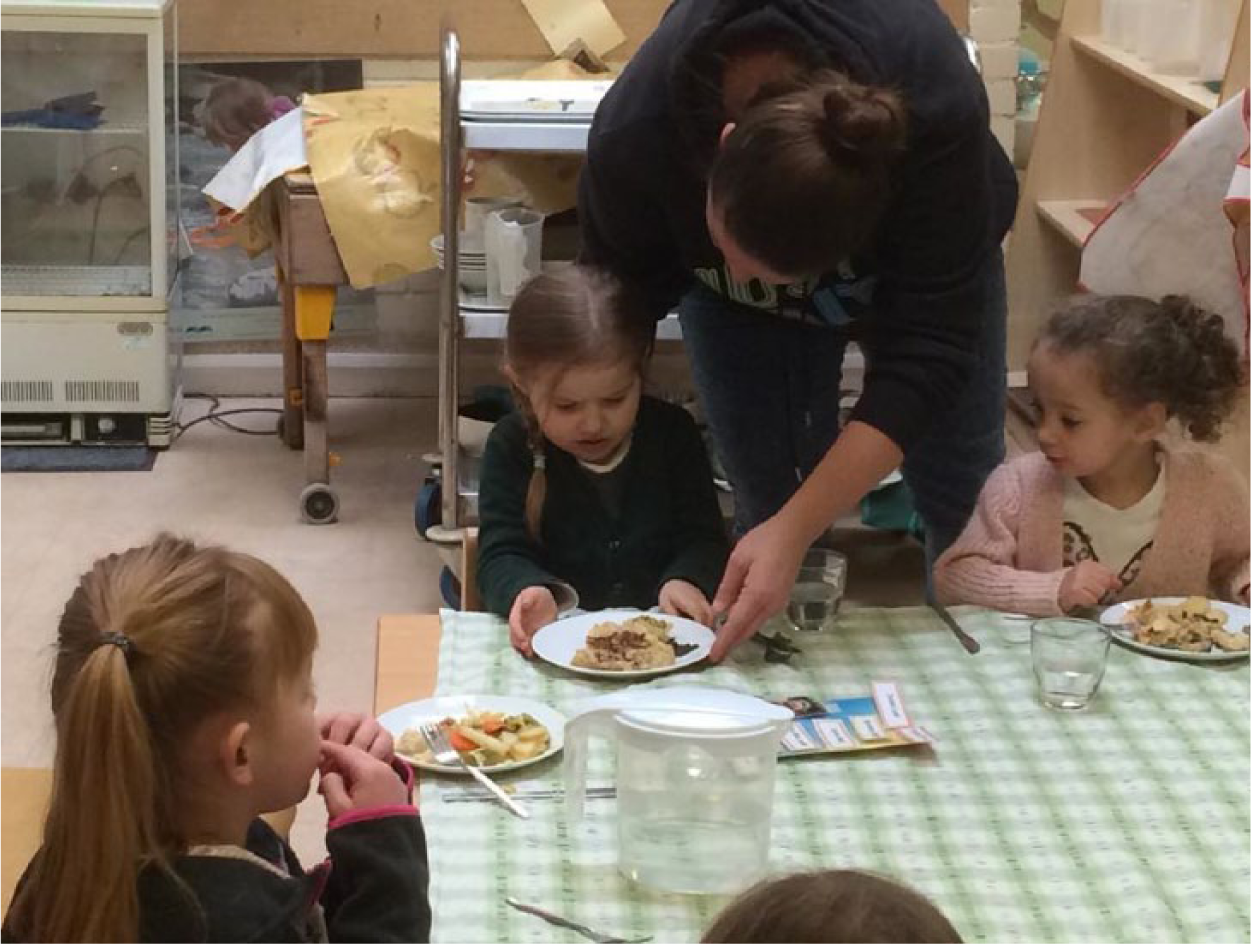
Lunch time.
The data collection methods included written field notes, videoing and photographs. Intensive time was spent observing during a six-month period, where lunchtime conversations and bodily interactions between the children and/or between the practitioners and the children were documented. Body-language movements were also carefully documented, where filmed footage and photographs served to compliment and generally thicken the ethnographic field notes (Gertz, 1973; Pink, 2001).
Becoming
The photograph in Figure 1 may well be used to ‘evidence’ quality UK early years provision – sensitive and localized adult support at lunchtimes, encouraging all young children to sit at the table and try new or eat familiar foods, whilst enjoying this sociable time together. To ‘read’ and savour the photograph as representative evidence in this way necessitates that we ‘di/still’ the movement long enough to assess and evaluate the bodies, gestures and facial expressions, as well as claim those practices and associated inferences as quality indicators of adult ‘scaffolding’. However, returning to Massumi’s (2002a) concern that we miss both the matter of bodies and the unceasing movement that constitutes the process of becoming, we need to refuse returning to the comfort of the arborescent model of the photograph as representation – the stable map where we identify and discuss what is already known. If we are to work with nomadic processes and to practise activism, what different kinds of work might be undertaken with the photograph? In what way can this data help us to envision new possibilities for a ‘weasel’ concept such as ‘quality’?
Rather than thinking about quality as a series of detectable, visible and measurable interactions and practices that lead to a child making linear, developmental progress through a trajectory of norms and age/stage-related expectations, we might reconceptualize quality as always already in movement – a process of becoming. Quality/qualities could be about experimenting with how ‘things’, including figures and more-than-human entities, are co-constituted, inhabiting a chaotic and relational assemblage of forces, bodies, smells, chairs and discourses taking on new significations. What is framed within the photograph in Figure 1 is ‘a commotion of relational activity’ (Manning and Massumi, 2014: 12) – that is, the adult and children together with the food, plates, cutlery, water, and so on will be in dynamic relation with one another. The photograph is a document that becomes part of the lived qualities as they were occurring. And, of course, whilst we cannot actually perceive these qualities, they will nevertheless be happening. Food, lips, hands, eyes and nose will be in molecular relation to one another. Taste, smells and colour will be in turmoil, generating sensation. Non-human matter as well as human – indeed, everything that smells – will be giving off light, volatile chemicals that float into air, then into the nose. The vegetables, meat and gravy, as well as the odours emanating from the rubber wire lying across the floor, the bacteria, moulds and fungi colonies flourishing all over the wood, metal and glass surfaces, the stale smell of drying paint and old play dough, and the children and adults, will be generating affect, intensities and forces. Matter will be combining with other matter, including culture, history, politics, economics and ideology.
The school meal is, in Deleuze’s (1990) terms, an ‘event’. The meal as event is never constructed from several or multiple elements, but always from a multiplicity of matter that moves together in a continuous flow. As event, this meal involves the knife and the fork and the table and the adult and the children and the temperature of the room and talking and fingers in mouths and frowns and cleanliness and policy and culture and ideology and, and, and … ‘It is impossible to determine where the event stops’ (Dolphijn, 2004: 24).
And yet, despite and because of the complexities, movements, forces and instabilities that circulate within the milieu of eating, there is, we think, a persistence in perceiving and understanding the school lunch as a space of containment where categories of perception and assessment will be evoked. These categorizations help practitioners to decide, for example, how the child in the foreground of the photograph in Figure 1 could be understood as a ‘good eater’, whilst the child looking intensely at the food, frowning, using her cupped hands to stop the plate of food coming any closer to her body, might be described as ‘fussy’. It is where the child who finds some sort of relational comfort in holding her fork in one way might be encouraged to hold it ‘correctly’. It is where children will learn to keep in check their immediate bodily aversion to certain tastes or sensations. It is where they will say ‘thank you’ for food that they have no appetitive for. It is where they have to tolerate the close physical proximity of the adult, her body, her warm breath, her odour and her touch – to learn that such close bodily encounters, whilst evoking bodily (dis)comfort, (un)ease, tension or anxiety, are nevertheless orthodox manifestations of ‘care’ and ‘kindness’.
We want to suggest that children, when eating their school meal, have to learn to map themselves onto ‘a stable map of the always already known’ (Massumi, 2002a: 12). It is a map that gains its stability through concepts such as quality, because it always and already legitimates what qualifies as ‘quality’ before the event. It has already been assumed, for example, that objects such as a tablecloth or a plate filled with vegetables are markers of quality.
‘Quality’, both within the context of the school meal and in other areas of early childhood education, works at maintaining the status quo. Quality ‘as a mechanism of control cannot tolerate difference or the threat of difference of that which resists or exceeds meaning’ (MacLure, 2011: 998). Nor can it pay attention to the affects of the event to which bodies respond and in which they participate, and thus it cannot appreciate that these affective flows are a form of thinking – thinking in action (Thrift, 2008) or thinking-feeling (Massumi, 2008). Nor can quality recognize that affect is beyond representation. Paraphrasing Katz (2000), speech cannot congeal affect. Talk cannot grasp affect. Affect is a form of expression that is often invisible, but on occasions erupts:
Blushes, laughs, crying, and anger emerge on faces and through coverings that usually hide visceral substrata. The doing of emotions is a process of breaking bodily boundaries, of tears spilling out, rage burning up, and as laughter bursts out, the emphatic involvement of guts as a designated source of the involvement. (Katz, 2000: 322)
However, could quality be reconfigured, where it could be concerned about and sensitive to the composition of an affective encounter? Where we can understand it as a network of intensities? Where it is produced in and amongst coalescing forces? In other words, can we conceptualize ‘quality’ as ‘becoming’, as open? Where body, movement and sensation produce something that warrants both attention and might potentiate different ways of ‘becoming’ quality? As Massumi highlights:
When I think of my body and ask what it does to earn that name, two things stand out. It moves. It feels, and it feels itself moving. Can we think body without this: an intrinsic connection between movement and sensation whereby each immediately summons the other? (Massumi, 2002a: 1)
Is there potential for making a difference to quality within this summoning?
Detouring to Norway
In order to pursue these thoughts further, we want to turn to Nina Rossholt’s study, which she undertook in her home city of Oslo, Norway. Nina conducted an ethnographic study in two ‘preschools’ (barnehagenes) for children aged between two and five. She spent 12 months undertaking fieldwork, where her principle aim was to appreciate how discourses of gender, age and the material produce subjects (Rossholt, 2009, 2012a, 2012b). In this article, we focus on an example of her data where the children are eating their midday meal, which has been prepared in the barnehagene:
Sohaila, a girl aged two, touches the soup with her spoon. Green spinach soup is lifted up in the direction of the mouth. The hand lifting the spoon with the green soup changes direction, and the green spinach soup drips onto the red sweater and her white bib; one spoonful in the mouth and one down the sweater. Sohaila looks at me while trying to get the spoon in the ‘right’ position. Green, red and white begin to merge. Soup touches Sohaila’s skin as well as touching her stomach. Sohaila takes a piece of the bread and butter and she licks the butter off with her tongue. A boy, Einar, also aged two, sits next to Sohaila. He too has a bowl of green spinach soup. He has eaten a piece of bread but the soup remains untouched. After a while, he pushes the soup away from him. He looks at the others eating and his gaze settles on the plate of bread and butter which is on the table. He looks down. He says, ‘Einar bread’. The practitioner asks, ‘Have you tasted the soup yet?’ Einar looks down, his mouth closed. The bread is only twenty centimetres away but he does not touch it. Sohaila continues to practise eating soup. She tries out different positions with her right hand but most of the soup goes in the wrong direction. Einar, it seems, is waiting for permission to eat a second piece of bread and butter. The practitioner tells me that she really wants to give Einar a second piece, but that she doesn’t dare. ‘I will get a scolding from the other practitioner’, she says. The staff have talked about Einar’s eating habits, and they have drawn up strict rules about how to react to him during mealtimes. Einar has to taste all the various foods that are on the table, and not just the bread and butter. Einar’s best friends have eaten two bowls of spinach soup. They eat fast. The spoons enter the bowl again and again: smiling faces, drinking glasses lifted, a composition of different sounds mingling with the sound of: ‘No, you have to wait. You haven’t tasted the soup yet’. After a while, Kari, the practitioner, gives Einar a piece of bread. (Field Notes, 24 November 2010)
If we stay with quality/qualities as always already in movement – a process of becoming – we are struck by how this observation oozes affect as a generative force. As O’Sullivan (2001: 126) points out: ‘There is no denying, or deferring, affects. They are what make up life … Affects are … the stuff that goes on beneath, beyond, even parallel to signification’. O’Sullivan then asks: ‘But what can one say about affects? Indeed, what needs to be said about them? … You cannot read affects, you can only experience them’. Can we say anything about affect? Can we talk about affect or theorize it in ways that will assist us in our endeavour to rethink quality? If, as we shall go on to suggest, affect flows through Nina’s observation, does this matter? And in what way does it matter? If, as O’Sullivan points out, affect cannot be read, what purpose will be served by paying attention to it?
We would argue that what Rossholt’s observation manages to capture are pre-linguistic and/or extra-linguistic forces that emerge through continual configurations between the human and the non-human, where spinach soup – its colour, texture, smell and taste – triggers pleasure, desire and abhorrence, and where the non-human (e.g. spoons, soup, colour, smell, texture, spinach, bowls and noise, as well as culture, ethnicity, ideology, etc.), together with Einar, Kari and the other children, is caught within alliances, relationships, intensities and forces.
However, as the observation indicates, this relational encounter has already been mapped with pre-given rules. For example, it would seem that the staff have adopted the common-sense practice of encouraging children to try other foodstuffs so as to extend their range of food preferences. Discursive practices are also at work at the micro and meta levels: Kari will get a scolding and Einar will not be able to eat bread and butter – practices that are directed at rendering both of them ‘docile’ (Foucault, 1977). Additionally, the practitioners in Einar’s setting (as well as practitioners in the UK) will be working within policy guidelines that are targeted at developing healthy eating habits so as to ward off the perils of obesity and chronic diseases. The limiting of the bread and butter stems from a healthy eating discourse that restricts the consumption of ‘bad’ foods whilst encouraging the consumption of ‘good’ foods (Buchanan and Ritchie, 2004; Hooper et al., 2012; Public Health, England, 2014). Thus, the practitioners’ ‘strict rules’ are bound up in structures that are aimed at enhancing the quality of Einar’s life.
Similarly, the processual relationship between hand, arm, soup and spoon that is being played out in the observation, although messy, is countenanced because of an expected outcome. A conceptual overlay pre-exists this moment because there is a ‘right’ way of holding the spoon. There is a common logical outcome, and, as Massumi notes, when a common logical outcome is followed, ‘product and process appear as versions of each other: copies. Production coincides with reproduction’. He goes on to note that ‘any potential the process may have had of leading to a significantly different product is lost in the overlay of what already is’ (Massumi, 2002b: xviii). In policing her own body, Sohaila ‘does not express the system’, but ‘is an expression of the system’, where ‘the system expresses itself in its subjects’ every “chosen” deed and mystified word – in its very form of life (its habitus, as Pierre Bourdieu would say)’ (Massumi, 2002b: xviii). Massumi then goes on to ask a significant question: ‘Where, in the conformity and correspondence between the life form of the subject and the system of power that is produced, has the potential for change gone?’ (Massumi, 2002b: xvii).
The potential for change
Deleuze and Guattari (1988: 118) suggest that words such as ‘quality’ constitute what they describe as ‘order words’, which, in turn, are a ‘death sentence’. They assert that, even when ‘softened’, order words bring death: ‘Order words bring immediate death to those who receive the order or potential death if they do not obey, or a death they must themselves inflict, take elsewhere’ (Deleuze and Guattari, 1988: 118). If we turn back to the observation, it becomes possible to see Kari struggling with the ‘strict rules’ that are caught up with issues relating to eating/quality, but also being affected by Einar. It is possible to understand Kari reaching what Braidotti describes as a ‘threshold of sustainability’. She elaborates further: ‘Your body will tell you if and when you have reached a threshold or limit. The warning can take the form of opposing resistance, falling ill, feeling nauseous or it can take other somatic manifestations’ (Braidotti, 2011: 308). A threshold, in Braidotti’s (2011: 309) terms, is a ‘corporeal warning’ or a ‘boundary marker’ that expresses a clear message: ‘too much!’
Caught within the swirling relations that are manifested in this particular encounter, Kari suspends what she ‘should do’ and allows Einar another slice of bread. The pre-imposed judgment of ‘eat this first, then that’ serves to create a dichotomy. Either Kari obeys the ‘death sentence’ or she acts clandestinely. What she is currently unable to do is take cognizance of the bodily affects that swirl in and around her, and use this bodily knowledge for rethinking thinking, where quality is a way of living; where, as a concept, it can change within the encounter of bodies being touched, bodies feeling; and where, in the space between the child and the material, the new can be created.
The problem is, as Rossholt (2009) has pointed out, we often define the new with old definitions and thus lose the potency of the new. Currently, this whole encounter is overshadowed by rationalist linear logic. However, following both Braidotti and Massumi, we would like to suggest that a concept like ‘quality’ could be made useful when it is not tied to an expected success or outcome. This effectively places ‘quality’ in the present. Situating quality in the present means that, in every situation, including mealtimes, the way in which all the different elements interrelate will be so complex that we will not be able to immediately comprehend the situation or the event. As Massumi notes in an interview with Mary Zournazi: ‘There’s always a sort of vagueness surrounding the situation, an uncertainty about where you might be able to go and what you might be able to do once you exit that particular context’ (Massumi with Zournazi, 2002). Like Massumi, we perceive this uncertainty as providing a measure or margin of manoeuvrability, and it is here that it becomes possible to (re)think ‘quality’. It is in the space of uncertainty that the concept of quality can become ‘an opening to experiment’ (Massumi with Zournazi, 2002: 214). By thinking of the concept of quality as an experiment, it becomes possible to ask: What could be the next experimental step? As Massumi with Zournazi (2002: 215) notes: ‘focusing on the next experimental step rather than the big utopian picture isn’t really settling for less. It’s not exactly going for more, either. It’s more like being right where you are – more intensely’ (original emphasis).
Yet there is cause to pause for thought. We are haunted by the following observation and remark, where Kari tells Nina that ‘she really wants to give Einar a second piece, but that she doesn’t dare. “I will get a scolding from the other practitioner”’. Such an observation and statement is a timely reminder of how individuals invest in and are motivated by forms of desire and power, which help to maintain and reproduce forms of thinking, including common sense. We are therefore left hoping, in the first instance, that the intensity that Massumi references could characterize new modes of ethical behaviour, which will take us beyond frameworks of established protocols and sets of rules and guidelines in relation to quality. Secondly, we hope that it will be amongst the movements of intense experimentation where the contingent, the overlapping and the contradictory can be synthesized, ‘but without effacing their heterogeneity or hindering their potential for future rearranging’ (Massumi, 1988, cited in Deleuze and Guattari, 1988: xiii). Following Deleuze and Guattari (1988: xiii), we ask: Does the concept of ‘quality’ have to be used or implicated in building the courthouse of reason or can it be thrown through the window and, in so doing, call forth a future form?
Concluding remarks
This article has used two examples of ethnographic data concerning mealtimes as a conduit for rethinking so as to (re)consider the concept of ‘quality’. In foregrounding the work of Braidotti, Massumi, Deleuze and Guattari, we have attempted to situate the event of eating within a logic of thought that resists anthropocentric tendencies, and, in so doing, we have become more raw to the effects and potential of affect. Being mindful of affect raises two possibilities in relation to the concept of ‘quality’. First, we might begin to consider (re)modifying ‘quality’, where it is understood as an experiment that unfolds and responds to the events of schooling. Corrupting Patton (2005: 404), but with good intentions, we want to consider whether the concept of quality could give expression to events of schooling whilst simultaneously being ‘betrayed’ by historical and contemporary forms of the concept. Might this process open up what Connolly (2002: 172 ) describes as ‘productive tensions’, where issues relating to quality can countenance ‘practical affective politics’ (Thrift, 2008: 214)? But if we are to countenance a ‘practical affective politics’, schools and schooling have to become places where human and non-human relations are embedded in ethical, haptic cartographies of affect. Within such networks, Kari would not have to resort to smuggling bread and butter to Einar. Rather, her affected body could, in turn, affect ‘others’, including the human and the non-human, and in this way a transition, however slight, could happen. She would step across the threshold. The question is: Are we brave enough to take affective steps so that the concept of quality can be breached?
Footnotes
Declaration of conflicting interests
The authors declare that there is no conflict of interest.
Funding
This research received no specific grant from any funding agency in the public, commercial or not-for-profit sectors.