



Abstract
In this article, I argue for a realist anthropology based on the recognition of mind-independent reality; pitching this premise against concerted anti-dualist tendencies in contemporary anthropological thinking. I spell out core analytical entailments of these, in my view, profoundly conflicting premises. In particular, I focus on perspectival multi-naturalism, arguing that despite adherents’ claims to reinvigorate studies of ‘ontology’, this approach instead exaggerates epistemological dimensions. When assessed from a realist stance, its ground position engenders a series of epistemic fallacies by which the ontological is, effectively, subordinated under epistemology. Advocates’ reluctance to appreciate a distinction between mind and mind-independent reality entails a profound contraction of perspective in terms of empirical and methodological scope, and, analytically, a disregard for ontological complexity and depth, thus curtailing the importance of anthropology in wider academic discourse.
Keywords
Mind-independent reality (MIR) is the foundational principle of realism; it defines the position (DeLanda and Harman, 2017; Lehe, 1998; Sayer, 2010). The basic assertion is that reality transcends human grasp; hence it cannot be spelt out in full through a study of human knowledge alone, no matter how broadly we define this dimension. There is somehow a surplus of existence relative to human comprehension; certainly in a contingent sense (i.e. limited grasp relative to the events, situations, objects, domains, etc. that specific humans encounter) and also principally. 1 For instance, there was matter-of-factly a virus in Wuhan, China, in December 2019 that caused disease, even though no human knew about it. And as it spread (in its ever-transforming shape) throughout the globe in 2020, it engaged the most varied forms of human knowledge. From the realist viewpoint, it would be rather absurd to claim that the virus itself took shape after these conceptions (what people thought ‘it’ was) and equally problematic, of course, to assume that virus deniers cannot contract COVID-19 (Bråten, 2020).
So, essentially, acknowledgement of MIR establishes a theoretically inescapable distinction (in the sense of non-identity) between what exists and the human grasp of existence. In the following, I prefer to use ‘imagining’ as the most inclusive term for the human side of this distinction. While, certainly, human imagining – its processes as well as products – also counts among what exists, the realist starting point is that it cannot be coterminous with cosmos. At another theoretical level, we thus appreciate a distinction between ‘ontology’ and ‘epistemology’; dimensions of being versus dimensions of knowledge. These aspects are not, as a matter of principle, coterminous. Axiomatically, ontology is somehow different from epistemology. While, arguably, anthropology has become ever more preoccupied with human imagining, variously couched as ‘meaning’, ‘knowledge’, ‘belief’, ‘cosmology’, ‘models’, etc. – or, increasingly, ‘concepts’ – the principle of MIR shifts our focus to the other pole. It is through and through a call for anthropology premised on the ontological.
This is hardly a novel contention; contemporary academic discourse abounds with a critique of anthropocentric approaches that (over)emphasize human minds. Actor–network theory (e.g. Latour, 2005) institutes agentive symmetry among human and non-human ‘actants’ in the formation of networks, while the closely related field of science and technology studies discloses the contingent nature of scientific discoveries, thus undermining simplistic notions about human genius. Others rethink humanity in terms of practical, phenomenological engagements with micro-environments; their particular ‘affordances’ (notably Ingold, e.g. 2000), while feminist scholarship has engendered a prolific field of post-humanism (e.g. Bennett, 2009; Braidotti, 2013; Haraway and Wolfe, 2016) concerned with ‘how matter comes to matter’ (Barad, 2003). This destabilization of anthropocentric presumptions undercuts the importance of what is generally viewed as human-specific properties, such as imaginational and imaginative interiors, in the constitution of reality. 2
The approaches I critique in this article are no exceptions: Viveiros de Castro (2014) and Viveiros de Castro and Wagner's (2015) perspectival multi-naturalism (PMN) and the ‘post-critical’ methodologies of recursive comparison that it has engendered (especially Holbraad's ‘ontography’, 2012, and Viveiros de Castro's ‘controlled equivocation’, 2004). Adherents of this stream of thought struggle to decentre overly anthropocentric presumptions, too. However, since human imagining is a sine qua non in ethnographic research (see Hornborg, 2021: 2; Pina-Cabral, 2017: 4), it remains pivotal in their so-called ‘ontological’ approach. Hence, PMN scholars cannot entirely escape the paradoxes that arise at the interface between mind and MIR. While some other strands of the ontological turn may be criticized for downplaying human imagining, PMN scholars are centrally concerned with this domain, in particular, the ‘alter’ (or ‘radically alter’) conceptualizations that ethnographers encounter in the course of fieldwork. In the following, I use the term ‘embedded concepts’ to denote this realm of situated human imagining, closely resembling what is customarily associated with ‘the emic’ in anthropological discourse; that is, the particular meanings that seem to inform the lives of fieldwork hosts. PMN’s claim that this domain is a matter of ontology rather than epistemology (Viveiros de Castro, 2012: 151–153) is at the heart of my critique.
Now, to avoid misunderstandings, it is important to note that PMN scholars’ rendering of ‘ontology’ is highly distinctive. At one level, Viveiros de Castro’s account of the ‘ontology’ of Amerindian multi-naturalism accords with philosophical usage; he illuminates a specific conception of being. However, the content of this particular ‘ontology’ engenders a veritable revolution when applied recursively, that is, back on the foundations of anthropological thinking. As Holbraad and Pedersen note, ‘to reconceptualize the notion of nature is ipso facto an intervention in questions of ontology’ (2017: 175; see also Kohn, 2013: 10). The Amerindian premise of multiple natures profoundly destabilizes the givens of ‘our’ (mono-naturalist) ontology. Moreover, it undercuts analytical presumptions in social science discourse as well, including the very concept of ‘ontology’. Especially the younger generation of PMN scholars have elaborated on this actively subversive potential of multi-naturalism, attempting to de-couple ‘ontology’ from its philosophical import. Shunning metaphysical foundationalism, they stretch the term towards an exceedingly eccentric definition where ‘ontology’ espouses a particular attitude-cum-methodology rather than a substantive theory about being. The overall aim is to instantiate an approach that takes ‘the things that people in the field say, do or use so seriously, that they trump all metaphysical claims made by any political, religious or academic authority’, and even doubling down on this deconstructive ambition by including ‘the authority that we assume in making this very claim’ (Holbraad and Pedersen, 2017: 287; original emphasis). 3
What is the status of embedded concepts in this reconfiguration of ethnographic practice? Relative to anthropology, they are ontological in the sense of reality-transforming data insofar as they, recursively, manage to affect theory; ideally, they play a role in the language game of anthropology. Moreover, relative to their embedding, as it were, embedded concepts are also ontological in PMN optics in the sense that they report on alter realities. This follows from general premises that remain crucial in PMN discourse, despite its refashioning as subversive methodology: (i) an anti-representational stance that encourages ethnographers to render informant statements, not as ‘beliefs’ but as ‘conceptualizations’, (ii) a commitment to frame ‘conceptualizations’ as serious, reality-generating philosophizing (sensu Deleuze and Guattari, 1994: 15–34), and, thus, on a more general level, (iii) the embrace of a principal anti-dualism that erodes the contrast between mind and MIR. Hence, in PMN, embedded concepts gain traction as ontological constituents also beyond disciplinary language games; they are, so to speak, indexical signs (sensu Peirce, see Hoopes, 1991), manifestations of the altered realities or natures that people inhabit.
Yet, my main argument is that PMN does not occasion a decisive shift to the ontological (see also Bråten, 2015, 2016); hence my use of quotation marks when referring to adherents’ peculiar application of ‘ontology’. From a realist viewpoint, I hold that what is branded ‘ontological anthropology’ (or the discipline’s ‘ontological turn’) is rather the most extreme manifestation possible of commitment to the epistemological (see also Graeber, 2015). This is so because PMN’s version of anti-dualism (their wilful erasure of ontology/epistemology distinctions) is engendering while concealing dualism at another level of reasoning, and as Heywood (2017: 7–8; see also Blaser, 2013: 551; Heywood, 2012; Pina-Cabral, 2017: 46; Scott, 2014) has made clear, such ‘meta-problems’ are hardly overcome by a retraction to ‘pure’ methodology. Moreover, I argue that this counter-created dualism turns out to have a vertical character, so what emerges is simultaneously a distinction between ontological flatness and depth (see also Peacock, 2015; Ssorin-Chaikov, 2013). More specifically, I argue that PMN’s assault on the mind/MIR divide prompts a hierarchical configuration (sensu Dumont, 1980) in which the mind comes to encompass MIR.
I will return to these claims in due course; first, it is necessary to bring out PMN’s explicit programme (its horizontal dimension, as it were) and contrast it with the realist perspective I favour. In all the adulation that currently surrounds the ontological turn, it is easy to miss how intensely radical the perspective is and how deeply it challenges classical modes of anthropology; certainly if one adheres to the realist view that cosmos is irreducible to human conceptualization. Clearly, either position provokes a series of ethical and political issues of critical importance for anthropological practise (see, e.g. Herzfeld, 2018; Pina-Cabral, 2017). To discuss these problems properly would require another article; my limited ambition here is to highlight some of the logical, analytical and methodological enigmas that irrealism of the PMN sort engenders.
‘Concepts equal things’
In PMN, mind and MIR are seen as mutually imbricated to such an extent that the terminological contrast ceases to take the character of a ‘relation’ in the accustomed sense; that is, as the linking of two different, self-same entities. They are rather understood as ‘relational’ in a constitutive sense, as ‘intra-actions’ rather than inter-actions, to borrow Barad’s notable distinction (2007: 33) – a position that reveals a conspicuous Deleuzian influence on PMN thinking (Skafish, 2014). Both mind and MIR are construed as outcomes of immanent, virtual actualization rather than entities existing prior to or externally to mutual engagement.
That this premise suffuses PMN is evident, not only from a depth-reading of central ethnographic works (Bråten, 2016), but in the explicit use of a sign of equality to denote the mutual imbrications of mind and MIR dimensions, for example, in the pervasive argument that concepts = things and vice versa. As Henare et al. put it (2007: 3; see also Holbraad, 2012), the authors attempt to turn attention ‘to the relationship between concepts and things in a way that questions whether these ought necessarily to be considered as distinct in the first place’. This dissolving of the prime realist distinction undercuts a range of other accustomed divides as well. For instance, Viveiros de Castro interrogates, inter alia, the distinction of thought versus practice (2012: 64–67) and subject versus object (2014: 60–63), while, arguably, Holbraad and Pedersen make the equalizing principle generic. This is palpable, for example, in their dissolving of the difference between thing and scale. Their notion of ‘self-scaling’ suggests that the two poles are not independent dimensions of being but intimately entwined aspects of each other. As the argument goes, we deal with ‘things that scale themselves or … scales that “thing” themselves’ (Holbraad and Pedersen, 2017: 130). Moreover, a ‘comparison’ is captured by the same logic of inter-penetration; scaling is seen as comparison and vice versa; PMN adherents do not compare ontologies, but conduct ‘comparison as ontology’ (Holbraad et al., 2014).
In sum, we sense a pervasive formula of equalization that, ultimately, allows all and every constituent or dimension of cosmos to converge, in and through their alleged immanent character. As Viveiros de Castro puts it with respect to Amerindian ‘ontology’; we deal with ‘a universe that is a hundred percent relational – one in which individual substances or substantial forms are not the ultimate reality’ (2012: 111). In this universe, ‘there are no representations … but only perspectives’ and ‘no ontological dualism of spirit (or “meaning”) versus matter (or “things”) … [T]he meaningful and the material are aspects of one single reality’ (2012: 124; original emphasis).
Importantly, starting from this premise, there is no way to specify how human imagining and wider reality differ. That would require a commitment (illegitimate in PMN’s view) to exteriority, the as-such character of each domain; their entity-ness or substance. While, as observers and analysts, ethnographers do gain access to emergent stabilizations post hoc, in their empirically manifest forms, the PMN perspective cannot, if it is true to itself, provide external standpoints from which to assess their emergence. In Viveiros de Castro’s phrasing, there is an ‘absolute absence of any exterior and superior arbiter’ (2015: 10). Hence, analytically, we are forced to approach human imagining and MIR as if they were coterminous domains; there is, so to speak, no ‘outside’ to either.
Having thus blocked the obverse possibility – of approaching concepts and things as different existences (concepts ≠ things) – one is also forced to treat the distinction between epistemology (dimensions of knowledge) and ontology (dimensions of being) in a particular way. Conceptually and analytically, these poles converge, too. If human imaginings are framed, not as (culturally diverse) representations of external reality, but as ontologically generative from within their being, it is virtually impossible to specify how epistemology differs from ontology.
Realist re-assertion: intransitive reality and epistemic fallacy
In contrast, to acknowledge MIR raises theoretical problems that are obscured in PMN thinking, chief of which is the challenge I keep pointing to: How to account for the inextricable difference (non-identity) between MIR and human imagining. This question is neither contrived nor unduly ‘theoretical’; it challenges any fieldworker with an open mind to the ethnographic reality in which she moves. Indeed, we face a double analytical challenge, since ethnographic research regularly entails at least two forms of imagining: the researcher’s perspective on the one hand and the perspective propounded by fieldwork hosts on the other hand. Evidently, the tensions arising along this epistemological axis have driven much of the reflexive critique in anthropology and also inspire PMN’s attempts to undercut epistemological hierarchies. In practice, as perceptive ethnographers know, the situation is even more complex, since our hosts may embrace several and apparently conflicting perspectives on reality. Ethnographers increasingly work in settings where embedded concepts intermingle or coalesce in complex ways. Hence, the realist principle institutes several contrasts between MIR and human imagining in the practice of ethnographic research. It is crucial to expose the analytical entailments of this complexity.
Firstly, realist analyses presuppose some notion, model or theory that can account for the non-identity of mind and MIR. Unless we make this simple requirement explicit, we project an ontological homogeneity that unavoidably muddles their relation. Below I argue that this is a highly problematic outcome of PMN positioning since the ensuing ‘flattening out’ of reality obstructs analyses of ontological complexity.
Secondly, asking how mind and MIR differ entails asking how MIR surpasses mind, that is, what aspects of reality that remain unaccounted for when restricting our focus to human imagining only. Here, I draw on the vocabulary of the critical realist philosopher Roy Bhaskar (1998, 2008), who distinguishes between transitive and intransitive reality. Resonating with the grammatical connotations of these terms, ‘transitive’ reality denotes aspects of reality that are (or can become) objects of human investigation, while ‘intransitive’ reality designates domains that are (contingently or principally) ‘impenetrable’ in this respect. For instance, coronaviruses were there in Wuhan, in existence and operative, before and beyond human knowledge about them. This is a minimal, formal specification of our principle of difference: Bhaskar poses a transcendent ontological domain (relative to the operation of human minds) in which objectification (the very foundation of epistemology) becomes problematic. By contrast, in the intra-active mode of reasoning, these domains are denied independent ontological status, thus rendered transparent in terms of each other. As I argue below, this stance results, eventually, in a retraction of anthropology to ethnographic phenomena that are accessible in terms of idealist methodology.
Thirdly, to assert dissimilarity between mind and MIR raises the question of where different entities are ‘located’ – in mind, or beyond. For instance, do agentive ancestors exist in the imaginations of human minds (only) or in MIR (as well)? This question becomes especially critical if, simultaneously, we assert ontological multiplicity; that is, entertain the idea of genuinely multiple worlds, existences or realities. This premise opens the logical possibility that agentive ancestors – or for that matter coronaviruses – may be real in certain realities, but not in others, and, arguably, this is the view implied by multi-naturalist claims. Taking this stance, the obvious realist questions are where these disparate ‘realities’ start and end, how to understand engagements across their boundaries, and what to make of the logical contradictions that arise when diverging ‘ontologies’ are held up against each other as systems of thought (see, e.g. Bessire and Bond, 2014; Frøystad, 2016; Laidlaw, 2012; Pina-Cabral, 2017: 25–26; Vigh and Sausdal, 2014). PMN’s retraction to the recursive methodology can be seen as an attempt to obviate these problems. Resisting ‘the potentially reifying (and essentializing) image of “multiple worlds”’ (Holbraad and Pedersen, 2017: 66, see also p. 180), proponents favour a de-territorialization of ethnography, as it were, in which the singularity of paradox – the ethnographer’s perplexity in and of itself – becomes the driving force in anthropological re-conceptualization. Evidently, this reluctance to ascribe ‘ontologies’ to ‘different groups of people, or to different ethnographic practices’ (Holbraad and Pedersen, 2017: 66), that is, to account for their socio-historical embedding, challenges in dramatic ways the classic ideal of broad, thick and contextualized ethnographic accounts. Ultimately, as Viveiros de Castro puts it, with respect to alterity, ‘each person is a people unto him- or herself’ (2011: 136).
Fourthly, it is paramount to keep mind and MIR apart analytically in practical research. Reasoning that disregards this distinction tends to fall into the trap of what Bhaskar (2008: 36–45) calls ‘epistemic fallacy’; that is, the logical error of rendering what are in fact ontological questions as matters of epistemology. Bhaskar (2011) argues, essentially, that, because Immanuel Kant’s transcendental idealism made reality dependent on the architecture of human minds, most of modern philosophy is marred by such epistemic fallacies. While acknowledging the distinction between mind and MIR, Kant made Dinge an sich inaccessible in a categorical sense, thus legitimating an all-out switch to epistemology. In subsequent philosophy, intransitive aspects were disregarded to such an extent that, reality became tantamount to human knowledge.
While Bhaskar’s all-encompassing claims about deep-rooted biases in Western philosophy may be overstated, we are on safe ground when asserting that mainstream anthropology has accentuated epistemological dimensions ever more clearly, at least since the 1960s. Structuralism (of the French sort), symbolism, constructivism, postmodernism, and poststructuralism – and, I claim, now the ontological turn – emphasize mind above MIR. Hence, the discipline is highly vulnerable to realist critique based on the notion of ‘epistemic fallacy’. The crux of the matter is that by ignoring or denying MIR we tend towards a unidimensional mode of reasoning in which epistemology turns in on itself. There is no recourse to externalities (intransitive realities) that can challenge or certify the contents of human imaginings. Consequently, all forms of embedded conceptualization must, in principle, be treated as equally valid.
In contrast, assuming that mind and MIR are not coterminous domains is theoretically more challenging in that, to repeat myself, meaningful analyses rest on the specification of the discrepancy. We are forced to consider how any attempt at conceptualization – be it the embedded concepts propounded by fieldwork hosts or the particular analytical approaches that guide the ethnographer – accord with intransitive reality. We sense the decisive shift from ‘concept’ to ‘thing’ – or from the epistemological to the ontological – here, as well as the emphasis on ‘realism’ in both connotations of the word: by way of acknowledging MIR we are concerned with intransitive as much as transitive domains, and we seek verisimilitude, that is, ontologically appropriate accounts of their relations. I should reiterate that the analytical challenges are formidable: in realist anthropology, it is not sufficient to go on ‘arguing from a point of view’, as it were; we need to account for the mutual relations and engagements of perspective and reality. What are the logical implications of disregarding this distinction, which PMN seems to be doing? How does it affect ethnographic research and anthropological theory?
PMN: empirically constricted
First, I should qualify my critique somewhat. In certain contexts, it seems sensible to ontologize epistemology, as it were, that is, to render human imaginings as reality reports rather than representations. Some conceptualizations may correspond to aspects of MIR in coterminous ways, so that the relation verges on equality. In these situations of ‘self-sustaining’ domains, one could earnestly argue that imaginative content constitutes reality in and through their socio-material practices. Evans-Pritchard’s (1976) brilliant analysis of the dynamics of Azande witchcraft easily comes to mind, while Kapferer’s (1991) investigations of performativity in Sinhalese exorcism and Michael W. Scott’s (2007) discussion of Arosi poly-ontology could be cited as more recent examples. These scholars root their analyses in the situated practices (‘onto-praxis’ in Scott’s term; 2007: 20–21) that create and sustain certain convictions about reality. We come to understand quite a bit about the empirical dynamics of ‘worlding’ in these studies, that is, how concepts interact with socio-material praxis (oracles, rituals, and everyday practices) in ways that work to institute witchcraft, exorcism and poly-ontology as imagined-cum-operational realities. The ‘moderate’ forms of anthropological realism discussed below (Herzfeld, 2018; Pina-Cabral, 2017; Zeitlyn and Just, 2014) are particularly suited to investigate these experiential domains.
Nevertheless, empirically, I see these situations as limiting cases – rare instances of conceptually constituted domains where situated human grasp reigns supreme, as it were. It would be erroneous to assume that this is the general condition, that reality can be accounted for entirely in terms of embedded concepts, no matter how philosophically sophisticated they are (the PMN proposition), or in terms of how reality registers in human experience more broadly (the emphasis of ‘moderate’ realists). Given the premise of intransitivity, we presume that MIR resists reduction to human concepts or experiences. We thus arrive at my first point about the limitations of PMN approaches: They are highly circumscribed empirically, dependent on a specific form of perspectival modulation in which we hone in on the most ‘self-constitutive’ domains of ethnographic realities. We come, thus, to privilege domains where it seems that embedded concepts ‘report’ indexically rather than ‘represent’ symbolically.
It is by way of such epistemological modulation that Holbraad (2012: 144–172) arrives at his conclusion that power = powder in Ifá divination – to the disregard of other conceptions and dimensions of power in Cuban everyday life, perhaps even in Ifá, or, for that matter other properties or usages of powder (see Bråten, 2016; Frøystad, 2016). We sense the immense costs of this form of modulation. Empirically, our ethnographic accounts become skewed, and it is no great surprise that this constriction is built into the very programme of ontological anthropology: the method of recursive comparison is designed to seek out the most paradoxical or radically alter traits in our fieldwork settings (Holbraad, 2012; Holbraad and Pedersen, 2017). Hence, not only do PMN adherents actively disregard non-conceptualized (intransitive) realities; also, as critics have noted (e.g. Bessire and Bond, 2014; Vigh and Sausdal, 2014), they actively neglect commonalities across divergent human milieu. The perspective is foundationally geared towards the most exotic aspects of the human world. 4
While mind and MIR converge in the PMN optic, realist anthropology would re-assert this distinction and be concerned with all the empirical domains and dimensions that seem to supersede or challenge specific conceptualizations. In other words, realist anthropology would have a commitment to ‘holism’ in the sense of attempting to account, as broadly as possible, for ‘what is really there’. We would be committed to empirical realities as they confront us during fieldwork, no matter how ‘alter’ or familiar specific concepts and practices seem. Unless we allow for this broad methodological approach, the claim to revive anthropological theory through a re-assertion of ethnography rings rather hollow. At any rate, the down-sizing of ethnographic research to alterity and conceptual paradox is exceedingly far from the original ambitions of that endeavour: to provide as truthful and comprehensive accounts as possible of the manifest complexity of specific field settings.
Discussing this stance in the context of ethnographic research, it is crucial to recognize the distinction between what could be termed ‘principal’ and ‘contingent’ intransitivity. Despite the ethical dilemmas that our position of externality and privilege raises, ethnographers are ontologically destined to conceive of situated life in ways that differ from the embedded conceptualizations they encounter. This is an inevitable and much-commented effect of epistemological formation through professional education as well as cultural and biographical conditioning more generally. Ethnographers cannot but see reality in other terms than the people they engage through fieldwork, especially when venturing far from their background environments. Hence, theoretically, we must allow that what are intransitive realities from one vantage point may be transitive (i.e. objectivized) ones from another.
It has become an almost hegemonic ideal in anthropology to work oneself out of this inevitable divergence as systematically as possible, ‘taking people seriously’ by way of actively resisting urges to frame their lives, and by transforming anthropological thinking through the paradoxical encounter. In Viveiros de Castro’s capturing phrases, the goal is ‘anthropology as a permanent exercise in the decolonization of thought’ (2014: 46–47), entailing ‘thinking thought otherwise’ (2014: 43). In contrast, realism (re-)institutes a reference point that challenges this stance: MIR. From this viewpoint, it would be highly detrimental for anthropology not to draw on our advantage of externality, that is, to actively disregard aspects of reality that escape embedded conceptualizations while being apparent to the ethnographer (see Zeitlyn and Just, 2014: 129–130). To realize the full potential of fieldwork encounters, then, we should identify and theorize aspects of reality that appear ‘occluded’ to our fieldwork hosts, for instance how witchcraft may be imbricated in colonial or capitalist dynamics (e.g. Comaroff and Comaroff, 1993), how exorcism articulates with state power (Kapferer, 1997), or how Christian mission may affect the poly-ontological conceptions of Arosi (Scott, 2016). More generally, we would be committed to investigating how various scales and dynamics of non-conceptualized reality – the workings of demography, cash economies, dispossessions, corruption, infrastructure, pandemics, biomedical interventions, etc. – impact on human imaginings and practices (see also Bessire and Bond, 2014). From the realist viewpoint, it amounts to an immense disciplinary retraction to do otherwise.
It is, nevertheless, paramount to allow the very same principle (of contingent intransitivity) to work in both directions. In principle, we need to recognize that embedded concepts may account for ontological aspects that escape the ethnographer’s purview; that situated conceptual-cum-experiential dynamics, such as witchcraft, exorcism or poly-ontology, may engender ontological insights that are occluded in the researcher’s social milieu. While PMN privileges ‘alterities’, making them the favoured focus of the anthropological investigation, I argue, rather, for a perspective that encloses them within a broader, realist analysis.
PMN: methodologically partial
There are also more practical, methodological reasons why it is difficult to defend the irrealist programme. 5 As noted above, PMN projects itself as ‘strictly a method’ aimed, not at a positive metaphysics or social theory but an ethnographically driven destabilization of any authoritative statement about reality (Holbraad and Pedersen, 2017: ix–x; Viveiros de Castro, 2015: 10). However, as Heywood (2017) makes it clear, even this, allegedly ‘neutral’ methodological stance necessarily conceals meta-ontologies (see also Scott, 2014); there is simply no way beyond some positive assumptions about reality. For instance, I hope my discussion has brought out that by equating concepts and things, PMN clearly favours non-dualist ontologies over other assumptions about reality.
While these points about meta-ontology are germane, here I am more concerned with practical methodology, what follows in the field when assuming PMN’s principal stance. This issue is not trivial, since concrete obstacles during fieldwork may be evidence of intransitivity and as such matters of ontology. ‘Mundane’ challenges may be as important as conceptual ones when trying to understand the reality we face, and, arguably, fieldwork practice is seldom as open and effortless as abstract theorizing. It forces us to heed realities, not of our conceptual making; this being the very rationale of fieldwork research. While PMN stresses this ‘friction’ with respect to one specific methodological challenge – the conceptual paradoxes of alterity that ethnographers encounter – realist anthropology would broaden the approach significantly, exploring all kinds of methodological obstacles as possible data on reality.
Evidently, one such constraint is that fieldworkers are hardly in a position to transform into non-human entities and thus come to perceive a muddy riverbank as a ceremonial hall for instance or enjoy the beery taste of a sip of human blood. It is also difficult to fathom a meaningful conversation between ethnographers and jaguars. More generally, fieldwork hosts report on a range of imaginational objects that are unavailable to the ethnographer as an experiencing person (see Herzfeld, 2018: 5–6). To a pervasive degree, then, we have to rely on what humans (shamans and others) tell us about the ‘natures’ of, for example, jaguars, plants, spirits and rocks; ontologically, ethnographers are barred from listening to what jaguars or rocks might ‘say’ on their own accord. I should underline that this is not a rhetoric point; such methodological constraints have profound bearings on what can be claimed ethnographically, and, thus, on how ethnographic research may inform anthropological theorizing. Clearly, ethnographers also study what fieldwork hosts do relative to these ‘beings’, but in the final instance, they are dependent on human accounts also when trying to make sense of practices – insofar as the overall goal is to arrive at the import of people’s conceptualizations through the bracketing of our conceptual prejudices.
In combination with the quest to explore the most alter or paradoxical of phenomena, PMN research gyrates, then, towards mythical, mystical, occult or religious domains (see also Bessire and Bond, 2014). These are, precisely, reality domains that challenge the power of participant observation in the accustomed sense. Hence, PMN comes to privilege an ontological ‘niche’ that is perfectly adapted to idealist methodology – a reliance on informant explications and the embedded meanings that these seem to reflect. For Viveiros de Castro, in particular, this constriction is driven by the ambition to elevate myths (their immanent transformational character) to the level of philosophy; on par with Deleuze’s notion of ‘concepts’ (Skafish, 2014). In sum, Graeber’s exclamation seems warranted: ‘[T]his is not just Idealism—it is about as extreme a form of Idealism as it is possible to have’ (2015: 23).
PMN: ontological homogenization
My discussion so far has largely focused on the left-to-right implications of the PMN equation concepts = things. I have been concerned with the epistemic fallacy that underlies tendencies to reduce MIR to mind. Now, it takes a special view of reality, indeed, to read the equation in the opposite direction, to claim that human concepts are, in a sense, ‘thingy’. This reverse reading is also entirely explicit in PMN discourse; Holbraad and Pedersen seek to analyse things in terms of their ‘conceptual affordances’ (2017: 217), that is, what kinds of human imagining things invite by way of being things. While there are realist potentials in this shift, their privileging of conceptual affordances, rather than practical affordances (Ingold, 2000) or non-humans’ agentive capacities (Latour, 2005), effectively undercuts this potential. Their ambition is to develop an approach that fundamentally destabilizes assumptions about what a thing is, rather than – in a realist mode – seeking to understand what things in fact are, do and implicate; relative to humans, and also relative to other things.
Bhaskar reveals the twin fallacy underlying irrealist reasoning of this kind. In addition to the epistemic missteps evident in left-to-right deductions, the obverse trajectory (framing concepts in terms of things) engenders what Bhaskar terms ‘ontic fallacy’: ‘the assumption of the compulsive determination of knowledge by being’ (2010: 246). Hence, at the base, we deal with an epistemic-ontic fallacy that renders left- and right-angled arguments equally wanting. The crux of the matter is that in irrealist reasoning, concepts and things are denied ipseity (selfsameness). Analytically, they are conflated to such a degree that their ontological distinctiveness disappears. Hence, one’s angle of argumentation (left–right or vice versa) tends to be an upshot of theoretical (or political) preference, rather than a stance based on ontologically informed reasoning about the relation between mind and MIR. To invoke COVID-19 again; a consistent left-to-right argument would have to concede that coronaviruses are constructions of the mind, while a consistent argument in the opposite direction must conclude that the viruses cannot be misunderstood, as it were. My point is that any mediation of these extremes – any middle position – rests, eventually, on a specification of the relation between mind and MIR, for example, how coronaviruses (an sich) accord or not with various forms of human imagining.
At an abstract level, Bhaskar’s point about the twin pitfalls in irrealist reasoning can be summarized in the following figure:
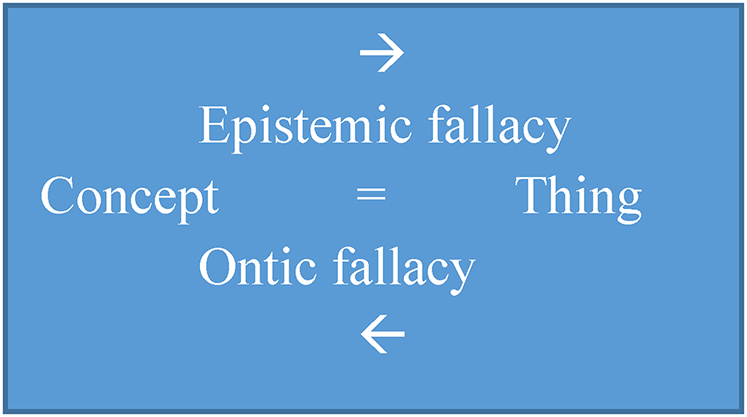
While illuminating, this formalization of logical fallacies conceals a question about content that Bhaskar leaves unaddressed. To intimate, in the PMN manner, that concepts and things are mutually constitutive does not shed any substantive light on reality unless we specify the meanings of these two terms, and we have nowhere else to start than with conventional notions. I surmise that this is also the conceptual universe in which PMN adherents move, despite claims to be thoroughly heuristic. They, too, necessarily start from basic notions about what concepts and things are, and, arguably, one can draw two logical inferences from the equation: either (re-)figure concepts in terms of what one associates with things, or (re-)figure things in terms of what one attributes to concepts.
Faced with this choice, it is hardly surprising that PMN adherents embrace the latter possibility. To frame human imagining in terms of the qualities conventionally attributed to things threatens to reduce the mind to physicality and call forth all kinds of socio-biological, neuro-deterministic, and dehumanizing spectres. Determined to take people’s imaginings seriously, this is the exact opposite of what PMN proponents struggle to achieve. Conversely, it is seen as theoretically invigorating for the discipline to render things concept-like; that is, to assume that reality is through and through conceptual in the sense of ontologically constitutive imaginings. This is yet another expression of the lopsided (i.e. left-to-right angled) epistemic-ontic fallacy at the base of PMN reasoning: Despite the renewed interest in materiality, and the claim to develop a post-humanist approach that takes ‘things as seriously as humans’ (Henare et al., 2007), human imagining remains the overall vantage point for the exploration of reality. In PMN, things are only allowed to ‘communicate’, as it were, that is, accorded proper existence in terms of their impact on human thought. Hence, we seem simply to be moving from anthropocentrism to anthropomorphism. Rather than taking things seriously as things, PMN projects human characteristics onto non-human domains of reality, reducing things to a kind of humanness.
Ultimately, this premise demands the embrace of an animistic ontology of sorts, in which all things are seen capable of sensing and conceptualizing. While, indeed, this is the basic premise of Amerindian ‘ontology’ (i.e. non-humans are thought to be human-like persons or subjects rather than species representatives) and, also, other strands of the ontological turn seem to converge on animist or vitalist presumptions, I surmise that, theoretically, this is a mistaken step. My contention is not primarily with substantive ontological claims – assertions about the animated or vital character of all things; although I doubt their verity (see also Hornborg, 2021). Rather, I call attention to the logical implications of confusing ontology and epistemology in this manner. Paradoxically, PMN’s ambition to explore reality in a fundamental sense through the maxim of multi-naturalism – ‘a constant epistemology and variable ontologies’ (Viveiros de Castro, 2004: 4) – ends up in an exceedingly restricted claim about reality’s character: a highly uniform or homogeneous ontology. To put it bluntly, we are forced to take the view that rocks have the same capacity of perceiving, imagining and knowing as humans. This premise is entirely explicit in vital materialism (see, e.g. Bennett, 2009). As Barad puts it succinctly in an interview: ‘[F]eeling, desiring and experiencing are not singular characteristics or capacities of human consciousness. Matter feels, converses, suffers, desires, yearns and remembers’ (Dolphijn and Tuin, 2012: 59).
My point is that this view effectively bars other ontological positions, in particular, non-uniform claims about knowledge formation: for example, the, admittedly credible, view that rocks actually cannot know but humans can, or at least that there are profound differences in the ‘knowledge’ engendered in rocks and humans (Pina-Cabral, 2017: 5–6, 172–180; see also Kohn, 2013). There are simply no principles of differentiation in PMN perspectives from which to specify such unevenness; we are left with a wholly homogenous ontology – despite vehement ‘multi-naturalist’ claims to the opposite.
In contrast, asserting MIR presupposes heterogeneity. Minimally, to repeat myself, realism is constitutive of analytical heterogeneity in that reality is taken to surpass while incorporating the mind. Thus, the former cannot be comprehended fully in terms of the latter; their difference is at issue. Moreover, liberated from the premise that reality (‘nature’) varies with perspective, one is free to explore ontological questions on their own terms, so to speak; in all their heterogeneity. To remain within our example, we are free to ask whether rocks can be said to ‘know’ in any meaningful sense of the term, and what kinds of knowledge jaguars may have that humans don’t and vice versa. Instead of succumbing to PMN’s totalizing ‘as if’ epistemology – what reality looks like when committing to a specific perspective – realist anthropology would make a decisive shift to the ontological pole, engendering questions about intransitive domains rather than perspective. At another level of abstraction, this is tantamount to querying relations between reality and perspective. Rather than totalizing a given perspective, we would interrogate what particular domains of being specific conceptualizations may illuminate; for example, Amerindians’ acute sensitivity to the shifting perspectives of humans and animals, Melanesian proclivities for partible, relational sociality (Strathern, 1988) and holographic configuration (Wagner, 1986), or Hindu conceptualizations of hierarchy (Dumont, 1980; see also Rio and Smedal, 2013).
As noted, PMN’s refusal to acknowledge intransitive exteriority leads, inevitably, to an ontology of homogeneity in which virtually everything in cosmos – rocks and humans, spirits and matter, power and powder, concept and things, things and scale, and scale and comparison – are rendered as mutually constitutive. This mind-boggling coalescence of beings and being into a thoroughly undifferentiated whole is, I claim, a logical entailment of the irrealist stance, that is, the failure to distinguish between transitive and intransitive domains. Roy Bhaskar has the following succinct remark about this position: [I]rrealism constitutes … a thicket such that if you enter it anywhere you are embroiled in it everywhere and must collapse – in what I call “reductio ad irrealism” – into a null point from which nothing can be said or done (1997: 142–143).
6
PMN: analytical monovalence
In this passage, Bhaskar intimates that the slide into irrealism obstructs analysis, and this is a valid point for the ontological turn as well. In PMN, the reality is rendered as so many instances of becoming – some recurrent, some not – but in either case, there is no recourse to principles of exteriority that might allow us to frame (i.e. analyse) the ‘becoming’ under study. Exteriorization is principally illegitimate in that it seeks to turn alterity into something recognizable; allegedly a reductive move. Viveiros de Castro is unequivocal about the matter: The so-called ontological turn is nothing more than a change in the disciplinary language-game that forbids, by declaring it an ‘illegal move’, such an analytical facility from the anthropologist’s part (2015: 13).
The only recognized ‘outsider’ in this approach is, as noted, the interiority of the ethnographer; the conceptual biases that guide the fieldworker’s thinking. These prejudges are seen as deeply troubling if brought to bear on ethnographic phenomena, that is, the overall goal is their destabilization through recursive comparison. One senses how PMN converges on the ‘null point’ in Bhaskar denouncement of irrealism; a principal retraction from what customarily passed as analysis. As Viveiros de Castro puts it succinctly, ‘[a]nthropology compares for the sake of translation, and not in order to explain, generalize, interpret, contextualize, say what goes without saying, and so forth’ (2014: 87). Moreover, here ‘translation’ does not refer to the customary anthropological tactic of making the unfamiliar familiar (‘cultural translation’), but to a recursive mode of comparison in which the source language is retained while the language of anthropology changes.
Nevertheless, this tendency towards singularity is balanced somewhat by the necessity of ethnographic description. After all, anthropological discourse hinges on some kind of narration of fieldwork experiences; a positive interlinking of things, utterances, actions and events (see also Herzfeld, 2018: 7; Zeitlyn and Just, 2014: 1). It is unsurprising that terms such as ‘network’ and ‘assemblage’ are favourites in the anti-dualist ethnography of this sort, denoting the indeterminate and transitory coming-together and holding-together of specifics. While these terms necessarily imply some kind of patterning and the ensuing ethnographies are, unavoidably, instances of analysis, we are left with unidimensional or ‘flat’ accounts of reality. As noted throughout, there is no recourse to external – ‘overarching’, ‘underlying’ or ‘uneven’ – principles (e.g. of scale or efficacy) from which to account for the coming- and holding-together of things. We are destined to freeze ethnographic data on one plane of being, as it were, and this stance is entirely explicit in parts of the ontological turn, regularly couched as an ideal of ‘symmetry’ (Latour and Porter, 1993: 103–104) or ‘flatness’ (e.g. DeLanda, 2013; Latour, 2005; Viveiros de Castro, 2010). While, then, PMN is, generally, averse to analysis as such, it is programmatically opposed to analytical depth (see also Peacock, 2015; Scott, 2013: 864; 2014).
Bhaskar has his own term for such flattening, namely ‘monovalence’ (1993: 406). The term denotes reasoning that totalizes being by way of its positive dimensions, that projects manifestations (the actual or observable) as a self-sufficient level of being, incapable of reacting with anything outside of itself. In contrast, Bhaskar poses a polyvalent ontology – a ‘deep’ and multidimensional reality beyond manifestations; consisting, inter alia, of differential ontological domains (the real, the actual and the empirical), ontological stratification, irreducible emergent properties, irreversible temporality, unequal formative impacts and non-manifest but nevertheless real (i.e. reality-constituting) dynamics. There is no space to expose Bhaskar’s (1993, 1998, 2008) rich philosophy here, other than pointing out the obvious fact that it offers a far more comprehensive toolbox for ethnographic research than the restrictive and retractive ‘one-eye view’ propounded by PMN.
Realist reorientations
While, to my mind, Bhaskar has pinpointed the problem of epistemic-ontic fallacies most cogently, there are also other versions of realism that sustain a degree of distinction between MIR and mind. In anthropology, Herzfeld’s ‘experiential realism’ (2018: 15) of the ‘middle ground’, Pina-Cabral’s ‘minimalist realism’ (2017: 5–7) and Zeitlyn and Just’s ‘middling realism’ (2014: 1) are prominent examples. These scholars insist on realist accounts of socio-historical embedding, that is, full exposure of the ontological complexities that characterize specific field sites. They are thus opposed to the epistemological ‘thinning’ that characterizes PMN ethnography (see above) and they also rectify Bhaskar’s overly abstract take on the social. Moreover, to a degree, these scholars share a phenomenological orientation that allows for investigation of the experiential interfaces of mind and MIR. In contrast to PMN’s peculiar projection of life as, essentially, a form of philosophizing, they open for a much broader understanding of how intransitive realities register in human lives. Accordingly, they also counter the strong tendency towards idealist methodology so characteristic of PMN (see above).
In sum, realist-oriented anthropology offers profound insights into people’s ontological engagements. It spans out from the left pole in our dualism, incorporating dimensions of human beings that PMN ignores or dismisses. There are also alignments between critical and ‘middle ground’ realism in that Bhaskar (1998, 2008) recognizes the inherent fallibility of human knowledge. Stressing ‘reality’ rather than ‘truth’ (but see Ahmad 2021), Herzfeld holds that the latter is ‘unknowable’ (2018: 3), Pina-Cabral, concentrating on ‘worlding’, argues that knowledge is profoundly ‘underdetermined’ (2017: 11), and Zeitlyn and Just emphasize ‘partiality’ and ‘incompleteness’ (2014: 13–34). Scepticism about ultimate knowledge is, thus, a common denominator in all these versions of realism.
However, as the qualifying terms indicate, Herzfeld, Pina-Cabral, Zeitlyn and Just embrace ‘moderate’ forms of realism. While the left side of our distinction is being substantiated, one senses a degree of ‘moderation’ with respect to intransitivity. The core question is how we, theoretically and practically, identify and analyse realities that fail to be registered experientially. In my view, critical realism draws a sharper line in this respect and, thus, invites more concerted scrutiny of the relation between mind and MIR. This is of critical importance in situations where field hosts’ convictions seem to be entirely out of tune with what the (realist-oriented) ethnographer takes to be reality – for example, when encountering coronavirus deniers. Here, critical realists would be less averse than many anthropologists to claim that the natural sciences have achieved ‘superior’ knowledge (approaching ‘objective truth’) relative to some (but certainly not all!) ontological objects. While coronaviruses surely continue to trick even hard-core naturalists, underscoring that natural science shares the problem of partiality with other forms of knowledge, I would, nevertheless, be inclined to argue that the scientific view trumps any experientially based notion about their non-existence. Analytically, to deny the viruses ‘objective’ existence threatens to erode the very principle of MIR that I, in the introduction to this article, posed as the defining criterion of realism. 7
PMN: concealed analytical hierarchy
It is now possible, finally, to address my initial claims: (i) that PMN’s explicit anti-dualism (the programmatic equation of concept and thing, etc.) counter-creates a concealed dualism at another logical level and (ii) that PMN’s monovalent optics veils the vertical quality of this dualism, that is, fails to grasp its hierarchical character. What the anti-dualist tactic entails is a subordination of ontology under epistemology, dependent on the subordination of MIR under the mind. Dumont’s (1980) figure of hierarchical encompassment is apposite to capturing this kind of subsuming: in PMN reasoning, epistemology comes to encompass ontology despite the explicit ambition to re-assert the latter. As I have argued, when operating the PMN programme consistently in ethnographic work, one ends up with conceptual paradox, idealist methodology, and monovalent analytics driven by perspectival singularity; all of which subsumes the right side of realist metaphysics (MIR, intransitivity, the ontological) under the left side (mind, transitivity, the epistemological). Hence, the kind of multiplicity propounded by the allegedly revolutionary dictum of multi-naturalism is epistemologically anchored, too. It is, metaphysically speaking, rendered as a property of human imagination.
Importantly, the realist position is also premised on multiplicity, but at the other end of the divide. Here, human imaginings are rendered subordinate to a wider reality of intransitivity; hence, multiplicity is seen as a property of MIR rather than the mind. While this may look like two different ways of stating the same concern, a shared and sharpened emphasis on multiplicity, the two perspectives are as far apart as logically possible. It is rather a case of deceiving (dis)similarity; two perspectives that seem so similar in their difference that they suggest mediation or even resolution by way of meta-positions. Actually, PMN and realism emerge out of so divergent theoretical premises that they cannot be bridged, at least not at the level of logical principles. It is, emphatically, not a case of logical symmetry that allows a simple ‘flip’ from one pole to the other, the reason being that PMN denies its hierarchical embedding while realism acknowledges it. Realists insist on ontological depth, since the multi-stranded character of MIR entails complex forms of differentiation, stratification and hierarchy, while multi-naturalism, by way of its monovalent (flat or symmetric) optics, denies depth dimensions as such.
To rephrase this point in Dumontian terms, it is apparent that the mind takes on the role of encompassing ‘value’ in PMN, while MIR serves the same role in realism. 8 Since this hierarchical configuration must necessarily be viewed ‘flatly’ from the standpoint of PMN, the encompassing value is effectively obscured. In PMN’s optic, we are unable to see beyond the one dimension where mind and MIR (concept vs. thing etc.) contrast on a horizontal plane, and PMN’s strong drive to dissolve of this contrast, in turn, engenders – while concealing – mind as the encompassing value. In contrast, realist anthropology would make the depth dimension (hierarchical encompassment) both explicit in and foundational for theorizing. In the realist view, intransitivity always already encompasses transitivity; the mind is logically subordinate to MIR.
Conclusion
My conclusion, then, is that PMN and realist anthropology based on the principle of MIR are irreconcilable approaches. At this point, I agree fully with Viveiros de Castro when he asserts that ‘these two cosmological outlooks [Western multiculturalism and Amerindian multinaturalism] are mutually incompatible’ (2014: 150–151). The perspectives conflict at the level of foundational principles, something that necessarily strains analyses that confuse or attempt to combine the two approaches. We are far into the absurd, indeed, if we are forced to assume that nature is, simultaneously, both multiple and non-multiple. This incongruence should be of concern to anthropologists who seek to incorporate ‘ontologies’ (in the highly distinctive PMN sense) into studies of, for example, capitalist transformations and environmental crises, which, I maintain, have intransitive dimensions and, thus, cannot be explicated fully in terms of embedded concepts. But my critique runs deeper. It points to the wide-ranging and possibly devastating effects of cutting ethnographic accounts and anthropological theorizing loose from the verity of MIR. A consistent application of PMN reasoning would result in a totalizing form of epistemic fallacy and, accordingly, a thoroughly inward-oriented, anthropocentric, monovalent and idealist anthropology – a singular concern with human mind, despite all claims to reinvigorate ontology.
Footnotes
Declaration of conflicting interests
The author declared no potential conflicts of interest with respect to the research, authorship and/or publication of this article.
Funding
The author received no financial support for the research, authorship and/or publication of this article.
