




Abstract
Current land pressures in the world cities of the global North are encouraging a move towards denser urban living and the development of smaller homes than has been the case for many decades. While this appears environmentally beneficial when compared with the alternative of suburban sprawl, it comes at a cost: the number of extremely small homes appears to be increasing particularly rapidly, with less communal and public space available to those living in compact homes which offer little room for socialising, storing possessions or working from home. Drawing specifically on the experience of England and Wales, with a focus on the overheated property market in London, this commentary sets out an international agenda for the study of small homes, noting the growing evidence of the negative impact of dense urban living on mental and physical health, home-working and familial and intimate relations, as well as its failure to solve the crisis of affordability. The article suggests that rather than being a reasoned response to the housing and environmental crises, the phenomenon of ‘shrinking homes’ indicates the growing role of finance in the development of cities, suggestive of the way that developers are extracting maximum value from restricted urban sites in an era of planning deregulation. In conclusion, the commentary argues that urban scholarship needs to compile more evidence of space inequality in cities, pushing for policies designed to enforce minimal space standards while reducing the ability of the wealthy to construct very large homes.
Introduction
Since the onset of industrialisation and widespread urbanisation, it has been noted that home sizes, measured by floorspace, have generally been getting bigger in the global North even as the average household, measured by number of residents, becomes smaller. These trends were particularly notable across the 20th century, with living space per inhabitant increasing by a factor of three between 1950 and 2000 in the USA, with average space rising from 27 m2 to 83 m2 (Wilson and Boehland, 2005). This trend was mirrored in Australia – generally considered to be the nation with the largest homes – with the average size of new homes rising from around 100 m2 in 1900 to 254 m2 by 2011 (McMullan and Fuller, 2015). UK homes, while markedly smaller than both, at around 60 m2 in the 1930s, rose to 83 m2 by the 1990s (Appolloni and D’Alessandro, 2021). Meanwhile, Japanese homes increased from an average of 78 m2 in 1973 to 90 m2 by 2014, exceeding the UK average despite the stereotype of Japanese cultures promoting micro-living and decluttered (danshari) lifestyles (see Daniels, 2008; Gygi, 2022; Owens, 2023).
While measuring the internal floorspace of a home is not an exact science, with different nations making different distinctions between internal and external spaces (e.g. some including porches or balconies in measures of gross internal floorspace), these trends suggest that housing is generally becoming larger, with increased space per person and less overcrowding. But in the last 10 years, these trends have baulked, with average home sizes stabilising or even declining in some nations: for example, the average new home in the UK is now around 70 m2 and a rapid rise of ‘starter’ homes in the USA has seen the average new single-family residence declining from its 2015 peak to around 230 m2 by 2022. Yet here, statistics relating to average home sizes are sometimes misleading, with a notable trend being the bifurcation between very large ‘augmented’ urban properties for the super-rich and much smaller, high-density condos and micro-apartments. This is especially the case in world cities, where pressures on land appear particularly intense. In Hong Kong, for example, it is thought around 200,000 live in ‘coffin’ houses smaller than 10 m2, while in Tokyo, where the rise of urban singles has been particularly pronounced compared to other cities in the global North (Ronald and Hirayama, 2009; Hirayama, 2021; Kottmann, 2022), apartments of between 20 and 29 m2 now constitute 40% of the rental market (Ronald, 2017). But even in traditionally low-rise ‘suburban cities’ such as Sydney, Toronto and San Francisco, the emergence of so-called micro-apartments is a notable phenomenon (Gabbe, 2015; Lippert, 2019; Vachon, 2018).
Meanwhile, in London, often described as one of the world’s most expensive property markets, evidence compiled from Energy Performance Certificates for 2.4 million homes in the capital suggests that the mean internal floorspace of 77 m2– close to the national average – obscures a growing share of very small properties. The proportion of homes below the 2015 Nationally Described Space Standard for England and Wales – 37 m2 for a single-person, one-bed unit – rose from around 4% of all London properties in 2014 to nearly one in 10 new homes by the end of 2021 (Hubbard et al., 2023). These homes appear to be concentrated in the central city, where property prices are highest and pressures on land are extreme, but there are also notable clusters in (well-connected) parts of the city where former office buildings and industrial units have been converted to smaller residential properties, such as Croydon, Brent Cross and Wembley (see Figure 1). These locations are increasingly populated by young adults, who appear acclimatised to living in dense urban neighbourhoods where these offer feasible transport options: in such locations, there seems an evident trade-off between housing cost, location and internal space, with the latter being sacrificed in return for convenience and (relative) affordability.
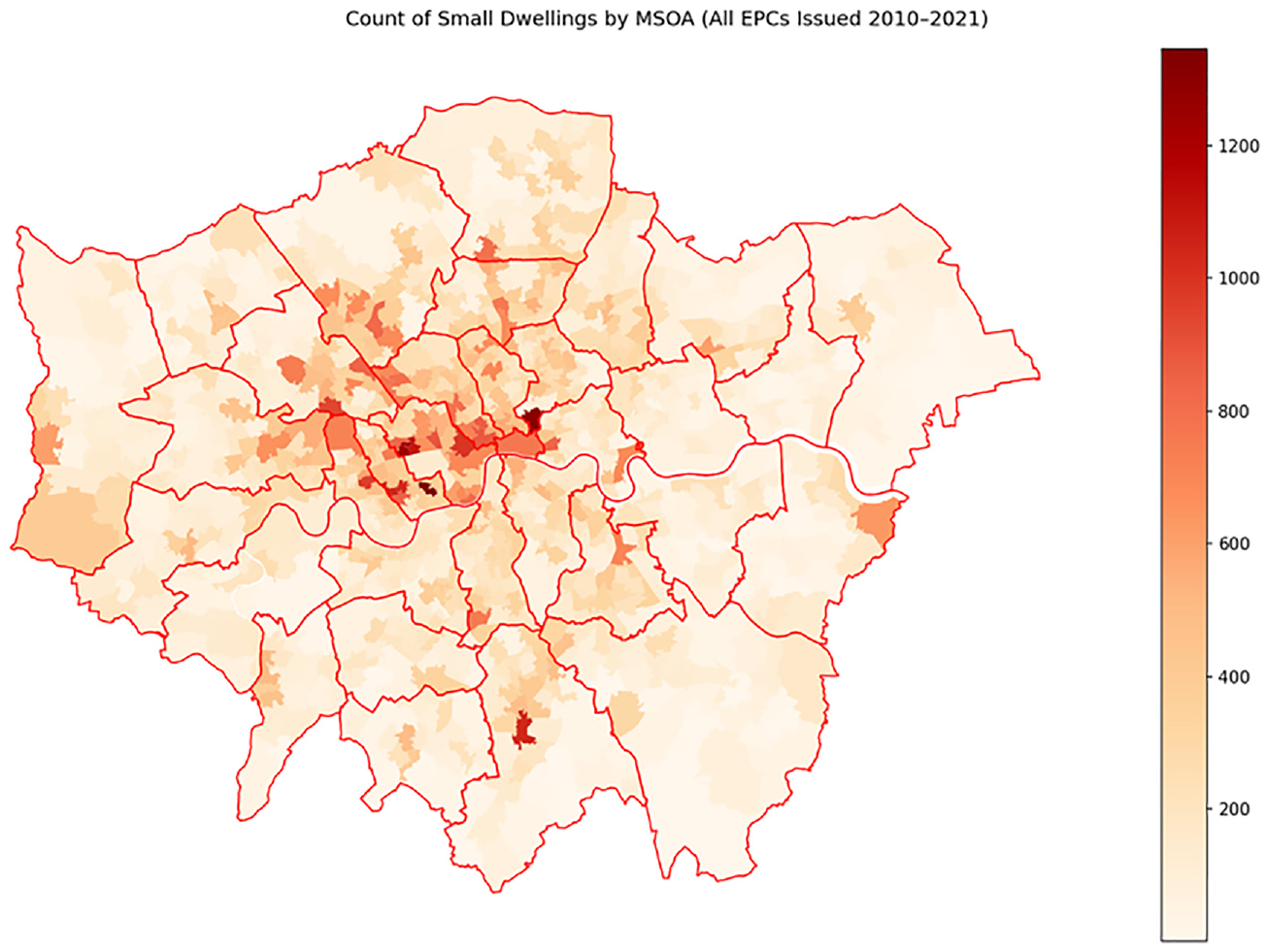
Sub-37 m2 homes in London by Middle Super Output Area (i.e. neighbourhood), 2010–2021.
While London is characterised by extremes of unaffordability (Gallent et al., 2017), these trends are mirrored in the property markets of many other ‘core’ cities in the UK – especially Manchester, Birmingham and Liverpool (Thomas et al., 2015) – as well as other internationally leading ‘world cities’ (e.g. see also Hochstenbach and Boterman, 2015, on young people’s housing aspirations in Amsterdam; Opit et al., 2018, on Auckland; Druta and Ronald, 2021, on Tokyo). This has not gone unnoticed in housing studies, with increasing attention being paid to the emergence of smaller homes (e.g. Evans, 2018; Harris and Nowicki, 2020; Jacoby and Alonso, 2022; Shearer and Burton, 2023), albeit that much of this has focused on the ‘tiny homes’ movement – i.e. the cabins and mobile homes associated with counter-cultural lifestyles (Shearer and Burton, 2019). Notably, some commentators have begun to develop a tentative typology of small homes that distinguishes between these tiny homes and sheltered accommodation for the elderly, student accommodation, co-living spaces and self-contained ‘micro-apartments’ or studios aimed at post-students and young professionals (see Harris et al., 2023).
It is the latter that accounts for the rapid increase in smaller homes in most cities in the global North, resulting in falling average house sizes, the ‘youthification’ of central cities (Moos, 2016) and the normalisation, and even glamorisation, of solo city-centre living (Owens, 2023). But the rise of small housing is not just a response to demographic trends, with proponents arguing that it also addresses concerns about the environmental impacts of continued urban sprawl: when constructed close to urban amenities, micro-apartments appear to adhere to the tenets of sustainable urbanism; compared with suburban growth at the city’s edge, they make better use of land and resources, reducing commuting times for young professionals and workers who want to live close to places of work, retail and leisure (Cohen, 2021). At the same time, it can be argued that smaller flats are more carbon friendly and energy efficient, being cheaper for individuals to heat or cool in times of climate change and rising energy prices (Clune et al., 2012). But it is the argument that smaller homes are more affordable, and that adding more housing stock in the form of micro-apartments will bring down prices in the wider housing market, that has prompted many policy-makers to promote them as a putative solution to the ‘housing crisis’, oftentimes changing building codes and planning regulations to facilitate their construction (Maddedu et al., 2015).
The rise of smaller urban homes hence appears an appropriate response to changing demographic, environmental and economic trends. But less generously, and viewed through the lens of critical urban theory, it has been argued that decades of horizontal suburban sprawl are being followed by an era of ‘vertical sprawl’ in which micro-apartments are an instrument of increased capital accumulation (Cerrada Morato, 2022; Nethercote, 2022; Sonn and Shin, 2020). From this perspective, micro-apartments and studio flats cannot be regarded as a solution to the housing crisis; they are part of the problem: as Harris and Nowicki (2020) note, the promotion of micro-living makes a virtue of necessity, with the unaffordability of larger homes for younger people a perverse justification for building smaller. Similarly, architectural commentator Jack Self (2020) has argued that: Tiny homes are a pathetic compromise, a poor trade-off between impossible cultural aspirations and pure economic desperation. They are reactionary products, manifestations of our fears about the future, and not any serious alternative to the status quo. The misguided masses who praise the minimalist lifestyle encouraged by tiny homes cannot see how these products fundamentally undermine their own class interests, cut off future social mobility, and curb prospects for greater wealth equality.
These arguments are supported by evidence of the problems associated with the new generation of smaller housing, such as poor ventilation, lack of space, excessive noise and inadequate natural light. For example, one retrofitted scheme in an office block in Ilford, London, next to the busy A12 trunk road, made national headlines in the UK for offering single-aspect studio flats of just 13 m2 (Jones, 2018). Likewise, a report by London Assembly member Tom Copley (2019) highlighted Urban House, Croydon: developed from a former office building, its units were all well below recommended National Space Standards, with one as small as 10 m2. Remarkably, in England and Wales, Permitted Development Rights have also allowed the construction of flats with no external windows whatsoever, with the only natural light from skylights (Ferm et al., 2021). For dwellers, this is likely to exacerbate feelings of claustrophobia and enclosure, and while national planning inspectors have concluded that windowless small homes are inadequate, until 2021 local authorities could not enforce the requirement to have windows under the rules permitting conversion of office development to domestic habitation (Gardiner, 2019).
Noting the divergent attitudes expressed towards very small homes in overheated urban property markets, this commentary argues for a comparative international research agenda around the proliferation of small homes, exploring their ‘value’ to developers, residents and the wider citizenry who live in neighbourhoods where micro-apartments are proliferating. Here, the commentary flags at least five themes worthy of urgent exploration. The first concerns the question of value and the way that smaller homes exacerbate, or reduce, house prices in given cities, with the accepted logic being that adding more smaller homes to housing markets will increase overall affordability. The second is the relation between urban neoliberalism, planning deregulation and the laissez-faire attitudes held by many planners towards very small homes. The third concerns the question of housing quality and the extent to which small homes can ever fulfil basic housing needs of security, comfort and self-actualisation, as well as accommodating change of lifestyle and requirements over a resident’s life course. The fourth concerns the adaptability of the home on a more daily basis, namely its ability to accommodate homeworking, which is now a normal and routine part of domestic life for an increasing share of the working population. Finally, this commentary turns to consider the long-term impact of living in small homes on mental and physical health, and the possible implications of this in densely developed neighbourhoods where there is often a lack of external public space for exercise, recreation and sociality.
Housing, finance and affordability
Many nations in the global North are in ‘housing crisis’, with pressures of in-migration, rising land prices and falling real-term wages conspiring to make housing unaffordable for many. For example, house price growth outstrips wages in 90% of England and Wales, and the English Housing Survey suggests that the average home cost 9.1 times earnings in 2021, up from 7.9 a decade earlier. At the same time, rents in the Private Rented Sector (PRS) are increasing by 20% year on year, with renters in the PRS now spending over a third of their income on housing on average, and over 50% in London. In theory, the production of large amounts of self-contained, small housing should help lower housing costs and provide affordable accommodation at this time of increased need, and the government in England and Wales recognised this in 2013 by dispensing with the need for developers to obtain planning permission when converting office buildings, and subsequently made National Space Standards optional rather than mandatory (Hubbard, 2023). This means that planning authorities can permit small housing if they feel it meets local demand, with the assumption being that the rapid addition of new homes will drive down rents in general.
However, recent literature on the financialisation of housing suggests the contrary, suggesting that the state’s encouragement of property development – which ‘removes housing from the long-term market in the interest of short-term, high-return profit-making’ (Amin and Lancione, 2022: 12) – is facilitating asset-based housing development that does not reduce prices or enhance affordability. Lubricated by the deregulation of mortgage finance and spiralling housing prices, international investment in housing has increased dramatically since the global financial crisis of 2007–2008, with the world cities of the global North appearing particularly attractive to investors because of ‘rent gaps’ between existing and potential profitability (Christophers, 2022). The wholesale development of (often-vertical) multi-unit residential rental housing is a frequent corollary, with this housing typically retained by institutional investors as a profit-generating asset (Brill and Özogul, 2021).
Despite the assumption that smaller homes will be more affordable, the implication here is that the imperative to build more units on a given site is driven by a profit motive – one that does not reduce prices but instead fuels the seemingly ceaseless financialisation of urban real estate, with the prevalence of studios and flats in Build for Rent properties a clear symptom of this (see Brill and Özogul, 2021). Indeed, while smaller homes are generally cheaper than larger ones in absolute terms, evidence from London suggests that micro-apartments cost considerably more per square metre: homes below the 2015 Nationally Described Space Standards (NDSS) minimum for a one-bedroom, one-person flat cost, on average, £9,000 per m2 whereas larger homes of 90 to 120m2 cost only half that on a metre-for-metre basis (Hubbard et al., 2023). This discrepancy is partly explained by the fact that even small homes must have appliances plumbed or wired in, with much of the cost of the very smallest homes accounted for by the costs of fixtures and fittings, which are similar to those of larger homes. But even allowing for this, those renting (or buying) small homes get less space for their money: in such case, tenants appear ‘willing subjects’ of financialisation (cf. Fields, 2017), who accept the reduced use value of the property but are prepared to pay heightened exchange value because it promises a convenient urban lifestyle that is otherwise unavailable to them. Based on research in Sydney, Clinton (2018: 8) likewise concludes: Micro-apartments appear to be fulfilling the need for dwellings that cater for smaller households, however, this dwelling typology … currently fails to provide significant affordability benefits, with these dwellings being more expensive or on par with larger studios within the same locality.
In this sense, it appears that the emergence of large amounts of small housing may not increase affordability but, on the contrary, raise land prices by permitting developers to extract more value from sometimes restrictive urban sites through de facto densification of housing (Robinson and Attuyer, 2021). Coupled with select de-zoning that allows developers to build higher than was the case in the past, the outcome is often contrary to expectations: far from lowering property prices in the local area, research suggests that the emergence of more housing units in a given neighbourhood is correlated with rising rentals and exclusionary displacement (Cavicchia, 2023; Murray and Limb, 2023). This suggests a relationship between the location of smaller units and gentrification, albeit the literature on urban gentrification has yet said little about small homes as financial investments implicated in processes of urban revaluation. Nethercote (2020: 841) hence concludes the ‘empirical and conceptual treatment of the financialisation of “multi-family” rental housing within a small but growing literature has been highly productive’, but notes that the ‘associated treatment of new purpose-built [small] accommodation remains relatively underdeveloped’. This suggests a need for urgent exploration as to whether small homes are a property class that is driving gentrification into previously affordable neighbourhoods as developers build higher and denser than ever before.
Planning, regulation and legal process
Given that smaller homes can be slightly cheaper to rent or buy than larger ones, the fact that they are relatively more expensive than larger ones tends to be ignored by local governments, who encourage their development as part of a drive to provide more homes for their citizens in the shortest possible time. This means that the traditional role of the state in upholding housing standards has sometimes been overridden. By way of example, in England and Wales the NDSS are planning guidelines introduced in October 2015 that gave all local authorities a clear set of guidelines for minimal room and property dimensions as best practice. These state that a dwelling with two or more bedspaces should have at least one double (or twin) bedroom and that a single bedroom should have a floor area of at least 7.5 m2 and be at least 2.15 m wide. The absolute minimum gross internal area in the NDSS is 37 m2 for a one-bed, one-person dwelling with a shower room. The NDSS also stipulate minimum ceiling heights of 2.3 m for at least 75% of the habitable area of a flat, suggesting a conception of space that is volumetric: nonetheless, this figure is lower than the minimum heights stipulated in Italy (2.7 m), Portugal (2.7 m), the Netherlands (2.6 m) and Germany (2.4 m) (Appolloni and D’Alessandro, 2021).
In this sense, the introduction of the NDSS in 2015 should have been a pivotal moment, providing local authorities with a clearer set of criteria for preventing substandard homes, but the reality has been more complex, as these are described and not prescribed standards: unlike the codes introduced in many nations, they are not enforced through building regulation (Madeddu, 2015). Furthermore, until 2021, they did not apply to conversions of industrial premises and offices to residential. Moreover, while local authorities can reject planning applications for housing beneath described standards, they are not obliged to do so given the that NDSS are not mandatory, having to be adopted in the Local Plan. Carr (2016: 57) concludes that: the Nationally Described Space Standard is not the equivalent of the nationally prescribed space standards that are the norm elsewhere in Europe … it works through planning rather than building regulation and can only be deployed by local authorities if there is a clearly evidenced need.
This means that in many towns and cities in England and Wales, and not just in London, substandard homes have actually proliferated since 2015: analysis of Planning Appeals also suggests that homes of up to 10% below the NDSS are seldom regarded as inadequate by the Planning Inspectorate when refusals are appealed by developers, while some flats considerably lower than that have also been approved on the basis that their layout could still provide ‘comfortable’ living standards (Hubbard, 2023). This suggests that some local authorities are loathe to enforce space standards where flats are close to the national guidelines, while others have not even adopted the guidelines, meaning they have little control over home sizes at all.
The latter approach means that in England and Wales it is largely down to housebuilders and developers to determine what size of home is most appropriate in a given situation, with the logic of the market taking precedence. Here, faith in the ability of the housing market to deliver the right type of homes in the right places has been characteristic of Conservative housing policy since 2010, with successive housing ministers often promising to ‘crack down’ on those local authorities that fail to meet housing targets. Such a position is based on the assumption that regulation will raise the average price of housing by restricting supply and increasing the costs of construction (Ball, 2011). It is also assumed that an immediate outcome of the increase in land prices arising from preventative regulation is a redistribution of wealth towards landowners who have done nothing themselves to add value, rather than developers who create jobs and build homes. On this basis, it is assumed that the deregulation of planning control, and accompanying relaxation of space standards, will accelerate the construction of new housing and lead to more affordable homes. In England and Wales, this logic led to the 2013 planning reforms that allowed developers to repurpose former office and retail units as residential accommodation without formal planning permission under Permitted Development Rights (Ferm et al., 2021). As indicated above, this assumption has proved incorrect, with deregulation oftentimes fuelling gentrification.
Considering the interplay of legislation, policy and practice, Carr (2016) argues that there remains a strong case for prioritising the regulation of housing adequacy over the pursuit of housing affordability given the emerging social consensus which exists around the desirability of minimum standards of housing space, with COVID-19 lockdowns increasing awareness of the fact that very small homes are potentially damaging to the living conditions of their occupiers (see below). But English space standards encourage rather than demand minimum standards, and interpretations of whether ‘the day-to-day needs’ of occupants are met by small flats vary from planning authority to planning authority. The existence of standards rather than rules hence creates confusion and contradiction, with developers finding schemes acceptable in some local authorities and not others. This means that there are a variety of interpretations that can be made of space standards as a means of constructing norms: while an enforced building regulation stipulating minimum size would distinguish between compliant and non-compliant properties, described standards lead to a group of properties that either do not fully comply with, or transgress, space norms. This indeterminacy, and differing interpretation of policies and rules, suggests that regulation itself is potentially vulnerable to gentrification, with those who profit from the development of small homes most able to mobilise legal expertise (Thorpe, 2021). This suggests an important role for studies of urban governmentality that explore how the normalisation of small homes in particular neighbourhoods is underpinned by planners’ assumptions about the type of homes desired by particular population groups (on urban governmentalities and housing more generally, see Hulme, 2020).
Home-making, intimacy and relationships
Feminist geographers have long noted that modern housing design and policy limit the possibilities for living arrangements that are not couple-centric or built around the nuclear family (Wilkinson, 2014). Against this, there is a belief that the needs of solo urban dwellers can be effectively met by small housing, with younger single people overwhelmingly being the intended occupants of micro-apartments (Clinton, 2018). This is in keeping with demographic trends that show a rapid rise in people delaying (or avoiding) long-term conjugal relationships, with the idealisation of solo-living, especially in urban contexts, seemingly encouraging young adults to seek one-person living arrangements. Harris and Nowicki (2020) argue that the unaffordability of larger homes for many single people is often used as justification for the promotion of small homes as the ‘solution’ to the housing crisis. Here, smaller homes are depicted as a normal and even desirable part of housing trajectories in which young people trade space for proximity to jobs, social facilities and infrastructures which allow them to connect to other singles nearby (Klinenberg, 2013). In contrast, home-sharing (e.g. in a house of multiple occupation) is typically depicted as a negative experience involving negotiations with ‘strangers’, the temporariness of ‘forced sharing’ stigmatised within discourses promoting solo, independent living (Wilkinson and Ortego-Alcazar, 2017).
Research has explored the influence of short-term renting on young adults’ home-making practices and sense of ontological security (Bate, 2021), but as yet little has been said about how this sense of temporariness is negotiated in constrained spaces. Small homes generally provide little space for effective socialising with friends, the storage of personal effects, exercising or food preparation, meaning repertoires of homemaking are constrained when compared to larger, more flexible properties that can ‘grow’ or adapt as occupiers’ needs change. Small flats are also far from conducive to pet ownership, but there may be instances where the space is shared with pets either legally or illegally. Nonetheless, decluttered lifestyles can appeal to younger residents who are new to cities and yet to accrue furniture or appliances, and given that millennials are more likely to download ‘content’ than possess piles of books and vinyl records, their space needs are perhaps less than was the case in previous generations (Owen, 2023). Here, injunctions against wastefulness are also important, with younger people appearing more likely than previous generations to hoard objects (Gygi, 2022). Yet this ignores the fact that the constrained assemblages of home-making evident in small homes may well contribute to affective experiences of precarity and stigma: in small flats it becomes impossible to bulk buy goods to make savings in grocery bills, for example, and there is an inevitable lack of space for tools for DIY or crafting (e.g. sewing machines that can be used to repair clothing). The contradiction of the decluttering process is of course that it does not allow for reuse, repurposing, recycling: things are simply disposed of if they do not give pleasure in the moment. Simply put, micro-apartments and flats encourage people to live in the moment, and not to keep objects that might have use in the future. Oftentimes there is also little space for washing and drying clothes, forcing reliance on commercial launderettes. So while in theory small homes promise cheap, stripped-down living, they are not always conducive to money-saving in times of precarity.
Given the diversity of ways that small homes might be occupied and lived, researchers hence need to better understand the relational complexities and micro-geographies of the material, social and emotional uncertainties of small homes, and their influence on individuals’ well-being. Moreover, while it is often assumed that the smallest flats are occupied by urban singles, more information is needed on who actually lives in these homes, and on what basis they occupy them. In most instances, there is little legal basis for restricting small homes to single occupation, and it may be that very small homes are occupied by couples, or even families, either on a long- or short-term basis. In such instances, living alongside others in constrained space can cause tensions because of the difficulty of maintaining ‘personal space’, and relations can be tested. As Brickell (2012: 241) argues, ‘home is a place of material breakdown and repairs, break-ups and patch-ups of social relations, and day-to-day disruptions and regulations in multisensory experiences’. Further exploration of how small homes are decorated, reorganised and adapted is hence necessary to demonstrate how occupants seek to improve their physical comfort, segregate different household activities and ameliorate the feelings of claustrophobia often associated with constrained living.
Home-working, space and adaptability
Debates concerning the desirability of small home living increased during the COVID-19 pandemic when many micro-apartment occupiers reported struggles with homeworking. Internationally, insufficient research was conducted on the mental and physical well-being of individuals living in small homes during lockdown, though Preece et al. (2021: 1653) completed interviews with those in small homes ‘near or below’ national space standards in three UK cities, with participants reporting ‘a sense of life merging into one, boredom and in some cases anxiety and stress, exacerbated by the inability to vary their use of space’. In London, a survey of 1000 households during lockdown suggested that 70% of the working-age population were working from home (see Hubbard et al., 2021), with those living in detached homes four times more likely to report being very satisfied with homeworking than those living in flats or apartments in purpose-built blocks. Overall, 70% of those in smaller properties reported difficulties in drawing boundaries between home and working life, as opposed to 30% in larger ones. In another study, over half of London’s residents reported altering their home during lockdown to facilitate homeworking, sometimes changing unused bedrooms to offices or partitioning spaces to establish a workstation (Özer and Jones, 2022). Clearly such adaptation was difficult for those living in smaller flats, with occupants forced to work from bed, use fridges as desks or even work on fire escapes or in communal corridors because of lack of space.
Though COVID-19 lockdowns now appear a thing of the past – at least for now – work in cities has not gone back to how it was. New spatialities of work have become normalised, with working at home and working from home being more usual now than was the case before lockdown in most of the global North (Reuschke and Ekinsmyth, 2021). For some commentators, this requires a major re-theorisation of housing, implying ‘a potential transformation of the physical structure of cities, the distribution of property values and broader labour and housing markets themselves’ (Doling and Arundel, 2022: 3). But more than this, it encourages a focus on housing form and function, and consideration of how homes can be effectively used as ‘offices’: the assumption that occupants of small homes can simply go to work in local cafes or co-working spaces is one that is dependent on whether such spaces exist locally or are affordable, and videoconferencing is not always possible in such spaces anyway. But Özer and Jones (2022) suggest that size per se may not always be the most constraining factor in home-working, with larger floor spaces not always sought by those working from home: rather, they argue many in smaller homes want additional spaces (i.e. a spare room or separate area away from the bedroom/living area) that can be adapted for work.
While such discussions principally relate to adult occupants, Kearns (2022) also suggests that there is lower educational attainment among children living in smaller homes for precisely the same reasons, with children unable to do homework effectively in a space where they are likely to be distracted. This implies that further comparative research is needed on the impact of homeworking on well-being and productivity in different types of home, for occupants of different ages, with due reflection on the way that work/life partitioning can be enabled in even the smallest homes. Until the COVID-19 lockdowns, very little work had been conducted on psycho-social adaptation to home-working (Alawad, 2021), but equally there had been little said about the practical adaptation of homes to work, particularly examples of good practice: future work on the occupation and consumption of small homes could well explore cross-cultural differences in perceptions of housing size sufficiency, but also suggest what spatial configurations, furnishings and space-making strategies could inform the small homes of the future. As Tervo and Hirvonen (2020: 1208) argue, while flats smaller than 30 m2 appear inadequate even for solo dwelling, and the goal should be for properties of at least 50 m2, homes between these thresholds can be made liveable through ‘careful floorplan design’ and well thought-out storage solutions.
Health and well-being
While the relationship between urban density, crowding and health is complex, there is evidence that living in small or overcrowded homes has negative consequences for people’s physical and mental health, and not only during times of enforced quarantine or lockdown (Kearns, 2022). Notions of thermal comfort, poor air circulation and inappropriate facilities for food production/consumption can all impact on physical health, including possible respiratory illness resulting from living in damp or mouldy conditions (Pineo et al., 2024). Whilst theoretically these can be mitigated through suitable ventilation and careful consideration of aspect, physical health problems can also be exacerbated by lack of external spaces or adequate room for exercise (a particular issue in neighbourhoods with few green spaces for public recreation). Where housing lacks accessible outdoor space, this can mean occupants lack ‘daylight, fresh air, a place to dry washing, socialise, play in, enjoy wildlife and to grow plants/vegetables’ (March et al., 2020: 20). In contrast, access to a private garden or balcony is associated with better all-round well-being (de Bell et al., 2020).
There is also evidence that being in a restricted space impacts negatively on mental health, ‘trapping’ people in a home where there is little variation in daily experience: vistas may be limited, and feelings of claustrophobia present. It has been suggested that young people experience this sense of constraint more acutely than older people, with studies completed during lockdown showing widespread psychological distress resulting from dissatisfaction with home (Fornara et al., 2022), and some evidence of impaired cognitive development among babies born during lockdown because of the lack of stimulus received whilst living in restricted indoor spaces (Ng and Ng, 2022). This again suggests the negative impact of living in homes which are too small to be easily adapted to multiple use, with ‘crowding’ related not just to the number of occupiers but also to the space available for storing furniture, possessions, clothes, etc.
But complicating this picture of small homes being claustrophobic is the idea that living in a small home can give the occupant a beneficial sense of living alongside others, even if they live alone. Clearly for some this is a selling point: co-living developments, for example, are often promoted as plugging occupants into a like-minded community of young, global professionals, suggesting possibilities for networking and connecting with neighbours in communal spaces even if bedrooms/studios are too small to socialise in (White, 2024). The flipside of this is that many developments of small flats or studios do not offer sufficient privacy for occupants: survey work in a range of cities in the global North suggests that those living in high-density rented accommodation report the highest rates of neighbour nuisance, with as many as two out of three experiencing persistent problems (Cheshire et al., 2018). Such constant awareness that one is sharing space with unwanted others, or living where there is frequent disturbance, can have significant impacts on well-being: for example, the reported effects of neighbour noise include stress, interrupted sleep, cognitive deficits and poor mental health (Evans et al., 2003; Torresin et al., 2022). This is not just because of the physical qualities of the noise that crosses the boundaries between different housing units, but also the fact that it frequently represents the unwanted receipt of the sound of other people’s intimate lives. As Stokoe (2006: 3) argues: Neighbours can hear (and overhear) arguments, toilet flushes, children playing, music and television choices, sexual intercourse; they can smell next-door’s dinner, painting, and pets; and they can see who comes and goes and at what time, who lives in the house, the type of house it is, and so on.
This suggests that privacy and intimacy are relational: if someone hears, sees or smells the intimate lives of others, they too might feel unable to keep their own life adequately private, and modify their own behaviours (Morrison, 2012). This can have profound consequences for partnering and parenting, as well as routines of self-care, e.g. dressing, washing, cooking.
Yet in all of this there is a lack of comparative evidence which explores the sensorial experience of living in small versus larger homes, or the long-term impact that living in a smaller home has on well-being. A lack of readily accessible data on home size, and the difficulty of controlling for neighbourhood and density effects, is an issue in many cases, with proxies such as calculations of overcrowding based on number of occupants and rooms not revealing lack of space per se, and ignoring factors such as whether occupants are unrelated adults or co-habiting partners. As such, Marsh et al. (2022) identified only eight academic papers considering the health impacts of living in small homes produced under Permitted Development Rights in England and Wales, and only three directly considering primary health outcomes such as physical and mental health. But even here there is little use of health data per se: instead, commentators tend to draw on anecdotal evidence about the impact of small homes and overcrowding on familial relations, lack of space to play or study and education. More widely, there appears to be little consideration of the size of housing on health and well-being compared with other measures of housing deprivation – e.g. disrepair – with size per se rarely considered a housing hazard in the literature (cf. peeling paint, mould, insect infestation, toxicity, allergens, poor sanitation etc.). Clearly, there is much to be done if we are to compile the type of evidence needed to discourage the building of housing that is palpably too small to be adequate or liveable.
Conclusions
Those arguing for sustainability transitions suggest that homes are, on average, too large in most of the global North, with domestic properties having disproportionate and excessive carbon footprints, responsible for greenhouse gas emissions sometimes approaching those associated with the transport and energy sectors (Cohen, 2021). From this perspective, there is a strong argument for reducing home sizes, with a notable ‘tiny homes’ movement having emerged that associates smaller homes with more sustainable living. Yet there are important differences between self-build, ecologically principled tiny housing in rural areas and the type of small studios and micro-apartments characteristically emerging in overheated world cities including London, New York, San Francisco, Sydney and Tokyo, as well as many secondary cities and regional capitals. Firstly, because they are self-built using DIY techniques, tiny homes in the countryside tend to be cheaper than the small homes built by corporate developers in city centres. Secondly, because they are in the countryside, the fact that they lack much internal space is less of an issue because occupants usually have sufficient external space for exercise, socialising, drying clothes, growing vegetables and so on. Thirdly, they tend to be occupied by older, middle-class occupiers who are downsizing, not younger people who are trying to establish themselves on the property ladder.
This suggests that space standards in housing can only be considered contextually through examination of how homes are being inhabited by particular groups and how this conforms with, or departs from, the assumptions of housebuilders and regulators who suggest that young urban singles do not want larger homes and are happy to trade space for location. Here, place-based analyses of how housing space norms are constructed and maintained appear a priority for urban studies, not least further understanding of international and cultural variation in what is regarded as a minimum standard of space sufficiency (Appolloni and D’alessandro, 2019). But given the emerging evidence that small homes are relatively expensive when compared with bigger properties, and the suggestion that they can be associated with mental and physical health problems, it appears that there is a strong case for the enforcement of minimum space standards based on careful consideration of what space is needed to maintain a decent and secure quality of life. Deciding what amount of space is sufficient is, however, incredibly difficult to determine, and in the absence of hard and fast data about the negative impacts of small homes on inhabitants, planners are generally seeking to encourage higher-density living, compact urban forms and walkable cities in the name of sustainability and affordability. Developers are only too happy to exploit this situation, meaning smaller homes are no longer the exception, with studios, condos and flats catering to solo dwellers rapidly increasing in number, especially at the gentrification frontier, where maximising the number of units, rather than number of bedspaces per se, appears the key to extracting maximum profit from urban land.
But there are alternatives: if homes are generally too big in much of the global North, and average sizes need to be reduced in the name of environmental efficiency and sustainability, one way of doing this is not to produce more very small homes but instead to prevent the construction of very large ones. Spatial inequality is perhaps the most pernicious issue in many world cities: in London, for example, there are large volumes of under-utilised residential space, with more than one in 20 homes thought to be unoccupied (Atkinson, 2019), while Burrows et al. (2022) report that over a 12-year period, 1500 mega-basements were added to London’s single-family homes (i.e. each more than one-storey deep or having a footprint larger than the ground floor of the property). These basements added value to ‘prime’ real estate by providing private swimming pools, cinema screens and garaging. As such, while the number of very small homes is proliferating, so is the number of very large ones, and housing space inequality is at levels not seen since the Second World War (Tunstall, 2015). And these trends are by no means isolated: a study in Toronto, for example, found around 5000 extensions to existing homes between 2001 and 2018, responsible for adding around 1.2 million m2 of living space to single-family homes, equivalent to over 10,000 generous two-person 120 m2 duplex flats (Buckley and Brauen, 2023). This given, it is necessary to ask whether it is environmentally sustainable and socially just to encourage the building of small studios designed for the less well-off at a time when the affluent enjoy more capacious and luxurious homes. Building more ‘average’-sized homes may not be the panacea for environmental and housing crises, but in world cities where housing size is bifurcating, it might be a good start.
Footnotes
Declaration of conflicting interests
The author declared no potential conflicts of interest with respect to the research, authorship, and/or publication of this article.
Funding
The author received no financial support for the research, authorship, and/or publication of this article.
