



Abstract
More than 600,000 people leave U.S. jails and prisons annually, a chronic policy concern for the penal state and welfare providers with many interventions recommending workforce development. However, job outlets are sparse, unstable, and often exploitative. But even as scholars document these conditions, their analyses are largely constrained to “classical” workfare programs rather than emergent job sectors. Indeed, security NGOs (non-governmental organizations) are hiring formerly incarcerated people, pushing the boundaries of how we conceptualize and measure the (re)production of socio-economic inequality. Drawing from 35 interviews with employees of the California-based security NGO Urban Alchemy, this paper offers two findings. First, reentry workers’ employment experience in the security sector indicates a blurring of stigma and social capital where people are finding work because of their record and without a third-party service provider. This “carceral networking” challenges how we study reentry success vis-à-vis the labor market. Second, reentry workers come to occupy a position of “penal liminality” that puts them at greater risk of surveillance from both their employers and penal agents while simultaneously leveraging police interventions to accomplish organizational goals. This tense dichotomy highlights how security work blurs the roles of those who police and those that are policed.
Introduction and background
Following incarceration in the U.S., the consequences of a criminal record are vast. Indeed, support system fragmentation (Phelps, 2020; Morenoff and Harding, 2014), protracted cycles of criminal legal supervision (Martin, 2021; Smiley, 2023), and exclusion from welfare provisions, job prospects, housing, and healthcare (Bonds, 2021; Harding et al., 2019; Kirk and Wakefield, 2018; Wakefield and Uggen, 2010) all compound; geography exacerbates these effects as many formerly incarcerated people return to communities marred by socio-economic marginalization and overpolicing (Leverentz 2022; Simes 2021). Of the resources left, record holders still avoid them to limit contact with state authorities (Brayne, 2014; Stuart, 2016). All that often remains is re-engaging with activities that spurred penal entrapment, revealing a precarity that is pervasive and cyclical (Western and Harding, 2022; Wacquant 2010). For the minority that avoid this fate, they must endure confusing and contradictory demands within their supervisory period (Augustine, 2019; Western and Harding, 2022). With more than 600,000+ people released into these conditions annually, both defining and facilitating reentry success is a chronic policy question that tows the line between punishment and welfare. Yet no matter where the debate falls, workforce development is a part of many interventions—from training to placement—as it helps diminish recidivism (Western, 2018).
To answer this call, numerous organizations have emerged, tackling reentry through various workfare and short-term employment programs (Kaufman, 2015; Myers and Goddard, 2018). In some cases, these organizations collaborate with police to increase participation and compliance within said programs, especially in areas of dense socio-economic inequality (Stuart, 2016). Amidst these provisions, most work on reentry and the labor market examines the job search process and employment consistency rather than on-the-job experiences themselves (Griffith et al., 2019). The few researchers that have documented this middle stage of the employment cycle note that available work environments are largely exploitative and unstable (Hatton, 2019; Purser, 2021; Zatz, 2020). For example, many reentry workers engage in manual labor (i.e., package distribution centers) or “gig work” (e.g., food delivery) sectors with minimal legal recourse should they face unreasonable work conditions, garnished wages, or outright termination. This outcome does not imply that available labor sectors are entirely composed of “bad jobs.” Employers just often sequester reentry workers to the bottom of the hierarchy due to their criminal records, often citing liability concerns and/or the “courtesy stigma” their organization takes on (Shi and Denver, 2025); this holds true even in cases of trade or vocational certifications where recordholders with the requisite training still struggle to find work (Lindsay, 2022). Indeed, the haphazard nature of employment for reentry workers makes it so that they must (1) accept available work conditions, (2) cycle through chronic bouts of socio-economic insecurity, and (3) struggle to meet the moral imperative of rehabilitation that employment signifies (Bumiller, 2015). But even though punishment and labor often coalesce to obstruct long-term reentry success, little is known about the experiences of reentry workers who (1) draw from networks outside of mainstream channels for work and (2) work in emergent labor fields rather than “standard” workfare programs.
This paper tackles these two gaps by examining the California-based, security NGO (non-governmental organization) Urban Alchemy (UA). Composed almost entirely of reentry workers, UA represents a unique case of security NGOs as employees participate in policing practices within economically and racially marginalized spaces. At the same time, it evokes questions about the changing landscape of reentry labor and social control because while new employment opportunities emerge, their long-term consequences may complicate their promise. Drawing from 35 interviews with workers, I argue that reentry labor is undergoing a neoliberal mutation within the security sector, one that partially collapses the symbolic boundaries between being policed and being police. This argument provides two contributions. First, Urban Alchemy represents a decisive, organizational blurring of the boundaries between stigma and social capital as reentry workers secure jobs because of their record rather than in spite of it. This process challenges the normative assumption that record holders must rely on third-party service providers (i.e., workfare agencies) to mitigate criminal record stigma. Moreover, it troubles the presumption that formerly incarcerated peers lack critical social capital as said peers are actually helping secure employment. To this end, I coin the term “carceral networking” to describe all opportunities and support that formerly incarcerated people secure, within the legal economy, around and beyond penal institutions. Second, reentry workers engaged in carceral networking can be thrust into an institutionally ambiguous position of control and enforcement I term “penal liminality,” defined by two interrelated phenomena: proximity sanctions and penal assimilation. First, “proximity sanctions” are the multiplicative risk of penal incursions into one's daily life across personal, workplace and interpersonal environments due to organizational collaborations with the criminal legal system. In other words, proximity sanctions refer to the additional risk of penal surveillance that comes with working alongside criminal legal agents (i.e., police). This dynamic differs from “standard” forms of surveillance for reentry workers—rather than enduring surveillance independent of their work, this risk of surveillance is endemic to their work. Second, workers undergo “penal assimilation” as they leverage this same organizational intimacy with police to meet their goals and undermine challenges to their authority. Ironically, then, reentry workers entrench and expand the very penal surveillance that entraps them.
Theoretical framework
Penal welfarism and reentry labor
Reentry in the U.S. is a protracted balancing act between punishment, rehabilitation and control. Converging with the meteoric emergence of “mass” incarceration in the 1960s, this balance proved troublesome for policymakers across the political aisle. Particularly, their main challenge was how to best manage historically marginalized, and criminalized, racial groups and classes (Gilmore, 2007; Hinton, 2016 Murakawa, 2014). Indeed, the latter half of the nineteenth century shifted from rehabilitation-centered parole to surveillance and risk assessment practices as crime prevention policies began to trump meaningful reintegration efforts (Burke and Tonry, 2006; Feeley and Simon, 1992). Garland's (2001) tracing of “penal modernism” in Europe shows a similar trajectory where the role of the state became protecting the collective “public” rather than remedying individual harms. This actuarial shift subsumed wards of the criminal legal system and the communities they returned to, creating a vicious cycle of hypercriminalization within communities experiencing intentional, infrastructural divestment (Gilmore, 2007; Miller, 2014). Said divestment paralleled a thorough coupling of state welfare provisions and penal policies that came to emphasize personal responsibility within an era of deepening structural inequalities (Wacquant, 2009).
At first, “neglect” best defined this trajectory given the sheer abdication of welfare provisions from marginalized communities, sustaining a self-reproducing criminal caste that the penal state needed to control through policing and incarceration (Tonry, 1996). However, Stuart (2016) points to the contemporary emergence of “malign attention” where penal actors place more attention on penalized populations for supposedly therapeutic ends. Indeed, penal actors focus on cultivating a sense of personal responsibility within the populations that they most often marginalize, a more individualized application of the historical turn outlined by Wacquant (2009). Such attention reflects a similar phenomenon of “net-widening” or the multiplication of criminal legal interventions (e.g., diversion programs) aimed at criminalized groups. But rather than decreasing the number of people within the criminal legal system, these interventions augmented their numbers; the alternatives, then, prove to be supplements to current penal arrangements rather than actual alternatives (Cohen, 1979). In the case of neglect, the state and non-state entities make minimal efforts to fully rein in marginalized groups, adopting a managerial approach that routinely cycles these populations between various institutions like hospitals and jails (Irwin, 1985; Lara-Millán, 2021). In the case of attention, state and non-state entities—further disaggregated between welfare and penal agencies—became more invested in curtailing these same marginalized groups for targeted, quasi-rehabilitative ends at a time where more people are under some form of supervisory release rather than incarcerated (Phelps, 2020). For those re-entering society, the transition from neglect to attention is twofold. On one hand, they are subject to stringent controls meant to deter criminality. On the other, they are routinely barred from resource access, often because of (1) demoralizing eligibility requirements (Smith and Simon 2020), (2) administrative failures (Halushka, 2023), and/or (3) geographical isolation from service providers (Leverentz, 2022; Simes, 2021). Indeed, the socio-economic weight of criminal stigma overwhelmingly results in re-incarceration (De Giorgi, 2017; Durose et al., 2014; Middlemass and Smiley, 2019). And while some reentry workers do reintegrate, the networking resources and organizational flexibility to meet penalized obligations are rare (Martin, 2021). Moreover, the carceral “dragnet” often subsumes people in their surviving networks, subjecting them to penal surveillance and further destabilizing the support that they can provide (Brayne, 2020; Comfort, 2008).
Employment continues to be a positive predictor of reentry success even within this environment (Western, 2018). However, navigating job applications proves burdensome with sporadic callbacks, an outcome predicated on employer attitudes toward the content of their records and any credentials they may have earned (Lindsay, 2022; Pager, 2007; Shi and Denver, 2025). Many applicants mitigate the impact of their records by weighing how much they choose to disclose to potential employers, ranging from avoiding the conversation to being forthright about incarceration to present a redemption narrative (Harding, 2003; Cherney and Fitzgerald, 2016). For example, an applicant may “fail” to mention their incarceration to an employer unless the latter runs a background check. This discovery can lead to (a) no callback, (b) organizational sanctions (e.g., reduced hours), (c) immediate termination, or (d) an embrace of their circumstances provided they commit to the redemption narrative. However, full disclosure does not necessarily lead to better outcomes even if applicants have a track record of skill development and minimal contact with the penal state post-release. Lindsay's (2022) study of prison credentials documents the frustration of formerly incarcerated men developing their technical skillset: doing “nothing” signals a lack of initiative but if they do pursue certifications and/or vocational skills the validity of those credentials hinges on employer perceptions. Where the credential came from mattered more than the expertise itself.
Finding and securing work make up most studies on labor and reentry but less work centers on-the-job experiences of reentry workers and the organizational practices those experiences engender (Griffith et al., 2019). Of the scholars that have analyzed current experiences, much of it centers the unstable and exploitative conditions of available work (see Hatton, 2019; Purser, 2021; Zatz, 2020) or note the cumulative loss in earnings that custodial supervision (i.e., parole) enables (Craigie et al., 2020; Harding et al., 2017). In other words, reentry workers are acted upon by penal and welfare arrangements as they navigate tumultuous work environments. The cumulative, deleterious effects of a criminal record are hard to dismiss given the current relationship between the right (penal) and left (welfare) hands of the United States and how they mutually reinforce one another at the local state, and federal levels (Gilmore, 2007; Wacquant, 2009). Yet the emphasis on reentry workers enduring these institutional collaborations overlooks instances where they are active participants. Specifically, there is a stark absence of analyses where reentry workers reinforce penal practices that can exacerbate the circumstances of their own marginalization. As this paper demonstrates, it is only by looking at emergent employment fields—in this case, security work—that such practices emerge, showing how said industry magnifies surveillance among its employees while simultaneously expanding penal oversight. I coin this ambiguous position as “penal liminality,” an overarching experience composed of two concepts: proximity sanctions and penal assimilation. First, proximity sanctions refer to how penal surveillance magnifies among formerly incarcerated security workers given their collaborations with police. Rather than just experiencing post-release supervision practices that interpenetrate their lives parallel to their work, the work environment itself magnifies the effects of supervision. For example, the general conduct of a reentry worker may have them report to their parole officer, submit documentation to remain in good standing, and avoid run-ins with police, often to the detriment of being able to hold a stable job (Halushka, 2023). However, a worker experiencing proximity sanctions may not just have to navigate these circumstances—they must also navigate an additional layer of penal scrutiny as they work alongside: (1) police to execute their duties and (2) fellow-record holders beholden to their own supervision. Indeed, their organizational proximity to police and their formerly incarcerated peers magnify the risk of future sanctions. Second, penal assimilation captures a dynamic where, despite magnified scrutiny, workers also leverage their proximity to the penal state to meet their own organizational goals. In doing so, they reinforce penal practices that underline their own criminalization. For example, a security worker overcoming a criminalized drug addiction might be tasked with monitoring drug-related activity and can threaten to call police during the intervention process. While this action is only meant to disrupt said activity, it has the additional consequence of ramping up surveillance in the area in which the activity occurred. Should the worker relapse into addiction for whatever reason, they are now beholden to this very same surveillance.
Social capital and stigma
Reentry literature often frames stigma and social capital as interrelated, yet empirically separate. On one hand, the criminal record is a negative “credential” that formerly incarcerated people must overcome to secure socio-economic support and increase their chances of successful integration (Cherney and Fitzgerald, 2016; Griffith et al., 2019). Furthermore, there is evidence to suggest that race affects success as White record holders enjoy more callbacks (see Pager, 2007), robust social networks, and job opportunities following their release when compared to Black and Latinx peers (Western and Sirois, 2019); more recent work, though, challenges this correlation (Lageson and Apel, 2025; Lin, 2024). On the other hand, the social capital that reentry populations can leverage for personal benefit presumably exist outside of penal relations, requiring external interventions (Travis, 2005; Wolff and Draine, 2004). Hattery and Smith (2010: 101) exemplify this interventionist approach, stating “we should work to develop and invest in programs that can create and provide the kind of social capital that can be accessed by reentry [populations].”
It is necessary to address stigma and social capital at a conceptual level within the reentry experience. First, stigma is the construction of otherness where “normals” identify and constrain deviance in ways that range from the interpersonal to structural (Goffman, 1963). Rather than being an immutable trait of individuals or groups, deviance emerges from two processes: (1) a group's attempt to enforce “rules” that delineate right and wrong behavior and (2) stigmatizing those who have broken them, often rendering said individual or group as pathological and to be subjected to the stewardship of institutional control and/or rehabilitation (Becker, 2010). For reentry populations, their criminal record is this stigma as it serves as an institutionalized catch-all for one's morality, reliability, and trustworthiness without attending to the circumstances of the conviction nor appraising their reintegration efforts. Many formerly incarcerated job applicants are aware of the all-encompassing nature of their record and commit to performing their capacity for redemption to employers (see Augustine, 2019; Harding, 2003) or self-select out of the application process entirely (Sugie, 2018; Vuolo et al., 2022). Employers, on the other hand, weigh this potential against the type of crime(s) committed, applicants’ track record of improvement, and their own beliefs in second chances (Shi and Denver, 2025; Pager, 2007; Smith, 2018; Uggen et al., 2014). The criminal record is disruptive on both sides which is why policy and organizational decisions that concern reentry seek to mitigate its effects, especially in searching for work.
Criminal record stigma proves cumbersome for reintegration yet this stigma also influences researchers’ analyses of formerly incarcerated workers’ conditions. Specifically, scholars persistently push for policy reforms like easier access to job training, housing, rehabilitation services, and other outstanding welfare provisions that would ease reintegration efforts (Halushka, 2023; Martin, 2021; Smiley, 2023; Western, 2018). These recommendations attend to imminent material and social needs but also assume that the stigma of the criminal record precludes productive avenues for reintegration. Specialized work that leans on one's knowledge and experience with stigmatized conditions such as the “professional ex-” is one exception (Brown, 1991). This preclusion is not detrimental but it often compels analyses to document strategies of working against the criminal record rather than sites where the stigma itself creates opportunities. Miller and Stuart's (2017) concept of “carceral citizenship” demonstrate the promise of this reframing as formerly incarcerated people have exclusive access to resources and programs while simultaneously being relegated to second-class status. Therein lies the paradox: criminal record stigma is institutionally janus-faced, it can both deny and grant opportunities. This paradox does not dubiously imply that criminal records are a “positive” social enterprise but it does challenge future analyses to attend to the record-holders’ nuanced experiences. This paper takes up this provocation by showing how reentry worker get a job because of their record, unseating the presumption that criminal records only detract from reintegration efforts.
Second, social capital is often flexible and all-encompassing as it (1) demonstrates the benefits of sociability and (2) emphasizes how non-financial resources can be leveraged for power and influence within social space (Portes, 1998). Bourdieu (1986: 21) continues to offer a compelling definition, asserting that it is “the aggregate of the actual or potential resources which are linked to possession of a durable network of more less institutionalized relationships of mutual acquaintance or recognition.” In other words, social capital highlights the nonmonetary “currency” that one has through participating in a social group and how that currency translates to various opportunities through one's connections in that group. At the same time, Bourdieu's framework requires a cogent “field” of actors—one that has identifiable institutions and an unquestioned autonomy—for social capital to emerge. Indeed, the exclusivity of the social network is constitutive of the capital it produces (Bourdieu, 1984). But for those enmeshed in the penal state, Sandberg (2008) challenges this prescription in their analysis of Norwegian street gangs by de-centering the necessity of an identifiable and autonomous field, finding that criminalized networks still experience symbolic contestation within sites of debased social value and transferability. In a similar vein, Ganathpy's (2023) examination of criminal networks in Singapore note that supposed “street cultures” are not as detached from criminal legal institutions as scholars assume, instead cultivating inroads that can lessen the impact of their records in their daily lives. Putman's (2000) approach compliments these critiques and renders social capital more expansive, noting that rather than just realized or potential opportunities, social capital is bounded by networks, norms, and trust that facilitate coordination and cooperation for mutual benefit. Sampson et al. (1999) parallels this framework by situating social capital in social space, noting that the internal organization and coordination of actors within a community dictates the distribution and efficacy of the capital drawn from its social networks. Taken together, social capital becomes about more than just potential and realized benefits from social networks—it is also about how those networks mobilize those connections and how institutions positively or negatively influence their momentum.
Still, social capital is ambivalent for formerly incarcerated people. On one hand, access to reentry services, supportive familial networks, and job placement programs increases their cache of social capital and, by extension, their opportunities for successful reintegration (Kirk and Wakefield 2018; Travis 2005; Western, 2018). On the other hand, their connections to peers impacted by the penal state can have a detrimental effect on those same reintegration efforts (Bowman IV and Mowen, 2017; Breese et al., 2000; Wolff and Draine, 2004). Placing this dichotomy within the expansive conceptualization of social capital highlights how both “sides” mobilize connections within networks but often result in success and failure, respectively, as one side seeks to reduce connections to criminalized spaces and peers while the other expands them. But this dichotomy is not clear-cut and overlooks circumstances where connections to a criminalized network catalyze reintegration efforts. For example, Rucks-Ahidiana et al. (2021) found that employment rates for formerly incarcerated workers are highest in “felon friendly” industries like construction. Moreover, employment success correlates to reentry populations’ proximity to workers in said industries rather than the employers. A quick counter to this finding is that these supposed “felon-friendly” industries are byproducts of third-party intervention; the density of employees matters less than who hires them so of course they will concentrate among certain employers. However, this paper shows that an overwhelming majority of those employed by the security NGO Urban Alchemy are formerly incarcerated and often recruit each other into the organization without third-party interventions. In some cases, they recruit directly from jails and prisons, improving one's chances of being granted parole. I define this emergent process as “carceral networking” which captures all opportunities and support that formerly incarcerated people secure, within the legal economy, around and beyond penal institutions. Participation in the legal economy is conceptually relevant here because it demands that we trace the processes of stigma-laden social capital deployment within “official” economic networks, processes that are already documented within informal and illegal economic spaces. This distinction helps to dissolve the moral boundaries surrounding social capital deployment. Rather than “criminal” or “street” capital (Ganathpy, 2023; Sandberg, 2008)—which exists outside standardized support systems—carceral networking captures the connections between the penal state and legitimized reentry networks.
Research methodology
This study explores two interconnected dynamics of reentry labor. First, it troubles the conceptual boundaries between social capital and stigma, particularly for reentry populations entering the labor market. Second, this troubling calls for researchers to reexamine the practical penal ramifications of sites where said boundaries break down, particularly in how surveillance and inequality manifest for reentry employees themselves. With these two points in mind, I draw from 35 semi-structured interviews with San Francisco employees of the security NGO Urban Alchemy (UA), a California-based organization that overwhelmingly employs formerly incarcerated people—approximately 1250 of their 1300 workers—to monitor marginalized areas like the Tenderloin District in San Francisco. I define a security NGO as a public or private non-state organization whose mission and organizational practices align with state goals of security provision (i.e., policing). On the private side, agencies can contract security company personnel to protect private interests (e.g., prevent property theft within commercial sites). On the public side, agencies can contract personnel to oversee public services and “keep the peace” in public spaces. So rather than representing a “challenge” to state authority, security NGOs represent a collaborative delegation of contemporary governance practices that upholds state authority and legitimacy within the public sector (Krahmann, 2005; Mutimer, 2009).
Within the broader agenda of governance practices, UA workers participate in social control measures on two fronts. First, they work alongside police to monitor public spaces and private property, engage in de-escalation practices, and report criminalized activity. Second, they oversee shelters, encampments, and other resource centers for unhoused populations. This dual approach proves lucrative. Indeed, UA has already achieved a budget exceeding $70 million—drawn primarily from city and state contracts—by the end of the 2023 fiscal year and have expanded beyond California to Alabama, Colorado, New Mexico, Oregon, and until recently, Texas. But more than just its sheer scale, UA represents a unique case for studying reentry experiences in the labor market on four fronts. First, their relative “newness” signals a burgeoning industry for reentry workers that has largely been overlooked by scholars—security—who often look toward workfare placements and other forms of precarious work. Second, they are distinct from their reentry service peers in San Francisco as their collaborations with policing agencies at the local, state, and federal level is overt rather than incidental. Compared to other service providers that have become “penalized” over time, especially in their welfare provision to marginalized groups (see Glmore, 2007; Miller, 2014; Wacquant 2009), UA's penal collaborations existed from the outset. Third, their distinction vis-à-vis their peers in San Francisco is also reflected in their funding, accruing at least $17 million more than the second highest “ambassador program” or organizations engaging in public services such as sanitation and tourism (Department of Energy Management, 2023). Fourth, their organizational reach extends across multiple states, showing success across various socio-political contexts; said success invites future comparative studies on reentry experiences outside of California.
UA engages in five activities: (1) clearing public spaces of drug paraphernalia, human waste, and other trash, (2) offering transitional housing to unhoused people, (3) connecting said people to welfare and treatment services, (4) currying favorable public relations as city ambassadors, and (5) acting as an additional layer of security for local businesses, government buildings, welfare services providers, and shopping hubs. Employees occupy a hierarchy composed of three major categories: practitioners, supervisors, and directors. Practitioners are the most numerous, existing at the “bottom” of the organization and do most of the day-to-day UA activities. Supervisors sit above practitioners and take on a managerial role in addition to practitioner work; distributing walkie talkies and coordinating zone assignments are two of their responsibilities. Lastly, directors are often tethered to the office—running staff meetings, hosting donor events, and overseeing UA decision-making; their logistical involvement and complexity pushes them further from public interaction. Additional employee categories exist alongside the main three, including office coordinators, support staff, and non-emergency dispatch; while present, these employee groups largely draw from the practitioner pool as alternatives to supervisor roles. These services and roles exist under the banner of “restor[ing] safety and cleanliness in the streets” because “police shouldn’t be the default answer to poverty and desperation” (Urban Alchemy, 2018). To this end, UA leadership prides itself on being as accessible as possible for potential applicants through mechanisms such as limited background checks. One director tells me in a passing conversation, “If you have a record, you have a job with us; that's the golden ticket” (Juan, personal communication, May 26, 2022). Despite this progressive approach, UA faces media scrutiny as an organization of “ex-cons”; this narrative often emerges following reports of organizational mismanagement of data, over-expenditure of city funds, workers allegedly violating peoples’ constitutional rights, and workers allegedly participating in criminalized activity. This paper does not arbitrate these claims but they are worth highlighting to demonstrate the UA's reputation is ambivalent despite the outpouring of financial support.
Because this project focuses on reentry experiences where social capital and stigma blur, semi-structured interviews with workers proved the most methodologically appropriate. To gather these interviews, I worked with UA leadership to distribute a call for respondent through internal organizational channels including email lists, text announcements, and posters. During the interview call, I gathered interviews between August 2022 and February 2025, ranging between 30 minutes and approximately 3 hours, with each respondent compensated with a $40 gift card for their time and given a pseudonym. I conducted interviews across two spaces—an Urban Alchemy Office in the Tenderloin and the recreation room of a nearby apartment complex. While the former is self-explanatory as a base of UA operations, the latter was close to the UA office and avoided disrupting respondents’ schedules. UA employees often circulated through this complex so long periods of hanging out avoided additional scrutiny. Respondents provided verbal consent to be interviewed and received a copy of the consent form with the contact information for my university's Institutional Review Board. During the interviews, I covered respondents’ incarceration, their job search process, their on-the-job experience with Urban Alchemy, and any support they received following release. Each interview was recorded, transcribed, and later analyzed in the qualitative coding software MaxQDA. Here I traced how workers learned about Urban Alchemy, negotiated their role given their shared experiences of marginalization with the people they worked with, and their experiences working alongside police; sidebar conversations with UA leadership and lower-level workers also provided insights.
Table 1 shows notable respondent characteristics. Of the 35 workers, 26 identified as non-Hispanic Black, five as Latino, two as non-Hispanic White, one as Southeast Asian, and one as Multiracial. Gender-wise, 28 respondents identified as men while seven identified as women. UA leadership describes themselves as a “Black” organization which is reflected in the racial distribution of respondents. Relatedly, UA is largely a “masculine” organization with most respondents identifying as men, specifically as Black men. These racial and gendered skews are more coincidental than intentional by virtue of the historical hyper-incarceration of low-income Black men in the United States. Respondent ages ranged from 22 to 65 with the average age being approximately 46 years old as many respondents served portions of a life sentence prior to release. Educationally, only six earned less than a high school degree or equivalent with 18 earning a high school diploma or GED, eight attending some college, and three earning associate's degrees. Many respondents also indicated that they were continuing their education through certifications and vocational programs as well as community college and four-year universities. Incarceration length ranged between two days and 43 years for an average of 15 years. While most UA employees have served time in prison, a handful of respondents only reported time in jail, an experience worth highlighting as jails are often overlooked when discussing incarceration (Norton et al., 2024; Wacquant, 2023). When it comes to further carceral characteristics, there was less interest in types of conviction (e.g., larceny, homicide, etc.) among employees because while crime type can influence hiring decisions (See: Pager 2007; Shi and Denver 2025), the project focuses on the cache of stigma and social capital more than correlations between crime type and hiring outcomes. Relatedly, many respondents chose not to discuss their past incarceration, limiting the scope of empirical inquiries such as if security work attracts employees with particular backgrounds. Job distribution is bottom-heavy with 23 practitioners and miscellaneous staff, eight supervisors, and three directors.
Sample characteristics of UA employees (N = 35).
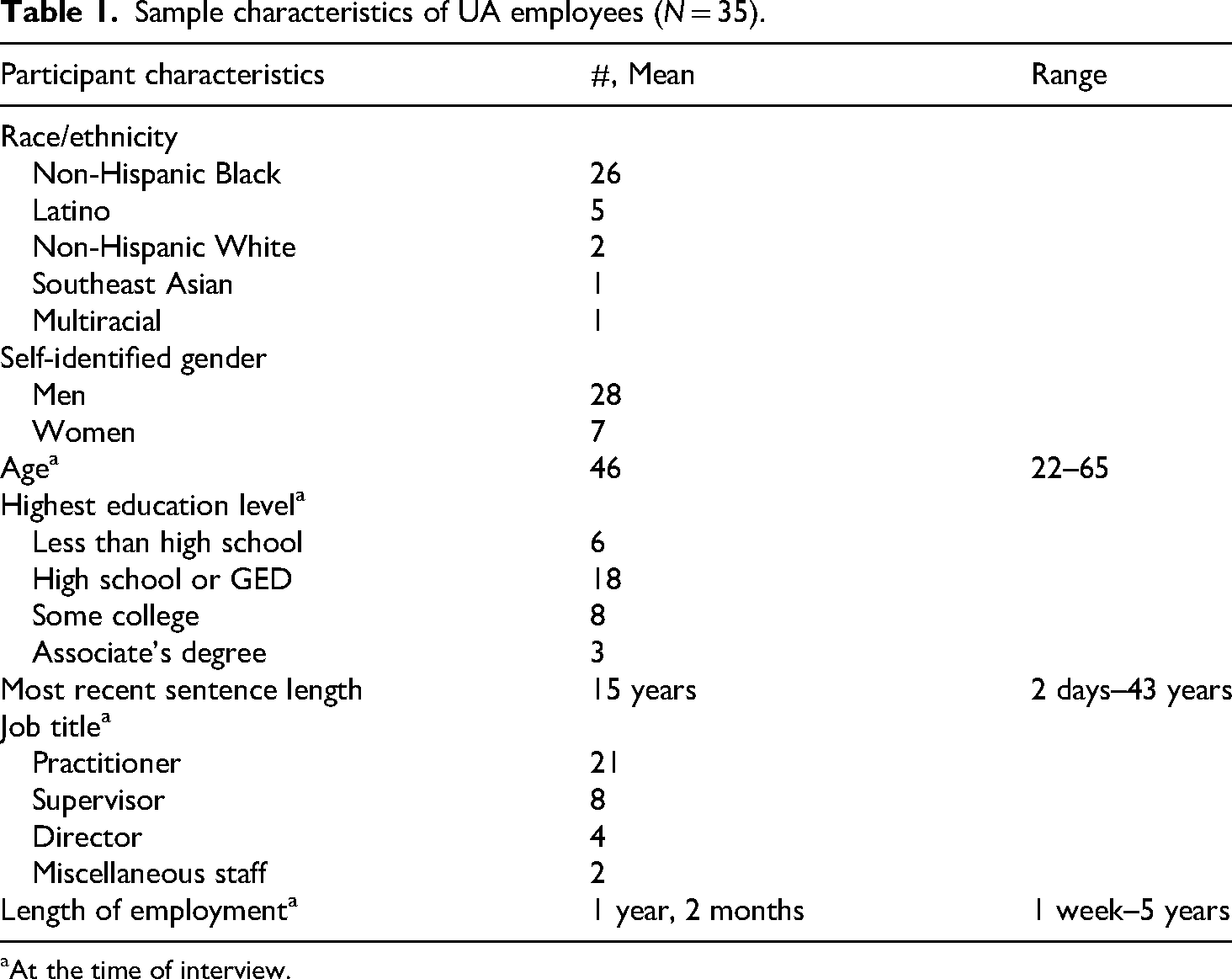
At the time of interview.
Keeping these demographics in mind, this study addresses researchers’ tendency to generalize acute racial and gendered experience. Specifically, the experiences of low-income Black men often come to represent the reentry outcomes. Two examples highlight the need to abandon this tendency. First, Western (2018) captures the importance of racial disaggregation as white members of the Boston Reentry Study cohort reported greater success with reintegration efforts compared to their Black and Latinx peers; the difference in outcomes can be attributed, in part, to the longevity and density of network ties during and after incarceration. In the present study, I made a concerted effort to recruit respondents who did not identify as Black and see how their experiences align with previous studies of “racialized reentry” (Western and Sirois, 2019). Second, Gurusami (2017) work on Black women's experiences finds that many of them frequent resource centers and workfare programs. On one hand, this pattern repeated among my respondents who were women, relying on said resource outlets and family. On the other, men were quicker to highlight their independence with agencies and loved ones often being absent from their success narratives. Such opposing representations implies a gendered navigation of reentry experiences that cannot be captured by just studying men.
Findings and analysis
This paper has two findings. First, the boundaries between stigma and social capital can blur as incarcerated peers become a viable resource. This blurring allows for “carceral networking” or the process of securing resources within the legal economy while still being intimately bound with penal institutions. Second, we see the emergence of “penal liminality” where workers occupy both a marginalized and marginalizing role. On one hand, the work of security NGOs is intimately bound to the penal state, binding their employees in kind. This dynamic, thus, places employees under a sharper scrutiny, rendering them easier targets for penal retaliation or what I term “proximity sanctions.” On the other, employees occupy a position that is organizationally bound to police as they manage unhoused folk and leverage penal agents to meet their goals, a process of “penal assimilation.”
Carceral networking
The “mark” of the criminal record bestows a negative credential that formerly incarcerated people need to work against to secure socio-economic support, especially employment. Following this logic, social capital presumably exists outside of social networks developed within carceral settings. This presumption implies a measurable gap between who can and who cannot provide viable employment opportunities; the task of job placement belongs to temp agencies, reentry programs, and halfway homes. However, many respondents noted that the people they were incarcerated with were the first ones to get them a job following release. In some cases, this opportunity proved to be the end-all-be-all as respondents didn’t seek additional work opportunities after recruitment into UA. In other cases, UA proved to be the most stable job, noting better pay and benefits that would allow them to reach financial milestones and achieve stability. To be sure, either circumstance did not preclude them from alternative work opportunities but said alternatives were either not explored due to the immediacy of employment or deemed unsustainable by respondents.
Carl (60, Black, Practitioner), offers his own recruitment story not long after being denied parole: [I] learned about [UA] when I was in prison. Matter of fact I gave my little sister's number [to a friend named Tim who got approved for parole] just in case they separated us. Soon [after], my little sister says: “Tim called. He told me that he's in a motel … and then later on he'd say he got a job. He said when you get out he got a job [with UA] for you. He'll send you a support letter [for your parole hearing]” And I was like okay! Now that's what [we] do—everybody that comes out, [we] tell them [about UA].
Here Carl addresses how recruitment rolls over for iterative generations of employees. While he was imprisoned, Carl stayed in contact with Tim who had been released, later letting Carl's sister know about a job opportunity: UA. Tim not only offered a job for Carl but also wrote a letter of support. With said letter, Carl was granted parole. Now, Carl and Tim have committed to recruiting their incarcerated colleagues. This insight challenges the prevailing narrative among reentry scholars that third-party intervention is necessary for formerly incarcerated workers to find work and meaningfully gain socio-economic stability. Indeed, rather than Carl needing support from a reentry organization to fashion an acceptable profile for his hearing, he drew exclusively from his informal network, Tim, who had recently been released.
More commonly, though, many employees learned about UA through former contacts after incarceration. Rashad (50, Black, Supervisor), exemplifies this trend: I got out and went to a halfway house [in San Francisco]… So I had a friend, his name is Maurice. He used to work at SF street cleaning [before UA]. So he told [UA] “I know somebody, that they [sic] wanna work for here.” We [sic] was in Lompoc Prison together. And like a week later, he got me on with it and did my training and stuff over at WeWork [a collaborative office space for companies and individuals]. And after that, started working over here […]
Compared to Carl, Rashad learned about UA after his release but it was not until he reconnected with Maurice, who had been incarcerated alongside him. This experience was surprisingly common for UA employees who described showing up to the office to request a job after learning about it from a peer; those who persisted over a few consecutive days received one. Such immediacy is striking as it usually takes months of searching until a job lead emerges. Already, there is evidence to suggest that shared carceral experiences are sufficient for the recruitment process, circumventing reentry organizations or similar welfare providers. Such nuance in recruitment strategies demonstrates how stigma and social capital are not as conceptually distinct for reentry workers as the record itself—and the institutions Carl and Rashad occupied—streamlined their release and employment processes, respectively.
Penal liminality
Now on the job, penal liminality captures the ambiguous nature of control and enforcement that formerly incarcerated workers experience. On one hand, they must navigate “proximity sanctions”—the multiplicative risk of penal incursions into their daily lives across personal, workplace and interpersonal environments—due to the necessary collaborations security NGOs have with police. On the other, workers can threaten penal intervention to meet organizational goals, a convergence I term “penal assimilation.” Put another way, security NGOs put their reentry workforce at greater risk of penal sanction given their collaborations with the police but it is those same collaborations that employees can leverage to accomplish their goals, even if its execution can reproduce patterns of social control. Said liminality ultimately creates a double-bind where UA workers can leverage the force of the penal state while also remaining beholden to its oversight.
Proximity sanctions
Proximity sanctions are the multiplicative risk of penal incursion into one's daily life by virtue of work that is necessarily bound up with penal agents. As mentioned above, Urban Alchemy's recruitment approach helps to minimize employment stigma and the negotiation process associated with it because their ultimate goal is to provide jobs knowing there are limited prospects elsewhere. At the same time, it places people closer to penal agents and their respective surveillance practices; a vignette offered by a UA Director exemplifies this dynamic. Within the first couple of years of operation, San Francisco Police Department officers came to the main office on Halloween to look for two employees. According to the officers, these employees were registered sex offenders and needed to be located as they could not be around children, an urgency aggravated by the fact that the Tenderloin has the densest concentration of youth in San Francisco (Shaw, 2025). For much of UA leadership, this was surprising and they complied to locate their employees (Juan, personal communication, May 26, 2022). This instance conveys two things. First, UA's employment process allows for a critical mass of reentry workers. Second, UA also enthusiastically complies with police to address any employmee oversight concerns. These elements produce a deeper well of reentry workers that are at greater risk of penal sanction and surveillance. To be sure, employers working with penal agents to sanction employees that violate the terms of their supervision is not unique to UA. But what does distinguish them is the dense concentration of reentry workers subject to this penal surveillance not just because of their own supervision but also the supervision of others; penal surveillance compounds among employees, implying a quasi-indefinite parole.
Acknowledging mutual surveillance extends to how workers conduct themselves around police. Demond (30, Black, Practitioner), communicates a general distrust: What I did think of police and what I still think of police is that they are not my friends. But you know, they’re humans, they’re doing their job. That's it, really—nothing to think of the police. I’m not [sic] nobody […] You know, they to their jobs and you do yours. Stay out of [police officers’] way and they stay out of ours.
Viola (51, Black, Support Staff), notes restrained interactions with police that extend beyond work: [M]y past is my past, you know? Of course, now I see good cops [on the job]. But I’m just… I’m very cordial, VERY cordial. And [working with police] is okay with me. Like I said, my past is my past—out of sight, out of mind—but if I don’t have to deal with them, I won’t, you know? I have a son that's currently incarcerated … and I have to deal with [the police] because I have to but other than that, out of sight, out of mind, like I say.
Demond and Viola highlight a polite distance—everyone does their jobs and stays out of each other's way. The tension stems from the threat of penal sanction given workers’ daily proximity to police; employees must play it safe with their conduct lest their own activities fall under scrutiny. At the same time, Viola's account shows how this disposition transcends her work and into her personal life, inducing a “secondary prisonization” (see Comfort, 2008) where she must begrudgingly acquiesce to penal surveillance as she navigates the bureaucratic procedures of her son's incarceration. Indeed, Viola's experience outlines three layers of incursion that UA employees may experience: the vestiges of their own parole, the penal oversight amplified by their job, and the carceral interventions that impinge upon their families and broader communities. These incursions do exist outside of security NGOs: workers can be on parole, have their parole officer show up to their job, and can also have loved ones experiencing their own criminal legal entanglements. But how researchers currently understand this three-pronged experience of surveillance does not capture organizations whose operations are necessarily connected to police; penal incursions are a feature rather than a byproduct of criminal legal procedures and practices. But even as reentry workers endure the arrangements brought upon by proximity sanctions, this same closeness grants workers some leverage.
Penal assimilation
Penal assimilation refers to how security workers leverage their penal collaborations to meet organizational goals. Beyond discussions of reentry, research on the criminal legal system reinforces a binary between those who police (e.g., police officers) and those who are policed (e.g., formerly incarcerated people). In one sense, this dichotomy is useful because it provides a clear trajectory of organizational change, namely how the penal state practices evolve alongside leadership shifts, introduced policies, and/or changes in cultural attitudes toward crime. At the same time, bifurcating these experiences overlooks security NGOs, particularly those employing reentry workers, as they now play an active role in the policing process. Put another way, reentry workers in the security sector are not just acted upon by penal and welfare agencies because of their record. Instead, their collaborations with these very agencies allow them to act upon their peers and/or other marginalized groups. For UA, employees directly participate in policing themselves rather than just collaborating with police. This dynamic implies a denser investment in penal interventions, one only captured by examining emergent sectors rather than “standard” reentry employment outlets.
Amid this convergence, UA leadership has a clear vision of what the role of UA is in the community vis-à-vis police. Henry (56, Black, Director), offered the following: We are first responders. And oftentimes, without the police even having to come, we’ve de-escalated fights, arguments, people pulling weapons on other citizens. You don’t have to call anybody—we’re there already! And so, that's an alternative to police pulling up to a guy with a knife yelling at some chick and they just [imitates shooting a gun with his hand] boom boom boom boom. While we’re standing there, there police never even come sometimes.
Here, Henry distinguishes between UA and police: UA workers are self-reliant and less violent. This distinction colors much of UA's mission statement and advertising, emphasizing that they are a separate entity that works with police but do not depend on them. But as I alluded within the description of UA's employee structure, directors are more removed from public interactions when compared to supervisors and practitioners, potentially overlooking how integral police are to UA activities.
Darren (41, White, Practitioner), speaks at length on how police may arise in his daily work: [W]e had a dude about two weeks ago who was trying to get crazy with people, tries kicking some homeless guy, [and] pulls a knife out! And … I mean … he started getting crazy and we [UA] ran his ass up out of there, you know what I mean? He got scared that we were going, to, like, beat him up but we weren’t going to beat him up. We were just trying to get him the hell up out of there before he hurt somebody. So, he ran to one of the little farmer's markets, to one of the little booths, and wouldn’t come out at all. [He] was scared that we were going to hurt him. We’re like “man, just leave, bro!” So, he runs across the street and tries to tell the cops we were trying to assault him and all this [sic] bullcrap and the cops come over and ask us and we’re like “man this dude's out here pulling knives on people, like he's going to hurt somebody!” and they got his ass up out of there. Unlike a lot of times, I’ve seen people on [a] wall and they won’t move and the cop comes by and I’ll tell them “hey man, this dude ain’t trying to move—can you help me out?” And they’ll go get him and get his ass up out of there. Then I tell the guy [moved from the wall] “look bro you move for the cop but when I ask you nicely, you’re going to treat me like crap. I mean, I’m asking you nicely, bro, just move!”
Across both moments Darren recounts how he and his colleagues leveraged police to resolve work-related issues. In the first case, the unhoused man Darren and his colleagues were trying to remove saw them as a threat which compelled him to seek protection from the police, the more violent group according to Director Henry. In the second case, he interrupted loitering and his lament about disrespect reveals a willingness to deploy police if his authority is threatened.
Rather than isolated incidents, Rashad (50, Black, Supervisor), discusses the normality of police collaboration: [O]ne thing I can say is that the police out here really support [Urban Alchemy]… I’ve never run across [sic] no bad police since I’ve been out here [in the Tenderloin]… You call the police and say “hey we need some help, we need some assistance” and they come help us.
Rashad reflects positively on the support that UA workers receive from police. But in concert with Darren, a situation that constitutes “help” is ambiguous as police authority can be leveraged to disrupt non-violent, yet criminalized, activity rather than just outwardly violent ones. Even more interesting than this routine deployment of police is how it contrasts with leadership's vision of Urban Alchemy; recall Henry discussing UA as a parallel agency rather than a routine police collaborator. This contradiction between marketing and action belies a penal assimilation—UA derives its interventionist success through its alignment with penal practices. Such success complicates the stigma of the criminal record because UA functions as a case where workers uphold potentially marginalizing practices—rather than just being recipients of these practices—as they themselves navigate reintegration. Thus, certain employment sectors establish a peculiar duality as record holders find themselves on both sides of penal enforcement.
Conclusion and discussion
Through 35 interviews with formerly incarcerated workers of the security NGO Urban Alchemy (UA), this paper troubles the conceptual boundaries of stigma and social capital by looking at an emergent field of reentry labor: security. Said intervention is laid out in two parts. First, security NGOs like UA exemplify a blurring of social capital and stigma for reentry workers in the labor market—reentry peers now become a viable employment network and workers are hired because of their record. More still, third-party workfare organizations are not necessarily integral to the reentry process as UA's direct recruitment strategies translate into immediate employment. I coin “carceral networking” to describe this conceptual blurring as formerly incarcerated people secure resources within the legal economy while still being intimately bound with penal institutions. Emphasizing the legal economy is crucial to carceral networking because it challenges researchers to examine “official” networks and institutional arrangements rather than those of the informal and/or illegal economy, centering the intimacy of the penal state and legitimized reentry networks. At the same time, this does not preclude future inquiry to examine if such dynamics do emerge in non-institutionalized spaces. Second, security NGO workers enjoy the perks of job stability but also exist in a state of “penal liminality” that troubles the dichotomy between those who police and those who are policed. On one hand, workers must endure “proximity sanctions” due to the nature of their collaboration with penal agents, tightening the lens even further on criminal legal surveillance across individual, workplace, and interpersonal contexts. On the other, security NGO workers use this proximity to leverage police intervention, revealing a process of “penal assimilation” that runs the risk of (re)producing criminal legal control.
With these findings in mind, it is also important to emphasize that more studies are necessary for determining the extent of their generalizability and validity beyond UA. First, respondents are constrained by their organizational affiliation, the specificities of the organization itself, and the context of San Francisco. This means that the findings do not speak to alternative employment (i.e. non-security) experiences both within and beyond the city and even the county, state, and federal penal policies that interpenetrate their particular context. Second, new questions emerge for each theoretical contribution. In the case of carceral networking, what is its conceptual purchase within organizations that deploy stricter hiring practices (e.g., background checks) and/or actively collaborate with workfare agencies to meet staffing goals? Do we see a comparable blurring of stigma and social capital or are those symbolic boundaries maintained? For penal liminality, how might this show up in cases where workers avoid contact with penal agents even as the larger organization collaborates with the criminal legal system? On one hand, do we still see aggravated experiences of surveillance? On the other, do workers still leverage the authority of penal agents to meet their own goals?
Beyond challenging longstanding presumptions and the new sites of inquiry that challenge engenders, UA also offers insight into the security sector and how that impacts formerly incarcerated employees. First, security work puts reentry employees into closer proximity to penal agencies, inviting acute institutional surveillance and scrutiny by both employers and police. Second, security work places reentry employees in a liminal space between the penal state and their marginalized peers as security NGOs align with police to prop up their legitimacy. This dynamic creates a tumultuous position whereby employees experience marginalization while propagating marginalizing practices historically associated with the police. Third, while it is important to be critical about the socio-economic exploitation of reentry populations and what constitutes said exploitation, UA's meteoric rise as a reentry-centered employer has made it a fiscal juggernaut that offers competitive pay, job stability and advancement opportunities for its workers. At the same time, reports of organizational turmoil imply a less than pristine work environment. Indeed, exploitation may be ameliorated at best, reflecting the broader context of socio-economic marginalization that reentry populations face. This context bolsters reentry policy concerns given the sheer amount of people that circulate through the U.S. criminal legal system, particularly surrounding employment. And while Urban Alchemy does offer a promising method of incorporating formerly incarcerated populations into the labor force, caution is still warranted. Specifically, UA's investment in personal responsibility indicates that support systems and funding for reentry resources are available but are intimately bound with the criminal legal system to be viable and sustainable. This intimacy is not new—non-state entities that offer little pushback to criminal legal practices have less resistance to overcome from policymakers and, by the same token, have an easier time expanding their budgets. San Francisco exemplifies this relationship as UA continuously secures funding despite the outcry of competing community organizations. Such expansive funding allows UA to take larger risks that facilitate growth, risks that less-funded organizations avoid entirely. For example, UA's short-lived expansion into Austin, Texas required they take on a paltry $1 million contract to oversee the ARCH, a homeless shelter. Competing organizations lacked the reserves to bid on this contract without a significant financial loss; Urban Alchemy won by default. Taken together, UA's rise is not just about organizational alignment but also the fiscal fortitude to withstand budgetary constraints, outlasting alternatives to penalized welfare provisions.
Broadening back out to the question of punishment and labor, UA is not an “omen” for the future of reentry work or the security sector but it challenges researchers and policymakers to revisit success measures beyond employment and avoiding reincarceration. First, how do we contend with the rise of non-state organizations that offer work while entrenching the marginalization that their employee base experiences? Second, what is the boundary between benefit and exploitation for reentry workers that take on this work given the availability—or lack thereof—of viable alternatives? Third, what does the rise of UA say about the socio-political climate surrounding policing and the governance of public space, particularly as it relates to poor and unhoused populations? Are there identifiable features of the cities in which they emerge and where they might fail to gain traction? Will these organizations continue to emerge amid deepening inequality or is this merely a period of penal experimentation, refining the collaborative potential between state and non-state entities? While such questions are beyond the scope of this paper, UA's growth and impact underline future inquiries into the contemporary (re)production of stratification and the expansion of penal control.
Footnotes
Acknowledgments
The author would like to acknowledge undergraduate members of his research team at the University of California, Berkeley for their help with interview transcription: Eduardo Ayala, Adrian Caceres, Amber Chen, Kai Bradlee Jean Fowler, Alonzo Harvey, Silas Nathaniel Kanady, Kimberly Lee, Charles Trinh Luu, and Amy Belen Vazquez. Additional thanks are reserved for Catherine (KT) Albiston, David J. Harding, Armando Lara-Millán, Osagie K. Obasogie, and Jonathan Simon for their enthusiastic engagement and feedback.

Ethical considerations
The Office for the Protection of Human Subjects (OPHS) Institutional Review Board at the University of California, Berkeley approved the data gathering process for this study (approval: 2022-06-15406) on August 03, 2022. Respondents gave written and verbal consent for review and signatures before starting interviews.
Consent to participate
All respondents gave informed consent for their participation in the study and the sharing of the information gathered for publication online. This consent was provided verbally and in written form via signature on the study consent form; an additional copy of the form was also provided to each respondent for their records so that they may contact myself or the Office for the Protection of Human Subjects at the University of California, Berkeley. Prior to offering informed consent, each respondent was given the study consent form to review and informed that they could ask any questions about the study and its goals as well as were free to terminate their participation at any time without penalty. All respondent communicated that they understood the purpose of the study and were participating of their own volition. For additional privacy, all respondents’ names have been anonymized.
Consent for publication
All respondents provided both verbal and written, informed consent for their data to be published and distributed.
Funding
The author disclosed receipt of the following financial support for research, authorship and/or publication of this article. This work was supported by the National Science Foundation (grant number 1000293100); the Social Science Research Council; The Russell Sage Foundation (grant number 2401-46640); the Law and Society Association; the UC Berkeley Graduate Division; the UC Berkeley Office for Graduate Diversity; the Institute for the Study of Societal Issues; the Institute for Research on Labor and Employment; the Center for the Study of Law and Society; the Black Studies Collaboratory at the University of California, Berkeley.
Declaration of conflicting interests
The author declared no potential conflicts of interest with respect to the research, authorship, and/or publication of this article.
Data availability statement
As per the guidelines for the Office for the Protection of Human Subjects at the University of California, Berkeley regarding sensitive groups—in this case, formerly incarcerated respondents—full interviews are not available to protect respondents and avoid the disclosure of potentially compromising information. All data is stored on an external hard drive without remote access capabilities. Should readers wish to review the interview data, please reach out to the author directly.