




Abstract
This article examines how old age, risk and vulnerability intersect in prison, introducing the concept of a humanitarian-punitive ethos to describe the carceral governance of older prisoners. Traditionally, in the social sciences, the figure of the older prisoner is viewed through two opposing lenses: vulnerability (aligned with care) and risk (tied to control). Drawing on staff narratives from HMP Wakefield, a high-security prison in England, the article shows how these logics coexist in practice. As the findings suggest, staff are tasked with both protecting and managing ‘dormant threats’ posed by older prisoners, framing their vulnerability as a condition to be managed rather than a reason to reconsider their incarceration. This dual role reshapes how ‘the older prisoner’ is understood and constructed, how prison work is experienced, and how aging challenges the carceral logic itself. The findings and argument have policy implications: they call for expanded release mechanisms and time-capped sentences that acknowledge the realities of aging in prison.
Introduction
He sat on the edge of his bed, his feet barely touching the floor. With crooked hands clutching a blue pen, he held out his worn sheets of paper. A cataract clouded one eye, his voice rasped. His cell was meticulously tidy. Opening a small cupboard-like fridge, he reveals rows of identical plastic bottles lined up; medical supplements prescribed to keep him from losing weight. He explains he has a malignant stomach tumour, cancer he adds, and is due for surgery any day now. He fears he won’t survive the operation, and he doesn’t know when it is coming, they’ll warn him the day before.
Bill has once been released but has been recalled after serving 43 years. He is 73 years old and is serving a life sentence. We asked an officer on the wing about him. She explained that he’d been found intoxicated on the street, breaching his licence. “He's not the worst here,” another officer added, “but he did kill a man once.” He seemed so weakened and worn, but the officer's words cast a darker light: beneath his frail exterior lingered the spectre of danger, unpredictable and still capable of harm. Vulnerable and risky. (Vannier, Fieldwork notes, April 2024)
As of 30 September 2024, 21% of the 86,966 prisoners in England and Wales were aged 50 or over, up from 10% in 2011 (House of Commons Library, 2024; Ministry of Justice, 2024, Table 1.Q.6). This demographic shift brings distinct challenges, as older prisoners face exacerbated ‘pains of imprisonment’ 1 which are linked to the physical and mental decline happening in prison. The ‘greying’ of the prison populations requires a wide range of adjustments to buildings and cells, to staff training and allocation (Hayes, 2016; Humblet, 2021; Mann, 2016; Turner et al., 2018).
‘Old age’ is admittedly an abstract concept that varies across carceral contexts, scholarship and jurisdictions (Vannier and Nellis, 2023). In England and Wales, His Majesty's Prison and Probation Service (HMPPS) defines ‘the older prisoner’ as individuals aged 50 or over (Public Health England, 2017: 10). This definition is based on evidence of accelerated aging in prison (Hayes et al., 2012). Yet, as Vannier and Nellis (2023: 4) argue, defining ‘old’ in prison is a sociological question, one that treats age as a socially constructed category: ‘[t]he issue with defining what constitutes an “old prisoner” 2 is first and foremost a sociological one, namely one that considers “old” as a social category in and of itself’. Examining the construction of the older prisoner is thus one of the goals of this paper.
The older prisoner is typically viewed through two separate lenses in the social sciences: vulnerability and risk. Vulnerability is linked to individuals’ limitations and suffering (Davies et al., 2023), promoting compassionate care and dignity (Herring, 2016b). Conversely, a risk-focused approach prioritizes control and containment (Beck, 1992; O’Malley, 2006), and aligns with punitive frameworks that target potential threats (Garland, 2001) and sidelines individual well-being or transformation considerations (Kemshall, 2017). Across disciplines, older age is widely seen as a marker of vulnerability (Schröder-Butterfill and Marianti, 2006), with criminological studies often portraying older prisoners as deserving of compassion due to their specific needs (Crawley and Sparks, 2005; Heaslip et al., 2023).
At the same time, academic research, and voluntary sector and state reports, reveal that the older prisoner is evocative of ‘risk’ (Crawley, 2005; Prison Reform Trust, 2024). They are scrutinized for the threats they pose to prison order and public safety (Wilkinson and Caulfield, 2020), particularly in cases of historic sex offences (Ievins, 2023). While some studies argue that old age should not diminish the need for risk assessments (Yorston, 2010: 695), most agree, including state sources, that older prisoners generally pose few control issues (e.g. HM Chief Inspectorate of Prisons, 2004: v). Moreover, risk-focused discussions, tend to highlight the dangers they face, in terms of poor health, violence, disrupted care and homelessness (Nuffield Trust, 2023; Prison Reform Trust, 2024). There thus seems to be an ambivalence towards the older prisoner, as a case for additional needs and a site of heightened risks. And the term ‘risk’ itself, when associated to older prisoners, appears to be conceptually unstable. It refers to the threat posed by older prisoners, and the threats they face. This paper does not offer a fixed definition of risk but instead examines how staff invoke, interpret and operationalise it, to ultimately discuss how this shapes the humanitarian-punitive ethos that governs older prisoners.
Scholarship on the prison officer, especially in high-security settings, has long recognised there is a tension between care and control (Crewe, 2007; Liebling, 2004; Tait, 2011). Liebling (2004) and Crewe (2011, 2007) describe the delicate balance between institutional demands for discipline and the emotional and the moral burdens this creates on staff-prisoners relationships. Tait (2011) shows that officers often feel torn between enforcing rules and offering support, and her typology identifies the most common officer type as one that is ‘conflicted’. Ievins (2023) discusses how staff struggle to set their moral boundaries when working with men convicted of sexual offences. Crawley’s (2005) work shows how some officers who work among older prisoners develop empathetic, humanising relationships that resist control logics. But she also describes the difficulties of seeing frailty and decline, and the unease of caring for those who are aging or dying in prison. However, Crawley does not frame these ambivalent responses as part of a broader, systemic, tension between care and control.
This article builds on these foundational studies to explore the dynamics of risk and vulnerability at play in the context of older prisoners. Some recent research, such as Bows and Westmarland's (2018: 72) study, have begun linking risk and vulnerability together, showing how older sex offenders manage risk in the community and face severe mental illness, limited support and resources. The British Medical Association (2019; see also, House of Commons Justice Committee, 2020: 20) also reminds that frailty often entails lower risk, and the Prison Reform Trust (2024) has advocated for compassionate release on these grounds (see also, Crawley and Sparks, 2006; The Howard League for Penal Reform, 2019: 5). Still, research on how these concepts interact in carceral practices remains scarce and incomplete when it comes to the interactions at play. In light of the growing aging prison population and with increasing numbers of older people dying in prison 3 (Ministry of Justice, HM Prison & Probation Service, 2025), it is vital to understand how risk and vulnerability shape perceptions about, and responses to, the older prisoner.
This paper focuses on staff's perspectives because it is through their daily interactions and management decisions over prisoners that concepts such as risk and vulnerability take shape in practice. Here the term ‘staff’ include both frontline officers and office-based management employees, as well office-based specialist workers of the prison estate. To avoid reinforcing ageist stereotypes, it examines staff perceptions of older prisoners’ vulnerability and risk levels, while highlighting how evidence-based sources challenge these assumptions.
This paper uncovers a humanitarian-punitive ethos, 4 where aspirations to protect coexist with risk aversion logics. While the coexistence of risk and vulnerability is not itself new, the paper examines how this tension manifests specifically in the management of older prisoners and reveals the distinctive effects it produces on staff perceptions and institutional practices. This ethos offers a useful explanatory lens for understanding how the ‘older prisoner’ is constructed, how prison work is experienced and how the broader carceral logic itself is challenged by aging in prison. What emerges is a logic that seeks to make older prisoners manageable or fit for imprisonment rather than questioning their continued incarceration. After describing the methodology, the article uncovers the dynamics of the humanitarian punitive ethos, and then discusses the conceptual, practical and policy implications thereof.
Methodology
The analysis draws on 21 semi-structured interviews conducted between January and March 2024 with staff 5 at HMP Wakefield, as part of a UKRI-funded study on hope among older life-sentenced prisoners. 6 Most participants joined following an introductory meeting; others were recruited by word of mouth. HMP Wakefield is a high-security Category A men's prison in West Yorkshire and is one of the oldest operational prisons in the UK. As of October 2022, it held 744 prisoners, 295 of whom were aged 50 or over, around 40% of the population (HM Inspectorate of Prisons, 2023). It also has the second-largest number of older life-sentenced prisoners in the Category A estate (Ministry of Justice, 2024). Though the prison has made some adaptations for aging prisoners, including mobility and healthcare provisions (Baidawi, 2015), the infrastructure remains in poor condition, with broken lifts, leaking roofs and insufficient staffing (HM Inspectorate of Prisons, 2023). A five-year action plan introduced a HIVE community for older prisoners that offered daily including craft sessions and wellbeing events (HMPPS, 2023), but this was discontinued during our fieldwork. The institutional distinctiveness of Wakefield, namely its heightened risk mindset and the demographic makeup of its prisoners, makes it an ideal site to explore the conceptual overlap and slippage between risk and vulnerability. The focus may, inevitably, limit its generalizability to other prison types but it still carries policy and theoretical weight. Indeed, rather than viewing it as an outlier, the prison can be seen as a prism through which the tension between care and control, or more specifically, the modern penal governance of older prisoners, becomes particularly legible.
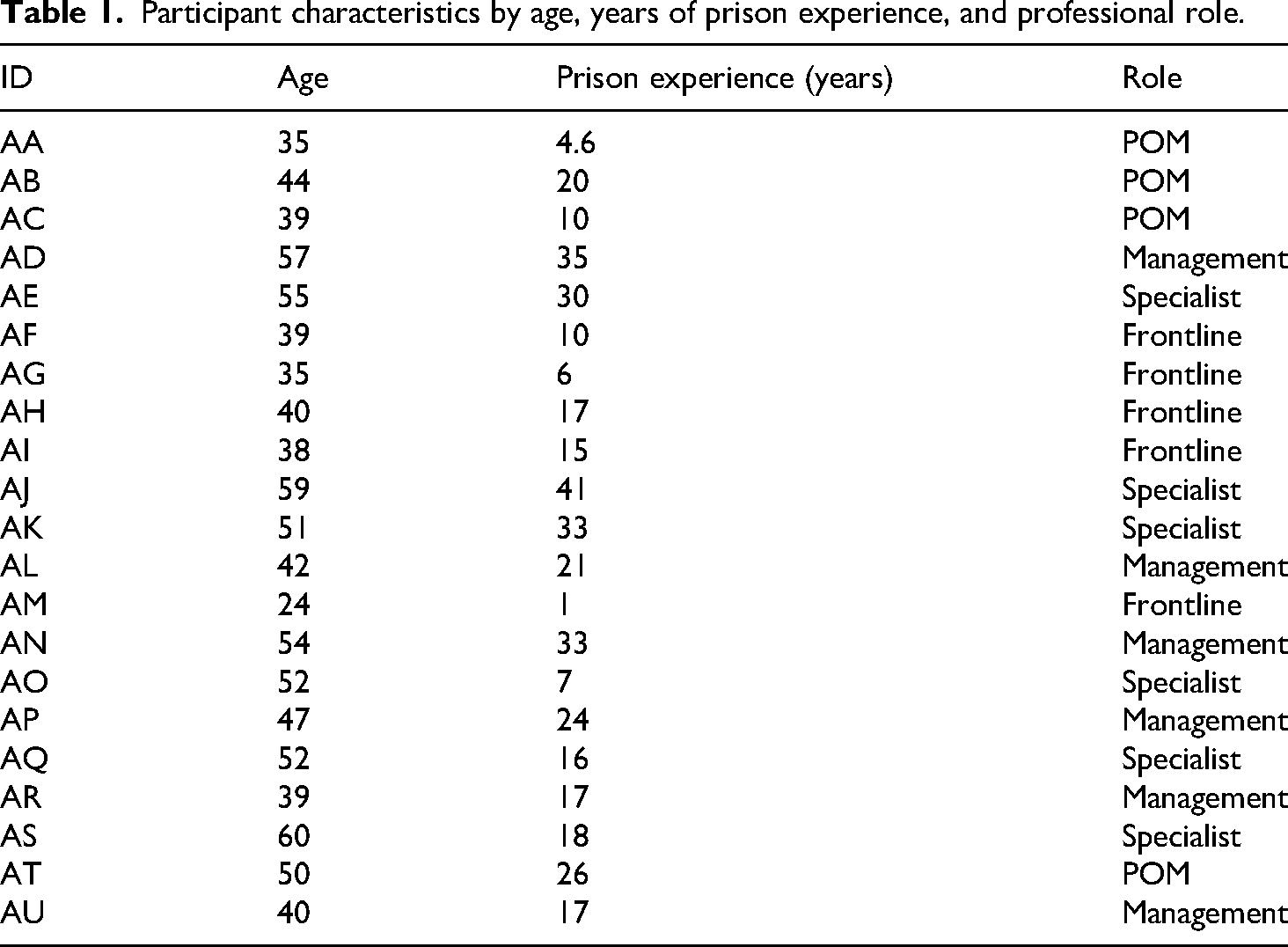
The sample includes a diverse cross-section of demographic features, and experience levels and backgrounds. The gender breakdown is 14 female and 7 male staff members. Their ages ranged from 24 to 60 years, with a mean age of approximately 44 years. Years of service spanned from 1 year to over 41 years, averaging 20.6, indicating a mix of early-career and highly experienced staff. Several had prior careers in probation, social care or healthcare. The sample includes both frontline and office-based roles with five participants in operational custody, four in offender management (POMs), six specialist office-based employees (e.g. healthcare, human resources, education), and six in senior management. Frontline staff had the most daily and direct contact with older prisoners. POMs, though office-based, were closely involved in sentence planning and rehabilitation requiring regular and meaningful interactions with older prisoners. Specialists provided key services tailored to older prisoners’ needs, and managers oversaw the prison's strategy, many drawing on prior direct experience with this population. The sample reflects a balanced mix of frontline and office-based staff and captures a broad spectrum of interaction with older prisoners, from daily contact to strategic oversight. The richness of insights lies in this diversity of role that reveal how varied experiences (whether close to, or at distance from, older prisoners) align around a common view of the humanitarian-punitive ethos (Table 1).
Participant characteristics by age, years of prison experience, and professional role.
The interviews lasted 45 to 90 minutes and were conducted online on Microsoft Teams. They were recorded and transcribed. The remote format allowed us to adapt to participants’ work schedules, in particular ongoing operational demands, and provided comfort for those less at ease in person. There are some methodological limitations (e.g. missing out on non-verbal cues) and minor technical hurdles that come with this approach, such as microphones and video cameras not working that can occasionally disrupt the flow of the conversation. But these moments were rare and the distance they created even helped ease the atmosphere at times. Questions included ‘what are the main struggles older prisoners encounter?’, ‘how do you meet their particular needs?’, ‘what does your role involve when working with older prisoners?’. Following a grounded theory approach (Birks and Mills, 2011: 1–15), themes were identified inductively and refined through triangulation with official data, policy documents and academic literature. Staff perceptions were cross-referenced with data included in ministerial reports (Ministry of Justice, HM Prison & Probation Service, 2025), voluntary sector research (e.g. Prison Reform Trust, 2024), and gerontological studies. Given the sensitivity of the research, ethics were prioritised throughout. The study was approved by the university ethics committee, screened by the NRC, and the prison. Ethical considerations and interview materials were developed with input from experienced colleagues and carefully monitored with the research associate throughout the study. Participants gave informed consent, their responses were anonymised, and the confidentiality of their interviews was ensured. A final debriefing shared support resources where needed.
The dynamics of the humanitarian-punitive ethos: the coexistence of risk and vulnerability
Old age as low risk
Most participants described older prisoners as ‘calm’ and ‘settled’ (Interview AF, frontline) and less likely to engage in violence, unlike younger peers who tend to be ‘quite volatile, quite violent’ (Interview AH, frontline). Older prisoners seek to avoid high-tension areas, some preferring ‘to stay in their cell’ and opting out of activities that could involve conflicts (Interview AT, POM). One participant described them playing chess or chatting quietly on association (Interview AN, management). Research and official data support this view, noting reduced violence and disorder with age (HM Chief Inspectorate of Prisons, 2004; Ridley, 2021). In part, these attitudes are tied to the fact that many older prisoners, having spent years in prison, have become institutionalized (Age UK, 2019).
The risk avoidant older prisoner is portrayed as being content with modest gestures of recognition. As one participant explained: To be fair, usually older lads are nine times out of 10 not a problem. They're all calm down, settled in, them been in jail, 20 odd years or whatever. They just want to get on with the sentence and have a peaceful, peaceful life. (Interview AF, frontline)
Older prisoners are also described as offering useful mentorship to other prisoners. By supporting the prison community, they contribute to reducing disruptions and help maintain a sense of calm. One participant noted, ‘mentors tend to be those older prisoners with the longer sentences’ (Interview AC, POM). Another described a 79-year-old prisoner keen to teach chess, sharing homemade boards and books: ‘He's 79, he's really, really keen on chess and he wants to (…) give that information to other people, teach people to play chess, he's written like little books for chess clubs, he's made like chess boards which he's given to other people’ (Interview AH, frontline).
This perception of low risk encourages acts of kindness and fosters meaningful, though often quiet and modest, interactions. As one officer said, ‘just a small thing, …a decent human conversation… you see that look change. …and it costs you nothing’ (Interview AL, management). Another participant described how an older prisoner who was turning blind but was not receiving adequate help in the prison, had prompted him to seek out external aid (Interview AB, POM). Old age can indeed emulate compassion and empathy (Humblet, 2020; Touraut, 2019, 2016) and provoking actions that go beyond staff official duties. Understandings of ‘low risk’ are thus rooted in broader assumptions about old age itself, which is associated with calmness, quietness, routine-based behaviours, and withdrawal from prison tensions. These are qualities that are seen to reduce risk.
Old age as dormant risk
Despite a dominant perception that older prisoners present lower risks, a persistent narrative suggests that risk lies dormant. Staff describe a cautious approach to managing older prisoners. One staff member cited an older prisoner prisoner who, despite deteriorating health, insisted he remained capable of violence. So he's 79. He.. although.. his health is deteriorating, he's still very, very stubborn in the sense that he won't accept any sort of social care stuff. AH: But his mindset is exactly the same as it was when he was younger that if we put him on to a main residential wing, he would hurt somebody. Vannier: You think so? You think he'd be capable of still hurting someone even at 79 years old? AH: Yeah. So he's always said, he'll joke about it. He's like, oh, “when I get to the point where I'm… Like I know I'm coming towards the end of my life,” he says. “Can I have a week back on the main wings?” (…) And so he says, even though physically I'm not what I was, he said I would find a way. (Interview AH, frontline)
This impression intensifies when staff bring back prisoner's criminal history. Older prisoners convicted of serious historical offences may have conformed in custody but are still seen as inherently risky. In these moments, institutionalised behaviour is not perceived as evidence of reform but rather as a mask for unresolved impulses: The risk is we don't know whether they're going to commit offenses again. And some of our best prisoners here have been found within month, going on computers, seeing things or reoffending… and they've been some of our best behaved. They've been through some of the programmes. Everyone thinks they're great, they're standing up there with other prisoners saying it the minute they get out that they’ve offended because it's, sometimes, it's in people's nature. (Interview AK, office-based specialist)
This example is illustrative of how lasting stigma can be invoked to make sweeping risk assessments about a group of people. Indeed, older prisoners, even without serious sex offenses, are still perceived as posing significant risks to prison order. Behaviours and attitudes that initially suggest low risk are later reinterpreted as suspicious. Furthermore, disengagement from activities and the regime is frequently interpreted as a lack of willingness to change. And this perception intensifies when older prisoners are seen as having nothing to lose. Indeed, their advanced age and limited time left to live reinforce the belief that change is neither likely nor meaningful to them. ‘If they know they're not getting out as well… they don't want to change, they don't want to do anything because… Their opinion? A lot of them is… I have nothing to lose. I'm here until I'm done, until I'm dead. I'm not… I'm not interested in changing’ (Interview AI, frontline management). Disengagement, which is quite common amongst older prisoners (Prison Reform Trust, 2010; Wahidin, 2004), is thus equated with demotivation for change rather than resignation. This framing justifies close monitoring because withdrawal can cause disruptions to management: ‘I think it keeps them going. It's motivation, I think another thing is I know I think this is important that they don't get unmotivated and I think if they get fed up, then we're climbing the walls’ (Interview AQ, office-based specialist).
Traits once viewed as low risk are also reassessed through a risk-focused lens when considering release and social reintegration. They are seen as signs that the person may not have the social or coping skills needed to adjust safely. As a result, their continued incarceration becomes necessary. The dangers older prisoners pose to public safety are thus not rooted in the risk of reoffending, but in the hurdles their social and physical decline entail. The view is that society will struggle to accommodate individuals who have become increasingly dependent or out of step with the outside world. As one staff member explained, an older man show signs of cognitive decline was still seen as risky for ‘the public’: ‘And it's safer for the public and for him if he's here, but obviously we need to make sure that we can deliver all his medical needs’ (Interview AP, management).
These perceptions of dormant risk are evidently influenced by the high-security environment. Risk is seen as ever-present, based on the assumption that those held in high-security conditions remain dangerous, even those who seem calm or vulnerable: So I think that if we're honest is something I think there's also a security element. You know, we work in a very high secure prison. You know, people are reported for being too friendly to prisoners, you know. You know, there's the boundaries that prison staff have which should be… Are stricter, maybe in some ways. And I think there's always that risk that people are very mindful. You know, you can't touch a prisoner, for example, you wouldn't touch a patient unless you were examining them. (Interview AE, office based specialist) There were younger cohort, they have a lot more instance of violence in their past, maybe their offense was more violent and then I think there's been an instigation that they are able to kind of bully and to manipulate some of the older more… more settled, more kind of compliant prisoners into doing violent acts for them. (Interview AU, management) We're stuck with a lot of our more complex prisoners with no hope of progression to a different unit, which means that out of our more problematic prisoners on the wings, we're having to pick who's the best of the worst to stay on wings. (Interview AU, management) …as to providing a provision that is only for the elderly, I wouldn't say that we do that directly. I would say that that would be something that we do indirectly by being inclusive for all prisoners, no matter what their background, age etc.. Because we don't particularly have a group that is just for the elderly. (Interview AO, office-based specialist)
But implicit in the testimonies above are the managerial concerns whereby treating older prisoners differently could ultimately provoke frustration amongst younger prisoners. This uniform approach likely seeks to avoid perceptions of favouritism and leniency and their associated managerial risks. Yet, as Williams (2013) stresses, equality of treatment may result in unequal outcomes. Sameness can indeed overlook the realities of aging in prison and the vulnerabilities that come with it, potentially resulting in unequal treatment. In fine, by insisting on sameness, age-related needs become dismissed in the name of both fairness and discipline.
Old age as omni-vulnerability
Vulnerability can also come first. Yet, risk quietly persists in the background, shaping how attention and care are delivered and interpreted. Older prisoners embody what might be called an omni-vulnerability, a form of vulnerability that cuts across all established categories outlined in the literature in the health sciences and gerontology (Andrew et al., 2008; Langmann, 2023; Marçola et al., 2023). Bui and Deakin (2021) offer a relevant framework for understanding how risk and vulnerability interact. Drawing on Herring (2016a, 2016b) and Brown et al. (2017), they describe particular vulnerability as affecting certain groups more susceptible to harm (Bui and Deakin, 2021: 2). This includes ‘situational’ vulnerability (heightened risk in certain contexts), ‘innate’ vulnerability (biological or developmental limits to self-defence), ‘social disadvantage’ (limited resources or support) and ‘risk-based’ vulnerability (specific traits requiring management).
Participants noted that older prisoners embody several of these categories. But these layers of vulnerability are not separate from risk. Many traits that make older prisoners vulnerable in fact generate new risks. Situational vulnerability is evidenced by a demographic shift in Wakefield, whereby a previously older population now mingles with younger prisoners convicted of organised crime and serious offences (Home Office, 2024; Prison Reform Trust, 2021). 7 During our fieldwork, we observed numerous violent incidents and outbreaks. This shift likely contributes to the growing harms experienced by older prisoners. Spatial limitations compound this environmental issue. Several older prisoners with mobility issues were accommodated in cells on upper landings due to limited space despite food being served on the ground floor. Some depended on informal carers to bring food up (Interview AS, office-based specialist). One lift had been broken for months: ‘We have two wings with lifts. One hasn’t worked since I’ve been here, and the other works intermittently… Anyone who's disabled or infirm finds it really hard to get around’ (Interview AP, management). In sum, the harms experienced by older prisoners create new risks, driven by demographic changes and the prison’s spatial shortcomings.
Cognitive decline was also commonly observed, an expression of ‘innate’ vulnerability tied to old age, and further evidenced in research in the health sciences and gerontology (Brooke et al., 2020; Cipriani et al., 2017; Toit et al., 2019). One staff member recounted how an elderly prisoner was ‘getting really, really upset’. And he ended up in tears with me ‘due to his inability to complete a simple potato salad’ (Interview AS, office-based specialist). But cognitive decline is also systematically linked to risk evaluations, shaping how prisoners engage with activities and programs that staff use to assess risk levels. One participant described a prisoner whose possible dementia, or hearing loss, was preventing programme access: He's completely stuck. […] If he's got dementia, he can't do a programme. But if it's just his hearing, then of course he can do a programme. (Interview AT, POM)
‘Social’ vulnerability too is evidenced amongst older prisoners, especially when family ties have been severed. For many older prisoners, staff and fellow prisoners become their primary or only support network (see also, Easton, 2018; Mills and Codd, 2008; Noujaim et al., 2019). One participant noted ‘He hasn’t got a wide family network out there. The only people he really knows, who he's close to, is us.’ (Interview AD, frontline). Because of this, some older prisoners are segregated ‘because it's not safe to put them on the wings’ (Interview AI, frontline). Separate gym sessions were also arranged for those over 60 to reduce intimidation or conflict (Interview AS, office-based specialist). Protective measures, even if framed as support, are really risk-management strategies. In all these ways, each layer of older prisoners’ omni-vulnerability is tightly correlated to risk considerations.
Interwoven vulnerabilities
Older prisoners often require more hands-on support, leaving staff physically and emotionally drained. Tasks like helping prisoners with mobility difficulties, providing hygiene support, or handling medical emergencies are particularly taxing. ‘It's a massive organisation every time he needs a shower to get him from A to B with sufficient staff and the resources and the timing’ (Interview AP, management). A participant described needing ‘weeks to recover’ from high-stress incidents involving older prisoners, ‘I just physically can't deal with this anymore’ (Interview AH, frontline).
The burden is exacerbated by the lack of proper training, support and equipment (Criminal Justice Joint Inspection, 2024; Nuffield Trust, 2023; Ridley and Waldegrave, 2025). One participant working in human resources remarked that ‘Over half of those have got less than two years' service’ to describe frontline prison officers' experience (Interview AJ, office-based specialist). The Prison Officers’ Association has voiced similar concerns about the lack of preparation for managing an aging population (BBC News, 2019). As a result, caring for older prisoners is often portrayed as outside the scope of many staff roles: ‘we're not particularly well equipped, we have to deal with a lot of that with such an ageing site’ (Interview AR, management). It is not just viewed as outside their job remit, but also as taking on duties meant for others: ‘If nurses are dealing with a serious incident and medications need to still be delivered, we have to do…’ (Interview AE, office-based specialist).
Many staff describe experiencing compassionate fatigue, a form of emotional exhaustion resulting from repeated exposure to suffering (see also, Hughes and ten Bensel, 2022; Humblet, 2020; Tait, 2011). These challenges are well-documented in the healthcare and social care professions who work closely with older and aging populations (Àstrom et al., 1990; Ceylantekin et al., 2023; Cocker and Joss, 2016). While some create emotional distance as a defence (Ievins, 2023; Tait, 2011) others describe moments of shared connection: ‘you have an obligation to stay down here, and you had your good times, you had your bad times, but you had them together’ (Interview AU, management).
But this shared labour leaves some staff feeling conflicted about the purpose and impact of their roles when working with prisoners who are unlikely to be released due to their advanced age: I've got one guy who has done nothing for 20 years. And he's refused to engage. And is now saying, well, what's the point? Because all the work that I need to do is going to take me 10 years. I'll be over 80. What's the point? So I think maybe he's kind of reached that point of no return. (Interview AT, POM) I feel a little bit uncomfortable about that because he's very settled here. He's been here, you know, probably 20 years. He knows all the staff. He's got his routine and actually sending him to a cat C prison is going to be quite an upset for him. (Interview AT, POM) Yeah, it's tough, it's tough. (…) And I think it's that there's always that balance isn't there… for us and there's that, you know, it's almost dissonance. It creates dissonance. I think that's the only way I can describe it. (…) But the dissonance comes from the humanistic factor [of] being a mother. Being a partner, being someone's sister, being someone's daughter, son. (…) you know, when you think about some of the atrocities, it creates that difficult dissonance. (…) they are also a prisoner. (Interview AE, office-based specialist) we've been told there's a policy coming in. “You need to do this.” And if that it's been brought in, it's brought in nationally. “We want it in by this date.” There's no real conversations and discussions and we don't feel like we have our say on it. It's just plumped in front of us and it's just another addition to our workload and it takes time away from my day job. (Interview AU, management)
Discussion: The implications of the humanitarian-punitive ethos
Redefining risk and vulnerability
The findings not only reveal that risk and vulnerability coexist, they show how their particular entanglement shapes staff practices, their responses and the underpinning carceral logics. At times, one appears to drive or overshadow the other; at other points, they reinforce and even merge into one another. This imbroglio reconfigures how we think of ‘risk’ and ‘vulnerability’ in practice inside prison.
Vulnerability often emerges as the entry point through which older prisoners are recognised. It is first associated with pre-conceived and deeply embedded age-based assumptions (frailty, quietness, passive), and then used to identify who is old. These characteristics render older prisoners seem ‘less risky’ in conventional terms. In this way, the meaning of ‘low risk’ arguably originates in cultural expectations of old age and is retroactively confirmed by the behaviour of older prisoners. In these moments, vulnerability seems to suppress risk, allowing staff to adopt more compassionate, less confrontational practices. In some cases, it may even lead to inaction, as low risk becomes equated with low visibility. This helps explain how the growing vulnerabilities associated with aging in prison, and the specific needs of older prisoners, are made ‘invisible’ and subsequently overlooked (Crawley, 2005; HM Chief Inspectorate of Prisons, 2004; Penal Reform International, 2020; Ridley and Waldegrave, 2025).
Risk, however, is not removed but reframed as something that is lurking behind years of imprisonment and signs of decline. Staff must remain alert to hidden threats that may resurface despite advanced age or apparent compliance. In this way, vulnerability becomes a cloak for risk, making it harder to detect. Compounding matters, the omni-vulnerability that render prisoners dependent and disengaged can generate new forms risks: for the public, for prisoners, for staff. Unlike traditional understandings of risk as a measure of dangerousness, risk takes on a broad encompassing and elastic form.
The dynamics of risk and vulnerability are expansive and interconnected. Staff, whether frontline or office-based, become entangled in this web. They endure the emotional and physical strain of providing care within the carceral environment and experience a moral dissonance between imposed carer role and the expected (and official) custodial responsibilities. Older prisoners’ vulnerability thus spreads between people and roles, creating risks not just for individuals classified as ‘vulnerable’ and managed as such, but also for those working close to them.
The interaction is not evenly weighted. While vulnerability often shapes how older prisoners are perceived initially, it is eventually subordinated to risk. Even protective measures, like special gym sessions or segregation, are risk-management strategies. Concerns about vulnerability are made to fit within the risk-focused priorities. If risk seems to supersede vulnerability, vulnerability works like a weathervane, indicating where risk is likely to emerge. The coexistence highlights a true interdependence, where risk and vulnerability among older prisoners are mutually influential.
The interdependent relationship between risk and vulnerability redefines the meaning of both terms. Traditionally, risk has been understood in actuarial or predictive terms, used to assess the likelihood of reoffending or to justify surveillance and punitive measures. Here, risk is no longer solely used as a tool of control or exclusion. It becomes a means to allocate care, prioritise support, and frame decisions about protection. This reframing expands risk's scope and function. It moves beyond future-focused assessments to include how vulnerability is perceived and responded to in the present. While this shift may seem more humanistic, it carries an essentialising role: risk sticks to older prisoners not simply because of what they do or might do, but because of what their omni-vulnerability is thought to mean and attract.
Similarly, vulnerability is no longer a static condition that prisoners simply ‘have’, a label that conventionally warrants compassion and protection. Instead, it is transformed into something is deeply relational, actively produced through everyday interactions within the prison. It emerges in how staff and other prisoners perceive and respond to signs of decline, which are often shaped by assumptions about old age. Other prisoners target those seen as weak, while staff interpret vulnerability through preconceived notions of frailty and dependence. As such, vulnerability is no longer this a neutral, measurable individual attribute, but an interactive construct shaped, in part, by pre-existing cultural biases and stereotypes.
The implications for how we think of the older prisoner
The coexistence of risk and vulnerability also has implications for how we understand the figure of the older prisoner. In prison sociology, the prisoner has long been characterised through a logic of risk and control, someone who poses a threat to society and must therefore be incapacitated, surveilled and disciplined (Crewe, 2009; Foucault, 1977; Sykes, 1958). Things have begun to change, with criminological research increasingly examining the pains and harms of those individuals who are imprisoned (Haggerty and Bucerius, 2020), bringing vulnerability to the fore.
This study moves away from the traditional construction of the prisoner as solely a risk-bearing subject. Yet, it also resists a straightforward humanisation narrative that centres only on suffering and the need for care. Instead, it reveals how the coexistence of risk and vulnerability transforms the older prisoner into a ‘dual-status’ prisoner, someone who is simultaneously a vulnerable subject in need of protection, and an unpredictable declining presence that requires management and control. Their perceived vulnerability can trigger increased care, but just as easily justify inaction, or heightened surveillance.
The dual-status prisoner heightens risk perceptions, even without visible disruptions. As staff testimonies show, the calmness of older prisoners is often met with suspicion. A prisoner's withdrawal from daily activities is seen as a sign that the prisoner has ‘nothing to lose’. Quietness can conceal dangerous intent or unresolved impulses. It is this ambiguity towards the dual status older prisoners that places staff in a constant state of alertness. It forces those in frontline and back-office positions to read every sign of vulnerability as a possible front that requires constant caution and pre-emptive intervention.
Importantly, this dual-status logic is not unique to older prisoners. It also applies to other liminal figures in prison, such as women, young adults, transgender individuals whose identities carry layered assumptions about both risk and needs (Chesney-Lind and Pasko, 2012; Muncie, 2009; Sumner and Sexton, 2016). The question becomes: how much risk must one embody and how much vulnerability must one endure, to be seen as truly deserving of care? And what forms of vulnerability are made legible, and therefore actionable inside prison?
The implications for how we think of the prison ecosystem
The coexistence of risk and vulnerability does not only reshape how prisoners are classified; it also profoundly alters the nature of prison work itself. The convergence of humanitarian and punitive logics demands a revaluation of what carceral governance entails, whether on the wings or behind a desk. The presence of frail, cognitively impaired and socially isolated prisoners reconfigures roles, responsibilities and expectations across the prison.
For some staff, this shift brings renewed purpose. Helping older prisoners maintain routines, access medical care or engaging in small interactions gives their work a more humanistic dimension. Acts of care can nourish existing empathy, and even quieter moments of connection. Yet, this shift comes at a cost. The emotional labour involved in caring for frail and dependent individuals introduces new forms of strain. Many speak of burnout, of emotional exhaustion, of the toll of witnessing deterioration they cannot meaningfully respond to. This resonates with a broader trend across the penal estate where staff are increasingly pulled into roles resembling informal social and healthcare provision (Criminal Justice Joint Inspection, 2024), often without the training or resources to meet these demands.
The humanitarian-punitive ethos eventually blurs the line between staff and prisoners. First, it creates a mirror: those who work closely to older prisoners are forced to confront their own aging, their own understanding of the passing of time, and ultimately of their own mortality. The prison, usually a site of control and distance between the staff and prisoners, becomes a space where existential questions about life and death surface in sync. Second, it transforms the traditional binary, ‘us versus them’ into something more intimate and unsettling, an ‘us will inevitably become them’.
Nonetheless, it is worth recalling that the humanitarian-punitive ethos describes a reality to which staff are adapting rather than one they have created. They are not the architects of older prisoners’ prolonged incarceration even if they oft end up operationalising it. Their responses, whether emotionally conflicted, procedurally rigid or quietly compassionate, reflect the range of their efforts to navigate a system whose logics lie largely far beyond their control.
When risk and vulnerability coexist, the prison job (frontline, or desk-type) becomes one of controlling care. The study shows that responses vary when contradictory logics converges. At times, older prisoners are monitored more closely, at others, they are separated, placed at a distance. Often, their quietness invites subtle, low-key interactions with staff. These responses are shaped by broader demographics trends, the lasting stigma of past crimes, staff own's aging. There are also moments where neither care nor control seems to prevail, when lack of training, inadequate resources or emotional overwhelm leave staff unable to act. In such cases, the humanitarian punitive ethos leads to a sort of paralysis, illustrating how competing logics can neutralise each other and leave needs unmet (echoing long-standing concerns about neglect of older prisoners (see Crawley, 2005).
This begs a final question: could the collision of caregiving and risk management, the mirroring of older prisoners onto staff, not infuse harsher treatment? Might the discomfort of imposed caregiving and shared human vulnerability not invite more rule enforcement? Research on a vulnerable prison unit by Sparks et al. (1996) shows how vulnerability can lead to a greater enforcements of rules as a way to maintain order and professional distance. Similarly, Tait (2011) and Liebling (2011) found that when officers feel torn between care and control, they revert to rule-bound, authoritarian practices to cope with emotional and role ambiguity. Studies in healthcare also show that under-resourced, under-trained staff working with vulnerable populations respond with neglect or mistreatment (Jogerst et al., 2008; Phillips and Guo, 2011). These studies suggest that care-related discomfort can reinforce harsher and more rigid responses rather than result in softening approaches. Under this light, it is thus highly possible that the coming together of care and control in the case of older prisoners could exacerbate punitive treatments.
The implications for how we think of the logic of imprisonment more generally
At first glance, the humanitarian-punitive ethos seems to reflect an adaptation of carceral governance to the growing reality of aging in prison. Wheelchair ramps are installed; medical equipment is sourced; separate gym sessions are created. Though often inadequate, these changes suggest that prisons are learning to respond to humane natural’ decline. 8
But the humanitarian punitive ethos exposes a deeper transformation in the underlying logic of imprisonment. In controlling care and making space for older prisoners, the prison system has made their presence seem normal. The result is an ecosystem that has subtly reshaped (or at least recognised the need to) its practices so that older prisoners, despite all their accumulated vulnerabilities and evidence that risk declines with age, remain fit for imprisonment. From this new perspective, the prison is no longer a temporary site of discipline, rehabilitation or incapacitation. It is becoming a long-term space of human maintenance. And the sentence is no longer a reducible measure of justice, a temporary ‘time out’ from society, but is turned into an open-ended process of managing decline away from the community. In this sense, the coexistence of risk and vulnerability is not evocative of a softening of the penal power. It serves to legitimatise and reinforce a new form of penal governance, in which the older prisoner is made permanently and irreversibly incarceable (i.e. punishable by imprisonment). This framing erodes the fundamental question of whether continued imprisonment remains necessary or justified in the context of aging behind bars, particularly when institutionalisation and withdrawal from activities compromise opportunities for progression and release, and when the quietness of older prisoners causes them to slip from view. This is precisely why the term ‘punitive’ remains so relevant when describing the new ethos. It captures how the management of vulnerability, though seemingly humanistic, really serves and cements punitive ends.
Conclusion: Challenging the imprisonment for older prisoners on grounds of the humanitarian-punitive ethos
The humanitarian-punitive ethos was recently reaffirmed in Parliamentary discussions. On 9 September 2024, the Government announced plans to ease prison capacity pressures and address the needs of vulnerable prisoners. In the House of Lords, Baroness Burt (Lib-Dem) raised concerns about safeguarding vulnerable prisoners, while Lord Carter (Cross-Bench) called for a national strategy for elderly prisoner care. Minister of State Lord Timpson responded: ‘Newer prisons are accessible by design, with adapted cells for mobility issues […] I remember meeting a 104-year-old wheelchair-bound prisoner at HMP Stafford. We are improving health and care provision for elderly prisoners’ (Parliament UK, 2024).
Despite this growing attention, the Government continues to resist age-based categorization: ‘MOJ and HMPPS are not persuaded that categorizing prisoners by age is helpful given the varied needs of older prisoners. Our view remains that management should be based on individual needs, not age’ (Ministry of Justice, HM Prison & Probation Service, 2020: 20). This position reflects the dual logic of the humanitarian-punitive ethos, that is, improving conditions while preserving uniform punishment. As the Howard League for Penal Reform warns, this approach risks turning prisons into ‘penal care homes’ (2019: 1).
This is what makes the humanitarian-punitive ethos so alarming: it normalises the continued incarceration of those whose age and vulnerability should call for compassion, not containment and exclusion. While it gestures toward care, it ultimately reinforces the assumption that prison remains the default setting, including for those whose physical and cognitive decline. But, it is precisely because this ethos exposes the tension between care and punishment so starkly, that it can also create space to rethink policy. It invites us to consider vulnerability not as a reason for prolonged incarceration, but as a call for mercy, early release and alternatives to imprisonment. Avoiding a general system of human containment by default requires rethinking why, and for how long, we incarcerate those men and women whose bodies and lives have reached a certain age. It also invites us to consider anew the power of risk in situ. Its interpretative elasticity captures the threat to and the threats posed by prisoners. This dual capacity allows it to absorb vulnerability, reframing it as a management problem rather than a prompt for empathy and compassion. This helps explaining why the humanitarian-punitive ethos persists so strongly and how meaningful considerations for release can be swept aside even when decline is obvious.
One important step would be expanding compassionate release policies. Current frameworks are narrowly applied and burdened by procedural obstacles (HM Chief Inspectorate of Prisons, 2004). A broader model would include long-term decline and cognitive impairment not just terminal illnesses, as well as functional dependency (arising from isolation, loss of financial autonomy and diminished access to meaningful societal roles or decision-making) as reasons for early release. Temporal limits on incarceration for older prisoners could also be generalised. This could include sentence caps tied to age at sentencing stages, automatic parole reviews for those over 70, or presumptive release after a fixed period for those sentenced at an advanced age (e.g. 50 years old). These proposals are not without precedent. France''s Article 729 of the Code de procédure pénale allows for the automatic review of continued detention for prisoners over the age of 70, allowing the juge de l'application des peines (sentence enforcement judge) to reassess the appropriateness of prolonged imprisonment based on health, age and risk criteria (for a critique of this mechanisms, however see, Vannier 2025). Spain offers similar early release mechanisms (Article 92 of the Spanish Criminal Code).
Age-responsive reforms are thus legally and practically feasible. They do not eliminate accountability or ignore public protection needs. Rather, they offer a proportionate and humane mechanism for evaluating whether continued incarceration serves any legitimate penal purpose in the context of aging in prison and declining risk. To avoid reinforcing age-based essentialism, these reforms would treat old age not as a fixed category, but as a social phenomenon that reshapes key aspects of social reintegration, such as work, autonomy and social ties, which are central to debates about the necessity of continued incarceration, particularly at the point of parole or early release. In this sense, age-linked sentence caps or parole reviews would not serve as rigid determinants, but rather as prompts for reflecting on the ways age is already understood and responded to in broader societal contexts. Finally, these reforms would encourage innovated thinking and investment in non-carceral alternatives, such as supported housing, community-based supervision, and transition programmes, or small-scale detention houses (e.g. the European RESCALED project), which may be better suited for older populations.
A final word of caution: this study draws on staff perspectives from one high-security prison in England. Though grounded in the specific context of HMP Wakefield, this focus allows for deeper analytical insight. The emotional strains on staff, the ambiguous dual-status of older prisoners and the humanitarian-punitive logic of imprisonment will likely echo, perhaps even more diffusely, across other high-risk or long-sentence prisons. In this way, Wakefield offers not just a case study, but a conceptual lens for understanding how perceptions of the older prisoner can reshape the practices of imprisonment. It may not reflect conditions in lower-security settings or in other jurisdictions but offers an interesting starting point for comparisons. Importantly too, the voices of older prisoners are absent, and their perspectives remain a vital for future research. On this point, it is key to acknowledge that the category ‘older prisoner’ is not a homogeneous group, as experiences of aging vary by disability, gender and ethnicity. The focus on staff perceptions however allows an analysis of how the figure of the ‘older prisoner’ becomes a site of governance and meaning-making in prison. Further research could build upon these findings by disaggregating the category and exploring how they are produced and responded to within carceral systems. In fine, the focus on staff perspectives highlights the need to consider the lived experience of staff and prisoners together rather than separately or in opposition, as they so often are. Despite these limitations, this study offers, hopefully, timely understandings into a shifting penal logic, highlighting the urgency of addressing ageing in prison not merely as a carceral issue, but as a broader societal concern.
Footnotes
Acknowledgements
The first version of this article was presented at the “All Souls Criminology Lecture series” in Oxford in November 2024, and I would like to thank Ian Loader for inviting me and the participants for their questions and discussion. I would also especially like to thank Netanel Dagan for his insightful and sharp feedback on later drafts, which helped clarify several important points. Thank you, finally, to the anonymous reviewers, for their stimulating and encouraging comments.

Funding
The author disclosed receipt of the following financial support for the research, authorship, and/or publication of this article: The research for this article was funded by the UK Research and Innovation, Future Leader Fellowship (grant number MR/V024876/1).
Declaration of conflicting interests
The author declared no potential conflicts of interest with respect to the research, authorship, and/or publication of this article.