




Abstract
This paper considers the pains of life-sentence imprisonment through the novel vantage point of old age understood as a process. Our prison populations are getting older and the use of life sentences is dramatically increasing. Yet, research, campaigning, law and policy have not addressed the long-term consequences of imposing life sentences on prisoners who will age. Whilst far from exhaustive, our study draws on studies in gerontology, health policy and penology. We rely on shared analysis of collected official data from the US and the UK to highlight how the expansion and growth of life sentences on the one hand, and the dramatic aging of the prison population, on the other, are intertwined and need to be considered together. This article emphasizes the urgency of taking a holistic approach to penal severity, one that includes analyses of scale, lived experiences, as well as of law and politics, to uncover the multiple forms of marginalization elderly prisoners are exposed to. Aging is a phenomenon we will all experience, yet, in the context of imprisonment, we argue that old age is a ‘prison problem’ rather than a ‘prisoner problem,’, urging research and policy to depart from the conventional and reductive view of the older prisoner as one in need of transformation and treatment or as being inherently criminal.
Introduction
Older prisoners are the fastest growing age group in prison systems around the world (Aday and Krabill, 2012; Baidawi et al., 2016; Di Lorito et al., 2018; Skarupski et al., 2018). In the US, 14% of prisoners are at least 55 years old (U.S. Bureau of Justice Statistics, 2021), an increase from 4% in 2000 (U.S. Bureau of Justice Statistics, 2021). 1 17% are over 50 years old in the UK in June 2022 which is an increase from 6% in 2002 (MoJ, 2022b, A.1.7).
Concomitantly to this phenomenon, the number of life sentences continues to dramatically increase. In the US, the sheer number of people serving life is staggering: one in seven people in prison today has a life sentence and approximately one-third have no opportunity for parole (Nellis, 2021). England and Wales impose more life sentences than Germany, Russia, Italy, Poland, the Netherlands and Scandinavia combined (MoJ, 2022b, A.1.15).
The increase of life sentences and the growth of the older prisoners’ sub-group coincide so that the older life-sentenced prisoners are the fastest growing sub-group in the prison estate in the US and the UK. In England and Wales, 33% of those serving a life sentence are aged 50 and over (MoJ, 2022b, A.1.16). This is nearly identical to the US, where 30% of those serving life with parole, life without parole, and a ‘virtual’ life sentence amounting to 50 years or more in prison, are 55 years old or more 2 (see Figure 1).
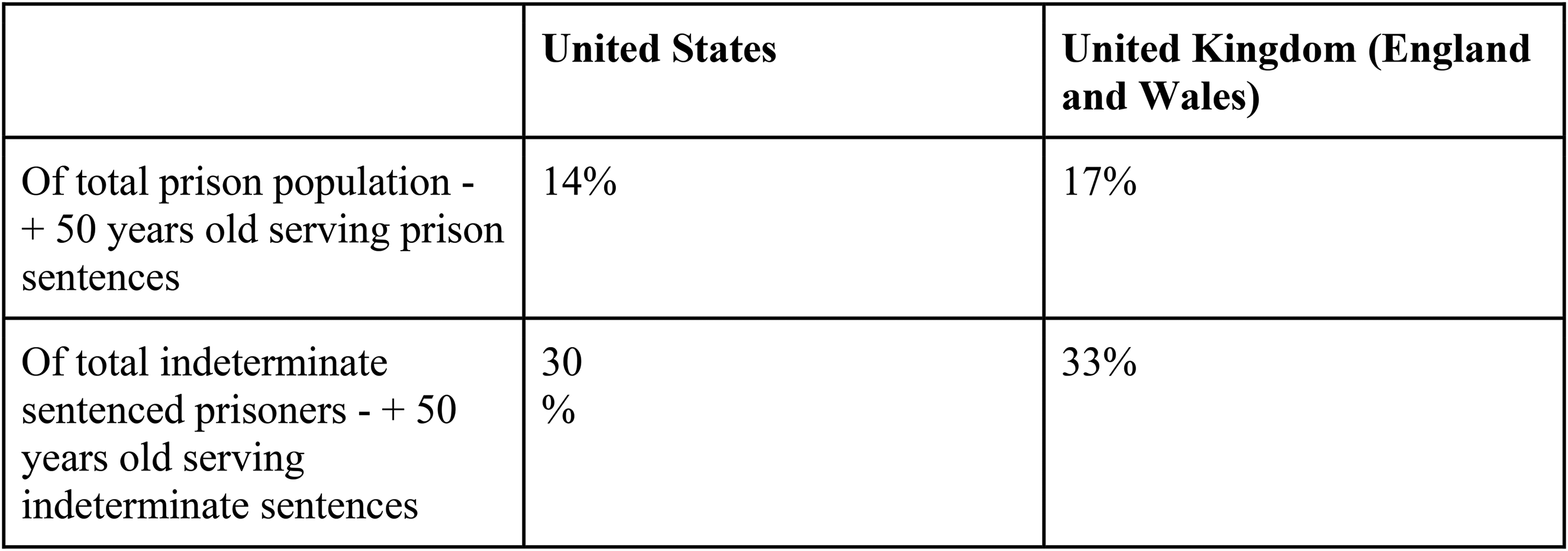
Life imprisonment among elderly in US and UK.
As per the literature in social policy and in the sociology of punishment, the problem of aging in prison is not terra incognita in policy but has impelled very limited action. Policymakers and prison administrators, in both the US and the UK, have expressed concerns at the pressures placed on personnel and budgets to manage a rapidly aging prison population, but the calls for action rarely result in meaningful change to the policies that have produced both the life-sentenced and aging prison populations (Prisons and Probation Ombudsman, 2017; Ridley, 2021). To the contrary, governments in the US and the UK have shown increased levels of support for life imprisonment because of its effect of calming public concerns about crime, despite the large body of criminological evidence that refutes its effectiveness on deterring crime (Apel and Nagin, 2015; Nagin, 2013). Though life sentences are a small share of the total prison populations (14% in US for all life sentences 3 and 16% of the sentenced prison population in the UK), the increasingly routine use of them, particularly in the 2000s, means the worst is yet to come vis-à-vis aging prisoners (MoJ, 2022a: table 1.1 and 1.9a). Indeed, this has had a normalizing effect on extreme punishments in the spectrum of available punishments and exerted upward pressure on lesser punishments (Mauer and Nellis, 2018; Seeds 2017; Vannier, 2021).
Within the literature on aging and imprisonment, older prisoners are mostly overlooked. The process of aging while incarcerated has been examined in both the health science and geriatric literatures (Harzke et al., 2010; Hayes et al., 2021; Williams et al. 2012), but the issue of old age in prison is treated as peripheral to wider debates in the field, in particular healthcare and medical needs (Aday and Maschi, 2019; Joynt and Bishop, 2018; O’Hara et al., 2019). To the extent that research has been conducted in criminology, studies are largely focused on narrative accounts by prisoners themselves, which gives rich textured understanding of prison life (see, e.g. Crawley and Sparks, 2005; Handtke et al., 2017; Humblet, 2021; Leigey, 2015). Few studies that focus on life imprisonment have begun to explore the unique pains of elderly prisoners who will not outlive their prison sentences because of sentence length (Nellis, 2022).
There is longstanding literature in the sociology of punishment that shows that the pains of imprisonment differ for Black people, women, people with disabilities, and people serving different sentences (Ben-Moshe et al., 2014; Chamberlen, 2016; Crewe et al., 2017; Johnson, 2004; Longazel et al., 2016). This has to do with prisoners’ social backgrounds and how they vary, sometimes dramatically. However, one thing that will happen to all prisoners, as will happen to all of us, is aging. We cannot avoid or resist ‘times’ relentless melt’ (Sontag 2008). This is not a niche issue.
Yet, there is something unique about aging in the prison environment. In revisiting and combining works on the pains of life imprisonment with studies on aging, we uncover how old age understood as a process, is before all a ‘prison problem’ rather than ‘a prisoner problem’, urging research and policy to depart from the reductive view of old age as a medical and healthcare issue that can be ‘fixed’. We also expose the double marginalization elderly prisoners face in law and politics when it comes to recognizing the extent of the pains they are exposed to in prison. The added value of this article is that it moves disciplinary boundaries by integrating a penological gaze – one that uncovers the specific pains of older adults sentenced to life imprisonment – with a gerontological gaze that looks at the different dimensions of old age and that treats it as something induced and exacerbated rather than a state.
As our life-sentenced prisoner populations grow and non-life sentences are getting longer in general, the aging prison population is slowly but unceasingly remaking what it means to experience the pains of imprisonment. With a deeper understanding of the workings of old age as something produced, maintained and exacerbated by life-long imprisonment, we are able to question the legitimacy of some of the most severe forms of prison sentences. This article in sum explores the meanings of penal severity from the novel vantage point of being incarcerated while transitioning into old age and in so doing shed light on the limits of life imprisonment. We do this holistically by looking at the scale of the problem, the embodied pains it provokes and the marginalization thereof in law and politics. Our claim is centred on life imprisonment but has appeal for wider debates around the problems of aging and dying in prison.
On defining old age and life imprisonment
In this section, we draw attention to and map out some of the definitional and typological hurdles which future researchers may wish to engage with in studies of aging in prison. Questions that must be settled include, who decides when an imprisoned person is old? Does it depend on how prisoners perceive and present themselves as such? Is it when other inmates or prison staff and administrators classify them as ‘elderly’? Does it depend on reaching a particular age? Or does a prisoner become ‘old’ when they reach retirement age as if they were living freely in society, or when their health and bodies begin to deteriorate and decline? The issue with defining what constitutes an ‘old prisoner’ is first and foremost a sociological one, namely one that considers ‘old’ as a social category in and of itself.
Old prisoners, indeed, are not a homogeneous group, where individuals share common interests (Bourdieu, 1984). ‘Old age’, just like ‘youth’, is just a word (Bourdieu, 1984). Addressing the phenomenon of old age in carceral settings should not lead to the artificial theoretical construction of a homogeneous social group, one that is essentialized on the basis of age alone. It is nonetheless of essence to discuss these definitional struggles, and to recognize the importance of identifying common characteristics in various understandings of ‘old age’ to stimulate comparative research and propel tailored public policies (Merkt et al., 2020).
There is much variation in scholarly works in the terms used to describe older prisoners. Most rely on numerical and chronological age to distinguish between old and young people in prison. The cut-off age generally varies from 45 to 65 (Aday and Krabill, 2012; Stojkovic, 2007; Yorston and Taylor, 2006), with works in gerontology preferring 65 (Fazel and Grann, 2002) and prison sociological studies often using the age of 50 (DiTomas et al., 2022; Mann, 2012; Stolicker and Galli, 2019; Turner et al. 2018). In the US, corrections administrators define ‘elderly’ across a fairly broad range from 50 in New York and Pennsylvania, for instance, to 65 or 70, mostly in Southern states. The terms to describe the qualitative characteristic of ‘old’ also vary. Scholars use ‘older’, ‘elderly’, ‘geriatric’, ‘mature’, and ‘aging’, and most rely on multiple terms (e.g. older, elder) interchangeably (Merkt et al., 2020).
Uncovering the reasons for choosing a particular age cut-off avoids essentializing simplistic classifications of prisoners and is illuminative of the making of certain social constructions in particularly restraining environments such as prison landings. Merkt et al.'s (2020) systematic review of how researchers define older imprisoned people highlights some of the reasons for determining age cut-offs, ranging from methodological decisions that require identifying a sufficiently large selection of participants to acquire statistical power, to relying on the assumption that prisoners age prematurely (Anno et al., 2004; Cipriani et al., 2017), or drawing on definitions set by institutions (Crawley and Sparks, 2005; Fazel and Grann, 2002). Other works tie old age to the appearance and increase of health issues and needs, which is called ‘functional definition’ (Harzke et al., 2010; Hayes et al., 2021; Rodriguez et al., 2017). Old age, in other words, is mainly treated from a biomedical and institutional stance suggesting it can be treated and resolved through structural changes. Rarely is aging approached from an embodied perspective (although see, Humblet, 2021) eroding the complexity and subjective nature of aging.
Separately, few legal scholars have addressed the complexity of defining and classifying ‘life imprisonment’ with an international lens. Exceptions include the work of Dirk van Zyl Smit and Appleton (2019) that offer two main categories to classify the wide range of types of life sentences, namely formal and informal life sentences. Formal life sentences include life with the possibility of parole (LWP) and life without the possibility of parole (LWOP), while informal life sentences include de facto and post-conviction detention. A formal life sentence is one that is labelled by law as life imprisonment and used in official statistics. Life with parole provides for a routine review mechanism by a court, a parole board or similar body to consider release whilst the latter is a type of punishment for which there is no consideration of release. In the UK, whole life orders are a type of life without parole punishment that offers no systematic review by a parole board in view of release.
Age, particularly old age, is rarely considered in law when discussing the definitional scope of life sentences. This is problematic for several reasons. First, old age can blur the distinction between LWP and LWOP if the minimum term is so long that it is highly unlikely one could survive it. Second, some minimum periods may not appear excessive but still rule out any possibility of release because the individual is older at the time of sentencing. Old age could thus challenge the conventional assumption that LWP sentences are necessarily more humane than LWOP because they offer some hope of release. Old age, in sum, forces us to consider life with parole and all long sentences closely and critically.
For this paper, the definition of the old prisoner draws on the 50-year cut-off because of the classification used by the official statistics we collected for those who are serving life sentences. ‘Old prisoners’ here refers both to prisoners who will grow old in prison because of the length of their sentence and include a more recent phenomenon, especially acute in the UK, of sentencing elderly people to life imprisonment. 4 While beyond the scope of this article, it is important to acknowledge the variability of pathways for which old prisoners can face a life sentence as lived experiences of aging may differ depending on the offenders’ age at the time of sentencing. 5 The pains the men and women serving life imprisonment are aggravated by old age, which is the focus of the next section.
The pains of life imprisonment through the prism of old age
Aging will happen to all of us, yet its impacts greatly vary depending on place and context. In this section, we revisit studies on the pains of imprisonment and of life imprisonment more specifically and bring them in conversation with works on aging. The aim is not to comprehensively analyze such literature – which includes the work of gerontologists, prison sociologists, psychologists, anthropologists among others – but to draw from it an essential point that holds value for the study of extreme forms of punishment. This concerns the fact that old age is produced by the carceral environment and that the indeterminacy of a life sentence enhances the pains of incarceration for those who age in prison. We argue that old age is prison-made rather than man-made and therefore cannot be fixed or treated in the prison environment. When exposed to death in prison, becoming old adds new, intolerable harms to those serving life sentences. Through the prism of old age understood as a dynamic phenomenon, we are able to shed new light on the unique severity of life imprisonment and question its legitimacy.
There is a lot to contemplate regarding older people having to navigate old age and its attendant medical issues in addition to navigating prison life itself. Prisons were designed and built with young able-bodied men in mind, but the demographic has shifted and will shift even more over time toward older, sicker residents. Prison life is described as incompatible with the processes of successful aging (Filinson, 2016). The very nature of imprisonment stands in the way of life course transitions (London and Myers, 2006) and may even speed up phases of decline and loss of dignity, agency and, quality of life (Maschi et al., 2011).
Prisons are a particularly hazardous place to grow old. The carceral system is largely unprepared to handle the medical, social, physical, and mental health needs for older people in prison. Nearly half of prisons lack an established plan for the care of the elderly incarcerated (Senior et al., 2013). The health care services in most prisons are mediocre at best, requiring off-site visits that are both burdensome and costly for aging residents. Canes, walkers, and wheelchairs are now a common sight in prison yards, and older people generate high costs for prison health systems that are ill equipped to care for people with complex health needs who may be nearing the end of their lives. (Bor, 2022: 622)
Research in gerontology shows that the generic pains of imprisonment for ageing individuals are exacerbated in prison, which is an environment deeply masculine and designed for aggressive young men. As such, older men do ‘harder time’ and experience imprisonment as a more severe form of punishment than their younger counterparts (Annaheim et al. 2018; Mann, 2012). Much like their counterparts in the community, aging prisoners frequently reported problems associated with activities of daily living such as walking long distances, moving up to the top bunk, standing for long periods, keeping pace with others, ascending and descending stairs, and hearing or seeing (Aday, 2001; Humblet 2021). They were infirm and just going through the motions, doing what they had to do at a bare minimum. They had mobility issues, weight issues, high blood pressure. One guy was dealing with cancer, another had glaucoma.” (cited in Bor, 2022: 623)
Such challenges can mean losing the ability to participate in daily supportive activities like visiting the chapel or library, taking classes or working (Wahidin, 2004; Humblet 2021). In their two-year study of the implications of aging in the UK's prison environment, Elaine Crawley and Richard Sparks noted the cognitive and mental health decline that follows an inability to keep up with the activities of daily living in prison (Crawley and Sparks, 2013).
What is striking from reading this literature is how prison shapes the phenomenon of aging. It is the prison walls, the limited prison staff training, the distribution of space, the medical care and lack thereof, provided by the prison institution, which determine the way aging unfolds. The fact that environment and context shape the aging processes has been widely explored in gerontology and is conceptualized as ‘aging in place’ (Frank, 2002). 6 Older inmates obviously do not have the option to choose the place in which they will age. Aging will differ in prison and failing to recognize that old age is a prison problem is problematic for two main reasons. Such an approach to old age suggests that the problem is tied to the prisoner and that their state of ‘being old’ can be ‘fixed’ through increased healthcare, tailored assistance, or training, and justify measures that segregate those who are old on grounds of ‘protection’ (Wangmo et al., 2017). This stance not only participates in prolonging ageist stereotypes, infantilizing the aging prisoner, reducing them to their needs, and eroding agency and individuality. By overlooking the agentic element of aging, we miss out on prisoners’ capacity to cope and adapt (Avieli, 2022). Gerontology works have long showed the limitations of such approaches that treat older people as impaired and limited (Humblet, 2021; Marson and Powell 2014; Salari 2005; Wangmo et al., 2017).
Crewe offers the view that the increased indeterminacy of life sentences is particularly harmful. For those who grow old in prison, such indeterminacy removes key markers of aging such as retirement, loss of a partner, developing chronic conditions. In reference to the fact that one in seven is serving a sentence with no predetermined end in England and Wales, Crewe says: [a]t the same time, the reconfiguration of penal power in prisons in England and Wales has added an additional layer of frustrations, which are neither inherent in the prison experience nor the outcome of sub-official practices and managerial failings. Instead, they are a corollary of particular kinds of institutional policies and techniques. They work alongside established pains in determining the experience of imprisonment, but they are different in their sources, their feel and their effects. (Crewe, 2011: 512–513)
The indeterminate character of life sentences further impact how prisoners experience time (O’Donnell, 2014). The distortion of time is particularly acute amongst older prisoners who are reported to grieve the lives they had in the past rather than the ones they could have led in the future (Crawley and Sparks, 2005). As gerontological studies show, the peculiarity of growing older stems from the fact that an important part of life has already taken place (Hedberg et al. 2013). According to O’Donnell's ‘pain quotient’ (2014) – a function of time to be served divided by how much longer the prisoner might expect to live – the pains experienced by aging life-sentenced prisoners are enhanced. The knowledge that ‘time is running out’ makes the experiences of older prisoners serving life sentences distinctively painful (Deaton et al. 2009; Wahidin 2004: 109); it intensifies the pain quotient.
Planning for the future, including planning for a respectable means of dying, perhaps surrounded by good medical care, friends and loved ones, and comfort, is beyond reach. Aging lifers describe a series of moving goalposts assigned to them at their review hearings which amounts to wasted time and mounting frustration, followed often by resignation (Gaynes et al. 2018). New Yorker Mujahid Farid was released from a 15-to-life sentence after serving more than three decades in prison. He recounted his experience in this way: In 2011, at my tenth parole board appearance, I was finally released–approaching 62 years of age. The closer I got to the release date, the more I looked around at the men I would be leaving behind, many of whom had, like me, been incarcerated since their teens and twenties and who were now, like me, more than 60 or 70 years of age. I became more sharply aware of the increasing infirmities they faced; the frailties of age; the illnesses affecting them; and their loss of hope through repeated parole denials. Like me, they had spent their entire adult lives in prison, and most were different from the person who had first entered the system. Unlike me, they were not going home.
7
The legal and psychological impacts of the life sentence are clearly immense (Leigey and Ryder, 2015; Liebling et al., 2019; Martin and Stermac, 2009). Less often are discussions of how the unfolding of a life sentence is embodied. To die in prison means prisoners will age, entailing the usual attributes of physical deterioration, becoming incapacitated, ill, infirmed, elderly, slower, forgetful. While people with life sentences may find meaning in their lives, the constant consciousness that they will likely die in prison tortures them daily (Hartman, 2016).
While the certainty of death settles in, the processes of aging feel endless given the indeterminate nature of life sentences (Vannier, 2021). One lifer writes, ‘being given a life sentence is like being told by a doctor that you’re going to die, you know, like you’ve got a terminal illness. You feel as if your life's effectively over. And even when you’ve got your head down and started doing your time it doesn't get any better…. It's every prisoner's greatest fear you know…that they’ll be taken out of here in a coffin’ (Jewkes, 2005: 336). Many lifers describe life in prison with no hope for release as an alternate death penalty, a death sentence imposed in slow motion. Conversations around the ‘graying’ of the prison population are incomplete unless they also consider the individual who faces aging until ‘death-by-prison’ (Seeds, 2022). We thus argue that an overlooked reason for which life sentences are exceptionally punitive is because the prisoner is required to endure the processes of aging while imprisoned for indefinite periods of time.
Aging life-sentenced prisoners suffer in special ways from the pains of indeterminacy, specifically through the loss of control over their aging bodies and aging minds. Staff who care for prisoners are ill-equipped to care for aging and elderly prisoners and, in the worst cases, may even be incited to support longer incarceration periods because of the calming effect older prisoners may have on younger people. ‘Older inmates are seen by some prison authorities as being less prone to violate rules or try to escape, thereby exerting a stabilizing or deflating force in the high-tension institutional environment where violence and riot are ever-present threats…It has been suggested that awareness of this stabilizing influence has discouraged some prison authorities from setting up the age-segregated units for the elderly’ (Yorston and Taylor, 2006: 334). Gerontological studies use ‘infantilization’ to describe behavioural patterns where those in authority interact with or treat an older person in a childlike manner (Salari, 2005). The deprivation of adulthood similarly depicts a form of discipline for prisoners of all ages in penology (Carlen 1982: 104ff). The harm produced involve both the disregard for bodies and mind that age, and the reduction of individuals to precisely that, namely their bodies and minds that grow older. In producing a continuum of harm for those who face lifelong sentences as they go through the different stages of the aging processes, old age adds new pains of imprisonment for those who become old in prison.
People who are at least 50 years old now and were sentenced when young experience the pains of extreme sentences at both ends of the age spectrum (Nellis, 2022). One might look at this category of lifer as the one receiving the harshest punishment of all. In the US, one in seven people serving LWOP who are at least 50 as of 2018 was less than 25 years old at the time of their sentence (Nellis, 2022). It is important in this discussion about aging to recall that age has already received a ‘discount’ when it comes to those at the young end. 8 A series of U.S. Supreme Court rulings narrowed the allowable use of life imprisonment to individuals who had been over a certain age (18) at the time of the offense, because of the unique impact and consequence of young age on imprisonment, but courts have not extended this reasoning to those for whom old age would make their imprisonment especially cruel or unusual.
Observers of the pains of modern imprisonment note a range of mental and physical deprivations as the intended pains of incarceration but also note the misuse of power by prison staff, alienation from family and friends, the unremitting loneliness and the institutional disregard for their humanity and dignity while imprisoned (Johnson and McGunigall-Smith, 2008; Vannier, 2021). These deprivations multiply when inflicted on those serving life and those who grow old while incarcerated, because added to the losses just mentioned are the physical and mental hardships that befall the aging person who lives in an environment poorly suited to respond. A loss of dignity accompanies both and is compounded for persons who are forced to grow old while serving an extreme prison sentence which, for a growing share of persons worldwide, has no discernible end date.
Whilst it is essential to uncover the particular pains experienced by old prisoners serving life sentences, we must avoid generalization and resist stereotypes where people are reduced to only one characteristic, old age. Old age explains some but not all aspects of the pains caused by life imprisonment. A focus on the needs and pains of old prisoners also runs the risk of reducing these individuals to their psychological and bodily-abilities, and in this way making broad statements about a class of prisoner are at the risk of missing their individuality including personality traits, mental health issues, social bonds, backgrounds and so on. Wahidin (2004) considered the reductive view of placing older prisoners on a continuum of ‘need’ and social welfare. Turning to prisoners’ experience may also reveal evidence of ‘successful’ aging in prison (Avieli, 2022). Our attention must therefore not be distracted from the first point we make that, while old age may be experienced by the prisoner, processes of aging are shaped by the prison environment. This approach emphasizes what Louise Brangan (2021) has uncovered through her conceptualization of pastoral penality, that penal severity is before all a ‘prison problem’ not a ‘prisoner problem’. As a matter of law and politics, old age should therefore be rigorously regulated when evaluating the severity of a punishment, which is the focus of the next section.
The marginalization of old age in politics and law
The politics of managing old age
In British and American politics, old age is often treated as a separate and discrete policy issue, akin to a technical prison management problem. Since the 2000s, the aging phenomenon has generated a groundswell of interest from charities, community organizations (e.g. Release Aging People in Prison, based in New York City) and government officials (e.g. in the UK: The Department of Health, 2001). Despite regular calls to develop nationwide strategies, there have been few responses to the challenges raised by the aging of the prison population (Prisons and Probation Ombudsman, 2017; Ridley, 2021). Aggravating matters in the UK, the National Offender Management Service (NOMS) has repeatedly opposed the development of a national strategy for older and less able prisoners on the grounds that management based on age was not appropriate and that the focus needed to be on individual needs.
The policies and guidance that have been successfully introduced at national level over the last two decades in both countries make up a complex policy and practice ‘patchwork’ concerned with the health, disabilities and discriminations, and rehabilitation. Research exposes that locally, prison institutions regularly fail to regulate access to healthcare, and consequently the physical health of the older prison population has declined. There is evidence of this in both the UK (Bretschneider and Elger, 2014) and in the US as well: identified gaps in medical, dental, and mental health care are widespread as prisons primarily focus on security over these needs (Garrido and Frakt 2020; Yarnell, et al., 2017).
The politics of old age and the prison practices that have developed are mostly concerned with managing old age (Crawley 2011; Turner et al. 2018). The focus is not on the inadequacy of prisons for old prisoners but on old age impairing the safe and efficient running of the prison. In the UK, the Ministry of Justice reminded in 2013 that the ‘view remains that prisoners should be managed based on individual needs not solely based on their age’ (MoJ, 2013). Frank Porporino (2014) for the National Institute of Correction in the US writes: ‘The issue of managing the elderly in prisons has emerged as one of the most significant and unplanned-for crisis in corrections’ (34). Managerial concerns are carelessly indifferent to the severity of life imprisonment for old prisoners. Little consideration has been given to how severe spaces of confinement are for prisoners who are old or going through the processes of aging. In addition, aspirations to fix ‘old age’ through tailored healthcare regimes remind us of the risks of encouraging punishment on the grounds that it can ‘benefit’ offenders (Loader, 2010).
Unlike the growing concern and interest for aging in prison, the increase of the number of life sentences is rarely discussed in politics as something problematic and tends to get diluted in broader prison debates about overcrowding or mass incarceration. The appeal to long-term incarceration is ongoing. In the UK one of a series of new measures to be added to the Police, Crime, Sentencing and Courts Bill (2022) to further protect the public includes the introduction of life imprisonment for offenders anyone who causes or allows the death of a child or vulnerable adult in their care rather than the current 14-year maximum. US legislative proposals to stem the rise of elderly imprisonment almost universally restrict early release opportunities from people serving life sentences, which works at odds with the purported aims of such policies (Nellis, 2022).
The managerial approach to the older prison population problem, and the scant attention given to the dramatic increase of life sentences in the UK and the US, can be tied to the ongoing need to satisfy public concerns regarding ‘dangerous criminals’ or ‘serious’ offenders. The old life-sentenced prisoner phenomenon is inextricably linked to the public demands to punish those deemed the worst of the worst, and most recently these are represented by persons convicted of sex crimes. Older individuals sentenced to life imprisonment are disproportionately convicted of these types of offenses and are viewed as inherently criminal and irredeemable (Turner et al., 2018). In the UK, the growth of the older lifer prisoner group has indeed primarily been driven by an increase in the number of older adults sentenced for sexual offences: 44% of imprisoned men aged 50 or over are serving sentences for sex offences (Halliday, 2022: 33). In the US this is the case for 26% of imprisoned people who are 55 and older (Bureau of Justice Statistics, 2021). Political rhetoric calls for especially harsh penal severity across the board, though a wide range of crimes falls under the broad umbrella of sex offences. This change has raised little debate because ‘there is scant sympathy for offenders and sex offenders in particular’ (Turner et al., 2018: 165), offenses against children, a subset of sex offences being ‘the most vilified subsection of the prison population’ (Mann, 2012: 356). Recent cases including Harvey Weinstein in the US and Jimmy Savile in the UK (Grey and Watt, 2013) have further shed light on the extent of sexual offences committed by adult men (Turner et al., 2018). Debating the legitimacy and merits of sentencing older men to life imprisonment may thus be seen as politically hazardous.
The severity of old age under law
Whilst there are specific provisions requiring the adjustment of carceral conditions to old prisoners’ specific needs, in particular on grounds of health, 9 there are no requirements under international law that old prisoners should benefit from a special regime under criminal law (as is the case for juveniles), especially at the time of sentencing. 10
At regional level, the European Court of Human Rights has recognized that age does not bar the imposition of a prison sentence but that it should be taken into account at the time of sentencing and throughout the carrying out of the punishment (Papon v. France 2001). 11 In the specific case of life imprisonment, the ECtHR held in Sawaniuk v the United Kingdom (2001), a case which concerned a 79-year-old man sentenced to life imprisonment for murder, that the punishment did not breach Article 3 of the Convention because the minimum period could be as short as 5 years.
At the same time, European human rights caselaw provides that life sentenced offenders must retain a realistic prospect of release (Vinter and others v The United Kingdom, 2013). Old age and the duration of the minimum periods could remove this possibility of release. Consider for instance, the hypothetical case of a prisoner sentenced to life imprisonment at the age of 80 and given a 25 minimum period before being eligible for release. Old age here seriously undermines the realistic nature of any prospect of release. The European Court has not yet held that life sentences with no realistic prospect of release because of old age would amount to inhumane and degrading treatment.
Shorter time periods could offset the risk of irreducibility caused by old age. Some judges have, however, highlighted the difficulty and pitfalls in setting an age cut-off to justify differential treatment on the grounds of old age. Judge Pinto in Khamtoku and Aksenchik v. Russia (2017) argued: it is difficult to draw a distinction between a person sentenced to imprisonment at the age of 50 who would be unable to apply for release on parole until the age of 75 and another person sentenced to fifteen years’ imprisonment at the age of 64, with the possibility of applying for release on parole after ten years. Neither prisoner could apply for release on parole unless they outlived the average Russian male. Accordingly, justification for the differential treatment cannot be regarded as objective, reasonable and legitimate. (para. 40).
In Bodein v France (2014), Judge Nussberger, similarly concluded that, jurisprudence guaranteeing the right to a review of a life sentence in relation to the life expectancy of the person concerned would privilege those who commit crimes or are arrested only at an advanced age and would then endanger the principles of equality in criminal sentencing.
In the US, courts have not yet considered age-related arguments related to the cruelty of life imprisonment imposed on elderly people. The Supreme Court however has taken a strict approach to life imprisonment in the context of juveniles, sharply narrowing the use of LWOP in 2016 under the Eighth Amendment (Montgomery v Louisiana, 2016). In the UK, courts can set minimum periods for prisoners sentenced to life imprisonment. They could reduce these periods to account for old offenders’ age but have not yet done so. If old age can be considered as a general mitigating factor under schedule 21 paragraph 11(g) of the Criminal Justice Act 2003, it does not prohibit judges from imposing sentences where the individual will die in prison.
In R v. Sampford (2014),
12
the judges explained (emphasis added): 15. Neither Troughton nor any other case, nor the schedule, suggests that a court has to do what it can to ensure that a defendant does not die in prison. If nothing else, no court would be in a position to conduct the necessary actuarial exercise. Even if it were, it would not override the requirement of the sentencer to reflect the circumstances of the killing in setting the minimum term. If those circumstances require a minimum which may result in the offender dying in prison, then that will be the minimum term.
This approach to minimum periods in the context of old life-sentenced prisoners was applied in R v Lowe (2014). A 82-year-old defendant was found guilty of murder and sentenced to life imprisonment with a 25 year minimum period before parole eligibility. For van Zyl Smit and Appleton (2019: 121) ‘There appears to be no way in English law in which Lowe could be released (…) before he dies’. A case like Lowe would breach the ECHR decision held in Vinter prohibiting irreducible life sentences. Reducibility of a life sentence carries greater weight for old offenders in order not to become a mere illusory possibility.
Old age has propelled new interest for parole reform in the US in particular. This legal dilemma was raised in the US amidst rising and expanding punitive policies (Rikard & Rosenberg, 2007; Williams, et al., 2011). The claim is that old prisoners may be less dangerous and less likely to engage in criminality 13 upon release whilst being more likely to suffer from disability or various physical and psychological pains (Chettiar et al. 2012; Fazel and Grann, 2002). Louisiana recently released several men who had served more than 50 years and were previously denied parole (Vigdor, 2021). Sentencing review units have been introduced by prosecutors in a number of cities including Baltimore, Maryland; Seattle, Washington; and Los Angeles, California (Robert, 2021). In New York, the legislature has been considering legislation that would expand opportunities for older prisoners who have served long sentences to petition parole boards for release (e.g. the Fair and Timely Parole Act).
The hope is to reinvigorate compassionate release programs, which are seldom used in the US yet available in virtually all states to relieve prison overcrowding and unite low-risk prisoners with their families (Nellis, 2022). Most ‘compassionate release’ policies that exist in state correctional systems in the US and the federal Bureau of Prisons require that individuals are both very old and extremely sick in order to qualify for reconsideration of their continued imprisonment. Compassionate release laws of some form are in effect in all states but Iowa, and those that pay special attention to geriatric candidates are authorized in less than half the country. Most include a stipulation of having had a nonviolent or nonhomicide conviction (Nellis, 2022). In the UK compassionate grounds only apply in two limited cases for those who are serving life sentences: if the prisoner has a terminal illness and death is likely to occur very shortly; or if they are bedridden or similarly incapacitated. In other words, prisoners can only apply for compassionate release in order to die at home or in a hospice rather than behind prison walls and just like in the US, very few are released in the UK.
The reasons are multifold. Difficulties to assess the medical prognosis and reconciling security concerns with compassionate appeals may explain, in part, why so few older prisoners are released. Physicians have been found to be reluctant to reach definitive prognosis because of the ‘uncertainty’ over patients’ disease course (Bor, 2022; Prost and Williams, 2020). Other hurdles to release include restrictions on people convicted of certain crimes (Vannier 2021), complex administrative discharge planning, and lack of knowledge from parole boards over serious illnesses. Having no family to return complicates early release as well (Ginn, 2012: 2). Through the prism of old age, release can even become punitive. Many older prisoners have become institutionalized and cannot fare alone. Local social services and the shortage thereof, ‘have been known to refuse social care funding for newly released prisoners’ in both countries (Bor, 2022; Ginn, 2012: 2).
The aging trend in sum brings together differing views of crime, punishment, justice, and mercy. Advocates of penal reform support leniency around parole policies for older prisoners who have served long sentences and are at low risk of recidivism. Opponents argue that such reforms would raise security issues and add pain and insult to victims’ families. As a result, old age remains on the periphery of conversations on the severity of the most extreme forms of punishment under law. Things may be changing, recognized by the Canadian Supreme Court who unanimously ruled in June 2022 that LWOP was unconstitutional based on its finding that sentences that extend beyond one's natural ability to outlive them are both cruel and unusual (R v. Bissonnette, 2022).
Conclusion
None of us can avoid ‘Time's relentless melt’. The life sentence demands that people age and die in prison. Yet our understanding of physical aging and life imprisonment in prison in criminology is rather limited. Most of the works in the social sciences cast the problem of aging in terms of health care and needs, missing out on the part played by prison in the workings of aging. By revisiting some key studies on experiences of life imprisonment and bringing them in conversation with works on aging we are able to shine new light on the pains of long-term incarceration. Death by prison takes on its fullest sense when considering old age in the face of spending life imprisoned. Old age, whilst a natural phenomenon, is very much induced by prison. The pains of becoming old are produced, accelerated, exacerbated by prison, including its architecture and design, and inadequate prison staff training and knowledge. Old age is not a ‘prisoner problem’, which views the prisoner as one in need of transformation and treatment or as being inherently criminal. Old age instead shows the importance, in the words of Brangan, of the government acknowledging ‘first that prison, “rather than the prisoner”, is fundamentally problematic and often harmful (…) then there can be a degree of retrenchment in penal control’. (2021: 61).
Old age, treated as a prison problem, we claim, heightens the severity of life imprisonment. While penal severity is built into the very idea of the criminal justice system where law and politics are meant to control and regulate excessive, unnecessary and inhumane punitive practices, the regulation and accountability of old age for those serving life sentences have not taken place. Instead, laws and politics have privileged managerial concerns for non-prison-abled bodies, and penal imaginaries around sex criminals have eclipsed concerns over the adequacy of life imprisonment for those who are old. This paper uncovers the double marginalization of old age in law and politics with the hope of propelling new political and practitioner interest and concern for a growing yet unique problem where the increased use of life sentences and aging trends collide.
A focus on life imprisonment's severity through the novel vantage point of old age invites greater analytical sensitivity to how and how much we punish, how we implement certain punishments and how we regulate such treatments. Our novel lecture of existing literature, combined with fresh new data on aging and life sentencing trends, further invites new research on the processes and factors of aging in corrective services that would help with the development of policy and programmes in relation to aging in prison landings.
There are limitations to our findings that should be acknowledged. The problems of aging and dying in prison may arise independently from the context of life imprisonment. Here we have focused on old age in the context of indeterminate life sentences. Offenders who are sentenced to fixed and shorter prison terms will equally face aging and old age, albeit in manners that have yet to being uncovered. Future research is direly needed to uncover the pains of old age and aging in the prison context at large, and such research agenda would bring together lived experiences of aging in prison and data on life expectancy. Further, the intent is not to bypass the importance of discussing, individually, the scale and legality of life imprisonment, or to present the effects and experiences of aging in a reductive manner. While old age is a multilayered prison problem, we recognize that prison institutions cannot solve the issue of aging alone. The analysis presented here has far-reaching implications for how we think about the role of the state in tackling the growing and broader societal issue of aging. If politicians continue to talk about the problem of old age in prison but disregard its connection to the dramatic increase of life imprisonment, their ability to provoke substantive policy change will ultimately be limited. The dissonance between old age in prison and the expansion of long-term prison sentences runs the risk of corroding public trust in government. Approaching penal severity from the standpoint of old age asks broader societal questions about healthcare, social care and ultimately how we treat and what we do with our elderly.
Footnotes
Acknowledgements
We are grateful to the anonymous reviewers for their helpful suggestions and to Louise Brangan, as well as Olga Sanchez de Ribera, Nicholas Trajtenberg Pareja and Julia Buxton for their comments on earlier drafts of this work.
Declaration of conflicting interests
The author(s) declared no potential conflicts of interest with respect to the research, authorship, and/or publication of this article.
Funding
The author(s) disclosed receipt of the following financial support for the research, authorship, and/or publication of this article: This work was supported by the UKRI.
