



Abstract
South African correctional centres reflect the nation's broader societal complexities, influenced by its diverse population and historical context. As the country navigates issues of crime, rehabilitation, and reintegration, the increasing presence of foreign national offenders adds further layers of complexity. While global research has explored themes of guilt and innocence, it often lacks relevance to the experiences of offenders, especially in developing countries like South Africa. This paper examines the guilt–innocence paradox as perceived by incarcerated offenders in South African correctional centres, where anti-social attitudes, diverse cultures and traditions, and historical and economic factors converge. Furthermore, the paper draws on cognitive dissonance, narrative identity, and neutralisation theory to explore how convicted foreign national offenders manage their moral identity. In-depth, face-to-face interviews were conducted with 40 offenders incarcerated at Baviaanspoort, Kgoši Mampuru, Krugersdorp, and Zonderwater correctional centres using a qualitative approach. The findings indicate that the participants’ guilt–innocence paradox is shaped by factors such as denial of involvement in crime, self-perception, attribution of blame to various sources, including victims, family background, social and environmental impact, and discrimination within the criminal justice system. This study contributes by amplifying the voices of incarcerated offenders and advocating for rehabilitative strategies and sustainable reintegration practices.
Introduction and background
South African correctional centres represent a microcosm of the country's broader societal complexities, shaped by its diverse population and historical context (Cameron, 2020; Kallenbach, 2023; Luyt, 2021). As the nation continues to address crime, rehabilitation, and reintegration issues, an increasing number of foreign national offenders have become part of the correctional system (Zitha and Jansen van Rensburg, 2024). South Africa's role as a regional economic hub has attracted individuals from across Africa (Ncube and Tracey, 2020), some of whom become involved in the criminal justice system (CJS) (Tshabalala, 2024). The presence of foreign nationals in South African correctional centres introduces additional layers of complexity, particularly regarding language, culture, and access to legal and rehabilitative resources (Symkovych, 2023; Zitha, 2020).
The guilt–innocence paradox describes the conflict between an offender's perception of their culpability and the formal legal determination of their guilt. Although they may be legally convicted, offenders often reject accountability, justify their actions, or view their punishment as unfair. This paradox frequently emerges when offenders rationalise their conduct, minimise the seriousness of their crimes, or attribute blame to external factors or victims, even when evidence confirms their guilt. Research concerning themes surrounding guilt and innocence has been conducted globally (Bardon, 2020; Battista et al., 2021; Cooper, 2019; Harsey and Freys, 2020; Kaptein and van Helvoort, 2019; May et al., 2021; Rowan et al., 2022; Rozmann and Levy, 2021; Schoultz and Flyghed, 2019; Tärnhäll et al., 2023; Tisak and Goldstein, 2023; Volbert et al., 2019; Walters et al., 2023; Walton, 2019; Ware et al., 2018; Wulandari et al., 2020). However, these studies are limited in scope, focus, and the relevance and availability of empirical data, particularly when considering offenders’ personal experiences in South Africa or other developing countries. Consequently, how convicted offenders personally experience the guilt–innocence paradox has not been thoroughly examined. The paradox emerges in distinctive and intricate forms in South African correctional centres, where social, economic, and historical influences intersect.
It is important to recognise that in both media and political discourse, foreign nationals are frequently scapegoated, often portrayed as primary drivers of crime and social disorder. This portrayal contributes to moral panic, deflecting attention from systemic issues such as inequality, governance failures, and institutional weaknesses (Kollamparambil, 2018; Nkanjeni, 2022; Zitha and Jansen van Rensburg, 2024). However, national incarceration statistics indicate that most offenders incarcerated in South Africa are South African citizens. During the 2023/24 period, the South African correctional centres’ population comprised of 157,056 incarcerated offenders, including 22,612 foreign nationals, reflecting a ratio of approximately 6:1 (Department of Correctional Services, 2023/24). These statistical realities contrast with dominant public narratives and raise critical questions about why certain populations are disproportionately blamed or highlighted in public discourse. Nonetheless, including foreign national offenders in exploring the ‘guilt–innocence paradox’ within South African correctional centres offers significant value. Their diverse cultural and social backgrounds provide unique insights into how guilt and innocence are perceived, enriching the understanding of justice and personal responsibility. This creates an opportunity for cross-cultural comparisons, highlighting the distinct experiences of incarcerated foreign nationals.
Immigration is a growing global trend, driven by the increasing interconnectedness of societies (Haider, 2023). Following the end of apartheid, South Africa adopted a more open immigration policy, leading to a rise in both documented and undocumented foreign nationals seeking better opportunities (Handmaker and Nalule, 2021). While the country has laws to regulate immigration, illegal immigration remains a significant issue (Machinya, 2022). Migrants are often driven by push factors such as conflict, war, natural disasters, poor healthcare, and lack of basic services. At the same time, pull factors like better job prospects, social benefits, and weak border enforcement attract them to host countries (Urbański, 2022).
Foreign nationals in South Africa face challenges related to socio-economic and political factors. Due to bureaucratic hurdles and legal restrictions, they face difficulties in accessing basic services such as healthcare, education, and social security. Many also experience prejudice and discrimination, with xenophobia being a common issue, especially for those from other African countries. This creates a hostile environment where foreigners are marginalised and sometimes targeted for violence or exploitation. Economic pressures arise as they compete for limited job opportunities, leading to tensions with local communities. Navigating the complex visa and work permit systems can also be challenging, prompting many to enter the informal economy, where their rights are often overlooked. These issues render foreign nationals vulnerable and hinder their ability to integrate into the South African society (Jansen van Rensburg, 2024; Niyitunga, 2024; Olowonihi et al., 2024).
This paper examines the guilt–innocence paradox among offenders by combining psychological and criminological theories. Cognitive dissonance theory explains how offenders manage the discomfort of being convicted while perceiving themselves as innocent, often altering beliefs or justifying actions to reduce this conflict (Festinger, 1957). McAdams’ (1989) narrative identity theory posits that offenders maintain their self-worth by constructing narratives that align with their sense of innocence. Criminologically, Sykes and Matza's neutralisation theory reveals how offenders rationalise their behaviour, using techniques like denying responsibility or harm to preserve a positive self-image and navigate between lawful and unlawful actions (Matza and Sykes, 1957). These theories clarify how offenders cope with guilt and maintain their moral identity.
This empirical paper delves into the lived experiences of convicted foreign national offenders in South Africa who have been found guilty of violent crimes. It seeks to understand the multi-faceted nature of guilt and innocence from their perspectives. Through in-depth interviews and qualitative analysis, the study explores how these individuals navigate their identities as ‘offenders’ while grappling with the legal and moral labels assigned to them. It provides insight into the broader implications of justice, rehabilitation, and societal perceptions of violent crime in South Africa. This research contributes to the growing body of literature in understanding the motivations and thought processes of violent offenders. Moreover, it informs correctional authorities on the importance of tailoring individualised intervention programmes that promote both cognitive therapy and affective empathy.
Theoretical framework
From a psychological perspective, this paper incorporates social, behavioural, and narrative psychology theories. Cognitive dissonance theory, developed by Festinger (1957), explores how individuals experience discomfort when they hold two or more conflicting beliefs, such as perceiving themselves as innocent while being convicted of a crime. Consequently, when confronted with facts contradicting their beliefs, they alter their beliefs to reduce the discomfort (dissonance) (Cooper, 2019; Festinger, 1957; Harmon-Jones and Mills, 2019). Offenders may see themselves as fundamentally good or innocent, but the conviction creates cognitive dissonance by suggesting they committed a crime. To resolve this internal conflict, they may maintain a narrative of innocence to preserve their self-concept, minimising or denying their involvement (Franzén and Gottzén, 2022; Gonçalves et al., 2024). To reduce the discomfort caused by dissonance, offenders might justify or rationalise their behaviour. For instance, they might blame external factors (e.g. ‘I was forced’ or ‘it was a misunderstanding’) or argue that the crime was not as severe as portrayed. These justifications allow them to perceive their actions in a way that reduces the dissonance between being convicted and maintaining their sense of morality. Offenders may also downplay the significance of their conviction to reduce dissonance. They might argue that the justice system was flawed, that they were unfairly treated, or that the sentence does not reflect who they truly are, thereby reducing the psychological discomfort associated with the crime. In some cases, offenders may completely deny their involvement in the crime to eliminate the dissonance. By constructing a version of events in which they are innocent, they can avoid the emotional and psychological discomfort of accepting guilt (Harmon-Jones and Mills, 2019; Hollin, 2021; Tisak and Goldstein, 2023).
As postulated by theorists such as McAdams in the narrative identity theory, people form their identities by integrating their life experiences into an internalised, evolving story of the self. This narrative is central to understanding their actions, decisions, and identity. Offenders may craft a narrative in which they see themselves as innocent to preserve a positive sense of self (McAdams, 1989, 2019, 2021). As a psychological coping mechanism, maintaining a narrative of innocence may help offenders deal with the guilt or emotional trauma of being convicted. By constructing a story where they are not fully responsible, they distance themselves from the psychological burden of guilt (Elam et al., 2024; Green, 2019; Helfgott et al., 2020; Kras, 2022).
From a criminological perspective, as proposed by Matza and Sykes’ (1957) neutralisation theory, insights into the offenders’ guilt–innocence paradox are explained. The theory outlines how offenders rationalise their criminal actions to preserve a positive self-image. Instead of fully embracing criminal values, they employ ‘techniques of neutralisation’ to temporarily justify their actions. This allows them to move between lawful and unlawful behaviour without adopting a fully deviant identity. The theory is based on Symbolic Interactionism, which explores how individuals interpret and derive meaning from social interactions, shaping their behaviour (Cope and Maruna, 2017; Matza and Sykes, 1957; Walters et al., 2023).
The main techniques of neutralisation refer to different strategies that offenders use to rationalise their criminal behaviour. In denial of responsibility, offenders attribute their actions to external forces, such as peer influence or unavoidable circumstances, casting themselves as victims rather than accountable participants. Denial of injury involves minimising the harm caused, suggesting that the impact was either trivial or non-existent. Denial of the victim occurs when offenders claim that the victim deserved the outcome or assert that there was no legitimate victim involved. In condemnation of the condemners, blame is shifted onto those who criticise or punish the offender, implying that society or authorities are corrupt and therefore unfit to judge. Finally, appeal to higher loyalties is when offenders justify their actions by arguing they were acting out of loyalty to a group or cause, which they perceive as having greater importance than legal or ethical standards (Costello and Laub, 2020; Grekul and Sanderson, 2020; Kaptein and van Helvoort, 2019; Valasik and Medina, 2023; Vitale and Meško, 2021).
Research methodology
This paper aims to explore how offenders in South African correctional centres perceive their innocence and use these insights to enhance rehabilitative initiatives. The study used a qualitative research approach. Qualitative research aims to deepen the understanding of people, their environments, and their experiences. It focuses on phenomena that individuals have personal experiences or opinions about. The paper employs interpretative phenomenology, which examines how participants perceive and make sense of their world and themselves. This approach reflects both the researchers’ observations and the participants’ perspectives to uncover the essence of their experiences (Neubauer et al., 2019; Schurink et al., 2021).
The research used a non-probability method and a purposive sampling technique to select participants (Strydom, 2021). It included in-depth, face-to-face, semi-structured interviews with 40 offenders from Baviaanspoort, Kgoši Mampuru, Krugersdorp, and Zonderwater correctional centres. The first author conducted these interviews, which lasted between 60 and 90 min, and they were recorded, transcribed, and translated (if necessary). The study received ethical approval from the University of South Africa's Ethical Review Committee and obtained permission from the Department of Correctional Services. Informed consent was secured from all participants for both the study and its reporting.
Interviewing incarcerated offenders, particularly foreign nationals, requires careful ethical consideration due to their vulnerable status and the complex dynamics within correctional facilities. Generally, offenders are considered vulnerable, hard-to-reach, and marginalised populations. When researching such groups, it is essential to recognise that any information they provide is valid, considering their limited opportunities to be heard. Trusting what participants choose to share without questioning their credibility is fundamental to conducting ethical research. In this context, adherence to ethical guidelines extends beyond merely obtaining institutional ethics clearance. Informed consent was obtained in a manner that considered potential language barriers, power imbalances, and the possibility of coercion. The first author made a concerted effort to build a positive rapport with participants during interviews by addressing language and cultural barriers, ensuring they felt safe, respected, and genuinely heard. Employing interview techniques rooted in connectivity, humanity, and empathy was essential for engaging with participants who were ‘doubly vulnerable’. Pseudonyms were used throughout the research to ensure participants’ confidentiality and protect their identities. Moreover, the first author was vigilant to any signs of distress and discomfort during the interview. In such cases, participants were asked to stop the interview and resume it at a later time, while being referred to the relevant support services (Rossiter et al., 2020; Shafi, 2020; Shaw et al., 2020). Most participants were uncomfortable revealing whether they were first-time or repeat offenders. This may be due to fear of being judged, feelings of shame, or concerns about how their answers might be used, even in a confidential setting. In a correctional environment, trust is limited, and offenders may worry about being seen more negatively if they admit repeating offences. For foreign nationals, added fears, such as deportation or cultural beliefs about authority, may also play a role. Their reluctance likely reflects the sensitive and personal nature of this information, rather than its lack of importance.
The interview transcripts were analysed using thematic analysis, following the approach outlined by Braun and Clarke (2006). The data was reviewed multiple times to identify initial codes, which were discussed, evaluated, and refined into themes and sub-themes. These refined themes were used to write the research findings (Maguire and Delahunt, 2017). Verbatim interview extracts were included to ensure that the participants’ voices and perspectives were authentically represented and effectively conveyed.
Findings and analysis
Forty male offenders from four South African correctional centres were interviewed. They are foreign nationals from Mozambique (14), Zimbabwe (6), Nigeria (5), Lesotho (4), Democratic Republic of Congo (DR Congo) (2), Tanzania (2), Malawi (2), Pakistan (2), Senegal (1), Ethiopia (1), and Angola (1). Notably, the sample includes identical twins (Allen and Nillan) from Tanzania and brothers (Saad and Hamza) from Pakistan. Most participants (38) are from Africa, with two brothers from Pakistan (South Asia). Their ages range from 27 to 56 years. Education levels vary from no schooling to tertiary education. They grew up in different family structures: nuclear families (18), single-parent households (9), extended families (7), divorced families (3), and polygamous families (3). Participants were mostly single (22), with some married (13), divorced (3), separated (1), or widowed (1). All participants were convicted of violent crimes, including aggravated robbery, house robbery, kidnapping, human trafficking, rape, rape of minors, attempted murder, and murder. Often, crimes occurred alongside other offences, as shown in Table 1.
Demographic profile of participants.
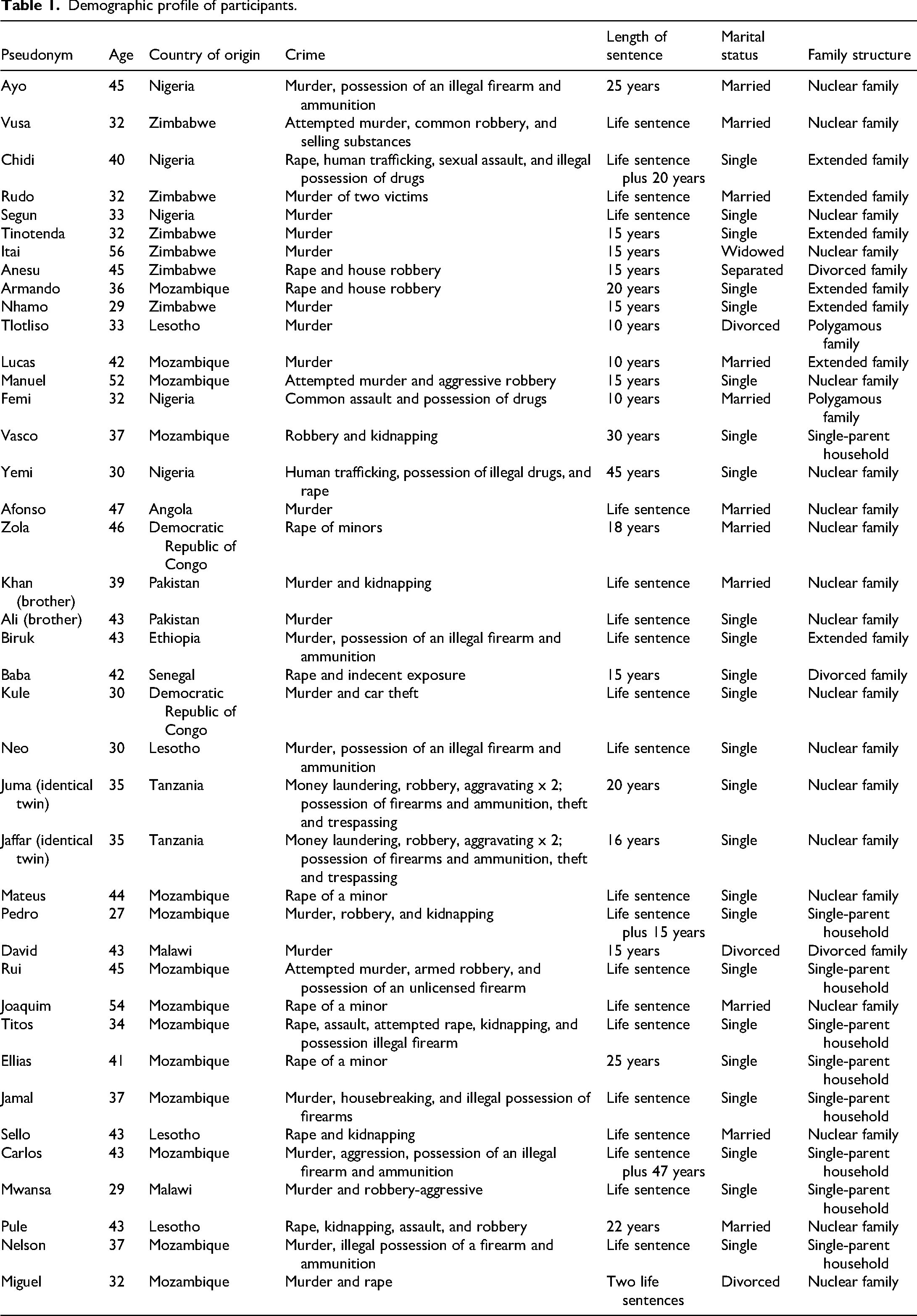
This section examines offenders’ perspectives on their involvement in crime, focusing on themes such as denial, self-perception, and identity. Offenders may engage in denial or minimisation of their actions and attribute blame to various factors, including their background and upbringing, environmental and external influences, and experiences of discrimination. Additionally, the section will examine offenders’ views on the CJS and their perceptions of the victims involved in their crimes. By reviewing these elements, a deeper understanding of how offenders rationalise their actions and the factors that shape their justifications is explored. Moreover, Goodlad et al. (2019) argue that the exploratory nature of the narrative approach enables researchers to identify patterns in offenders’ behaviour that distinguish them from non-offenders, as well as the causes behind their offending behaviour.
Denial of crime involvement
The participants’ responses shed light on how offenders, in this study, rationalise or deny their involvement in crimes. These denials typically involve portraying themselves as victims of injustice, highlighting perceived biases, challenging the evidence, and downplaying their role in the crime. The diversity and complexity of these responses underscore the multi-faceted nature of denial, influenced by social, psychological, and cultural factors (Bardon, 2020; Battista et al., 2021; Schoultz and Flyghed, 2019; Ware et al., 2018). Many participants assert their innocence, claiming they were framed or falsely accused. Examples of this are highlighted below: I was framed, I was not even there when the murder occurred. I was wrongfully arrested and sentenced (Ayo, 45-year-old Nigeria). I’m innocent. I was sentenced based on circumstantial evidence. Some people are jealous of me. I did not commit the crime. My enemies framed me (Ali, 43-year-old Pakistan). I was falsely accused. This thing is complicated, it accidentally happened (Afonso, 47-year-old Angola). My co-accused committed murder, but I was not aware. He claimed that he was with me. I was just arrested for doing nothing (Neo, 30-year-old Lesotho). I didn’t do it. I was shot 9 times, the complainant thought I’d die. I didn’t commit any crime (Rui, 45-year-old Mozambique). I was arrested because the person who actually committed the crime said I was with him and the victim knows me and he agreed that I was there when he was attacked, but I was not part of it (Tlotliso, 33-year-old Lesotho). I did not do anything. I was charged with human trafficking a South African lady. She is the co-accused's girlfriend. Rape also, I don’t understand (Yemi, 30-year-old Nigeria). I was falsely accused of killing my stepbrother (Biruk, 43-year-old Ethiopia). We did not commit any crime (Juma and Jaffar (identical twins), 35-year-old Tanzania). I was falsely accused. I still don’t understand why (Mateus, 44-year-old Mozambique). I did not commit any crime; I was framed because I’m a Nigerian (Segun, 33-year-old Nigeria). I didn’t do anything. They never believe because they know all Nigerians are selling drugs (Femi, 32-year-old Nigeria). We were accused of a murder we did not commit. We have been victimised because of the language barrier (Khan, 39-year-old Pakistan). I didn’t even commit the crime. People from the community accused me and the guys working in my salon of stealing. They beat me up with pangas, then I don’t know what happened, and suddenly I was under arrest (Sello, 43-year-old Lesotho). I was protecting my family. It was self-defence (Vusa, 32-year-old Zimbabwe). It was an honest mistake. My sentence is too harsh. I have requested that my sentence should be reduced. They should have thought about my children when sentencing (Itai, 56-year-old Zimbabwe). I was never at the crime scene, but I got the longest sentence (Neo, 30-year-old Lesotho). I was ‘accused’ of raping a child; no DNA, blood sample and semen (Baba, 42-year-old Senegal). I made a mistake … I did not commit any of the crime. I requested DNA and they refused me, and I was told that they did find semen on both victims. They think I’m crazy. I didn’t do anything. I was framed (Zola, a 46-year-old Congolese). My friend stabbed his brother-in-law in the neck, and he died on the spot, so we ran away. I did not commit any crime (Juma, 35-year-old Tanzania).
Self-perception and identity
The participants’ responses strongly emphasise positive self-perception and a tendency to downplay or rationalise negative aspects. Participants frequently highlight traits such as humility, kindness, and peacefulness, while also showing inconsistencies between their self-perception and their violent actions. This disparity suggests a complex relationship between self-image and criminal behaviour, often involving denial, defence mechanisms, and a lack of acknowledgement of underlying emotional or behavioural issues.
Participants tended to emphasise their positive personal traits and describe their general disposition as positive or agreeable. I’m very humble and kind (Segun, 33-year-old Nigeria). I’m generally a happy and peaceful person (Kule, 30-year-old DRC Congo).
There is often a disconnect between their self-perception and the violent crimes they are convicted of suggesting a disconnection between their self-image and their behaviour under certain conditions. I’m a good guy, you can see for yourself (participant laughing) (Ayo, 45-year-old Nigeria). I don’t have anger, niks niks,
1
only when I’m drunk (Lucas, 42-year-old Mozambique).
Some participants emphasise their control over emotions, stating they do not experience anger or have it only under specific circumstances. For instance, Joaquim shares that he does not experience anger, and Lucas says that his anger surfaces when he is drunk. However, these self-perceptions are not aligned with the violent nature of the crimes they are convicted of. The denial or minimisation of anger is notable, as anger is often associated with violent behaviour. This might indicate a reluctance to confront or acknowledge their emotional state or its role in their crimes. Research indicates that denial is frequently linked to a desire to avoid the consequences of actions, suggesting that individuals may downplay or rationalise their anger to protect their self-image (Craissati, 2021). Armando reflects on a ‘lack of understanding that certain things are wrong’, which suggests an awareness of moral or ethical shortcomings but frames it as an issue of comprehension rather than personal responsibility. This cognitive dissonance recognises moral failings but frames them as issues of comprehension rather than individual accountability. This framing allows them to maintain a sense of self-worth while distancing themselves from the emotional turmoil typically associated with violent crimes (Festinger, 1957).
Sources of blame
Background and upbringing
The participants frequently cite their challenging childhood experiences and the absence of stable support systems as key contributors to their actions. The participants’ accounts highlight the profound influence of their upbringing on their pathways to crime. Factors such as parental neglect, exposure to violence, economic hardship, negative peer influences, and cultural alienation are repeatedly cited as sources of blame. These experiences not only shaped their worldviews but also impaired their emotional and psychological development, making them more susceptible to engaging in violent crimes (Álvarez-García et al., 2019; Berti and Pivetti, 2019; Carr et al., 2020; Franzén and Gottzén, 2022; Gonçalves et al., 2024; Kacprzak, 2019; Labuschagne et al., 2024; Likitha and Mishra, 2021; Onyeneke and Karam, 2022; Segeren et al., 2020, Theofilopoukou, 2022).
Participants describe the loss of a parent and the emotional turmoil that followed. Paternal disinterest, self-raising, and lack of maternal care were also raised as issues. This contributed to a sense of abandonment and a lack of guidance during their formative years, as confirmed in various research studies (Carr et al., 2020; Labuschagne et al., 2024; Rachel et al., 2022). My father passed away and my mother remarried, and I was not coping emotionally with the change. I felt unwelcomed by her husband and family. We struggled a lot. I did not have a support system (Vusa, 32-year-old Zimbabwe). My father was never interested in me (Rudo, 32-year-old Zimbabwe). I feel a lot of pain, my childhood was not nice, and growing up without your father is not nice (Tinotenda, 32-year-old Zimbabwe). If my mother raised me, I would have gone to school and probably succeeded, but it was tough; I raised myself (Neo, 30-year-old Lesotho). My father used to beat us for small little things. He used to physically abuse us a lot. I was a loner and was not coping with school (Tlotliso, 33-year-old Lesotho). I was exposed to physical abuse. My father and his younger brother used to beat me because I was naughty. I had no connection with my mother. I’m learning to be kind and loving towards my wife and children because as a child I did not get it (Baba, 42-year-old Senegal). The violence and circumstances I grew up in affected me too much. They used to kill and rape people. We were defenceless (Rui, 45-year-old Mozambique). I was affected badly, I’d be in class and soldiers start shooting and bombs hitting everyone, and we would have to run, and sometimes we wouldn’t get home, we would hide in the veld. When we come back, people are killed, and houses are burnt. My childhood was bad (Jamal, 37-year-old, Mozambique).
The narratives also underscore the role of poverty and unemployment as catalysts for criminal behaviour (Berti and Pivetti, 2019; Onyeneke and Karam, 2022). Poverty and unemployment lead to danger or expose you to criminal life. If you don’t work, you must make a plan to make money (Chidi, 40-year-old Nigeria).
Environmental and external influences
The participants’ narratives emphasise the significant role of environmental and external influences in their criminal behaviour. Although some participants cited economic hardship as contributing to their criminal behaviour, research on the link between migration and crime has yielded mixed results (Susuman and Sithole, 2024). Additionally, negative social influences, including peer pressure and manipulation, played a critical role in steering them towards criminal activities. These factors highlight the complex interplay between external circumstances and individual actions (Álvarez-García et al., 2019; Christodoulou et al., 2019).
A recurring theme is the struggle to survive in the face of unemployment and poverty. Participants describe turning to crime as a means of supporting themselves and their families in the absence of legitimate opportunities. South Africa's unemployment rate is steadily on the incline. Research indicates that Black South Africans are more than four times as likely to be unemployed compared to White South Africans (United Nations Development Programme, 2022). This situation highlights the persistent socio-economic inequalities in the country, driven by historical and systemic factors that impact employment opportunities for various racial demographics (Azunna and Botes, 2024). This problem is further exacerbated for illegal foreign nationals as they may find it difficult to find formal employment because of their immigration status. This is because Section 38 of South Africa's Immigration Act 13 of 2002 prohibits the employment of illegal foreign nationals (Immigration Act 13 of 2002, s 38). I had to make a plan and support my family, you see, I was not working anywhere, so I had to survive. I was unemployed, poor and had no hope. How are we expected not to get involved in crime when we are only trying to survive? (Vusa, 32-year-old Zimbabwe). I was trying to support myself and my son. In my case, I had no choice, I had to support my child (Manuel, 52-year-old Mozambique). I was under the influence of alcohol. When I’m drunk, I become jaags ke nna
2
clever (Tlotliso, 33-year-old Lesotho).
Discrimination
The narratives of the participants reveal a pervasive theme of discrimination. Feelings of marginalisation, prejudice, and unequal treatment within the justice system and correctional facilities characterise these experiences. One prominent theme revealed is the belief that foreign nationals receive harsher sentences than South African citizens. Chidi explicitly attributes his severe punishment to his status as a foreigner, suggesting that his nationality influenced the legal outcome, reflecting a bias within the justice system against non-citizens. The participants raised feelings of being unfairly targeted and accused without proper cause. Furthermore, Chidi describes how being a foreign national in South Africa often leads to unjust accusations, reinforcing his sense of vulnerability and discrimination. The prevalence of discrimination based on nationality aligns with South African literature (Adeogun and Faluyi, 2018; Kerr et al., 2019; Ruedin, 2019).
Participants expressed feeling unwelcome and alienated within South African communities and institutions. Chidi shares that foreigners are made to feel like they do not belong in the country, which exacerbates their sense of exclusion and reinforces the perception that they are second-class citizens. Anesu highlights the marginalisation of foreign nationals, noting that they often lack a voice to speak out against the injustices they face. This lack of representation and advocacy further entrenches their feelings of powerlessness and alienation.
Discrimination is also linked to tribalism, particularly among some local authorities or chiefs. Anesu mentions that while not all are prejudiced, some chiefs engage in tribalism, treating foreign nationals with rudeness and disdain. The apartheid regime employed numerous strategies to foster division within the South African population. By exploiting distinctions between ethnic groups and tribes, the government succeeded in deepening hatred and distrust among many Black South Africans. Tribalism, which predated apartheid, was utilised as a tool to reinforce these divisions, particularly through the establishment of homelands. Consequently, ethnic groups were set against each other, embedding this division as an accepted societal norm (Baloyi, 2018). This form of discrimination is often rooted in deep-seated xenophobic attitudes, manifesting as name-calling and other derogatory behaviours. The use of derogatory terms like ‘makwerekwere’, 3 which is a xenophobic slur used to describe foreign nationals, is a common experience for the offenders. Both Anesu and Afonso recount being called this term by officials and inmates, reflecting the pervasive xenophobia within certain segments of South African society. Interestingly, Afonso contrasts the treatment by officials with that of fellow inmates, suggesting that inmates generally show more respect, with only a few exhibiting discriminatory attitudes. This indicates that discrimination may be more pronounced among those in positions of authority than among the general prison population.
Criminal justice system
The participants’ experiences with the CJS highlight significant issues of perceived discrimination, bias, and unfair treatment. The participants report being targeted and mistreated based on their nationality, while many feel that the police and courts did not fairly consider their cases. The perceived harshness of sentencing and the lack of consideration for personal circumstances further contribute to a sense of injustice and distrust towards the system. This belief is experienced not only by foreign national offenders but also by the broader offender population. Research suggests that offenders often regard their sentencing outcome as a measure of justice, and when it does not align with their perception of reality, they believe fairness is compromised (Jenness and Calavita, 2018).
Several participants express distrust of the police and the broader legal system. Femi, for example, describes an incident where he was harassed and searched by police without cause, reinforcing his belief that the system is biased and untrustworthy. This distrust is compounded by the experiences of being unfairly targeted and mistreated based on nationality or other biases. I told the police I was not there, even at court, but did they listen? Now I’m here (Segun, 33-year-old Nigeria). I didn’t do anything, they never believed me because they think all Nigerians are selling drugs. I only saw the police come and say show us your house and they harassed and searched and found nothing (Femi, 32-year-old Nigeria). According to me, my sentence is harsh. I have requested that my sentence should be reduced. They should have thought about my children when sentencing (Itai, 56-year-old Zimbabwe). I wish I was not sentenced, they should have left me and observed if I’d commit a crime again. It's not fair (Tlotliso, 33-year-old Lesotho).
Victim(s)
Several participants justify their actions by claiming the victim provoked them. The victim told me from nowhere that my girlfriend is his ex. I was confused about why he was telling me then and we started fighting and I stabbed him with a knife. I was just angry (Nhamo, 29-year-old Zimbabwe). It's not like I wanted to kill him. I didn’t know he was gay; he was fighting me because he wanted to sleep with me (Kule, 30-year-old DRC Congo). I still don’t understand why. That girl used to sleep around; the mother just accused me because I’m a foreigner. That girl had a boyfriend (Mateus, 44-year-old Mozambique).
Joaquim and Sello suggest that the victims initiated or encouraged the behaviour, which they used to rationalise their actions. I was trying to show her the way, bengi mukhuza,
4
it was in 2010, she was 13 years old (Joaquim, 54-year-old Mozambique). My makhwapheni
5
was using me financially and did not want to have sex with me. It's too much, it's like I killed someone, it's a crazy sentence for my crime. I was sentenced by someone who doesn’t have kids, that's why (Sello, 43-year-old Lesotho). ‘I had an affair with my 13-year-old stepdaughter. She was acting like a woman to me’. She was pressurising me to sleep with her. We were sleeping together, it was not rape, but no one listened. She threw herself at me, so is she not violent? When I was sentenced, she was 7 months pregnant with my child (Titos, 34-year-old Mozambique).
Participants’ perspectives on rehabilitation initiatives in the correctional centres
The participants in this study expressed conflicting perspectives on the purpose and objectives of intervention programmes, often describing them as a ‘one-size-fits-all’ approach. Their responses are shared below: Programmes are not effective, because they can’t change you, they don’t have any impact, it's just to push time. These programmes for maximum prisoners are not working (Afonso, 47-year-old Angolan). Honestly, there's nothing. I don’t participate, you don’t benefit anything, I just attend nje
6
(Miguel, 32-year-old, Mozambique). I attended the sexual offence course, even if I did not commit the crime (Baba, 42 years old Senegal).
Alternative perceptions highlighted a sense of achievement and recognition of the crucial role rehabilitation programmes play in shaping behaviour and transforming perspectives. These experiences were explained as follows: I attend programmes that are facilitated by social workers. I gained a lot, I was made aware of a lot of things I did not know about (Armando, 36-year-old, Mozambique). I learned how to conduct myself, especially among other people. We don’t participate, we just listen (Pule, 43-year-old Lesotho). I attended Crossroads, HIV/AIDS and murder course programmes. The one that deals with murder is only for one week and they tell you how to live and acknowledge the wrongful act, so you just sit and listen (Biruk, 43-year-old Ethiopia). I attended several programmes, anger management, robbery, murder and HIV/AIDS. They helped me psychologically (Neo, 30-year-old Lesotho). I have seen a social worker and she has helped me to forgive myself, and I want to change. I participate and it helps (Rudo, 32-year-old Zimbabwe). I do attend and participate. I benefited a lot because I’m HIV positive. I’m learning to correct myself; I have to correct my mistakes (Anesu, 45-year-old Zimbabwe). I attended a long time ago. I learned many things I did not know, for example, respect and how to control one's anger because if you can’t control it, you will end up being here (David, 43-year-old Malawi).
Towards rehabilitation and sustainable reintegration: Navigating the guilt–innocence paradox
Restorative justice serves as a balancing approach to formal sentencing, presenting a holistic response to harm that can potentially lessen recidivism rates and reinforce community trust in the efficacy and fairness of the justice system (Mpofu et al., 2024). In recent years, the implementation of restorative justice principles and practices has expanded within correctional facilities. This growth is evident both in the increasing use of restorative practices involving incarcerated individuals, victims, correctional staff, and relevant institutions, and in the exploration of restorative justice as a framework for correctional centres’ disciplinary policies (Perrella et al., 2024). Contrary to the conventional legal framework, where crime is defined as a violation of state law and punitive systems prioritise the state's role in prosecuting offenders, often marginalising the perspectives of communities and the realities of victims. In contrast, restorative justice is centred on collaborative approaches that facilitate dialogue while promoting healing and accountability, emphasising empathy, reconciliation, and restoring the harm caused by the crime (Omowon and Kunlere, 2024).
Consequently, the central tenet of restorative justice lies in repairing harm as the pathway to justice. Restorative approaches and practices within correctional centres encourage collaborative and cooperative decision-making processes focused on determining appropriate actions to repair harm, resolve conflicts, and facilitate relational healing. This contributes to the development of a more inclusive correctional environment. Simultaneously, these approaches promote the cultivation of essential interpersonal and individual skills, including empathy and self-efficacy (Perrella et al., 2024). Given that an empathy deficit is a significant predictor of violent behaviour, researchers must employ consistent and valid measurement tools to accurately assess this construct (Palix et al., 2022). Within the correctional facilities context, restorative practices have been implemented in two primary ways: firstly, as integral components of rehabilitation and treatment programmes, and secondly, as mechanisms activated to manage, address, and respond to conflictual situations arising within the correctional facilities environment (Perrella et al., 2024).
From a restorative justice perspective, the aim of justice transcends mere correction or treatment of offenders. Instead, it centres on enabling offenders to re-establish moral equilibrium through actions that repair the damage they have inflicted. Consequently, within this framework, traditional rehabilitation, comparable to punishment, is viewed as excessively individualistic, failing to acknowledge the socially constructed dimensions of justice (Maruna, 2016). Research suggests that interventions grounded in restorative justice principles may offer a more pragmatic and humane alternative (Mpofu et al., 2024).
Defining the variations in individuals’ moral foundations can offer deeper insights into the intricate attitudinal differences observed between punitive and rehabilitative approaches to justice (Dominguez, 2021). It is plausible to posit that incarcerated violent offenders, compared to non-offenders, may exhibit diminished levels of empathy. Within the framework of the justice system, empathetic skills are commonly understood through indicators such as an offender's expression of remorse, their empathetic concern for the victim's well-being and their cognitive awareness of the broader societal impact of their criminal actions (Palix et al., 2022). Furthermore, the significance of empathy is often overlooked within the traditional retributive justice system, which primarily emphasises punishment and deterrence.
A progressive approach to criminal justice reform aims to shift the focus from punishment to rehabilitation, enabling offenders to become responsible and contributing members of society. This method recognises that the display of deviant behaviour cannot be addressed solely by punishment; tackling underlying problems is central to reducing criminal incidents while promoting public safety and eliminating the fear of crime (Bloom and Bradshaw, 2022). Sustainable reintegration requires a nuanced approach that acknowledges the complexity of the guilt–innocence paradox often present in offenders’ narratives. This paradox, where offenders may oscillate between denying responsibility for their crimes and recognising their actions, poses unique challenges for rehabilitation and reintegration. Addressing this requires a multi-dimensional strategy that addresses the underlying causes of criminal behaviour and creates an environment that enables offenders to rebuild their lives.
When discussing the guilt–innocence paradox, it is important to consider society's expectations of how a guilty person should behave. In The Outsider (1942), Camus explores this theme through the character of Meursault, who is ultimately condemned not only for his crime but also for his emotional detachment and failure to showcase guilt in ways that society deems appropriate. Camus illustrates how guilt, in the eyes of society, is not only about the act committed but also about the emotional and behavioural responses expected in its aftermath. This reflects a more profound societal need for the guilty to express contrition, sorrow, and moral reflection; behaviours that reaffirm shared ethical norms. In failing to do so, Meursault becomes an outsider, punished as much for his emotional deviation as for his offence. The themes presented in Camus’ (1942) work resonate strongly when considering the experiences of foreign national offenders incarcerated in South African correctional centres. Meursault's condemnation for failing to exhibit socially expected emotions, rather than solely for his crime, reflects the tension foreign offenders may face when cultural, linguistic, and emotional norms differ from those of the dominant society.
In the South African context, where restorative justice and rehabilitative narratives often hinge on the demonstration of remorse and empathy, foreign nationals may struggle to navigate these expectations due to cultural dissonance, language barriers, or differing conceptualisations of guilt (Ogunwale et al., 2021; Zitha and Jansen van Rensburg, 2024). These offenders may be judged harshly for their offences and for perceived emotional detachment or failure to conform to local scripts of contrition. Much like Meursault, who is seen as morally deficient for not mourning in a socially acceptable way (Camus, 1942), foreign nationals may be perceived as unremorseful or resistant to rehabilitation, when in fact they may be grappling with displacement, fear, or a fundamentally different understanding of justice and accountability.
The participants’ accounts reveal potential barriers to reintegration, including inadequate support systems, socio-economic struggles, systemic discrimination, and a pervasive distrust of the CJS. Addressing these barriers is crucial to creating an environment that enables offenders to rebuild their lives. The findings underscore the profound influence of upbringing, socio-economic deprivation, and environmental pressures on pathways to crime. Effective reintegration must prioritise strategies that address these foundational issues, including poverty alleviation, family support, education, and access to mental health services. At the same time, rehabilitative initiatives must be designed to engage offenders in confronting the harm caused by their actions, helping them navigate the tension between denial and acceptance.
Economic hardship and unemployment are recurring drivers of criminal behaviour (Jawadi et al., 2021; Olonisakin et al., 2024; Thornton et al., 2023). Sustainable reintegration requires vocational training and pathways to stable employment, creating opportunities for offenders to achieve financial independence. A study involving 222 offenders in Malaysia who participated in technical, vocational, and entrepreneurship training within correctional centres revealed that most participants viewed the training as both practical and beneficial (Abdullah et al., 2021). Moreover, collaborations with the private and public sectors can provide skills development and job placement. A needs assessment study for vocational skills training in eThekwini, South Africa, found that the training courses were developed in collaboration with stakeholders and prospective employers, thus yielding positive results (Mayombe, 2021). Furthermore, entrepreneurship programmes, particularly for those facing systemic discrimination, empower offenders to create self-reliant futures while contributing to economic growth.
The participants’ tendencies to deny or minimise their crimes highlight gaps in recognising victim harm. This reinforces the importance of empathy-building interventions. Restorative justice approaches, such as victim-offender mediation, provide offenders with the opportunity to confront the impact of their actions, thereby fostering deeper self-awareness and accountability. Incorporating moral reasoning and emotional intelligence training can help offenders reconcile their self-perception and past behaviour, promoting personal transformation (Dominguez, 2021; Koegl, 2021; Narvey et al., 2021; Okonofua et al., 2021).
Discrimination against foreign nationals may further hinder reintegration. Reforming the justice system and implementing anti-discrimination campaigns can address these systemic inequities. Training policing and correctional staff on cultural competence and bias reduction can improve relationships between offenders and authorities, nurturing trust and equitable treatment.
Reintegration must be an ongoing process with continuous monitoring to ensure its success. Tailored support plans should address each offender's unique needs, with periodic reviews to track progress and adapt to emerging challenges. Feedback mechanisms help maintain programme effectiveness. Sustainable strategies can promote individual accountability, personal growth, and social harmony by addressing socio-economic, psychological, and systemic barriers through the lens of the guilt–innocence paradox. These approaches may help reduce cycles of crime and support safer, compassionate communities.
Conclusion
This study explored the guilt–innocence paradox among foreign national incarcerated offenders, revealing how individuals negotiate moral identity through denial, blame-shifting, and self-justification. Drawing on cognitive dissonance, narrative identity, and neutralisation theory, the research highlights the complex ways offenders make sense of their actions. However, guilt and innocence are not fixed concepts, particularly in South Africa, where apartheid-era injustices and post-democratic legal reforms have reshaped public and legal understandings of crime and culpability. Thus, the offenders’ narratives must be seen within this evolving context, where personal morality intersects with historical and legal change. Despite limitations such as potential response bias and the lack of longitudinal follow-up, the study offered valuable, context-specific insights through in-depth interviews. Future research should build on this study using mixed methods and longitudinal designs to explore how offenders’ perceptions of guilt and innocence evolve within a changing society.
Footnotes

Funding
The authors received no financial support for the research, authorship, and/or publication of this article.
Declaration of conflicting interests
The authors declared no potential conflicts of interest with respect to the research, authorship, and/or publication of this article.