



Abstract
This article focuses on the cases of 664 foreign nationals, the majority of whom are migrant workers, under sentence of death across the Gulf states (including Jordan and Lebanon) between 2016 and 2021. The features of these cases suggest that they are inextricably linked to migrant workers’ dependency under the kafala system, with examples of migrants duped into smuggling drugs across the border by their migrant broker, and once in country, accounts of violent altercations due to disputes about exit visas, and in the case of migrant domestic workers, self-defence against sexual violence. Engaging with the burgeoning literature on immigration, exploitation and criminalisation, as well as scholarship on capital punishment, this article will explore the multiple and unique layers of dependency fostered by the kafala system that place migrant workers at higher risk of the death penalty in these Gulf jurisdictions.
Introduction
As the structure of global society has shifted in late modernity, so too has the nature of penal power. Citizenship has become ever more salient as ‘states around the world have put the criminal justice system to work in managing mass mobility’ (Bosworth, 2017:373). Low-paid and ‘unskilled’ migrant workers from developing countries are an especially vulnerable category of migrant, who enjoy few protections from both their host and sending states, particularly when caught up in alien criminal justice systems facing serious charges that carry a death sentence (Hoyle, 2019).
Scholars of border criminology, Pickering, Bosworth and Franko Aas (2014:389) write about the ‘complex set of conditions of precariousness to which migrants, living in the shadow of the law, are exposed in their everyday realities. The precariousness includes not only the physical dangers of the journey but also social marginality upon arrival, economic hardship and exploitation, as well as intrusive policing, surveillance and the threats of deportation and detention’. In this article, we elaborate upon the ‘conditions of precariousness’, utilising the case study of migrant workers in the Gulf states, to make the case that the multiple sources of dependency engendered by the kafala system, work to put migrant workers at a heightened risk of capital punishment.
We draw upon data from our ‘mapping’ project which has recorded the prevalence and experiences of foreign nationals sentenced to death and executed in the Middle East and Asia from 2016 to 2021, and in particular on the 664 cases of death sentences – predominantly for homicide and drug offences – in the Gulf region. 1 We include Bahrain, Jordan, Kuwait, Lebanon, Qatar, Saudi Arabia and the UAE due to their high numbers of migrant workers and use of the kafala system. While much of the existing literature on immigration, exploitation and criminalisation has focused on Europe; here, we explore an under-theorised region in the global south.
We take as our starting point Amrita Pande's (2013) argument that kafala creates ‘illegal workers’ through multiple levels of dependency: first, while still in the home country, there is a dependency on the recruitment agencies who secure work placements in the Gulf and arrange the migrant's passage, creating scope for debt, exploitation and trafficking; second, whilst in the country, the migrant's economic and legal dependency on their sponsor facilitates extreme and regular abuse; and third, because of the tied-visa, a migrant's only choice for escaping an exploitative or abusive situation is to go ‘freelance’ and thus become ‘illegal’ which creates a population of even more readily exploitable workers at constant threat of deportation. In this article, we explore these categories and argue that not only do they create a category of ‘illegal workers’ but they create a situation which can facilitate the commission of illegal acts. Moreover, we examine an extra layer of dependency and precarity and look at the role of the sending states in the kafala system. Once a migrant worker has been arrested for a capital crime, we find examples of embassies reluctant to intervene, either due to the reliance on remittances, and a fear of compromising their economic relationship with the Gulf state, or because they relinquish responsibility for migrants’ criminal acts, notwithstanding their role in creating the structures through which exploitation and illegality occur.
Immigration, exploitation and criminalisation
A burgeoning literature has begun to chart the relationship between immigration status, labour exploitation and, ultimately, criminalisation and punishment. Most have focused on the European context, with scholars noting that ‘the illegalization and the hyper-criminalization of immigrants work symbiotically towards the reproduction of a vulnerable labor force, suitable for the most exploitable sectors of the post-Fordist economy’ (De Giorgi, 2010:153). Some view this process in a wider historical context, looking at the historical intertwinement of economic development and migration in Europe from the seventeenth century (Melossi, 2013). Others explore the contradictory role of the state, which on the one hand criminalises those who exploit migrant workers but, on the other hand, creates immigration controls that increase migrants’ illegality and susceptibility to exploitation through ‘the construction of institutionalised uncertainty’ (Anderson, 2010; Sitkin, 2014). Migrants’ exploitability is intrinsically connected to their ‘deportability’: ‘[m]igrant “illegality” is lived through a palpable sense of…the possibility of deportation’ which, crucially ‘provides an apparatus for sustaining their vulnerability and tractability as workers’ (De Genova, 2002:439). Moreover, the criminalisation of exploited migrants is inextricably linked to processes of racialisation: ‘[s]ubject to economic marginality and its myriad deprivations, assumed to be prone to crime, and always in the spotlight, immigrants’ criminalization is over-determined by a factor of three, with the common denominator being their racialization’ (Calavita, 2005:145).
While here we explore the exploitative nature of the kafala system of migration, it should be noted that dependency permeates other migratory regimes worldwide. Recent work explores the experiences of Sub-Saharan migrant tomato pickers in the South of Italy, who are governed by the ‘caporalato’ labour contracting system, a system of labour contracting in place for over a century and until the 1970s, used to employ agricultural workers from neighbouring Italian districts, before switching to Sub-Saharan African migrants (Melossi, 2021). The caporalato involves work brokers finding temporary, seasonal labour for tomato farmers and preys on migrants’ economic and migratory vulnerability, by subjecting them to low wages, poor work conditions and taking deductions from their salary in exchange for their brokerage (Melossi, 2021). The tomato pickers are spatially segregated into shantytowns and criminalised through the 2016 anti-caporalato law and processes of racialisation (Melossi, 2021). An interesting feature is the ‘refugeeization’ of the workforce, with Sub-Saharan refugees ‘included in the informal labour market but denied the full range of labour and citizens rights’ leaving them susceptible to unfair treatment (Melossi, 2021:498).
Other research has focused on internal migratory patterns in India and an exploited seasonal workforce created by the spatial geopolitics of internal colonialism and uneven regional development (Shah and Lerche, 2020). Those seasonal migrant workers, marginalised by their low-caste and tribal identities, are ineligible for ‘elementary citizenship rights’ and welfare benefits, and ‘[f]or the authorities, they simply do not exist and are treated as second-class citizens, if citizens at all’ (Shah and Lerche, 2020:726). While much of the literature examines ‘illegal’ or ‘irregular’ migration, other work explores the experiences of regular migrants who are victims of labour trafficking in Chinese restaurants in the Netherlands. van Meeteren and Wiering (2019) examine the ‘points of vulnerability’ that increase migrants’ susceptibility to labour exploitation, including migration-incurred debt, employer-bounded residence and work permits and the threat of deportation – all of which are features of the kafala system to which we now turn.
Kafala – Multiple and unique layers of dependency
Dependency is endemic to many migratory regimes around the world (particularly those involving temporary and tied visas), yet arguably kafala is unique. To understand why, it is helpful to explore its history. Discovery of Gulf oil in the 1970s, plus the relatively small indigenous population, transformed the region into rentier states 2 leading to a sudden increase in the need for migrant labour. Concerns that Arab migrants might hold Pan-Arabist political views that could destabilise Gulf regimes (Jamal, 2015), and could have a greater moral claim to ‘social rights’ inherent to citizenship (Longva 2000:185), encouraged Gulf states to turn to Asia – specifically South and Southeast Asia – as a source of cheap, easily exploitable and replaceable labour that would present no threat to the stability and hierarchy of the Arab indigenous population. This generated a rapid expansion of migrant labour communities in the Gulf, with an estimated 34 million migrants living or working in the region (UNDESA, 2020). More recently, a push towards Arabisation policies, over fear of ethnic and cultural displacement, has been met with strong pushback from businesses who cite the benefits of a cheap, hardworking Asian workforce (De Bel-Air, 2014). Hence, the region still relies on maintaining its migrant population on short-term tied-work visas, denying them the benefits of long-term residency or pathways to citizenship, with one activist we interviewed describing this as a ‘civil rights issue’. 3
Therefore, the ancient practice of ‘kafala’ or sponsorship, originally for safe passage and employment opportunities, has evolved to allow kafeels – both corporate and individual employers – to sponsor a migrant worker on a short-term work visa tied to that particular employer. While there are some jurisdictional differences between the implementation of kafala systems, they largely operate similarly across the region (Alzahrani, 2014:382). Migrants require their employer's permission for many tasks, leaving migrants heavily dependent on their sponsors for a range of social and financial matters that would ordinarily be beyond the prerogative of an employer (Maleab, 2015:310–11). As Babar (2014:420) stresses, ‘they place too much power directly in the hands of employers, and create a grave potential for the abuse of workers’ rights’.
Reflecting on the distinctiveness of the kafala migration system as compared to other migratory schemes around the world, Walia (2021) points out that migrant workers make up the majority of the labour force in the Gulf, and in some of the states, the majority of the total population, yet they are only resident on temporary visas, with no opportunity to gain citizenship
4
. Additionally, most migrant jobs are in the private not public sector – by way of example, in Saudi Arabia migrant workers make up about 89% of the private workforce, mainly in construction, retail and domestic work (De Bel-Air, 2014) – and as such, this ‘results in the devolution of immigration obligations from governments to dispersed citizen sponsors or companies’ (Walia, 2021:151). Others have expanded on this point: Surveillance of the ‘border’ is thus internalized, running through Kuwaiti society and simultaneously producing a structurally dependent migrant workforce. This ‘border’ is nevertheless differentially permeable: practices of visa trading allow the entry and irregular status of even more exploitable, cheap, and flexible migrant labor. The institutional dynamics of the kafala not only locks in the migrant worker to the sponsor-employer, the system also persists because it allows ordinary citizens in the Middle East to profit from ‘visa-trading’, and the sale of business licenses to migrant workers. Historically, the value underlying the kafala as a regulatory institution was the insurance or guarantee provided for an unknown foreigner. Today, although this persists as a residual value, the dominant value is benefit or profit (Fernandez, 2013:840).
The work of Pande (2013) on migrant domestic workers in Lebanon provides a framework for the analysis of our empirical data, as she explores the multiple layers of dependency inherent in the kafala system. First, in the migrant woman's home country, she becomes dependent on a migration broker – whether an agent or informal broker – to facilitate her sponsorship and travel to the Gulf, which can lead to the incursion of debt and at its most extreme, trafficking (Pande, 2013:422–425). Secondly, once in the country the worker is legally dependent on their sponsor, confined within their homes (in the case of domestic workers) creating conditions conducive to being trapped in abusive work situations (with violations ranging from wage theft, contract substitution, long hours and no time off and restrictions on mobility with passports confiscated) as they require their sponsor to maintain their legal status and finance their ticket home (Pande, 2013:426–430). Finally, the only way to escape an abusive work situation is to ‘runaway’ and work as an illegal ‘freelancer’, and thus ‘the system itself creates a new population of easily exploitable workers’ who are limited by the constant threat of deportation (Pande, 2013:431). In our analysis, we will explore how these different layers of dependency not only create ‘illegal workers’ but also create the conditions for illicit activities that can lead to the death penalty.
Mapping migrant workers on death row in the Gulf
The Gulf region is a strong exponent of death penalty retention, and Saudi Arabia especially frequently executes prisoners. As Table 1 shows, in the six-year period of our study, Saudi Arabia, the fourth highest executing state in the world, executed at least 727 prisoners and evidence from the European-Saudi Organisation for Human Rights, and other civil society organisations (CSOs), demonstrates that death sentences and executions take place in the context of systematic and egregious human rights violations. 5
Death sentences and executions in the Gulf States 2016–2021.
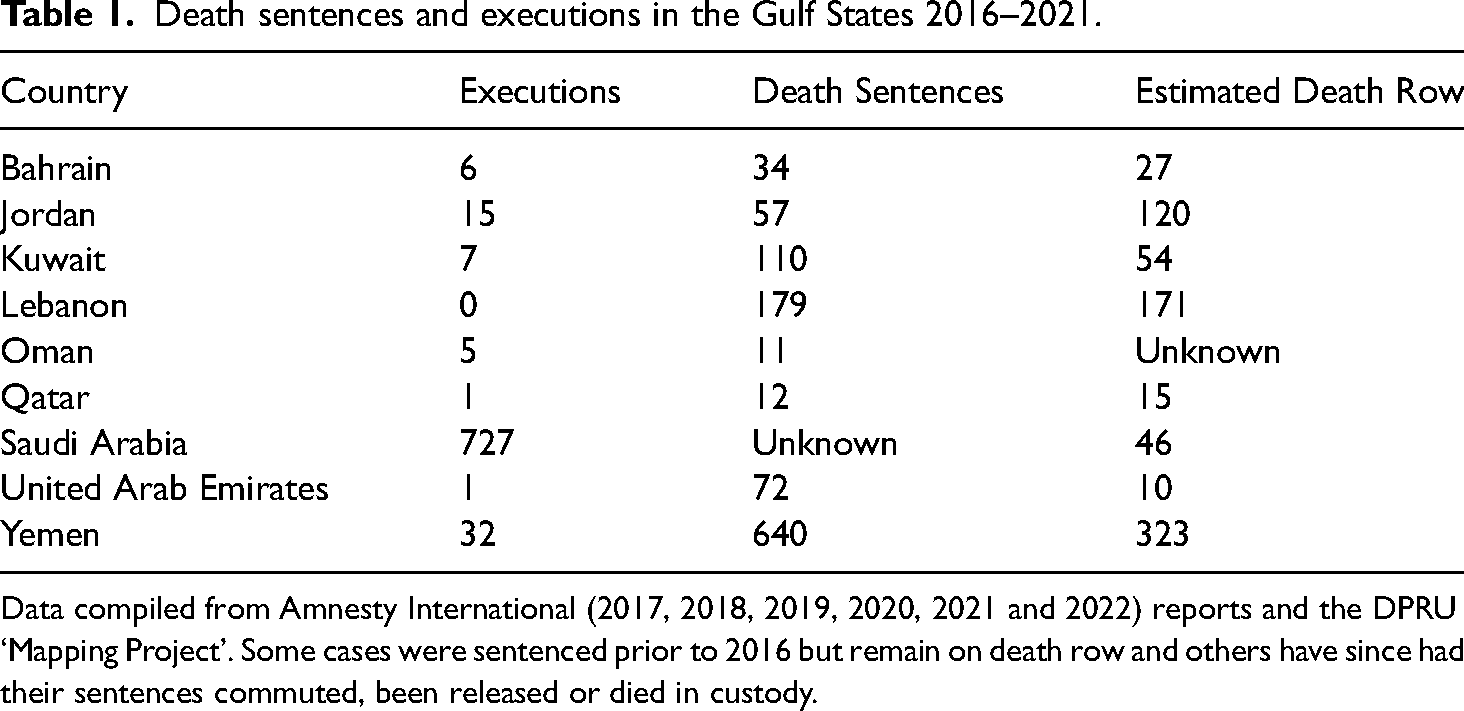
Data compiled from Amnesty International (2017, 2018, 2019, 2020, 2021 and 2022) reports and the DPRU ‘Mapping Project’. Some cases were sentenced prior to 2016 but remain on death row and others have since had their sentences commuted, been released or died in custody.
While human rights groups have raised concerns that the death penalty is also disproportionately used against migrant workers in Bahrain and Saudi Arabia (Rajab, 2010), information on death sentences and executions often does not typically reveal individuals’ nationalities, nor why non-nationals may be more exposed to capital punishment than citizens. We, therefore, set out to ‘map’ the incidence of migrant workers sentenced to death across Asia and the Middle East in order to explore the potential vulnerability of foreign national defendants to the death penalty in this region (Reprieve, 2012; Quigley, 2018; Hoyle, 2019; Hoyle and Girelli, 2019). Along with partner CSOs, we gathered 1241 cases of foreign nationals executed, sentenced to death or on death row from 2016 to 2021. Of these, 664 cases were from the Gulf region, which for this paper includes Bahrain, Jordan, Kuwait, Lebanon, Qatar, Saudi Arabia and the UAE due to their high rates of migrant workers and reliance on the kafala system. Oman and Yemen were excluded as there was a dearth of reliable data, though both countries receive migrant workers and apply the death penalty. As Table 2 shows, most are from South and Southeast Asia, with a considerable, and disproportionate, number of Pakistani nationals sentenced to death for drug offences (Hoyle et al., 2023).
Migrant workers under sentence of death in the Gulf 2016–2021.
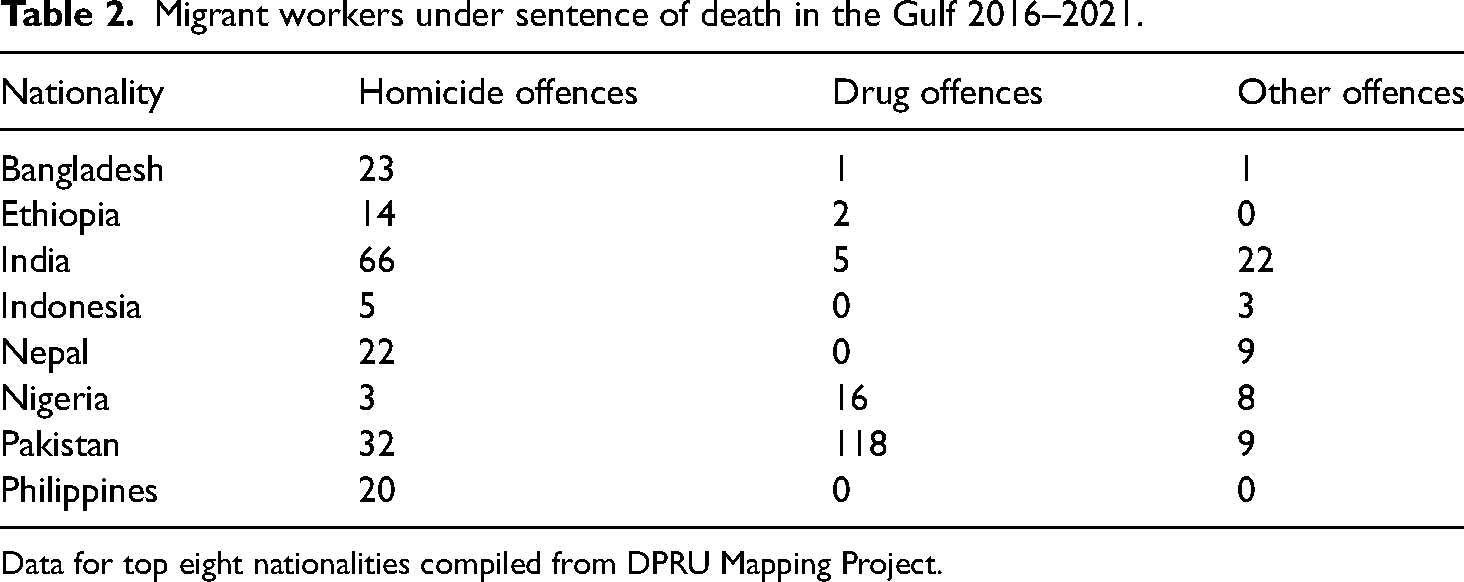
Data for top eight nationalities compiled from DPRU Mapping Project.
This region contains some of the ‘most secretive but currently prolific death penalty jurisdictions’ (Pascoe, 2016:200), where accurate data are extremely hard to obtain. In such ‘closed’ jurisdictions, death penalty scholars must adopt creative methods, relying upon a number of different sources to triangulate evidence (Pascoe, 2016). Therefore, we worked with a network of CSOs to gather data, including Eleos Justice, Ensemble Contre la Peine de Mort, European Saudi Organisation for Human Rights, Harm Reduction International, Justice Project Pakistan, Law and Policy Forum for Social Justice, The Death Penalty Project, Project 39A and Reprieve, as well as others working on the ground including journalists, lawyers and activists. We also collected cases from NGO reports and from conducting searches of media articles from local, national and regional newspapers in both detaining and sending states (we conducted systematic online searches of the most reputable media sources in both sending and receiving states, with key search terms such as ‘death penalty’, ‘death sentence’, etc.). The cases we identified were collated, cross-referenced, pseudonymised and recorded on our database. We gathered both factual data (nationality, charges, date of sentence and court dates etc.) and narrative qualitative data (circumstances of offence, access to legal and consular assistance etc.), which was thematically coded to reveal trends. We also conducted and thematically coded interviews with 29 experts in this area – lawyers, activists, journalists, researchers and returning migrant workers – to add context to the quantitative trends we identified. For ethical and access reasons, we did not attempt to interview anyone on death row. Due to the limitations in gathering data in closed jurisdictions, we acknowledge the impact on the accuracy and comprehensiveness of this study; however, where jurisdictions are not transparent in their use of the death penalty, we can assume that while there may well be more cases than we have identified, there are unlikely to be fewer.
We found that of the 664 cases in the Gulf, at least 317 foreign nationals were executed during this time and at least 290 are thought to remain on death row. Our data suggest a disproportionate use of the death penalty against migrant workers in Saudi Arabia (Hoyle et al., 2023), the UAE (for drug offences) and Bahrain (for homicide offences). Up to 79% of individuals sentenced to death for drug offences in Saudi Arabia are migrants, and ‘a foreign worker is at least three times more likely to be executed for drug crime than a Saudi’ (Larasati and Girelli, 2021:45). In the UAE, although the numbers are smaller, foreign nationals made up 94% of the death sentences for drug offences and in Bahrain, foreign nationals constituted 85% of the death sentences for homicide offences, although only 55% of the population. Across the other states in the region, there were no significant trends suggesting disproportionality in these two main offences, although the way that the death penalty applies to migrant workers appears to be discriminatory, as described below.
Migrant brokers and drug trafficking
As Pande (2013) notes, at the start of the migratory process, migrant workers become dependent on migrant brokers to facilitate their sponsorship and travel to the Gulf states. This creates a power imbalance and potential for exploitation, particularly where migrant workers are from rural areas, have limited literacy and may be on their first journey abroad. Indeed, our interviews provide countless tales of migrant workers being told they were being sent to one country for a particular job, but ending up in another jurisdiction, as well as stories of migrants being given falsified identification documents. Others were sent via third countries on visitor visas or were told to go to work in Saudi Arabia under the auspices of visiting for Hajj or Umrah. Migrants and their families also accrue significant debt to pay for the migration brokerage. As one of our interviewees from a CSO in Nepal stated, ‘Nepal has a cap of 10,000 Rs [on recruitment fees], but that is not happening; instead, people pay for example 1 Lakh Rs [100,000] and they are getting a receipt for 10,000 Rs, because of the government rule’. This creates a situation whereby migrant workers who face abusive work conditions in the country of destination are reluctant or unable to leave because they have significant debt to repay.
This issue intersects most directly with the death penalty in cases where migrant brokers trick migrants into smuggling drugs to the Gulf, with our data revealing many such cases from Pakistan. Indeed, this trend has been documented elsewhere, with a report by Justice Project Pakistan and Equidem (2019:13) detailing cases of Pakistani migrant workers who were coerced or deceived into smuggling drugs to Saudi Arabia by unlicensed migration ‘sub-agents’ and later sentenced to death. For example: In 2010, two subagents approached Farooq's father and offered to help his son to find employment in Saudi Arabia for a fee of Rs.150,000 (USD 1060)… On the day Farooq was taken to Charsadda, the subagents threatened Farooq's life and that of his family and forcibly made him swallow heroin capsules. Two days later, they forced Farooq to travel to Karachi with them, where they made him board the flight to Saudi Arabia under severe duress, informing him that somebody will be collecting him upon his arrival in Saudi Arabia. However, when Farooq landed in Saudi Arabia, he was arrested by the Saudi police and was subsequently sentenced to death by beheading (Justice Project Pakistan and Equidem, 2019:6).
Exploitative labour conditions and sexual violence
In many of the capital murder cases we studied, crimes seem to have been exacerbated by the specific conditions under which unskilled migrant workers live and work in the Gulf, as regulated by the kafala system. Indeed, Pande writes that ‘the cycle of dependency set into motion by the sponsorship system inherently creates another kind of vulnerability for the MDW [migrant domestic worker] – the inability to get out of abusive work contracts. The kafala system makes the MDW dependent on the employer for ensuring her legal status in Lebanon as well as financing her return ticket back home’ (2013:429). Human rights organisations have long reported on the violations against migrant workers in the Gulf, particularly on the plight of domestic workers who are more vulnerable to abuse by virtue of their work occurring in the private and unregulated domestic sphere (Human Rights Watch, 2006), as well as more recently, evidence that in the lead up to the FIFA World Cup in Qatar, at least 6500 migrant workers died working on the World Cup infrastructure due to unsafe work conditions, exhaustion and heat stroke (Pattison and McIntyre, 2021).
Our review of cases suggests that work visas and restrictions on mobility can be a source of violent contention. For example, in a case from Qatar, four Bangladeshi men and one Nepali man were sentenced to death in 2015 for murdering their employer. The workers had asked him for leave to return home and he had refused. An argument ensued, ending in the workers killing their employer. They then used his ‘smart card’ in order to issue themselves exit permits to leave the country (they were later sentenced to death in absentia) (media reports). Another case from Kuwait involved an Egyptian national who murdered his sponsor after a dispute over his residency visa, which the employer had refused to renew (media reports). A case from Saudi Arabia involved a Filipino man who was working as a driver and had been threatened with losing his job and his permit if he could not secure a legal driving license. He attempted to kill himself by driving the vehicle off the road. While he survived, he hit others who died and was sentenced to death for murder (CSO data). Another case from the UAE involved an Indian man who was sentenced to death after he held down a man while another Indian migrant killed the victim. He told prosecutors he had not wanted to be involved but was pressured by the other Indian migrant as he ‘owed’ him for helping him to secure a work visa to come to the UAE (CSO data).
Extant literature has reviewed the exploitation of domestic workers, who make up the ‘global care chain’ (Hochschild, 2000). The literature has characterised the violence against domestic workers in various ways: some conceptualise it as a form of structural violence (Kodoth, 2016; Henderson, 2020), others see it as a form of ‘unfree labour’, ‘legal servitude’ or ‘contract slavery’ (Parreñas, 2015; Lan, 2007; Jureidini and Moukarbel, 2004), others still view it in relation to human trafficking (Jureidini, 2010; Fernandez, 2013), and alternatively, as a form of ‘soft violence’ related to paternalism and surveillance (Parreñas, Kantachote and Silvey, 2021). While domestic workers in other jurisdictions also have visas tied to specific employers, the kafala system is the most extreme form of this, with domestic workers excluded from labour laws and their associated rights (Parreñas, Kantachote and Silvey, 2021). Moreover, the culture of ownership over domestic workers is common in the region; employers often have to pay large sums to secure a domestic worker and, therefore, consider that they own them, with one migrant worker we interviewed describing how ‘the agencies put all the girls together in front of the mall…and the employers will come and choose you, saying I will buy you as my help’ (returning migrant worker). Research has shown that due to their exclusion from labour laws, domestic worker disputes with employers are often criminalised (Strobl, 2009). In her critique of the kafala system and the pervasive gendered violence female domestic workers face, Walia (2021:154) highlights two cases of migrant workers sentenced to death for murder in Saudi Arabia: Filipina worker Jennifer Dalquez defended herself against her predatory employer, who attempted to rape her at knifepoint. Sentenced to death, she was later acquitted with the support of a global campaign demanding her freedom. Indonesian migrant worker Tuti Tursilawati…was executed in 2018 after being convicted for murdering her employer in an act of self-defense after an attempted rape. Tursilawati was the third Indonesian domestic worker executed in Saudi Arabia in a single year.
It is not just sexual abuse but physical abuse that has precipitated some of the women's crimes. From the secondary literature, we find a case from 2010 of another Indonesian domestic worker sentenced to death in Saudi Arabia, after murdering her female employer, who she claimed had physically and emotionally abused her for months prior to the incident (Amnesty International, 2014). She presented mitigating evidence that on the day of the incident, her employer had smashed her head against a wall, and she had retaliated by striking her with a rolling pin, ultimately causing her death 7 (Amnesty International, 2014). Likewise, in UAE, an Ethiopian domestic worker was sentenced to death in 2011 for murdering her employer and her employer's daughter; she claimed that she had been verbally abused and threatened with deportation prior to the crime (CSO data). In other jurisdictions, attention has been drawn to the fact that women are erroneously sentenced to death for homicide while acting in self-defence, otherwise known as ‘battered women syndrome’ (Peters, 2019; Streib, 1992). However, while self-defence is a legal defence in some of the Gulf jurisdictions, we found in practice it was not accepted as a defence and that judges sometimes refused to permit mitigating evidence of self-defence. Furthermore, domestic workers may sometimes be convenient scapegoats for murders committed by others: a Filipina domestic worker was executed in Kuwait in 2017, after being convicted for killing her employer's daughter, though the forensic evidence did not place her at the scene (CSO data); and a Nepali domestic worker was convicted of killing her employer in Saudi Arabia, yet she claims that she was forced to confess at knifepoint to cover for another family member who had killed him – she poignantly stated, ‘I don’t understand the law here. Mistress tricked me’ (media reports).
Deportability and runaways
The constant threat of deportation can mean that migrants become easily disposable workers who are more accepting of abusive work situations due to their lack of bargaining power (De Genova, 2002). For Pande (2013), the third area of kafala-related dependency relates to ‘runaways’ who, in escaping their abusive kafeel, become ‘freelancers’, who, due to their illegal status and ‘deportability’, become even more readily exploitable workers in the Gulf. We find this comes into play in death penalty cases when women, who may already be in ‘illegal’ positions, attempt to flee abusive employers, often with devastating consequences. The above-mentioned case of Tuti Tursilawati is an extreme example of a runaway case. Tuti, an Indonesian migrant worker, had been working in Saudi Arabia in a household where her wages had been withheld for months and she was being sexually abused. One day, while attempting to flee from her employer after he tried to rape her, she hit him, leading to his death. She escaped his home but was found by a group of men who gang-raped her, after which she was arrested for the murder of her employer (CSO data).
Another domestic worker, from Ethiopia, working in the UAE, was sent to a new employer by her agent. This put her in a precarious legal situation (as the kafala system does not permit a change of employer) and she was abused by her new employer and threatened with deportation. She killed her employer and ran away but was caught and sentenced to death (CSO data). We interviewed a domestic worker turned activist, who while working in Kuwait had not received her salary for months and asked her employer for permission to leave. She was taken to the agency who told her, in front of her employer, that her documents had been thrown away and she could not leave: ‘so, after that they took me back to the employer's house and I knew it was hopeless…After that my employer treated me like a slave, I worked so hard, I never rested and I just slept one or two hours every day’ (Indonesian migrant worker). Within the stringent confines of the kafala system, women being mistreated within the home of their employer have little recourse and those who choose to run away, or use self-defence, know their precarious legal status leaves them vulnerable, even though they may have strong mitigating circumstances in committing crimes of retaliation.
The culpability of sending states
Across the criminal justice systems of the Gulf states, we found that access to justice, especially for migrant workers, is extremely limited. As one research and advocacy group told us: ‘There is a discriminatory aspect to how laws are applied and effectively you have these dual-track legal systems, one that applies to nationals and wealthier foreigners and then there's a different legal system and enforcement with respect to low wage workers from the global south and that is an inherently discriminatory system’. Many migrants among our cases were not granted access to lawyers, translators or consular services by their detaining states. One research and advocacy CSO told us: ‘According to Saudi law, every person who is detained and doesn’t have the ability to hire a lawyer, the state should hire him a lawyer. But they do not, especially in the migrant worker cases’. This inevitably leads to poor outcomes for migrant workers: ‘It leads to this unfair trial and he can be sentenced with no real evidence. Migrant workers can be treated like this just because they are migrant workers and that leads to them getting these sentences. Many Pakistanis don’t even get a translator and they confess and sign on papers and they don’t know what they are signing’ (advocacy CSO). There are multiple reports of forced confessions, torture of detainees and wrongful convictions, with evidence from our database and secondary sources of migrant workers being used as convenient scapegoats in some cases (Reprieve and BIRD, 2021; Reprieve, 2013).
Our research suggests that migrant workers’ chances of being sentenced to death were reduced if they received timely and effective consular support after arrest in a Gulf state. However, this occurred only in a minority of cases. While there are many reasons why an embassy may not be proactive in supporting their national, including not being notified of their arrest by the arresting authority (despite the requirement to do this under the Vienna Convention on Consular Relations 1963) and a lack of resources, there are two other possible reasons that we identified for embassies’ inaction in these cases – reasons which are linked to the kafala migratory system. First, the sending state's reliance on remittances sent by migrant workers means that they are unwilling to intervene and risk their economic relationship with the Gulf state. And second, sending states may relinquish responsibility for migrant workers’ criminal acts, refusing to support them, while not acknowledging that their state's policy of exporting migrant labourers under the kafala system has created the structural conditions for migrant workers’ offending. This exposition of the sending state's role in maintaining the kafala system adds a new layer of dependency to Pande's (2013) formulation.
We find evidence in the secondary literature of embassies’ unwillingness to assist their citizens in the interests of maintaining their economic relationships with Gulf states: [E]ven if an embassy gets involved, it is not at all clear that it will side with its citizen against his or her kafeel because the opportunities for the country's migrant workers to find jobs in the Gulf and the remittances sent home by hundreds of thousands of such workers every month may be more important for the country than the protection of an individual citizen at the risk of burdening the relations with the host country (Alzahrani, 2014:385).
Nepal, which had 31 nationals on death row across the Gulf between 2016 and 2021, has a Foreign Employment Board fund of Rs 6 billion, to be used for the assistance of migrant workers, and migrant workers themselves are required to contribute to this fund as a condition of their overseas employment permit. However, our interview with a Nepali investigative journalist revealed that this fund has only been used to assist Nepali migrant workers facing criminal charges abroad four times since it was established in 2018. The journalist explained, ‘they said we really don’t want to spend money on the criminals, it won’t give a good impression if we are funding criminals’. In a similar vein, we discussed with Indonesian lawyers and activists why the government has provided ‘blood money’ (diyya) 9 to secure the release of some of its nationals from death row in the Gulf – mostly famously, the domestic worker, Satinah, in 2014 for whom the government paid $1.8 million (BBC News, 2014) – but not others. They explained that not only is blood money extremely costly for the government but there is also a belief that migrant workers need to take ‘personal responsibility’ for their crimes, notwithstanding states’ responsibilities for exporting nationals to Gulf states who have a poor track record of treatment of migrant workers and failing to assist them when needed. As such, sending states could be accused of perpetrating ‘structural violence’ against their nationals, due to their ‘failure to implement protective rights-based migration policies’ (Henderson, 2020:1599; Kodoth, 2016).
Conclusion
This article has explored the intersection of migrant worker exploitation and the death penalty for homicide and drug trafficking in the Gulf states. Our mapping project identified 664 foreign nationals under sentence of death or executed in the jurisdictions of Bahrain, Jordan, Kuwait, Lebanon, Saudi Arabia, Qatar and UAE, between 2016 and 2021. Many of the circumstances of their crimes were related to their restrictive and abusive migratory, work and living conditions under the kafala system, and their susceptibility to receiving a death sentence was at times exacerbated by a lack of consular support from sending states due to their reliance on remittances and thus their need to maintain their economic relationship with Gulf states.
While dependency is endemic to many migratory systems around the world, we focused on the unique and additive layers of precarity fostered by the kafala system, which, as a customary practice rather than a strictly legal regime, is arguably one of the most severe and entrenched systems of migratory labour exploitation in the world. In exploring these different manifestations of migratory dependency, we contribute to the extant literature on immigration, exploitation and criminalisation (De Giorgi, 2010; Melossi, 2013; De Genova, 2002; Calavita, 2005; Anderson, 2010; Sitkin, 2014), and shift the focus away from the global north, towards a unique context where migrant workers make up the majority of the private workforce but are afforded few labour rights and little access to justice, while simultaneously being exposed to the harshest penalties. Here, the intersection between citizenship, class (‘unskilled’ migrant labourers), gender (in the case of domestic workers) and penal power is stark. We utilised Pande's (2013) theorising on the three layers of dependency engendered by the kafala system (reliance on migration brokers; exploitative and restrictive conditions in the kafeel's home; and vulnerability as a ‘runaway’ and illegal worker) to show not only that these conditions create illegal workers – who ‘abscond’ due to the abusive work situations – but also a situation whereby illegal activities, such as homicide and drug trafficking, can occur. We contributed an additional category to Pande's (2013) formulation and looked at the role of sending states, who have exported their nationals and benefitted from their remittances, yet at times do not provide proactive support or acknowledge their own role in creating structures that enable this exploitation to occur.
While ‘unskilled’ migrant workers are viewed as a ‘polluting’ presence in the Gulf, and many ‘argue that the influx of foreign labor has brought on a growth in crime, violence, and unhealthy socio-cultural practices in the Gulf’ (Auwal, 2010:99), this article has made clear that our gaze should shift to the structural violence of the system in facilitating the criminalisation of migrant workers. Those workers sentenced to death or executed in the Gulf are an alarming illustration of a much wider systematic problem of labour abuse and exploitation, with the scenarios that lead to migrant workers committing violence in self-defence, and being susceptible to the death penalty, being preventable by laws protecting such workers from the abuse giving rise to acts of self-defence (Reprieve and Migrant Care, 2021:25). CSOs have urged Gulf states to ratify international treaties such as the International Convention on the Protection of Rights of All Migrant Workers and Members of Their Families, which places obligations on sending and receiving states to guarantee migrants’ rights, such as their right not to be subjected to torture or cruel, inhuman or degrading punishment, right to life, right to consular assistance and right to be informed of their rights in a language they understand (Reprieve and Migrant Care, 2021:19,24). Furthermore, the fact that high numbers of foreign nationals are being sentenced to death in the Gulf – at a particularly disproportionate rate in Saudi Arabia and UAE (for drug trafficking) and Bahrain (for murder) – indicates the arbitrariness of the death penalty, in contravention of international law, and is in keeping with research from other jurisdictions that shows that ‘those who are sentenced to death and executed are much more likely to be among the least powerful of all who are convicted of capital crimes’ (Lehrfreund and Hood, 2016:150). A punishment that extinguishes a life can never be justified within a system with high levels of discrimination and arbitrariness where migrant workers are exposed to the most punitive conditions of employment and justice.
Footnotes
Acknowledgements
In addition to those mentioned in the methods section, we want to thank the following people and organisations for their invaluable help and support in this research: the International Labour Organisation, Equidem, Pramod Acharya, Migrant Care and UN Women.
Funding
The author(s) disclosed receipt of the following financial support for the research, authorship, and/or publication of this article: This work was supported by the Economic and Social Research Council, (grant number Impact Acceleration Account 2002-KEA-510, Impact Acceleration Account 2202-TOP-762).
