



Abstract
This study explores the role of peer mentoring in a women's prison in England and Wales, focusing on its contributions to emotional well-being and the wider functioning of the prison. Drawing on qualitative interviews and focus groups with peer mentors, mentees, prison officers, and project workers, the findings highlight how peer mentors are perceived to ease staff workload and provide emotional support to other women in prison. However, the study found a paradox in peer mentoring, as while grounded in care, it also functions as a tool of informal control. This raises ethical considerations around institutional reliance on peer mentors, blurred boundaries between peer and staff roles, and the emotional labour involved. The paper concludes with recommendations for structured supervision, clearer role definitions, and enhanced support mechanisms to safeguard mentors’ well-being and ensure the ethical sustainability of peer mentoring programmes.
Introduction
Peer mentoring has become an increasing feature of mainstream criminal justice in England and Wales, reflecting a shift away from traditional, professional-led rehabilitative approaches. Unlike traditional support, peer mentoring is characterised by the shared lived experience between mentors and those they assist. This dynamic has contributed to its growing presence across various prison programmes, where peer mentors provide support in areas such as general advice and guidance, substance recovery, and illiteracy. Peer mentoring is primarily aimed at supporting desistance (Hucklesby and Wincup, 2014), with most research exploring its impact at an individual level, particularly in fostering personal change. However, this focus often overlooks the wider impact that peer mentoring can have within the prison.
This study takes place amid ongoing scrutiny of the female prison estate in England and Wales. Overcrowding, understaffing, and high rates of self-harm remain persistent issues, disproportionately affecting incarcerated women (Prison Reform Trust, 2024a; Women in Prison, 2024). Budget cuts to HM prisons and probation service in recent years have further exacerbated these challenges (Prison Reform Trust, 2014), making it increasingly difficult to implement effective prison reforms. Against this backdrop, this study explores the role of peer mentoring, emphasising its impact on enhancing the emotional well-being of women in prison, while also critically considering its broader role in supporting the prison function. It contributes to ongoing discussions around prison reform, gender-responsive policies, and the ethical implications of delegating such responsibilities to prisoners.
This study adopts a gender-responsive approach, recognising that incarcerated women often have distinct needs shaped by histories of physical, sexual, and emotional abuse, as well as adverse childhood experiences (Bright et al., 2022; Brown and Gelsthorpe, 2022; Fanarraga and Celinska, 2024; Karlsson and Zielinski, 2018; Tyler et al., 2019). Such experiences frequently influence how women engage with authority, rehabilitation, and support structures within prison (Crewe et al., 2017; Jeanis and Smith, 2020; Severance, 2005). Gender-responsive practices emphasise relational support and trauma-informed approaches, which are especially pertinent given the prevalence of abuse histories and the resulting distrust of authority figures among women in prison. Within this context, peer mentoring may offer a relational alternative to traditional hierarchical structures. While prison staff typically exert authority through institutional roles and rule enforcement, peer mentors draw on empathy and experiential credibility (Buck, 2020). This shift from formal control to informal influence positions peer mentoring as a form of soft governance that may feel less coercive yet still serves institutional goals.
Soft power refers to the ability to guide behaviour through trust and credibility rather than coercion (Nye, 1990; 2004). In contrast to hard power, which relies on force or punishment, soft power works through relational appeal. Crewe (2011) describes this as central to contemporary prison governance, where influence often relies on encouraging voluntary compliance. While the staff-prisoner relationship is typically shaped by power asymmetries, peer mentors are seen to operate on more equal terms, making them more approachable. Research by Walby and Cole (2021) highlights how prisoners may be more willing to engage with peer mentors in situations where they are reluctant to approach officers. Building on this, the present study explores how such dynamics, when combined with gender-responsive approaches, allow peer mentors to play a distinctive role in prison operations, sometimes achieving outcomes that formal authority cannot.
Relational theory offers additional insights into why peer support is particularly meaningful for incarcerated women. Unlike psychological frameworks focused on individual traits or autonomy, relational theory emphasises empathy and connection as key to women's psychological development. This is especially salient in prison environments, where isolation and disempowerment are common. The need for meaningful connection has been recognised as central to women's overall well-being (Bylington, 1997; Covington, 1998; Gilligan, 1982; Miller, 1976), underscoring why peer mentoring, grounded in mutual understanding, may resonant with incarcerated women.
At the same time, this study engages with broader debates around the relationship between care and control in criminal justice. While these are often treated as opposing forces, Raynor (1998) argues that supportive relationships and correctional aims can coexist. Peer mentoring offers a useful case through which to explore this intersection, as it is framed in terms of relational support but takes place within the structures of the prison. This raises important questions about how support is mobilised in such settings, and what this might mean for the women delivering it.
Gendered experiences of authority and institutional trust
In examining peer mentoring through a gendered lens, it is important to consider how women frame their experiences with authority figures. Women constitute approximately 4% of the total prison population in England and Wales (Prison Reform Trust, 2024b), a factor that Gorga (2024) argues has contributed to their underrepresentation in prison research. While distrust of authority exists across multiple prison environments (Crewe, 2011), research by Crewe et al. (2017) suggests that women face distinct, and heightened, barriers to engagement within the prison system's power structures. Pre-incarceration experiences of trauma, domestic violence, and economic dependency often lead to a mistrust of authority among women entering prison. Certainly, Liebling (2009) identified prior abuse as a central factor in shaping women's interactions with authority figures in prison, emphasising the importance of trust and control in these relationships for both researchers and policymakers.
Recognising the need for social connection and psychological support, the House of Commons Justice Committee (2013) recommended higher staff-to-prisoner ratios in women's prisons. Yet many incarcerated women report difficulties articulating concerns to male staff, which hinders communication and trust-building. Indeed, Buck (2019) found that individuals with convictions often frame their relationships with authority figures as adversarial. Worrall (1990) notes that women in prison often perceive themselves as unheard within a system dominated by male institutional structures, reinforcing feelings of marginalisation. Further research highlights how this dynamic impacts mental health and help-seeking behaviours. Women in custody frequently report feeling disempowered in managing their mental health, describing staff as unhelpful, uncaring, or condescending (Bright et al., 2022; Harner and Riley, 2013). Kelman et al. (2022) also found that many women described their initial imprisonment as traumatising, drawing comparisons to earlier experiences of abuse or coercion. A lack of clarity around prison rules further exacerbated anxiety, with some officers perceived as misusing their power, deepening mistrust and deterring constructive engagement with staff.
In the context of strained relationships with authority, peer-led approaches take on particular significance and research supports the value of these relationships. Buck (2020) found that people with convictions respond more positively to non-authoritative approaches. Similarly, Kelman et al. (2022) notes that supportive peer connections significantly ease the emotional burden of imprisonment for women. Patel et al. (2021) found that friendships and emotional bonds within prison improve incarcerated women's self-perception, identity, and coping strategies. This resonates with Taylor et al's (2000) tend-and-befriend model, which suggests that in response to stress, women are more likely to seek nurturant social bonds as a form of emotional regulation, which is a response rooted in evolutionary and neurobiological mechanisms, particularly the attachment-caregiving system. In a prison context, where distress, uncertainty, and isolation are prevalent, peer mentoring may serve as a structured extension of this coping strategy through providing an adaptive, relational framework to support emotional well-being.
Challenges of peer support work
Despite these benefits, Henderson and Meek (2022) note that women receiving peer mentoring may sometimes view mentors as extensions of the prison authority structure, particularly when mentors are seen as reinforcing institutional expectations. This can undermine the perceived independence of peer mentoring from prison staff, and undermine the very essence of peer support. Similar dynamics have been observed in gang-based desistance programmes, where peer educators were accused of hypocrisy or collusion with authorities, leading to mistrust (Pitts, 2006). Additionally, Nixon (2019) found that prison-based peer mentors were often expected to take on responsibilities traditionally assigned to staff, further blurring distinctions between peer support and institutional labour, which raises ethical considerations around the delegation of tasks to prisoners.
The emotional demands of peer mentoring also warrant consideration. Many mentors are navigating their own histories of trauma, making the emotional labour of support work particularly complex. Hochschild's (1983) concept of emotional labour provides a lens for understanding the psychological demands placed on peer mentors. Emotional labour encompasses both surface acting, which is the outward display of emotions that are not internally felt, and deep acting, whereby individuals attempt to modify their internal emotional state to align with expected external expressions. Within the context of peer mentoring, this often entails the suppression of personal distress to provide empathy and emotional stability to others. Research shows that incarcerated female mentors internalise the emotional demands of the role, which can lead to heightened stress, emotional exhaustion, and in some cases, retraumatisation (Henderson and Meek, 2022). In response to this, Buck et al. (2022) emphasises the importance of structured support networks as protective buffers, helping peer mentors to manage these pressures and sustain their well-being in emotionally demanding roles.
Materials and methods
The research was conducted between 2016 and 2023, with data collection taking place in 2016. The themes and recommendations remain relevant to ongoing discussions and practices within women's prisons today, as the challenges faced by incarcerated women have persisted and, in some instances, worsened in recent years. The study employed a qualitative approach within an interpretative paradigm, aiming to explore the subjective experiences and perceptions of peer mentoring. This approach facilitated a rich and nuanced understanding of the complexities within a women's prison setting in England and Wales. The researcher conducted this study as an outsider (Noaks and Wincup, 2004), having no prior employment history within prison nor lived experience of incarceration.
Participants and organisations
The research was not funded, and access to the prison was initially simplified by the researcher's affiliation with a university that had an established research partnership with the prison. However, formal approval from the National Offender Management Service (NOMS) and the University's Ethics Committee was required before the study could proceed. Once institutional consent was secured, the Head of Corporate Services at the prison served as the primary gatekeeper, facilitating initial access to participants. A total of 27 participants were interviewed, and four focus groups were conducted. The sample included peer mentors, mentees, project workers (who were paid employees that worked for external charities, inside the prison), and prison officers directly involved in peer mentoring. The breakdown of participants is detailed in Table 1.
Respondent sample.
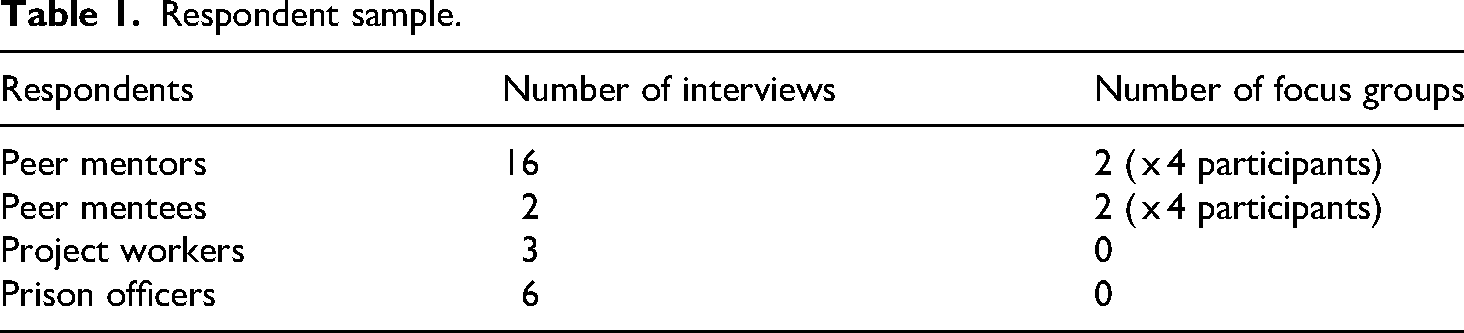
The research aimed to emphasise the perceptions and experiences of female peer mentors. Considering this, the majority of interviews were conducted with peer mentors. The researcher believed that their voices provided the richest and most authentic data because of their direct involvement in the programmes. The peer mentors participated in a variety of mentoring programmes, each designed to address different aspects of support within the prison. The Peer Supporters Initiative, a prison-led programme, focused on providing general advice and guidance to women, conducting inductions for new arrivals, and advocating for their peers. Additionally, the Links Programme, also prison-led, assisted women in completing applications and connecting them with key support services both within the prison and in preparation for their release. A charity-led initiative, specialising in supporting individuals affected by substance misuse, offered facilitated group recovery sessions and one-to-one support to those struggling with addiction. Another charity-led programme focused on addressing illiteracy by enabling literate prisoners to tutor those who faced challenges with reading and writing. Peer mentors were paid, and most were working towards an NVQ Level Three Certificate in Advice and Guidance, which was encouraged by staff. Their training was primarily on the job, beginning with shadowing experienced mentors and project workers before facilitating any group sessions. Additionally, the completion of the NVQ provided them with skills and knowledge relevant to their mentoring roles. Support from project workers was available on an ad hoc basis, but there was limited formal structures in place to provide ongoing guidance or feedback. A conscious decision was made not to differentiate peer mentors upon the programme that they were involved in because they frequently had experience of working for multiple peer mentoring programmes within the prison. Notably, the majority of Peer Supporters also worked as peer mentors for the literacy support programme and the substance misuse recovery initiative. As such, it was difficult to differentiate their separate experiences of each programme.
Participants were recruited using purposeful sampling through prison gatekeepers, including project workers and prison staff responsible for overseeing peer mentoring programmes, who distributed participant information sheets and gathered names of volunteers. While this process helped minimise disruptions to the prison regime, it also introduced the possibility of selection bias, as project workers may have selectively chosen participants likely to portray their programmes favourably. To mitigate this, the study's objective was explicitly stated as capturing experiences rather than evaluating programme efficacy.
Data collection and analysis
Interviews lasted approximately 30–45min and were conducted in private rooms within the rehabilitation centre or the literacy support scheme offices inside the prison. The focus groups were also held in private settings without staff presence to encourage open and honest discussions. All interviews and focus groups were audio-recorded with participant consent and subsequently transcribed. A professional transcription service was used, compliant with university data security policies. All identifying features were removed from the transcripts, and data was securely stored on password-protected devices. Upon completion of the research, all data was deleted in accordance with the Data Protection Act 1998. Confidentiality and anonymity were outlined in the consent forms, although limitations were noted. Full confidentiality could not be guaranteed if disclosures involved unprosecuted offences, prison rule breaches, or situations where an individual was at risk; none did. Participants were informed that there would be no sanctions for non-participation, addressing potential coercion concerns in line with Ward and Bailey (2012). The prison environment presented unique constraints, particularly regarding structured daily routines, which limited participant availability. Gatekeepers played a key role in minimising disruptions by scheduling interviews and focus groups at times that did not conflict with mandatory activities.
The researcher acknowledged a pre-existing favourable perception of peer mentoring, which could have influenced data interpretation. To mitigate potential bias, the researcher remained cognisant of the need for critical engagement with the data. Thematic analysis, following Attride-Stirling's (2001) approach, provided a structured framework for identifying themes. The analysis process began with coding the raw data into basic themes that captured recurring ideas, such as Practical and Emotional Support and Meditating Between Staff and Prisoners and Encouraging Compliance. These basic themes were then clustered into the organising theme of Extension of Institutional Functioning, which grouped related concepts under broader categories. Finally, these organising themes were synthesised into the global theme of Peer Mentoring as Operational Support. No formal member checking was conducted, meaning participants did not review the findings for accuracy. Demographic data was not collected as it was not within the scope of this study.
Results
The results section of this study is structured around a thematic network map (see Figure 1), which outlines the central themes explored.
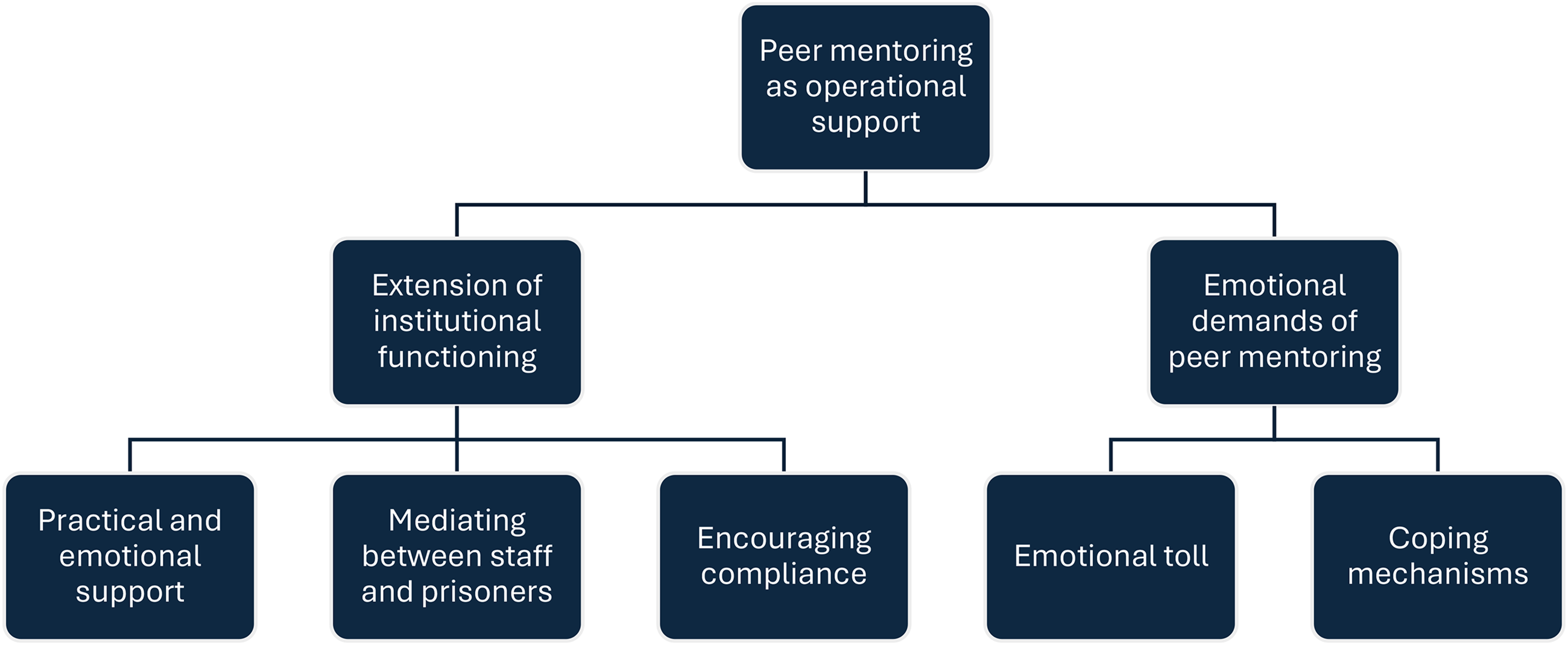
Thematic network map.
Organising theme one: Extension of institutional functioning
Practical and emotional support
A consistent theme among respondents was that peer mentoring eased the burden on prison officers by taking on tasks previously handled by staff. Peer mentors described assuming responsibilities that would otherwise fall to officers, particularly in assisting with administrative and day-to-day operational tasks. Jane (peer mentor) reflected in a focus group: They’re [prison officers] polite to us because we are doing one less thing that they need to worry about, and it does reduce their workload and worries and questions that are directed at them [general agreement].
This illustrates the recurring perception that peer mentors not only supported fellow prisoners but also took on operational duties. These contributions became part of the day-to-day running of the prison, positioning mentors as quasi-staff members who can bridge a gap in an overstretched system. Similarly, Cindy (peer mentor) described the scope of her responsibilities: It's dealing with day-to-day issues with the girls…helping with forms that take a burden off them [prison officers]. I think without us the prison would really struggle and you would notice the difference massively.
Cindy presents peer mentors as vital not only to the women they support but to the prison's overall operation. This reflects wider apprehensions about prisons relying on this form of labour to sustain operations, particularly in under-resourced settings (Nixon, 2019). Piper (peer mentor) reinforced this perception: I think it is underestimated quite how much we do, and the impact that it has, not just on us and the girls, but it helps the officers out massively. Even running the induction, that's a big part of the prison functioning that we are responsible for.
Piper's statement further demonstrates the extent to which peer mentors are integrated into prison routines. Andy (Safer Custody Manager) addressed this shift: There is a role of making sure the rules are being adhered to and there are services that prison officers deliver to prisoners, that can’t be delivered by prisoners … I wouldn’t see the peer support role as being a takeaway from the prison officers, but saying something, well here is a job that a prisoner could do, why should we have our staff doing it?
Andy's framing of peer mentoring as a redistribution of tasks suggests that its function extends beyond providing support to prisoners. The assertion “why should we have our staff doing it?” positions peer mentoring as a replacement for some officer-led responsibilities. While this may be viewed as a practical approach to resource allocation, it also raises some ethical considerations regarding the extent to which institutions rely on prisoner-led initiatives. Ellis (Offender Management Unit prison officer) acknowledged: It takes the strain off us. So that's what it's all about really … they’re like a middleman and just knowing that they are there and can deal with more minor issues like general queries and arguments on the wing can free up my time. In terms of the prison, Lorna [peer mentor] is essentially running the wing there.
The assertion that a peer mentor was “essentially running the wing” is revealing, similarly highlighting the extent to which mentors were perceived as maintaining prison stability.
Beyond these tasks, peer mentors were seen to play a role in providing emotional support and managing tensions among women in the prison. Given the relational needs of incarcerated women, highlighted in gender-responsive research (Bloom and Covington, 2000; Covington, 1998), the majority of respondents noted that peer mentors provided a level of support that was not typically available in staff-prisoner interactions. Alex (peer mentor) explained: Some people might be screaming in their cell, ringing their bell and then we come along, and we talk to them and calm them down, so that's taken, like, an hour off their [the officer's] time.
By stepping in before conflict escalates, peer mentors were perceived to act as a stabilising force in an environment where distress and tension is common. Similarly, Nicky (peer mentor) stated: We take the edge off the officers a little bit, because sometimes they [prisoners] just need someone to talk to. An officer can’t do that with everybody.
Furthermore, according to Piper (peer mentor): Sometimes someone's crying and you just sit there for ten minutes and don’t say anything at first. It's not about fixing things, it's about being there, which is what they need.
This echoes elements of relational theory (Gilligan, 1982; Miller, 1976), which emphasises the importance of social connection for women. These accounts highlight how peer mentors provide emotional reassurance, filling a gap in the prison's existing support structures. Certainly, there was no explicit directive indicating that the peer mentoring role was designed to relieve officers or reduce conflict; it was primarily framed as a support system for women in prison. Nonetheless, the role appeared to offer additional institutional benefits, frequently extending beyond its formal scope in ways that aligned with broader prison management objectives.
Mediating between staff and prisoners
Another theme that emerged was the role of peer mentors in facilitating communication between prisoners and prison staff. According to Natalie (peer mentor), during a focus group: When stuff changes the officers are like the last people to catch up with it and by that point it is too late, we help the prison function.
Natalie's comment reflects a broader view of peer mentors as key intermediaries in the flow of information within the prison because they are embedded in the daily routines, and they are seen as more attuned to changes or emerging issues than officers, who may be one step removed. This responsiveness, as perceived by participants, positions peer mentors not only as sources of support but also as contributors to the running of the prison. Tiffany (peer mentor) described how peer mentors helped interpret institutional changes for other prisoners: The officers don’t always have time to explain why something's changed, and that's where we come in. We explain it in a way that makes sense because we’ve been through it too.
Suzanne (peer mentor) expanded upon this, highlighting how peer mentors’ knowledge created a sense of status within the prison: Like with most jobs here we are serving a purpose and function in the prison and making a contribution. But I think more so with this job there's an added element of importance because you know so much about what's going on with the girls because they’re talking to you, which is information that officers like to have so you feel like you’ve got a bit of power. The officers can also use us to communicate any changes to the girls, especially if they’re unpopular because they know the girls will listen more to us.
This supports Walby and Cole's (2021) findings that peer mentors serve as an additional resource for staff, especially in situations where prisoners are reluctant to engage directly with officers. However, this influence can introduce ethical complexities, as their role increasingly aligns with institutional priorities. If officers rely on them to communicate ‘unpopular’ changes, it suggests that peer mentors may serve not only as facilitators of support but also as instruments of institutional order. Certainly, Henderson and Meek (2022) caution that peer mentors can sometimes be viewed with suspicion, particularly when they are perceived as being too closely aligned with staff priorities.
Encouraging compliance
Peer mentors were seen to play a role in promoting compliance within the prison. Unlike traditional staff enforcement, peer mentors exercised soft power (Nye, 1990; 2004) to mediate tensions, encourage rule adherence, and communicate institutional changes in ways that felt less authoritative and more acceptable to prisoners. Sayid (project worker) described a moment in which a peer mentor was able to command attention during a facilitated group session on substance misuse: There's me just trying to get the group just to listen, just to get involved, they just weren’t paying no attention, I just looked at the peer supporter just like – she just gets up tells them all what she expects – complete silence.
Sayid's account illustrates the authority peer mentors hold within the prison, particularly when speaking to those who may be resistant to engaging with staff or external facilitators. It also demonstrates how staff strategically rely on peer mentors’ credibility to manage group dynamics. Lorna (peer mentor) similarly reflected on how shared experience underpins her influence: I just say, look, I’ve been where you are. I know what it's like to feel angry, but kicking off isn’t going to help. They listen because I’ve been there, not because I’m telling them what to do.
Lorna's comment reinforces this dynamic by highlighting how influence in peer mentoring often stems from empathy and identification, rather than instruction or enforcement. Her ability to de-escalate situations is grounded in credibility derived from lived experience. This dynamic was echoed in Ellis’ (Offender Management Unit prison officer) description of how peer mentors help manage reactions to institutional change: It can be something like minor changes to regime that always seems to annoy some. With any change there’s normally some complaints but the peer supporters have a way of talking to the girls that doesn't aggravate the situation because it’s not like an authority figure, which we are.
The distinction Ellis draws between formal and informal authority further supports the view that peer mentoring functions as a tool of soft governance. The relational nature of this influence allows peer mentors to defuse conflict and promote compliance more effectively than officers in some contexts. However, it also risks co-opting them into informal roles of control, placing them in situations that are emotionally complex and ethically ambiguous.
Organising theme two: Emotional demands of peer mentoring
Emotional toll
While peer mentors had formal avenues of support via prison staff and project workers, structured systems for regular check-ins or debriefing were limited. The emotional toll of the role was compounded by the difficulty of separating personal struggles from mentoring responsibilities. Peer mentors often found themselves emotionally invested in the well-being of others while simultaneously managing their own hardships. According to Tiffany (peer mentor): I try not to show it, but sometimes I’m barely holding it together. You have to be strong for them, even when you’re falling apart.
This highlights the internal conflict many peer mentors experienced, as they worked to maintain emotional composure while feeling overwhelmed. It aligns with Hochschild's (1983) concept of surface acting, where individuals manage their outward emotional expressions to meet external expectations, even when those emotions do not reflect their true internal state. As Jane (peer mentor) further noted: Given that we’re all prisoners as well, we’re all dealing with our own personal issues, and you have to go and carry out your job with the news that you’ve got a massive confiscation behind you or you’ve just been sentenced to five, six, life in prison. So, you do have to be conscious of that because you are dealing with your own issues.
The emotional burden was intensified by the continuous nature of the role. Indeed, Lorna (peer mentor) described how the mentoring role blurred the boundaries between work responsibilities and daily life in custody: Even if you’re not at work they still come to you for advice and support so it's like you’re on call 24/7. Think about it, we are living and working in the same place. Most people will have a stressful day at work, and you come home and you do something about it, you offload. Yeah, the t-shirt comes off but that doesn’t mean anything as the girls still know you so they are still coming up to you and you can’t just ignore them or tell them to go speak to a guard.
This echoes Henderson and Meek's (2022) findings that female peer mentors often face difficulties in managing the emotional demands of their role, which can contribute to secondary trauma. This raises broader questions about the appropriateness of placing such emotional responsibilities on incarcerated women, particularly within a system where trauma histories and high rates of self-harm among women are well documented (Bright et al., 2022; Tyler et al., 2019).
Coping mechanisms
Despite these emotional demands, peer mentors often described how they managed the pressures associated with the role. While some sought support from prison staff and project workers when needed, most relied on an informal peer network to navigate the emotional strain of the role. Maria (peer mentor) emphasised the importance of this peer-led support system: We’ve got each other, we do talk to each other quite a lot, if you’re feeling down about something and we’re lucky because the group that we’ve got now, the team is very, very close.
This sense of solidarity functioned as an informal support network among mentors. Tiffany (peer mentor) echoed this sentiment, describing how she sought support at different levels depending on the situation: I just speak to the girls, they get it, or if I feel like I need to speak to someone a bit higher, someone not on the same level as me then I’ll speak to one of them [project staff].
The informal peer support also extended beyond formal discussions of mentoring and work. According to Tasha (peer mentor): Sometimes we don’t even talk about the mentoring. We just check in with each other, like, ‘You alright?’ That kind of thing keeps us going.
This illustrates how mentors engaged in emotional reciprocity, drawing on shared experience to process personal struggles while supporting others. While staff were sometimes approached for guidance, the primary source of emotional support remained within this informal peer network. This aligns with Buck et al. (2022), who emphasise the role of peer-led support systems in mediating the emotional challenges of peer work.
Discussion
This study highlights the role of peer mentoring in a women's prison, where mentors are seen to support both prison operations and the emotional well-being of incarcerated women. However, the study also raises questions about the institutional reliance on peer mentors, the ethics of shifting such responsibilities onto prisoners, and the psychological burden of peer work. Through a gender-responsive lens, the findings highlight the value of peer mentoring in providing relational care, something prison staff, operating within formal roles and institutional boundaries, may struggle to offer. This reflects insights from relational theory, which suggests that trust, empathy, and emotional safety are particularly important in how women form relationships, especially in carceral settings shaped by histories of trauma (Bylington, 1997; Covington, 1998; Gilligan, 1982; Miller, 1976).
The research identified that peer mentors were seen to play a role in bridging communication gaps, particularly by helping to manage prisoner responses to institutional changes. Officers noted using mentors to relay information about new rules, especially when they thought these changes risked generating resistance. This dynamic can be understood through the lens of soft power (Nye, 1990; 2004), which argues that influence is more effective when exercised through persuasion rather than coercion. This supports Crewe's (2009) assertion that contemporary prisons increasingly rely on less visible, relational forms of control rather than overt discipline. Unlike prison officers, peer mentors are seen as figures who can frame institutional messages in ways that prisoners are more likely to accept. However, this also raises apprehensions about whether peer mentors, despite their peer status, come to function as informal agents of prison authority, relaying institutional messages, managing prisoner behaviour, and becoming embedded in systems of control.
A central theme emerging from this study was the extent to which peer mentoring was viewed as helping the prison to manage operational pressures, such as staff shortages. Peer mentors often performed tasks that may otherwise have fallen to prison officers, including induction support, assisting with form-filling, and conflict mediation. The findings align with previous research that found peer mentors often function as an additional resource for staff (Nixon, 2019; Walby and Cole, 2021). However, it can be seen to blur the boundaries between peer support and unpaid institutional labour, creating ethical dilemmas around the delegation of staff responsibilities to prisoners who lack formal authority or safeguards. This potentially risks placing undue pressure on peer mentors, particularly in emotionally demanding roles where they are expected to perform staff-like duties.
Peer mentoring was seen to involve significant emotional labour, as defined by Hochschild (1983), particularly given that mentors live alongside those they support. Several participants described feeling unable to fully disengage from their roles, even outside of formal duties. In navigating their own emotional struggles while supporting others, mentors often had to suppress or manage their feelings to present as calm and composed. This reflects what Hochschild terms surface acting, the effort to display emotions that may not be genuinely felt in the moment. It resonates with findings by Henderson and Meek (2022), who found that female prison-based mentors struggled to maintain emotional boundaries, leading to heightened stress and, in some cases, secondary trauma. Given that women's prisons have higher rates of self-harm and mental health challenges (Tyler et al., 2019), this raises important considerations about delegating emotional care to incarcerated women. Despite these challenges, mentors developed informal coping strategies, often relying on their own peer support network. However, the absence of more structured support and supervision raises questions about how prisons can better protect peer mentors from the cumulative strain of surface acting, and from the risk of burnout, emotional fatigue, and secondary trauma.
These findings contribute to broader discussions about how care and control are interconnected in a prison setting. While peer mentoring is often presented as a supportive, rehabilitative initiative, it plays a clear role in maintaining institutional routines and order. Emotional support, in this context, becomes part of an informal infrastructure that helps manage compliance. This reflects a central tension in how peer mentoring functions as it is intended to offer care but also serves operational purposes. As mentors take on both functions, it can become difficult to clearly separate support from control. While Raynor (1998) questions whether correctional goals and supportive relationships are necessarily in conflict, the findings here suggest that ambiguity between care and control may exacerbate the pressures experienced by peer mentors, including emotional strain, role ambiguity, and a perceived sense of institutional reliance.
Study limitations
While this study provides valuable insights into peer mentoring in a women's prison, there are some limitations that should be acknowledged. The research is based on a relatively small qualitative sample, and the findings are not intended to be generalisable to all prison environments. The perspectives presented are shaped by the specific institutional context in which the study took place. Additionally, demographic information was not collected, which limits the ability to assess how factors such as age, ethnicity, or sentence length may influence peer mentoring experiences. Another limitation is that the study focused primarily on current peer mentors. Speaking to former mentors, including those who left the role for various reasons, as well as members of the wider prison population, could have offered a broader view of how peer mentoring is perceived and experienced, and may have brought further tensions to light.
Conclusion
This study highlights the dual function of peer mentoring as a source of emotional support among women in prison and as a mechanism through which institutional routines are maintained. The findings suggest that peer mentors occupy a complex position, offering care and connection in ways that are often highly valued, while also contributing to the functioning of the prison in ways that may blur the boundaries between support and control. This duality is particularly visible in how mentors are asked to relay institutional information, mediate conflict, and absorb emotional burdens, often without the formal support, training, or ethical safeguards that would accompany similar responsibilities in staff roles. These dynamics point to the need for greater attention to the institutional conditions under which peer mentoring is practised. There may be value in more clearly defining the scope of peer mentoring and developing structures that better protect the wellbeing of those involved. Further research could explore how peer mentoring is taken up and experienced in different institutional contexts. Understanding the conditions under which peer mentoring supports rather than strains those involved remains an important area for further work.
Footnotes

Ethical considerations
This study was approved by the University's Research Ethics Committee (approval no. 14/15:44) on June 02, 2015, and National Offender Management Service (approval no. 2015-015) on May 06, 2015.
Funding
The author received no financial support for the research, authorship, and/or publication of this article.
Declaration of conflicting interests
The author declared no potential conflicts of interest with respect to the research, authorship, and/or publication of this article.
Informed consent
All participants provided written informed consent prior to participating.