




Abstract
Amongst a variety of peer involvement and service user engagement roles, designed to realise criminal justice policy revolution and penal power re-alignment rhetoric, the peer mentor has garnered particular attention. What constitutes a peer from a non-peer remains undefined. Aggravating this uncertainty is a current lack of distinction made between different peer role profiles. We present qualitative residents-in-prison data drawn from an evaluation spanning four UK prisons. Residents-in-prison clearly distinguish their peers as those with living, rather than lived experience of custody. This is an original and important finding. We argue it is the shared synchronous living experience of criminal justice sanctions that constitutes the manifoldly transformative potential of the distinct peer mentor role. The Ministry of Justice's One HMPPS policy drive to consolidate practice indicates this uniquely dynamic definition of peer-ship status has implications beyond the custodial sector in which it is generated. Distinguishing between living and lived experience may have broader implications beyond the peer mentor role.
Keywords
Introduction
Peer roles and service user engagement initiatives have exploded across the UK's custodial and community justice sectors in the last few decades (Buck, 2020; Levenson and Farrant, 2002). Peer experience roles are advocated as a strategy to address deficit views of criminalised communities. It is asserted these roles can operate to empower community members to affect service delivery and sector policy transformation from ‘within’ (Albert, 2023: 14). Peer role opportunities recognise the value of co-ordinating more inclusive service user engagement strategies across the sector (see Albertson, 2025; Albertson and Albertson, 2023; Albertson and Phillips, 2025; HM Chief Inspector of Prisons, 2024: HM Inspectorate of Probation, 2025). Current definitions of the peer mentor in the criminal justice system tend to be broad, however, often conflating lived and living experience of this role, but most often referring to individuals with lived experience of criminal justice sanction ministering to those remaining imprisoned (e.g. Buck, 2020; Nixon, 2020a). The living experience participants in this present study, however, do not see these individuals as their ‘peers’. This is where our study's original contribution lies.
Peer involvement roles are utilised for different purposes as part of a wider custodial service user engagement infrastructure (Albertson, 2025). What constitutes a peer, however, remains obliquely defined (see Matthews, 2021). Different peer role titles, such as ‘peer support’, ‘mentoring’ and ‘peer mentoring’ are used interchangeably across the burgeoning literature (e.g. Brierley et al., 2025; Lenkens et al., 2024). We argue that isolating the distinctions between these role profiles circumvents this ‘conceptual swamp’ (Pawson, 2004: 2). This study presents a secondary analysis of residents-in-prison data, which provides a much-needed alternative evidential basis from which to radically rethink the constitution of ‘peer’ and distinguish the peer mentor role within criminological understanding. We apply the Home Office's (2023: 4) distinction between ‘lived’ and ‘living’ peer experience to the criminal justice setting. Those with lived experience of criminal justice sanctions already provide a valuable contribution in custodial settings. The UK's One HMPPS policy drive is to consolidate custodial and probation working practice (see Grey, 2023; Webster, 2022). This means that despite originating in the custodial setting, our dynamic categorisation of what constitutes a peer from a non-peer is generalisable, not just across the criminal justice sector (see HM Chief Inspector of Prisons, 2024; HM Inspectorate of Probation, 2025), but also other sectors utilising peer role initiatives.
Peer involvement roles have been identified as inspiring hope and fostering agency, as opportunities for residents-in-prison to serve their custodial sentences constructively. Peer role opportunities provide structure, ‘purpose and meaning’ (Perrin and Blagden, 2014: 916), promoting ‘positive outcomes’ for residents-in-prison (Schreeche-Powell, 2020: 34), and as providing meaningful activities that can also affect positive social climates and civic engagement rates (Bennett and Shuker, 2018; Edgar et al., 2011; Nixon, 2019, 2023; South et al., 2012). Stumbling blocks to the successful delivery of peer role initiatives in the criminal justice sector have been identified, linked to issues of agency, legitimacy, payment and unequal power relations in what are essentially coercive organisational contexts (Buck, 2017; Hucklesby and Wincup, 2014; Nixon, 2020a; Perrin, 2022; Schreeche-Powell, 2020; Wong and Horan, 2021).
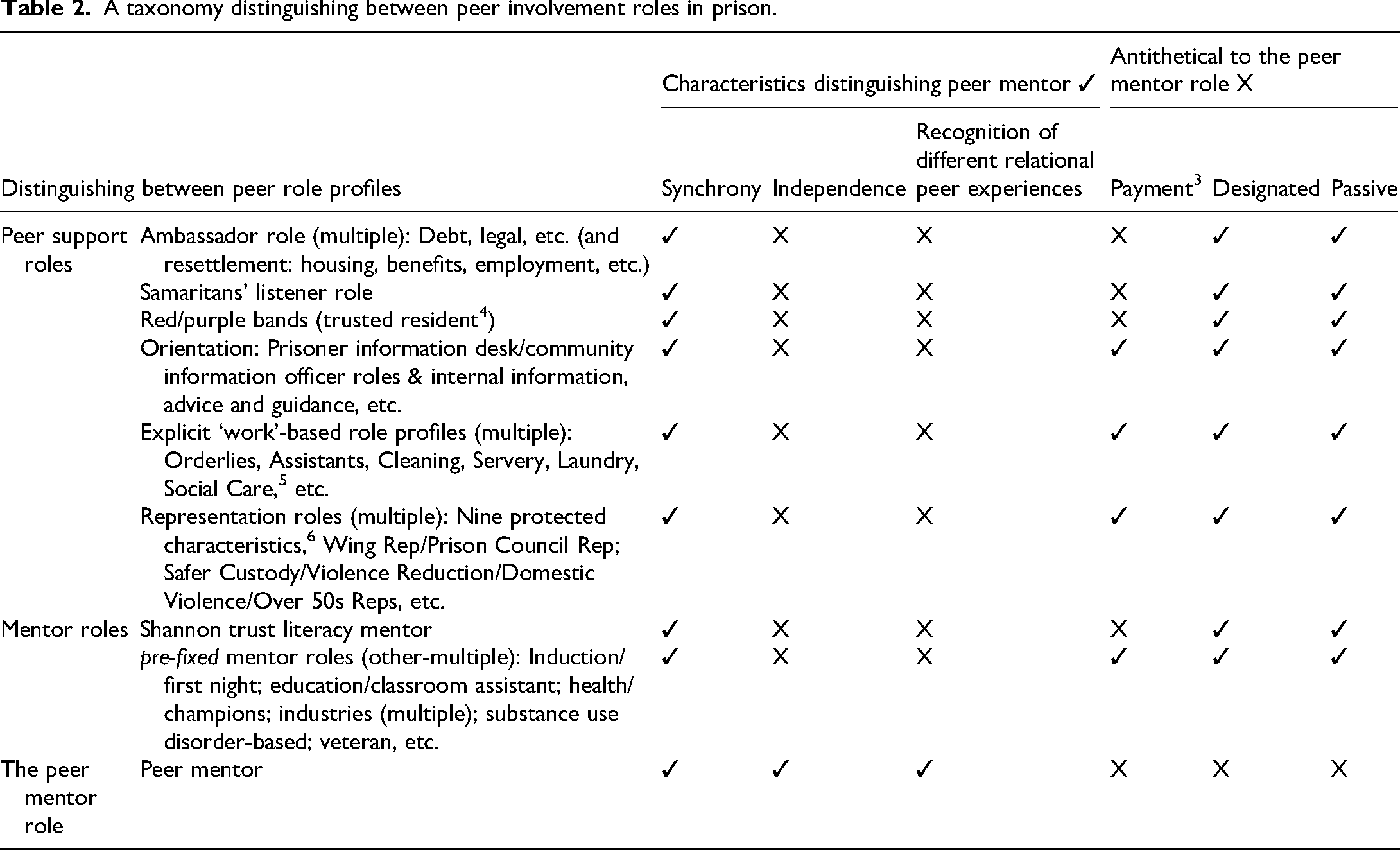
This article begins with a critical synthesis of empirical study findings as a typology from which to ground our peer role profile distinction argument. The peer involvement role element of an innovative mainstream wing delivery model pilot, subject to the original evaluation, is detailed. The sample of residents-in-prison and our approach to a secondary analysis of this qualitative data are featured. Two findings sections containing the results of our analysis are presented. Our taxonomy of peer roles in prison is provided in the discussion section (see Table 2), along with a clear definition distinguishing the peer mentor role in prison. The wider implications of our study findings are discussed in the concluding sections.
Distinguishing peer from non-peer and a typology differentiating peer support, mentor and peer mentor roles in the criminal justice system
Whilst the number of peer involvement roles has increased exponentially in the UK, establishing a robust empirical basis for their effectiveness has not (e.g. Brierley et al., 2025; Lenkens et al., 2024). We argue that consistency in peer and peer involvement role terminology cannot be established until these roles are distinguished. Until this is widely acknowledged, determining what makes peer involvement roles generic or unique, effective or ineffective, will remain beyond the scope of empirical study. We begin our literature review by noting three distinct role profiles: ‘peer support’, ‘mentor’ and ‘peer mentor’, which others have begun to define (e.g. Fletcher and Batty, 2012; McCulloch, 2021; South et al., 2017). We, however, uniquely differentiate and distinguish these three role profiles from each other (see Table 2), as a crucial step to advancing this field of empirical study.
The distinction between lived and living peer experience we apply to the criminal justice context here is drawn from the UK Home Office's (2023) calibration of peer experience terminology in the related recovery sector. This guidance defines experiences that are in the past as ‘lived experience’, referring to those who have successfully achieved recovery, which is distinguished from ‘living experience’, which is defined as those people who remain ‘currently affected’ (Home Office, 2023: 4). We apply this essentially dynamic and temporal distinction to the Criminal Justice System. We define ‘lived experience’ here – as applying to those having successfully exited their criminal justice sanction, and those with ‘living experience’ – as applying to those remaining currently affected by criminal justice sanction.
In the UK custodial context, the most recognised example of a peer support role is the Samaritan's Listener scheme. This unpaid role is specifically profiled to support those whose experience of prison generates suicidal ideations (Nixon, 2020b; Perrin and Blagden, 2014). This peer support role can be distinguished from mentor and peer mentor roles by its strict rules of confidentiality and the impediments to autonomy and attachment that characterise this peer interaction. This is evidenced by the ‘level of detachment’ listeners develop from those they work with, essentially to manage the fact that any independent or pro-active influence on ‘a prisoner's desire to take their own life or self-harm’ is forbidden (Nixon, 2020b: 210–211). Lesser well-known paid peer support roles in UK prisons are food preparation and service, porter, orderly and cleaning roles, induction, orientation and Social Care Assistant roles (see Edwards et al., 2009; Schreeche-Powell, 2020; Walton et al., 2023). The clear definitional distinctions of these roles are clarified further in Table 2. Encapsulated by responsibilities for internal custodial policies and procedures, such as anti-discrimination, violence reduction or anti-bullying, there are further paid peer support roles, collectively referred to as ‘Rep [representative] jobs’ (Stevens, 2012: 529). Here, we define peer support roles in the criminal justice system as part of our typology as – generically structured, largely mandated role profiles set up to meet residents’ formal care and support needs, in which the role holder and the recipient agency are constrained.
The most established example of a mentor role in custody is the Shannon Trust literacy mentor (Perrin et al., 2018). The Shannon Trust, a UK charity, regulates this unpaid literacy mentor role in prison scheme as part of their national programme. This mentor role is distinguished here from peer support and peer mentor roles as it requires a hierarchical relationship to be forged between ‘fluent readers [who] are paired with those less able’ (Perrin et al., 2018: 763). The Shannon Trust mentor coaches mentees through externally designated national reading programme resources, identified as taking a few months, at which point the peer interaction terminates (Perrin et al., 2018). Other less well-known examples of mentor roles occupy a wide range of role titles, for example: education mentor; classroom assistant; drugs mentor; and prison workshop mentor and health champion (e.g. Devilly et al., 2005). In other words, mentor role profiles are determined by said deficit. This is in stark contrast with the ‘non-hierarchical’ peer mentor relationship (Bassu et al., 2024: 6), which adopts a more encompassing strengths-based approach (see Telfer et al., 2021). We distinguish mentor roles in the criminal justice system here in our typology as being directly bounded by a hierarchic and temporally limited peer interaction involving a proficient provider supplying tutelage on a singular skill to a recipient in deficit.
In contrast, the peer mentor role in the criminal justice system has already been distinctly theorised as a critical and agentic form of relational practice, operating around four discrete role principles (Buck, 2020: 36–63): ‘Identity’ (opportunity for recognition of social status change); ‘Social pedagogy’ (creating every-day learning situations in which strength-based resourcefulness can be experienced and practiced); ‘Fraternity’ (generating a sense of belonging across groups in close proximity); and ‘Politicisation’ (raising a critical political awareness of current criminal justice processes). Similarly, the peer mentor role has been subject to auto-ethnographic reflection as, utilising Bourdieuian conceptual frameworks, the authors theorise the skills, competencies and knowledge habitus that are brought to the pedagogical practice table (Brierley and Best, 2025). Both theoretical frameworks are limited, however, by only considering self-evident examples of those having transitioned successfully into a professional role – who command the ‘privilege of distance’ (Bunn, 2023: 1563). Prioritising lived experience effectively overlooks the intrinsically more critical temporal immediacy of those with living experience of the peer mentor role. Notwithstanding, if this role does indeed comprise unique characteristics (Buck, 2020), continuing to use ‘peer support’, ‘mentor’ and ‘peer mentor’ role titles interchangeably obscures empirical progress (e.g. Brierley et al., 2025; Lenkens et al., 2024) when, as illustrated here, these roles are not the same. Our uniquely generated and distinct definition of the peer mentor role in prison is presented in the discussion section.
Stumbling blocks to peer role initiative delivery in the UK criminal justice system are established as ranging from justice staff resistance (Nixon, 2020a; Perrin, 2022), to being asked to conduct inappropriate duties (Buck, 2019), dependency issues, a lack of incentives and queries regarding the sectors capacity to provide appropriate levels of training and supervision (LeBel et al., 2015; South et al., 2012). Critically, more empirical-based questions have also been raised, such as securely determining the impact of payment and non-payment (Hucklesby and Wincup, 2014) and isolating the potentially role-profiled specific factors which either negatively or positively affect agency (see Wong and Horan, 2021). Residents-in-prison in the UK engage in a wide range of peer support and mentor roles that support mandated services, currently loosely defined as where one resident helps another (see HM Inspectorate of Prison, 2016; HMPPS, 2019; Schreeche-Powell, 2020). Acknowledged as a coercive environment, isolating the effects of payment for different peer roles across the UK justice sector remains a significant omission, particularly when conducted by those with living experience of sanction.
Drawing from the debate about the ethics of payment for prison work, if considered as operating to normalise or replicate paid employment in the community, then unionisation and bargaining power entitlements accrue (Mantouvalou, 2024). However, this obfuscates payment in prison, operating as a coercive incentive to behave. The potential implications of relating this to payment for peer roles are significant, given that these payments can also ‘be forfeited’ (Collins, 2024: 448). Payment may curtail peer role holders' abilities to ‘resist and reform aspects of life in prison’ (Maycock and McGregor, 2023: 14), when Buck (2020) asserts the peer mentor role comprises unique change agent characteristics. Hucklesby and Wincup (2014) have identified the risk of the co-option of the peer mentor role as impeding its transformative potential, ‘wherein mentors are co-opted into forms of practice they often critique’ (Buck, 2019: 349). Yet contemporary studies tend to resist subjecting issues of power, agency and payment to extensive scrutiny (e.g. Buck, 2020; Kjellstrand et al., 2023; Telfer et al., 2021).
We argue that if the variations in the prominently distinct peer role profile practice, about to be illuminated further below, remain empirically and theoretically indistinguishable – this will prove a significant barrier to both the credibility and future development of this nascent area of empirical study. This article presents a secondary analysis of residents-in-prison data as a unique contribution to these debates, as ‘little of what we know about prisons comes from the mouths of prisoners’ (Crewe and Bennett, 2012: ii). Our study findings ensure the voices of those with living experience of custodial peer role practice are represented in efforts to bring conceptual, empirical and theoretical clarity to this field.
Wing pilot initiative, evaluation brief and secondary data analysis
The HMPPS Creating Future Opportunities (CFO) 1 wing model pilot initiative required a single dedicated wing or house block to be identified that would be both funded and run by the CFO. Securing the CFO wing model pilot site status drew down secondment costs for three custodial staff, one Custodial Manager and two Specialist Officers, and provided three third sector Prime provider-sourced full-time Case Managers. This staff team were tasked to deliver at least a two-phase meaningful activities and community building programme over a total of 18 weeks. The CFO wing model pilot-brief was also to facilitate unpaid peer involvement role opportunities to support the aims of affecting a welcoming and rehabilitative community environment on a mainstream wing. Four prisons were successful in securing contracts which included a female houseblock, a male Lifers’ wing, and two male veterans’ wings.
Phase one involved the delivery of an eight-week course, through which a small sub-sample (representing approximately 10% of wing residents) progressed in groups of eight to 10. As a rolling programme, the next cohort of wing residents began phase one as the previous group entered phase two. As an unaccredited bespoke course, each site's schedule was uniquely tailored to each wing resident's profile. All included relevant employment or sentence planning progression, emotional regulation, thinking skills, reflection and featured external lived experience inspirational input. Phase two was a wing community development activity programme, running over a further eight weeks, with additional funding attached to improve wing interiors, designed to encourage a sense of belonging, improve cohesion and generate pride in the communities' living environment.
The evaluation was commissioned by a third sector Prime provider involved in pilot delivery to establish the three distinct unpaid peer involvement role delivery models adopted and to evaluate them against each other. Across the four pilot sites, all the peer roles were unpaid. The peer mentor role was elected in three of the four pilot sites (sites one, three and four) and site two elected for an Information, Advice and Guidance (IAG) Ambassador role. The three distinct peer involvement role delivery models elected were established as:
An externally accredited L2 mentoring qualification delivery model (sites one and three). An internal non-accredited peer mentor training delivery model (site four). An IAG Ambassador L2 qualification delivery model (site two).
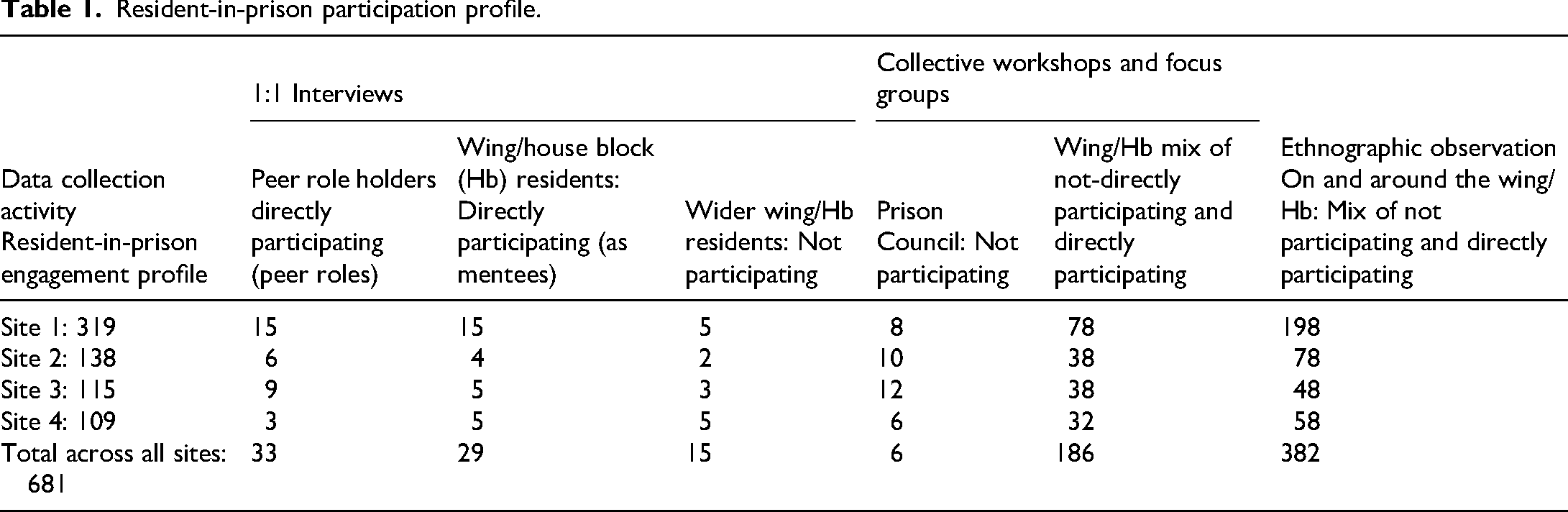
The primary remit of the evaluation was to report on which model operated most effectively to meet the wider initiative funders' aim of providing a welcoming and rehabilitative custodial community environment. Ethical clearance for the evaluation was granted from HMPPS National Research Committee (Ref. 2023-012 & 2023-238) and Sheffield Hallam University Research Ethics Committee (No. ER49795291) in January 2023. Data collection took place between February and December 2023 during multiple three-day-long site visits. Across the four sites, a total of 681 residents voluntarily engaged in some or all of our four core data collection activities, consisting of interviews, focus groups, workshops and ethnographic observation.
Wider wing or houseblock residents who were not involved directly with the core phased CFO delivery initiative (or peer role training or as mentees) were included in the data set to involve a more critical voice regarding what residents-in-prison felt they required from a peer involvement role programme. These contributions are identified within the sample profile table below (Table 1) as ‘not participating’ or ‘not-directly participating’ (i.e. not in a wider phased programme, but as engaging with the peer role holder outside of core phased programme time).
Study information sheets were shared and discussed before each data collection activity commenced. Residents received hard copies of Project Information sheets and consent forms, which were signed for each of the separate data collection activities. All signed consent forms included sections outlining their express consent for anonymised data to be included in evaluation reports and academic publications. Evaluation reporting output requirements involved data being subject to a pragmatic deductive thematic analysis, directed by the questions outlined in the commissioned evaluation brief (Braun and Clarke, 2019). All data were pseudonymised. 2 Four site-specific evaluation reports and a Commissioning briefing document were produced (see Albertson, 2024). We were struck by the potency with which so many differently profiled residents-in-prison viewed the peer mentor role as so distinct, which persisted despite any lack of familiarity with the specific peer role initiatives being evaluated.
Resident-in-prison participation profile.
For this present study, we conducted a secondary analysis of the data set described above, with the aim of addressing two discrete research questions set outside of the evaluation of the peer role element (Guenther and Falk, 2021), to ensure lessons for generalisability can be drawn out (Lewis et al., 2003):
How is the peer mentor role experienced by residents-in-prison? Can, and if so, how can the peer mentor be distinguished from other peer involvement roles?
Here, we conduct an inductive interpretative analysis, predicated on the phenomenological supposition that social reality is neither singular nor objective but shaped by human experience (Giorgi and Giorgi, 2008). Interpretive analysis is well-suited to examining complex, multifaceted processes within a real-life setting (Bhattacherjee, 2012). Our initial open coding of the data involved identifying personal experiential statements in a close, fine-grained fashion with classification by units of meaning per one-to-one interview transcript. This was a recursive process from which we identified six personal experiential themes (Smith et al., 2021): (1) synchronous; (2) independent; (3) structurally enabled; (4) payment; (5) externally designated; and (6) conditional passivity. At this point in our analysis, we integrated the more collectively sensitive workshop and focus group interview data into our data set. The next analytical iteration involved looking across this revised data set for more collective patterns of convergence and divergence, to identify group experiential themes (Smith et al., 2021). This process resulted in the generation of two group experiential master themes: (1) characteristics distinguishing the peer mentor role; and (2) characteristics antithetical to the peer mentor role. Our findings are presented below, using the two-group experiential master themes as findings section headings. Selection decisions regarding the quotes presented here to substantiate our findings are half from peer mentor role holders and the remaining half from wider residents with little or no knowledge of the CFO specific peer involvement role initiative being evaluated.
Findings 1: Characteristics distinguishing the peer mentor role
Our analysis generated three key themes distinguishing the peer mentor role. First, as operating in a synchronously shared living experience of sanction; Second, as functioning independently; and third, as being supported by enabling organisational infrastructures (see Albertson, 2025). Each of the different peer roles in custody is about to be featured and detailed in a forthcoming table (see Table 2). The most resoundingly reinforced theme identified is: in order to be a peer mentor in prison, one has to be living in prison alongside the same wing community that peer mentors in prison serve. Individuals coming into custody with a lived experience of custody were identified as inspirational, but not categorised as peers, and therefore not considered as appropriately positioned to be peer mentors to those in custody: You can build up from that shared initial experience of prison…but it's not the same because you’re in here and they’re not…. you can’t do things together… every prison and every wing is just not the same. (Tanya, Peer mentor, Interview) He’d make a great peer mentor when I get out, but I am in here…. peer mentors should be in prison with you… No, even if he came in every day – it still wouldn’t be the same. They need to be in the same place as you. (Ray, Ambassador, Interview) It's as and when its needed or just when it's the right time in the day. (Sean, Peer mentor, Interview)
More hierarchical mentor roles in prison are similarly identified as being conducted by peers in prison, but not meeting peer mentor role classification, as: Recovery Mentors is different because, well they’re more in crisis, whereas the peer mentoring has to really come in a bit later, when they are a bit more levelled out you know, and they are ready to move on. (Tanya, Peer mentor Interview) As a Shannon Trust Mentor, your job is to teach them to read because you can, and they can’t. But once they can read, your job is done. The peer mentor's job is never really at an end. (Aveline, Peer mentor, Interview)
Unlike Nixon (2020a) and Perrin (2022), we found peer mentor roles did not involve overt resistance or over-monitoring by wing staff and were characterised as alternative relationships operating in a co-consenting community-generated relational space: We don’t get closely monitored you know, like, ‘Did he turn up?’ and all, so there's no discipline used as a stick to be doing the peer mentoring. Sometimes we go to the staff with questions or more serious worries about people on here, but that's rare. We get the training then we are trusted enough to get on with it with anyone that wants to join in under their own steam. (David, Peer mentor, Interview) Peer mentors are there to knock down barriers in here not prop them up. (Prison Council workshop four)
The peer mentor role is distinguished from other peer roles by its strengths-based, personal development-focused relational approach. This is reinforced by this role's more dynamic, pro-active and in-situ identification of everyday opportunities for growth, resilience and practising agency (see Buck, 2020): Peer mentors are good at finding out what others are good at and backing that up. (Prison Council workshop three). Peer mentors – is about us trying to look after each other when we’re stuck in a system that doesn’t usually support people helping themselves. (Julio, Not participating, Interview) So, peer mentors help us see we can do things and respond to things differently every day. (Brianna, Not participating, Interview)
Peer relations originating from a perceived deficit on the part of the mentee, such as mentor and peer support roles, are contrasted with the peer mentor's assumption that the mentee is capable and has the same agency realisation capacity as peer mentors: When someone has decided they want to achieve something…. it's for when they are ready to develop themselves and get a little bit of advice, so more positive than a Listener. (Sean, Peer mentor, Interview). If you’re wanting to change… it's peer mentors that help just to becoming more aware of yourself and you’re thinking…because everyone's journey is different…Peer mentors are there to help you work with you on yourself, as long as it takes to do what you want to work on. (Cecily, Peer mentor, Interview) Most of the lads on here don’t even know what they are good at yet, no-one's ever told them. Peer mentors are there to find out. (Eric, Not participating, Interview).
This underlines the notion that improvements in the relational capacity of custodial wings rely on the regime bringing together residents-in-prison who want to engage (Bennett and Shuker, 2018). We found alternative peer relationship building acknowledged as not just being the responsibility of peer role holders, as transformation supporting infrastructures are identified as needing to be provided at regime, training, staff time allocation and meaningful activity delivery levels (see Albertson, 2025): On this wing it's more chilled out than others… We all live on here, so we don’t want it full of dickheads who don’t want to be engaging. (Owen, Not participating and Wing's PID, Interview) I feel relaxed and welcome here. They have all taken me under their wing…the peer mentors are literally on here all the time, and [the Custody Managers] door is always open… So, I feel they have all got my back. (Liam, Not participating, interview)
The peer mentor role, contributing to a different relational setting, is, in best practice delivery examples, supported by residents-in-prisons' access to externally accredited mentor qualifications. In line with Telfer et al.'s (2021) findings, this training pathway worked most effectively to prepare residents-in-prison to set up a different relational experience with their peers. This resonates with residents-in-prison acting in peer roles as realising alternative flows of intimate peer relations (see Nixon, 2023). Yet we found these relational flows were distinguished by the differently profiled peer roles and training pathways undertaken. A finding we identified, irrespective of the wing site having an active peer mentor initiative operating on it, or not: I’ve done Ambassador IAG training and the Mentoring level 2 at HMP XX, so I know it's not the same…. It's not only based on the Mentor training, it's adapted because the peer mentor's role is a different relationship… built on an evolving everyday relationship. (Ray, Not participating, interview) I’ve done the Shannon Trust Mentor training, that's external too, but it's on telling them what to do with the booklet mainly. The Listeners training, that's mostly about confidentiality. The big difference with the level 2 Mentoring is it's about building trusting relationships. In the wing course classroom I’m just building trust in there for later, as trust, well – its earned. (Andrew, Peer mentor, interview).
This delivery of meaningful daily interaction as a supporting mechanism for peer mentors to operate within is key, as an interactional platform from which alternative peer relations can be forged: We start by helping maintain the lads on the CFO course first, but that is just the start and a great way of getting to know them and them us. So, we get to build relationships with them every day, but it spills out more into the peer mentor role ‘proper’ as they already know and trust you, so they come to you out on the wing. (Rupert, Peer mentor, Interview) You are giving certain individuals the skills to be peer mentors, a qualification, and letting us get on with it, rather than having one peer mentor session a week on a Tuesday at 4 o’clock kind of thing. (Sean, Peer mentor, Interview)
This is underlined as enabling peer relations to evolve, as potential mentees have the agency to self-select their preferred peer mentor personality. The data presented here extends our understanding of the characteristics distinguishing the peer mentor in prison role as an in-situ, independent, and strength-based relational role, supported by enabling custodial infrastructures (see Albertson, 2025; Albertson et al., 2022).
Findings 2: Characteristics antithetical to the peer mentor role
Our analysis identifies characteristics antithetical to the peer mentor role as payment, externally mandated tasks and passive or time-limited peer interaction. The most resoundingly reinforced theme as antithetical to this role is: payment. Linked to the previous section's discussion about retaining peer mentor independence (Hucklesby and Wincup, 2014), reciprocity and ensuring genuine consent, these issues are all intimately bound to the question of payment: ‘Consent vs pay will always be a really big issue in prison’ (Tanya, Peer mentor Interview). A distinction most emphatically underscored during Prison Council workshops: Equalities Reps, Safer Custody Reps- they are paid peer roles. The PIDs too and industries workshop Mentors. We have drugs Mentors and Social Carers some prisoners do – but both of them are paid. Shannon Trust Mentors and Listener roles aren’t paid, but Listeners are there to just calm things down. Shannon Trust and the education Mentors are to help prisoners with only reading, writing and maths. Peer mentors isn’t a paid role – they get much more of a say in things. (Prison Council workshop one)
Peer Rep roles and a variety of mentor and social care roles are unequivocally identified as not being peer mentor roles. The identified characteristics of peer mentor roles, including a lack of payment, also had relevance to informing effective recruitment to the peer mentor role: You've got to have the right person …that wants to help somebody else, not because they're going to get paid for doing it. So it's different to out there because there's people in here will do it for what they get out of it, so not for the right reasons. (Aveline, Peer mentor, Interview) There are some nasty people in here that wouldn’t think twice about exploiting their grandma, let alone the vulnerable lads in here. (Eric, Not participating, Interview).
This finding is intimately tied to issues of payment. Our participants were clear: mentor and peer support roles are distinguished by being set up to address designated tasks and categorised as antithetical to the peer mentor role: Whereas Shannon Trust Mentors are there to work with people who can’t read. Listeners are only there to work with people when things are really bad, so neither of them are the same as the peer mentor at all. (Cecily, Peer mentor, Interview)
This anti-deficit view dominated in peer role interaction established from external diagnosis of crises, limitations (can’t dos), problems, and obstacles, as deficit-based, prescribed and inhibited role profiles indicative of less equal peer interactions: You've got the drugs and recovery Mentors, they're focussed on just that one thing really, but peer mentors they do the ‘full shebang’, so anything you decide you want to work on. (Shaun, Peer mentor, Interview) But it's like not saying ‘You need to do it that way’. Peer mentoring, it's more like working with them to work out a way of doing it that suits them and practicing it with them, so it goes beyond any specific task. (Devan, Ambassador, Interview)
Our analysis highlights that any pre-fix (excluding ‘peer’) before the mentor title is taken as indicative of a limited peer role brief and, along with peer support roles which are deemed short-term, transactional and externally mandated (see Nixon, 2020b), are considered antithetical to the peer mentor role: With them education Mentors and Shannon Trust Mentors, lads just go to be learnt to read and write so for something actual like an actual single thing they have to learn to do. Peer mentoring is more than that. (Mark, Peer mentor, Interview) A PID [Prisoner Information Desk] worker gives them an App and never sees them again. A Listener might listen one night, then might never see them again. Both are short term relationships, not based on building a relationship. For the peer mentors, the relationship is completely different. (William, Peer mentor, Interview)
Peer support and mentor role holders, as described above, operate with less autonomy, given the externally mandated limits and tasks applied. This resonates with Nixon's (2020b) identification of limitations on agency in peer support roles. Similarly excluded from the peer mentor criteria are induction, information and custodial orientation roles, including ambassador and literacy mentor roles, which are clearly identified as more generic peer support, not peer mentor roles: Them Listeners, it's just being with someone, calming them down like…but not actually working with them after to change anything. (Paul, Peer mentor, interview) For the PID worker, and Ambassadors it's all-around giving advice and information about prison … Shannon Trust, you get a booklet. For Listeners, there are things you can say, and you can’t say…. Peer mentoring is about helping people to help themselves. (Terry, Not participating, Interview)
The peer mentor role was also contrasted in our analysis with the passivity, or lack of agency and change agent capacity, that distinguished peer support roles. Similar to Telfer et al. (2021: 13) findings, our analysis found ‘the proactiveness of peer mentors’ and change agent characteristics (Buck, 2020), defined as being part of the peer mentor, not the peer support role remit: Listeners are like statues they are there, but they don’t do much. They just listen when things are bad for you, whereas peer mentors are more active than passive like the Listeners. (Ben, Peer mentee, Interview) A CIO [Community Information Officer] is just handing forms out to people. CIOs are not supposed to promote change, they are just there to signpost. (Craig, Not participating and Wing's CIO, Interview)
Our analysis highlights that residents-in-prison are cognisant of a temporal–transactional–relational peer role spectrum, on which peer support, mentor and peer mentor roles in custody can be said to sit: I think all them other peer roles, they definitely have some similar qualities, but I think the difference is they just deal with more practical things like a House Rep role, whereas a peer mentor doesn’t work like that, it's more constant, longer term and proactive. (Megan, Peer mentor, Interview)
Our findings identify characteristics antithetical to the peer mentor role to be: Payment and any designated task, or time-bound role-specific dictates, which function to pacify, rather than invigorate peer interaction. If taken together, our findings establish that peer support, mentor and peer mentor roles in prison are not the same and can be distinguished from each other.
Discussion
Significantly, our findings distinguish the peer in the criminal justice system as someone with living experience rather than someone with lived experience – this is an original and important finding – that may truly revolutionise this field of study. Moreover, our findings articulate the problems inherent to using the role profile titles of ‘peer support’, ‘mentor’ and ‘peer mentor’ interchangeably, as this study has demonstrated these roles have distinct characteristics. We contribute a taxonomy generated from the qualitative insight of those with living experience of these peer roles in custody in a table format here, and subsequently provide a clear definition of the peer mentor role in custody.
We define (and distinguish) the peer mentor role in prison as an:
A taxonomy distinguishing between peer involvement roles in prison.
Unpaid change agent leadership role undertaken by residents-in-prison, best performed by adapting externally accredited Mentor qualification skills and a distinct personal and social skill set to promote growth, advancement, hope and empowerment amongst their peers in a wing community. Peer mentors have the potential to champion community aspirations by representing collective interests at wing and Prison Council forums. The peer mentor role, in theory at least, has the potential to advocate for current service users’ living experience in national criminal justice practice and affect policy transformation – from within.
The limitations of this study are acknowledged as the subjective nature of the data generated by a small qualitative evaluation. This was minimised by our theoretically informed approach to this secondary analysis. Thinking with theory indicates ‘a willingness to borrow and reconfigure concepts and create new assemblages’ (Jackson and Mazzei, 2018: 717). The range of peer involvement roles evaluated in the original evaluation was small and supported by a well-resourced, innovative wing pilot delivery model, which many peer role initiatives do not benefit from. However, the selection of the peer role element was not mandated by the funder, but selected and delivered locally, independently and differently in each pilot site.
Conclusion
We propose a dynamic distinction between lived and living experience as temporally constituting ‘peer’ from ‘non-peer’ in the criminal justice system sanction context. Distinguishing peer mentor role characteristics from other peer support and mentor role profiles has significant implications for future empirical study designs in this area. Similarly precise classificatory definitions and mapping of peer role aim, function (and thus outcome) distinctions are required to establish a sophisticated evidence-based approach that can be effectively reviewed, evaluated and used to inform future peer involvement role and service user engagement infrastructures (see Albertson, 2025). Beyond the peer mentor role, further implications of this distinction between living and lived experience of sanction may affect how punishment and society scholars conduct research on experiences of incarceration more generally. This study's findings highlight that there are different dimensions of experience, some more relevant than others, to the understanding of the impact of incarceration. The appropriate response from the research community is to prioritise including and clearly distinguishing these distinctions in custodial experience in future studies.
The practice implications of our dynamic distinction of peers as sharing the ‘living’ experience of progression in, through and out of the Criminal Justice sanction together at the same time are significant. The implication of this distinction for those with lived experience of sanction is that, while they can still operate in the custodial environment, this has to be acknowledged as operating in a lived experience mentor, not a peer mentor role. Further, those with lived experience can also still operate in peer mentor roles, but amongst their own peer group, who are those who, like themselves, have successfully exited their criminal sanction. Raising the awareness of criminal justice practitioners to these clear distinctions will ensure the transformational change agent potential of the peer mentor role can more effectively affect innovative practice reform – as being genuinely affected by those with living experience – from ‘within’ (Albert, 2023; Albertson, 2025). For the potential of the peer mentor's contribution to policy revolution and power re-alignment aspirations to be realised across the sector, as theorised by Buck (2020), the role requires explicit independent change agent distinction. Formal recognition of this distinction means the role can be positioned effectively within existing service user engagement and consultation infrastructures already being prioritised across the sector (see Albertson, 2025; HM Chief Inspector of Prisons, 2024; HM Inspectorate of Probation, 2025).
The wider policy implication of this study's findings is a call to update and link national peer role initiative and service user engagement operational guidance for the UK Criminal Justice System. As the proposed distinction between peer and non-peer can be consistently applied across both custodial and community jurisdiction sanction contexts, it complements the Ministry of Justice's One HMPPS programmes consolidation of custodial and probation working practices (e.g. Grey, 2023; Webster, 2022). Finally, wider acknowledgement of this dynamic distinction between peer and non-peer experience status may result in further revolutionary impact across a broader range of other sectors also purporting to utilise peer role initiatives.
Footnotes
Acknowledgements
The author would like to thank Jake Phillips, Kevin Albertson and Marek Musiol for comments on early ideas and drafts. Particular thanks must go to the journal's anonymous reviewers whose constructive comments and proposed revisions resulted in a much stronger publication.

Funding
The author disclosed receipt of the following financial support for the research, authorship, and/or publication of this article: This work was supported by the Achieve Northwest (grant number N/A).
Declaration of conflicting interests
The author declares no potential conflicts of interest with respect to the research, authorship, and/or publication of this article. For the purpose of open access, the author has applied a Creative Commons Attribution (CC BY) licence to any Author Accepted Manuscript version arising from this submission.