




Abstract
This article introduces the concept of penal extractivism in the punishment and society literature. We define penal extractivism as the punitive strategies that a state implements to safeguard extractive industries from citizens’ contention. This concept addresses the limitations of categories like criminalization, protest policing, social control, and labour discipline while bridging the gap between punishment studies and research on extractive industries. Additionally, we draw upon evidence of the Espinar mining conflict in Peru to explain five punitive strategies the state uses to handle protests: (1) off-duty policing and critical assets legislation, (2) state of emergency declarations, (3) police or prosecutorial notes against environmental defenders, (4) criminal indictments, and (5) the transferring of criminal cases to distant jurisdictions. Based on our findings, we argue that penal extractivism is a dynamic and ambivalent project that targets marginalized rural populations. The state partially deters mobilizations but fails to address the underlying social unrest, reinforcing the conditions that perpetuate mining conflicts. This in-depth within-case analysis examines the relationship between punishment and extractivism in the global context of contemporary social mobilizations.
Keywords
Introduction
Mining capitalism has become a primary revenue source in Latin America, 1 sparking conflicts with rural populations due to distributional issues, environmental harm, and social inequalities (Svampa, 2019). Indigenous communities have been at the forefront of extractive disputes for decades, with state responses to these conflicts being varied and ambivalent (Paredes and Schorr, 2021). Environmental reforms have incorporated participatory mechanisms and prior consultation for indigenous peoples. Yet mining projects face difficulties gaining acceptance from communities near mining operations due to the ample evidence of environmental and livelihood degradation (Conde and Le Billon, 2017; Jaskoski, 2022). This situation has triggered widespread social unrest, mobilizations, and state criminalization across the continent. Based on data from the Observatory of Mining Conflicts in Latin America (OCMAL), Arce and Nieto-Matiz (2024) identified 268 cases of violent state responses to mining protests in the region, with 70% of these concentrated in four countries: Mexico, Peru, Guatemala, Ecuador, and Colombia. Despite the punitive effects of extractivism, especially toward protest movements in Latin America, punishment and society scholars have largely overlooked this phenomenon.
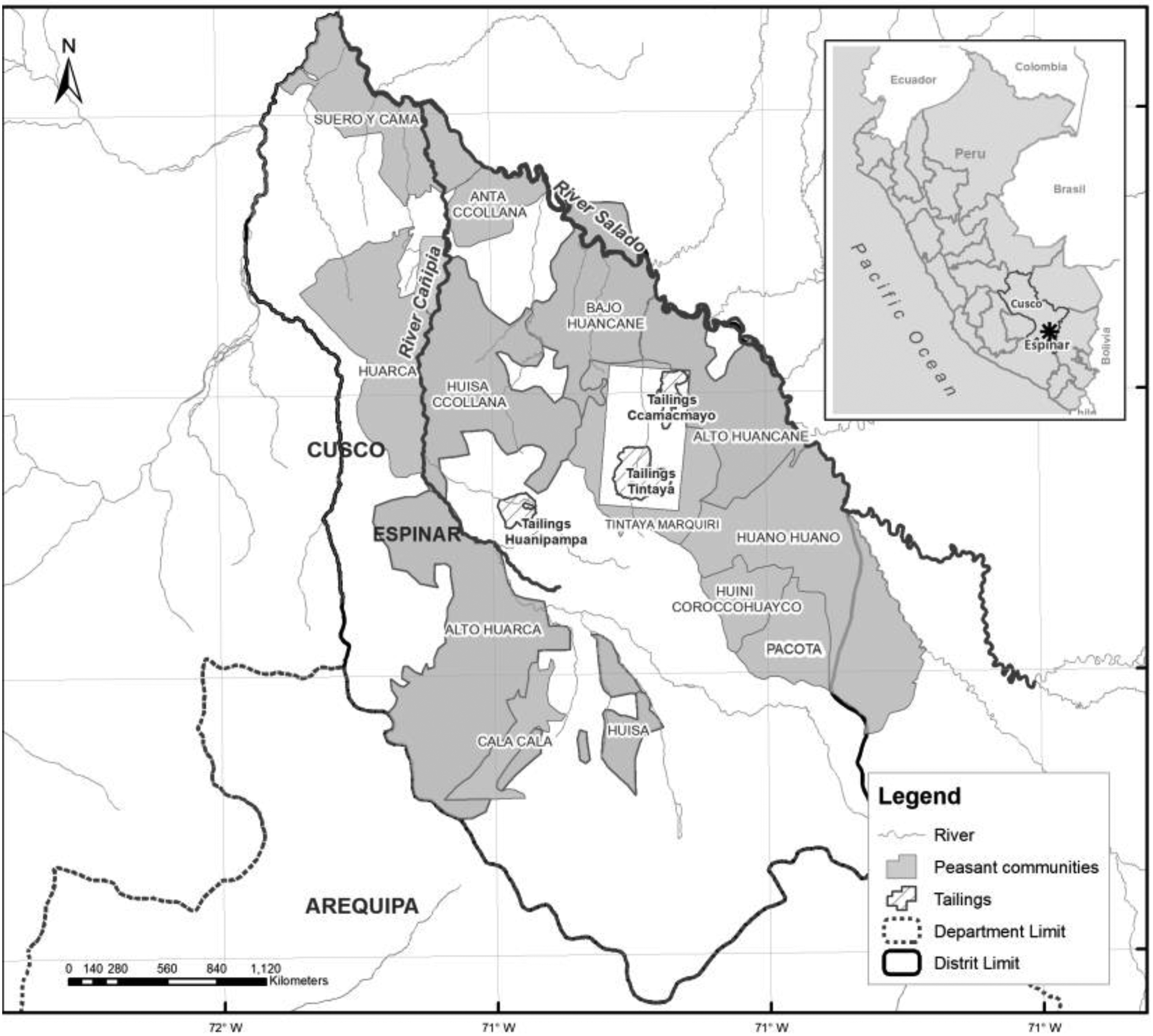
Province of Espinar, Peru. Source: Paredes (2022: 141).
The upsurge of extractivism and social protests followed neoliberal financial reforms, which countries implanted to attract foreign capital amid skyrocketing international commodity prices in the early 90s (Arellano-Yanguas, 2011; Dargent and Orihuela, 2017). Similar transformations shaped, albeit not fully determined, the rise of incarceration across the region. Despite this parallel trajectory, there has been little dialogue between scholars in the fields of punishment and extractive industries. Punishment scholars have contributed to our understanding of penal evolution in Latin America by privileging urban contexts (Fonseca, 2018; Hathazy and Müller, 2016; Sozzo, 2016, 2017; Wilenmann, 2019). Penality outside metropolitan centres, where extractive industries operate, has received considerably less attention. And while research on extractivism does focus on protest criminalization, it is mostly from the standpoint of police repression (Billo, 2017; Doran, 2017; Taylor, 2011; Taylor and Bonner, 2017). Few have analysed other penal institutions (e.g. prosecution services) equally important in this mobilization context (Lindt, 2023). Green criminology and the social movements research tradition stand out as critical perspectives on extractive capitalism indeed (Goyes, 2023; Goyes and South, 2016). Yet, neither has extensively theorized nor empirically studied the mining protest-penality nexus, which is the primary aim of our study. Our work focuses less on environmental crimes and degradation. Instead, we prioritize the analysis of punitive measures against social and environmental movements.
In doing so, we introduce the concept of ‘penal extractivism’ to denote the punitive strategies used by the state to safeguard extractive industries from citizens’ contention. In Peru, these are fundamentally police and penal strategies comprising (1) off-duty policing and critical assets legislation, (2) state of emergency declarations (SEDs), (3) police or prosecutorial notices, (4) criminal indictments (or threats thereof) against demonstrators, and (5) transfer of criminal cases to distant jurisdictions, forcing defendants to travel far away from their activist bases. Based on findings from the Espinar mining conflict in that country, we argue that penal extractivism is a dynamic and ambivalent project that targets the environmental collective action of marginalized rural populations. Punitive strategies rarely lead to incarceration but rather seek to deter demonstrations (e.g. road blockades) by subjecting many rural peasants to prolonged judicial trials, surveillance, and fear of detention. The economic and emotional impact of criminal charges is significant for those raising their voices against mining capitalism, with the process itself becoming the actual punishment (Feeley, 1992; Lindt, 2023).
What other implications does penal extractivism have on mining conflicts and social mobilizations? We found it partially succeeds in averting long-term disruptions to mining operations but fails to address the underlying social unrest. Instead, penal extractivism reinforces antagonistic positions between the state and social organizations, deepens distrust towards the state and mining corporations, and galvanizes civil society resistance; in other words, it fosters the social and political conditions that perpetuate the mining conflict. Now here, unlike dystopian accounts that stress only the coercive nature of the law and its underlying structures of domination (e.g. Darke and Khan, 2021), our study highlights the creative resistance and agency of marginalized groups, which express a collective aspiration of equitable resource-based development.
This study makes significant contributions to the study of punishment and extractive industries. By introducing penal extractivism, we may capture the empirical manifestations in which the state uses punitive strategies – primarily against marginalized peasants – to safeguard extractive development. Our conceptual innovation sheds light on the relationships between the extractive and penal fields, offering grounds for future comparisons both within and between nations. The study also delves into the ambiguous effects of penal extractivism on conflict resolution and social mistrust towards mining corporations and penal institutions, which, as noted earlier, research has only partially addressed. As we write these lines, new mining projects are underway across South America, grassroots organizations persist in the struggle, and local populations suffer from penal and environmental violence. Bridging this knowledge gap is thus of utmost importance, even more so amid calls to ‘southernize’ and ‘decolonize’ criminology (Carrington et al., 2016; Iturralde, 2023; Sozzo, 2023).
The article is divided into six sections. We begin defining penal extractivism from a political economy perspective. Next, we describe the mining conflict of Espinar and its landmark events. We then contextualize our case study and methodology. The following section carefully describes the strategies of penal extractivism. We then examine how grassroots and civil society organizations resist state coercion and conclude by discussing our findings and contributions.
Penal extractivism
Extractivism is the exploitation of raw natural resources ‘in large volumes and/or high intensity’ without or with limited industrial processing (Gudynas, 2018: 62). There is a debate on the pros and cons of this model, and whether it acts as a ‘curse’ or not for developing countries (Karl, 1997; Ross, 1999; Thorp et al., 2012). While negative impacts include displacement of communities, environmental degradation, and human rights violations, some argue that extractive industries (e.g. mining, oil, and gas) can significantly contribute to state revenues through taxes and royalties (Dunning, 2009), playing a central role in funding policies and development projects. For example, in Latin America, ruling elites consider extractivism to be an essential source of income, a dominant discourse that scholars describe as the ‘commodities consensus’ (Svampa, 2015: 67, 2019: 14) or the ‘extractive imperative’ (Arsel et al., 2016: 881). How extractivism interacts with the criminal justice system, and what role does punishment against those who fight livelihood and environmental degradation play (if any) in preserving extractive industries?
These questions invite us to explore the historical connection between extractivism and punishment, dating back at least to the sixteenth and seventeenth centuries with the rise of colonial capitalism. Though seldom described as such, examples of extractive penal labour abound in the literature (Melossi and Pavarini, 2018). The European workhouse, a forerunner of contemporary prisons, entailed the systematic processing of raw materials. English criminals were often sentenced to agricultural labour in the colonies – to work in the despoiled lands of indigenous peoples (Rusche and Kirchheimer, 2003). The ‘mining mita’ was a regime of indigenous labour imposed by Spanish colonial authorities across the Andes (Cotler, 2005). The U.S. burgeoning cotton industry infamously abused slave labour in the country's south. This historical trajectory reveals the role of penal labour within the political economy of extractivism. Vice versa, it shows the importance of extractive capitalism in the history of punishment as a social institution.
Penal coercion remains a central component in contemporary resource-based development. But it is less used to discipline the labour force and more to limit dissent (Boykoff, 2007). Unlike historical instances of forced and penal labour, such as the infamous ‘coolie trade’ during the Peruvian guano boom (Loustaunau et al., 2022), present-day penal extractivism is less concerned with regulating the labour force as this would simply not comply with today's democratic labour standards. Its primary goal is to suppress dissent and undermine social movements threatening extractive investments. Under the extractive imperative philosophy, state officials often describe these movements as ‘unpatriotic’ or ‘against the nation’ – see Riofrancos’ (2017: 685) evidence from Ecuador. Labelling protesters as national security threats indeed helps to justify police and penal coercion (Monaghan and Walby, 2017: 57). While we could theorize today's penal extractivism around practices of penal labour (see Page and Soss, 2021), this article focuses on contemporary extractive industries, social mobilization against them, and subsequent penal measures.
Accordingly, we define penal extractivism in political economy terms as the punitive strategies a state implements to safeguard extractive industries from citizens’ contention. Regardless of whether the objective is to prevent, control or punish perceived transgressions, these strategies are punitive because they target not only individual offenders but entire populations that decide to challenge extractivism. They are also punitive insofar as those affected usually perceive and denounce them as such, making penal extractivism a fundamentally violent phenomenon (Super, 2023). Our definition is inspired by Rusche and Kirchheimer's (2003: 5) conspicuous assertion that every system of production tends to develop punishments in correspondence with the productive relations of a given society. But importantly, we distance ourselves from economic determinism and argue that cultural representations underpin legal definitions of extractive industries as goods worthy of protection through coercive means.
We must emphasize that neither extractivism nor its punitive strategies (i.e. penal extractivism) are purely material and instrumental. They embody cultural and ideological forms – thereby the suffix ism. As previously mentioned, ruling elites in resource-based economies often perceive extractivism as a crucial, almost sacred path to development (Leiva, 2019). Therefore, it is essential to recognize that activities like copper or gold extraction carry symbolic meanings beyond their material aspects – they represent more than just the extraction of copper or gold (Murray Li, 2007). Likewise, punishment as an institution is contingent on legal actors being socialized within a specific political and penal culture (Garland, 2013; Smith, 2008). Extractive penality in the Peruvian context is further shaped by a cultural, indeed neoliberal, framework that assigns a sacred value to the exploitation of commodities, and which links punishment with order maintenance and development.
That being said, scholars have generally studied protests and extractive disputes under notions like ‘protest policing’, ‘the criminalization of protests’, ‘social control’, and ‘labour discipline’. Although not in contradiction with penal extractivism, these categories either encompass too broad a spectrum of phenomena or neglect penal aspects we deem relevant to understanding the connection between penality and extractivism.
First, researchers in the field of extractive industries use criminalization rather loosely to denote either the passing of legislation increasing the penal costs of social mobilization, police excessive use of force, or the prosecution of demonstrators (Taylor and Bonner, 2017; Lindt, 2023). As used in the literature, the term narrowly connotes a rather vertical, arbitrary, and dysfunctional form of state coercion (Doran, 2017; Middeldorp and Le Billon, 2019). The notion also exhibits a semantic tension between ideological critique and social analysis, with the former being too often privileged over the latter. More general legal scholarship views criminalization dispassionately as either ‘the law in the books’ or the actual practice of law enforcement (Lacey, 2009; Zaffaroni et al., 2002). While these dimensions are all constitutive of penal extractivism, our concept privileges the analysis of empirically observable punitive strategies, many of which extend beyond formal criminalization. For example, surveillance of road infrastructure in Peru may not directly aim to punish (criminalize) individuals but still contributes to a widespread sentiment of prosecution among the population – a punitive dimension that penal extractivism fully captures.
Second, protest policing, primarily rooted in the Global North, underscores police coercion in the handling of demonstrations (Della Porta and Reiter, 1998; De Lint, 2005). Things are different elsewhere. In Latin America, after procedural penal reforms and the advance of neoliberalism in the extractive field, line prosecutors and police officers are responsible for conducting criminal investigations and handling protest events (Lindt, 2023; Tuesta, 2021). As a category of analysis, protest policing overlooks other penal institutions and actors involved in the handling of demonstrations. It emphasizes only police governance, not penal governance.
Third, penal extractivism and social control are obviously interconnected. However, social control's various meanings and over-inclusiveness drive us to introduce a more specifically suited concept. Janowitz (1975) notes that early American sociologists conceived social control as a property of human interaction enabling cooperation according to desired values. Later, under structural functionalism, the notion shifted in meaning to denote conformity-inducing practices that opposed deviance. Scholars in the 1960s, influenced by labelling theory and critical criminology, highlighted social control as a product of state action that increased social conflicts, inequality, and crime (Sumner, 1997). Scheerer and Hess (1997) find social control a useful category at a higher level of abstraction, but its varied conceptual history (Melossi, 1992) makes it too diverse for our specific empirical analysis. The term includes state criminalization, resource-regulating policies, community defence actions, and historical examples like Chinese forced labour in nineteenth century Peru (Clark et al., 2018; Loustaunau et al., 2022). It proves unsuitable for theorizing the nuanced relationship between mining protests and penal power.
Finally, we believe two main features differentiate penal extractivism – for example, with respect to labour discipline and general crime deterrence. First, its sociological and political connection with extractivism as a global project that unites nations and shapes the world we live in. Resource-extraction is crucial for the global economy, and this will unlikely change anytime soon. Governments and elites worldwide agree on the ‘extractive imperative’ (Arsel et al., 2016; Svampa, 2015), thereby on the need to securitize extractive industries. Such ideological consensus is rarely present in labour discipline and other forms of social control. Second, unlike general crime deterrence, formal democratic states have more difficulties legitimizing repression against extractive protests. This is especially true in democracies where labelling protesters as ‘criminals’ will likely meet civil society resistance. Still, as our evidence shows, penal extractivism ends up affecting entire communities living near extractive operations. Since adjudicating, legitimizing and individualizing criminal responsibility is difficult in the extractive context, states tend to develop punitive strategies seldom used in other areas of crime control or labour discipline. 2
Penal extractivism, or extractive penality, thus merits a different chapter in the punishment and society literature. It should not be treated as ‘just another form of penality’. The concept captures empirical regularities in the extractive domain more accurately than neighbouring terms. Moreover, penal extractivism distinctively evokes two interrelated political economies – that of punishment and extractive industries. The concept is not ahistorical; as formulated here, it echoes the legacy of penal practices within extractive industries and the struggle of those who experience their effects. In that sense, we think the Andean region is ideal for studying penal extractivism, its past and present. Historically, mining capitalism is a dominant mode of production in Bolivia, Chile, Colombia, Peru, and Ecuador, to name only a few. Punitive laws have been implemented in these countries to protect the extractivist models, drawing convergence from both left and right regimes. Evidence in this regard is clear. Research in Argentina (Taylor and Bonner, 2017), Ecuador (Billo, 2017), Peru (Lindt, 2023; Paredes and Schorr, 2021; Saldaña and Portocarrero, 2017), and other Latin American countries (Alvergne, 2018; Celi Toledo et al., 2021) show the increasing legal costs of social mobilization for environmental defenders, notwithstanding community development strategies aiming to secure a social mining license. 3 In the following sections, we focus on the mining conflict of Espinar, a province in the Cusco Region of Peru where the harmful effects of that relationship are visible and longstanding.
The case of Espinar and the landmark event of 2012
The Espinar mining conflict centres on Glencore Corporation's Tintaya-Antapaccay copper extraction project in Espinar, Cusco, at 4100 m above sea level (Figure 1). Operating since 1980 and privatized in 1994, the project switched ownership through the years with multinationals such as BHP Billiton, Xstrata, and now Glencore. With a recent expansion extending its lifespan by 20 years, Tintaya-Antapaccay is a key mining project in Peru's Southern Mining Corridor given its connection to major mining hubs and export routes along the coastline.
In the early 2000s, protests under BHP Billiton sought fair compensation and local development investments, resulting in a 3% annual mining rent agreement (Muñoz et al., 2007; Paredes, 2023; World Bank, 2005). Tensions rose over a decade later when the state approved an expansion of the mining project. Dissatisfied with perceived limited benefits, social organizations pushed for renegotiation, aiming for a 5% contribution (Muñoz et al., 2007). Environmental concerns simultaneously surfaced. Local NGOs received complaints about pollution impacting health and livestock (Paredes, 2022). On 21 May 2012, after unsuccessful negotiations to increase mining profits and address environmental concerns, social organizations went on a general strike.
Widespread mobilizations led to confrontations involving 500–1500 riot police, resulting in two protester fatalities, over 100 injuries, 22 arrests, and detentions inside the mining facility. A week-long state of emergency was declared, during which demonstrators briefly held the local Attorney General hostage but released him after mediated negotiations. On 28 May, legal experts, along with church representatives and the prosecutor-in-chief, entered the mining facility and confirmed numerous on-site arrests. They raised concerns about due process violations and noted that even a police station, which used Xstrata-branded paper, operated inside the mine. Outside the facility, riot police seized a church organization's vehicle, arresting two representatives and a community leader for allegedly inciting mobilizations. Police faced accusations of abuse and evidence planting – which later a court ruled inadmissible. The sequence continued with the arrest of Espinar's Mayor, Oscar Mollohuanca, a prominent environmental defender.
These events received extensive media coverage and condemnation from human rights and environmental organizations. The Attorney General replaced the prosecutor-in-chief with someone holding a retributive stance, immediately accusing the leaders of mischief and rioting. The judiciary transferred the cases to a court district hundreds of kilometres away from Espinar, resulting in a jurisdictional dispute. After a decade, the Court of Appeals for Ica recently dismissed charges due to a lack of evidence. The National Police have announced their intention to appeal the verdict (La República, 2023). This crisis extended beyond national borders, as environmental defenders and civil society organizations filed a lawsuit against Xstrata in a London tribunal, citing violence within the mining facility (Bowcott, 2017). Over a decade later, the Environmental Assessment and Oversight Agency (OEFA, 2023a, 2023b) imposed pollution-related measures on Glencore, confirming a past study on elevated metal levels in local water and bloodstream samples (CENSOPAS, 2010).
This heavy-handed state repression left a lasting impact on collective memory – to the extent that local social organizations annually commemorate the narrated events of 2012. It also deepened the public mistrust of the criminal justice system by reinforcing perceptions that legal authorities defend corporate interests. However, we must not misconstrue that penal extractivism only manifests in periods of overt confrontation. Moderate penal struggles are persistent in Espinar and similar contexts, permeating the everyday life of rural communities.
Methods
We deliberately chose to study the Espinar mining protests in Peru because they make a representative case within the landscape of Latin American mining conflicts. These generally involve continuous environmental, socioeconomic, and even cultural disputes between multinational companies, rural communities, and state institutions (Alvergne, 2018; Billo, 2017; Doran, 2017; Middeldorp and Le Billon, 2019; Riofrancos, 2017; Svampa, 2019; Taylor and Bonner, 2017). These and other governance challenges are all present in Espinar. The enduring relevance and sustained low intensity of this conflict further make it a salient case to study the logic, dynamics, and nuanced implications of penal extractivism.
The study adopts a process tracing methodology that facilitates the analysis of punitive strategies within our case, emphasizing the underlying sequencing of decisions, actions, and interactions (George and Bennett, 2005). This methodological approach aligns with established procedures of purposive sampling (Tansey, 2007), fieldwork-based interviews, and extensive secondary data analysis (George and Bennett, 2005). The deliberate selection of ‘elite informants aimed to provide diverse firsthand insights into events, decision-making processes, and the social mechanisms’ (Seawright and Gerring, 2008) that structure penal extractivism. The purposive sampling strategy followed two criteria: a quota for different types of informants to ensure a broad spectrum of stakeholders engaged in the studied process and a positional criterion to ensure interviewees possessed sufficient knowledge in their field (Tansey, 2007). Our sample (N = 29) includes frontline and managerial police officers, prosecutors, criminalized social leaders, community and association leaders, defence attorneys, representatives from the Ombudsman Office, and local NGOs providing legal aid. This method permits an in-depth processual analysis of history (Mahoney, 2015) that avoids ‘cherry-picking’ events and testimonies based on a selective reading of history. Instead, we explore all relevant testimonies, times, and events associated with penal extractivism, its evolution and its impact on the communities of Espinar.
In May 2022, we conducted interviews in Cusco and Espinar, each lasting between 30 min and 1 h. We obtained informed consent and authorization for audio recording under respondent anonymity. We required formal approval to interview state officials, and used NVivo for data analysis. Despite numerous attempts, Glencore representatives were unavailable for interviews. Additionally, data on arrests and criminal charges proved challenging due to decentralization in rural areas. While recognizing the non-universal applicability of our data and variations in the types of mining conflicts (Paredes, 2022), we think our study paves the way for understanding the logic of penal extractivism, thereby contributing to knowledge creation across two scholarly domains – punishment and society, and the extractive industries and society. Going beyond the confines of empirical generalizations, our findings and theoretical contribution provide a robust foundation for scholars in these fields to further explore the penal landscape of extractive industries.
The strategies of penal extractivism
Off-duty policing and critical assets legislation
The National Police of Peru signed 138 agreements with mining corporations for an estimated US$15 million between 1995 and 2018 (Instituto de Defensa Legal, 2019: 8–9). The three multinationals that have operated in Espinar since the early 2000s have all signed such agreements. These are regulated by a provision distinctively named law of extraordinary policing services, which authorizes officers on leave or vacation to work for public or private organizations (SPIJ, 2017a). Off-duty services are due under exceptional circumstances (hence the name ‘extraordinary’), for example, when police stations are understaffed, or private security is unavailable. A 2017 provision departed from this principle and authorized off-duty policing for the external security of mining infrastructure (SPIJ, 2017b: 6). These measures, Saldaña and Portocarrero (2017) 4 note, facilitate the privatization of police services.
Between 2017 and 2018, Pedro Pablo Kuczynski's administration issued several decrees labelling mining infrastructure and the road system necessary for their operations as ‘critical national assets’ (SPIJ, 2017b, 2018b). This gave the state freedom to allocate – without the need for any agreement – police personnel to safeguard these assets and blurred the line between on-duty and off-duty policing Any government now has the authority to allocate on-duty police personnel to protect private mining infrastructure because these are ‘critical national assets’. The latter facilitates off-duty policing as corporations can hire that same personnel to follow up on the job. Moreover, any disruption can be framed as a threat to critical national assets and used to justify a SED, thus increasing the penal costs of protesting.
State of emergency declarations
SEDs have become a common strategy to handle protests in Latin America (Wright, 2018: 44–45). They entail a temporary suspension of fundamental rights such as personal safety, freedom of movement, the right to assemble, and the inviolability of one's dwelling (Congreso de la República del Perú, 1993). As we write, ‘the highway’ connecting Espinar to adjacent mining hubs and strategic seaports (henceforth, ‘the mining corridor’) is under a state of emergency. The measure has been extended six times since first enacted on 14 January 2023 (SPIJ, 2023a, 2023b). We found 22 SEDs for Espinar in the last 11 years: 14 issued to control mining conflicts and the remaining to address the spread of COVID-19 and weather-related crises.
The frequent use of SEDs contradicts their constitutional definition as exceptional measures. Siles (2016: 134) denounces a ‘normalization of emergencies’ in Peru. Legal scholars note SEDs are poorly justified. Official decrees often rely on dogmatic and dubious intelligence reports (Saldaña and Portocarrero, 2017). Furthermore, some describe SEDs as preventive strategies to secure the ‘internal order’ – a buzzword in Peruvian legal culture. For example, one decree for Espinar highlights the necessity to prevent alterations to the ‘internal order and the normal functioning of activities’ (SPIJ, 2018a: 1). Another used predictive language to justify an extension: ‘Since there is not yet a solution to the conflict with the communities, it is not possible to discard that protests will resume, thus the need to prolong the state of emergency’ (MININTER, 2018: 2; SPIJ, 2018c).
The role of the military is also controversial. Almost every SED authorized deploying military personnel in Espinar (SPIJ, 2023a, 2023b). Constitutionally, they can cooperate on public safety only under exceptional circumstances (i.e. a state of emergency). The Ministry of Interior often draws on classified intelligence, arguing the need to cover police shortages. A second justification centres around crime prevention, with official documents labelling the military as a ‘highly dissuasive force’ that ‘will guarantee the safety of infrastructure’ and essential public services (MININTER, 2023: 2), again contradicting the exceptional character of military involvement under Peruvian constitutional law.
Notably, these strategies interact according to the intensity of mass mobilizations. Police and private security monitor the mining corridor, nearby mining hubs and seaports. Authorities recognized the strategic importance of this infrastructure, hence the need for permanent surveillance. A local police officer noted that regular police and off-duty officers hired by Glencore patrol the mining corridor, immediately alerting (via WhatsApp) of any risks of interference to the traffic of vehicles: ‘Even if there is a demonstration by five people, they send an alert, and the mine immediately stops the circulation of vehicles […] Yes, yes, they patrol the corridor. Even there are police personnel who are…There are two bases. Two bases are located up there. They also patrol the corridor’ (Police Officer).
Two other interviewees explained that Glencore's community relations personnel also contribute to surveillance, as they are acquainted with the communities and the swinging collective mood. Some locals even assured people are acting as informants under the mine's payroll: ‘people from the same community, [they] take advantage of their ignorance, of their gullibility and poverty, some have been indoctrinated to give minute by minute report of what's going on in there’. We could not corroborate these versions, nor others that claimed a police station still operates (as in 2012) inside the mine. Yet our interviewees agreed that surveillance is permanent and that two bases with police personnel work in the area.
Moving beyond surveillance, if a small group of protesters spontaneously blocks the mining corridor, police will engage in negotiated management to attempt a solution. This approach is generally used when the number of demonstrators ranges from five to twenty. Officers will arrive at the scene and persuade demonstrators to stand off the road. They will remind them that blocking the traffic circulation is illegal. If they persist, a local prosecutor will arrive to intensify negotiations. People might respond by demanding the presence of a mining representative, which often indeed comes to facilitate a solution: ‘It takes five peasants to block the entire corridor, […] they demand a mining representative to come and talk, five peasants it's all it takes’, one police officer noted.
A SED will be the outcome if a strike persists, giving leeway to police reinforcements carrying equipment such as tear gas, face shields and, supposedly, non-lethal weapons. Note that a road blockade affects Glencore's operations and those of two other companies: Hudbay and MMG. Neither local police nor demonstrators look forward to escalation. The 2012 events are fresh in the collective memory. Police authorities stress their priority is maintaining public order at ‘zero social costs’, avoiding excessive force which could result in serious injuries or fatal victims. But the equilibrium is tense. Two officers in managerial positions insisted that unblocking the mining corridor is equally vital given their obligation is to protect the ‘critical national assets’: Our functional obligation is to protect the critical asset, that is the southern corridor extending from Apurimac to Arequipa. In compliance with the law, we must unblock it [the mining corridor]. But we often have problems covering those 292 Km. We have only three police stations with no more than 200 men. I’m exaggerating: perhaps no more than 50 [men]. That is why we apply some techniques. We have installed two bases. […] We’ll see if the budget permits putting one more to cover the entire area and improve the conditions that vehicles of Las Bambas, Hudbay and Antapaccay (Glencore) require to take their products out to the seaport of Matarani for export and processing. (Police officer)
This quote illustrates the connection between a mining-dependent notion of ‘critical assets’ and the police strategies tailored to unblock the mining corridor, from negotiated management to escalated force (Della Porta and Reiter, 1998: 15–17).
Police and prosecutorial notices
Somewhere in between police surveillance and criminal prosecution, authorities make frequent use of notifications to deter protesters. If they learn via radio broadcast or intelligence information that communities plan to go on strike, they will identify and send notices to leaders and promoters. Prosecutors, police officers, and criminalized individuals acknowledge this, with the latter group saying that local radios are used to disqualify their causes. Notices are official letters encouraging people to abide by the rule of law during protests or to abandon the idea if a state of emergency has been declared – otherwise, they should expect to be criminally charged. These warnings may also arrive informally through police ‘visits’ to rural communities, situations they use to drop intimidatory messages on the penal consequences of mass mobilizations. ‘I’d prefer to receive the notification rather discretely, not like publicity. To your leader, we are…[investigating], we are coming’. Or on the way, [they] meet people and loudly speak: ‘We are coming for that person because he's indicted’. ‘What will our neighbours think of this? What will the rest think?’ ‘Hey, they are going to take him, and if we speak against the company, they going to take us too’. I see that as intimidation. Because silently [it could be done]. It's unnecessary to have a police car on your door. We have cell phones. They have our personal information. So simply they could just… The company knows where I live. So, they don’t have to come to our little village telling everyone, ‘We are looking for that lady’. (Criminalized individual) We do crime prevention together with the police to prevent them from affecting public or private property, and from committing any excess against people. We warn the leaders that they must do it peacefully if they protest. Otherwise, well, justice will be served. (Prosecutor)
Criminal indictments
Penal extractivism in Espinar is primarily based on criminal indictments comprising either police reports accusing protesters of committing crimes, preliminary investigations conducted by the local prosecutor, and the formal presentation of charges in court. Locals often interpret these proceedings equally as criminal indictments; in other words, according to defence attorneys, many people believe they are being prosecuted even if that is not formally the case. This belief is bolstered by the proliferation of notices, which suggests a continuum between these warnings and forthcoming indictments. Prosecutors justify all this as crime prevention and ‘just desserts’ under the rule of law.
Criminalized individuals accuse law enforcement of serving extractive interests and Glencore of moving the judicial strings. We could not corroborate these claims, even though mining representatives have often pushed for criminal charges and economic compensation. Glencore recently appealed a court verdict demanding three years of imprisonment and 230,000 soles (US$62,179) in compensation against Sergio Huamani, a prominent environmental defender (La República, 2023). But our sources confirm that police and prosecutors are primarily responsible for these indictments that disseminate a collective feeling of persecution. ‘I have been criminally indicted 12 times, one I think came from the mine, the rest from the Attorney General’, Pablo Pérez noted. ‘We want to protest, not banally, [but]a formal protest, so they don’t respect us. For not wanting to respect our rights, they indict us’, Jorge Quispe lamented. While we could not prove these claims and confirm with official data, they suggest that indictments seek the strategic incapacitation of social leaders. Police authorities justified this measure as effective law enforcement, and those on the receiving end claimed it proves the system is submissive to extractive interests. Yes, look, our police strategy follows that line, right? We need to identify the actors. There is an international norm saying that, after identifying the leader, you can control the mass. So, we always try to identify the leader. But this protest criminalization has a boomerang effect. When we criminalize and proceed with a report that is evidence-based, it creates a collective demand for no criminalization. They demand that cases be withdrawn or dismissed in court. (Police officer) Unfortunately, the Attorney General and the mining company are allies. The company calls, and they immediately react. For example, when peasants living near the corporation begin to protest, the Attorney General is already there. They barely need [colloquial expression] to get there to accuse us of whatever. Many people here are critical of prosecutors. Two prosecutors are currently being questioned: [names]. Because they are…Not only because of their relationship to the corporation but because many cases have not been processed. (Criminalized individual)
Defence attorneys and prosecutors noted that charges are inter alia for damages against public property, disobedience of public authority, vandalism, and even kidnapping – the likelihood of being indicted increases when protesting during a state of emergency. Derechos Humanos sin Fronteras (Human Rights without Borders), a local NGO, reports that 94 individuals from rural communities currently face charges. NGOs like the former provide legal aid and advocacy for the criminalized and have played a central role in avoiding convictions. Although higher courts often dismiss charges, suggesting that judicial independence somehow exists, trials take a long time as prosecutors frequently appeal verdicts. What is puzzling, a lawyer commented, is that public attorneys appointed by the National Police and the Mining Corporation often present their appeals. This judicial pattern reveals the institutional dimension of penal extractivism.
The transferring of criminal cases
Social unrest in Espinar prompted Peruvian judicial authorities to transfer the judicial cases of prominent environmental defenders to the faraway judicial district of Ica in May 2012. This controversial decision was justified on the grounds that reigning social turmoil in Espinar would endanger case processing per the Peruvian Constitution (Poder Judicial, 2012). The Judiciary Act referred to the state of emergency back then in place to stress the likelihood of undesirable disturbance. This shows the relationship between criminal indictments and SEDs as punitive strategies. Note the decision to transfer criminal cases was also in response to a ‘classified’ request from the Ministry of the Interior (Poder Judicial, 2012), illustrating that penal extractivism is a multi-agency project.
Defence attorneys and NGO representatives claimed the above decision violated the rights to defence, natural justice, procedural fairness, and proportionality. Some of them filed a constitutional complaint to restore Espinar's jurisdictional competence. The appeal reached the Tribunal Constitucional (2015), but the highest court ruled against the appellants. By transferring cases, the judicial process is less likely to be disrupted. A senior prosecutor noted that legal actors may worry less about security and public pressure. He added judicial authorities initially sought to transfer cases somewhere closer to Arequipa (293.7 km from Espinar) but soon realized protesters could still afford the trip. The Judiciary then decided that Ica, a district located 989.8 Km from Espinar, was the best option. That is approximately a 17-h drive, more if travelling by bus.
Prosecutors insisted upon interviews on how this measure was constitutionally compliant and necessary given the security concerns. It aimed at safeguarding the judicial process, though at the expense of increasing the scope of deterrence and the penal risk of activism. Many would fear this sets a precedent for future judicial transfers that isolate defendants from their social support base. Being already socially marginalized, they must bear the economic and emotional burden of travelling to court hearings. Many judicial trials have lasted more than 10 years. Some have not even concluded yet. ‘I often had to go all the way there [Ica]. Six times during the first trial. Same during the second trial. A little bit less now. Since the pandemic, I was allowed to attend online’, Carlos noted. ‘We live in the countryside, and to file a complaint you must travel. It's a whole expensive process. We suffer with the mine. Where there is no mining, I’m sure people live more peacefully’, another interviewee noted. Here again, local NGOs have provided legal advice and financial aid to partially cover travelling expenses.
Everyday resistance of the ‘criminalized peasant’
Our research found that many police officers and prosecutors believe protesters lack genuine political consciousness. State officials acknowledge the environmental crisis but stress that local leaders manipulate the population for political gain, for example, to promote their candidacies for regional elections or negotiate favours with the mine (Paredes, 2022). Since these leaders are inciting the population to protest, pressing charges against them is a ‘just dessert’ under the rule of law. This collective representation assumes leaders are disingenous while peasants are an easily manipulated, gullible crowd incapable of exercising independent political will.5 Legal authorities, it seems, underestimate ordinary people's cognitive capacities and political awareness (Boltanski and Thévenot, 2006; Scott, 1987). The explicit vexation toward rural leaders reflects a colonial and classist mindset (Cotler, 2005). Many of them are no longer ‘subjugated’ indigenous peasants. They have received formal education and political training, transitioning from a position of subordination to one of agency, which precisely distrubs legal authorities: Many community representatives own tanker trucks which they rent – rumours say – to the mine. They also own houses in Cusco and Arequipa. Instead, I must borrow money to purchase a car. I must be paying, I don’t know, a loan for five years. And I ask myself how these peasants can…and they end up saying, ‘I only work selling candies in town.’ With tanker trucks, supply trucks, SUVs, and everything? (Prosecutor) Community representatives are behind mobilizations, and behind there's always an advisor. This is more personal than political. A new representative is elected, and they reignite demonstrations against the mine. They seek visibility for later competing in local elections. And to be honest, most demonstrators are rural peasants. And if you ask them why they are here, they don’t even know! They join because otherwise they get a 100–200 soles fine (US$30–60). So, obviously, they are instigated by community representatives. It is both personal and political. They seek visibility to see how far they can get. (Prosecutor)
Because police and prosecutors interpret the above as prima facie evidence of manipulation, they often use criminal indictments against local leaders. This ‘everyday’ penal extractivism elicits collective sentiments of fear and persecution yet also anger and solidarity. Indictments aim to undermine social movements. Some argue deterrence is somewhat real. Others suggest that people are still determined to fight despite the penal costs. Evidence suggests that social leaders find ways to counter penal extractivism. Social leaders note that criminalization is widespread and draw the logical and symbolic conclusion that being charged is the consequence of protecting the public interest – not because they committed a crime. When indictments become a common occurrence affecting many, the social label of denunciado (criminally indicted) loses its effectiveness as a means of shame and deterrence. This cognitive shift drives people to reject the legal justification of punishment: We went with the president [of the community] to stop those tank trucks from taking the water out. The indictment came right after. Of course, they don’t accuse the whole community. Who's the head? They always go against the leaders. That's why I always repeat, as Mr Mauricio said, that this is an experience for us. Every representative gets a criminal indictment. Even if he's the honest person on earth. (Criminalized individual)
Social leaders and defence attorneys describe that confrontations with law enforcement often leave many residents under the impression that criminal charges will be laid. Whether accurate or not, that impression results from interactions where police utter threats of criminal indictment while on patrol. The goal here is to promote deterrence. Actual indictments yield tangible economic hardships for rural peasants. Interviews suggest the significant economic burden of hiring defence attorneys, diverting valuable time and energy from prolonged criminal proceedings, and facing unpleasant interactions with legal actors and the press. But to understand people's responses, we must delve into the symbolic meanings underpinning their descriptions of everyday penal extractivism. This will help us to fully grasp the linkage between punishment, collective representations and social mobilization (Simmons, 2016).
In that sense, we found that SEDs, threats of indictments, and surveillance strategies increase the collective sense of persecution. This creates an emotional toll on rural communities and reinforces their mistrust of state institutions and representatives. However, similarly to Simmons’ (2016) studies in Mexico and Bolivia, in Espinar, these shared emotional understandings contribute to the renewal of collective identification. So, if penal extractivism aims to weaken social mobilization and discourage dissent, the labelling process yields the opposite effect (Becker, 1966). Demonstrators identify and frame themselves with a new social identity: that of the campesino criminalizado (criminalized peasant). Therefore, paradoxically, indictments simultaneously become a personal grievance and boosters of collective identity, a process Goffman (1963: 112) describes as ‘in-group alignment’. Here, law enforcement fails to recognize that demonstrators could be using ‘techniques of information control’ (Goffman, 1963: 91) to disguise identification. People understand that acknowledging commitment increases their visibility and chances of being targeted. When police officers ask for identification, individuals often reply, ‘We are all leaders’ and ‘We are all protesting’. These responses frustrate police officers and prosecutors seeking to individualize responsibilities. Rather than manipulation, as police officers and prosecutors maintain, these responses express a collective identity attuned to avoiding identification.
So, against political expectations of deterrence, penal extractivism activates a network of civil resistances to criminal indictments. These may dissuade some individuals from joining general strikes but do not deter demonstrations as a whole – they even prompt NGOs to support those being criminalized (Paredes, 2016). Goffman (1963: 67) defines cognitive recognition as ‘the perceptual act of assigning an individual a specific social or personal identity’. Legal actors perceive protesters as negatively influenced by mischievous political interests, disinformation, or manipulation, a penal belief that offers little emotional incentive to pursue noncoercive dialogue with individuals who already carry the burden of stigmatization. Conversely, demonstrators accuse authorities of pursuing hidden economic interests against the community. These findings on how penal extractivism flares up division and discontent align with prior research on environmental disputes in Latin America (Doran, 2017; Lindt, 2023; Rasch, 2017; Taylor and Bonner, 2017). However, our work delves deeper as it unravels how legal actors ideologically support punitive strategies under the extractive imperative (Arsel et al., 2016), and how social organizations react in opposition. This further helps identify differences in the symbolic value that legal and social actors (Simmons, 2016) attribute to penal extractivism.
Discussion
In this article, we formulated and applied the concept of penal extractivism within a case study in the Peruvian region of Espinar. We argued this concept is more specific and theoretically useful than neighbouring terms. Protest policing overlooks other penal institutions, social control is over-inclusive, and labour discipline is too narrow. Likewise, criminalization is narrowly limited to the judicial sphere, thereby ignoring the punitive effects of preventive practices (e.g. police surveillance of mining infrastructure) extending beyond that scope. Instead, penal extractivism offers a tighter fit between conceptual attributes and empirical manifestations. The notion allows us to think a bit more outside ‘the crime and punishment box’; that is, theorizing the connection of two political economies – punishment and extractive industries – seldom analysed despite their historical and sociological affinities. Penal extractivism articulates these traditions, thus revealing its utility across research fields. That is, we think, its heuristic virtue as a category of analysis: for punishment and society, it brings to the forefront a set of problems and phenomena hitherto overlooked and undertheorized despite their cross-national relevance in Latin America; for scholars in the field of extractive industries, it provides a framework to elucidate the penal specificity of resource-based development.
Second, and moving into the empirical sections of our paper, the mining conflict of Espinar highlights long-standing social divisions in Peruvian society and how the state prioritizes mining capitalism over environmental and livelihood concerns (Merino, 2015; Paredes, 2022). Social organizations in Espinar do not advocate for Glencore to leave. Their representatives acknowledge dependency on mining revenues. But they insist revenues and environmental well-being are (non-mutually exclusive) priorities (Paredes, 2022). Latin American democracies generally have limitations representing these voices from communities impacted by mining capitalism. National authorities of both right and left-wing governments frame extractivist interests as beneficial to the entire population – Svampa's (2015: 67) ‘commodities consensus’ idea. However, as our case study demonstrates, penal extractivism only partially undermines social movements that challenge this consensus in Peru. It instead shapes the social identity of denunciado (indicted) or campesino criminalizado (criminalized peasant). This unintended sociological consequence of extractive penality and its labelling process triggers further environmental contestation.
Third, our evidence indicates that penal extractivism has limitations. The Peruvian state is weak, and prior research shows that resource scarcity hinders law enforcement in rural contexts (López and Tuesta, 2015; Tuesta, 2021). Strategies like police notices and indictments are cost-effective methods that expose individuals to the penal system. But even if the Peruvian state had greater infrastructural capacity, as in Chile (Soifer, 2015), this would unlikely yield more punitive outcomes. The state cannot afford prolonged disruptions to mining operations or frequent human rights crises. Mining companies tend to avoid the reputational costs of being associated with repressive systems too. They are under civil society scrutiny in their host countries, further bolstered by international binding conventions and local NGOs offering legal support and advocacy (Paredes, 2022). These factors have proven to moderate penal extractivism. They become ‘legal shelters’ for grassroots organizations challenging the mining status quo in domestic and international arenas. Overall, in a formal democratic state, the political implications of overly punitive repression against social mobilizations can be more serious than those against crime. Claims by police authorities that they must protect mining infrastructure at a ‘zero social cost’ illustrate this political and penal ambivalence.
Fourth, although designed by the state, extractive penality is not orchestrated by a coordinated state system fully responsive to extractive interests. The judicial system remains a battleground of legal disputes (Goodman et al., 2017). Note that charges seldom result in prison sentences in Espinar and other similar cases. Courts often dismiss charges, although after lengthy proceedings. This trend indicates room for contestation and degrees of autonomy within the Peruvian judicial system, notwithstanding its procedural unfairness in multiple issues (e.g. the transferring of judicial cases). Claiming the entire criminal justice system is subservient to penal extractivism is thus inaccurate. As we demonstrate, some institutions like the National Police and the Attorney General are more compromised than others with this agenda.
The study also invites us to examine the enduring legacies of colonialism. Unlike the neoliberal penality thesis, which faced rigorous critiques (Dal Santo, 2020; Sozzo, 2018), decolonial theories are being welcomed and revisited in Latin America (Iturralde, 2023; Sozzo, 2023). Yet, in some cases, theory application yields overly deterministic accounts that overlook national and cross-national penal variations, as well as discontinuities and local resistance. For example, drawing inspiration from Anibal Quijano's coloniality of power, Darke and Khan (2021) hyperbolically argue that colonialism – the colonial past – is the main driver of penal outcomes in Brazil. Similar conclusions that ignore other social forces and stress only continuity cannot be drawn from our study. From a political perspective, few things are as emblematic of neoliberalism and colonialism as mining capitalism. Yet sociologically, penal extractivism in Peru defies reduction to the colonial past (Rochabrún, 2007: 454) despite its undeniable influence in regions like Espinar. People here do not experience criminalization as passive subjects. Rural peasants are not yanaconas, 6 mining representatives are not feudal lords, and prosecutors are not visitadores 7 representing absolutist powers. On the contrary, the local population stands at the vanguard of democratic contestation (Paredes, 2016). Social leaders have gained political and legal knowledge, and civil society actively supports their causes.
We believe Espinar, as a case study of environmental and penal suffering, could lay the empirical and theoretical groundwork for future comparative research. For instance, we may hypothesize that social movements will have less margin of contestation in extractive-capitalist societies with more repressive, stronger, and centralized states. We may speculate too that coloniality will have a decisive influence over penal extractivism in societies where, ceteris paribus, the colonial past remains a central organizing principle of social relations. Recall that extractive penality is a global phenomenon whose political economy is intertwined with the history of the prison and social control institutions. Future research, therefore, could address comparisons between past and present local cases. For example, despite obvious administrative and socioeconomic differences, Espinar and the conspicuous labour struggle in the US Appalachia region exhibit striking similarities. Coal workers were also subject to surveillance, initially to hinder unionization efforts and later to neutralize strikes and social mobilization (McKinney, 1977). Leaders faced short-term imprisonment, albeit later charges were dropped. A pivotal event – the Battle of Blair Mountain – also shaped the historical memory. People in both distant regions still carry the brunt of social inequality and penal and environmental harm (Gaventa, 2019; Perdue, 2023). 8 So, historical and international comparisons of local cases are both possible and necessary to explain the variegated nature of penal extractivism – note that these comparisons may even bridge the north, south, and east divides that are relevant today in criminology (Carrington et al., 2016; Piacentini and Slade, 2024). We are thus confident that scholars in the fields of punishment and extractive industries will find this research agenda relevant and feasible.
Footnotes
Acknowledgements
Thanks to Katia Aviles for her exceptional research assistance, Audrey Macklin for supporting our project application in 2020, Matthew Light for his valuable advice, and Kevin Walby for his insightful feedback on this paper. We also wish to thank the anonymous reviewers and the editors of Punishment & Society for their observations. Earlier versions of this paper benefitted from discussions at the 2022 Global Meeting on Law & Society, the 23rd Annual Conference of the European Society of Criminology, the Work in Progress series presented by the CrimSL Research Cluster for the Study of Racism and Inequality at the University of Toronto, and the Permanent Online Workshop on Social Studies in Criminal Justice coordinated by Maximo Sozzo, Gabriel Bombini and Ezequiel Kostenwein. Finally, the authors wish to thank the leaders of social organizations in Espinar for welcoming us into their communities and allowing our research.
Declaration of conflicting interests
The authors declared no potential conflicts of interest with respect to the research, authorship, and/or publication of this article.
Funding
The authors disclosed receipt of the following financial support for the research, authorship, and/or publication of this article: This study was primarily funded by the Dean’s International & Indigenous Initiatives Fund (DIIIF) at the University of Toronto. Subsequent funding support was granted by the CrimSL Research Cluster for the Study of Racism and Inequality, also based at the University of Toronto.
