




Abstract
Recent efforts to dismantle felon disenfranchisement regimes have the potential to substantially expand electoral eligibility among people with criminal records; however, even among those with criminal legal histories who are eligible to vote, voting rates are often extremely low. Analyzing interview, focus group, and text message conversations among a multi-state sample around the November 2022 election, we identify and describe how administrative barriers to voting—including a lack of understanding about the voting process, confusion about legal eligibility, and perceived risks of rearrest of voting while ineligible—pose an access to justice issue among system-impacted people. These barriers are amplified by government mistrust, specifically the perception that barriers are intentionally constructed to suppress voting, and they are potentially mitigated by outreach by community organizations that are viewed as credible. The findings emphasize that legislative reforms repealing disenfranchisement laws must be accompanied by on-the-ground efforts to address administrative burdens to broaden access to the franchise.
The intersection of mass incarceration and felon disenfranchisement laws deprives a large portion of the country of the right to vote (Manza and Uggen, 2006). Scholarship has focused on critiquing the rationales for disenfranchisement (e.g., Ewald, 2002; Karlan, 2004) and estimating the number of people disenfranchised (Uggen et al., 2022). In many states, however, most people with convictions regain the right to vote—a right that the Court has described as “preservative” of all other rights (Reynolds v. Sims, 377 U.S. 533, 562, 1964)—after incarceration or supervision. Yet, even when eligible, few people vote (Meredith and Morse, 2015). Low voter turnout is attributed to several factors: first, criminal legal involvement may be driven by the same factors that influence electoral participation (e.g., income, education) (Brady et al., 1995). Second, criminal legal contact erodes trust in government and decreases voter motivation (Lerman and Weaver, 2014). Third, lack of information and/or misinformation about voter eligibility may lead people to mistakenly believe that they are ineligible to vote (Drucker and Barreras, 2005; Ewald, 2024; McCahon, 2016; Manza and Uggen, 2004; Uggen and Manza, 2004).
We expand upon these latter two reasons by examining the informational and procedural costs to voting experienced by system-impacted people. We identify how these burdens are exacerbated when viewed through a lens of mistrust and skepticism towards government. We draw from administrative burden and access to justice frameworks to show how dynamic state voting laws and non-transparent state criminal legal systems limit voting access. We analyze interviews, focus groups, and text messages from system-impacted people during the November 2022 election in five states with different disenfranchisement regimes: California, Michigan, Ohio, Pennsylvania, and Texas. By expanding our focus beyond those with criminal records and incarceration histories to system-impacted people, including their close family members, we recognize that barriers primarily affecting those with felony convictions can also have consequences for people with other forms of non-disenfranchising criminal legal contact (e.g., arrests, misdemeanor convictions, jail incarceration), extending to the families of those directly affected (Burch, 2014; Sugie, 2015; White, 2019). We contribute three findings: first, people report several barriers to voting, including a lack of understanding about voting, confusion about eligibility, and perceived risks of rearrest of voting while ineligible. Second, people often perceive barriers as intentional government actions aimed at further marginalizing communities, thereby amplifying the consequences of these barriers. Third, barriers can sometimes be mitigated by the provision of information, assistance, and encouragement to vote, which family members, friends, and community organizations can provide as credible intermediaries, fostering engagement with the political system.
Amidst recent and unprecedented state reforms 1 expanding voting rights to people with convictions, it is imperative to understand how rights restoration is perceived by system-impacted people. Barriers to voting—including those specific to system-impacted people and the long legacy of policies restricting voting—are a clear (but often underrecognized) issue of access to justice. When people with criminal legal histories play a negligible role in the democratic process, their concerns go unaddressed (Manza and Uggen, 2006), with implications for the long-term prospects of electorally-driven criminal legal reforms (Bazelon, 2019).
The intersection of voting laws with the criminal legal system
Disenfranchisement laws are generally part of the civil legal system. However, the criminal legal system casts a long shadow over how citizens understand and comply with these laws. Electoral participation can already be challenging, especially for those with constrained resources, unstable housing, and less education (e.g., Gronke et al., 2008; Uggen and Manza, 2002). Moreover, the imposition of criminal categories and penalties in disenfranchisement laws creates a varied and dynamic national legal landscape (Uggen et al., 2022), imposing high informational costs and making it difficult for those affected to navigate.
Civil disenfranchisement and criminal law intersect in determining who becomes disenfranchised and how states punish ineligible voting. State laws delineate important legal distinctions based on the type of conviction (e.g., felony v. misdemeanor) and/or timing related to the conclusion of criminal legal supervision (e.g., imprisonment, parole, or probation). Criminal record information is frequently incomplete, fragmented, and error-prone (Lageson, 2020; Sandoval and Lageson, 2022), making it challenging to understand these distinctions. Furthermore, determining when a person completes their sentence—a milestone that sometimes (but not always) restores their right to vote—can be an arduous and non-transparent process in some states, often intentionally so. For example, the ongoing struggle to fully realize Amendment 4, Florida's ballot initiative aimed at restoring rights upon completion of a criminal sentence, revolves around the legislature's efforts to make rights restoration contingent upon fulfilling legal financial obligations (LFOs) 2 (Figueredo, 2020). This example illustrates the difficulty of correctly determining a person's voter eligibility, which requires successfully drawing legal distinctions around the type of conviction and sentence completion.
High-profile instances of harsh penalties for mistakenly voting while ineligible can create a climate of fear about voting. Voting rights advocates in California often heard formerly incarcerated people invoke the case of a Texas woman sentenced to five years in prison for voting while on federal supervised release (Medina, 2022), even though people on federal supervised release in California are eligible to vote. Florida recently pursued criminal prosecution of illegal voting by individuals with convictions; that many of these individuals were surprised and puzzled when arrested for these crimes suggests that they were confused about their voter eligibility (Wines and Vigdor, 2022). Consequently, eligible voters with convictions confront legal ambiguity and sometimes perceive the threat of harsh criminal legal penalties for voting when ineligible.
The national landscape of criminal legal and civil disenfranchisement laws determining voter eligibility varies across states and over time. When disenfranchisement laws change, they create temporal complexity, so that legal exclusions at one point are not necessarily relevant in future years. Decades of failed litigation and advocacy surrounding disenfranchisement recently saw legislative efforts bear fruit in loosening eligibility requirements: in the last two decades, 27 states changed their laws, restoring rights to some groups, modifying eligible offenses, and simplifying restoration processes (Chung, 2022). While many of these changes expand eligibility for people with convictions, uneven reforms across jurisdictions can heighten legal ambiguity.
Administrative burdens and access to voting
The administrative burden framework facilitates an understanding of how this complex legal landscape restricts voting access by highlighting how rights accessibility depends on perceived costs to constituents (Herd and Moynihan, 2018). In the parlance of administrative burdens, “learning costs” result from an incomplete understanding and confusion about legal eligibility. In Drucker and Barreras (2005), a quarter of respondents with convictions reported not knowing whether they were eligible to vote; more troublingly, a significant number mistakenly believed they were ineligible (see also Ewald, 2024; McCahon, 2016; Manza and Uggen, 2004; Uggen and Manza, 2004). Notably, election officials are sometimes mistaken about voter eligibility for individuals with records (Allen, 2011), demonstrating the extent of confusion about disenfranchisement laws (Lewis and Arriaga, 2022), and leading some to describe this confusion as de-facto disenfranchisement (Wood and Bloom, 2008).
Accessing the vote—and determining one's eligibility to do so—is a clear access to justice issue. Rights restoration (e.g., by completing supervision or paying LFOs) is a justiciable event that involves navigating myriad “law-like processes and institutions” (Sandefur, 2008: 339; see also, Genn et al., 1999; Sandefur, 2019) to fully comprehend one's right to vote. Depending on the extent of administrative burdens across states, individuals with conviction histories sometimes need to rely on attorneys and legal expertise to understand their legal eligibility. 3 Even in states where rights restoration is relatively clear, the certainty about legal eligibility is tied to the intersection of civil and criminal legal systems, often depending on legal (or legal-like) actors’ expertise to convey this knowledge in a credible manner.
In the access to justice literature, voting is not a common example, likely because voting falls outside of conventional domains of civil law, such as marriage, employment, and housing, where people commonly require civil legal representation. However, contemporary laws that restrict the franchise, such as voter identification laws, 4 should be in discussion with a broadened conception of access to justice (Herd and Moynihan, 2018), encompassing justice-related needs of marginalized groups (Sandefur, 2019). Misinformation around legal eligibility for people with records is situated within a historical legacy of racialized voter suppression relating to disenfranchisement laws (Behrens et al., 2003), coupled with other laws, policies, and practices that have legally disenfranchised or suppressed access to the ballot box for women, racial and ethnic minorities, and poor people in the United States (Daniels, 2020).
The administrative burden framework emphasizes that burdens are constructed by government agencies and elected officials. Some states attempt to mitigate misinformation by providing resources (e.g., informational guides, factsheets, etc.) and others exacerbate confusion by failing to define legal eligibility or engaging in high-profile prosecutions for mistakenly voting while ineligible. Indeed, in some states, misinformation may be intentional, to perpetuate de-facto disenfranchisement when faced with an increasingly untenable public position to legally disenfranchise people with records (Herd and Moynihan, 2018). Among system-impacted people, this agentic view of burdens—and the actors and laws that shape those costs—is an orienting frame to understand burdens and their consequences (see Edwards et al., 2023 for an example in child welfare). For many system-impacted people, government agencies and actors have proved non-responsive to their needs (Carr et al., 2007; Kirk and Matsuda, 2011). Negative interactions with criminal legal agencies impart lessons about government inclusivity and effectiveness (Justice and Meares, 2014), diminishing voter motivation among system-impacted people (Burch, 2014; Lerman and Weaver, 2014; Sugie, 2015; but, see Anoll and Israel-Trummel, 2019; Walker, 2020). Administrative burdens to voting are magnified and complicated by this sense of exclusion—and oftentimes, perceived injustice—by the government.
Credible intermediaries
Given the extent of barriers to voting and perceived distrust about the intentions of government agencies, credible intermediaries—including family members, friends, and community organizations—may be best positioned to mitigate costs and facilitate access to the franchise. Research on administrative burdens identifies nongovernmental organizations as intermediaries easing informational costs, including those associated with law and policy changes, new governmental programs, and benefits and services (DeLuca et al., 2023; Heinrich, 2018; Heinrich et al., 2022; Herd and Moynihan, 2018; Sackett and Lareau, 2023). Moreover, nongovernmental organizations often have strong reputations and track records as important intermediaries in voter mobilization (Hertel-Fernandez and Porter, 2021; LeRoux, 2007; LeRoux and Krawczyk, 2014), especially among historically marginalized groups (Clarke, 2000; Djupe and Neiheisel, 2012; Hula and Jackson-Elmoore, 2001; LeRoux et al., 2022) and people with criminal legal experiences (Owens, 2014; Owens and Walker, 2018).
Concerning voting access for system-impacted people, the issue of credibility is particularly consequential. Many intermediaries in the administrative burden literature operate as extensions of government, contracted to provide specialized services to enroll people in specific programs (Herd and Moynihan, 2018). However, in the criminal legal domain, groups that are closely connected to the government may not be well positioned as mediators. Instead, relating to criminal legal contact, people with lived experiences are often perceived as credible (Lopez-Aguado, 2013; Marlow et al., 2015; Matthews, 2021). In addition, family members and friends play a central role in supporting formerly incarcerated people by providing social support (Harding et al., 2014; Visher et al., 2004; Western et al., 2015). Even if family members, friends, and community organizations may be best positioned to serve as credible intermediaries to mitigate the costs of voting access, designating this responsibility to them raises other issues about equity, secondary burdens, and the distributional consequences of voter access (e.g., Miller, 2014).
Data and methods
We analyze state disenfranchisement laws and qualitative data collected from Project VOICES (Voter Outreach In Communities Experiencing System-Involvement), including interviews (N = 58 people), focus groups (N = 12 groups, 79 people), and text messages (N = 1,829 people) across five states (California, Michigan, Ohio, Pennsylvania, and Texas) during the November 2022 election. We primarily recruited participants for interviews and focus groups in partnership with Alliance for Safety and Justice (ASJ) 5 by outreaching at their community events. We also partnered with other organizations to hold two focus groups in California. Interviews were conducted in-person, by phone, or by zoom, depending on the participants’ preferences (and our team members’ locations), and focus groups were conducted in person. The text message sample comprised ASJ's membership in our focal states and was primarily recruited through social media. Overall, participants across these methods sometimes (but not necessarily) overlapped, 6 and participants had varied levels of engagement with ASJ, with some having higher engagement (interviewees, focus group participants) and some having minimal involvement (text message recipients). Generally, our participants are more likely to be engaged with community organizations compared to the broader population of system-impacted people (a concern we revisit in the discussion). Nevertheless, as our findings show, even among this group, lack of information and prevalence of misinformation are common.
For interviews and focus groups, we asked respondents about their experiences with voting, voter eligibility beliefs, and perceptions about voting. For text messages, we sent messages before the election as part of a broader outreach campaign (N = 15,157 people) and encouraged respondents to ask any questions. Approximately 12% of people (N = 1,829) replied to us, and we focus on these conversation threads in this study. These data are complementary: the interviews and focus groups provide rich dialogue about voting, exploring motivations and experiences (interviews) and varied and contested viewpoints (focus groups). The text messages capture people's questions and concerns before the election but are limited in their richness and depth.
We analyzed transcripts from interviews, focus groups, and text messages using a flexible coding approach (Deterding and Waters, 2021). We developed a codebook reflecting a combination of inductive and theory-informed codes. Using transcripts in Dedoose software (v9.0.86), we applied index codes to capture broad topic-based text segments. Then, we focused within index codes on sub-topics and themes to iteratively analyze transcripts and connect them to theoretical and contextual considerations (e.g., states, regions, demographic groups). Finally, we wrote memos to synthesize findings across topics and themes. For index coding, two researchers coded the transcripts, with randomly-selected transcripts coded twice for inter-rater reliability. During this process, we met weekly to discuss and reflect on the coding process and findings.
Findings
We provide descriptive characteristics of participants by outreach method (Table 1). California is the most heavily represented, which reflects ASJ's prominence in California and our institutional homes throughout the state. For interview and focus group participants, the median age was 48 years old and 42 years old, respectively. Over half of participants were male, and most self-identified 7 as non-Hispanic Black.
Descriptive characteristics, by method.
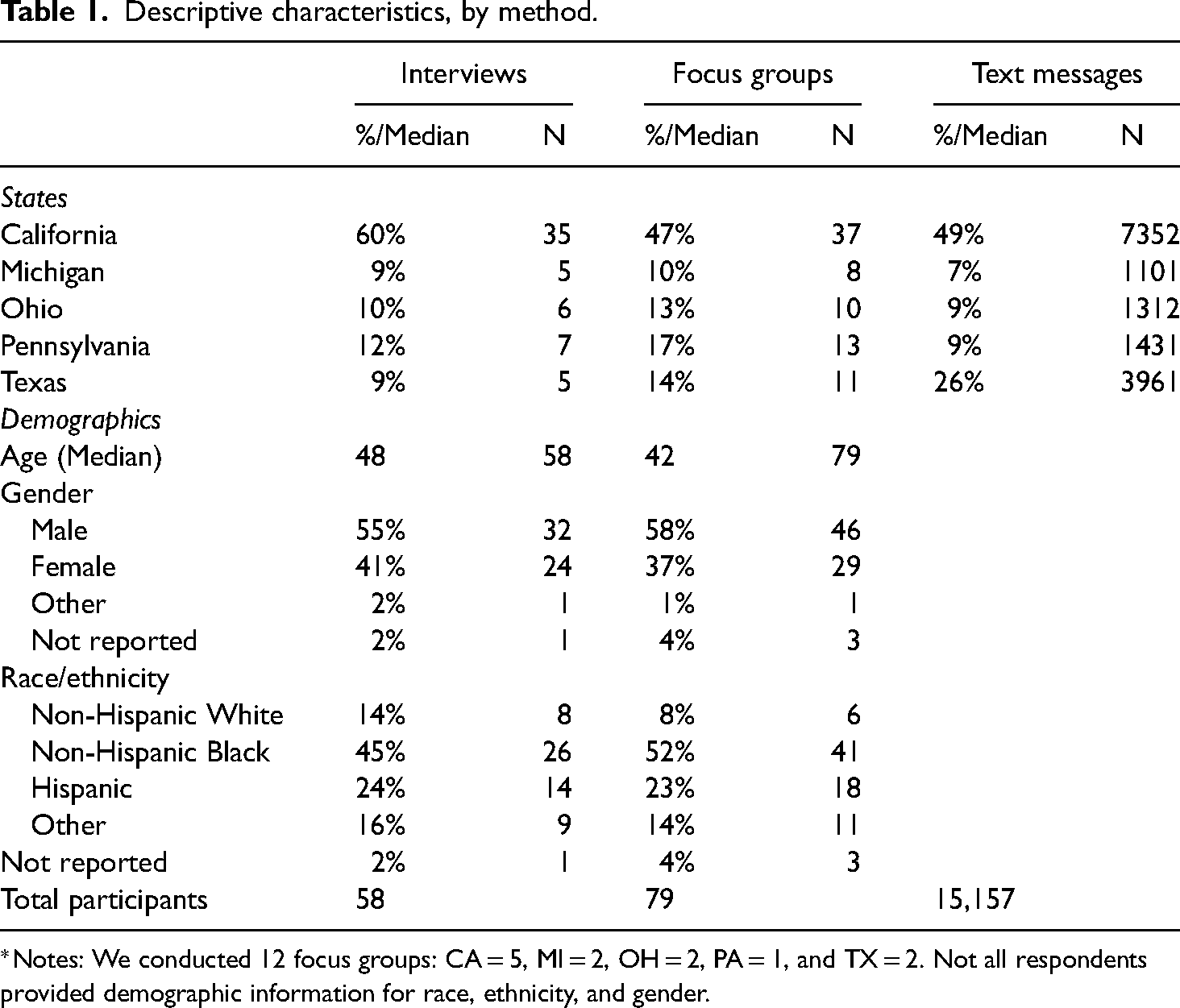
Notes: We conducted 12 focus groups: CA = 5, MI = 2, OH = 2, PA = 1, and TX = 2. Not all respondents provided demographic information for race, ethnicity, and gender.
Concerning disenfranchisement laws, our states vary by type of conviction (misdemeanor, felony jail or felony prison) and period of disenfranchisement (Table 2). Four states (California, Michigan, Ohio, and Pennsylvania) disenfranchise people with specific sentences while incarcerated, restoring rights upon release. Texas is the only state in our sample that disenfranchises beyond incarceration, resulting in ambiguity when determining when voting rights are restored. Texas disenfranchisement extends throughout probation and parole periods, requiring an individual to be fully discharged from their sentence. The discharge process can extend disenfranchisement beyond the point of formal supervision and generally includes satisfying all outstanding LFOs, fines, fees, or restitution, making it difficult to determine when someone is fully discharged. While these distinctions hold critical legal significance in the context of voter eligibility, our findings below demonstrate that participants rarely made these distinctions across states.
Disenfranchisement law exclusions, by state.
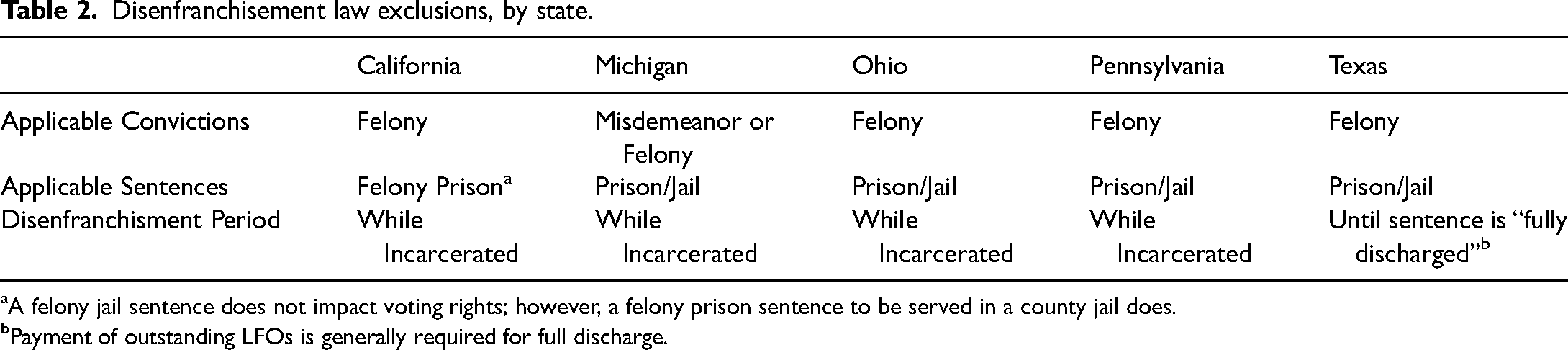
A felony jail sentence does not impact voting rights; however, a felony prison sentence to be served in a county jail does.
Payment of outstanding LFOs is generally required for full discharge.
Barriers to voting
Most participants described the voting process as unclear and confusing—consequences partly attributable to their criminal legal status—which influenced their perceptions of voting access. According to Raymond, 8 a 49-year-old Black man in Michigan, “I ain’t gonna say scary, but it was unfamiliar … when [you] have unfamiliarity, it's uneasy … The voting. It can be overwhelming for people who don’t want to do it. You don’t know where to go, you don’t know who to really vote for.” Similarly, Jasmine, a 44-year-old Black woman in California, described, “I don’t know which [ballot propositions] … They all– they all are confusing … I don’t even have a recent ballot here with me to show you, but just because it's not simple. They don’t simplify it, and I think they’re doing that on purpose.”
Beyond the ambiguity surrounding the voting process, people commonly expressed the mistaken belief that having a felony conviction (or even going to jail) resulted in permanent disqualification to vote for life. After receiving our text messages encouraging them to register to vote if eligible, a respondent from Ohio stated, “I am a felon. I have no voting rights,” even though a conviction in Ohio doesn’t automatically disqualify a person from voting.
9
During a discussion about eligibility in Texas, Delia, a 40-year-old Hispanic woman, described the power of this belief: It's very confusing on purpose …. The majority of people that I know, who get booked in and are going to jail, one of the biggest things is, you know, you can’t ever vote again. Right. And so, that's what I believed. Every unit I went to the narrative is, ‘You got a felony now. You’re never gonna get a job, and you’re never gonna vote.’ And so, you believe that.
Although many participants acknowledged that voting laws differ across states, they expressed uncertainty about the details. Chris, a 66-year-old Black man in Michigan, highlights this point, stating, “In some of the states, felons aren’t allowed to vote,” but then continued, “I don’t know which states they are exactly.” Beyond eligibility, participants often invoked punitive practices of other states, expressing concern about the criminal consequences of voting if ineligible. During a focus group in Ohio, Sheri, a 66-year-old Black woman, referenced Crystal Mason, who was convicted of voting while ineligible in Texas: “[People think] they gonna get arrested, or they’re gonna feel something's gonna happen.” Darren, a 41-year-old Black man in California, noted this, too: “They tell you, if you [are] not supposed to vote, you know, you can get locked up for voter fraud.” This statement prompted agreement from others in the focus group, one calling this explanation “ordinary.”
When discussing this uncertainty, some participants underscored the struggles faced by people recently released from prison. They noted how people in “survival mode” have difficulty navigating complex and unclear voting laws. As Julian, a 41-year-old Chicano man from California, stated, “A lot of our people come home, they don’t know about none of this crap [about voting]. They, they’re just trying to be off of parole, not being harassed based on that. So, voting is just another foreign language to them. And there's nobody educating them.” We also heard participants describe “survival” as an experience that changes with time, with people increasing their capacities, resources, and voting motivations as their situations improve and stabilize. Among those who vote, respondents often described themselves as taxpayers, and therefore, constituents whose needs should be addressed by the government. Identifying as a taxpayer and a constituent facilitates a view of voting as an accountability mechanism over those in power. Later in the interview, Julian added: A constituent has the power of the vote to change the vote, to educate people, when they’re disgruntled about the person that they voted for. A constituent is able to walk into the office and have an education and original conversation as to what it is that they want changed. People listen to you when you’re educated [about] the system. They, you know, because they know, at that point, their seat is in jeopardy.
Barriers perceived as constructed and intentional
I just don’t feel like the system is set up to look out for me or anyone else … I just feel extremely frustrated and that's why I wait until the last day to vote, because I’m like, ‘I don’t fucking want to do this. They don’t want me to do it, either’ … [I]t's like, really inaccessible, it's really confusing … I try to avoid it at all costs … even though everyone's like, ‘It's a right, it's a privilege.’
Sarah, 33-year-old multiracial woman, California Poverty is part of racism. You can’t separate them, even, even, even if a white kid was poor … They will say he's a trailer trash fucking … [L]ittle fucking fool that doesn’t belong here. You know what I’m saying? He doesn’t belong to our club … .It's always been the same. Like everybody, everybody could look for happiness except us. Pursuit of happiness, except for us, right? So, it's kind of like, we’ve been excluded from being a real American. Like, the American thing is only for some people.
Many people regarded elected officials as untrustworthy and integral components of a power structure that fails to serve the best interests of their communities. These sentiments are common in the general population; here, among system-impacted people with direct and lengthy experiences with the criminal legal system, respondents expressed these sentiments as deeply personal. Candace, a Black woman in California, stated, “[I]t's just like [we’re] a pawn. That's what makes me feel used.” Participants often expressed discouragement with the types of issues that elected officials pursue, which are often not relevant to the needs of underserved, system-impacted people. In a focus group in Texas, Jerry, a 59-year-old white man, stated: What people don’t realize for those of us who’ve been formerly incarcerated, these are all life and death issues for us … [I]t's really hard because the things that were important in your campaign, you don’t consider me an important enough voting bloc for my issues to be that important to you. “When I was in Illinois, I had people coming up to me telling me their parole officer told them if they tried to register to vote they were going to send them back to prison. I know you have the right to vote as soon as you get out in Illinois. …” “But if it's- If it's [voting rights restoration] on this paper, they can’t– they can’t fight this paper.” “Yes, they can.” “They can lie to you all day ‘cause they do that, right? They – they verbally lie to us all day.”
Overcoming barriers
The prevailing view that the government intentionally creates obstacles to discourage voting among system-impacted communities has implications for overcoming administrative burdens. When asked how people learned about their voter eligibility and who motivated them to vote, participants sometimes mentioned family, friends, and acquaintances, such as formerly incarcerated people living in the same shelter or neighborhood friends, as helping them understand their rights and motivating them.
More commonly, however, the majority of participants referenced community organizations, including our partner organization (ASJ) and many other organizations, as sources of voting information and motivation. These organizations include legal services (who provide voting information during other legal assistance), religious groups, and local and national organizations working with system-impacted communities. First, organizations provided information that clarified misunderstandings about voter eligibility. In Pennsylvania, Eddie, a 47-year-old Black man in Pennsylvania, described the role of his Pastor and various community groups: “So, basically, I was always on that level of, ‘I was a convicted felon and I couldn’t vote,’ and then I found out that that's not true. Breaking the Chainz and other people … were like, ‘Yes you can. There's this law, that law,’ you know?” Apart from educating people about their rights restoration, we also heard from some people that community organizations clarified that they were, in fact, not yet eligible to vote. Discussing her eligibility before changes to disenfranchisement laws in Michigan, Doreen, a 50-year-old Black woman, stated, “And then I actually found out for myself that literally, I really couldn’t [vote]. I got involved with a criminal justice organization, and, found out that …, I wasn’t really allowed to vote and that they was trying to pass the laws for me to be able to vote.”
Second, organizations educated people about the voting process, assisted with registration and sent reminders about elections. During a Michigan focus group, Janelle, a Black woman in her 50s, highlighted the importance of having an organizational structure that supports voting: “They made sure you didn’t forget it. They emailed you several times … They text you. They made sure you didn’t forget.” Participants emphasized the educational value of organizations informing them about salient issues and offices at stake in elections. Travis, a 46-year-old Black man in California, described an organization that “would actually take the time and have a community gathering on voting” and groups that “tried to educate us, show the processes, and the candidates.” For some, that support was what it took for them to engage in voting, often characterized as “stress[ful]” or “intimidating.” As Dwayne, a 40-year-old Black man from California, described: Going to school, I wasn’t necessarily the best student. And the way they reached out, they weren’t like putting in a lot of jargon, a lot of big words, you know, so that, like made it better … Instead of being like, ‘You should know this,’ or making me feel, like, dumb for not understanding something that I’ve never, you know, been part of.
Third, organizations promoted the salience of voting, emphasizing the role that system-impacted people could play in elections. Latoya, a 49-year-old Black woman in California, described how Californians for Safety and Justice brought up “different issues, different propositions, the different bills, they always let us know which senators were behind our bills.” Latoya added later, “If we don’t vote, we’re not going to get somebody that's been here for us, that's been down in the trenches with us.” Similarly, during our discussion, Darren, quoted earlier, described getting connected with a “social justice organization in South Central [Los Angeles] … learning about systems and systemic racism and how a lot of people don’t want us to vote, and how the real power in our vote is at the local level, you know?” Javier, a 51-year-old Black Puerto Rican man in Ohio, connected his experience with the organization Building Freedom Ohio, noting how “Your vote is your voice.” He elaborated on how voting is important to overcome the barriers imposed by the government, stating the following: “Whether it's because we’re returning citizens, whether it's because we’re African American or Hispanic, they don’t want us to vote because our votes are powerful. And so, when somebody is trying to take your voice and take your vote, even if you don’t see the importance of it at the time, you need to look at why somebody's trying to take it, because there is some importance in that.”
Organizations often served as powerful messengers because of their perceived credibility with system-impacted constituents. Almost universally, participants appeared to implicitly view these types of organizations as credible. The relative lack of discussion about their credibility stands in stark contrast to the lengthy discussions and references about distrust of government. Importantly, many of the organizations were local community and criminal legal organizations, including reentry groups, transitional housing, and other organizations for system-impacted people. Participants also named other organizations, including the League of Women Voters, legal aid societies, and other non-criminal-legal-related groups, implying their authority and credibility.
Discussion
We analyzed interviews, focus groups, and text messages to understand how civil and criminal legal systems intersect to create costs for voting. First, people reported several barriers, including lack of information and misinformation about voter eligibility, and risks of rearrest of voting while ineligible. Second, people often viewed barriers as intentional government actions to marginalize communities, and these perceptions amplified the consequences of barriers. Third, people commonly referred to family members, friends, and community organizations as providing information, assistance, and encouragement to vote, overcoming barriers to voting. By connecting administrative burden and access to justice frameworks, we show how these barriers to voting constitute an access to justice issue, under a broadened conception of justice (and further, that voter access more generally can be construed as an access to justice problem) (Sandefur, 2019).
The findings emphasize that recent state reforms dismantling disenfranchisement laws and expanding rights restoration have not been felt on-the-ground by many people now eligible to vote. In fact, the peculiarities of each state's laws were rarely acknowledged or discussed by respondents. Further, we find that state practices, especially high-profile practices in Texas and Florida, influence perceptions of people living in other states, even if those states have different orientations to prosecute and punish voting illegally. The generalized notion that “felons can’t vote” or that incarceration results in lifetime exclusions from voting, regardless of state laws (also see Ewald, 2024; McCahon, 2016; Uggen and Manza, 2004), contrasts with other, non-voting case studies examining state-based administrative burdens. In terms of Medicaid programs, for example, people express specific knowledge about state differences regarding benefits and eligibility (Michener, 2018).
It is likely that people do not distinguish state differences in disenfranchisement laws because voting is often of second- (or third-) order importance, relative to meeting basic needs, such as accessing medical care or housing (e.g., Uggen and Manza, 2002). People voiced the importance of survival, especially in the months after incarceration, which takes precedence over voting. This, combined with government distrust, further deters people from investigating when and how their voting rights are restored. Similar to other research that highlights distrust and intentionality regarding administrative burdens in child welfare (Edwards et al., 2023), our findings underscore the importance of these perceptions for amplifying the meaning of burdens, their consequences, and people's propensity to overcome burdens.
Relatedly, the finding that people often invoke state practices in other states raises important questions about how to reduce burdens in a federalist system. When people in California, a state offering resources for determining eligibility, voiced concerns about rearrest relating to cases in Texas and Florida, it suggests that some states may disproportionately undermine the progress made by other states in reducing burdens and enhancing access to justice. How these spill-over consequences relate to the role of community organizations for mitigating burdens is a fruitful area for future research.
A primary motivation of this study is to inform policy solutions to address barriers to voting encountered by system-impacted people. While we should not rely solely on these data for policy recommendations, the finding that community organizations mitigate burdens for some participants points to promising interventions. Our findings suggest that community organizations can help address administrative costs (e.g., understanding how to register and vote, learning about ballot initiatives and candidates, and receiving reminders about deadlines) and can facilitate motivation for some system-impacted people (see Mijs, 2016). In these ways, community organizations may be best suited to assisting some system-impacted people with understanding their rights and navigating this complex legal landscape.
Identifying these opportunities raises questions about promises, challenges, and the role of community organizations in overcoming voting barriers. Most directly, there is a need for resources from government and philanthropy to support community organizations to outreach to system-impacted communities. At the same time, we are keenly aware that asking community organizations to overcome barriers created by government contributes to “carceral devolution,” or the transfer of obligation from governmental agencies to organizations (Miller, 2014). As Miller describes, carceral devolution is situated within neoliberalism (e.g., Cheliotis and McKay, 2022; Kaufman, 2015), shifting the “… responsibility of the state to serve the needs of former prisoners and the off-loading of its capacity to rehabilitate them onto poor communities of color” (2014: 314). By identifying community organizations as promising mediators, we do not mean to put the onus of addressing burdens on resource-constrained communities; however, in the current climate of punitive governmental actions by some states to obfuscate eligibility, to arrest people who mistakenly register and vote, and to double down on lengthy sentences, community organizations may be best positioned to assist system-impacted people in overcoming these challenges.
It is important to interpret our findings within the context of our sampling and recruitment strategy. Our sample was primarily recruited in collaboration with our community partner, ASJ, and participants had varying engagement levels with ASJ before speaking with us. Our sample is likely more active in their communities compared to the broader population of system-impacted people. Our sample is also older, with a median age in the early- to mid-40s, compared to younger people, who are often arrested and convicted. While participants commonly discussed their voting behavior now, as compared to their younger selves, who may have been less inclined to vote or were struggling to meet basic needs, these aspects influence our findings. These considerations are particularly notable given that we identified widespread misinformation about voter eligibility and distrust of government, even among this group of more engaged participants.
Overall, our findings add to existing scholarship documenting how the criminal legal system depresses voting among system-impacted people. By limiting access to voting through disenfranchisement barriers—whether direct exclusions through voting laws or indirect exclusions through administrative burdens—system-impacted people's voices and needs remain unheard and unattended to by elected officials, impeding integration and inclusive citizenship. This reinforces the emotional distrust and frustration expressed by system-impacted people, further dampening motivation for electoral participation. This is clearly an access to justice issue, which restricts access to the franchise and takes a toll on poor, racial and ethnic minority communities, who are disproportionately affected by the criminal legal system and bear the brunt of inequalities in the political process generally, leading to a more unequal political system.
Footnotes
Acknowledgements
Thank you to our community partner, Alliance for Safety and Justice, and to study participants for sharing their experiences and insights. We are grateful to the co-editors of this special issue and the anonymous reviewers, who provided valuable feedback and suggestions that substantially strengthened the article's contributions.
Declaration of conflicting interests
The author(s) declared no potential conflicts of interest with respect to the research, authorship, and/or publication of this article.
Funding
The author(s) disclosed receipt of the following financial support for the research, authorship, and/or publication of this article: This work was supported by the National Science Foundation (SES-2215480) and Alliance for Safety and Justice.
