




Abstract
This study explores how Black and Latinx young adults (ages 18–25) who were reentering the community from Los Angeles County jails viewed racial injustice in the criminal legal system in the context of the Black Lives Matter (BLM) protests of summer 2020. A sample of nine young adults participated in a series of up to nine monthly interviews between June 2020 and May 2021. The participants included seven young adults who identified as Black and two who identified as Latinx. Overall, participants held negative views of the criminal legal system and felt that police officers harmed Black and Brown people and communities. While most participants expressed support for the BLM protests, others doubted the protests as an effective tactic to address racial injustice. Even those who supported the protests described doubts about the possibility of genuine systemic changes in the criminal legal system and society. Findings pose implications for cultivating optimism for social change and countering legal cynicism among system-involved young adults.
Introduction
The death of George Floyd in the summer of 2020 reignited Black Lives Matter (BLM) protests across the globe, a movement that began in 2013. Additional police killings of Black citizens, including Breonna Taylor and Rayshard Brooks, drove a groundswell against systemic racism and racial injustice. BLM protests erupted just months into the COVID-19 pandemic. COVID-19 disproportionately impacted poor Black and Latinx communities, reflecting entrenched systemic inequities and placing Black people at the crux of two lethal pandemics: COVID-19 and systemic racism (Jones, 2021; Merelli, 2020). As COVID-19 confined people to their homes, the video of George Floyd's death rapidly gained traction through social media and news outlets. Reactions to the video and quick organization from activists led to millions of people leaving the safety of quarantine to protest on the streets in support for Black lives and against racial injustice in the criminal legal system (Cox, 2022; Maqbool, 2020).
Despite a cynical view of the criminal legal system, considering its foundation as rooted in structural racism, the BLM movement still aspires to enact lasting change through advocacy and activism leading to reform and abolition (Maqbool, 2020). Little is known about how young people involved in the criminal legal system (herein referred to as “system-involved”) view BLM protests and their potential for long-term structural change. People involved in the legal system at this age are potentially the most affected by the liberation movement and are likely to be entrapped in the legal system, making their level of care and involvement in the movement's goals crucial (Durose and Antenangeli, 2021). This study explores how prior encounters with the criminal legal system shape the perspectives of Black and Latinx young adults reentering society after jail regarding the system's relation to structural racism. It also investigates how their lived experiences influence their view of the 2020 BLM protests and its potential to address structural racism within the criminal legal system.
Literature review
The Black lives matter movement
In 2013, the Black Lives Matter movement began in response to the acquittal of George Zimmerman for the death of 15-year-old Trayvon Martin, led by Alicia Garza, Opal Tometi, and Patrisse Cullors (Garza, 2014). Following the police murders of Eric Garner, Tamir Rice, Sandra Bland, and many others between 2014 and 2016, millions worldwide took to the streets and chanted “Black Lives Matter” to bring attention to police brutality against Black people (Francis and Wright-Rigueur, 2021). The BLM protests, which created an international movement, highlighted police brutality and other forms of racial discrimination in institutions, industries, and systems (Francis and Wright-Rigueur, 2021). This collective action propelled people of all racial backgrounds to fight against state-sanctioned racial violence (Parker et al., 2020).
On May 25th, 2020, Minneapolis police officers arrested George Floyd, a Black man accused of using a counterfeit $20 bill (Hill et al., 2021; Kishi, 2020). Four police officers violently apprehended Floyd with one, Derek Chauvin, pinning his knee on Floyd's neck until he died of asphyxiation (Kishi, 2020). Mass protests swept across the United States after witnesses recorded and shared footage of George Floyd crying out for his mother and taking his last breath while the police officers allowed him to die (Hill et al., 2021; Kaul, 2020). The video of George Floyd's death garnered millions of views across various platforms (Wirtschafter, 2021). Continued police brutality, such as the murder of Breonna Taylor, a Black woman who police officers shot and killed in her sleep, re-ignited and fueled conversations of racial injustice (BBC News, 2022; Stand with Bre, n.d.; Francis and Wright-Rigueur, 2021). Like 2014, people took to the streets to uplift the lives of Black people. However, in 2020, people engaged in more militant tactics to garner widespread attention that highlighted the racial injustice ingrained within the criminal legal system and pushed for radical systemic changes to address and eradicate racial inequities.
Our research took place in Los Angeles during the summer of 2020 where thousands of people consistently filled the streets similar to other major U.S. cities. With the region's long history of community organizing against anti-Black police violence, BLM protesters exercised various tactics, such as shutting down freeways, to garner the attention of local and national officials (ABC7, 2020; Felker-Kantor, 2018). Within 10 days, the Los Angeles Police Department arrested over 3000 protestors for failure to disperse and curfew violation (Braslow, 2020; Ho, 2020). Los Angeles continued protests throughout the summer, with over 100,000 people expressing their dismay with the persistent and lethal racial injustice within the criminal legal system.
Legal cynicism
George Floyd's death exists as one example of a long history of police abusing their power and engaging in excessive violence against Black lives (Jean, 2020; Ray, 2020). Though the BLM movement fights against structural racism across society, the protests focused on state-sanctioned racial violence within the criminal legal system (Gebhard et al., 2022; Merelli, 2020). BLM protests called for the indictment of police officers who directly contributed or caused the death of innocent Black lives and the abolishment of policing as a whole (Callimachi et al., 2020; Davey and Bosman, 2014; New York Times, 2020; Press, 2014). However, police rarely face consequences for misconduct, even with lethal use of force, which contributes to legal cynicism among Black and Latinx populations (Andone et al., 2020; Thomson-DeVeaux et al., 2020).
Legal cynicism reflects the belief that the law does not operate in a just and fair manner (Moule et al., 2019). Black and Latinx people have a long history of police distrust due to disproportionate contact and mistreatment (Olorunnipa, 2014; Owusu-Bempah, 2017; Weitzer, 2010; Weitzer and Tuch, 2006). Research has observed stark racial differences in relation to police surveillance, treatment, arrests, and police conduct (Fagan et al., 2016; Meehan and Ponder, 2002; Owusu-Bempah, 2017; Slocum and Wiley, 2018). Racially minoritized individuals, particularly Black people, have experienced disproportional consequences across the criminal legal system, including higher rates of arrests and convictions and longer sentences for similar charges (Hinton et al., 2018; Nellis, 2021; Nkansah-Amankra et al., 2013; Petersilia, 1985; Rosenberg et al., 2017). Sustained disproportionality and harsh treatment within the criminal legal system contributed to widespread legal cynicism among Black people, including those who are system-involved and their family members (Bobo and Thompson, 2006; Hagan et al., 2018; P. LeBel et al., 2017; Sampson, 2013; Sampson and Bartusch, 1998). For example, Bobo and Thompson (2006) found that only 35% of Black people who reported that they would call the police in the event of a home burglary expected an appropriate response from the police. Additionally, prior studies show that police violence and misconduct against Black and Latinx people inflicts trauma that spans across generations (Bryant-Davis et al., 2017; Olorunnipa, 2014; Sewell and Jefferson, 2016). This distrust of law enforcement often extends to the larger criminal legal system—including courts, judges, and probation officers (LeBel et al., 2017).
Though scholarship has focused on legal cynicism in the context of the police relations with the community (Campeau et al., 2021; Kochel, 2018; McCarthy et al., 2020), the police are essentially a direct pathway to entering the criminal legal system. In a racialized class society, the decisions made by police officers not only reflect their individual actions but also represent the broader legal system's role in perpetuating state-sanctioned violence. The criminal legal system perpetuates class and racial divisions, as it disproportionately impacts low-income and racially minoritized people (Bobo and Thompson, 2006). Young people in marginalized and disenfranchised communities are faced with multiple structural challenges that directly push them into the legal system, including hyper-surveillance and over-policing in their schools and neighborhoods (Rios, 2011). Therefore, as social movements strive to address the foundation of structural racial inequities, including the legal system itself, it is important to center the experiences and voices of those directly impacted by these inequities. System-involved young people possess valuable insights that can contribute to effecting radical social change. Ultimately, understanding the dynamics of legal cynicism and its relation to the BLM movement among these individuals can help to uplift and include their perspectives in the development of tactics to achieve meaningful social change.
Purpose of the present study
This study examines system-involved young adults’ perspectives on the 2020 BLM protests. Young adults are the focus of this study as they are highly impacted by the criminal legal system and the most likely age group to recidivate (Durose and Antenangeli, 2021). As the young adults reentered society from jail, they encountered both the COVID-19 pandemic and racial uprisings that called for the betterment of Black lives through systemic change within the criminal legal system. Presently, scant research explores young and system-involved people's attitudes towards the BLM protests in the wake of George Floyd's death, as much of the extant research centers on the early years of BLM (Godsay and Brodsky, 2018; Smiley, 2019). Additionally, limited research has examined the opinions of system-involved young adults in relation to the criminal legal system and the BLM protests. Their intersectional identities as racially minoritized persons with direct involvement in the criminal legal system offer an important perspective that can inform how identity influences perceptions of racial uprisings and legal cynicism. The following research questions are posed: 1) Among racially minoritized young adults reentering society, how do prior encounters with the criminal legal system influence their perspectives of the system and its relation to structural racism? 2) How did the racially minoritized system-involved young adults view the potential for the 2020 Black Lives Matter protests to remedy structural racism in the criminal legal system?
Method
This present study uses a focal sample of nine young adults (selected from a larger longitudinal study) to examine their perceptions of the 2020 BLM movement. The larger, prospective longitudinal qualitative study spanned June 2020 to May 2021 with a purposive sample (n = 15) of young adults (aged 18–25) reentering society from county jail. Interviews focused on the reentry experiences of young adults during the COVID-19 pandemic (Abrams et al., 2022).
Recruitment and study sites
To recruit participants in the larger study, researchers established a partnership with two local agencies that provide services to young adults undergoing reentry. Between March and May 2020, participants were referred to the study by providers if they were: 1) between 18 and 25 years old; 2) recently released from jail (i.e., on probation, parole, or released from imprisonment within the past 6 months); and 3) English or Spanish speaking.
The first recruitment site (program 1) delivers social and health services to participants who reentered society from jail within the last 6 months. The second recruitment site (program 2) offers programs and resources (i.e., mentorship, career resources, and wraparound services) for system-involved youth and young adults. Both programs referred eligible young adults to the study team for recruitment. The principal investigators for this project (second and fourth authors) had prior connections with the reentry agencies through research collaborations. Fifteen young adults enrolled in the larger qualitative study, and interview data from nine of the participants were used for the present study.
Data collection
Our university's institutional review board (IRB) and the Los Angeles County Department of Health Services (DHS) reviewed and approved study procedures. The study team obtained informed verbal consent via audio or video call, emphasizing that study participation and interview/survey responses would not influence their standing with reentry services or the criminal legal system.
Participants were invited to conduct up to nine monthly semi-structured remote interviews (audio or video call) between June 2020 and May 2021. The first and third author conducted the interviews, both researchers of color. Recorded interviews ranged from 15 to 60 min, averaging 30 min. The interview protocol encompassed questions about recent events related to the 2020 BLM protests, such as instances of police violence, city-wide protests, or developments in high-profile trials. Moreover, participants were asked about their views on the effectiveness of the 2020 BLM protests as a strategy for social change and if they themselves had participated in any of the protests. The same questions were asked at each interview, but responses varied in length, which resulted in variations in interview duration.
Recruitment during COVID-19 presented challenges such as limited access to potential participants and technological barriers among potential participants with limited internet or telephone access. Given the intensity of data collection (monthly interviews), the team agreed that we had a broad enough group with diverse experiences to answer the study questions. Participants received a $25 payment for each completed interview. A professional service transcribed interviews, and trained research assistants checked the transcriptions for accuracy.
Focal sample
The focal sample (n = 9) included participants who were active in the study during the 2020 Black Lives Matter protests (i.e., during the summer of 2020 and beyond). Those who did not participate past June 2020 or did not discuss BLM and were excluded (n = 6). Seven participants identified as male and two identified as female. All participants identified as either Black (n = 7) or Latinx (n = 2). Participants were 21-year-old on average and within 6 months of their release from jail at the start of data collection (see Table 1).
Aggregate sample demographics.
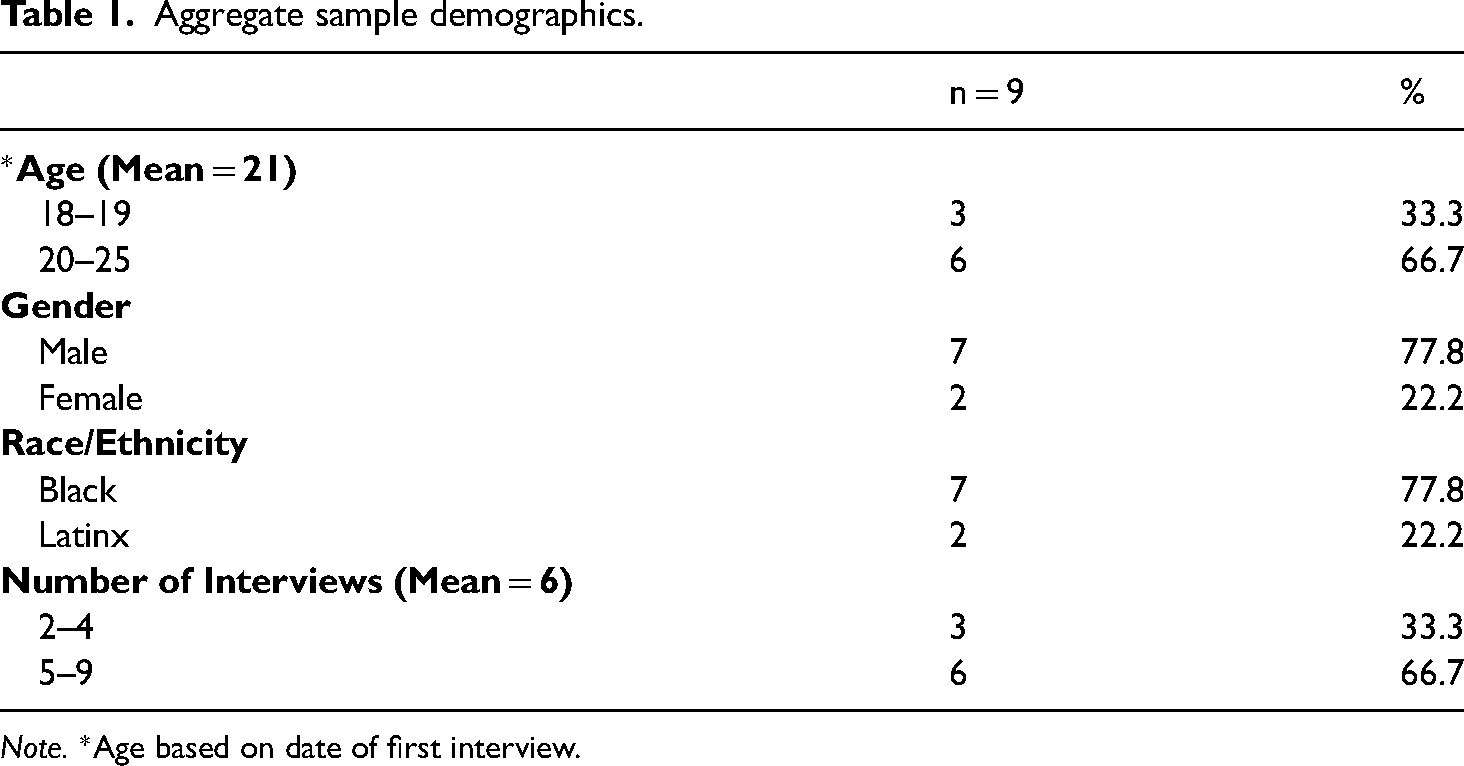
Note. *Age based on date of first interview.
The focal sample includes nine participants with a total of 51 interviews, including an average of 6 interviews per participant (see Table 1). Participants generally completed interviews monthly. However, researchers allowed participants to have gaps between interviews greater than 1 month and remain in the study to minimize attrition due to challenges often observed in youth experiencing reentry (Miller, 2021), including changing phone numbers, recidivism, and housing instability. By maximizing retention, the longitudinal design allowed the study to capture real-time perspectives of the BLM protests as they were unfolding. Of the nine young adults, three completed all nine interviews, and seven participated in four or more interviews. Table 2 contains individual participant information including race, age, and number of interviews.
Participant pseudonyms and information.
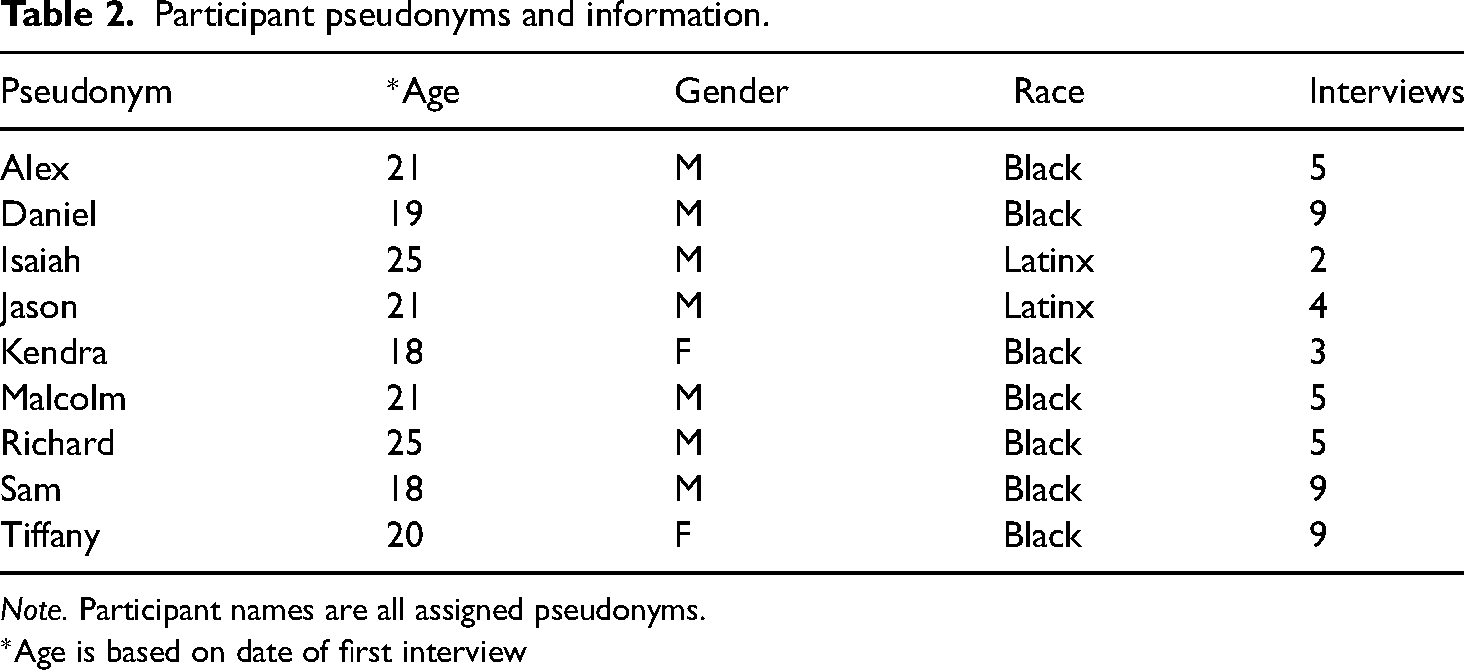
Note. Participant names are all assigned pseudonyms.
Age is based on date of first interview
Focal sample analysis
Researchers conducted inductive thematic analysis of the transcripts (Braun and Clarke, 2022) using Dedoose Software (Version 8.3.35, 2020) to store, code, and retrieve data. First, researchers developed a preliminary codebook by open coding interviews. After open coding, two research assistants coded three randomly selected interviews with the preliminary codebook. Coded interviews were reviewed to confirm a mutual agreement on the application of the codes. With regular meetings, the team finalized the codebook and applied it to all interviews.
After the coding process was complete, codes were organized on an Excel spreadsheet into a matrix displaying the application of codes by participant and interview timepoint. The completed matrix captured the progression of attitudes and beliefs over time to help identify common patterns or themes between the participants. This analysis contributed to a visual display of the primary themes (see Figure 1).
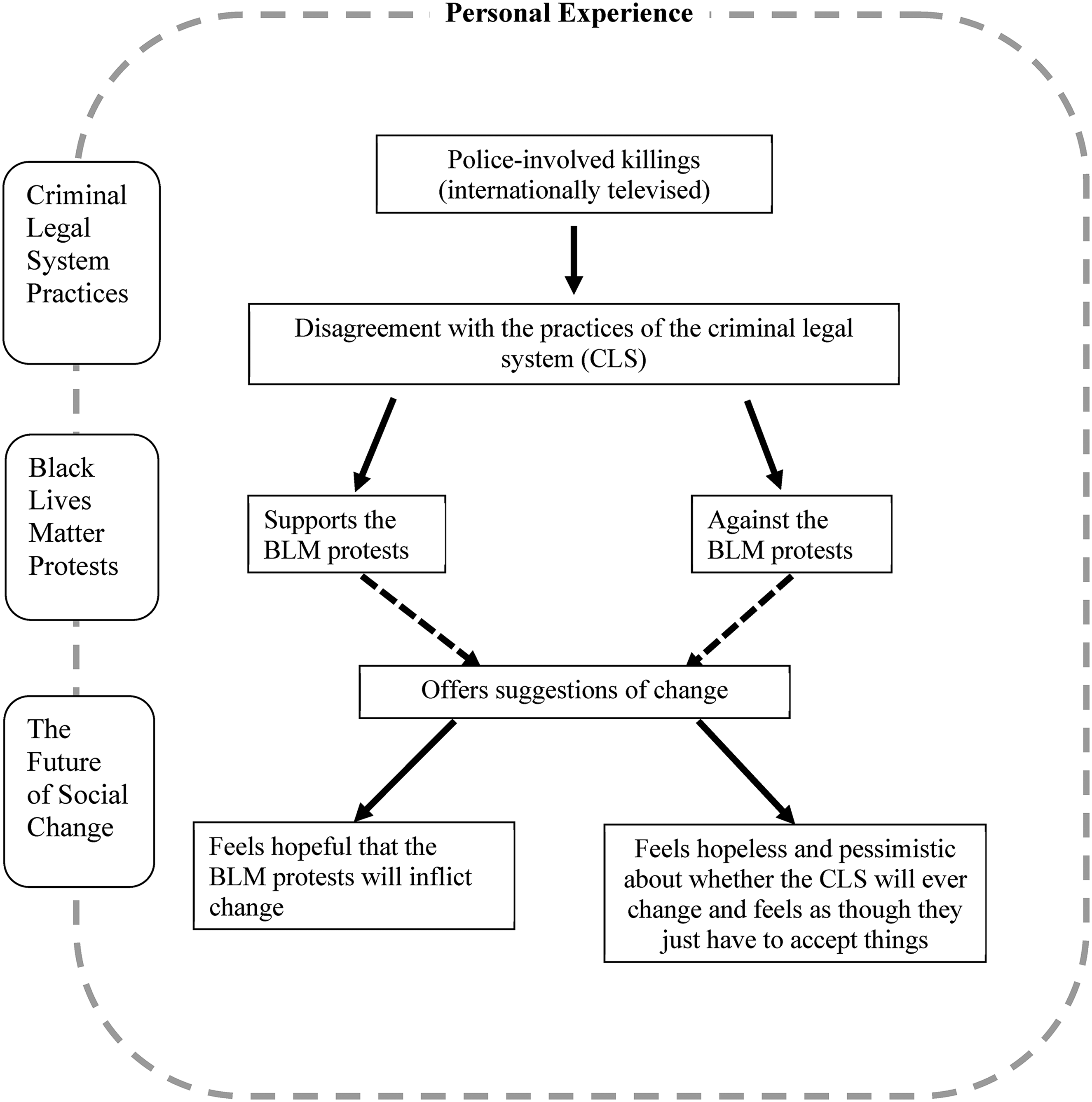
Map of topics.
Findings
The findings clustered around three main topics: 1) Criminal Legal System Practices, 2) Black Lives Matter Protests, and 3) The Future of Social Change. Participants’ voices directly informed the visualization of the topics in Figure 1. As the young adults shared their perspectives, their thinking typically followed the pattern depicted in Figure 1, indicated at the top of the schematic, with participants seeing injustice against Black and Latinx people and then progressing to their vision for social change (shown in the bottom portion of the figure). Participants described their feelings and opinions of each topic by expanding on their discussion of the prior topic. As shown in Figure 1, participants’ personal experiences with police and the criminal legal system informed their perceptions of each topic. Each quote from the young adults includes the month and year to indicate its connection to the timeline of BLM-related events, as they often discussed their personal experiences and things they saw on the news or social media. Perception of their experiences informed their views on society, the BLM protests, and the criminal legal system.
Criminal legal system practices
As shown in Figure 1, participants’ views of the criminal legal system practices clustered into two steps of development. First, they saw police killings of Black people and in response to observed injustices, the young adults developed their perceptions and attitudes towards the criminal legal system, including racism and fairness.
During the study period, multiple acts of police violence against Black people became widely publicized, such as the deaths of Breonna Taylor and George Floyd, as well as the trial of Derek Chauvin. The young adults described their reactions to the news surrounding police-involved deaths and collectively viewed the police officers as responsible. For example, Tiffany, insisted that police officers had intentionally acted in malice in the death of Breonna Taylor in March 2020 and stated:
One of the officers told the other officer to turn his camera off because we don't want anything that we might say to be on record. What else comes from that? Intentional. You all meant to do this. It was thought up, you all knew what you all was about to do. It's so messed up that that's… covered up or excused because they're a police officer. No, you are not a higher being, you're not. We're all human, we all bleed blood. You are no higher than me (April 2021).
Tiffany insisted that the police officers had attempted to cover up their wrongdoings after murdering Breonna Taylor. She also explained how police officers are afforded more leniency that allows them to evade responsibility.
Other participants also believed that the criminal legal system favored law enforcement over citizens. Despite Chauvin's guilty conviction on all three charges brought against him, Alex doubted the legitimacy of the charges and sentence terms. He shared, “I feel like [Chauvin's] still going to get out… I feel like with the system right now, I feel like there is nothing fair” (April 2021). Alex explained that Chauvin's role as a police officer allowed him to evade consequences and still “get out” of prison despite his conviction, thereby expressing his legal cynicism.
Participants expressed significant distrust of police, a feeling of unsafety around police, and a need for self-reliance. Kendra believed in abolishing police and that “everybody should protect themselves… Police don’t protect nobody but white people” (August 2020). Another participant, Sam, shared similar sentiments about who the police decide to help. He expressed that since the age of 14 years old, he has had negative experiences with the police and “can only think of one time the police actually helped” (August 2020). Sam's negative experiences with the police informed his evaluation that police are not a source of safety or protection.
Other young adults expressed frustration with the court system. Daniel reflected on his experiences and shared his cynical view of the court system when he said:
[Everyone in the court system is] all working together. They get paid… They’re careless, they act like they [are] helping you… I been in this damn court system since the age of 14. Each judge and public attorney that I got for myself, they barely said a word. I had to speak for myself (November 2020).
In feeling that he had to depend on himself in lieu of a public defender, Daniel formed the view that public defenders collaborated with judges and solely focused on getting paid. Sam also shared a cynical view when explaining terms of restitution and how they can negatively influence probation if unpaid. He stated, “[if] you [do] not deal with it, they going to try to arrest you. And then you're back in the same position. It's like a loophole” (July 2020). As someone with firsthand experience with restitution and requirements of parole, Sam viewed restitution as one of many ways that the criminal legal system keeps people in the system.
Overall, the young adults were critical of the criminal legal system's practices, particularly its positive bias toward police officers and the lack of support for those most impacted by the system. They drew upon instances in their lives where they believed that police officers or the court system treated them unfairly. Their firsthand experiences with the criminal legal system, along with news regarding police-involved shootings, led the young adults to overwhelmingly disagree with the functions and practices of the criminal legal system.
Black lives matter protests
Participants witnessed widespread Black Lives Matter demonstrations in-person or via the media. During interviews, they expressed their views on the protests and the overall BLM movement. Figure 1 illustrates the finding that all participants disagreed with the practices of the criminal legal system but were divided in their opinion of the BLM protests. Some of the young adults conveyed approval and appreciation for the protests. For instance, Jason said, “It's cool that people are protesting and trying to show like unity right now” (August 2020). Similarly, another participant, Malcolm supported the protests but described concerns about sustainability:
I respect it, and I like it. I don't like that they kind of calmed down… I feel like it should have definitely kept going more. Yeah, so I feel like these protests should have happened sooner. I just hate how the protests started, and they stopped. It's like this happens every 2 years. Something got to change (August 2020).
Despite his respect for the protests, the gradual decline in the strength and presence of the protests disappointed him. He highlighted a historical trend of BLM protests losing momentum, and how a lack of sustainability relates to the effectiveness of protest to enact change.
Some of the young adults supported the protests because they felt its aims reflected their lived experiences, noting shared racial identity with the protesters. Kendra simply stated, “I'm Black, so I'm with it” (August 2020). Sam also felt connected due to his racial identity and stated, “Well, of course I support it because it's people with the same color skin as me” (August 2020). The Black racial identity of protesters and the movement's message directly connected to some participants. Even participants who did not attend protests felt a part of the fight. Tiffany said simply, “We need to fight for our rights” (August 2020). Most participants supported the BLM protests, its message, and the symbolic meaning behind a unified fight for equality.
Alternatively, a few participants did not agree with the protests or believed that the protests were ineffective, reflecting legal cynicism in the population. For example, Richard did not support the protests and felt “like they blew it way out of proportion… [the protests were] an excuse to break the law” (August 2020). Others held more nuanced or conflicted views. The timing of the protests upset Daniel, as he viewed them as a form of performative activism. He wondered, “I don't know why the fuck they care now. We've been going through this shit for 400 years” (August 2020). Despite his frustration with racial injustice, this tension dissuaded Daniel from engaging with or supporting the protests.
Racial injustices against Black people are endemic to the United States, leading to the normalization of police misconduct and fatal police shootings (Lett et al., 2021). Consequently, some young adults like Daniel and Richard did not understand the necessity for widespread large-scale protests. Similarly, Isaiah viewed the protests as a potential threat to his probation. He shared, “I wasn't too concerned with it. I wasn't out there. I'm on probation. I don't have time for people who are going out there, going to steal from stores… Then again, it's sometimes the government or people need to see this so some change happens” (August 2020). Though an overwhelming majority of participants agreed with the protests and the message of “Black Lives Matter,” some retreated from an ostensible fight for their rights due to the risk of mingling with individuals engaged in illegal activities and the skepticism as to the effectiveness and need of the protests.
The future of social change
As shown in Figure 1, regardless of their stance on the protests, the young adults offered suggestions for change in the criminal legal system. Alex discussed the foundation of the criminal legal system and stated that, “A couple of the laws are messed up. So, we could start off with changing the laws and change it with better laws” (September 2020). Alex believed that laws that impact people differently need to change to achieve equality. Others, such as Malcolm, spoke to those tasked with enforcing the law and urged a need “to reevaluate a lot of the officers that's serving and that got that badge because a lot of them don't need that badge at all” (August 2020). Thus, participants’ perspectives echoed the same message that the numerous videos and incidents of police misconduct shared throughout the summer of 2020 displayed: there is a clear and urgent need to reevaluate policing and practices within the criminal legal system.
While some participants viewed police departments and specific laws as potential areas of intervention, others focused on economic disparities. Daniel emphasized the city of Los Angeles's large budget and the inadequate amount of public money dedicated to efforts that support citizens in need. For example, Daniel lamented about the relief funding that the Los Angeles Lakers franchise received at the time:
Why are you giving money to people that already have millions and billions of dollars, bro? Give that billions and millions to the community and get these n*****s off the streets, bro. You guys have the finances and the money to do it (November 2020).
Daniel was advocating for reallocation of city funds and rerouting of private dollars to resources that would uplift and provide support for Los Angeles’ citizens and communities.
Many participants identified aspects of the criminal legal system in need of significant changes. The conditions of prison concerned another young adult, Sam. He shared that he supported prison abolition due to his belief that people need, “Rehabilitation, real rehabilitation. Because if you ask me, prison doesn't necessarily make people work… Because if you look at the prisons in other countries, they actually help rehabilitate people” (October 2020).
In comparison to how prison operate in other countries, Sam highlighted how U.S. prisons miss the key component of rehabilitation.
While participants offered suggestions for change, most participants expressed a sense of hopelessness and believed that the injustices within society were simply too deeply entrenched to change (shown in Figure 1). Therefore, the young adults maintained that the protests would not lead to systemic changes and felt that racial injustices within the criminal legal system were a part of an endless cycle. Daniel pointed out that the ongoing fight for the rights of Black citizens dates to slavery. He believed that the protesters, particularly allies and companies whom he saw as performatively sharing the “Black Lives Matter” message, would ultimately have little impact and shared: [They will] keep this shit up probably for another year and then they're going to forget about us once again, and then another Black dude gonna get shot and it's gonna repeat again. It's a cycle. It just keeps happening. Like nothing is changing in this world (August 2020).
Other participants’ beliefs were rooted in real-time events that occurred throughout the protests. Alex said, “I know you've seen it on social media the other day that 14-year-old girl getting shot… four times by a police officer… like I said, it's not going to stop, it don't stop, it's not going to be fair, I feel like, ever. But it's just another thing” (April 2021). Alex's belief that the criminal legal system would continuously operate in an unfair manner stemmed from the ongoing police shootings even in the midst of the Black Lives Matter protests. Like others, his beliefs were based on first-hand experiences of racial injustice.
Despite cynicism towards the potential impact of protests, a few participants remained hopeful about the protests and the future of society. Kendra thought, “We might get something out of [the protests]… there might be something that they could get out of it” (August 2020). Additionally, Malcolm stated, “I just feel like a lot of people [are] waking up, finally getting out of that ignorant zone. I think that situation opened a lot of people eyes because the video just ridiculous. It was like you can't deny that at all, the video, no matter who you are.” (August 2020). Despite a glimmer of hope among a few young adults, most in this study felt hopeless and pessimistic regarding racial justice and the future of criminal legal reform.
Discussion
The first research question asked how prior experiences with the criminal legal system influence the perception of the system in relation to structural racism among racially minoritized young adults reentering society. This study found that the personal experiences of the racially minoritized young adults informed their perceptions of both the criminal legal system and the ability of the BLM protests to influence systemic change. The young adults shared that the negative encounters they had experienced in the criminal legal system or encounters that they witnessed were a product of deeply embedded racial bias within the structure of the criminal legal system, thus contributing to a strong sense of legal cynicism. Many believed that actors within the criminal legal system, including police officers and judges, were racially biased. The participants pointed to how the criminal legal system has continuously harmed Black and Brown people, a sentiment observed in previous research (Alexander, 2012). The present study extends this literature to include perspectives of system-involved people as related to the entirety of the BLM protests rather than a singular instance of police violence that contributed to the movement.
Moreover, participants had witnessed numerous instances of police brutality involving innocent Black civilians and their own community members, which cemented their beliefs that police officers are biased and consciously choose to criminalize Black and Latinx people while protecting white people. Other studies support that many Black and Latinx people hold the belief that the police and other apparatuses of the criminal legal system are racially biased and intentionally value white lives more than others (McCarthy et al., 2020; Owusu-Bempah, 2017; Verhaeghen and Aikman, 2022). Thus, firsthand experiences of dealing with the criminal legal system among the participants directly influenced their legal cynicism.
The second research question asked how the racially minoritized young adults who reentered society at the height of the 2020 BLM protests viewed the protests and their potential to remedy structural racism in the criminal legal system. Though the young adults agreed that racial injustice occurs within the criminal legal system, they held differing views on the specific tactics and strategies utilized during the 2020 BLM protests. While several of the young adults in this study supported the BLM protests and appreciated seeing people speak out against racial injustice, none shared that they had participated in the protests. Conversely, there were a few young adults who did not support the protests and believed that the protests were more of a disruption than activism. Their understanding of change ranged from a micro-level, such as firing specific police officers, to a more macro-level, as some pushed for revisions to the law.
In sum, feelings about the importance of the BLM protests were mixed and conflicted.
Despite their support for BLM, participants expressed deep pessimism about the ability of the protests to achieve systemic changes. All participants referenced the cycle of police brutality, followed by race-related calls to action, and ultimately a period of silence and inactivity until the next incident occurs—hence the title of this paper, “We’re not the first and we’re not going to be the last.” Participants argued that the repeated cycles of police violence and lack of accountability demonstrate that protests do not lead to systemic changes. The young adults believed that this cycle exists and continues due to the lack of needed systemic changes in response to racial injustices. Legal cynicism was thus prevalent among participants and appeared to fuel feelings of hopelessness. Ultimately, this critical theme of hopelessness reinforces the impact of the legal system as experiencing reentry poses multiple structural barriers that may also further erode hope for their future. Understanding the significance of this hopelessness underscores the need to actively address structural issues for restoring faith in genuine change.
Implications
This study presents implications for how police and court interactions can shape one's outlook on society and how legal cynicism impact community and political engagement. Repeated negative encounters with law enforcement can result in cynicism that affects one's outlook on societal change and self-efficacy in terms of having the social power to change society (Hofer et al., 2020; Miller and Stuart, 2017). While this sense of cynicism and lack of self-efficacy may influence other areas in life, including individuals’ perceived ability to overcome environmental challenges, we did not measure that concept in this study.
Moreover, though the BLM protests led to notable changes in attitudes concerning systemic racism, legal cynicism continued to persist in these young adults. The system-involved young adults did not experience any changes in their everyday lives following the BLM protests. This dissonance may ultimately lead to the exclusion of input and perspectives from system-involved young adults in important policymaking decisions, due to the young adults’ belief that racial injustice will never cease to exist. However, more research needs to examine how these attitudes correlate with opportunities for civic and community engagement. Future research can further explore how social movements can better obtain and incorporate the voices of marginalized young adults, and thus boost their optimism for the possibility of true change.
Lastly, reentry programs could register system-involved people to vote as well as provide more education and engagement around voting and the benefits of civic engagement. Doing so, can foster a sense of hope for social change among young people, which can hold particular significance for Black and Latinx individuals with systems involvement who may harbor strong skepticism towards the legal system, as increased civic engagement has the potential to foster a renewed optimism regarding the future of our society.
Limitations
This study has several limitations. Given that this was a qualitative study with a small sample size from one large urban environment, the findings may not apply to other settings or contexts. Additionally, there were an uneven number of interviews per participant, which means that potential bias exists as people who stayed in the study may differ from those who did not. Last, racial and ethnic differences were not analyzed within the sample as there were only two Latinx participants (shown in Table 2). However, their views ultimately aligned with the other participants in our thematic analysis. Despite these limitations, there are several strengths of this study including the collection of real-time data collection from Black and Latinx system-involved young adults during the unfolding of major historic events.
Conclusion
This longitudinal qualitative study explores the views of Black and Latinx young adults who were reentering from jail during the 2020 BLM protests in relation to the ability of the BLM movement to impact systemic racism in the U.S. criminal legal system. Findings demonstrate the depth of legal cynicism and distance from the movement of racial justice among system-involved Black and Latinx young adults are rooted in firsthand experiences. Though most participants supported the BLM protests, participants did not show optimism regarding the possibility of true systemic change. Many held a strong belief that the protests were simply a part of the cyclical nature of racial uprisings. Notably, the 2020 BLM protests centered around racial injustice within the criminal legal system, yet these racially minoritized young adults felt removed from the movement itself, despite their direct contact with the system and the movement ostensibly fighting for their rights. Given the historical significance of the BLM protests and its global impact, this study highlights the disconnect that can persist between social movements and the very people that are advocated for on behalf of a movement. Despite limitations, this study captures important real-time perspectives of the 2020 BLM protests and legal cynicism from those most impacted by the events.
Footnotes
Declaration of conflicting interests
The authors declared no potential conflicts of interest with respect to the research, authorship, and/or publication of this article.
Funding
The author(s) disclosed receipt of the following financial support for the research, authorship, and/or publication of this article: This research was supported by the National Institute on Drug Abuse (K23DA045747) and California Community Foundation (BA-19-154836). The information, content and/or conclusions are those of the authors and should not be construed as the official position or policy of, nor should any endorsements be inferred by NIH or the U.S. Government.
