




Abstract
Western nations like Australia should be safe havens for people fleeing their home countries due to war, persecution, and other threats. People make often perilous journeys in search of asylum expecting protection from violence. However, these expectations are not matched by the realities of Australian immigration detention. This study explores the realities of detention by analysing women's experiences of violence, including intimate partner violence, within Australian long-term immigration detention. The study uses quantitative data derived from 629 Commonwealth Ombudsman reports on 252 women. The results show that violence against women is rife in Australian detention facilities, where women are victims of multiple forms of violence perpetrated by partners, families, other detainees, and staff. Personal and situational factors are explored, including type and length of detention, family and kinship networks, as well as previous experiences of violence.
Introduction
he pulled my hair, he punched me, and he threw glass dishes at me … I was pregnant with my second son, he threw the kitchen knife at my stomach… 1
This is the testimony of a woman interviewed within research conducted by Rivas (2022) on women's experiences of Australian immigration detention. This woman described in detail her experiences of intimate partner violence (hereinafter IPV), perpetrated by her husband whilst they were detained in the community (i.e. open detention) in Australia. Violence against women is a widespread issue across Australia, with 22.8% of adult women having experienced IPV at least once across their lifetime (Australian Bureau of Statistics, 2016). This also extends to women in immigration detention, who also suffer gender-based violence and other forms of interpersonal violence despite being under the supervision of the state. Gender-based violence refers to harmful acts directed at an individual based on their gender, with women being disproportionately affected. This violence is rooted in power inequality between genders and can include physical, sexual, psychological, and economical harm. IPV is one of the most common forms of gender-based violence (UN Women Australia, 2020). Due to the state depriving them of their liberty, these women cannot escape from suffering such violence. Rather than Australia being a safe haven for asylum seekers, it instead perpetuates their conditions of vulnerability. Such conditions have also been observed in other countries, such as the United Kingdom (Bosworth and Turnbull, 2015). Despite women in immigration detention having to navigate these conditions daily, little empirical research has been conducted to unpack the exact nature of their vulnerability. This paper aims to explore the situation of women in detention by examining the extent and types of their violent victimisation in Australian long-term immigration detention.
Australia's use of mandatory long-term immigration detention has been widely criticised by national and international bodies, human rights activists, in media reports, public debate and a growing body of research (see e.g. Gleeson and Yacoub, 2021; Human Rights Law Centre, 2021; Minns et al., 2018). The current policy of indefinite, mandatory immigration detention of all undocumented/irregular/unauthorised migrants (as defined by the Australian legislation Migration Act, 1958 ) was first introduced in Australia in 1992 as a result of heightening concern amongst politicians and the wider community regarding the increase in arrivals of asylum seekers from Cambodia and Vietnam. It is one of many increasingly restrictive measures that have been introduced since then to deter asylum seekers and irregular migrants in general from seeking to enter Australia.
Australian immigration detention facilities – both onshore and offshore – are typically located in harsh, remote locations, in order to keep the detainees of these facilities hidden away from the public (Briskman et al., 2010; Crock and Ghezelbash, 2010; Hyndman and Mountz, 2008; Newman et al., 2008). In this article, I will focus on onshore facilities as this is where the majority of detainees are held. The conditions of these immigration detention facilities are very similar to prisons (Aleinikoff et al., 2020). Like prisons, they are characterised by the presence of high razor wire, electric fences around the perimeter of immigration detention facilities, and constant surveillance including the use of CCTV. Similarly, detainees may be subject to handcuffing, body searches (including strip searches), being addressing by number rather than by name, and isolation – from both the wider community as a group and from each other in isolation units (Bessant, 2002; Bull et al., 2013; Hudson-Rodd, 2009; Refugee Health Research Centre, 2007; United Nations Commission on Human Rights, 2002). In addition to these general conditions, detainees are confronted with several other issues within immigration detention facilities including racism, poor hygiene stemming from limited access to amenities, unsuitable shelter against temperatures because of harsh and remote locations, substandard food, and limited access to both physical and mental health care (Athwal, 2015; Cheliotis, 2013). These immigration detention conditions, particularly those concerning detainees’ loss of liberty and freedom of movement, physical isolation, and loss of self-determination have been documented across detention facilities in Australia and offshore (Hudson-Rodd, 2009).
A study by Hudson-Rodd (2009) found that multiple detainees had expected Australia to be a safe, calm place to live after having escaped persecution and torture in their home country. Instead, they found themselves in prison-like facilities, which compounded the trauma they had already experienced (Bull et al., 2013; Mountz et al., 2012; Rabin, 2009). Overall, in these immigration detention facilities there is an overwhelming emphasis placed on security and ensuring that these individuals do not abscond into the wider community (Refugee Health Research Centre, 2007). However, this focus on security comes at a cost. That is, the needs and vulnerability of these detainees are ignored and consequently no action is taken to address and improve the conditions and treatment of those held in immigration detention facilities (Bacon et al., 2016).
In comparison to men, women experience different risks and challenges during the irregular migration process and their time in immigration detention. For example, women are at a higher risk of abuse including beatings, rape, starvation, exploitation, and discrimination (Martin and Herzberg, 2014; O'Neil et al., 2016). Globally, women experience physical and emotional violence at all stages of their migration: before leaving their country of origin, in refugee camps, during transit, and even once they have reached their destination, including in refugee camps and immigration detention facilities (Esposito et al., 2020; Jolly and Reeves, 2005; Martin and Herzberg, 2014; O'Neil et al., 2016). Whilst migration to a country free of conflict and political persecution can be beneficial for women because it enhances their experiences of social equality (i.e. by providing an environment characterised by increased gender equality, freedom and autonomy), it is also fraught with risk (Jolly and Reeves, 2005).
By exploring the extent and types of violent victimisation of women in Australian long-term immigration detention, I will argue that there is a clear intersection between structural violence against non-citizens in the form of immigration detention, and interpersonal violence, including gender-based violence that impacts women in detention. Rather than women being provided a safe haven, the Australian government knowingly continues to utilise immigration detention whilst failing to address safety concerns generally and those of women specifically. In this way, the characteristics of detention (i.e. length and type) constitute the context in which different types of interpersonal violence evolve, including at the hand of partners, family members and staff. My analysis is based on a unique dataset of migrants in long-term immigration detention which is provided by the Australian Commonwealth Ombudsman. That data includes information from professionals and testimony and reporting of the women themselves on their physical, mental, and social well-being (see Rivas, 2022 for a detailed overview of data).
Australian immigration detention
Irregular migration policies differ across Western nations. However, a practice almost all have in common is the use of immigration detention. Currently, under the Migration Legislation Amendment (Regional Processing and Other Measures) Act 2012 (Cth), irregular migrants who arrive in Australian excised offshore territory will not be allowed to apply for asylum in Australia and will instead be held in immigration detention facilities. These facilities are intended to deter, manage, and deport unauthorised irregular migrants. There are several offshore and onshore immigration detention facilities in Australia. These facilities include Immigration Detention Centres (IDC), Immigration Residential Housing (IRH), Immigration Transit Accommodation (ITA), Alternative Places of Detention (APOD), and Community Detention (CD). IDCs, such as Villawood IDC in Sydney, are closed detention facilities used to detain individuals considered to be high-security risks 2 (Department of Immigration and Border Protection, 2015). IRH is another type of closed immigration detention facility that provides lower security accommodation for detainees (Galardi, 2012). ITA and APOD detention facilities are two other closed, low-security alternatives. The CD is an open type of immigration detention as detainees reside within the Australian community. This type of detention is available to individuals who are deemed to not pose a risk to the Australian community following health and security checks. Whilst individuals who are detained in CD have much greater freedom than those in any other form of detention, they are still considered by the Australian government to be unlawful non-citizens (Katz et al., 2013). As a result, individuals in CD are required to comply with certain conditions, which include curfews, monitoring, reporting to the Department of Home Affairs (DHA) on a regular basis, and they must remain at the address designated to them by the Minister for Immigration (Department of Immigration and Border Protection, 2015). Individuals held in CD are provided by the Australian government with a limited basic living allowance but are not entitled to work rights if they arrived in Australia by boat after August 2012. Some individuals are also unable to access Medicare and must rely on charitable organisations instead (Asylum Seeker Resource Centre, 2013).
The amount of time people are held within these facilities by the Australian government has increased more than eightfold over the past decade from an average of almost three months (81 days) in June 2013 to over two years (708 days) in August 2023 (Department of Home Affairs, 2023; Department of Immigration and Citizenship, 2013). The number of people held in long-term immigration detention, or for a period of two years or longer, has also steadily increased, from 445 people in June 2013 to 559 people in August 2023 (Department of Home Affairs, 2023; Department of Immigration and Citizenship, 2013). This increase in overall detention length and number of individuals who are being held in long-term immigration detention occurred despite the overall number of individuals held in immigration detention in Australia decreasing over this same time period, from 12,027 people in June 2013 to 1338 people in August 2023 (Department of Home Affairs, 2023; Department of Immigration and Citizenship, 2013). Of these 1338 people, there were 1153 men, 112 women, and 73 children, meaning that women make up 8.4% of the immigration detention population (Department of Home Affairs, 2023). In August 2023, 1056 people were detained in closed immigration detention facilities, with the remaining 282 people held in community detention. 891 (84.4%) of the 1056 individuals held in closed facilities were detained because of their visas being cancelled by the Australian government. The cancellations were due to individuals either overstaying the length of their visa or breaching the conditions of their visa. A total of 165 individuals were irregular migrants whose arrival – whether by air or maritime – was unauthorised. Of these 165 unauthorised arrivals, 130 (78.7%) were irregular maritime arrivals (Department of Home Affairs, 2023). Those irregular maritime arrivals now held in Australian immigration detention are barred from applying for a protection visa in Australia, meaning that the only way they can leave detention is by agreeing to be resettled in a safe third country or by returning to their country of origin (Department of Home Affairs, 2022).
The intersection of structural and interpersonal violence
The violence experienced by women in Australian immigration detention can be seen as the intersection of two different types of violence: structural and interpersonal. Structural violence within the context of immigration detention facilities occurs at different levels. It can occur through policy which allows for the use of indefinite detention in prison-like facilities, in the form of creating an environment which places non-citizens in insecure and unsafe conditions. It can also occur via the government which facilitates and perpetuates violence through their inaction to address these conditions and a potential lack of oversight, as well as neglect (Bhatia, 2020; Weber and Pickering, 2011). Structural violence thus characterises the overall and particular context in which interpersonal violence develops and spreads. It creates different contexts across a continuum of restriction in both closed and open detention. Regardless of the type of detention, Australian immigration policy renders those who are detained powerless, restricting their access to information, services, agency, or the ability to exercise self-determination, albeit to differing degrees (Hourani et al., 2021). Structural violence also exacerbates prior experiences of violence for those in immigration detention and facilitates interpersonal violence, particularly against women (Canning, 2017; Hourani et al., 2021). Interpersonal violence (including gendered violence as defined in this paper) takes the form of physical, sexual, and emotional abuse and assault that is perpetrated by partners, family members, other detainees, detention staff, and community members (Hartry, 2012; Menjívar and Abrego, 2012). Due to the nature of immigration detention, women's experiences of interpersonal violence are facilitated, exacerbated and perpetuated by their confinement within the structures of violence that immigration detention represents (Canning, 2017). Women are isolated, cut off from support and unable to report due to fear of consequences, especially if violence is experienced at the hands of detention staff, a partner or a family member. This shows the contradictory nature of the system. That is, despite the legal responsibility of the Australian government to protect women held in immigration detention facilities, their inaction to address safety concerns and the continuing use of immigration detention results in the ongoing victimisation of women, who are trapped and powerless to change their circumstances. These conditions interact with elements of cultural differences, personal histories of torture, and trauma that women have had prior to their detention.
The number of women held in Australian immigration detention is relatively small in comparison to men, making them a minority (Kneebone, 2005). When women are referred to in scholarly literature, they are typically regarded as being part of a family unit and only referred to in relation to the roles they play in the family unit: that of mothers, wives and carers (Kneebone, 2005). Women are rarely considered as individuals in the way that men are. Women who deviate from these roles, such as women who arrive in Australia seeking asylum alone, or at least without a male guardian of some sort (husband, father, and brother) or any children, challenge this idea of what is often considered a ‘good’ or ‘ideal’ woman (Esposito et al., 2019; Kneebone, 2005; Pickering and Cochrane, 2012). This in turn has negative implications for them when it comes to their experiences of immigration detention. This is evident in a study by Rivas and Bull (2018) that examined the impact of long-term immigration detention on the mental health and human rights of women detainees. They found that women who were listed as the primary subjects/applicants (often unaccompanied) were held in closed immigration detention for longer and held in detention overall for longer than women who were listed as secondary to a male family member (Rivas and Bull, 2018). Whilst their detention could be (and often was) justified as a means of protecting lone women or women without partners, the reality is that their experiences of detention exposed them to greater risks of violence and harm. Although there is limited research that focuses on the impact of immigration detention on women, there is some research on refugee populations that has found that women tend to have poorer physical and mental health than men (Essex et al., 2022). In general, women are understood to have distinctive experiences of detention, whether criminal or immigration detention, in comparison to men. This difference in the way women experience immigration detention is not only distinct from how men do in terms of their mental and physical wellbeing, but also extends to their experiences of violence, which in turn impacts their physical and mental health (Bosworth et al., 2016; Filges et al., 2016).
Gender-based differences are particularly evident when considering women's experiences of physical and sexual assault (Bacon et al., 2016; Esposito et al., 2019; Rabin, 2009). For example, a report by Bacon et al. (2016) examined the experiences of women detained by the Australian government in a regional processing detention facility in Nauru. The findings detailed instances of sexual harassment and rape – in which multiple cases resulted in the women falling pregnant and seeking abortions. The sexual assault of these women in immigration detention is also evident throughout more than 2000 leaked documents from within the Australian immigration detention system. These reports detail the frequent occurrence of sexual assault of women detainees in Nauru (Farrell et al., 2016). These women who have suffered severe sexual trauma are forced to continue to live in the same unsafe environment where the assault took place, and consequently risk being revictimised (Bacon et al., 2016; McCall, 2015). According to Bacon et al. (2016), this is because the immigration detention conditions, including the infrastructure of the detention facilities, give rise to these harmful experiences. Moreover, the lack of security leaves women more open to abuse which results in women generally feeling unsafe. Women who experience IPV and other forms of abuse and assault in detention face multiple barriers to reporting these crimes to police or other authorities. Many fear the stigma, shame and exclusion that is attached to abuse and assault, as well as the fear of retaliation and further violence (Segrave, 2021). Consequently, the incidents of both physical and sexual assault are underreported (Bacon et al., 2016; McCall, 2015).
This paper will build upon the existing research outlined above by exploring the nature of violence experienced by women detained in Australian immigration detention facilities for two years or longer. This article first examines the types and overall prevalence of violence experienced by women. This is followed by an analysis of situational and personal factors through three concepts: conditions of detention, kinship and family networks, and previous experiences of violence. The stress and tensions of long-term detention and being housed in closed detention might increase the overall level of violence that women experience, as well as victimisation by IPV. The role of kinship and family can be ambiguous: on the one hand, they might provide protection, in particular against IPV, but on the other hand, they might excuse such violence and support the perpetrator. Finally, previous experiences of violence like a history of torture and trauma might make women more vulnerable in immigration detention. I will first analyse these factors in relation to general and non-IPV violence for all women, and then for the group of women who were detained with a partner and suffered from IPV.
Methodology
The population in long-term immigration detention in Australia is difficult to access for research (Barns and Newhouse, 2015). As a result, little empirical data is available on individuals held in immigration detention by the Australian government. One of the few available sources of empirical data on women in Australian immigration detention are the reports published by the Commonwealth Ombudsman on individuals held in immigration detention for two years or longer. The Ombudsman inspects detention centres and ensures compliance by the DHA when locating, detaining, and removing individuals defined as ‘unlawful non-citizens’ (Commonwealth Ombudsman, 2022). The six-monthly reports on long-term immigration detainees that form part of this function are anonymised and published on the Commonwealth Ombudsman website; they are the basis of this article. I examined 629 reports on 252 women who had been in detention for two years or longer during the period from June 2013 to June 2017. These reports contain both quantitative data and a narrative for the individual they pertain to, compiled based on reports by service providers such as nurses and psychologists. Each report contains details regarding the individual's case progression, circumstances and status, health, age, any detention incidents, and detention history, including the time spent in detention and at what detention facility, at the time of the report. 3
Violence was measured through accounts of abuse and assault or IPV that were noted in the reports as either professionally reported or self-reported (by the woman). Sources of professional reporting of social issues included general practitioners, nurses, International Health and Medical Services (IHMS), DHA, psychiatrists, and psychologists. An instance of IPV or abuse and assault was coded if the woman was subject to any reported violent, threatening, coercive, or controlling behaviour. The severity of this violence is not available. The category of violence (e.g. abuse, assault, or IPV) was coded based on the perpetrator (i.e. family, staff, detainees, or others).
Women's experiences of violence in immigration detention were examined through the lens of three contextual factors. These three contextual factors are (1) the conditions of detention, (2) relational conditions like kinship and family networks, and (3) previous experiences of violence as individual-level conditions. Conditions of detention include detention length (measured in years) and type of detention facility (either open, closed or a combination of the two types). Kinship and family networks were indicated by information on who the women were detained with. This included children, partners, parents, siblings, and extended family members. Previous experiences of violence were measured as reported histories of torture or trauma, in order to assess the pre-existing vulnerability of women. A series of chi-square tests of contingencies statistics were used to establish the relationship between the dependant variables of abuse and assault, and IPV and the contextual conditions. 4
Results
Sample
A total of 156 women were detained for 2–2.5 years, 49 women were detained for between 2.5 and 3 years, 28 for 3–3.5 years, 13 for between 3.5 and 4 years, and six women were detained for more than 4 years. Overall the women were held in immigration detention for between 2 and 6 years and 3 months. On average, these women spent nearly 3 years in immigration detention.
The age of the 252 women when they first arrived in Australia ranged from 14 to 80 years of age, with a mean age of 32.6 years (SD = 11.05). 5 Most (88.1%) of the 252 women arrived in Australia as irregular maritime arrivals. The other 11.9% of the 252 women arrived in Australia with some type of visa, such as working, studying, or visiting visas, which they then overstayed or which were revoked. The majority (72.6%) of women arrived with a partner or family member. These family members include children, parents, siblings, or other extended family. The majority of women who arrived alone remained alone whilst in immigration detention, except in the case of 17 women who arrived alone but were then detained with family due to either being reunited with family or having given birth whilst in detention.
Upon arrival, the 252 women were detained in a range of immigration detention facilities across the country. Ninety-one (36.1%) were detained in CD (i.e. open detention), whilst the other women were held in closed detention facilities. Eighty-eight (34.9%) of those women in closed detention were detained in APODs and 70 (27.8%) were detained in IDCs. Two women were held in ITAs upon their arrival, and one woman was detained in IRH.
Experience of violence: Types and prevalence
The level of interpersonal violence experienced by women in immigration detention was high, with 60 (23.8%) of the 252 women having experienced at least one type of violence during their detention (Table 1). Abuse and assaults either by family, other detainees, detention staff or others were common: 18.7% of women experienced some type of abuse and assault by these individuals. Twenty-four women reported abuse and assault by family, 15 women reported abuse by other detainees, 12 women were abused by detention staff, and nine women were abused by others (such as people in the community).
Abuse, assault, and intimate partner violence were reported across detention length (n = 252 women, multiple victimisation).
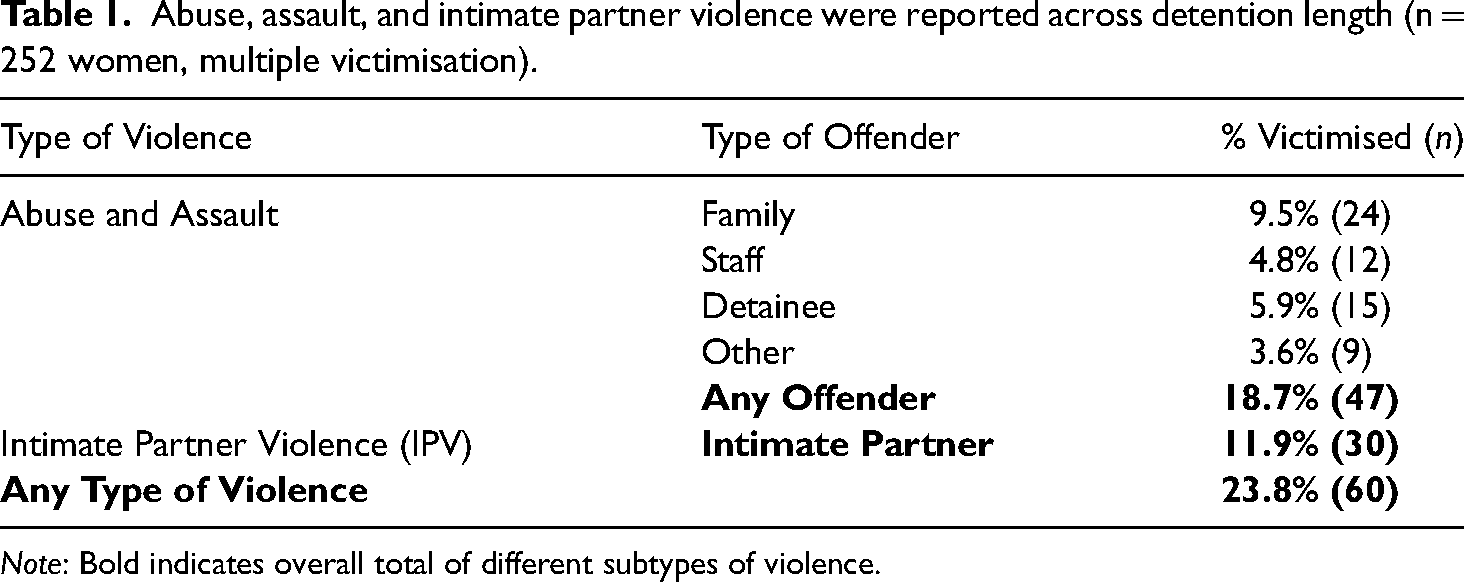
Note: Bold indicates overall total of different subtypes of violence.
Further, 30 (11.9%) of the 252 women experienced IPV whilst detained. When only focusing on the 75 women who were actually detained with a partner this rate jumps up to 40%. IPV for these women took on many forms, including social, emotional and even financial, as noted by one service provider for detainees when discussing the case of a woman who experienced IPV whilst detained (Rivas, 2022). Multiple service providers interviewed by Rivas (2022) also highlighted that many instances would have gone unreported. One of these service providers noted that many women do not disclose domestic violence situations out of fear their husbands will be punished, leading them to become separated and that this consequence could impact their ability to be released from detention.
Abuse and assault
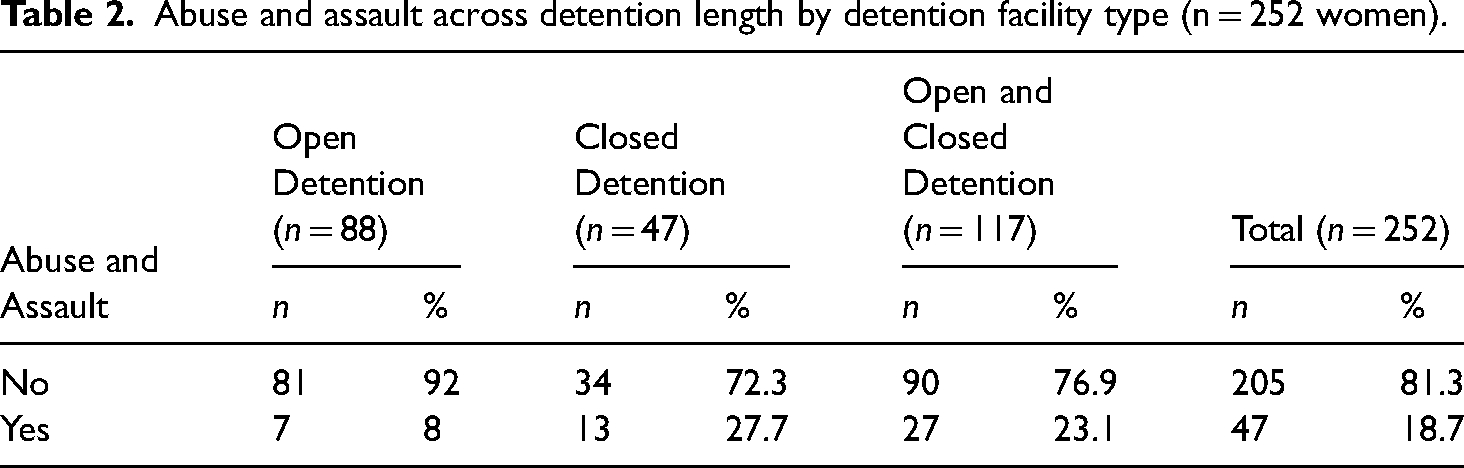
In this section I analyse whether different detention conditions produce different stress levels or if they differ in the extent to which violence can be controlled, thus leading to more women being victimised in certain facilities. Abuse and assault against women occurred significantly more for those held in closed detention compared to those detained in either open detention or in a combination of open and closed facilities (Table 2, χ2(2, n = 252) = 10.661, p = .005, V = .206). Closed detention thus produces an environment in which violence increases. There are three possible interpretations for this. Firstly, this may be partially due to heightened stress levels among the detainees which may exacerbate the use of violence to gain some sense of power and control or to release frustration (Hourani et al., 2021). Secondly, women in closed detention are being held in close quarters with detention staff and other detainees, which means there is little possibility for women to place space between themselves and those who would harm them. Lastly, it may also indicate that there is a lack of control of violence due to inaction by the personnel and little oversight by the government in the prison-like conditions of closed detention. These three factors may coalesce and contribute to an overall climate of violence in these facilities.
Abuse and assault across detention length by detention facility type (n = 252 women).
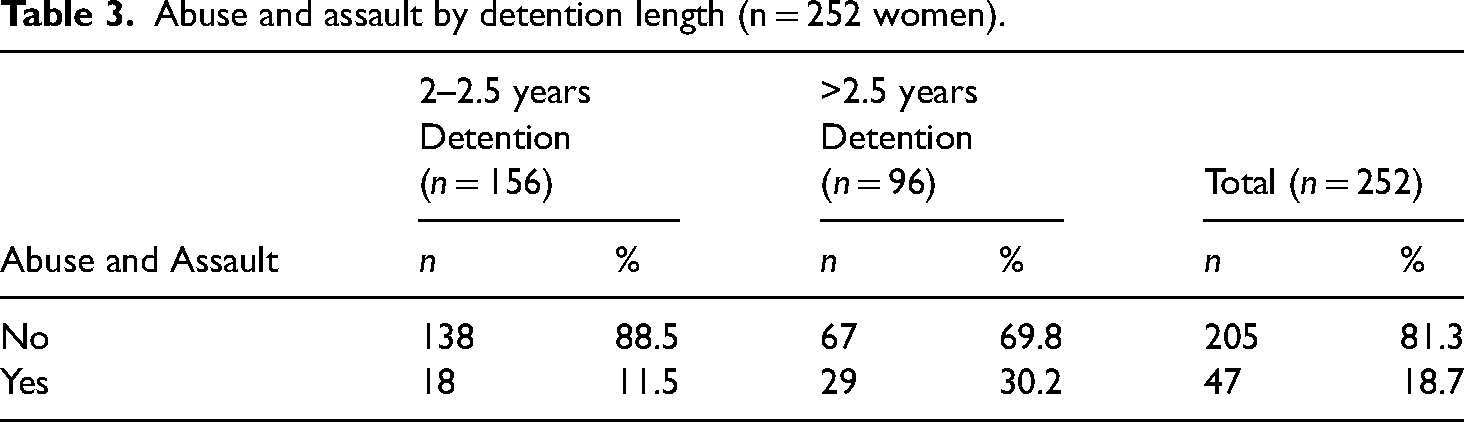
Long-term detention acts as an independent stressor, with a significant impact on violent victimisation at the hands of others. Detention longer than 2.5 years nearly tripled the prevalence of abuse and assault in general. 11.5% of women detained for up to 2.5 years reported having been victims of abuse and assault, and this proportion increases to 30.2% for those detained longer than 2.5 years (Table 3, χ2(1, n = 252) = 13.653, p = <.001, V = .233).
Abuse and assault by detention length (n = 252 women).
Family members can be a source of violence themselves, but also of protection against abuse and assault in detention. Under the circumstances of long-term immigration detention, families might lose their capacity to protect and might even be more often the source of violence. One of the service providers interviewed by Rivas (2022) explained that the immigration process puts incredible stress on relationships and families, often resulting in relationship breakdowns and family violence.
Family here included (own) children, parents, siblings, cousins and other extended family members in all possible combinations. When compared to women who were detained alone, those who were detained with any family members did neither experience less or more abuse and assault (χ2(1, n = 252) = .461, p = .497, V = .043). Single women in immigration detention therefore are not at a higher risk of being violently victimised than those who are embedded in family networks. As we will see below, the impact of family networks differs according to the types of members for IPV, while there is no significant positive or negative net effect of family relations on violent victimisation.
Women's prior experiences of violence seem not to be a source of vulnerability to further victimisation. There was no significant relationship between whether women had a reported history of torture or trauma and whether they experienced abuse or assault whilst in detention (χ2(1, n = 252) = .059, p = .807, V = .015). Independent of such personal experiences and histories, immigration detention puts women at risk of violence.
Intimate partner violence
In this section, experiences of gendered violence in the form of IPV are analysed for the 75 women, who came or/and were detained with a partner. Close to half of these women (40%) reported incidents of IPV, which is an extraordinary proportion if compared to global or Australian rates. IPV is a specific type of violence, and the contextual conditions might differ in their impact from general abuse and assault by others. Thus, closed detention had the opposite effect on IPV compared to general abuse and assault. Only 11.1% of women held in closed detention with a partner reported IPV victimisation, making them the least likely group of women to experience IPV. Comparatively, women detained in open detention were more likely to experience IPV (50%), followed by women held in a combination of open and closed detention (41.3%).
Although closed detention may act as an important stressor or are a generally violent environment, open detention facilities (i.e. CD) have comparatively less monitoring of behaviour and movement of detainees compared to what occurs in closed detention facilities. It may be due to this lower level of monitoring that IPV takes place more frequently in open than closed detention as there is no one there to stop these behaviours or to function as control and protection. Again, the detention conditions and failure of the state to ensure the safety of these women is a clear example of structural violence facilitating interpersonal violence.
Whilst longer detention served as a stressor for instances of abuse and assault reported by women, this was not the case when examining IPV. Detention length had no significant impact on their experiences of IPV, with the proportion of women only slightly increasing across the length of detention (χ2(1, n = 75) = .893, p = .345, V = .109). 35% of women detained between 2 and 2.5 years with a partner were victims of IPV, with this rate increasing to 45.7% of women detained for longer than 2.5 years with a partner. This indicates that women who were in an abusive relationship presumably were in such relationships already during the first 2.5 years of their detention, and this continued throughout their time in detention. Longer detention did not make relationships significantly more often abusive.
In contrast to general abuse and assault, the presence of a kinship network and family around the women was related to the prevalence of IPV. When looking at the role of family members around women in addition to their partner, the proportion of women who experienced IPV whilst detained with a partner and family was nearly 2.5 times higher at 43.8% than for women detained with a partner only (18.2%, χ2(1, n = 75) = 2.557, p = .182, V = .185). However, this difference was not statistically significant. It turned out that family constellations differed in their impact on women's violent victimisation by their partners. 44.3% of the 61 women detained with a partner and children were victims of IPV. Whilst this was more than double the rate of IPV experienced by women detained with just a partner and no children, the difference is not significant (χ2(1, n = 75) = 2.474, p = .141, V = .182). Further, no significant relationship between the prevalence of IPV and women being detained with a partner and any other type of family member, including parents and siblings, was found. Extended family does not serve as a strong protective factor against IPV in an immigration detention context. In contrast, the nuclear family constellation (partner and children) exacerbated the risk of these women experiencing IPV in a family dynamic.
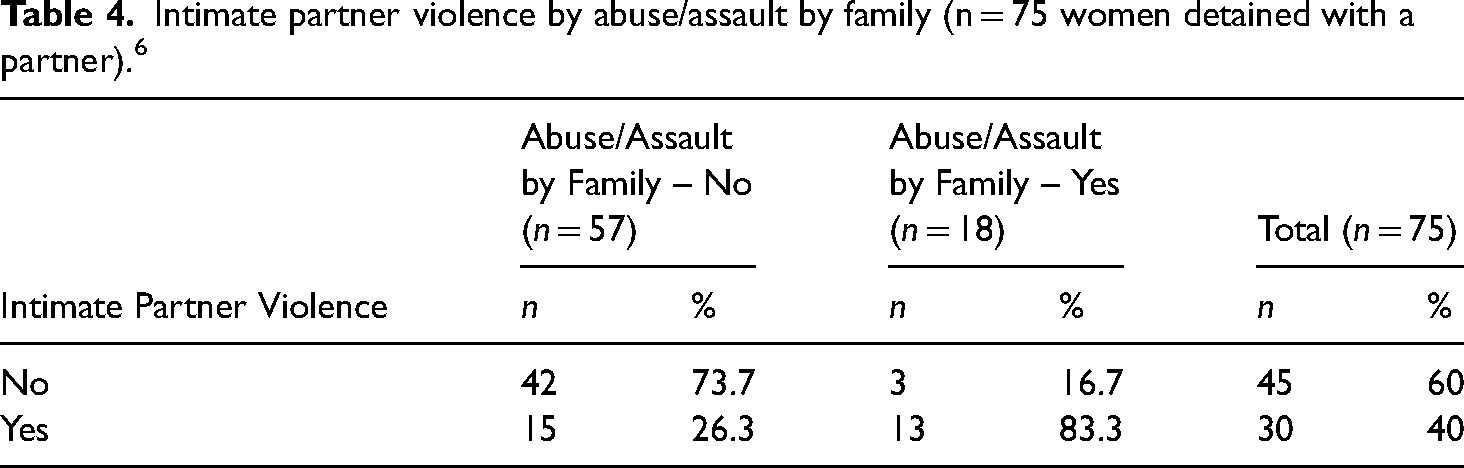
Importantly, IPV and abuse by other family members are closely connected. Of the 75 women who were detained with a partner, those who experienced abuse and assault by family members were much more likely to also experience IPV (Table 4, χ2(1, n = 75) = 18.531, p < .001, V = .497). Among the group of women detained with a partner, 83.3% of those women who experienced abuse by family members were also victims of IPV. While family networks seemingly are not protective against IPV, these results demonstrate that they are an additional source of violence in an already violent situation. Family members might condone, excuse, or even encourage IPV if violence within the family is also occurring. As no significant association was found between victimisation by IPV, and violence at the hand of any other group, be it staff, other detainees, or other people in the community, this emphasises the ambiguous and problematic role of extended families and their networks in detention.
Intimate partner violence by abuse/assault by family (n = 75 women detained with a partner). 6
Again, no significant relationship between a higher level of personal vulnerability, measured here as a history of torture or trauma, and IPV was found (χ2(1, n = 75) = 1.587, p = .208, V = .145). For both general abuse and assault and IPV, experiences of violence in detention are independent of prior experiences of violence. Whatever long and perilous journeys that they undertook, all women are exposed to violence that is bred in detention itself.
Discussion and conclusion
The purpose of this study was to explore the extent and types of violent victimisation of women in Australian immigration detention. The types of interpersonal violence examined included abuse, assault, and IPV. Three sets of factors and their relationship with these types of violence were explored: the role of detention type and length as stressors, the role of family networks as support, but also as a potential source of violence, and vulnerability resulting from previous experiences of violence in the form of torture and trauma. The findings presented in this paper align with those of previous studies (see Jolly and Reeves, 2005; Martin and Herzberg, 2014; O'Neil et al., 2016) which found that women experience violence throughout the migration process. This study shows that detention is no different. Immigration detention constitutes another environment of violence that is shaped by stress, control (or lack of it), and vulnerability. For some women these experiences of violence are new, but for others, they are another layer of victimisation. The findings show the context that structural violence in the form of immigration detention, creates a fertile ground for interpersonal violence (including gendered violence). The inaction by the Australian government to address these issues adds another layer of structural violence by allowing and perpetuating violence against women in immigration detention.
The type of facility women were held in and the length of their detention (i.e. detention conditions) had varying impacts depending on the type of violence women experienced. Being held in closed detention meant that women were more likely to be victims of abuse and assault. This may be due to them being trapped in a violent environment. However, the opposite was true when looking at IPV as women were more likely to experience IPV whilst detained in community detention (i.e., open detention), and least likely when held in closed detention. This can be ascribed to several factors, including the greater level of monitoring and surveillance present in closed facilities compared to open detention. It may be inferred that perpetrators had fewer opportunities to commit IPV without being observed by others or getting caught. Bacon et al. (2016) attributed women's experiences of violence and abuse to the infrastructure of the detention facilities. These results support this in principle, with a lack of security for women in open detention. However, women in closed detention may have felt less able to report instances of violence committed by a partner for fear of further abuse whilst in detention with said partner. They may also have feared other repercussions such as being separated, which could negatively impact their ability to be released from detention. Rivas and Bull (2018) found that Australian immigration policy privileges the entry of women who are members of a family with a male head of household. This is another example of structural violence, as these women are trapped in abusive and often violent relationships due to the precarious nature of seeking asylum in Australia, the policy that keeps them detained, and the conditions of long-term immigration detention. The other type of condition explored in this paper, length of detention, increased the likelihood of women being victims of abuse and assault the longer they were detained. Comparably, detention length had no significant impact on whether women experienced IPV or not.
The role of family and kinship networks around these women also influenced their experiences of violence. Although being detained alone or with family made no significant difference to whether women were abused or assaulted, it was a key factor for IPV. When women were detained with family, the presence of children exacerbated the risk of experiencing IPV in a nuclear family dynamic. This finding aligns with previous research outside of immigration detention such as that by Clements et al. (2022) which found that the majority of IPV survivors reported that their abuser (partner) utilised their children as a way of intimidating, harming, and frightening them. In addition to this, experiencing abuse and assault at the hands of other family members, such as parents and siblings, greatly reduced any protections against IPV that a family might have otherwise provided. Clark et al. (2010) similarly found that for women outside detention, violence perpetrated by family members was associated with an increased risk of victimisation of IPV. Within detention, family networks and relations are more a source of violence than otherwise.
The last factor examined was previous histories of violence, in particular trauma and experiences of torture. In contrast to research by Dross (2000) who notes that women who have previous experiences of torture and trauma may be more likely to be re-victimised, this was not the case in this study. Instead, victimisation of the women, either in the form of abuse and assault or IPV, was independent of their prior experiences of violence. Overall, personal factors, including whether the women had a history of torture and trauma and if women were detained with family, had no significant impact on whether they experienced violence or not. However, one exception emerged. That is, if women who were detained with a partner, experienced abuse and assault at the hands of family members, then they were significantly more likely to experience IPV than those who did not. Thus, it appears that the conditions of detention played a greater role in whether women experienced violence whilst detained. It is the context of structural violence that immigration detention creates that exposes women to all types of interpersonal violence. Such exposure was exacerbated, either directly or indirectly, by their lengthy detention in the insecure and unsafe conditions of detention. These findings clearly demonstrate the intersection between structural and interpersonal violence in immigration detention.
The findings from this study lend themselves to a range of implications for current policy regarding the safety of women detainees. During the time migrants are held in immigration detention, more attention needs to be paid to their safety, in particular ensuring that women have protection from abuse and assault at the hands of others. It is now clear that the type of facility contributes to women's experiences of violence. Open detention is by far the better option compared to closed detention when it comes to the overall wellbeing of women, but there are fewer protections from violence available to women detained in community detention (Rivas, 2022). Safeguards and programs should be implemented to ensure women understand not only that abuse and assault are illegal, but they do not need to remain in unsafe situations and know who to inform and where to go for support, without fear of repercussions. Women detained in the community also need more assistance in accessing support services. Within the closed immigration detention facilities, there needs to be more monitoring and staff training to both recognise abuse within families and between partners, but also prevent other detainees or staff from abusing or assaulting these women.
Overall, this article has contributed to the literature by examining women's experiences of immigration detention through the theoretical frameworks of structural and interpersonal violence. The results show that Australian immigration detention is a violent environment for women. Many of these women, like others who have made often perilous journeys to Australia in search of asylum and protection, have done so in search of a safe haven. However, these expectations were not matched by the reality. It is the responsibility of the Australian government to provide safety for those under the custody of the state. Women will continue to be victimised in immigration detention until the Australian government abolishes the use of these facilities, or at least until changes limiting the length of time people are detained and safeguards to recognise and prevent violence are implemented.
Footnotes
Declaration of conflicting interests
The author(s) declared no potential conflicts of interest with respect to the research, authorship, and/or publication of this article.
Funding
The author(s) received no financial support for the research, authorship, and/or publication of this article.
