



Abstract
The transition from prison to society tends to be tough and painful for people in resettlement and challenging to facilitate for professionals. The Norwegian Correctional Services aim for a continuous reentry focus throughout the prison sentence. Norway has been presented as one of the Nordic exceptional penal states, partly based on ‘the encouraging pattern of officer-inmate interactions’. However, this exceptional picture has been criticized for paying more attention to discourse than to lived experiences. As newly released persons’ experiences of interaction and relationships with staff and of how these facilitate and frustrate their reentry processes have largely been ignored, this article draws attention to their perspectives. Inspired by narrative analysis, in cooperation with persons with lived experience, we constructed three stories of challenges and support during resettlement. Through these in-depth presentations of frustrating misrecognition, ignorance and fragmentation, but also of closeness, continuity, recognition, belonging and de-stigmatization, this study provides important insights into how interaction and relationships with staff enable and constrain reentry to society. By bringing lived experience into the discourse of Nordic exceptionalism, this article adds valuable perspectives to this still ongoing debate. Overall, we argue for a revitalization of the primary officer role and a broader approach to resettlement to facilitate support throughout the prison sentence.
Introduction
The transitional phase from prison to society tends to be tough and painful for people in resettlement and challenging to facilitate for professionals. In light of this, improvement of resettlement practice has been discussed in several European countries (Dünkel et al., 2019). The prison and probation services aim to prepare people for crime-free lives through a continuous focus on throughcare and a gradual transition to the community (Dünkel and Weber, 2019; Pruin, 2019). Despite these intentions, reentry assistance is often fragmented and distanced (Cracknell, 2020; Dominey, 2019; Koffeld-Hamidane et al., 2023; Robinson, 2005). Drawing upon narratives of newly released persons in Norway, this article aims to explore experiences of the impact of staff on challenges and support during resettlement.
Literature on staff impact during resettlement
Previous research illustrates how prison and probation staff, by treating resettling people as human beings, going beyond their work duties, and including people in something meaningful, promote feelings of normality, worth and belonging. To be treated as a human being involved being respected, accepted and recognized as more than the crime one had committed (O'Sullivan et al., 2020). These experiences are often related to special units or prisons based on programmes with particular aims, such as peer mentoring (Einat, 2017; O'Sullivan et al., 2020) and treatment or rehabilitation more generally (Blagden et al., 2016; Giertsen et al., 2015). Staff who saw participants as individuals, trusted in them and believed they could change, characterized the social climate in some of these units (Blagden et al., 2016; Collica-Cox, 2018). Blagden et al. (2016) and Meek and Lewis (2014) highlighted how recognizing positive changes and reflecting them back to the participants galvanized commitment to their personal change process. This also counteracted stigma and feelings of humiliation (Stone et al., 2018). Recognition and appraisal of participants’ desire for and movement towards rehabilitation and desistance helped them gain confidence to maintain crime-free lives and pro-social identities as non-offenders (Doekhie et al., 2018: 509). Experiences of being valued as assets within a community beyond oneself appeared to facilitate positive change (Blagden et al., 2016; Collica-Cox, 2018; Einat, 2017; Giertsen et al., 2015; Meek and Lewis, 2014; O'Sullivan et al., 2020). Longitudinal studies have also emphasized the importance of continued relationships, where staff were seen as encouraging, caring and acknowledging, and practising an open-door policy. Participants felt comfortable when talking freely without being judged, allowing staff to be reliable stepping stones who provided hope and motivation for life changes (Collica-Cox, 2018; Meek and Lewis, 2014).
However, the literature also shows the pains and struggles of rehabilitation and re-entry, and how these hinder resettlement. Research by Durnescu (2019) and Miller (2021) presents and discusses how criminal records stick with the person for a long time after imprisonment, and cause difficulties in areas such as finding and keeping suitable housing, employment and supportive formal and informal relationships. Additionally, Durnescu (2019) underlines how the pains of release are often interrelated, creating vicious circles as one pain leads to another. In the US, penal voluntary organizations have been shown to be inadequate in reducing structural barriers during resettlement (Miller, 2014). In the Norwegian context, however, staff in these organizations find that they can work close to their ideal of supporting de-stigmatization and mitigating challenges following release. However, at the same time, Norwegian probation workers describe a turn away from practices that support resettlement (Koffeld-Hamidane et al., 2023).
Resettlement is commonly understood as a process of control and supervision within the Correctional Services, aiming to integrate people into society after imprisonment. Terminology describing resettlement frequently changes, and the process has been seen as starting pre-release and continuing ‘through the gate’ into the community (Cracknell, 2023). Based on our findings, we argue for a broader focus, where resettlement practice starts at the very beginning of imprisonment.
Resettlement practice in Norway
Prison officers, probation staff, and staff in penal voluntary organizations hold significant but varying interests and responsibilities in Norwegian resettlement practice. The Norwegian Correctional Services aim to implement remand and penal sanctions in a manner that is satisfactory for society, and which prevents criminal offences, and to facilitate a system that allows offenders to change their pattern of criminal behaviour (Kriminalomsorgsdirektoratet, 2021: 7). In line with this, prison officers and probation staff continually balance tasks of control and care. But despite being subject to the same overarching laws and guidelines, practices are differently organized behind the prison walls and in the community. Probation staff are responsible for following up individual sentences, organized in a manner that supports undisturbed, personal conversations with sentenced persons. However, they have recently expressed their frustration at seeing their practice moving away from relationship building and social work (Koffeld-Hamidane et al., 2023). Prison officers, on the other hand, work under more dynamic and less structured conditions. The primary officer scheme was introduced to formalize their work of facilitating rehabilitation and desistance, stating that the primary officer must carry out background surveys, coordinate future plans and interdisciplinary cooperation, and motivate and support people throughout the sentence (Justis-og beredskapsdepartementet, 2002). Despite the intention of the scheme and its potential for resettlement work, today's practice of the role has been considered as holding a huge, unfulfilled potential (Culbertson, 2021). Local and individual interpretations and prioritizations, lack of time and resources, rotation of officers, and relocation of imprisoned persons challenge relationship building and structured reentry work and lead to considerable differences in practice. Even though penal voluntary organizations in Norway have taken ever greater responsibility to support desistance during resettlement, they do not implement sentences. Penal voluntary organization staff and probation staff hold similar ideals to achieve individual change and belonging following release (Koffeld-Hamidane et al., 2023). Despite this, only penal voluntary organization staff found that they worked in line with these ideals. By practising ‘umbilical cord’ support, through a resource focus and establishing close, continued relationships, they managed to reduce barriers related to identity change, stigma and navigating the welfare system.
The Correctional Services aim for a continuous focus on preparation for release throughout the prison sentence (Kriminalomsorgsdirektoratet, 2021). However, the penal system has recently undergone changes that negatively influence opportunities to work in line with this aim. The prison population has changed due to higher penalty levels for some serious offences, while more sentences for less serious offences are served in the community, and growing numbers serve out their full sentences. Other developments are cuts and reductions in staff, high numbers of people in solitary confinement, and permanent closure of several low-security prisons (Justis-og beredskapsdepartementet, 2019, 2022; Sivilombudsmannen, 2019). Penal voluntary organizations have also taken on greater responsibility in reentry work (Koffeld-Hamidane et al., 2023). Discrepancies between aims and practices related to resettlement have been highlighted by practitioners and researchers (Johnsen and Fridhov, 2019; Koffeld-Hamidane et al., 2023; Todd-Kvam and Ugelvik, 2019). Prison staff report fewer opportunities to engage in reentry work, while probation caseworkers are concerned about the impact of the recent changes on rehabilitation and desistance (Actis, 2020; Koffeld-Hamidane et al., 2023; Todd-Kvam, 2020), and researchers point out how the increasing risk focus has re-shaped the Norwegian penal field (Todd-Kvam, forthcoming). A recent report also criticizes the Correctional Services’ inadequate rehabilitative support during imprisonment, their lack of insight into imprisoned people's needs and challenges, and their failure to draw up realistic and encouraging sentence plans (Riksrevisjonen, 2022).
Norwegian resettlement practice within the debate of penal exceptionalism
Norwegian penal practice has, as one of the Nordic penal states, been presented in exceptionally positive terms, as Pratt and Eriksson (2013) substantiated differences in punishment between clusters consisting of Finland, Sweden and Norway on the one hand, and England, Australia and New Zealand on the other hand. The prison ‘tours’ that formed the basis for these understandings lasted between 2 and 4 h and were usually accompanied by a senior officer. Features of the prison were sometimes discussed with prison managers and staff, and in some cases with imprisoned persons. This approach was partly chosen because in that way ‘… it would be possible to observe recurring patterns relating to officer-inmate interaction, dining and visiting arrangements, and various other accoutrements of the material conditions of life that were common to the prisons and prison systems in each cluster’ (Pratt and Eriksson, 2013: 9). The authors summarized the differences in the five areas of ‘prison size’, ‘officer/inmate relations’, ‘quality of prison life’, ‘prison officers’, and ‘work and education programmes’. The extraordinary interaction between staff and imprisoned persons in Nordic prisons was highlighted through how staff took part in counselling and planning, daily tasks and activities, how the two parties got to know each other well, and how staff respect for imprisoned persons seemed to be an institutional feature.
This exceptional presentation has been neutralized by Norwegian and international penologists (Crewe et al., 2022; Crewe and Ievins, 2021; Ievins and Mjåland, 2021; Ugelvik, 2013). It has been considered as idealizing, and as disregarding the pain of imprisonment and the unevenness in mild treatment in Nordic penal contexts. Although people are kept safe in decent and harmless conditions, imprisonment in Norway is often experienced as empty, careless, negligent and meaningless (Ievins and Mjåland, 2021). The positive portrayal has also been questioned as more interested in penal discourse than in lived realities (Crewe et al., 2022).
The backdrop of an exceptional Norwegian penal practice has been the starting point for projects aiming to enhance imprisonment and working conditions internationally. The American organization Amend, based at the University of California, is one of the partners in a project where Norwegian staff participate in training prison officers to support positive change, rehabilitation and desistance (Justis-og beredskapsdepartementet, 2022). However, one of the project instructors reflected on her experience of discrepancies between methods and schemes and daily practice in Norwegian prisons: ‘Every time I enthusiastically talk about the Norwegian primary officer scheme, I am increasingly convinced of the scheme's untapped potential. I find myself rather wanting to talk about how I think it should be used, rather than how I know it works in practice’ (Culbertson, 2021: 105, our translation).
We would argue that the visiting ‘tours’ that Pratt joined would have led to different descriptions if they had been guided by people imprisoned in the various units. This is because, behind the presentations of exceptional quality of prison life and relationships, there are lived experiences. As newly released persons’ stories of staff assistance during resettlement have largely been ignored, this article aims to explore their experiences. We ask for their perceptions of relationships and interaction with prison officers, probation staff and penal voluntary organization staff in this context, and of how this challenges and supports their reentry processes.
Methodology
This article draws on 13 interviews with persons recently released from prison. While these interviews were initially analysed thematically, during this process we increasingly became aware of the added value of a narrative analysis of the data. A narrative methodology maintains the integrity of the participants’ views and keeps their narratives intact instead of fragmenting and decontextualizing them (Josselson, 1995; Schinkel, 2014). Narrative research often creates empathy for the narrator, and can narrow the distance between people from different social backgrounds (Riessman, 2002). Our analysis involved both an analysis of narratives (Polkinghorne, 1995: 12), that is, collecting stories as data, with their analysis resulting in descriptions of themes that held across the stories, as well as narrative analysis, where we collected descriptions and events and further synthesized their plots into one or more stories (Polkinghorne, 1995: 12). While the narrative turn is generally dated to the 1980s in most disciplines, a sustained interest in stories emerged in criminology more recently, in the 2010s (Fleetwood et al., 2019). This has enabled the discipline to explore the ways in which people's stories about their lives are shaped and their consequences in terms of perceived harm and these people's futures (Maruna and Liem, 2021), which form the basis for the present study.
Recruitment and participants
Participants were recruited through gatekeepers in three probation offices and three voluntary organizations, after discussing the research aims and criteria for inclusion. The recruitment approach was deliberately broad, including anyone who had recently experienced the transition from prison to society, with the aim of engaging a diverse sample encompassing different experiences of resettlement. Twelve men and one woman participated, aged from 19 to 66. At least three had parents born and raised outside Norway. They lived in different parts of the country and had served their last sentence in twelve different prisons of varying levels of security. Three of them had been released from high-security facilities (participants are presented in more detail in Table 1).
Presentation of participants.
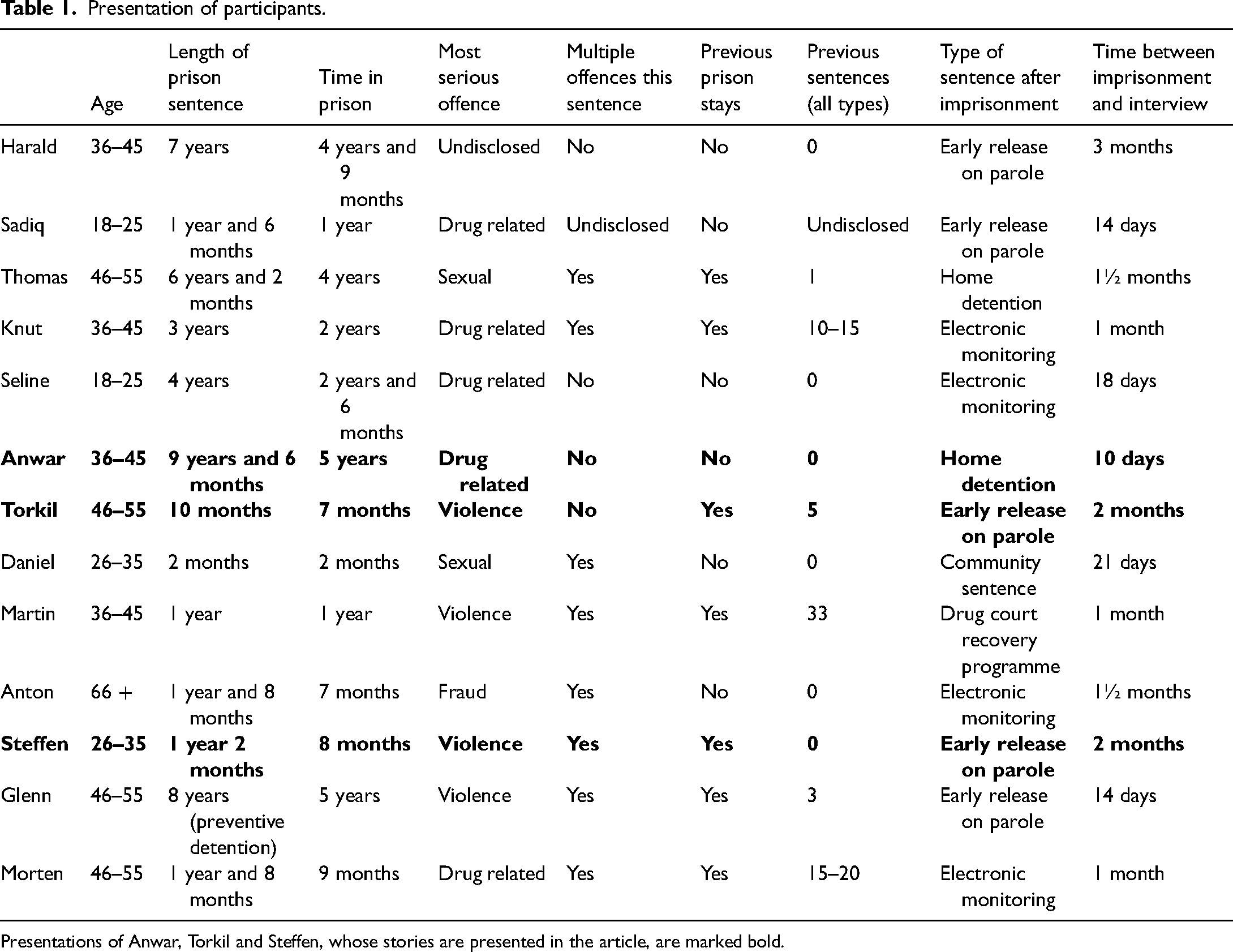
Presentations of Anwar, Torkil and Steffen, whose stories are presented in the article, are marked bold.
Data construction
Before the interviews, the researcher and participants communicated about the topic and aim of the project and agreed on a time and place for the appointment. This enabled us to establish rapport before the interview. Participants were interviewed individually, in person, from one week to three months after release. Interviews took place between April and August 2021, in meeting rooms at a university or in libraries, in cafés, and in a private home. Interviews started with a review of the information sheet, signing of consent, and completion of a background form. These initial steps facilitated informal chats and a careful movement towards the research topic. Interviews started broadly, allowing participants to talk about whatever they found relevant to the topic. Gradually questions narrowed down to how they experienced relationships with staff during imprisonment and after release. Participants were asked if they had been in post-release situations in which they would previously have been likely to commit criminal acts, and what affected their actions in such situations. How interaction with staff affected the likelihood of them staying away from crime was of particular interest. Interviews were recorded and transcribed before analysis.
To form a general picture of our findings, we adopted a thematic approach before conducting a narrative analysis, inspired by Larsgaard et al. (2020). This allowed us to describe themes that were held across several interviews and provided an initial overview. We built this approach on Polkinghorne's analysis of narratives. We then selected three interviews which we found presented powerful contextual examples of participants’ lived experience. The three interviews illustrate differences and similarities, uniqueness and diversity, and were deliberately selected to present varying experiences on the topic. Through a process of narrative analysis, we derived stories which were each based on analysed data from one interview with one person only. In this narrative analysis of these three interviews, we drew together the events of each story into temporally organized wholes where events unfolded chronologically and culminated in an outcome. This operation of emplotment composed places, descriptions and events into stories, in which new levels of relational significance appeared. Through this narrative analysis, we constructed stories from elements of each interview which we understood as making a meaningful contribution to answering our research question. Following this process, we ran a second phase of employment in cooperation with three persons with lived experience in resettlement. They represented WayBack, a non-profit foundation that had an advisory capacity in the research project (Roche et al., 2010). Representatives from WayBack were not interviewed in our study. During our cooperative analysis with WayBack, we analysed and discussed the preliminary, anonymized stories, which resulted in enhanced, more compact presentations of individual stories.
This analytic approach led to broad and nuanced employment reflections on each story. Based on narrative analysis, the stories were abstracted from the data, and revealed meaning not apparent in the data themselves. They were constructed through several stages of selection and analysis, to provide illustrative answers to our questions of interest. The collaborative analysis thus involved ordering and organizing the separate interview data into coherent stories, without making further changes to the individual narratives.
We introduce our presentation with a broad overview of relevant themes from the analysis of narratives. Regardless of sentence length, participants described events and interactions with staff from all aspects of imprisonment. They often described paradoxes, where staff would either take the initiative to get to know them or were mainly ‘drinking coffee in the office to pick up their salary’. Experiences of productive relationships with primary officers were referred to as ‘pure luck’. Imprisonment often felt monotonous and without progression due to a lack of interest and sentence planning by the staff. Interaction with probation staff was mostly presented as either supportive or shallow, but some participants described control measures as intrusive and disruptive. Voluntary organization staff were found to provide outstanding support, which participants considered as basically the Correctional Services’ responsibility.
Stories of ignorance and fragmentation, recognition and closeness
Each of the following three stories is based on analysed data from one person only. Each story is presented as a whole section preceded by a short contextualization, inspired by Klevan et al. (2016), and followed by an employment analysis in light of relevant literature. Quotes within the extracts are direct quotes, and the surrounding text is the analysed story.
Torkil's story
Torkil is in his late forties. He rented a flat and had a stable job when imprisoned. He served a ten-month sentence for violence in a low-security prison and was released on parole after almost seven months. He had previously served five shorter prison sentences, some of them in the same unit. During the interview, Torkil kept comparing his sentences. His previous, shorter stays felt like breaks from his daily life. But his latest, longer sentence had a more negative effect on his life. The interview took place at a bakery in his hometown and lasted for about 75 min. I didn’t receive any help from the prison. I got a bunch of false promises. ‘You can get electronic monitoring, you can apply for transfer to low security, … apply for this and apply for that…’ I sent application after application. Lots of them were not even received at the other end. They got lost. I wasn’t impressed by the prison officers. It all started with the application for electronic monitoring. One of them urged me in advance to apply after two or three weeks. So I could keep my flat while I waited for a transfer, I managed to save up for two or three months’ rent before I started my sentence. I really hoped to get that application approved. But after a long time, they rejected it. I asked them ‘Why? I can’t just get rejected orally?’ Well, it was because I was sentenced for violence, which means there's no way you get electronic monitoring. But if I had known that I wouldn’t have bothered to apply, and just given up on the flat. Then I would have found a new flat after release and saved that 63000 kroner. That's a lot of money.
Several of my applications simply disappeared into thin air and were neither sent nor processed. But one day my primary officer told me to send an application to an open institution, where I could work while serving my time. He told me they would sort it out. I said ‘Okay, I'll do that’. After a while, I called the institution and asked ‘Have you looked at my application? Is there any chance?’ ‘Yes, we have your application, but haven’t received any approval from your primary officer’, he said. So I had to contact him again, and he wasn’t around every day. It took time. And, hah, I finally got rejected. The application had suddenly reached higher up in the prison system, and the lawyer and management thought, ‘No, this kind of sentencing is not for you, you don't need it’. ‘No, well, then … Okay’. I replied. What was I supposed to say? Staff in my unit advised me to apply, so I did. And they didn’t quite understand this, either.
Eventually I thought it would be brilliant to get transferred to a regular transitional home, since I had a job and a home, and was in quite a good position to return to society. But my time was limited. After a while, the transitional housing staff told me I could have got a place there, … if they’d only received my application earlier … In other words, the prison believed I wasn’t allowed to apply for anything until I received a response to the first application. So, I had to serve my entire sentence in the same prison. I could actually have got a place in the transitional housing, if I had sent that application earlier. It was just bullshit. So, I’ve really been tricked badly, you know, all the way. At the end, I felt that it got personal. I followed the advice of the staff the whole time, and that ruined most of it. The blokes who worked with me in the kitchen asked ‘Do they have their own shredder for your papers, or what? If we had half of your problems, things would have been really bad’. Fortunately, I’m very patient. But it got to be too much, heh. I got a bit pissed off and shouted at the officer a couple of times … I was a bit annoyed with him. At one point my primary officer said ‘If this application doesn’t get through, I’ll leave. You’ve had enough misfortune. This is just nonsense’. He didn’t understand where my papers went or how I got so many rejections either. He felt bad about it, because he was the one who helped me find information and send applications and stuff.
You’re supposed to try to get motivated to get back into society and all that, but with all the nonsense I experienced in that prison, I was close to getting my parole revoked just because they managed to annoy me that much. I could actually have been out working a lot earlier. Then I would have avoided all that debt. I borrowed 63000 just to keep my flat while I was inside. And when I was released, I suddenly got information about a possible foreclosure at home, for the last 900. I just thought ‘Hello, you must be kidding!’ But I’m a very optimistic person. If my financial situation calms down, life will be easier. Money isn’t much, but unfortunately, it's still everything. Heh.
They could have saved me a lot of applications, if they had guidelines to follow. No one knew what rights you have as an inmate in this or that category. You must ask over and over again, preferably other inmates who have been there before. But that's not how it should be. The staff should give you advice. So the prison staff didn’t set very high standards this time. It wasn’t very impressive. Heh. That's just the way it is, I’ve realized. But if I had known just half of this beforehand, I wouldn’t even have turned up at the prison gate, to be honest.
Ignorance and fragmentation
Torkil's story is about false promises, postponements and being misled by prison officers. It presents experiences of repeated ‘lacks’ from staff: a lack of interest, a lack of motivation, a lack of information, a lack of communication, and a lack of professional practice. This reflects the ignorance and fragmentation of Torkil in this context, which generated emotional and financial distress. Despite following guidance from staff, Torkil did not get what he applied for. Rejections were based on his goals being unachievable, or his applications being handed in late or in the wrong order. Based on staff recommendations, he spent much energy on trying to reach unattainable goals. Torkil's patience and acceptance in this context is revealed through laughter and modest resignation but is occasionally overshadowed by irritation and frustration. At a turning point in the story, he highlights how poor advice and missing applications prevented any sentence progression. By quoting peers and staff, Torkil underpins how this distress made him feel deceived (Riessman, 2008). This part of the story illustrates how he eventually felt that this ignorance and fragmentation was personal and stigmatizing. On top of false hopes of sentence progression, this fostered frustration, anger and disappointment. When such emotional experiences become intense, they have been shown to harm desistance processes during resettlement (Stoll, 2022).
Torkil reflects on leaving prison in a worse state than he entered it, despite his motivation and plans to resettle. He put money aside to keep his flat until he could earn enough while on electronic monitoring. However, because of the wrong advice he was given, he incurred a debt and possible foreclosure during imprisonment. Todd-Kvam illustrates how penal-related debt in general affects change processes, in that: ‘The struggle to keep one's head above water financially will reinforce and prolong the liminal experience of desisting from crime’ (2019: 14). As Torkil found a lack of interest in his resources and challenges, a lack of structured conversations, and a lack of preparations for a future plan, his goals were not adjusted in line with the aims of the Correctional Services. If the challenges associated with his accommodation had been addressed at the very start of his imprisonment, Torkil would not have been close to homelessness upon release.
This story illustrates a work culture of a lack of understanding and overall interest, which frustrated Torkil's motivation, possibilities and sentence progression. The disclaiming of responsibility by staff also affected the building blocks for trust and care, and hindered relationship building. Despite Torkil's characterization of his relationship with his primary officer as positive, it turned out that the officer's advice was perceived as ultimately misleading. Refusals and wrong advice caused annoyance and despair, which upset Torkil's desired return to society and probably produced pains of goal failure (Nugent and Schinkel, 2016). What might have appeared to staff as separate elements were of great significance for Torkil's broader project of getting his life back on track.
Anwar's story
Anwar is in his early forties. He has a family and owns a house. Anwar served his first prison sentence of almost 10 years for drug-related offences. He started in a high-security prison and was transferred to an open prison and then transitional housing. At the time of the interview, he was serving the last part of his sentence at home. The interview took place ten days after release, in the café at his workplace, and lasted for about 90 min. As a first-timer, I knew nothing about prisons. Based on what I have seen and heard in the media about Norwegian prisons, I thought ‘Wow!’ The Correctional Services’ plans are good. But I was very disappointed to see they were just camouflage. When I served in high security, I had a nice room and plenty of space. I had my own shower and all that. But there's so much more to it. During the two years I served there, no officer ever came to ask ‘Hey, how are you? Can we help you with anything? Are there any courses you would like to attend?’ or something like that. If you don’t take the initiative, you’re forgotten. Simple as that. When I applied for an open prison, my primary officer had to write an attachment. He said: ‘I don’t know exactly what to write about you. The only thing I know is that you are liked by inmates and staff. You are very nice, and never make any noise. But that's all I know’. I told him that I had been there for two years, which was plenty of time to get to know me, to invite me to meetings, to ask how I was doing and things like that. ‘Yes, but we only have positive things to write about you’. I thanked him for saying that. But that was the answer I got. After two years.
But when I was transferred to the open prison, I got a completely different view of the Correctional Service. I became part of a community where everyone had something to do. I could walk around from morning to night. Staff were very helpful. I was no longer a number. I was a person, trusted and given responsibilities. That helped me a lot mentally. My brain opened. I saw new things and started thinking about the future. I thought a lot about where I was going and what I needed to address. And if I had anything on my mind, a problem or something like that, I could address it. I could knock on the prison director's door, have a cup of coffee with him, and talk about my problems or applications. I could have a cup of coffee with the lawyer. I felt that they listened to me. Not just ‘La, la, la!’, they listened to me. That was a good transition for me. I simply got a new perspective on life.
After a while I moved to transitional housing. I could finally start working. But I have some pride, you know, so I wouldn’t call people I know. I wanted to find something on my own but wasn’t sure of how to go about it. I had some contact with TFL (a penal voluntary organization) while I served at the open prison, so I continued that contact. We started with a short interview over the phone, and then Conny (staff member at TFL) came over to have a chat. We worked very closely. We communicated daily for three months, until I found my job. I searched for ads online and forwarded them to her. She replied ‘Should we just go for it?’ She drove for hours to get here. We met many times, for interviews or just for chats. She's been very encouraging, and she contacted the possible employers for an interview. It's not easy for an inmate to start all over again, because we live in a society where it's easy to judge people. And when you tell people you’ve been in prison, they think all sorts of weird things. I wasn’t worried about the interviews themselves, but about how people viewed me. It was a great help that Conny made the first contact and introduced me to the employers, because she knows me. If they still wanted to interview me, my situation wouldn’t shock them. That meant I could focus on what the job involved, my strengths and weaknesses, and who I am as a person. I could tell them I wasn’t proud of my sentence, but it was still a part of my life. It probably took a bit of a toll on my self-confidence again. My employer is very open and non-judgmental, so I jumped straight into the job, and I’m getting more and more responsibility and confidence each day. I have TFL to thank for it. They are very efficient and stand by their promises. That's something I’ll never forget.
From ignorance to recognition and belonging
Anwar's story presents feelings of ignorance, recognition and belonging, illustrated through two main transitions in the story, the move from a high to a low-security prison and from an open prison to society. It describes the staff's lack of interest in relationship building in the high-security prison, and how life there surprised and disappointed him. It also exemplifies how staff ignorance towards Anwar and his sentence progression could have complicated his transition from a high-security prison. The transition to an open prison illustrates an important shift from his experiences of being ignored, forgotten and dehumanized, to perceived attention, recognition and responsibility. This turning point also highlights the importance of being part of a community in the open prison, and of being treated as a human being rather than a number. Prison units emphasizing that people are more than the crime they committed have been shown to promote supportive relationships and experiences of positive change (Blagden et al., 2016; O'Sullivan et al., 2020).
The second transition in Anwar's story, from open prison to society, further underlines the meaning and struggle of belonging. Anwar's uncertainty and expectations of labelling challenged his return to daily work, and were probably related to experiences from his initial encounter with imprisonment. In this context, Anwar established a close and lasting relationship with Conny, based on respect, recognition, trust and effort, which have all been shown to initiate and maintain desistance processes (Collica-Cox, 2018; Meek and Lewis, 2014; Ugelvik, 2021). Conny managed to highlight Anwar's personality and resources when approaching his future employer. She enabled the employer to recognize Anwar as a person, rather than seeing him as an unemployable offender. Her ‘umbilical cord’ supervision (Koffeld-Hamidane et al., 2023) challenged structural barriers and facilitated Anwar's reentry into society.
Steffen's story
Steffen is in his early thirties and lives with his mother and stepfather. He was still holding on to a job, even though he was heavily using drugs when he was imprisoned. Steffen was sentenced to 14 months for violence and released on parole after almost 10 months. He served his entire sentence in a high-security prison. Despite some previous convictions and serving his current sentence for a number of offences, he had not been imprisoned before. When interviewed, he had been released 2 months previously. The interview took place in a library in his hometown and lasted about 90 min. I guess it's never cool to be in prison, but it was good for me. Actually, like a wake-up call. I was completely devastated when I entered prison and was shielded from everything and everyone. When I finally got sober and came back to normal, I struggled for a long time. I was transferred to the drug rehabilitation unit where I attended courses. We were asked how we felt at daily morning meetings and motivated each other to stay away from drugs. I shared my history of addiction and what it did to me, which was important for my motivation. It was a relief to talk to others about the bad thoughts I go through 300 times by myself. It's not the same as saying it to myself, because the feeling remained inside my chest.
My primary officer had conversations with me three days a week, one hour each time, to help me stay sober. I was afraid to relapse if I didn’t get that help. I was lucky I had that man as my primary officer. Because of his personality I became very attached to him. He was very calm, which calmed me too. I actually recovered in prison. But it wasn’t easy to plan for my release. I didn’t believe I could manage without drugs out in society. I feared a relapse, to be honest. I thought it would be tough to hear all the sounds and experience the surroundings. And I noticed that already on my first day out. I was in my mother's house when family members came to visit. I just had to go to bed. I was completely devastated. It was too much. My primary officer told me in advance, ‘You should know, it's going to be tough the first couple of weeks’. It was quite extraordinary. I wasn’t really prepared for it.
Now that I’m released, the probation office checks that I’m at work and that I’m at home after 11 pm. But that control is kind of classified. I never know, because they could come to my house on unannounced visits. I haven’t really thought much about what it's like to have someone following me like that. My probation worker was very satisfied with everything I did, as she thought things were getting better and better. Within a fortnight after release, she told me how surprised she was that I wasn’t back in. She knows everything written in my papers, that I’m a heavy addict and major criminal, and that it's impossible to keep me under control. Some conversations with her last a long time, and we talk about anything. Sometimes I answer her questions in advance because I know what she's going to ask. It's kind of funny. I’ve told her things that she couldn’t read from my papers. That's great, because then she gets a slightly different impression of me. I was very happy that she saw me as a kind person. Because that's what I’ve been my whole life. I’ve always been kind and helped everyone.
The probation office has access to my Facebook account and my phone. If they suspect I’m into some secret chats about crime and stuff, they can take my phone. They have access to the operator to get the PUK code and can search the entire phone. Then they delete everything, so the phone is like new from the shop. And if they get suspicious again, they check what I’ve created and downloaded. Quite recently, I started a relationship with a girl. At the next meeting my caseworker asked ‘How have you been?’ I saw her smiling almost from ear to ear. ‘Things are going very well. I’ve got a girlfriend” “So I've seen!’ she replied. Because they check my Facebook account regularly. She said that's very good, and that she hoped things would turn out well. I get a lot out of our conversations. I think her advice will be useful. For example, if I’m close to relapse: ‘Think of what we talked about! About how important life is, and what you could lose’. She has signed me up for regular sessions with a therapist, so I’ll have someone to talk to after my parole. If I keep seeing that therapist, I think I’ll be fine in the future. Better than I’ve ever been.
Closeness, continuity and de-stigmatization
Steffen's story illustrates a positive experience of resettlement, from the very start of imprisonment, which involved a drug rehabilitation unit, peer support and predictable, caring and long-lasting relationships with his primary officer and probation staff. It also demonstrates how conversations and relationships facilitated recovery and desistance.
Regular talks with his primary officer helped Steffen get rid of heavy thoughts. Their rapport was built on the officer's calmness, competence, motivation and prioritization. This was a continuation of Steffen's positive experiences from group work in the drug rehabilitation unit, through talk, peer support and recognition. This helped Steffen work on himself and become ‘clean’ in prison. A similar relationship developed with his probation staff after release. In other studies, continued relationships, both during and after imprisonment, have been shown to provide hope for crime-free futures (Collica-Cox, 2018; Meek and Lewis, 2014).
Despite Steffen's positively loaded experience of imprisonment, he faced challenges in reintegrating into society. To overcome these obstacles, he used quotes from his primary officer and probation staff as supportive self-instructions. Optimistic statements from staff can motivate and build confidence, by promoting ‘bursts of energy’ and ‘boosts of self-esteem’ (Doekhie et al., 2018; Stone et al., 2018: 396). For some, the significance of such statements and conversations has emerged long after the time in which they took place (Farrall et al., 2014).
Steffen found that he was being monitored by the probation office. Even though his probation staff going through his social media accounts could have made him feel untrustworthy, Steffen presented this in positive terms. As the probation staff got to know him beyond presentations in his papers, he felt recognized as a human being. This allowed him to hold on to the identity of ‘a nice bloke’, in contrast to an ‘addict’ or a ‘criminal’. During our analysis in cooperation with WayBack, the veracity of this comprehensive amount of surveillance was questioned. Those involved regarded Steffen's experiences as exaggerated or imagined. However, regardless of the true content of the monitoring, Steffen expressed positive experiences like recognition, care and connectedness. Leaning on Sandberg's understanding that ‘Whether true or false, the multitude of stories people tell reflect, and help us understand, the complex nature of values, identities, cultures, and communities’ (Sandberg, 2010: 448), this part of Steffen's story illustrates what he considered valuable support. His story exemplifies perceptions of continued care in different relationships throughout resettlement. By connecting Steffen with a therapist at the end of his parole, his probation worker managed to ‘wrap him up’ and enable continuity. In assisting, guiding and caring for him after imprisonment, she also practised beyond a negligent approach (Ievins and Mjåland, 2021) and closer to ‘umbilical cord’ supervision (Koffeld-Hamidane et al., 2023).
Discussion
The data from 13 interviews in this article, including in-depth presentations of the analysis of three of them, limits the generalizability of the findings. However, by relating our analysis and the following discussion to recent debates on Nordic penal exceptionalism, to established concepts of supervision and the grip of penal power, and to literature on recent practice, the findings still contribute to more complex understandings of resettlement assistance. Further research would be preferable to enable broader generalizations on the topic.
Based on our findings, we will discuss how lived experiences of resettlement can be understood within the perspectives and concepts of ‘Maloptical’ supervision (McNeill, 2019) and ‘the grip of penal power’ (Crewe and Ievins, 2021: 64) and how they challenge the more idealized picture of Nordic penal exceptionalism (Pratt and Eriksson, 2013). We also include implications for resettlement practice and policy.
In light of Maloptical supervision, where people ‘(…) suffer the pain of not being seen; at least not as they would recognize themselves’ (McNeill, 2019: 225), we see how persons in resettlement might suffer from being ignored or misrecognized as individuals within a broader context, and how this may frustrate pathways of reentry. Crewe and Ievins (2021) draw on the concept of Maloptical supervision as they present ideal typical experiences related to recognition and misrecognition during imprisonment. They illustrate how the grip of penal power in prisons can be ‘loose’ or ‘tight’ in desirable or undesirable ways, and how a lack of attention and intervention can be frustrating and harmful. They compare an undesirable lack of tightness, where people are unseen, misrecognized and stigmatized, to their ideal form of tightness, where ‘the grip of power makes its subjects feel held or contained, gripped supportively rather than constrictively’ (Crewe and Ievins, 2021: 64). Our analysis illustrates how the grip of penal power may vary due to random and individual practices between staff members, but also due to subcultural differences. It also presents substantial insight into how interaction with staff enhance the desired ‘grip’, and what this brings to their lived experience. We illustrate how a looser grip of power leads to perceptions of randomness, ignorance and misrecognition, and how this, from the initial stage of imprisonment, fostered obstacles to meaningful change efforts. Additionally, our analysis adds valuable knowledge of how individual reentry processes evolve within a broad perspective of resettlement.
Our findings present a nuanced picture of Norwegian penal practice, by adding the perspectives of those who recently walked out of the prison gate to the still ongoing debate on Nordic penal exceptionalism (Crewe et al., 2022; Crewe and Ievins, 2021; Ievins and Mjåland, 2021; Ugelvik, 2013). By bringing lived experiences of fragmentation, carelessness, and a negligent approach during resettlement into this penal discourse, this article challenges the more idealized presentation of daily interaction based on consideration and acceptance (Pratt and Eriksson, 2013). Probation staff have described similar fragmented and distanced assistance following release, and how this contradicted their ideals of practising hands-on, umbilical cord support (Koffeld-Hamidane et al., 2023). However, the current article also presents lived experiences of interaction close to this ideal, much in line with a tighter and more appreciative grip of power (Crewe and Ievins, 2021). In this way, our results also enhance the more positive perceptions of support, more in line with an exceptional practice. Unfortunately, such practice seems to occur at random, within contexts of misrecognition and a loose grip of penal power.
Seeing our findings in light of the recent critique of the Correctional Services’ lack of rehabilitative practices during imprisonment (Riksrevisjonen, 2022), internal variations and non-utilization of the primary officer scheme (Culbertson, 2021), we argue for a broader and more structured understanding of and approach to reentry work. We have shown how misrecognition and a loose grip of penal power during imprisonment seem to relate to cultural differences, unstructured working conditions, and staff members’ individual interpretations, prioritizations and engagement. Some of the main tasks of the primary officer scheme are among the points criticized for not being properly effectuated (Riksrevisjonen, 2022), and therefore contributing to fragmented and frustrating assistance throughout and after the prison sentence. As the scheme aims to formalize and facilitate holistic rehabilitation work, it has been considered as holding a huge unfulfilled potential (Culbertson, 2021). Overall, we consider revitalizing and brushing the dust off the primary officer scheme together with a broader approach to resettlement to be beneficial to support people throughout their prison sentences.
Footnotes
Acknowledgements
We are very grateful to Emma Villman for valuable comments on an early draft version of this article and to the anonymous reviewers for comments and recommendations.
Declaration of conflicting interests
The author(s) declared no potential conflicts of interest with respect to the research, authorship, and/or publication of this article.
Funding
The author(s) disclosed receipt of the following financial support for the research, authorship, and/or publication of this article: This article is part of a PhD financially supported by the Norwegian DAM Foundation.
