



Abstract
With the rapid expansion of livestreaming platforms in China and the growing participation of creators from marginalised backgrounds, some formerly incarcerated individuals have entered the digital labour market as self-described ‘special university graduates’, sharing lived experiences of crime, imprisonment, and reentry with online audiences. Drawing on narrative identity and relational desistance scholarship, particularly the concept of belonging, this study examines how lived-experience streamers navigate stigma, platform governance, and the demands of digital labour while performing prison and post-release narratives. Over 6 months, 42 ex-prisoner creators on Kuaishou were observed, with sustained attention to 13 of them, and in-depth online interviews were conducted with five participants. The findings show that livestreaming operates as a negotiated relational space in which creators engage in moral meaning-making, shape pro-social narrative selves, and cultivate audience recognition. Through ongoing interaction, livestream rooms can generate reciprocal emotional investment and a sense of community, enabling conditional forms of belonging. At the same time, these practices unfold within tightly regulated platform environments and broader structures of moral governance that constrain what can be said, how prison experiences are framed, and which identities are deemed legitimate.
Keywords
I always thought that the special university had educated me well, but now I realized that there is another place that has truly educated and influenced me. Where is it? It’s the Kuaishou Green Platform, because the Kuaishou Green Platform not only provides me with such a platform to fulfill my wishes and repay my debts, but I have also truly made friends with so many positively minded people, so I am particularly moved. Today, what I want to share is how I, after returning to society, step by step, have come to where I am today. Do you want to hear the story, my fam? (Xiaoli, livestream on 22th June 2022).
Introduction
‘Special university graduate’ is a commonly used term on Kuaishou and other Chinese livestreaming platforms to refer to people who have experienced incarceration, particularly those who engage in lived-experience streaming. For these ‘graduates’, rebuilding life after returning to the community is a tremendous challenge. The most crucial and difficult aspect of this process is securing and sustaining stable employment. Re-employment for ex-prisoners depends not only on personal adjustment and effort but also on overcoming dual discrimination from society and the labour market (Flake, 2015). In several countries, including Singapore, the United States, and the United Kingdom, some businesses—such as cafés and restaurants—actively recruit ex-prisoners. Notable examples include Redemption Roaster (Forge, 2024), Liberty Kitchen (Cumming, 2017), Edwins Leadership & Restaurant Institute (Pilkington, 2019), and Jailhouse Café (Taylor, 2022). However, such initiatives are largely absent in China. The strong social stigmatisation of ex-offenders means that individuals who have served sentences are often reluctant to disclose this aspect of their identity to people outside their families (Chui and Cheng, 2013; Zhang, 2025).
In recent years, a sub-group of content creators has emerged on the popular Chinese livestreaming platform Kuaishou: prison-related lived experience livestreamers. Kuaishou is a social media platform centred on short videos and live-streaming content, with revenue primarily generated from advertising and a gifting economy. Since its launch in 2011, it has become one of China’s most popular video-sharing platforms, enabling diverse, often marginalised, Chinese populations living outside the country’s urban centres to become ‘unlikely’ creative workers—self-employed digital entrepreneurs (Lin and de Kloet, 2019: 1). Kuaishou reported approximately 408 million average daily active users in the first quarter of 2025 (Ng, 2025). A joint report released in 2024 by the China Association for Performing Arts and Kuaishou indicated that more than 15 million people identified livestreaming as their primary occupation by the end of 2023 (Fan, 2025).
Lived experience streamers openly disclose their past incarceration and predominantly create content by sharing personal experiences and stories about prison, attracting followers through short videos and livestreams. Some of these streamers rely on fan donations as their primary income, while most others, after building a significant fan base, engage in product promotion and sales as income generation, as do many other creators on these platforms (Lu and Siegfried, 2021). This paper aims to analyse, in line with recent studies on tertiary/relational desistance, how lived experience livestreamers navigate various restrictions and stigmatisation while building an alternative career based on stories of crime, incarceration, and reintegration.
Relational desistance, narrative and belonging
In the past two decades, desistance from crime studies have provided a constructive framework to understand life after incarceration for serious crime from the perspective of those who experience the process themselves. Shover (1996: 121) defines desistance as ‘the voluntary termination of serious criminal participation’. Secondary desistance goes beyond the behavioural aspect and refers to the adoption of a role or identity that desists from crime (Maruna and Farrall, 2004). McNeill (2014) first proposed tertiary desistance as ‘one’s sense of belonging to a (moral) community’, which emphasises the socially constructed process of desistance beyond an individual-level pathway. Weaver and McNeill (2015) emphasised the importance of moral engagement and reconnection with social networks. Schinkel (2014) found that neither positive framing of prison experience nor grand narratives of redemption predict successful desistance; however, meaning-making and fulfilment beyond mere abstention from reoffending are nonetheless indispensable.
Nugent and Schinkel (2016) further proposed three analytical levels of relational desistance: micro, meso and macro, in terms of interactions and influences. Importantly, their paper argued that desistance from re-offending on its own is not always a positive state of being; lives must be viewed holistically beyond criminological measures and concepts. This was taken up and developed by McNeill and Schinkel (2024) in a recent review of relevant literature on tertiary/relational desistance in the past 10 years. They emphasised that the concept of belonging is crucial and more expansive than tertiary/relational desistance, and consequently offered a conceptual map for future study of the aspects and dynamics of belonging in the process of desisting from crime. ‘Durability of belonging’ is particularly helpful in analysing the sustainability of lived experience digital content creation.
Relational desistance and the expansion of the concept towards broader questions of belonging in the study of desistance call for attention to relevant narratives at personal, community and social, as well as structural levels. As Presser (2016) argued, criminology took the narrative turn rather late compared to other social science disciplines, but in the past two decades there has been substantial research on the narrative nature of desistance from crime (Harding et al., 2017; Hlavka et al., 2015; Maruna, 2001). Most studies of narrative and desistance focus on individual narrative identity change and its relationship with secondary desistance (King, 2013; Stone, 2016).
Other studies focus on structural forces in shaping narrative identity regarding rehabilitation and desistance. For example, Warr (2020) discussed the narrative requirements for prisoners to demonstrate their contribution to disciplinary discourse as a form of under-recognised labour, exposing the complexity of what is considered a rehabilitated identity. Similar requirements also exist in the Chinese context, manifest partly in mandatory autobiography writing and staged performances of redemption (Zhang, 2023; Zhang and Dong, 2019). Given the prevalence of collectivism embedded in Confucian thought, relational desistance and belonging are particularly important yet underdeveloped aspects to study in the Chinese context, which continue to shape institutions, policies, and social control (Au and Wong, 2022).
Marginalised visibility and digital entrepreneurship in China
In the Chinese context, ex-prisoners often manage their ‘carceral citizenship’ by withholding this aspect of their identity altogether, particularly during the process of seeking employment (Zhang, 2025). The absence of publicly visible redemption stories is heavily shaped by the weight and reach of collective stigma surrounding imprisonment in China, where a criminal record is commonly perceived as a morally contaminating status that may even extend to families and communities (Chen, 2002; Li and Lin, 2025). Within a collectivist moral framework, shame is relational and enduring, therefore encouraging ex-prisoners to remain silent when they are no longer forced to contribute to the disciplinary narrative after exiting penal institutions (Chui and Cheng, 2013). As a result, self-disclosure that is not institutionally required or officially scripted is rare, risky, and may negatively affect belonging.
Unlike in many liberal democratic societies, where narrative disclosure and entrepreneurial self-presentation may function as recognised pathways to desistance and reintegration, in China the public articulation of prison experience remains largely incompatible with dominant norms of respectability, employability, and moral worth (Albert, 2025). The Chinese context is analytically distinct due to the combination of tightly regulated information about imprisonment, limited public discussion of penal experiences, and highly restricted post-release opportunities for people with criminal records. These conditions make livestreaming on Kuaishou a particularly significant site for examining how people following imprisonment negotiate recognition, belonging, and legitimacy under heightened regulatory and moral constraints. It is against this backdrop that the emergence of lived experience streamers who publicly perform their prison stories is not merely unconventional, but provocative and innovative.
To understand how such digital storytelling becomes economically desirable rather than merely expressive, it is necessary to situate it within China’s digital economy and the state-led promotion of entrepreneurship as a pathway to social mobility and inclusion. According to the White Paper on the Chinese Digital Economy released by China’s State Council Information Office, China’s digital economy reached 45.5 trillion yuan by 2021, accounting for 39.8% of its GDP (Xinhua, 2022). The policy of ‘Mass Entrepreneurship and Mass Innovation’ has been promoted as a national initiative in China since 2015 and is presented as a means to reduce poverty and achieve overall national prosperity (Yu, 2017).
Many Chinese sociologists and anthropologists have been drawn to conducting digital field research through short video platforms such as Kuaishou, focusing on diverse groups including truck drivers, gamers, and other types of content creators (Zhenshi Gushi Jihua, 2021). Lin and Kloet (2019: 2) examined how Kuaishou enables rural youth to ‘express their resistance against education’ and the strains of achieving upwards class mobility through the creation and circulation of the ‘shehui ren’ (society man): a discursive figure who transgresses social norms to accumulate wealth and gain social recognition. Building on Jarrett’s (2015) concept of ‘digital housewives’, Tan et al. (2020: 1254) criticised Kuaishou for exploiting livestreaming hosts in much the same way society exploits the labour of housewives, whereby creators’ labour becomes alienated in the process of capitalising on their personal knowledge and memories. For lived experience streamers whose lives remain largely marginalised, their interaction with platforms remains structurally ambivalent and potentially exploitative. This research is concerned with how Chinese ex-prisoners who publicly share their prison stories on livestreaming channels engage in entrepreneurship, perform their identities, and strive to achieve redemption.
This body of literature situates livestreaming not only as a cultural practice but also as a structurally encouraged form of digital entrepreneurship in contemporary China, shaped by state policy, platform capitalism, and unequal moral economies of visibility. This study contributes to the exploration of meso- and macro-level relational desistance and seeks to enrich this emergent field by extending both its breadth and depth within international desistance research. It examines how prison experience and criminal pasts are narrated, selectively performed, and morally reframed within a platform environment that simultaneously encourages personal disclosure while amplifying social, economic, and political risk.
Methods
Data collection and research participants
In March 2022, using the search terms ‘special university graduates’, ‘sentence serving’, and ‘post-incarceration’, the author located and followed a total of 100 accounts on Kuaishou that posted directly about previous incarceration experiences. Accounts were selected based on recent activity and a clear focus on sharing prison-related stories through personal experience.
From March to April 2022, the author systematically observed their livestreaming activities and reviewed the short videos they had created. Among the 100 creators, 58 did not upload short videos or livestream regularly and were therefore unfollowed. The remaining 42 creators either uploaded short videos regularly or combined regular video uploads with livestreaming. Typically, these creators uploaded new short videos one to three times per week, with video lengths ranging from 30 seconds to 2 minutes. Those who engaged in livestreaming tended to go live daily, often during peak engagement hours from 7 pm to 11 pm. Some also streamed during the afternoon, requiring them to prepare content for two sessions each day.
By the beginning of May 2022, the author selected 13 creators who livestreamed daily as the main subjects of observation, as this indicated a stronger commitment to streaming as full-time work. Between May and August 2022, the author focused on observing the livestreams of one creator for 1–2 hours each day, as well as reviewing all their video content during this period, and took detailed observational notes. According to the author’s observation log, for eight of the streamers, their livestreams were observed for an average of 8 days each; for the remaining five streamers, 5 days were spent in each of their livestream rooms. Observations focused on three interconnected aspects aligned with the research questions outlined above: narrative performance and self-identity; audience interaction and its role in shaping livestream content; and broader structural conditions, including platform regulations, overt and covert forms of censorship, and the political economy of digital labour, which delimit the narrative possibilities available for articulating lived experience and prison life.
To gain a deeper understanding of the creators and the behind-the-scenes work they undertake, as well as the processes they navigate, the author selected eight individuals for one-to-one interviews based on the number of observation hours accumulated. However, only four agreed to participate. One to two interviews with each participant were conducted between July and September 2022, while the author continued to observe their videos and livestreaming activities. Interviews were semi-structured and covered three broad clusters of topics: participants’ personal journeys with livestreaming; the audience communities they had built; and platform-related experiences, with individualised questions informed by prior observations. Additional questions addressed ‘backstage’ preparation work, income generation, and projected sustainability (Table 1).
Ex-prisoner Kuaishou content creator information.
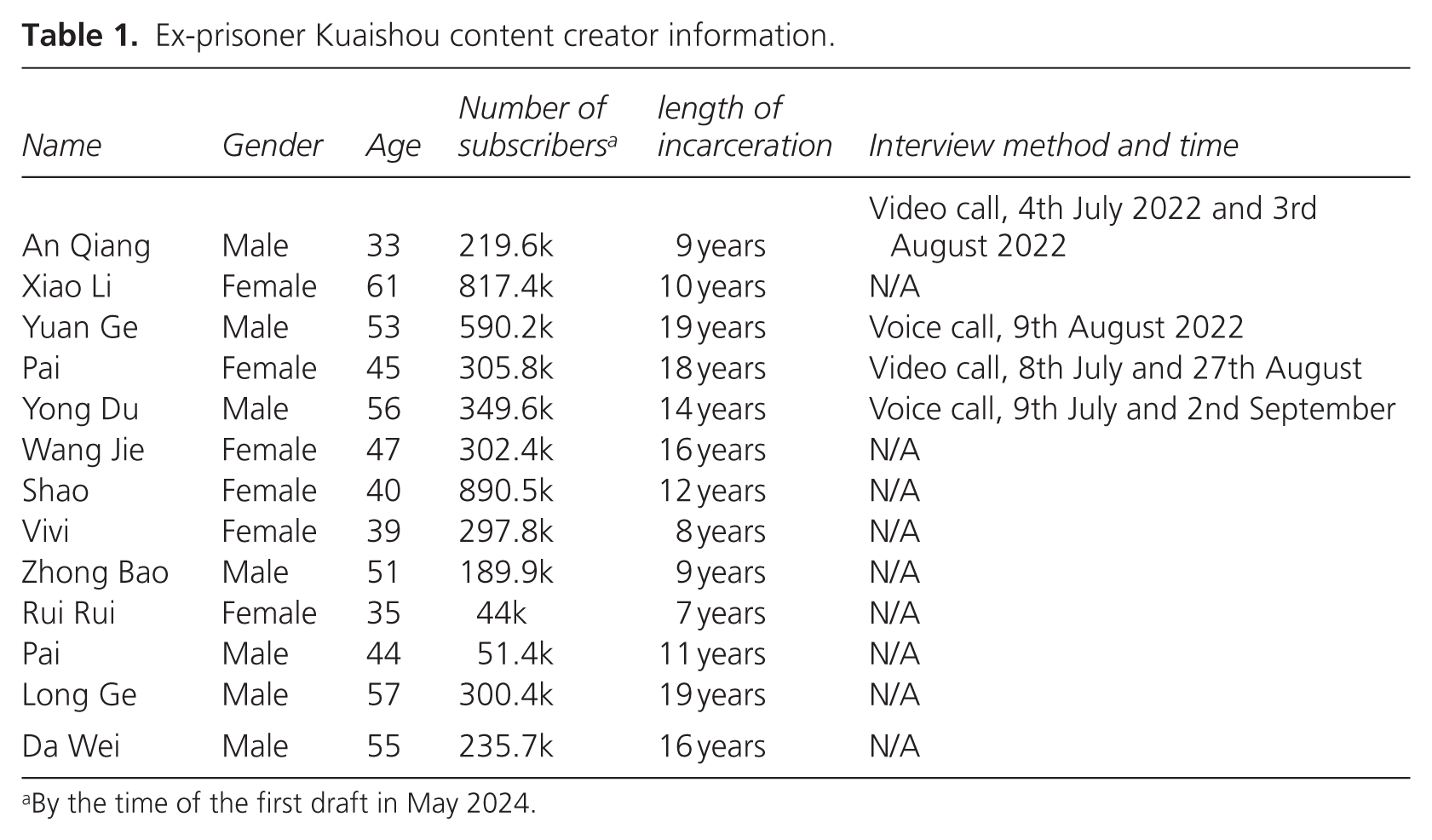
By the time of the first draft in May 2024.
Research ethics and data analysis
The data used in this study, including user IDs, photographs, video content, and livestreams, are publicly accessible without any gatekeeping mechanisms. The creators expect their content to be discoverable by anyone using the platform. The author’s Kuaishou account was inactive, with no profile picture, nickname, or uploaded content, and no commenting or gift-giving was undertaken during the observation of videos or livestreams. For interviews conducted specifically for this research, consent was obtained to use the content exclusively for academic publication. The names of creators mentioned in this paper have been anonymised.
In anticipating new viewers daily on their livestream channels, these creators also actively manage the risks associated with potential harm. While incarceration and criminal records are sensitive topics, participants were deliberate in disclosing only officially recorded aspects of their criminal history, thereby ensuring that such disclosures would not result in future legal repercussions. To attract viewers, the creators employed various tags, signalling their intent to engage in public discussion.
Although the study draws on multiple forms of data, including interviews, livestream observations, video content, and audience interactions, all materials were analysed in textual form through transcripts and detailed fieldnotes. Observations of video content, livestreaming, and audience interactions were recorded as fieldnotes. Interviews were voice-recorded and subsequently transcribed. Fieldnotes are bilingual and interview transcripts are in Chinese; all Chinese content was translated into English by the author to ensure accuracy.
All collected and translated textual data were imported into the qualitative data analysis software NVivo 12 Pro for macOS. Thematic analysis was conducted to explore the creators’ engagement processes in performing their ex-prisoner identities online. The analysis focused on patterns of meaning and narrative practice across integrated data sources, rather than on visual or multimodal features as distinct analytic objects. Forty-eight codes were generated from the qualitative data and were categorised using themes drawn from existing literature, such as platform censorship, narrative identity, emotional labour, redemption scripts, and pro-social identity. Themes specific to this study also emerged, including moral construction, narrative conflict, digital community, and online redemption.
Findings
Active lived experience creators typically produce around three videos per week but often livestream daily, with sessions lasting between 3 and 8 hours. The content of these livestreams primarily focuses on sharing personal experiences of offending, incarceration, and reentry, recounting various criminal cases they have witnessed or heard about, as well as other stories from their time in prison and life after release. During livestreams, they often respond to questions or offer advice to family members of individuals currently serving sentences or those about to enter prison. Their audience largely comprises regular Kuaishou users who enjoy listening to engaging stories, alongside some viewers who are family members of individuals serving or about to serve sentences, or those who have been incarcerated themselves.
This paper presents findings on key themes, including entry into livestreaming as a career, content creation processes encompassing meaning-making and platform censorship, the navigation of narrative conflicts, and the emergence of digital community spaces between lived experience creators and their fans. The following sections examine identity work and narrative labour at the level of individual experience, focusing on how streamers make sense of post-imprisonment trajectories and perform viable selves through platform labour.
From prisoner to digital entrepreneur
Few individuals choose to become full-time Kuaishou creators immediately upon release from prison. Most turn to this innovative pathway only after encountering numerous setbacks in their post-release job searches. Pai’s self-introduction on her account at the time of the study reads: ‘Life always has irreversible regrets. With a poor understanding of the law, I spent the best years of my life, eighteen years, inside the high walls and electric fences. I hope that my story can provide some inspiration, urging people to cherish what they have and appreciate freedom. 1 ’ Pai is a compelling storyteller with remarkable resilience. She was sentenced to death with a reprieve at the age of 25 for her involvement in a gang-led robbery that resulted in a fatality, orchestrated by her boyfriend at the time. During the interview, Pai recounted her struggles with job searching: ‘When you go out to look for a job, they ask about your age, and when you say, “Oh, I’m over forty” and then mention your education level—elementary school. Plus, ,you’ve just come out of prison. Who would hire you?’
An Qiang, who served 9 years in prison for participating in gang-related criminal activities, offered another perspective. He suggested that the prevalence of creators from the northeast might be linked to the region’s less developed economy compared to the south, leading to fewer job opportunities—a challenge compounded for those with a criminal record. Living in a small town in Heilongjiang Province, An Qiang returned home in spring 2022 at the age of 33. After 2 months of deliberation, he decided to post his first video on Kuaishou. His account introduction states: ‘Ignorant in youth, trapped in prison! The prodigal son turns around, sharing his experiences! Let my story be a lesson—stay away from crime!’
An Qiang shared that he had no specific skills and initially intended to find an entry-level job upon his release from prison. However, he soon discovered that recruiters had ways of accessing his identity information, including his criminal record. Registration as a rider on food delivery apps required a clean criminal background, making it impossible for him to secure such employment. He concluded that living in a small town significantly limited his employment prospects ‘All the major platforms for delivery and taxi services require a clean record’.
When asked if he could rely on his personal network or connections, he noted that there were reservations even among friends. An Qiang had considered various possibilities: ‘Two of my former “prison buddies” may be able to provide opportunities for work, but they might find it awkward to interact with me as an employer or employee, so I didn’t want to ask’. Another factor that influenced his decision-making was the impact of the pandemic. Strict measures implemented nationwide raised concerns for An Qiang about potential quarantine costs and the uncertainty of finding work: ‘Going away is very risky; I might end up just paying money for being in quarantine without actually finding a job’.
Yong Du was sentenced to life imprisonment in the early 2000s. After serving 14 years, he was released upon completing his sentence. 2 The background photo on Yong Du’s Kuaishou account homepage features a picture of him with his wife. By the time of the interview, it had been nearly a year since he posted his first Kuaishou video, and he had amassed 200,000 followers. In the videos where lived experience creators shared their journeys to becoming livestreamers, nearly all spoke about the discrepancy between their hopes and dreams upon leaving prison and the harsh realities they faced on the outside. When Yong Du first returned, he was ambitious, believing that, after being away for so long, he could make a fresh start and achieve the success he had envisioned for himself. However, he quickly discovered that the challenges were far greater than he had anticipated. In the beginning, Yong Du secured a job through a friend’s introduction. However, during a lunch break at work, he overheard his co-workers gossiping about his past incarceration. ‘It shook me, and I could not shake the feeling of being judged and looked down upon from my mind, so I just quit’. Shortly after leaving the job, he became seriously ill, which further hindered his ability to work.
During his recovery, Yong Du came across Kuaishou and observed various creators on the platform, including disabled individuals and truck drivers, who were finding recognition and creating value through their content. A chance encounter at home ultimately inspired him to join the livestreaming community: ‘I helped an elderly lady in the neighbourhood, and she thanked me so much that I was really touched. I lost my freedom for so many years and hadn’t received genuine gratitude in such a long time. I loved that feeling, and I figured I should help others more’. This experience led Yong Du to try becoming a creator on Kuaishou. While he hoped to generate income through livestreaming, he emphasised that his greatest wish was to provide guidance and warnings to confused teenagers through his stories, steering them away from deviance and potential offending.
Guan Ge was sentenced to death with a reprieve in 2003 for homicide resulting from his involvement in a local gang. After 19 years, he was released in 2021 and joined the Kuaishou platform in July of the same year. While still in prison, Guan Ge learned about Kuaishou through newspapers, television, and conversations with newly incarcerated individuals. He discovered that smartphones had become commonplace and that the world had entered the age of social media, including livestreaming, which presented potential opportunities for income generation. Throughout his incarceration, Guan Ge dedicated himself to self-education. He spent all his in-prison earnings on newspapers and books, reading everything he could access. As he explained: ‘I did that because I didn’t want to come out and be a useless person. My father had passed away, and I wasn’t sure about my mother’s financial situation. That’s when I thought about starting my own business through Kuaishou when I returned’. Upon his release, Guan Ge initially took on short-term jobs while simultaneously exploring livestreaming on Kuaishou. Over time, as his livestreaming gained traction, he transitioned into being a full-time content creator.
Pai had also heard about livestreaming and e-commerce as emerging ways to earn money before leaving prison. She believed that this career path could provide her with a livelihood. Having interacted with people from diverse backgrounds and as someone who valued learning, Pai viewed her years in prison as a form of education. She noted that sharing stories from within prison could provide the public with a better understanding of what life in incarceration truly entails.
Driven by post-release uncertainty and the harsh realities of the job market, restrictions imposed by the pandemic, the rise of the livestreaming industry, and their desire to reconnect with society, these ‘special university graduates’ ventured into this unfamiliar line of work, confronting the challenges and seizing the opportunities it presented. When Pai posted her first short video, she did so without consulting anyone. However, she quickly felt regretful and adjusted the video’s settings to make it visible only to a select audience. Reflecting on her hesitation, she asked herself: ‘Is this livestreaming platform scarier than prison? What is the worst thing that could happen?’ Gradually, she found the courage to take a leap of faith and began building her channel.
Similarly, An Qiang wrestled with the decision to launch his own channel. He worried that sharing his prison experiences was not something to boast about and feared being recognised by people from his town. His biggest concern was the potential impact on his family. As he explained: ‘People might say, “Their son just came out of prison, and now he’s blatantly talking about what happened inside on the internet. Has he no shame?” Despite these fears, An Qiang ultimately reasoned that he had every right to try. ‘I am not stealing or robbing anyone. I am earning a living through my own efforts. What’s there to be ashamed of? It’s surely better than begging on the street or engaging in illegal activities that could send me back to prison’.
The journey to becoming a social media content creator as an ex-prisoner demands curiosity, proactiveness, and the willingness to explore new technologies and opportunities within the digital economy. It often stems from a lack of success in traditional career pathways and requires overcoming internal fears as well as societal judgement and prejudice. However, this is merely the beginning of an innovative and challenging journey.
From story to space: Relational work of moral belonging
Moral stories and pro-social selves
There are various types of livestreaming creators, including those focused on gaming, talent showcasing, relationships, and e-commerce, among others. Lived experience creators primarily categorise themselves as ‘story creators’. Even when some expand their content to include e-commerce or other talents, storytelling remains central to their livestreams. According to a platform recruitment campaign for story creators, this category includes livestreaming channels featuring content such as current affairs, folk stories, historical narratives, inspirational accounts, social commentary, horror and drama, internet stories, talk shows, and family stories. A smaller group of lived experience creators specialise in other niches. For example, some brand themselves as ‘relationship creators’ who focus on topics of intimacy and interpersonal relationships, such as Vivi, while others like Zhang Bao and Rui Rui are ‘sales creators’ who focus on promoting products.
Content creation in livestreaming is inherently creative work, with storytelling as its cornerstone. Livestreaming storytelling resembles a solo online performance. While a typical screenwriter may aim to produce a single play each year, livestreamers must craft and deliver new scripts daily. They manage all aspects of the production process themselves, including conceptualisation, planning, scene and lighting setup, costume design, body language practice, voice modulation, and more. Additionally, they must engage directly with their audience through comments to maintain viewer interest.
Creators often remind their fans to interact with their content by giving likes, casting votes, sending virtual gifts, or purchasing items from their online shops, which are often linked to their accounts. For creators like An Qiang, livestreaming requires full dedication. He spends his time creating short videos, preparing story content, livestreaming, and analysing the communication strategies of successful creators. As An Qiang explained: ‘If you can’t keep the fans, who will listen to your chat every day, right? They are there for the stories, and that’s how you keep the old fans and attract new ones’. Over time, he learned that audience expectations demand drama. ‘Your story needs ups and downs; you can’t be too flat because who would want to listen? It needs some appropriate exaggeration’.
Having a plot is not enough; stories also require a moral dimension to feel truly meaningful, as the necessity of moral teaching has been deeply ingrained in the Chinese mainstream literary tradition (Sibau, 2018). Yong Du, for instance, crafts his stories by starting with two contrasting characters. In one of his narratives, he compares a person with social status who makes an honest mistake to another character driven solely by greed, who commits corruption in pursuit of money and vanity. The former is always portrayed in a more respectful light.
An Qiang imparts lessons through the stories of various prisoners he has encountered. ‘For example, I talk about the cost of being impulsive or what activities can lead to illegal actions. I hope that through my stories, everyone can gain some insight, better understand what it’s like inside, and learn to cherish their current lives’, he explains. Similarly, after 18 years in prison and countless life experiences, Yong Du underscores the importance of selecting the right story to tell, as well as the deeper reason behind sharing it.
In my livestreaming room, most of the audience are parents, and their children are mostly junior high school and high school students. Many children don’t listen to their parents anymore and are not interested in learning. They often start hanging out on the streets after dropping out. When I was the group leader in prison, I dealt with a lot of young offenders, I’d take care of them. So, I understand their mentality very well. For example, I told everyone a story about a 16-year-old who committed theft, about his entire experience of growing up. I’m not a teacher; I can only use storytelling to inspire or resonate with others to educate their own children better.
Certainly, not every story is crafted with the intention of conveying educational or moral significance. The stories they choose to tell often captivate the audience through dramatic conflicts or unusual turning points, with the creators improvising and interacting with their audience during the storytelling process to impart an additional ‘lesson’. For instance, during one of Xiao Li’s livestreams, she shared a poignant story about a fellow prisoner in the female prison who had suffered domestic violence from her husband. On one occasion, she fought back with a knife, injuring her husband severely. Despite this, the husband later forgave her and refused to divorce her. However, this prisoner tragically succumbed to illness while serving her sentence. Xiao Li then addressed the audience, asking if there were any men present and advising them not to engage in domestic violence. She argued that if someone resorts to violence against their spouse, their children will never forgive them, urging them not to think they can mistreat their wives and still have a healthy relationship with their children. Many fans in the chat praised her, stating that her argument made a lot of sense.
Virtue, in traditional Chinese ethics, is considered to be shared among family members, and operates as an accumulative asset (Elvin, 1984). When Yuan Ge was serving in the military, he participated in a major flood relief and rescue operation and received a second-class merit. But only a year later, he committed a crime and was sentenced to prison. ‘That’s why I wanted to see if I could prevent some young people from going down the path I once took. In this lifetime, I want to leave something meaningful behind. I want to accumulate some virtue for my mother and, perhaps, for my future family’.
Yong Du wants to help others with his stories as well. ‘I mostly want to help those who are between 18 and 21 years old and have gone astray. If they have only made minor mistakes, then I will do my best to help them’. Yong Du says that he spends 1–2 hours responding to private messages every day after his 4-hour livestream session. Considering the intensity of the livestreaming work, this makes him very tired. However, for him, the sense of achievement is very real: ‘Whenever someone says “thank you” to me in the end, I feel that I have received a reward for that hour or half-hour. Or when they send a folded hands emoji, even if it’s just an emoji, I am very happy. My partner asks why I do it: I just want to get a thank you in return’.
Pai believes that the value she brings goes beyond her identity as a former prisoner. She feels satisfied if her real-life experiences can help people gain a deeper understanding of freedom and instil more passion and love for life. She told the author that she plans to contact the women’s prison where she was incarcerated and give a speech to encourage women inside not to give up in the face of difficulties. Pai wishes to open a clothing factory someday in the future, exclusively employing those who came back from women’s prisons. She hopes to encourage them to engage in volunteer work, which would demonstrate not only economic independence but also earn broader social recognition. Similarly, Yuan Ge expressed his desire to go to schools and share stories of crime and justice with middle and high school students as part of their legal education. He mentioned that he has already contacted local educational institutions, and once the pandemic ends, he hopes to fulfil his goals.
Emotional labour: possibility for reciprocation
Emotional interaction is a primary component rather than a secondary aspect of livestreaming as a form of work. The expressive abilities of story creators, encompassing the dramatic, narrative, and emotional aspects of storytelling, are crucial. ‘Emotional labour’, defined as ‘the management of feeling to create a publicly observable facial and bodily display in return for a wage’ (Hochschild, 1983), takes a unique form in the livestreaming context. There are many fans who have no personal connections to prisons; their interest in prison stories may be driven by curiosity about the unknown and a desire to explore the world behind bars. In this regard, the fan base of lived experience streamers is similar to other types of creators, such as travel content creators; or creators of certain professions with little online self-representation, such as truck drivers or farmers (Liu and Wang, 2022). While the main content is storytelling, fans who watch them, like many other livestreaming enthusiasts, seek emotional fulfilment. Guan Ge is highly aware of fans’ emotional needs: Everyone gets on social media to relax, to seek joy and comfort, including some of the haters. In the livestream, I tell stories with dramatic turns, incorporating some fictional elements with real life experiences. I infuse my personal emotion into my stories, creating a particularly rich atmosphere. The most important thing is a mix of truth and fiction. I can tell you that I sometimes leave the truth behind because if I say it outright, they will certainly get upset and not buy it.
Emotional labour performed by lived experience streamers also involves the mobilisation of moral values, as discussed earlier. While this labour is often demanding and emotionally consuming, it is not experienced as a purely unilateral provision of service. The emotional connection between streamers and their online ‘family’ can be reciprocal, with participants describing a sense of companionship and mutual understanding. According to Pai, initially she didn’t even understand the significance of tapping the heart icon during a livestream as a way to increase data traffic; it was the fans who taught her the intricacies of livestreaming. She expressed that: I feel they are really like my family. Perhaps they see my strong side, and some of them have also understood my inner struggles, knowing that behind my smile, there is a lot of bitterness. For some people, once they are moved by you, they treat you as a friend. They even say to others in the livestream room, ‘If you support Pai, don’t make her talk about things that are sad for her; it’s harmful to her.’ They are really kind, and it’s like they truly empathize with me.
Emotional needs in this context are complex and extend beyond passive reception. As An Qiang explains, ‘People follow you because they need something, and some of them need to offer understanding. They help you by offering understanding, giving you a chance’. The expressed ‘need to offer understanding’ is analytically significant, suggesting that some viewers derive a sense of fulfilment from investing emotionally in the streamer. At the same time, this reciprocity is shaped by the streamer’s ongoing emotional labour, which involves sustaining a morally acceptable and supportive presence in order to remain worthy of such understanding.
Co-created a safer space
Building on the discussion of emotional fulfilment, this section examines how livestreaming rooms hosted by lived experience streamers can also function as co-created safe spaces. These livestreams are organised around experiences of imprisonment, stigma, and family disruption, which shape the expectations and interactional norms of participation. The thematic focus of lived experience livestreaming reorients engagement within the room, enabling forms of recognition, mutual understanding, and belonging to emerge through sustained interaction between streamers and sections of viewers.
Among the fans who frequently appear in their livestream rooms, a number of them are family members of prisoners who want to understand life inside—whether their loved ones are eating well or how challenging the work is within the prison. For them, opportunities for direct contact with their incarcerated relatives are very limited, with phone calls and visits always being under supervision. In various ‘special university’ livestream rooms on Kuaishou, you can often see family members sending barrage messages or requesting video call opportunities, asking questions like ‘Should I wait for him to be released?’ or ‘How long might my son receive a sentence reduction for?’ The streamers are usually happy to answer such questions, as they have gone through similar experiences and are in a unique position to offer advice that is otherwise difficult to access. Typically, these Q&A opportunities do not come with charges but may involve voluntary donations, helping to build a fanbase.
It has been widely observed that female creators often strategically attract and sustain ‘ambivalent intimacy’ with male fans who contribute generously to gifting them across various livestreaming platforms (Ye et al., 2023). However, from my observation and interviews, female ex-prisoner creators do not rely on this method of audience building and income generation. Once, during a livestream session, Xiao Li talked about how most of her fanbase consists of female viewers, who told her they simply like the way she talks, her personality, and her smile. Pai also shared with me that she does not deliberately attract ‘Top One Guys’, nor does she spend a lot of time chatting with them or accept their private gifts.
Xiao Li, in her fifties, served a long-term sentence for economic crimes. She now lives with her husband and grown-up son, who helps her with product sales in her livestream channel. Xiao Li takes good care of herself, with silky long straight hair, a generous personality, and a lively energy when telling stories. Although she did not agree to be interviewed, it seemed that she was facing some difficulties during my attempts to contact her, as the exposure brought her online and offline troubles with individuals previously involved in her case. However, she steadied her pace soon after, and the number of viewers in her live broadcasts has continuously increased. As of autumn 2024, she has gained over 800,000 subscribers to her channel.
These dynamics suggest that the livestreaming room operates as a relationally produced space of conditional safety, sustained through shared understanding rather than platform design alone. In a context where information about imprisonment is largely mediated through official and tightly controlled channels, such spaces are distinctive in enabling the circulation of experiential knowledge. For lived experience streamers, this reduces reliance on gendered or performative forms of visibility; for viewers—particularly family members of prisoners or formerly incarcerated people—it offers a rare environment in which experiences are recognised and information is exchanged in ways perceived as credible and empathetic.
‘Grey’ topic and ‘green’ platform: Macro-level narrative precariousness
Apart from considering the preferences of their fans, the creators also need to adhere to the platform’s requirements. During the livestreams, I observed that many terms and phrases were being replaced. The most common examples include ‘special university’ (replacing prison), ‘small kankan’ (replacing detention centre, as the Chinese word is kanshousuo), ‘six gates’ (referring to the police, as in the security gates), ‘teacher or commander’ (prison staff), ‘delete account’ (meaning murdered someone), ‘rock sugar’ (drugs), ‘eight plus one’ (alcohol, as 8 + 1 = 9, and 9 is the homophone of alcohol in Chinese), ‘rice’ (money), ‘jian qiang’ (rape, reversing qiang jian, the Chinese translation), and more.
Initially, I assumed that these would be categorised as coded language, used by the creators to add a layer of mystery to prison stories. However, An Qiang told me that these are simply created to circumvent the platform’s ‘sensitive word’ detection. If a creator uses certain terms in the livestream, they will receive a warning, and in severe cases, their account might be suspended or even banned. Yong Du told me that once he had 55 short videos deleted on the same day by the platform after a sweep of his content. The platform left a phone number for him, and he immediately consulted them. Yong Du was pleased with the platform as they patiently analysed his scripts, pointed out problematic areas, and explained why those parts were unacceptable. Yong Du appreciated the platform’s help and believed they assisted him because they wanted him to become a better person.
Digital platform governance creates a pervasive sense of uncertainty and insecurity among content producers, and many feel obliged to post statements of loyalty on their homepage expressing their value alliance with Kuaishou, such as ‘thank you Kuaishou for providing such a wonderful platform’, ‘I support Kuaishou for transmitting positive value’ (Lin and de Kloet, 2019: 7). ‘Green platform’ as seen in the quote at the start of this paper is also a commonly used term created use to toe the line of the platform policies, as ‘green’ denotes healthiness in the Chinese context (Shi et al., 2011). Other than considering platform censorship, audience preferences, and the moral implications of the stories, there is also tension between different prison discourses: prison as a cultural symbol; prison as a daily experience; and prison as the embodiment of the national punishment and rehabilitation ideal. Pai explained to me how she tries to make choices amid contradictions: Sometimes I feel conflicted. I always say that I am spreading positive energy, but will those friends on the inside think I am hypocritical? I clearly know there are so many dark things in there, but I never talk about them. Honestly, my original intention was to share real stories and let families outside understand the truth. But firstly, the platform doesn’t allow it, and secondly, prison is the enforcement agency of punishment and rehabilitation, it represents the image of a country. When you appear on this platform, I think one should establish a positive image of the prison, right?
Yuan Ge consider keeping the prison stories ‘positive’ as a way of helping people develop in a positive way: In prison, some of the staff members were corrupted and do things such as arranging a better position for someone within the prison workplace in exchange for profit. But I just gloss over these; my fans understand. The country invests a lot of manpower, material resources, and financial resources to let you change yourself and start anew. Even the worst person has a kind side. When a prodigal son does return It’s all because of the unwavering support from parents and family. And that’s what I want to convey in my stories.
Intertwined with moments of positivities, lived experience creators must navigate complex and often conflicting prison narratives, making choices, and shaping stories while they weigh on various considerations. Becoming a livestreamer is not an easy career choice, and the sense of accomplishment is far from a regular occurrence. The daily life of a livestreamer involves fatigue, tension, and pressure. Since starting her livestream, Pai always feels like there’s not enough time. She attributes this mainly to being isolated in prison for such a long time and having to figure everything out on her own without support. The most significant challenge might be managing her own mental health, as she describes it as ‘feeling like taking off all your clothes in front of others’. Especially when you publicly reveal your identity: ‘people say all sorts of things, ‘are you trying to make your ancestors proud?’ ‘Are you proud of what you have done?’ Some even sent me a pair of shoes 3 . I think these people have dark minds. When I first started, I couldn’t sleep at night. Now I feel that after all, kindness prevails, and most of them support and encourage you’.
An Qiang also mentions that his mood can be greatly influenced by the stories he tells during livestreams, especially when recounting unpleasant past experiences. ‘Doing this is quite stressful. I have almost no time to chill in a day, and I feel like I’m losing hair every time I take a shower’. When I interviewed An Qiang, he had been livestreaming for just over 4 months, 6 days a week, but earning a mere one or two thousand yuan each month. 4 While Yong Du has a larger fan base, his income isn’t significantly higher than An Qiang’s. Yuan Ge is doing the best among the interviewees, with a five-figure monthly income. However, such success is rare among them. Ice Sister, Fu Yun, Yong Du, An Qiang, Shao, and Rui Rui all started promoting products after having accumulated a certain level of livestream traffic. Still, most of their time is spent on telling stories, and their loyal fans tend to stay after hearing the stories to support by purchasing some items.
Discussion and conclusion
The current study set out to explore how individuals with lived experience of imprisonment engage with Kuaishou to reconstruct pro-social identity, generate income, and negotiate belonging in the digital sphere. The findings suggest that livestreaming functions simultaneously as a site of self-reworking, relational exchange, and structural negotiation. On screen, they actively transform prison experiences into moral testimony and entrepreneurial resource. At the same time, these stories are also shaped by powerful narrative constraints, such as audience expectations, platform reward mechanisms, and overt and covert platform censorship. Through ongoing interactions with their audience, desistance is performed and reciprocally affirmed to a degree, requiring sustained emotional and moral labour. Livestreaming thus emerges as fragile and negotiated pathway through which belonging after prison is pursued within the boundaries set by platform capitalism and penal ideologies.
Maruna and Ramsden (2004: 131) argued that the ‘social process of narrative reconstruction (. . .) provides a means of escape from this chimera of deviance and shame’ and, more importantly, turns their past into meaningful narrative material for constructing a positive present and future self-identity. The term ‘lived experience’ is central to the livestreams of ex-prisoners, echoing literature on the ‘wounded healer’ and its significance in rehabilitation work (LeBel et al., 2015). On the one hand, this narrative aligns with themes of redemption and helps counteract personal stigma; on the other hand, it provides a pathway for self-realisation and social recognition.
Moreover, shifting their identity narratives towards a more generative concern for future generations allows them to focus on building a pro-social future while fostering community involvement (Maruna, 2001: 102). The concept of ‘earned redemption’ could further help legitimise ex-prisoners’ desistance in the eyes of society (Albert, 2024). This echoes previously discussed concept of belonging and relational desistance by seeing the process and inherently interactive. This study contributes to the need for further understanding of ‘how and with what consequences criminalised people experience, or fail to experience, belonging’ in tertiary/relational desistance work (McNeill and Schinkel, 2024: 48).
Livestreaming prison stories involves all three levels of relational desistance: they are dealing with reactions from their immediate family and community, they are interacting with the wider community that are users of the platform in this case, and they are also situated in social reality and reaction to their innovative attempt, which manifest in toeing the line of being positive. For most lived experience creators, livestreaming began as an alternative career path in response to the challenges of securing employment. Over time, it evolved into a demanding yet rewarding endeavour.
Unlike many other livestreams on the Kuaishou platform, which often feature competition to stimulate consumerism among fans, lived experience creators tend to distance themselves from such practices. This distinction may explain their unique appeal. For these creators, short videos and livestreaming serve not merely as a means of earning money but as a rare space for sharing and being heard. Within this space, what is often ‘unspeakable’ and ‘unheard’ finds expression, allowing for the possibility of crafting a newly redeemed sense of self. Ex-prisoners who become livestreamers are neither solely providers of emotional services nor fully engaged in digitised performance labour aimed at creating a shopping theatre. Rather than deliberately packaging and promoting certain traits, they present themselves as genuine individuals. While they employ techniques to engage and attract viewers, these livestreamers do not heavily rely on scripts or targeted image curation and instead depend largely on their personal charm. Although this down-to-earth quality endows them with a unique appeal, it may also limit their potential for professionalisation and commercialisation in an increasingly competitive platform market.
The livestreaming rooms of lived experience creators also highlight the existence and marginalisation of criminal justice-involved communities in China. Family members wanting to obtain valid information, individuals with similar experiences, and members of public who seek to offer acceptance and support, form these online communities. This suggests a future where the process of personal reform would be less individual and more of a communal effort involving families, communities, and collective social will. Suzuki et al.’s (2025) recent qualitative metasynthesis of 13 studies on tertiary desistance published between 2019 and 2023 have found three key conditions for building tertiary desistance across all existing studies: realisation of support, trusting and equal relationships, and reciprocity in these relationships. However, such community building and meso-level belonging require much structural support than currently available.
Discussions and narratives surrounding prisons have long been characterised by contradictions and tensions within mainstream social contexts. Social media platforms like Kuaishou have offered ex-prisoner creators a unique space to share their stories and be heard. Regardless of how audiences perceive them, users can access their profiles at any time, entering a creative space they have crafted, often centred on their incarceration experiences. However, this space remains a site of constant negotiation, as the governance of digital platforms fosters a pervasive sense of uncertainty and insecurity among underprevelidged content creators (Hou and Zhang, 2022). Many lived experience creators make a deliberate effort to shape their prison stories in alignment with the demand for ‘positive energy’, a term that has gained prominence in China’s political discourse since 2012 (Chen et al., 2021). ‘Positive energy’ embodies a form of ‘transcendental Chinese patriotism’, with the state widely employing the term to signify attitudes or emotions that align with the ideological and value systems of the Chinese Communist Party (Du, 2014: 5; Peidong and Lijun, 2018: 3). Narrative labour contributes to disciplinary capital: positive narrative of prison is not only personal but also social, political and moral. Warr’s (2020) work help to go further and explain why narrative around offending and prison experience must be understood as being shaped by various structural forces rather than a simple demonstration of individual moral stance or attitude towards self-reform.
There are important limitations to this study, as it only captured a particular cohort of creators operating within one digital ecosystem at a particular moment in its regulatory and algorithmic development. As such, the findings cannot be generalised to all individuals with lived experience engaging in online entrepreneurship, nor do they account for those who exited the field earlier on. Future work in this area would benefit from longitudinal designs, comparative work across platforms and regulatory contexts, and closer examination of audience motivation and engagement. Such work would deepen understanding of how digital economies shape the sustainability of relational desistance, as well as the durability and evolution of narrative desistance in the ever expanding digital space.
Footnotes
Acknowledgements
Great appriciation to Xiaonan for her kind assistance during this study.

Ethical considerations
No institutional requirement was in place for ethical approval at the time of the study, oral consent was obtained from the main participants of this study as we did not have any face-to-face meetings.
Funding
The author received no financial support for the research, authorship, and/or publication of this article.
Declaration of conflicting interests
The author declared no potential conflicts of interest with respect to the research, authorship, and/or publication of this article.