




Abstract
This article examines practitioner understandings and implementation of gender-responsive support within female prisons in England and Wales in the context of a growing emphasis on effective deportation of foreign national prisoners. Drawing on a case study of female prisoners from Central and Eastern states of the European Union (EU), we argue that the aims of gender-responsivity, designed to address women's gendered vulnerabilities to support their re-entry in the UK, are pragmatically re-shaped to accommodate the uncertainty surrounding their immigration status. We show how in practice, gender-responsive support functions at best to ‘manage’ gendered needs of women who are ‘not of interest’ to immigration authorities, and at worst to legitimate exclusion by side-lining vulnerabilities of women deemed as having ‘no right to remain’ in the UK. This occurs in the context of limited access to legal redress to challenge deportation decisions, unevenly spread resources in the female prison estate, and practitioners’ occupational cultures which emphasise paternalistic valuations of female foreign national prisoners’ femininity. We locate the findings in criminological debates about ‘gendering of borders’ and conclude with a reflection on the implications for advocacy at the time of increasingly restrictive immigration controls following the UK's exit from the EU.
Introduction
Drawing on a case study of incarcerated Central and Eastern European (CEEU) women 1 , this article examines the applications of gender-responsive support in female prisons in England and Wales in the context of the increased deportation of EU prisoners. Gender-responsivity denotes a set of penal strategies and provisions that aim to create ‘an environment that reflects an understanding of the realities of women's lives and addresses the issues of the women’ (Bloom et al., 2003: v). Over the past 10 years, this approach has been encapsulated in penal policy via Women's Policy Framework (Ministry of Justice, 2018) 2 and related Guidance on Working with Women in Custody and the Community (Her Majesty’s Prison and Probation Service Women’s Team, 2018). Gender-responsivity recognises female foreign national prisoners (FFNP) as a distinct group with specific experiences and characteristics as part of a broader policy drive to ‘recognise and respond to diversity and difference’ in prisons in England and Wales, ‘in order to deliver more effective rehabilitation’ (Her Majesty’s Prison and Probation Service, 2018, p. 12). This has occurred at the time of a significant expansion of a system of border control in the prison estate in England and Wales whereby, since the passing of the UK Borders Act 2007, any ‘foreign criminal’ with a custodial sentence of more than two years is subject to automatic deportation, while all non-citizen prisoners are considered for deportation (Bhui, 2007; Bosworth, 2011). This has been accompanied by a policy agreement between the Prison Service and the Home Office (National Offender Management Service, 2015) to concentrate foreign nationals in prisons known as ‘foreign national hubs’ 3 in order to expedite removals (Kaufman and Bosworth, 2013; Kaufman, 2015).
This article provides an analysis of the application of gender-responsivity to female prisoners of Central and Eastern European origin – a subgroup of FFNPs which increased significantly over the past decade (Ministry of Justice, 2020). In 2020, over 50% of FFNPs in England and Wales were EU nationals, 60% of whom came from A8 and A2 EU accession countries of Central and Eastern Europe (Ministry of Justice, 2020). This demographic profile has coincided with an expansion of border control mechanisms in the female prison estate (such as the introduction of a bespoke ‘foreign national only’ wing) (Robinson, 2013) and a marked emphasis on more effective deportation of EU national prisoners in the run up to, and since, the UK's exit from the European Union (‘Brexit’) (Home Affairs Committee, 2016; Migration Observatory, 2020). Within this context, female CEEU prisoners have also become a more prominent subject of gender-responsive support provided by prison-based third sector agencies, representing a fifth of new cases (Prison Reform Trust and Hibiscus Initiatives, 2012; 2018). The article examines the deployment of gender-responsivity on-the-ground, in the context of prison-based border control, to a group of women who have borne the brunt of both these policy developments.
However, gendered dimensions of the growing convergence of the criminal justice and immigration control spheres have gathered relatively little attention among migration scholars and criminologists alike (though see inter alia Hartry, 2012
This article contributes the growing subfield of border criminologies which examines intersections between punishment, immigration control and gender (inter alia Lee, 2014; Gerard, 2014; Gerard and Pickering, 2012; Pickering and Cochrane, 2013), by documenting how pragmatic attempts to reconcile gender-responsivity with pressures to expedite removal of EU citizens from prisons reify the exclusionary logic of the hostile environment. It begins by assessing woman-centredness as the dominant policy principle constituting foreign national women as penal subjects, at the time of an emphasis on more effective deportation of EU national prisoners. Then follows an analysis of in-depth interview data with 23 third sector and prison practitioners across three female prisons and two third sector organisations, looking at the judgments and values underpinning the provision of gender-responsive support to CEEU women. In particular, we draw attention to two uses of gender-responsivity. The first is to ‘manage’ the gendered vulnerabilities
6
of CEEU women who are not ‘of interest’ to the immigration authorities, in line with a broader mandate to resettle them back to the British polity (Her Majesty’s Prison and Probation Service, 2018
Gender-responsivity, prisons, and border control
Gender-responsivity has emerged as a key way in which FFNPs are regulated as penal subjects (Ballesteros-Pena, 2020). Based on liberal rationalities akin to those of ‘commercialised feminism’
7
, it conceives of FFNPs and their gendered/cultural characteristics through a prism of ‘needs’ amenable to support and advocacy (Goodkind, 2005), amending penal regimes with the aim of aiding their sentence progression and (re)integration once released into the British territory (Goodkind, 2005; Ministry of Justice and Her Majesty’s Prison and Probation Service, 2018). In prisons, gender-responsive guidance identifies FFNPs as a distinct group characterized by experiences of gender-based violence (particularly forced sex work) and difficulties in maintaining ties with families abroad, and recommends implementation of ‘gender-responsive services’, in order to ‘empower women to engage in their own rehabilitation’
The increasing presence of CEEU women in UK prisons has occurred at the time of growing efforts of the UK government to make more effective use of deportation powers against EU prisoners (Home Affairs Committee, 2016). Before the UK's departure from the EU, application of the Freedom of Movement law (FOM) (Directive 2004/39/EC) meant that EU nationals enjoyed greater legal protections against deportation compared to non-EU equivalents, with deportation warranted only if the person's offending posed ‘a threat to public policy or security’ – a test which becomes more stringent the longer an EU citizen has lawfully resided in the UK (Guild, Peers and Tomkin, 2019; McGuinness and Wilkins, 2019). In practice, the Home Office guidance has considered all EU prisoners as potentially deportable (Home Office, 2016), with offending itself indicating ‘lack of integration’ and sentence length and seriousness of offending serving as key indicators of likelihood that the legal threshold of ‘genuine, present and sufficiently serious threat’ has been met (Home Office, 2016, p. 28). This, as Griffiths (2017) points out, has existed in the context of a much broader attack on the ability of EU citizens to secure legal redress against deportation decisions - as evident in cuts to legal aid and the ‘deport first, appeal later’ system. In contrast to gender-responsivity, this evinces an actuarial approach to treatment of FFNPs, which constructs foreign national prisoners, regardless of gender, as risks to be expelled from the UK (Bosworth and Guild, 2008; Ugelvik, 2014). In the decade between 2010 and 2019, the share of removed foreign national offenders from EU countries rose from 17% to 68%, while in 2018 alone, a third of women forcibly removed were EU citizens (McGuinness and Wilkins, 2019). In becoming a practical site for the implementation of the government's deportation strategy, prisons play a key role in policing the borders of the British nation-state (Fekete and Webber, 2010; Kaufman, 2015; Barker, 2017). Alongside creating a reformable foreigner implicitly returnable to the community, prisons increasingly help determine foreigners’ rights and entitlements (Kaufman and Bosworth, 2013), as well as providing a means of producing a group of EU citizens deemed undeserving both to stay in the UK and of protections under the FOM Directive.
Efforts to expedite expulsion of EU national prisoners have coincided with logistical shifts to reconcile the re-entry orientated gender-responsiveness and the legal requirement to consider all non-citizen prisoners for deportation (Tomaszewska, 2016). The Women's Custodial Review, which reviewed gender-responsive regimes, instructed prisons to manage FFNPs ‘in the same way as British nationals, unless instructed otherwise by the UK Border Agency’ 9 (Robinson, 2013, p. 30), in line with the Women's Policy Framework. It also recognized however, that ‘deportation decisions can be taken at any point in the sentence’, and therefore FFNPs of interest to the immigration authorities are to be managed via a ‘twin track’ procedure – one which aims to prepare them for both – deportation and release (Robinson, 2013, p. 30). This ambivalence was reflected in the updated Ministry of Justice and Home Office Service Level Agreement which established a ‘hub’ to house FFNPs likely to be deported, providing enhanced access to immigration officers and thus ‘earlier decisions on immigration status’ (Robinson, 2013; National Offender Management Service, 2015). It was also absorbed into the roles of FNLOs, who should ensure that FFNPs’ gendered needs are addressed in line with the HMPPS’ commitment to UK-based resettlement (Ministry of Justice and Her Majesty’s Prison and Probation Service, 2018), while also being mandated to facilitate deportation by identifying FFNPs to immigration officials and facilitating their transfer to the ‘foreign national hub’ prisons (Her Majesty’s Prison and Probation Service, 2018). This approach ostensibly represents a more nuanced gender-responsive regime for FFNPs – accommodating border enforcement alongside recognition of FFNPs’ gendered vulnerabilities – segregating them into the ‘hub’ based on immigration status rather than lack of British citizenship per se (Ministry of Justice, 2013). However, such arrangements also raise questions about the purpose of gender-responsivity, as well as its potential for calcifying stereotypes which sustain practices of ‘social sorting’ of migrant women into categories which determine whether their mobility is or is not considered to pose a risk (Wilson and Weber, 2008).
Scholars in the field of border criminology have closely tied these developments to debates about the ‘gendering of borders’, documenting how the language of gendered and racialised vulnerability is used as a mechanism through which to govern women who are subject to immigration controls (Bosworth et al., 2013; Lee, 2014; Pickering and Ham, 2014). This stands in contrast to actuarial frameworks which seek to remove foreign nationals as ‘risks to the state’, which are more readily applied in the male prison estate (Weber and Pickering, 2013; Kaufman, 2015). More often, gender-responsiveness has also signified policies and practices which aim to ‘care for’ migrant women, on the basis of specific gendered vulnerabilities, albeit ones which have to be evidenced in specific state-approved ways, and which often reflect gendered and racialised stereotypes about the passivity and dependability of migrant women (Aradau, 2004; Andrijasevic, 2010; FitzGerald, 2010). In practice, commitment to the notion of care is often weak in prisons (Carlen, 1982; Hannah-Moffat, 2000) and within the immigration service (FitzGerald, 2010; Gibney, 2013), both of which operate as institutions of discipline and exclusion (Bosworth and Guild, 2008). FFNPs are instead subject to arguably a more complex system of control, where politics of risk and care interact in the process of ‘social sorting’ via women's familial and intimate relationships, and experiences of gender-based violence (Ticktin, 2008; Villacampa and Torres, 2015).
Research design and methodology
This article draws on an analysis of in-depth interviews conducted with 23 practitioners who work with female CEEU prisoners and FFNPs in gender-responsive capacity. The sample comprised professionals employed in the prison service as well as in the third sector, including: FNLOs, Diversity Managers, non-governmental organisation (NGO) caseworkers and advisors, and foreign national support project managers. Participants were sampled purposively, based specifically on their responsibilities for gender-responsive work with FFNPs. This included frontline practitioners delivering advisory clinics and workshops, as well as those in senior/managerial positions, responsible for implementing foreign national-specific sections of local equality and diversity plans. Participants were recruited from five organisations, including two national charities supporting FFNPs and three female prisons in the South and the East of England (Table 1).
Locales from which participants were recruited.
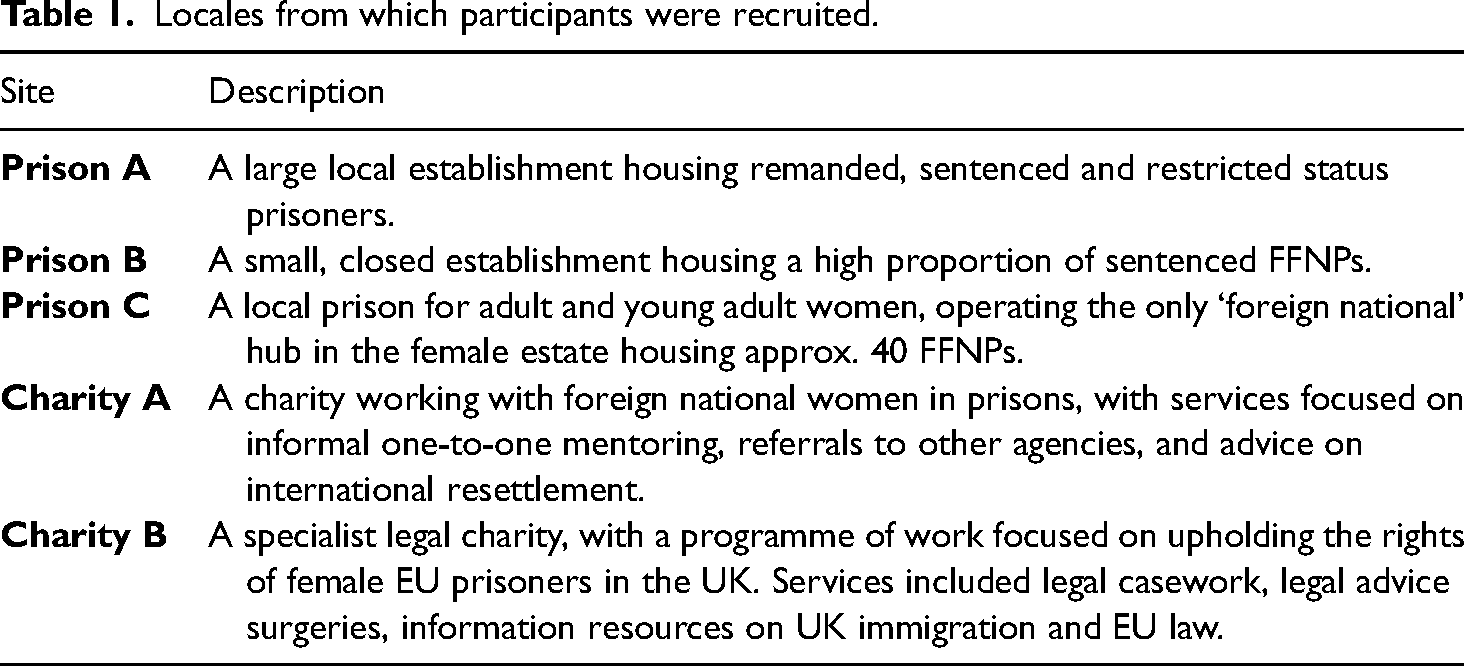
All three prisons had established Equality and Diversity Teams, with service provision from external agencies, including the two charities mentioned above. There were some differences in resourcing and prioritisation of FFNPs within wider diversity agendas in each location, but their guiding principles reflected an emphasis on ‘holistic multi-agency working’ and ‘culturally-informed practice’ within the Women’s Policy Framework (2018). In line with the Service Level Agreement between the Ministry of Justice and the UK Border Agency (2009), all three locations additionally received regular visits from UK Border Force officials, with the aim of identifying and liaising with women liable for removal from the UK. The establishments, though varied in terms of capacity, function, and type, at the time that the research was conducted collectively housed 76% of all female foreign national prisoners in England and Wales (Ministry of Justice, 2018b).
The interviews were carried out face-to-face, followed a set interview schedule and explored three overarching areas: I) perceptions of female CEEU prisoners as a cohort of FFNPs, II) experiences and challenges of providing gender-responsive support to CEEU women, including immigration enforcement, and III) values informing gender-responsive work. The interviews lasted between 35 min and two hours 40 min, were audio-recorded with the permission of the interviewee, and transcribed verbatim. All participants have been anonymised via use of pseudonyms, with personal and professional information also removed to prevent identification. Data were subjected to deductive and inductive thematic analysis in NVivo, in line with principles outlined by Braun and Clarke (2006). The study gained favourable ethical opinion from the University of Surrey Ethics Committee and Her Majesty's Prison and Probation Service National Research Committee.
Findings
Occupational values, paternalism and a rehabilitative zeal
Whereas gender-responsive policy and practice is often formally framed in terms of ‘empowerment’ – a term emphasizing women's agency and previously associated with liberal feminist movements – prison practitioners more commonly operate within paternalistic cultures of ‘caring for’ female prisoners (see also Carlen, 1982; Hannah-Moffat, 2000, 2001). This occupational mandate is rooted in a ‘sense of mission’, and often described as an outcome of gender-responsive work which motivates practitioners towards ‘working on’ women as a form of a ‘project’ (Crawley, 2006; Arnold, 2016). The accounts of practitioners indicated that this was connected closely to a culture of ‘making a difference’ (see also Bennett, Crewe and Wahidin, 2013) from which (alongside enforcement of order, security and safety) officers and other staff derived a sense of justification and meaning in their interactions with female CEEU prisoners: I am not saying I’m very important but I’ve found myself very important in the sense that I can basically help the [CEEU] women to understand the system a bit better, you know what's going to happen to them here, help them with the daily stuff, because many of them, they don't even understand the basic paperwork. (Millie, Diversity Officer)
In practice, rather than being concerned with listening to and acting ‘on behalf’ of individuals, partitioners often prioritised identifying characteristics believed to be associated with CEEU women's offending. For Helen, a Diversity and Equality Manager at Prison A, CEEU women represented simply a new FFNP regional group, one characterised by failed migratory projects and histories of sex-based exploitation. This view typified perceptions of the majority of both, prison and third sector practitioners, in all three establishments. The role of the politics of border control in the women's stories was often omitted. Instead, understandings of CEEU women's offending often emphasized relationality and dependency on exploitative partners and/or familial responsibilities. Gendered vulnerabilities were understood to be located in two sites: the women themselves, and circumstances of poverty and exploitation in the countries of origin, with emphasis on the latter. We had more Eastern European women the past few years, definitely people from Romania, Bulgaria, some Polish. And yeah, you do notice kind of commonalities – they’re in for various things, but often for theft, fraud, those sorts of things. They often come here with partners or other people from their background, want a better life but things go wrong for them… (Helen, Diversity and Equality Manager)
Despite many practitioners readily describing CEEU women as ‘quiet’ and ‘distrustful of staff’, efforts to engage with CEEU women (and other FFNPs) to understand their priorities and preferred interventions were rare and ad hoc. In all three prisons, ‘making a difference’ via gender-responsive work frequently comprised one-to-one or group advice (e.g. informal conversations and check-ins, scheduled group or individual meetings), and referrals to further services. In practice, these often functioned as less ‘advisory’ and more spaces in which to position CEEU women vis-à-vis existing gender-responsive service provision, as well as guiding them toward better choices in respect to their relationships in line with practitioners’ moral evaluations of their gendered vulnerabilities: We’ve got better this year, I think, at getting them into classes and services. So we have things like Family Matters
10
and various courses for domestic violence. And when you listen to them, that's the kind of things they need actually… (Ewa, FNLO)
Underlying this approach to gender-responsivity was a conceptual investment in the connection between the CEEU female prisoners and the British polity. For many practitioners, paternalistic engagement styles were tied to occupational commitments to deploying gender-responsivity to support FFNPs’ eventual resettlement in the UK – a principle which was understood to apply regardless of citizenship status. Gender-responsive work was often described as distinct from immigration enforcement, with CEEU women's relational vulnerabilities, such as experiences of gender-based violence, addressed in the same way as those of the UK national women. Ultimately, gender-responsive advice was often understood as a tool which can align CEEU women with normative standards of domesticity and intimacy, in linking them with services which, as one Diversity Officer put it ‘can help them assimilate to the British society’ (Millie, Diversity Officer). As this Foreign National Liaison Officer remarked: I mean, so apart from their sentence to serve, some have immigration issues, but that's a totally different department which is immigration. I liaise with immigration, but I am not an immigration officer. We are here to support them as they progress through their sentence, like with any other prisoner. (Katheryn, FNLO)
Justifications for gender-responsive work with CEEU women, as shown in the above account, could be driven by practical considerations, just as much as an attachment to institutional and occupational principles. The positioning of gender-responsive support as aiding ‘assimilation’ in the UK was often articulated with an assumption that CEEU women were less likely to be deported because they were EU citizens. However, in practice women who were not of interest to the Home Office comprised a relatively small proportion of the CEEU cohort in all three prisons, as one charity worker noted: For majority of the women, the Home Office is the biggest issue and EU nationals are not exempt from deportation by any stretch… Say, you come in and get caught shoplifting within a week, you are going to be removed. Before they couldn't do anything because you’re exercising your Treaty Rights, but they’ve changed that now. We’ve had people who’ve lived here more than 10 years but got deported because they couldn't show they were exercising Treaty Rights
11
. (Mar, charity worker)
In turn, ambiguity about the immigration status of CEEU women created challenges for practitioners, especially FNLOs, who at once had to make sense of responses in terms of their working mandate as gender-responsive ‘advisors’ whilst also having to act as ‘immigration postmen’ (Kaufman, 2013). Among CEEU women caught in the immigration net, the logic of gender-responsivity was much more pragmatic, though no less paternalistic, with gendered needs conceived as problems to be reconciled with border control, rather than simply managed.
From value-driven ‘making a difference’ to pragmatic ‘balancing of needs’
Although a rehabilitative orientation was evident in the applications of gender-responsiveness in principle, this was adapted when approaching CEEU women considered for deportation, and who, in line with the ‘twin track’ policy (Robinson, 2013) were to be prepared for both release and potential removal from the UK. This was the most numerous sub-group of the CEEU women practitioners worked with. Commitment to resettlement has a long history as a key occupational impetus behind gender-responsivity (Bloom et al., 2003), and it can exist in conflict with bordering work (Kaufman, 2013). However, these two dimensions were often framed by practitioners as complementary, rather than contradictory, features of their work, especially when managing CEEU women with unresolved immigration status. For many practitioners, the ubiquitous threat of deportation compounded CEEU women's already complex gendered vulnerabilities with removal acknowledged as potentially returning some women to exploitative networks and separating them from families resident in the UK: There is no one apart from us that has that holistic view of their situation. If she doesn't want to disclose that she's afraid to go home because she will be beaten up, the Home Office would never know. That's why you need to try and get to know what their issues are… and if they have language issues on top, things can get really complicated (Mar, charity worker)
Consequently, the perceived and practical interdependence of the gendered and immigration needs of CEEU women structured the nature of gender-responsive advice. In cases where removal was likely, but by no means certain, the role of practitioners centred on need balancing – structuring of advice and service provision to encourage CEEU women to manage their relational ‘choices’ in ways which pragmatically accommodated the risk of deportation. Many practitioners, especially FNLOs and Diversity Officers, recounted encouraging prompt exposure to immigration authorities, not only as a function of their role as immigration liaisons but as a gender-responsive measure, often by prioritising immigration insecurity on a par with ongoing relational and familial concerns. This emphasis on need balancing, rather than empowerment, reflected a broader context of increasing scarcity of legal advice resources available to foreign national prisoners Bottom line – the quicker you engage with the Home Office, the quicker you’ll know where you stand with them. We had a lady recently from [HMP] Y – she had all her family there, couldn't speak English, very isolated. They don't have much in a way of immigration help there, and she got sent here [the foreign national hub] … and granted, she doesn't get to see them as often, but in the end she understood she has better support here for immigration, contact with people from her country and other things. (Rob, Foreign National Manager)
The uneasy pragmatism of gender-responsive management of CEEU women in the shadow of immigration enforcement was deepened by uneven distribution of resources. Despite being established to expedite deportation, the foreign national hub in practice concentrated resources to do with both immigration enforcement and gender-responsive support. Indeed, some practitioners saw their role as to advise CEEU women to transfer to ‘the hub’ to in order to both, resolve immigration issues swiftly and access adequate gender-responsive provision. This approach featured as a common response to women considered ‘vulnerable’. These were women, who, as well as being pursued by the immigration authorities, required intensive language support, culturally sensitive mentoring, or referrals to specialist services (e.g. anti-trafficking). This was especially pronounced at Prison B, where such expertise and services were scarce, despite housing a relatively large cohort of CEEU population. As this Foreign National Manager explained: Originally, this was supposed to be fast-track immigration wing for deportation. But like HMP X for example, they will send you everyone they have. But you have to take into account the politics and it just goes on… But to be honest, it has been beneficial for them with problems with association or isolation. You put all that into one thing and it just becomes foreign national. It's a bit of both (Matt, Foreign National Manager)
The practitioners, aware of the realities of unevenly-spread resources and complexity of CEEU women's legal and social predicaments, often employed gender-responsivity as an imperfect method of positioning them ‘for their own good’, as much as a fulfilling their contractual obligation to support immigration enforcement. Such judgements were mostly pragmatic – informed neither by an allegiance to the goals of border control, nor a zeal to ‘empower’ CEEU women in line with the gender-responsive ideal. This was facilitated, rather than impeded, by the occupational cultures of paternalism and a rehabilitative orientation. Support for transfers to the ‘foreign national hub’ and greater exposure to immigration authorities were often legitimated as aiding CEEU women's progression toward release by emphasizing swift resolution of immigration cases. In practice however, transfer to the ‘hub’ has been found to constrain access to release preparation, and, in some cases, to impede family contact (Her Majesty’s Inspectorate of Prisons, 2017).
Gender-responsivity as a tool of exclusion
The idea of balancing needs can also have a wider effect of decontextualizing or sidelining women's relational vulnerabilities in ways which help justify exclusion. Gender-responsivity is theoretically designed to be inclusive by recognizing gendered circumstances underlying women's offending to support effective sentence progression and resettlement (Bloom et al., 2003). As Bosworth and Kaufman (2013, p.14) assert, such calculus relies on understanding of CEEU women as subjects ‘implicitly reformable and returnable to the community’. In some situations, where Deportation Orders were signed or removal imminent, implementing gender-responsive advice as a domestic-oriented endeavour was, as many practitioners agreed, unsustainable. This occurred in the context of limited appeal options and dwindling legal representation resources to challenge deportation decisions based on FOM/ Directive 2004/39/EC. In situations where the practitioners’ capacities to ‘make a difference’ were under question, gender-responsive advice was pragmatically repositioned in terms of aiding to prepare the women for their inevitable deportation. Such logics were frequently applied to women who could not demonstrate their right to remain under FOM, faced automatic deportation, or faced deportation following recall into custody. As this legal advisor stated: When they’re on a Deportation or Removal Order, it's pretty much a done deal. I mean it's possible to challenge that based on EEA regulations, right to family life but there is no legal aid for that, so in many cases it's a non-starter (Caroline, legal advisor)
Discretionary judgements about the deportability of CEEU women had tangible impacts on decisions about the application and nature of gender-responsive support. In cases where appeal mechanisms failed and removal was certain, focus on balancing familial and parental responsibilities with speedy resolution of immigration status turned to pragmatic need re-orientation – recalibrating gender-responsive support to a more explicit focus on preparation for expulsion to the country of origin. This included an increased emphasis on telephone contact with family in the ‘home country’, linking with support agencies abroad, and advising women on discussing their deportation with children and families in the UK. This was often packaged through a sense of benevolence – as observed by one FNLO – ‘the best you can do is accept that you’re going to go and focus on preparing yourself for it’ (Aaron, FNLO). As this charity worker put it: You remember Marina? Obviously, you know, very long sentence, came from Poland a few years back, wanted to settle in the UK. To be honest her offence is very serious, so I’m not surprised she got straight deportation. She wanted to fight it and got some help from Charity B, but in the end a lot of work we’ve done with her is around the worst-case scenario – making sure she has phone credit to call Poland, a place to go when she gets there… (Jayde, charity worker)
In such cases, where the practitioners’ capacity to govern CEEU women's relationships in line with the rehabilitative ideal was challenged by deportation powers, occupational values of ‘making a difference’ were reformulated and more commonly utilised to displace blame from practitioners to the women themselves. In such situations, previous gendered and moral evaluations of CEEU women underpinned by occupational values of paternalism and an instinct of inclusion give way to judgements of individualised, and gendered, blame for the women's own deportation. Previously recognised contextual factors (relying on exploitative networks, family and partners to survive as a new migrant) were side-lined or ignored, with women responsibilised for the impact of removal on themselves and their familial, maternal and intimate attachments. As this Foreign National Liaison Officer explained: I think that if you come to a different country, you should probably try to adapt and not abuse the system. It wouldn't occur in my mind that I’m coming to the UK and commit a crime, I would expect that obviously I would have to be punished somehow, or if you don't want to be deported try to apply for British passport or make sure that you follow the procedures (Ewa, FNLO)
At the same time, practitioners attempted to find external sources of legitimacy for their decisions to re-align gender-responsivity with the aims of border control in response to women adjudged deportable. In nearly all interviews, practitioners tapped into state discourses emanating from the ‘hostile environment’ policy (Home Office, 2016), adjoining moral evaluations of female CEEU prisoners as ‘failed female migrants’ to actuarial notions of ‘public safety’ limiting the freedom of movement rights. This is not to say that practitioners concurred, in principle, with the actuarial calculus underpinning the management of FFNPs with Deportation Orders, nor that ‘empowering’ this sub-section of women had to involve challenging deportation decisions in every case. It is rather to suggest that the practitioners operated, for the most part, in circumstances which constrained their ability to effectively ‘care for’ CEEU women deemed by the state as ‘threat to public safety’, especially where it was clear that removal would have a detrimental effect on their relationships. Far from trying to live up to the ideal of ‘empowerment’, practitioners constructed priorities and acted on professional judgement of what constitutes valid gender responsive ‘work’, while battling limited resources (Crawley, 2006; Arnold, 2016). As one Diversity Officer told us: You know, we try to support them the best we can, we look into how they ended up in a situation where they got themselves into trouble and… But there are women where you think “Do you deserve to stay in this country, you know, when you left your kids and come here do arrange sham marriages?” Obviously, that's what immigration will be looking at, it's not for me to judge (Kasia, Diversity Officer)
Such narratives often exemplified the ‘double stigmatisation’ of women subject to border control for both breaching immigration rules and failure to meet expectations of a ‘good female migrant’(Bosworth et al., 2018). However, respectable womanhood was unattainable for many of the CEEU women, who prior to their imprisonment, were trapped in socio-economic reality which propelled them to crime in the first place. Practitioners pragmatically invoked notions of ‘threat to public safety’ as a source of legitimacy to their institutional role as immigration liaisons, whilst carefully managing their own working values as officers charged with addressing the relational needs of CEEU women in their care. The process of pragmatically acting over the women ‘in their best interests’ in ways which aligned with the goals of immigration control served not only as an example of paternalism at work, but also calcified individualised forms of gendered judgement involved in the ‘social sorting’ of CEEU women in contact with immigration authorities.
Discussion
To date, understanding of intersections between gender, imprisonment and border control remains limited. Based on a case study of female CEEU prisoners in England and Wales, the contribution of this article is twofold. First, it has detailed the ways in which the application of advice and signposting, as primary tools of gender-responsiveness, shifts in the context of pressures to expedite the deportation of EU nationals and the ubiquity of the deportation threat. In the context of scarce access to legal redress to appeal deportation decisions, the goals of gender-responsivity are altered to connect with practitioners’ pragmatic judgements about the likely sentence outcome and the likelihood of removal. In doing so, the practitioners sever the symbolic and practical link between gender-responsivity and resettlement in the UK (Ministry of Justice, 2018a). Instead, the focus of gender-responsive advice and support is reoriented to prioritise resolution of immigration status uncertainty or active preparation for what is seen as likely or inevitable deportation. The article has also highlighted the role of practitioners’ occupational cultures, including the paternalistic value systems, which shape deployment of advice as a mechanism to guide CEEU women ‘in their best interests’ – particularly by advising them to address their familial and relational needs in line with either looming or inevitable deportation. As such, the emphasis on ‘balancing’ rather than ‘recognising’ CEEU women's relational vulnerabilities was reflective of the practitioners’ limited capacity to ‘empower’ them in line with their own wishes or the Women's Policy Framework (Her Majesty’s Prison and Probation Service, 2018). Instead, gender-responsive advice served as a device to instil compliance with institutional pressures skewed toward border control. This is consistent with other studies which have been sceptical about the extent to which such apparent pragmatism fused with paternalistic value cultures can be considered an effective means of ‘empowerment’ (Kruttschnitt and Gartner, 2005; Hannah-Moffat, 2010).
Second, this article has drawn attention to how the intrenchment of the policy priority to deport EU citizens into the realm of gender-responsive work in the female estate is made possible, in part, by an emphasis on valuations of non-citizen women's femininity (Bosworth et al., 2013; Pickering and Ham, 2014). While overall, CEEU women's criminalisation and imprisonment were understood to be underpinned by a range of hardships emphasized as relational (primarily dependency on exploitative partners and/or familial responsibilities), women subject to immigration proceedings were often abstracted from the social circumstances underlying their offending all together, and ‘responsibilised’ for their impending removal alongside its familial and relational impacts. Such inconsistent emphasis on culpability and ‘gendered disapproval’ (Burman and Gelsthorpe, 2017) existed as an arbitrary a posteriori justification for modifying or withdrawing support in line with a woman's immigration status. Consistent with other research which highlights bordering practices as heavily invested in ‘gendered moralities’ (Pickering and Ham, 2014), we show how this served to legitimise the state's decisions to expel them by perpetuating the state's own narratives of non-citizen women subject to immigration enforcement as a ‘risk to public safety’. Under the full force of the deportation regime, as Bosworth et al. (2015, p.1) highlight, ‘efforts to meet changing gender expectations in countries of origin are denied and rarely impact on failed scripts of women at the border’. In ratifying state categories – in seeing like a state (Scott, 1999) – practitioners ultimately buttress the exclusionary gendered politics underlying the state's effort to limit Freedom of Movement rights, and perpetuate gendered judgements through which non-citizen women are produced as ‘undesirable’.
The underlying concern in both iterations of gender-responsivity is that they operate with a blind spot about the role of gender-responsive interventions, and the moral and risk evaluations of non-British women which underpin them, in the production of national borders (Pickering and Ham, 2014). Practitioners saw gender-responsivity as a fundamentally domestic endeavour, with CEEU women understood as a distinct regional group presenting with gendered ‘needs’ amenable to ‘management’ within the prison via advice and specialist service referrals, and not one connected to the contested meaning of ‘foreignness’ in the prison system operationalising a political ambition to expedite deportation of incarcerated EU citizens as ‘risks to the state’ (Kaufman, 2013; p. 169). As Pickering (2011) argues, selective recognition of FFNPs as ‘socially situated’ sidesteps questions about the role of changing immigration policy in shaping the meaning of ‘foreignness’ in prison, the values underpinning inclusion and exclusion, and the operation of gender-responsivity in that context. As such, we conclude that, gender-responsivity, as applied to incarcerated CEEU women, has less to do with empowering or preparing them for release, and more to do with their pragmatic ‘management’ in the evolving context of a prison system which has contractually committed itself to help expel those who ‘have no right to remain in the UK’ (National Offender Management Service, 2015; p. 2).
Policy implications and future research directions
These findings have implications for the strategic direction of gender-responsive service provision for FFNPs. In the context of ongoing policy questions about citizenship, gender and imprisonment, recognition of the transnational nature of punishment is key to addressing the uneasy meshing of gender-responsivity and the ‘deportation regime’. The key implication of this article is that gender-responsivity should be more explicitly attentive to the nature of imprisonment which is no longer ‘bounded by the nation state’ (Aas, 2007; p. 522) and where immigration policy actively shapes the landscape of gender-responsive priorities and responses to FFNPs. With the end of the Brexit transition period, the social and legal situations of incarcerated CEEU women are likely to become more complex as some may find it difficult to evidence their right to remain in the UK under EU Settlement Scheme, while the protections of the 2004 EU Citizens Directive cease to apply (Migration Observatory, 2018). The continued, and expanding, use of deportation powers against incarcerated EU women suggests that adequate gender-responsive support requires emphasis on access to legal, as well as social and cultural, support – including robust legal representation to challenge deportation and administrative removal decisions. Correspondingly, our findings add urgency to the emerging policy questions about the reach and scope of gender-responsive support – particularly international resettlement (Prison Reform Trust and Hibiscus Initiatives, 2018). While, as we show, efforts to prepare the women for return to the country of origin formed a part of gender-responsive advice, this existed as a pragmatic response, rather than a result of strategic, and critical, engagement with the increasingly global nature of imprisonment (Turnbull and Hasselberg, 2019).
Findings of this study represent a snapshot in time, illuminating the effects of immigration policy landscape prior to the UK's exit from the European Union. Though institutional gender-responsive arrangements for FFNPs and their management within the prison-based deportation regime remain largely the same, future studies should examine the implications of the changing immigration regime for gender-responsive treatment of incarcerated EU citizen women, including those entitled to the Settled Status and those incarcerated after the end of the Freedom of Movement. Finally, this article offers a case study focused on application of gender-responsive support to CEEU women, which may not be generalised straightforwardly to FFNPs as a whole. The effects of the intertwinement of gender-responsiveness and immigration control on other groups of racialised FFNPs (e.g. those from former British colonies) bear closer intersectional examination, as some may enjoy fewer legal protections as non-citizens and for whom lack of effective gender-responsive and legal support while facing deportation may have graver consequences (Armenta, 2017).
Footnotes
Acknowledgements
We would like to thank Prof Daniel McCarthy and the reviewers for their comments on an earlier version of this article.
Declaration of conflicting interests
The author(s) declared no potential conflicts of interest with respect to the research, authorship, and/or publication of this article.
Funding
The author(s) disclosed receipt of the following financial support for the research, authorship, and/or publication of this article: This work was supported by the Dawes Trust.
