




Abstract
This paper uses thousands of cases of imprisonment published under the police section of a weekly gazette entitled Boletim Oficial do Governo da Província de Angola to explore the connections between slavery and the “birth of the prison” in Luanda, the capital of the Portuguese colony of Angola between 1836 and 1869. It demonstrates that as the colonial administration gradually abolished the institution of slavery in the mid-nineteenth century, masters and mistresses sent thousands of captives to jail for “correction,” which could include imprisonment, beatings, and forced labour. By focusing on “correction” cases, this paper problematizes the dichotomy between pre-modern and modern types of punishment and demonstrates that the prison in Luanda reinforced the violence of the slaveholding class.
Introduction
On June 8, 1960, the Portuguese secret police, which was then operating in the colony of Angola, arrested 57 people for subversive activities against the state, including Agostinho Neto, the leader of an anti-colonial group called the People’s Movement for the Liberation of Angola (MPLA) (The Crisis, 1962: 337). After he was imprisoned in Luanda, the capital of Angola, Neto was deported to Lisbon, Portugal and then to the Tarrafal concentration camp in Cape Verde, an island located off the coast of West Africa. The other suspects received prison sentences. Despite these measures, Portuguese efforts to suppress anti-colonial activities in Angola were ultimately futile. In 1961, a group of insurgents stormed Luanda’s São Paulo Jail demanding the release of political prisoners and marking the beginning of Angola’s war of independence for the MPLA and its supporters (Davidson, 1972; Marcum, 1978).
Although the history of the prison within this context remains largely unexplored, clues about its past can be found in nationalist poetry from the twentieth century. During his incarceration, Neto (1961) wrote about the mistreatment and torture that African prisoners endured at the hands of the Portuguese, including beatings with the palmatória (wooden paddle). In Noites de Cárcere (Prison Nights) and Criar (To Raise) respectively, Neto describes “blood that runs down nails busted from the palmatória,” and the sounds of beatings (Bešlić, 2017: 27; Neto, 1961: 30). By invoking images of the palmatória in his poetry, Neto points to the connection between colonial violence and the exploitation of African labor. Before it was used on the bodies of prisoners, masters and mistresses used the palmatória to punish enslaved people. When Neto wrote Noites de Cárcere and Criar, slavery had been abolished in the colony. However, it was replaced with a violent forced labor system that remained in effect until 1961 (Luce, 1990).
Using thousands of cases of imprisonment published under the police section of a weekly gazette entitled Boletim Oficial do Governo da Província de Angola, this paper explores the connections between slavery and the “birth of the prison” in Luanda. It demonstrates that as the colonial administration gradually abolished the institution of slavery in the mid-nineteenth century, masters and mistresses sent thousands of enslaved Africans to jail for “correction,” which could include imprisonment, beatings, and forced labor. By focusing on “correction” cases, this paper shows that slaveholders continued to inflict violence on the bodies of enslaved people, and that women were especially vulnerable to private punishments because of their proximity to the slaveholding household. During this period, the Chief of Police, Jozé Lourenço Marques, was responsible for publishing the content in the police section. Although he almost never cites the reasons for “correction,” and provides few details about the enslaved population, these cases illustrate that the “birth of the prison” did not replace the violence of the master or mistress, but instead reinforced it.
Focusing on Jozé Lourenço also highlights the blurred distinction between freedom and unfreedom, especially within a slaveholding context where varying penal regimes co-existed (De Vito, 2008). Jozé Lourenço arrived in the colony as a degredado (exiled convict). Because of Angola’s reputation of being a “white man’s grave,” the Portuguese crown struggled to attract free settlers and had to rely on convicts to fill labor shortages and to spread Portuguese influence throughout the interior. Despite being prisoners, having a European background could offer degredados advantages, especially compared to the enslaved population. In the absence of white settlers from Europe, many convicts filled positions within the colonial administration and were promoted within the ranks of the military. Some even became major slave traders (Aló, 2006; Coates, 2001; 2014; Corrado, 2007; Cunha, 2004; Marques, 2001; Pacheco, 1994-1995; Pantoja, 1999). Jozé Lourenço, for instance, rose from a soldier to the Chief of Police—a position he held for nearly twenty years. During the mid-nineteenth century, he played a key role in enforcing the “slow death of slavery” and “correction” cases (Lovejoy and Hogendorn, 1993).
After a brief look at the historiography, this paper explores the economic changes and liberal reforms introduced in the mid-nineteenth century and their effects on the prison and the enslaved population. It then uses accounts from enslaved Africans to demonstrate that violence was a major characteristic of slavery within this context. Although the colonial administration introduced measures to limit “excessive” violence and gradually abolish slavery, this paper concludes by showing how cases of “correction” reinforced the violence of the master/slave relationship.
Historiography and contribution
Following the publication of Michel Foucault’s Discipline and Punish: The Birth of the Prison (1977), historians began re-examining the origin of the penitentiary. While Whig scholars had attributed the decline of bodily punishments and the emergence of the penitentiary to humanitarian reforms, Foucault argued that the prison was among a series of institutions that had emerged during the modern era to shape the mind through surveillance and discipline. Its purpose, according to Foucault, was not rehabilitation, but “to render individuals docile and useful” (Foucault, 1977: 231). Consequently, the prison was no less repressive than punishments directed against the body that characterized the pre-modern period (Foucault, 1977: 231).
Recently, historians have begun to challenge the narrative that the “birth of the prison” marked a rupture from pre-modern punishments that inflicted bodily pain (Salau, 2015). In the African context, Florence Bernault (2003) has argued that the transition from violent to less overtly violent punitive practices was absent on the continent, and that the prisons that emerged in the African context were comparable to the jails of pre-modern Europe. However, Diana Paton (2004) is critical of Foucault’s binary conception of pre-modernity and modernity. While Bernault (2003) relies on Foucault’s theoretical framework, Paton (2004) argues that modern power in colonial Jamaica worked on both the body and mind, and that slaveholders and the state made direct use of physical punishment before and after emancipation. In her work on Rio de Janeiro, Martine Jean (2017) agrees with Paton. Jean points out that while liberal ideas around punishment shaped Brazil’s penal system, it also maintained “traditional modes of punishment, which were intrinsic to its slave economy alongside modern ones” (Jean, 2017: 219). Because of its multiple functions, the prison was a “hybrid zone of punishment that straddled pre-modern and modern, colonial and postcolonial penal regimes” (Jean, 2017: 218).
Building upon this scholarship, this paper also challenges these dichotomies, exploring how liberal ideas around punishment, demographic changes brought on by the end of the Portuguese export slave trade, and economic reforms in Luanda developed alongside local needs to contain the enslaved population. It also addresses a bias in the prison scholarship, which has largely focused on the American context. During the mid-nineteenth century, the colonial administration introduced measures to ameliorate conditions for enslaved people as part of broader reforms in Angola, including an 1853 Ordinance banning slaveholders from using “excessive” violence on their captives. Yet, these efforts saw slaveholders use imprisonment to indirectly punish the bodies of enslaved Africans, effectively turning the prison into an apparatus of slavery.
Unlike Paton and Jean, however, this paper not only explores the “birth of the prison” within a slaveholding context, but also one that was a major exporter of enslaved Africans to the Americas. Of the 12.5 million enslaved Africans forcibly shipped across the Atlantic, 45% came from West Central Africa (Curtin, 1969). During the entire period of the Atlantic slave trade, Luanda was the largest slave port (Domingues da Silva, 2013). After the ban on the Portuguese maritime slave trade in 1836, and the establishment of the Anglo-Portuguese Mixed Commission Court and the Tribunal de Julgamento das Prezas por Trafico de Escravatura (Tribunal of Prizes) in Luanda in 1844, the number of slave exports from Luanda declined. Nonetheless, an illegal slave trade flourished in other Angolan ports until the 1860s. Some of the merchants who dominated this illegal slave trade resided in Luanda and were among those sending their captives to the police for “correction,” helping to sustain this enslaving economy.
Focusing on the enslaved population also suggests that the prison did not just emerge to mobilize scarce labor power. In the United States, some scholars (Hindus, 1980; Adamson, 1983; Alexander, 2010; Davis, 1998; Gilmore, 2000; Blackmon, 2008) have argued that the abolition of slavery prompted new needs for cheap labor, which led to the emergence of the prison and the convict lease system. However, this explanation is inadequate in the African context, where slavery experienced an expansion in the nineteenth century to meet global demands for tropical products and commodities. This expansion challenges the belief that slavery was incompatible with liberalism and the “modern” age (Tomich, 1988, 2018). Regardless of anti-slavery movements in Europe, slavery remained an important institution in African societies (Lovejoy, 2012). Although imprisonment could offer the colonial state in Luanda access to labor, cases of “correction” therefore need to also be understood as a strategy to ease the effects of emancipation and keep enslaved Africans tied down to their owners.
Enslaved men and women were not passive throughout this process. When confronted with abuse, many turned to colonial laws and institutions to defend their rights and interests. At times, the administration in Luanda could be their “unlikely ally” by enforcing limits on violence (Mason, 2003: 9). However, it also acted in the interests of the slaveholding class, tightening its grip through policing and imprisonment.
Economic reforms, policing, and the prison
From 1514 to 1867, about 12.5 million enslaved individuals were forcibly shipped across the Atlantic to the Americas (David Eltis et al., 2018). Of these, Brazil alone imported about five million, with the majority coming from West Central Africa (Curtin, 1969). During the entire period of the trans-Atlantic slave trade, Luanda was the largest slave port. Between 1701 and 1867, Daniel B. Domingues da Silva (2013:12) estimates that the town supplied at least 1.6 million people to the Americas and most ended up in Brazilian markets. While the port of Benguela in Southern Angola emerged as a major exporter of enslaved Africans in the mid-eighteenth century, Luanda held its dominant position in the South Atlantic.
The nineteenth century, however, was a period of major economic and social reform. Pressured by Britain, the Portuguese Premier Visconde de Sá da Bandeira outlawed the Portuguese export slave trade in 1836. 1 By 1842, Portugal and Britain had signed an Anti-Slave Trade Treaty, allowing the British to formally seize Portuguese vessels suspected of participating in the slave trade and establishing an Anglo-Portuguese Mixed Commission Court in Luanda to try suspected slave traders. However, slave merchants found ways around the Portuguese and British naval authorities patrolling the coast Many moved their slave trading operations to ports south of Luanda, including Novo Redondo, Quicombo, Lobito, Egito, Catumbela, Bahia Farta, Benguela Velha and Moçâmedes, as well as ports in the north, such as Ambriz, Cabinda, Molembo, Mayumba, and Loango (Ferreira, 2008: 313-334; Oliveira, 2021: 60).
Although these Angolan ports continued supplying enslaved Africans to the Americas, especially Cuba, into the 1860s, the slave trade from the port of Luanda virtually ceased by 1850. In that year, Brazil began enforcing a ban on slave imports (Bethell, 1970; Ferreira, 2008). Since Angola and Brazil had largely carried out a bilateral trade in the South Atlantic, earlier Portuguese efforts to suppress the export slave trade were ineffective (Ferreira, 2012). Without its main outlet for captives, Luanda’s economy transitioned to the export of raw materials and tropical products, such as ivory, coffee, beeswax, gum copal, palm and groundnut oil (Freudenthal, 2005; Law, 1995).
Over the years, the motivation behind the abolitionist movement has sparked scholarly debate. Rather than view it as a triumph of humanitarianism, Eric Williams (1961) has argued that abolitionism was a response to the economic decline of the British West Indies. Although Atlantic slavery helped finance the industrial revolution in Britain, Williams asserts that slavery was ultimately incompatible with industrial capitalism. Since then, Roger Anstey (1968) and Seymour Drescher (1977) have challenged Williams’ “decline thesis,” arguing that the trade in enslaved Africans played a marginal role in the rise of the industrial period and that the British abolished the slave trade at a time when it was most profitable. More recently, however, Dale Tomich (1988, 2018) has highlighted the limitations of abolitionism, pointing out that slavery experienced an expansion in the nineteenth century in many parts of the Atlantic. This “second slavery” was remade “as part of a new global and political order” and was compatible and stimulated by a modern industrial capitalist economy and liberal ideas and values (Tomich, 2018: 479).
Although Tomich’s (1988, 2018) work focuses on the United States, Brazil, and Cuba, slavery also experienced an expansion in the colony of Angola to meet increased demands for labor in the licit economy. During what scholars have called the “age of emancipation,” enslaved Africans were increasingly delivered to arimos (plots of land) in the hinterland of Luanda and along riverbanks, especially the Bengo, Dande, and Kwanze, where they produced goods for consumption and export to external markets (Freudenthal, 2005; Candido, 2020). Others were brought directly to Luanda to work in the licit economy. When Luanda was opened to free trade on June 5, 1844, enslaved labor was increasingly used to transport, sort, package, and sell licit goods (Curto, 1999).
Within a short time, the retention of enslaved Africans in the local economy altered Luanda’s demographic landscape. As the primary slave port in the South Atlantic, José C. Curto and Raymond R. Gervais (2001) have pointed out that Luanda’s population fluctuated alongside the demand for labor in the Americas, suffering a decline from 1781 to 1844. However, the end of the export slave trade reversed this trend. Between 1844 and 1850, Luanda’s population more than doubled from 5605 to 12,565, with the number of enslaved Africans increasing from 2749 to 6020 (Curto, 1999). According to Curto, this “demographic explosion” among the enslaved population was not the result of natural reproduction. Instead, enslaved Africans had to be brought from the interior, where slavery remained an important institution (Curto, 1999).
Liberal penal reforms and degredo (exile)
The expansion of slavery within the colony of Angola also coincided with a liberal era in Portugal’s history and the “birth of the prison.” Between 1828 and 1834, Portugal was embroiled in a civil war between liberal constitutionalists and conservative absolutists. When the liberals seized power, they introduced penal reforms spearheaded by the works of Jeremy Bentham, including the 1843 Regulamento Provisório da Polícia das Câdeas (Provisional Regulation for the Policing of the Jails), and the 1852 Código Penal (Penal Code), which replaced the medieval law then in place, the Ordenações Filipinas (Philippine Ordinances) (Coates, 2014: 26; João Vaz, 2020). 2
The arrival of the liberal regime in Lisbon also shaped reforms in Angola. Shortly after arriving in Luanda in 1845, the Portuguese liberal Governor Pedro Alexandrino da Cunha appointed a commission to inspect Luanda’s cadeia (jail), and the dungeons within the fortresses of São Miguel, Penedo, and São Pedro de Barro. The result was the Regulamento Provisório Para a Cadeia de Loanda (Provisional Regulation for the Jail in Luanda), which Governor Cunha published on June 19, 1847. Based on the content of his Regulamento Provisório, Governor Cunha was likely influenced by liberal ideas around punishment that were emerging in Portugal and other parts of Europe. His Regulamento Provisório, for instance, engaged in the process of categorization as described by Foucault, requiring wardens to record the age, marital status, naturalidade (place of birth), profession, criminal background, and physical characteristics of the people entering Luanda’s jails (Boletim Oficial do Governo da Província de Angola, 1847b: 1-3, 1847c: 1-3).
However, factors on the ground also shaped Governor Cunha’s prison policy. As Jean (2019) has described in her work on Rio de Janeiro, “the prison served as an intensified microcosm of societal dynamics” (Jean, 2019: 680). Consequently, Governor Cunha’s reforms reflected and enforced existing colonial hierarchies, separating enslaved people from free individuals, and “white” women from pretas (black women) (Boletim Oficial do Governo da Província de Angola, 1847b: 1-3, 1847c: 1-3). Since few foreign women settled in the colony before the twentieth century, most “white” women in Luanda were Luso-Africans who were considered white because of their wealth and status (Miller, 1988).
In 1847, Governor Cunha then appointed the ex-degredado Jozé Lourenço Chief of Police, a choice that reflects the opportunities available to Portuguese convicts in a colony with so few white settlers (Almanak Statístico da Província d’Angola e Suas dependências Para o Anno de 1852, 1851: 5). Because of its reputation of being a “white man’s grave,” the Portuguese crown used convicts to fill labor shortages in the military and to staff outposts. As Timothy J. Coates (2001; 2014) points out, convicts could be transported to any one of Portugal’s colonies. But increased demands for labor in the nineteenth century turned Angola into a major site of degredo. Jozé Lourenço, in particular, was born in Portugal around 1794 and banished to Angola for 10 years sometime before 1815 for conspiring to commit an injury (Boletim Oficial do Governo da Província de Angola, 1880: 79; Joaquim Jozé Cardoso da Silva, 1834). 3
Although they were unfree, degredados, including Jozé Lourenço, could leverage their European background to receive promotions and become part of the slaveholding elite. While serving his 10-year sentence, Jozé Lourenço was forced to labor for the colonial state and was subjected to corporal punishments. On August 27, 1816, he received 25 beatings with a stick for being insubordinate to the commander of the Fortress of São Francisco do Penedo. Later that year, he was imprisoned in the Fortress of São Miguel for stealing money (Joaquim Jozé Cardoso da Silva, 1834). Despite complaints about his “poor military record,” Jozé Lourenço was promoted to an ensign in 1821, lieutenant in 1836, and captain in 1846 (Acácio da Silveira Pinto, 1850). By the mid-nineteenth century, he and his Luso-African wife Dona Filippa da Silva Mourão owned an arimo called Quicuxi just outside of Luanda, where they used enslaved labor to grow cassava, vegetables, and grapes for making wine (Boletim Oficial do Governo da Província de Angola, 1865b: 404; Carvalho e Menezes, 1848: 134). Even though he benefitted from the labor of enslaved Africans, Jozé Lourenço would eventually be tasked with enforcing the “slow death of slavery.”
Reforms continued after Governor Cunha’s departure in 1848. On December 30, 1852, the Portuguese colonial administration divided the colony of Angola into comarcas (judicial districts), each with their own juiz de direito (judge of law). While the purpose of the comarca was to improve efficiency, it exposed the weakness of Portuguese “colonial” rule, which was limited to the coastal enclaves of Luanda and Benguela and a few presídios (inland military-administrative units) in their respective hinterlands. The comarca of Luanda, for instance, served the entire “ancient Kingdom of Angola” and extended as far south as Novo Redondo. Any person convicted of a crime within this comarca could be imprisoned in Luanda (De Athoguia, 1852).
The size of the comarca ultimately contributed to overcrowding and further strained the finances of the local charity the Santa Casa da Misericórdia. While wealthier prisoners had to pay jail fees, the colonial administration in Luanda offset the remaining costs onto the Misericórdia, which was responsible for feeding and clothing poor prisoners within the cadeia. Descriptions of this jail are rare, but it was likely small, contributing to overcrowding. In 1876, the cadeia comprised just two “sallas livres” (open rooms), a “secret prison,” and dungeon (d’Oliveira, 1876). By 1858, the Misericórdia struggled to cover its expenses because of the “large number of prisoners” coming from the interior, most of whom were poor (Boletim Oficial do Governo da Província de Angola, 1858: 3).
Slavery and private violence
Since the publication of Igor Kopytoff and Suzanne Miers’ work (1978), scholars have debated the nature of slavery within African societies. Kopytoff and Miers argued that slavery in Africa was relatively benign and was just one of a series of dependent relationships. Although enslaved people were outsiders, Miers and Kopytoff maintained that captives could achieve quasi-kin status over time. Shortly afterwards, Orlando Patterson (1982) countered that slavery was a type of “social death,” and that through violence and natal alienation enslaved people were rendered totally powerless and dependent on their masters and mistresses. Kopytoff’s and Miers’ most vocal critic, however, was Claude Meillassoux (1991), who argued that slavery was the antithesis of kinship, and that slavery was not only violent, but that enslaved people were produced through violence, especially warfare.
Within the context of Luanda at least, violence, and the threat of violence, was pervasive. In October 1841, a German doctor Gustav Tams arrived in town on a commercial expedition and stayed at the home of Luanda’s Spanish general surgeon Benito Hordas y Valbuena and his wife Dona Catarina. During this visit, Tams noted that Dona Catarina punished her slaves on a regular basis. When one of her young seamstresses did not perform her duties perfectly, she received a dozen beatings with a palmatória. According to Tams, this punishment was “practiced along the entire coast of Angola” (Tams, 1845: 254). Tams also heard captives being whipped in the courtyard: Dona Catarina, the wife of the physician, seemed to feel real pleasure in standing in the balcony, and with a fiendish smile, looking upon the poor wretches writhing under the whip. Hence it was, that every one in Luanda preferred purchasing slaves which had been disciplined under the eye of Donna Catarina, and paid in higher price for them than for those which were trained in other houses (Tams, 1845: 255).
Shortly after Tams visited the colony, the colonial administration began printing the Boletim Oficial. Combined with travelers’ accounts, it demonstrates that violence was a feature of slavery within this context, with cases of masters and mistresses punishing their slaves appearing throughout. In May 1845, authorities accused someone named Manoel João of beating, and then selling one of his female slaves. The punishment was so severe that her new owner had to take her to Santa Casa de Misericórdia hospital, where she eventually succumbed to her injuries. Since authorities could not prove that the injuries had caused her death, they released Manoel from custody (Boletim Oficial do Governo da Província de Angola, 1846: 2).
Slaveholders also adopted some of the tools of confinement that had emerged during the trans-Atlantic slave trade (Costa e Silva, 2002; Goulart, 1971; Lara, 1988). According to Stephanie E. Smallwood (2007), “turning captives into commodities was a thoroughly scientific enterprise” (Smallwood, 2007: 43). Upon their enslavement, captives were first held in feiras (slave markets), which Joseph C. Miller (1988) has described as “contained clusters of straw-roofed huts, each with a high-walled pen” (Miller, 1988: 176). Once they started the long march to the coast, they were tied or chained together to prevent escape (Tams, 1845: 260-261; Miller, 1988: 194). When they arrived in Luanda, they then awaited embarkation in quintais (enclosed slave pens), which were located on merchants’ properties, or around the edges of the town (Domingues da Silva, 2017: 60). Later, masters and mistresses adopted some of these tools to punish enslaved Africans that were retained in the local economy. In March 1851, António José da Silva notified the public in the Boletim Oficial that his captive João had fled with chain around his neck, suggesting that he had recently been punished (Boletim Oficial do Governo da Província de Angola, 1851: 4).
As slavery expanded in this period, so did the violence of enslavement. Restraints used on captives were later used on prisoners inside the cadeia, free and enslaved alike (Candido, 2013). Following the 1836 ban on slave exports, merchants established factories in remote locations to evade naval squadrons and replaced their quintais with barracoons (Domingues da Silva, 2017: 63). In February 1852, naval authorities confiscated 149 gargalheiras (chokers) and 14 libambos (iron collars) from one factory in Moçâmedes, just south of Benguela, belonging to the local slave trader José Maria Matozo da Câmara. On March 3, 1852, the items were then sold at public auction around noon in Luanda’s customhouse and at least some may have found their way inside the jail (Boletim Oficial do Governo da Província de Angola, 1852a: 4). In October 1852, the Câmara Municipal (Municipal Council) spent 44$750 réis on gargalheiras, libambos, and other tools for the cadeia (Boletim Oficial do Governo da Província de Angola, 1852b: 2).
The gradual abolition of slavery
During the mid-nineteenth century, the colonial administration in Luanda introduced measures to curb cases of “excessive” violence against enslaved people as part of broader reforms to abolish slavery on the continent. The Portuguese Governor of Angola Visconde de Pinheiro published an Ordinance on October 7, 1853, prohibiting slaveholders from beating their captives and from using devices of confinement on their bodies, except for chains for recalcitrant offenders. Thereafter, they had to send enslaved Africans to the police for punishment, which would take place in the pelourinho (public square) at the Governor or the Chief of Police’s request Slaveholders who did not comply with the law could be fined, with their captives assuming the status of libertos (liberated Africans) (Boletim Oficial do Governo da Província de Angola, 1853: 1-2).
To protect enslaved people from abuse, and investigate cases of mistreatment, the Portuguese Premier Sá da Bandeira also established the Junta Protectora dos Escravos e Libertos (Board for the Protection of Enslaved Persons and Freed Africans) on December 14, 1854. Captives who had been abused by their owners could appear before the Junta Protectora and receive a medical examination. Once a physician confirmed that mistreatment had occurred, the Board would cover the cost of their manumission, and the enslaved individuals would be “liberated” and placed in the custody of the Junta Protectora (Oliveira, 2021: 94).
During the 1850s, other measures were introduced to “liberate” the enslaved population. After the publication of a December 1854 decree, slave owners had to register their captives within 30 days, or risk losing them to the colonial state as liberated Africans. On July 24, 1856, Premier Sá da Bandeira then introduced a law freeing children born of enslaved women, if they served their mothers’ masters and mistresses until the age of 20. Two years later, his government finally legislated that slavery would be abolished within a twenty-year period. By 1869, all captives were legally “liberated” and assumed the status of libertos (Curto, 2020).
Within this context, however, libertos were not entirely free, but instead held an intermediary status between slavery and freedom (Coghe, 2010; 2012). After the 1836 ban on the Portuguese export slave trade, and the establishment of the Anglo-Portuguese Mixed Commission Court in Luanda, enslaved Africans found on board slave ships were “rescued” and subsequently “liberated.” To avoid foreign interference in the judgement of their ships, the Portuguese then established the Tribunal de Julgamento das Prezas por Trafico de Escravatura (Tribunal of Prizes) on September 14, 1844, to adjudicate slaving vessels (2020). However, the number of people “freed” through this mechanism was relatively small. While the courts in Havana liberated 10, 986 enslaved Africans between 1824 and 1841 (Lovejoy, 2016: 26), Curto estimates that Portuguese naval authorities “rescued” only about 2100 people from slave ships and barracoons from 1836 to 1861 (Curto, 2020: 242). According to Curto (2020), most enslaved Africans were instead “liberated” through legal mechanisms introduced in the 1850s, not through the Tribunal das Prezas.
Despite their “free” status, these liberated Africans had to serve a period of apprenticeship before they could be fully emancipated (Coghe, 2010; Curto, 2020). As scholars have pointed out in other contexts, apprenticeships were often disguised as “alternative forms of bonded slave labor” (Lovejoy and Anderson, 2020: 3). With so many of Luanda’s elite involved in the illegal slave, these apprenticeships also made libertos vulnerable to re-enslavement and export. In 1844, the colonial administration arranged apprenticeships for 30 liberated Africans with the local slave trader José Maria Matozo de Andrade Câmara (Matozo da Câmara, 1844). Just three years later, he was implicated in the illegal slave trade with his partner Augusto Guedes Coutinho Garrido (Boletim Oficial do Governo da Província de Angola, 1847a: 1).
Liberated Africans “rescued” from slave ships were also confined in Luanda’s Depósito dos Libertos (Freedpersons’ Depot), which was located within the old convent of the Jesuits. According to an anonymous traveler (1862) who visited the colony in the mid-nineteenth century, liberated Africans within this convent were not entirely free. When authorities released them from the Depósito dos Libertos to work, libertos had to be guarded by soldiers and chained together. Some were even held in a “filthy” dungeon inside the convent (Anonymous, 1862: 8), reinforcing their marginal status and preventing them from obtaining the rights of free individuals.
Although violence remained a characteristic of slavery, the establishment of the Junta Protectora gave enslaved people a forum to seek protection. Sometime during the week of December 27, 1862 and January 2, 1863, an enslaved woman named Catharina accused her owner, Dona Maria Apolinária Matozo da Câmara, the sister of the slave trader José Maria Matozo de Andrade Câmara, of violence. Through the assistance of an interpreter, she explained to the Chief of Police Jozé Lourenço that Dona Maria Apolinária had her flogged 300 times and confined in a tronco (heavy iron stock) on a farm called Mucopia. She also said that she was forced to wear a gargalheira for three months. When she presented the gargalheira to Jozé Lourenço, he placed Catharina under the care of the Junta Protectora. After learning of the allegations, Dona Maria Apolinária stated publicly in the Boletim Oficial that Catharina never belonged to her. Unfortunately, the outcome of the case is unknown (Boletim Oficial do Governo da Província de Angola, 1863a: 23-24).
About three months later, an enslaved person named António went to the Chief of Police Jozé Lourenço and accused his master, a European resident named Gregório Gonçalves, of abuse. In the Boletim Oficial, Jozé Lourenço noted that António had open wounds on his body and a thick chain around his neck. When authorities asked about these injuries, António explained that his master treated him poorly and that he had even killed and buried a cria (child) belonging to an enslaved woman named Maria. In response, Jozé Lourenço placed António under the custody of the Junta Protectora (Boletim Oficial do Governo da Província de Angola, 1863b: 117).
Seeking help from the Junta Protectora could be risky. Although the Board offered at least some recourse from violence, protection was not guaranteed. On June 17, 1856, an enslaved person named Vicente went to the Junta Protectora and accused his master, a resident of the district of Icolo e Bengo named Manuel da Luz Carvalho e Araujo, of not giving him enough food and beating him. Subsequently, the President of the Board reached out to the chefe (chief) of Icolo e Bengo to confirm Vicente’s account. When the chefe accused Vicente of being a liar and a runaway, the Junta Protectora ordered that he be punished and forced work in the public cemetery (Silva Quelhas, 1856: 21).
Cases of “correction”
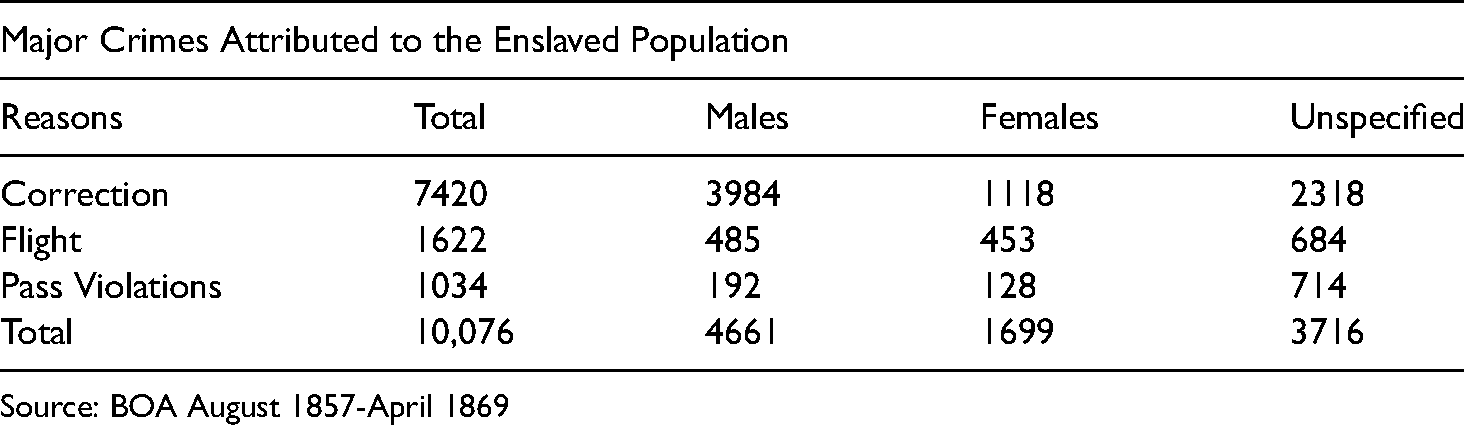
While some slaveholders continued to abuse their captives privately, many also took advantage of the 1853 Ordinance. By forcing masters and mistresses to punish enslaved people through the intermediary of a colonial official, the Ordinance seemingly limited the power of the slaveholding class. But simultaneously, it gave masters and mistresses the authority to send captives to police, which they did in high numbers. Between August 1857, the date of the first publication of the police section of the Boletim Oficial, and April 1869, when all enslaved Africans were officially “liberated,” the Chief of Police recorded 23,023 cases of imprisonment, of which 11,421 involved captives. The primary reason for the incarceration of enslaved people was for “correction” at their owners’ request (7420 cases), followed by cases of attempted flight (1622) and pass violations (1034).
Source: BOA August 1857-April 1869
Sending captives to the Chief of Police for “correction,” in particular, allowed masters and mistresses to indirectly punish the bodies of enslaved people, and reinforced the paternalistic relationship that had characterized slavery. While the 1853 Ordinance limited private violence, correction represented a transfer of violence from the owner to the colonial state. After visiting the colony of Angola in the 1850s, the British mining engineer Joachim John Monteiro described the abuse inflicted upon an enslaved person imprisoned at their owner’s request: When a slave requires correction or punishment, he is delivered over to the police for that purpose, and as desired, he is either placed in the slave-gang, chained by the neck to others, and made to work at scavengering, carrying stone…or receives a thrashing with a cat-o-nine-tails, or a number of strokes on the palms of the hands with a flat, circular piece of wood pierced with five holes and with a short handle (Monteiro, 1875: 40).
Once the punishment was administered, the owners were notified. On January 4, 1860, the Chief of Police ordered that an enslaved person named João Joaquim F. de Assis-Escravo receive 50 whips for insulting a guard, and that his master, António José Coelho Villela, subsequently receive a declaração do castigo (declaration of punishment) (Correspondência do Chefe da Polícia, 1860: 182v).
Although some slaveholders may have directly brought their captives to the police for “correction,” many, especially those residing outside Luanda, had to rely on a network of Luso-African and African officials. Among them were chefes, who ordered armed empacaceiros (African soldiers) to transport enslaved Africans to Luanda for punishment (Boletim Oficial do Governo da Província de Angola, 1865a: 314). Under vassalage treaties, African sobas (local African political authorities) were required to supply the Portuguese colonial administration with labor, including empacaceiros, in exchange for military and political support and legal protection against enslavement. In turn, empacaceiros who refused to turn over enslaved Africans for “correction” could face punishment. After one from Calumbo ignored orders from the chefe in July 1859 to help escort enslaved Africans to Luanda, he was arrested (Correspondência do Chefe da Polícia, 1859: 80).
As Paton (2004) and Jean (2017) have pointed out in their work on colonial Jamaica and Brazil respectively, the “birth of the prison” did not represent a complete break from bodily punishments. Along with violence, “correction” also included confinement in one of Luanda’s jails. During the nineteenth century, they primarily consisted of dungeons within fortresses and the cadeia. However, to accommodate large numbers of enslaved prisoners, the colonial administration established the Prisão do Carmo (Carmo Prison), located next to the Nossa Senhora do Carmo Church, which also served as a police station. Although captives could end up in any one of Luanda’s jails, those imprisoned for “correction” were often held in the Prisão do Carmo, which had a small section for men and another for women, both of which were overcrowded and poorly ventilated (Boletim Oficial do Governo da Província de Angola, 1869: 146). Because of these poor conditions, authorities had to transfer Francisco and Manuel, enslaved people belonging to D. Anna de Jesus Guerea and Joaquim Pinheiro Falcão respectively, to the Misericórdia hospital in February 1867. Both had been imprisoned in the Prisão do Carmo for “correction.” Just one month later, authorities brought Manuel, Narcisa, Januario, and Agostinho to the Misericórdia hospital from the Prisão do Carmo, where they had been imprisoned at the request of their owners for “correction” (Boletim Oficial do Governo da Província de Angola, 1867: 48).
Before enslaved people could be released from the town’s jails and the Prisão do Carmo, their owners had to pay a fee, which could make them vulnerable to “abandonment.” According to the President of the Conselho do Governo (Government Council) Luiz José Mendes Affonso, slave owners were abandoning enslaved people in the cadeia to starve, forcing the Fazenda Publica (Treasury Board) to cover the expenses (Boletim Oficial do Governo da Província de Angola, 1866: 7). Although the reasons are unclear, some slaveholders may have wanted to avoid paying prison fees. In August 1865, Jozé Lourenço informed the public that police had captured an enslaved person in the suburbs named João and sent him to the Prisão do Carmo. He warned his owner—a priest named José—that he had 30 days to retrieve João before he would be “liberated” (Boletim Oficial do Governo da Província de Angola, 1865c: 339). Within a slaveholding context, however, this “freedom” was precarious. Once “liberated,” João would likely be confined in the convent of the Jesuits and apprenticed to one of Luanda’s residents.
Of the 7420 captives imprisoned at their owners’ request, only 1118 were women. Despite being a minority, women were vulnerable to other types of abuse, including sexual violence (Candido and Oliveira, 2021). In March 1863, someone named Florencio Rodrigues Costa sent his captive Catharina and her cria to the police station for “correction.” When Catharina revealed to the Chief of Police Jozé Lourenço that her child belonged to Florencio, he placed her under the custody of the Junta Protectora (Boletim Oficial do Governo da Província de Angola, 1863c: 91).
Some of the people imprisoned for “correction” were also used to labor for the colonial state. When the military hospital in Luanda received 26 and a half arrobas 4 of cotton on December 13, 1847, the Secretary General João de Roboredo recommended using the people sent to the cadeia for “correction” in the ginning process since “they had nothing better to do” (Boletim Oficial do Governo da Província de Angola, 1848: 1). Then, in September 1854, 10 captives imprisoned for “correction” were put to work cleaning the city. Officials even encouraged slaveholders to punish captives to meet labor needs (Boletim Oficial do Governo da Província de Angola, 1854: 4). On April 18, 1856, the President of the Câmara Francisco Joaquim Farto da Costa notified residents in the Boletim Oficial that they could send captives for “correction” to the Secretária da Câmara (Chamber Secretary) where they would be assigned work carrying building materials for the cemetery (Boletim Oficial do Governo da Província de Angola, 1856: 7). Although there is no evidence that their labor played a crucial role in the economy, these cases highlight the blurred distinction between private and public violence.
Conclusion
In conclusion, the “birth of the prison” in Luanda cannot be understood without studying slavery. Throughout the nineteenth century, masters and mistresses used corporal punishment and devices of confinement that had been used throughout the trans-Atlantic slave trade period to punish their captives. Following the 1836 ban on the export slave trade and the “slow death of slavery,” the colonial administration introduced limits on abuse. Nonetheless, these measures did not eliminate violence, but rather reinforced it, allowing slaveholders to punish the bodies of their captives through the intermediary forces of the police and the prison.
After the “slow death of slavery,” emancipation finally came into effect in 1875. However, it was replaced with a contract labor system that was comparable to slavery. Contract workers ended up on coffee and cocoa plantations on the archipelago of São Tomé and Príncipe or were retained within Angola (Clarence-Smith, 1976). Widely unpopular, this forced labor regime was a major theme in Neto’s poetry. At the end of Criar, Neto calls for “peace from the sweat and tears of the contract” and liberation from the “roads of slavery” (Neto, 1961: 30). When the events of 1961 occurred, the Portuguese initially responded with violence and imprisonment, before relenting and abolishing the contract labor system. But by then, they were embroiled in a war that ended with Angola’s independence in 1975.
Footnotes
Declaration of Conflicting Interests
The author(s) declared no potential conflicts of interest with respect to the research, authorship, and/or publication of this article.
Funding
The author(s) received no financial support for the research, authorship, and/or publication of this article.
