




Abstract
In contemporary research, Nordic countries are considered to have comparatively lenient penal policies, such as the restricted use of imprisonment. However, criminal justice in Finland during the early decades of its independence was exceptionally harsh. Due to its history, Finland is considered a difficult case for institutionalist theories that have related the Nordic welfare state model with lenient penal policy. This analysis argues that Finland’s development away from this severity was, in fact, caused by the shift of its social policy toward that of a (Nordic) welfare state in the 1940s, which is associated with the adoption of the model of democratic corporatism after decades of intense political conflict. The 1940s were a turning point when regulation of prison population sizes started to become an objective in legislation concerning the penal system. Meanwhile, independent of legislation, judges’ attitudes and sentencing practices began to relax. A generational replacement began among the criminal justice elite that manifested as generational disagreement in the 1950s, and by the 1970s, a reformist consensus was achieved.
Keywords
Introduction
In comparative penal policy, the Nordic countries are often admired as kind and trusting societies. According to John Pratt and Anna Eriksson’s (2013) Nordic exceptionalism thesis, their humaneness results from the Nordic culture, a product of long historical processes. However, they also note that Finland’s social and penal development drastically diverged from Scandinavia at the beginning of the 20th century for several decades. Finland of the 1920s and 1930s was a country that had only recently recovered from a civil war with an aftermath of prison camps and executions, where governments were pursuing laissez-fare economic policies, and where industrialists used violent strike-breakers to confront small militant trade unions. The imprisonment rate was extraordinarily high, and the Finnish police were fighting a violent prohibition battle against alcohol traffickers with little trust from the public. Since then, Finnish criminal justice has become noticeably more befitting of a Nordic welfare state. For Pratt and Eriksson (2013: 6–7), Finland was simply returning to its cultural home. On the other hand, more detailed histories of this development have emphasized the nature of this change as a consolidated effort that was organized by key individuals, beginning at the end of the 1960s (e.g., Lappi-Seppälä, 2009: 349–360).
I argue that the Finnish criminal justice has been neither culturally determined nor coordinated by individuals but has taken its form somewhere in between, in the context of political guidelines broader than mere penal policy. Returning to the Nordic path was not inevitable, but rather, it was made possible by radical changes in the institutional context of Finnish criminal justice, which facilitated reconciliation and a shift toward socially responsible penal policy. Here, considering the overlooked development that occurred in Finnish criminal justice from the 1940s to 1960s preceding the criminal justice activism of the 1970s matters. Cross-comparisons show the significance of welfare institutions and social corporatism for imprisonment rates. This article adds the temporal dimension: Does the development of the imprisonment rate vary with the development of these institutions over time?
In the following paper, I present an institutionalist framework of the analysis, the method for a theory-oriented case study, a detailed depiction of the discussion surrounding the Finnish case, itemized research questions, a historical analysis, and corresponding conclusions.
Durkheimian causal model
Institutionalism refers to the idea that the way political activities are organized makes a difference independent of other factors, such as cultural contexts, technological development, and the diffusion of ideologies. While explanations vary, broad criminological literature associates economic deregulation, welfare state retrenchment, and rising inequality with a punitive turn in Western democracies (e.g., Garland, 2001; Wacquant, 2009). Consistent with this claim, comparative research concludes that the punitive turn has been the starkest in Anglophone countries that follow the liberal model of political economy, where institutional change has been the greatest (Cavadino and Dignan, 2006; Lacey, 2008; Lappi-Seppälä, 2008). Regression analyses that control for crime and other variables have established an inverse correlation between the social expenditure and imprisonment rate (Beckett and Western, 2001; Downes and Hansen, 2006).
Why would penal policy covary with social policy? Presumably, policy emerges from a political system, and differences in electoral arrangements have been proposed as independent determinants of both. Strong welfare states and lenient penal policies are associated with proportional representation, while liberal welfare states and harsh penal policies are associated with first-past-the-post systems. However, in the 1990s, New Zealand’s change to proportional representation did not curtail punitive trends, and furthermore, the punitive turn was not initiated by a widespread rejection of proportional representation.
Another aspect of political systems that is associated with penal policy differences are institutions of interest representation, which entails liberal pluralism on one hand and social corporatism on the other. Scores measuring corporatism inversely correlate with imprisonment rates (Greenberg, 1999). In addition to pluralism, corporatism may also be contrasted with federalism. While corporatism and federalism do not preclude each other, they are both arguably ways of forming an intermediary level between people and the central state. Corporatist countries tend to have lower imprisonment rates, whereas federalist countries experience higher rates (Jacobs and Kleban, 2003). According to John Sutton’s (2013) statistical analysis, corporatism, high union density, and political centralization define countries that have mostly avoided a punitive turn.
Émile Durkheim, a pioneering sociologist of criminal law, theorized on the relationship between the welfare state and punishment, and interestingly, was also a corporatist theorist (Häkkinen, 2020). In The Division of Labor Durkheim (1933: 70–132, 200–229, 256–301) suggests that the welfare state could create a new form of solidarity in functionally differentiated societies, replacing traditional solidarity that is based on conformity and punishment. Penal law protects solidarity based on uniform normative expectations (mechanical solidarity), where deviation is socially dangerous; punishment expiates breaches in the eyes of the community. In a growing and developing society, building solidarity on likeness becomes decreasingly feasible, but still, social coexistence requires some form of regulation. Durkheim suggests that positive “restitutive” law, which facilitates the creation of specialized relationships, could increasingly replace criminal law as the moral foundation for cohesion in a society that relies on the cooperation of heterogeneous individuals (organic solidarity). While the predominance of restitutive law increases, the intensity of penal law diminishes.
However, Durkheim (1933: 353–388, 1957: 5–13, 208–220) expresses pessimism about this taking place. His primary concern was the underdevelopment of economic regulation. Since organic solidarity requires increasing regularity in the relationship between capital and labor as well as social security, which would increase individual autonomy away from the market, Durkheim (1933: 1–31, 181–190, 301–303) turned toward political theory in his search for the necessary conditions to create economic regulation. What kind of institutions could generate this? Durkheim’s political sociology is limited to the theory of democratic corporatism, but the focus is intentional. Believing that the economy is an increasingly important domain and one that suffers from normlessness and that moral individualism is structurally founded on functional differentiation, Durkheim investigates institutions that exhibit structural harmony with the division of labor, capable of regulating the economy and creating solidarity across regional boundaries. Durkheim finds his answer in consolidated, autonomous, and democratic trade unions.
The starting problem in Durkheim’s (1957: 28–109) political sociology is an unrestrained state that is distant, clumsy, and repressive in its regulatory efforts. A specialized economy needs autonomous trade unions to act as modern particularistic intermediaries between the individual and state in order to create specialized economic regulation, such as employment terms. However, Durkheim worries that even modern particularistic communities could suppress the individual. Fortunately, the solution lies in the trade unions and corporatist democracy. Political deliberation in a society requires institutional arrangements; law does not appear spontaneously. Individual participation in intermediary institutions could enable democratizing communication between individuals and the state in a way that cannot be solely achieved by attempting to poll individual opinions in majoritarian politics. The task of the thus democratized state would be to guarantee emancipatory universal individual rights through positive legislative action in whatever domains of policy necessary. Autonomous trade unions protect the individual from state repression on one hand and the policy autonomy of the state from undeliberated public opinion on the other. The state, then, protects individuals from the collective particularism of intermediary groups.
Durkheim neglects to discuss political parties, perhaps assuming that they only exist within the state in parliament. After Durkheim, many democracies have developed organized mass parties that represent social groups and act more like intermediary institutions. However, they tend to be intimately linked with corporatism and form stable interest coalitions with corporative groups, so they easily fit within this theory.
Durkheim’s political theory may be interpreted as explaining the necessary causal conditions for the division of labor to lead to organic solidarity. In Durkheim’s legal theory, modern organic solidarity and mechanical solidarity—along with their associated types of law—correlate inversely. To ask how the division of labor can lead to organic solidarity is to ask the following: How can the division of labor lead to a declining reliance on penal law? The causal hypothesis is as follows: While the historical context is a developing democracy with a specialized economy, the basic condition is the establishment of institutional arrangements that can create the missing economic regulation and social security. If organized, autonomous trade unions exist, the state must recognize their public role. Trade unions create labor market regulation by themselves, and they also facilitate political participation and communication between individuals and the state, which democratizes the state, encouraging it to create social security. Creation of the missing restitutive regulation increases societal solidarity, which is expressed through increased trust across regions and classes as well as feelings of social responsibility. This, in turn, increases the emotional readiness of a society to loosen penal control, as it is a decreasingly necessary antidote to feelings of social disintegration.
Within case institutional analysis
The purpose of this paper is to diachronically observe this causal hypothesis within a case by following realist methodology (see George and Bennett, 2005). Theory testing within case analysis begins with a hypothesis that concerns the causal relationship between variables, which is conceptualized and observed to judge the presence of the hypothesized mechanisms. Micro and macro processes can both be traced. The causal chain is reconstructed at the level of analysis (Beach and Pedersen, 2013: 14–16, 40–43). Analysis consists of a causal figure depicting the hypothesized cause, effect, and mechanisms in-between as well as the descriptive inference for whether the history of events corresponds (Waldner, 2015). The mechanisms are not conceptualized as variables but invariant systems that are composed of entities (e.g., social agents or structural phenomena) and their activities (i.e., verbs describing what the entities do). The data consists of case observations, whose value as evidence is assessed through contextual case understanding (Beach and Pedersen, 2013: 36–40, 49–52, 69–76). Figure 1 depicts the Durkheimian causal hypothesis.
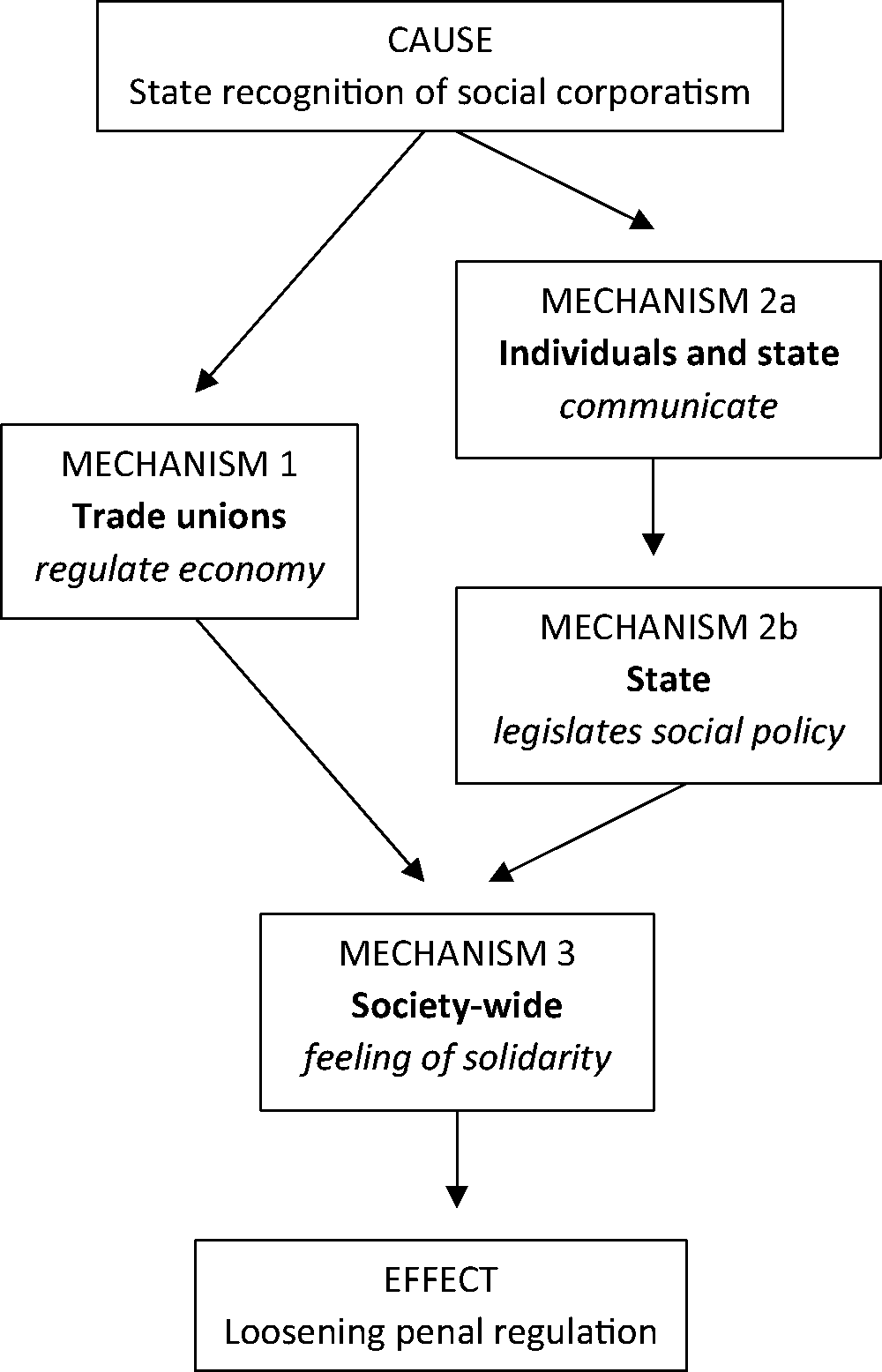
A causal explanation of decreasing punishment intensity.
Institutions create stability, which makes institutional crossroads and reallotments highly decisive moments. Regarding institutional change, this analysis relies on the concept of punctuated equilibrium, which characterizes politics by stable periods that are, in turn, demarcated by sudden transformations that are commonly caused by external shocks. This concept is most useful when analyzing periods of crises. During extended stable periods, the role of strategic agency increases.
The case of Finland
Michael Cavadino and James Dignan (2006: 160–161) write about Finland in their seminal work in the field of comparative penal policy: …despite its social democratic nature, Finland in the 1970s had a surprisingly high prison population by contemporary European standards. But thereafter, at least until the turn of the century – and as a result of a quite deliberate reorientation in official policy – Finland reduced its imprisonment levels to such an extent that it could be regarded as having taken over the Netherlands' traditional role as the beacon of penal enlightenment in Western Europe. … The year 1976 was important for Finnish penality. That was the year when … the Finnish Penal Code of 1889 was amended by the addition of a chapter which enshrined ‘just deserts’ as the main principle of sentencing. It also marked the beginning of a long and steep decline in the use of imprisonment in Finland, from a peak of 118 per 100,000 population in 1976 (high by Western European standards even today).
Since Nordic social democracies tend to have low imprisonment rates, Finland’s contemporary low rate makes sense, but the problem rests in its high initial level. It even worsens when one considers that the imprisonment rate did not peak in 1976. The rate was 137 per 100,000 people in 1966, 151 in 1956, and over 200 in the 1940s (Figure 2). While the imprisonment rates in Scandinavia followed similar paths of decline in the 19th century and relative stability thereafter, the Finnish imprisonment rate had diverged by the 1910s (Christie, 1968). By 1968, when Finnish experts according to Cavadino and Dignan realized Finland’s overuse of incarceration, the imprisonment rate had already been falling for two decades. Cavadino and Dignan fail to consider that the explanation may lie in the primary conclusions of their work: Low imprisonment rates are associated with strong corporatist welfare states and sentencing practices are more important for determining levels of incarceration than penal ideology or criminal law in books (Cavadino and Dignan, 2006: 337–339). Rather than being an “exception to the rule” (Cavadino and Dignan, 2006: 337), what if Finland is a longitudinal example of the rule in action?
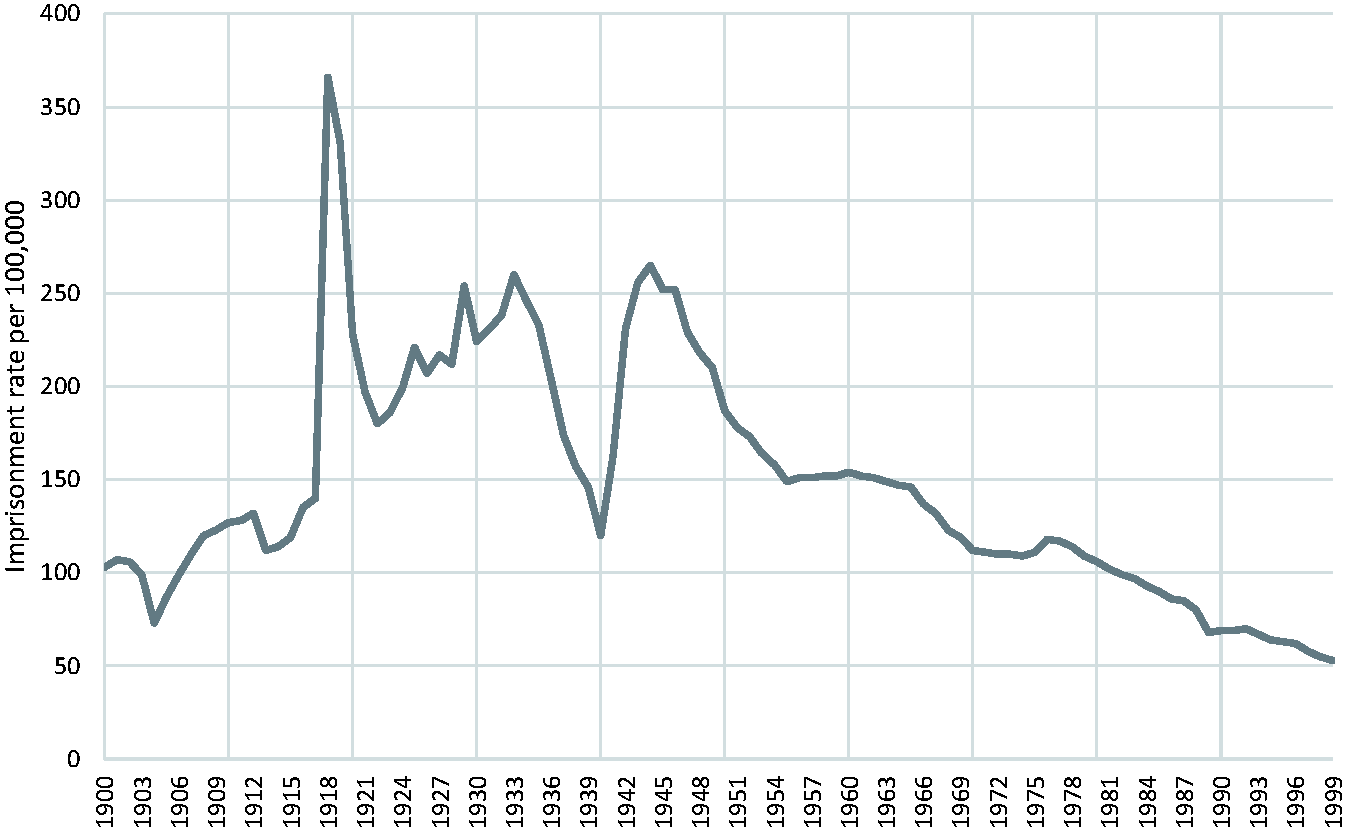
The Finnish imprisonment rate in the 20th century (Hannula, 2004; Von Hofer et al., 2012).
Cavadino and Dignan rely on what Jukka Kekkonen (2001) describes as the official narrative of Finnish penal policy: The decline in the Finnish imprisonment rate began in the 1970s as a result of new goal setting among Finland’s criminal justice elite. Notably, much of the history of Finnish criminal justice has been written in affiliation with the Finnish Ministry of Justice. Kekkonen, on the other hand, points to the importance of considering changes in the sentencing practices that preceded the reform period and the structural context of Finnish criminal justice, especially profound social conflict and distrust in the early 20th century Finland. Leif Lenke (1980) similarly explains Finnish exceptionalism in the context of political conflict and a weak labor movement. Democratization and social democratic power, in particular, led to humanizing criminal justice reforms in the early 20th century across Scandinavia. In Finland, political conflict and penal repression were significantly more intense, and the political left was fragmented. Subsequent reform periods correlated with increased working-class influence in politics.
Tapio Lappi-Seppälä (2009: 362–365), the most prominent expert of Finnish penal policy, emphasizes the role of the emerging welfare state’s development as an underlying factor that created the capacity for socially responsible crime control and influenced the local character that the just deserts ideology acquired in Finland. However, even Lappi-Seppälä moves the reforms of the late 1960s and 1970s to center stage, and specifically contextualizes them within the realm of welfare state development. The preceding change in sentencing practices plays a lesser role and is not contextualized along the same lines.
My hypothesis is that a change in the Finnish political structure in the 1940s led to the regulatory regime’s transformation, which included the declining intensity of punishment. The reforms of the 1970s were significant but part of a longer continuum. The basis for comparison is the newly independent Finland from 1917 onwards, which was affected by the external shock of the Second World War. The legacy of this crisis took place from 1944 to 1991, when an economic and geopolitical shock caused a subsequent turn in Finnish social policy (see Häkkinen, 2019). To judge the presence of the mechanisms, as hypothesized in the Durkheimian causal model, the following questions should be addressed:
Cause: When/why was corporatist interest representation recognized by the state? Mechanism 1: Did it increase labor market regulation in the form of collective agreements? Mechanism 2a: How did union density develop? Who did the corporative groups represent, and what were their relationships with the parties? How did the recognition of the groups affect law drafting? Mechanism 2b: How did welfare state policy evolve, and what was the role of corporatism? Mechanism 3: Did changes in legislation and the elites’ attitudes reflect the growing appreciation for positive individual autonomy and social responsibility? Were there other signs of a declining resort to structures of “mechanical solidarity,” such as increasing secularism and decreasing conformist nationalism? Effect: Did penal intensity decline?
Social context until 1939
The annexation of Finland from Sweden to join the Russian Empire as an autonomous grand duchy in 1809 caused the formation of a distinct Finnish legal system based on pre-annexation Swedish law. Finnish estates started to assemble regularly in the 1860 s, which began an era of legislative activity and economic liberalization. Although the growth of the Russian central government’s state capacity restricted Finnish autonomy in the early 20th century, a progressive political reform was achieved when a window opened in 1906 due to an empire-wide political upheaval, which included the creation of a democratically elected Finnish parliament. However, the new parliament’s capability for social reform was thwarted until Finland became independent, following revolutions in Russia, in late 1917. Then, in January 1918, severe political tension led to a civil war outbreak between revolutionary social democrats and government-authorized, right-wing civil guards. The government forces won with German support, but the death toll from battles, executions, and prison camps was great.
Independent Finland was still far from becoming a welfare state. Responsibility for poor relief was transferred from the church parishes to municipalities in 1865. In 1879, an economic reform was enacted in the form of a poor relief law, which was based on less eligibility, in an attempt to increase labor mobility. Social problems were concentrated among the growing rural landless population. A modest first step towards modern social security was the legislation of occupational accident insurance at the end of the 19th century. Finland was developing into a wage labor society. Unionization began by the 1880 s. By 1907, peak organizations for labor unions and employers had been founded (see Rahikainen, 1993: 89–94). Immediately after the Civil War, the bourgeoisie victors tried to solve the social problems that had led to the war with a land reform that created a huge number of new farms. However, their average size was small, and many were soon abandoned (Urponen, 1994: 165–169).
Following the Civil War, social and industrial trust were low. Employers rejected collective bargaining. The workers’ central organization, too, was in the hands of hard-liners. Unlike Scandinavia, the interwar era did not witness the birth of neo-corporatism (Kettunen, 2001: 228–230). The Finnish parliament finally became fully functional after the 1919 elections, and in the 1920s and 1930s, it became the sole locus for national politics, lacking institutionalized intermediaries between the individual and state. Controlling the majority, bourgeoisie parties were distrustful of the reorganized Social Democratic Party, and overall, political conflict was substantial. Seppo Hentilä (2018: 107) describes interwar Finland as an authoritarian society with a democratic state. Institutionalizing the results of the Civil War included formalizing the Civil Guards’ status, which exercised political monitoring (Hentilä, 1999: 143–146; 2018: 154–164).
Nevertheless, unlike in the similarly newly independent Baltic countries and Poland, parliamentarism—and consequently the social democratic movement—survived. Parliamentarism faced its greatest challenge during the Great Depression with the rise of the radical nationalist Lapua Movement. Through political violence and displays of force, it manipulated the government’s composition and platform. Anti-communist legislation was passed in an effort to appease it, which included banning the worker’s central organization as well as communist electoral activities. The movement started to lose support as its violent nature became clearer, especially after a failed attempt to begin an armed rebellion in 1932. After this crisis, the influence of political extremism diminished, and political conflict eased somewhat. Of the bourgeois parties, the Agrarian League neared the Social Democrats to the extent of accepting them as a government coalition partner in 1937 (Hentilä, 1999: 152–155, 161–165, 169–172).
Interwar social policy was austere, and social expenditure remained at one to two percent of the state budget. Poor relief administration was fixated on moral classifications and conserving social divisions (Satka, 1995: 85–94). Resorting to poor relief meant legal incompetence and disenfranchisement. The recipients were strictly monitored and half of them were institutionalized. Those who defaulted on their child support, alcoholics, and those considered to be leading unproductive lifestyles were sent to punitive workhouses. Even though poor relief recipients had to repay any assistance they received, concerns about assistance fraud were prevalent (Urponen, 1994: 177–184). An increase in assistance costs during the Great Depression was interpreted as moral deterioration. In a 1936 reform, separate laws were passed for the maintenance of needy children, vagrants, and alcoholics, which was influenced by contemporary criminological thinking that was preoccupied with individual prevention (Satka, 1995: 95–104; Urponen, 1994: 195–197). Following the Social Democrats’ accession to the government, a rudimentary (and ultimately inconsequential) pension insurance system passed in 1937 (Urponen, 1994: 197–200, 233).
Politically, the 1920s and 1930s were marked by jealous nationalism, militarism, and moral conformism. Social policy became oriented toward penalizing those with loose morals. The victorious side in the Civil War attempted to construct unity through patriotism and traditionalist agrarianism. The memory of the war—construed as a liberation against an external threat—was cherished through ceremonies and monuments in an attempt to build solidarity (Hentilä, 2018: 73–78). In the Finnish Church many interpreted the Civil War as a victory for traditions over the devil and (as they saw it) oriental anarchy. Church membership remained nearly universal, and its social standing was deep-seated. Members of the clergy were active in radical nationalist politics (Heikkilä and Heininen, 2016: 167–169, 180–182, 190–191).
Regarding the Durkheimian causal hypothesis and research questions above, corporatist interest representation remained unrecognized, while social security was still rudimentary, causing Finland to lag behind other Nordic countries. Overall, nationalism and moral conformism were powerful forces in Finnish society during this era. Elite attitudes reflected individual responsibility, and individual citizens continued to rely on traditional communities.
Interwar criminal justice
Imprisonment had become established as the standard punishment for serious crime in Finland from the 1860 s onwards, and theft became the most common principle offense among convicted prisoners (Hannula, 1981: 93–100). Imprisonment was mandatory for those convicted of theft, except for first-time petty offenses. Mandatory minimums were high for repeat theft. These strict attitudes toward theft can be explained by the country’s continued poverty on the one hand and by society’s growing regard toward the protection of private property on the other, which was due to economic liberalization. The imprisonment rate remained stable until a modest rise began following the social turmoil of 1905, coinciding with increasing imperial government interference in Finnish criminal justice. Russia joined the First World War in 1914 and introduced wartime measures that further increased this rate. Mass pardons were implemented every few years to regulate the size of the prison population.
At the end of the Civil War in 1918, the government camps held over 80,000 prisoners. Approximately 6,000 remaining prisoners were transferred in the autumn of 1918 to the Prison Service (Aho and Karsikas, 1980: 39–40), which caused a prominent spike in the imprisonment rate (see Figure 2). The exclusionary reaction to the failed revolution reflected the elites’ disillusionment toward the people. There was a discursive need to other insurgents as criminals (Hentilä, 2018: 37–48). The punishments for participating were sentenced summarily in provisional courts. The vast scale of imprisonment was hardly tenable in peacetime conditions, and as emotions cooled down, the vast majority of those sentenced were released due to the permanent introduction of conditional imprisonment, the extension of early release in 1919, and several amnesties between 1918 and 1921. However, as the measures were conditional, participation in the revolt continued to aggravate numerous sentences for ordinary crime (Hannula, 2004: 455–460).
Following the peak, fine defaults (especially for drunkenness) significantly added to the imprisonment rate in the 1920s after the fine system was reformed and punishments for drunkenness increased in 1921. The Great Depression worsened the situation nearing the turn of the decade (Hannula, 2004: 180–187). Drunkenness became the most commonly recorded crime in the 1920s and 1930s, despite exceedingly low alcohol consumption (Hietanen, 1992: 162–163). Strict attitudes toward it reflect a contemporary moralism in social policy. During the crisis of the early the 1930s, increased political imprisonment (due to anti-communist legislation) and the number of sentences for ordinary crime contributed to the second peak in the imprisonment rate. Aside from the anti-communist laws, several other significant reforms with ambivalent effects were enacted during these crisis years. Imprisonment for fine default was reduced with the introduction of shortened sentences under the harsh “water and bread” treatment in 1930. Punishments for drunkenness were finally lowered in 1931. Parole extension in the same year introduced the routine application of early release (Lappi-Seppälä, 2011: 173–174). These reductions may have been the result of reaching the material limits of large-scale imprisonment once again. On the inflationary side, preventative detention for recidivists was introduced in 1932, and some alcohol offenders were interned with a provisional law in 1934. After the crisis, the imprisonment rate declined for the rest of the 1930s, which was due to reduced fine defaults and political imprisonment, and fewer sentences. The lowest point was reached in 1940 after approximately twenty percent of prisoners were pardoned to join the war effort (see Aho and Karsikas, 1980: 41).
Overall, inmates sentenced for theft and assault formed the core of the prison population, while inmates sentenced for political offenses and alcohol-related crime intensified the variation. Meanwhile, the politics of crime control were unconcerned with the size of the basic prison population. The number of sentences for political crimes and theft peaked during the crisis periods, while the number of sentences for assault rose in the 1920s. Ideologically, Finnish criminal justice was influenced by the widespread individual prevention paradigm, but it was not a driving force behind the reforms and did not determine their severity (Hannula, 2004: 103–153, 198–200, 447–449, 461–465, 471–476). Reductions in the imprisonment rate co-occurred with the release of extreme political conflict. After 1918, Finland moved away from a political war, and in the mid-1930s, they pulled back from the threat of a new one. Both political imprisonment and sentences for ordinary crime decreased. Notably, the number of sentences for ordinary crime covaried more precisely with political crises than with economic crises (Hannula, 2004: 302–304). The era’s agrarian settlement ideology was reflected in the construction of new prisons in remote wetland locations with the intention of reclaiming farming land (Pajuoja, 1993: 50–57). Prisons were, nonetheless, permanently overcrowded. In opposition to later claims, contemporary experts were acutely aware of how elevated the Finnish imprisonment rate was, citing manifold numbers, as compared to Scandinavian countries (see Boije, 1925; Serlachius, 1926; Vankeusyhdistys, 1933).
Two early somewhat progressive reforms were drafted during the spell of the center-left government in the late 1930s. In 1939, the enactment of general rules concerning recidivism in sentencing repealed the harsh provisions for repeat theft, which had the indirect effect of reducing preventative detention (Hannula, 2004: 445–446). Juvenile justice was reformed in an educational direction in 1940, introducing the discretionary waiving of charges and increasing conditional sentences, but it also extended juvenile prison sentences in some cases. While its steepness remains somewhat puzzling, I suggest that the decrease in imprisonment in the late 1930s was the result of a political thaw, which still lacked institutional support at this time, making it volatile, as soon became evident.
Finland fought two wars with the Soviet Union between 1939 and 1944. Thus, the third peak of the imprisonment rate was due to wartime legislation, the wide jurisdiction of field courts over soldiers and civilians, an increased number of sentences, and political internment (Aho and Karsikas, 1980: 42; Hannula, 1981: 135–136; Hietanen, 1992: 166–172). Denmark had a similar significant increase in imprisonment during the war (Jaakkola and Tham, 1989: 50), but unlike Finland, this may be explained by the Nazi occupation that faced an active resistance movement and a widescale purge against collaborators afterward. By the end of the 1940s, the Danish imprisonment rate was, once again, far below that of Finland. Besides Finland, the only other continuously unoccupied and democratic European country that took part in the war was Great Britain. The imprisonment rates of England and Wales remained stable throughout both world wars (Allen et al., 2017: 4). These facts indicate that Finland’s wartime peak was not an inevitable byproduct of the war but a continuation of the trend that began in the 1910s. This time, the Finnish detention regimes affected outsiders as well. Malnourishment of those in Finnish prisoner-of-war and internment camps resulted in high mortality rates that were akin to those of totalitarian countries (Danielsbacka, 2016: 11).
Postwar social context
The peace treaty with the Soviet Union abolished the Civil Guard and several other institutions of the interwar social order, and while the continuity of Finland’s constitutional system remained uninterrupted, the war became a critical juncture that upset the pre-war institutional arrangement. The international context determined institutional choice and modeling. Before the war, it was ambiguous whether Finland was a Nordic country or an Eastern European “border state.” Now the only alternative to Soviet alignment was to observe Scandinavia.
A profound change occurred in industrial relations. The unionization rate was low between the wars, especially after the ban on the original worker’s peak organization. However, a new organization (SAK) with social democratic leadership was founded immediately after this ban. The shock of the war and need for national cooperation caused employers to formally recognize SAK as a legitimate negotiating party in 1940. Following the war, membership rose dramatically in unions that were affiliated with SAK and among white-collar employees and farmers. The first general agreement between peak organizations was reached in 1944, and the so-called wage decision of 1945 created a system of collective agreements and a future framework for centralized bargaining and tripartite political participation. New laws concerning collective agreements and the conciliation of labor disputes were enacted in 1946 (Urponen, 1994: 216–221). Parity in industrial agreements democratized the labor market relationship (Kettunen, 2001: 244–246). Membership also grew in political parties, and those affiliated with corporative groups (i.e., leftist parties and the Agrarian League) quickly developed into organized mass parties.
Interest representation in politics changed from pluralistic to corporatist without constitutional changes (Helander, 1983: 11–18). Centralized bargaining in the distinct form of tripartite “incomes policy” did not start until 1968 and never became as pivotal as it was in Sweden or Austria. Instead, neo-corporatist participation took place in state committees. Their number increased rapidly, and the participation of central organizations became systematic after the war (Helander, 1983: 18–22; Rainio-Niemi, 2010: 248–252). State committees were in the center of political decision-making. Institutionalized inclusion enabled the role of associations to act as intermediary institutions and brought interest mediation into politics (Rainio-Niemi, 2010: 241–248).
In social policy, the paradigm of means testing gave in. The share of social expenditure in the state budget rose from three to thirteen percent between 1945 and 1950 (Alestalo and Uusitalo, 1986: 202). The administration of social services was reformed in 1950, and basic welfare replaced poor relief in 1956. Care outside of institutions became prioritized (Urponen, 1994: 229–232). More importantly, the development of social insurance reduced the need to resort to basic aid. The major reforms that built the Finnish social security system were universal child allowances in 1948, universal state pensions in 1957, earnings-related occupational pensions in 1961, and universal health insurance in 1963 (see Alestalo and Uusitalo, 1986: 202–205; Kettunen, 2001: 235–238; Rahikainen, 1993: 94–98). Other welfarist policies included investments in preventative public health work and public hospitals in the 1950s, and improvements to housing and unemployment benefits in the 1960s (Alestalo and Uusitalo, 1986: 211–217).
Welfare turned from residual to comprehensive. Income security expenditure increased twelve-fold, health expenditure did so ten-fold between 1950 and 1980. Families with children and pensioners were covered first, and new groups were added in the 1960s. Reimbursement levels increased. Social expenditure caught up with—and even exceeded—many comparable countries. Well-being and equality improved in the realms of health, education, and housing. Finland’s economic structure changed as both industrial and service work simultaneously increased, and its economic growth was rapid. While this helped the welfare state development, it does not explain the timing. Welfare state reforms were not markedly associated with variations in leftist power within the parliament either, and in general, the governments were weak (Alestalo and Uusitalo, 1986: 205–209, 217–228, 230–232, 235–236, 244, 250–257).
As communist activity had been permitted again after the war, the parliamentary left grew in size but lost unity. The newly founded communist electoral pact, the People’s Democrats, formed a government with the Social Democrats and Agrarian League in 1944, but they remained in opposition from 1948 to 1966. The Social Democrats suffered from severe internal divisions. Consequently, the Agrarian League became the hub of parliamentary politics, participating in most governments. The Finnish welfare state was built as a compromise between the Social Democrats and trade unions (who prioritized high reimbursements rates), the Agrarian League (who prioritized universal coverage), the People’s Democrats (who were balanced between the interests of the workers and small farmers), and the political right (who tried to limit development). The role of democratic corporatism was crucial during this process (Alestalo and Uusitalo, 1986: 264–266; Kettunen, 2001: 240–244).
The sacrificial pathos of Finnish nationalism toned down after the war, as the notion of a “society” replaced that of the “fatherland.” The relationship between the Finnish state and individual experienced a rapid change, like the newly launched training of social workers, which emphasized equality and compassion instead of discipline and individual responsibility (Satka, 1995: 118–123, 132–135). The growing clientele of welfare services challenged the idea of welfare recipients as “others” and exposed coercive care to criticism (Urponen, 1994: 240–241). Discourse on disability changed from the 1930s, where disabled people were portrayed as a burden to the country, to the 1950s, as rehabilitation became understood as a way to find beneficial positions for disabled people within society. Finally, by the 1960s, the right to participate in society was emphasized as a value in and of itself (Leppälä, 2014). Secession from the Finnish Church increased after the war expressing growing individualism and a decreasing religious conformism (Heikkilä and Heininen, 2016: 204–208).
Regarding the Durkheimian causal hypothesis and research questions above, corporatist interest representation was recognized during and immediately after the war. Increases in the labor market’s regulation in the form of collective agreements instantly followed. Union density grew rapidly, making the corporative groups widely representative. This applied to the blue-collar unions that were linked to the leftist parties but also to producer organizations that were linked to the Agrarian League and white-collar unions associated with the political right. The recognition of democratic corporatism manifested in the systematic inclusion of central organizations in state committees, which played a key role in law drafting. Welfare state policy expanded rapidly, especially in the area of social insurance, and the involvement of corporatist collective actors was consistent. The development of social security and changes in elite discourse since the 1930s reflected an evolving attitude toward individual autonomy and social responsibility. The individual became increasingly reliant on the state and modern intermediary institutions, such as the growing trade unions, while they also gained a sense of autonomy from local communities, the church, and nationalist organizations that represented conformist solidarity.
Postwar criminal justice
The end of the war marks a shift where legislative reforms started to replace mass amnesties as the primary method for limiting the size of the prison population. Committees that were established to evaluate prison administrations after the war criticized the wartime prison conditions and recommended reforms (Hannula, 1981: 142, 151–154). Reforms that concerned sentence enforcement extended the practice of early release in 1944. The Legal Affairs Committee of the parliament acknowledged the government’s proposal as a step toward a more “humane and expedient” penal policy. Open-style imprisonment, consisting of paid work in minimum-security conditions, was introduced in 1946 and extended in 1954 (Pajuoja, 1993: 64–72). Meanwhile, the “water and bread” punishment was repealed. In 1948, the utilization of conditional sentences increased. Youth imprisonment was reduced in 1953. Prisoners’ rights and prison conditions started to improve (see Ruokanen, 1981: 84–99).
There was some backlash, especially concerning the effects of the 1939 recidivism reform around the early the 1950s, a quieter phase in welfare state development. The punishments for theft increased in 1946, and the use of preventative detention was reinvigorated in 1953. However, no comprehensive penal increases were achieved (see Hannula, 1981: 150–151, 160–161, 163–165). In scholarly discourse, clashes occurred between the conservative criminal law professors in Finland’s only law school and younger reformist experts affiliated with the Ministry of Justice, including the influential future professor and research director, Inkeri Anttila (see Hannula, 1981: 162–163; Ruokanen, 1981: 100–103). In the Cold War context, Scandinavia was the natural source the reformists utilized for modeling, just as it was for social policy. The ministry’s new research department became the primary home for criminological research in Finland, allowing criminologists to gain political access, but also a professional incentive and an opportunity (as the historians of Finnish criminal justice) to perhaps overly credit themselves for the reform successes.
Reforms that limited the use of prisons continued. Imprisonment for fine defaults was reduced in 1963, the use of early release increased again in 1966, and the use of discretionary dismissal in criminal cases increased in 1967. The late 1960s saw the beginning of a more concentrated legislative effort to continue reducing imprisonment this time characterized by expert consensus. To their credit, these reforms were implemented against a backdrop of rising recorded crime from the late 1960s onwards, unlike previous reforms. The policy consisted of shorter sentences and substituting imprisonment with fines, conditional sentences, and early release. Theft and drunk driving were crimes whose sentences were particularly targeted (Lappi-Seppälä, 1998: 6–21). Many of the most important reforms took place early on: Drunkenness was decriminalized and imprisonment for fine default reduced in 1969, preventative detention was reduced in 1971, and punishments for theft were lowered in 1972. While considerable glory for these reforms has occasionally been given to a group of experts and student activists known as the November Movement as well as the associated prisoners’ rights organization, Krim, by the time the groups organized in the late 1960s, the reforms were largely already in the midst of preparation (Soukola, 1997).
It may be more significant, however, to consider that court practices relaxed after the war as unconditional sentences became increasingly short nearing the 1960s (see Lappi-Seppälä, 1998: 8–12). When the concerted reforms of the late 1960s and 1970s began, shifts in court practices several times preceded the amendments, which emphasizes the role of the judges. The number of fine default prisoners dropped after the reforms in 1963 and 1969, but both times, there had already been a clear decrease over the previous few years. The use of preventative detention collapsed after the reform in 1971, but it had already nearly halved in the preceding five years. Reduction in the use of conditional imprisonment for drunk driving cases from around ninety percent of sentences to below fifteen percent, started in the late 1960s and was almost complete by 1977 when the drunk driving statutes were reformed (see Lappi-Seppälä, 2011: 169–171, 180–181, 195–197). These empirically observed changes in court practices independent of or preceding legislative changes, are in opposition to the above-mentioned claim of inflexible legalism as a central obstacle in Finnish criminal justice reform.
A contracting trend began in penal legislation already in the 1940s concurrently with the birth of social corporatism and early welfare state development. Even when reforms were fewer, the courts kept actively reducing the length of prison sentences. It remains undisputed that the decline of imprisonment rates reflected a genuine alleviation of harshness.
Conclusion
Finnish interwar penal policy was a far cry from Nordic humaneness and welfarism, despite contemporary Finnish experts’ awareness of Finnish exceptionalism. The Finnish case shows that the Nordic countries are culturally capable of harshness. The country’s development toward a more lenient penal policy started in the 1940s, well before the 1970s’ criminal justice activism. In opposition to the legalism thesis, court practices played an important role in this development. The Finnish case does not support the plausibility of transforming the criminal justice system through activism without a favorable institutional background. Instead, it supports the idea of a relationship between the corporatist welfare state and lenient penal policy. Finland’s development occurred in the context of the welfare state’s growth, which involved democratic corporatism playing an important role. After the shock of the war, the creation of institutions and policies that increased positive individualism and solidarity across societal subgroups made it possible for people to relent when it came to harsh individual responsibility for deviation without fear of social disintegration.
Some reservations should be made, however. At this time, welfare states were expanding in many places. If political institutions explain certain aspects, it concerns the style and extent of the welfare state’s development. Relatedly, some historical contingencies may have made the outcome more Durkheimian than even the Durkheimian model would have predicted. Due to its developmental context, a strong agrarian party maintained the power balance between the state and corporations, which advanced universalism in reimbursement rates. The agrarian party, a “state party,” advanced universalism in coverage. Third, employer organizations already had political access before the war. It was the recognition of unionized labor’s legitimacy by the state and the employers that mattered. Lastly, even within the pre-corporatist system, the level of political conflict seems to have been an influential factor, which is evidenced by the declining imprisonment rate after the internal crises of the 1910s and 1930s, the latter one especially only partially explained by a direct decrease in political imprisonment.
Footnotes
Acknowledgements
The paper was written as part of a dissertation project supervised by Heikki Pihlajamäki and Ari Hirvonen. In addition to the Journal’s reviewers, I thank Jussi Pajuoja and Tapio Lappi-Seppälä for comments.
Funding
The author(s) disclosed receipt of the following financial support for the research, authorship, and/or publication of this article: This work was supported by Olga ja Kaarle Oskari Laitisen säätiö.
