



Abstract

EDITORIAL
The summer has begun with an inarguable bang with what proved to be a fascinating election and landslide result. Of particular note was a history-making number of seats for the Green Party, suggesting that climate change might be becoming a more important issue politically in at least some areas. Time will tell whether that translates to policy in the coming months.
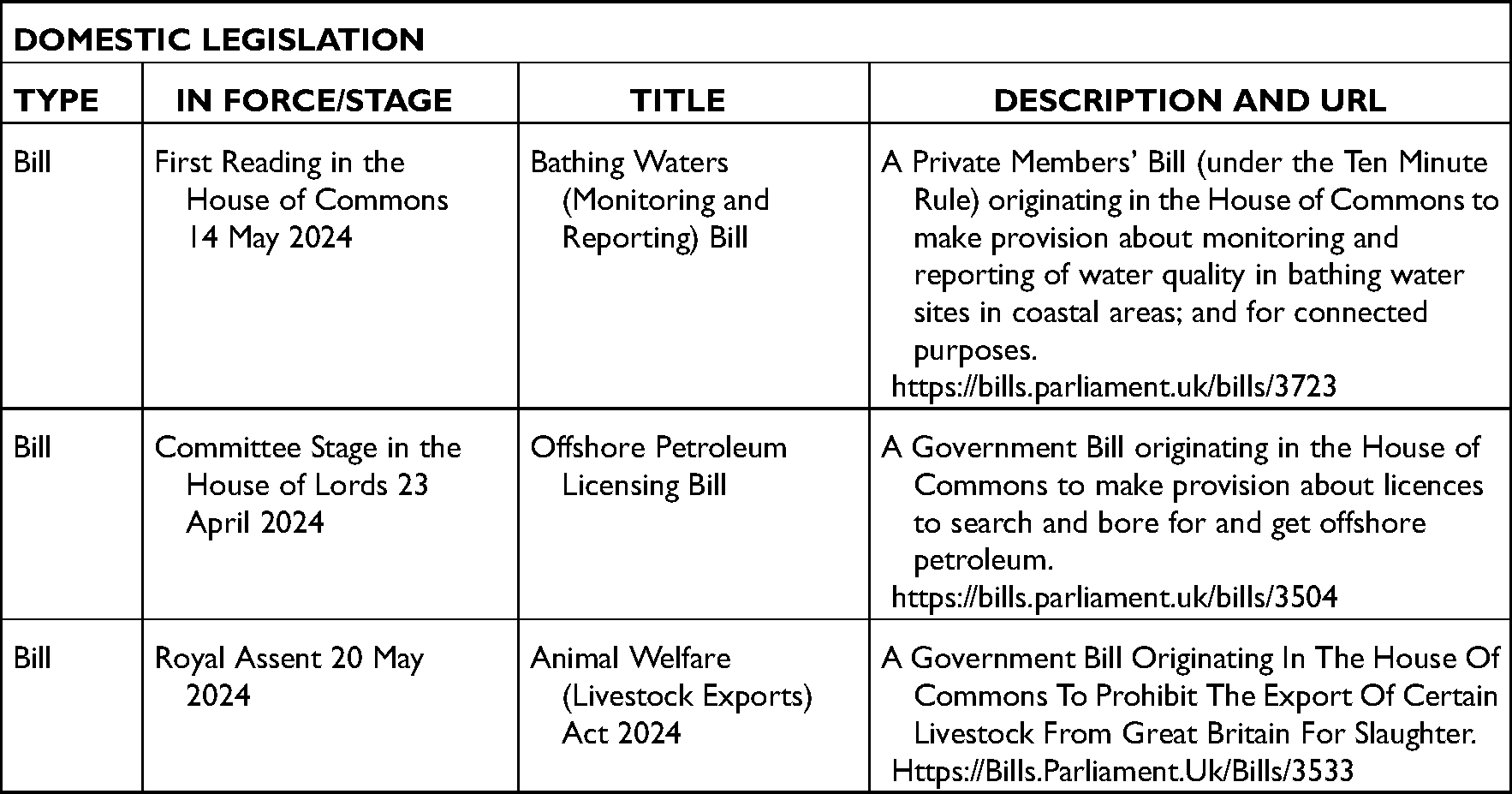
Unsurprisingly, legislatively it was a slow quarter with Parliament being suspended on 30 May. There was some limited movement in respect of the Offshore Petroleum Licensing Bill which moved to the Committee Stage and the introduction of the Bathing Waters (Monitoring and Reporting) Bill. What will be interesting to see is what decisions the new Government will make in respect of moving climate change action forward; will this Government usher in a new era of climate change forward action or will it be more of the same slow and inconsistent progress?
Friends of the Earth yet again sought to hold the government to account with a judicial review of the previous Secretary of State's approval of proposals and policies in the Carbon Budget Delivery Plan, laid before Parliament pursuant to an order made in a previous matter brought by Friends of the Earth. In this most recent matter, the Court was with the Applicant and held the Secretary of State's assumptions that the proposals and policies would be delivered in full was based on a mistaken understanding of the true factual position and therefore irrational.
The Committee of Public Accounts had rather gloomy news in respect of decarbonising home heating. It found consumers were still faced with far too much complexity and confusion. There was also no plan for accommodating homes where heat pumps were not practical and a distinct lack of decisiveness over the role of hydrogen was affecting investors’ ability to commit to major low-carbon technologies. Again, it will be interesting to see if there is a change in attitude towards clearer and more effective climate change policies with a new Government at the helm. Read on for more updates.
Update
Anna McClean
EU LEGISLATION AND TEXTS
Commission Regulation (EU) 2024/1103 of 18 April 2024 implementing Directive 2009/125/EC of the European Parliament and of the Council as regards ecodesign requirements for local space heaters and separate related controls and repealing Commission Regulation (EU) 2015/1188
This Regulation lays down ecodesign requirements for the placing on the market and putting into service of domestic local space heaters with a nominal heat output of 50 kW or less and commercial local space heaters with a nominal heat output of the product or a single tube segment heat output of 300 kW or less. This Regulation also lays down ecodesign requirements for separate related controls.
https://eur-lex.europa.eu/legal-content/EN/TXT/?uri=CELEX%3A32024R1103&qid=1721136660559
Directive (EU) 2024/1203 of the European Parliament and of the Council of 11 April 2024 on the protection of the environment through criminal law and replacing Directives 2008/99/EC and 2009/123/EC
This Directive establishes minimum rules with regard to the definition of criminal offences and penalties in order to protect the environment more effectively, as well as with regard to measures to prevent and combat environmental crime and to effectively enforce Union environmental law.
https://eur-lex.europa.eu/legal-content/EN/TXT/?uri=CELEX%3A32024L1203&qid=1721136660559
Regulation (EU) 2024/1244 of the European Parliament and of the Council of 24 April 2024 on reporting of environmental data from industrial installations, establishing an Industrial Emissions Portal and repealing Regulation (EC) No 166/2006 (Text with EEA relevance)
This Regulation lays down rules on the collection and reporting of environmental data on industrial installations and establishes an Industrial Emissions Portal (the ‘Portal’) at Union level in the form of an online database giving public access to such data. The Regulation implements the UNECE Protocol on Pollutant Release and Transfer Registers (the ‘Protocol’). The objectives of this Regulation are to enhance public access to information through the establishment of the Portal, thereby facilitating public participation in environmental decision-making as well as identifying sources of industrial pollution, and to enable industrial pollution to be monitored in order to contribute to its prevention and reduction.
https://eur-lex.europa.eu/legal-content/EN/TXT/?uri=CELEX%3A32024R1244&qid=1721136660559
Directive (EU) 2024/1275 of the European Parliament and of the Council of 24 April 2024 on the energy performance of buildings (recast) (Text with EEA relevance)
This Directive promotes the improvement of the energy performance of buildings and the reduction of greenhouse gas emissions from buildings within the Union, with a view to achieving a zero-emission building stock by 2050, taking into account the outdoor climatic conditions, the local conditions, the requirements for indoor environmental quality, and cost-effectiveness.
https://eur-lex.europa.eu/legal-content/EN/TXT/?uri=CELEX%3A32024L1275&qid=1721136660559
Commission Recommendation (EU) 2024/1343 of 13 May 2024 on speeding up permit-granting procedures for renewable energy and related infrastructure projects C/2024/2660
For the purposes of this Recommendation, renewable energy projects should be understood to mean production plants for the generation of renewable energy, including in the form of renewable hydrogen, and the assets needed for their grid connection and for the storage of the energy produced. Related infrastructure, referred to in this Recommendation, should be understood to mean electricity, gas and heat networks or storage assets which are necessary to integrate renewable energy into the energy system.
https://eur-lex.europa.eu/legal-content/EN/TXT/?uri=CELEX%3A32024H1343&qid=1721136660559
Commission Recommendation (EU) 2024/1590 of 28 May 2024 on transposing Articles 8, 9 and 10 on the energy saving obligation's provisions of the Directive (EU) 2023/1791 of the European Parliament and of the Council on energy efficiency
C/2024/3223
Member States can choose at their discretion the way of transposing and implementing the requirements regarding the energy savings obligation that is best suited to their national circumstances. In this context, it would be recommended to interpret the relevant provisions of Directive (EU) 2023/1791 in a consistent way which would contribute to a coherent understanding of Directive (EU) 2023/1791 across Member States as they prepare their transposition measures. Moreover, this Recommendation should provide guidance on the interpretation of those provisions of Directive (EU) 2023/1791 that have been amended in comparison with Directive 2012/27/EU. It should therefore be read alongside Recommendation (EU) 2019/1658 and complement the latter.
https://eur-lex.europa.eu/legal-content/EN/TXT/?uri=CELEX%3A32024H1590&qid=1721136660559
Regulation (EU) 2024/1610 of the European Parliament and of the Council of 14 May 2024 amending Regulation (EU) 2019/1242 as regards strengthening the CO2 emission performance standards for new heavy-duty vehicles and integrating reporting obligations, amending Regulation (EU) 2018/858 and repealing Regulation (EU) 2018/956 (Text with EEA relevance)
PE/29/2024/REV/1
This Regulation sets CO2 emissions performance standards for new heavy-duty vehicles. Those standards contribute to achieving the Union's climate-neutrality objective and the intermediate Union climate targets, as laid down in Regulation (EU) 2021/1119 of the European Parliament and of the Council, Member States’ targets of reducing their greenhouse gas emissions, as laid down in Regulation (EU) 2023/857 of the European Parliament and of the Council, and the objectives of the Paris Agreement, as well as to ensuring the proper functioning of the internal market. The Regulation also lays down requirements for the reporting of CO2 emissions from, and fuel consumption of, new heavy-duty vehicles registered in the Union.
https://eur-lex.europa.eu/legal-content/EN/TXT/?uri=CELEX%3A32024R1610&qid=1721136660559
Regulation (EU) 2024/1781 of the European Parliament and of the Council of 13 June 2024 establishing a framework for the setting of ecodesign requirements for sustainable products, amending Directive (EU) 2020/1828 and Regulation (EU) 2023/1542 and repealing Directive 2009/125/EC (Text with EEA relevance)
PE/106/2023/REV/1
This Regulation establishes a framework for the setting of ecodesign requirements that products have to comply with to be placed on the market or put into service, with the aim of improving the environmental sustainability of products in order to make sustainable products the norm and to reduce the overall carbon footprint and environmental footprint of products over their life cycle, and of ensuring the free movement of sustainable products within the internal market. This Regulation also establishes a digital product passport, provides for the setting of mandatory green public procurement requirements and creates a framework to prevent unsold consumer products from being destroyed.
https://eur-lex.europa.eu/legal-content/EN/TXT/?uri=CELEX%3A32024R1781&qid=1721136660559
Regulation (EU) 2024/1787 of the European Parliament and of the Council of 13 June 2024 on the reduction of methane emissions in the energy sector and amending Regulation (EU) 2019/942 (Text with EEA relevance)
PE/86/2023/REV/1
This Regulation lays down rules for the accurate measurement, quantification, monitoring, reporting and verification of methane emissions in the energy sector in the Union, as well as the reduction of those emissions, including through leak detection and repair surveys, repair obligations and restrictions on venting and flaring. This Regulation also lays down rules on tools ensuring transparency as regards methane emissions.
https://eur-lex.europa.eu/legal-content/EN/TXT/?uri=CELEX%3A32024R1787&qid=1721136660559
DOMESTIC CASE LAW
Administrative law
Friends of the Earth v Secretary of State for Energy Security and Net Zero [2024] EWHC 995 (Admin)
The claimants sought judicial review of the secretary of state's approval of proposals and policies in the Carbon Budget Delivery Plan (CBDP) laid before Parliament in March pursuant to the order made in R (oao Friends of the Earth) v Secretary of State for Business, Energy and Industrial Strategy [2022] EWHC 1841 (Admin). The court granted the application in part. Under s. 13 Climate Change Act, the secretary of state had to prepare proposals and policies that would enable carbon budgets for the period 2033–2037 to be achieved. The court held that the secretary of state had made his decisions under s. 13 on the assumption that each of the proposals and policies would be delivered in full, which was a mistaken understanding of the true factual position and his decision was therefore irrational. The decision could not be saved by s. 31(2A) Senior Courts Act 1981 because the secretary of state would not have been highly likely to have reached the same decision if he had not made that assumption. Alternatively, if the secretary of state did not consider that each of the proposals and policies would be delivered in full, his decision under s. 13 was flawed and unlawful as he did not have sufficient information regarding the material consideration of risk to the individual proposals and policies. The court also held that the word ‘must’ in the test in s. 13(3) that the proposals and policies as a whole ‘must be such as to contribute to sustainable development’ connoted a degree of certainty that a particular outcome would eventuate. By stating in the CBDP that the proposals and policies were ‘likely’ to make the required contribution, his assessment did not come near the higher threshold required by s. 13(3) and he had erred in his decision. The court did, however, find that the secretary of state had complied with the requirement under s. 14 Climate Change Act 2008 to set out for Parliament his proposals and policies for meeting the relevant carbon budgets. The court held that s. 14 required the secretary of state to explain how the proposals and policies would enable the carbon budgets to be met and this required a description of them and their contribution towards the objectives. It did not require explanation or discussion of the risk factors and how they would be overcome.
In the Matter of an Application by No Gas Caverns Ltd and Friends of the Earth Ltd for Judicial Review [2024] NICA 50
This was an appeal against the trial judge's dismissal of the appellants’ judicial review which challenged the grant of a marine licence, discharge consent, and abstraction licence granted by the Department of Agriculture, Environment and Rural Affairs in relation to a project involving the installation of a five hundred million cubic metre underground gas cavern storage facility. There were 2 grounds of appeal: (1) that the judge had erred in concluding that that the decisions did not need to be referred to the Executive Committee pursuant to s. 20 and s. 28A Northern Ireland Act 1998; (2) that the judge had erred in concluding that the financial contribution to the local community offered by the developer was not taken into account by the Minister. The court allowed the appeal. It held that it was not correct to dismiss the case as one that did not involve the statutory responsibility of other departments. The fact that the project was a significant and controversial project of cross-cutting nature engaged the obligation to refer the decision to the Executive Committee. The court also held that, in the absence of sufficient explanation from the Minister, he cannot be said to have left out of account the financial contribution.
R (on the application of Rights Community Action Ltd) v Secretary of State for Levelling Up, Housing and Communities [2024] EWHC 1693
This case was an application for judicial review of a Written Ministerial Statement (WMS) which set energy efficiency standards for new homes and which directs local authorities not to set local energy efficiency standards for buildings that go beyond those in building regulations. The court held that the consideration of the environmental harm caused by the WMS satisfied the requirement in s. 19 Environment Act even though it was carried out retrospectively as it was done in substance, with rigour and an open mind. It further held that there was nothing unlawful in the Minister's choice to put considerable weight on the impact on the supply of housing, over the potential benefits of imposing higher energy efficiency standards. The court rejected the claimant's argument that the WMS unlawfully emasculated local authorities’ powers under s. 1 Planning and Energy Act 2008 to impose reasonable requirements in their development plans for development to comply with energy efficiency standards that exceed the energy requirements of building regulations. It held that the purpose of s. 1 as a whole was to prevent inconsistency of standards, which was exactly what the WMS was seeking to avoid, and s. 1(5) makes it clear that the Government can constrain the setting of standards in development plans through the use of national policy. The application was rejected.
Environmental assessment
R (on the application of Finch) v Surrey County Council [2024] UKSC 20
This appeal concerned a developer's application for planning permission to expand oil production from a well site. The proposed development required an environmental impact assessment to be carried out and the developer claimed that, in relation to the climate impacts, the EIA need only cover the direct releases of greenhouse gases from the development itself and did not need to include an assessment of the greenhouse emissions from burning of the oil extracted. The Council accepted this approach and granted planning permission. The appellant, acting on behalf of a local action group, applied for judicial review of the Council's decision. The High Court rejected this claim and held that the combustion emissions were not within the scope of Directive 2011/92 on the effects of public and private projects on the environment and the Town and Country Planning (Environmental Impact Assessment) Regulations 2017, or alternatively, that whether to assess them was a matter of evaluative judgement for the local authority for which it had given legally valid reasons. The Court of Appeal upheld the High Court's decision on the second ground. This case concerned an appeal of the Court of Appeal's decision. The Supreme Court allowed the appeal. It held that greenhouse gas emissions which would occur when oil extracted from the well was burnt had to be included in the EIA. The oil extracted would inevitably be burnt, releasing greenhouse gases in a readily estimable quantity and these were an effect of the development on the climate. The Directive did not impose any geographical limit on the scope of the environmental impacts that had to be assessed, and the Council had been wrong to confine the EIA to emissions from the development site. It rejected the High Court's finding that emissions occurring on combustion could not in law be regarded as effects of the project because what was burnt as fuel would not be the crude well oil but an end product produced at a separate facility. It held that the refining process did not alter the basic nature or intended use and did not break the causal connection between the extraction and combustion. The Supreme Court also held that whilst the UK's policy of encouraging domestic oil was relevant to the Council's decision whether to grant planning permission, it was not relevant to the requirement to carry out an EIA and did not justify limiting the scope of the EIA.
CG Fry & Son Ltd v Secretary of State for Levelling Up, Housing and Communities [2024] EWCA Civ 730
The case concerned an appeal by a developer against the refusal of its application for judicial review of the defendant's decision to decline to discharge conditions attached to planning permission because there had not been an appropriate assessment under Conservation of Habitats and Species Regulations 2017. The court dismissed the appeal. It held that s. 63 of the Regulations could apply to authorisation of both reserved matters and the discharge of conditions if the authorisation was necessary to enable the project to be lawfully implemented. It further held that the Regulations did not qualify the scope or content of the assessment according to the stage of the decision-making process at which it was being carried out and that where an assessment was required before an ‘implementing decision’ was made, the assessment had to be of the whole development whose implementation was authorised.
Planning law
Moakes v Canterbury City Council [2024] EWHC 1272 (Admin)
The claimant challenged the decision of Canterbury City Council to grant planning permission for the expansion of a business park in the Kent Downs Area of Outstanding Natural Beauty. The court held that the Council had breached its constitution regarding public participation by preventing two organisations from speaking in opposition to a planning proposal at a planning committee meeting, but that the claimant had failed to show that this caused material prejudice. The officer's report had summarised all the objections and there was no evidence as to what else the organisations wished to say and the court therefore refused to quash the planning permission.
R (on the application of Bradbury) v Brecon Beacons National Park Authority [2024] EWHC 1242 (Admin)
The claimant applied for judicial review of the defendant's decision to grant two interrelated planning permissions on the grounds that the defendant had breached the Local Government Act 1972 by failing to publish the updated Habitats Regulations Assessment Screening Matrix and Appropriate Assessments online. The court found that the Habitats Regulations documents were not published online in advance of the planning committee meeting and the public had been denied a voice and concluded that there had been a technical breach of reg. 63(5) of the Conservation of Habitats and Species Regulations 2017. However, it held that the threshold in s. 31(2A) Supreme Courts Act 1981 had not been met on the basis that although giving the public the opportunity to make representations might have resulted in ‘more voices added to the chorus’, it was ‘impossible to imagine that anything new or different might have emerged’. The court therefore refused relief on the basis that it was highly likely that the outcome would not have been substantially different if the conduct complained of had not taken place.
Chelmsford City Council v Mixture [2024] EWHC 1006 (KB)
The local authority applied for a final injunction in relation to an unauthorised encampment. The local authority had served five enforcement notices on the respondent alleging breaches of planning control by materially changing the use of the land. In 2023 the respondent pleaded guilty to two counts of failing to comply with an enforcement notice but subsequently indicated that, in the absence of other residential accommodation, he was likely to return to the land. The court granted the application. It held that where the individual had repeatedly failed to comply with planning enforcement notices after he had committed serious and flagrant breaches of planning control, it was appropriate to grant a final injunction restraining them from committing further breaches and requiring them to remedy the breaches that had already occurred.
Environmental information
Crossland v Information Commissioner [2024] UKFTT 361 (GRC)
This appeal related to information requested by the appellant from Leeds City Council relating to the raising of the height of a wall within a conservation area by the appellant's neighbours without planning permission. The appellant was concerned with the conduct and impartiality of the Council employees dealing with the issue of the wall. In response to the appellant's argument that the Council's reliance on the exception in reg. 12(4)(b) Environmental Information Regulations 2004 (manifestly unreasonable) was indicative of blocking tactics or mishandling of the request for information, the tribunal held that the evidence did not demonstrate anything other than the Council's continued attempts to deal with the appellant's numerous information requests in the context of a long running dispute. It held that the Council was entitled to rely on reg. 12(4)(a) in refusing to disclose the requested information because it did not hold the information and that although the EI Regulations appear to make reliance in reg. 12(4)(a) subject to the public interest test, the public interest has no practical value in respect of the exception in reg. 12(4)(a). The tribunal did, however, find that there had been a technical breach of reg. 14(5)(a) and (b) as the Council's response to the appellant did not inform him of his ability to seek an internal review under reg. 11 or of the appeal provisions under reg. 18. It also found that the Information Commissioner's decision that the Council was entitled to rely on reg. 12(4)(a) was not in accordance with s. 58 Freedom of Information Act 2000 as it involved a wrongful exercise of discretion and it substituted the decision accordingly but noting that this had no practical effect and required no steps to be taken by the Information Commissioner or the Council.
McCarthy v Information Commissioner [2024] UKFTT 421 (GRC)
This case was an appeal against the Information Commissioner's decision that Chapel-en-le-Frith Parish Council did not hold the information contained in emails between two councillors and the applicants in statutory nuisance proceedings. The tribunal held that ‘information held by councillors in their personal email accounts in their role of councillor may be, but is not necessarily, held on behalf of the Council’. It further held that the information requested was, if held at all, likely to be held by the councillors for the purpose of their functions as elected members and not as part of them carrying out the functions of the Council as a public authority. As such, it was not held on behalf of the Council. Although the request for information had been dealt with by the Information Commissioner under the Freedom of Information Act 2000, the tribunal held that the information was environmental information and ought to have been dealt with under the Environmental Information Regulations 2004. However, the only significant difference between application of the FOIA and the EIR was that, in theory, the public interest balance applies to the exemption under the EIR, but it is not possible to undertake a meaningful public interest test when a request is refused on the basis that the information is not held and it would have reached the same conclusion under the EIR. The appeal was therefore refused.
Roberts v Information Commissioner [2024] UKFTT 405 (GRC)
This case was an appeal against the Information Commissioner's decision that the Environment Agency was entitled to rely on reg. 12(5)(a) Environmental Information Regulations 2004 (national security and public safety) to withhold information redacted from the annual report under an agreement made pursuant to s. 20 Water Resources Act 1991 between United Utilities and the Environment Agency relating to Thirlmere reservoir. The information was withheld on the basis that it related to locations that relate to the supply and distribution of water and that its disclosure would have an adverse effect on the ability of United Utilities to protect the public from a drinking water perspective and potential acts of sabotage. The Information Commissioner found that disclosing the information would adversely affect national security and public safety and that he had not been presented with any public interest arguments for disclosing the information. The tribunal found that making information available that could be used in an act of sabotage or that would make it difficult to protect the public from such as act would adversely affect the public safety: the clear tenor of the UK National Protocol for the Handling, Transmission and Storage of Reservoir Information and Flood Maps is that releasing information which exposes the vulnerabilities of a reservoir increases the risk of that information being used for malicious purposes. The redacted information contained specific content that was not already in the public domain. The tribunal held that although sabotage is a low probability event, it carried a risk of very significant harm and therefore it placed ‘very significant weight’ in the public interest test on avoiding an adverse effect of this nature on public safety or national security. The tribunal found that there was a public interest in enabling the Keswick Flood Action Group (of which the appellant was a member) to perform its function to the community and in transparency, but that this was clearly outweighed by the significant weight of the public interest in maintaining the exemption. The tribunal found that the Environment Agency was entitled to rely on reg. 12(5)(a) to withhold the redacted information.
Tyerman v Information Commissioner [2024] UKFTT 382 (GRC)
This case was an appeal against the Information Commissioner's decision that South West Water (SWW) was entitled to rely on reg. 12(5)(b) Environmental Information Regulations 2004 (the course of justice) to withhold information requested by the appellant about the start and finish time of a combined sewer overflow discharge on a specific date and any other spills that occurred at the same time in the Exmouth area. The Information Commissioner had decided that the exception in reg. 12(5)(b) was engaged due to ongoing inquiries by Ofwat and the Environment Agency into the performance of water companies and that the balance of public interest favoured maintaining the exception. The tribunal found that very similar information was being publicly reported at the time and SWW had not explained why disclosure of the requested information would adversely affect the course of justice. The tribunal therefore found that reg. 12(5)(b) was not engaged and required SWW to disclose the requested information to the appellant.
Lavelle v Information Commissioner [2024] UKFTT 343 (GRC)
This case was an appeal against the Information Commissioner's decision that Northumbrian Water was not entitled to rely on the exception in reg. 12(5)(b) Environmental Information Regulations 2004 (the course of justice) to withhold information requested by the appellant regarding discharges from its Whitburn Steel Pumping Station into the North Sea. The tribunal held that Northumbrian Water had not shown that the disclosures requested would have an adverse effect on the ongoing Ofwat and Environment Agency inquiry into sewage treatment works. It did not agree that Northumbrian Water's inability to control the timing of the release of the information would cause it to be unable to adduce it as evidence to the inquiry to defend itself. The tribunal went on to consider how the public interest test would be applied had reg. 12(5)(b) been engaged. It accepted that in reviewing the balance between disclosure and withholding information a public authority might consider the existence of an inquiry but found that in this case too much of a blanket approach had been taken. The tribunal required Northumbrian Water to disclose the requested information to the appellant.
Bickerdike v Information Commissioner [2024] UKFTT 380 (GRC)
This case was an appeal against the Information Commissioner's decision that National Highways had been right to consider the appellant's request for information about two disused railway bridges to be ‘manifestly unreasonable’ under reg. 124)(b) Environmental Information Regulations 2004. The tribunal found that National Highways had exaggerated the position in relation to the allegations against the appellant but that his requests were manifestly unreasonable due to the nature of the requests and the limited public interest in the subject matter. It found that the appellant was in part motivated by a wish to cast National Highways in a poor light and at best a disregard as to whether this would be the result, concluding that the appellant wished to create a significant level of distress for National Highways staff. It found that the public interest in the disclosure of the information was significantly outweighed by the lack of value and serious purpose behind the requests.
Sullivan v Information Commissioner [2024] UKFTT 318 (GRC)
This case was an appeal against the Information Commissioner's decision that Islington Council was entitled to refuse to disclose information requested by the appellant relating to a bin shed/lumber store of a particular estate on the basis that it did not hold the information. The request had been dealt with under the Freedom of Information Act 2000 and the tribunal held that the Environmental Information Regulations 2004 rather than the Freedom of Information Act 2000 applied to the request. The tribunal allowed the appeal. It found that on the balance of probabilities further information was held by the Council which should have been disclosed and ordered the Council to conduct a further search for all information within the appellant's request.
Bickford-Smith v Information Commissioner [2024] UKFTT 522 (GRC)
This case was an appeal against the Information Commissioner's decision that the Rural Payments Agency was entitled to rely on reg. 12(3) Environmental Information Regulations 2004 (personal data) to refuse to disclose some of the information requested by the appellant relating to New Forest common land applications. The RPA had provided information in response to the request but had redacted full addresses and County Parish Holding numbers. The tribunal found that the appellant's concern regarding changes to the ways that payment scheme monies are calculated was a valid legitimate interest but that disclosure of the information sought was not necessary to meet that legitimate interest. It further held that, even if disclosure had been necessary, the legitimate interest did not outweigh the rights and freedoms of the data subjects not to have their personal data disclosed.
Clarke v Information Commissioner [2024] UKFTT 520 (GRC)
This case was an appeal against the Information Commissioner's decision that Torridge District Council was entitled to rely on reg. 12 Environmental Information Regulations 2004 to withhold an Article 4 Direction report requested by the appellant. The Council withheld the report under reg. 12(4)(e) (internal communications), reg. 12(5)(b) (the course of justice), and reg. 12(3) (personal data). The Information Commissioner decided that the Council had conducted appropriate and adequate searches and on the balance of probabilities no further information was held and that disclosure would adversely affect the Council's ability to carry out an inquiry. It also decided that the balance of public interest favoured maintaining the exception. The tribunal allowed the appeal and ordered the Council to disclose the report. It found that, on the balance of probabilities, the Council did hold further information that was within the scope of the request. It found that there was no request for legal advice within the documentation and the communication was not covered by legal professional privilege. If further held that whilst material contained in a report in an Article 4 Direction might make enforcement action more difficult in some cases, the Council had not explained how disclosure would affect an inquiry in this case and the course of justice exception was therefore not engaged. The report had already been sent to third parties at the time of the request and was therefore not only an internal communication. The exception in reg. 12(4)(e) was therefore not engaged. The tribunal did not agree that for councillors holding public office, publication of their names in an associated matter would prejudice their privacy rights to the extent that this would override the interests in disclosure.
Elstone v Information Commissioner [2024] UKFTT 521 (GRC)
This case was an appeal against the Information Commissioner's decision that Mid Devon District Council was entitled to rely on reg. 12(5)(e) Environmental Information Regulations 2004 (commercial confidentiality) to withhold all of the information requested by the appellant from a Development Viability Review. The tribunal held that the test under reg. 12(5) is that disclosure ‘would’ have an adverse effect, which means that it needs to be more likely than not. It found that the disclosure of some of the information redacted would not affect the Council's bargaining position in the sale of properties but that disclosure would affect the confidentiality of a property development company owned by the Council and that the public interest in maintaining the exception outweighed the public interest in disclosure.
Surrey Searches Ltd v Northumbrian Water Ltd [2024] EWHC 1643 (Ch)
The claimant was a personal search company that undertook searches for use in real property sale and purchase transactions. This case concerned sums paid by the claimant to the defendants for drainage and water searches carried out by the defendants from December 2013. The claimant claimed that the information constituted environmental information and therefore the defendants were required under the Environmental Information Regulations 2004 to make the information available for free or a reasonable charge. The court held that the EIR regime does not govern orders for drainage and water reports or the amount that can be charged for them.
Poole v Information Commissioner [2024] UKFTT 504 (GRC)
This case was an appeal against the Information Commissioner's decision that the Department for Education was entitled to rely on reg. 12(4)(b) Environmental Information Regulations 2004 (manifestly unreasonable) to refuse the appellant's request for information relating to the sale of playing fields. The tribunal allowed the appeal and ordered the DfE to provide the information requested. It held that although the appellant had made seven requests in the space of a year, and this was bordering on burdensome, the requests did not repetitively ask for the same thing and developed from answers given. It further held that although the appellant's motives included to challenge the DfE's decision, they also included to have more information about the sale and better understand how and why the decision to sell the land had been reached.
Abbott v Information Commissioner [2024] UKFTT 478 (GRC)
This case was an appeal against the Information Commissioner's decision that Kirklees Council was entitled to rely in reg. 12(5)(b) Environmental Information Regulations 2004 (the course of justice) to refuse to provide the information requested by the appellant relating to a specific planning application. The tribunal dismissed the appeal. The information requested included legal advice and associated internal communications relating to a matter which was highly likely to be subject to legal proceedings. The tribunal accepted that disclosure of the information would have an adverse effect on future planning applications relating to the land. It further found that as the information was subject to legal professional privilege and related to a live matter, reg. 12(5)(b) was engaged. It found that the exception in reg. 12(5)(b) is wider than the information subject to LPP and information that is not subject to LPP may still fall within the scope of the exception if its disclosure would have an adverse effect on the course of justice. It held that the balance of public interest was in favour of maintaining the exception.
Bence v Information Commissioner [2024] UKFTT 445 (GRC)
This case was an appeal against the Information Commissioner's decision that Cornwall Council was entitled to rely on reg. 12(5)(b) Environmental Information Regulations 2004 (the course of justice) to withhold information requested by the appellant relating to the installation of fixed bollards which prevented access by vehicle to the appellant's property. The tribunal confirmed that the information requested was environmental information for the purposes of the Environmental Information Regulations 2004 and rejected the Council's argument that information sent to legal services for the purpose of seeking legal advice was covered by legal advice privilege. It held that pre-existing documents that were simply attached to privileged emails or forwarded to legal advisors did not achieve the protection of privilege by being so attached or forwarded. This also applied to pre-existing emails or chains of emails of whom the sender or recipient was not the Council's legal department that had been forwarded to the legal department. As the Council's argument that disclosure would adversely affect the course of justice was based solely on the assertion that the information attracted legal advice privilege, the tribunal held that reg. 12(5)(b) was engaged only in relation to emails between the legal department and others. It held that the public interest in disclosure was outweighed by the ‘strong in-built interest in not undermining the principle of legal professional privilege’ in relation to these emails and the Council was therefore entitled to rely on reg. 12(5)(b) in relation to them. The tribunal decided that the Council ought to be given the opportunity to consider if any other exceptions applied to the email attachments and pre-existing emails forwarded to the legal department and issued a case management order to allow the Council to put forward any additional exceptions.
Water
R (on the application of River Action UK) v Environment Agency [2024] EWHC 1279 (Admin)
This claim related to pollution of the River Wye and the River Lugg, both of which were designated as sites of special scientific interest, from agricultural run-off. Reg. 4(1)(a)(i) Reduction and Prevention of Agricultural Diffuse Pollution (England) Regulations 2018 placed certain obligations on land managers regarding the use of manure or fertiliser. The Environment Agency's enforcement policy was to offer advice and guidance and only to use prosecution as a last resort. The claimant applied for judicial review of the Environment Agency's approach to the enforcement of the Reduction and Prevention of Agricultural Diffuse Pollution (England) Regulations 2018, arguing that it failed to have regard to the requirements of reg. 9(3) Conservation of Habitats and Species Regulations 2017. The court held that it was recognised and entirely lawful for a regulator to have a policy to guide enforcement. It held that the regulator had discretion regarding ensuring compliance in each case, there might be a range of different acceptable ways in which compliance could be secured, and that prosecutors had a significant margin of discretion when exercising the discretion to prosecute. The court found that there was nothing illegal about the Environment Agency's approach to ensuring compliance with the 2018 Regulations and refused the application.
Worcestershire County Council v Pain [2024] EWHC 913 (Admin)
Worcestershire County Council appealed against the Crown Court's decision to allow the respondents’ appeal against their convictions for the offence of failing to comply with notices served under s. 24 Land Drainage Act 1991. The notices served by the Council requiring the removal of three irrigation pools that had been constructed along the line of a watercourse flowing across a farm required the respondents to ‘reinstate land to former condition’. The Crown Court held that this was to be interpreted as requiring the removal of all the waste from each of the three pools and that this went beyond the Council's powers under s. 24. The court in this instance allowed the appeal and held that the notice required reinstatement of the watercourse to the condition before the waste was deposited and not to land beyond this and that this was within the Council's power.
Environment Agency v High Speed Two (HS2) Limited [2024] EWHC 1560 (TCC)
The Environment Agency applied for an interim injunction under s. 44(3) Arbitration Act 1996 prohibiting HS2 Ltd from carrying out earthworks at two sites until the earlier of the grant of consent by the EA or the determination of arbitral proceedings brought by the EA. The two sites were located within water bodies from which the amount of groundwater abstraction exceeds available groundwater resources and which are at risk of deterioration and serious damage. The EA argued that the proposed earthworks would necessitate permanent consumptive abstraction of groundwater. The court dismissed the application and considered that costs should follow the event. It held that there was no evidence that the case was one of urgency or that it was necessary to make the order sought so as to preserve assets and the EA had therefore not surmounted the jurisdictional hurdle of s. 44(3).
Manchester Ship Canal Co Ltd v United Utilities Water Ltd [2024] UKSC 22
The canal owner appealed against the decision that it had no private law action in trespass or nuisance against a statutory sewerage undertaker in relation to the discharge of untreated sewage into the canal. The court allowed the appeal and held that s. 116 Water Industry Act 1991 did not prevent the owner of a watercourse from bringing claims in trespass and nuisance against a sewerage undertaker who had made unauthorised discharges of untreated sewage into the water course. This was the case even where the discharges were not the result of negligence or deliberate misconduct.
Nuisance
Dennis v Head Start Day Nursery Ltd [2024] EWHC 1248 (Admin)
The respondents had operated a nursery for children up to five years of age. The appellant was a neighbour of the nursery who was appealing the district judge's decision that the noise from the nursery did not amount to a nuisance. The court dismissed the appeal and held that the district judge had correctly applied the objective threshold test for determining whether there was an actionable interference with the use and enjoyment of land in finding that the noise complained of did not amount to a sufficiently high level of interference with ordinary use of property.
Davies v Bridgend County Borough Council [2024] UKSC 15
The respondent local authority appealed against a decision that its breach of its duty in private nuisance in relation to Japanese knotweed that had encroached onto the appellant's neighbouring land had caused a reduction in its value. The court allowed the appeal. The encroachment had existed when the appellant had bought the land and before the respondent knew of its presence. The diminution of value of the appellant's property had therefore occurred before an actionable tort in private nuisance had arisen and the respondent's subsequent failure to treat the knotweed had not materially contributed to the diminution in value. On an application of the ‘but for’ test, the fact that the diminution in value would have occurred in any event meant that there was no causal link between the breach of duty and the diminution in value claimed.
R (on the application of Ball) v Hinckley and Bosworth Council [2024] EWCA Civ 433
The appellant appealed against the decision that the respondent local authority had the power to vary an abatement notice issued under s. 80 Environmental Protection Act 1990 in respect of a statutory nuisance. The notice related to the operation of a motor racing circuit and imposed limits on noise levels and on the number of noisy days. The operator later requested variations, which the local authority granted. The court allowed the appeal and held that the local authority did not have the power to vary the notice. An express power to vary was given to the magistrates’ court in reg. 2(5)(b) Statutory Nuisance (Appeals) Regulations 1995 which made it difficult to argue that a similar power should be implied in favour of the local authority. The court dismissed the argument that a variation power for the local authority would make the system more flexible and economic and held that permitting something merely because it was more convenient or cheaper was not a legitimate foundation for the implication of the power. It also rejected the argument that the local authority's power to withdraw an abatement notice indicated that there was also a power to vary since a power to vary was a lesser step than a power to withdraw. The power to vary was not a lesser power compared to a power to withdraw but was a different type of power altogether.
EU CASE LAW
Judgment of the Court (Seventh Chamber) of 20 June 2024
European Commission v Republic of Bulgaria
The Court noted that pursuant to Article 6(1) of the Habitats Directive, for every special area of conservation the Member States must establish the necessary conservation measures which correspond to the ecological requirements of the natural habitat types listed in Annex I to that directive and the species listed in Annex II present on the site concerned. The conservation measures referred to in Article 6(1) of the Habitats Directive cannot, in principle, be limited to measures intended to avoid external man-caused impairment and disturbance and should include, if necessary, positive proactive measures to maintain the site or restore it to a state of conservation. In light of the evidence submitted by the Republic of Bulgaria, in particular the examples of national provisions imposing an obligation on the Bulgarian authorities to establish conservation measures, including proactive measures, the Commission has not demonstrated to the requisite legal standard that Bulgarian legislation does not make it possible to ensure that the obligations of the Republic of Bulgaria under Article 6(1) of the Habitats Directive have actually been fulfilled. It was also held that the Republic of Bulgaria failed to fulfil its obligations under Article 4(4) of the Habitats Directive by failing to designate as special areas of conservation, as soon as possible and within six years at most, 194 of the 229 sites of Community importance at issue. The remainder of the action was dismissed.
https://eur-lex.europa.eu/legal-content/EN/TXT/?uri=CELEX%3A62022CJ0085&qid=1721136294708
CONSULTATIONS

NEWS AND MISCELLANEOUS
‘Rate of global warming caused by humans at an all-time high’, University of Leeds, 5 June 2024
Global warming caused by humans is advancing at 0.26°C per decade – the highest rate since records began, according to new research by more than 50 leading international scientists.
‘“Historic” European Court of Human Rights ruling backs Swiss women in climate change case’, EuroNews, 9 April 2024
In a landmark decision, the European Court of Human Rights (ECHR) has today ruled that government inaction on climate change violates fundamental human rights. The right to respect for one's private and family life is the main legal basis through which the court has previously ruled on environmental cases, but this decision is ‘historic’ regarding the climate crisis, observers say.
‘Ban fossil fuel ads to save climate, says UN chief’, BBC News, 5 June 2024
UN Secretary General António Guterres called coal, oil and gas corporations the ‘godfathers of climate chaos’ who had distorted the truth and deceived the public for decades.
‘Climate change made UK's waterlogged winter worse’, BBC News, 22 May 2024
Climate change is a major reason the UK suffered such a waterlogged winter, scientists have confirmed. It was the country's second wettest October to March period on record and a disaster for farmers, who faced flooded fields during a key planting period.
‘World's top climate scientists expect global heating to blast past 1.5C target’, The Guardian, 8 May 2024
Hundreds of the world's leading climate scientists expect global temperatures to rise to at least 2.5C (4.5F) above preindustrial levels this century, blasting past internationally agreed targets and causing catastrophic consequences for humanity and the planet, an exclusive Guardian survey has revealed.
‘Is climate change making turbulence worse?’, BBC News, 22 May 2024
A Singapore Airlines flight from London to Singapore experienced severe turbulence on Tuesday that resulted in the death of British man Geoff Kitchen. Turbulence of that intensity is rare but recent studies have shown that climate change could be increasing the risk.
‘World has been breaching key 1.5C threshold for the last year, scientists warn’, Sky News, 5 June 2024
Global average temperatures from June 2023 to May 2024 were 1.63 degrees above the 1850–1900 ‘pre-industrial’ baseline according to Copernicus, the EU's climate monitoring service.
‘Factcheck: Why the recent ‘acceleration’ in global warming is what scientists expect’, CarbonBrief, 4 April 2024
Over the past year, there has been a vigorous debate among scientists – and more broadly – about whether global warming is ‘accelerating’. This, in turn, has led to questions about whether the world is warming ‘faster than scientists expected’. Here, Carbon Brief takes a detailed look at the issue and finds that there is increasing evidence of an acceleration in the rate of warming over the past 15 years.
‘New £5m collaboration to help UK prepare for climate change’, King's College London, 20 May 2024
A new £5 million hub is being launched to deliver faster and more impactful action in the UK to help all four nations prepare better for the predicted effects of climate change. The new Maximising UK Adaptation to Climate Change (MACC) hub aims to inform a national climate change adaptation plan by addressing current barriers around public awareness, policy, legislation and climate data that might be hindering the UK's ability to adapt to global warming.
https://www.kcl.ac.uk/news/new-5m-collaboration-to-help-uk-prepare-for-climate-change
‘Seagrass planted to tackle global warming’, BBC News, 12 April 2024
Coastal seagrass beds are being revived as part of a global effort to tackle climate change. Cumbria Wildlife Trust is restoring a vast seagrass meadow near Barrow, in south Cumbria, at a cost of £141,000 – including partial funding from the Environment Agency.