




Abstract
India has characterised shale gas as a transitional energy source and is planning to commercially scale the extraction of shale gas through hydraulic fracturing (fracking). Currently, India has announced 56 fracking projects spread across six Indian states. In doing so, exploration of shale gas resources has started in India. The regulations that govern conventional extraction processes are also applicable to fracking activities. The conflation of fracking with conventional drilling processes in India's regulatory approach may have implications for the country's water security, given the unique risks that fracking poses to water resources. This article analyses India's regulatory framework applicable to fracking-specific water (FSW) issues. In doing so, this article identifies four key paradigms of water security and maps these key paradigms with the US fracking experience, identifying four key FSW issues. Subsequently, this article evaluates if India's multilevel regulatory system regulates the identified four FSW issues. In conclusion, this research finds that before commercially scaling fracking operations, India must conduct a scientific inquiry on the impact of proposed fracking projects on its water resources. In doing so, it must re-examine its regulations at the federal and state levels to comprehensively cover FSW issues.
Introduction
India has characterised natural gas as a ‘bridge fuel’, a fuel that can enable India to immediately begin phasing down its coal usage while building the necessary infrastructure for generating energy from renewables. 1 This approach aligns well with India's goal to augment the proportion of natural gas in the country's energy portfolio from six per cent to 15 per cent by 2030 and reduce coal consumption. 2
India plans to extract natural gas through hydraulic fracturing (fracking) coupled with horizontal drilling to realise this goal. This technological advancement allows natural gas extraction by creating fissures in non-porous (shale) rocks by injecting pressurised water and tapping the otherwise locked natural (shale) gas. 3 Fracking is a water-intensive process that poses a significant impact on the water security of a country. 4 The Indian federal government has announced 56 shale gas extraction projects using fracking, falling in 6 Indian states (here, ‘states’ refer to subnational level government). 5 As of December 2023, all the projects are in the exploration stage. The Directorate General of Hydrocarbon (DGH), the federal-level regulator of hydrocarbon resources in India, estimates that India has more than 63 trillion cubic feet (tcf) of recoverable shale gas, enough to meet its 2030 goal. 6 However, all the fracking projects in India fall in water-stressed areas. 7
Thus, in the case of fracking in India, a dilemma manifests through the trade-off between water and energy. Despite this, there is currently a gap in the literature on whether India's regulatory framework addresses the water security issues posed by the proposed fracking projects. In this context, this article aims to analyse whether the current regulatory framework in India addresses the water security issues posed by its proposed fracking projects. In light of the dilemma (water vs energy), as discussed in the second section, this article analyses the extent to which the existing regulatory framework in India addresses water security issues at the federal and subnational levels.
However, to do so, it is first important to answer two questions: first, what do the authors of this article mean when they use the term ‘water security’? And second, what does fracking pose to water security issues? Water security has different meanings and components; however, the current literature broadly identifies four key water security paradigms: water availability, water contamination, water as a human need and water as sustainability. This article uses these four key paradigms and analyses how proposed fracking projects in India will impact these paradigms of water security. In doing so, this article identifies four key fracking-specific water (FSW) security issues: the requirement of large volumes of water (water availability); identifying aquifers and monitoring their contamination (water contamination); rationing of water for drinking and agricultural purposes in the areas where fracking projects are in process (water as human need); recycling and disposal of produced flow-back water (water as sustainability) and maps them with the four paradigms of water security. After identifying FSW issues, the article analyses whether these issues are regulated in India's multilevel regulatory framework.
This article comprises five distinct sections. Following this introductory section, the second section delves into the potential water security concerns associated with proposed fracking projects in India. Additionally, this section notes a gap in current literature, which fails to address whether India's multilevel regulatory framework regulates such issues. The third section then outlines four key paradigms used to define water security, providing further context in light of the unique water security risks posed by fracking in India. To identify these risks, the fourth section analyses the FSW issues encountered in the United States and contextualises them within India's legal system. Finally, the fifth section assesses whether FSW issues in India are subject to regulation within the multilevel legal framework, examining federal-level and state-level regulatory frameworks applicable to fracking processes in India.
Fracking in India: Emerging water vs energy dilemma
India imports roughly half of its natural gas needs. 8 However, India can significantly reduce its natural gas imports if it can recover its 63 tcf of recoverable shale gas reserves. 9 A shale revolution in India can help around 700 million people who rely on solid fuel for cooking and 244 million without access to electricity. 10 As India enters the fracking sector as one of the newest and youngest stakeholders, the issue of water security also comes to the surface, as extracting shale gas through fracking is a water-intensive process.
India has a looming water crisis; around 200,000 people die due to water scarcity each year, and 600 million Indians face high to extreme water stress. 11 With 4 per cent of the world's freshwater resources, India caters to the water needs of around 17.4% of the world's population. 12 Around 80% of the domestic water supply in India is fulfilled by groundwater, and 72% of Indian aquifers have dried up due to excessive groundwater extraction. 13 India's groundwater depletion rate is the highest globally, more than the combined total of the United States and China. Nearly 50% of the useable water in India is not utilised due to leakages and improper management. 14 Alarmingly, 70% of India's surface and groundwater are contaminated. 15 Besides, climate-related events brought additional challenges to water availability. 16 Recent heat wave episodes have accentuated water availability in many parts of the country. 17 Therefore, in the case of fracking in India, a dilemma manifests through the trade-off between water and energy.
Amidst this dilemma, balancing water security with energy needs is also crucial for India. The India Water (Prevention and Control of Pollution) Act, 1974, which is central to water governance in India, does not mention the term ‘Water Security’. The Indian judiciary and policy frameworks concerning water, like the Atal Bhujal Yojana, discuss the term ‘water security’ but do not define it, leaving a broader interpretation of water-related risks in fracking. 18 Thus, when India is exploring shale gas resources through fracking, it is vital to analyse if the Indian regulatory framework addresses the water security issues that it may increasingly face while commercially scaling its fracking operations.
The present literature extensively discusses how fracking projects impact water resources, overarchingly posing risks to the water security of a country (the term water security is discussed and defined later in the third section).
In doing so, the current literature focuses on how the regulatory frameworks of the United States, 19 the European Union (EU), 20 China, 21 and the Latin America region, 22 among others, regulate FSW risks. Still, it does not assess India's regulatory framework in light of the water security issues posed by the proposed fracking projects in India. 23
For instance, in 2020, an edited book that ‘addresses the need for deeper understanding of regulatory and policy regimes around the world concerning the use of water to produce “unconventional” hydrocarbons, including shale gas, coal bed methane, and tight oil, through hydraulic fracturing’, covered regulatory issues related to the risks posed by fracking on the water security of several countries but did not review the situation in India. 24 An inquiry to the editors of the book revealed that they could not find sufficient information or any Indian authors to provide such information within the time frame they had.
The editor's response can be substantiated by a 2018 study that found an unusually ‘pro-development’ oriented viewpoint among different policy actors regarding shale gas extraction through fracking in India. 25 However, amidst the climate crisis, it is essential to analyse how water resources will be impacted by technologies touted as transitional, such as fracking, in the case of India. Therefore, it is important to analyse the impact of fracking on India's water security.
There is a gap in the literature on whether India's regulatory framework addresses the water security issues posed by the proposed fracking projects. In this context, this article aims to analyse whether the current regulatory framework in India addresses the water security issues posed by its proposed fracking projects. However, to do so, it is first important to determine the water security issues posed by fracking when scaled at the commercial stage in India. This article relies on the FSW issues faced by the United States while commercially scaling fracking. The United States has successfully commercialised fracking to such an extent that it has now become an energy-secure country and has started exporting shale gas to the EU. 26 The US ‘shale revolution’ is extensively studied in context with its impact on water resources. In 2013, the Indian federal government issued a shale gas policy highlighting that shale gas reserves in India are in a ‘difficult environment from the exploration point of view’. 27 The policy framework was issued 2 years after signing a memorandum of understanding with the US government on knowledge exchange regarding fracking between the two countries. 28 As a result of such knowledge exchange, the DGH issued guidelines on shale gas environment management, acknowledging that fracking poses peculiar challenges to Indian water resources, especially due to its large water requirement. 29 The 2018 guideline specifically recognises that fracking requires ‘5 to 10 times that of conventional drilling process’ and that ‘the major difference [between conventional extraction process and fracking] being in the hydraulic fracturing technologies requiring a large volume of water … the activities are likely to deplete water sources and cause pollution due to the disposal of flow-back water’.
However, instead of dealing with these water-specific issues, the guideline concluded, ‘for majority issues, good practices for Shale Gas and Oil would be identical to those for conventional operations’. 30 Additionally, the guideline concluded that the generic environmental clearance process applicable to unconventional oil and gas processes is sufficient to resolve the water issues relating to fracking. Generally, the federal-level environment regulatory in India issues regulatory manuals concerning environmental protection for onshore and offshore oil & gas exploration, 31 but no such manual is available for the shale gas extraction processes as of July 2023.
In this context, water security issues faced by the United States while commercially scaling fracking can provide important information on how the commercial scaling of fracking can impact India's water security. In doing so, this article recognises that India's geographical conditions, as well as usage of water, are different than those of the United States, and to contextualise the US fracking-related water security issues from India's perspective, this paper focuses on the current water security issues faced by India.
Water security issues in fracking
What is water security?
Water security, as a concept, is subject to academic and policy debate as there are multiple definitions of the concept, and different definitions are used by international organisations such as the World Economic Forum and the Global Water Partnership. 32 Thus, it is difficult to analyse the impact of one specific technological advancement on the water security of a country as it is difficult to precisely pinpoint what ‘water security’ as a concept entails. The academic literature attempts to comprehensively review the different aspects and emerging paradigms related to ‘water security’. 33 There is also a lack of definition of water security under Indian laws and policies. Water security has been discussed in legislative proceedings and judicial decisions but has never been defined. 34
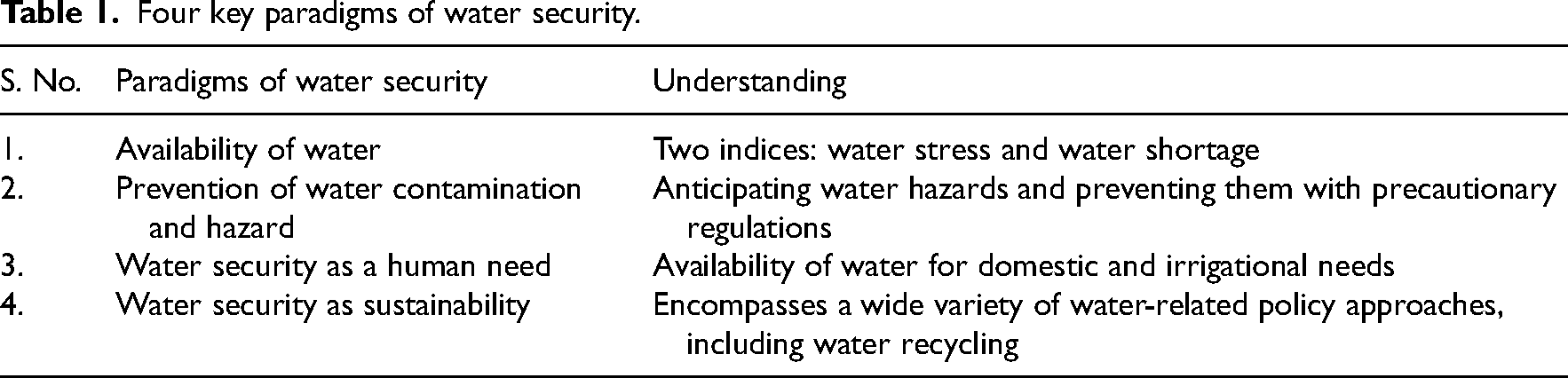
The term ‘water security’ is a relatively recent subject of academic discourse. The current literature identifies four different paradigms of water security. 35 The first paradigm concerns the ‘availability of water’, which combines two indices: water stress and water shortage. 36 The Indian federal government extensively uses this paradigm in its water reports and thus forms the basis of analysis. In doing so, this article will investigate how many fracking projects are planned in the Indian states vis-à-vis water stress and shortages as reported in the water reports.
The second paradigm of water security is the prevention of water contamination and hazards. The United Nations Educational, Scientific and Cultural Organization Institute for Water Education and the US Environment Protection Agency (EPA) widely promote this understanding of water security. 37 The critical understanding of this approach is that water is a sovereign subject, and legal systems must regulate its water resources by anticipating future harms and hazards. This research uses the US EPA report on fracking-related water hazards and contamination in this context. Then, it analyses whether the water regulations in India at the national and subnational levels regulate those issues. It is important to clarify here that the US EPA's identified water hazards related to fracking are identified as probable water hazards in India, according to India's environment management guidelines on fracking. Thus, there is a direct scientific understanding of the transfer of fracking-related water contamination and hazards from the US fracking experience to India.
The third paradigm related to water security is ‘water as human need’, which investigates the security perspective of water only through anthropocentrism, covering issues such as the availability of sufficient quantity and quality of water at an affordable price for short-term and long-term needs of humans. 38 This approach is widely used by the United Nations Development Programme (UNDP), as it defines water security as ‘all aspects of human security about the use and management of water’. For this article, how fracking impacts ‘water as a human need’ is defined to analyse if fracking projects in India would impact the availability of drinking water and irrigational needs. Such an approach aligns well with the water reports, which focus on the availability of drinking and irrigational water in all the Indian states.
Lastly, the fourth approach towards water security is ‘water as sustainability’. Although water security from a sustainability perspective encompasses the three paradigms discussed above, it also includes the circularity of water usage. This means that if the water used in a particular technological process is recycled or reused, the process is also sustainable (Global Water Partnership, 2008). 39 This article investigates the environmental clearance reports of the fracking projects in India to analyse if sufficient measures are in place to recycle fracking-related wastewater. It also analyses the federal-level and state-level regulations of India to understand if such regulations cover fracking wastewater regulations (Table 1).
Four key paradigms of water security.
Fracking and water security issues: The US experience
Natural gas is typically extracted from layers of rocks that are porous enough to permit the movement of the gas. 40 However, a significant quantity of natural gas remains encased in low-permeable dense layers of rocks. Usually, such dense layers are referred to as shale rocks, and the natural gas found in shale rocks is called shale gas. To extract shale gas, oil and gas industries apply an external pressure strong enough to produce cracks in the shale rocks. Such cracks are produced by vertically injecting pumping up to 3600 m3 (about 10 times more than the conventional natural gas extraction) of pressurised water into the shale rocks through a wellbore, making natural gas extraction water-intensive. 41
The requirement for freshwater, within 6 years’ lifetime of the wellbore, can increase by 770% to keep producing the same amount of shale gas. 42 This freshwater is typically mixed with chemicals and proppant, and the resulting mixture is referred to as shale fluid, which is forced under pressure into vertical wellbores that lead to shale rocks. The vertical well bores are then extended horizontally to reach shale rocks beneath urban structures where direct vertical drilling is impossible. Shale fluid contains chemicals that are used to smooth the movement of gas and water, and the fluid also contains proppants, which keep the fissures open for an extended period. 43
When the pressure of the vertically injected shale fluid drops, a portion (up to 40% of total injected shale fluid) flows back upward alongside the methane-rich shale gas, which can then enter aquifers that are usually the sources of domestic water supply. To avoid mixing groundwater and the flow-back water, fracking operators must ensure the integrity of all fracking wells with no leaks. 44 Certain US states permitted reinjecting the flow-back water into the earth's surface as a means of getting rid of contaminated water.
The extraction of shale gas, as well as the reinjection of flow-back water, led to seismic activity, and several studies have shown that contaminated flow-back water can seep into aquifers that supply drinking water, particularly if the wells into which the water is reinjected are not properly cemented and cased.
Experiences of using water for fracking in the United States reveal that the requirement of freshwater per fracking well, within 6 years, can increase to 770 per cent, whereas the flow-back may increase to 1440 per cent. 45 In the United States, some states reinjected the flow-back water into the earth's surface as a method of disposing of contaminated water. However, such reinjection of produced water led to seismic activities, and research highlights that the contaminated flow-back water can leak into drinking water aquifers, especially if the wells into which the water is reinjected are not properly cemented and cased.
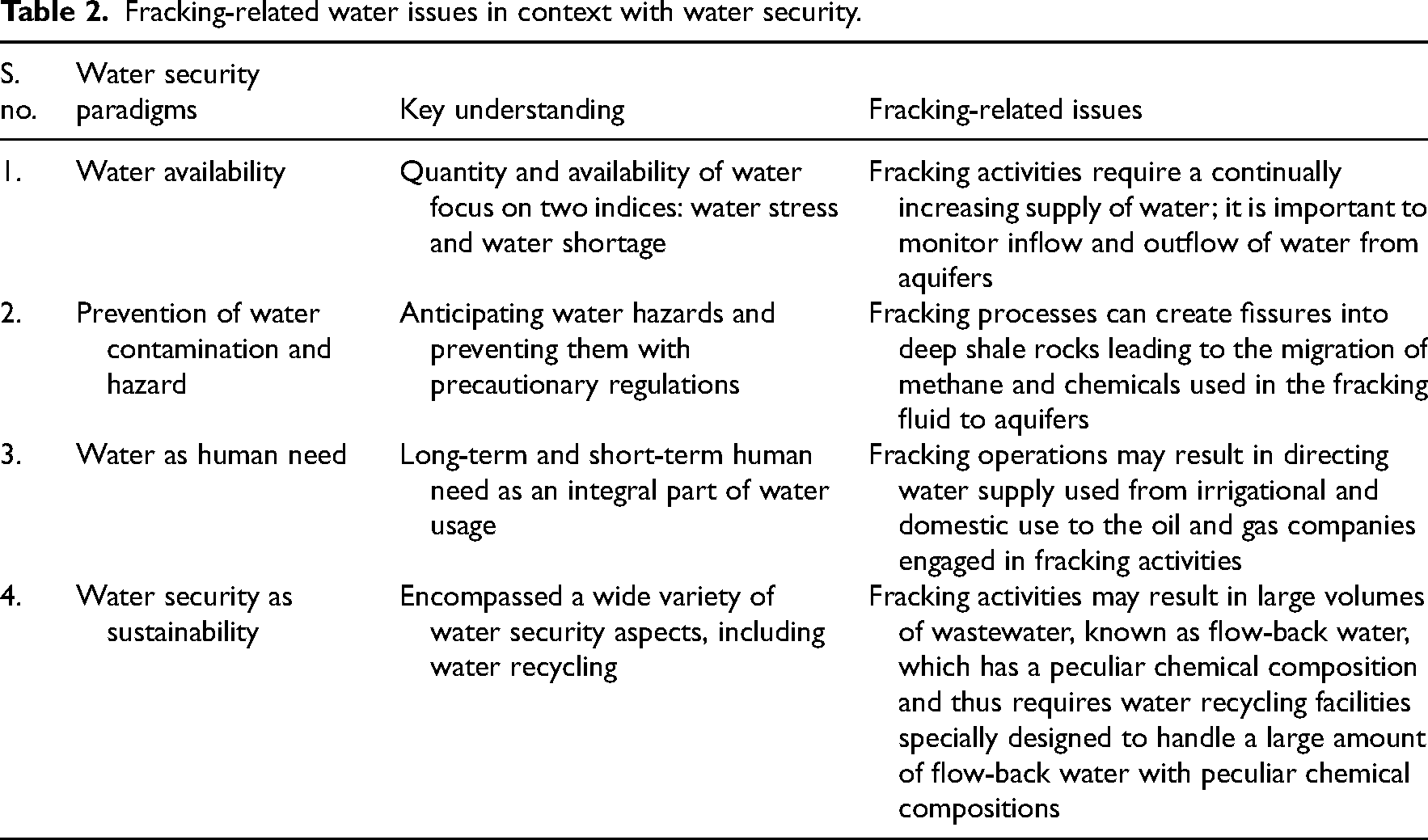
A series of studies conducted by Duke University highlighted several water issues posed by the fracking process in the United States. 46 Additionally, the US EPA conducted a series of scientific investigations to understand the FSW security issues. Such issues include (but are not limited to: (1) sourcing of 5–9 million gallons of water per activity and monitoring aquifers; (2) methane and chemical migration into aquifers; (3) rationing of water resources for domestic purposes vis-a-vis fracking purposes and (4) flow-back (produced) water management, among others. 47
Additionally, several recent studies indicate that as a fracking well grows old, its water requirement to produce the same amount of shale gas as it used to when it was created increases exponentially. In this context, one of the studies highlighted that ‘the volume of water used for fracking energy resources has risen sharply in recent years, raising concerns about its sustainability in regions where water resources are stressed’. 48
In the United States, in 2015, shale gas extraction through fracking used 708 billion gallons of water. Moreover, the annual water consumption rate in major US fracking sites in 2015 and 2016 was around 116 billion litres. The energy-water dynamics in fracking are further complicated by the fact that the US fracking wells produced, until 2015, around 803 billion litres of methane and chemical-rich flow-back water, posing a challenge in disposing of flow-back water without contaminating aquifers. Apart from the high usage of water, methane (the major component of shale gas) contaminated water in domestic water supplies near fracking areas of the United States. 49
In this context, water risks related to fracking, for this study, pose the following issues considering the above-discussed four components of water security (Table 2).
Fracking-related water issues in context with water security.
Gaps in India's regulatory framework
In India's multilevel legal system, oil and gas fall within the legislative competence of the federal government, whereas ‘water’ is a matter of subnational (state or provincial level) competence. 50 Moreover, the Indian constitution states that the federal government gains legislative competence over subject matters covered in an international agreement that India ratifies. It is important to note that in the event of a conflict between federal-level and state-level laws, federal legislation prevails. Thus, state governments must ensure consistency with the federal-level regulations. 51 Since India has signed and ratified international environmental law agreements, the federal government has gained competence in several environmental matters, including water. It has set up a centralised Environment Impact Assessment (EIA). 52 Thus, in practice, water resources remain a matter of shared competence between India's federal and state governments. 53
The EIA process in India is established through an executive act (through notification) by federal regulators. Thus, changes to the process do not require a discussion in parliament and can be done by the federal-level regulator without consultation with the subnational-level governments. 54 For instance, between 2019 and 2023, the federal-level regulator made more than 100 changes in India's EIA process by publishing notifications. One such change in 2020 exempts oil and gas exploration processes, including fracking-related exploration processes, from conducting an EIA. 55
To attract oil and gas corporations to extract shale gas and oil resources in India, the federal government of India has: (1) exempted corporations from the requirement of conducting an EIA when fracking is used for exploring shale gas and oil resources from 2020 onwards and (2) implemented a uniform licencing scheme in which corporations can use conventional and unconventional hydrocarbon extraction techniques under a single licence. 56 The EIA process at the exploration stage is important to identify risks related to fracking before scaling it to the commercial stage. Since 2020, projects using fracking for exploration purposes are not required to conduct an EIA. However, such exploratory projects are still required to get permission from the respective state governments. Additionally, although fracking processes in India are assessed for their environmental impact by the federal government at the commercial stage, the standard for such assessments is the same as that set for conventional natural gas extraction processes. 56
The regulatory thresholds set for approving conventional natural gas extraction processes may not address water risks posed by fracking as (1) fracking processes require 5 to 10 times more fresh water than conventional hydrocarbon extraction processes; (2) the wastewater (commonly known as flow-back water, discussed later) produced in the fracking project has different chemical composition than the wastewater produced in conventional hydrocarbon extraction processes and thus, handling of such wastewater, requires a specific set of regulations and (3) fracking poses peculiar risks to contamination of groundwater resources, such as methane migration into aquifers and thus it is important to demarcate and monitor aquifers, near a fracking site. 57 Since the risks to water resources posed by fracking are acutely different from those posed by conventional natural gas processes, FSW risks are not categorically identified and regulated in India.
Therefore, it is a complicated task to pinpoint regulations concerning water issues posed by a specific technology in India. To add to this complexity, the Indian regulatory framework, either at the federal or state level, does not have any fracking-specific regulations and does not differentiate between conventional hydrocarbon extraction processes and unconventional hydrocarbon extraction processes, like fracking. In 2019, the Indian parliament, at the federal level, amended the definition of ‘petroleum’ to clarify that the term ‘petroleum’, which falls under the legislative competence of the federal, includes shale gas and oil resources (section 3 (k), The Petroleum And Natural Gas Rules, 1959). This, in effect, leads to a situation where regulations that apply to conventional hydrocarbon extraction processes are also applicable to fracking. Even though the risks and impacts differ, the legal framework does not recognise them.
It is important to note that while granting environmental clearance to fracking projects, the federal government may ask corporations to follow specific regulatory standards by raising project-specific ‘Terms of Reference’ (TORs, yardstick on which the environmental impact of a project is assessed), like the requirement for casing the shale well to avoid methane migration to groundwater resources. The DGH, in its environment management guidelines, recommends the federal government raise projects such as specific TORs, but it is not compulsory. 58
To identify if the present regulatory framework in India covers FSW security issues, this article looks into such regulations at the federal and state levels. The current literature establishes that at the federal level, there are no fracking-specific regulations in India. However, before exempting exploratory shale gas projects from conducting an EIA in 2020, the federal government granted environmental clearances to two exploratory fracking projects, and this article, while looking into the overall regulatory framework of India at the federal and state levels, examines whether specific fracking-specific TORs were issued while granting EIA to those projects. Additionally, since water is a shared competence in India, state governments can cover FSW issues in their respective legislative and regulatory framework. Therefore, this article reviews the regulations and legislation of the six states where the proposed 56 fracking-specific projects are located.
For the federal-level regulatory review, the fracking-specific environmental clearance reports are available on the Ministry of Environment, Forest, and Climate Change (MOEFCC, federal regulator of environmental standards in India) website. 59 The authors searched the portal using the key phrases ‘fracking’, ‘hydraulic fracturing’ and ‘shale’. This search resulted in two shale gas fracking projects in two Indian states, covering 19 fracking wells for exploration purposes, that received environmental clearances. The authors reviewed these two EIA reports to identify and examine whether any fracking-related specific TORs were raised while granting environmental clearance and if these TORs covered any of the four identified fracking-related water security risks.
From January 2020 onwards, corporations are not required to conduct an EIA while exploring shale gas and oil using fracking. 60 However, they are still required to get permission from the respective state governments, but obtaining it does not require an EIA. Thus, for the state-level review, the authors analyse whether state-level governments raised any fracking-specific conditions while granting permissions to such projects. In doing so, the authors look into the official websites of the regulators of each of the six states. We found three state-level permissions granted to exploratory fracking projects without raising FSW issues. Still, all three permission letters did mention that the corporations must follow state-level regulations concerning water resources. Accordingly, the authors did a literature review on water legislation and its underlying regulations in the six Indian states where fracking projects are. In doing so, the authors relied on the Indian federal government's Water Composite Report of 2018 and 2019 (referred to here as the water report) released by India's federal-level think tank, NITI Aayog. 61 The water reports cover the status of water resources in India and the legislation and regulations governing water issues in India at the federal and state levels (Figure 1).
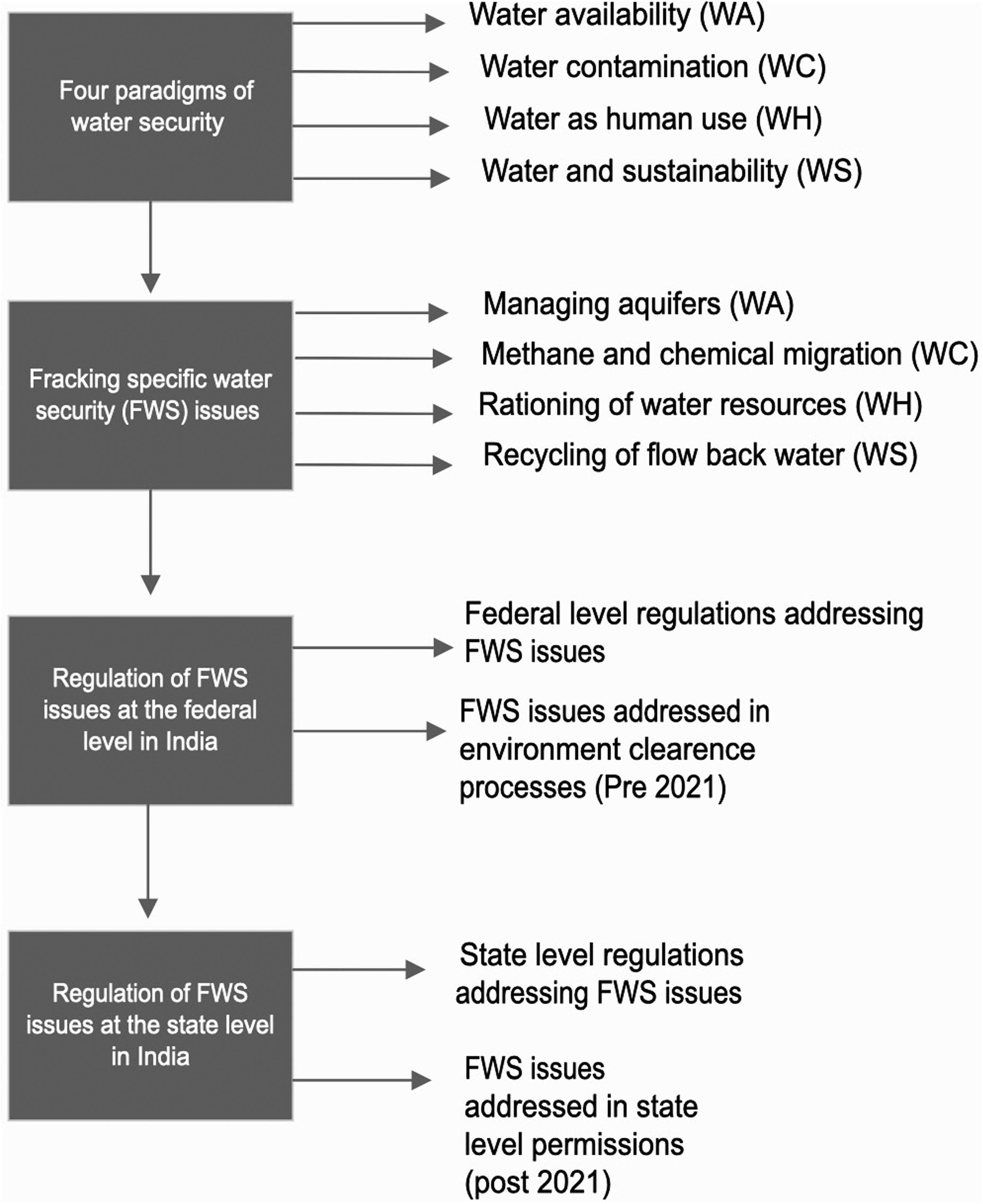
Schematic flow of the argument.
Analysis
Based on the identified gaps in India's current regulatory framework, this section analyses state-specific regulations that govern fracking and water security issues. Since all six Indian states with proposed fracking projects are water-stressed, and fracking projects require at least 5 to 10 times more water resources, proposed fracking projects are likely to put further stress on these Indian states’ water crisis. 62 In this situation, it is essential to understand if the subnational-level authorities in India regulated emerging fracking-related water issues in context with the four components of water security. Based on the US fracking experience, this section of the research device the following yardstick for measuring how effectively India's water regulations at the state level regulate potential fracking-related water issues. Subsequently, this section looks into the water regulations of each of the six states with fracking projects in India and discusses whether the regulations effectively regulate fracking-related water issues.
Water availability
This subsection analyses if the proposed fracking project will impact the availability and access to water in the regions where such fracking projects are likely to be commercially scaled. As discussed above, before 2020, exploratory fracking projects are required to conduct an EIA. The EIA reports of all the projects are available on the MOEFCC website. 63
To analyse the impact of proposed fracking projects on water access and availability, the authors have studied the two exploratory fracking EIAs (Gujarat and Arunachala Pradesh) and compared the water requirement projected against each exploratory fracking well against the conventional drilling process. For the other four states, where fracking exploratory EIAs are not available (post-2020 scenarios), the authors have taken 5 to 10 times the water requirement value mentioned in the EIA of the conventional oil and gas drilling in the respective states (as DGH estimates that fracking requires 5–10 times more water as compared to conventional process). This estimates the increase in water requirement in the areas where fracking projects are proposed. This comparison is made against the status of the water crisis in each Indian state. The status of the ‘water crisis’ is released by the water report 64 by analysing the per capita water availability as stated in India's water report (Table 3).
Comparing water requirements in conventional vis-a-vis fracking wells.
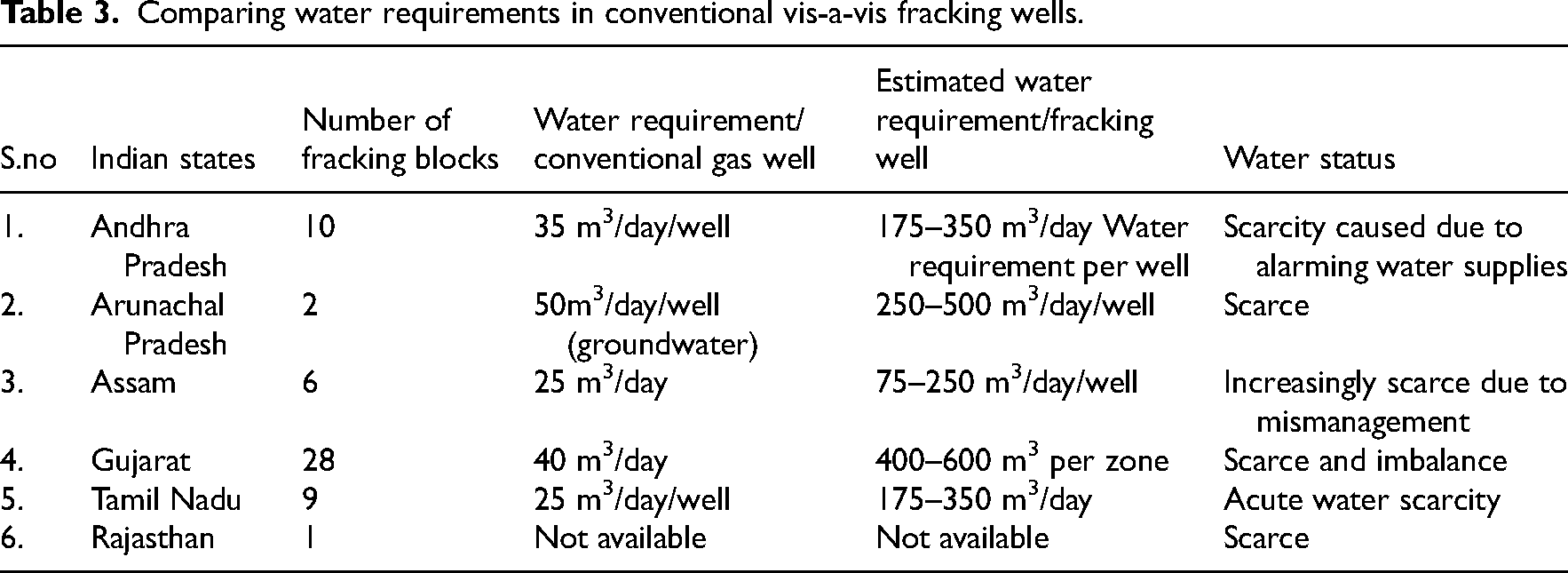
All the proposed fracking projects fall within the water-stressed areas, where water resources range from ‘increasingly stressed’ to ‘acute scarcity’. Thus, fracking projects would likely further impact these stresses. The EIA reports of the two exploratory fracking projects state that water sourcing for fracking will be done through ‘private tankers’; however, it is the primary source through which tankers receive such water.
A recent study highlights that such private tankers in India source water through groundwater extractions, as groundwater ownership is linked with land ownership. 65 Thus, a person owning land that has groundwater resources can abstract water and supply it for fracking. It is important to note that groundwater can move from one aquifer (rocks containing groundwater) to another. Thus, it is important to monitor the inflow and outflow of water from one aquifer to another. This will allow regulators to map the flow of groundwater resources and avoid illegally drenching groundwater resources.
India currently has a ubiquitous problem of illegal drenching of groundwater resources. There is an urgent need to map the number of aquifers and the inflow and outflow of groundwater resources in India. In this context, it is important to understand if these states’ regulations have a sufficient framework to assess how corporations are drenching groundwater resources. As a yardstick, this section analyses if water regulations in these states demarcate and regulate rocks containing groundwater (aquifers) by monitoring the inflow and outflow of water in aquifers. 66 This criterion highlights whether the state authorities are well-equipped to assess groundwater extraction and map groundwater pollution by maintaining aquifer-wise data.
Only Andhra Pradesh (10 planned fracking projects) recognises aquifers as groundwater management units and maintains a dedicated dataset on aquifer groundwater abstraction. All the other Indian states that have proposed fracking projects neither have any data on aquifer-wise groundwater abstraction nor consider aquifers as basic management units for groundwater abstraction. This may allow fracking corporations to abstract millions of gallons of water through farmlands without any checks. Importantly, with half of India's fracking projects, Gujarat has a groundwater extraction rate of 72 per cent as against the national average of 60 per cent. Although the federal government monitors groundwater levels periodically, it is important first to map aquifers and then administer aquifers as water management units to monitor real-time water extraction.
Therefore, out of the six Indian states with fracking projects, all are in water-stressed areas. Still, only one state monitors the extraction of groundwater from aquifers. Thus, groundwater extraction and reinjection of flow-back water into aquifers might go unregulated whilst fracking projects are implemented in the Indian states. Thus, fracking projects in these states will challenge already scarce water resources in these regions.
Water contamination
Fracking poses several hazards to water resources, including increased water consumption (up to 770 per cent), methane-rich flow-back water, and disposal of a large amount of produced water. This FSW risk requires fracking-specific regulations. Thus, it is vital to analyse whether federal-level or state-level regulations require precautionary measures to prevent water contamination. The DGH guideline and all specific TORs in both the exploratory EIAs require corporations to ensure ‘well integrity’, a process through which chemicals used in fracking processes do not enter nearby aquifers, thus contaminating groundwater resources. 67 After 2020, since EIA is not necessary, it is unclear if such a requirement of ‘well integrity’ will still be imposed while doing exploratory fracking in India. However, through DGH's guidelines, the federal government emphasises the need for such well integrity. Therefore, such a requirement will likely be imposed once the federal government grants commercial-level EIAs to fracking projects.
However, none of the six state governments that grant permission to conduct exploratory fracking have a regulation on well integrity. Well integrity is important to ensure that the shale fluid and the flow-back water produced do not spread beyond the fracking wells into the groundwater resources. 68 Moreover, since only one state maps the inflow and outflow of water into aquifers, it is impossible to recognise if the shale fluid or the flow-back water has entered aquifers near the fracking wells in the other five states. This could lead to unrecognised contamination of groundwater resources.
Since fracking results in a large amount of flow-back water, it is also important to understand if any of the six Indian states with fracking projects categorically regulate flow-back water. In doing so, the authors of this study looked into water regulations of each of the states to identify if the applicable regulatory framework differentiates between different types of wastewater and their management. It is important to note that flow-back water poses peculiar risk as compared to conventional oil and gas drilling wastewater as (1) the quantity of the flow-back water, which is higher than the wastewater produced during conventional extraction processes and (2) components of the wastewater as shale fluid contains chemicals to smoothen the flow of pressurised water and to keep the cracks open of the shale rock, additionally, with flow-back water can also contain a substantive amount of methane. 69
Thus, subnational-level regulators having provisions to categorise wastewater would understand the peculiarities of the risks posed by flow-back water. Apart from Gujarat, which has 28 fracking projects (Gujarat Regulations for the Reuse of Water, 2012), none of the regulators at the subnational has provisions to differentiate between types of wastewater. While regulations in Andhra Pradesh, Arunachal Pradesh, Assam and Tamil Nadu are entirely silent on the categorisation of wastewater or regulating fracking-specific risks, Rajasthan has proposed regulations for categorising wastewater as per the risks associated with the activities that generate them. However, such regulation is still at the proposal stage and has no teeth. As of July, 28 fracking projects (all in Gujarat) are under the regulatory framework that recognises and regulates FSW risks, especially by categorically imposing regulations on flow-back water.
Therefore, although the federal government, under its EIA clearance framework, requires well integrity, which is a precautionary step towards preventing water contamination, none of the states in India imposes the precautionary step of well integrity. Moreover, apart from Gujarat, none of the Indian states differentiate between wastewater based on their volume or composition and thus may lead to contamination of water resources as flow-back water may be treated as per the conventional wastewater treatment processes, leaving chemicals specific to flow-back water untreated.
Water as a human need
The third aspect of water security explores human needs. In this context, this section looks into the water policy frameworks of the subnational units and whether these policies ensure a steady supply of drinking water and irrigation water. All six states have dedicated policies for drinking water and irrigating water supply. However, initial data raise eyebrows about the implementation of these policies. For instance, in Tamil Nadu (nine projects), groundwater availability hit an all-time low to ‘zero’ in 2015, and water was sourced from the neighbouring states. In the same year, local communities protested the fracking projects, alleging that despite hitting the ‘ground zero’, the private corporation continued exploratory fracking (that does not require environmental clearance at the national level) through water-drenched (and eventually stored) from nearby farmlands. 70 However, the water-stressed subnational unit of Rajasthan (one fracking project) is an outlier in this category as it ensures a steady drinking water supply to 80% of its households despite severe droughts.
The water report states that Rajasthan, Andhra Pradesh and Gujarat implemented participatory and decentralised rural water management strategies that other states can model. Rajasthan implemented ‘Mukhya Mantri Jal Swavlambhan Abhiyan’ to ‘ensure effective implementation of improved water harvesting and conservation initiatives’. 71 Under the ‘Neeru-Chettu Programme’, Andhra Pradesh has repaired about 7,000 farm ponds and 22,000 check dams to ensure water supply to drought-prone areas in the state. 72 The Gujarat ‘Sujalam Sufalam Yojana’ is similar to Andhra Pradesh's, which focuses on the ‘deepening of water bodies before monsoons and increasing water storage for rainwater collection’. 73
Although Rajasthan is fulfilling the water needs of its state's population, despite its geographical shortcomings, ‘∼50% rural and ∼60% urban inhabitants are still not covered with drinking water supply by the state’. 74 Additionally, its groundwater levels are critical and are not regulated by the state, posing a challenge to overall water security to fulfil human needs in the context of fracking.
Both Andhra Pradesh and Gujarat have been leading programmes to restore their groundwater levels and have been successful in around 75 per cent of units. However, both states must also significantly improve the rural drinking water supply. Andhra Pradesh has additional challenges with its wastewater. It is reported that less than 33 per cent of the wastewater in the state is not treated due to low installed capacity. 75 This poses the challenge of contamination of both surface and groundwater and their usage for human needs.
In Arunachal Pradesh, 70 per cent of the households are supplied with water. However, it is not essentially drinking water. Assam's overall performance in the Composite Water Management Index is lowest compared to other states. Only 20 per cent of the urban population has access to drinking water, and wastewater is not treated, leading to severe water quality issues in drinking water. Tamil Nadu is leading in the six states that are or will be running fracking projects regarding the water management index. It has ‘restored 100 per cent of the irrigation potential of identified bodies, and 78 per cent of critical wells have improved’. 76
Although all the states with fracking projects in India have policies on the water for human use, primarily drinking water and irrigational needs, implementing these policies has significant gaps, as the water report records.
Water and sustainability
Lastly, an analysis of the overall sustainability of fracking projects in all six subunits raised a common question: Where are the water management and related infrastructure? The data from this section is taken from the Water Report 2018 and 2019.
Andhra Pradesh only treats 26 per cent of its energy project-related wastewater due to lack of infrastructure; Arunachal Pradesh has no groundwater recharge facility and no data on water management dynamics despite having water-stressed conditions; in Assam (six fracking projects), only 6 per cent of household have drinking water supply with minimal wastewater treatment facility; although Gujarat has sufficient wastewater treatment plans for conventional oil and gas extraction process, it has no policy yet on wastewater management of fracking projects; lastly, Tamil Nadu has no specific policy on fracking projects and do not have any dedicated wastewater treatment plan (in fact the fracking operator in Tamil Nadu, as noted in its EIA report, does not take into account the difference of water requirement in fracking and conventional drilling process). It is important to note here that wastewater facilities in India must obtain a license from state-level authorities, state pollution control boards, to function, and there is no guidance on establishing fracking-specific wastewater processing units in any of the six states. 77
There are no fracking-specific wastewater regulations in India, either at the federal or subnational level. Fracking-related wastewater requires specific wastewater treatment plants (in terms of volume and characteristics of the wastewater), which neither the federal-level nor state-level regulations require corporations to establish.
Conclusion
While commercial extracting of shale gas via fracking in India can fulfil its continually increasing energy needs, it can also pose a risk to India's water security. Thus, it is important to analyse if FSW security issues are regulated in India. The US fracking experience provides vital information on the impact of fracking on water security issues.
Although federal regulations do not acknowledge the water security concerns related to fracking in India, the state-level regulations potentially cover some of the FSW issues.
India has planned 56 fracking projects distributed across six distinct states. All six states are situated within the water-stressed regions of India. However, only one of these states has conducted a comprehensive mapping of aquifers and the inflow and outflow of groundwater. The management of aquifers is crucial for ensuring the continued accessibility and availability of water resources to the local population and preventing unauthorised water exploitation by fracking corporations.
The substantial disparity in water consumption between fracking and conventional drilling processes raises concerns regarding water sourcing for fracking operations in India. The absence of emphasis on this matter in the federal-level EIA reports and state-level environmental clearance permissions are particularly problematic, given that all fracking projects in India are situated in water-stressed regions. Due to the prevalent issue of illicit water appropriation in India, implementing fracking initiatives can potentially redirect water resources intended for domestic and agricultural utilisation towards fracking operations.
In India, states with most fracking projects currently lack a comprehensive categorisation system for different types of wastewater. Consequently, the potential risks associated with the volume and composition of flow-back water have not been adequately addressed at the federal or state level in India. The potential impact of fracking on water quality in India is a matter of concern due to inadequate precautionary regulations pertaining to water contamination resulting from fracking activities, particularly regarding the regulation of well integrity.
There is no fracking-specific policy at the subnational level in India. However, the general water policy framework in all six states with fracking projects in India aims to strike a balance between the population's water needs and business interests. However, the effectiveness of this balance is uncertain due to a lack of comprehensive data, as highlighted in the water reports of 2018 and 2019.
The regulations and policies of Indian states do not indicate the disposal of flow-back water or the establishment of adequate water treatment infrastructure concerning the quantity and quality of such water.
In the present scenario, India must undertake a comprehensive scientific investigation to assess the potential consequences of proposed fracking projects on its water security. A thorough evaluation of the existing regulatory framework on fracking projects is necessary before their commercial implementation. The initial measure towards tackling water security concerns involves establishing a precise definition and evaluating the relationship between fracking and water security concerns at the federal and state levels. The fundamental frameworks of water security, examined in this article and subsequently analysed, serve as a foundational basis for undertaking such an endeavour.
Footnotes
Declaration of conflicting interests
The authors declared no potential conflicts of interest with respect to the research, authorship, and/or publication of this article.
Funding
The authors disclosed receipt of the following financial support for the research, authorship, and/or publication of this article: This work was supported by the University of Surrey.
Authors’ contribution
SKY worked on the fracking regulations in the multilevel legal systems of India and the United States and the overall analytical framework of the article. CB and GKS worked on the conceptual framework of water security and improved the flow of the article's methodology.
