




Abstract
The precautionary principle is accepted in India as a fundamental tool to promote sustainable development and is employed within Indian environmental governance to promote better health and environmental decisions. Scientific uncertainty is at the core of the precautionary principle. The application of the precautionary principle is an open-ended issue. This article seeks to add to the limited empirical studies on the understanding, appreciation and application of the precautionary principle by key environmental actors, as differing legal responses and decisions may be irreversible before conclusive scientific knowledge and evidence become available. Building on researcher’s unique Indian data, and drawing on the theoretical insights developed by Charles Weiss, an explanatory environmental framework addresses the uncertainty of science by assembling a scale of legal standards arranged in a hierarchy of levels of increasing certainty familiar to lawyers and the judiciary. Reported Indian cases from the Supreme Court and the National Green Tribunal are selected to illustrate levels of scientific certainty or uncertainty and corresponding legal standards of proof constituting acceptable bases for legal decisions in practical context especially the precautionary principle. The article suggests India should develop a framework of guidelines that would provide an effective roadmap for decision-makers applying the precautionary principle.
Keywords
Introduction
The pursuit of sustainable development goals is driven by evidence-based policy and decision-making based on scientific knowledge and supported by environmental governance and the rule of law. 1 Nevertheless, the 2019 UN Environmental Rule of Law: First Global Report states that limits on current scientific certainty and understanding mean environmental matters paradoxically can raise more questions than answers. 2 The preferred environmental approach adopted in some jurisdictions is based on the application of the precautionary principle as it helps decision-makers act promptly and determine if appropriate cost-effective measures have been put into place to prevent environmental degradation and damage to human health. 3
The precautionary principle is accepted as a fundamental tool to promote sustainable development and has an important function at both international and national levels. It provides for action to avert risks of serious or irreversible harm to the environment or human health in the absence of scientific certainty about that harm and offers the ‘authority to take public policy decisions covering environmental protection in the face of uncertainty’. 4 Where there is no uncertainty in the calculation of risks, there is no justification for the employment of the precautionary principle. Thus, scientific uncertainty is at the core of the precautionary principle. 5
However, the international application of the precautionary principle is an open-ended issue. Some believe that its use helps make better health and environmental decisions. Whereas others think that employing the precautionary principle is inconclusive due to the difficulty in achieving a consensus that reflects appropriate responses to manage risks, benefits and costs. 6 Excessive discretion tends to exacerbate unpredictable and inconsistent environmental decisions, distorts regulatory priorities, stifles technological innovation and reverses the burden of proof reflecting uncertainty between science-based governance and the over or under application of the precautionary principle. 7
In India, pollution produces complex environmental issues involving scientific uncertainty and imprecise health risks. These pollution matters are influenced by incomplete information, inconclusive evidence, ambiguous values and public controversy. For example, Spruijt’s study identifies how such cases differ in the level and type of scientific uncertainty, the societal unrest they cause and the application of the precautionary principle. 8 The study highlights the debate regarding particulate matter that concerns the health impact of different particle types, the underlying causal mechanisms of these health impacts and the nature of the exposure–response relationship for various health endpoints. 9 It may result in varying judicial responses. This uncertainty creates governance challenges for regulatory and adjudicatory decision-makers concerning health, well-being and the environment.
At the outset, it is necessary to state that this article does not address the challenging issues pertaining to the precautionary principle at the international level involving its legal status, the consensual interpretation of core meaning, its different versions and the means for predictable and effective implementation. These matters are well-documented and have generated a body of active but discordant opinion and literature. 10 Instead, this article offers a domestic account of the interpretative range of the principle and the legal uncertainty that it creates in India.
Building on the existing literature, this article carries unique Indian data that add to the limited empirical studies on the understanding, appreciation and application of the precautionary principle by key environmental actors, especially the Indian judiciary, as differing legal responses and decisions may be irreversible before conclusive scientific knowledge and evidence become available. The first section is the introduction. The second section offers a brief account of the application of the precautionary principle by the Indian judiciary through illustrative case law. The third section presents the methods (mixed methods and multiple case studies) employed in this pilot research that investigates challenges associated with scientific uncertainty and the application of the precautionary principle. The fourth section analyses the data from key environmental actors – the Decision-Makers (judicial and scientific judges) and the Influencers (Pollution Control Board members, environmental lawyers, scientists and think-tanks) involved in the National Green Tribunal (NGT). It also uses the theoretical framework of Charles Weiss to produce a common ‘scientifically legal’ lexicon of meaning intelligible and useable by both the scientific and legal communities. This is followed by the conclusion in the fifth section.
Precautionary principle and its judicial application in India
The role of the Supreme Court of India in recognising the precautionary principle as an essential feature of sustainable development and a part of customary international law promoted its derivative application from constitutional mandates namely Articles 21, 48A and 51A(g). 11 In 1996, Kuldip Singh J in Vellore Citizen Welfare Forum v Union of India 12 declared that the principle involves three conditions:
State government and statutory authorities must anticipate, prevent and attack the causes of environmental degradation;
Where there are threats of serious and irreversible damage, lack of scientific certainty should not be used as a reason for postponing measures to prevent environmental degradation;
The ‘onus of proof’ is on the actor or developer or industrialist to show the actions are environmentally benign.
Additionally, the specialised environmental tribunal, NGT is a creation of a statute; its jurisdiction, powers and procedures are construed and applied according to the language of the National Green Tribunal Act 2010. The NGT interprets and applies the precautionary principle as mandated by s. 20 of the National Green Tribunal Act 2010.
13
The NGT declared the precautionary principle to be an integral part of national environmental law:
The applicability of [the] precautionary principle is a statutory command to the Tribunal while deciding or settling disputes arising out of substantial questions relating to environment. Thus, any violation or even an apprehended violation of this principle would be actionable by any person before the Tribunal. Inaction in the facts and circumstances of a given case could itself be a violation of the precautionary principle, and therefore bring it within the ambit of jurisdiction of the Tribunal, as defined under the NGT Act 2010.
14
The NGT regards the precautionary principle as a determinative norm that allows the judges to examine the probability of environmental degradation and resulting harm that may occur from a proposed activity. This involves well-crafted scientific knowledge supporting precaution and prohibition of harm and a commitment to dealing with risks. 15 To activate precaution, actions are based on scientific information and analysis of possible risks to human health and environment, albeit tentative, inconclusive or in dispute. Tentative, inconclusive or disputed scientific information creates uncertainty in relation to gaps in data and/or poor data, ignorance, faulty models, scientific inconsistency and disagreement on the nature of risk with low epistemic threshold of evidence and tend towards risk prevention. 16
The availability of merit review to the NGT promotes judicial application of the principle. As a merit court, the NGT becomes the primary decision-maker and can undertake in-depth scrutiny that involves not only law but also the technical evaluation underpinning a decision. 17 The precautionary principle is invoked and followed by judicial and expert members as a normative commitment. It thereby directs the judges, particularly the technical expert judges, to offer scientifically based structural solutions and policies that respond creatively to weak, ineffective regulation even in the absence of regulation. Adoption of a variety of procedures, including investigative, 18 stakeholder consultation 19 and appointment of specialised committees, 20 helps in the application of the precautionary principle. This improves active participation through dialogue, argument and norms for eliciting factual realities and expert knowledge to respond to environmental problems. Expert members by on-spot site inspection can evaluate contradictory claims, positions and reports filed by the parties. 21 The stakeholder consultative process is applicable to cases of wider ramification involving major issues including river cleaning and air pollution. 22 The specialised committees promote the accountability of different authorities for the implementation of the rules under the National Green Tribunal Act 2010. 23
Thus, the precautionary principle in India mandates well-judged usage in favour of observing, preventing and mitigating potential threats. Indeed, modern risk factors have become more complex, far reaching and adversely affect public health and environment. The principle is employed as a tool within Indian environmental governance to promote better health and environmental decisions. However, the principle is both controversial and difficult to apply due to its inconsistency (normative aspects) and misapplication (legal standard of proof). In the fourth section, these issues are addressed in the Indian context.
Methods
Theoretical evidence exists how scientific experts when providing policy advice address the questions about scientific uncertainty 24 and limited evidence linked to the application of precautionary principle (measures) in cases of scientific uncertainty. 25 However, there is case law analysis about how the Indian judiciary applies the precautionary principle. 26
This article through mix methods and multiple case studies analyses unique evidence that addresses the complexities of scientific uncertainty and the legal standard of proof associated with the appropriate use of precautionary principle by the Indian judiciary.
Mixed methods and a purposive sampling approach were preferred to gather empirical data to have a broader perspective of the research in question. 27 Pilot fieldwork data were collected from 35 key environmental actors involved to varying degrees in the NGT from April 2019 to July 2019. Key environmental actors were the Decision-Makers (NGT judicial and scientific judges) and the Influencers (Pollution Control Board members, environmental lawyers, scientists and think-tanks). The Decision-Makers and Influencers regularly and productively contribute to environmental decision-making in the NGT. The Influencers either appear before the NGT or are appointed by the NGT to assist them in environmental matters as amicus curie or are qualified external experts on the tribunal appointed committees for fact-finding and scientific evaluation processes. The data were collected through questionnaires, interviews (semi-structured and open-ended) and five interactive specialist workshops. 28 All interviews were recorded and subsequently transcribed. Individual permission to use all recorded material was obtained. The workshops also focused on knowledge, awareness and capacity building by interactions between key actors to improve understanding of complex scientific uncertainties, economic and environmental challenges and corresponding legal responses in an adaptive manner.
Further, multiple case studies were used to analyse the Supreme Court of India and NGT judgments by identifying the usage of key precautionary terms: principle, approach, measure, value, burden of proof and relief granted. The SCC OnLine 29 was used as the primary database. It contains the most recent reported judgments. A data set was randomly selected of five judgments of the Supreme Court from 1996 to 2019 (the first case being reported in 1996) and five judgments of the NGT from 2011 to 2018 (the first case being reported in 2011). The theoretical framework of Charles Weiss is applied to unwrap and review the reported judgments presented in this article. 30 Weiss’ framework provides levels of scientific certainty or uncertainty and corresponding legal standards of proof constituting acceptable bases for legal decisions in practical context especially the precautionary principle and the danger of serious or irreversible harm.
Main findings of the project
Mixed methods data
Effective regulation and decision-making relies on high-quality data to make informed decisions. A major concern in India is the paucity of effective data gathering projects. Incomplete and inaccurate information, inconclusive evidence and public controversy affects, constricts and possibly misdirects regulatory and judicial decision-making. For example, in the 2019 National Clean Air Programme (NCAP) Report,
31
the Government of India acknowledges in the field of environmental monitoring, the data quality is posing a major challenge as the reliability of such measurements needs to be ascertained…perplexing statistics in various reports, correlating air pollution with health impacts without the use of indigenous dose response functions, further complicates the issue by possibly creating an ambiguous public perception.
32
Ensuring data accuracy and precision advances scientific knowledge and certainty thereby providing evidence for decision-making and playing an important role in risk minimisation. This pilot project seeks to unwrap the challenges arising from scientific uncertainty through its multiple layers that result in the application of the default position being the precautionary principle that may bring with it stultifying outcomes for growth and negative economic consequences.
The pilot project data from the 35 key environmental actors regularly and productively contributing to environmental decision-making in the NGT were collected and analysed. Scientific uncertainty is central to understanding how and why the precautionary principle is applied. It resulted in the identification of the following five descriptors that constitute the normative aspects and contribute to the understanding and application of the precautionary principle and uncertainty: (1) defining the term; (2) invoking and applying the principle; (3) scientific uncertainty and its multiple layers; (4) interventionist strategy for applying the principle; and (5) threshold of harm.
The first descriptor, defining the term, resulted in 40.7 per cent of the respondents considering precaution as a principle (1998 Wingspread Statement on the Precautionary Principle), 53.1 per cent an approach (1992 Rio Declaration), 3.1 per cent an ethical value (2005 UNESCO Report on the Precautionary Principle World Commission on the Ethics of Scientific Knowledge and Technology (COMEST)) and 3.1 per cent failed to answer the question. These starkly varying answers to the definition of the precautionary principle create difficulties for environmental governance. The responses also reflect differing judicial understanding as evidenced in case law. For instance, in Research Foundation for Science (18) v Union of India, 33 the Supreme Court of India stated, ‘this principle is described as an approach to protection of environment or human health…‘; whereas in M C Mehta v Union of India 34 described it as a ‘principle underlying environmental law’; and in Jaipur Golden Gas Victims v Union of India 35 as ‘precautionary measures’. Thus, the meaning of the principle is blurred through changing declaratory language.
The second descriptor being the grounds for invoking the precautionary principle showed differences in understanding the application of the principle. About 12.5 per cent responded that the principle be invoked in conditions of scientific certainty; 59.3 per cent in scientific uncertainty; 22 per cent in both scientific certainty and uncertainty; and 6.2 per cent failed to answer. A related question about relevance or irrelevance regarding the application of the principle with sound baseline data, robust operational standard, defined causal link between pollution and health and effective responsive enforcement showed surprising variation in the results. About 47 per cent answered as relevant, whereas 53 per cent found it irrelevant. These responses mirror the judicial approach taken in some cases where the court appears to have conflated the determinants uncertainty and absolute or reasonable certainty based on scientific information, data availability and analysis of risks. 36 These Indian decisions create confusion regarding the scope and application of the precautionary principle through the conflation of precaution and prevention. In India, the endorsement, invocation and application of the precautionary principle overrides if not absorbs the prevention principle. 37 This development in India’s environmental regime is supported by a judiciary that is proactive within a dynamic decision-making process wherein environment, health and public interests are given the utmost consideration.
The third descriptor concerning scientific uncertainty and its multiple layers produced mixed responses. About 84.6 per cent stated that the scientific uncertainty was due to data shortcomings whereas 15.6 per cent identified impacts. According to the key environmental actors, the uncertainty in data was because it was inadequate (78.2 per cent), ambiguous (12.5 per cent), ignorance (6.2 per cent) and a combination of the above (3.1 per cent).
Inadequate data resulted from the lack of a representative environmental baseline (59.38 per cent), lack of a critical pollutant analysis (6.25 per cent), inadequate sampling and analysis procedure (25 per cent) and inadequate analytical modelling (9.37 per cent).
Ambiguity in the data was a result of contested data sets (28.12 per cent), unvalidated models (25 per cent), disagreement between the specialists (15.6 per cent) and language and meaning (31.25 per cent).
Ignorance in data stems from scientific technological ignorance (22 per cent), lack of information sharing and coordination among stakeholders (43.7 per cent), gaps and surprises (18.3 per cent) and unanticipated impacts (16 per cent).
These results reflect concerns raised by the Indian judiciary about the quality of data needed to make informed decisions. For example, the Supreme Court in Hanuman Laxman Aroskar v Union of India 38 stated that incomplete information and inadequate data impacts on transparent, responsive and inclusion decision-making. The NGT in an air pollution case stated that the report submitted by the concerned ‘lacked data and analysis’. 39 In M/S Sterlite Industries v Tamil Nadu Pollution Control Board, 40 the NGT emphasised the importance and need of reliable and cogent evidence or reasonable scientific data for decision-makers. In Sant Akolner case, 41 the NGT noted that there was hardly any substantial ground water quality data which could be statistically relied upon from the regulatory agencies regarding ground water quality trends and characteristics before deciding the matter.
The fourth descriptor about the interventionist strategy to apply the precautionary principle produced the following results – 56.25 per cent for achieving and maintaining ambient environmental standards, 9.38 per cent for identifying significant polluters, 3.12 per cent for apportionment of pollution by individual pollution source and 31.25 per cent for causal linkage between the level of pollution and human health and ecology.
The fifth descriptor concerning the threshold of harm shows a trend towards risk prevention with a low epistemic threshold of evidence. About 59.4 per cent preferred the application of the principle to regulate threats of harm to human health or the environment, whereas 40.6 per cent responded to serious or irreversible harm. This result is unsurprising due to the influential role of the precautionary principle based upon the crucial link between life and a healthy environment as enshrined in Article 21 of the Constitution of India and its subsequent recognition in the preamble of the NGT Act 2010. 42 For example, the Supreme Court in M C Mehta v Union of India 43 while explaining the scope of the precautionary principle stated ‘the principle requires anticipatory action to be taken to prevent harm. The harm can be prevented even on a reasonable suspicion’. In Ajay Kumar Negi v Union of India, 44 the NGT opined ‘the precautionary principle is a tool for making better health and environmental decisions. It aims to prevent harm from the outset rather than manage it after the fact has occurred’.
The analysis of the data shows the key environmental actors (Decision-Makers and Influencers) involved in the NGT differ about their understanding and application of the normative aspects of the precautionary principle in advice and decision-making. Scientific uncertainty is endemic in environmental decision-making. It is argued that the normative aspects should be explicitly addressed in the process of environmental decision-making. This is due largely to the unclear formulation of the principle and the lack of an appropriate framework of guidelines. Elsewhere, those jurisdictions including EU, 45 UK, 46 Australia, 47 Canada 48 and New Zealand 49 with advanced environmental regulations have developed guidelines within frameworks of good regulatory practice.
Drawing on effective foreign regulatory practices and developing a framework of guidelines would help in addressing the normative challenges of precautionary principle and enhance the effectiveness of its application. Emphasis should be placed on ‘the nature of the risk, its level of uncertainty, magnitude and reversibility; who is exposed (for example, disproportionately affected or highly vulnerable communities); issues of technological and economic feasibility, benefits, proportionality and non-discrimination; preventability of the risk; social values’.
50
They should also take cognisance of factors including weighing the costs and benefits of regulation to the community, through formal risk assessment and cost-benefit analysis, performance-and outcomes-focused, transparent and accountable, and targeted at achieving statutory objective, open to review and modification when new scientific information becomes available, adaptive management, involving monitoring, research, periodic evaluation and review, and efficient and effective compliance.
51
Foreign judgments can be of comparative value to Indian environmental decision-makers. 52
The understanding and actions taken in applying precaution differ from country to country. Factors such as ‘attitudes to risk management, the role of science and scientists in decision-making processes, openness of decision-making processes, nation’s economy including level of “development” and nature of “natural environment” affect the application of the precautionary principle’. 53 The complex and uncertain scientific risks with shared environmental externalities make it desirable for India to import good practice rules or principles into its legal system.
Multiple case studies
So far, the article has focused on the complex issues of interpretation and application of the precautionary principle by key environmental actors involved in the NGT. It now presents an alleviating framework offering a possible solution to the Gordian knot that binds the precautionary principle and scientific uncertainty. Mutual cognition, appreciation and association between disciplines, in this case science and law, is problematic. Environmental issues involving both disciplines require a common approach. Science and law demand a common vocabulary for a standard of proof that will promote the effective understanding of scientific uncertainty and the precautionary principle. In this context, Charles Weiss’ theoretical framework may unpick the ‘knot’. 54
Weiss seeks to increase the ‘practical value of precautionary principle’ as a legal principle by ‘specifying the standard of proof to which the evidence for environmental danger is to be held’. 55 The standard of proof corresponds to the level of scientific certainty or uncertainty required to trigger precautionary intervention. The absence or failure to define the standard of proof is a denial to specify the evidence of environmental harm and risk. For example, the ‘European courts, which consider the principle to be binding, have failed to arrive at a consistent statement of what it requires in any given situation’. 56
Weiss states the framework [scale] makes it easier to convey to decision makers [judiciary] the level of uncertainty associated with any assertion of scientific fact, and to distinguish among the science, the uncertainty connected with that science, and the justification for action…the scale seeks to improve risk assessment for policy makers [judges], increase public understanding of the role of scientific uncertainty, undermine the most absurd arguments in the guise of scientific facts, and increase the level of honesty in presenting scientific advice and advocacy, and expert testimony.
57
Nevertheless, the frame is subject to criticism. For instance, a wide range of people may assign different meanings to the same words or introduce subjectivity in characterising uncertainty in given situations. 61 Despite these shortcomings, the frame helps in making the disagreements precise and intelligible to the various interested parties. It offers a platform that constitutes an acceptable basis for reaching legal decisions.
Taking a position based on the established standard of proofs in civil, criminal and administrative proceedings in the US courts 62 and legal literature, Weiss proposed an 11-point scale of scientific uncertainty 63 as presented in Table 1.
Source (Weiss, 2003a; 2006).
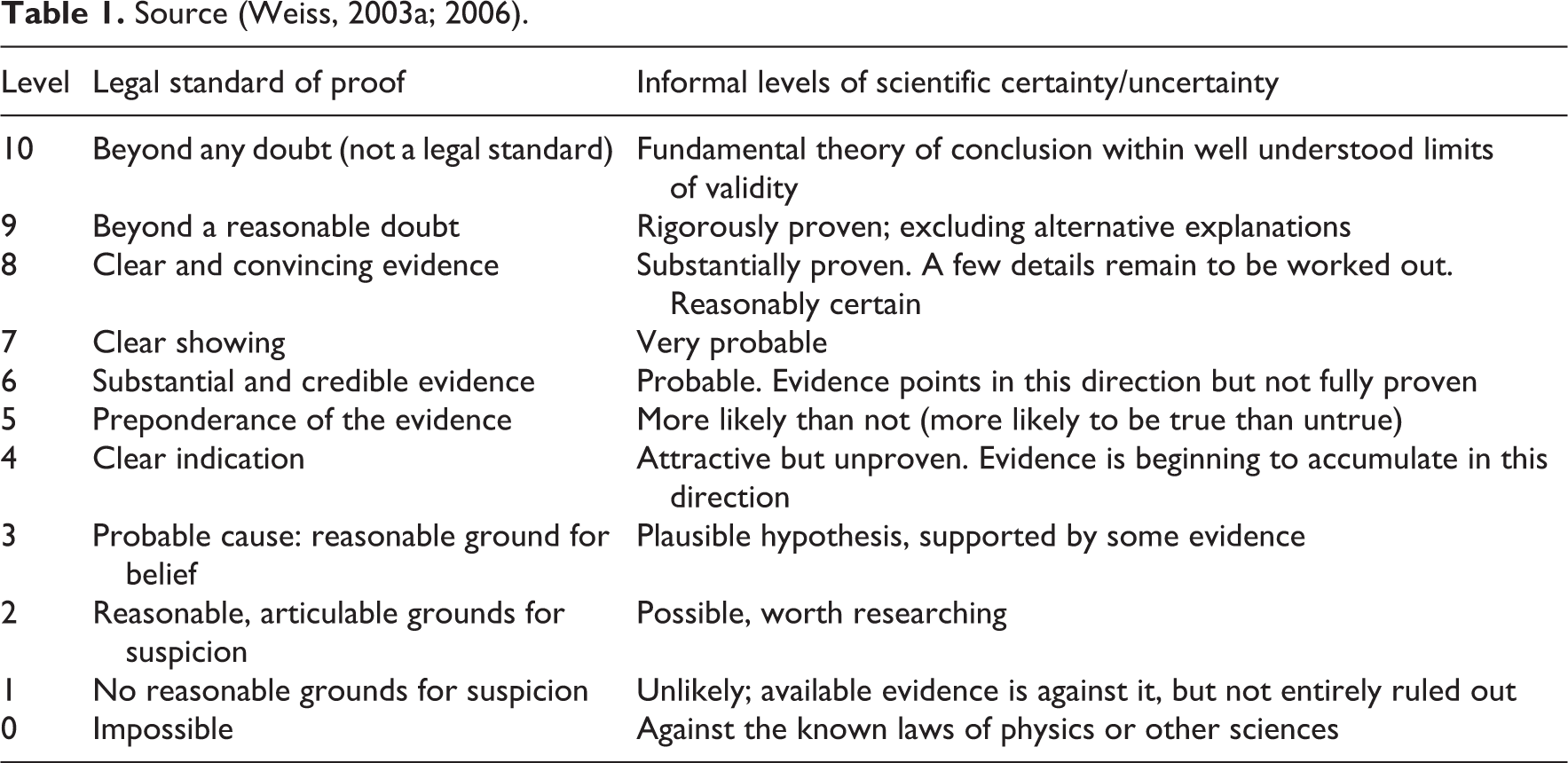
The precautionary principle places the burden of proof on the proponent but does not specify the standard of proof to which the scientific evidence be subjected. The Indian judiciary has highlighted this issue by stating ‘in recent times a serious challenge that has appeared before the courts more often than not, is the basis on which the precautionary principle is to be applied’ 64 ; ‘the submission of scientific evidence that precludes the court from inquiring into the issue’ 65 ; ‘the uncertainty of scientific proof may involve the tribunal to decide on guess work and use of robust common sense’. 66 Thus, as a broad approach and in an understandable form, the scale would ‘help to make the treatment of scientific uncertainties…more explicit, more precise, and more amenable to rational argument’. 67
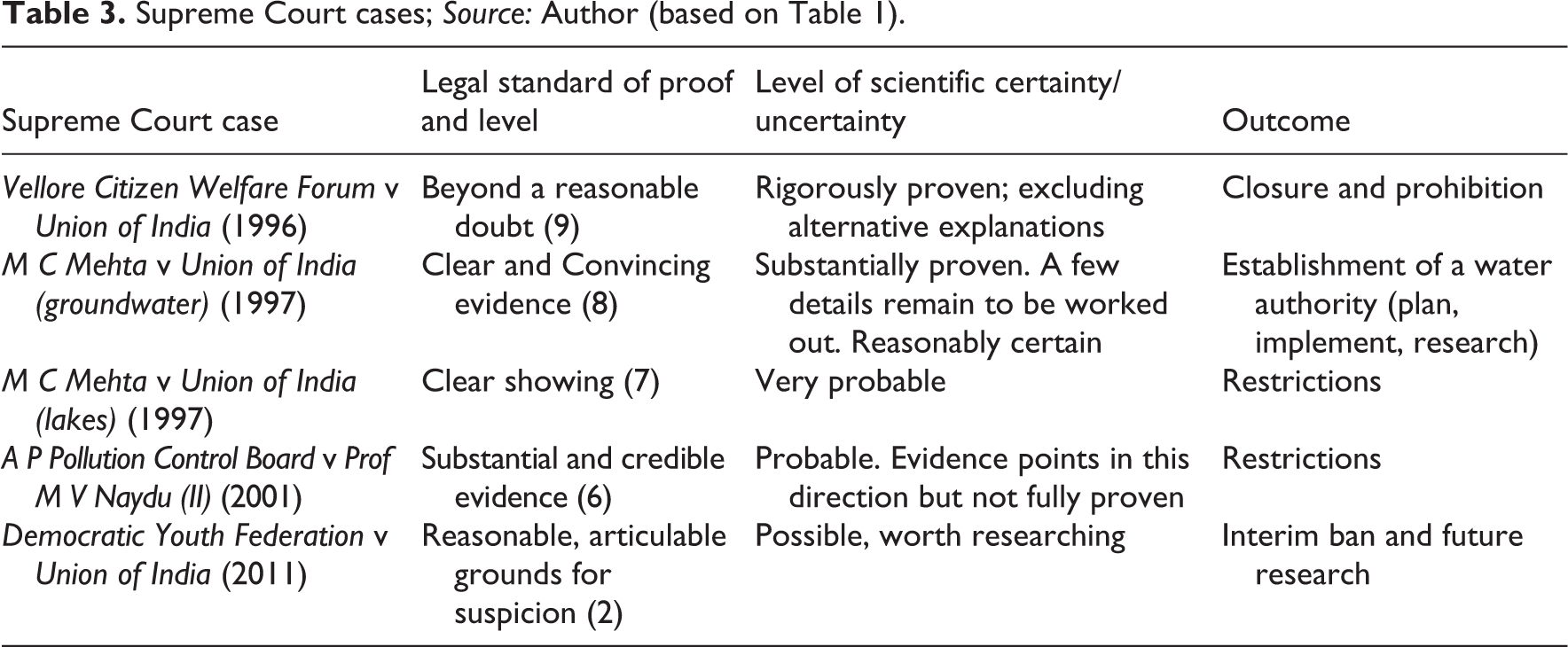
Tables 2 and 3 comprise of selected reported cases of the NGT and Supreme Court (10 cases, evenly divided between the Tribunal and Supreme Court). They are evaluated and located on the Weiss scale of certainty/uncertainty and legal standards of proof. In addition, the tables also reflect the nature of action (outcome) ordered by the judiciary. The practice of drawing precedents from case law is common in the reviewed cases. Table 2 refers to the NGT cases.
NGT cases; Source: Author (based on Table 1).
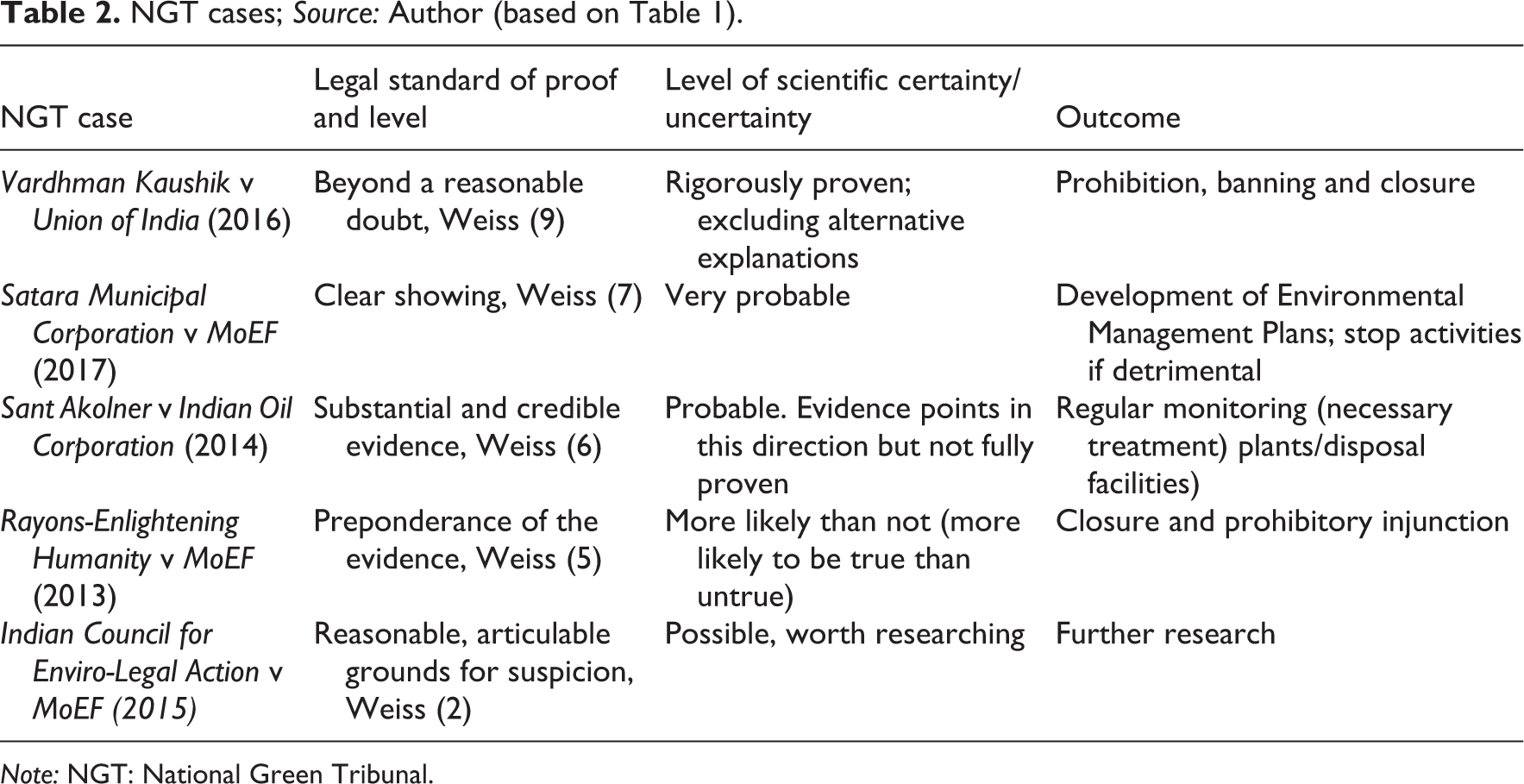
Note: NGT: National Green Tribunal.
Supreme Court cases; Source: Author (based on Table 1).
In Vardhman Kaushik v Union of India, 68 the legal standard of ‘beyond a reasonable doubt’ 69 is assigned level 9 as the contributory sources of air pollution (vehicles, construction activities, burning of municipal solid waste (MSW) and agricultural residue, dust on roads, industrial and power house emissions including fly ash, and emissions from hot-mix plants and stone crushers) in Delhi were ‘firmly identified’. 70 The ‘convincing data’ showed that the ambient air quality was severe and adversely and hazardously affected the public health and persons of all generations without exception. 71 Accordingly, the NGT ordered precautionary measures including banning 15 years old vehicles or older, closure of stone crushing units, implementing dust management plans, installing air purifiers, no burning of waste and preference to the use of public transport systems.
In Satara Municipal Corporation v MoEF, 72 the standard of ‘clear showing’ 73 assigns it level 7 as it is very probable that the ‘new and unforeseen conditions’ 74 will cause serious harm or damage. The case involved the proposed reconstruction of a dam near the world heritage site of the Kas plateau. The proposed new reconstruction activity would adversely affect the sensitive ecology of the Kas plateau including ecological niches and habitats supporting various plant communities and high numbers of plant and animal species. The NGT applied the precautionary principle by requiring formulation of environmental safeguards, measures and management plans prior to the execution of the proposed project.
The next standard of proof ‘substantial and credible evidence’ 75 being level 6 is associated with the Sant Akolner case. 76 The NGT considered the potential sources of groundwater pollution either by the presence of oil depots or industries in the surrounding areas. Applying the principle of proximity, the NGT was of the opinion based on available data, analysis, reports and documents that a strong co-relation existed between the type of contamination of the groundwater and oil storage depots. The NGT while applying the precautionary principle ordered regular monitoring of the groundwater including necessary treatment and disposal.
In Rayons-Enlightening Humanity v MoEF, 77 the standard of ‘preponderance of evidence’ 78 level 5 is assigned. The location of an MSW plant near human habitation was a contested site. Based on a few maps and photographs as convincing evidence, the NGT found that the MSW plant was bound to have hazardous effects on the health of the residents in the area, some of them being adjacent to the contested site. The contested site in which the plant was located, was more likely and bound to cause groundwater pollution, which was relatively at a higher level through leaching. Accordingly, the NGT applied the precautionary principle and ordered the closure of the MSW plant and granted a permanent prohibitory injunction.
The standard of ‘reasonable, articulable grounds for suspicion’ 79 is the least stringent standard with the lowest level of epistemic evidence. This is level 2 and is applied to the Indian Council for Enviro-Legal Action v MoEF 80 a case to determine whether HFC-23 emissions per se are a pollutant. HFC-23 forms part of greenhouse gases that have an impact on depletion of ozone layer and global warming, but there are concerns about their extent and degree. Accordingly, the NGT directed the regulatory and expert bodies to conduct a comprehensive data base study on HFC-23 and its impact on global warming.
Table 3 illustrates the judgments from the Supreme Court of India.
In Vellore Citizen Welfare Forum v Union of India, 81 the Supreme Court was convinced ‘beyond a reasonable doubt’, 82 therefore level 9, that leather tanneries operating in Tamil Nadu destroyed the ecology, degraded the environment and posed a health hazard. The technical reports evidenced the untreated effluents from nearly 900 industries polluted groundwater, contaminated agricultural lands and exposed the residents to serious diseases. Accordingly, the Supreme Court applied the precautionary principle and directed the closure of rogue tanneries, prohibition and restriction on the location of industries and installation of treatment effluent plants before the reoperation of industries.
The standard of ‘clear and convincing evidence’ 83 level 8 is applied in the M C Mehta v Union of India 84 (groundwater case) dealing with groundwater depletion. Evidence supported by technical reports convinced the court that there was a gradual depletion of groundwater levels, dwindling water resources, deterioration of groundwater and surface quality and a haphazard use of land. To assess the complex issues in water resource management, the Supreme Court directed the constitution of a water authority to operationalise the precautionary principle. The water authority was expected to plan, develop and implement research on sustainable water resource management.
In M C Mehta 85 (lakes case), the standard of ‘clear showing’ 86 is applied at level 7. The Supreme Court while applying the precautionary principle placed restrictions on the proposed new construction in the areas outside the greenbelt of the Badhkal and Surajkund lakes. Based on expert opinion, the new proposed large-scale construction near the lakes was bound to cause adverse impact on the local ecology. The proposed construction activity may disturb the rainwater drains thereby impacting on the water levels and water quality of the water bodies and disturbance to the aquifers and hydrology in the area.
The case of A P Pollution Control Board v Prof M V Nayudu (II) 87 is covered by the standard of ‘substantial and credible evidence’ 88 level 6. The Supreme Court considered whether the establishment of chemical industry carries with it the imminent danger of chemicals or chemical effluents polluting the waters of Himayat and Osman Sagar lakes. Based on exhaustive scientific evidence provided by expert organisations, the Supreme Court applied the ‘reasonable person’ test and concluded that there was every ‘likelihood’ of the industry affecting the sensitive catchment area of the lakes. 89 Accordingly, the court applied the precautionary principle and directed that the regulatory agencies should not permit any polluting industries within the radius of 10 kilometres of the lakes.
The standard of ‘reasonable, articulable grounds for suspicion’ 90 is applied to Democratic Youth Federation v Union of India v Union of India, 91 level 2, considering the ill-effects of endosulfan on human beings and the environment. The differing reports presented to the court regarding the usage of endosulfan and its impact on human health and the environment led to the application of precautionary principle. Consequently, the court ordered the interim ban on the production, sale and use of endosulfan and an undertaking of a detailed scientific study on Endosulfan.
Thus, the multiple case studies reflect Weiss’ legal standard of proof scale that offers greater precision in defining the degree of scientific uncertainty. ‘The level of this uncertainty, and the approach to that uncertainty, are important inputs into the risk assessment that enters into any decision’. 92 Good environmental practices aim to evaluate scientific uncertainties and incorporate such evaluation in decision-making. Informed decisions based on precision in language and concept are the essence of an appropriate precautionary decision. The ‘scientifically legal’ lexicon offers an opportunity to express different levels of scientific uncertainty in a legal language facilitating precautionary interventions with greater certainty.
Conclusion
Court room cases are invariably decided by factual evidence offered by witnesses and experts. The evidence is mediated and presented by advocates speaking the language of law to the judiciary. However, in environmental cases, the role and status of science and technical expertise are increasingly important factors in decision-making by the court.
Academic literature recognises that current different understandings of the precautionary principle, informal scientific levels of certainty or uncertainty and legal standards of proof may introduce subjectivity into the judgments. This may result in vague and malleable formulations, over or under reaction to significant or insignificant risks and oppose technological innovation based on unproven intuition.
This article highlights two principal issues in environmental decision-making by the Indian judiciary. The first examines the meaning, appreciation and application of the precautionary principle by key environmental actors who are regularly involved in the presentation or resolution of environmental issues in the NGT. The unique pilot survey establishes that the range of key environmental actors differ in their definitions and usage of this principle. There exists limited common understanding between Decision-makers and Influencers about the normative aspects of the principle and related scientific uncertainty.
The second issue focuses on scientific uncertainty, the legal standard of proof and its impact on the precautionary principle. Weiss framework offers a pathway for the Indian judiciary by assembling a scale of legal standards of proof arranged in a hierarchy of levels of increasing scientific certainty. This tabular form transposes levels of scientific certainty into parallel legal terminology familiar to lawyers and the judiciary. It becomes a ‘scientifically legal’ lexicon of meaning for the judges and lawyers. Weiss does not claim the scale is absolute nor clearly defined but nevertheless it makes evidence more precise and therefore it is easier to understand the value of scientific evidence by categorising it as a helpful tool operating somewhere between ‘beyond reasonable doubt’ and ‘impossible’.
The findings presented in the article encourage next-step thinking in India’s environmental governance. There is a need to develop a framework of guidelines that recognises the normative aspects 93 and legal standard of proof for scientific uncertainty 94 in the application of the precautionary principle. Adapting from foreign regulatory guidelines and developing a ‘scientifically legal’ lexicon that expresses different levels of scientific uncertainty in a legal language, the framework would provide a roadmap regarding the usage of the precautionary principle. Such a framework would assist the Janus-faced precautionary principle to become a consistent, effective, accountable and transparent tool. 95 This would enable decision-makers to promote the environmental rule of law and further India’s commitment to sustainable development goals.
Footnotes
Acknowledgements
I thank Northumbria University for the 2019 GCRF Networking and Collaboration Research Funding (seed corn). I also thank Dr Ajay Deshpande, Former Expert Judge of the NGT India, for his valuable contribution and positive involvement during this research. Additionally, I thank my research collaborators from UK (Professors Sue Farran, Abbey Brown, Michelle Slater, Jane Entwistle, Anil Namdeo and Simon Griffiths) and in India (Professors Gopichandran Ramchandran, Chandrashekhar Rawandale and Sanjay Uphadhyay) for their valuable support. My thanks to Er J S Kamyotra, Former Member- Secretary Central Pollution Control Board India, for his technical advice regarding this research. I thank Dushyant Kaul for his excellent research assistance in the preparation of this article. Finally, I thank the two anonymous referees for their helpful and constructive comments.
Declaration of conflicting interests
The author(s) declared no potential conflicts of interest with respect to the research, authorship, and/or publication of this article.
Funding
The author(s) disclosed receipt of the following financial support for the research, authorship, and/or publication of this article: The research was funded by the Northumbria University 2019 GCRF Networking and Collaboration Research Funding (seed corn).
