




Abstract
The UK Government has announced its plans to bring forward the deadline for phasing out all petrol and diesel vehicles from 2040 to 2030, 10 years earlier than planned. This is a radical acceleration in the transition to electric mobility. The need to draw up coherent and robust UK regulatory structures for managing the end-of-life consequences of this transition is now more urgent than ever. This article explores the potential role of extended producer responsibility (EPR) in facilitating the safe and sustainable management of electric vehicle (EV) batteries at their end of life. It outlines the current EV battery problem from the perspective of end-of-life management, before exploring the utility of EPR in achieving a circular economy approach and reviewing the current EPR frameworks that would apply to this waste stream once a battery is no longer powerful enough to drive an EV. We conclude that current EPR frameworks for battery management are neither sufficiently clear nor suitably robust to ensure safe and sustainable electric lithium ion battery management and suggest how these could be remodelled to achieve better outcomes in this area.
Keywords
Introduction
The Prime Minister of the UK recently announced that the prohibition on sales of new petrol and diesel vehicles will be brought forward to 2030 from 2040. 1 The electric vehicle (EV) revolution is advancing rapidly. This is welcome for the many potential environmental and health benefits that should result from the decarbonisation of transport. However, the full potential of this revolution can only be unlocked alongside timely planning to support appropriate end-of-life management of EVs in a way that is compatible with the principle of the circular economy, which seeks to keep resources in use for as long as possible. Among the most complex and urgent of issues that must be addressed in this context is the need to ensure safe and sustainable management of the vehicles’ batteries (most commonly, lithium-ion batteries: hereafter, LIBs) at the end of their first life in an EV. 2
Technological advancement in the field of EVs has raised new end-of-life management challenges that previous end-of-life vehicle (ELV) and battery legislation felt little need to address. The size, weight and power of EV LIBs, coupled with the significant variations in their design and chemical complexity, present unique challenges to their recycling and reuse. Lead-acid batteries used in traditional automotives for ignition and lighting have achieved significant take back and recycling rates (the mooted figure is above 90 per cent 3 ; with four-fifths of European Union (EU) Member States at least achieving at least 75 per cent 4 ) with relative ease due to lead-acid battery standardisation and the high return of recoverable lead contained within such batteries. By contrast, the current complexities of EV LIB recycling suggest that as volumes of spent EV batteries grow, significant waste management problems will arise, unless appropriate infrastructure and governance systems are developed to manage this. 5 Crucially, EV LIBs retain significant capacity at the end of their first life when they are no longer able to power an EV. 6 These LIBs also continue to house valuable rare and critical materials, whereas inappropriate disposal can lead to a loss of valuable materials without utilising the residual capacity contained in the battery. Disposal may also present risks of serious injury to health and the environment (e.g. through explosions, toxic gas emissions, fires and leachate).
This article suggests that current regulatory mechanisms for end-of-life battery management (primarily enshrined in the 2006 Batteries Directive (2006/66/EC), 7 which operates in conjunction with the 2000 ELV Directive (2000/53/EC) 8 fail to provide a sufficiently robust extended producer responsibility (EPR) framework to facilitate a circular economy for EV batteries in the UK. The article explores why regulation, as it presently stands, is ill-equipped to handle the waste implications of electric mobility. It suggests how regulation may be strengthened in the UK’s post-Brexit era to facilitate a battery circular economy. Importantly, the EU has recently (December 2020) released a proposal 9 for new battery regulations that will address some deficiencies in the 2006 Directive. Although we focus here mainly on the 2006 Directive (currently in force at the time of writing), we will, where relevant, discuss the anticipated direction of future regulations as outlined in the new proposals.
The second section of the article clarifies the EV battery problem and explains why a circular economy is not likely to shape itself in this area without policy and regulatory interventions. Moreover, time frames are short given the projected scale and volume of end-of-life EV LIBs that will need to be processed in the near future. EV LIB recycling and reuse represents a tough challenge due to (inter alia) limitations of technology, lack of UK facilities and infrastructure, as well as the ill-adapted regulatory framework. The third section explores the concept of EPR and its value in facilitating a circular economy through responsible management of end-of-life products. We cite evidence from other waste streams to show how robust EPR frameworks can benefit environmental and sustainability goals and promote more responsible handling of valuable or hazardous waste. The fourth section considers current UK ELV regulation, and the fifth section reviews the Batteries Directive. These sections highlight legislative gaps and oddities such as the lack of integrated take-back and recycling targets, as well as definitional uncertainty. The sixth section, which concludes the article, suggests how battery regulation post-Brexit may be revised, through robust EPR frameworks, to more effectively manage the EV transition. Here, we recommend that a newly formed, EV-specific EPR scheme may be necessary to deal adequately with the expected exponential increase in ELV EV batteries.
The EV battery problem: Volumes and lifespan
Although EV LIBs are durable, they have a finite lifespan. 10 Current evidence suggests that once the effective charging capacity of the battery has fallen to about 75–80 per cent of the original capacity, it is no longer optimal for providing traction for EVs. 11 However, the battery will still contain significant residual capacity at this point; this represents both opportunities and threats. The large residual power means that the battery needs careful management when discarded from EV use, as there are significant potential risks of electrocution, fire, explosions and from chemical toxicity. At the same time, the residual power can be an opportunity to extract further value from the battery: already, such batteries are being put to several other less demanding second-use applications, such as stationary energy storage systems, including home or neighbourhood back-up power systems or grid power buffering strategies. 12 If it is assumed that the first-life period of an EV battery is 8–10 years, studies estimate that the number of LIBs becoming available globally per annum for remanufacturing, recycling and repurposing is likely to exceed 3,000,000 between 2029 and 2032 as well as reaching 50 per cent of new vehicle demand between 2020 and 2033. 13
LIBs contain a variety of valuable, critical materials (including nickel, cobalt, lithium and graphite) and as such, they provide a significant potential opportunity for obtaining value from material recycling, recovery and reuse. The main options for end-of-life management of EV LIBs are recycling or second-use of spent batteries. However, there are a number of challenges surrounding both of these options. 14 Neither LIB second-use practices nor recycling processes in this new and emerging technology are as yet fully developed. As a result, ongoing research is still needed to identify the most efficient processes. As the growth of e-mobility is a relatively recent phenomenon, few EV LIBs have reached the end of their first life, thus volumes are not yet sufficient for large-scale recycling to be economically profitable. Safe and sustainable EV LIB management systems will not only require planning but will also need to be steered through effective regulation. This article highlights how sound EPR frameworks for EV batteries can contribute to this.
The number of licensed ultra-low emissions vehicles on UK roads is rising steadily year-on-year. Projections from the National Grid suggest that the stock of EVs in the UK could reach between 2.7 million and 10.6 million by 2030, rising to as much as 36 million by 2040. 15 The UK Government’s 2018 Road to Zero strategy aims to drive this forward. The strategy largely focuses on replacing petrol and diesel vehicles with low and zero emission EVs: a move that is identified as having a crucial role in the ‘least cost pathway’ to achieving the UK’s 2050 climate change targets. To do so, the Government set the target that by 2050 almost every car and van will be zero-emission and is now committed to phasing out new petrol–diesel cars by 2030 to accelerate the EV transition. 16 According to the International Energy Agency’s 2017 EV outlook, these figures place the UK fourth worldwide by EV market share and seventh by volume. 17
Forecasts of the annual weight of EV batteries to be managed suggest that over 16,000 tonnes of end-of-life EV battery packs will need to be reprocessed as they leave the UK vehicle market by 2028 though this may accelerate if there is to be a phase out of petrol–diesel cars by 2030. 18 Foster and others estimate that the number of LIBs becoming available globally per annum for remanufacturing, recycling and repurposing is likely to exceed 3,000,000 between 2029 and 2032. 19 The International Energy Agency (2020) estimates that 100–120 gigawatt hours of EV batteries will be retired by 2030, a volume roughly equivalent to current annual battery production, warning that without effective measures to address such volumes, this could become a significant environmental liability. 20 Estimates of the global tonnage of spent LIBs discarded by 2030 range from 11 million tonnes to 16 million tonnes. 21 The rapid uptake of EVs in China, for example, has resulted in projections for 120,000–200,000 tonnes of LIBs for recycling in 2020. 22 This has been facilitated by a number of strategic measures at the local, state and national level in China: for example, a number of Chinese cities such as Shenzhen now have a fully electrified bus fleet. 23 With similar schemes being rapidly developed across the UK and the EU 24 , this provides some idea of the potential volumes of spent EV batteries that we will need to deal with in the near future.
Despite the anticipated volume of EV LIBs that will soon need to be managed, the UK does not currently have any LIB recycling facilities or infrastructure. Some end-of-life LIBs are exported at present for recycling, mainly to the EU (e.g. to facilities in Belgium). 25 This export will become more problematic after 2025 when volumes rise substantially due to issues around processing capacity, transport, safety and waste shipment regulations. 26 Moreover, the handling and transportation of end-of-life LIBs requires a good degree of care, leading to high transportation costs. Environmental considerations and current regulation prevent the disposal of LIBs in landfills. Further, EU regulations may restrict exporting end-of-life LIBs in the future (post-Brexit, from 1st January 2021, the UK will be treated as a third country for the purposes of waste shipment). 27 As such, and owing to current low levels of LIB take-back, it is difficult to ascertain how vehicle manufacturers intend to proceed post Brexit, when volumes of EV batteries that have reached the end of their first life begin to rise substantially.
Evidence suggests that recovery of battery materials through recycling has many environmental benefits, such as reduced energy demand, conservation of natural resources, lower toxicity potential of secondary materials and reduced greenhouse gas emissions: thus battery recycling can potentially fulfil several crucial EU and UK goals 28 (e.g. lead-acid battery recycling, which produces secondary lead, results in the reduction of greenhouse gas emissions by two-thirds compared to primary production of lead; and the human toxicity potential for producing primary lead is about 18 times higher compared to that of secondary lead). 29 The multiple potential environmental and economic benefits of battery recycling make it crucial to develop regulatory frameworks that support improvements in recycling efficiencies and infrastructure for the high-growth sector of EV LIBs. It is essential that efficient systems for managing LIBs from EVs are developed if their widespread use is to be sustainable, and it is imperative that these are deployed in the UK if it is to be a major manufacturer and consumer of EVs.
What is EPR?
Since the late 1980s, EPR has been a ubiquitous regulatory tool used to combat the potential environmental and health effects that products can pose, particularly where a product has reached the end of its useful life.
30
As a result, over 400 EPR schemes are now known to be in existence worldwide,
31
with the EU championing such policies.
32
EPR, which acts as an extension of the polluters pays principle and the prevention principle within the EU,
33
has two main aims: one, to reduce the immediate environmental impact of the product via mitigating the product’s harm at the end of its life and, the other, to influence the long-term design of a product.
34
EPR seeks to achieve these aims via passing responsibility for the whole lifecycle (but focusing particularly on waste) of a targeted product to producers. In consequence, this can result in the producer having various physical and/or financial responsibilities for a marketed product throughout its life, and thereafter at the end-of-life. Typical responsibilities may include design restrictions, as well as collection, treatment and recycling/reuse obligations. In addition to the benefits detailed above, EPR is also an effective regulatory tool in transitioning economics from the traditional linear model of disposal that evolves around single-use to one which promotes circularity. Circularity means that goods travel in a resource efficient, continuous circular motion through the different stages of its lifecycle (i.e. design/manufacture
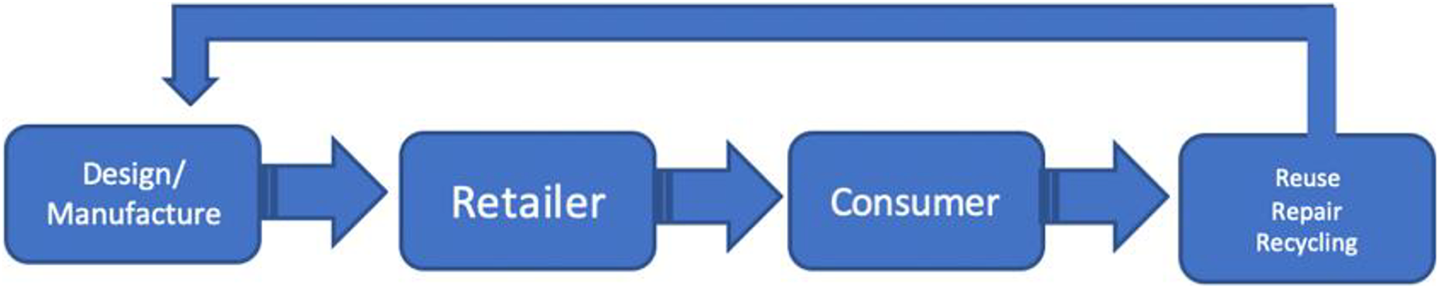
Circular economy. 35
In implementing EPR, legislation often demands that producers meet their extended responsibilities through individual or collective schemes. 36 The concept of individual responsibility is based on the premise that producers, individually, should bear the physical and/or financial burden for their own product. This can benefit the circular economy goals in many ways: for example, it may incentivise the producer to eco-design their product as the costs for recycling will be lower, which would improve recycling efficiency. If producers eco-design their products by, for example, making them easier to dissemble, or by ensuring compatibility with current recycling techniques and environmental standards, then this can significantly reduce the end-of-life management costs for the producer as well as offer many environmental benefits. Individual responsibility models of EPR may be suited to a ‘closed-loop’ circular economy, which aims to backhaul products that can thereafter be recycled and those same materials are used to make the same product. A looped system such as this gives certainty of material quality and security to the producer. A simple example might be where a tin can is recycled and the material is modelled back into a tin can by the original producer, ready for resale. 37 However, individual responsibility will undoubtedly increase costs associated with logistics. 38 On the other hand, collective responsibility enables producers to discharge their burden of responsibility as a ‘group’. This usually operates via producers funding a ‘producer responsible organisation’, which takes on and discharges the burden of responsibility on behalf of the obligated producer for a fee. This could include the producers’ administrative, collection, treatment and recycling responsibilities. Such collective responsibility schemes may, in some instances, stifle any incentive to eco-design but may ultimately be easier to introduce. 39 As such, most EPR schemes are designed to include an element of collective responsibility; individual responsibility is optimal, but seldom used. 40
EPR has demonstrated effectiveness in managing end-of-life waste. It was first conceptualised in Sweden during the 1990s 41 and came to regulatory fruition in Germany under the 1991 Packaging Ordinance. 42 The Ordinance sought to place regulatory EPR responsibility on producers to collectively take back and recycle a targeted percentage of waste packaging from manufacturers and their distributors. In the early years of implementation, Germany saw a drop of 1 million tonnes in packaging use, and 66 per cent of producers had optimised at least 50 per cent of their packaging. 43 Some commentators saw the Ordinance as highly problematic due to a continued low market demand for waste plastic packaging within Germany. This led to increased amounts of waste packaging entering other EU Member States markets; thus, acting as a disincentive for domestic collection and recycling of Member State packaging. However, this resulted in harmonised action from the EU, by way of the Waste Packaging Directive (Directive 94/62/EC). 44 Another example of EPR success is evidenced in the Japanese Electric Household Appliance Recycling Law that was first enacted in 2001 and aimed to shift waste responsibility from government to producers for refrigerators, washing machines, air conditioners and TVs. 45 Here, distributors take responsibility for transporting targeted goods from final users to producers so as to facilitate recycling. Since 2008, all targeted goods have seen a recycling rate of between 74 per cent and 91 per cent, which is up from a range of 56–78 per cent in 2001. 46
Globally, there is now a continued drive towards enacting EPR policy; the EU has enacted four waste streams that contain EPR principles, namely batteries, ELVs, waste packaging and waste electronic and electrical equipment (the first two streams being the focus of this article). Experience from such waste streams globally has shown that EPR policy is effective in raising consumer awareness, expanding waste collection infrastructure and shifting costs of end-of-life management from municipalities to producers or stewardship organisations, thus easing the cost burden for local and central governments. In addition, EPR offers a number of other potential benefits, such as encouraging producers to internalise lifecycle costs and promoting environmental benefits through improved product design, reverse logistics, closed loop supply chains and resource recovery. 47
ELVs and EPR in the UK
TheELV Directive introduced EPR for vehicle manufacturers in relation to vehicles coming off the market. Manufacturers must take back their products to reuse, recycle or remanufacture, either directly or in association with one or more networks of treatment companies or via a collective scheme. 48 In 2015, the targets for ELVs (set by reference to vehicle weight) were raised so that there must be 85 per cent reuse or recycling rising to 95 per cent by the inclusion of recovery (mainly incineration for energy).
This EPR structure, devised at the end of the 20th century, envisioned the recycling of internal combustion engine vehicles rather than EV equivalents and as such it does not directly address responsibility for the battery pack. On the one hand, it may seem obvious that, as part of the vehicle, the EV battery must be included in the EPR scheme and its targets. The battery may constitute up to 20 per cent of the weight of the vehicle, so meeting of ELV targets should necessarily include the battery. On the other hand, there is a separate regulatory regime, also incorporating EPR principles in relation to batteries more generally under the Batteries Directive. 49 Again, given its history, the Directive (discussed further in the fifth section) inadequately addresses EV batteries. ‘Automotive batteries’ under the Batteries Directive are restricted to ‘any battery or accumulator used for automotive starter, lighting or ignition power’. 50 In internal combustion engine vehicles, this will ordinarily be a lead acid battery for which (as we have seen) there are strong market-based recycling incentives. 51
In contrast, lithium-ion EV batteries are classed as industrial. Although this issue is dealt with in more detail in the sixth section, it is important to note here that the Batteries Directive defines an industrial battery as any battery or accumulator designed for exclusively industrial or professional uses or used in any type of EV. 52 There is a misnomer, therefore, in labelling an EV battery in everyday consumer use as ‘industrial’. The European Commission has acknowledged the problems with this, particularly in view of the impending rise in numbers of EV batteries that will be placed on the market, noting that for industrial batteries the Directive only vaguely regulates the obligations stemming from the extended producer responsibility principle. 53
The revision of the 2006 Directive addresses the current vagaries of regulation (see the fifth section) and has been anticipated for some time. The new 2020 European Commission proposals 54 now finally provide some indications about the likely form of that revision. The current preferred option, according to the proposals, is to introduce a new discrete category for EV batteries, which will be defined as ‘any battery specifically designed to provide traction to hybrid and electric vehicles for road transport’. 55 It is less clear what the English response, promised in the Resources and Waste Strategy for England, 56 will be and how closely this will align to the EU review either in terms of definitions or targets (this issue is discussed further in the fifth section).
In the meanwhile, the regulatory structure for EV LIBs straddles the two directives in a somewhat unsatisfactory manner. For example, there are contrasting processes of take back and differing targets under the two Directives. The Batteries Directive does not currently set targets for the take back of industrial batteries, though it does demand that these should be collected on request. There are targets for the recycling of industrial batteries but unlike the ELV Directive, these are not simply weight based but (for industrial batteries) instead set as a recycling efficiency target of 50 per cent by average weight. Not only is this a complex equation but the ease with which that recycling efficiency target can be met will vary considerably depending on battery chemistry (discussed further in the fifth section, n. 63). The 2020 European Commission proposals indicate plans to introduce increased reporting obligations for EV battery producers, 57 along with higher recycling efficiency targets (although they are unlikely to impose any explicit collection targets for EV/automotive batteries: the proposals indicate this is not the current preferred option).
In practice, there seems no major issue with the take back of industrial batteries, but to date the vast majority of such batteries would not emanate, in large quantities, from EVs (this may change in the future as EV uptake rises and present EV fleets start to age). Effective take back may be unsurprising in that the Directive prohibits the landfill or incineration of industrial batteries. 58 Turning to the ELV Directive, this demands that producers must provide a suitable network of authorised treatment facilities or make approved alternative arrangements, offering free take back for their vehicles. In the UK, verification of a vehicle is provided by the authorised treatment facility issuing a certificate of destruction (without charge to the owner), which will allow the Driver and Vehicle Licensing Agency to deregister the vehicle. It is estimated that 1.8 million cars leave the market every year, but that there is a shortfall of between 500,000 to 800,000 certificates of destruction meaning that there is considerable ‘leakage’ in the system. 59 This may result in part from owners, who are required to check that a facility is approved and licensed, failing to appreciate what constitutes an approved route of disposal.
Since the vehicle will contain certain hazardous materials, until the point that it is depolluted, an ELV should be treated as hazardous waste. 60 Depollution will involve the removal of fluids and other hazardous substances and components. The EV battery pack may be considered hazardous in the general sense of that word and should doubtless be removed as part of the treatment process, though regulatory clarity on this point would be welcome. Given the weight-based targets under the ELV Directive, referred to at the beginning of this section, a weighty EV battery will need to be the subject of reuse, recycling or recovery. One must bear in mind that incineration of the battery is prohibited (see above) but recovery processes based on pyrometallurgy are in use 61 and presumably not classed as incineration (but again clarity would be welcome). Note, however, that battery reuse counts towards ELV targets. This suggests that obligations under the ELV Directive are met at the point at which the EV battery enters second-use. This raises a difficult question: who presently bears the responsibility for that battery when it leaves that repurposed use? It would be odd and somewhat unfair if the producer having once met obligations under the ELV Directive now faced further obligations under the Batteries Directive.
To address this dilemma, one needs to consider what is meant by reuse. If reuse is limited to use of the battery for the same purpose (as a vehicle battery) so that repurposing was not ‘reuse’, then only batteries retained to drive vehicles would be considered as reused. Repurposed batteries would not meet ELV targets, though such batteries would constitute waste as soon as the car owner chose to discard the vehicle 62 rather than goods sold contractually for another purpose. One solution would be to accept that reuse includes repurposing. This would have some advantages but might create havoc in assessing targets if the same batteries are subject to double counting. The ELV Directive is ambiguous in this regard, defining reuse as ‘any operation by which components of end-of-life vehicles are used for the same purpose for which they were conceived’. 63 EV batteries are designed to store energy but, acting as the drive engine of a vehicle, should they be regarded as ‘conceived’ for a purpose other than simple energy storage? If so, a battery repurposed for energy storage alone should not necessarily be regarded as used ‘for the same purpose for which they were conceived’. The new European Commission proposals indicate a firm intention to clarify dilemmas of EV battery second-use, with the current preferred option being to designate used batteries as waste at the end of first life (unless they will be reused again as EV batteries). It appears likely that repurposing will be considered a waste treatment operation and repurposed (second life) batteries will be designated as new products. 64
The European Automobile Manufacturers’ Association (ACEA) proposes a definition of second-use, across EU waste legislation to overcome this conundrum. 65 The ACEA also advocates that the ELV Directive ‘should prevail over any other legislation as the ELV Directive deals with the complete vehicle, including any automotive battery or industrial battery’. The position taken here seems to be that the take-back obligation to the vehicle owner should be considered as discharged once the battery pack is taken back as part of the vehicle. The ACEA also states that with regard to ‘industrial batteries coming from end-of-life vehicles, (the) End-of-Life Vehicle Directive 2000/53/EC dealing with the complete vehicle should prevail over any other legislation’. This would mean presumably that having discharged its obligations under the ELV Directive an automotive or original equipment manufacturer ought not to face further take-back responsibilities under the Batteries Directive as repurposed batteries reach the end of their life. One can sympathise with this position but it provides no answer as to who does bear the take-back responsibilities for repurposed batteries. To have a comprehensive EPR system for EV batteries, this question requires an answer, and current regulation provides no clear response.
Batteries Directive and EPR in the UK
In trying to influence the immediate environmental impact of batteries, the EU introduced principles of EPR via the 2006 Batteries Directive, which has been transposed and used as the baseline for battery waste management across all European Member States; although note that the newly proposed regulation (see the fourth section) seeks to ‘fine-tune’ the Directive’s EPR measures by introducing definitional changes, although its principle remains the same. 66 Before examining how the 2006 Directive has shaped EPR in the batteries sector, let us briefly consider the future of that legislation, post-Brexit.
While the EU has published its new batteries regulation, post-Brexit this will not apply to Great Britain. Northern Ireland finds itself in a rather different position by virtue of the Northern Ireland Protocol to the Withdrawal Agreement, as it is obliged to align with certain Single Market rules. Included here are areas such as technical regulation of goods, agriculture and environmental standards. If Northern Ireland is to avoid the need for regulatory checks on the Irish Border, then it will need to meet requirements of measures such as the batteries regulation. For Great Britain, the Batteries and Accumulator Regulations 2009 will continue to apply. These regulations transposed the Batteries Directive 2006 using the now repealed powers under section 2(2) of the European Communities Act 1972 and apply for the most part 67 throughout England, Wales and Scotland. As EU-derived domestic legislation, as it continues to have effect in domestic law by virtue of section 2 of the EU Withdrawal Act 2018. For England at least, however, it is clear that the 2009 Regulations are subject to review as part of a commitment made under the Resources and Waste Strategy. 68
A major question for that review is how closely aligned the English regulations (and those of the two other devolved governments) will be to the new EU regulation. Roughly 80 per cent of cars manufactured in the UK are exported and just over half of these go to EU member states. 69 These vehicles would need to comply with the new batteries regulation so that the EV drive battery would be required to meet (e.g.) battery composition and labelling requirements. Some 85 per cent of UK car imports emanate from the EU 70 and will arrive with batteries compliant to these requirements. Moreover, given the considerable integration of supply chains across the EU and UK, options to depart radically from the EU legislation may be limited by commercial considerations.
In terms of waste flows, the signing of the Withdrawal Agreement has eased worries that World Trade Organisation tariffs may apply to imports and exports of metal waste. There was early adaptation by the UK in preparation for Brexit of the Transfrontier Shipment of Waste Regulations 2007 71 in the form of the International Waste Shipments (Amendment) (EU Exit) Regulations 2019. 72 With Brexit, the UK becomes a third country but in terms of waste flows it remains a Basel Convention party and an Organisation of Economic Co-operation and Development Decision country in the eyes of the EU, so providing the waste shipment is not for disposal, it will be controlled by established international mechanisms. As with other trade issues, there may be teething problems in the change of regime, though regulators are cooperating to prevent this happening. However, the danger in the longer term is whether Northern European capacity for metal recovery and recycling will be able to accommodate third country EV battery waste and whether it makes economic sense for the UK to lose the critical material components to other countries. Bear in mind that the new EU batteries regulation, mandating as it does minimum recycled content in newly produced batteries, may begin to place a premium on recycled metals.
Turning to the work done by the 2006 Directive, it regulates the large amounts of batteries being placed on the European market and introduces measures to ensure sustainable management at their end-of-life by extending the producers’ responsibilities. Here, the Directive contains obligations that burden those who produce and/or manufacture batteries, as they are most able to influence the design of their product so as to facilitate recycling (although, as noted above in the third section, the achievement of this goal is somewhat diluted in collective responsibility schemes). Under the Waste Batteries and Accumulators Regulation 2009, which implemented the Batteries Directive within the UK, the ‘producer’ includes any person that, irrespective of the selling technique used…‘places batteries, including those incorporated into appliances or vehicles, on the market for the first time in the United Kingdom on a professional basis;’ 73 This primarily captures the manufacturer but could, in relevant circumstances, capture importers who sell to end users.
The primary objective of the Batteries Directive is to minimise the negative impact of batteries and waste batteries, thus contributing to the protection, preservation and improvement of the environment and human health; while also ensuring efficient use of resources, reduction in greenhouse gas emissions and stimulating the EU economy. 74 The Directive includes provisions that cover the entire lifecycle of batteries (this includes, design, placing on the market and end-of-life): producers are given responsibility for the management of waste batteries that they have placed on the market. However, in discharging these responsibilities, producers are permitted to instruct third-party producer responsible organisations, who in turn execute the EPR burden on behalf of (generally) a collective of producers.
The Directive currently contains three broad categories of batteries: portable, industrial and automotive. Portable batteries are defined as being able to be carried without difficulty and are sealed (such as an AA battery). Due to their size and ease with which they can be disposed of in municipal waste, such batteries were, at the time the Directive was written, considered the most potentially problematic by the European Commission. Subsequently, they are the focus of the most rigorous provisions within the Directive. By contrast, industrial batteries (defined as those designed solely for industrial or professional use, as well as batteries used in EVs) and automotive batteries (which must act as an automotive starter, lighter or igniter) are subject to less stringent EPR obligations (note, however, that this is likely to change under revised batteries regulations, with the planned introduction of a distinct category for EV batteries). 75
EVs are used predominantly by private individuals, although as aforementioned their batteries are currently somewhat oddly grouped in the Batteries Directive under the classification of industrial batteries. They are clearly not portable and neither fall within the category of automotive batteries, nor have a separate, distinct category, which might have enabled more specific, and targeted EV battery obligations. It is important to note, however, that under the newly proposed regulations, the definitional oddities noted above are likely to be resolved. 76
As a result of the above misnomer in battery classification, the Directive includes a reactive ‘take-back’ measure for industrial EV batteries. Here, the producer shall ‘not refuse to take-back waste industrial batteries’. This is as opposed to a proactive ‘collection’ obligation supported by distributors and targets, which can currently be found in the obligations for portable batteries. As such, EV battery producers are not required to meet any take-back targets, although they are obliged to give end-users information about the existence of take-back schemes and the harmful effects of incorrect disposal. 77 The fact that EPR obligations for producers of EV LIBs are so weak increases the risk that private individuals (who will be the most common users and owners of EV batteries) may remove, disassemble, store or use these batteries in highly dangerous or hazardous ways should they choose not to return them to the producer. It is noted, however, that where an EV is taken to an authorised treatment facility, the EV battery will be removed under the depollution requirements of the ELV Directive (see the fourth section n48) that may provide some safeguard against unsafe private disposal.
To support take-back rates, the Directive stipulates that industrial batteries cannot be subject to disposal by way of landfill or incineration, owing to an enforced prohibition; 78 a prohibition that was taken to mean that take-back rates of industrial batteries would be close to 100 per cent. However, the small amount of available data does not support this assumption, as there are noticeable differences between industrial batteries being placed on the market and those actually being taken back. In 2015, 491,000 tonnes of industrial batteries were placed on the market, whereas only 435,000 tonnes were taken back by producers; a difference of 56,000 tonnes or 11 per cent. 79 This therefore raises the question as to why current legislation makes no mention of take-back (as opposed to recycling) targets for industrial batteries.
Once the battery has been taken back, producers must deliver-up the industrial battery to an Approved Battery Treatment Operator who will undertake the obligated battery recycling or recovery (reuse is a notable omission here, as the Directive is silent on the point). 80 This obligation is supported by the inception of targeted recycling efficiencies, which in essence requires all producers to meet certain recycling to weight percentages. Strikingly, LIBs, the most common chemistry used in EVs, are classified as ‘other batteries’ as the classifications are based on chemistry rather than application for recycling efficiency purposes. As such, ‘other batteries’ must meet a minimum recycling efficiency of just 50 per cent, as opposed to 65 per cent for lead-acid and 75 per cent for nickel-cadmium batteries 81 (note, however, that the new EC regulatory proposals indicate that this target will rise to 65 per cent by 2025 and 70 per cent by 2030). 82 Recycling efficiency relates to the percentage sum of the battery weight which is needed to be recycled. Therefore, 50 per cent of the total weight of an EV LIB battery is required to be recycled to comply with the Directive. This is particularly low considering the weight of an EV battery is predominantly attributable to the cell housing. EV battery casings alone typically amount to around 35.4 per cent of the total battery weigh, which results in recycling efficiency targets being met rather easily. 83
Moreover, EV batteries house a number of critical and precious metals; some of which are at significant risk of supply chain shortfalls for EV battery producers: this includes fragilities due to production or distribution risk. 84 As such, the current recycling efficiencies do not promote efficient recovery of the critical, scarce and valuable metals (such as cobalt, nickel etc.) contained within the battery: it is even more necessary to ensure recovery of these materials as they are currently at risk of supply chain fragilities. In trying to tackle such low efficiencies, LIBs (or any EV battery composition) could be independently defined and targeted. Moreover, as opposed to the current ‘full battery’ recycling efficiency target seen above, recycling efficiencies could instead relate to specified material components that are deemed important for resource efficiency. 85 It is important to note, also, that the composition of batteries may change as chemistries evolve. Battery chemistries often innovate to cut down on high-value components or components that are particularly subject to supply chain fragilities. While these innovations may be environmentally beneficial in many ways, they may also have some unintended consequences, as the value of metals is an important driver for recycling. Thus, as low-value chemistries develop over time, economic drivers for recycling may actually reduce.
In 2015, LIBs used 40 per cent of the world’s lithium supplies (which is just one of the materials used in EV batteries). By 2025, projections estimate that EV battery production will outstrip the 2015 rate of lithium production; although, it is noted that known lithium reserves are expected to cope with the increased demand. However, this would require a scale-up in environmentally costly mining activity, 86 although, the EU is continuing to explore ways of reducing demand via resource efficiency. 87 With this in mind, it is notable that producers are under no proactive obligation, nor incentivised (unlike under the ELV Directive) to first consider ‘second-life’ and/or reuse potential of EV batteries, before proceeding to recycling. To that end, a number of battery stakeholders have noted that the Directive is not well adapted to new developments, particularly concerning LIBs and battery reuse. 88 This is a significant shortcoming of current battery regulations: the batteries sector is highly dynamic and innovative and is regarded as ‘a strategic imperative for Europe’ in the context of the clean energy transition and is a key component of its automotive sector. 89 The lack of reuse and second-use definitions and obligations contributes to an unclear legal situation in which there is no definitive answer as to who takes responsibility for reused batteries (as noted in the fourth section of this article). 90
Recommendations and conclusions
This article has examined current legal and regulatory frameworks for the end-of-life management of EVs, in particular its suitability for the end-of-life management of EV batteries. A central problem, we have argued above, is that current legislation applicable to automotive and EV batteries has significant gaps and peculiarities that make it unsuited in supporting appropriate end-of-life battery management in the midst of a transition to electric mobility that is now well underway. These outdated Directives, which were written prior to the widespread adoption of e-mobility, could ultimately hinder further battery innovation, instead of facilitating it; as well as limiting the sustainability aims of the EV revolution. Strengthening EPR frameworks for EV battery management is imperative.
The UK, which is in its post-Brexit implementation period, now has an opportunity to revise and modernise its outdated EPR practices to better and more effectively achieve an EV battery circular economy. In fact, for England, the UK Government has already signalled its intention to do so via ‘Our waste, our resources: A strategy for England’, 91 which contains a promise to review current battery and ELV regulations by the end of 2020 and 2021, respectively. Although details are sparse in the 2018 strategy document, the Government has set out a guiding framework for EPR revisions that include the setting of clear outcomes, objectives, targets and responsibilities; producers to bear the full net cost of end-of-life management of their product; the use of modulated fees to encourage sustainable development/design decisions; and finally, the scheme should allow consumers to easily play their part. Further, the Waste Strategy lays down that the underpinning principles of any revision will require, as a minimum, that all producers pay into the devised EPR system and that costs to producers are fair and transparent. 92
Carrie Bradshaw has argued that frames of waste problems, as definitional interpretations of situations relating to waste, help to understand the complexities that need to be addressed. 93 The domain of that study, food waste, positions the problem as largely behavioural. In contrast, the issues in relation to EV batteries is much more structural, since the vast majority of EV batteries will end their first life as the vehicle makes its way to an authorised treatment facility and issues such as overconsumption are not nearly so significant. On the other hand, there are similarities in relation to the Resource and Waste Strategy for England to which Bradshaw points which do apply here. The Strategy positions EV battery waste (as it does food waste) as a specific challenge, pointing to the coming growth in EV take up and the volume of battery waste as problematic while promising legislative review. 94
Notably, the strategy sets a target of introducing two new EPR schemes by the end of 2021. Therefore, given the benefits of clear and consistent ELV and battery regulations, this article argues for the enactment of a single-sourced EV battery EPR scheme, which has been solely designed to invoke EV battery producer responsibility. We argue this, because many uncertainties currently arise from the fact that end-of-life management of EV batteries is presently governed by two separate pieces of legislation (i.e. the ELV Directive and Batteries Directive). Not only do these two Directives have areas of inconsistency (e.g. in terms of take-back targets and reuse obligations as discussed in the fourth and fifth sections) but also they lack clarity as to when one Directive applies over another.
Moreover, a single source of EV battery EPR legislation would help to clarify current definitional complexities. Importantly, such a move would enable EV batteries to be removed from the current ‘industrial’ battery definition which, we have contended, hinders effective end-of-life management. Any newly introduced EPR scheme should also, ideally, hold notions of individual producer responsibility (here, the producer will be solely responsible for their battery pack on an individual basis, not a collective one) so as to engage battery producers in facilitating reuse, recycling and recovery of their battery pack, while also incentivising eco-design. Moreover, it is also recommended that proactive and enforceable targets for battery collection are needed to facilitate better end-of-life battery management. Further, highly targeted recycling efficiencies are needed so as to promote recovery of the most critical and valuable battery materials: for example, by focusing recycling efficiency targets on specific materials contained in EV batteries, as opposed to the current ‘full battery’ recycling efficiency. Reuse is a notable omission in current EV battery legislation. Given that EV battery reuse and second life is currently being actively promoted and adopted as a promising way to harness maximum value, it is crucial that regulatory regimes are formulated to ensure safe and sustainable reuse and second life application. Current legal uncertainties and the absence of definitional clarity around second-use raise many unanswered questions about responsibility for a repurposed battery. The measures contained in the new European Commission regulatory proposals that clarify definitions and potential responsibilities arising from battery reuse and repurposing is a positive and much-needed step. However, we recommend that wider policy decisions around EV LIB repurposing need careful consideration of the relative circular economy benefits of this as an end-of-life management strategy and one that should be informed by data from economic, safety and lifecycle analysis.
To conclude, this article has examined current and recommended further EPR mechanisms to improve waste management in the EV sector. This is particularly important in the light of Britain’s exit from the EU and the Prime Minister’s recent announcement bringing forward the prohibition on the sale of new petrol and diesel vehicles from 2040 to 2030. We argue that although the tonnage of EV batteries reaching the end of their first life in an EV will soon grow exponentially, current regulations are ill-equipped to deal safely and efficiently with these quantities. Failing to address this issue could lead to human health and environmental hazards in the future. EV batteries will have large amounts of residual energy even after they have reached the end of their first life, they also house considerable amounts of critical materials, many of which are at risk of future supply shortfalls. Regulatory structures for the safe and sustainable end-of-life management of these batteries are now imperative. We have discussed why current UK battery regulations are inappropriate for managing the end-of-life impacts of the EV transition and recommend an EV specific battery EPR scheme. We acknowledge that the EU’s newly proposed battery regulation would go some way to addressing the 2006 Directives deficiencies. However, given that this regulation will not apply in Great Britain as the UK is no longer a Member State of the EU, it remains to be seen whether the UK will align itself with the EU in any future legislative review of its waste battery legislation.
Footnotes
Acknowledgments
The authors would like to thank Paul Anderson and Anthony Hartwell at the University of Birmingham for their valued feedback and suggestions on this research. The authors would also like to thank the Faraday Institution for supporting this work.
Conflict of interest
The author(s) declared no potential conflicts of interest with respect to the research, authorship, and/or publication of this article.
Funding
The author(s) disclosed receipt of the following financial support for the research, authorship, and/or publication of this article: This work was supported by the Faraday Institution [grant numbers FIRG005 and FIRG006].
