




Abstract
Addressing global warming by reducing carbon emissions is recognised as a necessary step to try and ensure the survival of the planet. Integral to this it is essential that those who have contributed most to global warming undertake fundamental changes in the way their economies and societies operate. Among the numerous solutions proposed is a reduction in fossil fuels, especially in transport systems. This includes moving away from vehicles dependent on diesel and petrol to electric vehicles. This apparently ‘green’ solution may come at a grave environmental cost however, especially in those parts of the world already vulnerable to climate change. This is because the metals required to make electric vehicle batteries – and to store renewable energy supplies, can be found in the deep seas. Mining them presents a solution to a current need but risks future environmental disaster especially for island states adjacent to these seas. One such area under threat is the Pacific.
Introduction
In 2021 the UK hosted the twenty-sixth Conference of the Parties to the United Nations Framework Convention on Climate Change (COP26). This international gathering of global leaders, public and private sectors and civic society once again drew the world's attention to the problem of global warming, the dangers and consequences of climate change and the need to make firm commitments to reduce carbon emissions. In this context announcements made in 2021 by both the United States and the United Kingdom to move faster on addressing climate change and reducing carbon emissions are to be applauded, 1 as are shifts to renewable energy, reductions in the use of fossil fuels and a greater awareness of the obligations of everyone to take steps to save the planet for future generations. These commitments have been described as a ‘global green revolution’. However, as with all revolutions there may be casualties and long-term costs. This article focusses on the increased demand for rare metals which is being driven by the shift to electric cars, the storage needs of energy generated by solar and wind power, and other advances in technologies which are intended to address carbon emissions.
Currently China dominates the lithium-ion battery production market, 2 while raw materials such as cobalt and lithium are acquired through terrestrial mining. China also controls 80% of the world's raw materials needed for such batteries. 3 This raises two key issues. One is the danger of relying on limited supply chains in a political unstable world, and the related concerns of limited market competition on pricing. The other is the environmental and human rights issues raised by terrestrial mining. 4 Other sources to feed into supply chains are therefore being sought. One of these is the deep-sea bed, in particular an area of the central Pacific known as the Clarion-Clipperton Zone (CCZ). 5 This zone is mostly located in international waters but it also touches on the Exclusive Economic Zones (EEZs) of several Pacific island states. 6 More significantly any adverse consequences from mining the CCZ could encroach on the waters, biodiversity and interdependent eco-systems of these EEZs. This article engages with the controversies and concerns surrounding deep-sea mining by firstly, locating the topic within the context of addressing climate change through carbon-emissions reduction. Secondly, by examining the issues raised by proposals to mine the deep-sea, for which there are proponents and opponents. Thirdly, the question of legal regulation is considered, particularly whether existing frameworks are appropriate for governing activity in these areas of the global commons. The article concludes with some thoughts on other measures which may need to be undertaken to support the shift to ‘going green’.
Addressing climate change through carbon emissions’ reduction
Commitment to limit global warming to below 2 degrees Celsius above pre-industrial levels was secured by the Paris Agreement in 2015 which was adopted by the United Nations on 12 December 2015. 7 COP26 sought to hold state parties to commitments to achieve this goal through the declaration of nationally determined contributions (NDCs) indicating targets for the reduction of factors contributing to global warming. One of the ways of achieving this is to reduce carbon emissions through a shift from fossil fuels to renewable energy sources such as wind, solar and water-power, and to move from diesel and petrol supported transport systems to electric, hybrid or hydrogen powered forms of transport. The UK government has stated its ambition to have at least 50% of all vehicles as ultra-low emissions vehicles (ie vehicles that use low carbon technology) by 2030, and to ban the sale of new petrol and diesel vehicles by 2030. 8 The UK government has also recently announced new targets for reducing its greenhouse gas emissions by at least 68% (compared to 1990 levels) by 2030. 9
These shifts to ‘green’ technologies come at an environmental cost, however. Electric vehicles require the use of critical and rare metals: ‘Electric vehicle batteries are predominantly lithium-ion batteries … which use lithium, cobalt, nickel and graphite.’ 10 While developing technologies may ensure maximum extraction efficiency, accelerated green transitioning is likely to result in demand outstripping supply, so that more of these metals are likely to be needed. It has been suggested for example, that demand for cobalt which is needed for lithium-ion batteries will increase by 60% above 2017 levels by 2025. 11
Similarly, the shift to renewable energy sources such as solar and wind-power require energy storage systems which use ‘a complex mix of metals – such as copper, cobalt, nickel, rare earths, lithium and silver’. 12 Indeed it is only now being realised that a ‘green global revolution’ might not be as straightforward and as environmentally friendly as was first thought. This is particularly the case with proposals to mine these metals from the deep-sea bed.
Mining the deep-sea
The deep-sea for the purposes of this paper is that part of the sea below 200 m. 13 Here three mining areas have been identified: 1. the abyssal plains/deepwater plains – ie the floor of the sea bed where slow growing polymetallic nodules (approximately the shape and size of potatoes) hold precious minerals, including copper, manganese, nickel and cobalt – crucial materials in modern batteries; 2. the metal-rich crust which covers seamounts which rise thousands of meters above the abyssal plains, and which contain cobalt, platinum and molybdenum; 3. vents of superheated water occurring along the volcanic ridges running through ocean basins where there are mineral deposits of sulphides rich in copper, lead, zinc, gold and silver. 14 This article focusses primarily on the mining of polymetallic nodules which lie on the sea-bed.
In order to be mined these nodules will be scraped off the surface of the sea-bed along with about 10 cm of sediment from the ocean floor using robotic machines a little like huge combine harvesters. The disturbed sediment could disperse across a large area of the sea, and the removal of nodules could effectively destroy the habitat provided by the sea-bed. Mined nodules and sediment will be pumped up a long tube to a surface support-vessel where nodules will be sorted and waste (sediment etc) returned to the sea either at surface level or down a tube to deeper water. Nodules will then be transported by ships to processing plants. 15
The presence of polymetallic nodules has been identified in several areas of the ocean but this article focuses on the central south Pacific zone, the Clipperton Fracture, or Clarion-Clipperton Zone (CCZ). This is effectively a deep-sea valley or trench which runs between Hawaii and Mexico. It is 4000 metres below the ocean surface and over 4.5 million sq km in size. The CCZ holds polymetallic nodules containing nickel, copper, manganese and other precious ores. 16 One estimate is that the CCZ mineral wealth far outstrips land-based sources of copper, nickel, and cobalt. 17 While 1.44 million sq km have been set aside as Areas of Particular Environmental Interest (APEI), protected from resource extraction, current exploration contracts cover almost the same size area - 1.2 million sq km.
The sea-bed which lies outside the EEZ of any countries is referred to as the ‘Area’. 18 The Area is an international zone which falls under the jurisdiction of the International Seabed Authority (ISA). This Authority was established under the United Nations Convention on the Law of the Sea (UNCLOS). 19 As stated in section 137(2) of UNCLOS, ‘All rights in the resources of the Area are vested in mankind as a whole’, in other words ‘the Area’ is part of the global commons. It is further stated in the same section that ‘the minerals recovered from the Area … may only be alienated in accordance with this Part and the rules, regulations and procedures of the Authority’ (ie the International Seabed Authority). The issues raised by this provision will be considered in Part 5.
With respect to deep-sea mining, at present the Authority has only granted ‘exploration’ contracts, the majority of which have been granted for exploring the CCZ. Already, as is evident from Figure 1 below, there is international competition in the area with exploration activities being carried out by China, Russian Federation, France, Germany, Belgium, Japan, Norway, Singapore, the Republic of Korea, UK, and a conglomerate of the Russian Federation, Cuba, Bulgaria, Poland and the Czech Republic. Figure 1 also shows the demarcation of APEI on the margins of the Clarion Fracture Zone and protected areas within it. However, these APEI and protected areas make up less than a quarter of the total area, are not contiguous. and being water there is nothing to prevent the adverse consequences of exploration activities (and ultimately extractive mining) diffusing into these parts of the ocean. 20
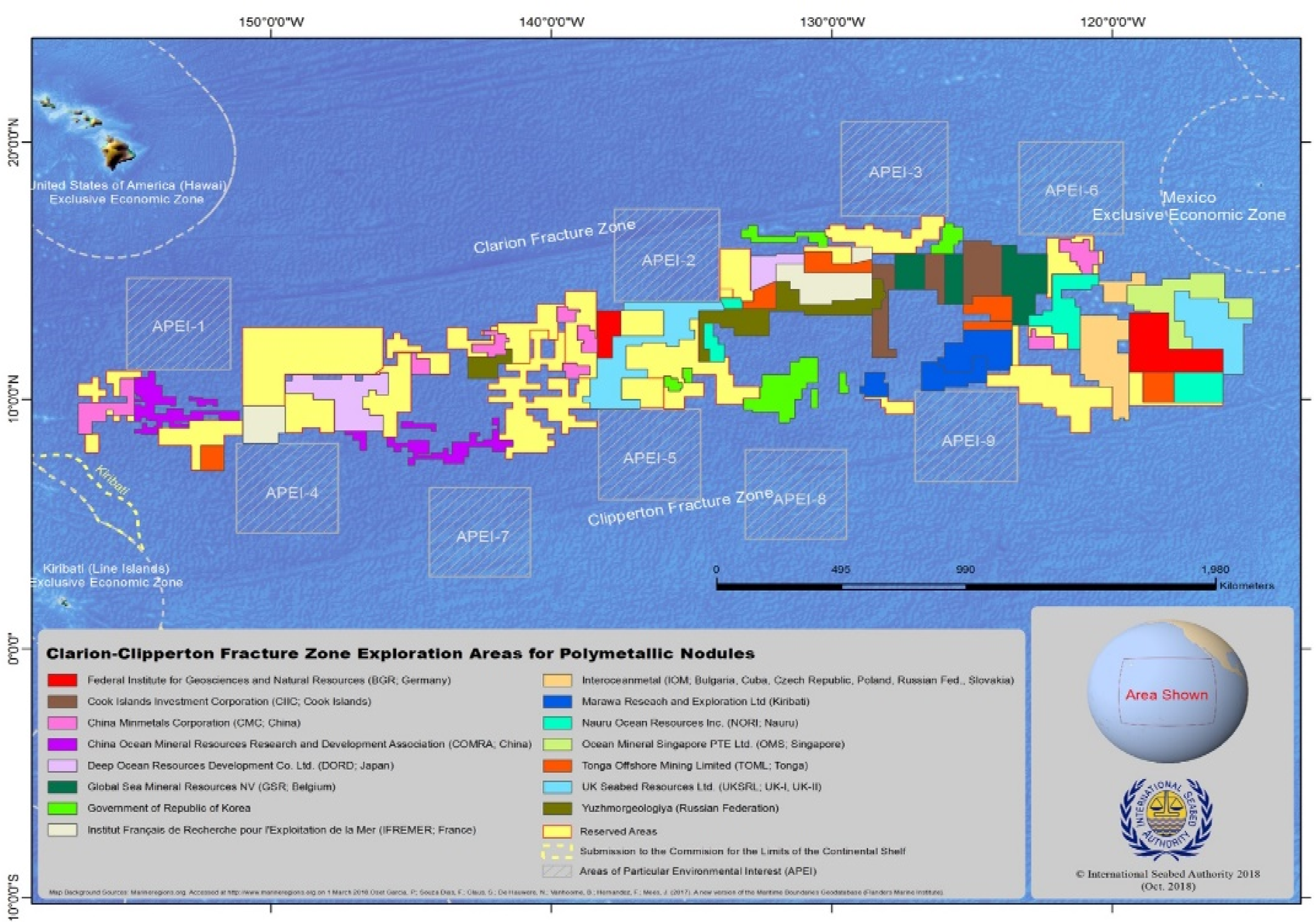
Map of the exploration areas granted in the Clarion Clipperton Zone.
CCZ and pacific island states
Among those interested in the potential economic benefits of the CCZ are Pacific island states whose own Exclusive Economic Zones (EEZ) either include part of the CCZ or are adjacent to it. These include Cook Islands, Kiribati, Tonga and Nauru and most recently Tuvalu. For these states the potential economic benefits of deep-sea mining promise new income revenue streams to facilitate development and mitigate the dangers of overreliance on single source revenues such as fishing (Kiribati), tourism (Cook Islands and Tonga) or exhausted terrestrial mining (Nauru). Lacking national resources to undertake such mining themselves, these countries, being member states of the UNCLOS, have sponsored private companies to undertake exploratory mining.
Debates around deep-sea mining
Deep-sea mining is controversial. Opponents point to the current lack of scientific knowledge about the deep-sea, a vast area which is difficult to access because of its extreme depth and intensity of water pressure, and which is only just beginning to be researched as a result of developments in robotic technology. 21 Lack of knowledge means that it is difficult, if not impossible, to ascertain the environmental impact of any deep-sea mining on the eco-systems, micro-organisms and marine life that inhabit the deep sea. 22 Exploration to date suggests that only 0.01% of the total area of CCZ has been sampled by scientists, that 85% of the global seabed remains unmapped, 23 and that 90% of species discovered are new to science. 24 A further environmental concern is that deep-sea mining may be counter-productive to reducing CO2 emissions as ocean microbes absorb about one third of carbon dioxide generated on land. 25 Ocean microbes also have the potential to provide new antibiotics due to the unique compounds that they produce. Research has indicated that many microbes live on the polymetallic nodules. 26 There is also the issue of noise created by mining vehicles and related activities negatively impacting on cetaceans (whales) and other species. 27 In the Pacific this is a concern not only because in 2017 eleven Pacific Island countries signed up to the Pacific Whale Declaration to strengthen whale conservation across the region, 28 but also because for countries like Tonga, whale watching is a vital contributor to tourism.
Proponents argue that one of the tasks of exploratory mining is to undertake research, not only to ascertain the mining quality and quantity of the minerals that may be available in any given area, but also the marine life, so that the risks of any exploitation, in terms of potential environmental impact, can be assessed. 29 Where there is insufficient knowledge or scientific evidence to fully assess the risk of harm to the environment then the precautionary principle would support protective action, or proceeding with extreme caution or not at all.
While states and companies which are committed to the precautionary principle of environmental protection are likely to take this task seriously, there is the danger that exploration research undertaken by mining companies may be more concerned with ascertaining the value of metals in their allocated area and whether they are worth the very high cost of extraction. Private companies after all, have their investors to think about, while governments committing public funds to such ventures want to see a return. The importance of research regarding the marine life or bio-diversity of the deep-sea may be of secondary importance and impact reporting could be skewed so as to minimise the risk.
Even where exploratory research focusses on possible environmental impacts, the fact is that exploratory mining using relatively modestly-sized equipment cannot forecast the impact of large-scale sea-bed mining should it go ahead. While some research in other areas of the sea-bed have taken place, arguably these do not replicate the conditions or scale of the deep-sea bed, or the processes that would be engaged to extract the metals. 30 Exploration studies tend to use small-scale remotely-controlled machines not the large robotic machines which will be used if, following exploration licences, full mining licences are granted. 31 Research elsewhere suggests that long-term damage is likely. 32
Although deep-sea mining and the harvesting of polymettalic nodules refers to the sea-bed, there is the probability that it will also impact on the column of water above this and the inter-related ecosystems of the ocean. 33 There may also be the danger that the transport ships and mining platforms will cause environmental damage including oil and toxic waste pollution. A study by the Royal Swedish Academy of Science predicted that each mining ship would release about 2 million cubic feet of discharge every day, some of it containing toxic substances such as lead and mercury. 34 Greenpeace has estimated that sediment could travel ‘hundreds or even thousands of kilometres’. 35
Opponents of deep-sea mining argue that not enough is known about the deep-sea, a zone of little light and often near freezing temperatures. 36 Much of the biodiversity of the deep-sea is in its water column – an area not controlled by ISA. However, scientists believe that in the sediment of the seabed there may be thousands of microbial species. 37 To date scientists have identified polychaete worms, crustaceans, sponges, sea cucumbers, starfish, brittlestars, sea urchins and various deep-sea fish in this area. Similarly, on the seamounts there are eco-systems supporting corals, sponges and filter feeders which in turn support tuna, sharks, dolphins and sea-turtles. 38 Around the hot water-vents other species have been identified such as: blind yeti crab, the scaly-foot snail, 39 giant clams, purple octopus, white crabs and 10-foot tube worms. 40 Scientists asserts that the large-scale implications for deep-sea species can only be properly assessed with better knowledge of how the relevant ecosystems function. 41
International organisations such as: the International Union for the Conservation of Nature (IUCN), 42 World Wide Fund for Nature (WWF), 43 and the Ocean Foundation, 44 have spoken out against deep sea mining and urged caution. At a local level the Civil Society Forum of Tonga, 45 the Alliance of Solwara Warriors (Papua New Guinea) 46 and Te Ipukarea Society (Cook Islands) 47 have all advocated a ten-year moratorium on exploration. The Pacific Network on Globalisation has urged caution, stressing the importance of the need for full and informed prior consent from Pacific communities, the adoption of the precautionary principle when considering possible environmental impact, and the importance of potential trans-boundary impacts. 48 This Network has also warned of accepting legislation and policies influenced by bodies outside the region which may not sufficiently consider indigenous rights. 49 Some Pacific island governments (eg Fiji and Vanuatu) and parliamentary oppositions (notably in the Cook Islands), have concerns regarding deep sea mining in the Pacific and have urged a moratorium. 50 Most recently big brands such as BMW, Volvo Group, Volkswagon, Microsoft Google, Samsun and Philips have supported a moratorium. 51 Indeed, in April 2021 a consortia of Pacific civil society organisations wrote to the UK government requesting its assistance to support a moratorium. 52
Deepsea mining and protecting the oceans
As indicated above the race to obtain new sources of rare earth minerals and metals is driven in large part by the shift away from fossil fuels towards ‘greener’ technologies. Justified by a desire of nations to reduce carbon emissions and address climate change, this cannot however, be seen in isolation. There is also an international agenda to protect the oceans through commitment to the United Nations Sustainable Development Goals. (SDGs). 53 Of particular relevance are SDG 14: Life Below Water, which focusses on conserving and sustainably using the oceans, seas and marine resources; and the Aitchi biodiversity targets, which were agreed to give effect to Convention on Biological Diversity (CBD). 54 Notable in this context are targets to safeguard ecosystems, 55 prevent the loss of biodiversity and effectively conserve coastal and marine areas. In 2014 the World Parks Congress suggested that the initial target of protecting 10% of the world's oceans, should be enlarged to 30% of the oceans to be highly protected by 2030. Some countries, including the UK, have adopted this 30 by 30 target. This is to be achieved through the declaration of marine protected areas (MPAs) and Other Effective Area-based Conservation Measures (OECMs). The Global Ocean Alliance brings together 72 countries that share this ambition. 56
Pacific island countries, including those hoping to benefit from deep-sea mining have been at the forefront of advocating protection of the oceans – particularly the Pacific ocean, both regionally and nationally. Cook Islands, for example, declared the whole of its EEZ (2 million sq. km) a mixed-use MPA Marae Moana (Sacred Ocean) in 2017. 57 The aim was to protect and conserve the ecological, biodiversity and heritage values of the marine environment of the Cook Islands. Deep-sea mineral exploration under the Seabed Minerals Act 2019 provided that ‘No licence may be granted that … would likely lead to a contravention of a declaration of a marine protected area, the Marae Moana Act 2017, or other zoning rules’(section 69(1)(b)). The 2020 amendment to the Seabed Minerals Act (Act No 18, 2020) however, makes no mention of the Marae Moana, thereby paving the way to facilitate deep-sea mining in Cook Island waters. 58
In 2015 Kiribati established the Phoenix Islands Protected Area (PIPA), upgrading an area protected for conservation since 2008 to a 408,250 sq km MPA. 59 The move was applauded by the United Nations General Assembly as an exemplary model of marine protection. 60 The PIPA includes extensive breeding grounds for tuna, coral-communities and reef systems and the ‘highly diverse, abundant and ancient life on PIPA seamounts’. 61 To compensate for the ban on fishing the PIPA Conservation Trust Fund Act 2009, established a non-government charity, hoping that funds from public and private donors would be forthcoming. Initial funds were received from Conservation International and New England Aquarium (now replaced by the Aquarium of the Pacific (LA)), and subsequent contributions from the Waitt foundation and Oceans 5. PIPA became a UNESCO World Heritage site in 2010. However, in late 2021 Kiribati declared that it was abandoning the protected status of the PIPA and opening up the area to commercial fishing on the grounds that the financial rewards that had been promised were insufficient to compensate for loss of fishing revenues. 62 The extent to which this is or is not true is debateable. There is some suspicion that China (to whom Kiribati switched allegiance in 2019 – having previously supported Taiwan) has exerted pressure to gain more fishing concessions, 63 or that overspend by the Kiribati government has left a hole in its finances. Whatever the cause, it means that Kiribati can now pursue deep-sea mining on its doorstep without the criticism that this goes against the rationale for establishing the PIPA.
In contrast Niue declared its intention this year to protect all of its EEZ, 64 and Tonga has also committed to designating 30% of its EEZ as Marine Protected Area by 2030. Tonga however is a country that is deeply in debt, 65 and while the flow of remittances from the Tongan diaspora keep the economy afloat, disruption to tourism as a result of border closures during the pandemic has highlighted the importance of seeking other revenue streams if the economy is to move into the black. The economic attraction of deep-sea mining is understandable.
There is sadly a paradox in the Pacific. At a regional level Pacific island states are committed to ensuring that its shared stewardship of the Pacific Ocean recognises ‘the connections that Pacific people have with their natural resources, environments, cultures and livelihoods’. 66 Pacific island countries are also in the frontline of the adverse effects of climate change including warming seas, rising sea levels and coastal erosion, salt-water inundation into fresh-water lenses, erratic weather including more frequent heavy rain surges and droughts. The commitment of the developing world to addressing the causes of climate change is important to them. At the same time these are countries with little resilience to economic shocks or disruptions (as occasioned over the last two years by the Covid-19 pandemic impact on tourism), 67 are deeply aid-dependent, and in many cases have few natural resources which can be exploited to facilitate development and improve the lives of their citizens. A joint statement issued by the Nauru government by Nauru, Tonga and Kiribati described seabed mining as ‘a welcome and exciting development … which should be embraced by everyone who cares about the climate future of our planet’. It is also seen as ‘an extractive industry regime (which) will aim to alleviate some of the economic disparities that exist between the Global North and the Global South’. 68
It is also the case that while Pacific Islands, such as Cook Islands, recognise the need for baseline studies, mitigation strategies and monitoring, they lack the resources to carry these out themselves. They are therefore dependent on outside scientific expertise. This has to be funded and so it is usually the mining companies which provide or finance this expertise giving rise to question marks around transparency, independence and rigor. 69 Deep sea mining also raises management, technical and legal issues which Pacific islands are ill-equipped to deal with. While there may be technical capacity at a regional level, organisations, such as the South Pacific Community and the South Pacific Regional Environment Programme, had to date been silent on the issue of deep-sea mining. 70 These organisations may, in any case, be mindful of the financial repercussions which could flow from aligning themselves one way or the other.
There are therefore economic imperatives that have to be weighed against environmental risks and competing marine priorities. There are also legal questions that have to be resolved.
Regulating deep-sea mining
While the Law of the Sea Article 192 provides that ‘States have the obligation to protect and preserve the marine environment’ their sovereignty only extends to their own EEZs. Deep-sea mining within an EEZ even if the environmental consequences spread beyond that EEZ are within the sovereign jurisdiction of states. As indicated earlier the governance and regulation of the ‘Area’ (that part of the sea-bed falling outside of national jurisdictions) falls to the International Seabed Authority (ISA).
The role of ISA
As indicated above, the International Seabed Authority (ISA) is an autonomous United Nations body established in 1994 under the UNCLOS. It has 168 members, which normally meet once a year in Jamaica. The ISA has the task of promoting and regulating sea-bed mining outside EEZs and responsibility for issuing exploration licences. Applicants must be either state signatories to UNCLOS or sponsored by state signatories. 71 The sponsoring state has responsibility to ensure that a contractor observes UNCLOS and ISA rules. The International Tribunal for the Law of the Sea has published an advisory opinion on the responsibilities and obligations of states in this regard, which sets high standards of due diligence. 72 To date the ISA has granted thirty-one 15-year exploration mining licences for deep-sea areas in the Atlantic, Pacific and Indian Ocean. It will consider a further application from Tuvalu later in 2022. 73 Of these licences 17 are for exploration of polymetallic nodules in the CCZ, and five are for cobalt-rich crusts in the Western Pacific Ocean.
(Table 1)
ISA mining exploration licences.
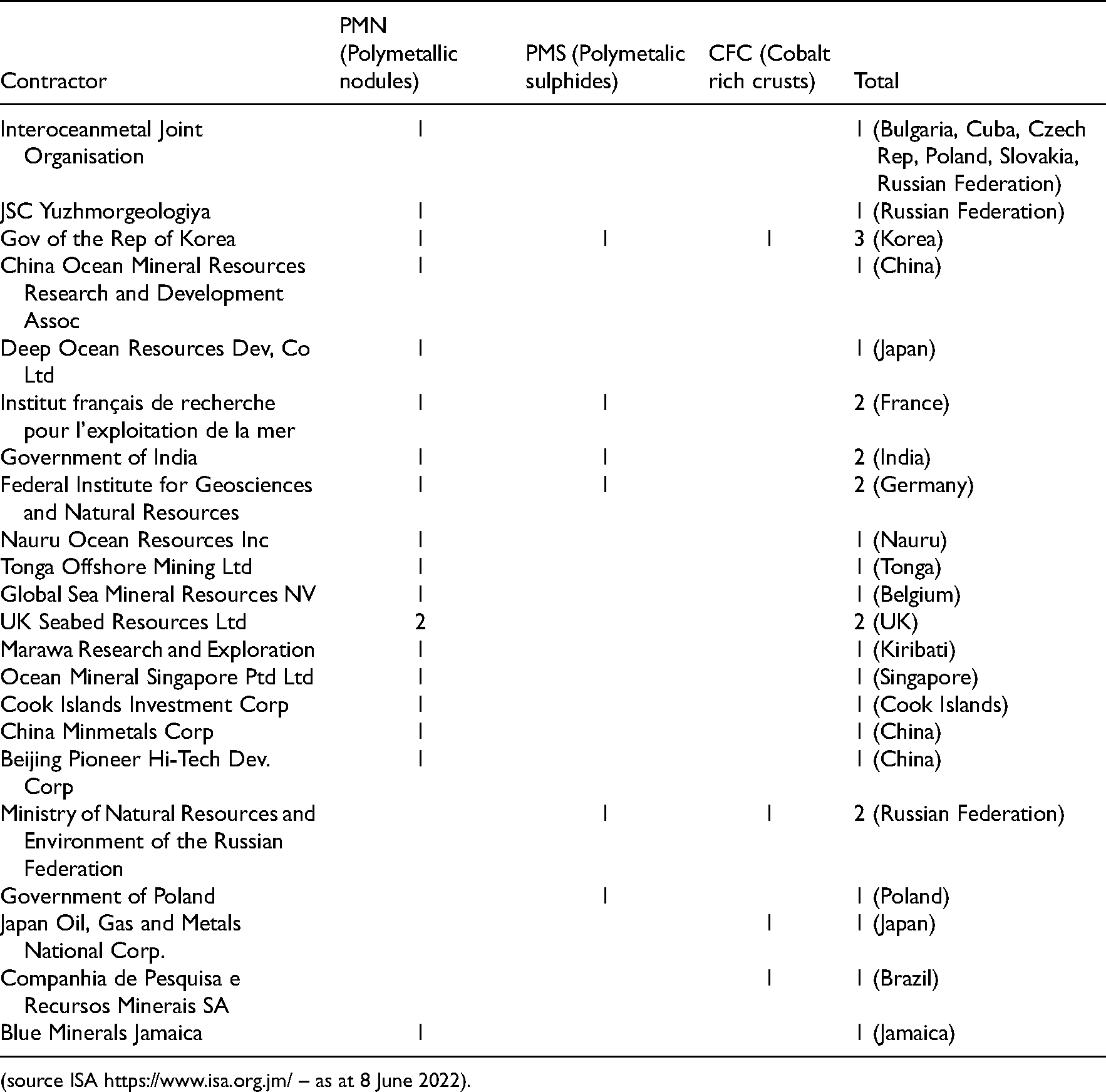
(source ISA https://www.isa.org.jm/ – as at 8 June 2022).
As indicated above the ISA has at present only granted exploration licences These exploration contracts have been granted either to countries undertaking exploration themselves, or to countries sponsoring private companies or public/private companies to undertake exploration. However, there is a loophole in the current regulatory regime which permits a state to indicate that it will commence exploratory mining in two years. Nauru has triggered this provision. 74 This means that ISA has two years from the date of Nauru's notification - which was in June 2021, 75 to put in place a raft of appropriate measures to regulate mining of the deep-sea bed. If it fails to agree regulations then ISA must consider and provisionally approve Nauru's mining plan based on whatever regulatory regime is in place in 2023. While there is some debate as to whether the obligation of ISA to consider means that it must approve the Nauru plan, the fact that to date the ISA has not refused any exploration licences does not give hope for optimism that it will refuse.
Much needs to be done. There are currently a number of legal gaps in the regulation of deep-sea mining. Firstly, ISA members have not yet agreed a mining code to govern exploitation agreements. This has been pending since 2014 and while it was hoped that consensus among the 168 members might be reached at the annual meeting in 2020, this was not held due to COVID-19. A COVID restricted meeting did take place in December 2021 in Kingston, Jamaica but the negotiation of regulations was not part of the agenda, 76 nor were a number of members able to be present including those most opposed to deep-sea mining. Primarily the meeting set out a road map going forward with an increased number of meetings scheduled for 2022. The Legal and Technical Commission (LTC) met behind closed doors in April 2022 but even if new regulations are agreed these are unlikely to be voted on by the full council until 2023. There was moreover concern regarding the lack of transparency around the LTC meeting, not least because many of its members are contracted to mining companies. 77
Secondly, there is as yet no agreed mechanism for the distribution of economic benefits derived from deep-sea mining should mining go ahead. 78 Companies and governments that have invested heavily in exploration endeavours and then exploitation activities will be seeking to recoup their costs and make profits. However, where this mining takes place in the ‘Area’ governed by ISA any benefits are meant to be for ‘humankind’ because this Area is part of the global commons. 79 There therefore needs to be a mechanism for collecting, managing and distributing these funds, and meeting the diverse expectation of benefit. 80 Arriving at consensus in this context is no easy task. 81
Thirdly, given the difficulties of establishing fault and causation for environmental harm – especially in the deep sea where there are no physical barriers, there needs to be in place some form of pollution insurance to cover the possibility of environmental harm to species, livelihoods, marine and land environments. 82 Again, nothing has been decided on this to date.
Fourthly, while the ISA imposes an obligation on sponsoring states to undertake an environmental impact assessment (EIA) to support exploratory mining and this is a state obligation under Article 206 of UNCLOS, it has been suggested that ‘the existing regulations present only a portion of a robust EIA process’. 83 In particular they lack detail and do not directly feed into the decision-making process. Indeed, it has been suggested that ‘A high degree of uncertainty exists in all aspects of the environmental management of DSM projects: a lack of environmental understanding at all spatial and temporal scales; mining and support technologies that are still under development; and environmental regulations that are still in draft form.’ 84 At present the control of information in the EIA is largely in the hands of the applicant, and therefore lacks robust and impartial oversight or assessment against standards, objectives or actions established by the regulator. The dangers of weak EIA processes in respect of any deep sea mining are illustrated by the Solwara 1 project in Papua New Guinea – a project that ultimately collapsed and cost the Papua New Guinea government a considerable sum of money. 85 The proposed deep-sea mining was within the EEZ of Papua New Guinea. Although approved, a subsequent independent review of the EIA by a non-government organisation found that there was insufficient information to evaluate the impact of the mining, the baseline studies were incomplete, the risk assessments were inadequate for many aspects of the mining process, mitigation measures were underdeveloped or untested, there was a lack of sufficient stakeholder engagement and a lack of transparency about the process. 86
A further concern is whether ISA is fit for purpose. 87 Greenpeace claim that ISA is increasingly subject to lobbying by mining companies some of whom speak on behalf of government delegations at the ISA meetings. 88 These companies also prepare and fund government applications for exploration contracts. This is particularly likely to happen in countries where there is a lack of autonomous technical skill. A High Level Panel for Sustainable Ocean Economy has also expressed concerns about the governance of ISA and a lack of transparency, and apparent mining-approval bias facilitated by the procedural obstacles faced by those who wish to oppose a mining application. 89 There are also concerns that the ISA lacks an environmental or scientific assessment group. Applications for licences are considered by a legal and technical commission dominated (it is claimed) by lawyers and geologists. 90
Areas beyond national jurisdiction
While the ISA is responsible for the ‘Area’, falling into what some might consider an environmental legal lacuna, are the seas which lie beyond national jurisdictions, and above the seabed. Clearly this is not a total legal black hole as there is plenty of legislation to regulate shipping, dumping at sea, the transhipment of hazardous waste, the taking of fish etc across this area of the seas commonly referred to as the global commons or the heritage of mankind. This area of high-seas make up about 40% of the surface of the planet and 64% of the surface of the oceans. By its very nature the constantly moving column of water cannot belong to anyone and international law recognises the rights of all to traverse it and utilise it within the constraints of agreed international laws. In recent years however, it has been felt that the current legal regime fails to sufficiently protect and secure these areas for future generations. 91 In particular there is concern that the bio-diversity and the environmental value of the high seas is insufficiently protected from degradation and unsustainable extraction. Climate change and ocean acidification are also impacting adversely on the high seas as is the widespread problem of plastic pollution. While the UNCLOS creates a general obligation on all states to conserve the marine environment there is no single instrument which establishes a framework for protecting marine diversity. There is, therefore, a proposal, currently on the table, to create a new international instrument under the umbrella of the United Nations Convention on the Law of the Sea to Govern Areas Beyond National Jurisdiction (ABNJ). 92
In 2004 the United Nations General Assembly created an ad hoc working group to look into the matter. This met between 2006 and 2015. In 2011 the issues to be considered were agreed. These were: marine genetic resources – including the sharing of benefits; area-based management tools – including marine protected areas; environmental impact assessments; and capacity building and the transfer of marine technology. In 2015 The General Assembly adopted a resolution to develop an international legally binding instrument and established a preparatory committee to make recommendations to the General Assembly on a draft instrument. 93 The preparatory committee met between 2016 and 2017, culminating in an inter-governmental conference when the final report of the preparatory meetings was presented in July 2017. 94 In December 2017 the UNGA adopted Resolution 72/249 approving the commencement of negotiations for a new international instrument. The first round of negotiations was held in 2018. A first draft was produced in August 2019 and a revised draft in late 2019. 95 The original aim was to conclude negotiations in early 2020. The COVID pandemic intervened. Virtual sessions were held in late 2020. The fourth session of the inter-governmental conference on the proposals was held in March 2022. 96 Further revisions to a draft were discussed and incorporated, with a revised draft being published in May 2022. Although progress is being made a final draft still seems to be some way off. 97
While it is clear that regional, national and sectoral measures regulating the high seas and their resources are failing to sufficiently protect the oceans, arriving at any consensus of what an international framework should look like or how it would work is contentious. Scientists would like to see the establishment of a network of marine protected areas as key area-based management tools. Developing countries would like to see a mechanism for the more equitable distribution of benefits deriving from marine genetic resources and the ocean's bio-diversity. Environmentalists would like to see standardisation on all stages of environmental impact assessments affecting the oceans and for most, if not all, activities. Countries lacking scientific and technical expertise have challenged the form and process of capacity building and technology transfer which is promised, while others have pointed out that very few countries have the capacity to appropriate marine genetic resources, and those that do, want to be able to do so without burdensome regulatory regimes. 98 There is also some concern regarding the relationship of any new international instrument with regulatory regimes that already exist especially as regards fisheries. 99
Any new treaty will need to work with existing regulatory bodies, including the International Seabed Authority. How the potentially competing priorities of these various bodies will be harmonised remains to be seen. What is evident from the negotiations around the draft text of the treaty is that arriving at consensus is extremely difficult. This does not bode well for a comprehensive set of regulations to govern deep-sea mining. In their absence the negative consequences of deep-sea mining might be avoided if other paths were chosen to reduce the consumption of fossil fuels in vehicles and to devise alternative methods of storing renewable energy.
Adopting an holistic approach to the challenges of ‘going green’
The demand for the metals which can be secured by deep-sea mining, is, as stated at the outset, driven by the desire to reduce carbon emissions and move to renewable energy supplies and encourage or compel a shift to electronic vehicles. More needs to be done therefore to explore other options for supporting these shifts.
A report produced for Earthworks in 2019, 100 indicated that ‘Recycling is the most important strategy to reduce primary demand’. At present although there is some recycling of batteries and the metals they contain, it is limited. 101 Paul Anderson speaking to the BBC in April 2021 indicated that only about 5% of lithium-ion batteries are currently recycled. 102 One approach would be to require manufacturers of such batteries to also provide recycling plants. This is happening with some European manufacturers. The problem is that the biggest producers of such batteries currently have much weaker regulatory regimes, not only in terms of production, but also as regards recycling. If a more circular economy is to be pursued then there has to be commitment to recycling as well as manufacture supported by fully integrated regulatory frameworks. 103 This may require government incentives, prioritisation in policy and public/private investment.
Another problem is that recycling may not be carbon neutral. For example, currently separating out lithium, manganese, cobalt and nickel from recycled batteries is energy-intensive, and the cost (especially labour costs) may act as a disincentive or tempt battery manufacturers to shift recycling to places where regulatory regimes – including environmental regulations, are less strict and labour cheaper. Some of these costs can be reduced through new technologies and the deployment of robotics, so a further associated strategy to reduce primary demand is not only to give more attention to technologies that reduce the quantity of metals needed for batteries but also to improve the cost effectiveness of recycling.
There is also research being undertaken on alternatives to lithium-ion batteries. This includes work being done on sodium-ion batteries which would rely on cheap and available sodium (salt) rather than rare metals; 104 hydrogen fuel cells – with work being developed by Toyota; 105 graphene supercapacitators – being researched in conjunction with lithium-ion batteries by Samsung; 106 lithium-sulphur – being researched by Sony; 107 and redox flow batteries which combine hydrochloric acid and sulphuric acid to produce batteries with particularly capacity for storing wind and solar energy (powerpacks). 108 There is also ongoing research on batteries which are more environmentally friendly. Developments in Sodium (Na)-ion batteries is being carried out at the University of Warwick, 109 while research at the University of Bristol collaborating with Imperial College, London is developing batteries using sodium and potassium ions. 110
Cars could also be powered by their own solar panels, 111 or, instead of cars being powered, the roads could be (not dissimilar to the principle behind trams) - prototypes have been trialled in Sweden (for trucks) and the Netherlands. 112
These alternatives are not always carbon-neutral. For example, the upside of hydrogen fuel is that burning hydrogen produces only water as a by-product and is more efficient and cleaner than lithium. The downside is that the production of hydrogen requires fossil fuels – although alternatives are being explored using algae and other resources that might be turned into hydrogen. Nor do they provide immediate alternatives, for example graphene supercapacitators could replace batteries altogether but research to date has not produced sufficiently useable and stable graphene. In the interim research is ongoing looking at enhancing the performance of lithium-ion batteries in conjunction with graphene.
While encouraging, many of these innovations are a long way from being commercially viable or capable of being produced at scale. Nor is the government ploughing the same amount of money into these types of research as it is into facilitating the move to electric vehicles which are already being manufactured.
Conclusion
From an environmental perspective a shift to electronic vehicles may be short-sighted. While the sale of electric cars is accelerating the underlying issues of too many cars on the roads and traffic congestion are not being addressed. Similarly, promising greater provision of charging points, does nothing to address energy consumption. That energy has to come from somewhere and even if it is from renewable sources such as wind and solar, it needs to be stored and conducted to points of use. Currently this also needs rare metals. At the same time the ‘green revolution’ is unlikely to mark a levelling up either of access to electric vehicles across societies – including in the UK, but more particularly between the developed and developing world. In the latter not only are there challenges of infrastructure deficit and limited in country technology and research resources but also limited consumer purchasing power to obtain electric vehicles. Critics, moreover, consider that the shift to electric vehicles will not reduce carbon emission sufficiently to keep global warming to the 1.5 degrees above industrial levels agreed in the Paris agreement because the change will be too slow, piecemeal and not entirely carbon-neutral. 113 These are all important considerations. The focus of this article however has been on the environmental risk associated with procuring the metals necessary for the manufacture of electric cars and related to this the storage of power systems to charge them. Deep sea mining to meet the manufacturing demands triggered by government agendas to move to electric vehicles will cause environmental damage far from the corridors of Westminster. If, however, the need to address climate change is a global concern then repercussions across the planet should be taken into account in developing solutions.
Footnotes
Declaration of conflicting interests
The author(s) declared no potential conflicts of interest with respect to the research, authorship, and/or publication of this article.
Funding
The author(s) received no financial support for the research, authorship, and/or publication of this article.
