




Abstract
The study examines young children’s peer group interactions characterized by creative language use. We operationalize the concept of everyday poetics to explore the forms, heteroglossic resources, and the social and aesthetic purposes of children’s peer encounters. The data consists of video ethnography conduced in a bilingual Swedish-English preschool for children aged 1–5 in Sweden. Using multimodal conversation analysis, the study shows that everyday poetics involved young bilinguals engaging in aesthetic, exploratory talk through sound and meaning associations, category explorations, and cross-speaker sound and word play in both institutional languages. Children’s language play served multiple purposes beyond the social relationality of the peer group. Children employed heteroglossia in aesthetic performances and language teaching, which became integral parts of social episodes that began as language play. The study argues that analytical attention to aesthetic and playful features of everyday interaction can contribute to our deeper understanding of human sociality.
Introduction
Human language is a multifaceted means of communication, used to accomplish social actions, make explicit references and perform social identities (cf. Goodwin, 2018; Jakobson, 1960; Ochs, 2012). Children who learn to speak more than one language from an early age encounter language as a dialogical phenomenon, with each utterance representing various—sometimes overlapping or even contradictory—voices, practices, and linguistic varieties (cf. Bakhtin, 1981; Linell, 2009). As demonstrated by multiple studies, verbal play from an early age provides children with a means of language exploration, serving as an important resource for expressing identity, forming alliances, and navigating conflicts within multilingual peer groups (Cekaite, 2018; Chukovsky, 2022; Iwamura, 1980). The poetic potential of language—that is, its self-referential use for aesthetic purposes or as an expression of creativity (Carter, 2016; Jakobson, 1960)—in everyday conversations has received comparatively less attention in sociolinguistic research.
This study explores young children’s verbal play in a bilingual Swedish-English preschool for 3–5-year-olds in Sweden. It examines the poetic potential of heteroglossic verbal practices in children’s peer interactions and aims to contribute to our understanding of young children’s verbal creativity (e.g., “verbal artistry” in Bauman and Briggs, 1990; and “the poetics of ordinary talk” in Jefferson, 1996) within a heteroglossic institutional setting, where two languages—Swedish and English—were used and taught in parallel activities. As will be argued, verbal creativity involves young children’s phenomenological engagement with language (Ochs, 2012) and their aesthetic and affective experiences in the process of co-constructing shared peer cultures.
Theoretical perspective
The study builds on the notion of heteroglossia, introduced by Mikhail Bakhtin to describe “the social diversity of speech types” (Bakhtin, 1981: 263). Heteroglossia is now a widely used term applied across various domains where multiple language varieties are used. Although Bakhtin originally developed this concept in relation to literary texts—specifically the novel as a genre—his view of heteroglossia is instrumental in depicting diverse characters: it serves as a tool that authors use to index the diversity of characters through specific linguistic resources. Speech types, dialects, and languages are thus treated as symbols or representations of different speaker types, often associated with “partly opposed or conflicting spheres” (Ivanov, 1999: 101). Heteroglossia encompasses both centripetal (unifying) and centrifugal (stratifying, dispersing) forces. As Bakhtin writes, “[t]he authentic environment of an utterance, the environment in which it lives and takes shape, is dialogized heteroglossia, anonymous and social as language, but simultaneously concrete, filled with specific content and accented as an individual utterance” (1981: 272).
In sociolinguistics, heteroglossia refers to context-bound, situated meanings of a language indexed by linguistic and other semiotic resources, and their role in the organization and negotiation of the local social order (cf. Kyratzis et al., 2010). Previous research on languages socialization has demonstrated that children in multilingual contexts, particularly those with diverse linguistic backgrounds learning the majority language, effectively employ heteroglossic practices in their “creative appropriation of hegemonic values regarding language” (Evaldsson and Cekaite, 2010: 602). The present study also foregrounds the performative function of language as a key aspect of heteroglossia. Importantly, heteroglossic practices are understood not merely as displays of social distinctions, but as means through which such distinctions are brought into being, contested, and negotiated (Bauman and Briggs, 1990).
A phenomenological understanding of language—that bridges its symbolic, indexical, and performative functions—highlights that “everyday speech is an experience in itself” (Ochs, 2012: 149). This perspective draws attention to “the poetics of ordinary talk” (Jefferson, 1996) and language’s “phenomenological potential to immerse interlocutors in an affective zone of intense intimacy” (Ochs, 2012: 151). Such a theoretical approach can be fruitfully operationalized by exploring everyday interactions and the situated ecologies of talk, including children’s peer group interactions, which are characterized by a symmetrical social organization that supports play and joint creative actions.
Previous research
Research on young children’s social interactions has demonstrated that play with language features is part of their social and verbal repertoires from an early age (Cekaite, 2018; Chukovsky, 2022; Iwamura, 1980). Children use, explore, and transform various aspects of language, beginning with sound play (Aronsson, 2011; Ferguson, 1977; Keenan, 1974). Numerous studies have shown that children’s verbal play serves multiple functions. It is exploratory in nature and reflects their journey toward discovering and mastering various linguistic features. For example, young children can create and exploit the ludic potential of incongruities between correct and imaginative lexical glosses and other linguistic elements (Cekaite, 2018; Dunn, 1998). Moreover, manipulating language features provides both individual enjoyment and opportunities for shared playful activity. In their studies of 7–9-year-old children’s verbal play during everyday peer interactions in a Swedish primary school, Cekaite and Aronsson (2004, 2005) demonstrated that variation and transformation of multiple features of Swedish contributed to the microgenetic development of language creativity. The increasing complexity of children’s artful language use reflected their growing lexical, syntactic, and pragmatic knowledge, supporting their overall language proficiency (cf. Blum-Kulka et al., 2004; Iwamura, 1980). Their playful engagement was associated with, and interpreted through, the lens of the “poetics of ordinary talk” (Jefferson, 1996), characterized by the systematic “clustering of sounds, curiously playful turn-designs, conspicuously well-fitted word-selections, and so on” (Rae et al., 2021: 1; see also Mlynář and Rieser, 2025: 2).
This conversational understanding of poetics can be further developed by connecting it to Jakobson’s (1960) view of the poetic function of language—that is, its metalingual, self-referential use that enables speakers to reflect on linguistic form. As illustrated by Cekaite and Aronsson (2005), children engaged in everyday poetics by building on, recycling, and expanding each other’s contributions, deploying both similar and divergent features to achieve affiliation in peer play. Notably, their language play was also shaped by the features of the multilingual educational setting, where children were learning Swedish as a second language (cf. Howard, 2009, on children’s play with different registers; see also Nasi, 2024, on wordplay by multilingual children in Italy).
These studies show that children creatively exploited various features of their language learning practices—such as language drills, normative and invented conjugations, word endings, novel derivations, and teacher register—to construct ludic situations characterized by collaborative improvisation. The entertaining potential of these practices was grounded in children’s shared experiences as second language (L2) learners in classroom settings. Publicly performing erroneous uses of Swedish not only demonstrated their metalinguistic or metapragmatic awareness but also served as a way for children to position themselves socially and display their stance on their social identities.
Studies on interactions among young L2 learners in educational settings have also suggested that, in multilingual contexts, children may orient themselves toward different ideological and societal values associated with majority and/or minority languages by engaging in heteroglossic verbal practices. These practices are characterized by the “differentiation of multiple codes and registers in the creation and negotiation of social distinctions” (Kyratzis et al., 2010: 457). Several studies on children’s peer play in multilingual educational settings have demonstrated that children use heteroglossic practices—such as switching between available linguistic codes—to criticize or affiliate with peers (Björk-Willén and Cromdal, 2009; Cekaite and Evaldsson, 2017; Evaldsson and Cekaite, 2010; Kyratzis, 2010). Björk-Willén and Cromdal (2009) found that 3-year-old children in multilingual preschools in Sweden and Australia strategically selected different linguistic codes during peer play, demonstrating an awareness of the social meanings indexed by the those codes. Their study illustrated how young L2 learners recycled and playfully enacted educational practices such as book reading, object labeling, and self-introduction routines. By choosing among the linguistic codes available in their preschools, the children were able to assume specific play roles—such as teacher or student. These heteroglossic verbal practices reflected children’s understanding of the local, situated meanings and the status of institutional languages.
Similarly, Kyratzis (2010) showed how children from a minority linguistic background (Spanish) used their shared home language in a monolingual educational setting—an English-language preschool in the United States—to navigate the “polarizing discourses about national belonging” (2010, p. 558), while managing participation frameworks and shifting “footing” (Goffman, 1979) across two languages. While their play often reproduced ideologies about the hierarchical status and social roles of English and Spanish in the United States, their heteroglossic practices—including fluid transitions between languages and the creation of hybrid utterances—enabled them to “blur the boundaries” between the languages and enact their bilingual identities (Kyratzis, 2010: 579).
The ability to recognize and use heteroglossia is, however, a learned skill. Children require not only time to develop their L2 but also support from teachers in order to enter and participate in multilingual peer play (Cekaite and Evaldsson, 2017; Cekaite and Simonsson, 2023). In their study conducted in a monolingual (Swedish) preschool, Cekaite and Evaldsson (2017) followed a 3.5-year-old immigrant girl who recently arrived in Sweden. Other children—also from various immigrant backgrounds—used their more advanced knowledge of the majority language to exclude her from peer play. The study highlights the importance of teachers taking an active role as language socialization agents. Their participation in cross-linguistic meaning negotiations and their scaffolding of children’s multiparty activities were shown to be crucial in establishing a productive language learning ecology within this heteroglossic institutional context.
Beyond the negotiation and management of social roles, heteroglossia has also been discussed in relation to children’s poetic—both aesthetic and affective—engagement with language(s). In another study on multilingual children’s interactions in a Swedish preschool, Cekaite (2018) illustrated how innovation, conformity, and incongruence in children’s language play can contribute to the microgenesis of language creativity. The study revealed that learning to play with the norms and rules of language often occurred as a collaborative performance in multiparty settings. It involved verbal improvizations, repetitions, and innovations, providing “empirical support for the theoretical conceptualization of creativity as a social and cultural process, <. . .> one of the core features that characterize human sociality” (Cekaite, 2018: 34; cf. Vygotsky, 1990).
The present study aims to deepen our understanding of young children’s engagement in everyday poetics by focusing on heteroglossic practices in peer interactions. By examining naturally occurring interactions in the bilingual institutional setting of a Swedish-English preschool, the goal is to gain greater insight into how children orient to and appropriate linguistic resources within their play repertoires. Additionally, the study seeks to explore how young children’s verbal play contributes to the organization of their social relationships.
Method
Setting and data
Video-ethnographic data were collected in a bilingual Swedish-English preschool located in an urban area in Sweden. The preschool followed a two-way bilingual education model with one-teacher/one-language policy (cf. Schwartz, 2024: 54). Although Swedish is the socially dominant language in Sweden, English holds high status, resulting in a relatively flat language hierarchy and a symmetrical distribution of both languages in daily preschool activities. All structured activities were conducted in both languages on an alternating schedule (e.g., circle time in Swedish on Monday and in English on Tuesday). During free play, mealtimes, and transitional activities, teachers consistently used their designated institutional language. In line with the national curriculum for early childhood education and care (ECEC; Skolverket, 2019), teachers emphasized the communicative aspect of language learning. However, some structured literacy activities in both English and Swedish—such as alphabet instruction, thematic vocabulary learning, drills, translations, and metalingual commentary—were incorporated into the weekly schedule.
All Swedish-speaking teachers had a good command of English, although the English-speaking teachers varied in their proficiency in Swedish, ranging from near-native to very rudimentary. In conversations among the staff—for example, during planning meeting—English was typically used. The children came from diverse linguistics backgrounds, including English (UK and US varieties), Swedish, French, Italian, Turkish, Japanese, among others. Most children began attending the preschool between the ages of 12 and 18 months, with very limited expressive verbal skills, and were immediately immersed in the Swedish-English environment. The children were free to choose either English or Swedish when interacting with both teachers and peers. It was evident that they recognized the teachers’ language preferences and generally addressed them in the corresponding language. However, Swedish was typically (though not always) used in peer interactions.
Data collection was conducted during two research periods, each lasting 2 weeks, in March and September 2020. 1 It involved 80 hours of video-recordings of naturally occurring interactions. The participants included the preschool staff and children aged 12 months to 5 years. The documented activities encompassed both unstructured and structured events, unfolding according to the typical daily schedule. These included morning arrival and greetings, free play, circle time, park visits, mealtimes, and teacher-led instructional activities (e.g., alphabet, book reading, mathematics, crafting).
The video-ethnographic data were logged, coded, and transcribed. Analytic attention focused on children’s peer interactions, particularly instances of language play. Special emphasis was placed on heteroglossic language play—characterized by children’s use of multiple language codes. The data were analyzed using multimodal conversation analysis (Deppermann, 2013; Goodwin, 2018), exploring the sequential organization of interaction and participants’ use of verbal and embodied semiotic resources. The initial selection of episodes for this study included situations where: (i) children highlighted their use of linguistic resources and (ii) employed code alternation (i.e., heteroglossia) in a playful and socially strategic way. Detailed contextual analysis revealed that heteroglossic language play was linked to situational context (e.g., free play periods) and to children’s ability to use interactional and linguistic resources in a self-referential—that is, metalinguistic and poetic (cf. Jakobson, 1960)—manner.
All names in the transcripts are pseudonyms. Transcription conventions are listed in the Appendix 1.
Analysis
Analysis of children’s peer interactions in the bilingual preschool suggests that episodes of language play and creativity involved children’s varied and incongruent uses of multiple linguistic features—pronunciation, sound play, novel lexical derivations, metalinguistic comments, imaginary languages, and alliteration—in what can be called described as situations of everyday poetics (cf. “poetics of ordinary talk” in Jefferson, 1996). These episodes were inherently social: language play and heteroglossia were layered onto the children’s social activities. Within the institutional context—where children differed in age and linguistic proficiency—these conditions occasioned language exploration and, at times, led to negotiations of meaning and shifts in footing as children navigated between play and non-play frames. The bilingual educational policy was reflected in children’s improvisational verbal play, which was marked by heteroglossia: the strategic, but also spontaneous and improvisational use of available codes (Swedish and English), as well as the creation of imaginary, ludic idiolects, produced through co-operative action (Goodwin, 2018).
Sound play and emergent heteroglossic negotiation of meaning
Analysis of children’s peer interactions in the bilingual educational setting demonstrates how everyday poetics functions as a resource within children’s play repertoires, characterized by its emergent, occasioned, and improvisational nature. Transformations of language forms—including playful manipulation of phonetics and pronunciation—were occasioned by the interactional dynamics of the moment. However, these actions were not always recognized or taken up as playful by all participants, at times, occasionally resulting in misalignment within the play actions.
Excerpt 1 illustrates how two 3-year-old girls, Emma and Vera, become entangled in negotiating the boundaries of the play frame. During a free play period, their interaction involved transformations of pronunciation and heteroglossic practices, leading to a shift from ludic engagement with language to a search for shared meaning. In this episode, Vera, holding a piglet mask, approaches Emma and introduces herself as “Greta Gris” (the Swedish version of the popular cartoon character Peppa Pig; gris meaning “pig” in English). Although Emma responds with enthusiasm, the interaction soon becomes marked by ambiguity and misalignment around the pronunciation and meaning of “Greta Gris” and, eventually, “Peppa Pig.”
Excerpt 1: Greta Gris—Peppa Pig
Emma (3yo), Vera (3yo)
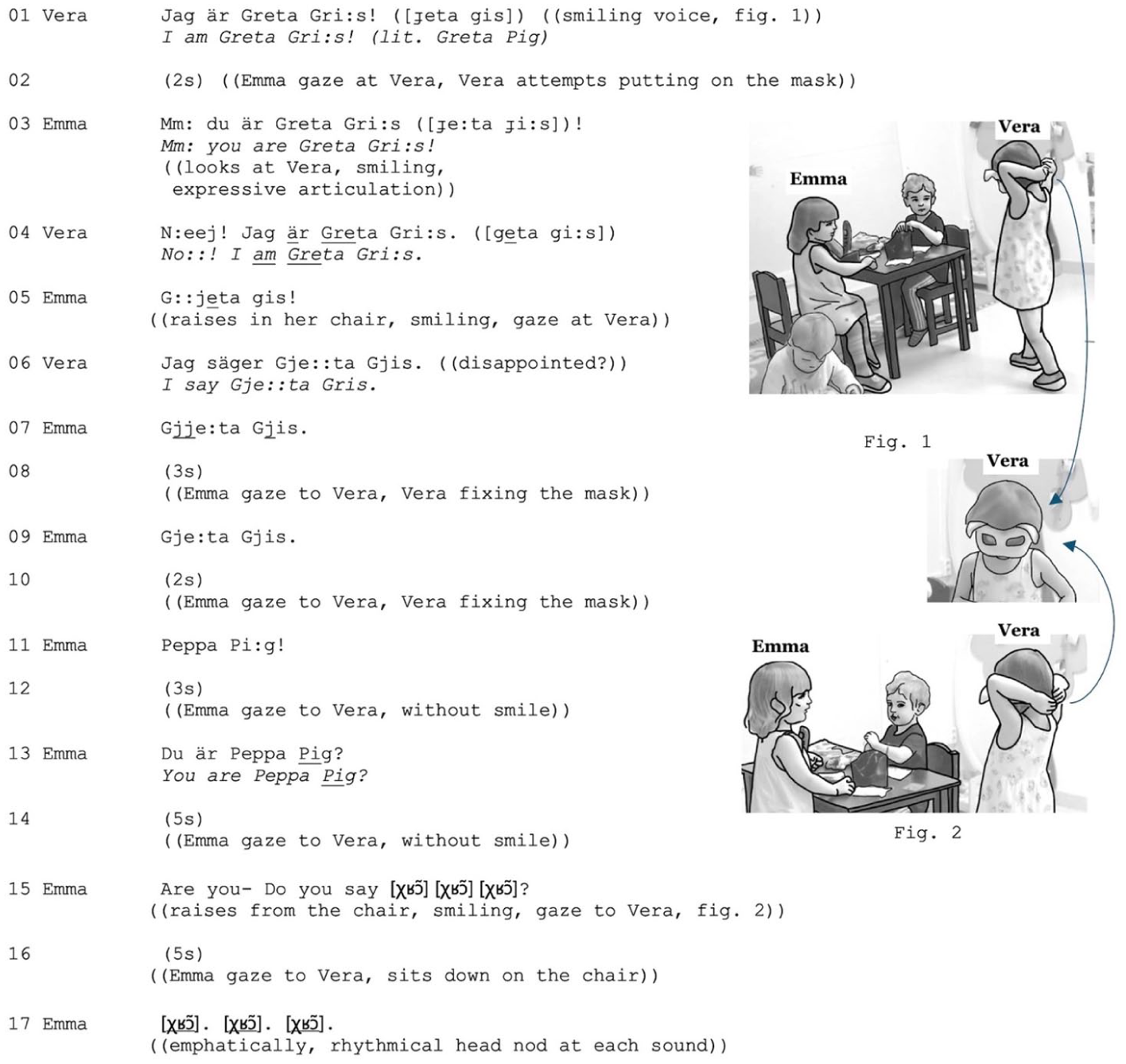
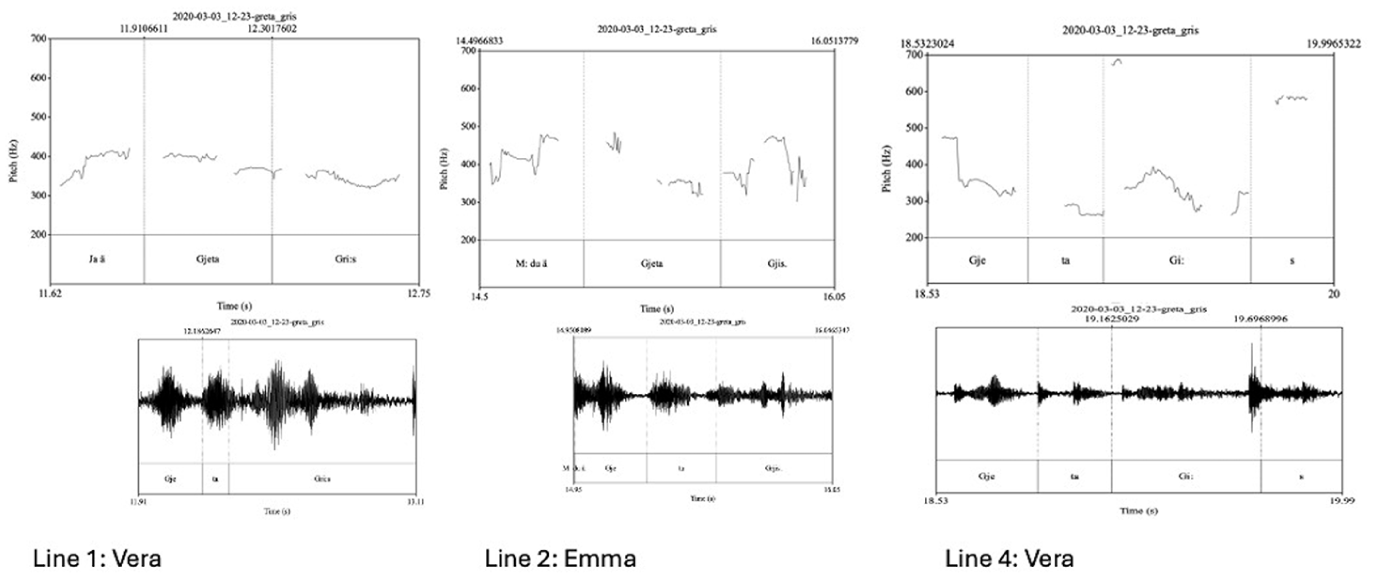
Vera presents herself as “Greta Gris” with a slightly altered pronunciation of the fricative /r/, though without any particular emphasis or marked intonation (line 01). Emma enthusiastically aligns with the proposed play frame. With expressive intonation and a smile, she responds with a confirmation Mm: du är Greta Gri:s! “Mm: you are Greta Gri:s!” (line 03). However, a moment of misalignment arises when Vera objects N:eej “No::!” (line 04) and reintroduces herself as Greta Gris: Jag är Greta Gri:s “I am Greta Gri:s,” pronouncing it as [geta gi:s] (line 04). Emma attempts to replicate this pronunciation by repeating and emphasizing the beginning of the phrase (line 05). The children here are orienting to and sustaining focus on the language forms through recycling, mimicking, and format tying (see Evaldsson and Cekaite, 2010). The main noticeable difference in the girls’ pronunciation is Vera’s emphasis on Gris versus Emma’s emphasis on Greta, achieved through a combination of raised pitch, increased loudness, and sound elongation. The pitch track and sound intensity in figure 3 visualize this difference in the production of “Greta Gris,” with Vera’s initiation (line 01), Emma’s initial response (line 03), and Vera’s subsequent correction (line 04):
Emma accepts Vera’s correction, adapting to her pronunciation and reproducing the emphasis and rising intonation, though with some modification (line 05). Emma pronounces “Greta Gris” in an exaggerated, hyper correct manner, smiling and rising from her chair—an embodied display that highlight her excitement about the proposed play. While the appropriate pronunciation of “Greta Gris” remains under negotiation, the role claimed by Vera is not contested. Emma’s embodied display, particularly her smiling, demonstrates her orientation to Vera’s corrections as an invitation to engage in sound play (cf. Evaldsson, 2025). Emma adapts and varies her pronunciation, emphasizing and exaggerating key phonemes (Gj:e:ta Gjis, line 07).
After several attempts to advance the verbal play, Emma recognizes that her actions are not acknowledged by Vera, prompting a shift in footing—from a non-serious to serious (Goffman, 1974)—in an effort to achieve shared understanding. She stops smiling and looks intently at Vera (line 09), repeating the Gjeta gjis variant. As Vera still does not respond or confirm Emma’s pronunciation and continues adjusting the mask on her face, Emma resorts to code-switching, translating Greta Gris into English (“Peppa Pig!”, line 11). The heteroglossic context of the institutional setting, along with her peer’s presumed bilingual competences, is drawn upon to facilitate mutual understanding. Emma’s repetition—Du är Peppa Pig? “You are Peppa Pig?” (line 13)—serves as another heteroglossic clarification attempt, aimed at confirming both the play frame and Vera’s role within it. When Vera still does not respond (line 14), Emma uses onomatopoeic pig sounds—hro hro hro ([χʁɔ̃] [χʁɔ̃] [χʁɔ̃])—in a further attempt to clarify and directly reference the cartoon (lines 15 and 17). As Vera’s response remains absent, the children eventually shift their attention to other activities.
As demonstrated in Extract 1, 3-year-old children orient to language form and the available language varieties in performing, interpreting, and modifying play frames. Normatively relevant language varieties are employed to introduce, clarify, and establish a joint play frame—something presented as exciting and enticing—and are used to achieve mutual understanding. The performative potential of everyday poetics is invoked by one of the girls, but it is not yet equally appreciated by other members of the peer group, leading the children to shift to other, mutually shared play repertoires. The girls effectively engage in playful heteroglossic practices through their “creative appropriation of hegemonic values regarding language” (Evaldsson and Cekaite, 2010: 602). Within the peer group, Swedish is primarily used to facilitate and enhance their play activities, while English serves as a supportive language for meaning-making, particularly in moments of communicative difficulty.
The entertaining potentials of lexical derivates: Words as experience
Public play with lexical items—including lexical innovations in the institutionally relevant languages, Swedish and English—was used by the children both as an exciting play move and as means of getting access to play. Novel word derivations were introduced as entertaining play objects. However, while the innovative and incongruent aspects of the children’s language use were important for the collective development of play, peer acceptance of these playful initiatives was neither automatic nor easily granted (cf. Strid and Cekaite, 2022). This is evident in Excerpt 2, during a play session involving 3-year-old boys and construction blocks (Lego Duplo), where one of the boys, Kenji, attempts to present novel lexical items as relevant, entertaining, and noteworthy—akin to play objects. The boys are gathered around a shared Lego construction of a ship.
Excerpt 2: Apple bush
William (3yo), Henri (3yo), Kenji (3yo)
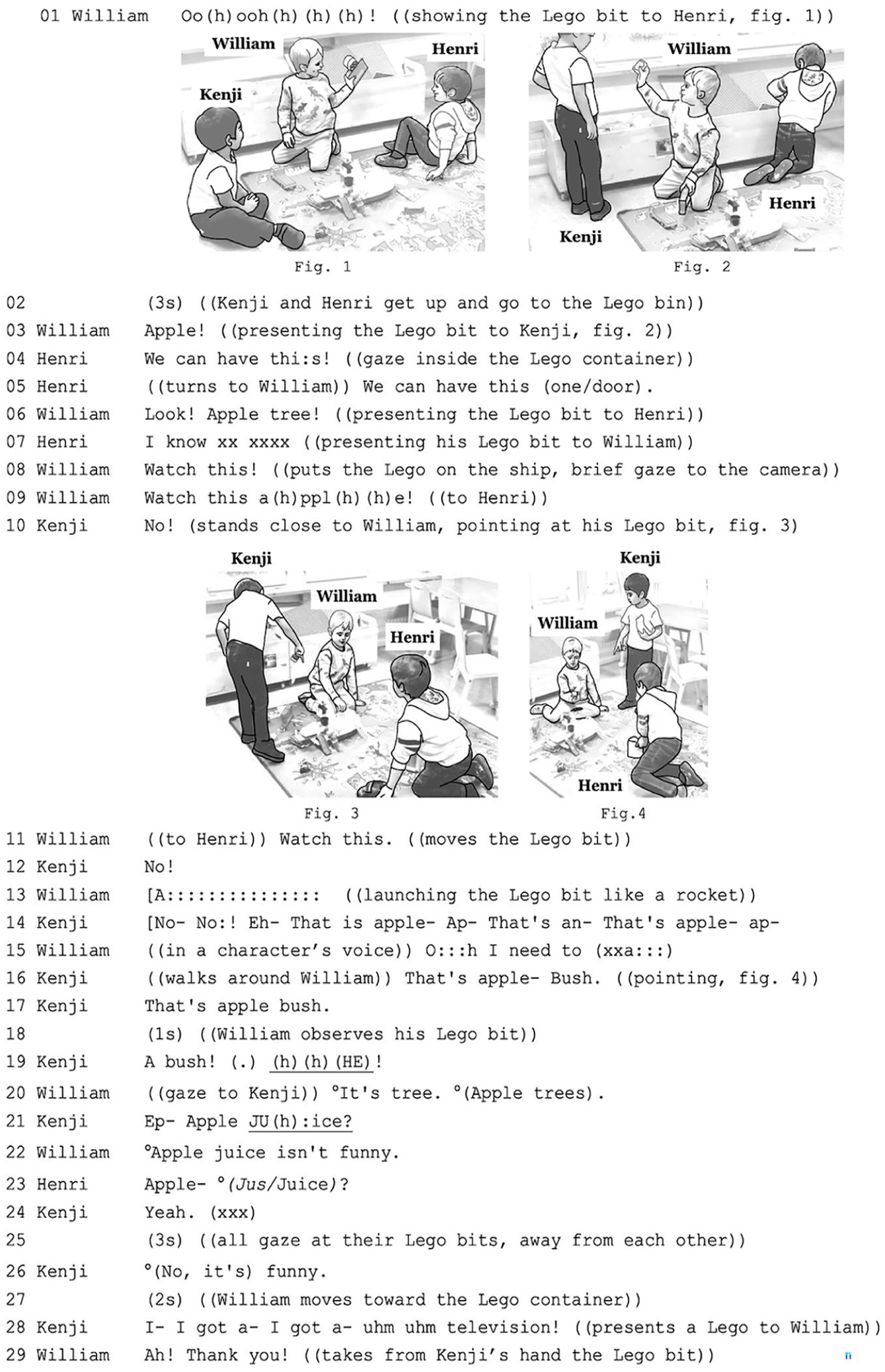
William finds a Lego peace featuring a stylized image of an apple tree and excitedly announces his discovery with a loud surprise token Oh!, laughter, and a visual display of the piece—presenting it as a noteworthy object: Apple! (figure 2, line 03). He continues to draw his peers’ attention by introducing a collocation, transforming “Apple” into “Apple tree” (line 06). This labeling and creative re-labeling of the Lego piece shifts its role in the construction play. Kenji attempts to join in, initially objecting with repeated “No!” responses (lines 10 and 12) and trying to redirect William’s attention to a similar action format. Kenji proposes an alternative label—“That’s apple”—repeating it three times (line 14) but fails to secure William’s attention and uptake (lines 13 and 15).
Kenji ultimately succeeds in gaining his peer’s attention by reusing, with transformation (Goodwin, 2013), William’s labeling of the Lego piece. The “apple tree” is reimagined as an “apple bush,” an imaginary item that exploits the entertaining potentials of an incongruent concept—combining “apple” and “bush” (lines 16 and 17). Kenji introduces novel collocations (“apple tree”/“apple bush”) as entertaining, noteworthy play objects, drawing on the self-reflexive, poetic function of language (Jakobson, 1960). He secures William’s gaze and marks his utterance as playful through an exaggerated laugh token, inviting shared laughter and uptake (lines 19 and 20; cf. Andrén and Cekaite, 2017).
William, however, treats Kenji’s utterance as a correction of his understanding of the play object and a diversion from the established play trajectory. After closely examining the Lego piece, he disagrees with Kenji, maintaining his original labeling “It’s tree. (Apple trees)” (line 20). Kenji makes another attempt to join William’s play by introducing wordplay as an additional layer in the shared play frame. Possibly misinterpreting William’s quietly spoken utterance “(Apple trees),” which includes an audible fricative in the final position (line 20), Kenji reuses it in a new collocation—“Apple juice”—accompanied by a laughter token that marks the poetic qualities of the utterance as a play-relevant and entertaining contribution (line 21). He draws on both lexical structures and phonetic/prosodic features, demonstrating his attunement to what Jefferson (1996: 28) termed “one person cross-turn poetics”—that is, building verbal and prosodic play on a prior’s speaker’s talk (see also Cekaite and Aronsson, 2004). Although Kenji’s laughter invitation is ignored, William acknowledges the humorous intent by explicitly rejecting it: “Apple juice isn’t funny” (line 22). In doing so, William demonstrates an understanding of the verbal play as part of their shared play repertoire, while simultaneously dismissing its entertaining potential within the ongoing activity.
Henri, another child co-participating in the Lego play, continues adding new blocks to the shared construction while attentively following William’s and Kenji’s conversation. Henri employes a heteroglossic practice by pronouncing the Swedish form jus “juice” (line 23), both to check his understanding and to evaluate the playful potential of the proposed word. Kenji confirms that the reference is indeed to apple juice (line 24) and asserts—contrary to William’s earlier stance—that his contribution is funny (line 26). However, as neither Henri nor William responds, the verbal play trajectory becomes abandoned.
As demonstrated, play with words—such as labeling of play objects, forming collocations, and emphasizing particular sounds—involves children’s use of various syntactic structures, derived lexical items, and the exploitation of incongruency. Their contributions to play carry poetic potential and are distributed and created co-operatively across multiple speakers’ turns (Goodwin, 2018). Cross-turn linguistic innovations are presented for public experience and evaluation as play-relevant “objects” and as entertaining contributions to an emergent, multiparty play activity. The meta-evaluation of lexical items (e.g., labels) as either funny (line 26) or not funny (line 22) illustrates that 3-year-old children recognize the playful potential of everyday poetics. Excerpt 2 highlights the children’s engagement with the creative and entertaining aspects of language, as well as the importance of the uptake and public acknowledgment—underscoring that the performance of “verbal artistry” (Bauman and Briggs, 1990: 79) requires an appreciative audience (see also Nasi, 2025).
Heteroglossic play and epistemic meaning negotiations
Children also engaged in heteroglossic play that involved public, rhythmic, and melodic performance, drawing on several available language varieties across multiple speakers—that is, everyday cross-turn poetics. Notably, the heteroglossic nature of the bilingual institutional setting, where the children were expected to have knowledge of both Swedish and English, emerged in their interactions through epistemic meaning negotiations (e.g., “Do you know what x is”) and language-teaching features. Verbal play performed in a public setting served as an effective resource for fostering a sense of belonging (Björk-Willén, 2022), characterized by shared attention and affective alignment among peers—even when children were engaged in individual play unfolding in parallel. Excerpt 3 demonstrates how two 4-year-old boys, Kevin and Tristan, engage in verbal play and epistemic meaning negotiations while building their own figures with domino tiles. The boys converse in Swedish, but Kevin spontaneously code-switches to English with the phrase “just in time” as he pushes dominoes into a single heap (line 01).
Excerpt 3: “Just in time”
Kevin (4yo), Tristan (4yo), English in bold.
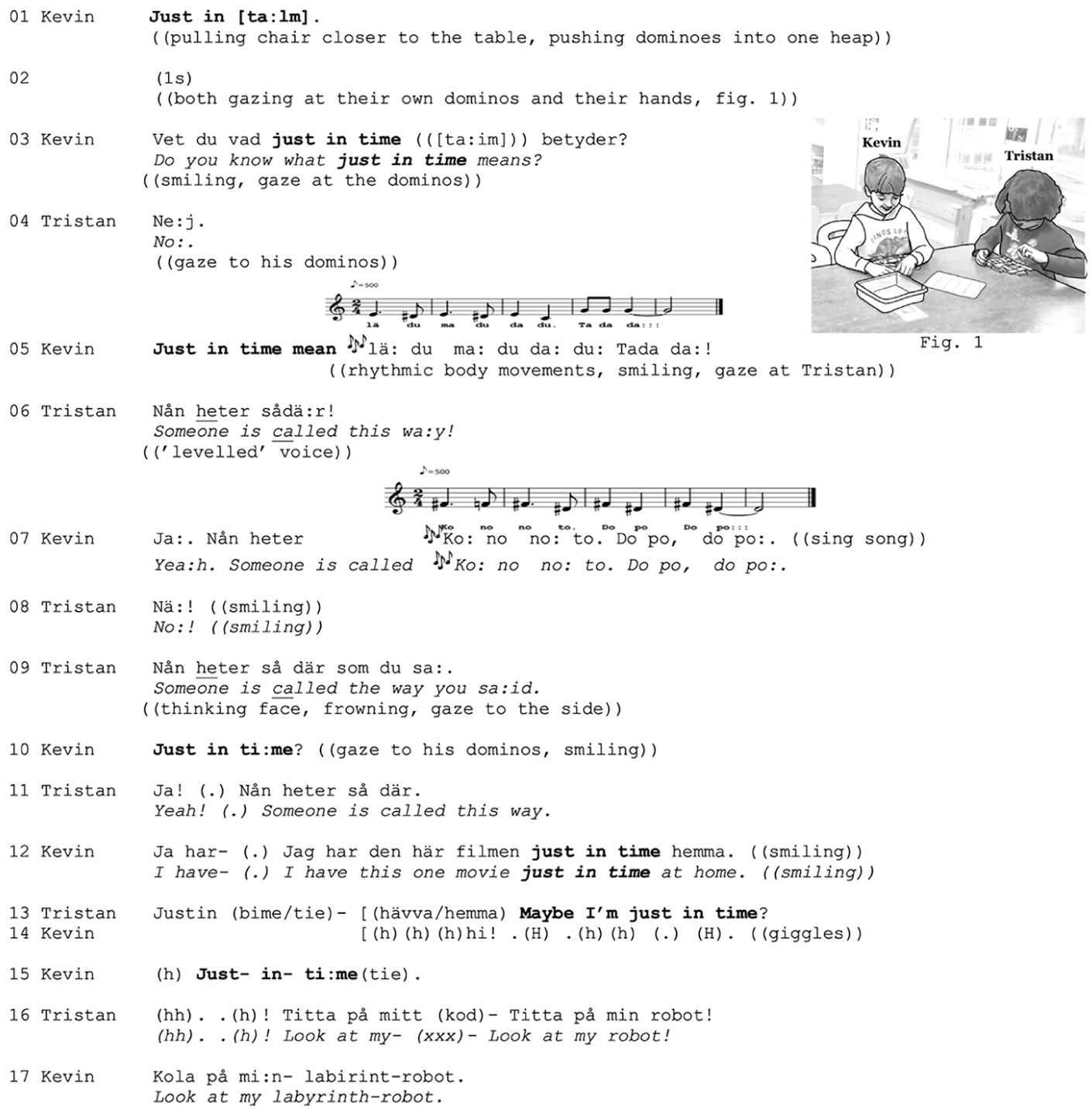
Kevin’s utterance in English can be interpreted either as relevant to his current action (pushing dominoes), or as a spontaneous remark, given that the boys had been speaking primarily in Swedish immediately beforehand (line 01). When he receives no uptake from Tristan, Kevin draws on features of language-teaching discourse in a heteroglossic question: Vet du vad
Tristan, however, does not align with Kevin’s playful performance. In a serious tone, accompanied by a “thinking” facial expression, he states that “Nån heter sådä:r!” “Someone is called this wa:y!” (line 06). His response highlights the challenges children may face in achieving public recognition of their playful contributions. Tristan orients to the lexical content and the negotiation of meaning, rather than to the heteroglossic play, thereby misaligning with his peer’s spontaneous performance. Kevin, however, continues his playful engagement, exploiting the incongruity between language teaching/learning routines and spontaneous creative expression. He recycles the educational phrase “han heter” “he’s called”—a common self-presentation structure in language teaching—but once again transforms it into a playful, poetic, and nonsensical name, delivered in a sing-song manner (line 07). Kevin capitalizes on intra-turn poetics—that is, shifting from the referential to the self-referential function of language within a single utterance—and on the incongruity between the conventionalized phrase and the nonsensical rendering of the referent for “just in time.” Heteroglossia in this case involves multiple linguistic codes: Swedish, English, and an invented, imaginary one. Although Tristan does not verbally align with Kevin’s turn, he adopts a playful stance by smiling (line 8). Notably, in this bilingual preschool, the flexible norms for language choice in peer group conversations created what can be described as translanguaging spaces, where children could select language varieties based on a wide range of situational and contextual factors.
Both boys continue exploring the lexical meaning of Kevin’s initial “just in time” (line 01), sustaining their joint engagement for over an extended sequence. The shift from a “serious” interaction to a mutually aligned playful one is marked by their embodied attunement (lines 12–15), particularly through shared smiles and laughter. The topic of their conversation—the exploration of “just in time” as either a person’s name or a movie title—is negotiated across multiple language domains and involves both intra- and cross-turn poetics (lines 09, 11, and 12). Rather than contesting each other’s epistemic authority, the children improvise and collaborate, co-constructing meaning through playful interaction.
Excerpt 3 illustrates how both children demonstrate their heteroglossic (i.e., strategic) use of the institutional languages—Swedish and English—as well as their everyday languaging practices, drawing on experiences from the institutional context of language learning and teaching. They orient to heteroglossic bilingual play as a valuable resource for sustaining focused and entertaining shared engagement, while simultaneously participating in individual, object-oriented play. Rather than reflecting a power struggle between competing language ideologies, their language play enables them to remain affectively attuned and to embody a “playing together” frame.
Metalingual play with imaginary languages
The heteroglossic character of the bilingual educational setting manifested in children’s peer interactions through their metalinguistic attention to and exploration of “the living experience of enacted language” (Ochs, 2012: 155). The children displayed creativity in collaborative metalinguistic explorations and improvisational aesthetics, readily joining in or commenting on the peer’s performances and metalinguistic remarks. The emergent negotiation in Excerpt 4 takes the form of a self-contained play activity—an entertaining and socially engaging time together while waiting for the next scheduled activity to begin.
Excerpt 4 illustrates how two 4-year-old boys, Tristan and Kevin, enter the assembly room, sit in their assigned spots, and wait for other children and teachers to arrive for an activity. Initially, a competition arises between them overt who enters the room first. Tristan declares that he is the winner this time (line 03), prompting Kevin to object and complain, stating that he does not want to participate in the competition (lines 04 and 05). This interaction evolves into verbal play, characterized by heteroglossic features that the children use to contribute to or contest word meanings, as well as to create new—yet mutually shared—linguistic codes.
Excerpt 4: Nånå-språk “The no-no-language”
Tristan (4yo), Kevin (4yo)
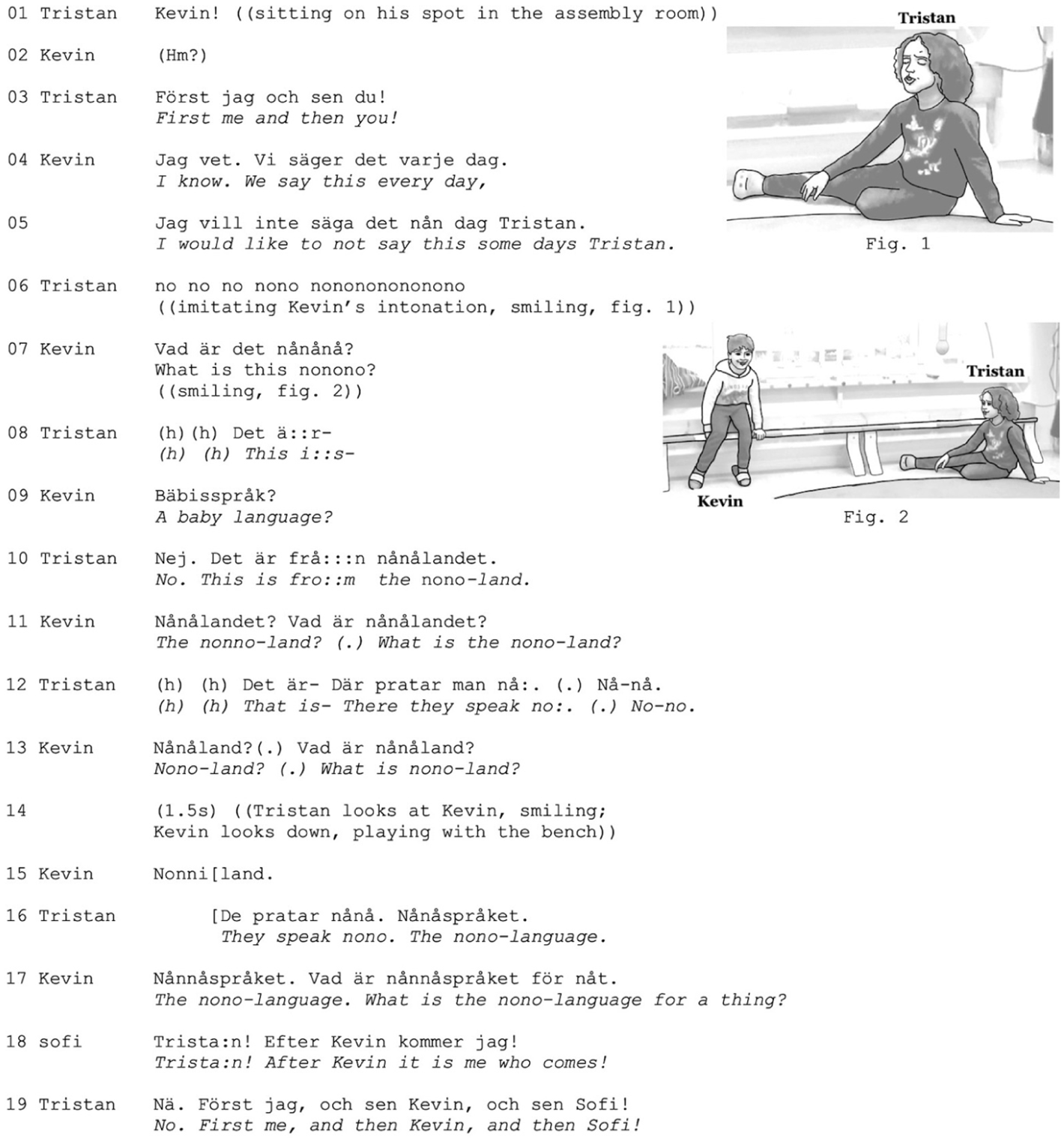
Excerpt 4 continues with Tristan responding to Kevin’s complaint by spontaneously engaging in language play. On the spot, he invents a nonsensical verbalization—“nononono”—produced as a long, rhythmic sequence of repeated syllables. Tristan recycles the intonation of Kevin’s complaint, thereby softening its force (line 06). Tristan smiles and maintains eye contact with Kevin, framing his utterance as humorous—perhaps as friendly teasing rather than a challenge or mockery. Indeed, Kevin appears to interpret it this way as well; rather than taking offense, he immediately joins the play by asking Vad är det nonono “what is this nono nono” (line 07). In doing so, Kevin highlights Tristan’s nonsensical utterance as a topic worthy of discussion, treating “nonono” as if it has meaning or a referent. Tristan, laughing, accepts this interpretation and begins to explain Det ä::r- “This i::s-” (line 08). Kevin quickly contributes his own interpretation, suggesting that “nonono” is a bäbisspråk “baby language.” (line 09). This metalinguistic labeling of is notable—not only does it frame “nonono” as a specific type of language, possibly onomatopoetically linked to infant babbling, but it also sets the stage for further elaboration. Tristan readily aligns with this idea, extending it by suggesting that “nonono” is spoken in a country—Nonoland (line 10)—and a population: Där pratar man nå: “There they speak no::” (line 12). Tristan’s contribution reflects a metasociolinguistic stance in which languages or codes are imagined as nation-building elements (cf. Evaldsson and Sahlström, 2014). This playful construction suggests that the bilingual character of the preschool and its language education practices may be “seeping into” (Björk-Willén and Cromdal, 2009) the boys’ imaginative play. Within this co-created translanguaging space, sociolinguistic features become rich resources for playful exploration and meaning-making.
The playful exploration of “nonono,” the newly invented word, continues in a dialogic mode through a series of question-answer turns, rhythmic alliterations, and cross-turn improvizations. Both boys smile throughout, indicating their enjoyment of the co-operative performance of an imaginary language, as they recycle and modify the pronunciation of the word (nonno, no, nonni). Excerpt 4 demonstrates how both children skillfully manipulate linguistic resources as tools or objects for play and enjoyment. The attunement to everyday poetics is evident in their shared play repertoire, which enables them to recognize each other’s playful cues and co-operatively advance the interaction. The children’s references to imagined languages, fictional speakers, and invented countries reflect their sensitivity to the linguistic diversity present in their peer group. Moreover, their awareness of sociolinguistic variation mirrors bilingual learning practices that characterize this preschool setting. The children’s joint creative engagement—their initiative, collaboration, and ability to frame their interaction as play—can be seen as contributing to their sense of belonging within the preschool community and among their peers.
Concluding discussion
The present study has examined the peer language use of 3–5-year-olds in a bilingual preschool in Sweden, with a particular focus on children’s practices involving verbal play and heteroglossia as invoked and exploited within the peer group. The findings demonstrate that children’s verbal play functioned as a social discursive resource, integral to their peer interactions in various ways. Language play was relevant to the children’s everyday activities and the crafting of social relationships as they spent time together in an early childhood educational setting. They engaged in language transformations and heteroglossic play to initiate and sustain peer interactions, often layering these creative language activities “on top” of their multimodal engagements as a form of entertainment. Receiving uptake to one’s unexpected and creative language manipulations was not a guaranteed outcome; rather, peer group dynamics played a crucial role in achieving successful uptake and positive evaluation. These dynamics highlight the importance of social attunement and responsiveness in the co-construction of playful linguistic exchanges.
The heteroglossic features of children’s verbal play involved their use of the available language varieties—Swedish and English, the languages of the bilingual educational institution. Traces of language teaching practices (e.g., language drills, metalingual comments), as well as spontaneously created imaginary languages, were actively exploited in children’s meaning-making and ludic language use. The entertaining, jocular potential of verbal play often emerged through the combination of incongruent linguistic features. These features were co-operatively exploited as enjoyable ways of spending time together in the peer group—for instance, when children introduced and negotiated a play frame or clarified misunderstandings during play activities.
Everyday poetics and aesthetic forms were expressed through sound play, cross-turn alliterations, repetitions, and playful manipulation of rhythm and melody of spoken utterances. In an improvisational mode, children created and responded to each other’s contributions, co-constructing a dynamic and imaginative linguistic space. Their mundane conversations highlight the importance of recognizing how language use extends beyond the referential, encompassing both individual and collaborative aesthetic dimensions (cf. poeticity in Mlynář and Rieser, 2025: 19). These interactions can be seen as “semiotic enactments”—“temporally unfolding experiences, whose configuration at any moment is influenced by the voices, bodies, and dispositions of others present and non-present and a calculation of the situation at hand” (Ochs, 2012: 153). Metalinguistic features—both in relation to the children’s language practices within the educational setting and their poetic, self-referential use of language—reveal a deep fascination with language production itself. Words, phrases, and sounds became play objects: things to orient to, manipulate, and appreciate together. The act of creating and performing various verbal features was not only entertaining and pleasurable but also demonstrated how everyday poetics in children’s social worlds is closely tied to language as lived experience.
The analysis presented in this study highlight notable parallels between children’s heteroglossic practices and the concept of translanguaging (García and Li, 2014), understood as “dynamic and creative linguistic practices that involve flexible use of named languages and language varieties as well as other semiotic resources” (Li, 2018: 14). For instance, Burdelski (2025), who also focuses on bilingual children’s code-switching, emphasizes how children actively construct translanguaging spaces. In line with this, we suggest that the heteroglossic practices analyzed in this study can similarly be viewed through the lens of translanguaging spaces—dynamically co-constructed within the peer group through playful and creative language use.
While the analysis broadly aligns with the phenomenological argument that “[e]xperience no sooner comes into consciousness than it becomes penetrated by linguistic forms” (Ochs, 2012: 143), the present study offers a nuanced view of such experience as not necessarily shared group phenomena. Attunement to the poetic possibilities of language(s) may not be mutual among participants in a given social situation (Ex. 1), and their aesthetic value may not be appreciated by all interlocutors (Ex. 2). The ability to creatively reflect on the linguistic forms and reuse them “with transformation” (Goodwin, 2013) reflects a heightened degree of metalinguistic awareness.
Episodes of language play also reveal children’s experiences within the institutional educational context. Children engaged in joint verbal play by incorporating elements of teacher discourse—such as explicit questions about word meanings (Ex. 3), follow-up questions, meta-talk about language, and references to (imagined) national identity (the Nonoland and its people in Ex. 4, cf. Evaldsson and Sahlström, 2014). Moreover, the children’s interest, investment, and engagement in joint verbal play (as illustrated in Ex. 3 and 4) demonstrate not only a shared play repertoire but also how these social interactions contribute to sustaining their sense of belonging and friendship within the preschool community.
In the analysis of young bilingual children’s verbal play, heteroglossia emerges as a productive analytical lens for understanding language use beyond institutional or normative language boundaries. In the context of a Swedish-English preschool in Sweden, language ideologies cannot be easily framed in terms of power-related tensions between minority and majority languages. Both institutional languages—Swedish, as the majority societal language, and English, as a global lingua franca— carry significant ideological value (Larsson et al., 2022; Roberts, 2021). They function as shared communicative resources between teachers and children, and the ideological framing of these language varieties is complex and non-binary. While previous research has often emphasized how children’s code-switching reflects and reproduces broader societal language ideologies, the present study shifts focus to “the temporal unfolding of language in and across situations” (Ochs, 2012: 144). It highlights how children orient to talk as dialogic and multivoiced—yet also tangible and available for creative manipulation and reproduction.
Overall, the present study demonstrates how children engage with language as an artifact—something that can be played with, manipulated, and enjoyed. However, this is not a skill immediately accessible to all language users, including children. The ability to engage in verbal play and exhibit metalinguistic awareness is, at least to some extent, shaped by experiences of schooling, literacy, and education. Tentatively, it can be suggested that bilingual children—particularly those in bilingual educational contexts—might be more especially attuned to verbal play due to their exposure to educational discourse about language(s). The analysis of children’s ordinary talk allows to reflect on the concepts of heteroglossia and poetics, not as abstract literary constructs, but as emergent features of peer group interaction. The frame of play provides multiple opportunities for children to explore everyday poetics and heteroglossia as part of their play repertoire—language as a play artifact. In sum, we argue that everyday poetics and heteroglossia are “in the air”—embedded in and emergent from children’s language in the ordinary peer talk.
Footnotes
Appendix 1
Acknowledgements
We would like to express our appreciation to the research participants, the editors of the Special Issue, and the anonymous reviewers for providing constructive feedback and suggestions for improving the paper.

Ethical considerations
The Swedish Ethical Review Authority approved the study (project number 2019-04611).
Consent to participate
Written consent forms were collected from participants and children’s guardians. Children and teachers were informed about the research process and their right to exit participation. During the fieldwork, the recording was stopped whenever the children or teachers displayed uneasiness or unwillingness to be recorded.
Consent for publication
Consent for publication was obtained within the consent for participation. The data are anonymized. All names are pseudonyms. Line drawings are used to preserve the participants’ confidentiality.
Author contributions
Olga Anatoli: data collection, transcription, analysis, writing, revisions.
Asta Cekaite: conceptualization, analysis, literature review, writing, revisions.
Funding
The authors received no financial support for the research, authorship, and/or publication of this article.
Declaration of conflicting interests
The authors declared no potential conflicts of interest with respect to the research, authorship, and/or publication of this article.
Data availability statement
All data are confidential and cannot be shared.