



Abstract
This case study documents social interaction between a nurse and a 4-year-old boy during routine Draw-a-Man assessments at a child health center. Detailed analyses illuminate how the nurse scaffolded head, legs, arms, eyes, and mouth step by step, as elements of a jointly improvised monster story. Nurse-child interaction alternated between scaffoldings and joint improvisations during the child’s drawing of a man who would ‘guard’ a monster. The drawing was co-construed through storytelling and alignments. Divergent participation frameworks were invoked, when the child did not let go of his precious drawing, insisting on taking it home to dad, while the nurse invoked the center’s routines (archiving all drawings). This brief micro drama was resolved through whispered by-play between mother and child. The analyses show how a drawing task is co-construed through improvisations and storytelling, and it also illuminates the role of joint performance for building we-teams and adult-child alignments.
Keywords
Introduction
The present case study from a routine visit at a child health center documents a nurse’s interactional work in making a young child engage in unfamiliar semiotic activities, the Draw-a-Man test, a task of child development, that is well-known in both clinical and educational assessment contexts, originally devised by Goodenough in 1926 (Cox, 1993). Draw-a-Man assessments primarily indicate to what extent children over time spontaneously include numerous body parts or only a few in drawings of the human body. In their drawings of ‘a man’, children tend to advance from a few incoherent lines over enigmatic tadpole drawings to a ‘complete representation of the human figure as seen in full face’ (Cox, 1993: 2–3). For the health center, the drawing task is a routine event – along with other assessments of development – but for many of the individual children, it involves a social situation where they are expected to perform in novel ways, when interacting with an unfamiliar adult, in an unfamiliar context. There has been some work on doctors’ and nurses’ ways of distracting or entertaining children in the face of threatening procedures (Aronsson and Rundström, 1989; Rindstedt, 2013; Rindstedt and Aronsson, 2012), but as yet, there has not been much work on performance aspects of adult-child interaction in routine child health practices.
This single-case study illuminates how a nurse and a child at a child health center engaged in creative improvisations (Duranti and Black, 2012; Rendle-Short et al., 2014; Sawyer, 1997), turning an ordinary assessment task into playful improvizations. We will explore the nature of nurse-child interaction during the drawing task and the ways in which the child’s performance can partly be analyzed in terms of a joint performance.
Informal learning between adults and children has often been discussed in terms of scaffolding, a concept that was already introduced 50 years ago (Wood et al., 1976) as a way of discussing master-apprentice learning and particularly the ways in which masters or elders (e.g., parents, teachers) provide material or verbal support that facilitates the acquisition of novel skills or insights. The scaffolding metaphor has been attributed to Lev Vygotsky, but he did not explicitly deploy it. However, it is in line with both activity theorizing and social interactional views on informal learning (for critical discussions of the metaphor, see Koole and Elbers, 2014; Renshaw, 2013; Shvarts and Bakker, 2019).
There exists prior work on scaffolding in education, but, as discussed by Koole and Elbers (2014) much of it does not build on detailed or rigorous empirical work, and they instead advocate CA-oriented analyses for more systematic analyses of master-apprentice learning. Renshaw (2013, p. 59) has discussed relational aspects of scaffolding, meaning that ‘learning with and from others can be as much about building a relationship as it is about mastering a specific skill’. But, he does not specifically cite empirical work to underpin this view on relationship building.
Much prior work on adult-child scaffolding concerns the transmission of knowledge in educational contexts (c.f., Koole and Elbers, 2014). But some work concerns informal contexts. Drawing on a large collection of multiparty make-believe play in a preschool context, Pursi (2019) has documented adult improvisations and their role in scaffolding and supporting multiparty peer group play in a preschool context. Family life is another arena where adults recurrently engage in scaffolding children’s everyday routines through combinations of directives and playful improvisations (Aronsson and Cekaite, 2011; Aronsson and Gottzén, 2011; Goodwin, 2007b; Goodwin and Cekaite, 2013). The role of adults’ playful improvizations has not been much explored outside of educational and family life context. But there is some work on doctors’ and nurses’ playful improvisations during physical examinations and treatment (Aronsson and Rundström, 1989; Rindstedt, 2013; Rindstedt and Aronsson, 2012). The present study of nurse-child scaffolding fills a gap through its focus on a child health setting.
This paper concerns performance-in-interaction, documented in an authentic clinical setting, a child health center, and it deploys a combination of situated CA-oriented analyses with dramaturgical concepts (Goffman, 1959, 1971, 1978). Erving Goffman has been a pioneer in analyzing interactional aspects of performance and impression management during social interaction (Goffman, 1959, 1961, 1967). His classical work on footings (1979) concerns the many ways (verbal, nonverbal, nonvocal) in which participants position themselves and align in relation to topics, co-participants and other people, including both same-side and other-side parties. One basic departure is his way of discussing shifting participation frameworks, including how participants align with different participants and tasks, and how they navigate within socially situated frameworks, including public/private; familiar/unfamiliar; my side/your side (Goffman, 1979, 1981). In Goffman’s discussion of the interaction order (Goffman, 1983) and more specifically, in his work on character contests (Goffman, 1967), taking sides is a recurring feature of social interaction (on CA and ‘taking sides’, see Pomerantz, 1980).
In a pioneer ethnography, Goodwin (1990) explored adolescent children’s play practices – including storytelling, gossip and disputes and children’s side taking – in peer groups in an urban street area, documenting interaction, with rigorous CA-analyses. Her ethnographic work can be seen to expand Goffman’s work on alignments, illuminating in detail how children align – and disalign with others – when making assessments of their own and other parties’ performances (Goodwin, 1990; 2007a). Much of her work involves multiparty frameworks, as even dyadic encounters recurrently involve third parties, for example, an absent (blameworthy) peer:
Well you tell her to come say it
in front of my fa:ce (0.6) and
In her analyses of peer group conversations, Marjorie Goodwin (e.g., her quote above of two girls’ talk about a third girl’s gossiping) partly draws on Goffman and his work on participation frameworks. A major idea in Goffman’s analyses is that our notions of speakers and hearers tend to be overly simplistic, as they do not account for by-play or issues related to who speaks to whom through whom. Audience design is not merely about the here and now, but also about how participants orient to absent parties. In this brief extract, audience design involves gossip about an absent offender, a peer, showing how snippets of conversations might invoke both absent parties and talk about past or future events, as when Barbara talks about what she will do when confronting her offender (another girl in the group).
In the case study of the present paper, a young child similarly engages in social interaction that invoked an absent party (his dad). There is as yet not much work on adult-child improvisations in health care contexts. Our case study is unique in that it presents detailed analyses of nurse-child scaffoldings and playful improvisations during the Draw-a-Man task, taken from a larger video ethnography of authentic health care assessments of young children’s drawing skills. In line with theorizing on improvisations (Duranti and Black, 2012; Sawyer, 1997; cf., Aronsson, 2023), improvisations are analyzed in terms of a continuum from standard procedures to impromptu contributions.
Getting in and out of play is at times a complex matter as our case study will illuminate (see also, Rendle-Short et al., 2014). In our view, the present study fills a gap, through documenting nurse-child performance in an assessment setting, highlighting a nurse’s delicate balancing between task-oriented scaffoldings and more playful improvisations.
Data and methodology
Institutional context
Since the late 1960s, practically every child in Sweden undergoes developmental assessments at a Child Health Center (Barnavårdscentral), in the company of a parent, around the time when s/he has turned four. The tasks during this routine visit (formerly called ‘4-year-control’) include assessments of the child’s vocabulary and drawing skills (Draw-a-Man/Rita en gubbe), along with measurements of height, weight, hearing, and eye sight. The drawing task involves assessments of the individual child’s ability to include a number of ‘details’ of the human body in the drawing, for example, head, legs, and mouth (Cox, 1993). Many 4-year-olds, like the children at the present center primarily produced tadpole drawings, that is, figures where both head and body are represented by one round figure (cf. Cox, 1993), whereas other children include a number of so called ‘details’, like arms, legs, head, and eyes. At the health center, the drawings of individual children varied greatly, as did their other performances and physical measurements. At large, the Draw-a-Man task seems to be deployed as a way of interacting with young children, not as a formal test.
Data selection
The present single case study involves social interaction between a 4-year-old boy and a nurse during Draw-a-Man activities that routinely take place when a child has turned 4 years of age. It is taken from a larger corpus of a dozen videos of nurse-child encounters, a total selection of all 4-year-old children at two health centers during a set period (2017–2018) including 12 children and 7 nurses. This study is part of a larger study of all visits of children, 0–6 years of age (Aronsson and Rindstedt, 2023). This specific case study has been chosen, as it illuminates both how adult-child alignments are built and how the drawing as such is partly co-created by child and nurse.
It is our belief that this micro analytic study illuminates adult-child alignments and disalignments in an institutional child health context, and more specifically the micro politics of play.
Participants
All sessions involved at least three participants: nurse, parent(s), and child. This particular session involved the nurse, a 4-year-old boy and his mother, both of Japanese origin. As in most other cases, only one parent accompanied the child to the visit. The drawing task was quite alien for the target child, who had moved to Sweden with his family. But like most other young children in the larger corpus, he listened intently to the nurse’s directives, trying to do his very best during all tasks. At home, he engaged in computer gaming, but not in any drawing activities (according to his mother).
Video ethnography and transcription
One of the authors, Camilla Rindstedt, carried out the video ethnographic fieldwork at two different child health centers, deploying a hand-held video camera with a good quality external microphone, when making all the recordings. Each visit included the child’s drawing activities, as well as other assessments and measurements. The specific tasks were not administered by the nurses in any rigorous order and they were interspersed with small talk with the participant child or his/her parent. This particular visit fell within the normal time range, lasting about 30 minutes (including greetings, examinations of the individual child, other tasks, small talk, and leave taking). The entire Draw-a-Man episode lasted for 4:24 minutes.
Video ethnography constitutes an important research method for work on performance and participation, as it allows detailed and repeated analyses of multiparty aspects of interaction. Moreover, it is suited to multimodal analyses of social interaction, including verbal, nonverbal, and nonvocal aspects (Goodwin, 2007a, 2007b; Ochs and Schieffelin, 1989). In line with work on affiliations and alignments (Goodwin, 1990) our focus has been on the participants’ alignments in relation both to the task and to co-participants.
The data were transcribed during repeated viewings of the original Swedish videos. The transcriptions have been made in line with CA conventions, with an ambition to stay close to the originals and to convey a sense of the participants’ spoken language (see Appendix for a Transcription Key, drawing on Goodwin, 2007a). For reasons of systematicity, the translations are less detailed than the Swedish originals. In line with Goffman’s (1959, 1961, 1971, 1979) dramaturgical and multimodal model, participants’ changes of seating arrangements and locomotion were noted, as well as other nonvocal actions – such as smiling, nodding, and gestures. The transcriptions cover both verbal and nonverbal changes of affective stances (Goffman, 1979; Ochs and Schieffelin, 1989).
Ethics
In line with ethical commitments to the participants, neither the original videos, nor any drawings are disseminated. Nelly’s name is anonymized with an initial N (as in Nurse). The boy’s anonymized name, Yuto, is a common name in Japan. Great care has been taken to secure all participants’ consent and anonymity. As in all cases in the larger data set of 12 Draw-a-Man visits, both the nurses, the children and their co-participant parents were informed that they could withdraw from the recordings at any time. But it can be noted that this did not happen for any of the participants of the data collection at large. The study was approved by the Regional Ethical Review Board in Stockholm (Dnr 2016/2435-31/5).
Analysis
In the Swedish child health context, the Draw-a-Man task involves a social situation where a child’s drawing activities are under assessment – in the interface between public and private – and where it is possible to explore how a child aligns both with the task as such and with the nurse (and a co-present parent) through verbal, nonverbal, and non-vocal means, that is, through multimodal resources. In line with prior work on alignments (Goffman, 1978; Goodwin, 1990, 2007a, 2007b) our focus has been on the participants’ alignments and disalignments during situated activities.
This paper analyzes how the nurse scaffolded the child’s drawing, and how she recurrently engaged in creative improvisations (Duranti and Black, 2012; Sawyer, 1997). Our analyses will uncover how the child and nurse co-created play scenarios where the child re-contextualized the task as Draw-a-Monster and where the nurse followed suit, improvising that the monster would encounter two boys (his boy and her boy) which made it necessary for both nurse and child to draw a little man (boy).
Improvisations about what to draw (Ex.1–Ex.3)
As in most other child health encounters in the larger data corpus, the nurse presented the drawing task to the child, not as a task or demand, but as in the form of a polite request.
Ex.1 Draw-a-Man task transformed by child into Draw-a-Monster (NUR=nurse; C=child)
As can be seen, nurse Nelly presents the drawing task, as something of an invitation, courteously telling the boy that she ‘would very much like’ a drawing of ‘a little man or something’ (lines 2–4). He smilingly accepts her invitation when announcing that ‘I can draw a monster’, aligning with her polite request of ‘a drawing’, but improvising when announcing that he can draw a monster (not ‘a little man’, line 5). She, in turn improvises, building on his monster theme by confessing that she might then become super scared. She thereby indirectly aligns with his monster plan. Through their mutual alignments, both boy and nurse can be seen to engage in joint improvisations. At this point, Yuto confides that he draws a ko:nstigt monster (weird monster) upgrading the ‘monster-like’ qualities of his monster by accentuating its weirdness (line 9).
Ex.2 Monster is co-created into a ‘super dangerous’ monster
The nurse orients to the assessment task with its requirement for details when scaffolding the child’s drawing (‘What’s next then on the monster?’ line 10). Her question can be seen as an advice implicative question (Bloch and Antaki, 2022; Butler et al., 2010) in that she suggests that there is more to be represented. However, the child is happily unaware of the underlying implications (‘more details’ are needed!) This can be seen in his response, a proud outcry –
In line with prior work on response cries (Goffman, 1978; as part of adult-child praise, see Aronsson and Morgenstern, 2021; Aronsson and Rindstedt, 2023) his outcry can be seen as something of a glee cry, inviting the nurse to share his pride in his performance, a weird monster. It accentuates his performance in that he invites the nurse to have a look and see for herself. When she aligns by asking him to confirm ‘okay, it’s a monster’ (line 13), he nods in assent, and she then asks him whether it is dangerous or nice (line 15). She thus builds two consecutive questions in line with a monster story. Through both questions, she can indirectly be seen to accept his introduction of the monster theme.
In multiparty settings between children, an important aspect of recipient design is to act in accordance with conversational maxims, not the least ‘be entertaining!’, a maxim that is also important in institutional settings (Cathcart-Strong, 1986). Nurse Nelly is notably amused when responding to his proud announcement, in a smiley voice (line 13) and when asking whether his monster is dangerous or kind (line 15).
On another note, children in pediatric settings tend to respond more easily to disjunctive question formats than to yes/no or wh-questions (for work on question formats in pediatric context, see Stivers, 2012). It can be noted that nurse Nelly’s disjunctive question – whether the monster is ‘dangerous or nice?’ – allows the responding party more agency than y/n-question in that it offers him a choice. Yet, it is not as demanding as an open question (e.g., ‘tell me about your monster’) or wh-questions (cf., Stivers, 2012).
On an underlying level, the nurse’s word-choice (whether the monster is ‘dangerous’ or ‘nice’, line 15) can be seen as advice implicative (Bloch and Antaki, 2022; Butler et al., 2010) in that it indirectly invites storytelling (e.g., ‘how’ dangerous is it?). The child tells the nurse that it is indeed dangerous, ‘super dangerous’ (jättefa::rlit, line 16), aligning with her choice of terms, but expanding the monster’s ‘dangerous-ness’. Jointly, they have thus upgraded the monster-likeness of the monster. At this point of the session, the child is smiling broadly (proudly) and the nurse aligns with his depiction of the monster, confirming that he has indeed become the creator of ‘a super dangerous’ monster (line 19).
On another note, this extract illuminates the role of adults’ questions (Houen et al., 2016) for the scaffolding of children’s actions (e.g., nurse’s questions, lines 10, 13, and 15).
In response to Nurse Nelly’s questions and initiatives, Yuto indirectly engaged in self-praise when he successively upgraded his monster, ‘I can draw a monster’ (line 5), then adding that it is a weird monster (line 9) and then indeed ‘
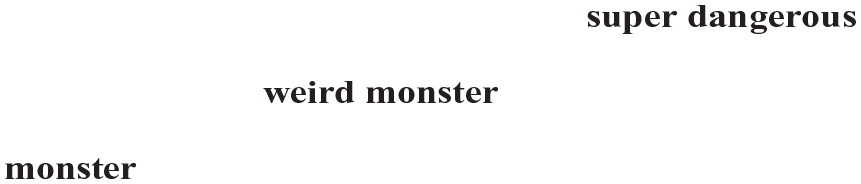
Step-wise upgradings of monster.
As can be seen during the continuation of this episode, the nurse now orients to the institutional framework (Draw-a-Man) and the fact that the child’s monster evidently does lack some body parts, some of the ‘details’ that constitute the basis for Draw-a-Man assessments.
In a second act of this micro drama, nurse and boy jointly improvised a scenario of a boy who would master the super dangerous monster, fighting against it.
Ex.3 Nurse introduces two monster guards
When Yuto starts out by announcing that monsters tend to fight with each other, nurse Nelly responds with another improvisation, suggesting that ‘we will draw a boy’, a guard who will make sure that the monster will be nice (snäll). At this point, she introduces the idea of two boys, one for her, one for him, who will see to it that the monster will be nice (lines 21–25). She thus aligns with his theme of fighting, but for a good cause.
It can also be noted that she deploys collaborative we-formats (Brown and Levinson, 1987; see also Aronsson and Rundström, 1989; Fantasia et al., 2021), that is, solidary-oriented forms of alignment through a plural format, discussing how ‘we will draw’ and how ‘we will make space for a boy each’ (lines 22–25). In this context, ‘we’ can be seen as a tie-sign (Goffman, 1971: 188–237), anchoring the nurse-child team as a ‘we’ or ‘we-team’. The child then nods in assent, accepting her proposal of two boys, who will fight together, turning the monster into a ‘nicer’ (snällare) one.
On another note, the nurse’s initiative – a boy each – can be seen as her way of handling a monster that lacked many of the traditional body parts of a man. In terms of the institutional framework, the monster is not quite fine, since it does not include many body parts. She does not verbalize her objections but initiates another drawing, through her introduction of the idea of two boys. This enables her to scaffold his drawing of a boy by drawing a boy of her own and by producing embedded directives in the form of online commentaries (Heritage and Stivers, 1999) on what a monster boy guard might need, starting with its head (lines 27–28). In response to her scaffolding (line 27), it can be noted that Yuto complies by sketching the head/body of another boy, a tadpole figure, his boy, anew aligning with the task at hand (line 29).
Joint improvisations (Ex.4–Ex.6)
Ex.4 Child and nurse co-construe ‘a super-big boy’ with legs, arms and eyes
Yuto apparently enjoys the drawing task, following nurse Nelly’s suggestions intently, and producing initiatives of his own, something that shows his engagement in their joint project. He improvises when starting out by announcing that his boy will be a ‘super-big boy’ (jätte-sto:r pojke). Thereby, he can also be seen to produce an indirect self-praise (Pomerantz, 1984) about being a big boy. She apparently orients to such indirect self-praise, when transforming it into direct praise ‘yeah you’re a big boy’ (line 31). Just before, Nurse Nelly had already scaffolded his drawing of a head (last lines of prior extract). She now moves on to what his boy will need in order to run (legs), scaffolding a number of body parts – legs and arms, and then eyes, playfully accounting for how the boys will need all of this in order ‘to be able to run’ (line 32), ‘to fight with monsters’ (lines 35–36), and in order to be able ‘to see things’ (line 38). The nurse could be seen to scaffold the boy’s head (e.g., through her questions, Ex. 3, lines 27 + 29), and her scaffolding continues to be successful in that Yuto now also draws legs and arms (Ex.4, lines 33 and 37). As can be seen, this extract also involves a lot of nurse-child improvisations in the form of collaborative playfulness (cf., Pursi, 2019) about a superbig boy and about monsters.
During this collaboration, Yuto thus intently follows Nelly’s instructions, producing head, legs, and arms, integrating them into a tadpole figure (Cox, 1993). She then continues by accounting for the guard’s need for two eyes and a mouth:
Ex. 5 Nurse scaffoldings of facial details (eyes and mouth)
In line with nurse Nelly’s scaffolding in the form of advice implicative questions and other prompts (lines 47–48), Yuto now draws eyes (line 48) and a mouth (line 50), so that his boy will be able to see, and a mouth so that he will eat and become big and strong (lines 48–49). When she tells him that their boys are ‘big and strong aren’t they?’, he nods approvingly (line 55). Moreover, he provides an account of his own for including eyes in the drawing, suggesting that his boy, guard, ‘looks at her when hitting her’ (line 57). Yuto is a beginner speaker of Swedish and he refers to his boy as ‘she’, but his choice of pronoun might refer to the monster.
At this point, it can be seen that nurse and boy, engage within somewhat different frameworks. Yuto is primarily involved in construing a big and strong boy who can fight the monster, whereas the nurse invokes a boy who is strong so that he can fight what is evil. In line with the dictum of Pippi Longstocking by Astrid Lindgren ‘someone who is very strong also has to be very nice’. On a somewhat speculative note, Yuto could be seen to be ‘doing masculinity’ through his emphasis of size, ranking, and strength (on young masculinities and ranking, cf., Danby and Baker, 1998; Goodwin, 1990, e.g., chap.5 and 9).
During the same encounter, the nurse again improvised by suggesting that Yuto could draw a cross – as a play-thing for his boy –and in so doing, she simultaneously introduced him to the second routine task (Draw-a-Cross):
Ex.6 The two boys get crosses to play with: Scaffolding Draw-a-Cross
Anew, the nurse engages in playful improvisations, suggesting that their two boys should have something ‘to play with’ (two crosses, lines 60–61). First, she asks Yuto if he knows what a cross looks like. Then she offers to show him how to draw a cross by explicating ‘a straight line like that and another straight line just across’ (lines 65–67). This is more or less in line with the standard instruction for this task (Draw-a-Cross) when nurses assess the fine motor control of 4-year-olds (so called pencil grip). At this point, Nelly improvises another scenario. Through introducing the idea of two swords in the drawing, one for ‘my boy’ and one for ‘your boy’ (lines 69–71), she again presents the upcoming task, not as a task, but as another invitation to play, another improvisation. Again, nurse and boy thus engage in joint improvisations: He can be seen to align with her suggestions – her scaffolding of a plaything/cross (lines 60–67) – in that he draws a cross (line 68) and in that he smilingly accepts her praise for his ‘big and nice’ cross in her/their improvised scenario about how the two boys now have a cross each to play with (engaging in collaborative playfulness, Pursi, 2019).
Summing up nurse-child collaboration (extracts 3–6), it has resulted in a drawing with a head legs, arms, eyes, and a mouth (lines 29, 33, 37, 48, and 50), as documented in the nurses’s verbal assessments of the boy’s uptake to her improvisations and scaffoldings. Her assessments across the four extracts illuminate the child’s drawing trajectory in relation to her playful suggestions and scaffolding activities.
However, child and nurse conceptualize the crosses somewhat differently. He frames them as ‘weapons’, whereas she frames them as ‘play-things’. In terms of care center assessment procedures, nurse Nelly apparently wants Yuto to show that he is able to draw a cross. By tailoring the task as a fantasy task (a part of their shared monster scenario) she transforms it into play, making it into an attractive activity for this child who normally did not engage in drawing activities. As an aside, it can be noted that – like many other 4-year-old children – he as yet did not master a pencil grip, holding on loosely to the pen with his three middle fingers. But within the play framework of their joint monster script, he now engaged studiously both in drawing a cross, and a boy (including a number of body parts, so called details).
Final act: Negotiations about ownership of the drawing (Ex.7–Ex.8)
Child health centers routinely collect Draw-a-man drawings for their archives (screenings of 4-year-olds). Overall, the children of the present video corpus all looked pleased – or even proud – at the idea that the nurse (and center) would save them. Most of them apparently interpreted the nurses’ collecting of their drawings as a form of indirect praise or as yet one more proof of the value of their drawings.
When the session was about to end, nurse Nelly routinely reached out for the child’s drawing, while telling him that she would save it:
Ex.7 Saving or taking his drawing?
Nurse and child are seated diagonally, at the corner of her large office desk. When nurse Nelly tells Yuto that she will ‘save’ his drawing (line 84), he raises from a seated position on his chair (where he has been looking up at her) to a higher position, standing on his knees on his chair with his eyes at about her eye level (line 88), Thereby he can be seen to position himself in a facing formation (Kendon, 1990; see also Bateman, 2022) in relation to nurse Nelly. From this position, he also (line 88) announces that he will ‘save the drawing for pa:ppa’ (for his dad). He is looking at her unsmilingly and intently from about the same eye level. In what can be seen as embodied resistance (Butler et al., 2010) he responds to her request to let go of his drawing, showing that he does not align with her idea of ‘saving his drawing’ at the center.
It can be noted that he thus objects multimodally, both through embodied resistance and verbally, telling her that he has other plans, plans of his own ‘that one (.) I’ll show it to dad’. For him, dad is also part of his imagined audience, his participation framework for the drawing, not merely the co-present parties (nurse, mother). She responds to his objection by providing two social accounts (Buttny, 1990) for her saving/taking his drawing: (i) he can make a new drawing at home (lines 89–90) and (ii) ‘this one we’ll save here, because that’s what we usually do we’ll keep it, okay’ (lines 90–91). It can be noted that accounts are important aspects of the micro politics of social life, and more specifically of remedial interchanges (Goffman, 1971; chap.4).
As can be seen, the child became notably upset, when Nurse Nelly revealed that the center would keep his drawing, Apparently, he has primarily seen his/their drawing as his own possession, something to take home. It is his monster guard and his drawing of a magic sword. Nurse Nelly had kindly assisted him into make it happen, but he sees himself as the rightful owner of the finished artwork (the person with copyright as it were).
Ex.8 Child calls into question nurse’s notion of ‘so fun’
Nurse Nelly responds to the child’s objections, by providing yet one more social account for keeping his drawing, telling him that saving his drawing is what is ‘so fun’ (line 93). He listens politely, but doggedly and unsmiling, still kneeling on his chair, expressing embodied resistance showing that he – from his side of the situation – apparently does not see the taking of his drawing as fun. Moreover, he verbally challenges the rightfulness of her taking/’saving’ his drawing, calling her reasoning into question, explicitly positioning her as accountable (why?/Varfö:r, line 94). In response, she then provides one more social account for saving his drawing, telling him that on his next visit ‘we can show that this one you drew when you were four years’ (lines 95–97).
In response to the child’s embodied resistance and verbal objection, his mother then intervenes through a whispered comment in their home language (line 99), and after this brief by-play (Goffman, 1979, 1981), he finally complies, noddingly expressing his consent (line 101).
When explicitly challenging the center’s right to keep his/their drawing, the boy could be seen to initiate an ownership dispute, where he oriented to the private give and take of family life and not to the institutional regulations of the care center. In the final brief dispute about ownership, nurse and child juggled between different sides, between her side and his side, and between public and private interests.
But at home, the boy will be on his own, as she will not be there to assist him. For the child, part of the allure of ‘his’ drawing probably had to do with the nurse’s skillful way of improvising a joint project during the drawing task, co-creating not only a drawing, but also we-team alignments and a shared story.
Summary of nurse-child improvisations
The young boy initially drew a monster that lacked many of the body parts that form the basis of standard assessments of children’s drawings of a ‘man’. But the nurse’s playful improvisations (through storytelling and indirect directives) formed parts of the success of the boy’s drawing activities. She delicately oriented to his interest in monsters, animating his monster in a number of ways, for instance, when asking if it’s ‘dangerous or nice’, a disjunctive question that prompted a smiling and upgraded response ‘super dangerous’. By improvising a scenario that included both a monster and a man (boy guard), to scare away the monster, she managed to secure a drawing with a number of body parts that emerged step by step as parts of joint improvisations. Moreover, she animated the task of drawing a cross through storytelling, suggesting that each guard would need a cross/toy sword for defending himself against the monster. Notably though, she conceptualized the crosses as toys, whereas the child primarily saw them as swords.
Discussion
It is our belief that our analyses of the present micro drama will contribute to work on doctors’ and nurses’ ways of collaborating with young children in pediatric contexts (Rindstedt and Aronsson, 2012; Stivers, 2012; Tates et al., 2002). Moreover, our analyses will hopefully contribute to theorizing on the micro politics of play (Goffman, 1959, 1961, 1971) and to work on adult-child negotiations in family life settings (Aronsson and Cekaite, 2011; Goodwin and Cekaite, 2013) by documenting the artfulness and collaborative playfulness (Pursi, 2019), mobilized by adults when interacting with young children, orienting to and juggling conflicting demands.
The present single case study fills a gap, through documenting nurse-child performance in an assessment context, highlighting the nurse’s delicate balancing between task-oriented assessment work and playfulness. The findings illuminate the role of creative improvisations (Duranti and Black, 2012; Sawyer, 1997) in showing how the nurse’s questions are built on the boy’s improvisations, for instance, when she aligns with his monster theme by posing a question about whether his monster is dangerous or kind. Through close collaboration, nurse and child engage in joint improvisations, co-creating a monster story and a sense of drama, not just a drawing.
The findings can be analyzed in terms of scaffoldings, as the nurse scaffolded much of the child’s drawing of a man (head, legs, arms, eyes, mouth). But the drawing simultaneously emerged as a product of joint action and playfulness, as joint performance, in the form of creative improvisations and storytelling, by both child and nurse who could be seen as a joint team as it were, collaborating in the drawing task across semiotic modes (play, talk, drawing). Both child and nurse made a number of improvisations that rendered the monster more monster-like, and both of them had reasons to be proud of the final drawing. In brief, the analyses show how the drawing emerged as the joint performance of nurse and child, balancing between playful improvisations and institutional order, a product of joint storytelling and improvisations. As in children’s peer group play (Goodwin, 1990), the nurse-child performance is thus a joint production, built on alignments and joint action. The drawing emerged, not as a one-man product, not as a solo performance of the child or nurse, but as the success of their joint story-telling performance, their teamwork (Goffman, 1959).
Moreover, our findings support Renshaw’s (2013) claims that learning with and from others is not merely about specific skills (like drawing practices), it also about building relationships. The child and nurse’s collaborative action as a we-team (Goffman, 1959) across semiotic modes – imitation, play, verbal comments, and drawing activities – illuminates how performance also involves the building of relationships.
Footnotes
Appendix: Transcription key *
*Based on Goodwin’s (2007a) adaptations of Jefferson (1984).
Declaration of conflicting interests
The author(s) declared no potential conflicts of interest with respect to the research, authorship, and/or publication of this article.
Funding
The author(s) received no financial support for the research, authorship, and/or publication of this article.