



Abstract
This study investigates instances where experienced researchers make explicit claims of lack of knowledge (e.g., ‘I have to reveal my ignorance completely’) in the context of paper discussions during research group meetings. Drawing on multimodal interaction analysis, the analysis focuses on epistemic disclaimers in their sequential contexts, and the local management of institutional identities and domains of knowledge. The analyzed data draw from video-ethnographic work involving participant observation and video recordings at a research program in Physical Chemistry at a Swedish university. Focusing on epistemic disclaimers occurring in first pair-parts, the analysis explores how senior researchers employ disclaimers to mark the eliciting function of their questions, as they work to encourage participation by opening the floor while positioning co-participants as (more) knowledgeable. The results evidence how the accomplishment of peer collaboration and knowledge distribution in scientific work involves the management of rights and responsibilities with respect to knowledge and scientific expertise.
Keywords
Introduction
This paper explores the interactional work of group leaders to engage fellow researchers in scientific discussions during research group meetings in a university Physical Chemistry research program. In this setting, chemists and physicists of different academic ranks, with varied levels and types of expertise, interact: professors, supervisors, postdocs, PhD students, and master students. In our corpus of video-recorded meetings, we identified instances where experienced researchers acting as group leaders disclaim own knowledge when opening discussions and new lines of inquiry within discussions of published papers. Several studies have investigated epistemic disclaimers in response turns but only few have been dedicated to their occurrence in sequence-initiating actions. Epistemic disclaimers in first-position have been shown to work on speakers’ own turns, indicating a stance on what is to follow in the turn (Kärkkäinen, 2003; Weatherall, 2011). In institutional interaction, research indicates that epistemic disclaimers may be mobilized to reduce epistemic authority and create more conversational participation frameworks (e.g., Clifton, 2019; van der Meij et al., 2022). Research group meetings, as a professional setting of teamwork characterized by high levels of specialization and hierarchies (cf. Jacoby and Gonzales, 1991; Philipps and Paruschke, 2024), are a perspicuous setting for further investigations of the functions of epistemic downgrades. Using multimodal interaction analysis (e.g., Goodwin, 2018, LeBaron et al., 2018), this paper explores how epistemic disclaimers are mobilized by senior researchers in first-pair parts to encourage co-participants’ engagement in scientific discussions, while managing epistemic rights and responsibilities connected to institutional identities. We argue that the disclaimers mobilized by senior researchers, in the interactional context of research group meetings, work to manage expectations about knowledge domains and epistemic authority, in ways that demonstrate an orientation to sustain the meetings as environments of peer collaboration and knowledge sharing in the larger context of collaboratively producing scientific knowledge.
Epistemics, institutional identities, and expertise
The orientation to differential states of knowledge among participants in conversation is a constitutive feature of human social action (e.g., Goodwin, 1979, 1987, 2018; Stivers et al., 2011). Through turn design, participants position themselves and their co-participants as more or less knowledgeable in relation to each other (Heritage, 2012). This positioning may be conceptualized as epistemic stance taking, and moves away from knowledge as a subjective mental dimension to capture the social and intersubjective dimension of language use (Kärkkäinen, 2006). However, even though epistemic stances are dynamically configured within sequences of interaction, ‘there are specific normative expectations related to the epistemic rights and obligations of some social categories’ (Mondada, 2013, p. 598). In fact, epistemic rights function as resources to construct and establish participants’ identities in interaction (Raymond and Heritage, 2006).
The negotiation of epistemic rights and asymmetries in participants’ knowledge, though ubiquitous in human interactions, become especially pronounced in institutional settings where individuals engage within institutional identities as ‘experts’ and ‘owners’ of specific knowledge domains, thereby acquiring distinct social positions of epistemic authority (Nissi and Lehtinen, 2016). Epistemic relations in different institutional activities are marked by an asymmetry or distribution, where one part does certain types of actions (e.g., asking questions, showing, explaining), vis-à-vis reciprocal responsive actions from another part. However, as Schegloff (1992) emphasizes, ‘not all talk at work is work talk’ (p. 117). Although participants may be oriented to the institutional demands and the relevance of their roles, ‘the setting does not directly contribute to the production of the talk; it is not procedurally consequential’ (ibid). Instead, it is through the ways in which the talk (and other conduct) is produced that a work setting and its local epistemic ecology (Goodwin, 2013) is realized as a concerted interactional accomplishment (Schegloff, 1992).
In one of few interactional studies of research group meetings, the setting in focus for this study, Jacoby and Gonzales (1991) show how expertise is interactionally achieved and not simply a matter of hierarchical professional relations in terms of novice and expert categories. Claims to candidate expertise are ratified (or not) by co-participants in group discussions among researchers, demonstrating that the constitution of ‘more-knowing’ or ‘less-knowing’ positions is a potentially shifting interactional achievement. An emerging body of studies of ‘expertise-in-interaction’ similarly explores how actions are oriented to distributions of expertise in institutional interaction (e.g., Arminen and Simonen, 2021). Approaching expertise as a separable domain of epistemics, Harms et al. (2021), for example, showed that incoming and outgoing medical doctors during shift handovers treat their peers as having equal medical expertise but different levels of access to knowledge about the patients. In line with the above, the present study explores how expertise is oriented to in professional interaction, in our case, by focusing on expert practitioner’s disclaims of knowledge and their sequential context.
Disclaiming knowledge
To disclaim knowledge in interaction does not always have to do with uncertainty or actual lack of knowledge. For example, the employment of ‘I don’t know’ has been shown to do turn-organizational work, as in the case of topic-closing (Beach and Metzger, 1997; Keevallik, 2016). As a practice for stance taking, disclaimers are frequently used in response turns for resisting some aspect of a question (Lindström and Karlsson, 2016), doing non-answers (Stivers and Robinson, 2006) or prefacing trouble with a requested action (Beach and Metzger, 1997; Keevallik, 2011). In the classic study of the use of ‘I dunno’ by Princess Diana in an interview, Potter (2010 [1997]) shows that the disclaimer may also work as ‘a stake inoculation’ used to prevent talk from being undermined or discounted.
While there is a large literature on epistemic disclaimers in response turns, that is, second pair-parts, disclaimers in first pair-parts have, according to Weatherall (2011), ‘received relatively little analytic attention’ (p. 320). Kärkkäinen (2003) describes that disclaimers in first pair-parts are often employed in the beginning or in the middle of multiunit turn constructions and indicate a stance to what is to follow in the turn. The findings indicate that the markers work on speakers’ own turns and actions rather than on the sequential activities started by another. Focusing specifically on the use of ‘I don’t know’ in first pair-parts and analyzing two categories of actions, first assessments and approximations, Weatherall (2011) shows that the disclaimer in these interactional environments works as a prepositioned epistemic hedge, that is, as a practice for displaying less than full commitment to a next thing, functioning as ‘an alert to the relevance of an epistemic issue – for example, [that] what follows may be exaggerated, perhaps not to be taken literally or be otherwise uncertain’ (p. 334).
In institutional settings, epistemic disclaimers make relevant aspects of the epistemic order (see Drew, 1991; Heritage, 2008). Of particular relevance to our study, van der Meij et al. (2022) show that in classroom interaction, disclaimers and elements that downgrade epistemic authority or status, are employed by teachers in initiating-turns to facilitate student participation and to amplify the eliciting function of questions. In this way, teachers use epistemic disclaimers to navigate their dual roles as both epistemically authoritative figures and facilitators in whole-class discussions. Focusing on academic writing consultations, Skogmyr Marian et al. (2021) describe how writing counselors claim insufficient knowledge in assessments of students’ writing in relation to their subject areas and assignments (cf. domains of epistemics in Harms et al., 2021). The study demonstrates how distributions of knowledge are negotiated and offers insights into the ways students and counselors construct their institutional identities. In a workplace setting, in a case study of leadership-in-action, Clifton (2019) argues that leadership, by use of epistemic downgrades, ‘is achieved by the gentle art of persuasion’ (p. 353). The study shows how a decision-maker (and team leader) uses disclaimers (‘I don’t know (if)’) to soften the critique of a subordinate’s work. Clifton argues that when criticism is done in such a manner, it receives affiliation and sustains a positive relationship. In all, the studies shed light on how experts or leaders as institutional agents act on their epistemic status and domains of knowledge and expertise in interaction with novices or subordinates to negotiate distributions of knowledge and to manage social relations.
The present study contributes to the literature cited above by focusing on the form and function of epistemic disclaimers in first position. It further develops research on epistemic downgrades in institutional settings by investigating in more depth when experts/senior researchers employ epistemic disclaimers in research group meetings and the interactional work accomplished by their use. Philipps and Paruschke (2024) identify regular lab meetings as loci where researchers become members of a team as they get acquainted with the ongoing research; its scope, problems, and limits; the solutions at hand; and the know-how within the team. At the same time, the meetings are an integral part of the ongoing work of producing scientific knowledge as they constitute ‘environment[s] for thinking through scientific matters’ (p. 2). As such, our study also contributes to research on expertise in institutional interaction, by exploring how participants in research group meetings orient to different domains of knowledge as part of the management of a discussion framework (cf. van der Meij et al., 2022) to encourage participation and collaborative scientific work.
Method
Data and empirical setting
The video data of research group meetings are drawn from a larger video-ethnographic study exploring learning and knowledge construction in scientific research work at a Physical Chemistry research program at a Swedish university. As one of six research programs focusing on different areas within chemistry at the department in question, this setting can be described as a hybrid workplace and educational space. Following the methods and principles of video-based and multimodal interaction analytic research (e.g., Goodwin, 2018; LeBaron et al., 2018), the fieldwork included observations and video-recordings (appr. 60 hours) of everyday research activities, such as research group and supervision meetings, office conversations and laboratory work. The participants were informed about the study and granted consent to participation through written consent forms.
For this study, we analyzed the video-recordings of seven meetings that the participants referred to as ‘paper discussions’, four in-person and three online (9 hours in total). One or two professors/group leaders would be present together with an average of 6 to 10 additional researchers, such as postdocs, PhD students and master students. The discussion of published papers aimed at updating the group about novel methods and new themes in their research field. As noted by Philipps and Paruschke (2024), this kind of group meetings also served to familiarize novice scientists with the way in which arguments are arranged and findings are presented in their research field, thus constituting important arenas for socialization (see also Jacoby and Gonzales, 1991). Taking place every other week, the paper discussions were attended by researchers within the program, who to varying degrees also collaborated in other research activities. In preparation for the paper discussion meetings, a group member would select a paper, share it in advance with the group, and prepare a 15-minutes summary presentation as well as discussion questions that would lay the ground for an open discussion in the group. One of the senior researchers acted as chair. The common language in the meetings was English, as several members had international backgrounds.
The fieldwork took place during a period of seven months during 2019–2020. Two cameras were used to record the four meetings that took place in-person, capturing as much as possible of the visual field of the participants, including the participants’ gaze and power point projections. For three online meetings on the Zoom platform, a temporary alternative to the in-person meetings during the Covid-19 pandemic, the recordings were done using the platform’s recording function. While this allowed a full record of the participants’ shared visual field, possibly relevant aspects, such as when participants muted or unmuted their microphones, were not registered.
Analytic procedures
The analytic work began with an unmotivated examination of the research group meetings, revealing that, similar to what has been found in previous research, epistemic disclaimers in responsive turns were common. We then directed our attention to epistemic disclaimers occurring in first-pair parts, which were much less common, noticing that these disclaimers were doing interactional work related to the management of epistemic authority, institutional identities and a discussion framework. For this study, we identified three examples that showcase different positions of epistemic disclaimers within a first-pair part and how they deal with expectations on speakers’ and co-participants’ domains of knowledge and expertise in ways that invited co-participants’ engagement in discussions and peer collaboration.
The analyses will highlight how participants take epistemic stances vis-à-vis each other and the unfolding organization of actions (e.g., Goodwin, 2007, 2013). Epistemic stances are expressed and negotiated by the employment of multimodal resources and epistemic disclaimers, more specifically, have been shown to be associated with specific gaze behavior (Pekarek Doehler, 2022). The analyses therefore encompass the participants’ use of verbal, non-verbal, visual, and other semiotic resources that the participants draw upon and treat as relevant to the evolving organization of activities (e.g., Goodwin, 2018).
The analyzed sequences have been transcribed according to conventions developed in conversation analysis (e.g., Jefferson, 2004; see Appendix) and multimodal interaction analysis (e.g., Mondada, 2019). All participants are called by pseudonyms. When frame grabs extracted from the video recordings are included in the transcripts, the participants’ faces have been blurred to protect their identities.
Analysis
In this section, we analyze senior researchers’ employment of epistemic disclaimers in sequence-initiating actions. We will demonstrate how the epistemic disclaimers operate on the participants’ expected expertise, both speaker and hearers, in ways that are oriented toward knowledge sharing and peer collaboration. As will be shown, the expectations concern on the one hand the researchers’ separable domains of knowledge (cf. Harms et al., 2021) and on the other normative expectations related to the epistemic rights and obligations of social categories, such as a senior researcher who may be expected to display epistemic authority over the scientific matters discussed in the research group meetings (cf. Mondada, 2013). The analysis considers the form, placement within the turn as well as the function of the epistemic disclaimer in its local context. Extract 1 is a case of a prepositioned disclaimer that works to prospectively manage co-participants’ expectations about the questioner’s epistemic status. In Extract 2, the epistemic disclaimer occurs in the aftermath of a first-pair part and is used to account for the authenticity of a question. In Extract 3, the disclaimers similarly occur toward the end of a longer first-pair part turn and are mobilized to downgrade a sequentially built claim of expertise.
Disclaiming knowledge to frame a question
We begin by exploring how an epistemic disclaimer is used to frame an upcoming question as beyond the senior researcher’s knowledge domain. Prior to the analyzed interaction in Extract 1, the group has been discussing why they do not use organic materials in their experiments. The discussion was motivated by a question posed by Gustav, who has presented a summary of the paper selected for discussion in this meeting, and that is projected on a power point slide (see Figure 1).
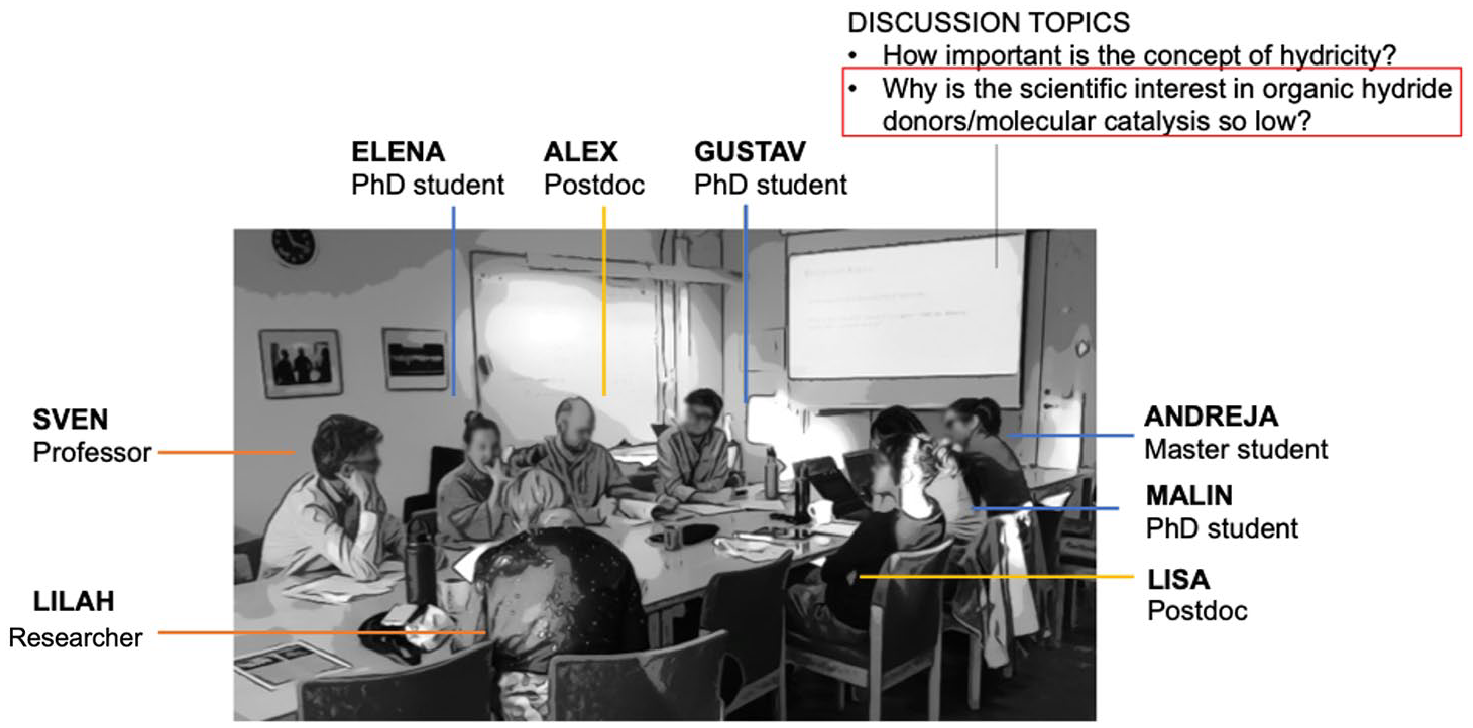
Participants and discussion topics of Extract 1.
Immediately before Extract 1, the discussion has concerned organics as poor catalysts. At this point, Sven takes the turn to pose a question. The information request (lines 1, 3–7) is framed by an epistemic disclaimer (line 2).
200124; 11.19:00-11.19:16
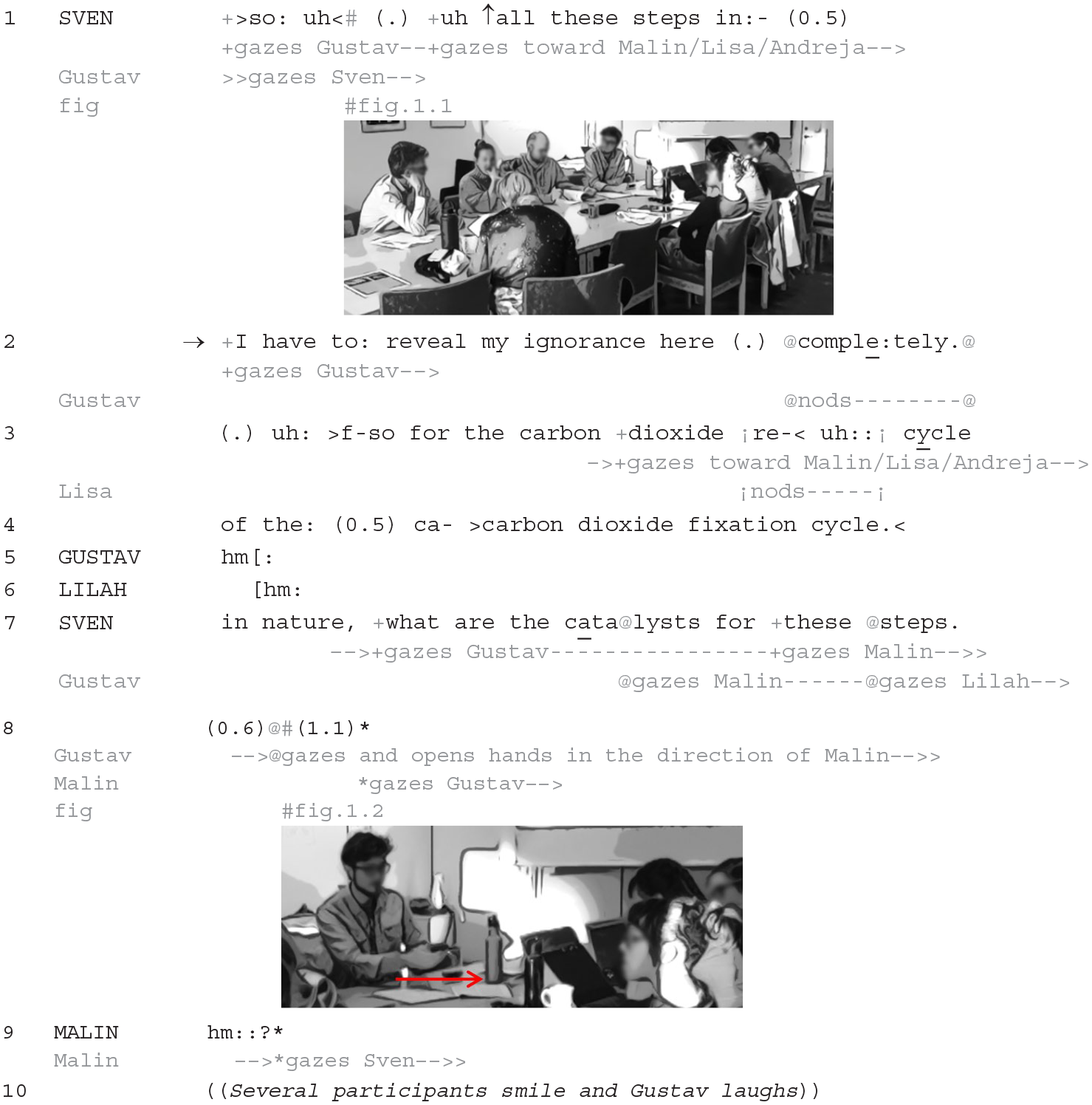
As visible in Figure 1.1, Sven takes the turn while gazing at Gustav, who mutually gazes at him, and initiates an utterance: ‘all these steps in:-’ (line 1) as he shifts gaze direction to Malin, Lisa and Andreja on the opposite side of the table. Abandoning the turn under construction and gazing again at Gustav who posed the original question, Sven inserts the epistemic disclaimer ‘I have to: reveal my ignorance here (.) compl
In the production of and immediate response to the question, the participants use gaze in ways that show an orientation toward who may be eligible and accountable for answering the question. During the contextualizing part of the turn Sven’s gaze moves toward Malin, Lisa and Andreja (lines 3–4, 7), to again look at Gustav during the crucial moment of formulating the question ‘what are the c
Interestingly, and nuancing Kärkkäinen’s (2012) finding that stanced digressions produced by speakers in the midst of an extended turn generally do not receive a response (see also Weatherall, 2011), the disclaimer designed using an extreme case formulation (Pomerantz, 1986), that Sven is ‘completely ignorant’ about the matter at hand, does not go by unnoticed. Gustav, who Sven was gazing at during the production of the epistemic disclaimer, in a state of mutual gaze nods in response (line 2). Additionally, while the transcription of Sven’s turn in Extract 1 has privileged his gaze and the mutual gaze established with co-participants who showed some sort of acknowledgement of his talk, an alternative transcription presented below annotates the embodied and non-verbal actions of Lilah and Elena, who in a brief parallel interaction, not evidently oriented to by Sven, notice the extreme case disclaimer. As Edwards (2000) noted, an extreme statement risks easy refutation by a single exception, and may be treated as an index of the speaker’s attitude or subjectivity rather than as a straightforward description of factual circumstances. Although not verbally challenging the disclaimer, Lilah and Elena in this schism (Egbert, 1997), establish mutual gaze and display certain ‘amusement’ with Sven’s knowledge disclaimer.
200124; 11.19:02–11.19:11
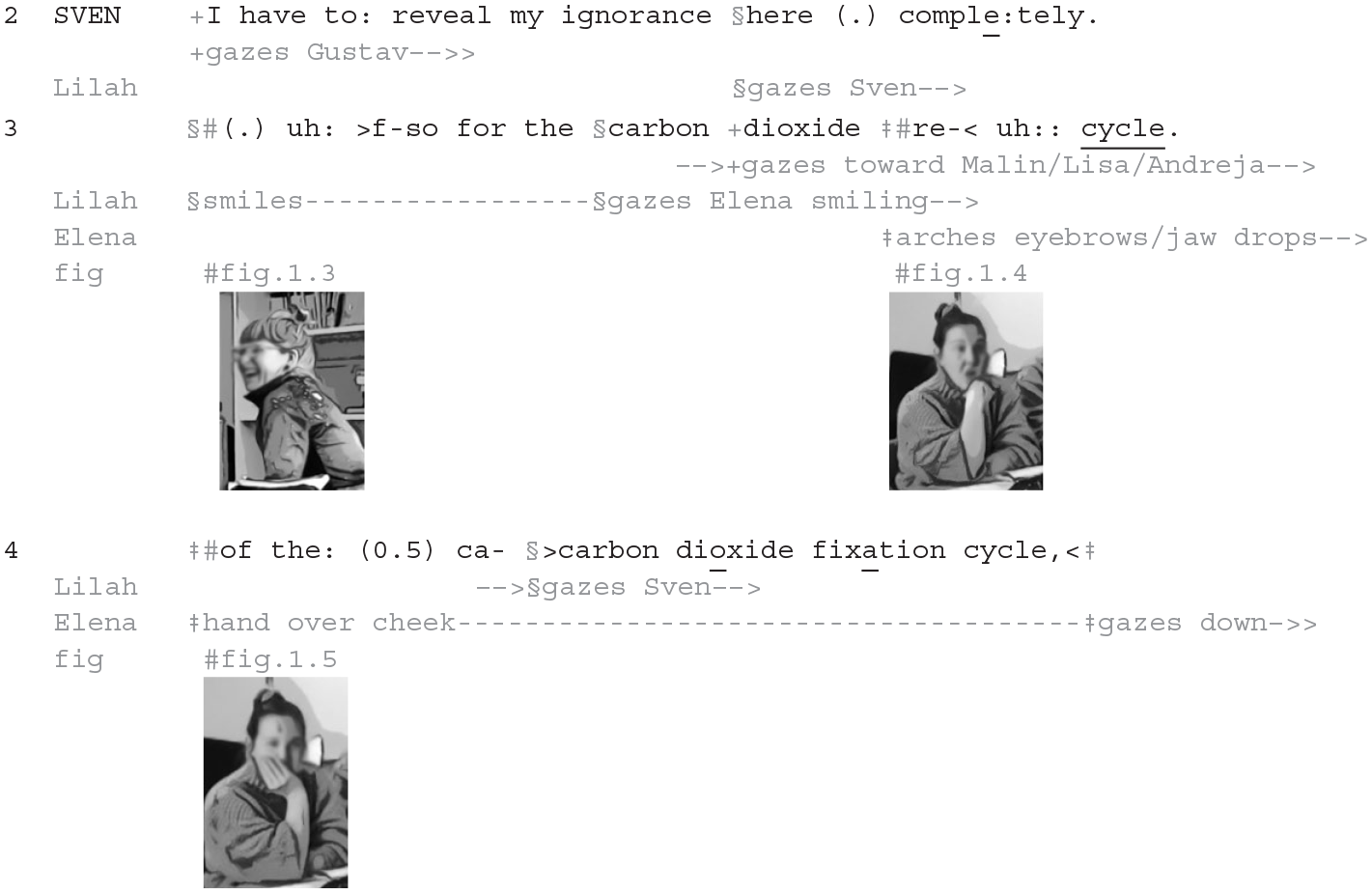
During Sven’s production of the epistemic disclaimer, Lilah starts smiling with an open mouth (Figure 1.3), turning her head and gaze in the direction of Elena. In response, Elena in a swift movement arches her eyebrows and drops her jaw as if in astonishment (Figure 1.4), to then return to a neutral face with her chin resting on her hand (Figure 1.5). This brief exchange of embodied actions and facial expressions, displays an affective stance oriented toward the extreme disclaimer itself (cf. Edwards, 2000) but likely also to the fact that it is the most senior researcher in the group who makes this disclaimer. The affective stances highlight the participants’ responses to the senior researcher’s actions as constituting a breach of expectations, however without further consequences for the unfolding organization of actions as Lilah moves on to produce a response that Sven subsequently orients to: ‘Rubisco’ (line 17), an enzyme involved in the first major step of carbon fixation.
200124; 11.19.18–11.19.29
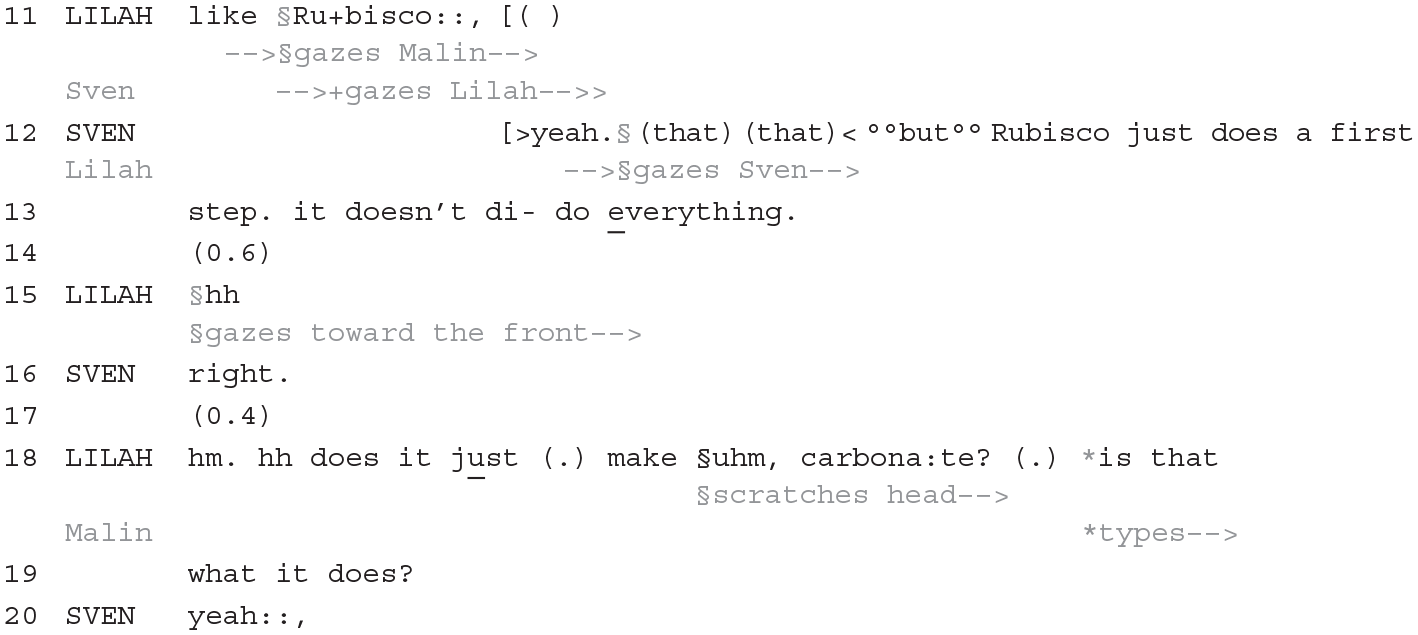
Responding to Lilah’s suggestion, Sven disregards ‘Rubisco’ as a full answer: ‘but Rubisco just does a first part. it doesn’t do everything’ (lines 14–15). Even though delivered as a disagreement, marked by the disjunction ‘but’, Sven’s response embeds an evaluation of Lilah’s candidate answer as correct but insufficient. Lilah remains silent, and Sven adds a confirmation request, ‘right’ (line 18). Lilah seems to agree with Sven’s disagreement, as she now seeks his confirmation: ‘does it just (.) make uhm, carbonate? (.) is that what it does?’ (lines 20–21). At this point Malin starts typing, and as becomes evident later, googles the topic (not shown here), to then contribute to the discussion. Lilah’s response in line 11 evidences that Sven’s question elicited participation. The evaluative way Sven engages with Lilah’s response upgrades his previously expressed epistemic stance of being ‘completely ignorant’ to having some knowledge, thereby also displaying that he was oriented to a group exploration of the scientific matter in question (cf. Philipps and Paruschke, 2024).
This analysis has revealed how the employment of an epistemic disclaimer works to prospectively manage co-participants’ expectations about the questioner’s epistemic status and expertise. Through its turn-initial position, the disclaimer primarily operates on the speaker’s epistemic status thereby framing the question as authentic (cf. van der Meij et al., 2022). Accompanied by a changing gaze direction, it also works to position the co-participants as potentially more knowledgeable, although indirectly. We will next explore the consequences of a more direct ascription of knowledge to the co-participants, followed by a disclaim of knowledge on the senior researcher’s part.
Disclaiming knowledge to account for a question
We proceed to show how an epistemic disclaimer may work as an account for why a question is being asked in ways that underline its authenticity. The extract is drawn from an online meeting when postdoc Lisa presented a summary of a paper. In the beginning of Extract 2, she opens the group discussion by asking a question about one of the schemes presented in the paper (see Figure 2).
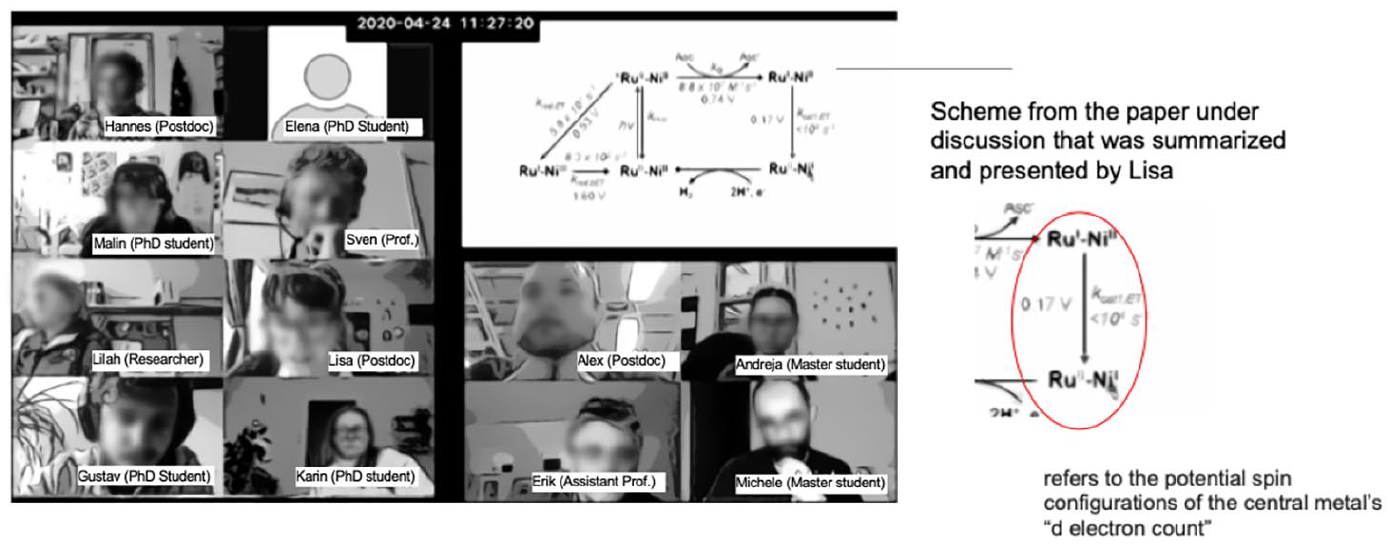
Extract 2 Zoom meeting view, participants, and topic of discussion.
As Lisa formulates her query in line 1, she points with the mouse cursor to one part of the scheme claiming that there is ‘something with the reorganization energy here’ and, subsequently, points to another part of the scheme, drawing a conclusion ‘that makes this step very slow’ (line 2). She explicitly acknowledges her uncertainty about this understanding of the scheme and the processes represented in it: ‘but I’m not sure if this is the case’ (line 4).
200424; 11.27:30–11.28:09
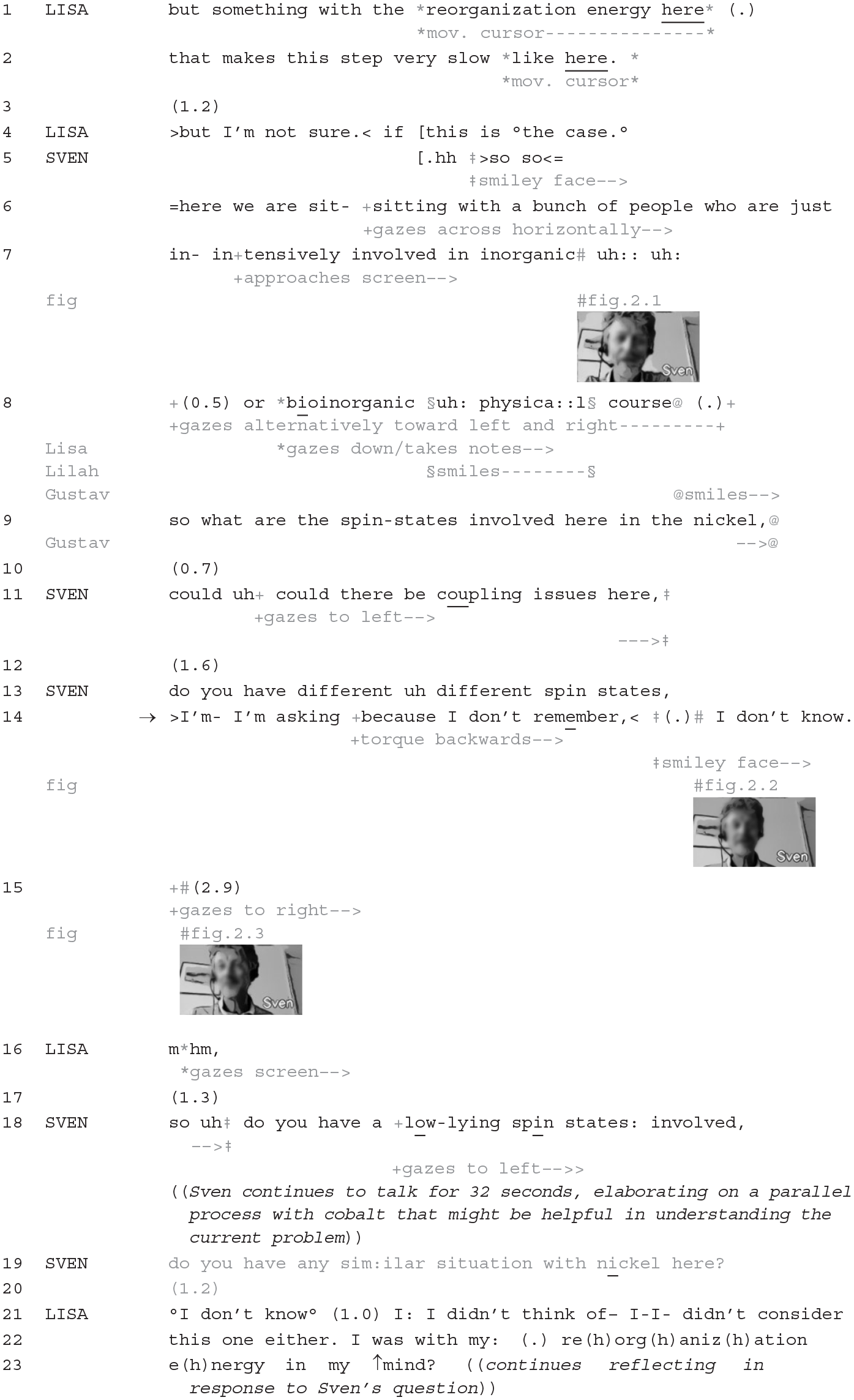
In response to Lisa’s formulation of a candidate understanding, Sven, in his role as chair, takes the turn and smilingly (Figure 2.1) addresses a designated part of the group (‘a bunch of people’), describing them as just now being ‘intensely involved’ in a bioinorganic physical course (lines 5–8), which is the subject dedicated to the study of the kind of phenomena relevant for this discussion (geometry and reactivity of transition metal complexes). Thereby, he makes relevant the researchers’ varying expertise concerning a specified knowledge domain (cf. Harms et al., 2021) and treats the members of the group as having certain rights but also responsibilities to know more than him or others in the meeting about this topic (Stivers et al., 2011). The accountability invoked by this address might be what Lilah and Gustav orient to as they smile in response (line 8), Lilah in fact being one of the teachers, who will later on (beyond this extract) look through the course material and engage in the discussion. Sven moves on to produce three questions directed to his co-participants that raise the possibility of a different reason for what they are seeing in the scheme (coupling issues) than what Lisa proposed (reorganization energy): (1) ‘so what are the spin-states involved here in the nickel’ (line 9); (2) ‘could uh could there be coupling issues here’ (line 11); and (3) ‘do you have different uh different spin states’ (line 13). The reformulation from the first to the third question, from a wh-question to a polar question (about the spin-states), indexes a higher epistemic stance while requesting ‘less’ from co-participants.
Immediately following this set of questions, in turn-final position and in separate turn-constructional units, Sven produces the epistemic disclaimers: ‘I’m asking because I don’t remember’ and ‘I don’t know’ (line 14), gradually downgrading his epistemic status. On one hand, it is possible to observe how, as described by Goodwin (1987), claiming forgetfulness may be used to encourage another speaker to participate in the conversation. The claim of not remembering simultaneously presents the speaker as K+ and K−, in that the state of not knowing may be only temporal and in fact recruited for rhetorical reasons rather than as an accurate representation of a cognitive state. On the other hand, it is interesting that Sven moves on to produce a stronger claim of actually not knowing, the turn-final disclaimers in the context of prepositioned questions retroactively accounting for his actions, by recasting the information request as an authentic request, rather than a known-answer question. Consequently, and in line with what van der Meij et al. (2022) found in their study of classroom interaction, by downgrading his epistemic stance, the eliciting function of the questions is amplified. The disclaimers are thereby related to the local management of epistemic status and authority (cf. Clifton, 2019), and to the accountability of asking and answering questions, as well as the expectations that are linked to the researchers’ different knowledge domains.
Besides a minimal acknowledgement token produced by Lisa (line 18), there are no contributions forthcoming from the research group. For reasons of limited space, it is not possible to demonstrate the full development of the sequence but after a fourth reformulation of the question (line 18) Sven starts what will turn out to be a long turn, where he during 32 seconds explains the reasoning behind his question about spin states with reference to another chemical element, cobalt. Thereby he shows that he does not know enough about the particular process concerning nickel at the same time as he models a way of reasoning around scientific matters. Lisa is the first to respond (lines 21–23) by stating that she has not considered the spin states but had reorganization energy in her mind. Beyond the extract she however continues to reflect on what Sven has said, whereupon Sven answers with new questions and other researchers start engaging in the discussion. In other words, similar to what occurred in Extract 1, the questions posed by the senior researcher function to elicit group explorations, although the matters talked about are highly complex and it thereby may take some time before contributions are forthcoming.
In Extract 2, the epistemic disclaimer occurs in the aftermath of a first-pair part and is used to account for a question as authentic. The fact that the disclaimer is preceded by an explicit reference to a particular part of the group, ascribing them status as experts on the matter at hand (cf. Nissi and Lehtinen, 2016), in combination with the knowledge disclaimer, establishes a steep epistemic gradient between this designated group and Sven (cf. Harms et al., 2021). This displays the senior researcher’s orientation to that the group should contribute to the discussion and share knowledge with each other.
Disclaiming knowledge to downgrade a previous knowledge claim
In our last Extract 3, the epistemic disclaimer is preceded by a claim of knowledge produced by one of the research group’s senior researchers and group leader, Lilah. Sven is not present at this meeting (see Figure 3). Prior to Extract 3, Lilah has called the group’s attention to some data presented in the paper under discussion, which prompted Gustav to observe that a lot of dimer (a type of compound) would be produced. In response, Lilah initiates a story about a visit to the authors’ lab at the time of the reported experiments.
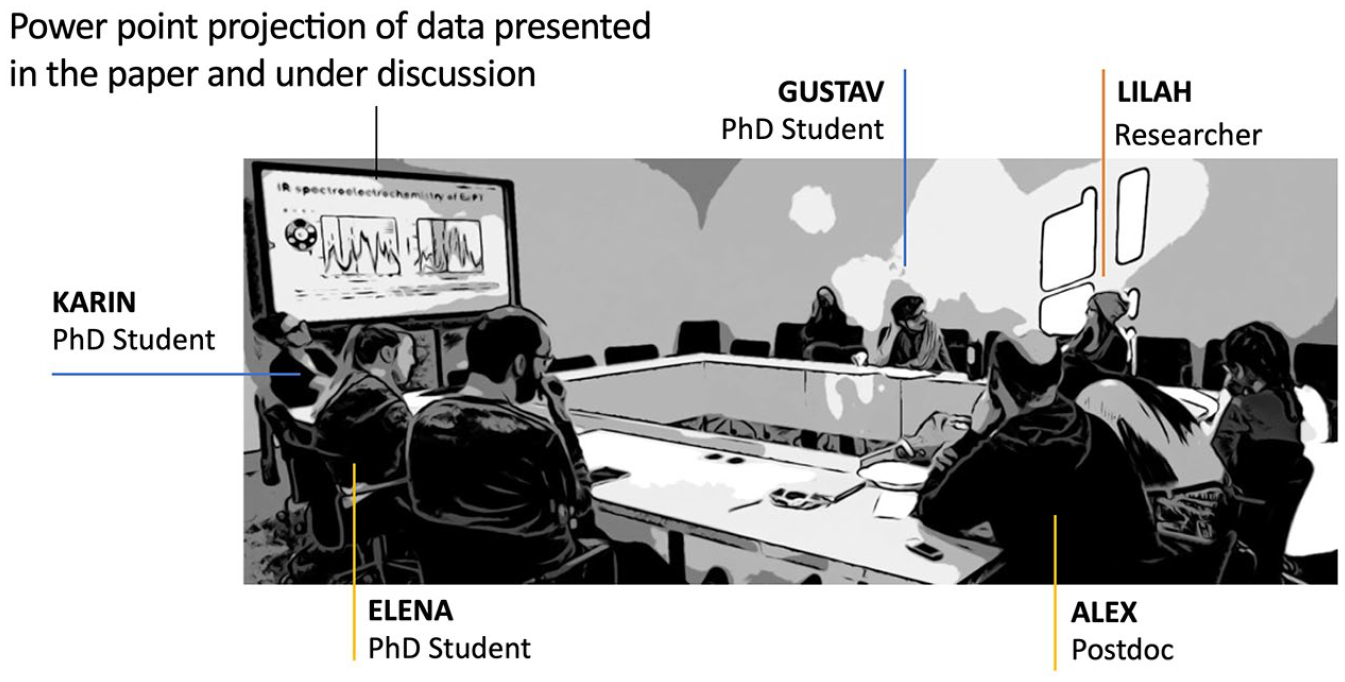
Participants in Extract 3.
200214; 14.34:40–14.35:38
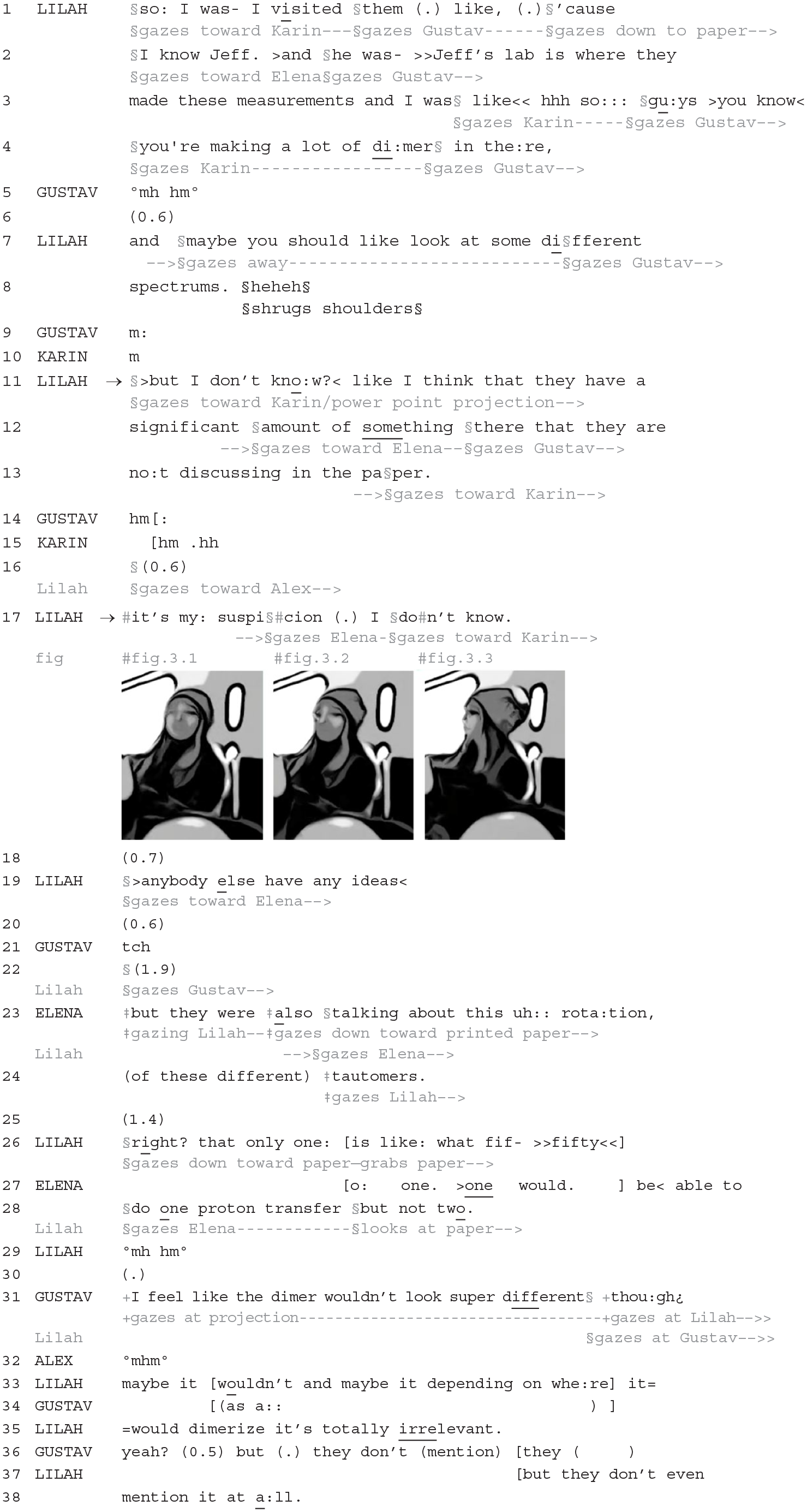
The disclaimers produced by Lilah in Extract 3 are mobilized against the backdrop of a story (lines 1-8) in which the experienced researcher claims first-hand ‘behind-the-scenes’ knowledge about the research reported in the paper, thereby asserting epistemic primacy (Stivers et al., 2011). In contrast to Extracts 1 and 2, the referred knowledge domain does not concern a subject area. Instead, the senior researcher claims expertise through reporting having assessed the experiment in negative terms (lines 3–4) and given advise about how the researchers should proceed (lines 7–8). The disclaimer ‘>but I don’t know?<’ (line 11) resembles the prepositioned disclaimers described by Weatherall (2011), where one of the sequential contexts in which I don’t know occurs is as preliminary to an assessment, for example to a hedged, downgraded complaint. In this case, what follows the disclaimer is a nuanced critique (lines 11–13) that shifts the focus away from the specific mention of ‘dimer’ and instead highlights that ‘something’ is not being discussed in the paper. The critique is framed by use of an epistemic mitigation ‘like I think that . . .’ (Kärkkäinen, 2003), which alerts the recipients that the upcoming utterances are formulated from a subject position rather than presented as objective facts. The critique is even further downplayed as Lilah produces yet another disclaimer, ‘it’s my: suspicion (.) I don’t know’ (line 17), gazing at different participants around the table (Figures 3.1–3.3). In other words, the epistemic disclaimers seem oriented to downgrade the speaker’s epistemic authority indexed by the story. Different from what happened in Extract 1, the experienced researcher is here not merely claiming lack of knowledge, but mobilizes the disclaimers at a crucial point of turn-transition as the storytelling sequence has reached its completion. The orientation toward encouraging participation is further evidenced by the reference to the relevance of contributions to the discussion ‘>anybody else have any ideas<’ (line 19) which explicitly invites participation. The utterance ascribes some knowledge to the group, although in a mitigated way. In comparison to Extract 2, where the senior researcher addressed a part of the group by referring to a knowledge domain in which their expertise was expected, the referrals to ‘anybody’ and ‘any ideas’ establish a discussion framework with less accountability.
In fact, after a moment of silence, Elena initiates disagreement with the basis for the critique by pointing out that the authors mention information that could explain the issue at hand (lines 23–24). Lilah examines the paper again, reading a certain extract related to the aspect pointed out by Elena, who complements her argumentation in lines 27-28. At this point, Gustav objects that ‘I feel like the dimer wouldn’t look super different though’ (line 31). Lilah agrees and as Gustav retakes a critical stance toward the paper by adding: ‘but (.) they don’t (mention)’, Lilah, in overlap, aligns with a recycled and upgraded maximum case formulation ‘they don’t even mention at
In Extract 3, the employment of disclaimers, as well as the downplaying of the critique, operate on a claim of epistemic access and authority that has emerged sequentially through a demonstration of knowledge. The disclaimers are mobilized as part of the interactional work of re-opening the floor while positioning co-participants as knowledgeable to agree or disagree with a critique and to come up with their own ideas about what is potentially problematic in the presentation of the data in the paper.
Discussion
This study has explored the interactional work of senior researchers to engage members of their research group in discussions about published papers. More specifically, we have examined the use of prepositioned epistemic disclaimers and their role in the management of knowledge domains and expertise in the context of research group meetings. In their ethnographic study of lab meetings, Philipps and Paruschke (2024) found that research group meetings, as they provided environments for researchers to talk through scientific matters, were constitutive of doing science. The micro-level perspective taken in this study, sheds light on some of the ways in which such an environment is accomplished interactionally.
Previous studies on epistemic disclaimers in first-pair parts (Kärkkäinen, 2003; Weatherall, 2011) have documented their employments in the production of assessments and approximations, showing that they are used by speakers to display that they are not fully committed to what follows in their turn at talk. In our data, the disclaimers similarly provide an interpretation frame (Kärkkäinen, 2012) for the following talk, prospectively framing (Extract 1) and retrospectively accounting for (Extract 2) an information request as well as downgrading an epistemic stance that has been sequentially built (Extract 3). We found that depending on the position of the epistemic disclaimer within the turn, it operates in different ways on the speaker’s epistemic status and authority. A prepositioned turn-initial disclaim of knowledge, as in Extract 1, rather straightforwardly framed the upcoming question as authentic and thus primarily oriented to the speaker’s epistemic status. When occurring later in the turn, the local epistemic environment in which the disclaimers occurred was crucial. When preceded by an explicit ascription of knowledge, as in Extract 2, the disclaim of knowledge established a steep epistemic gradient between the senior researcher and the group members that operated on the latter’s accountability to know more than the speaker. When preceded by a demonstration of knowledge, as in Extract 3, the epistemic disclaimer instead worked to downgrade the speaker’s locally built expertise.
We suggest that these initiating turns with epistemic disclaimers are oriented to elicit contributions from co-participants, a finding similar to van der Meij et al.’s (2022) observation about the interactional work of epistemic disclaimers in teacher turns. The senior researchers’ gaze behaviors further corroborate this analysis, as they, most clearly visible in the in-person meetings, move their gaze across the members of the group during the production of their questions, thereby monitoring their availability to make a contribution (cf. Fasel Lauzon and Berger, 2015). In addition, the co-participants’ responses to the senior researchers’ questions display their understanding of them as oriented to eliciting their participation. Expanding on Weatherall’s (2011) conclusion that prepositioned disclaimers primarily work on speakers’ own turns and actions, we thus find that the disclaimers in their sequential contexts also operate on the co-participants’ knowledge domains in ways that, in the context of scientific discussions, make relevant the sharing of knowledge and peer collaboration.
The disclaimers moreover act on the epistemic rights and responsibilities connected to the senior researchers’ institutional identities and epistemic authority (cf. Mondada, 2013). The affective stances with smiling and facial expressions display that the senior researchers’ knowledge disclaims, in particular when produced by the most senior researcher (Extracts 1 and 2) and designed using an extreme case formulation (Extract 1), seem to somewhat clash with expectations linked to the institutional identity of the senior researcher. In his study of leadership in workplaces, Clifton (2019) found that leaders may use epistemic downgrades to downplay their authority to engender positive working relationships. Similarly, the experienced researchers’ interactional work of managing epistemic authority and institutional identities by use of epistemic disclaimers, serves the accomplishment of the research group meetings as a space for peer collaboration. However, in the research group meetings this is not simply a question of establishing a positive work environment but of significant scientific relevance as the researchers locate knowledge gaps as part of their research work, where the discussions about scientific matters are crucial for producing new knowledge as well as new scientists (cf. Jacoby and Gonzales, 1991; Philipps and Paruschke, 2024).
Research groups constitute dynamic epistemic ecologies (Goodwin, 2013; Jacoby and Gonzalez, 1991), that are characterized by high levels of specialization and hierarchies at the same time as its participants work in common projects and toward shared goals. The use of epistemic disclaimers reveals how the senior researchers emphasize divergent domains of knowledge in ways that counteract expectations about their expert identity in the group while more or less explicitly opening up for other’s knowledge and expertise on the matter at hand. In their study of shift-handovers between resident physicians, Harms et al. (2021) show how expertise is made relevant as a domain of epistemics through the co-participant’s orientations to similar professional knowledge and reasoning skills as opposed to knowledge about a specific patient. In a different way, our study shows how expertise, within the domain of professional knowledge, is oriented to by making relevant the co-present participants’ separable ‘domains of expertise’ as well as modeling ways of conducting reasoning around scientific matters, within the framework of the research group as a locus for engaging with and producing the know-how within the team, intrinsic to the production of scientific knowledge (cf. Philipps and Paruschke, 2024). The members of the research group could thus be said to work to distinguish different kinds of expertise (e.g., organic materials) within a shared realm of expertise (i.e., Physical Chemistry). In all, the study sheds light on the complex epistemic ecology of research groups and evidence how the accomplishment of peer collaboration and knowledge distribution in scientific work involves the management and negotiation of rights and responsibilities with respect to knowledge and scientific expertise.
Footnotes
Appendix
Declaration of conflicting interests
The author(s) declared no potential conflicts of interest with respect to the research, authorship, and/or publication of this article.
Funding
The author(s) received no financial support for the research, authorship, and/or publication of this article.