



Abstract
This paper presents an analysis of how the particular categories of children and youth are used within the instructional work of learning to drive. Using Membership Categorisation Analysis (MCA) and multimodal Conversation Analysis (CA) of a collection of cases drawn from 85 video-recorded driving lessons, we demonstrate how the participants treat children and youth as a category of traffic users whose main category predicate appears to be their expected unpredictability and carelessness, placing particularly high demands on drivers’ awareness and caution. This is evident in in-event and post-event interactions about traffic encounters with children and youth, as well as in traffic contexts where they have not (yet) been spotted but their sudden appearance is anticipated. The results suggest that the institutional constructions of children and youth as a potential source of trouble prepare trainee drivers for unforeseen events and contingencies and shape their social stock of knowledge as future motorists.
Keywords
Introduction
Becoming a competent car driver involves more than learning to successfully master the car controls and obey traffic rules. It also entails socialisation into ‘the social life on the road’ (Broth et al., 2019: 8) where traffic participants interpret each other’s behaviour and use it to decide on their next move. In our corpus of video-recorded driving lessons, we found a notable orientation by the in-car participants to children and youth in traffic as requiring particular caution. This is in line with both lay conceptions (e.g. Murray, 2009) and research evidence (e.g. Ampofo-Boateng et al., 1993; Renard et al., 2022) identifying children as a particularly vulnerable group of traffic users who lack the relevant cognitive and perceptual skills to safely take part in traffic. This paper shows that trainee drivers and instructors routinely characterise children and youth as a distinct category of traffic participants expected to potentially engage in unpredictable behaviour and hence requiring particular attention from the trainee driver. Analysing the multimodally organised interaction between the trainee driver and the instructor, we find that talk about children and youth is geared to promoting the trainee driver’s risk awareness. Showing that their categorisation practices draw on, and contribute to, common-sense notions of children and youth as a distinct threat to traffic safety, we argue that the teaching and training of drivers’ risk awareness involves, among other things, learning to systematically apply cultural knowledge to particular traffic situations and to act responsively, in ways that minimise risk of collision and person injury.
Learning to drive – and becoming a driver
In one of his early lectures Sacks (1992/1966) discussed members’ cultural measurement systems describing ‘traffic’ as a self-organising social system: . . .persons can be seen to clump their cars into something that is ‘a traffic,’ pretty much wherever, whenever, whoever it is that’s driving. That exists as a social fact, a thing which drivers do. . . (Vol., 1, 437).
One of the key points of this lecture is that drivers recognise the behaviour of road users (including themselves) by reference to such a members’ understanding of traffic, that thereby forms an instance of social order. In effect, noticing that someone drives ‘slowly’ or ‘recklessly’ involves matching the speed or headway of a vehicle with that of the surrounding traffic and/or road infrastructure, rather than looking at the speedometer or consulting the traffic code. The consequence of this is that becoming a driver essentially entails more than merely the mastery of the car controls or even the ability to manoeuvre the vehicle on different types of roads, intersections or parking spaces, while adhering to the traffic rules. It also entails learning to use a social stock of knowledge (Schutz and Luckmann, 1973), by which one can identify and categorise other road users according to their behaviour in a given traffic situation. Becoming a competent member-driver thus means to learn to see the road with suspicion predicting other road users’ next actions (cf. Sacks, 1972), and to gain access to and act on some of the taken-for-granted assumptions, or background expectations (Garfinkel, 1967), that motorists overwhelmingly share.
In the limited but rapidly growing literature on social interaction and driver training, several studies have examined the impact of mobility – the fact that the traffic landscape is constantly unfolding – on the instructional work taking place in the driving school car. For instance, focusing on the training of systematic use of the mirrors (known as the ‘mirror routine’), Björklund (2018) compared stationary briefings, where the normatively patterned practices of looking were being explicated in detail for the purposes of upcoming manoeuvres, with the subsequent in-traffic training of the routine. Björklund’s analysis demonstrates how the instructor’s work involves monitoring the student’s use of the mirrors as well as tightly coordinating the delivery of instructions with the emerging traffic situation and the student’s ongoing as well as projected car control actions. On a different tack, Deppermann (2018) focuses on two syntactic forms of driving instructions – declaratives and imperatives – showing how their differential use indexes the urgency of the student’s performing the instructed action. Similarly, De Stefani (2018) examined the spatio-temporal ordering of navigational instructions, showing also how their design revealed the instructors’ orientation to the students’ current level of competence. Finally, the importance of driving instructions being graspable for the students is further highlighted in a study by Rauniomaa et al. (2018) who observed that instructions of complex manoeuvres are often parsed, that is, chunked up into constituent sub-actions and spelled out as the parties make way ‘through relevant points in time and space’ (p. 49).
Other studies have turned to the explicit teaching of the background expectations relevant to the traffic situations being encountered during driving lessons. Notably, in a study of corrections in different mobile settings, Levin et al. (2017) show how driving instructors use correction sequences to unpack the logic underlying the troublesome driving move(s) – thereby explicating the practical reasoning that fully-fledged member-drivers would draw upon to make the correct decision(s) in similar situations. This type of explication of ‘a drivers’ mindset’ forms a common component of driver training. For instance, when practicing the use of the indicators, instructors routinely stress the accountability of their own vehicle, pointing out that other road users must be able to anticipate the imminent actions of the driving school car by ‘reading the intentions’ of the trainee driver (Broth et al., 2018). In a follow-up study on the accountability of driving actions, Broth et al. (2019) observed how instructors routinely use mental state ascriptions to explain how other road users are interpreting the trainee driver’s conduct. Clearly, formulations of ‘the other’s side’ – such as ‘he didn’t think that you would do this’ or ‘the lorry wants to overtake you’ – serve to explicate the members’ procedural knowledge operating in the situation on hand, thereby more broadly socialising the trainee driver into ‘the social life of the road’ (Broth et al., 2019: 8).
This type of situated reasoning draws on the social stock of knowledge – shared in varying degrees by drivers and other road users – that provides for a description of traffic as a self-organising system (Sacks, 1992/1966), as well as makes it possible to teach and learn how to become a member-driver. The present article targets a vital segment of that knowledge: risk awareness and readiness for the unexpected. Our analysis focuses on the trainee drivers’ and instructors’ particular orientation to children and youth, explicating how relevant categorial features are operationalised in traffic for the purpose of raising trainee drivers’ risk awareness.
Data and method
The data set comprises a total of 85 video recorded driving lessons with four different trainee drivers in an urban area in Sweden. 1 Recordings were made using three GoPro cameras and a sound recorder placed inside driving school cars. Rough transcripts of these lessons (i.e. time codes with verbal conduct and descriptions of traffic situations) were already available prior to this particular study. Seeking to understand exactly how the categories of children and youth are used for promoting risk awareness in driving instruction, these transcripts were initially searched for Swedish child-related words such as barn (child/children), ung (young), pappa (dad), mamma (mom), skola (school) and lekplats (playground). The search was later expanded with words such as akta (watch out) and springa (run); words that were used by the in-car participants while referring to children and youth participating in traffic in the instances found (see Appendix 2 for the complete list of search entries). In total, the search resulted in a collection of 14 instances of in-car participants verbally orienting to children or youth while driving.
The rough transcripts of the instances were transformed into detailed multimodal transcripts following conventions as formulated by Jefferson (1986) and Mondada (2018: see Appendix 1). Subsequently, the instances were analysed using Membership Categorisation Analysis (MCA) and multimodal Conversation Analysis (CA) – two distinct analytical approaches with a common origin in Harvey Sacks’ (1992/1965) early work on conversation.
By means of CA, researchers aim to inductively uncover the interactional organisation of events by taking an emic perspective, that is, studying how participants treat and orient to each other’s verbal, vocal and bodily conduct as well as their mobility and sensoriality. All these different aspects, not least the last two, are vital in analysing driving instruction lessons as these interactions are highly multimodal in character. Of course, in-car participants talk to each other, point to things and gaze in various directions, but they also move through traffic in a mobile vehicle and can sense the trainee driver’s (and instructor’s) actions with their bodies (e.g. braking, speeding up or changing gears). Repeatedly watching video-recordings and transcribing multimodal conduct in meticulous detail enables us to discern the exact sequential and simultaneous ordering of events. This facilitates the possibility to notice, for instance, the trainee driver’s slowing down of the car as a response to the instructor’s warning for an upcoming situation requiring caution.
Membership Categorisation Analysis, in turn, was developed as a domain of inquiry into the intricate but structured ways in which members draw on cultural knowledge to make sense of the world around them (Fitzgerald and Housley, 2015; Jayyusi, 1984; Sacks, 1992/1964; Stokoe, 2012). Membership categories are ways of classifying persons into types along some common property or properties: ‘Male’, ‘Trucker’ or ‘Driving instructor’ for instance, are all categorial descriptions of a segment of the population. Membership categories are further organisable into collections – that, together with rules for their application, form Membership Category Devices (MCDs) – such that ‘Gender’ is a device for ‘Male’ (but not the other two categories), ‘Driving school’ is a device for ‘Driving instructor’ (but not the others) while both ‘Occupation’ and ‘Road users’ can be valid devices for ‘Trucker’ and ‘Driving instructor’ alike (but not for ‘Male’). Because, in principle, any given category may belong to different devices, membership categorisation and the inferential work that it engenders are strictly bound to the interactional context.
The use of a category invokes, as potentially relevant, certain dispositional features – Category Predicates – such as traits, tastes or other tendencies routinely ascribed to its incumbents (e.g. moustache for ‘Male’, while handlebar or horseshoe moustache specifically may be more applicable to ‘Trucker’). It may also invoke certain practices, activities or types of action known as Category Bound Activities (CBAs, e.g. ‘being on the road’ for ‘Trucker’ and ‘Driving instructor’). Sacks (1992/1964) described membership categories as ‘inference rich’ in the sense that ‘a great deal of the knowledge that members of a society have about the society is stored in terms of these categories’ (p. 40), which explains the conventionalised associations of category predicates and CBAs to membership categories. Since the turn of the millennium, we have witnessed an increasing research interest in how membership categories are used, spanning across diverse domains of interaction such as police interrogations (Stokoe, 2010), court hearings (Licoppe, 2015), youth counselling helplines (Cromdal et al., 2018), conflict mediation (Stokoe, 2015), sitcom shows (Okazawa, 2022) and school playgrounds (Butler, 2008).
Importantly, the operation of a membership category does not require its explicit mention. Ascriptions about membership can sometimes be delicate and may be designedly accomplished by avoiding to go on record with a category (Austin and Fitzgerald, 2007; Stokoe, 2003). Instead, relevant categories may be inferred from the presence of (typically clusters of) category predicates or activities. Moreover, relevant membership categories may be generated from other discursive actions such as formulations of setting or place. For example, ‘zebra crossing’ makes relevant an activity (crossing the street, cf. Sacks, 1992; Smith, 2020) as well as a category of pedestrian road users (not zebras), while ‘school crossing’ generates the relevance of a specific class of pedestrians – children – but also other categories such as school crossing guards or supervisors. It must be stressed that description, categorisation and membership ascription are all situated accomplishments. While the operation of membership categories turns on taken-for-granted cultural knowledge, participants mobilise this knowledge in situ, that is, in each and every local situation (Hester and Eglin, 1997).
In sum, as a tool for analysis of social interaction Membership Categorisation Analysis (MCA) ‘uncovers a vast complexity of members’ methods, procedures and devices for producing and making sense of the social world, as well as of various specific features of that world in specific settings’ (Jayyusi, 1984: 59). Our focus in this article is on risk awareness – an integral part of driver training – examining specifically how children are categorised as road users in multimodally organised interaction prompted by emergent traffic constellations. Drawing on current work in MCA in tandem with multimodal CA allows us to explicate how relevant features of context are invoked to assemble specific driver-relevant understandings of risk in urban traffic, thereby socialising driver students into a member-driver’s mindset.
Analysis
As mentioned in the previous section, searching through the rough transcripts of the data resulted in a collection of 14 instances in which the in-car participants verbally orient to children and youth in traffic (we will henceforth use the terms children and children and youth interchangeably). The instances comprise both ‘in-event’ and ‘post-event’ talk (cf. Broth et al., 2019) about children. In other words, the in-car participants verbally oriented to children’s presence in traffic (for example at a zebra crossing) both during encounters with children in the traffic situation at hand (in-event) and after such encounters (post-event). Although most instances were found at these two structural loci, we also found some cases in a third type of situation, more hypothetical in nature. In these instances, children are not (visibly) present in the traffic situation but are nonetheless oriented to by the in-car participants and hence made relevant as a group of possibly present traffic participants to be aware of there and then. In this section all three types of situations will be discussed and described by means of representative examples from the collection. The analyses will demonstrate how membership categorisation may be mobilised as a powerful discursive resource for instructing and displaying risk awareness in driver training.
In-Event Orientation to Children
The instances in which trainee driver and instructor orient to children who are present in an upcoming traffic situation typically include either a warning by the instructor or an expression of caution or uncertainty by the trainee driver. In the former cases on which we will focus first, the instructor warns the trainee driver about the presence of children by drawing on a range of multimodal resources including directing the trainee’s attention to them both verbally and by pointing. In both cases, the instructor assembles category-based extreme-case formulations and formulates, or otherwise makes inferable, category-bound activities.
Extract 1 is a case in point. At the start of this extract, the in-car participants are driving on a main road with several zebra crossings ahead. When a group of pedestrians in the distance approach one of these zebra crossings from the right, the instructor issues a warning.
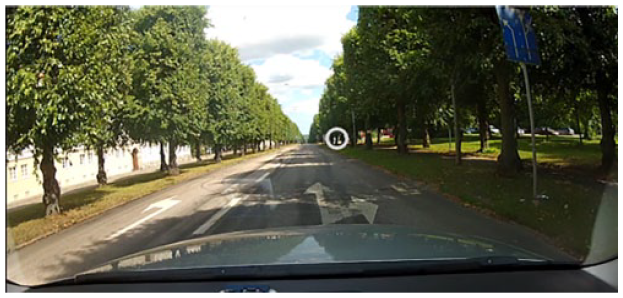
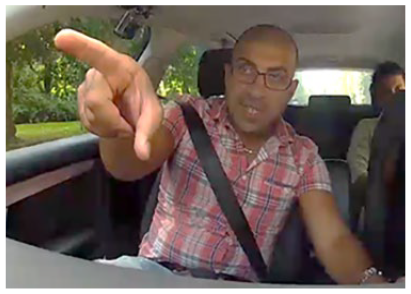
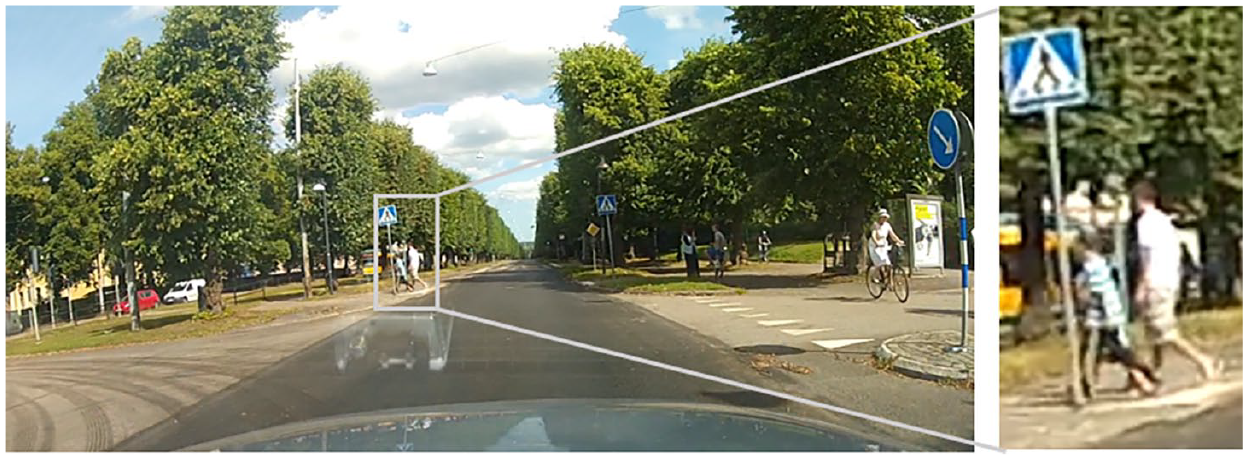 Figure 3a Figure 3b
As several pedestrians walking towards the zebra crossing can be discerned through the line of trees in the distance (see circle in Figure 1), the instructor alerts the trainee driver to the upcoming situation. He announces the children’s presence, points to them (see Figure 2) and checks verbally whether the trainee driver sees them (line 1). While the trainee driver confirms with ‘m’ (l. 2) and a nod (l. 3), the instructor produces an increment to his turn (‘at the zebra crossing’) while retracting his pointing hand. When the trainee driver then slows down, the instructor responds with a positive evaluation (‘yeah that’s right’, line 3), confirming that this is indeed the driving action he expected the student to take. In line 4, the group crosses the street (Figures 3a and b), and the trainee driver accelerates briefly after they have reached the curb.
The extract shows how the instructor alerts the trainee driver to an upcoming situation in which a heightened readiness to act is particularly relevant. He does so by categorising the pedestrian formation as children, disregarding the fact that one of the pedestrians is significantly taller, and presumably older and more responsible, than the others. Furthermore, he emphasises the children’s relevance by exaggerating their number with the extreme-case formulation en massa (loads of), and by mentioning their location – approaching a zebra crossing, that is, an area where the activity of crossing the road is to be expected. The relevant inferences of the instructor’s category work – that a whole lot of children will soon be in front of the driving school car – work as a heads up for caution to be taken. We may note that while the instructor’s warning turns on the streamlined categorisation of children and the exaggerated formulation of group size, the actual reason for caution remains unspecified. The instructor’s positive evaluation (l. 3) receipts the trainee driver’s correct hearing of the warning, as evidenced in her responding choice of driving action.
While the instructor’s warning in Extract 1 only implies the hazards of children’s proximity to the road, in Extract 2 the presence of a child near the curb is explicated in terms of a category-bound inclination towards unpredictable behaviour.
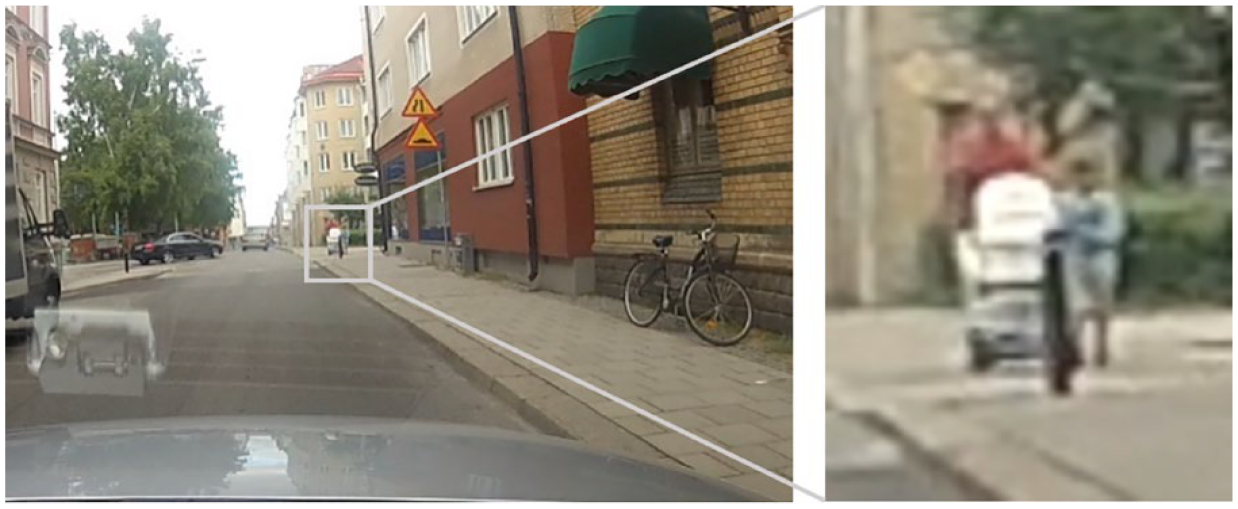 Figure 4a Figure 4b
 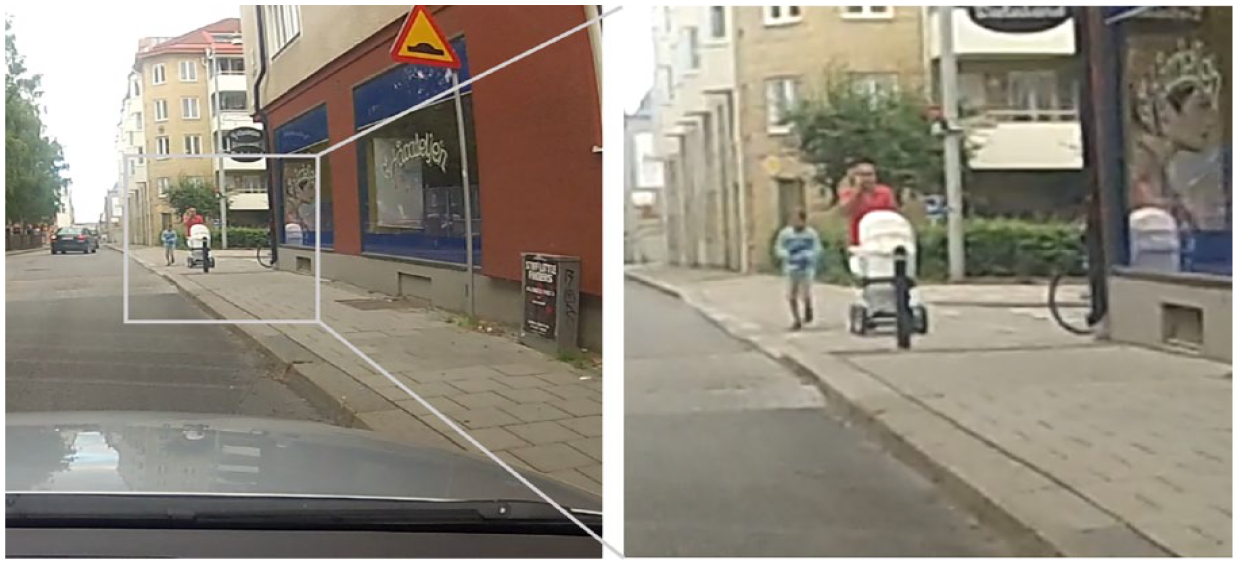 Figure 5a Figure 5b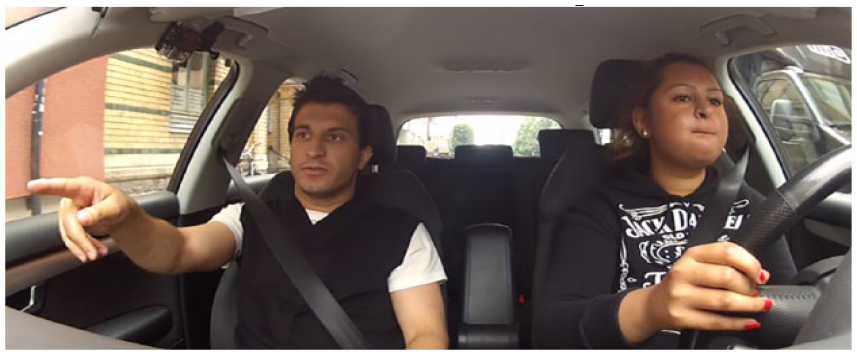
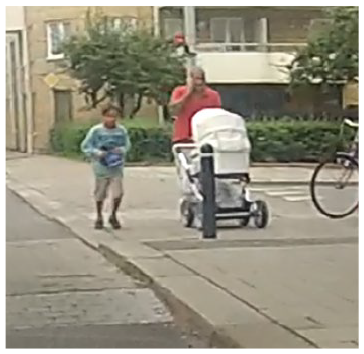 Figure 6 Figure 7
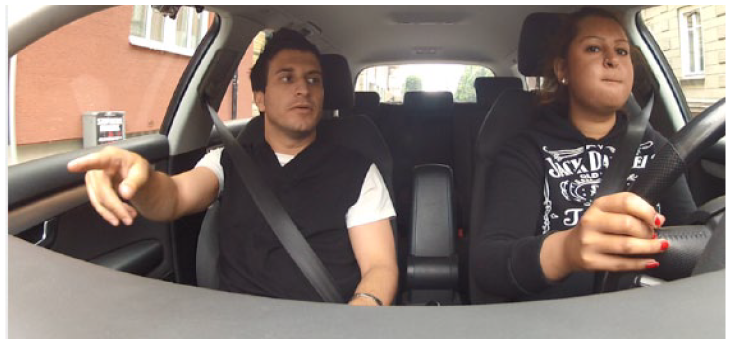 Figure 8
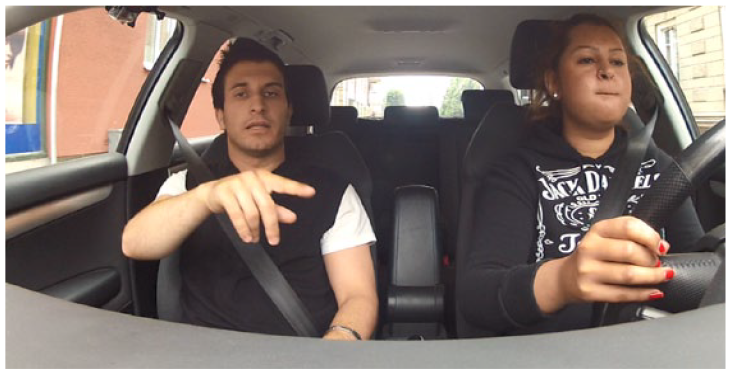 Figure 9
In this extract, the in-car participants are approaching a boy and an adult with a pram walking on the pavement. At the beginning of this extract the boy moves from the adult’s left to his right, closer to the street and, hence, the car (see Figures 4a and b and 5a and b). The instructor draws the trainee driver’s attention to the upcoming situation by producing the imperative kolla här (look over here) while simultaneously preparing a pointing gesture clarifying the deictic expression ‘here’ (l. 3-5). The instructor then starts another turn-constructional unit (vi vill-, ‘we want’), but breaks it off and produces a second, more elaborate alert to the trainee driver consisting of the imperative kolla (look), a description of the event specifying the child’s behaviour (han springer, ‘he is running’) and a request for confirmation (se ru den, ‘do you see him’, l. 5), while pointing to the running child (Figures 6 and 7). Notably, the break off in the progression of the instructor’s turn reflects the abrupt change in the child’s behaviour – from walking along on the left side of the adult, to suddenly running and rounding the adult on the curb side.
In line 7, the trainee driver confirms with a minimal ‘hm’ that she is watching the boy and she gazes at him simultaneously. The instructor then gazes at the trainee driver, checking that she is monitoring the boy’s movement on the sidewalk (Figure 8), while formulating an upshot deduced from the child’s impulsive behaviour, namely that he may at any time enter the road in front of them: ‘one never knows if he will cross’ (l. 8). Note that while the kinetographic gesture (Ekman and Friesen, 1969) – pointing from the right to the left side of the street (l. 8, Figures 8 and 9) – and the deictic third person pronoun (han, he) orient to the particular child on the sidewalk ahead of the car, the otherwise generic pronominal construction (e.g. Gruber, 2011) in the initial clause (‘one never knows’) rather promotes a hearing of the instructor’s turn as a generalised driver problem, as something to bear in mind in similar situations.
This extract constitutes a second example of an instructor directing the trainee driver’s attention to a child (again ignoring the adult) and demonstrating a detailed attentiveness to the qualities of the child. In this case, the instructor focuses on his ‘running’ which in itself implies unpredictability. In so doing the instructor stresses the need to anticipate a sudden, possibly critical, change of the traffic situation. This time, the hazard is spelled out – the child leaving his category-relevant space and running onto the road (cf. Smith, 2017) – and linked to the child’s observably impulsive, and therefore unpredictable, behaviour. As much driver training is dedicated to learning how to act predictably (Broth et al., 2019) and how to project other road users’ imminent actions (Broth et al., 2018), unpredictable, behaviour is ineludibly a form of traffic hazard. While the category ‘child’ remains unstated, the pedestrian in question is observably a young child and is indeed treated as such by the instructor describing his behaviour (impulsively running). The instructor is building a lesson by producing his warning as generalisable to a similar class of traffic encounters.
Together our first two extracts show how instructors employ a variety of resources as they draw their trainee drivers’ attention to children in an upcoming traffic situation, thereby making relevant a state of heightened caution and attentiveness to the situation at hand on the part of the driver. However, noticing and acting on children being close to traffic is not unique to the instructors. In the next example, it is the trainee driver who demonstrates taking caution – verbally and through his driving – upon having spotted children at an upcoming crossing. Extract 3 shows the driving school car slowly advancing into a three-way crossing. While the trainee driver is instructed to continue straight, a child and an adult pushing a pram are approaching from the right.
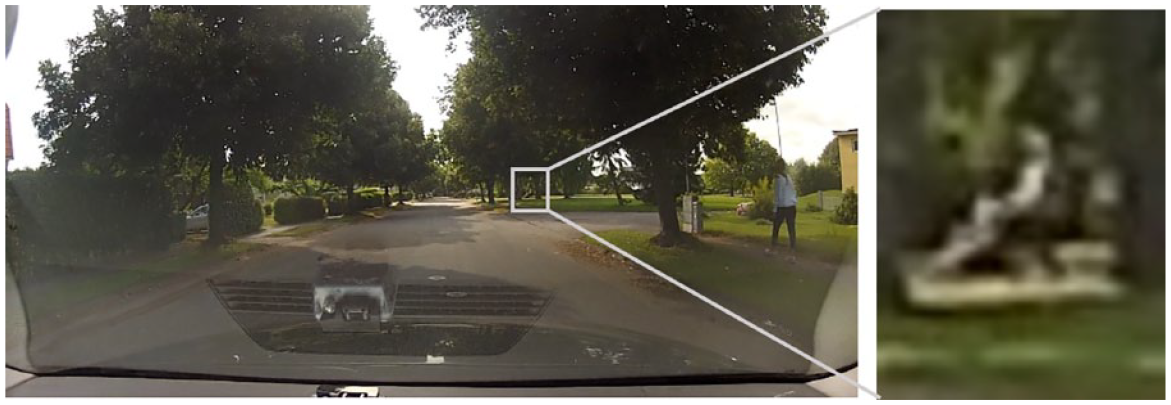 Figure 10a Figure 10b
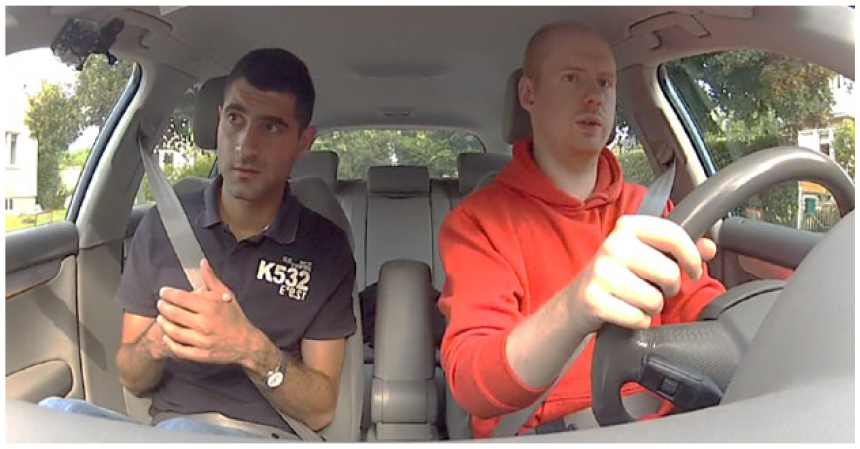 Figure 11
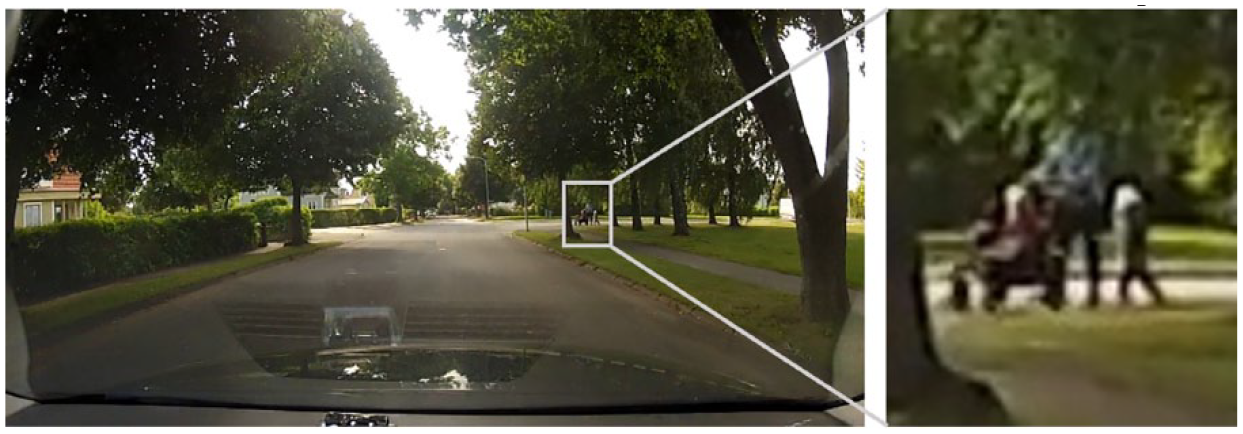 Figure 12a Figure 12b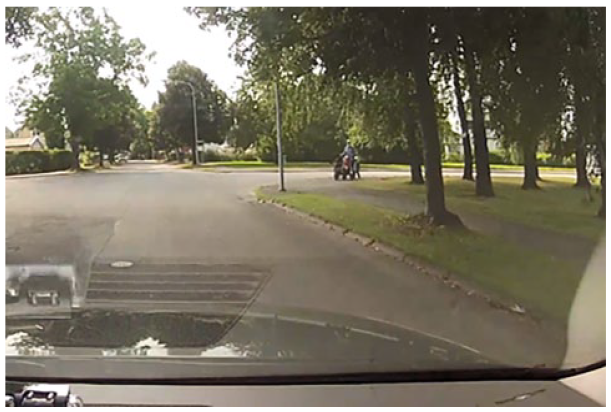
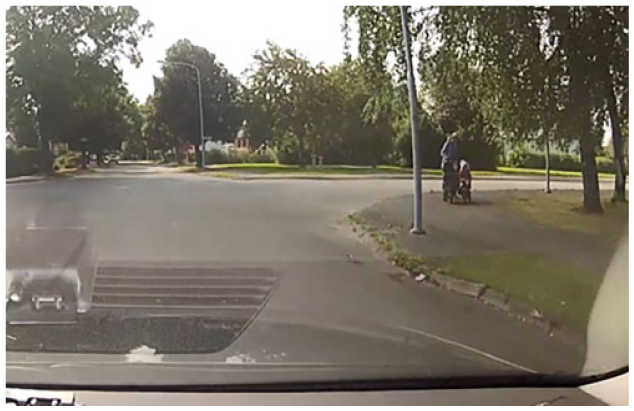 Figure 13 Figure 14
After the navigational instruction (De Stefani and Gazin, 2014) and a pause during which the pedestrian formation is visibly moving towards the crossing (l. 1-2, Figures 10a and b), the trainee driver hesitates, verbalising his plan of action (‘I wait for that one with the children, or’) and begins to slow down (l. 3). His utterance both accounts for his slowing down and simultaneously requests confirmation by means of the problem projecting tag ‘or’ (Lindström, 1999). After some consideration, the instructor – now also looking at the pedestrians (Figure 11) – disagrees and proposes to continue calmly, treating the trainee driver’s assessment of the situation as too cautious, as the pedestrians are not (yet) visibly about to cross the street (see Figures 12a and b). Indeed, in line 6 then, the pedestrian formation turns left and continues along the pavement, providing the instructor with proof for his reading of the situation (see Figures 13 and 14).
While this extract shows an orientation to children as initiated by the trainee driver, their presence is treated with a similar degree of caution as in Extracts 1 and 2. The trainee driver slows down, manifesting his intention to let the pedestrians pass, while soliciting the instructor’s advice. The reference to the pedestrians as ‘that one with the children’ highlights the presence of children as the one relevant feature of the pedestrian formation. Although the instructor recommends proceeding, he instructs the trainee driver to use caution by ‘continuing a bit calmly’ (l. 5). In this way, both in-car participants demonstrably orient to the relative proximity of the children as grounds for increased vigilance and for displaying consideration with the other road users.
The extracts in this section have shown that, while approaching a traffic situation that involves the presence of children who may enter the road, instructors and trainee drivers alike treat it as a default reason for caution. They do so by mainly or exclusively orienting to the children, rather than the mobile formation (McIlvenny et al., 2014) they appear to be a part of, and establishing an awareness of the need to drive more cautiously, that is more attentively and slower, when encountering this type of traffic participant. In this way, they establish a members’ way of viewing traffic, a particular form of scenic intelligibility (Jayyusi, 1993). Trainee drivers’ accountable use of such interpretive practices are routinely encouraged by their instructors, but at the same time, their reading of the scene is treated as provisional, leaving room for further refinement.
Post-event orientation to children
Apart from instances in which instructor and trainee driver orient to children while approaching them in traffic, our collection also includes instances in which the in-car participants address a situation with children that they have just passed. In these post-event cases, it is either the instructor who critically assesses the trainee driver’s behaviour, or it is the trainee drivers themselves who express uncertainty about or difficulty with the encounter. Extract 4 demonstrates an example of the instructor commenting on the trainee driver’s recent performance as they were passing two buses at a bus stop with children and young passengers disembarking and walking onto the street from behind and between the two buses (see Figure 15).
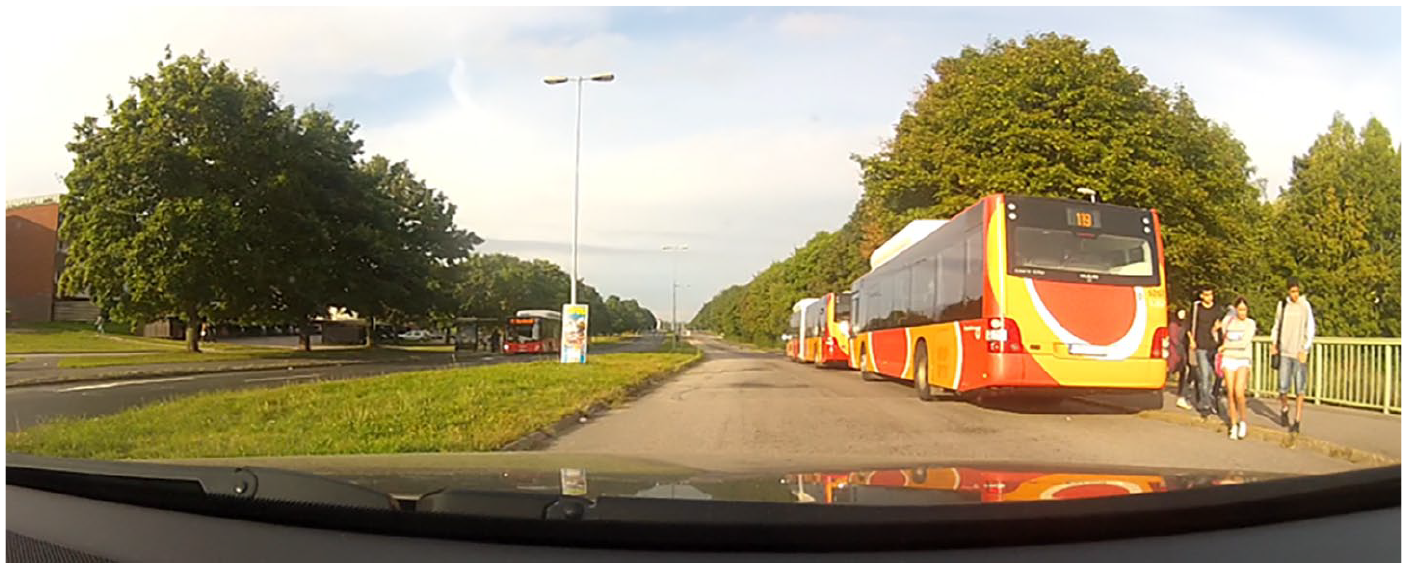
Two buses with young people disembarking (15s prior to Extract 4).
Fifteen seconds after passing the bus stop (as in Figure 15), the instructor clears his throat and initiates a critical reflection exchange topicalising the accountable lack of risk awareness on the part of the trainee driver that is evident in his driving (l. 1-7). Verbalising the accountability of driving in a ‘how-you-drive-tells-me-how-you-think’ construction, the instructor spells out in so many words the commonly invisible, taken-for-granted process of predication that is the attribution of intention (Jayyusi, 1984; see also Broth et al., 2019, on mental state ascription in driver training).
Accounting for his actions, the trainee driver invokes the traffic regulations to claim that he did have the right of way, as the buses were not indicating to leave the bus stop (l. 8-10), thereby treating the instructor’s ‘them’ (dom, line 6) as referring to the buses. The instructor confirms this claim, but then broadens the relevant attentional focus from the buses to their passengers, asking if the trainee driver had noticed ‘how many youths’ were on the bus (l. 11-14). The ‘oh’-carried realisation claim (Heritage, 1984: 322) in line 15 shows that the trainee driver understands the question as implying that there were in fact many youths, rather than as an actual question making relevant an answer consisting of a number or other type of quantification. Furthermore, this response may indicate that he understands the categorial implications of ‘many youths’ being on – and disembarking (cf. Figure 15) – the bus, with ‘many’ characterising the situation as even more unpredictable, as there are multiple traffic participants to keep an eye on. The trainee driver’s claim of understanding (Koole, 2010), however, is not straightforwardly accepted by the instructor who pursues more evidence of the trainee driver’s inferential work, asking how youth ‘usually behave’ around bus stops (l. 16). In this way, the student’s driving occasions what is essentially a lesson in traffic awareness.
The instructor’s question contains a generalisation (‘how do they usually behave’) and thereby solicits an answer that can be heard as a category-bound activity (CBA); a habitual practice, following on disembarking a bus, of incumbents of the membership category ‘youth’. In replying, the trainee driver produces a CBA-formulation ‘they usually just walk straight out’, thereby demonstrating his familiarity with this particular situation around buses at bus stops. The instructor confirms the CBA and carries through the instructional exchange by stressing the need for risk awareness (l. 20) and recommending caution (l. 23) and alertness to any potential pedestrians entering the road (l. 25), as routine ways of managing this type of traffic situations. Similar to the previous extracts with younger children being oriented to as careless and potentially running onto the street without paying attention to traffic, this exchange draws on a cultural understanding of young persons as unreliable, careless and potentially ignorant participants in traffic – in this instance as particularly prone to carelessly walking out in the street. Reflecting on the lack of caution in situations that demand increased vigilance, such post-event exchanges introduce trainee drivers into a drivers’ mindset – a thoroughly pedagogical undertaking which involves membership category work to explicate the taken-for-granted knowledge and practical reasoning of member-drivers.
Anticipatory Orientation to Children
In line with the characteristics of impulsive behaviour routinely ascribed to children in proximity to traffic (as seen particularly in Extracts 2 and 4), the data set also contains instances in which the presence of children has not been established, but is nonetheless being entertained as a risk, as something that trainee drivers need to anticipate and look out for. A consistent feature of these instances is the instructors’ use of the category bound activity ‘running out onto the street’ when introducing the prospect of a locally relevant hazard. In three out of four such cases, the instructor warns about the possible presence of children by posing a category implicative known-information question, that is a question the instructor knows the answer to (KIQ, Mehan, 1979). Consider Extract 5, in which the in-car participants drive into a street where a lorry, parked on the right, is being (un)loaded.
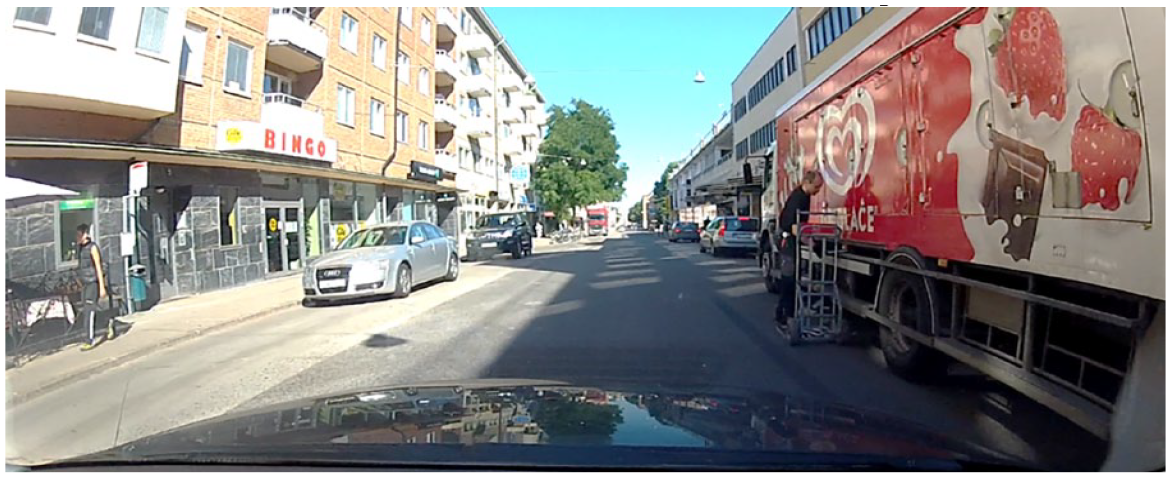 Figure 16
When the trainee driver moves to change into second gear, the instructor advises him to keep going in first gear (l. 2-3). As the trainee shifts back to first gear, the instructor produces an increment accounting for the correction by referring to the man standing in the street, next to the lorry (l. 5, Figure 16). Thus, the current traffic situation is construed as requiring caution.
After the trainee driver’s receipt (l. 7), the instructor adds a KIQ: ‘and plus, what can run out in front of the lorry’. The question anticipates an additional reason for caution: as they are passing by the lorry, something that may be hidden from view – in this case by the lorry – may suddenly enter the street in front of the car. The ‘what’-fronted question projects a category-type of answer, rather than a specific actor, and the suggested activity in the remainder of the question is hearable as bound to incumbents of that category. With a rising pitch demonstrating an orientation to the question as a KIQ (cf. Sacks and Schegloff, 1979: on trymarking), the trainee driver supplies the projected category ‘children’ (l. 10) which is readily confirmed by the instructor as the category of road users that was being alluded to (‘just de’, l. 12).
In this example, the trainee driver is not only instructed to respond to the contingencies present (i.e. changing back to first gear while entering a street where a man is (un)loading a lorry), but also to be on the lookout for any additional contingencies hidden from view. Note that the differential categorisations impute different levels of risk and traffic awareness to the two actors: while the behaviour of the observed working man is described as ‘standing and working’, which implies staying close to the lorry and out of the way of the oncoming vehicles, the presumed action of the undetected generic child is described in contrary terms – it may well end up in front of the hood running. In other words, despite the caution to be taken in relation to the man’s presence in the street, his actions are construed as reasonably predictable, whereas the child’s actions are not.
In Extract 6, another trainee driver has just turned into a narrow street with cars tightly parked on both sides. This specific traffic infrastructure raises the issue of the trainee driver’s risk awareness and vigilance.
Reminding the trainee driver that the street is rather narrow, the instructor alerts him to a need for careful steering. Just as in our previous case, he then poses a KIQ (l. 3, ‘so what can run out from between the cars’) that clearly projects as its relevant answer the category to which the stated category-bound activity applies. Beginning the turn with ‘so’, ties the question to their current circumstances – the narrow street with cars tightly parked on both sides. The question-answer sequence is disrupted as the instructor (again) corrects the trainee driver’s steering (l. 4-5), and the KIQ is repeated in line 7.
This time, the trainee driver answers with ‘children and such’ (l. 9) which implicates a membership categorisation device (MCD) consisting of a collection of unreliable road users, not easily detected between parked cars and inclined towards carelessly running out onto the street, of which children comprise the only named such category. The instructor affirms the answer and moves to instruct the trainee driver how to manage driving on narrow city roads: very slowly and in first gear. In contrast to Extracts 1-4 where children were evidently present at the scene, the last two examples demonstrate that the ‘blind spots’ which the participants encounter along the road – spaces precluded from sight – sensitise them to situations of reduced visibility with the potential of children and other unpredictable traffic participants suddenly ‘running out’ into traffic, requiring them to proceed with extra caution.
Concluding discussion
Our analysis has shown how the particular categories of children and youth are used within the instructional activities of learning to drive. The categories are associated with certain traits and behaviours such that their use makes relevant a need for increased attention while moving along in traffic. This is particularly the case in situations where children and youth can be sighted close to the road, but also in locations where the presence of children can reasonably be expected while the relevant field of vision is partly obscured. In these latter circumstances, also children who have not (yet) been observed are taken into account, and their routinely careless and unpredictable behaviour – should they come into view – is anticipated. Arguably, this group constitutes an even greater risk than children who can be continuously monitored, because their presence may be discovered suddenly at any time, making it difficult to react in time or plan ahead for emergency actions.
As we have shown, driving instructors as well as trainee drivers draw upon a range of discursive resources – including extreme case formulations, category predicates, category-bound activities and the exclusion or defocusing of accompanying adults present at the scene – along with bodily resources such as pointing and slowing down to invoke categorial descriptions of children and youth when talking about principles of risk awareness in traffic. The resulting image of children and youth is that of expectedly unpredictable road users, who will unthinkingly run or walk out onto the street without paying attention to the oncoming traffic.
Though children’s insufficient skills for safely participating in traffic have been extensively documented (e.g. Ampofo-Boateng et al., 1993; Barton and Morrongiello, 2011; Renard et al., 2022) the focus of our analysis has been on the situated practice of driving instructors and their students by which this insufficiency is predicated of the child. As Speier (1973: 148) pointed out, ‘seeing human beings as ‘children’ is not just recognising biological or physical properties, although to be sure they have those distinctively. It is the cultural recognition of children’s practices’. It seems an important insight from the observed categorisation work, how cultural notions of children as not fully competent participants in society’s business are inflected for the purposes of instructing trainee drivers about vigilance and caution.
The analysis contributes practice-based knowledge to the developing area of risk studies (e.g. Boholm and Corvellec, 2011), and in particular to the relationship between risk and trust as articulated by Watson (2022) and Watson (2009). In ethnomethodological terms, trust is a condition for socially intelligible action (Garfinkel, 1967), and by extention for the possibility of social order. In short, just as game players rely on mutual knowledge of, and a principal willingness to adhere to, a set of rules, trust is the members’ mutual reliance on the moral foundations of the natural attitude that entails reciprocity of methods for sense-making and interchangeability of perspectives (Schutz, 1973). Indeed, the notion of traffic as a self-organising social system turns on trust: road users assume that their fellow participants in traffic – were they to change places – would see and act on the current circumstances in the same way as they themselves are currently doing. Their actions are observable, recognisable and more or less projectable. Children’s actions, by contrast, are mostly not. As we learn from our data, within the driver’s mindset, children’s behaviour in (or close to) the road cannot be easily projected and so the lessons that are being taught entail a distrustful attitude towards their participation in traffic. Notably, the categorisations – in particular the verbalisations of children’s dispositions and category bound activities – formulate or gloss (Garfinkel and Sacks, 1970) the risk present in the unfolding situation but, crucially, do so to allow generalisation to future situations that hold a family resemblance to the current one.
By way of conclusion, we have shown that regardless of their observed behaviour, children in our data were routinely and unremarkably attributed with being impulsive, ignorant of present risk and generally unreliable participants in traffic who are likely to leave their category-relevant space (Smith, 2017) without considering other traffic participants – adding a significant layer of risk to traffic situations. Indeed, this was also the case for locations where no children were sighted, but their presence anticipated. These were not necessarily category-relevant locations such as schools and playgrounds (as targeted by our search through the data), but also locations where general driving caution was called for, and where, in addition, critical spots were obscured from vision. Learning to identify these spots as requiring a raised awareness is formative of a driver’s mindset, as is learning to apply the default distrustful orientation towards children as participants in traffic. The routinely rehearsed ascription of children’s habitual, category-bound carelessness and unpredictability in traffic is an important requisite of that socialisation process.
Footnotes
Appendix 1 – Transcription conventions
Talk was transcribed following the conventions developed by Gail Jefferson (1986). For multimodal conduct, we followed the conventions developed by Lorenza Mondada (2018) given below:
Acknowledgements
We thank Lena Levin and Daniel Björklund-Flärd for partaking in collecting the data, and our colleagues at PAN (Section for Pedagogic Practices at Linköping University) for commenting on an early version of this paper. We would also like to thank the anonymous reviewers for their thorough reading of the manuscript and their excellent comments and suggestions for improvement. We would also like to thank the anonymous reviewers for their thorough reading of the manuscript and their excellent comments and suggestions for improvement.
Declaration of conflicting interests
The author(s) declared no potential conflicts of interest with respect to the research, authorship, and/or publication of this article.
Funding
This research was funded by the Swedish Research Council (VR, grant numbers 2019-04910 and 721-2012-5367).